

Successful behavior change in obesity interventions in adults: a systematic review of self-regulation mediators
Open accessThe DOI matches its Crossref record; 125 of the 125 references it cites were found in a registry or an index; 7 of the 46 sources its claims cite were checked for support.
Abstract
BACKGROUND: Relapse is high in lifestyle obesity interventions involving behavior and weight change. Identifying mediators of successful outcomes in these interventions is critical to improve effectiveness and to guide approaches to obesity treatment, including resource allocation. This article reviews the most consistent self-regulation mediators of medium- and long-term weight control, physical activity, and dietary intake in clinical and community behavior change interventions targeting overweight/obese adults. METHODS: A comprehensive search of peer-reviewed articles, published since 2000, was conducted on electronic databases (for example, MEDLINE) and journal reference lists. Experimental studies were eligible if they reported intervention effects on hypothesized mediators (self-regulatory and psychological mechanisms) and the association between these and the outcomes of interest (weight change, physical activity, and dietary intake). Quality and content of selected studies were analyzed and findings summarized. Studies with formal mediation analyses were reported separately. RESULTS: Thirty-five studies were included testing 42 putative mediators. Ten studies used formal mediation analyses. Twenty-eight studies were randomized controlled trials, mainly aiming at weight loss or maintenance (n = 21). Targeted participants were obese (n = 26) or overweight individuals, aged between 25 to 44 years (n = 23), and 13 studies targeted women only. In terms of study quality, 13 trials were rated as "strong", 15 as "moderate", and 7 studies as "weak". In addition, methodological quality of formal mediation analyses was "medium". Identified mediators for medium-/long-term weight control were higher levels of autonomous motivation, self-efficacy/barriers, self-regulation skills (such as self-monitoring), flexible eating restraint, and positive body image. For physical activity, significant putative mediators were high autonomous motivation, self-efficacy, and use of self-regulation skills. For dietary intake, the evidence was much less clear, and no consistent mediators were identified. CONCLUSIONS: This is the first systematic review of mediational psychological mechanisms of successful outcomes in obesity-related lifestyle change interventions. Despite limited evidence, higher autonomous motivation, self-efficacy, and self-regulation skills emerged as the best predictors of beneficial weight and physical activity outcomes; for weight control, positive body image and flexible eating restraint may additionally improve outcomes. These variables represent possible targets for future lifestyle interventions in overweight/obese populations.
Overview
CoChat Summary
TL;DR
This systematic review of 35 lifestyle intervention studies found that autonomous motivation, self-efficacy, and self-regulation skills are the most consistent self-regulation mediators of weight control and physical activity in overweight/obese adults. For long-term weight control, positive body image and flexible eating restraint may also matter, while dietary intake had no consistent mediators.
Key findings
- Across 35 studies testing 42 putative mediators, 10 used formal mediation analyses; 28 were randomized controlled trials, mainly targeting weight loss or maintenance (n = 21). Study quality was rated strong for 13 trials, moderate for 15, and weak for 7; all 10 formal mediation analyses were rated medium quality.
- For medium/long-term weight control (≥12 months), formal mediation supported body image (significant in 100% of 3 tests), self-regulation skills (75% of 3 formal tests; 83% of 6 overall tests), and self-efficacy/barriers (67% of 3 formal tests; 68% of 28 overall tests). Autonomous motivation and flexible eating restraint were promising but derived from a single study each.
- For long-term physical activity, the main predictors were autonomous motivation (83% of formal mediation tests; 93% of overall tests) and self-efficacy (67% of formal tests; 75% of overall tests). Self-regulation skill use was less consistent and derived from low-quality studies.
- For dietary intake, no consistent mediators were identified. In the short term, self-efficacy/barriers and self-regulation skill use were each consistent with mediation in 75% of tests, but long-term self-efficacy was consistent with mediation in only 2 of 8 tests.
Methods
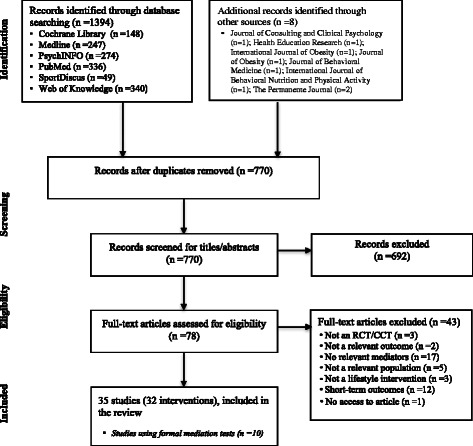
- Systematic review conducted per PRISMA. Six electronic databases were searched for peer-reviewed articles published January 2000–February 2014, plus manual cross-referencing; 1,394 records plus 8 manual additions yielded 1,404 potential articles, 770 abstracts screened, and 35 articles describing 32 unique lifestyle interventions included.
- Eligible studies were experimental lifestyle interventions in overweight/obese adults (≥18 years), reporting outcomes at least 6 months after intervention start and quantitative assessments of self-regulation mediators and weight/BMI, physical activity, or dietary intake. Results were separated into short-term (<12 months) and long-term (≥12 months) outcomes, and formal mediation studies were reported separately from predictor studies.
- Quality was assessed with an adapted Effective Public Health Practice Project tool and a mediation-specific checklist. Heterogeneity prevented meta-analysis, so findings were synthesized narratively with vote counting of significant mediation effects.
Limitations
- The paper states substantial heterogeneity in variables, study designs, measurement methods, populations, and intervention formats/lengths prevented deriving pooled mediation estimates or using meta-analytic techniques; narrative vote counting is less robust. It also notes many primary studies had poor methodological quality, none of the formal mediation studies were strong, outcome measures varied, coding relied on article descriptions, the year 2000 search cutoff was largely arbitrary, and non-controlled trials were included in some analyses.
- The paper states there were too few studies per mediator, dietary evidence was too sparse for meaningful conclusions, and external validity for self-regulation skills and autonomous motivation may be limited because findings came from few research groups using similar designs.
- Evident from the text: only 10 of 35 studies used formal mediation, and for short-term outcomes formal mediation was reported only for physical activity and only two mediators (body image/self-worth and self-efficacy/barriers), so much of the evidence is correlational or predictor-based rather than causal.
Model-written summary. Check it against the paper before relying on it.
Integrity signals
Registry
Cites
Statistics
Figures
Verification
Claims the paper makes
3 Valid · 1 Not valid · 26 Not checked · 77 Own results and interpretations
The cited sources support only part of this claim — read each source’s verdict below.
In the paper
“Second, if and when individuals are able to successfully self-regulate their behaviors, these effects tend to be sustainable, which is essential for having a lasting impact on health; moreover, this successful self-regulation may also “transfer” to, and help change, other health behaviors [18].”
§ Successful behavior change in obesity interventions in adults: a systematic review of self-regulation mediators > Background
What the sources say
- Partly supportedcites [18] Mata J Silva MN Vieira PN Carraça EV Andrade AM Coutinho SR Motivational “spill-over” during weight control: increased self-determination and exercise intrinsic motivation predict eating self-regulation Health Psychol. 2009 28 709 716 10.1037/a0016764 19916639 sourceExperimental — accuracy not yet measured
The Abstract reports that motivation predicted eating self-regulation over 12 months, and the Discussion (p. 18) reports possible spill-over from exercise motivation to eating regulation. These passages support the transfer part of the citing sentence, but they do not establish that successful self-regulation generally produces sustainable effects after the intervention. (LLM, conf=0.86)
hedgedstates an association- Asserted: passes — The authors put it forward as true.
- Checkable: passes — It can be checked against evidence.
- Load-bearing: passes — The paper’s conclusions depend on it.
- Based: passes — The paper gives a reason why it holds.
- Partly supported
Every source the paper cites for this claim was checked and supports it.
In the paper
“Second, if and when individuals are able to successfully self-regulate their behaviors, these effects tend to be sustainable, which is essential for having a lasting impact on health; moreover, this successful self-regulation may also “transfer” to, and help change, other health behaviors [18].”
§ Successful behavior change in obesity interventions in adults: a systematic review of self-regulation mediators > Background
What the sources say
- Supportedcites [18] Mata J Silva MN Vieira PN Carraça EV Andrade AM Coutinho SR Motivational “spill-over” during weight control: increased self-determination and exercise intrinsic motivation predict eating self-regulation Health Psychol. 2009 28 709 716 10.1037/a0016764 19916639 source
The Discussion (p. 18) concludes that spill-over may occur between exercise motivation and eating self-regulation during a weight-control intervention. This supports the cited possibility that self-regulation in one health behavior may help change another. (LLM, conf=0.90)
hedgedstates a possible cause- Asserted: passes — The authors put it forward as true.
- Checkable: passes — It can be checked against evidence.
- Load-bearing: passes — The paper’s conclusions depend on it.
- Based: passes — The paper gives a reason why it holds.
- Supported
Every source the paper cites for this claim was checked and supports it.
In the paper
“More broadly, psychological flexibility appears to predict health and psychological well-being [97], is thought to reflect more committed, values-based goal pursuit [98,99] and is considered a hallmark of self-determination [89], factors which may help explain successful health behavior self-regulation.”
§ Successful behavior change in obesity interventions in adults: a systematic review of self-regulation mediators > Discussion
What the sources say
- Supportedcites [97] Kashdan TB Rottenberg J Psychological flexibility as a fundamental aspect of health Clin Psychol Rev. 2010 30 865 878 10.1016/j.cpr.2010.03.001 21151705 PMC2998793 source
The introduction says psychological flexibility makes a major contribution to daily well-being and lasting psychological health. The ‘Balance among important life domains’ section adds that flexibility-related abilities account for incremental variance in social and psychological health. No page numbers are provided in our copy. (LLM, conf=0.91)
hedgedstates an association- Asserted: passes — The authors put it forward as true.
- Checkable: passes — It can be checked against evidence.
- Load-bearing: unclear — It is unclear whether the paper’s conclusions depend on it.
- Based: passes — The paper gives a reason why it holds.
- Supported
A result the paper reports from its own data — it cites no other source for it, so there is none to check. The quote shows it is in the paper.
In the paper
“Eating disinhibition, which appeared to be an additional predictor in the short-term, does not seem to be consistent in the long-term provided that it was significant only in 38% of the 16 times it was tested.”
§ Successful behavior change in obesity interventions in adults: a systematic review of self-regulation mediators > Results > Mediators/predictors of weight control
hedged- Asserted: passes — The authors put it forward as true.
- Checkable: passes — It can be checked against evidence.
- Load-bearing: passes — The paper’s conclusions depend on it.
- Based: passes — The paper gives a reason why it holds.
A result the paper reports from its own data — it cites no other source for it, so there is none to check. The quote shows it is in the paper.
In the paper
“For physical activity, significant putative mediators were high autonomous motivation, self-efficacy, and use of self-regulation skills.”
§ Successful behavior change in obesity interventions in adults: a systematic review of self-regulation mediators > Abstract > Results
hedgedstates a possible cause- Asserted: passes — The authors put it forward as true.
- Checkable: passes — It can be checked against evidence.
- Load-bearing: passes — The paper’s conclusions depend on it.
- Based: passes — The paper gives a reason why it holds.
36 more claims
Create a free account to see all 107 claims and to verify the 39 references still open.
- It may state two separate claims as one. 40
- Probably not a substantial claim. 41
- The quote only partly states this claim. 1
Claims other papers make about this one
Each is checked against this paper’s own text: does it say what the citing paper says it does?
The source backs part of the claim, not all of it — or backs it for a different population, condition or comparison.
In the citing paper
“This supports findings from a 2015 systematic review suggesting that psychological or self-regulatory skills and body image act as effective mediators of behavior change in lifestyle interventions [66].”
From Barriers and facilitators to diet, physical activity and lifestyle behavior intervention adherence: a qualitative systematic review of the literature (2023) · cites this paper as [66]
Experimental — accuracy not yet measuredThe source backs part of the claim, not all of it — or backs it for a different population, condition or comparison.
In the citing paper
“Improved body acceptance was associated with more stable maintenance of weight control behaviors, especially in individuals with low initial body image satisfaction [94].”
From Dietary and Behavioral Strategies for Weight Loss and Weight Loss Maintenance: A Narrative Review (2025) · cites this paper as [94]
Experimental — accuracy not yet measuredThe source backs part of the claim, not all of it — or backs it for a different population, condition or comparison.
In the citing paper
“This approach potentially enhances the effectiveness of pharmacological treatments through ongoing support and education using real-time microlearning approaches to promote individual self-care capability [18], as well as through supporting the adoption of health-seeking self-care behaviors using nudges and personalized insights delivered using an accessible digital platform [19,20].”
From Impact of Digital Engagement on Weight Loss Outcomes in Obesity Management Among Individuals Using GLP-1 and Dual GLP-1/GIP Receptor Agonist Therapy: Retrospective Cohort Service Evaluation Study (2025) · cites this paper as [20]
Experimental — accuracy not yet measuredIn the citing paper
“Improvements in body acceptance were associated with greater durability of behaviors supporting weight control, particularly among individuals with low baseline satisfaction with their appearance [94].”
From Dietary and Behavioral Strategies for Weight Loss and Weight Loss Maintenance: A Narrative Review (2025) · cites this paper as [94]
In the citing paper
“Findings on self regulatory strategies indicated that regular monitoring of behaviors, planning, and flexible adjustment of actions were more frequently observed among individuals achieving long term results [94].”
From Dietary and Behavioral Strategies for Weight Loss and Weight Loss Maintenance: A Narrative Review (2025) · cites this paper as [94]
1 more claim about this paper
Create a free account to see every claim other papers make about this one.
Self-check
Percentages, sums and reported differences re-computed from the paper’s own numbers.
Each contradiction between two passages listed here was confirmed by an independent check.
Rated minor: it would not touch a result — a value no result rests on, a p-value that stays on the same side of the significance level, or a conflict that is clerical, resolved elsewhere in the paper, or outside its own findings.
In the paper
§ Successful behavior change in obesity interventions in adults: a systematic review of self-regulation mediators > Results > Mediators/predictors of physical activity
“Fourteen variables, grouped in seven categories, were tested as mediators/predictors of short-term weight control (Table 4).”
§ Successful behavior change in obesity interventions in adults: a systematic review of self-regulation mediators > Methods > Data synthesis
“Table: Table 4 Mediators/predictors of short-term physical activity (<12 months)”
Rated minor: it would not touch a result — a value no result rests on, a p-value that stays on the same side of the significance level, or a conflict that is clerical, resolved elsewhere in the paper, or outside its own findings.
In the paper
§ Successful behavior change in obesity interventions in adults: a systematic review of self-regulation mediators > Results > Mediators/predictors of physical activity
“11 looked into short-term outcomes (less than 6 months beyond the start of the intervention)”
§ Successful behavior change in obesity interventions in adults: a systematic review of self-regulation mediators > Methods > Data synthesis
“Table: Table 4 Mediators/predictors of short-term physical activity (<12 months)”
Rated minor: it would not touch a result — a value no result rests on, a p-value that stays on the same side of the significance level, or a conflict that is clerical, resolved elsewhere in the paper, or outside its own findings.
In the paper
“| ↑ Self-regulation skill use | 3 | 3 | 75 | 6 | 6 | 83a |”
§ Successful behavior change in obesity interventions in adults: a systematic review of self-regulation mediators > Methods > Data synthesis
Reported 75 · recomputed 66.666667
Rated minor: it would not touch a result — a value no result rests on, a p-value that stays on the same side of the significance level, or a conflict that is clerical, resolved elsewhere in the paper, or outside its own findings.
In the paper
“| Study design (n = 35) | | Intervention (n = 35) | | | Trial | | Aim | | | NCT | 6 | Weight loss | 15 | | NRCT | 1 | Weight maintenance | 6 | | RCT | 28 | Exercise adherence | 3 | | Arms | | Health promotion | 8 | | 1 arm | 6 | Other | 2 |”
§ Successful behavior change in obesity interventions in adults: a systematic review of self-regulation mediators > Methods > Data synthesis
Reported 35 · recomputed 34
Citations
Cites
Baron, R. M., & Kenny, D. A. (1986) · Journal of Personality and Social Psychology · doi:10.1037/0022-3514.51.6.1173 · Cited by 91,532
Self-efficacy: The exercise of control
Bandura, A., Freeman, W. H., & Lightsey, R. (1999) · Journal of Cognitive Psychotherapy · doi:10.1891/0889-8391.13.2.158 · Cited by 46,835
(2013) · Cited by 44,563
The "what" and "why" of goal pursuits: Human needs and the self-determination of behavior
Deci, E. L., & Ryan, R. M. (2000) · Psychological Inquiry · doi:10.1207/s15327965pli1104_01 · Cited by 34,210 · cited 3×
“Additionally, because self-determined, well-internalized behaviors are associated with the satisfaction of the needs for autonomy, competence, and relatedness - and with the feelings of internal coherence and well-being that are thought to emerge from those experiences - this provides an explanation for the behavior t…”
BackgroundThe Cochrane Collaboration's tool for assessing risk of bias in randomised trials
Higgins, J. P. T., Altman, D. G., Gotzsche, P. C., Juni, P., Moher, D., Oxman, A. D., Savovic, J., Schulz, K. F., Weeks, L., Sterne, J. A. C., et al. (2011) · BMJ · doi:10.1136/bmj.d5928 · Cited by 33,817
Liberati, A., Altman, D. G., Tetzlaff, J., Mulrow, C., Gøtzsche, P. C., Ioannidis, J. P. A., Clarke, M., Devereaux, P. J., Kleijnen, J., & Moher, D. (2009) · PLoS Medicine · doi:10.1371/journal.pmed.1000100 · Cited by 28,164 · cited 3×
“A data extraction form was developed, informed by the PRISMA statement for reporting systematic reviews [21] and the Cochrane Collaboration’s tool for assessing risk of bias [27].”
MethodIntrinsic Motivation and Self-Determination in Human Behavior
Deci, E. L., & Ryan, R. M. (1985) · doi:10.1007/978-1-4899-2271-7 · Cited by 26,772 · cited 1×
“A wide variety of health behavior change theories has been employed to provide conceptual organization of these determinants, including social cognitive theories such as the theory of planned behavior [5], theories of motivation such as self-determination theory [6], theories distinguishing between motivational and po…”
BackgroundDermyshi, E., Wang, Y., Yan, C., Hong, W., Qiu, G., Gong, X., & Zhang, T. (2017) · Neonatology · doi:10.1159/000454668 · Cited by 24,451
Self-efficacy: the exercise of control
(1997) · Choice Reviews Online · doi:10.5860/choice.35-1826 · Cited by 24,281
From Intentions to Actions: A Theory of Planned Behavior
Ajzen, I. (1985) · Action Control · doi:10.1007/978-3-642-69746-3_2 · Cited by 19,057
Cited by
Items 401–500 of 798
Mohammadi-Nasrabadi, M., Sadeghi, R., Rahimiforushani, A., Mohammadi‐Nasrabadi, F., SHOJAEIZADE, D., & Montazeri, A. (2020) · Revista de Nutrição · doi:10.1590/1678-9865202033e180268 · Cited by 4
“Higher autonomous motivation, self-efficacy, and self-regulation skills have emerged as the best predictors of beneficial weight and physical activity outcomes; for weight control, positive body image and flexible eating restraint may additionally improve outcomes [39].”
BackgroundLima, R. L. S., de Oliveira, E. J. S. G., Pereira, E. C., Costa, L. D. S., Dourado, T. S., Valadão, J. A., de Lima, R. C., Campelo, G. P., de Brito, R. M., de Oliveira, C. M. B., et al. (2020) · Acta Cirúrgica Brasileira · doi:10.1590/s0102-865020200030000007 · Cited by 4
Punjala, S. R., Adamjee, Q., Silas, L., Gökmen, R., & Karydis, N. (2021) · Transplant International · doi:10.1111/tri.13816 · Cited by 4
“effective in controlling diet and increasing physical activity, thereby losing bodyweight [27].”
BackgroundGardiner, C. K., & Bryan, A. D. (2021) · British Journal of Health Psychology · doi:10.1111/bjhp.12523 · Cited by 5
Murray, K., Brichacek, E., & Rieger, E. (2021) · Journal of Clinical Psychology · doi:10.1002/jclp.23163 · Cited by 4
Lu, C. H., Blyderveen, S. V., Yu, Z., Vanstone, M. G., Biringer, A. B., Sword, W. A., Schmidt, L. A., & McDonald, S. D. (2021) · The Journal of Maternal-Fetal & Neonatal Medicine · doi:10.1080/14767058.2021.1937988 · Cited by 4
“There is a growing consensus that a biopsychosocial approach may help explain the complex nature of GWG [19], given the suggested multifactorial nature for success in achieving planned behavioral changes and weight-related goals [18,20,21].”
BackgroundAffective disorders, weight change, and patient engagement in a rural behavioral weight loss trial
Goessl, C. L., VanWormer, J. J., Pathak, R. D., Ellerbeck, E. F., & Befort, C. A. (2021) · Preventive Medicine · doi:10.1016/j.ypmed.2021.106698 · Cited by 4
MacPherson, M., Merry, K. J., Locke, S., & Jung, M. E. (2022) · Journal of Technology in Behavioral Science · doi:10.1007/s41347-022-00253-7 · Cited by 4
“, 2019), reliance on external motivators alone has been discouraged, and researchers have suggested that intervention developers focus their efforts on improving autonomous motivation (Teixeira et al., 2015).”
BackgroundBentley, J. R., Yu, X., Karmarkar, A. M., Downer, B. G., Prochaska, J. D., & Lyons, E. (2022) · BMC Cancer · doi:10.1186/s12885-022-09629-7 · Cited by 5
“, closer to intrinsic) tend to predict long-term, self-regulated adherence to PA [26].”
BackgroundBaillot, A., St‐Pierre, M., Lapointe, J., Bernard, P., Bond, D. S., Romain, A. J., Garneau, P. Y., Biertho, L. D., Tchernof, A., Blackburn, P., et al. (2022) · JMIR Research Protocols · doi:10.2196/39633 · Cited by 4
“From an SCT perspective, interventions fostering an individual’s perceived self-efficacy via positive reinforcement can help promote PA uptake and adherence [55].”
Encantado, J., Marques, M. M., Gouveia, M. J., Santos, I., Sánchez‐Oliva, D., O’Driscoll, R., Turicchi, J., Larsen, S. C., Horgan, G. W., Teixeira, P. J., et al. (2022) · Psychology of sport and exercise · doi:10.1016/j.psychsport.2022.102314 · Cited by 5
Self-citationAnnesi, J. J. (2023) · Behavioral Medicine · doi:10.1080/08964289.2023.2174065 · Cited by 5
“…weight loss is indicated by social cognitive theory, 12 self-regulation theory, 32 self-efficacy theory, 25 and previous related research; 11,33 however, the present findings indicated indirect effects through its facilitation of improvements in TMD, SE-eating, and EmE early in a treatment…”
BackgroundAnnesi, J. J. (2024) · Journal of Prevention and Health Promotion · doi:10.1177/26320770241248415 · Cited by 4
“…methods emphasizing exercise-induced mood improvements, self-regulatory skills development, and self-efficacy emanating from increased abilities to deal with common challenges to weight-loss behaviors have demonstrated promise (Annesi & Walsh, 2021; Elfhag & Rössner, 2005; Teixeira et al., 2015).”
Wasserkampf, A., Kleinert, J., & Chermette, C. (2018) · Health Psychology and Behavioral Medicine · doi:10.1080/21642850.2018.1435998 · Cited by 6
“exercise participation in obese (Silva et al., 2011; Teixeira et al., 2015), this cluster is assumed to be the most favourable in terms of exercise adoption.”
BackgroundMethodCost Effectiveness of Two Lifestyle Interventions in the Vermont WISEWOMAN Program
Johnson, A. T., Maiberger, M., Donegan, S., Kaplan, N. C., & Kinner, P. (2019) · Preventing Chronic Disease · doi:10.5888/pcd16.180417 · Cited by 6
Long-Term Weight Loss Maintenance
Fischer, M., Oberänder, N., & Weimann, A. (2020) · IntechOpen eBooks · doi:10.5772/intechopen.92103 · Cited by 2
Enhanced Information Retrieval by Using HTML Tags.
Böttcher, S., Werner, L., & Beckmann, R. (2005) · DMIN · Cited by 4
von Schau, N., Betz, C., Weber, A., Bader, A., König, L. M., Bartelmeß, T., Al‐Masri, M., Hofmann, R., & Haderer, M. (2025) · Research Square · doi:10.21203/rs.3.rs-6540216/v1 · Cited by 4
Bayram, F., Sönmez, A., Kiyici, S. K., Akbaş, F., Yetgin, M. K., Yazıcı, D., Çingi, A., Sargın, M., Seniz, U. N. A. L., İŞERİ, C., et al. (2024) · Current Obesity Reports · doi:10.1007/s13679-023-00541-0 · Cited by 3
“In this regard, telemedicine is particularly important for gaining control of impulsive/emotional eating via creating a mechanism enabling access to a supportive body system (psychologists in particular, as well as consultants or peers) [101, 103, 105].”
Kaushal, N., Nemati, D., Keith, N. R., & Hagger, M. S. (2024) · Medicine & Science in Sports & Exercise · doi:10.1249/mss.0000000000003450 · Cited by 3
Mesarič, K. K., Kodrič, J., Bogataj, Š., Pernat, A. M., Kuzmanovski, A., Zakrajšek, B. L., & Pajek, J. (2025) · Journal of Behavioral Medicine · doi:10.1007/s10865-025-00583-w · Cited by 4
“…that that active participation between sessions was one of the key drivers of behavior change, and that aligns with previous research suggesting that self-regulation skills, self-efficacy and autonomous motivation are best predictors for beneficial weight loss out - comes (Teixeira et al., 2015 ).”
Popp, C. J., Wang, C., Berube, L. T., Curran, M., Hu, L., Pompeii, M. L., Barua, S., Li, H., St‐Jules, D. E., Schoenthaler, A., et al. (2025) · Nutrients · doi:10.3390/nu17132178 · Cited by 3
“Weight-loss self-efficacy is the ability to control eating in challenging situations and is a strong predictor and mediator of weight management [16].”
Torbahn, G., Schoene, D., Ernst, I. G., Schwingshackl, L., Rücker, G., Knüttel, H., KEMMLER, W. K., Sieber, C. C., Batsis, J. A., Villareal, D. T., et al. (2026) · Obesity Reviews · doi:10.1111/obr.70123 · Cited by 3
“In our review, BCI was considered as a distinct intervention component that may facilitate the implementation of successful WL and EX strategies during the study period and moreover, might support the long-term maintenance, as shown previously in younger adults [25].”
Promoção de comportamentos alimentares saudáveis e gestão do peso: Investigação em portugal
Godinho, C. I. A., & Marques, M. M. (2016) · Psychology Community & Health · doi:10.5964/pch.v5i2.203 · Cited by 5
Self-citationRobles, A. C. Z., Arboleda, A. Y. R., Mesa, J. F. C., & Morales, J. C. C. (2018) · Revista Colombiana de Rehabilitación · doi:10.30788/revcolreh.v17.n2.2018.179 · Cited by 7
Annesi, J. J. (2019) · Psychosocial Intervention · doi:10.5093/pi2019a2 · Cited by 3
“…of how treatment-associated changes in psychological variables impact out-of-school physical activity, various explanatory models previously evaluated in adults (Annesi, 2017; Annesi & Johnson, 2015; Teixeira et al., 2015) were tested with elementary school-age children within this research.”
BackgroundResultHugh‐Jones, S., Burke, S. M., & Stubbs, R. J. (2021) · Appetite · doi:10.1016/j.appet.2021.105308 · Cited by 3
Uma intervenção cognitivo-comportamental em grupo com indivíduos com obesidade
Neufeld, C. B., Teodoro, M. C., Brust-Renck, P. G., Boff, R. D. M., & Ribeiro, R. P. P. (2022) · Psico · doi:10.15448/1980-8623.2022.1.37402 · Cited by 3
Ehmann, M. M., LaFata, E. M., McCausland, H. C., Knudsen, F. M., & Butryn, M. L. (2023) · Obesity Science & Practice · doi:10.1002/osp4.695 · Cited by 4
“49 In the opposite direction of effect, in line with cognitive dissonance and effort justification theories, individuals who experience high barriers to MVPA may reconcile dissonant cognitions about barriers and MVPA benefits by discounting the importance of MVPA, especially if they perceive low…”
Lee, S., Lahoda, K., Myers, N. D., Horowitz, A., Chiu, K., Begdache, L., & Einav, E. (2024) · Pilot and Feasibility Studies · doi:10.1186/s40814-024-01468-6 · Cited by 4
“Based on extensive literature review [2, 11–26], we pro-pose to develop and test a new online behavioral intervention, named the Physical Activity Self-efficacy (PAS) intervention.”
BackgroundArli, D. I., Pekerti, A., Siaputra, I. B., Bogomolova, S., & Rundle-Thiele, S. R. (2024) · Journal of Philanthropy and Marketing · doi:10.1002/nvsm.1872 · Cited by 3
Xiaocui, H., Shengyao, Y., Samsudin, N., Li, K., & Xuefen, L. (2025) · BMC Women s Health · doi:10.1186/s12905-025-03907-9 · Cited by 3
“This finding may reflect reverse causation, suggesting that postpartum women with higher BMIs consciously select healthier dietary options as part of deliberate efforts toward weight management or reduction [55].”
Mottley, J., Devries, K. M., Edwards, P., Esponda, G. M., Roberts, T., Larrieta, J., & Rathod, S. D. (2025) · Trauma Violence & Abuse · doi:10.1177/15248380251357616 · Cited by 3
Higher Complex Carbohydrate Diets in Gestational Diabetes
Hernandez, T. L. (2017) · Springer eBooks · doi:10.1007/978-3-319-56440-1_33 · Cited by 3
Annesi, J. J., & Johnson, P. H. (2019) · Health Behavior Research · doi:10.4148/2572-1836.1058 · Cited by 3
“mediators of weight-loss treatment effects have been researched, the corresponding studies often relied on cross-sectional data that failed to account for the dynamics associated with weightchange processes, infrequently assessed mediation using accepted analytical standards, did not adequately account for mood change…”
BackgroundMethodResultInfluentialChang, M., Tan, A., Ling, J., Wegener, D. T., & Robbins, L. B. (2020) · Appetite · doi:10.1016/j.appet.2020.104700 · Cited by 4
“Results of a recent systematic review and meta-analysis (Teixeira et al., 2015) and several randomized controlled intervention studies (Campbell et al., 2008; Fuemmeler et al., 2006; Partridge, McGeechan, Bauman, Phongsavan, & Allman-Farinelli, 2017; Schneider et al., 2016; Shaikh et al., 2011)…”
BackgroundInfluentialThe Theory of Hedonic Motivation
Williams, D. M. (2019) · Cambridge University Press eBooks · doi:10.1017/9781316275047.017 · Cited by 4
Effects of mood on self-regulating physical activity and sweets intake within obesity treatments
Annesi, J. J. (2022) · Nutrition and Health · doi:10.1177/02601060221078157 · Cited by 3
“Although a systematic review of 35 studies focused on effects of self-regulation processes within obesity interventions (Teixeira et al., 2015) suggested its important role for changing weight-loss behaviors and weight, interrelations between physical activity, mood, and self-regulation were not…”
BackgroundAnnesi, J. J. (2022) · Health Behavior Research · doi:10.4148/2572-1836.1113 · Cited by 8
Annesi, J. J. (2022) · Minerva Psychiatry · doi:10.23736/s2724-6612.21.02254-5 · Cited by 4
Nho, J., Kim, H. Y., & Kim, E. J. (2022) · Worldviews on Evidence-Based Nursing · doi:10.1111/wvn.12564 · Cited by 3
Martínez, M. C., Franco‐Paredes, K., Díaz-Reséndiz, F. D. J., & Ruíz, E. J. C. (2022) · Clinical Obesity · doi:10.1111/cob.12530 · Cited by 3
Self-determination: the key to successful weight loss and maintenance programs
Peregrin-Alvarez, J. M. (2023) · Advances in Obesity Weight Management & Control · doi:10.15406/aowmc.2023.13.00386 · Cited by 3
Indirect Effect of Self-Regulated Exercise on Mood Through Self-Efficacy Changes
Annesi, J. J. (2023) · Health Behavior Research · doi:10.4148/2572-1836.1179 · Cited by 3
Theory to treatment to theory: Evolving a community-based obesity intervention
Annesi, J. J. (2023) · Evaluation and Program Planning · doi:10.1016/j.evalprogplan.2023.102270 · Cited by 3
Lee, C. L., Jamil, J. A., Chang, J. T., Yap, K. X., Yap, H. Y., & Khoo, W. J. (2023) · Malaysian Journal of Nutrition · doi:10.31246/mjn-2022-0025 · Cited by 3
Chang, M., Tan, A., Wegener, D. T., & Lee, R. E. (2023) · Nutrients · doi:10.3390/nu15133023 · Cited by 3
Cheng, A. L., Dwivedi, M. E., Martin, A., Leslie, C. G., Fulkerson, D. E., Bonner, K., Huecker, J. B., Salerno, E. A., Steger-May, K., & Hunt, D. M. (2023) · American Journal of Lifestyle Medicine · doi:10.1177/15598276231222868 · Cited by 3
Boulanger, B., Bégin, C., Bédard, A., Lévy-Ndejuru, J., Carbonneau, É., & Lemieux, S. (2024) · Applied Physiology, Nutrition, and Metabolism · doi:10.1139/apnm-2023-0443 · Cited by 3
Glanz, K., Kather, C., Chung, A., Choi, R. J., Volpp, K. G. M., & Clapp, J. T. (2024) · BMJ Open · doi:10.1136/bmjopen-2023-078111 · Cited by 5
“12 Similarity in participants’ enrolment characteristics make predicting success difficult, but future initiatives may consider polling participants about previous loss attempts, as prior studies have shown this to be a successful predictive factor.”
BackgroundThe Influence of Anthropometric Characteristics on Punch Impact
Pinto, M., Crisóstomo, J., Silva, G., & Monteiro, L. (2025) · Sports · doi:10.3390/sports13010012 · Cited by 4
Decrease in Self-Efficacy for Exercise at 12 Weeks after Exercise Education in Diabetic Patients
Matsui, N., Washida, K., Shoji, M., Nakaizumi, D., Kitagawa, T., Terada, S., & Uchiyama, K. (2017) · Health · doi:10.4236/health.2017.94046 · Cited by 3
“Social cognitive theory (SCT), which is based on self-efficacy, can contribute to changes in lifestyle and weight loss in obesity [2].”
BackgroundBayesian Classification of Personal Histories - An application to the Obesity Epidemic
Stephens, C. R., Gutiérrez, J. A. B., & Flores, H. (2019) · Advances in intelligent systems and computing · doi:10.1007/978-3-030-14118-9_24 · Cited by 3
Long-Term Implications of Developmental Programming and Obesity
Heindel, J. J. (2019) · Current topics in environmental health and preventive medicine · doi:10.1007/978-981-15-0520-1_9 · Cited by 3
Mediators of quality of life in brain injury
Johnson, K. S., & Ditchman, N. (2020) · Brain Injury · doi:10.1080/02699052.2020.1827456 · Cited by 3
Annesi, J. J. (2021) · The Permanente Journal · doi:10.7812/tpp/21.076 · Cited by 3
What’s the secret of behaviour change?
Burell, G. K. (2021) · European Journal of Preventive Cardiology · doi:10.1093/eurjpc/zwab136 · Cited by 3
Kauppi, K., Borg, P. T., Roos, E., Torkki, P. M., & Korpela, K. (2024) · BMJ Open · doi:10.1136/bmjopen-2023-079708 · Cited by 2
“Nevertheless, we consider the use of a broad instrument, our large dataset and research on multiple physical health indicators as strengths of this study.”
MethodAnnesi, J. J. (2024) · Health Education & Behavior · doi:10.1177/10901981241281331 · Cited by 2
“Both intra-individual-and group-based analyses were utilized to extend already-productive lines of investigation centered around the psychosocial factors of self-regulation and self-efficacy (Annesi, 2022; Mata et al., 2009; Teixeira et al., 2015).”
Franco, S. F., Carraça, E. V., Nobre, I., Rodrigues, B., Ilharco, V., Kahlert, L., & Silva, M. N. (2025) · Pilot and Feasibility Studies · doi:10.1186/s40814-024-01587-0 · Cited by 2
“Additionally, self-regulatory skills such as self-monitoring, goal setting, and action planning have been identified as crucial mediators of long-term PA engagement [22] and as integral components of effective behavior change interventions for breast cancer survivors [13].”
Self-citationBrindal, E., Kakoschke, N., Golley, S., Fung, M.-C., James‐Martin, G., & Baird, D. (2025) · Appetite · doi:10.1016/j.appet.2025.107873 · Cited by 2
Edemskaya, E. V., Георгиевич, З. Г., Podyacheva, E., Toropova, Y. G., & Korolev, D. V. (2025) · Bulletin of Experimental Biology and Medicine · doi:10.1007/s10517-025-06496-7 · Cited by 2
“This is attributable to insufficient adherence of patients to long-term medication regimens and recommended lifestyle changes [2] as well as concerns about invasive surgical procedures.”
Kipfer, A., Laatikainen, T., Partonen, T., Roponen, J., Lamidi, M., & Nuutinen, O. (2025) · Journal of Affective Disorders Reports · doi:10.1016/j.jadr.2025.100914 · Cited by 2
Kipfer, A., Kahala, M., Kyhä, H., Nurmi, K., Puustinen, J., Korkeila, J. A., Ruusunen, A. A., & Kunvik, S. (2025) · Nutrition and Health · doi:10.1177/02601060251332358 · Cited by 2
“The strengths of this intervention study include the randomized, controlled study design and the combination of individual and group-based nutrition counselling grounded on theoretical frameworks that support long-term lifestyle changes (Miller, 1996; Nelson, 2017; Teixeira et al., 2015).”
Pereira, H. V., Silva, M. N., González, J. J. P., Roberts, G. C., Sørensen, M., Andersen, E., Røynesdal, Ø. B., Wyke, S., Gray, C. M., Hunt, K., et al. (2025) · Journal of Physical Activity and Health · doi:10.1123/jpah.2024-0758 · Cited by 2
Self-citationPalmeira, A. L., Carraça, E. V., Santos, I., Silva, M. N., Sánchez‐Oliva, D., Horgan, G. W., Stubbs, R. J., Heitmann, B. L., & Mata, J. (2025) · Annals of Behavioral Medicine · doi:10.1093/abm/kaaf054 · Cited by 2
Self-citationEichel, V. M., Oomen-Welke, K., Störk, M., Huber, R., Storz, M. A., & Naumann, J. (2025) · Preventive Medicine Reports · doi:10.1016/j.pmedr.2025.103279 · Cited by 2
“Nevertheless, problems with lifestyle change include acceptance and long-term success (Teixeira et al., 2015; MacLean et al., 2015).”
Annesi, J. J. (2025) · Behavioral Sciences · doi:10.3390/bs15121624 · Cited by 2
“Each of these factors have been supported in the treatment-associated reduction in weight (SE, Burke et al., 2015; SR, Teixeira et al., 2015; mood; Blaine et al., 2007).”
InfluentialHealth Motivation as a Predictor of mHealth Engagement Across BMI: Cross-Sectional Survey
Chang, S.-H., Yeh, L., Chen, D., Hu, K., Yu, M., & Chang, C. (2025) · JMIR mhealth and uhealth · doi:10.2196/71625 · Cited by 3
“Prior literature indicated that while people with obesity may have a high level of awareness regarding their health risks, they often faced complex psychological and behavioral barriers that reduced their confidence to initiate or sustain change [34].”
Beyond the Game:Exploring the Impact of Different Sports on Well-Being in Abu Dhabi
Badri, M. A., Alkhaili, M., Aldhaheri, H., Yang, G., Albahar, M., AlRashdi, A. S., Yaaqeib, S. I., & Alsawai, A. (2025) · Pure (University of Bath) · doi:10.13189/saj.2025.130112 · Cited by 2
García, G. G., Campos, M. D. C., Soto, J., Diaz, A., Buchaca, E. F., Martínez, D., Bernal, M., Escobar, V., Rodríguez, L., Valdés, E., et al. (2026) · Microorganisms · doi:10.3390/microorganisms14040749 · Cited by 2
Mack, I., Kullmann, S., de Sequeira, C. L. M., Klos, B., Zipfel, S., Birkenfeld, A. L., & Erschens, R. S. (2026) · Reviews in Endocrine and Metabolic Disorders · doi:10.1007/s11154-026-10047-4 · Cited by 5
Teong, X. T., Liu, K., Vincent, A. D., Liu, B., Wittert, G., Hutchison, A. T., & Heilbronn, L. K. (2026) · Clinical Nutrition · doi:10.1016/j.clnu.2026.106686 · Cited by 2
Hilbert, A. (2016) · BMJ Open · doi:10.1136/bmjopen-2015-010845 · Cited by 3
Effective Strategies to Help Adults Manage How Much They Eat
Waite, M. A., & Rippe, J. M. (2016) · Springer eBooks · doi:10.1007/978-3-319-43027-0_4 · Cited by 4
Can self-regulation explain why not everyone is overweight or obese?
Plummer, A., & Walker, I. A. (2021) · Australian Journal of Psychology · doi:10.1080/00049530.2021.1883999 · Cited by 2
“Dichotomous thinking may disrupt weight selfregulation (Teixeira et al., 2015).”
Annesi, J. J. (2021) · Journal of Nutrition Education and Behavior · doi:10.1016/j.jneb.2021.07.003 · Cited by 3
M-W, C., Wegener, D. T., Pek, J., & Lee, R. E. (2022) · Austin Journal of Public Health and Epidemiology · doi:10.26420/austinjpublichealthepidemiol.2022.1118 · Cited by 2
Lira, L. L. F., Cavalcante, K. C., Freire, T. T., Takagi, I. M., de Oliveira, C. M. B., Moura, E. C. R., & Leal, P. D. C. (2023) · Revista da Associação Médica Brasileira · doi:10.1590/1806-9282.20230535 · Cited by 4
“However, although widely used, it has lower success rates than surgical treatment, which has already proven more effective 6-8 .”
BackgroundGraham, H., Madigan, C. D., & Daley, A. (2023) · Journal of Behavioral Medicine · doi:10.1007/s10865-023-00455-1 · Cited by 2
“This finding is important given that research identifying mediators of successful outcomes in weight management interventions found that self-regulation skills emerged as the most consistent predictor of both short-and long-term weight control in adults (Teixeira et al., 2015).”
BackgroundHamer, O., Bray, E. P., Harris, C., Blundell, A., Kuroski, J. A., Schneider, E., Watkins, C. L., & Clegg, A. J. (2023) · BMJ Open · doi:10.1136/bmjopen-2023-075364 · Cited by 2
“25 These interventions may be delivered individually or in groups, in clinical, community, workplace and online settings, and include a variety of components such as cognitive behaviour change, mindfulness, relaxation and motivation.”
BackgroundČurović, I., & Grečić, D. (2023) · Fizicka kultura · doi:10.5937/fk77-49910 · Cited by 3
Bolmsjö, B. B., Chiarappa, S., Stenman, E., Grundberg, A., & Sundquist, K. (2024) · Preventive Medicine Reports · doi:10.1016/j.pmedr.2024.102845 · Cited by 3
“It has also been suggested to be a predictor of weight control (Teixeira et al., 2015).”
BackgroundBjörkman, S., Höskuldsdóttir, G., Mossberg, K., Laurenius, A., Engström, M., Fändriks, L., Eliasson, B., Wallengren, O., & Larsson, I. (2024) · Obesity · doi:10.1002/oby.24131 · Cited by 2
“Various behavioral and psychological factors affecting weight loss treatment have been identified [2, 3]; thus, eating behaviors are important for obesity treatment outcome.”
Lindahl, M., Mortensen, G. L., Larsen, M., Thrysøe, P., Bach, C. N., Geert-Jørgensen, A., Mathiesen, T. W., Gulstad, K. N., Noer, B. R., Fogstrup, I. H., et al. (2025) · European Journal of Physiotherapy · doi:10.1080/21679169.2025.2519345 · Cited by 2
“…adequate choices of physical activities accommodating the individual’s experience of enjoyment and self-efficacy to maintain an active lifestyle [20,22,35,42,43]. in addition, it is essential to encourage maintenance for those experiencing a loss of muscle strength that may follow massive…”
Long-Term Weight Maintenance and Dietary and Behavioral Management of Weight Recurrence
Grothe, K. B., Koball, A. M., Ames, G. E., & Czerwony, B. A. (2025) · Springer eBooks · doi:10.1007/978-981-96-5099-6_17 · Cited by 2
[EFFICACY OF SELF-MONITORING IN WEIGHT LOSS: A SYSTEMATIC REVIEW OF RANDOMIZED CONTROLLED STUDIES].
Ruelas, K. E., Bacardí‐Gascón, M., & Jiménez–Cruz, A. (2015) · PubMed · doi:10.3305/nh.2015.32.6.9847 · Cited by 2
The Contribution of mHealth in the Care of Obese Pediatric Patients
Vlachopapadopoulou, E. A., & Fotiadis, D. I. (2016) · Advances in healthcare information systems and administration book series · doi:10.4018/978-1-4666-9861-1.ch007 · Cited by 2
Micanti, F., & Loiarro, G. (2016) · Journal of Obesity & Weight loss Therapy · doi:10.4172/2165-7904.1000314 · Cited by 2
“Psychotherapy is the most useful instrument to reconstruct body image and achieve weight maintenance [3-7].”
BackgroundEffectiveness of social media for weight reduction on overweight undergraduate students in Thailand
Pattanapongsa, T., Jiamjarasrangsi, W., Hanvoravongchai, P., & Pekthong, D. (2019) · Journal of Health Research · doi:10.1108/jhr-03-2019-0044 · Cited by 5
“In the long run, there could be many factors that are complex and that influence the change of BMI and WHtR that cannot be clearly explained in behavioral science[23].”
BackgroundThaha, R. M., Hasan, N., Hadju, V., Jafar, N., Muhiddin, S., & Maria, I. L. (2021) · Gaceta Sanitaria · doi:10.1016/j.gaceta.2020.12.023 · Cited by 5
Menichetti, J., Kulla, A., Bosio, C., Steinsbekk, A., & Graffigna, G. (2021) · PSICOLOGIA DELLA SALUTE · doi:10.3280/pds2021-002008 · Cited by 2
Injustice impairs self‐regulation and affects food choice
Macedo, V. M. C., Correia, I., & Prada, M. (2021) · Journal of Applied Social Psychology · doi:10.1111/jasp.12822 · Cited by 2
Annesi, J. J., & Stewart, F. A. (2022) · Family & Community Health · doi:10.1097/fch.0000000000000348 · Cited by 3
Huang, X., Li, M., Shi, Y., Yao, H., Lei, Z., Kou, W., Li, B., Shi, J., Zhang, W., & Jian, W. (2022) · Frontiers in Endocrinology · doi:10.3389/fendo.2022.996814 · Cited by 2
Fatty Acid Profile of Red Blood Cells as Markers in Dietary Regimes and Beyond
Ferreri, C., Sansone, A., Ferocino, A., Tueros, I., & Martinez, S. A. (2022) · Biomarkers in disease · doi:10.1007/978-3-031-07389-2_26 · Cited by 3
Annesi, J. J. (2023) · Journal of Prevention and Health Promotion · doi:10.1177/26320770231178516 · Cited by 3
“This is consistent with previous research (Annesi & Eberly, 2022; Teixeira et al., 2015).”
BackgroundResultHome-based aerobic exercise feasibility in oxaliplatin-receiving newly-diagnosed cancer survivors
Kanzawa-Lee, G. A., Larson, J. L., Resnicow, K., Ploutz-Snyder, R. J., Krauss, J. C., & Smith, E. M. L. (2024) · European Journal of Oncology Nursing · doi:10.1016/j.ejon.2024.102649 · Cited by 5
Tailoring and utilising gamification to facilitate behaviour change
Bharamgoudar, R., Elmqvist, K., Qiu, S., Rigaudy, M., Vink, J., Yu, C., Zhang, Y., & Eisingerich, A. B. (2016) · Spiral (Imperial College London) · Cited by 4
Camilleri, G. M. (2015) · theses.fr (ABES) · doi:10.70675/06f2f6f9zfe6fz45afza9fdzc874da345cb4 · Cited by 5
Metadata
- Authors
- Teixeira, P. J., Carraça, E. V., Marques, M. M., Rutter, H., Oppert, J.-M., De Bourdeaudhuij, I., Lakerveld, J., & Brug, J.
- Affiliations
- University of Lisbon (PT)
- London School of Hygiene & Tropical Medicine (GB)
- Inserm (FR)
- Amsterdam Public Health (NL)
- Corresponding author
- Teixeira, Pedro J
- ORCID
- Venue
- BMC Medicine
- Published
- 2015-04-16
- Volume
- 13
- Issue
- 1
- Pages
- 84-84
- ISSN
- 1741-7015 (ISSN-L)
- PMC
- PMC4408562
- OpenAlex
- W2092285599
- Semantic Scholar
- 99966d9cd971dd6a646ec628d2242042583d1635
- Cited by
- 711
- References
- 125
- Citations by year
- 2026: 50 · 2025: 57 · 2024: 55 · 2023: 50 · 2022: 64 · 2021: 86 · 2020: 76 · 2019: 107 · 2018: 65 · 2017: 49 · 2016: 43 · 2015: 7
- FWCI
- 7.59
- Type
- journal article
- Language
- en
- Open access
- gold
- doi.org
- Locations
- BMC Medicine (publishedVersion, cc-by)
- Europe PMC (PubMed Central) (publishedVersion, cc-by)
- PubMed Central (publishedVersion, cc-by)
- PubMed (publishedVersion)
- Pure Amsterdam UMC (publishedVersion, other-oa)
- Amsterdam UMC (VU Amsterdam) - Institutional Repository (publishedVersion)
- LSHTM Research Online (London School of Hygiene and Tropical Medicine) (acceptedVersion)
- Data Archiving and Networked Services (DANS) (acceptedVersion, other-oa)
- Ghent University Academic Bibliography (Ghent University) (submittedVersion, other-oa)
- HAL (submittedVersion, other-oa)
- UCL Discovery (University College London) (submittedVersion)
- Data Archiving and Networked Services (DANS) (submittedVersion)
- Funders
- European Commission (278186, FP7‐HEALTH‐2011)
- FP7 Health (278186)
- Topics
- Social Sciences › Psychology › Applied Psychology › Behavioral Health and Interventions
- Health Sciences › Medicine › Public Health, Environmental and Occupational Health › Obesity, Physical Activity, Diet
- Health Sciences › Medicine › Public Health, Environmental and Occupational Health › Obesity and Health Practices
- Keywords
- obesity intervention, behavior change, self-regulation, mediators, weight loss, weight maintenance, physical activity, dietary intake, autonomous motivation, self-efficacy, self-monitoring, dietary restraint, body image, relapse, lifestyle intervention, overweight adults
- MeSH terms
- Behavior Therapy, Diet, Humans, Life Style, Motor Activity, Obesity, Weight Loss, Overweight
About these checks
Registry, retraction, Cites and statistics results are computed, not judged, with one exception: a printed reference that no index lists is read once by a model before it counts as a citation error. Claims are extracted by a model and kept only when their quote appears verbatim in the text; each cited source is then checked, with a model’s help, for whether it says what the claim relies on. Those verdicts can be wrong — read the claim’s quote and the cited source before relying on one.
The claim verdicts this report counts are experimental: their accuracy is not yet measured.
A language model drew the claims from the paper on 2026-10-04, under version 3 of the claim definition (model deepseek-v4.1-flash, prompt extract-v3).
A second model labelled each claim on 2026-10-04 (model jev-1.13-20260917, definition revision gold-guideline-v0.2).
Cited sources are checked with a language model’s help (gpt-6-sol).
Statistics and arithmetic are recomputed, not judged.
Confidence bands are shown only for fields calibrated on our annotated test set. None is calibrated yet, so no band is shown.
What counts as a claim ›How we measure confidence ›How we check this ›
Are you an author, or do you see a problem with this page? Request a review
Data sources
Bibliographic data: Semantic Scholar, OpenAlex, Crossref.
Contains information from the Semantic Scholar Academic Graph Datasets, made available under the ODC Attribution License (ODC-BY 1.0).
Semantic Scholar’s data is described in: Kinney, R., et al. (2023). The Semantic Scholar Open Data Platform. arXiv:2301.10140.
