

Evolution of insecticide resistance and its mechanisms in Anopheles stephensi in the WHO Eastern Mediterranean Region
Open accessThe DOI matches its Crossref record; 110 of the 120 references it cites were found in a registry or an index; 93 of the 286 sources its claims cite were checked for support.
Abstract
BACKGROUND: While Iran is on the path to eliminating malaria, the disease with 4.9 million estimated cases and 9300 estimated deaths in 2018 remains a serious health problem in the World Health Organization (WHO) Eastern Mediterranean Region. Anopheles stephensi is the main malaria vector in Iran and its range extends from Iraq to western China. Recently, the vector invaded new territories in Sri Lanka and countries in the Horn of Africa. Insecticide resistance in An. stephensi is a potential issue in controlling the spread of this vector. METHODS: Data were collated from national and international databases, including PubMed, Google Scholar, Scopus, ScienceDirect, SID, and IranMedex using appropriate search terms. RESULTS: Indoor residual spaying (IRS) with DDT was piloted in Iran in 1945 and subsequently used in the malaria eradication programme. Resistance to DDT in An. stephensi was detected in Iran, Iraq, Pakistan, and Saudi Arabia in the late 1960s. Malathion was used for malaria control in Iran in 1967, then propoxur in 1978, followed by pirimiphos-methyl from 1992 to 1994. The pyrethroid insecticide lambda-cyhalothrin was used from 1994 to 2003 followed by deltamethrin IRS and long-lasting insecticidal nets (LLINs). Some of these insecticides with the same sequence were used in other malaria-endemic countries of the region. Pyrethroid resistance was detected in An. stephensi in Afghanistan in 2010, in 2011 in India and in 2012 in Iran. The newly invaded population of An. stephensi in Ethiopia was resistant to insecticides of all four major insecticide classes. Different mechanisms of insecticide resistance, including metabolic and insecticide target site insensitivity, have been developed in An. stephensi. Resistance to DDT was initially glutathione S-transferase based. Target site knockdown resistance was later selected by pyrethroids. Esterases and altered acetylcholinesterase are the underlying cause of organophosphate resistance and cytochrome p450s were involved in pyrethroid metabolic resistance. CONCLUSIONS: Anopheles stephensi is a major malaria vector in Iran and many countries in the region and beyond. The species is leading in terms of development of insecticide resistance as well as developing a variety of resistance mechanisms. Knowledge of the evolution of insecticide resistance and their underlying mechanisms, in particular, are important to Iran, considering the final steps the country is taking towards malaria elimination, but also to other countries in the region for their battle against malaria. This systematic review may also be of value to countries and territories newly invaded by this species, especially in the Horn of Africa, where the malaria situation is already dire.
Overview
CoChat Summary
TL;DR
This systematic review traces insecticide resistance evolution in *Anopheles stephensi* across the WHO Eastern Mediterranean Region plus India, Sri Lanka, and Ethiopia, showing resistance to all major insecticide classes and multiple metabolic and target-site mechanisms. It argues that continuous resistance monitoring and mechanism-informed vector control are needed, especially for malaria elimination in Iran and newly invaded Horn of Africa countries.
Key findings
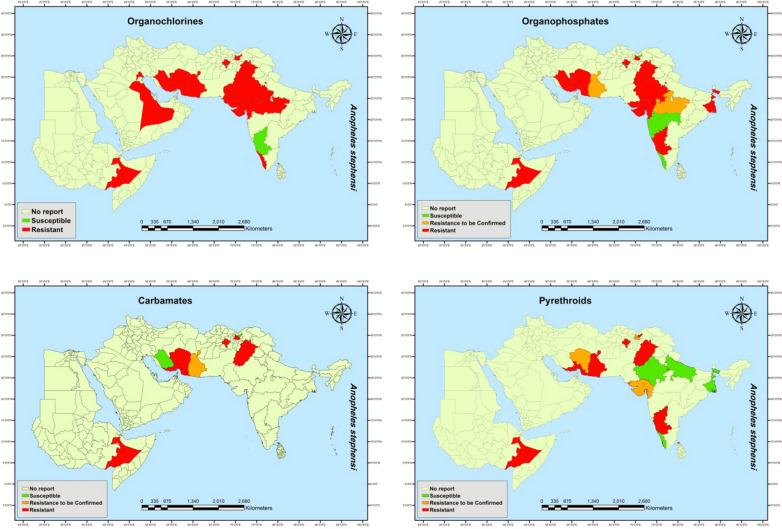
- DDT resistance in *An. stephensi* was detected in Iran in 1957 and later in Iraq, Pakistan, and Saudi Arabia in the late 1960s; pyrethroid resistance was detected in Afghanistan in 2010, India in 2011, and Iran in 2012. In Ethiopia, the newly invaded population was resistant to all four major insecticide classes, with mortality after discriminating concentrations of DDT 32%, malathion 32%, pirimiphos-methyl 14%, bendiocarb 23%, propoxur 21%, permethrin 53%, and deltamethrin 67%.
- Iran’s insecticide sequence included DDT from 1945, malathion from 1967/1968, propoxur from 1978, pirimiphos-methyl from 1991/1992–1994, lambda-cyhalothrin from 1994–2003, followed by deltamethrin IRS and LLINs. Malathion susceptibility was mostly restored after 1982, larvae remained susceptible to temephos, and recent resistance to bendiocarb emerged.
- Mechanisms included GST-based DDT resistance, later pyrethroid-selected knockdown resistance, esterases and altered acetylcholinesterase for organophosphate resistance, and cytochrome P450s for pyrethroid metabolic resistance. A semi-field trial found deltamethrin plus PBO caused higher mortality than deltamethrin alone.
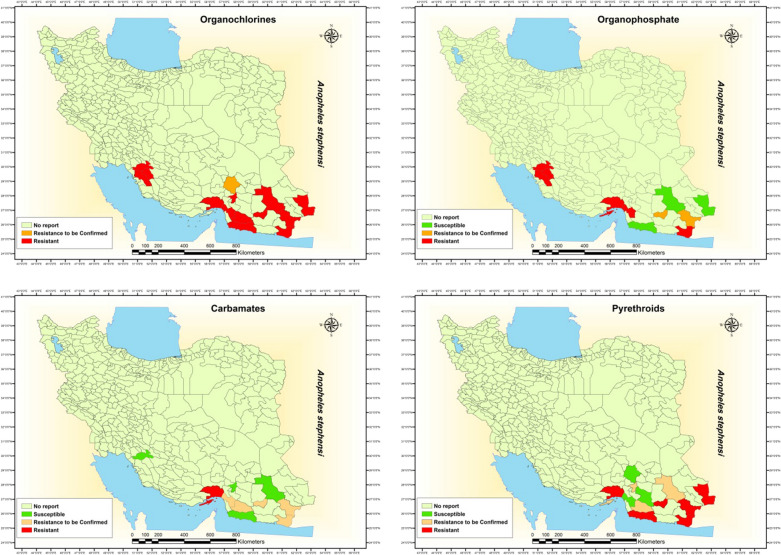
- Resistance was often province- or state-specific; for example, *An. stephensi* in Kunar, Afghanistan was susceptible to bendiocarb, while cytochrome P450 levels were highest in Laghman and Nangarhar, where PBO nets could be deployed.
Methods
- Systematic review of literature from 1 January 1925 to 10 March 2020, searching PubMed, Google Scholar, Scopus, ScienceDirect, SID, and IranMedex, plus conference proceedings and hand-searched reference lists.
- Included studies on adult and larval *An. stephensi* from WHO EMR countries using WHO standard kits and discriminating concentrations; India and Ethiopia were included although not WHO EMR member states. Excluded studies using non-WHO insecticides/concentrations/kits, plant extracts, dose–response bioassays, net bioassays, and residual bioassays.
- Data were extracted into Excel to build a chronological history, and resistance maps were prepared in ArcGIS 10.5 at district level for Iran and province/state level for the region using WHO resistance criteria.
Limitations
- The paper states that insecticide susceptibility monitoring is not routinely performed in sentinel sites with adequate temporal and spatial coverage; in some provinces/states data are old, nonexistent, or substandard, and “resistance to be confirmed” is often not followed up with additional tests. It also notes that intensity testing with 5× and 10× insecticide-treated papers is emphasized but not consistently done.
- Evident from the text: as a narrative systematic review, it does not pool data meta-analytically, and its conclusions depend on available published studies, which may be constrained by reporting gaps and heterogeneous bioassay methods despite the WHO inclusion criteria.
Model-written summary. Check it against the paper before relying on it.
Integrity signals
Registry
Cites
Statistics
Figures
Verification
Claims the paper makes
38 Valid · 4 Not valid · 38 Not checked · 21 Own results and interpretations
Some cited sources support this claim and some don’t — read each source’s verdict below.
In the paper
“Pyrethroid insecticide resistance in An. stephensi from Iran [78, 84–87], Afghanistan [27, 28] and India [34, 36] is in part due to cytochrome p450s.”
§ Evolution of insecticide resistance and its mechanisms in Anopheles stephensi in the WHO Eastern Mediterranean Region > Discussion
What the sources say
- Not checked — no full text of the sourcecites [78] Nikpour F Vatandoost H Hanafi-Bojd AA Raeisi A Ranjbar M Enayati AA Evaluation of deltamethrin in combination of piperonyl butoxide (PBO) against pyrethroid resistant, malaria vector, Anopheles stephensi in IRS implementation: an experimental semi-filed trial in Iran Iran J Arthropod Borne Dis. 2017 11 469 481 PMC5775154 29367924
- Not matchedcites [84] Enayati AA. Cross resistance between DDT and permethrin in Anopheles stephensi from Iran. MSc thesis. Tarbiat Modarress University. Tehran. 1992.
Its entry has no title and year that we can search by.
- Not matchedcites [85] Omer SM Georghiou GP Irving SN DDT/pyrethroid resistance inter-relationships in Anopheles stephensi Mosq News. 1980 40 200 209
Its entry has no title and year that we can search by.
- Not checked — no full text of the sourcecites [86] Davari B Vatandoost H Oshaghi M Ladonni H Enayati A Shaeghi M Selection of Anopheles stephensi with DDT and dieldrin and cross-resistance spectrum to pyrethroids and fipronil Pestic Biochem Physiol 2007 89 97 103 source
- Not checked — no full text of the sourcecites [87] Soltani A Vatandoost H Oshaghi MA Ravasan NM Enayati AA Asgarian F Resistance mechanisms of Anopheles stephensi (Diptera: Culicidae) to temephos J Arthropod Borne Dis. 2015 9 71 83 26114145 PMC4478420
- Supportedcites [27] Safi NHZ Ahmadi AA Nahzat S Ziapour SP Nikookar SH Fazeli-Dinan M Evidence of metabolic mechanisms playing a role in multiple insecticides resistance in Anopheles stephensi populations from Afghanistan Malar J. 2017 16 100 28253925 PMC5335852 source
This source is cited for the Afghanistan portion of the sentence. Its Conclusions say that pyrethroid resistance in An. stephensi from Kunar and Nangarhar is likely caused in part by metabolic mechanisms including P450s; the Discussion also reports elevated P450 levels in those field populations. (LLM, conf=0.93)
- Disputedcites [28] Safi NHZ Ahmadi AA Nahzat S Warusavithana S Safi N Valadan R Status of insecticide resistance and its biochemical and molecular mechanisms in Anopheles stephensi (Diptera: Culicidae) from Afghanistan Malar J. 2019 18 249 31349836 PMC6660931 sourceExperimental — accuracy not yet measured
For the Afghanistan portion attributed to this paper, the Discussion says that pyrethroid resistance in the studied populations remained low, suggesting it was conferred only by a relatively weak kdr mechanism. The paper reports elevated cytochrome P450 content in those populations, but does not attribute their pyrethroid resistance to it; its explicit P450–pyrethroid link concerns Dubai, Iran and India. (LLM, conf=0.83)
Checked by a reasoning model — may be wrong.
- Not checked — no full text of the sourcecites [34] Ganesh K Vijayan V Urmila J Gopalan N Prakash S Role of esterases and monooxygenase in the deltamethrin resistance in Anopheles stephensi Liston (1908), at Mysore Indian J Exp Biol 2002 40 583 588 12622206
- Not checked — no full text of the sourcecites [36] Hariprasad TP Shetty NJ Biochemical basis of alphamethrin resistance in different life stages of Anopheles stephensi strains of Bangalore, India Pest Manag Sci. 2016 72 1689 1701 26598105 source
plainstates a possible cause- Asserted: passes — The authors put it forward as true.
- Checkable: passes — It can be checked against evidence.
- Load-bearing: passes — The paper’s conclusions depend on it.
- Based: passes — The paper gives a reason why it holds.
Some cited sources support this claim and some don’t — read each source’s verdict below.
In the paper
“Resistance to different OPs and carbamate insecticides in An. stephensi in Iran [87, 115] and Afghanistan [27, 28] can be traced back to aAChE.”
§ Evolution of insecticide resistance and its mechanisms in Anopheles stephensi in the WHO Eastern Mediterranean Region > Discussion
What the sources say
- Not checked — no full text of the sourcecites [87] Soltani A Vatandoost H Oshaghi MA Ravasan NM Enayati AA Asgarian F Resistance mechanisms of Anopheles stephensi (Diptera: Culicidae) to temephos J Arthropod Borne Dis. 2015 9 71 83 26114145 PMC4478420
- Disputedcites [115] Enayati AA Ladonni H Biochemical assays baseline data of permethrin resistance in Anopheles stephensi (Diptera, Culicidae) from Iran Pakistan J Biol Sci. 2006 9 1265 1270 sourceExperimental — accuracy not yet measured
The citation is attached to the Iran portion of the sentence, not the separately cited Afghanistan portion. The Discussion (p. 6) says no insecticide resistance had been reported in Iranian An. stephensi; it describes rising enzyme levels as a warning of possible future resistance. The paper does not identify altered acetylcholinesterase as the cause of organophosphate or carbamate resistance. (LLM, conf=0.87)
Checked by a reasoning model — may be wrong.
- Partly supportedcites [27] Safi NHZ Ahmadi AA Nahzat S Ziapour SP Nikookar SH Fazeli-Dinan M Evidence of metabolic mechanisms playing a role in multiple insecticides resistance in Anopheles stephensi populations from Afghanistan Malar J. 2017 16 100 28253925 PMC5335852 sourceExperimental — accuracy not yet measured
The Discussion (page not supplied) says insensitive AChE would affect malathion resistance and bendiocarb tolerance in the Afghan populations; it also notes a similar pattern of AChE insensitivity in Iranian An. stephensi. The Abstract Conclusions (page not supplied) attribute the Afghan findings to AChE insensitivity combined with metabolic mechanisms. The paper does not establish AChE as the cause of resistance to different organophosphates and carbamates in both countries, and describes bendiocarb tolerance rather than resistance. (LLM, conf=0.86)
- Supportedcites [28] Safi NHZ Ahmadi AA Nahzat S Warusavithana S Safi N Valadan R Status of insecticide resistance and its biochemical and molecular mechanisms in Anopheles stephensi (Diptera: Culicidae) from Afghanistan Malar J. 2019 18 249 31349836 PMC6660931 source
The Discussion states that insensitive acetylcholinesterase (iAChE) is involved in organophosphate and carbamate resistance in An. stephensi from Iran and Afghanistan. Its account of the Afghan populations also says iAChE should confer resistance to malathion and bendiocarb. The paper uses iAChE rather than the claim’s aAChE, but describes the same altered target-site mechanism. (LLM, conf=0.91)
plainstates a cause- Asserted: passes — The authors put it forward as true.
- Checkable: passes — It can be checked against evidence.
- Load-bearing: passes — The paper’s conclusions depend on it.
- Based: passes — The paper gives a reason why it holds.
The cited sources support only part of this claim — read each source’s verdict below.
In the paper
“Several mechanisms including metabolic and insecticide target site insensitivity are involved in insecticide resistance in An. stephensi from different countries, each of which has its own operational significance in vector control [26–28, 31, 33–36, 38, 39, 42, 47, 48].”
§ Evolution of insecticide resistance and its mechanisms in Anopheles stephensi in the WHO Eastern Mediterranean Region > Background
What the sources say
- Partly supportedcites [26] Ahmad M Buhler C Pignatelli P Ranson H Nahzat SM Naseem M Status of insecticide resistance in high-risk malaria provinces in Afghanistan Malar J. 2016 15 98 26888409 PMC4758152 sourceExperimental — accuracy not yet measured
The Results (kdr genotyping; page unavailable) associate target-site kdr mutations with resistance in An. stephensi from two Afghan provinces and suggest that other mechanisms are also present. The paper does not identify those other mechanisms as metabolic or establish that both mechanisms are involved across different countries. The Discussion (page unavailable) does say that understanding resistance mechanisms is important for vector control. (LLM, conf=0.86)
- Supportedcites [27] Safi NHZ Ahmadi AA Nahzat S Ziapour SP Nikookar SH Fazeli-Dinan M Evidence of metabolic mechanisms playing a role in multiple insecticides resistance in Anopheles stephensi populations from Afghanistan Malar J. 2017 16 100 28253925 PMC5335852 source
The Background reports metabolic enzyme activity associated with resistance in An. stephensi from India and confirms both enzyme-based and target-site insensitivity mechanisms in populations from Iran. The Conclusions report multiple mechanisms in Afghanistan and link monitoring resistance to vector-control measures. (LLM, conf=0.90)
- Supportedcites [28] Safi NHZ Ahmadi AA Nahzat S Warusavithana S Safi N Valadan R Status of insecticide resistance and its biochemical and molecular mechanisms in Anopheles stephensi (Diptera: Culicidae) from Afghanistan Malar J. 2019 18 249 31349836 PMC6660931 source
The Background (page not supplied) identifies metabolic resistance and target-site insensitivity in An. stephensi, including evidence from Afghanistan, India and Iran. The Discussion and Conclusions (pages not supplied) connect differing resistance mechanisms to vector-control decisions, including insecticide choice and province-specific strategies. (LLM, conf=0.91)
- Not checked — no full text of the sourcecites [31] Singh RK Kumar G Mittal PK Insecticide susceptibility status of malaria vectors in India: a review Int J Mosq Res. 2014 1 5 9
- Partly supportedcites [33] Dykes CL Das MK Eapen A Batra CP Ghosh SK Vijayan VA Knockdown resistance (kdr) mutations in Indian Anopheles stephensi (Diptera: Culicidae) populations J Med Entomol 2016 53 315 320 26747858 PMC5853671 sourceExperimental — accuracy not yet measured
The Abstract (p. 1) identifies sodium-channel kdr mutations as a target-site resistance mechanism and documents them in Indian An. stephensi populations. The Discussion (p. 3) says kdr alone did not produce pyrethroid resistance in two tested populations. Our copy does not establish metabolic resistance mechanisms in this species or resistance mechanisms across different countries. (LLM, conf=0.87)
- Not checked — no full text of the sourcecites [34] Ganesh K Vijayan V Urmila J Gopalan N Prakash S Role of esterases and monooxygenase in the deltamethrin resistance in Anopheles stephensi Liston (1908), at Mysore Indian J Exp Biol 2002 40 583 588 12622206
- Not checked — no full text of the sourcecites [35] Gayathri V Balakrishna Murthy P Reduced susceptibility to deltamethrin and kdr mutation in Anopheles stephensi Liston, a malaria vector in India J Am Mosq Control Assoc. 2006 22 678 688 17304937 source
- Not checked — no full text of the sourcecites [36] Hariprasad TP Shetty NJ Biochemical basis of alphamethrin resistance in different life stages of Anopheles stephensi strains of Bangalore, India Pest Manag Sci. 2016 72 1689 1701 26598105 source
- Partly supportedcites [38] Singh OP Dykes CL Das MK Pradhan S Bhatt RM Agrawal OP Presence of two alternative kdr-like mutations, L1014F and L1014S, and a novel mutation, V1010L, in the voltage gated Na + channel of Anopheles culicifacies from Orissa, India Malar J. 2010 9 67 20509922 PMC2895608 sourceExperimental — accuracy not yet measured
The Background identifies voltage-gated sodium-channel mutations as a mechanism of resistance to DDT and pyrethroids, and the Conclusions report kdr-like mutations in Indian An. stephensi. The paper does not address metabolic resistance or document mechanisms across different countries; its Methods specify mosquitoes collected in Alwar, India. It also does not discuss the mechanisms’ operational significance in vector control. (LLM, conf=0.87)
- Partly supportedcites [39] Singh OP Dykes CL Lather M Agrawal OP Adak T Knockdown resistance (kdr)-like mutations in the voltage-gated sodium channel of a malaria vector Anopheles stephensi and PCR assays for their detection Malar J. 2011 10 59 21401946 PMC3068127 sourceExperimental — accuracy not yet measured
The Background and Discussion (page not available) describe voltage-gated sodium-channel mutations as a target-site mechanism of resistance in An. stephensi, and the Discussion mentions work on Iranian and Indian populations. Our copy does not establish metabolic resistance in this species or the claimed range of mechanisms across countries; those parts are not supported by this source. (LLM, conf=0.85)
plainstates an association- Asserted: passes — The authors put it forward as true.
- Checkable: passes — It can be checked against evidence.
- Load-bearing: passes — The paper’s conclusions depend on it.
- Based: passes — The paper gives a reason why it holds.
- Partly supported
Every source the paper cites for this claim was checked and supports it.
In the paper
“Anopheles stephensi from Lahore, Pakistan was resistant to DDT and malathion [80].”
§ Evolution of insecticide resistance and its mechanisms in Anopheles stephensi in the WHO Eastern Mediterranean Region > Results > Insecticide resistance in Anopheles stephensi in other WHO/EMR countries, plus India, Sri Lanka and Ethiopia
What the sources say
- Supportedcites [80] Hemingway J. Genetics and biochemistry of insecticide resistance in Anophelines. PhD thesis, London School of Hygiene & Tropical Medicine, 1981. 10.17037/pubs.04609913. source
The discussion on p. 23 identifies malathion-resistant An. stephensi from Lahore, Pakistan. The resistance-results passage immediately before p. 90 reports that the Pakistani ST LA colony was resistant to DDT and had no mortality after one hour of exposure to 5% malathion. (LLM, conf=0.91)
plain- Asserted: passes — The authors put it forward as true.
- Checkable: passes — It can be checked against evidence.
- Load-bearing: unclear — It is unclear whether the paper’s conclusions depend on it.
- Based: passes — The paper gives a reason why it holds.
- Supported
The cited sources support only part of this claim — read each source’s verdict below.
In the paper
“In studies in 1957 and 1980, the species was resistant to DDT, dieldrin and malathion in the country [23, 80].”
§ Evolution of insecticide resistance and its mechanisms in Anopheles stephensi in the WHO Eastern Mediterranean Region > Results > Insecticide resistance in Anopheles stephensi in other WHO/EMR countries, plus India, Sri Lanka and Ethiopia
What the sources say
- Not checked — no full text of the sourcecites [23] Gramiccia G De Meillon B Petrides J Ulrich A Resistance to DDT in Anopheles stephensi in southern Iraq Bull World Health Organ 1958 19 1102 1104 20604035 PMC2537830
- Partly supportedcites [80] Hemingway J. Genetics and biochemistry of insecticide resistance in Anophelines. PhD thesis, London School of Hygiene & Tropical Medicine, 1981. 10.17037/pubs.04609913. sourceExperimental — accuracy not yet measured
The resistance-spectrum discussion (p. 90) says the An. stephensi ST IRAQ colony was resistant to DDT, dieldrin and malathion. The cited copy does not establish that studies in both 1957 and 1980 found this resistance; its discussion of malathion in Iraq instead mentions detection in 1975 (p. 23). (LLM, conf=0.86)
plain- Asserted: passes — The authors put it forward as true.
- Checkable: passes — It can be checked against evidence.
- Load-bearing: unclear — It is unclear whether the paper’s conclusions depend on it.
- Based: passes — The paper gives a reason why it holds.
52 more claims · 18 with their cited sources checked
Create a free account to see all 101 claims and to verify the 18 references still open.
- It may state two separate claims as one. 35
- Probably not a substantial claim. 13
- The quote only partly states this claim. 1
Claims other papers make about this one
Each is checked against this paper’s own text: does it say what the citing paper says it does?
The cited source says what the claim attributes to it.
In the citing paper
“The species is now resistant to all major groups of insecticides as well as developing a variety of resistance mechanisms21.”
From Predicting the environmental suitability for Anopheles stephensi under the current conditions in Ghana (2024) · cites this paper as [21]
Self-check
Percentages, sums and reported differences re-computed from the paper’s own numbers.
Each contradiction between two passages listed here was confirmed by an independent check.
Rated minor: it would not touch a result — a value no result rests on, a p-value that stays on the same side of the significance level, or a conflict that is clerical, resolved elsewhere in the paper, or outside its own findings.
In the paper
§ Evolution of insecticide resistance and its mechanisms in Anopheles stephensi in the WHO Eastern Mediterranean Region > Abstract > Results
“Resistance to DDT in An. stephensi was detected in Iran, Iraq, Pakistan, and Saudi Arabia in the late 1960s.”
§ Evolution of insecticide resistance and its mechanisms in Anopheles stephensi in the WHO Eastern Mediterranean Region > Results
“DDT was used until 1957 when An. stephensi became resistant to it [8]”
Rated minor: it would not touch a result — a value no result rests on, a p-value that stays on the same side of the significance level, or a conflict that is clerical, resolved elsewhere in the paper, or outside its own findings.
In the paper
§ Evolution of insecticide resistance and its mechanisms in Anopheles stephensi in the WHO Eastern Mediterranean Region > Abstract > Results
“The pyrethroid insecticide lambda-cyhalothrin was used from 1994 to 2003 followed by deltamethrin IRS and long-lasting insecticidal nets (LLINs).”
§ Evolution of insecticide resistance and its mechanisms in Anopheles stephensi in the WHO Eastern Mediterranean Region > Results
“Since 2003, IRS continued using only deltamethrin and lambda-cyhalothrin until 2011.”
Rated minor: it would not touch a result — a value no result rests on, a p-value that stays on the same side of the significance level, or a conflict that is clerical, resolved elsewhere in the paper, or outside its own findings.
In the paper
§ Evolution of insecticide resistance and its mechanisms in Anopheles stephensi in the WHO Eastern Mediterranean Region > Abstract > Results
“followed by pirimiphos-methyl from 1992 to 1994.”
§ Evolution of insecticide resistance and its mechanisms in Anopheles stephensi in the WHO Eastern Mediterranean Region > Results
“Pirimiphos-methyl replaced propoxur in 1991 until it was replaced with lambda-cyhalothrin plus propoxur in 1994 [19, 20].”
Rated minor: it would not touch a result — a value no result rests on, a p-value that stays on the same side of the significance level, or a conflict that is clerical, resolved elsewhere in the paper, or outside its own findings.
In the paper
§ Evolution of insecticide resistance and its mechanisms in Anopheles stephensi in the WHO Eastern Mediterranean Region > Abstract > Results
“Malathion was used for malaria control in Iran in 1967”
§ Evolution of insecticide resistance and its mechanisms in Anopheles stephensi in the WHO Eastern Mediterranean Region > Results
“malathion IRS was used in malaria vector control in Iran since 1968 [14].”
Citations
Cites
Insecticide Resistance in Insect Vectors of Human Disease
Hemingway, J., & Ranson, H. (2000) · Annual Review of Entomology · doi:10.1146/annurev.ento.45.1.371 · Cited by 1,558
Self-citationInsect glutathione transferases and insecticide resistance
Enayati, A. A., Ranson, H., & Hemingway, J. (2005) · Insect Molecular Biology · doi:10.1111/j.1365-2583.2004.00529.x · Cited by 1,084
Self-citationRanson, H., Jensen, B., Vulule, J. M., Wang, X., Hemingway, J., & Collins, F. H. (2000) · Insect Molecular Biology · doi:10.1046/j.1365-2583.2000.00209.x · Cited by 645
Self-citationVONTAS, J. G., SMALL, G. J., & HEMINGWAY, J. (2001) · Biochemical Journal · doi:10.1042/bj3570065 · Cited by 583
Self-citationN’Guessan, R., Corbel, V., Akogbéto, M., & Rowland, M. (2007) · Emerging Infectious Diseases · doi:10.3201/eid1302.060631 · Cited by 548
Safety of pyrethroid‐treated mosquito nets
Zaim, M., Aitio, A., & Nakashima, N. (2000) · Medical and Veterinary Entomology · doi:10.1046/j.1365-2915.2000.00211.x · Cited by 366
Self-citationThe molecular basis of two contrasting metabolic mechanisms of insecticide resistance
Hemingway, J. (2000) · Insect Biochemistry and Molecular Biology · doi:10.1016/s0965-1748(00)00079-5 · Cited by 345
Self-citationWorld Trade Report 2019: The future of services trade
World Trade Organization (2019) · World Trade Report · doi:10.30875/7e6f8c91-en · Cited by 324
Alternative insecticides: an urgent need
Zaim, M., & Guillet, P. (2002) · Trends in Parasitology · doi:10.1016/s1471-4922(01)02220-6 · Cited by 286
Self-citationLumjuan, N., Rajatileka, S., Changsom, D., Wicheer, J., Leelapat, P., Prapanthadara, L.-A., Somboon, P., Lycett, G., & Ranson, H. (2011) · Insect Biochemistry and Molecular Biology · doi:10.1016/j.ibmb.2010.12.005 · Cited by 280
Strode, C., Donegan, S., Garner, P., Enayati, A. A., & Hemingway, J. (2014) · PLoS Medicine · doi:10.1371/journal.pmed.1001619 · Cited by 274
Self-citationSEVEN YEARS OF REGIONAL MALARIA CONTROL COLLABORATION—MOZAMBIQUE, SOUTH AFRICA, AND SWAZILAND
SHARP, B. L., KLEINSCHMIDT, I., STREAT, E., MAHARAJ, R., BARNES, K. I., DURRHEIM, D. N., RIDL, F. C., MORRIS, N., SEOCHARAN, I., KUNENE, S., et al. (2007) · The American Journal of Tropical Medicine and Hygiene · doi:10.4269/ajtmh.2007.76.42 · Cited by 269
Malaria Management: Past, Present, and Future
Enayati, A., & Hemingway, J. (2010) · Annual Review of Entomology · doi:10.1146/annurev-ento-112408-085423 · Cited by 264
Self-citationGlobal Trends in the Use of Insecticides to Control Vector-Borne Diseases
van den Berg, H., Zaim, M., Yadav, R. S., Soares, A., Ameneshewa, B., Mnzava, A., Hii, J., Dash, A. P., & Ejov, M. (2012) · Environmental Health Perspectives · doi:10.1289/ehp.1104340 · Cited by 256
Self-citationFaulde, M. K., Rueda, L. M., & Khaireh, B. A. (2014) · Acta Tropica · doi:10.1016/j.actatropica.2014.06.016 · Cited by 245
Carter, T. E., Yared, S., Gebresilassie, A., Bonnell, V., Damodaran, L., Lopez, K., Ibrahim, M., Mohammed, S., & Janies, D. (2018) · Acta Tropica · doi:10.1016/j.actatropica.2018.09.001 · Cited by 192
Lessons from the past: managing insecticide resistance in malaria control and eradication programmes
Kelly-Hope, L., Ranson, H., & Hemingway, J. (2008) · The Lancet Infectious Diseases · doi:10.1016/s1473-3099(08)70045-8 · Cited by 191
Self-citationYadouleton, A. W. M., Asidi, A., Djouaka, R. F., Braïma, J., Agossou, C. D., & Akogbeto, M. C. (2009) · Malaria Journal · doi:10.1186/1475-2875-8-103 · Cited by 179
Shrinking the Malaria Map: A Prospectus on Malaria Elimination
Feachem, R. G., Phillips, A. A., & Targett, G. R. A. (2009) · IHI Repository · Cited by 170
Ghanchi, N. K., Mårtensson, A., Ursing, J., Jafri, S., Bereczky, S., Hussain, R., & Beg, M. A. (2010) · Malaria Journal · doi:10.1186/1475-2875-9-1 · Cited by 162
Enayati, A. A., Vatandoost, H., Ladonni, H., Townson, H., & Hemingway, J. (2003) · Medical and Veterinary Entomology · doi:10.1046/j.1365-2915.2003.00418.x · Cited by 161
Self-citationInsecticide Resistance in Malaria Vectors: An Update at a Global Scale
Riveron, J. M., Tchouakui, M., Mugenzi, L. M. J., Menze, B. D., Chiang, M.-C., & Wondji, C. S. (2018) · InTech eBooks · doi:10.5772/intechopen.78375 · Cited by 154
HENRY, M.-C., ASSI, S.-B., ROGIER, C., DOSSOU-YOVO, J., CHANDRE, F., GUILLET, P., & CARNEVALE, P. (2005) · The American Journal of Tropical Medicine and Hygiene · doi:10.4269/ajtmh.2005.73.859 · Cited by 150
Nkya, T. E., Poupardin, R., Laporte, F., Akhouayri, I., Mosha, F., Magesa, S., Kisinza, W., & David, J.-P. (2014) · Parasites & Vectors · doi:10.1186/s13071-014-0480-z · Cited by 136
Vatandoost, H., Oshaghi, M. A., Abaie, M. R., Shahi, M., Yaaghoobi, F., Baghaii, M., Hanafi-Bojd, A. A., Zamani, G., & Townson, H. (2006) · Acta Tropica · doi:10.1016/j.actatropica.2005.11.002 · Cited by 135
Self-citationYadouleton, A., Martin, T., Padonou, G., Chandre, F., Asidi, A., Djogbenou, L., Dabiré, R., Aïkpon, R., Boko, M., Glitho, I., et al. (2011) · Parasites & Vectors · doi:10.1186/1756-3305-4-60 · Cited by 132
Seyfarth, M., Khaireh, B. A., Abdi, A. A., Bouh, S. M., & Faulde, M. K. (2019) · Parasitology Research · doi:10.1007/s00436-019-06213-0 · Cited by 126
Reimer, L., Fondjo, E., Patchoke, S., Diallo, B., Lee, Y., Ng, A., Ndjemai, H. M., Atangana, J., Traore, S. F., Lanzaro, G., et al. (2008) · Journal of Medical Entomology · doi:10.1093/jmedent/45.2.260 · Cited by 123 · cited 1×
“However, there is a slight difference in those two alleles in terms of conferring resistance to DDT and pyrethroids [28, 105].”
BackgroundTungu, P., Magesa, S., Maxwell, C., Malima, R., Masue, D., Sudi, W., Myamba, J., Pigeon, O., & Rowland, M. (2010) · Malaria Journal · doi:10.1186/1475-2875-9-21 · Cited by 119
Hien, A. S., Soma, D. D., Hema, O., Bayili, B., Namountougou, M., Gnankiné, O., Baldet, T., Diabaté, A., & Dabiré, K. R. (2017) · PLOS ONE · doi:10.1371/journal.pone.0173098 · Cited by 112
Insecticide resistance in Anopheles stephensi in Somali Region, eastern Ethiopia
Yared, S., Gebressielasie, A., Damodaran, L., Bonnell, V., Lopez, K., Janies, D., & Carter, T. E. (2020) · Malaria Journal · doi:10.1186/s12936-020-03252-2 · Cited by 111
Towards Malaria Elimination - A Leap Forward
(2018) · InTech eBooks · doi:10.5772/intechopen.69750 · Cited by 110
Quantitative analysis of gene amplification in insecticide-resistant Culex mosquitoes
PATON, M. G., KARUNARATNE, S. H. P. P., GIAKOUMAKI, E., ROBERTS, N., & HEMINGWAY, J. (2000) · Biochemical Journal · doi:10.1042/bj3460017 · Cited by 98 · cited 1×
“Esterases overexpressed by upregulation, gene amplification as well as enhanced metabolic property [34, 90, 91, 101, 102] are involved mainly in organophosphorus and secondarily in carbamate and pyrethroid insecticides resistance.”
BackgroundSelf-citationAnthropogenic Factors Driving Recent Range Expansion of the Malaria Vector Anopheles stephensi
Surendran, S. N., Sivabalakrishnan, K., Sivasingham, A., Jayadas, T. T. P., Karvannan, K., Santhirasegaram, S., Gajapathy, K., Senthilnanthanan, M., Karunaratne, S. P., & Ramasamy, R. (2019) · Frontiers in Public Health · doi:10.3389/fpubh.2019.00053 · Cited by 97
Soltani, A., Vatandoost, H., Oshaghi, M. A., Enayati, A. A., & Chavshin, A. R. (2017) · Pathogens and Global Health · doi:10.1080/20477724.2017.1356052 · Cited by 91
Self-citationGayan Dharmasiri, A. G., Perera, A. Y., Harishchandra, J., Herath, H., Aravindan, K., Jayasooriya, H. T. R., Ranawaka, G. R., & Hewavitharane, M. (2017) · Malaria Journal · doi:10.1186/s12936-017-1977-7 · Cited by 90
Hanafi-Bojd, A. A., Vatandoost, H., Oshaghi, M. A., Haghdoost, A. A., Shahi, M., Sedaghat, M. M., Abedi, F., Yeryan, M., & Pakari, A. (2012) · Acta Tropica · doi:10.1016/j.actatropica.2011.04.017 · Cited by 88
Self-citation(2005) · PubMed · Cited by 83
Self-citationOxborough, R. M., Kitau, J., Jones, R., Feston, E., Matowo, J., Mosha, F. W., & Rowland, M. W. (2014) · Malaria Journal · doi:10.1186/1475-2875-13-37 · Cited by 82
The biochemical nature of malathion resistance in Anopheles stephensi from Pakistan
Hemingway, J. (1982) · Pesticide Biochemistry and Physiology · doi:10.1016/0048-3575(82)90019-0 · Cited by 76
Self-citation(2004) · PubMed · Cited by 75
Self-citationDarriet, F., Koffi, A. A., Konan, L. Y., Chandre, F., & Carnevale, P. (2000) · Bulletin de la Société de pathologie exotique · Cited by 75
(1976) · PubMed · Cited by 72
Indication of pyrethroid resistance in the main malaria vector, Anopheles stephensi from Iran
Vatandoost, H., & Hanafi-Bojd, A. A. (2012) · Asian Pacific Journal of Tropical Medicine · doi:10.1016/s1995-7645(12)60114-x · Cited by 69
Self-citation(2000) · PubMed · Cited by 63
Singh, O. P., Dykes, C. L., Das, M. K., Pradhan, S., Bhatt, R. M., Agrawal, O. P., & Adak, T. (2010) · Malaria Journal · doi:10.1186/1475-2875-9-146 · Cited by 59
(2008) · PubMed · Cited by 58
Toe, K. H., Müller, P., Badolo, A., Traore, A., Sagnon, N., Dabiré, R. K., & Ranson, H. (2018) · Medical and Veterinary Entomology · doi:10.1111/mve.12316 · Cited by 58
Singh, O. P., Dykes, C. L., Lather, M., Agrawal, O. P., & Adak, T. (2011) · Malaria Journal · doi:10.1186/1475-2875-10-59 · Cited by 57
Davari, B., Vatandoost, H., Oshaghi, M. A., Ladonni, H., Enayati, A. A., Shaeghi, M., Basseri, H. R., Rassi, Y., & Hanafi-Bojd, A. A. (2007) · Pesticide Biochemistry and Physiology · doi:10.1016/j.pestbp.2007.04.003 · Cited by 55
Self-citationTikar, S. N., Mendki, M. J., Sharma, A. K., Sukumaran, D., Veer, V., Prakash, S., & Parashar, B. D. (2011) · Journal of Insect Science · doi:10.1673/031.011.8501 · Cited by 52
Safi, N. H. Z., Ahmadi, A. A., Nahzat, S., Ziapour, S. P., Nikookar, S. H., Fazeli-Dinan, M., Enayati, A., & Hemingway, J. (2017) · Malaria Journal · doi:10.1186/s12936-017-1744-9 · Cited by 45
Self-citationResistance Mechanisms of Anopheles stephensi (Diptera: Culicidae) to Temephos.
(2015) · Europe PMC (PubMed Central) · Cited by 44
Self-citationMalaria control in Iran--present and future.
Zaim, M. (1987) · PubMed · Cited by 43
Self-citationTiwari, S., Ghosh, S. K., Ojha, V. P., Dash, A. P., & Raghavendra, K. (2010) · Malaria Journal · doi:10.1186/1475-2875-9-179 · Cited by 42
PCR-based methods for the detection of L1014 kdr mutation in Anopheles culicifacies sensu lato
Singh, O. P., Bali, P., Hemingway, J., Subbarao, S. K., Dash, A. P., & Adak, T. (2009) · Malaria Journal · doi:10.1186/1475-2875-8-154 · Cited by 41
Self-citation(2015) · Europe PMC (PubMed Central) · Cited by 40
Self-citationMalaria situation analysis and stratification in bandar abbas county, southern iran, 2004-2008.
(2010) · Europe PMC (PubMed Central) · Cited by 39
Self-citation(1998) · PubMed · Cited by 38
Allossogbe, M., Gnanguenon, V., Yovogan, B., Akinro, B., Anagonou, R., Agossa, F., Houtoukpe, A., Padonou, G. G., & Akogbeto, M. (2017) · Malaria Journal · doi:10.1186/s12936-017-1727-x · Cited by 37
(2016) · PubMed Central · Cited by 36
Self-citationRaghavendra, K., Prasad, K., Verma, V., Velamuri, P., & Pande, V. (2017) · Journal of Vector Borne Diseases · doi:10.4103/0972-9062.217613 · Cited by 35
Vector ecology and susceptibility in a malariaendemic focus in southern Islamic Republic of Iran
Soleimani-Ahmadi, M., Vatandoost, H., Shaeghi, M., Raeisi, A., Abedi, F., Eshraghian, M. R., Madani, A., Safari, R., Shahi, M., Mojahedi, A., et al. (2012) · Eastern Mediterranean Health Journal · doi:10.26719/2012.18.10.1034 · Cited by 34
GAYATHRI, V., & MURTHY, P. B. (2006) · Journal of the American Mosquito Control Association · doi:10.2987/8756-971x(2006)22[678:rstdak]2.0.co;2 · Cited by 33
Hanafi-Bojd, A., Abbasi, M., Yaghoobi-Ershadi, M., Vatandoost, H., Oshaghi, M., Hazratian, T., Sedaghat, M., Fekri, S., Safari, R., Mojahedi, A., et al. (2019) · Asian Pacific Journal of Tropical Medicine · doi:10.4103/1995-7645.250344 · Cited by 32
Self-citationVatandoust, H., & Borhani, N. (2004) · ACTA MEDICA IRANICA · Cited by 32
Safi, N. H. Z., Ahmadi, A. A., Nahzat, S., Warusavithana, S., Safi, N., Valadan, R., Shemshadian, A., Sharifi, M., Enayati, A., & Hemingway, J. (2019) · Malaria Journal · doi:10.1186/s12936-019-2884-x · Cited by 29
Self-citationAli Khan, H. A., Akram, W., & Lee, S. (2018) · Journal of Medical Entomology · doi:10.1093/jme/tjx247 · Cited by 28
Bio-ecology of malaria vectors in an endemic area, Southeast of Iran
Yeryan, M., Basseri, H. R., Hanafi-Bojd, A. A., Raeisi, A., Edalat, H., & Safari, R. (2016) · Asian Pacific Journal of Tropical Medicine · doi:10.1016/j.apjtm.2015.12.007 · Cited by 28
Self-citationBigoga, J. D., Ndangoh, D. N., Awono-Ambene, P. H., Patchoke, S., Fondjo, E., & Leke, R. G. F. (2012) · Acta Tropica · doi:10.1016/j.actatropica.2012.08.010 · Cited by 28
Status of insecticide resistance in high-risk malaria provinces in Afghanistan
Ahmad, M., Buhler, C., Pignatelli, P., Ranson, H., Nahzat, S. M., Naseem, M., Sabawoon, M. F., Siddiqi, A. M., & Vink, M. (2016) · Malaria Journal · doi:10.1186/s12936-016-1149-1 · Cited by 27
(1998) · PubMed · Cited by 24
(2003) · PubMed · Cited by 24
Amin Gorouhi, M., Ali Oshaghi, M., Vatandoost, H., Ali Enayati, A., Raeisi, A., Reza Abai, M., Salim-Abadie, Y., Ali Hanafi-Bojd, A., Paksa, A., & Nikpoor, F. (2018) · Journal of Arthropod-Borne Diseases · doi:10.18502/jad.v12i3.82 · Cited by 22 · cited 2×
“stephensi from Iran, Afghanistan, India, and Pakistan is documented in several papers [34, 36, 47, 87, 89, 90, 102, 103].”
Background(2014) · International Journal of Mosquito Research · Cited by 22
Vatandoost, H., Reza Abai, M., Akbari, M., Raeisi, A., Yousefi, H., Sheikhi, S., & Bagheri, A. (2019) · Journal of Arthropod-Borne Diseases · doi:10.18502/jad.v13i1.929 · Cited by 21
DDT-resistance in Anopheles stephensi.
(1961) · Europe PMC (PubMed Central) · Cited by 21
(1986) · PubMed · Cited by 21
(1999) · PubMed · Cited by 20
Zare, M., Soleimani-Ahmadi, M., Davoodi, S. H., & Sanei-Dehkordi, A. (2016) · Parasites & Vectors · doi:10.1186/s13071-016-1851-4 · Cited by 20
(2013) · PubMed · Cited by 19
Knockdown Resistance (kdr) Mutations in Indian Anopheles stephensi(Diptera: Culicidae) Populations
Dykes, C. L., Das, M. K., Eapen, A., Batra, C. P., Ghosh, S. K., Vijayan, V. A., Mishra, S., & Singh, O. P. (2016) · Journal of Medical Entomology · doi:10.1093/jme/tjv242 · Cited by 18
Djadid, N. D., Barjesteh, H., Raeisi, A., Hassanzahi, A., & Zakeri, S. (2006) · Journal of Medical Entomology · doi:10.1603/0022-2585(2006)43[1171:isaacs]2.0.co;2 · Cited by 17
Rathor, H. R., Nadeem, G., & Khan, I. A. (2013) · Vector-Borne and Zoonotic Diseases · doi:10.1089/vbz.2012.1055 · Cited by 17
(2002) · PubMed · Cited by 15
Sahu, S. S., Thankachy, S., Dash, S., Nallan, K., Swaminathan, S., Kasinathan, G., & Purushothaman, J. (2020) · Malaria Journal · doi:10.1186/s12936-020-3112-4 · Cited by 14
Genetics and biochemistry of insecticide resistance in Anophelines
Hemingway, J. (2017) · London School of Hygiene & Tropical Medicine · doi:10.17037/pubs.04609913 · Cited by 14
Self-citationEnayati, A. A., & ., H. L. (2006) · Pakistan Journal of Biological Sciences · doi:10.3923/pjbs.2006.1265.1270 · Cited by 11
Self-citation(2017) · Europe PMC (PubMed Central) · Cited by 10
Self-citationRana, S. M., Khan, E. A., Yaqoob, A., Latif, A. A., & Abbasi, M. M. (2014) · Journal of Medical Entomology · doi:10.1603/me13116 · Cited by 10
Insecticide resistance in anophelines in eastern Saudi Arabia.
Peffly, R. L. (1959) · PubMed · Cited by 8
Adaptation of in vitro cytoadherence assay to Plasmodium knowlesi field isolates
Fatih, F. A., Siner, A., Ahmed, M. A., Woon, L. C., Craig, A. G., Staines, H. M., Singh, B. B., Krishna, S., & Cox‐Singh, J. (2010) · Malaria Journal · doi:10.1186/1475-2875-9-s2-o13 · Cited by 7
Chitra, S., & Pillai, M. K. K. (1984) · Proceedings: Animal Sciences · doi:10.1007/bf03186277 · Cited by 6
Hariprasad, T. P., & Shetty, N. J. (2016) · Pest Management Science · doi:10.1002/ps.4194 · Cited by 6
Resistance to DDT in Anopheles stephensi in southern Iraq.
(1958) · PubMed Central · Cited by 4
Chitra, S., & Pillai, M. K. K. (1985) · PubMed · Cited by 3
"MOSQUITO FAUNA OF IRAN 2- CULEX (DIPTERA: CULICIDAE) "
(1985) · Cited by 3
Singh, O., Dykes, C., & Adak, T. (2010) · Malaria Journal · doi:10.1186/1475-2875-9-s2-p67 · Cited by 3
A LARGE-SCALE MALATHION TRIAL IN THE BANDAR ABBAS AREA
(1972) · Cited by 1
(1980) · Mosquito news
(1975) · Mosquito news
(1956) · Bulletin of the National Society of India for Malaria and other Mosquito-Borne Diseases
(1974) · Europe PMC (PubMed Central)
(1976) · Mosquito news
(2013) · DOAJ (DOAJ: Directory of Open Access Journals)
Research works printed but not linked: 13
- Edrissian GH Malaria history and status in Iran J Sch Public Health Inst Public Health Res. 2003 1 50 61
- Schapira A Zaim M Raeisi A Ranjbar M Kolifarhood G Nikpour F History of the successful struggle against malaria in the Islamic Republic of Iran 2018 Tehran Neekpey
- Mofidi C Samimi B Eshghi N Ghiassedin M Further studies of anopheline susceptibility to insecticides in Iran; results of Busvinc and Nash method Inst Parasit Malariol. 1958 585 1 7
- Mofidi C Samimi B Resistance of Anopheles stephensi to dieldrin Inst Parasit Malariol. 1960 650 3 4
- Yaghoobi-Ershadi M Manouchehri A Malaria and Hormozgan province J Sch Med. 1986 3–4 69 79
- Iranpour M Yaghobi Ershadi M Motabar M Susceptibility to organochlorine, organophophorous, carbamate and pyrethroid insecticides of Anopheles stephensi from Minab Iran J Public Health. 1994 2 87 98
- Mousa-Kazemi S Yaghobi Ershadi M Comparison of susceptibility level of wild population of Anopheles stephensi to insecticides in Minab and Bandarabbas J Birjand Uni Med Sci. 1998 5 32 39
- WHO. Insecticide resistance in Anopheles stephensi in Iraq: at the end of 1967. WHO/VBC.1968; 78:1-12.
- Eshghy N Ladoni H Javadian E Resistance of Anopheles stephensi Liston to malathion in the provice of Fars, Southern Iran Iran J Public Health. 1985 14 1 8
- Azizi K Soltani A Poodat A Khodadadi M Yaran M Hasanvand B Susceptibility of Anopheles stephensi against five current chemical insecticides Hormozgan Med J. 2011 14 305 311
- Enayati AA. Cross resistance between DDT and permethrin in Anopheles stephensi from Iran. MSc thesis. Tarbiat Modarress University. Tehran. 1992.
- Coetzee M Horne DWK Brookea BD Hunt RH DDT, dieldrin and pyrethrold Insecticide resistance in African malaria vector mosquitoes: an historical review and implications for future malaria control in southern Africa S Afr J Sci 1999 95 215 218
- Darriet F Robert V Thovein N Carnevalle P Evaluation of the efficacy of permethrin-impregnated intact and perforated mosquito nets against vectors of malaria WHO/VBC. 1984 84 899
Cited by
Bier, E. (2022) · Nature Reviews Genetics · doi:10.1038/s41576-021-00386-0 · Cited by 219
Balkew, M., Mumba, P., Yohannes, G., Abiy, E., Getachew, D., Yared, S., Worku, A., Gebresilassie, A., Tadesse, F. G., Gadisa, E., et al. (2021) · Malaria Journal · doi:10.1186/s12936-021-03801-3 · Cited by 117
Abbasi, E., Vahedi, M., Bagheri, M., Gholizadeh, S., Alipour, H., & Moemenbellah‐Fard, M. D. (2022) · Heliyon · doi:10.1016/j.heliyon.2022.e08830 · Cited by 72
Shehzad, M., Bodlah, I., Siddiqui, J. A., Bodlah, M. A., Fareen, A. G. E., & Islam, W. (2023) · Environmental Science and Pollution Research · doi:10.1007/s11356-023-29271-5 · Cited by 78
“The dilemma arises from the injudicious and consistent use of a limited number of similar chemicals, leading to significant selection pressure and the evolution of resistant populations (Enayati et al. 2020; Siddiqui et al. 2023).”
BackgroundMorphological identification and genetic characterization of Anopheles stephensi in Somaliland
Ali, S., Samake, J. N., Spear, J., & Carter, T. E. (2022) · Parasites & Vectors · doi:10.1186/s13071-022-05339-y · Cited by 52
“[12]), and is capable of Plasmodium falciparum and Plasmodium vivax transmission [13, 14].”
Background
Metadata
- Authors
- Enayati, A., Hanafi-Bojd, A. A., Sedaghat, M. M., Zaim, M., & Hemingway, J.
- Affiliations
- Mazandaran University of Medical Sciences (IR)
- Tehran University of Medical Sciences (IR)
- Liverpool School of Tropical Medicine (GB)
- Corresponding author
- Zaim, Morteza
- Venue
- Malaria Journal
- Published
- 2020-07-17
- Volume
- 19
- Issue
- 1
- Pages
- 258-258
- ISSN
- 1475-2875 (ISSN-L)
- PMC
- PMC7367398
- OpenAlex
- W3042690370
- Cited by
- 62
- References
- 120
- Citations by year
- 2026: 8 · 2025: 11 · 2024: 12 · 2023: 15 · 2022: 9 · 2021: 7
- FWCI
- 1.29
- Type
- journal article
- Language
- en
- Open access
- gold
- doi.org
- Licence
- cc-by
- creativecommons.org/licenses/by/4.0 (tdm)
- creativecommons.org/licenses/by/4.0 (vor)
- Locations
- Malaria Journal (publishedVersion, cc-by)
- PubMed Central (publishedVersion, cc-by)
- PubMed (publishedVersion)
- LSTM Online Archive (Liverpool School of Tropical Medicine) (acceptedVersion)
- DOAJ (DOAJ: Directory of Open Access Journals) (submittedVersion, cc-by-sa)
- Topics
- Health Sciences › Medicine › Public Health, Environmental and Occupational Health › Malaria Research and Control
- Life Sciences › Biochemistry, Genetics and Molecular Biology › Molecular Biology › Insect Resistance and Genetics
- Life Sciences › Immunology and Microbiology › Parasitology › Vector-borne infectious diseases
- Keywords
- Anopheles stephensi, insecticide resistance, malaria vectors, DDT resistance, pyrethroid resistance, metabolic resistance, target site insensitivity, glutathione S-transferase, esterase, acetylcholinesterase, cytochrome P450, long-lasting insecticidal nets, indoor residual spraying, Iran, WHO Eastern Mediterranean Region, resistance mechanisms
- MeSH terms
- Africa, Northern, Animals, Anopheles, Asia, Biological Evolution, Insecticide Resistance, Insecticides, Middle East, Evolution, Molecular
About these checks
Registry, retraction, Cites and statistics results are computed, not judged, with one exception: a printed reference that no index lists is read once by a model before it counts as a citation error. Claims are extracted by a model and kept only when their quote appears verbatim in the text; each cited source is then checked, with a model’s help, for whether it says what the claim relies on. Those verdicts can be wrong — read the claim’s quote and the cited source before relying on one.
The claim verdicts this report counts are experimental: their accuracy is not yet measured.
A language model drew the claims from the paper on 2026-10-10, under version 3 of the claim definition (model deepseek-v4.1-flash, prompt extract-v3).
A second model labelled each claim on 2026-10-10 (model jev-1.13-20260917, definition revision gold-guideline-v0.2).
Cited sources are checked with a language model’s help (gpt-6-sol).
Statistics and arithmetic are recomputed, not judged.
Confidence bands are shown only for fields calibrated on our annotated test set. None is calibrated yet, so no band is shown.
What counts as a claim ›How we measure confidence ›How we check this ›
Are you an author, or do you see a problem with this page? Request a review
Data sources
Bibliographic data: Semantic Scholar, OpenAlex, Crossref.
Contains information from the Semantic Scholar Academic Graph Datasets, made available under the ODC Attribution License (ODC-BY 1.0).
Semantic Scholar’s data is described in: Kinney, R., et al. (2023). The Semantic Scholar Open Data Platform. arXiv:2301.10140.
