

Comparison of the nutrient content of children’s menu items at US restaurant chains, 2010–2014
Open accessThe DOI matches its Crossref record; 22 of the 22 references it cites were found in a registry or an index; 1 of the 14 sources its claims cite were checked for support.
Abstract
OBJECTIVE: To determine changes in the nutritional content of children's menu items at U.S. restaurant chains between 2010 and 2014. METHODS: The sample consisted of 13 sit down and 16 fast-food restaurant chains ranked within the top 50 US chains in 2009. Nutritional information was accessed in June-July 2010 and 2014. Descriptive statistics were calculated for nutrient content of main dishes and side dishes, as well as for those items that were added, removed, or unchanged during the study period. RESULTS: Nutrient content of main dishes did not change significantly between 2010 and 2014. Approximately one-third of main dishes at fast-food restaurant chains and half of main dishes at sit down restaurant chains exceeded the 2010 Dietary Guidelines for Americans recommended levels for sodium, fat, and saturated fat in 2014. Improvements in nutrient content were observed for side dishes. At sit down restaurant chains, added side dishes contained over 50% less calories, fat, saturated fat, and sodium, and were more likely to contain fruits/vegetables compared to removed sides (p < 0.05 for all comparisons). Added side dishes at fast-food restaurant chains contained less saturated fat (p < 0.05). CONCLUSIONS: The majority of menu items, especially main dishes, available to children still contain high amounts of calories, fat, saturated fat, and sodium. Efforts must be made by the restaurant industry and policy makers to improve the nutritional content of children's menu items at restaurant chains to align with the Dietary Guidelines for Americans. Additional efforts are necessary to help parents and children make informed choices when ordering at restaurant chains.
Overview
CoChat Summary
TL;DR
Between 2010 and 2014, the nutrient content of children’s main dishes at large US restaurant chains did not improve significantly, while side dishes showed some improvements, especially at sit-down chains. Many main dishes still exceeded 2010 Dietary Guidelines recommendations for fat, saturated fat, and sodium.
Key findings
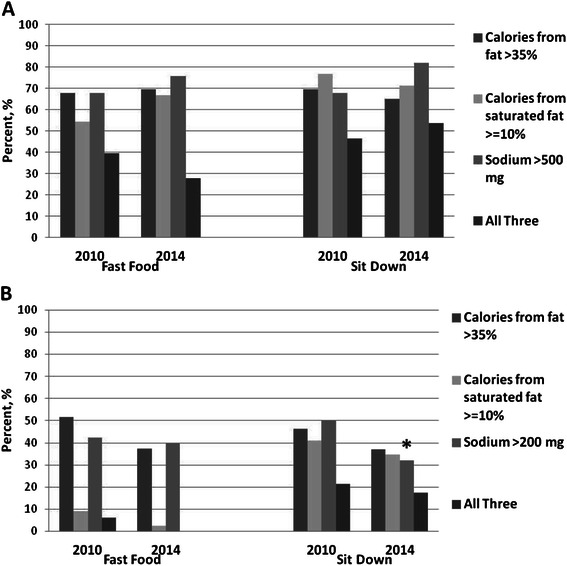
- Main dishes showed no significant average nutrient changes from 2010 to 2014, except fast-food main dishes had a lower mean percentage of calories from saturated fat in 2014 (14.4% to 12.0%, p < 0.05). In 2014, about 28% of fast-food and 54% of sit-down main dishes exceeded all three recommendations for fat, saturated fat, and sodium; 65–82% exceeded individual sodium, fat, or saturated-fat recommendations.
- Sit-down side dishes improved: 2014 side dishes averaged about 50 fewer calories (p = 0.03) and 125 mg less sodium (p = 0.03) than 2010. Added sit-down side dishes contained over 50% less calories, fat, saturated fat, and sodium and were more likely to contain fruits/vegetables than removed sides (p < 0.05 for all), but had less fiber (3.5 g removed vs 1.9 g added, p = 0.01).
- Fast-food side dishes had similar average nutrient content between 2010 and 2014, though added side dishes contained less saturated fat than removed side dishes (p = 0.05).
- Fruit/vegetable content of sit-down side dishes was 78.6% in 2014 versus 66.1% in 2010 (not statistically significant); fast-food side dishes were 48.5% in 2010 and 47.5% in 2014.
Methods
- The sample included 28 US restaurant chains from the top 50 in 2009 (13 sit-down and 15 fast-food per Methods; the abstract states 16 fast-food), after excluding buffets, pizza, convenience/snack chains, chains without separate children’s menus, and chains without posted nutrition information.
- Nutrition data were collected from restaurant websites in June–July 2010 and June–July 2014 for children’s main and side dishes. Items were categorized as added, removed, or unchanged.
- Descriptive statistics were calculated for calories, fat, percent calories from fat, saturated fat, percent calories from saturated fat, fiber, sodium, and fruit/vegetable presence. Differences were tested with t-tests and chi-square tests (p < 0.05), and proportions exceeding 2010 Dietary Guidelines thresholds were calculated.
Limitations
- The paper states that results depend on the accuracy and validity of nutrition information posted on restaurant websites, which may be under-reported and likely underestimates actual nutrient values; it also cannot account for additions after preparation or beverages consumed with meals, and cannot comment on parent/child purchasing behavior.
- The paper states that the federal menu-labeling law was delayed until December 2015, so the study only approximately captures the period from introduction to pending implementation.
- The paper states that five sit-down chains lacked complete nutrient data, so sample sizes vary for saturated fat, sodium, and fiber. Evident from the text: the abstract and Methods disagree on the number of fast-food chains (16 vs 15).
Model-written summary. Check it against the paper before relying on it.
Integrity signals
Registry
Cites
Statistics
Figures
Verification
Claims the paper makes
1 Valid · 0 Not valid · 10 Not checked · 29 Own results and interpretations
A result the paper reports from its own data — it cites no other source for it, so there is none to check. The quote shows it is in the paper.
In the paper
“Nutrient content of main dishes did not change significantly between 2010 and 2014.”
- Also stated in: § Main dishes · plain
“At both fast-food and sit down restaurant chains, the average nutrient content of main dishes did not substantially change between 2010 and 2014.”
- Also stated in: § Discussion · plain
“The nutrient content of main dishes offered at sit down and fast-food restaurant chains did not appreciably change and the nutrient content of removed and added main dishes was similar during the study time period.”
§ Comparison of the nutrient content of children’s menu items at US restaurant chains, 2010–2014 > Abstract > Results
plainn = 83- Asserted: passes — The authors put it forward as true.
- Checkable: passes — It can be checked against evidence.
- Load-bearing: passes — The paper’s conclusions depend on it.
- Based: passes — The paper gives a reason why it holds.
- Also stated in: § Main dishes · plain
A result the paper reports from its own data — it cites no other source for it, so there is none to check. The quote shows it is in the paper.
In the paper
“The nutrient contents of unchanged main dishes (n = 45 at fast-food restaurant chains and n = 83 at sit down restaurant chains) were nearly identical between 2010 and 2014 (data not shown).”
§ Comparison of the nutrient content of children’s menu items at US restaurant chains, 2010–2014 > Results > Main dishes
plainn = 45- Asserted: passes — The authors put it forward as true.
- Checkable: passes — It can be checked against evidence.
- Load-bearing: passes — The paper’s conclusions depend on it.
- Based: passes — The paper gives a reason why it holds.
A result the paper reports from its own data — it cites no other source for it, so there is none to check. The quote shows it is in the paper.
In the paper
“Overall, the proportion of side dishes at fast-food and sit down restaurant chains that exceeded recommendations for percent of calories from fat (>35 %), percent of calories from saturated fat (<=10 %), and sodium (<200 mg) decreased between 2010 and 2014.”
§ Comparison of the nutrient content of children’s menu items at US restaurant chains, 2010–2014 > Results > Side dishes
plainstates an association- Asserted: passes — The authors put it forward as true.
- Checkable: passes — It can be checked against evidence.
- Load-bearing: passes — The paper’s conclusions depend on it.
- Based: passes — The paper gives a reason why it holds.
A result the paper reports from its own data — it cites no other source for it, so there is none to check. The quote shows it is in the paper.
In the paper
“The only exception being that main dishes at fast-food restaurant chains had a lower mean percentage of calories from saturated fat in 2014 compared to 2010 (p < 0.05).”
§ Comparison of the nutrient content of children’s menu items at US restaurant chains, 2010–2014 > Results > Main dishes
plain- Asserted: passes — The authors put it forward as true.
- Checkable: passes — It can be checked against evidence.
- Load-bearing: unclear — It is unclear whether the paper’s conclusions depend on it.
- Based: passes — The paper gives a reason why it holds.
A result the paper reports from its own data — it cites no other source for it, so there is none to check. The quote shows it is in the paper.
In the paper
“The average nutrient content of side dishes offered at fast-food restaurant chains was similar between 2010 and 2014.”
§ Comparison of the nutrient content of children’s menu items at US restaurant chains, 2010–2014 > Results > Side dishes
plain- Asserted: passes — The authors put it forward as true.
- Checkable: passes — It can be checked against evidence.
- Load-bearing: unclear — It is unclear whether the paper’s conclusions depend on it.
- Based: passes — The paper gives a reason why it holds.
12 more claims
Create a free account to see all 40 claims and to verify the 13 references still open.
- It may state two separate claims as one. 20
- The quote only partly states this claim. 1
- Probably not a substantial claim. 9
Claims other papers make about this one
Each is checked against this paper’s own text: does it say what the citing paper says it does?
The source backs part of the claim, not all of it — or backs it for a different population, condition or comparison.
In the citing paper
“Restaurant food and beverages have been linked with overconsumption of calories, sodium, total fat, saturated fat, and sugar-sweetened beverages as well as under-consumption of milk, fruits, vegetables, and vitamins A and C in children [2, 4–7].”
From Child and parent perspectives on healthier side dishes and beverages in restaurant kids’ meals: results from a national survey in the United States (2018) · cites this paper as [4]
Experimental — accuracy not yet measuredThe source backs part of the claim, not all of it — or backs it for a different population, condition or comparison.
In the citing paper
“Recent changes to the food environment, such as more fruit and vegetable side dishes on US children’s menus and decreased soda consumption nationwide, may be helping to normalize healthier options, on restaurant menus, though these items have yet to become widespread [4, 32, 33].”
From Child and parent perspectives on healthier side dishes and beverages in restaurant kids’ meals: results from a national survey in the United States (2018) · cites this paper as [4]
Experimental — accuracy not yet measuredThe source backs part of the claim, not all of it — or backs it for a different population, condition or comparison.
In the citing paper
“These findings may reflect increased availability and accessibility of palatable, healthier options across settings (e.g. school, after school programs, restaurants) given that familiarity and repeated exposure help children learn to like and consume foods [4, 30, 31].”
From Child and parent perspectives on healthier side dishes and beverages in restaurant kids’ meals: results from a national survey in the United States (2018) · cites this paper as [4]
Experimental — accuracy not yet measuredThe cited source says what the claim attributes to it.
In the citing paper
“Recent evidence suggests that some restaurants are offering a larger number of healthy options on children’s menus than in the past, with menu additions that are lower in calories, fat, and sodium and/or higher in fruits and/or vegetables [4, 13].”
From Child and parent perspectives on healthier side dishes and beverages in restaurant kids’ meals: results from a national survey in the United States (2018) · cites this paper as [4]
The cited source says what the claim attributes to it.
In the citing paper
“Restaurant food and beverages have been linked with overconsumption of calories, sodium, total fat, saturated fat, and sugar-sweetened beverages as well as under-consumption of milk, fruits, vegetables, and vitamins A and C in children [2, 4–7].”
From Child and parent perspectives on healthier side dishes and beverages in restaurant kids’ meals: results from a national survey in the United States (2018) · cites this paper as [4]
Experimental — accuracy not yet measured
Self-check
Percentages, sums and reported differences re-computed from the paper’s own numbers.
Each contradiction between two passages listed here was confirmed by an independent check.
Rated minor: it would not touch a result — a value no result rests on, a p-value that stays on the same side of the significance level, or a conflict that is clerical, resolved elsewhere in the paper, or outside its own findings.
In the paper
§ Comparison of the nutrient content of children’s menu items at US restaurant chains, 2010–2014 > Results > Side dishes
“However, only the difference in saturated fat content at sit down restaurant chains was statistically significant; in 2010 approximately 50 % contained at least 10 % of calories from saturated fat compared to 32 % in 2014 (p = 0.04) (Fig. 1).”
§ Comparison of the nutrient content of children’s menu items at US restaurant chains, 2010–2014 > Results > Main dishes
“*p<0.05 comparing percent of side dishes exceeding recommendations for sodium content in 2010 and 2014”
Rated minor: it would not touch a result — a value no result rests on, a p-value that stays on the same side of the significance level, or a conflict that is clerical, resolved elsewhere in the paper, or outside its own findings.
In the paper
§ Comparison of the nutrient content of children’s menu items at US restaurant chains, 2010–2014 > Results > Side dishes
“| % of Calories from Saturated Fat | 11 | 4.6 (8.2) | 18 | 0.9 (1.7) | 15 | 12.6 (10.7) | 44 | 6.0 (8.8)* |”
§ Comparison of the nutrient content of children’s menu items at US restaurant chains, 2010–2014 > Results > Side dishes
“| Saturated Fat (g) | 11 | 0.68 (0.98) | 18 | 0.17 (0.34)* | 15 | 4.1 (4.1) | 39 | 1.5 (2.4)** |”
Citations
Cites
Dietary Guidelines for Americans, 2010
(2011) · Choice Reviews Online · doi:10.5860/choice.49-0615 · Cited by 1,553
Dietary Guidelines for Americans, 2010
Marshall, T. A. (2011) · The Journal of the American Dental Association · doi:10.14219/jada.archive.2011.0248 · Cited by 1,401
McGuire, S. (2011) · Advances in Nutrition · doi:10.3945/an.111.000430 · Cited by 1,028
The Patient Protection and Affordable Care Act
(2018) · Policy and Program Planning for Older Adults and People With Disabilities · doi:10.1891/9780826128393.0010 · Cited by 863
Powell, L. M., & Nguyen, B. T. (2013) · JAMA Pediatrics · doi:10.1001/jamapediatrics.2013.417 · Cited by 346 · cited 1×
“ets, contributing approximately 84–191 kcal and 160– 404 kcal to the mean daily intakes of children and adolescents, respectively, who reported being consumers [4].”
BackgroundBhattacharya, D., Aldus, C. F., Barton, G., Bond, C. M., Boonyaprapa, S., Charles, I. S., Fleetcroft, R., Holland, R., Jerosch‐Herold, C., Salter, C., et al. (2016) · Cited by 339
Osei-Assibey, G., Dick, S., Macdiarmid, J., Semple, S., Reilly, J. J., Ellaway, A., Cowie, H., & McNeill, G. (2012) · BMJ Open · doi:10.1136/bmjopen-2012-001538 · Cited by 188 · cited 1×
“The food environment plays an influential role in shaping the diets of children and may contribute to the development of obesity and other adverse health outcomes [1, 2].”
BackgroundPoti, J. M., Duffey, K. J., & Popkin, B. M. (2014) · The American Journal of Clinical Nutrition · doi:10.3945/ajcn.113.071928 · Cited by 175 · cited 1×
“5 % were high consumers, with more than 30 % of their daily calories coming from fast-food restaurants [5].”
BackgroundBruemmer, B., Krieger, J., Saelens, B. E., & Chan, N. (2012) · Journal of the Academy of Nutrition and Dietetics · doi:10.1016/j.jand.2012.04.019 · Cited by 135
What's on the menu? A review of the energy and nutritional content of US chain restaurant menus
Wu, H. W., & Sturm, R. (2013) · Public Health Nutrition · doi:10.1017/s136898001200122x · Cited by 108 · cited 4×
“In a study of 245 restaurant chains, only 11 % of main dishes and 33 % of sides offered on children’s menus met the KidsLiveWell standards (created by the National Restaurant Association) [15].”
BackgroundInfluentialFast-food menu offerings vary in dietary quality, but are consistently poor
Kirkpatrick, S. I., Reedy, J., Kahle, L. L., Harris, J. L., Ohri-Vachaspati, P., & Krebs-Smith, S. M. (2014) · Public Health Nutrition · doi:10.1017/s1368980012005563 · Cited by 90 · cited 1×
“menus at restaurant chains [15–18].”
Accuracy of Stated Energy Contents of Restaurant Foods
Urban, L. E., McCrory, M. A., Dallal, G. E., Das, S. K., Saltzman, E., Weber, J. L., & Roberts, S. B. (2011) · JAMA · doi:10.1001/jama.2011.993 · Cited by 79
Nutritional Quality of Foods At and Away From Home
Lin, B., Frazão, E., Lin, B.-H., & Frazao, E. (1997) · RePEc: Research Papers in Economics · doi:10.22004/ag.econ.234485 · Cited by 71
Dodds, P., Wolfenden, L., Chapman, K., Wellard, L., Hughes, C., & Wiggers, J. (2014) · Appetite · doi:10.1016/j.appet.2013.10.013 · Cited by 63
Poor Nutrition on the Menu: Children’s Meals at America’s Top Chain Restaurants
Batada, A., Bruening, M., Marchlewicz, E. H., Story, M., & Wootan (2012) · Childhood Obesity · doi:10.1089/chi.2012.0016 · Cited by 61 · cited 1×
“The study found that 91 % of the meals did not meet the KidsLiveWell standards and over a quarter of the restaurants did not have any meals that met these standards [3].”
BackgroundStein, K. (2010) · Journal of the American Dietetic Association · doi:10.1016/j.jada.2010.07.017 · Cited by 55
Namba, A., Auchincloss, A., Leonberg, B. L., & Wootan, M. G. (2013) · Preventing Chronic Disease · doi:10.5888/pcd10.120224 · Cited by 51
Changes in the Energy and Sodium Content of Main Entrées in US Chain Restaurants from 2010 to 2011
Wu, H. W., & Sturm, R. (2014) · Journal of the Academy of Nutrition and Dietetics · doi:10.1016/j.jand.2013.07.035 · Cited by 48
Comparison of Fast-Food and Non-Fast-Food Children's Menu Items
Serrano, E. L., & Jedda, V. B. (2009) · Journal of Nutrition Education and Behavior · doi:10.1016/j.jneb.2008.02.005 · Cited by 37 · cited 1×
“This observation has been reported previously and is likely due to larger portion sizes served at sit down compared to fast-food restaurant chains [19].”
BackgroundFries or a fruit bag? Investigating the nutritional composition of fast food children’s meals
Wellard‐Cole, L., Glasson, C., & Chapman, K. L. (2011) · Appetite · doi:10.1016/j.appet.2011.09.024 · Cited by 36 · cited 1×
“menus at restaurant chains [15–18].”
Hobin, E. P., White, C. A., Li, Y., Chiu, M., O'Brien, M. F., & Hammond, D. G. (2013) · Public Health Nutrition · doi:10.1017/s1368980013002498 · Cited by 35 · cited 1×
“menus at restaurant chains [15–18].”
Neighborhood Influences on Girls’ Obesity Risk Across the Transition to Adolescence
Hoyt, L. T., Kushi, L. H., Leung, C. W., Nickleach, D. C., Adler, N., Laraia, B. A., Hiatt, R. A., & Yen, I. H. (2014) · Pediatrics · doi:10.1542/peds.2014-1286 · Cited by 26 · cited 1×
“The food environment plays an influential role in shaping the diets of children and may contribute to the development of obesity and other adverse health outcomes [1, 2].”
Background
Cited by
Cantu-Jungles, T. M., McCormack, L. A., Slaven, J. E., Slebodnik, M., & Eicher‐Miller, H. A. (2017) · Nutrients · doi:10.3390/nu9101088 · Cited by 97
“Main and side dishes at sit down and fast-food restaurant chains consistently contained high amounts of fat, saturated fat and sodium, and low amounts of fiber and fruits/vegetables [26].”
BackgroundMcCrory, M. A., Harbaugh, A. G., Appeadu, S., & Roberts, S. B. (2019) · Journal of the Academy of Nutrition and Dietetics · doi:10.1016/j.jand.2018.12.004 · Cited by 65
“However, they are not in agreement with studies that reported on a limited number of foods(38,39) or over a shorter period of time.(32,40) Over 80% of Americans consume sodium at or above the recommendation level.”
ResultTrends in Nutrient Content of Children’s Menu Items in U.S. Chain Restaurants
Moran, A. J., Block, J. P., Goshev, S., Bleich, S. N., & Roberto, C. A. (2017) · American Journal of Preventive Medicine · doi:10.1016/j.amepre.2016.11.007 · Cited by 56
“Between 2011 and 2013, McDonald’s replaced French fries and soda in Happy Meals with fruit and lowfat milk.6 Between 2013 and 2015, large national chains, including Applebee’s, Subway, Chipotle, Arby’s, Panera Bread, Wendy’s, and Burger King, announced they would remove soda as the default choice on children’s menus.7…”
Trends in Sodium Content of Menu Items in Large Chain Restaurants in the U.S.
Wolfson, J. A., Moran, A. J., Jarlenski, M., & Bleich, S. N. (2017) · American Journal of Preventive Medicine · doi:10.1016/j.amepre.2017.08.018 · Cited by 42
Theis, D. R. Z., & Adams, J. M. (2019) · PLoS ONE · doi:10.1371/journal.pone.0222773 · Cited by 42
Metadata
- Authors
- Deierlein, A. L., Peat, K., & Claudio, L.
- Affiliations
- Icahn School of Medicine at Mount Sinai (US)
- City University of New York (US)
- Corresponding author
- Deierlein, Andrea L.
- ORCID
- Deierlein, Andrea L.
- Venue
- Nutrition Journal
- Published
- 2015-08-15
- Volume
- 14
- Issue
- 1
- Pages
- 80-80
- ISSN
- 1475-2891 (ISSN-L)
- PMC
- PMC4536860
- OpenAlex
- W1764059258
- Cited by
- 25
- References
- 22
- Citations by year
- 2024: 1 · 2023: 3 · 2022: 2 · 2021: 4 · 2020: 2 · 2019: 7 · 2018: 1 · 2017: 5
- FWCI
- 2.14
- Type
- journal article
- Language
- en
- Open access
- gold
- doi.org
- Locations
- Nutrition Journal (publishedVersion, cc-by)
- PubMed Central (publishedVersion, cc-by)
- PubMed (publishedVersion)
- CUNY Academic Works (City University of New York) (submittedVersion)
- Funders
- National Heart, Lung, and Blood Institute (R25HL108857)
- National Institute of Environmental Health Sciences (T35ES007298)
- Eunice Kennedy Shriver National Institute of Child Health and Human Development (T32HD049311)
- Topics
- Health Sciences › Medicine › Public Health, Environmental and Occupational Health › Obesity, Physical Activity, Diet
- Health Sciences › Nursing › Nutrition and Dietetics › Nutrition, Health and Food Behavior
- Health Sciences › Medicine › Public Health, Environmental and Occupational Health › Consumer Attitudes and Food Labeling
- Keywords
- restaurant chains, fast food, sit-down restaurants, nutrient content, sodium, saturated fat, dietary fat, calories, side dishes, main dishes, Dietary Guidelines for Americans, menu changes, child nutrition
- MeSH terms
- Energy Intake, Child, Fatty Acids, Food Analysis, Food Labeling, Fruit, Humans, Nutritive Value, Restaurants, Sodium, Dietary, United States, Vegetables, Nutrition Policy, Fast Foods
About these checks
Registry, retraction, Cites and statistics results are computed, not judged, with one exception: a printed reference that no index lists is read once by a model before it counts as a citation error. Claims are extracted by a model and kept only when their quote appears verbatim in the text; each cited source is then checked, with a model’s help, for whether it says what the claim relies on. Those verdicts can be wrong — read the claim’s quote and the cited source before relying on one.
The claim verdicts this report counts are experimental: their accuracy is not yet measured.
A language model drew the claims from the paper on 2026-09-30, under version 3 of the claim definition (model deepseek-v4.1-flash, prompt extract-v3).
A second model labelled each claim on 2026-09-30 (model jev-1.13-20260917, definition revision gold-guideline-v0.2).
Statistics and arithmetic are recomputed, not judged.
Confidence bands are shown only for fields calibrated on our annotated test set. None is calibrated yet, so no band is shown.
What counts as a claim ›How we measure confidence ›How we check this ›
Are you an author, or do you see a problem with this page? Request a review
Data sources
Bibliographic data: Semantic Scholar, OpenAlex, Crossref.
Contains information from the Semantic Scholar Academic Graph Datasets, made available under the ODC Attribution License (ODC-BY 1.0).
Semantic Scholar’s data is described in: Kinney, R., et al. (2023). The Semantic Scholar Open Data Platform. arXiv:2301.10140.
