

Burnout in nursing: a theoretical review.
Open accessThe DOI matches its Crossref record; 113 of the 115 references it cites were found in a registry or an index; 27 of the 261 sources its claims cite were checked for support.
Abstract
BACKGROUND: Workforce studies often identify burnout as a nursing 'outcome'. Yet, burnout itself-what constitutes it, what factors contribute to its development, and what the wider consequences are for individuals, organisations, or their patients-is rarely made explicit. We aimed to provide a comprehensive summary of research that examines theorised relationships between burnout and other variables, in order to determine what is known (and not known) about the causes and consequences of burnout in nursing, and how this relates to theories of burnout. METHODS: We searched MEDLINE, CINAHL, and PsycINFO. We included quantitative primary empirical studies (published in English) which examined associations between burnout and work-related factors in the nursing workforce. RESULTS: Ninety-one papers were identified. The majority (n = 87) were cross-sectional studies; 39 studies used all three subscales of the Maslach Burnout Inventory (MBI) Scale to measure burnout. As hypothesised by Maslach, we identified high workload, value incongruence, low control over the job, low decision latitude, poor social climate/social support, and low rewards as predictors of burnout. Maslach suggested that turnover, sickness absence, and general health were effects of burnout; however, we identified relationships only with general health and sickness absence. Other factors that were classified as predictors of burnout in the nursing literature were low/inadequate nurse staffing levels, ≥ 12-h shifts, low schedule flexibility, time pressure, high job and psychological demands, low task variety, role conflict, low autonomy, negative nurse-physician relationship, poor supervisor/leader support, poor leadership, negative team relationship, and job insecurity. Among the outcomes of burnout, we found reduced job performance, poor quality of care, poor patient safety, adverse events, patient negative experience, medication errors, infections, patient falls, and intention to leave. CONCLUSIONS: The patterns identified by these studies consistently show that adverse job characteristics-high workload, low staffing levels, long shifts, and low control-are associated with burnout in nursing. The potential consequences for staff and patients are severe. The literature on burnout in nursing partly supports Maslach's theory, but some areas are insufficiently tested, in particular, the association between burnout and turnover, and relationships were found for some MBI dimensions only.
Overview
CoChat Summary
TL;DR
This theoretical review of 91 quantitative studies found adverse job characteristics—high workload, low staffing levels, long shifts, and low control—are consistently associated with burnout in nursing, with severe potential consequences for staff and patients. The literature partly supports Maslach’s theory, but incomplete burnout measurement and mostly cross-sectional designs limit causal inference.
Key findings
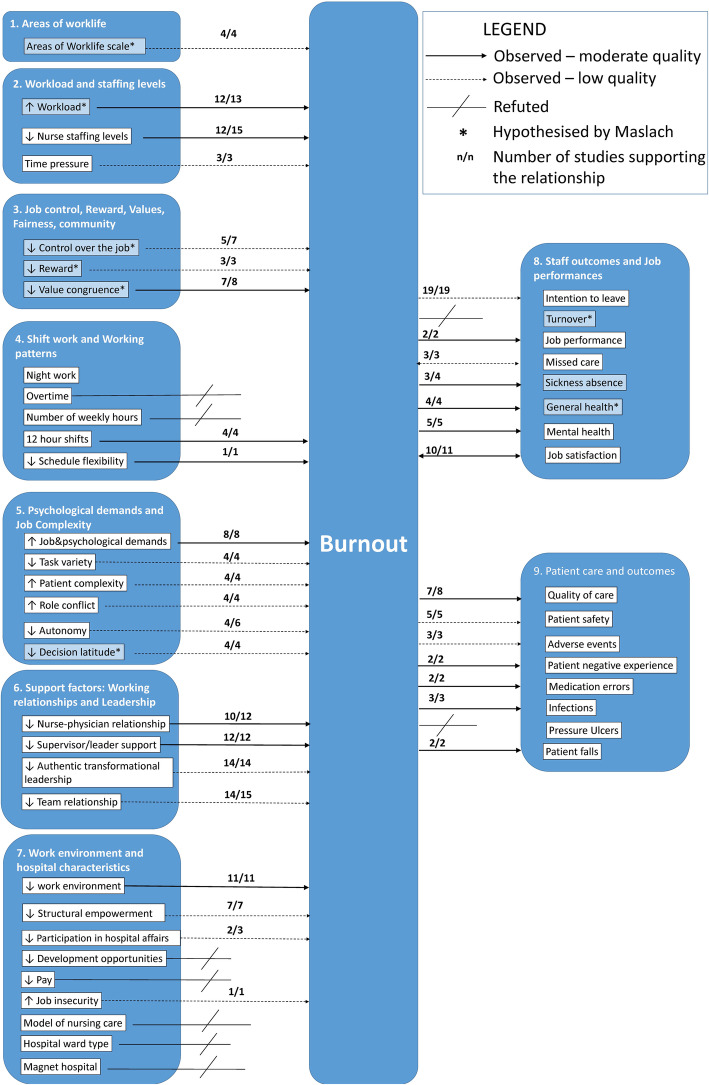
- Across 91 studies, high workload was supported in 12/13 studies, low/inadequate nurse staffing in 12/15, ≥12-h shifts in 4/4, low control over the job in 5/7, low reward in 3/3, low value congruence in 7/8, low decision latitude in 4/4, poor supervisor/leader support in 12/12, negative team relationship in 14/15, and intention to leave in 19/19.
- Burnout was associated with reduced job performance (2/2), poor quality of care (7/8), poor patient safety (5/5), adverse events (3/3), medication errors (2/2), infections (3/3), and patient falls (2/2); no association was found with pressure ulcers. Turnover was refuted despite being hypothesised by Maslach, with only one small study finding Depersonalisation associated with turnover within 2 years.
- Most studies used the Maslach Burnout Inventory (n = 81), but only 39 (47%) measured and reported all three MBI subscales; 23 used Emotional Exhaustion only, 11 used Emotional Exhaustion and Depersonalisation, and 9 summed the three subscales despite advice against this. Maslach’s hypothesised predictors were generally supported, but often only for some MBI dimensions.
Methods
- Theoretical review conducted according to Campbell et al. and Pare et al.; systematic search of MEDLINE, CINAHL, and PsycINFO in May 2019 for English quantitative primary empirical studies examining associations between burnout and work-related factors or outcomes in nurses or nursing assistants in healthcare settings. Studies focused exclusively on personal factors, only comparing burnout levels across settings, or literature reviews, commentaries, and editorials were excluded.
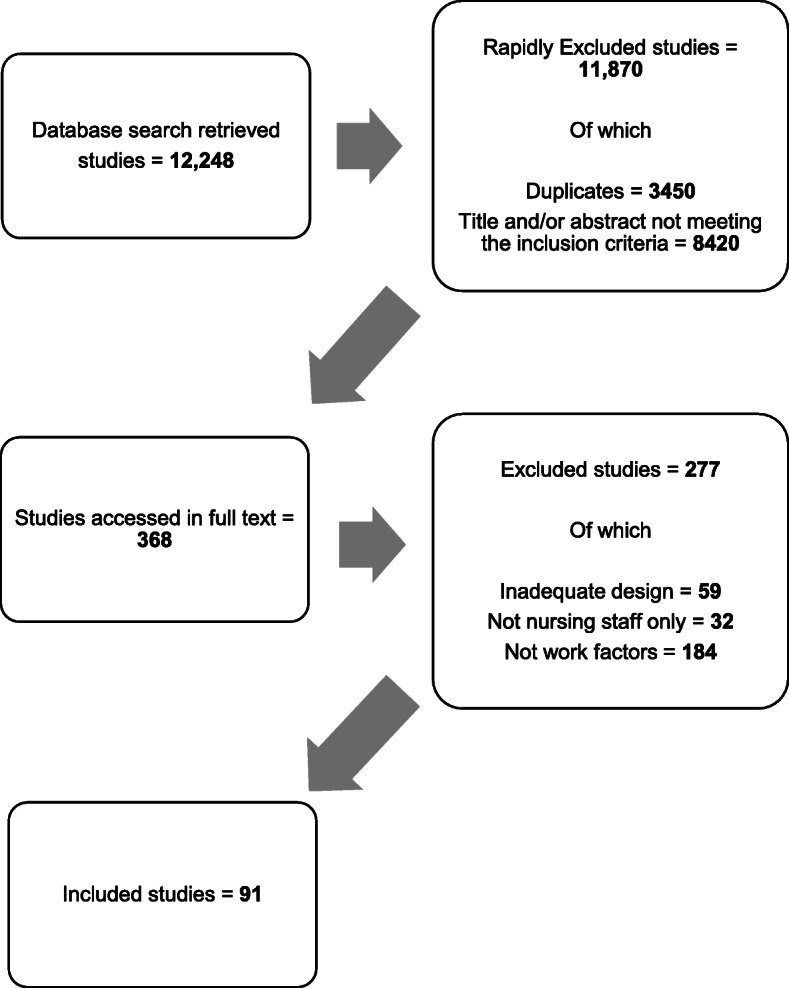
- The search yielded 12,248 records; 368 full texts were accessed, and 91 studies were included. Data were extracted on country, setting, sample size, staff group, burnout measure, variables tested, and findings; a coding frame starting from Maslach’s multidimensional theory produced nine broad categories. No formal quality appraisal was performed, but key quality aspects were summarised.
Limitations
- Stated by the authors: no formal quality appraisal instrument was applied; studies were reported without context or estimates such as ORs and 95% CIs; personality and other individual variables were not considered in data extraction; and studies indexed elsewhere or grey literature may have been missed.
- Evident from the text: 87/91 studies (97%) were cross-sectional, limiting temporal and causal inference and creating simultaneity bias, with factors such as missed care, job satisfaction, and mental health treated as both predictors and outcomes. Incomplete MBI measurement—only 39/91 studies used all three subscales, and 9 summed subscales—further limits testing of Maslach’s theory.
Model-written summary. Check it against the paper before relying on it.
Integrity signals
Registry
Cites
Statistics
Figures
Verification
Claims the paper makes
24 Valid · 3 Not valid · 199 Not checked · 100 Own results and interpretations
The sources with a verdict support this claim; the rest weren’t checked yet, have no full text we could read, or their verdicts aren’t rated yet.
In the paper
“high psychological demands were associated with higher odds of Emotional Exhaustion [62, 78]”
§ Burnout in nursing: a theoretical review > Results > Psychological demands and job complexity
What the sources say
- Supportedcites [62] Vidotti V Ribeiro RP Galdino MJQ Martins JT Burnout syndrome and shift work among the nursing staff Rev Lat Am Enfermagem 2018 26 e3022 30110099 PMC6091368 source
The Method section identifies psychological demands as a dimension of the Demand-Control-Support Questionnaire. In Results, Table 3 reports that high demand was associated with higher odds of emotional exhaustion among day-shift nursing staff (adjusted OR 2.50, 95% CI 1.44–4.35). The reported association is specific to the day shift. (LLM, conf=0.91)
- Not checked — no full text of the sourcecites [78] Bourbonnais R Comeau M Vezina M Dion G Job strain, psychological distress, and burnout in nurses Am J Ind Med 1998 34 1 20 28 9617384 doi:10.1002/(sici)1097-0274(199807)34:1
plainstates an association- Asserted: passes — The authors put it forward as true.
- Checkable: passes — It can be checked against evidence.
- Load-bearing: passes — The paper’s conclusions depend on it.
- Based: passes — The paper gives a reason why it holds.
- Supported
The cited sources support only part of this claim — read each source’s verdict below.
In the paper
“and Emotional Exhaustion and Personal Accomplishment [50]”
§ Burnout in nursing: a theoretical review > Results > Working relationships and leadership
What the sources say
- Partly supportedcites [50] Hanrahan NP Aiken LH McClaine L Hanlon AL Relationship between psychiatric nurse work environments and nurse burnout in acute care general hospitals Issues Ment Health Nurs 2010 31 3 198 207 20144031 PMC2856615 sourceExperimental — accuracy not yet measured
The Discussion (‘Strong Mangers and Leaders’) reports a significant relationship between manager skill and emotional exhaustion. The Results state that none of the work-environment factors, including manager skill, were associated with personal accomplishment in the adjusted or unadjusted models. The claim is therefore supported for emotional exhaustion but not personal accomplishment. (LLM, conf=0.92)
plainstates an association- Asserted: passes — The authors put it forward as true.
- Checkable: passes — It can be checked against evidence.
- Load-bearing: unclear — It is unclear whether the paper’s conclusions depend on it.
- Based: passes — The paper gives a reason why it holds.
- Partly supported
Every source the paper cites for this claim was checked and supports it.
In the paper
“The inability to establish a temporal link means limits the inference of causality [115].”
§ Burnout in nursing: a theoretical review > Discussion
What the sources say
- Supportedcites [115] Antonakis J Bendahan S Jacquart P Lalive R On making causal claims: a review and recommendations Leadersh Q 2010 21 6 1086 1120 source
Section 1, “What is Causality?”, lists temporal precedence as a condition for measuring a causal effect and explicitly calls temporal ordering necessary but not sufficient. Thus, inability to establish temporal order limits causal inference. (LLM, conf=0.93)
plain- Asserted: passes — The authors put it forward as true.
- Checkable: passes — It can be checked against evidence.
- Load-bearing: passes — The paper’s conclusions depend on it.
- Based: passes — The paper gives a reason why it holds.
- Supported
The sources with a verdict support this claim; the rest weren’t checked yet, have no full text we could read, or their verdicts aren’t rated yet.
In the paper
“| Night work | | | √ | |”
- Also stated in: § Working patterns and shift work · plain
“Working night shifts was associated with burnout (composite score) [68] and Emotional Exhaustion [62], but the relationship was not significant in two studies [69, 70].”
§ Burnout in nursing: a theoretical review > Results
What the sources say
- Not checked — no full text of the sourcecites [68] Anwar MM Elareed HR Burnout among Egyptian nurses Journal of Public Health-Heidelberg 2017 25 6 693 697 source
- Supportedcites [62] Vidotti V Ribeiro RP Galdino MJQ Martins JT Burnout syndrome and shift work among the nursing staff Rev Lat Am Enfermagem 2018 26 e3022 30110099 PMC6091368 source
The Results (Table 2) show that the relationship between work shift and burnout differs across dimensions: emotional exhaustion and professional realization differ significantly by shift, while depersonalization does not. The Discussion also reports higher overall burnout levels among day-shift than night-shift nursing staff. This supports the claim that night work is not consistently associated with burnout. (LLM, conf=0.86)
- Not checked — no full text of the sourcecites [69] Wisetborisut A Angkurawaranon C Jiraporncharoen W Uaphanthasath R Wiwatanadate P Shift work and burnout among health care workers Occup Med (Lond) 2014 64 4 279 286 24550196 source
- Not checked — no full text of the sourcecites [70] Ilhan MN Durukan E Taner E Maral I Bumin MA Burnout and its correlates among nursing staff: questionnaire survey J Adv Nurs 2008 61 1 100 106 18034813 source
plain- Asserted: passes — The authors put it forward as true.
- Checkable: passes — It can be checked against evidence.
- Load-bearing: unclear — It is unclear whether the paper’s conclusions depend on it.
- Based: passes — The paper gives a reason why it holds.
- Also stated in: § Working patterns and shift work · plain
Every source the paper cites for this claim was checked and supports it.
In the paper
“Long shifts of 12 h or more were associated with all MBI subscales [74]”
§ Burnout in nursing: a theoretical review > Results > Working patterns and shift work
What the sources say
- Supportedcites [74] Dall’Ora C Griffiths P Ball J Simon M Aiken LH Association of 12 h shifts and nurses’ job satisfaction, burnout and intention to leave: findings from a cross-sectional study of 12 European countries BMJ Open 2015 5 9 e008331 26359284 PMC4577950 source
The Measurements section identifies the three MBI subscales as emotional exhaustion, depersonalisation and personal accomplishment. The Discussion explicitly reports an association between shifts of 12 hours or more and all three subscales; the Shift length and nurse outcomes section reports the corresponding adjusted results. (LLM, conf=0.95)
plainstates an association- Asserted: passes — The authors put it forward as true.
- Checkable: passes — It can be checked against evidence.
- Load-bearing: passes — The paper’s conclusions depend on it.
- Based: passes — The paper gives a reason why it holds.
- Supported
201 more claims · 15 with their cited sources checked
Create a free account to see all 326 claims and to verify the 23 references still open.
- Probably not a substantial claim. 64
- It may state two separate claims as one. 72
- The quote only partly states this claim. 2
Claims other papers make about this one
Each is checked against this paper’s own text: does it say what the citing paper says it does?
The source backs part of the claim, not all of it — or backs it for a different population, condition or comparison.
In the citing paper
“Burnout among HPs is significantly associated with suicidal ideation [7], decreased job satisfaction [8], and increased turnover intention, ultimately resulting in a loss of HPs and deterioration in the quality of care, which is also negatively affected, as is patient safety and health status [9,10,11].”
From Effects of Third-Wave Cognitive Behavioral Therapy for Healthcare Professionals’ Burnout: A Systematic Review and Meta-Analysis (2025) · cites this paper as [9]
Experimental — accuracy not yet measuredThe source backs part of the claim, not all of it — or backs it for a different population, condition or comparison.
In the citing paper
“Reducing EE and DP may also contribute to improved workforce retention and lower absenteeism, ultimately benefiting healthcare providers and enhancing patient safety and care quality [9,10,11].”
From Effects of Third-Wave Cognitive Behavioral Therapy for Healthcare Professionals’ Burnout: A Systematic Review and Meta-Analysis (2025) · cites this paper as [9]
Experimental — accuracy not yet measuredThe cited source says what the claim attributes to it.
In the citing paper
“Last but not the least, some other organizational factors may also affect burnout, such as excessive workload, time pressure, high job demands, low rewards, low job autonomy, or negative team atmosphere [13].”
From The efficacy of applying the Interpersonal Effectiveness skills of dialectical behavior therapy into communication skills workshop for clinical nurses (2023) · cites this paper as [13]
Self-check
Percentages, sums and reported differences re-computed from the paper’s own numbers.
Each contradiction between two passages listed here was confirmed by an independent check.
Rated minor: it would not touch a result — a value no result rests on, a p-value that stays on the same side of the significance level, or a conflict that is clerical, resolved elsewhere in the paper, or outside its own findings.
In the paper
“The database search yielded 12 248 studies, of which 11 870 were rapidly excluded as either duplicates or titles and/or abstract not meeting the inclusion criteria. Of the 368 studies accessed in full text, 277 were excluded, and 91 studies were included in the review.”
§ Burnout in nursing: a theoretical review > Results
Reported 368 · recomputed 378
Rated minor: it would not touch a result — a value no result rests on, a p-value that stays on the same side of the significance level, or a conflict that is clerical, resolved elsewhere in the paper, or outside its own findings.
In the paper
§ Burnout in nursing: a theoretical review > Results
“| Overtime | | | √ | |”
§ Burnout in nursing: a theoretical review > Results > Working patterns and shift work
“One study found working that overtime was associated with composite MBI score [73].”
Rated minor: it would not touch a result — a value no result rests on, a p-value that stays on the same side of the significance level, or a conflict that is clerical, resolved elsewhere in the paper, or outside its own findings.
In the paper
“Most studies used the Maslach Burnout Inventory Scale (n = 81), which comprises three subscales reflecting the theoretical model: Emotional Exhaustion, Depersonalisation, and reduced Personal Accomplishment. However, less than half (47%, n = 39) of the papers measured and reported results with all three subscales.”
§ Burnout in nursing: a theoretical review > Results > Measures of burnout
Reported 47 · recomputed 48.148148
Citations
Cites
The measurement of experienced burnout
Maslach, C., & Jackson, S. E. (1981) · Journal of Organizational Behavior · doi:10.1002/job.4030020205 · Cited by 14,496
The job demands-resources model of burnout.
Demerouti, E., Bakker, A. B., Nachreiner, F., & Schaufeli, W. B. (2001) · Journal of Applied Psychology · doi:10.1037/0021-9010.86.3.499 · Cited by 13,643
Maslach, C., Schaufeli, W. B., & Leiter, M. P. (2001) · Annual Review of Psychology · doi:10.1146/annurev.psych.52.1.397 · Cited by 12,852
(1996) · Consulting Psychologists Press eBooks · Cited by 7,863
Freudenberger, H. J. (1974) · Journal of Social Issues · doi:10.1111/j.1540-4560.1974.tb00706.x · Cited by 5,463
Hospital Nurse Staffing and Patient Mortality, Nurse Burnout, and Job Dissatisfaction
Aiken, L. H. (2002) · JAMA · doi:10.1001/jama.288.16.1987 · Cited by 5,226
The Copenhagen Burnout Inventory: A new tool for the assessment of burnout
Kristensen, T. S., Borritz, M., Villadsen, E., & Christensen, K. B. (2005) · Work & Stress · doi:10.1080/02678370500297720 · Cited by 3,136
On making causal claims: A review and recommendations
Antonakis, J., Bendahan, S., Jacquart, P., & Lalive, R. (2010) · The Leadership Quarterly · doi:10.1016/j.leaqua.2010.10.010 · Cited by 2,441
Synthesizing information systems knowledge: A typology of literature reviews
Paré, G., Trudel, M.-C., Jaana, M., & Kitsiou, S. (2015) · Information & Management · doi:10.1016/j.im.2014.08.008 · Cited by 1,987
Burnout: 35 years of research and practice.
Schaufeli, W. B., Leiter, M. P., & Maslach, C. (2009) · Career Development International · doi:10.1108/13620430910966406 · Cited by 1,964
Research works printed but not linked: 4
- Ekstedt M Burnout and sleep: Institutionen för folkhälsovetenskap/Department of Public Health Sciences 2005
- Cherniss C Burnout in new professionals: a long-term follow-up study J Health Hum Resour Adm 1989 12 1 11 24
- Adali E Priami M Evagelou H Mougia V Ifanti M Alevizopoulos G Burnout in psychiatric nursing personnel in Greek hospitals European Journal of Psychiatry 2003 17 3 173 181
- Laschinger HKS Shamian J Thomson D Impact of magnet hospital characteristics on nurses’ perceptions of trust, burnout, quality of care, and work satisfaction Nurs Econ 2001 19 5 209 219
Cited by
Items 901–1,000 of 1,160
Burnout prevalence and associated factors among nurses in Birtamode, Nepal: a cross-sectional studyPreprint
Dawadi, B., Joshi, Y. P., van Teijlingen, E., & Sitoula, R. K. (2025) · Research Square · doi:10.21203/rs.3.rs-6094192/v1 · Cited by 1
Sağlık Çalışanlarında Mesleki Tükenme: Görsel Haritalama Tekniği ile Bibliyometrik Bir Analiz
ÖZEN, M. Y., & Seda, U. Y. A. R. (2025) · Abant Sosyal Bilimler Dergisi · doi:10.11616/asbi.1453291
Professional burnout among hematopoietic stem cell transplant nurses: a scoping review
de Azevedo, V. D., de Oliveira, J. S. A., dos Santos, T. A., de Souza, L. B. F., Sales, A. D. B. R. P., Sátiro, L. S. P., Santos, V. E. P., & de Azevedo, I. C. (2025) · Acta Paulista de Enfermagem · doi:10.37689/acta-ape/2025ar0002172i
de Azevedo, V. D., de Oliveira, J. S. A., dos Santos, T. A., de Souza, L. B. F., Sales, A. D. B. R. P., Sátiro, L. S. P., Santos, V. E. P., & de Azevedo, I. C. (2025) · Acta Paulista de Enfermagem · doi:10.37689/acta-ape/2025ar0002172 · Cited by 2
Enhancing Nurses' Professional Quality of Life: A Psycho-Educational Intervention Study
Khalid, Z., & Schwaiger, E. (2025) · Pakistan BioMedical Journal · doi:10.54393/pbmj.v8i3.1167
Gil‐Almagro, F., García-Hedrera, F. J., Carmona-Monge, F. J., & Peñacoba, C. (2025) · Enfermería Intensiva (English ed ) · doi:10.1016/j.enfie.2025.500524 · Cited by 1
Zhu, S., & Feliciano, A. Z. (2025) · International Journal of Public Health and Medical Research · doi:10.62051/ijphmr.v3n2.05
“This study reflects that work pressure affects nursing services and is not conducive to providing better nursing care to patients, as it can easily lead to occupational burnout (J et al., 2020).”
Zheng, S., Li, T., Han, M., & Wu, M. (2025) · International Theory and Practice in Humanities and Social Sciences · doi:10.70693/itphss.v2i4.321 · Cited by 1
Juneja, S., Nah, R., & Heath, J. (2025) · British Journal of Mental Health Nursing · doi:10.12968/bjmh.2023.0034 · Cited by 4
Decent Work Conditions and Nigerian Nurse Emigration: The Role of Burnout and CommitmentPreprint
Ajayi, D. O., Tanova, C., Bayighomog, S. W., et al. (2025) · SSRN Electronic Journal · doi:10.2139/ssrn.5248601
A Study on the Relationship Between Personality Traits and Job Satisfaction of Nurses
George, J. (2025) · Advances in human resources management and organizational development book series · doi:10.4018/979-8-3693-3791-2.ch006
Wells, L. K., Bullock, A. F., & Killingback, C. (2025) · Journal of Further and Higher Education · doi:10.1080/0309877x.2025.2501599 · Cited by 2
Artar, M., & Balcıoğlu, Y. S. (2025) · SSRN Electronic Journal · doi:10.2139/ssrn.5256523
Oluoch, D., Odinga, N., Waithira, C., et al. (2025) · SSRN Electronic Journal · doi:10.2139/ssrn.5252685
Why not become a teacher? Undergraduate students’ perceptions and implications for recruitment
Pleasants, J. (2025) · Teachers and Teaching · doi:10.1080/13540602.2025.2507246
“Students also have concerns about the working conditions for teachers, but teaching is far from the only professional career with stressful work environments (e.g. Dall’ora et al., 2020).”
Addressing Burnout and Supporting Mental Health in Laboratory Medicine
Kawam, A. (2025) · Clinics in Laboratory Medicine · doi:10.1016/j.cll.2025.04.005
Maloles, C. (2025) · International Journal For Multidisciplinary Research · doi:10.36948/ijfmr.2025.v07i03.46123
Self-Care, Burnout, Job Satisfaction, and Performance Among Nurses in Government Hospitals
Cubillan, D., & Digamon, J. S. (2025) · Psychology and Education A Multidisciplinary Journal · doi:10.70838/pemj.391002 · Cited by 2
Nurses’ Work Methods Assessment Scale: Turkish Validity and Reliability Study
Uysal, D., Demirsoy, N., Türe, A., Bıyık, M., Trindade, L. D. L., Ribeiro, O. M. P. L., & Silva, J. M. A. V. (2025) · Nursing Reports · doi:10.3390/nursrep15060220
“Well-organized workflows and balanced workloads reduce nurse stress and protect against burnout [13].”
Vigo, K., Kaplon, A., & DeMarco, K. (2025) · Journal of Holistic Nursing · doi:10.1177/08980101251350022
“In reviewing 95 studies, Dall ’ Ora et al. (2020), consistently found that adverse job characteristics — "high workload, low staf fi ng levels, long shifts, low control, low schedule fl exibility, time pressure, high job and psychological demands, low task variety, role con fl ict, low autonomy,…”
Scherr, A. E. S., Kellogg, M. B., & Ayotte, B. J. (2025) · Worldviews on Evidence-Based Nursing · doi:10.1111/wvn.70052 · Cited by 1
Identifying, managing and preventing nurse burnout in the emergency department
Brennan, E. (2025) · Emergency Nurse · doi:10.7748/en.2025.e2234 · Cited by 2
Farès, Z., & Hasbaoui, A. (2025) · Archives des maladies professionnelles et de médecine du travail/Archives des maladies professionnelles et de l'environnement · doi:10.1016/j.admp.2025.102864
Problems of development of nursing human resources in the world Information about the authors
Ostrovskaya, I. (2025) · Meditsinskaya sestra · doi:10.29296/25879979-2025-04-07
Christianson, J., Sommers-Olson, B., Leiberg, J., & Kaminstein, D. S. (2025) · Witness The Canadian Journal of Critical Nursing Discourse · doi:10.25071/2291-5796.170 · Cited by 2
Burnout and resilience among moroccan healthcare professionals: a comprehensive multi-hospital study
Guider, H., Jaouhar, S., Bouzid, J., Fadil, W., Himmouche, N., Cigarroa, I., Alaiki, A. E., Hilali, A., Hami, H., & Hadrya, F. (2025) · Jurnal NERS · doi:10.20473/jn.v20i2.65721
Mthembu, N. B. C., Khumalo, N. B., & Ngidi, L. Z. (2025) · International Journal of Applied Research in Business and Management · doi:10.51137/wrp.ijarbm.2025.nmsb.45834 · Cited by 1
Behaghel, A., Jean, E., Cipel, H., Manolios, É., Ponsard, C., Révah‐Levy, A., & Sibéoni, J. (2025) · Journal of Psychiatric and Mental Health Nursing · doi:10.1111/jpm.70011 · Cited by 1
“These elements are also inversely correlated with nurse burnout, as shown in the literature (Dall'Ora et al. 2020).”
Aşkan, F., Yürük, E., Todil, T., Kara, M., Şata, M., Turgut, M. A., & Çelik, B. (2025) · SSRN Electronic Journal · doi:10.2139/ssrn.5346709
Sassanti, S. W., Wihastuti, T. A., & Ismail, D. D. S. L. (2025) · Journal of Applied Nursing and Health · doi:10.55018/janh.v7i2.349
Health Care Workers and Burnout: A Cross-Sectional Study
Vidal, C., Stennett, A., Leaf, P. J., Rahman, N. K., Ryan, L. M., & Irvin, N. A. (2025) · AJN American Journal of Nursing · doi:10.1097/ajn.0000000000000122 · Cited by 3
Shinkareva, N. V., Горенков, Р. В., Ponomareva, I. V., et al. (2025) · Problems of Social Hygiene Public Health and History of Medicine · doi:10.32687/0869-866x-2025-33-3-509-516
Zhao, Z., Qi, Y., & Wan, H. (2025) · Journal of Advanced Nursing · doi:10.1111/jan.70101
Nursing home workforce: perspectives on maintaining and improving staff morale
Como, D. H., Wong, C. M., Shier, V., Lekovitch, C. A., Chew, F. M., Britton, J., & Leland, N. E. (2025) · The Gerontologist · doi:10.1093/geront/gnaf171 · Cited by 1
EMOTIONAL BURNOUT IN NURSES: DIAGNOSIS AND PREVENTION
Boitsaniuk, S. I., Levkiv, M., & Ostrovskyi, P. Y. (2025) · Clinical and Preventive Medicine · doi:10.31612/2616-4868.5.2025.15
Healing circles: A practice of authentic connection and a path for nurse leaders
McClendon, P., Espejel, L., & McGraw, M. (2025) · Nursing Management · doi:10.1097/nmg.0000000000000279
Effectiveness of the mood shifter ball intervention on stress and burnout among nurses
Seethalakshmi, A., Raj, J. M., & Poomalai, G. (2025) · Journal of Education and Health Promotion · doi:10.4103/jehp.jehp_2163_24 · Cited by 1
Aline, M., & Kalenzaga, S. (2025) · Research Square · doi:10.21203/rs.3.rs-7199792/v1
Burnout Syndrome Among Perioperative Healthcare Providers in Rwanda
Tuyishime, E., Bould, C., MacIsaac, D. I., Nkurunziza, C., Mpirimbanyi, C., Nduhuye, F., Pereira, M., O'Reilly, H. D., & Bould, M. D. (2025) · Anesthesia & Analgesia · doi:10.1213/ane.0000000000007672 · Cited by 1
Hemşirelerin Sosyal Destek Algısı ve Umut Düzeyinin Doğurganlık Motivasyonuna Etkisi
Baykal, İ., & Öz, H. S. (2025) · Bandırma Onyedi Eylül Üniversitesi Sağlık Bilimleri ve Araştırmaları Dergisi · doi:10.46413/boneyusbad.1454732
Chekol, T. S., Gebregzi, A. H., & Abebe, S. D. (2025) · doi:10.2196/preprints.78834
Burnout, Organizational Support, and Work-Life Balance Among the Abu Dhabi Filipino Nurses
Ubas, M. (2025) · HAL · doi:10.70838/pemj.420603 · Cited by 1
Emotional Intelligence and Post-Pandemic Resilience: A Framework for Public Health Nursing
da Silva, T. M. H. R. (2025) · IGI Global eBooks · doi:10.4018/979-8-3373-1992-6.ch007 · Cited by 1
Niu, J., Zhang, J., Jing, X., Chang, G., Wang, Z., Yang, Y., Li, B., Bian, M., & Chen, S. (2025) · Research Square · doi:10.21203/rs.3.rs-7033463/v1
Ataiyero, Y., Dube, A., Odell, J., Carter, V., Smith, H. A., Hardy, S., Leary, A., & Jones, S. (2025) · BMJ Open · doi:10.1136/bmjopen-2025-102529 · Cited by 1
“15 Therefore, safe staffing levels involve assessing individual patient needs, evaluating ward factors, such as staff turnover, and considering nursing activities like clinical supervision.”
Technological support of nursing in a modern medical organization
Kondratova, N., & Agisheva, N. (2025) · Meditsinskaya sestra · doi:10.29296/25879979-2025-05-04
Asignación del personal de enfermería vs. indicadores hospitalarios: revisión paraguas
Parra, D. I., Salazar, J. K. P., Arenas, L. A. E., & Garzón, N. E. (2024) · Avances en Enfermería · doi:10.15446/av.enferm.v42n3.114392
Massive transfusion protocols: do they have a role in neonatal intensive care units?
Guolla, L., Williams, C., Chan, A. K., et al. (2025) · Archives of Disease in Childhood · doi:10.1136/archdischild-2025-329130
Nursing Burnout and Improving Retention to Improve the Quality of Patient Care
Ingenito, E. M. (2025) · IGI Global eBooks · doi:10.4018/979-8-3373-6207-6.ch009
The Difference in Future Thinking Between Nurses with and without Burnout: A Case-Control Study
Feng, Y., Xue, B., Hu, Z., Feng, S.-Y., Zhao, Y., Li, X., Yang, X., & Luo, H. (2025) · SAGE Open · doi:10.1177/21582440251358068
“…factors, such as decent work conditions, excessive work-load, leadership style, lack of rewards or recognition, poor interpersonal relationships, lack of fairness, social support, and work-family conflict, contribute to nurse burnout (Dall’Ora et al., 2020; Niinihuhta & Ha¨ggman-Laitila, 2022).”
The Relationship of Satisfaction With Life on Quality of Care in Nurses: A Cross‐Sectional Study
Çiftçi, N., & Sarman, A. (2025) · Scandinavian Journal of Caring Sciences · doi:10.1111/scs.70115
Detecting Nurse Burnout with Multi-Modal Large Language Models: A Feasibility Study
Luo, J., Duan, Y., Li, H., & Liu, I. (2025) · IEEE International Conference on Human-Machine Systems (ICHMS) · doi:10.1109/ichms65439.2025.11154274 · Cited by 1
“Emotional exhaustion is a key component of occupational burnout, and workers who experience burnout often suffer from decreased well-being, increased cynicism, and may exhibit impulsivity, procrastination, and interpersonal conflict [2].”
Bailey, C. A., Beeler, L., & Lewis, J. (2025) · Journal of Nursing Education · doi:10.3928/01484834-20250908-01 · Cited by 1
Burnout Syndrome in Nursing: A Concept Analysis
Lee, S. Y., Han, K. S., Jung, M., & Cha, S. (2025) · Journal of Korean Academy of Psychiatric and Mental Health Nursing · doi:10.12934/jkpmhn.2025.34.3.330 · Cited by 2
“Low self-efficacy resulting from burnout has been identified as a factor that further intensifies such psychological distancing [9,18].”
Systematic review on occupational stress and its risk factors among nurses
Jaradat, Y., Mahareq, O., Ganazreh, S., Manasreh, T., & Shaban, M. (2025) · Nursing Depths Series · doi:10.56294/nds2025419 · Cited by 2
Paulo, M., Vagos, P., da Silva, D. R., Castilho, P., Soares, J., Sousa, R., Hellmig, F., & Rijo, D. (2025) · Journal of Contextual Behavioral Science · doi:10.1016/j.jcbs.2025.100955
Examining the frequency, severity and associated factors of burnout in Nebraska physical therapists
Sleddens, N. M., Beam, E. L., Meyer, K. P., Stamler, L. L., LaFramboise, L. M., Sayles, H. R., & Wengel, S. P. (2025) · Physiotherapy Theory and Practice · doi:10.1080/09593985.2025.2571795
“Additionally, burnout contributes to higher healthcare costs through increased turnover, absenteeism, and reduced productivity (Cantu, 2019; Dall’ora, Ball, Reinius, and Griffiths, 2020; Dewa et al., 2014; Kushnir et al., 2014; Toppinen-Tanner et al., 2005).”
Network analysis of perceived stress and burnout among Chinese nurses
Suo, X., Zhang, Y., Zhang, Y., Zhang, S., Tian, J., Wan, X., Yuan, X., Zhai, J., Gao, J., & Hu, M. (2025) · Current Psychology · doi:10.1007/s12144-025-08440-4
“The relationship between perceived stress and burnout among nurses has been the subject of extensive research, with numerous studies consistently demonstrating a significant positive correlation between these two constructs(Dall’Ora et al., 2020; Khamisa et al., 2016).”
Dismantling burnout: Insights from a public relations practitioner’s autoethnography
Bilowol, J., Wise, D., & Robinson, J. A. (2025) · Public Relations Inquiry · doi:10.1177/2046147x251389627 · Cited by 1
“Viewed through this lens, burnout is conceptualised as the negative pole on a continuum of employee wellbeing, with work engagement positioned at the opposite, positive end (Dall ’ Ora et al., 2020).”
InfluentialReinert, L., Schulte‐Althoff, M., Gubser, R., Edenharter, V., Müller‐Werdan, U., Aykaç, V., Freyer, J., Simon, L., Balzer, F., Tolxdorff, T., et al. (2025) · doi:10.2196/preprints.85962
Smith‐Carroll, A., Schoch, M., & Kerr, D. C. (2025) · Journal of Advanced Nursing · doi:10.1111/jan.70303
The Future of Midwifery Rests with Our Students: Can You Meet the Challenge?
Kitson-Reynolds, E., & Naish, M. (2025) · Springer eBooks · doi:10.1007/978-3-032-04281-1_4
Nováková, M., Bártová, A., Šteffl, M., & Holmerová, I. (2025) · Contemporary Nurse · doi:10.1080/10376178.2025.2586195
“Our findings support previous studies indicating that nurses who experience burnout report reduced job performance, decreased patient safety, and an increased intention to leave their position (Dall’Ora et al., 2020; Vasconcelos & Martino, 2018).”
Tittlemier, B. J., Conci, S., Hodges, G., Miles, R., Scheirlinck, J., Willis, B., & Webber, S. C. (2025) · Physiotherapy Canada · doi:10.3138/ptc-2024-0115
Gur, A., Sher‐Censor, E., Zisberg, A., & Gur‐Yaish, N. (2025) · Journal of Health Organization and Management · doi:10.1108/jhom-04-2025-0191
Chowdhury, P. N., Khan, A. U., Akter, Y., et al. (2025) · medRxiv · doi:10.1101/2025.11.26.25341107
Breaking the silence: addressing nurse suicide through occupational health
Walker, S. H. (2025) · Mental Health Practice · doi:10.7748/mhp.2025.e1753
Fuladvandi, M., Shahrousvand, S., Sarlak, E., fouladvandi, G., & Roshani, S. (2025) · Journal of Nursing and Midwifery Sciences · doi:10.5812/jnms-165551
Quintana-Lorenzo, M. L., la Torre, H. G., Rodríguez-Suárez, C.-A., Sánchez, J. J. S., Pinto-Plasencia, R. J., & Soriano, J. V. (2025) · Journal of Interprofessional Care · doi:10.1080/13561820.2025.2579535
Liu, N., Niu, L., Hu, Q., Wang, Y., Zheng, D., Yao, M., & Mi, G. (2025) · Revista da Escola de Enfermagem da USP · doi:10.1590/1980-220x-reeusp-2025-0162es
Liu, N., Niu, L., Hu, Q., Wang, Y., Zheng, D., Yao, M., & Mi, G. (2025) · Revista da Escola de Enfermagem da USP · doi:10.1590/1980-220x-reeusp-2025-0162en · Cited by 1
“Previous studies have indicated that nurses may experience negative emotions, such as burnout and fatigue, as well as positive emotions, such as long-term work (1, 2) growth and in their happiness (3, 4) .”
Li, G., Ding, C., Duan, Z., & Luo, W. (2025) · BMJ Open · doi:10.1136/bmjopen-2025-100392
Machine Learning Based Prediction of Burnout in Nurses During the COVID-19 Pandemic
Yeu, W. C., & Yin, N. Z. (2025) · Safety and Health For Medical Workers · doi:10.69725/shmw.v1i4.294
Melnikov, A. S., Nelyubina, E. V., Кунафин, М. С., et al. (2025) · EMERGENCY MEDICAL CARE · doi:10.24884/2072-6716-2025-26-4-19-25
Levels of Burnout Among Nurses and Related Factors
Özçalık, C. K., & Babat, A. (2025) · Fenerbahçe Üniversitesi Sağlık Bilimleri Dergisi · doi:10.56061/fbujohs.1411967
Kamaluddin, K. G. (2025) · Journal of Nursing Science and Professional Practice · doi:10.4103/jnspp.jnspp_36_25 · Cited by 1
Malekzadeh, A., & Mazlomian, S. (2025) · Nursing and Midwifery Journal · doi:10.61882/unmf.23.3.30
Sitanggang, S. E., & Rantung, G. A. J. (2025) · Journal of Applied Nursing and Health · doi:10.55018/janh.v7i3.426
Epstein, M., Söderström, M., Rudman, A., Tucker, P., & Dahlgren, A. (2026) · International Journal of Nursing Studies Advances · doi:10.1016/j.ijnsa.2026.100485 · Cited by 4
“Burnout has further been linked to nurses ’ intentions to leave their jobs (Dall ’ Ora et al., 2020), thereby threatening adequate hospital staffing.”
Ekstrand, M., Ekwall, A. K., & Porter, S. V. (2026) · Scandinavian Journal of Caring Sciences · doi:10.1111/scs.70175 · Cited by 2
“Investing in continuous professional development among HCP also increases the quality of care, patient safety, job satisfaction and career [6, 19].”
Yin, T., He, W., Xie, Y., Ma, J., & Liao, X. (2026) · Frontiers in Psychology · doi:10.3389/fpsyg.2025.1712653 · Cited by 5
“Turnover intention is an important antecedent variable of turnover behavior and the most effective indicator for predicting turnover behavior (Dall’Ora et al., 2020).”
Oliquiano, A., & Cuevillas, R. (2026) · JPAIR Multidisciplinary Research · doi:10.7719/jpair.v63i1.978
Psychological Impact, Cultural Adjustment, and Performance of Nurses Working Abroad
Norden, N., & Cunanan, G. M. (2026) · Psychology and Education A Multidisciplinary Journal · doi:10.70838/pemj.510806
Shin, E. (2026) · Nursing Reports · doi:10.3390/nursrep16020045
“As this condition stems from a lack of positive professional conditions and an overwhelming presence of negative stressors, healthcare organizations must move beyond individual-level coping and address systemic environmental factors to prevent professional erosion and ensure patient safety [23–25].”
Wang, C., Liu, Y. F., Liu, Y., Wu, Y., & Zhu, L. (2026) · Research Square · doi:10.21203/rs.3.rs-8512629/v1
Liu, X., Yu, N., Zhou, X., Bie, Y., Zhu, J., Liu, Y., & Hu, Z. (2026) · BMC Nursing · doi:10.1186/s12912-026-04389-2
“Nurses working extended hours also demonstrated lower knowledge scores, reinforcing concerns raised in prior studies that excessive workload reduces the capacity for reflective learning and ongoing skill development [22–24].”
The Impact of the COVID-19 Pandemic on Registered Nurse Employment Across Settings
Ahr, C. J., Gates, C., Nguyen, T. D., Friese, C. R., Manojlovich, M., & Davis, M. A. (2026) · Medical Care · doi:10.1097/mlr.0000000000002294 · Cited by 1
Aşkan, F., Yürük, E., Todil, T., Kara, M., Şata, M., Turgut, M. A., & ÇELİK, B. (2026) · Journal of Pediatric Nursing · doi:10.1016/j.pedn.2026.02.009
Hubungan Efikasi Diri Dengan Burnout Pada Perawat Rumah Sakit X
Nadliroh, R., & Affandi, G. R. (2026) · Academia Open · doi:10.21070/acopen.10.2025.10933
Filaj, E., & Sota, M. (2026) · Burns · doi:10.1016/j.burns.2026.107916
Mukakarisa, H., Mubuuke, A. G., Nanyoga, R. C., et al. (2026) · medRxiv · doi:10.64898/2026.02.19.26346685
Goussinsky, R., & Michael, K. (2026) · Journal of Interpersonal Violence · doi:10.1177/08862605251363621
“Systematic reviews clearly demonstrate that, in health care, staff burnout is associated with a range of negative consequences, including reduced quality of patient care, increased threats to patient safety, and occurrence of adverse events (Dall’Ora et al., 2020).”
Prevalence of Emotional Exhaustion Among Respiratory Therapists
Miller, A. G., Burr, K. L., Emberger, J. S., Hinkson, C. R., Hoerr, C. A., Juby, J. G., Roberts, K. J., Smith, B. S., Strickland, S. L., Sexton, B., et al. (2026) · Respiratory Care · doi:10.1177/19433654261418949 · Cited by 1
Deng, J., Xiao, Y.-X., Wang, L., & Bao, A.-Z. (2026) · World Journal of Psychiatry · doi:10.5498/wjp.v16.i3.116166
Attention performance in emergency physicians: the effect of shift duration and cardiac arrest cases
Yasak, İ. H., DEMİR, H. A., ŞEYHANLI, E. S., Giden, R., & Barut, E. (2026) · BMC Emergency Medicine · doi:10.1186/s12873-026-01529-4
“This finding is consistent with the extensive literature demonstrating the adverse effects of circadian rhythm disruption and chronic sleep deprivation on cognitive functions like attention and reaction time, and the broader risk of occupational burnout in healthcare settings [5, 6, 13, 14].”
Brants, P., Hanefeld, S., Jacobs, A.-S., Hüttl, J., Hanika, S., Lücker, K., & Vey, D. (2026) · BMC Nursing · doi:10.1186/s12912-026-04519-w · Cited by 2
“While the detrimental effects of factors like overtime and staff shortages are well-documented, in international research a clear understanding of how these specific, structural working-time arrangements drive the negative spillover effect and hinder recovery is still lacking [16, 17].”
ОЦІНКА ПРОФЕСІЙНОЇ ЯКОСТІ ЖИТТЯ МЕДИЧНИХ СЕСТЕР ВІДДІЛЕННЯ РЕАНІМАЦІЇ ТА ІНТЕНСИВНОЇ ТЕРАПІЇ
Чорна, А., & Борейко, Л. (2025) · ГРААЛЬ НАУКИ · doi:10.36074/grail-of-science.20.06.2025.109
WANG, S.-R., Peng, S.-M., Shia, B., et al. (2026) · doi:10.2196/preprints.94450
Dynamic Human Resource Management Improves Arterial Blood Gas Sample Collection Outcomes
Xu, Q., Zhou, Y., Xiang, Y., Zhao, Y., & Zhao, S. (2026) · Journal of Nursing Management · doi:10.1155/jonm/3978908
Professionel nysgerrighed i arbejdet med deeskalering
Berring, L. L., Price, O., & Hallett, N. (2024) · Sygeplejevidenskab dk – Journal of Nursing Research & Professional Knowledge · doi:10.62680/fa0526
Metadata
- Authors
- Dall’Ora, C., Ball, J., Reinius, M., & Griffiths, P.
- Affiliations
- University of Southampton (GB)
- Karolinska Institutet (SE)
- Corresponding author
- Dall’Ora, Chiara
- Venue
- Human Resources for Health
- Published
- 2020-06-05
- Volume
- 18
- Issue
- 1
- Pages
- 41-41
- ISSN
- 1478-4491 (ISSN-L)
- PMC
- PMC7273381
- OpenAlex
- W3011614181
- Cited by
- 1,181
- References
- 115
- Citations by year
- 2026: 239 · 2025: 276 · 2024: 211 · 2023: 211 · 2022: 148 · 2021: 79 · 2020: 14
- FWCI
- 27.93
- Type
- journal article
- Language
- en
- Open access
- gold
- doi.org
- Licence
- cc-by
- creativecommons.org/licenses/by/4.0 (tdm)
- creativecommons.org/licenses/by/4.0 (vor)
- Locations
- Human Resources for Health (publishedVersion, cc-by)
- PubMed Central (publishedVersion, cc-by)
- PubMed (publishedVersion)
- ePrints Soton (University of Southampton) (acceptedVersion)
- DOAJ (DOAJ: Directory of Open Access Journals) (submittedVersion, cc-by-sa)
- Funders
- National Institute for Health and Care Research (NF-SI-0616-10068)
- Topics
- Health Sciences › Medicine › Public Health, Environmental and Occupational Health › Occupational Health and Burnout
- Social Sciences › Psychology › Social Psychology › Stress and Burnout Research
- Health Sciences › Health Professions › General Health Professions › Healthcare professionals’ stress and burnout
- Keywords
- burnout, nursing workforce, workload, nurse staffing, job control, shift length, role conflict, job insecurity, leadership, turnover, sick leave, patient safety, quality of care, nurse-physician relationship
- MeSH terms
- Burnout, Professional, Health Status, Humans, Internal-External Control, Job Satisfaction, Leadership, Nurses, Personnel Turnover, Quality of Health Care, Time Factors, Workload, Workplace, Sick Leave, Nurse's Role, Patient Safety
About these checks
Registry, retraction, Cites and statistics results are computed, not judged, with one exception: a printed reference that no index lists is read once by a model before it counts as a citation error. Claims are extracted by a model and kept only when their quote appears verbatim in the text; each cited source is then checked, with a model’s help, for whether it says what the claim relies on. Those verdicts can be wrong — read the claim’s quote and the cited source before relying on one.
The claim verdicts this report counts are experimental: their accuracy is not yet measured.
A language model drew the claims from the paper on 2026-10-10, under version 3 of the claim definition (model deepseek-v4.1-flash, prompt extract-v3).
A second model labelled each claim on 2026-10-10 (model jev-1.13-20260917, definition revision gold-guideline-v0.2).
Cited sources are checked with a language model’s help (gpt-6-sol).
Statistics and arithmetic are recomputed, not judged.
Confidence bands are shown only for fields calibrated on our annotated test set. None is calibrated yet, so no band is shown.
What counts as a claim ›How we measure confidence ›How we check this ›
Are you an author, or do you see a problem with this page? Request a review
Data sources
Bibliographic data: Semantic Scholar, OpenAlex, Crossref.
Contains information from the Semantic Scholar Academic Graph Datasets, made available under the ODC Attribution License (ODC-BY 1.0).
Semantic Scholar’s data is described in: Kinney, R., et al. (2023). The Semantic Scholar Open Data Platform. arXiv:2301.10140.
