

Burnout in nursing: a theoretical review.
Open accessThe DOI matches its Crossref record; 113 of the 115 references it cites were found in a registry or an index; 27 of the 261 sources its claims cite were checked for support.
Abstract
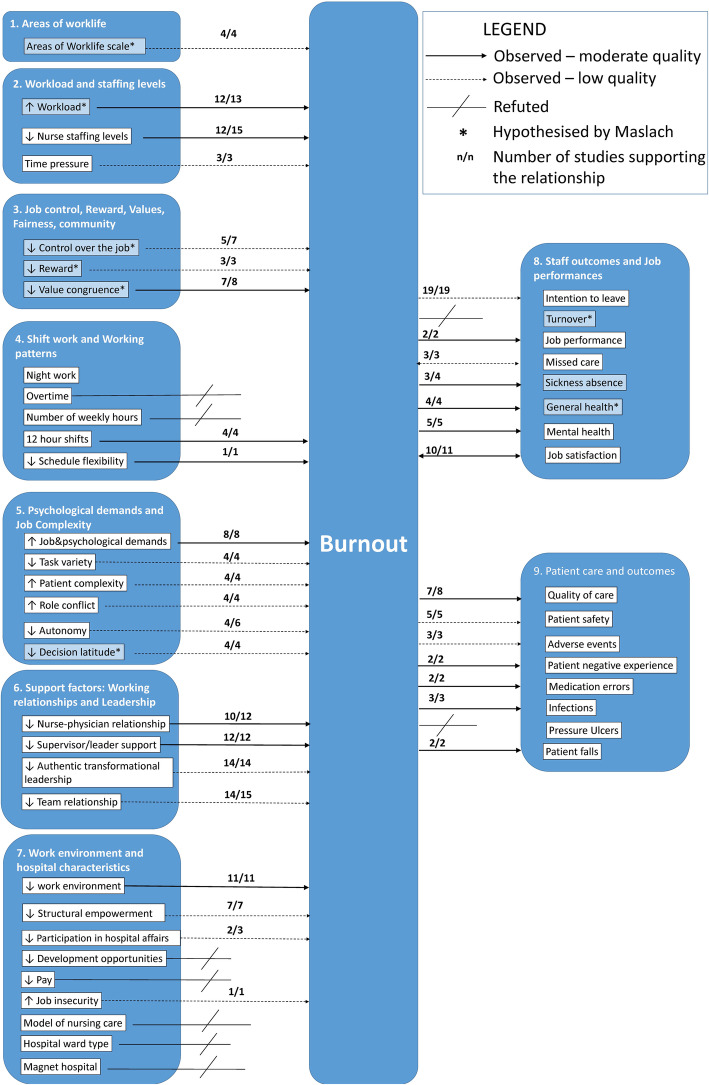
BACKGROUND: Workforce studies often identify burnout as a nursing 'outcome'. Yet, burnout itself-what constitutes it, what factors contribute to its development, and what the wider consequences are for individuals, organisations, or their patients-is rarely made explicit. We aimed to provide a comprehensive summary of research that examines theorised relationships between burnout and other variables, in order to determine what is known (and not known) about the causes and consequences of burnout in nursing, and how this relates to theories of burnout. METHODS: We searched MEDLINE, CINAHL, and PsycINFO. We included quantitative primary empirical studies (published in English) which examined associations between burnout and work-related factors in the nursing workforce. RESULTS: Ninety-one papers were identified. The majority (n = 87) were cross-sectional studies; 39 studies used all three subscales of the Maslach Burnout Inventory (MBI) Scale to measure burnout. As hypothesised by Maslach, we identified high workload, value incongruence, low control over the job, low decision latitude, poor social climate/social support, and low rewards as predictors of burnout. Maslach suggested that turnover, sickness absence, and general health were effects of burnout; however, we identified relationships only with general health and sickness absence. Other factors that were classified as predictors of burnout in the nursing literature were low/inadequate nurse staffing levels, ≥ 12-h shifts, low schedule flexibility, time pressure, high job and psychological demands, low task variety, role conflict, low autonomy, negative nurse-physician relationship, poor supervisor/leader support, poor leadership, negative team relationship, and job insecurity. Among the outcomes of burnout, we found reduced job performance, poor quality of care, poor patient safety, adverse events, patient negative experience, medication errors, infections, patient falls, and intention to leave. CONCLUSIONS: The patterns identified by these studies consistently show that adverse job characteristics-high workload, low staffing levels, long shifts, and low control-are associated with burnout in nursing. The potential consequences for staff and patients are severe. The literature on burnout in nursing partly supports Maslach's theory, but some areas are insufficiently tested, in particular, the association between burnout and turnover, and relationships were found for some MBI dimensions only.
Overview
CoChat Summary
TL;DR
This theoretical review of 91 quantitative studies found adverse job characteristics—high workload, low staffing levels, long shifts, and low control—are consistently associated with burnout in nursing, with severe potential consequences for staff and patients. The literature partly supports Maslach’s theory, but incomplete burnout measurement and mostly cross-sectional designs limit causal inference.
Key findings
- Across 91 studies, high workload was supported in 12/13 studies, low/inadequate nurse staffing in 12/15, ≥12-h shifts in 4/4, low control over the job in 5/7, low reward in 3/3, low value congruence in 7/8, low decision latitude in 4/4, poor supervisor/leader support in 12/12, negative team relationship in 14/15, and intention to leave in 19/19.
- Burnout was associated with reduced job performance (2/2), poor quality of care (7/8), poor patient safety (5/5), adverse events (3/3), medication errors (2/2), infections (3/3), and patient falls (2/2); no association was found with pressure ulcers. Turnover was refuted despite being hypothesised by Maslach, with only one small study finding Depersonalisation associated with turnover within 2 years.
- Most studies used the Maslach Burnout Inventory (n = 81), but only 39 (47%) measured and reported all three MBI subscales; 23 used Emotional Exhaustion only, 11 used Emotional Exhaustion and Depersonalisation, and 9 summed the three subscales despite advice against this. Maslach’s hypothesised predictors were generally supported, but often only for some MBI dimensions.
Methods
- Theoretical review conducted according to Campbell et al. and Pare et al.; systematic search of MEDLINE, CINAHL, and PsycINFO in May 2019 for English quantitative primary empirical studies examining associations between burnout and work-related factors or outcomes in nurses or nursing assistants in healthcare settings. Studies focused exclusively on personal factors, only comparing burnout levels across settings, or literature reviews, commentaries, and editorials were excluded.
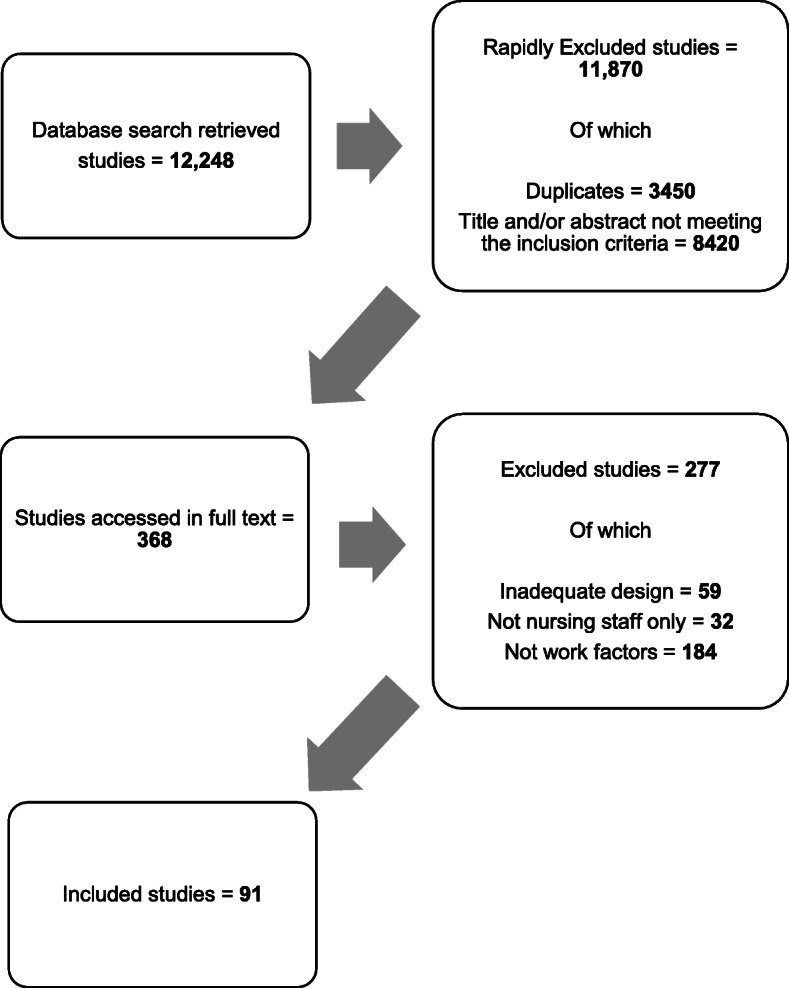
- The search yielded 12,248 records; 368 full texts were accessed, and 91 studies were included. Data were extracted on country, setting, sample size, staff group, burnout measure, variables tested, and findings; a coding frame starting from Maslach’s multidimensional theory produced nine broad categories. No formal quality appraisal was performed, but key quality aspects were summarised.
Limitations
- Stated by the authors: no formal quality appraisal instrument was applied; studies were reported without context or estimates such as ORs and 95% CIs; personality and other individual variables were not considered in data extraction; and studies indexed elsewhere or grey literature may have been missed.
- Evident from the text: 87/91 studies (97%) were cross-sectional, limiting temporal and causal inference and creating simultaneity bias, with factors such as missed care, job satisfaction, and mental health treated as both predictors and outcomes. Incomplete MBI measurement—only 39/91 studies used all three subscales, and 9 summed subscales—further limits testing of Maslach’s theory.
Model-written summary. Check it against the paper before relying on it.
Integrity signals
Registry
Cites
Statistics
Figures
Verification
Claims the paper makes
24 Valid · 3 Not valid · 199 Not checked · 100 Own results and interpretations
The sources with a verdict support this claim; the rest weren’t checked yet, have no full text we could read, or their verdicts aren’t rated yet.
In the paper
“high psychological demands were associated with higher odds of Emotional Exhaustion [62, 78]”
§ Burnout in nursing: a theoretical review > Results > Psychological demands and job complexity
What the sources say
- Supportedcites [62] Vidotti V Ribeiro RP Galdino MJQ Martins JT Burnout syndrome and shift work among the nursing staff Rev Lat Am Enfermagem 2018 26 e3022 30110099 PMC6091368 source
The Method section identifies psychological demands as a dimension of the Demand-Control-Support Questionnaire. In Results, Table 3 reports that high demand was associated with higher odds of emotional exhaustion among day-shift nursing staff (adjusted OR 2.50, 95% CI 1.44–4.35). The reported association is specific to the day shift. (LLM, conf=0.91)
- Not checked — no full text of the sourcecites [78] Bourbonnais R Comeau M Vezina M Dion G Job strain, psychological distress, and burnout in nurses Am J Ind Med 1998 34 1 20 28 9617384 doi:10.1002/(sici)1097-0274(199807)34:1
plainstates an association- Asserted: passes — The authors put it forward as true.
- Checkable: passes — It can be checked against evidence.
- Load-bearing: passes — The paper’s conclusions depend on it.
- Based: passes — The paper gives a reason why it holds.
- Supported
The cited sources support only part of this claim — read each source’s verdict below.
In the paper
“and Emotional Exhaustion and Personal Accomplishment [50]”
§ Burnout in nursing: a theoretical review > Results > Working relationships and leadership
What the sources say
- Partly supportedcites [50] Hanrahan NP Aiken LH McClaine L Hanlon AL Relationship between psychiatric nurse work environments and nurse burnout in acute care general hospitals Issues Ment Health Nurs 2010 31 3 198 207 20144031 PMC2856615 sourceExperimental — accuracy not yet measured
The Discussion (‘Strong Mangers and Leaders’) reports a significant relationship between manager skill and emotional exhaustion. The Results state that none of the work-environment factors, including manager skill, were associated with personal accomplishment in the adjusted or unadjusted models. The claim is therefore supported for emotional exhaustion but not personal accomplishment. (LLM, conf=0.92)
plainstates an association- Asserted: passes — The authors put it forward as true.
- Checkable: passes — It can be checked against evidence.
- Load-bearing: unclear — It is unclear whether the paper’s conclusions depend on it.
- Based: passes — The paper gives a reason why it holds.
- Partly supported
Every source the paper cites for this claim was checked and supports it.
In the paper
“The inability to establish a temporal link means limits the inference of causality [115].”
§ Burnout in nursing: a theoretical review > Discussion
What the sources say
- Supportedcites [115] Antonakis J Bendahan S Jacquart P Lalive R On making causal claims: a review and recommendations Leadersh Q 2010 21 6 1086 1120 source
Section 1, “What is Causality?”, lists temporal precedence as a condition for measuring a causal effect and explicitly calls temporal ordering necessary but not sufficient. Thus, inability to establish temporal order limits causal inference. (LLM, conf=0.93)
plain- Asserted: passes — The authors put it forward as true.
- Checkable: passes — It can be checked against evidence.
- Load-bearing: passes — The paper’s conclusions depend on it.
- Based: passes — The paper gives a reason why it holds.
- Supported
The sources with a verdict support this claim; the rest weren’t checked yet, have no full text we could read, or their verdicts aren’t rated yet.
In the paper
“| Night work | | | √ | |”
- Also stated in: § Working patterns and shift work · plain
“Working night shifts was associated with burnout (composite score) [68] and Emotional Exhaustion [62], but the relationship was not significant in two studies [69, 70].”
§ Burnout in nursing: a theoretical review > Results
What the sources say
- Not checked — no full text of the sourcecites [68] Anwar MM Elareed HR Burnout among Egyptian nurses Journal of Public Health-Heidelberg 2017 25 6 693 697 source
- Supportedcites [62] Vidotti V Ribeiro RP Galdino MJQ Martins JT Burnout syndrome and shift work among the nursing staff Rev Lat Am Enfermagem 2018 26 e3022 30110099 PMC6091368 source
The Results (Table 2) show that the relationship between work shift and burnout differs across dimensions: emotional exhaustion and professional realization differ significantly by shift, while depersonalization does not. The Discussion also reports higher overall burnout levels among day-shift than night-shift nursing staff. This supports the claim that night work is not consistently associated with burnout. (LLM, conf=0.86)
- Not checked — no full text of the sourcecites [69] Wisetborisut A Angkurawaranon C Jiraporncharoen W Uaphanthasath R Wiwatanadate P Shift work and burnout among health care workers Occup Med (Lond) 2014 64 4 279 286 24550196 source
- Not checked — no full text of the sourcecites [70] Ilhan MN Durukan E Taner E Maral I Bumin MA Burnout and its correlates among nursing staff: questionnaire survey J Adv Nurs 2008 61 1 100 106 18034813 source
plain- Asserted: passes — The authors put it forward as true.
- Checkable: passes — It can be checked against evidence.
- Load-bearing: unclear — It is unclear whether the paper’s conclusions depend on it.
- Based: passes — The paper gives a reason why it holds.
- Also stated in: § Working patterns and shift work · plain
Every source the paper cites for this claim was checked and supports it.
In the paper
“Long shifts of 12 h or more were associated with all MBI subscales [74]”
§ Burnout in nursing: a theoretical review > Results > Working patterns and shift work
What the sources say
- Supportedcites [74] Dall’Ora C Griffiths P Ball J Simon M Aiken LH Association of 12 h shifts and nurses’ job satisfaction, burnout and intention to leave: findings from a cross-sectional study of 12 European countries BMJ Open 2015 5 9 e008331 26359284 PMC4577950 source
The Measurements section identifies the three MBI subscales as emotional exhaustion, depersonalisation and personal accomplishment. The Discussion explicitly reports an association between shifts of 12 hours or more and all three subscales; the Shift length and nurse outcomes section reports the corresponding adjusted results. (LLM, conf=0.95)
plainstates an association- Asserted: passes — The authors put it forward as true.
- Checkable: passes — It can be checked against evidence.
- Load-bearing: passes — The paper’s conclusions depend on it.
- Based: passes — The paper gives a reason why it holds.
- Supported
201 more claims · 15 with their cited sources checked
Create a free account to see all 326 claims and to verify the 20 references still open.
- Probably not a substantial claim. 64
- It may state two separate claims as one. 72
- The quote only partly states this claim. 2
Claims other papers make about this one
Each is checked against this paper’s own text: does it say what the citing paper says it does?
The source backs part of the claim, not all of it — or backs it for a different population, condition or comparison.
In the citing paper
“Burnout among HPs is significantly associated with suicidal ideation [7], decreased job satisfaction [8], and increased turnover intention, ultimately resulting in a loss of HPs and deterioration in the quality of care, which is also negatively affected, as is patient safety and health status [9,10,11].”
From Effects of Third-Wave Cognitive Behavioral Therapy for Healthcare Professionals’ Burnout: A Systematic Review and Meta-Analysis (2025) · cites this paper as [9]
Experimental — accuracy not yet measuredThe source backs part of the claim, not all of it — or backs it for a different population, condition or comparison.
In the citing paper
“Reducing EE and DP may also contribute to improved workforce retention and lower absenteeism, ultimately benefiting healthcare providers and enhancing patient safety and care quality [9,10,11].”
From Effects of Third-Wave Cognitive Behavioral Therapy for Healthcare Professionals’ Burnout: A Systematic Review and Meta-Analysis (2025) · cites this paper as [9]
Experimental — accuracy not yet measuredThe cited source says what the claim attributes to it.
In the citing paper
“Last but not the least, some other organizational factors may also affect burnout, such as excessive workload, time pressure, high job demands, low rewards, low job autonomy, or negative team atmosphere [13].”
From The efficacy of applying the Interpersonal Effectiveness skills of dialectical behavior therapy into communication skills workshop for clinical nurses (2023) · cites this paper as [13]
Self-check
Percentages, sums and reported differences re-computed from the paper’s own numbers.
Each contradiction between two passages listed here was confirmed by an independent check.
Rated minor: it would not touch a result — a value no result rests on, a p-value that stays on the same side of the significance level, or a conflict that is clerical, resolved elsewhere in the paper, or outside its own findings.
In the paper
“The database search yielded 12 248 studies, of which 11 870 were rapidly excluded as either duplicates or titles and/or abstract not meeting the inclusion criteria. Of the 368 studies accessed in full text, 277 were excluded, and 91 studies were included in the review.”
§ Burnout in nursing: a theoretical review > Results
Reported 368 · recomputed 378
Rated minor: it would not touch a result — a value no result rests on, a p-value that stays on the same side of the significance level, or a conflict that is clerical, resolved elsewhere in the paper, or outside its own findings.
In the paper
§ Burnout in nursing: a theoretical review > Results
“| Overtime | | | √ | |”
§ Burnout in nursing: a theoretical review > Results > Working patterns and shift work
“One study found working that overtime was associated with composite MBI score [73].”
Rated minor: it would not touch a result — a value no result rests on, a p-value that stays on the same side of the significance level, or a conflict that is clerical, resolved elsewhere in the paper, or outside its own findings.
In the paper
“Most studies used the Maslach Burnout Inventory Scale (n = 81), which comprises three subscales reflecting the theoretical model: Emotional Exhaustion, Depersonalisation, and reduced Personal Accomplishment. However, less than half (47%, n = 39) of the papers measured and reported results with all three subscales.”
§ Burnout in nursing: a theoretical review > Results > Measures of burnout
Reported 47 · recomputed 48.148148
Citations
Cites
The measurement of experienced burnout
Maslach, C., & Jackson, S. E. (1981) · Journal of Organizational Behavior · doi:10.1002/job.4030020205 · Cited by 14,496
The job demands-resources model of burnout.
Demerouti, E., Bakker, A. B., Nachreiner, F., & Schaufeli, W. B. (2001) · Journal of Applied Psychology · doi:10.1037/0021-9010.86.3.499 · Cited by 13,643
Maslach, C., Schaufeli, W. B., & Leiter, M. P. (2001) · Annual Review of Psychology · doi:10.1146/annurev.psych.52.1.397 · Cited by 12,852
(1996) · Consulting Psychologists Press eBooks · Cited by 7,863
Freudenberger, H. J. (1974) · Journal of Social Issues · doi:10.1111/j.1540-4560.1974.tb00706.x · Cited by 5,463
Hospital Nurse Staffing and Patient Mortality, Nurse Burnout, and Job Dissatisfaction
Aiken, L. H. (2002) · JAMA · doi:10.1001/jama.288.16.1987 · Cited by 5,226
The Copenhagen Burnout Inventory: A new tool for the assessment of burnout
Kristensen, T. S., Borritz, M., Villadsen, E., & Christensen, K. B. (2005) · Work & Stress · doi:10.1080/02678370500297720 · Cited by 3,136
On making causal claims: A review and recommendations
Antonakis, J., Bendahan, S., Jacquart, P., & Lalive, R. (2010) · The Leadership Quarterly · doi:10.1016/j.leaqua.2010.10.010 · Cited by 2,441
Synthesizing information systems knowledge: A typology of literature reviews
Paré, G., Trudel, M.-C., Jaana, M., & Kitsiou, S. (2015) · Information & Management · doi:10.1016/j.im.2014.08.008 · Cited by 1,987
Burnout: 35 years of research and practice.
Schaufeli, W. B., Leiter, M. P., & Maslach, C. (2009) · Career Development International · doi:10.1108/13620430910966406 · Cited by 1,964
Development of the practice environment scale of the nursing work index†‡
Lake, E. T. (2002) · Research in Nursing & Health · doi:10.1002/nur.10032 · Cited by 1,769
Cummings, G. G., MacGregor, T., Davey, M., Lee, H., Wong, C. A., Lo, E., Muise, M., & Stafford, E. (2010) · International Journal of Nursing Studies · doi:10.1016/j.ijnurstu.2009.08.006 · Cited by 1,104
Nurse Burnout and Patient Satisfaction
Vahey, D. C., Aiken, L. H., Sloane, D. M., Clarke, S. P., & Vargas, D. (2004) · Medical Care · doi:10.1097/01.mlr.0000109126.50398.5a · Cited by 977 · cited 2×
“concluded that higher Emotional Exhaustion and low Personal Accomplishment levels were associated with patient dissatisfaction [93], and Van Bogaert et al.”
BackgroundEffects of Hospital Care Environment on Patient Mortality and Nurse Outcomes
Aiken, L. H., Clarke, S. P., Sloane, D. M., Lake, E. T., & Cheney, T. (2008) · JONA: The Journal of Nursing Administration · doi:10.1097/01.nna.0000312773.42352.d7 · Cited by 860
Nurse turnover: the mediating role of burnout
LEITER, M. P., & MASLACH, C. (2009) · Journal of Nursing Management · doi:10.1111/j.1365-2834.2009.01004.x · Cited by 838
Effects of Hospital Care Environment on Patient Mortality and Nurse Outcomes
Aiken, L. H., Clarke, S. P., Sloane, D. M., Lake, E. T., & Cheney, T. (2009) · JONA: The Journal of Nursing Administration · doi:10.1097/nna.0b013e3181aeb4cf · Cited by 799
Nurse staffing, burnout, and health care-associated infection.
Cimiotti, J. P., Aiken, L. H., Sloane, D. M., & Wu, E. S. (2012) · American Journal of Infection Control · doi:10.1016/j.ajic.2012.02.029 · Cited by 763
Burnout syndrome in critical care nursing staff
Poncet, M. C., Toullic, P., Papazian, L., Kentish-Barnes, N., Timsit, J.-F., Pochard, F., Chevret, S., Schlemmer, B., & Azoulay, É. (2007) · American Journal of Respiratory and Critical Care Medicine · doi:10.1164/rccm.200606-806oc · Cited by 750
SPENCE LASCHINGER, H. K., LEITER, M., DAY, A., & GILIN, D. (2009) · Journal of Nursing Management · doi:10.1111/j.1365-2834.2009.00999.x · Cited by 730
Spence Laschinger, H. K., & Leiter, M. P. (2006) · JONA: The Journal of Nursing Administration · doi:10.1097/00005110-200605000-00019 · Cited by 723 · cited 4×
“This was also found by Leiter and Laschinger, who found that positive nursephysician collaborations predicted Personal Accomplishment [57, 85].”
BackgroundMethodInfluentialThe Burnout Measure, Short Version.
Malach-Pines, A. (2005) · International Journal of Stress Management · doi:10.1037/1072-5245.12.1.78 · Cited by 610
Hunsaker, S., Chen, H., Maughan, D., & Heaston, S. (2015) · Journal of Nursing Scholarship · doi:10.1111/jnu.12122 · Cited by 592
Job-related burnout: A review.
Shirom, A. (2003) · Handbook of occupational health psychology. · doi:10.1037/10474-012 · Cited by 583 · cited 1×
“Shirom and colleagues suggested that burnout occurs when individuals exhaust their resources due to longterm exposures to emotionally demanding circumstances in both work and life settings, suggesting that burnout is not exclusively an occupational syndrome [15, 16].”
BackgroundNurse burnout and quality of care: Cross‐national investigation in six countries
Poghosyan, L., Clarke, S. P., Finlayson, M., & Aiken, L. H. (2010) · Research in Nursing & Health · doi:10.1002/nur.20383 · Cited by 574
Risk factors and prevalence of burnout syndrome in the nursing profession
Cañadas-De la Fuente, G. A., Vargas, C., San Luis, C., García, I., Cañadas, G. R., & De la Fuente, E. I. (2015) · International Journal of Nursing Studies · doi:10.1016/j.ijnurstu.2014.07.001 · Cited by 547
Burnout and risk factors for cardiovascular diseases
Melamed, S., Kushnir, T., & Shirom, A. (1992) · Behavioral Medicine · doi:10.1080/08964289.1992.9935172 · Cited by 490
A Multidimensional Theory of Burnout
Maslach, C. (1998) · Theories of Organizational Stress · doi:10.1093/oso/9780198522799.003.0004 · Cited by 445
Stimpfel, A. W., Sloane, D. M., & Aiken, L. H. (2012) · Health Affairs · doi:10.1377/hlthaff.2011.1377 · Cited by 424
Dall'Ora, C., Griffiths, P., Ball, J., Simon, M., & Aiken, L. H. (2015) · BMJ Open · doi:10.1136/bmjopen-2015-008331 · Cited by 408 · cited 1×
“more were associated with all MBI subscales [74] and with Emotional Exhaustion [49, 75].”
BackgroundSelf-citationEffects of nurse work environment on job dissatisfaction, burnout, intention to leave
Nantsupawat, A., Kunaviktikul, W., Nantsupawat, R., Wichaikhum, O. ‐., Thienthong, H., & Poghosyan, L. (2017) · International Nursing Review · doi:10.1111/inr.12342 · Cited by 374
Janssen, P. P. M., De Jonge, J., & Bakker, A. B. (1999) · Journal of Advanced Nursing · doi:10.1046/j.1365-2648.1999.01022.x · Cited by 357
Spence Laschinger, H. K., Wong, C. A., & Grau, A. L. (2012) · International Journal of Nursing Studies · doi:10.1016/j.ijnurstu.2012.05.012 · Cited by 348
LASCHINGER, H. K. S. (2012) · Journal of Nursing Management · doi:10.1111/j.1365-2834.2011.01293.x · Cited by 344
Van Bogaert, P., Timmermans, O., Weeks, S. M., van Heusden, D., Wouters, K., & Franck, E. (2014) · International Journal of Nursing Studies · doi:10.1016/j.ijnurstu.2013.12.009 · Cited by 324
Van Bogaert, P., Kowalski, C., Weeks, S. M., Van heusden, D., & Clarke, S. P. (2013) · International Journal of Nursing Studies · doi:10.1016/j.ijnurstu.2013.05.010 · Cited by 323
Maslach, C., & Leiter, M. P. (2016) · Stress: Concepts, Cognition, Emotion, and Behavior · doi:10.1016/b978-0-12-800951-2.00044-3 · Cited by 320
Burnout, self- and supervisor-rated job performance, and absenteeism among nurses
Parker, P. A., & Kulik, J. A. (1995) · Journal of Behavioral Medicine · doi:10.1007/bf01857897 · Cited by 314
Leader Empowering Behaviours, Staff Nurse Empowerment and Work Engagement/Burnout
Greco, P., Spence Laschinger, H., & Wong, C. (2006) · Nursing Leadership · doi:10.12927/cjnl.2006.18599 · Cited by 289
Workload and burnout in nurses
Greenglass, E. R., Burke, R. J., & Fiksenbaum, L. (2001) · Journal of Community & Applied Social Psychology · doi:10.1002/casp.614 · Cited by 287
Dall’Ora, C., Ball, J., Recio-Saucedo, A., & Griffiths, P. (2016) · International Journal of Nursing Studies · doi:10.1016/j.ijnurstu.2016.01.007 · Cited by 286
Self-citationGriffiths, P., Ball, J., Drennan, J., Dall’Ora, C., Jones, J., Maruotti, A., Pope, C., Recio Saucedo, A., & Simon, M. (2016) · International Journal of Nursing Studies · doi:10.1016/j.ijnurstu.2016.03.012 · Cited by 285
Self-citationBoamah, S. A., Read, E. A., & Spence Laschinger, H. K. (2017) · Journal of Advanced Nursing · doi:10.1111/jan.13215 · Cited by 276
Moloney, W., Boxall, P., Parsons, M., & Cheung, G. (2018) · Journal of Advanced Nursing · doi:10.1111/jan.13497 · Cited by 273
Are teamwork and professional autonomy compatible, and do they result in improved hospital care?
Rafferty, A. M., Ball, J., & Aiken, L. H. (2001) · Quality and Safety in Health Care · doi:10.1136/qhc.0100032 · Cited by 262
Self-citationBoamah, S. A., & Laschinger, H. (2016) · Journal of Nursing Management · doi:10.1111/jonm.12318 · Cited by 261
Estryn-Béhar, M., Van der Heijden, B. I. J. M., Ogińska, H., Camerino, D., Le Nézet, O., Conway, P. M., Fry, C., & Hasselhorn, H.-M. (2007) · Medical Care · doi:10.1097/mlr.0b013e31806728d8 · Cited by 253
Relationships of Work and Practice Environment to Professional Burnout: Testing a Causal Model
Leiter, M. P., & Spence Laschinger, H. K. (2006) · Nursing Research · doi:10.1097/00006199-200603000-00009 · Cited by 253
‘Burnout’, absence and turnover amongst British nursing staff
Firth, H., & Britton, P. (1989) · Journal of Occupational Psychology · doi:10.1111/j.2044-8325.1989.tb00477.x · Cited by 249
Nurse Burnout and Patient Safety Outcomes: Nurse Safety Perception Versus Reporting Behavior
Halbesleben, J. R. B., Wakefield, B. J., Wakefield, D. S., & Cooper, L. B. (2008) · Western Journal of Nursing Research · doi:10.1177/0193945907311322 · Cited by 236
Liu, X., Zheng, J., Liu, K., Baggs, J. G., Liu, J., Wu, Y., & You, L. (2018) · International Journal of Nursing Studies · doi:10.1016/j.ijnurstu.2018.05.005 · Cited by 234
Rudman, A., & Gustavsson, J. P. (2011) · International Journal of Nursing Studies · doi:10.1016/j.ijnurstu.2010.07.012 · Cited by 232
Zhang, L.-F., You, L.-M., Liu, K., Zheng, J., Fang, J.-B., Lu, M.-M., Lv, A.-L., Ma, W.-G., Wang, J., Wang, S.-H., et al. (2014) · Nursing Outlook · doi:10.1016/j.outlook.2013.10.010 · Cited by 228
Burnout in nurses – the relationship between social capital in hospitals and emotional exhaustion
Kowalski, C., Ommen, O., Driller, E., Ernstmann, N., Wirtz, M. A., Köhler, T., & Pfaff, H. (2010) · Journal of Clinical Nursing · doi:10.1111/j.1365-2702.2009.02989.x · Cited by 222
Giorgi, F., Mattei, A., Notarnicola, I., Petrucci, C., & Lancia, L. (2018) · Journal of Advanced Nursing · doi:10.1111/jan.13484 · Cited by 219 · cited 1×
“Two studies looked at the effect of burnout on job performance: one found a negative association between burnout (measured with CBI) and both task performance and contextual performance [106].”
BackgroundLaschinger, H. K. S., Borgogni, L., Consiglio, C., & Read, E. (2015) · International Journal of Nursing Studies · doi:10.1016/j.ijnurstu.2015.03.002 · Cited by 215
Kanai‐Pak, M., Aiken, L. H., Sloane, D. M., & Poghosyan, L. (2008) · Journal of Clinical Nursing · doi:10.1111/j.1365-2702.2008.02639.x · Cited by 214
Work related stress, burnout, job satisfaction and general health of nurses: A follow‐up study
Khamisa, N., Peltzer, K., Ilic, D., & Oldenburg, B. (2016) · International Journal of Nursing Practice · doi:10.1111/ijn.12455 · Cited by 209
Maben, J., Latter, S., & Clark, J. M. (2007) · Nursing Inquiry · doi:10.1111/j.1440-1800.2007.00357.x · Cited by 201
Burnout in Psychiatric Nurses: Contributions of the Work Environment and a Sense of Coherence
Levert, T., Lucas, M., & Ortlepp, K. (2000) · South African Journal of Psychology · doi:10.1177/008124630003000205 · Cited by 194
Van Bogaert, P., Meulemans, H., Clarke, S., Vermeyen, K., & Van de Heyning, P. (2009) · Journal of Advanced Nursing · doi:10.1111/j.1365-2648.2009.05082.x · Cited by 194
The role of stress and level of burnout in job performance among nurses.
Gandi, J. C., Wai, P. S., Karick, H., & Dagona, Z. K. (2011) · PubMed · Cited by 185
Nurse Burnout, Nurse‐Reported Quality of Care, and Patient Outcomes in Thai Hospitals
Nantsupawat, A., Nantsupawat, R., Kunaviktikul, W., Turale, S., & Poghosyan, L. (2016) · Journal of Nursing Scholarship · doi:10.1111/jnu.12187 · Cited by 179
Hanrahan, N. P., Aiken, L. H., McClaine, L., & Hanlon, A. L. (2010) · Issues in Mental Health Nursing · doi:10.3109/01612840903200068 · Cited by 176
Burnout Syndrome and shift work among the nursing staff
Vidotti, V., Ribeiro, R. P., Galdino, M. J. Q., & Martins, J. T. (2018) · Revista Latino-Americana de Enfermagem · doi:10.1590/1518-8345.2550.3022 · Cited by 176
KLOPPER, H. C., COETZEE, S. K., PRETORIUS, R., & BESTER, P. (2012) · Journal of Nursing Management · doi:10.1111/j.1365-2834.2011.01350.x · Cited by 173
Shift work and burnout among health care workers
Wisetborisut, A., Angkurawaranon, C., Jiraporncharoen, W., Uaphanthasath, R., & Wiwatanadate, P. (2014) · Occupational Medicine · doi:10.1093/occmed/kqu009 · Cited by 171
Maslach, C., & Leiter, M. P. (2016) · Encyclopedia of Mental Health · doi:10.1016/b978-0-12-397045-9.00149-x · Cited by 169
Lee, H.-F., Chiang, H.-Y., & Kuo, H.-T. (2019) · Journal of Nursing Management · doi:10.1111/jonm.12648 · Cited by 165
Lavoie, P., Michaud, C., Bélisle, M., Boyer, L., Gosselin, É., Grondin, M., Larue, C., Lavoie, S., & Pepin, J. (2018) · Journal of Advanced Nursing · doi:10.1111/jan.13416 · Cited by 152
The relationship between multidimensional leadership and burnout among nursing staff
KANSTE, O., KYNGÄS, H., & NIKKILÄ, J. (2007) · Journal of Nursing Management · doi:10.1111/j.1365-2934.2006.00741.x · Cited by 151
Bobbio, A., Bellan, M., & Manganelli, A. M. (2012) · Health Care Management Review · doi:10.1097/hmr.0b013e31822242b2 · Cited by 146
Burnout and its correlates among nursing staff: questionnaire survey.
İlhan, M. N., Durukan, E., Taner, E., Maral, I., & Bumin, M. A. (2008) · Journal of Advanced Nursing · doi:10.1111/j.1365-2648.2007.04476.x · Cited by 145
Teng, C.-I., Shyu, Y.-I. L., Chiou, W.-K., Fan, H.-C., & Lam, S. M. (2010) · International Journal of Nursing Studies · doi:10.1016/j.ijnurstu.2010.04.005 · Cited by 145
A New Look at Nurse Burnout: The Effects of Environmental Uncertainty and Social Climate
Garrett, D. K., & McDaniel, A. M. (2001) · JONA: The Journal of Nursing Administration · doi:10.1097/00005110-200102000-00009 · Cited by 129
Effects of Organizational Innovations in AIDS Care on Burnout among Urban Hospital Nurses
AIKEN, L. H., & SLOANE, D. M. (1997) · Work and Occupations · doi:10.1177/0730888497024004004 · Cited by 119 · cited 1×
“Regarding ward and hospital type, Aiken and Sloane found that RNs working in specialised AIDS units reported lower levels of Emotional Exhaustion [98]; however, ward type was not found to be significantly associated with burnout in a study on temporary nurses [53].”
BackgroundLi, B., Bruyneel, L., Sermeus, W., Van den Heede, K., Matawie, K., Aiken, L., & Lesaffre, E. (2013) · International Journal of Nursing Studies · doi:10.1016/j.ijnurstu.2012.07.001 · Cited by 111
Relationship between job demand and burnout in nurses: does it depend on work engagement?
García-Sierra, R., Fernández-Castro, J., & Martínez-Zaragoza, F. (2016) · Journal of Nursing Management · doi:10.1111/jonm.12382 · Cited by 111
Jansen, P. G. M., Kerkstra, A., Abu-Saad, H. H., & Van Der Zee, J. (1996) · International Journal of Nursing Studies · doi:10.1016/0020-7489(95)00060-7 · Cited by 104
Campbell, M., Egan, M., Lorenc, T., Bond, L., Popham, F., Fenton, C., & Benzeval, M. (2014) · Systematic Reviews · doi:10.1186/2046-4053-3-114 · Cited by 103
Organizational Climate and Occupational Health Outcomes in Hospital Nurses
Stone, P. W., Du, Y., & Gershon, R. R. M. (2007) · Journal of Occupational and Environmental Medicine · doi:10.1097/01.jom.0000251622.05429.0c · Cited by 99
Laschinger, H. K. S., & Read, E. A. (2016) · JONA: The Journal of Nursing Administration · doi:10.1097/nna.0000000000000407 · Cited by 98
Leineweber, C., Westerlund, H., Chungkham, H. S., Lindqvist, R., Runesdotter, S., & Tishelman, C. (2014) · PLoS ONE · doi:10.1371/journal.pone.0096991 · Cited by 95
Factors influencing nurse‐assessed quality nursing care: A cross‐sectional study in hospitals
Liu, Y., & Aungsuroch, Y. (2018) · Journal of Advanced Nursing · doi:10.1111/jan.13507 · Cited by 93
Bagheri Hosseinabadi, M., Ebrahimi, M. H., Khanjani, N., Biganeh, J., Mohammadi, S., & Abdolahfard, M. (2019) · Journal of Clinical Nursing · doi:10.1111/jocn.14778 · Cited by 87
Johnson, J., Louch, G., Dunning, A., Johnson, O., Grange, A., Reynolds, C., Hall, L., & O'Hara, J. (2017) · Journal of Advanced Nursing · doi:10.1111/jan.13251 · Cited by 86
Job satisfaction and burnout among paediatric nurses
Akman, O., Ozturk, C., Bektas, M., Ayar, D., & Armstrong, M. A. (2016) · Journal of Nursing Management · doi:10.1111/jonm.12399 · Cited by 85
Job stressors and burnout in hospitals: The mediating role of emotional dissonance.
Andela, M., Truchot, D., & Van der Doef, M. (2016) · International Journal of Stress Management · doi:10.1037/str0000013 · Cited by 84
Linking Nurse Leadership and Work Characteristics to Nurse Burnout and Engagement
Lewis, H. S., & Cunningham, C. J. L. (2016) · Nursing Research · doi:10.1097/nnr.0000000000000130 · Cited by 79
Tourigny, L., Baba, V. V., & Wang, X. (2010) · The International Journal of Human Resource Management · doi:10.1080/09585192.2010.528656 · Cited by 75
Organizational Traits, Care Processes, and Burnout Among Chronic Hemodialysis Nurses
Flynn, L., Thomas-Hawkins, C., & Clarke, S. P. (2009) · Western Journal of Nursing Research · doi:10.1177/0193945909331430 · Cited by 74 · cited 3×
“Missed care was investigated in three studies, and it was found to be both predictor of Emotional Exhaustion [32], an outcome of burnout [20, 103].”
BackgroundResultLaeeque, S. H., Bilal, A., Babar, S., Khan, Z., & Ul Rahman, S. (2018) · Journal of Aggression, Maltreatment & Trauma · doi:10.1080/10926771.2017.1410751 · Cited by 73
Job dissatisfaction and burnout of nurses in Hunan, China: A cross‐sectional survey
Zhou, W., He, G., Wang, H., He, Y., Yuan, Q., & Liu, D. (2015) · Nursing & Health Sciences · doi:10.1111/nhs.12213 · Cited by 72
Madathil, R., Heck, N. C., & Schuldberg, D. (2014) · Archives of Psychiatric Nursing · doi:10.1016/j.apnu.2014.01.002 · Cited by 72
Effect of effort‐reward imbalance and burnout on infection control among Ecuadorian nurses
Colindres, C. V., Bryce, E., Coral‐Rosero, P., Ramos‐Soto, R. M., Bonilla, F., & Yassi, A. (2018) · International Nursing Review · doi:10.1111/inr.12409 · Cited by 70
Burnout Evaluation and Potential Predictors in a Greek Cohort of Mental Health Nurses
Konstantinou, A.-K., Bonotis, K., Sokratous, M., Siokas, V., & Dardiotis, E. (2018) · Archives of Psychiatric Nursing · doi:10.1016/j.apnu.2018.01.002 · Cited by 69
Rouxel, G., Michinov, E., & Dodeler, V. (2016) · International Journal of Nursing Studies · doi:10.1016/j.ijnurstu.2016.07.010 · Cited by 67
Dhaini, S. R., Denhaerynck, K., Bachnick, S., Schwendimann, R., Schubert, M., De Geest, S., & Simon, M. (2018) · International Journal of Nursing Studies · doi:10.1016/j.ijnurstu.2018.03.019 · Cited by 67
Working and Environmental Factors on Job Burnout: A Cross-sectional Study Among Nurses
Galletta, M., Portoghese, I., Ciuffi, M., Sancassiani, F., Aloja, E. D., & Campagna, M. (2016) · Clinical Practice & Epidemiology in Mental Health · doi:10.2174/1745017901612010132 · Cited by 62
(2002) · PubMed · Cited by 60
Faller, M. S., Gates, M. G., Georges, J. M., & Connelly, C. D. (2011) · JONA: The Journal of Nursing Administration · doi:10.1097/nna.0b013e3182059492 · Cited by 60
On the relationship between safety climate and occupational burnout in healthcare organizations
Zarei, E., Khakzad, N., Reniers, G., & Akbari, R. (2016) · Safety Science · doi:10.1016/j.ssci.2016.05.011 · Cited by 59
Nurse burnout in China: a questionnaire survey on staffing, job satisfaction, and quality of care
Lu, M., Ruan, H., Xing, W., & Hu, Y. (2015) · Journal of Nursing Management · doi:10.1111/jonm.12150 · Cited by 56
Basar, U., & Basim, N. (2016) · Journal of Advanced Nursing · doi:10.1111/jan.12958 · Cited by 55
Cao, X., & Naruse, T. (2019) · Japan Journal of Nursing Science · doi:10.1111/jjns.12233 · Cited by 55
Early career burnout among nurses: Modelling a hypothesized process using an item response approach
Gustavsson, J. P., Hallsten, L., & Rudman, A. (2010) · International Journal of Nursing Studies · doi:10.1016/j.ijnurstu.2009.12.007 · Cited by 53
Nursing work environment, value congruence and their relationships with nurses’ work outcomes
Shao, J., Tang, L., Wang, X., Qiu, R., Zhang, Y., Jia, Y., Ma, Y., & Ye, Z. (2018) · Journal of Nursing Management · doi:10.1111/jonm.12641 · Cited by 46
Nurse work environment and job-related outcomes in Brazilian hospitals
Dutra, H. S., Cimiotti, J. P., & Guirardello, E. D. B. (2018) · Applied Nursing Research · doi:10.1016/j.apnr.2018.04.002 · Cited by 39 · cited 2×
“According to two studies, Emotional Exhaustion and Cynicism predicted job dissatisfaction [54, 101], while four studies reported that Emotional Exhaustion only was associated with increased odds to report job dissatisfaction [73, 82, 88, 100]; one study reported that Cynicism only was associated with job dissatisfacti…”
ResultMarques-Pinto, A., Jesus, É. H., Mendes, A. M. O. C., Fronteira, I., & Roberto, M. S. (2018) · The Spanish Journal of Psychology · doi:10.1017/sjp.2018.30 · Cited by 33
The role of rewards and demands in burnout among surgical nurses
Basińska, B., & Wilczek-Rużyczka, E. (2013) · International Journal of Occupational Medicine and Environmental Health · doi:10.2478/s13382-013-0129-8 · Cited by 30
Anwar, M. M., & Elareed, H. R. (2017) · Journal of Public Health · doi:10.1007/s10389-017-0831-2 · Cited by 19
Burnout as a developmental process among Japanese nurses: Investigation of Leiter's model
KITAOKA‐HIGASHIGUCHI, K. (2005) · Japan Journal of Nursing Science · doi:10.1111/j.1742-7924.2005.00025.x · Cited by 11
Thompson, D. C. (2014) · KU ScholarWorks (The University of Kansas) · Cited by 9
(1998) · doi:10.1002/(sici)1097-0274(199807)34:1<20::aid-ajim4>3.0.co;2-u
Research works printed but not linked: 4
- Ekstedt M Burnout and sleep: Institutionen för folkhälsovetenskap/Department of Public Health Sciences 2005
- Cherniss C Burnout in new professionals: a long-term follow-up study J Health Hum Resour Adm 1989 12 1 11 24
- Adali E Priami M Evagelou H Mougia V Ifanti M Alevizopoulos G Burnout in psychiatric nursing personnel in Greek hospitals European Journal of Psychiatry 2003 17 3 173 181
- Laschinger HKS Shamian J Thomson D Impact of magnet hospital characteristics on nurses’ perceptions of trust, burnout, quality of care, and work satisfaction Nurs Econ 2001 19 5 209 219
Cited by
Relationship between nurse burnout, patient and organizational outcomes: Systematic review
Jun, J., Ojemeni, M. M., Kalamani, R., Tong, J., & Crecelius, M. L. (2021) · International Journal of Nursing Studies · doi:10.1016/j.ijnurstu.2021.103933 · Cited by 606
Azoulay, E., Cariou, A., Bruneel, F., Demoule, A., Kouatchet, A., Reuter, D., Souppart, V., Combes, A., Klouche, K., Argaud, L., et al. (2020) · American Journal of Respiratory and Critical Care Medicine · doi:10.1164/rccm.202006-2568oc · Cited by 272
“Hence, a strategy that preserves both sleep quantity and mood stability is warranted (30).”
BackgroundZis, P., Artemiadis, A., Bargiotas, P., Nteveros, A., & Hadjigeorgiou, G. M. (2021) · International Journal of Environmental Research and Public Health · doi:10.3390/ijerph18010349 · Cited by 224
“Burnout is defined by the three key dimensions of emotional exhaustion, depersonalization (often referred to as cynicism), and increased feelings of inefficacy, often referred to as reduced feelings of personal accomplishment [1].”
BackgroundBruyneel, A., Smith, P., Tack, J., & Pirson, M. (2021) · Intensive and Critical Care Nursing · doi:10.1016/j.iccn.2021.103059 · Cited by 183
Galanis, P., Moisoglou, I., Katsiroumpa, A., Vraka, I. S., Siskou, O. C., Konstantakopoulou, O., Meimeti, E., & Καϊτελίδου, Δ. (2023) · Nursing Reports · doi:10.3390/nursrep13030095 · Cited by 208
Metadata
- Authors
- Dall’Ora, C., Ball, J., Reinius, M., & Griffiths, P.
- Affiliations
- University of Southampton (GB)
- Karolinska Institutet (SE)
- Corresponding author
- Dall’Ora, Chiara
- Venue
- Human Resources for Health
- Published
- 2020-06-05
- Volume
- 18
- Issue
- 1
- Pages
- 41-41
- ISSN
- 1478-4491 (ISSN-L)
- PMC
- PMC7273381
- OpenAlex
- W3011614181
- Cited by
- 1,181
- References
- 115
- Citations by year
- 2026: 239 · 2025: 276 · 2024: 211 · 2023: 211 · 2022: 148 · 2021: 79 · 2020: 14
- FWCI
- 27.93
- Type
- journal article
- Language
- en
- Open access
- gold
- doi.org
- Licence
- cc-by
- creativecommons.org/licenses/by/4.0 (tdm)
- creativecommons.org/licenses/by/4.0 (vor)
- Locations
- Human Resources for Health (publishedVersion, cc-by)
- PubMed Central (publishedVersion, cc-by)
- PubMed (publishedVersion)
- ePrints Soton (University of Southampton) (acceptedVersion)
- DOAJ (DOAJ: Directory of Open Access Journals) (submittedVersion, cc-by-sa)
- Funders
- National Institute for Health and Care Research (NF-SI-0616-10068)
- Topics
- Health Sciences › Medicine › Public Health, Environmental and Occupational Health › Occupational Health and Burnout
- Social Sciences › Psychology › Social Psychology › Stress and Burnout Research
- Health Sciences › Health Professions › General Health Professions › Healthcare professionals’ stress and burnout
- Keywords
- burnout, nursing workforce, workload, nurse staffing, job control, shift length, role conflict, job insecurity, leadership, turnover, sick leave, patient safety, quality of care, nurse-physician relationship
- MeSH terms
- Burnout, Professional, Health Status, Humans, Internal-External Control, Job Satisfaction, Leadership, Nurses, Personnel Turnover, Quality of Health Care, Time Factors, Workload, Workplace, Sick Leave, Nurse's Role, Patient Safety
About these checks
Registry, retraction, Cites and statistics results are computed, not judged, with one exception: a printed reference that no index lists is read once by a model before it counts as a citation error. Claims are extracted by a model and kept only when their quote appears verbatim in the text; each cited source is then checked, with a model’s help, for whether it says what the claim relies on. Those verdicts can be wrong — read the claim’s quote and the cited source before relying on one.
The claim verdicts this report counts are experimental: their accuracy is not yet measured.
A language model drew the claims from the paper on 2026-10-10, under version 3 of the claim definition (model deepseek-v4.1-flash, prompt extract-v3).
A second model labelled each claim on 2026-10-10 (model jev-1.13-20260917, definition revision gold-guideline-v0.2).
Cited sources are checked with a language model’s help (gpt-6-sol).
Statistics and arithmetic are recomputed, not judged.
Confidence bands are shown only for fields calibrated on our annotated test set. None is calibrated yet, so no band is shown.
What counts as a claim ›How we measure confidence ›How we check this ›
Are you an author, or do you see a problem with this page? Request a review
Data sources
Bibliographic data: Semantic Scholar, OpenAlex, Crossref.
Contains information from the Semantic Scholar Academic Graph Datasets, made available under the ODC Attribution License (ODC-BY 1.0).
Semantic Scholar’s data is described in: Kinney, R., et al. (2023). The Semantic Scholar Open Data Platform. arXiv:2301.10140.
