

Burnout in nursing: a theoretical review.
Open accessThe DOI matches its Crossref record; 113 of the 115 references it cites were found in a registry or an index; 27 of the 261 sources its claims cite were checked for support.
Abstract
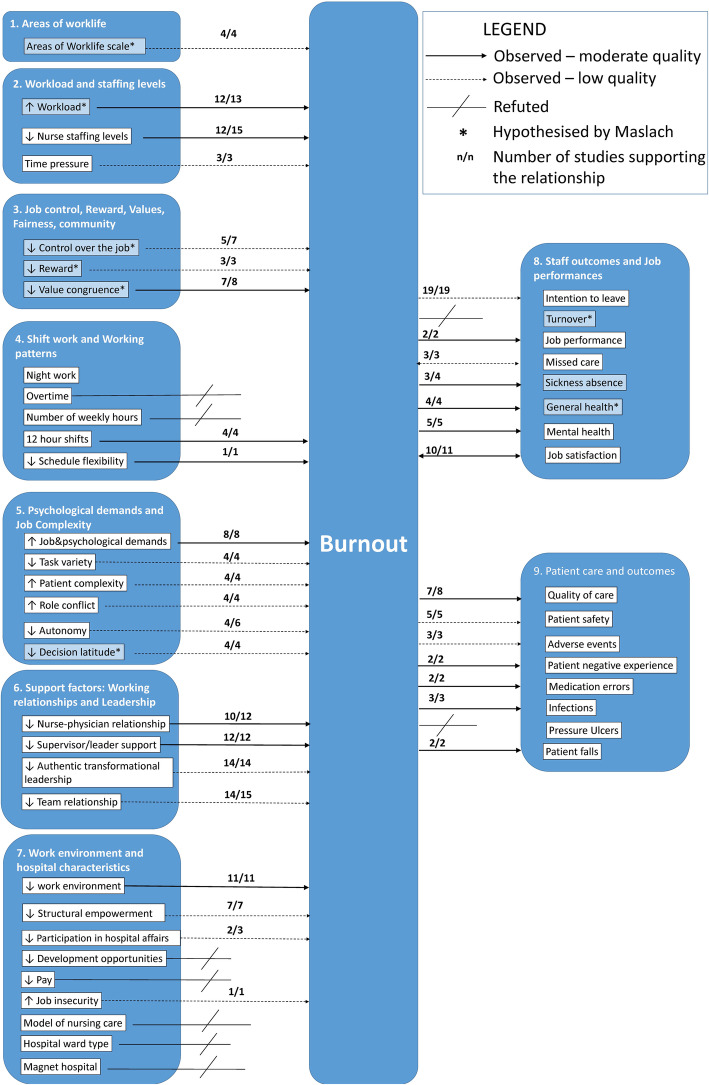
BACKGROUND: Workforce studies often identify burnout as a nursing 'outcome'. Yet, burnout itself-what constitutes it, what factors contribute to its development, and what the wider consequences are for individuals, organisations, or their patients-is rarely made explicit. We aimed to provide a comprehensive summary of research that examines theorised relationships between burnout and other variables, in order to determine what is known (and not known) about the causes and consequences of burnout in nursing, and how this relates to theories of burnout. METHODS: We searched MEDLINE, CINAHL, and PsycINFO. We included quantitative primary empirical studies (published in English) which examined associations between burnout and work-related factors in the nursing workforce. RESULTS: Ninety-one papers were identified. The majority (n = 87) were cross-sectional studies; 39 studies used all three subscales of the Maslach Burnout Inventory (MBI) Scale to measure burnout. As hypothesised by Maslach, we identified high workload, value incongruence, low control over the job, low decision latitude, poor social climate/social support, and low rewards as predictors of burnout. Maslach suggested that turnover, sickness absence, and general health were effects of burnout; however, we identified relationships only with general health and sickness absence. Other factors that were classified as predictors of burnout in the nursing literature were low/inadequate nurse staffing levels, ≥ 12-h shifts, low schedule flexibility, time pressure, high job and psychological demands, low task variety, role conflict, low autonomy, negative nurse-physician relationship, poor supervisor/leader support, poor leadership, negative team relationship, and job insecurity. Among the outcomes of burnout, we found reduced job performance, poor quality of care, poor patient safety, adverse events, patient negative experience, medication errors, infections, patient falls, and intention to leave. CONCLUSIONS: The patterns identified by these studies consistently show that adverse job characteristics-high workload, low staffing levels, long shifts, and low control-are associated with burnout in nursing. The potential consequences for staff and patients are severe. The literature on burnout in nursing partly supports Maslach's theory, but some areas are insufficiently tested, in particular, the association between burnout and turnover, and relationships were found for some MBI dimensions only.
Overview
CoChat Summary
TL;DR
This theoretical review of 91 quantitative studies found adverse job characteristics—high workload, low staffing levels, long shifts, and low control—are consistently associated with burnout in nursing, with severe potential consequences for staff and patients. The literature partly supports Maslach’s theory, but incomplete burnout measurement and mostly cross-sectional designs limit causal inference.
Key findings
- Across 91 studies, high workload was supported in 12/13 studies, low/inadequate nurse staffing in 12/15, ≥12-h shifts in 4/4, low control over the job in 5/7, low reward in 3/3, low value congruence in 7/8, low decision latitude in 4/4, poor supervisor/leader support in 12/12, negative team relationship in 14/15, and intention to leave in 19/19.
- Burnout was associated with reduced job performance (2/2), poor quality of care (7/8), poor patient safety (5/5), adverse events (3/3), medication errors (2/2), infections (3/3), and patient falls (2/2); no association was found with pressure ulcers. Turnover was refuted despite being hypothesised by Maslach, with only one small study finding Depersonalisation associated with turnover within 2 years.
- Most studies used the Maslach Burnout Inventory (n = 81), but only 39 (47%) measured and reported all three MBI subscales; 23 used Emotional Exhaustion only, 11 used Emotional Exhaustion and Depersonalisation, and 9 summed the three subscales despite advice against this. Maslach’s hypothesised predictors were generally supported, but often only for some MBI dimensions.
Methods
- Theoretical review conducted according to Campbell et al. and Pare et al.; systematic search of MEDLINE, CINAHL, and PsycINFO in May 2019 for English quantitative primary empirical studies examining associations between burnout and work-related factors or outcomes in nurses or nursing assistants in healthcare settings. Studies focused exclusively on personal factors, only comparing burnout levels across settings, or literature reviews, commentaries, and editorials were excluded.
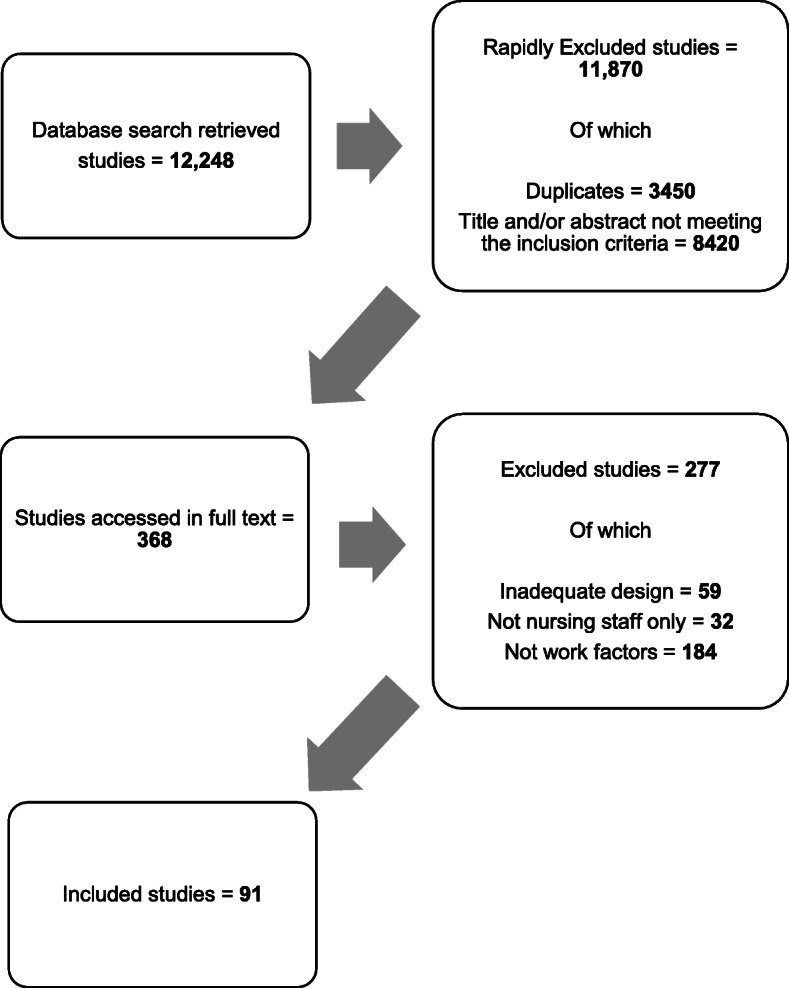
- The search yielded 12,248 records; 368 full texts were accessed, and 91 studies were included. Data were extracted on country, setting, sample size, staff group, burnout measure, variables tested, and findings; a coding frame starting from Maslach’s multidimensional theory produced nine broad categories. No formal quality appraisal was performed, but key quality aspects were summarised.
Limitations
- Stated by the authors: no formal quality appraisal instrument was applied; studies were reported without context or estimates such as ORs and 95% CIs; personality and other individual variables were not considered in data extraction; and studies indexed elsewhere or grey literature may have been missed.
- Evident from the text: 87/91 studies (97%) were cross-sectional, limiting temporal and causal inference and creating simultaneity bias, with factors such as missed care, job satisfaction, and mental health treated as both predictors and outcomes. Incomplete MBI measurement—only 39/91 studies used all three subscales, and 9 summed subscales—further limits testing of Maslach’s theory.
Model-written summary. Check it against the paper before relying on it.
Integrity signals
Registry
Cites
Statistics
Figures
Verification
Claims the paper makes
24 Valid · 3 Not valid · 199 Not checked · 100 Own results and interpretations
The sources with a verdict support this claim; the rest weren’t checked yet, have no full text we could read, or their verdicts aren’t rated yet.
In the paper
“high psychological demands were associated with higher odds of Emotional Exhaustion [62, 78]”
§ Burnout in nursing: a theoretical review > Results > Psychological demands and job complexity
What the sources say
- Supportedcites [62] Vidotti V Ribeiro RP Galdino MJQ Martins JT Burnout syndrome and shift work among the nursing staff Rev Lat Am Enfermagem 2018 26 e3022 30110099 PMC6091368 source
The Method section identifies psychological demands as a dimension of the Demand-Control-Support Questionnaire. In Results, Table 3 reports that high demand was associated with higher odds of emotional exhaustion among day-shift nursing staff (adjusted OR 2.50, 95% CI 1.44–4.35). The reported association is specific to the day shift. (LLM, conf=0.91)
- Not checked — no full text of the sourcecites [78] Bourbonnais R Comeau M Vezina M Dion G Job strain, psychological distress, and burnout in nurses Am J Ind Med 1998 34 1 20 28 9617384 doi:10.1002/(sici)1097-0274(199807)34:1
plainstates an association- Asserted: passes — The authors put it forward as true.
- Checkable: passes — It can be checked against evidence.
- Load-bearing: passes — The paper’s conclusions depend on it.
- Based: passes — The paper gives a reason why it holds.
- Supported
The cited sources support only part of this claim — read each source’s verdict below.
In the paper
“and Emotional Exhaustion and Personal Accomplishment [50]”
§ Burnout in nursing: a theoretical review > Results > Working relationships and leadership
What the sources say
- Partly supportedcites [50] Hanrahan NP Aiken LH McClaine L Hanlon AL Relationship between psychiatric nurse work environments and nurse burnout in acute care general hospitals Issues Ment Health Nurs 2010 31 3 198 207 20144031 PMC2856615 sourceExperimental — accuracy not yet measured
The Discussion (‘Strong Mangers and Leaders’) reports a significant relationship between manager skill and emotional exhaustion. The Results state that none of the work-environment factors, including manager skill, were associated with personal accomplishment in the adjusted or unadjusted models. The claim is therefore supported for emotional exhaustion but not personal accomplishment. (LLM, conf=0.92)
plainstates an association- Asserted: passes — The authors put it forward as true.
- Checkable: passes — It can be checked against evidence.
- Load-bearing: unclear — It is unclear whether the paper’s conclusions depend on it.
- Based: passes — The paper gives a reason why it holds.
- Partly supported
Every source the paper cites for this claim was checked and supports it.
In the paper
“The inability to establish a temporal link means limits the inference of causality [115].”
§ Burnout in nursing: a theoretical review > Discussion
What the sources say
- Supportedcites [115] Antonakis J Bendahan S Jacquart P Lalive R On making causal claims: a review and recommendations Leadersh Q 2010 21 6 1086 1120 source
Section 1, “What is Causality?”, lists temporal precedence as a condition for measuring a causal effect and explicitly calls temporal ordering necessary but not sufficient. Thus, inability to establish temporal order limits causal inference. (LLM, conf=0.93)
plain- Asserted: passes — The authors put it forward as true.
- Checkable: passes — It can be checked against evidence.
- Load-bearing: passes — The paper’s conclusions depend on it.
- Based: passes — The paper gives a reason why it holds.
- Supported
The sources with a verdict support this claim; the rest weren’t checked yet, have no full text we could read, or their verdicts aren’t rated yet.
In the paper
“| Night work | | | √ | |”
- Also stated in: § Working patterns and shift work · plain
“Working night shifts was associated with burnout (composite score) [68] and Emotional Exhaustion [62], but the relationship was not significant in two studies [69, 70].”
§ Burnout in nursing: a theoretical review > Results
What the sources say
- Not checked — no full text of the sourcecites [68] Anwar MM Elareed HR Burnout among Egyptian nurses Journal of Public Health-Heidelberg 2017 25 6 693 697 source
- Supportedcites [62] Vidotti V Ribeiro RP Galdino MJQ Martins JT Burnout syndrome and shift work among the nursing staff Rev Lat Am Enfermagem 2018 26 e3022 30110099 PMC6091368 source
The Results (Table 2) show that the relationship between work shift and burnout differs across dimensions: emotional exhaustion and professional realization differ significantly by shift, while depersonalization does not. The Discussion also reports higher overall burnout levels among day-shift than night-shift nursing staff. This supports the claim that night work is not consistently associated with burnout. (LLM, conf=0.86)
- Not checked — no full text of the sourcecites [69] Wisetborisut A Angkurawaranon C Jiraporncharoen W Uaphanthasath R Wiwatanadate P Shift work and burnout among health care workers Occup Med (Lond) 2014 64 4 279 286 24550196 source
- Not checked — no full text of the sourcecites [70] Ilhan MN Durukan E Taner E Maral I Bumin MA Burnout and its correlates among nursing staff: questionnaire survey J Adv Nurs 2008 61 1 100 106 18034813 source
plain- Asserted: passes — The authors put it forward as true.
- Checkable: passes — It can be checked against evidence.
- Load-bearing: unclear — It is unclear whether the paper’s conclusions depend on it.
- Based: passes — The paper gives a reason why it holds.
- Also stated in: § Working patterns and shift work · plain
Every source the paper cites for this claim was checked and supports it.
In the paper
“Long shifts of 12 h or more were associated with all MBI subscales [74]”
§ Burnout in nursing: a theoretical review > Results > Working patterns and shift work
What the sources say
- Supportedcites [74] Dall’Ora C Griffiths P Ball J Simon M Aiken LH Association of 12 h shifts and nurses’ job satisfaction, burnout and intention to leave: findings from a cross-sectional study of 12 European countries BMJ Open 2015 5 9 e008331 26359284 PMC4577950 source
The Measurements section identifies the three MBI subscales as emotional exhaustion, depersonalisation and personal accomplishment. The Discussion explicitly reports an association between shifts of 12 hours or more and all three subscales; the Shift length and nurse outcomes section reports the corresponding adjusted results. (LLM, conf=0.95)
plainstates an association- Asserted: passes — The authors put it forward as true.
- Checkable: passes — It can be checked against evidence.
- Load-bearing: passes — The paper’s conclusions depend on it.
- Based: passes — The paper gives a reason why it holds.
- Supported
201 more claims · 15 with their cited sources checked
Create a free account to see all 326 claims and to verify the 23 references still open.
- Probably not a substantial claim. 64
- It may state two separate claims as one. 72
- The quote only partly states this claim. 2
Claims other papers make about this one
Each is checked against this paper’s own text: does it say what the citing paper says it does?
The source backs part of the claim, not all of it — or backs it for a different population, condition or comparison.
In the citing paper
“Burnout among HPs is significantly associated with suicidal ideation [7], decreased job satisfaction [8], and increased turnover intention, ultimately resulting in a loss of HPs and deterioration in the quality of care, which is also negatively affected, as is patient safety and health status [9,10,11].”
From Effects of Third-Wave Cognitive Behavioral Therapy for Healthcare Professionals’ Burnout: A Systematic Review and Meta-Analysis (2025) · cites this paper as [9]
Experimental — accuracy not yet measuredThe source backs part of the claim, not all of it — or backs it for a different population, condition or comparison.
In the citing paper
“Reducing EE and DP may also contribute to improved workforce retention and lower absenteeism, ultimately benefiting healthcare providers and enhancing patient safety and care quality [9,10,11].”
From Effects of Third-Wave Cognitive Behavioral Therapy for Healthcare Professionals’ Burnout: A Systematic Review and Meta-Analysis (2025) · cites this paper as [9]
Experimental — accuracy not yet measuredThe cited source says what the claim attributes to it.
In the citing paper
“Last but not the least, some other organizational factors may also affect burnout, such as excessive workload, time pressure, high job demands, low rewards, low job autonomy, or negative team atmosphere [13].”
From The efficacy of applying the Interpersonal Effectiveness skills of dialectical behavior therapy into communication skills workshop for clinical nurses (2023) · cites this paper as [13]
Self-check
Percentages, sums and reported differences re-computed from the paper’s own numbers.
Each contradiction between two passages listed here was confirmed by an independent check.
Rated minor: it would not touch a result — a value no result rests on, a p-value that stays on the same side of the significance level, or a conflict that is clerical, resolved elsewhere in the paper, or outside its own findings.
In the paper
“The database search yielded 12 248 studies, of which 11 870 were rapidly excluded as either duplicates or titles and/or abstract not meeting the inclusion criteria. Of the 368 studies accessed in full text, 277 were excluded, and 91 studies were included in the review.”
§ Burnout in nursing: a theoretical review > Results
Reported 368 · recomputed 378
Rated minor: it would not touch a result — a value no result rests on, a p-value that stays on the same side of the significance level, or a conflict that is clerical, resolved elsewhere in the paper, or outside its own findings.
In the paper
§ Burnout in nursing: a theoretical review > Results
“| Overtime | | | √ | |”
§ Burnout in nursing: a theoretical review > Results > Working patterns and shift work
“One study found working that overtime was associated with composite MBI score [73].”
Rated minor: it would not touch a result — a value no result rests on, a p-value that stays on the same side of the significance level, or a conflict that is clerical, resolved elsewhere in the paper, or outside its own findings.
In the paper
“Most studies used the Maslach Burnout Inventory Scale (n = 81), which comprises three subscales reflecting the theoretical model: Emotional Exhaustion, Depersonalisation, and reduced Personal Accomplishment. However, less than half (47%, n = 39) of the papers measured and reported results with all three subscales.”
§ Burnout in nursing: a theoretical review > Results > Measures of burnout
Reported 47 · recomputed 48.148148
Citations
Cites
The measurement of experienced burnout
Maslach, C., & Jackson, S. E. (1981) · Journal of Organizational Behavior · doi:10.1002/job.4030020205 · Cited by 14,496
The job demands-resources model of burnout.
Demerouti, E., Bakker, A. B., Nachreiner, F., & Schaufeli, W. B. (2001) · Journal of Applied Psychology · doi:10.1037/0021-9010.86.3.499 · Cited by 13,643
Maslach, C., Schaufeli, W. B., & Leiter, M. P. (2001) · Annual Review of Psychology · doi:10.1146/annurev.psych.52.1.397 · Cited by 12,852
(1996) · Consulting Psychologists Press eBooks · Cited by 7,863
Freudenberger, H. J. (1974) · Journal of Social Issues · doi:10.1111/j.1540-4560.1974.tb00706.x · Cited by 5,463
Hospital Nurse Staffing and Patient Mortality, Nurse Burnout, and Job Dissatisfaction
Aiken, L. H. (2002) · JAMA · doi:10.1001/jama.288.16.1987 · Cited by 5,226
The Copenhagen Burnout Inventory: A new tool for the assessment of burnout
Kristensen, T. S., Borritz, M., Villadsen, E., & Christensen, K. B. (2005) · Work & Stress · doi:10.1080/02678370500297720 · Cited by 3,136
On making causal claims: A review and recommendations
Antonakis, J., Bendahan, S., Jacquart, P., & Lalive, R. (2010) · The Leadership Quarterly · doi:10.1016/j.leaqua.2010.10.010 · Cited by 2,441
Synthesizing information systems knowledge: A typology of literature reviews
Paré, G., Trudel, M.-C., Jaana, M., & Kitsiou, S. (2015) · Information & Management · doi:10.1016/j.im.2014.08.008 · Cited by 1,987
Burnout: 35 years of research and practice.
Schaufeli, W. B., Leiter, M. P., & Maslach, C. (2009) · Career Development International · doi:10.1108/13620430910966406 · Cited by 1,964
Research works printed but not linked: 4
- Ekstedt M Burnout and sleep: Institutionen för folkhälsovetenskap/Department of Public Health Sciences 2005
- Cherniss C Burnout in new professionals: a long-term follow-up study J Health Hum Resour Adm 1989 12 1 11 24
- Adali E Priami M Evagelou H Mougia V Ifanti M Alevizopoulos G Burnout in psychiatric nursing personnel in Greek hospitals European Journal of Psychiatry 2003 17 3 173 181
- Laschinger HKS Shamian J Thomson D Impact of magnet hospital characteristics on nurses’ perceptions of trust, burnout, quality of care, and work satisfaction Nurs Econ 2001 19 5 209 219
Cited by
Items 301–400 of 1,160
Hatukay, A. L., Shochat, T., Zion, N., Baruch, H., Cohen, R., Azriel, Y., & Srulovici, E. (2023) · International Journal of Nursing Studies · doi:10.1016/j.ijnurstu.2023.104677 · Cited by 15
Tetzlaff, E. J., Cassan, C., Goulet, N., Gorman, M., Hogya, B., & Kenny, G. P. (2024) · American Journal of Industrial Medicine · doi:10.1002/ajim.23576 · Cited by 11
“36 Petrino et al. 34 indicate a distinct association between insufficient human resources and the extent of reported burnout.”
Cortés-Álvarez, N. Y., Lara-Morales, A., Bautista, E., Marmolejo-Murillo, L. G., Jiménez, A. D., Hernández, L. A. V., Moya, M. F., & Vuelvas-Olmos, C. R. (2024) · PLoS ONE · doi:10.1371/journal.pone.0304092 · Cited by 16
“The patterns identified previous [39,54,55,61], and the present study consistently show that complex work environments are considered an important factor in burnout development, and even this factor could be decisive for staff to decide to leave their jobs.”
BackgroundHussein, A. H. M., Hashish, E. A. A., & Younes, B. M. (2024) · SAGE Open Nursing · doi:10.1177/23779608241285400 · Cited by 9
“The reported levels of absenteeism, presenteeism, and impaired daily living activities among nurses stem from the demanding nature of their work, long hours, high patient-to-nurse ratios, and physically and emotionally taxing situations (Dall ’ Ora et al., 2020).”
BackgroundJordan, J. E., Garner, K., Bones, K., McKenzie, L., Linzer, M., Rathert, C., Goelz, E., McCall, J., Sawyer, E., Geelen-Baass, B. N., et al. (2024) · Health Care Management Review · doi:10.1097/hmr.0000000000000420 · Cited by 12
Zhao, Z., Gao, H., Chen, F., & Dong, H. (2024) · Geriatric Nursing · doi:10.1016/j.gerinurse.2024.12.007 · Cited by 15
Lee, N., Baernholdt, M., Epstein, B., Bissram, J., Adapa, K., & Mazur, L. M. (2025) · Workplace Health & Safety · doi:10.1177/21650799251319366 · Cited by 12
Luo, Y., Chen, Y., & Feng, M. (2025) · International Nursing Review · doi:10.1111/inr.70050 · Cited by 12
Bernstein, S., Catchpole, K., Kelechi, T. J., & Nemeth, L. S. (2022) · The Joint Commission Journal on Quality and Patient Safety · doi:10.1016/j.jcjq.2022.02.007 · Cited by 10
Impact of Physical Workload and Mental Workload on Nurse Performance: A Path Analysis
Pamungkas, R. A., Ruga, F. B. P., Kusumapradja, R., & Kusumapradja, R. (2022) · International Journal of Nursing and Health Services (IJNHS) · doi:10.35654/ijnhs.v5i2.604 · Cited by 33
Identification of Predictive Nursing Workload Factors: A Six Sigma Approach
Buestán, M., & Perez, C. (2022) · Sustainability · doi:10.3390/su142013169 · Cited by 12
Haraldsson, P., Nylander, E. M., Jonker, D., Ros, A., & Josefsson, K. A. (2024) · Work · doi:10.3233/wor-230205 · Cited by 13
“In hospital settings, the work environment has been shown to affect employees in the form of a high workload, long work shifts, low sense of control [10], and lifting, pushing and pulling during patient handling [11].”
BackgroundYildirim, D. U., Şenyuva, E., & Kaya, E. (2024) · International Journal of Nursing Practice · doi:10.1111/ijn.13239 · Cited by 15
Research priorities of Australian cancer nurses: A national consensus survey
Bradford, N., Pitt, E., & Alexander, K. E. (2022) · Collegian Journal of the Royal College of Nursing Australia · doi:10.1016/j.colegn.2022.01.005 · Cited by 8
Factors associated with burnout in a multidisciplinary team of an oncology hospital
Saura, A. P. N. S., Valóta, I. A. D. C., da Silva, R. M., & Costa, A. L. S. (2022) · Revista da Escola de Enfermagem da USP · doi:10.1590/1980-220x-reeusp-2021-0448en · Cited by 39
Bataweel, A. O. (2023) · Open Journal of Nursing · doi:10.4236/ojn.2023.132009 · Cited by 13
Racoviță, M., Tate, J., Wait, S., et al. (2023) · British Journal of Nursing · doi:10.12968/bjon.2023.32.14.698 · Cited by 9
“21 A 2020 UK review of working conditions for nurses found that compared with nurses working in the private sector, public sector nurses had high levels of stress, high pressure from staff shortages and double the number of sickness days.”
Lee, K. Y., Zakaria, N., & Zakaria, N. (2024) · SAGE Open Nursing · doi:10.1177/23779608241245212 · Cited by 28
“In addition, they have to deal with additional stressors such as exposure to death and dying, demanding patients and family members, long working hours, and shift work, making them highly susceptible to burnout (Dall ’ Ora et al., 2020).”
BackgroundMurray, D. D., & Chiotu, L. B. (2024) · Issues in Mental Health Nursing · doi:10.1080/01612840.2024.2322045 · Cited by 10
“The findings of the present study are similar to Dall’Ora et al. (2020) whereby nurses consistently described that the “workplace stresses imposed upon them and the persistent and severe staffing shortages had left them feeling “demoralized, deval-ued, and diminished.”
BackgroundResultInfluentialKakyo, T. A., Xiao, L. D., & Chamberlain, D. J. (2024) · International Nursing Review · doi:10.1111/inr.12977 · Cited by 18
Original Research: Addressing Nurse Burnout: The Relationship Between Burnout and Physical Activity
Guerrero, K. S., Fleming, S., Calderon, A., & Fontenot, N. M. (2024) · AJN American Journal of Nursing · doi:10.1097/01.naj.0001023020.53993.34 · Cited by 13
Shen, Y., Lythreatis, S., Singh, S. K., & Smart, P. (2024) · Journal of International Management · doi:10.1016/j.intman.2024.101204 · Cited by 15
Dingelstad, J., Grommé, F., & Wallenburg, I. (2025) · New Technology Work and Employment · doi:10.1111/ntwe.12334 · Cited by 14
Jacobs, S., Moloney, W., Terry, D. R., Lewis, P. A., Topping, A. E., Agüero, M. G., & Cavanagh, S. J. (2025) · Nursing Reports · doi:10.3390/nursrep15030095 · Cited by 15
Exploring the role of staffing needs in JD-R theory: evidence from public healthcare organizations
Pirrotta, L., Cantarelli, P., & Bellè, N. (2025) · Management Decision · doi:10.1108/md-07-2024-1718 · Cited by 18
Dong, S., Shen, X., Zhao, T., Zeng, R., & Chen, M. (2025) · Journal of Nursing Management · doi:10.1155/jonm/6653143 · Cited by 10
Nurmeksela, A., Schavoronkoff, K., & Jokiniemi, K. S. (2025) · Journal of Nursing Management · doi:10.1155/jonm/9980485 · Cited by 25
Campione, A., & Henschke, C. (2025) · BMC Nursing · doi:10.1186/s12912-025-03745-y · Cited by 10
Martín‐Parrilla, M. Á., Durán‐Gómez, N., Montanero‐Fernández, J., Casas‐Méndez, C., López‐Jurado, C. F., & Cáceres, M. C. (2025) · International Journal of Mental Health Nursing · doi:10.1111/inm.70151 · Cited by 21
Retaining Those Who Care: Ethical Climate, Leadership, and Workforce Sustainability in Healthcare
Poeira, A., & Nunes, L. (2025) · Healthcare · doi:10.3390/healthcare13233014 · Cited by 14
General well‐being of intensive care nurses: A prototype analysis
Jarden, R., Sandham, M. H., Siegert, R. J., & Koziol‐McLain, J. (2021) · Nursing in Critical Care · doi:10.1111/nicc.12706 · Cited by 14
Cohen, B., DePierro, J. M., Chan, C. C., Tolan, E., Deshpande, R., Feder, A., Feingold, J. H., Peccoralo, L. A., Pietrzak, R. H., & Ripp, J. (2022) · JONA The Journal of Nursing Administration · doi:10.1097/nna.0000000000001216 · Cited by 12
Floating to intensive care units: Nurses' messages for instant action to promote patient safety
Ahmed, F. R., Timmins, F., Dias, J. M., Al‐Yateem, N., Gamil, R., Subu, M. A., Mustafa, H., & AbuRuz, M. E. (2023) · Nursing in Critical Care · doi:10.1111/nicc.12907 · Cited by 12
Identifying Holistic Nursing Research Priorities for 2023–2026
Freysteinson, W. M., Hines, M. E., Wardell, D. W., Friesen, M. A., Conrad, S., Zahourek, R. P., Gallo, A., & Prather, J. G. (2023) · Journal of Holistic Nursing · doi:10.1177/08980101231213725 · Cited by 9
“Moreover, approximately 50% of nurses will leave or have considered leaving the nursing profession as an outcome of burnout (Dall ’ Ora et al., 2020; Montañés Muro et al., 2022), a frightening prospect contributing to a critical nursing shortage.”
BackgroundMalinowska‐Lipień, I., Gabryś, T., Kózka, M., Gniadek, A., & Brzostek, T. (2023) · Medycyna Pracy · doi:10.13075/mp.5893.01426 · Cited by 14
“Working in conditions of constant physical and mental effort, significant workload, the number of staff inadequate to the needs of patients, 12-h shifts, lack of satisfaction and lack of compensation for work increase the risk of burnout [9].”
BackgroundResultDakin, F., Rai, T., Paparini, S., & Greenhalgh, T. (2023) · BMJ Leader · doi:10.1136/leader-2023-000780 · Cited by 14
Terry, D. R., Peck, B., Baker, E., & Schmitz, D. (2024) · BMC Nursing · doi:10.1186/s12912-024-01723-4 · Cited by 12
“We suggest that the widespread pressure on early carer nurses identified elsewhere [36], has implications for policymakers to leverage or mandate that health services provided management and leadership training as part of their suite of induction learning [37].”
BackgroundHickey, P. A., Connor, J. A., Whiting, J., & Wood, L. J. (2024) · JONA The Journal of Nursing Administration · doi:10.1097/nna.0000000000001412 · Cited by 9
Herz, M., Bösl, S., & Gebhard, D. (2024) · BMC Nursing · doi:10.1186/s12912-024-01855-7 · Cited by 16
“This lack of time and limited opportunities for recovery during the workday are associated with psychological distress and the development of burnout among RLTC staff [28], which was underscored by a cross-sectional study indicating a 40.0% prevalence of caregiver burnout [29].”
BackgroundInfluentialLow-value health care, de-implementation, and implications for nursing research: A discussion paper
Beks, H., Clayden, S., Shee, A. W., Manias, E., Versace, V. L., Beauchamp, A., Namara, K. M., & Alston, L. V. (2024) · International Journal of Nursing Studies · doi:10.1016/j.ijnurstu.2024.104780 · Cited by 14
Nurse Preceptor Motivations, Barriers, and Perceived Rewards Post-Pandemic
Kauth, C., & Reed, J. M. (2024) · MEDSURG Nursing · doi:10.62116/msj.2024.33.5.241 · Cited by 8
Al-Ali, F., Radwan, A., Darwish, T. K., & Khassawneh, O. (2025) · International journal of organizational analysis · doi:10.1108/ijoa-11-2024-4979 · Cited by 13
Development and Assessment of the Personal Emotional Capital Questionnaire for Adults
Khazaei, M., Holder, M. D., Sirois, F. M., Oades, L. G., & Gendron, B. (2021) · International Journal of Environmental Research and Public Health · doi:10.3390/ijerph18041856 · Cited by 12
Sick leave and occupational burnout among nurses caring for patients with multiple sclerosis
Saposnik, G., Bueno-Gil, G., Sempere, Á. P., Muñoz, B. D. R., Mesa, A. L., Azanza-Munarriz, C., Ríos, N. B., Goicochea-Briceño, H., Horno, R., Sánchez-Franco, C. M., et al. (2022) · Multiple Sclerosis and Related Disorders · doi:10.1016/j.msard.2022.103916 · Cited by 10
Khan, N. H., Hassan, S., Bahader, S., Fatima, S., Zaidi, S. M. I. H., Virk, R., Jiang, K., & Jiang, E. (2022) · International Journal of Environmental Research and Public Health · doi:10.3390/ijerph19148748 · Cited by 12
Managing periprosthetic joint infection—a qualitative analysis of nursing staffs’ experiences
Walter, N., Wimalan, B., Baertl, S., Lang, S., Hinterberger, T., Alt, V., & Rupp, M. (2022) · BMC Nursing · doi:10.1186/s12912-022-00978-z · Cited by 10
“Facilitating associated psychosocial challenges is essential as patient care can be adversively affected by personal stress [17].”
Health-care provider burnout in Syria during COVID-19 pandemic’s Omicron wave
Swed, S., Bohsas, H., Ibrahim, I., Hafez, W., shoib, S., Sawaf, B., Rais, M. A., Aljabali, A. S., Shaheen, N., Elsayed, M., et al. (2022) · Medicine · doi:10.1097/md.0000000000032308 · Cited by 10
“However, more medical mistakes have been associated with HCWs burnout, which may threaten patient safety.[16,17] The purpose of this research was to determine the extent of burnout among healthcare professionals during the COVID-19 pandemic’s Omicron wave and to identify risk variables for this psychological aftereffe…”
BackgroundThe effect of full-time culture on quality and safety of care – a literature review
Magerøy, M. R., & Wiig, S. (2023) · International Journal of Health Governance · doi:10.1108/ijhg-11-2022-0106 · Cited by 17
Zeng, X., Yang, J., Li, Y., Chen, M., Wu, J., Hu, Y., Lu, W., Liu, J., Yang, Q., Guo, W., et al. (2023) · Perspectives In Psychiatric Care · doi:10.1155/2023/1736608 · Cited by 13
Alhenaidi, A., Al‐Haqan, A., Kelendar, H., Al‐Bader, B., Alkandari, O., & Al-Zuabi, H. (2023) · INQUIRY The Journal of Health Care Organization Provision and Financing · doi:10.1177/00469580231206253 · Cited by 14
“16 Among the adverse effect of professional burnout is healthcare workers turnover.”
BackgroundInfluentialEsteban‐Sepúlveda, S., Terradas, R., Ribeiro, T. C., Pagès, E. G., Sangrà, P. S., & Lacueva‐Pérez, L. (2022) · Enfermería Clínica · doi:10.1016/j.enfcli.2021.12.009 · Cited by 20
The influence of pet ownership on self-compassion among nurses: a cross-sectional study
Jiang, H., Mei, Y., Wang, X., Wang, W., Lin, B., Zhao, Z., & Zhang, Z. (2023) · PeerJ · doi:10.7717/peerj.15288 · Cited by 12
“According to Ding & Xu (2021) , self-compassion moderates the relationship between attachment anxiety and self-esteem and has a mediating effect on subjective well-being.”
BackgroundPark, J. S., Kim, H. K., & Lee, M. H. (2024) · Applied Nursing Research · doi:10.1016/j.apnr.2024.151819 · Cited by 9
Bouche, A., Jaussaud, J., Pic, O., Koleck, M., Dupuy, L., Ouvrard, C., Amieva, H., & Rascle, N. (2025) · Journal of Advanced Nursing · doi:10.1111/jan.16709 · Cited by 11
“According to Dall'Ora et al. (2020) and Duan-Porter et al. (2018), diverse job characteristics—high workload, quantitative demands, work culture, low staffing levels, long shifts, low control and working as nurses' aide—are associated with burnout and depression.”
Chen, X., Xu, Y., Zhang, Q., Huang, H., Tan, X., & Yang, Y. (2025) · BMC Public Health · doi:10.1186/s12889-024-21199-w · Cited by 16
Burnout among nurses practicing in critical care units: Predicting the contributing factors
Yousif, S. Y., & AL‐Fayyadh, S. (2025) · Journal of Education and Health Promotion · doi:10.4103/jehp.jehp_926_24 · Cited by 12
“[25] With respect to the time span and occurrence of burnout, the present study showed that the time span was considered one of the factors that the predicated burnout in nurses.”
A Scoping Review of Instruments Used to Measure Resilience in Samples of Nurses
Cooper, A. L., Roberts, G., Hegney, D. G., & Brown, J. A. (2025) · Journal of Advanced Nursing · doi:10.1111/jan.16769 · Cited by 8
“For example, burnout, which is one factor in resilience in nurses is associated with reduced patient safety and adverse events, including patient falls, medication errors and infections (Dall'Ora et al. 2020).”
Popa, M. V., Gurzu, I. L., Mîndru, D. E., Gurzu, B., Handra, C. M., Eva-Maria, E., Olaru, I. I., Anton-Păduraru, D.-T., Warter, C., & Duceac, L. D. (2025) · Healthcare · doi:10.3390/healthcare13050563 · Cited by 8
Thankachen, S., Kabir, Z., & Sadath, A. (2025) · Journal of Migration and Health · doi:10.1016/j.jmh.2025.100325 · Cited by 13
“Nurses often experience high burnout (Chigwedere et al., 2021), which is associated with factors such as high workload, value incongruence, low control over the job, limited decision latitude, poor social climate/social support, and low rewards (Dall ’ Ora et al., 2020).”
Paustian‐Underdahl, S. C., Li, Y., Whyte, J., & Haye, D. C. D. L. (2025) · Nursing Outlook · doi:10.1016/j.outlook.2025.102398 · Cited by 11
Kong, X., Zhao, M., Li, R., Li, Z., Chang, D., Zhou, X., Ma, Q., & Gao, Y. (2025) · BMC Medical Education · doi:10.1186/s12909-025-07391-5 · Cited by 7
“Such adverse job characteristics are closely linked to job burnout [14], which could lead to negative physical, psychological, and occupational outcomes [15].”
Su, P.-P., Chen, S., Chang, F., Feng, H., Feng, X., Wen, L., Hu, H., Ouyang, J., & Wu, X. (2025) · BMJ Open · doi:10.1136/bmjopen-2024-095858 · Cited by 10
“In summary, improving nurses’ SWB is crucial to meeting demands for”
When Nurses Leave: A Critical Incident Study of Turnover Intentions
Rhéaume, A., Breau, M., & Boudreau, C. (2025) · Journal of Clinical Nursing · doi:10.1111/jocn.17837 · Cited by 9
“Several individual factors are also associated to turnover intentions such as burnout (Dall'Ora et al. 2020; Heinen et al. 2013) and age (Van der Heijden et al. 2019).”
Mutair, A. S. A., Alsaleh, K., Alrasheeday, A., Almadani, N. A., Alyami, H. M., Daniyal, M., & Almahmoud, S. A. (2025) · SAGE Open Nursing · doi:10.1177/23779608251350578 · Cited by 9
“…health and is strongly associated with staff turnover, low morale, absenteeism, and other issues, all of which can have serious repercussions on the quality of patient care and safety (Al-Omari et al., 2019; Dall ’ Ora et al., 2020; Edú-Valsania et al., 2022; Lee et al., 2023; Salama et al., 2022).”
Decent work conditions and Nigerian nurse emigration: The role of burnout and commitment
Ajayi, D., Tanova, C., Bayighomog, S. W., & Akinwande, A. S. (2025) · Acta Psychologica · doi:10.1016/j.actpsy.2025.105294 · Cited by 15
Instruments for Assessing Nursing Care Quality: A Scoping Review
Correia, P. S. R., Bernardes, R. A., & Caldeira, S. (2025) · Nursing Reports · doi:10.3390/nursrep15090342 · Cited by 16
Kyambade, M., & Namatovu, A. (2025) · Leadership in Health Services · doi:10.1108/lhs-02-2025-0021 · Cited by 11
Contributing to a Healthier World: Exploring the Impact of Wellbeing on Nursing Burnout
Sanders, C., Burke, J., & Muzyk, A. J. (2022) · Journal of Happiness and Health · doi:10.47602/johah.v2i2.14 · Cited by 10
Lu, Y., Li, Y., Zhong, X., Long, H., Chen, F., & Jin, X. (2022) · International Journal of Environmental Research and Public Health · doi:10.3390/ijerph192316042 · Cited by 11
Richert, M., & Zucchero, R. A. (2023) · Journal of Long-Term Care · doi:10.31389/jltc.160 · Cited by 11
Lönnqvist, K., Sinervo, T. S., Kaihlanen, A., Vehviläinen-Julkunen, K. M., & Elovainio, M. J. (2023) · BMC Health Services Research · doi:10.1186/s12913-023-09949-9 · Cited by 13
“…examining demands related to the nursing work environment and health effects, Dall’Ora et al. (2020) identified several factors including a high work-load, low control over the job, low decision latitude, and a lack of social support as predictors of poor health among the nursing workforce [15].”
BackgroundBrown, J. A., Harvey, C. L., Byrne, A., & Hegney, D. G. (2023) · Public Health Nursing · doi:10.1111/phn.13256 · Cited by 15
Compassionate Care: A Qualitative Exploration of Nurses’ Inner Resources in the Face of Burnout
Flowers, S.-L. D., Guillén-Solà, M., Sansó, N., & Galiana, L. (2024) · Nursing Reports · doi:10.3390/nursrep14010006 · Cited by 10
“It is interesting to note that burnout has recently been added to the World Health Organisation (WHO) International Classification of Diseases (ICD-11) [13] and is often cited as a primary cause for nurses leaving the profession [3,6,7,14].”
BackgroundLiu, C., Li, S., Zhou, J., Zhang, M., & Chen, H. (2024) · Nursing Open · doi:10.1002/nop2.2136 · Cited by 6
“Burnout is prevalent in healthcare professions, particularly nursing (Dall'Ora et al., 2020).”
BackgroundOzdoba, P., Jurek, K., & Dobrowolska, B. B. (2024) · Frontiers in Public Health · doi:10.3389/fpubh.2024.1501102 · Cited by 16
“Inclusion criteria comprised: [1] voluntary participation consent, [2] possession of a valid nursing license, [3] current employment at a hospital in eastern part of Poland, [4] a minimum of 2 years of professional experience, and [5] availability of Internet access.”
Influence of Evidence-Based Design Strategies on Nurse Wellness
Raj, M., Jimenez, F. E., Rich, R. K., Okland, K., Roy, L., Opollo, J. G., Rogers, J. L., & Brittin, J. (2022) · HERD Health Environments Research & Design Journal · doi:10.1177/19375867221110915 · Cited by 9
“Chronic work-related stress contributes to exhaustion, decreased job satisfaction, and reduced efficacy among nurses (Arnetz et al., 2019; Dall’Ora et al., 2020; Labrague et al., 2017).”
BackgroundCho, O., Yoon, J., & Kim, M. (2022) · Public Health Nursing · doi:10.1111/phn.13131 · Cited by 7
Examining the relation between self-realization and burnout levels of nurses
Çetinkaya, Ş., & Gunes, N. E. O. (2022) · Medicine · doi:10.1097/md.0000000000030592 · Cited by 15
“[13] Research consistently found that adverse job characteristics – high workload, low staffing levels, long shifts, low control, low schedule flexibility, time pressure, high job and psychological demands, low task variety, role conflict, low autonomy, negative nurse-physician relationship, poor supervisor/leader sup…”
BackgroundMao, F., Wan, J., Sun, Y., Yang, B., Wang, Y., & Cao, F. (2023) · Journal of Clinical Psychology · doi:10.1002/jclp.23612 · Cited by 6
Job satisfaction of Spanish and Portuguese optometrists
Alvarez-Peregrina, C. C., de la Noceda, A. G., Martínez-Pérez, C., & Sánchez‐Tena, M. Á. (2024) · Journal of Optometry · doi:10.1016/j.optom.2023.100492 · Cited by 11
“Because high job satisfaction is of great importance to avoid emotional disengagement, apathy, and decreased quality of services, which result in poorer patient care that could have serious consequences.”
BackgroundGurney, L., MacPhee, M., Howard, A. F., et al. (2020) · Critical Care Explorations · doi:10.1097/cce.0000000000000224 · Cited by 7
“Nurse burnout can occur as a result of moral distress and is identified in the literature as negatively impacting interprofessional teamwork and contributing to nurse attrition (6, 7).”
BackgroundFoster, S. (2020) · British Journal of Nursing · doi:10.12968/bjon.2020.29.12.721 · Cited by 7
Anwendungsfälle der Nutzung analytischer Informationen im operativen Kontext
Bucher, T., & Dinter, B. (2008) · Alexandria (UniSG) (University of St.Gallen) · Cited by 7
Galanis, P., Moisoglou, I., Katsiroumpa, A., et al. (2023) · Research Square · doi:10.21203/rs.3.rs-3177171/v1 · Cited by 7
Michl, G., Bail, K. S., Turner, M. R., & Paterson, C. C. (2024) · Nursing and Health Sciences · doi:10.1111/nhs.13095 · Cited by 13
Langton, E., & Morley, E. (2025) · Issues in Mental Health Nursing · doi:10.1080/01612840.2024.2438892 · Cited by 10
Bai, M., Jing, T., Li, S., & Zhang, Z. (2025) · Scientific Reports · doi:10.1038/s41598-025-93627-9 · Cited by 10
Yu, H., Tibbitt, C. C., Carthon, J. M. B., Lasater, K. B., Bauermeister, J. A., & McHugh, M. D. (2025) · Health Equity · doi:10.1089/heq.2024.0196 · Cited by 6
Shin, J. I., Lee, S. E., & Morse, B. L. (2025) · The Journal of School Nursing · doi:10.1177/10598405251342532 · Cited by 8
da Silva, F. C., Souza‐Talarico, J. N., de Souza, T. P. B., Kuba, G., & Turrini, R. N. T. (2025) · Nursing Open · doi:10.1002/nop2.70268 · Cited by 11
“Crucially, burnout among nurses is closely linked to prolonged exposure to work-related stress (Cañadas-De la Fuente et al. 2015; Dall'Ora et al. 2020).”
Zhao, M., & Xie, M. (2025) · PLoS ONE · doi:10.1371/journal.pone.0329270 · Cited by 11
“…by rapid tempo, sustained pressure, and emotional labor, resulting in cumulative physical-mental fatigue; and restrictive environmental conditions featuring prolonged standing with limited interpersonal interaction/emotional expression, which contribute to intensified professional burnout [24,25].”
Exploring Resilience in Nursing: Multilevel Strategies for Enhancing Workplace Well‐Being
Ali, S. I., & Shaban, M. (2025) · Journal of Advanced Nursing · doi:10.1111/jan.70117 · Cited by 6
Lv, X., Ding, Z., Wang, T., & Zhang, M. (2025) · Frontiers in Public Health · doi:10.3389/fpubh.2025.1631669 · Cited by 8
Ibrahim, I. A., Alenezi, A., Zeid, M. A. G. A., Khedr, M. A., El-Ashry, A. M., Albagawi, B. S., & Abdelrahim, S. M. (2025) · Journal of Nursing Management · doi:10.1155/jonm/1175290 · Cited by 11
Grace, place and space: fostering employee technological innovation in the new normal
Burleson, J., Greenbaum, B. E., & Thatcher, J. B. (2022) · Internet Research · doi:10.1108/intr-12-2021-0940 · Cited by 8
Janson, A. L., Opheim, R., & Hellesø, R. (2023) · Scandinavian Journal of Educational Research · doi:10.1080/00313831.2023.2185810 · Cited by 7
“Adverse job characteristics are associated with burnout in nursing (Dall ’ Ora et al., 2020).”
BackgroundMithen, L. M., Weaver, N., Walker, F. R., & Inder, K. (2023) · BMJ Open · doi:10.1136/bmjopen-2023-072668 · Cited by 12
Can personal psychological resources reduce burnout and turnover in Australian hospital nurses?
Eley, S., & Hassmén, P. (2023) · Australian journal of advanced nursing · doi:10.37464/2023.403.1129 · Cited by 11
Lin, X., Ma, X., Yi, X., Qu, C., & Li, F. (2023) · Frontiers in Public Health · doi:10.3389/fpubh.2023.1237843 · Cited by 9
Eriksson, M., Johannesson, E., Kerekes, N., Emilsson, M., Pennbrant, S., & Nunstedt, H. (2024) · International Journal of Environmental Research and Public Health · doi:10.3390/ijerph21020198 · Cited by 10
Metadata
- Authors
- Dall’Ora, C., Ball, J., Reinius, M., & Griffiths, P.
- Affiliations
- University of Southampton (GB)
- Karolinska Institutet (SE)
- Corresponding author
- Dall’Ora, Chiara
- Venue
- Human Resources for Health
- Published
- 2020-06-05
- Volume
- 18
- Issue
- 1
- Pages
- 41-41
- ISSN
- 1478-4491 (ISSN-L)
- PMC
- PMC7273381
- OpenAlex
- W3011614181
- Cited by
- 1,181
- References
- 115
- Citations by year
- 2026: 239 · 2025: 276 · 2024: 211 · 2023: 211 · 2022: 148 · 2021: 79 · 2020: 14
- FWCI
- 27.93
- Type
- journal article
- Language
- en
- Open access
- gold
- doi.org
- Licence
- cc-by
- creativecommons.org/licenses/by/4.0 (tdm)
- creativecommons.org/licenses/by/4.0 (vor)
- Locations
- Human Resources for Health (publishedVersion, cc-by)
- PubMed Central (publishedVersion, cc-by)
- PubMed (publishedVersion)
- ePrints Soton (University of Southampton) (acceptedVersion)
- DOAJ (DOAJ: Directory of Open Access Journals) (submittedVersion, cc-by-sa)
- Funders
- National Institute for Health and Care Research (NF-SI-0616-10068)
- Topics
- Health Sciences › Medicine › Public Health, Environmental and Occupational Health › Occupational Health and Burnout
- Social Sciences › Psychology › Social Psychology › Stress and Burnout Research
- Health Sciences › Health Professions › General Health Professions › Healthcare professionals’ stress and burnout
- Keywords
- burnout, nursing workforce, workload, nurse staffing, job control, shift length, role conflict, job insecurity, leadership, turnover, sick leave, patient safety, quality of care, nurse-physician relationship
- MeSH terms
- Burnout, Professional, Health Status, Humans, Internal-External Control, Job Satisfaction, Leadership, Nurses, Personnel Turnover, Quality of Health Care, Time Factors, Workload, Workplace, Sick Leave, Nurse's Role, Patient Safety
About these checks
Registry, retraction, Cites and statistics results are computed, not judged, with one exception: a printed reference that no index lists is read once by a model before it counts as a citation error. Claims are extracted by a model and kept only when their quote appears verbatim in the text; each cited source is then checked, with a model’s help, for whether it says what the claim relies on. Those verdicts can be wrong — read the claim’s quote and the cited source before relying on one.
The claim verdicts this report counts are experimental: their accuracy is not yet measured.
A language model drew the claims from the paper on 2026-10-10, under version 3 of the claim definition (model deepseek-v4.1-flash, prompt extract-v3).
A second model labelled each claim on 2026-10-10 (model jev-1.13-20260917, definition revision gold-guideline-v0.2).
Cited sources are checked with a language model’s help (gpt-6-sol).
Statistics and arithmetic are recomputed, not judged.
Confidence bands are shown only for fields calibrated on our annotated test set. None is calibrated yet, so no band is shown.
What counts as a claim ›How we measure confidence ›How we check this ›
Are you an author, or do you see a problem with this page? Request a review
Data sources
Bibliographic data: Semantic Scholar, OpenAlex, Crossref.
Contains information from the Semantic Scholar Academic Graph Datasets, made available under the ODC Attribution License (ODC-BY 1.0).
Semantic Scholar’s data is described in: Kinney, R., et al. (2023). The Semantic Scholar Open Data Platform. arXiv:2301.10140.
