

Burnout in nursing: a theoretical review.
Open accessThe DOI matches its Crossref record; 113 of the 115 references it cites were found in a registry or an index; 27 of the 261 sources its claims cite were checked for support.
Abstract
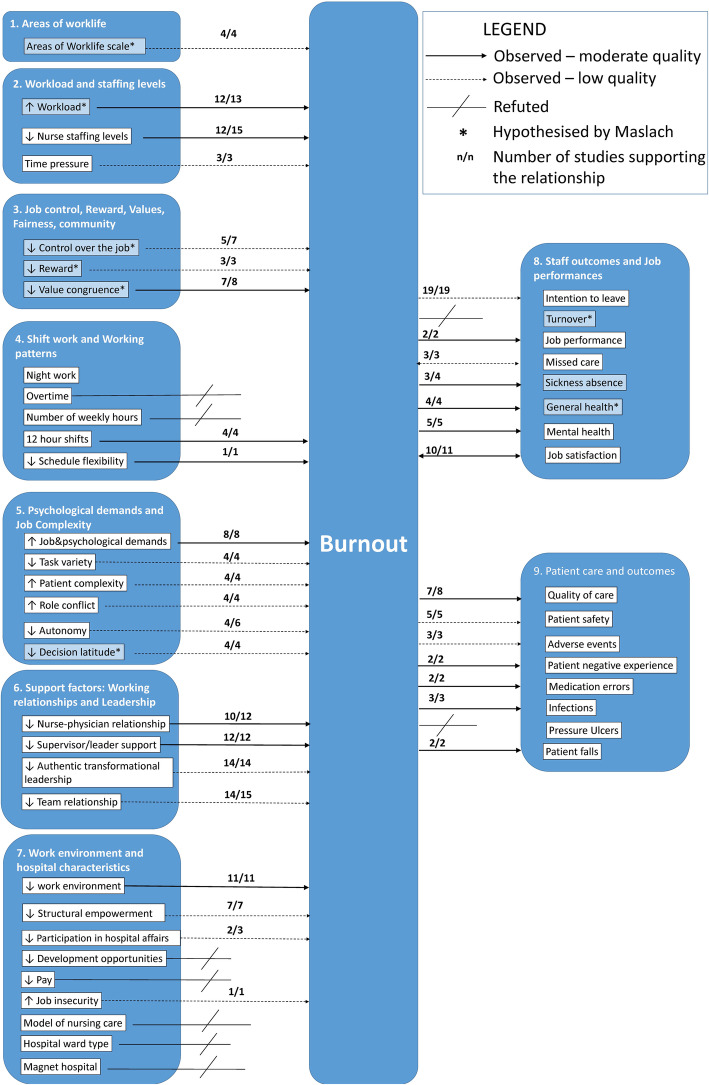
BACKGROUND: Workforce studies often identify burnout as a nursing 'outcome'. Yet, burnout itself-what constitutes it, what factors contribute to its development, and what the wider consequences are for individuals, organisations, or their patients-is rarely made explicit. We aimed to provide a comprehensive summary of research that examines theorised relationships between burnout and other variables, in order to determine what is known (and not known) about the causes and consequences of burnout in nursing, and how this relates to theories of burnout. METHODS: We searched MEDLINE, CINAHL, and PsycINFO. We included quantitative primary empirical studies (published in English) which examined associations between burnout and work-related factors in the nursing workforce. RESULTS: Ninety-one papers were identified. The majority (n = 87) were cross-sectional studies; 39 studies used all three subscales of the Maslach Burnout Inventory (MBI) Scale to measure burnout. As hypothesised by Maslach, we identified high workload, value incongruence, low control over the job, low decision latitude, poor social climate/social support, and low rewards as predictors of burnout. Maslach suggested that turnover, sickness absence, and general health were effects of burnout; however, we identified relationships only with general health and sickness absence. Other factors that were classified as predictors of burnout in the nursing literature were low/inadequate nurse staffing levels, ≥ 12-h shifts, low schedule flexibility, time pressure, high job and psychological demands, low task variety, role conflict, low autonomy, negative nurse-physician relationship, poor supervisor/leader support, poor leadership, negative team relationship, and job insecurity. Among the outcomes of burnout, we found reduced job performance, poor quality of care, poor patient safety, adverse events, patient negative experience, medication errors, infections, patient falls, and intention to leave. CONCLUSIONS: The patterns identified by these studies consistently show that adverse job characteristics-high workload, low staffing levels, long shifts, and low control-are associated with burnout in nursing. The potential consequences for staff and patients are severe. The literature on burnout in nursing partly supports Maslach's theory, but some areas are insufficiently tested, in particular, the association between burnout and turnover, and relationships were found for some MBI dimensions only.
Overview
CoChat Summary
TL;DR
This theoretical review of 91 quantitative studies found adverse job characteristics—high workload, low staffing levels, long shifts, and low control—are consistently associated with burnout in nursing, with severe potential consequences for staff and patients. The literature partly supports Maslach’s theory, but incomplete burnout measurement and mostly cross-sectional designs limit causal inference.
Key findings
- Across 91 studies, high workload was supported in 12/13 studies, low/inadequate nurse staffing in 12/15, ≥12-h shifts in 4/4, low control over the job in 5/7, low reward in 3/3, low value congruence in 7/8, low decision latitude in 4/4, poor supervisor/leader support in 12/12, negative team relationship in 14/15, and intention to leave in 19/19.
- Burnout was associated with reduced job performance (2/2), poor quality of care (7/8), poor patient safety (5/5), adverse events (3/3), medication errors (2/2), infections (3/3), and patient falls (2/2); no association was found with pressure ulcers. Turnover was refuted despite being hypothesised by Maslach, with only one small study finding Depersonalisation associated with turnover within 2 years.
- Most studies used the Maslach Burnout Inventory (n = 81), but only 39 (47%) measured and reported all three MBI subscales; 23 used Emotional Exhaustion only, 11 used Emotional Exhaustion and Depersonalisation, and 9 summed the three subscales despite advice against this. Maslach’s hypothesised predictors were generally supported, but often only for some MBI dimensions.
Methods
- Theoretical review conducted according to Campbell et al. and Pare et al.; systematic search of MEDLINE, CINAHL, and PsycINFO in May 2019 for English quantitative primary empirical studies examining associations between burnout and work-related factors or outcomes in nurses or nursing assistants in healthcare settings. Studies focused exclusively on personal factors, only comparing burnout levels across settings, or literature reviews, commentaries, and editorials were excluded.
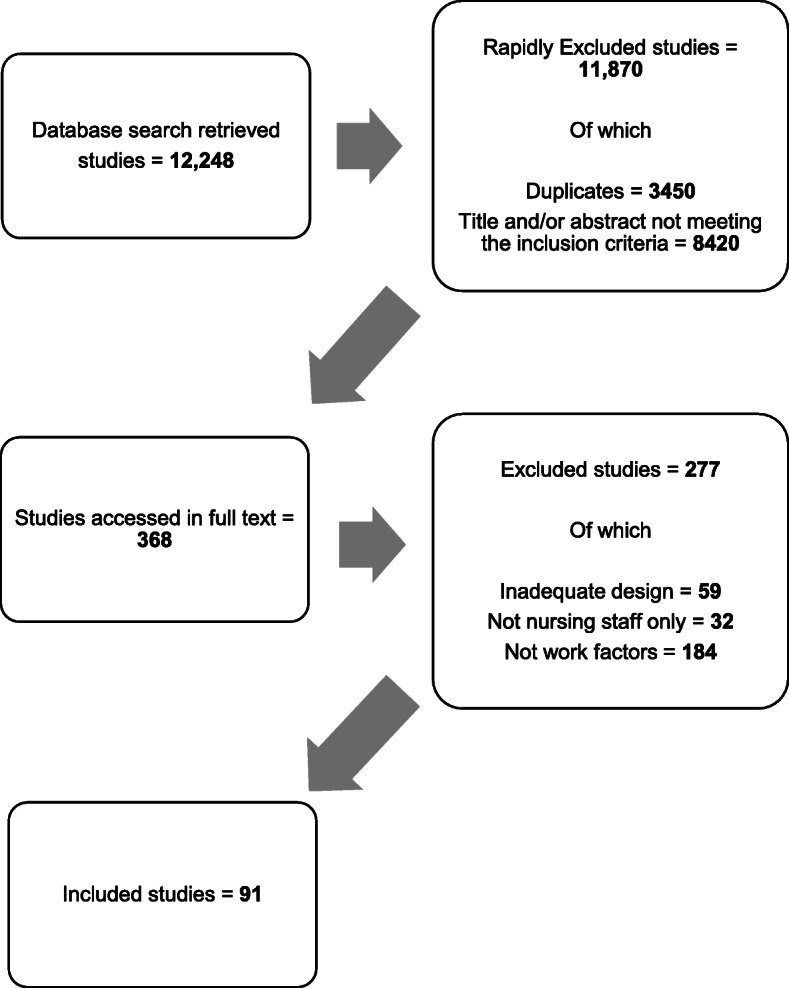
- The search yielded 12,248 records; 368 full texts were accessed, and 91 studies were included. Data were extracted on country, setting, sample size, staff group, burnout measure, variables tested, and findings; a coding frame starting from Maslach’s multidimensional theory produced nine broad categories. No formal quality appraisal was performed, but key quality aspects were summarised.
Limitations
- Stated by the authors: no formal quality appraisal instrument was applied; studies were reported without context or estimates such as ORs and 95% CIs; personality and other individual variables were not considered in data extraction; and studies indexed elsewhere or grey literature may have been missed.
- Evident from the text: 87/91 studies (97%) were cross-sectional, limiting temporal and causal inference and creating simultaneity bias, with factors such as missed care, job satisfaction, and mental health treated as both predictors and outcomes. Incomplete MBI measurement—only 39/91 studies used all three subscales, and 9 summed subscales—further limits testing of Maslach’s theory.
Model-written summary. Check it against the paper before relying on it.
Integrity signals
Registry
Cites
Statistics
Figures
Verification
Claims the paper makes
24 Valid · 3 Not valid · 199 Not checked · 100 Own results and interpretations
The sources with a verdict support this claim; the rest weren’t checked yet, have no full text we could read, or their verdicts aren’t rated yet.
In the paper
“high psychological demands were associated with higher odds of Emotional Exhaustion [62, 78]”
§ Burnout in nursing: a theoretical review > Results > Psychological demands and job complexity
What the sources say
- Supportedcites [62] Vidotti V Ribeiro RP Galdino MJQ Martins JT Burnout syndrome and shift work among the nursing staff Rev Lat Am Enfermagem 2018 26 e3022 30110099 PMC6091368 source
The Method section identifies psychological demands as a dimension of the Demand-Control-Support Questionnaire. In Results, Table 3 reports that high demand was associated with higher odds of emotional exhaustion among day-shift nursing staff (adjusted OR 2.50, 95% CI 1.44–4.35). The reported association is specific to the day shift. (LLM, conf=0.91)
- Not checked — no full text of the sourcecites [78] Bourbonnais R Comeau M Vezina M Dion G Job strain, psychological distress, and burnout in nurses Am J Ind Med 1998 34 1 20 28 9617384 doi:10.1002/(sici)1097-0274(199807)34:1
plainstates an association- Asserted: passes — The authors put it forward as true.
- Checkable: passes — It can be checked against evidence.
- Load-bearing: passes — The paper’s conclusions depend on it.
- Based: passes — The paper gives a reason why it holds.
- Supported
The cited sources support only part of this claim — read each source’s verdict below.
In the paper
“and Emotional Exhaustion and Personal Accomplishment [50]”
§ Burnout in nursing: a theoretical review > Results > Working relationships and leadership
What the sources say
- Partly supportedcites [50] Hanrahan NP Aiken LH McClaine L Hanlon AL Relationship between psychiatric nurse work environments and nurse burnout in acute care general hospitals Issues Ment Health Nurs 2010 31 3 198 207 20144031 PMC2856615 sourceExperimental — accuracy not yet measured
The Discussion (‘Strong Mangers and Leaders’) reports a significant relationship between manager skill and emotional exhaustion. The Results state that none of the work-environment factors, including manager skill, were associated with personal accomplishment in the adjusted or unadjusted models. The claim is therefore supported for emotional exhaustion but not personal accomplishment. (LLM, conf=0.92)
plainstates an association- Asserted: passes — The authors put it forward as true.
- Checkable: passes — It can be checked against evidence.
- Load-bearing: unclear — It is unclear whether the paper’s conclusions depend on it.
- Based: passes — The paper gives a reason why it holds.
- Partly supported
Every source the paper cites for this claim was checked and supports it.
In the paper
“The inability to establish a temporal link means limits the inference of causality [115].”
§ Burnout in nursing: a theoretical review > Discussion
What the sources say
- Supportedcites [115] Antonakis J Bendahan S Jacquart P Lalive R On making causal claims: a review and recommendations Leadersh Q 2010 21 6 1086 1120 source
Section 1, “What is Causality?”, lists temporal precedence as a condition for measuring a causal effect and explicitly calls temporal ordering necessary but not sufficient. Thus, inability to establish temporal order limits causal inference. (LLM, conf=0.93)
plain- Asserted: passes — The authors put it forward as true.
- Checkable: passes — It can be checked against evidence.
- Load-bearing: passes — The paper’s conclusions depend on it.
- Based: passes — The paper gives a reason why it holds.
- Supported
The sources with a verdict support this claim; the rest weren’t checked yet, have no full text we could read, or their verdicts aren’t rated yet.
In the paper
“| Night work | | | √ | |”
- Also stated in: § Working patterns and shift work · plain
“Working night shifts was associated with burnout (composite score) [68] and Emotional Exhaustion [62], but the relationship was not significant in two studies [69, 70].”
§ Burnout in nursing: a theoretical review > Results
What the sources say
- Not checked — no full text of the sourcecites [68] Anwar MM Elareed HR Burnout among Egyptian nurses Journal of Public Health-Heidelberg 2017 25 6 693 697 source
- Supportedcites [62] Vidotti V Ribeiro RP Galdino MJQ Martins JT Burnout syndrome and shift work among the nursing staff Rev Lat Am Enfermagem 2018 26 e3022 30110099 PMC6091368 source
The Results (Table 2) show that the relationship between work shift and burnout differs across dimensions: emotional exhaustion and professional realization differ significantly by shift, while depersonalization does not. The Discussion also reports higher overall burnout levels among day-shift than night-shift nursing staff. This supports the claim that night work is not consistently associated with burnout. (LLM, conf=0.86)
- Not checked — no full text of the sourcecites [69] Wisetborisut A Angkurawaranon C Jiraporncharoen W Uaphanthasath R Wiwatanadate P Shift work and burnout among health care workers Occup Med (Lond) 2014 64 4 279 286 24550196 source
- Not checked — no full text of the sourcecites [70] Ilhan MN Durukan E Taner E Maral I Bumin MA Burnout and its correlates among nursing staff: questionnaire survey J Adv Nurs 2008 61 1 100 106 18034813 source
plain- Asserted: passes — The authors put it forward as true.
- Checkable: passes — It can be checked against evidence.
- Load-bearing: unclear — It is unclear whether the paper’s conclusions depend on it.
- Based: passes — The paper gives a reason why it holds.
- Also stated in: § Working patterns and shift work · plain
Every source the paper cites for this claim was checked and supports it.
In the paper
“Long shifts of 12 h or more were associated with all MBI subscales [74]”
§ Burnout in nursing: a theoretical review > Results > Working patterns and shift work
What the sources say
- Supportedcites [74] Dall’Ora C Griffiths P Ball J Simon M Aiken LH Association of 12 h shifts and nurses’ job satisfaction, burnout and intention to leave: findings from a cross-sectional study of 12 European countries BMJ Open 2015 5 9 e008331 26359284 PMC4577950 source
The Measurements section identifies the three MBI subscales as emotional exhaustion, depersonalisation and personal accomplishment. The Discussion explicitly reports an association between shifts of 12 hours or more and all three subscales; the Shift length and nurse outcomes section reports the corresponding adjusted results. (LLM, conf=0.95)
plainstates an association- Asserted: passes — The authors put it forward as true.
- Checkable: passes — It can be checked against evidence.
- Load-bearing: passes — The paper’s conclusions depend on it.
- Based: passes — The paper gives a reason why it holds.
- Supported
201 more claims · 15 with their cited sources checked
Create a free account to see all 326 claims and to verify the 23 references still open.
- Probably not a substantial claim. 64
- It may state two separate claims as one. 72
- The quote only partly states this claim. 2
Claims other papers make about this one
Each is checked against this paper’s own text: does it say what the citing paper says it does?
The source backs part of the claim, not all of it — or backs it for a different population, condition or comparison.
In the citing paper
“Burnout among HPs is significantly associated with suicidal ideation [7], decreased job satisfaction [8], and increased turnover intention, ultimately resulting in a loss of HPs and deterioration in the quality of care, which is also negatively affected, as is patient safety and health status [9,10,11].”
From Effects of Third-Wave Cognitive Behavioral Therapy for Healthcare Professionals’ Burnout: A Systematic Review and Meta-Analysis (2025) · cites this paper as [9]
Experimental — accuracy not yet measuredThe source backs part of the claim, not all of it — or backs it for a different population, condition or comparison.
In the citing paper
“Reducing EE and DP may also contribute to improved workforce retention and lower absenteeism, ultimately benefiting healthcare providers and enhancing patient safety and care quality [9,10,11].”
From Effects of Third-Wave Cognitive Behavioral Therapy for Healthcare Professionals’ Burnout: A Systematic Review and Meta-Analysis (2025) · cites this paper as [9]
Experimental — accuracy not yet measuredThe cited source says what the claim attributes to it.
In the citing paper
“Last but not the least, some other organizational factors may also affect burnout, such as excessive workload, time pressure, high job demands, low rewards, low job autonomy, or negative team atmosphere [13].”
From The efficacy of applying the Interpersonal Effectiveness skills of dialectical behavior therapy into communication skills workshop for clinical nurses (2023) · cites this paper as [13]
Self-check
Percentages, sums and reported differences re-computed from the paper’s own numbers.
Each contradiction between two passages listed here was confirmed by an independent check.
Rated minor: it would not touch a result — a value no result rests on, a p-value that stays on the same side of the significance level, or a conflict that is clerical, resolved elsewhere in the paper, or outside its own findings.
In the paper
“The database search yielded 12 248 studies, of which 11 870 were rapidly excluded as either duplicates or titles and/or abstract not meeting the inclusion criteria. Of the 368 studies accessed in full text, 277 were excluded, and 91 studies were included in the review.”
§ Burnout in nursing: a theoretical review > Results
Reported 368 · recomputed 378
Rated minor: it would not touch a result — a value no result rests on, a p-value that stays on the same side of the significance level, or a conflict that is clerical, resolved elsewhere in the paper, or outside its own findings.
In the paper
§ Burnout in nursing: a theoretical review > Results
“| Overtime | | | √ | |”
§ Burnout in nursing: a theoretical review > Results > Working patterns and shift work
“One study found working that overtime was associated with composite MBI score [73].”
Rated minor: it would not touch a result — a value no result rests on, a p-value that stays on the same side of the significance level, or a conflict that is clerical, resolved elsewhere in the paper, or outside its own findings.
In the paper
“Most studies used the Maslach Burnout Inventory Scale (n = 81), which comprises three subscales reflecting the theoretical model: Emotional Exhaustion, Depersonalisation, and reduced Personal Accomplishment. However, less than half (47%, n = 39) of the papers measured and reported results with all three subscales.”
§ Burnout in nursing: a theoretical review > Results > Measures of burnout
Reported 47 · recomputed 48.148148
Citations
Cites
The measurement of experienced burnout
Maslach, C., & Jackson, S. E. (1981) · Journal of Organizational Behavior · doi:10.1002/job.4030020205 · Cited by 14,496
The job demands-resources model of burnout.
Demerouti, E., Bakker, A. B., Nachreiner, F., & Schaufeli, W. B. (2001) · Journal of Applied Psychology · doi:10.1037/0021-9010.86.3.499 · Cited by 13,643
Maslach, C., Schaufeli, W. B., & Leiter, M. P. (2001) · Annual Review of Psychology · doi:10.1146/annurev.psych.52.1.397 · Cited by 12,852
(1996) · Consulting Psychologists Press eBooks · Cited by 7,863
Freudenberger, H. J. (1974) · Journal of Social Issues · doi:10.1111/j.1540-4560.1974.tb00706.x · Cited by 5,463
Hospital Nurse Staffing and Patient Mortality, Nurse Burnout, and Job Dissatisfaction
Aiken, L. H. (2002) · JAMA · doi:10.1001/jama.288.16.1987 · Cited by 5,226
The Copenhagen Burnout Inventory: A new tool for the assessment of burnout
Kristensen, T. S., Borritz, M., Villadsen, E., & Christensen, K. B. (2005) · Work & Stress · doi:10.1080/02678370500297720 · Cited by 3,136
On making causal claims: A review and recommendations
Antonakis, J., Bendahan, S., Jacquart, P., & Lalive, R. (2010) · The Leadership Quarterly · doi:10.1016/j.leaqua.2010.10.010 · Cited by 2,441
Synthesizing information systems knowledge: A typology of literature reviews
Paré, G., Trudel, M.-C., Jaana, M., & Kitsiou, S. (2015) · Information & Management · doi:10.1016/j.im.2014.08.008 · Cited by 1,987
Burnout: 35 years of research and practice.
Schaufeli, W. B., Leiter, M. P., & Maslach, C. (2009) · Career Development International · doi:10.1108/13620430910966406 · Cited by 1,964
Research works printed but not linked: 4
- Ekstedt M Burnout and sleep: Institutionen för folkhälsovetenskap/Department of Public Health Sciences 2005
- Cherniss C Burnout in new professionals: a long-term follow-up study J Health Hum Resour Adm 1989 12 1 11 24
- Adali E Priami M Evagelou H Mougia V Ifanti M Alevizopoulos G Burnout in psychiatric nursing personnel in Greek hospitals European Journal of Psychiatry 2003 17 3 173 181
- Laschinger HKS Shamian J Thomson D Impact of magnet hospital characteristics on nurses’ perceptions of trust, burnout, quality of care, and work satisfaction Nurs Econ 2001 19 5 209 219
Cited by
Items 801–900 of 1,160
Professional Quality of Life and Job Satisfaction of School Nursing in SpainPreprint
Zafra-Agea, J. A., Ramírez‐Baraldes, E., Maldonado-Manzano, E., et al. (2024) · Preprints.org · doi:10.20944/preprints202407.0098.v2 · Cited by 1
Kotsakis, A., Avraam, D., Malliarou, M. M., Halkiopoulos, C., Galanakis, M., Sfakianakis, M., & Soteriades, E. S. (2024) · Preprints.org · doi:10.20944/preprints202407.1849.v2 · Cited by 1
Kotsakis, A., Avraam, D., Malliarou, M. M., Halkiopoulos, C., Galanakis, M., Sfakianakis, M., & Soteriades, E. S. (2024) · Preprints.org · doi:10.20944/preprints202407.1849.v3 · Cited by 1
Trauma Experience and the Impact on Caregivers in Formal and Family Settings: Ethical Considerations
Morley, G., & Isham, L. (2025) · Springer eBooks · doi:10.1007/978-3-031-87526-7_6 · Cited by 1
Burnout and Psychological Distress among Cardiology Nurses in a Tertiary Care Center
Alheraisi, B. A. (2025) · Journal of Nursing Science and Professional Practice · doi:10.4103/jnspp.jnspp_15_25 · Cited by 1
Nurses’ shift work: impact on health
Dornik, L. (2020) · doi:10.26493/978-961-293-015-8.57-67
Valimaki, M. A., Hipp, K., Chen, J., Huang, X., Guo, J., & Wong, M. S. (2021) · Research Square · doi:10.21203/rs.3.rs-140064/v1
“These problems have been documented as resulting in physical illnesses, psychological symptoms,(23) burnout,(8) low work satisfaction(7) and quality of life, and increased sickness absence(11, 19) among personnel.”
BackgroundLo del campo en el campo. Defender los derechos agrarios, A. Warman
Rosales, K. (1993) · Decisión
The Perfect Storm: Organizational Dissonance and the Global Pandemic
Jun, J. (2021) · Workplace Health & Safety · doi:10.1177/21650799211055859
Impact of Career Burnout Across Nursing
Smallheer, B. (2022) · Nursing Clinics of North America · doi:10.1016/j.cnur.2021.12.001
The Effect of Care Pathways on Coronary Care Nurses: A Preliminary Study
Daghash, H., Abdullah, K. L., & Ismail, M. D. (2022) · Quality Management in Health Care · doi:10.1097/qmh.0000000000000336
“When nurses experience less burnout and fatigue, they become more emotionally engaged and their well-being improves.(59) In addition, they may become more alert to potential safety hazards and care more for patients’ needs.”
BackgroundPatinadan, P. V. (2021) · DR-NTU (Nanyang Technological University) · doi:10.32657/10356/155030
Kittichokwattana, P., Harun, A. B., & Zain, Z. M. (2022) · International Journal of Economics Business and Management Research · doi:10.51505/ijebmr.2022.6601
“The meta-analysis conducted by Dall’Ora et al.(2020)asserts that substantial studies supported the Leiter and Maslach’s mediation model of burnout but insufficient tests in some areas.”
Methodحسنین, إ. ع. ع. (2022) · مجلة کلية الآداب بقنا · doi:10.21608/qarts.2022.144903.1454
Callado, A. M. A. P., & Lucas, P. R. M. B. (2022) · Editora Artemis eBooks · doi:10.37572/edart_2808226061
latha, M. P., & rani, S. J. (2020) · IDC International Journal · doi:10.47211/idcij.2020.v07i04.001
A análise da relação de enfermeiras(os) da estratégia saúde da família com a sua profissão
dos Santos, A. C., Borges, F. A., Carloni, P. R. R. F. R., et al. (2022) · Revista Eletrônica de Enfermagem · doi:10.5216/ree.v24.69008
The Relationship between Nurses Fatigue and their Work Engagement in School Settings at Alexandria
Khaled, A., & Ali, M. (2022) · Egyptian Journal of Nursing and Health Sciences · doi:10.21608/ejnhs.2022.261793
“However, adverse job characteristics—high workload, low staffing levels, long shifts, low schedule flexibility, time pressure, low task variety, role conflict, low autonomy and low control—are associated with nurses' fatigue and burnout (Dall’Ora et al., 2020).”
BackgroundInfluentialSÍNDROME DE BURNOUT EM ENFERMEIROS INTENSIVISTAS
Neves, J. G. H., Holanda, G. R. B., de Medeiros, R. L. S. F. M., et al. (2022) · Revista interdisciplinar em saúde · doi:10.35621/23587490.v9.n1.p834-845
Sands, S. R., Covell, C. L., & Caine, V. (2022) · International Journal of Bahamian Studies · doi:10.15362/ijbs.v28i0.459 · Cited by 1
“A work environment where nurses experience high psychological stress and burnout creates ideal conditions for nurse turnover (Dall’Ora et al., 2020) resulting in loss of nursing human capital (Covell, 2008).”
BackgroundMethodInfluentialRecognising and Managing Clinical Nurses’ Frustration
Zolkefli, Y., & AL‐Fayyadh, S. (2022) · The Malaysian Journal of Nursing · doi:10.31674/mjn.2022.v14i02.026
Tifinny, Azazi, A., Daud, I., Kalis, M. C. I., & Shalahuddin, A. (2023) · Asian Journal of Economics Business and Accounting · doi:10.9734/ajeba/2023/v23i3925 · Cited by 3
Desmette, D., & Villotti, P. (2023) · Le travail humain · doi:10.3917/th.854.0289 · Cited by 1
Burnout en el personal sanitario del área crítica COVID de un hospital nacional
Barrientos, L. X. B. (2022) · Revista Cuidado y Salud Pública · doi:10.53684/csp.v2i2.52
The Impact of Burnout Syndrome on the Quality of Nurses’ Work
Duranková, S., Harvanová, G., & Kaščáková, M. (2023) · Journal of Nursing and Women s Health · doi:10.29011/2577-1450.100087
Das kollektive pflegerische Erleben bei Hochaltrigkeit und Intensivpflege: Eine qualitative Studie
Haidinger, E., & Krutter, S. (2023) · Pflege · doi:10.1024/1012-5302/a000931
Feeling Burnt Out? You’re Not Alone
Fraser, D. (2023) · Neonatal Network The Journal of Neonatal Nursing · doi:10.1891/nn.2022-0067
Structural Limits and Consensual Mobilisation
Sainsaulieu, I. (2023) · Springer eBooks · doi:10.1007/978-981-19-9354-1_1
Wang, X., Ma, S., & Liao, W. (2023) · OBM Neurobiology · doi:10.21926/obm.neurobiol.2301164 · Cited by 1
The Balance of Building Resilience
Newton, I. G. (2023) · Springer eBooks · doi:10.1007/978-3-031-16983-0_1
Ge, Y.-X., Sun, X.-X., Chen, L., Yu, L., & Zhang, J. (2023) · Research Square · doi:10.21203/rs.3.rs-2918022/v1
Burnout and Its Influencing Factors among Hospital Nurses: A Cross-Sectional Study
Lee, K. A., & Park, H. (2023) · Journal of Health Informatics and Statistics · doi:10.21032/jhis.2023.48.2.157
“고 간호의 질 저하 및 환자의 사망과 관련되어 간호 성과를 측정하는 중요한 지표이다[2,6,7].”
Relation between Nursing Students’ Tendencies for Entrepreneurship and Career Adaptability
Ramadan, B., Gad, R. A., Ramadan, A. A., et al. (2023) · Tanta Scientific Nursing Journal · doi:10.21608/tsnj.2023.307831
Michel, A. (2023) · The Journal of Perinatal & Neonatal Nursing · doi:10.1097/jpn.0000000000000749
Ji, Q. (2023) · Journal of Clinical and Nursing Research · doi:10.26689/jcnr.v7i4.5125
“(4) Strengthen the supervision and management of elderly care institutions to ensure that the quality of elderly care services is guaranteed and improved ([5]).”
BackgroundPaul, M. (2022) · THE RESEARCH RESERVOIR · doi:10.47211/trr.2022.v08i02.020
The Correlation Between Self-Efficacy and Motivation on Elderly's Daily Independence
Reguyal, J. C. G. (2022) · Proceedings Series on Health & Medical Sciences · doi:10.30595/pshms.v3i.614
FACTORS TO HELP RECOGNIZE BURNOUT SYMPTOMS IN HOSPITAL NURSES
Lukács, A., & Simon, N. (2023) · Health Problems of Civilization · doi:10.5114/hpc.2023.130647 · Cited by 1
Relationship between burnout, job performance and nurse-patient interaction in Taizhou, ChinaPreprint
Yang, Y., Wu, W., Ke, Z.-W., Jiesisibeike, Z. L., & Tung, T. (2023) · Research Square · doi:10.21203/rs.3.rs-3320063/v1 · Cited by 1
Chocolates or Tissues: Mitigating Momentary Burnout
Benedetti, C. (2023) · Emerald Group Publishing Limited eBooks · doi:10.1108/s1479-368720230000045011
Development and validation of a nomogram for predicting high-burnout risk in nursesPreprint
Ning, M., Chen, Z., Yang, J., et al. (2023) · Research Square · doi:10.21203/rs.3.rs-3385393/v1
Shrestha, S., Sharma, S., Gurung, S. K., Chapagain, R., & Dhungana, B. R. (2023) · International Journal of Occupational Safety and Health · doi:10.3126/ijosh.v13i4.51447 · Cited by 1
Characteristics Burnout of Emergency Nurses at dr. Soediran Mangun Sumarso Hospital, Wonogiri
Widiyono, W., Aryani, A., Sutrisno, S., et al. (2023) · Healthcare Nursing Journal · doi:10.35568/healthcare.v5i2.3394
Factors Associated with Work Fatigue among Nurses in South Tangerang City Public Hospital
Muzakir, H., & Vidyarini, A. V. (2023) · Jurnal Cakrawala Promkes · doi:10.12928/promkes.v5i2.8846 · Cited by 2
“Research has shown that factors such as workload, work environment, job demands, personal characteristics, and health status can contribute to work fatigue among nurses [5].”
BackgroundRodriguez, J., Kupczynski, L., & Mccraney, M. (2023) · Journal of Education and Practice · doi:10.7176/jep/14-30-06
Emotional Intelligence And Empathy: Predictors Of Counselor's General Health
Abomah, P. W., Agbakpe, G., & Quaye, C. N. L. (2023) · Academic Journal of Psychology and Counseling · doi:10.22515/ajpc.v4i1.7478
Tamrie, M. F., Birhanu, M., Tigist, W., Alemu, Y. B., & Shiferaw, W. S. (2023) · International Archives of Nursing and Health Care · doi:10.23937/2469-5823/1510187 · Cited by 2
Validade psicométrica do Burnout Assessment Tool entre trabalhadores de enfermagem brasileiros
Júnior, L. J. S. (2023) · Digital Library of Theses and Dissertations (Universidade de São Paulo) · doi:10.11606/d.22.2023.tde-06102023-143518
Revisiting Nurse Scheduling Practice
Zolkefli, Y., & Zolkefli, M. Y. H. (2023) · INTERNATIONAL JOURNAL OF CARE SCHOLARS · doi:10.31436/ijcs.v6i2.313
“Research has also proposed that such flexibility optimises schedules and increases job productivity (3).”
BackgroundNurses’ Experiences of Conflict Management at a Teaching Hospital in Namibia: A Qualitative Study
Munangatire, T., Tomas, N., & Alweendo, M. M. (2023) · Journal of Nursing Management · doi:10.1155/2023/6663194
“While burnout has been reported as a potential outcome of confict, it is also possible that nurses who are burnt out are avoiding managing confict [11].”
BackgroundNURSE BURNOUT PREDICTORS IN HEALTHCARE UNITS DURING COVID-19 IN EAST JAVA, INDONESIA
Santoso, W., & Sudarsih, S. (2023) · Jurnal Administrasi Kesehatan Indonesia · doi:10.20473/jaki.v11i2.2023.252-263 · Cited by 1
The Relationship Between Workload and Burnout Incidence in Nurses in Critical Care Room
Angraini, A. D., Sapeni, M. A.-A. R., & Lastriyanti, L. (2023) · An Idea Health Journal · doi:10.53690/ihj.v3i3.176 · Cited by 2
Malairojsiri, A. (2023) · Frontiers of Nursing · doi:10.2478/fon-2023-0041 · Cited by 1
Andrade, L. M. S. (2023) · Digital Library of Theses and Dissertations (Universidade de São Paulo) · doi:10.11606/t.22.2023.tde-08122023-164351 · Cited by 2
Aristana, I. N., Arsawan, I. W. E., & Rihayana, I. G. (2023) · Jurnal Organisasi dan Manajemen · doi:10.33830/jom.v19i2.4264.2023 · Cited by 9
Vveinhardt, J., & Foktas, P. (2024) · Management Theory and Studies for Rural Business and Infrastructure Development · doi:10.15544/mts.2023.35
خشبة, ف. ا. ح. (2024) · المجلة المصرية للدراسات النفسية · doi:10.21608/ejcj.2024.336106
Factors Contributing to Work Fatigue Among Construction Workers
Fitri, R. Y., Sukesi, T. W., & Hariyono, W. (2024) · ARTERI Jurnal Ilmu Kesehatan · doi:10.37148/arteri.v5i1.395 · Cited by 3
“31 The results of this study have no association between education level and fatigue in construction workers.”
BackgroundBURNOUT SYNDROME PREVALENCE AMONG EMERGENCY MEDICINE WORKERS: A SURVEY STUDY
Timler, W., Kempa, J., Hertz, Z., et al. (2023) · Emergency Medical Service · doi:10.36740/emems202304103
Bartosiewicz, A., & Łuszczki, E. (2024) · Medycyna Pracy · doi:10.13075/mp.5893.01436
“A theoretical review of 91 studies conducted by Dall’Or et al. identifying studies from 28 countries has shown that high workload, staff shortages, and time pressure during procedures are closely related to the occurrence of professional burnout among nurses [30].”
BackgroundCarthon, J. M. B., Brom, H. M., Maye, A., Gil, J., Rizzo, J. A., Amenyedor, K. E., Montalvo, W., & Villarruel, A. M. (2024) · SSRN Electronic Journal · doi:10.2139/ssrn.4773826
Evaluación de estrés y síndrome de burnout en el personal de enfermería del área de hospitalización
Borja-Caiza, C. E., Peralta-Beltrán, Á. R., González-Salas, R., & Matheu-González, C. (2023) · Revista Arbitrada Interdisciplinaria de Ciencias de la Salud Salud y Vida · doi:10.35381/s.v.v7i2.3379
Factores de riesgo psicosociales, burnout e indicadores de salud en trabajadores
Chasi-Chiluisa, H. P., Noroña-Salcedo, D. R., Falcón, V. V., et al. (2023) · Revista Arbitrada Interdisciplinaria de Ciencias de la Salud Salud y Vida · doi:10.35381/s.v.v7i2.3386
Síndrome de burnout en el personal médico del área de neonatología
Serrano, S. P. P., Peralta-Beltrán, Á. R., González-Salas, R., & Flores-Pilco, D. A. (2023) · Revista Arbitrada Interdisciplinaria de Ciencias de la Salud Salud y Vida · doi:10.35381/s.v.v7i2.3485
Medidas preventivas y correctivas para la gestión del estrés laboral
Yumbay-Taris, R. T., Peralta-Beltrán, Á. R., González-Salas, R., & Matheu-González, C. (2023) · Revista Arbitrada Interdisciplinaria de Ciencias de la Salud Salud y Vida · doi:10.35381/s.v.v7i2.3522
ELEVATING NURSING CARE STANDARDS: A COMPREHENSIVE CRITICAL REVIEW
Shammari, A. S. A. A., Anazi, A. D. B. A., Anazi, S. D. B. A., Anazi, K. D. B. A., Anze, B. A. A., & Shammry, S. A. A. (2022) · Journal of Population Therapeutics and Clinical Pharmacology · doi:10.53555/jptcp.v29i04.5489
ОСОБЛИВОСТІ ПРОФЕСІЙНОГО САМОЗДІЙСНЕННЯ МЕДСЕСТЕР ТА ЙОГО ЗВ’ЯЗОК З МЕНТОРСТВОМ
Тулуп, Л. Я., Марущак, М. І., Коробко, Л. Р., & Мялюк, О. П. (2024) · Медсестринство · doi:10.11603/2411-1597.2023.3-4.14561 · Cited by 2
Estimación del síndrome de burnout del personal de salud de una unidad de cuidados
Riofrío, P. D. Z., Albornoz-Zamora, E. J., Falcón, V. V., & Nuñez, J. M. A. (2023) · Revista Arbitrada Interdisciplinaria de Ciencias de la Salud Salud y Vida · doi:10.35381/s.v.v7i1.3617
Brooks, D. C., Bishop, M., Albertini, R., Hider, A., & Sim, S. H. (2024) · doi:10.31234/osf.io/urpgh
Síndrome de burnout del personal de enfermería en el servicio de oncología clínica
Landín-Rojas, J., Armijos-Campoverde, L. M., Romero-Fernández, A. J., & Hernández-Guerrón, M. (2023) · Revista Arbitrada Interdisciplinaria de Ciencias de la Salud Salud y Vida · doi:10.35381/s.v.v7i1.3630
Advanced Insights in Nursing Science: Applying ARIMA-CLSTM for Concept Analysis
Thirumalaikumari, T., Kumar, V., Somasundaram, K., Josephson, P. J., Mavliya, A. K., & Basha, H. A. (2024) · International Conference for Innovation in Technology (INOCON) · doi:10.1109/inocon60754.2024.10512152
Febriani, R. A., & Musharyanti, L. (2023) · Bali Medical Journal · doi:10.15562/bmj.v12i2.3732 · Cited by 5
Guerreiro, G. M. C. D., & Pereira, D. G. (2024) · Journal of Clinical Nursing · doi:10.1111/jocn.17223
Special Challenges Working with Foster Care Youth in the Inpatient Setting
Naylor, M. W., Chambliss, J. E., Singh, R., & Du, R. (2024) · Child and Adolescent Psychiatric Clinics of North America · doi:10.1016/j.chc.2024.04.004 · Cited by 1
Professional Quality of Life and Job Satisfaction of School Nursing in SpainPreprint
Zafra-Agea, J. A., Ramírez‐Baraldes, E., Maldonado-Manzano, E., et al. (2024) · Preprints.org · doi:10.20944/preprints202407.0098.v1
Braga, L. D. A., da Silva, M. R., & Filho, M. L. D. S. (2024) · Revista Contemporânea · doi:10.56083/rcv4n7-077 · Cited by 1
Burnout and Psychological Capital among Nurses in Selected Hospitals in Batangas City
Kalalo, D. C. M. (2024) · International Journal of Research Studies in Psychology · doi:10.5861/ijrsp.2024.001
You are Kenough: Battling burnout with Barbie
Johanson, P., & Ledbetter, H. (2024) · Nursing Made Incredibly Easy! · doi:10.1097/nme.0000000000000068
da Silva, N. P., de Barros, F. R. B., dos Santos, M. L. S. C., de Oliveira, F. B., de Oliveira, E. M., & Marinho, M. L. (2024) · Revista de Pesquisa Cuidado é Fundamental Online · doi:10.9789/2175-5361.rpcfo.v16.13363
Network analysis of perceived stress and burnout among Chinese nursesPreprint
Suo, X., Zhang, Y., Zhang, Y., et al. (2024) · Research Square · doi:10.21203/rs.3.rs-4825399/v1
Yin, L., Qiu, L., & Zhang, G. (2024) · medRxiv · doi:10.1101/2024.09.10.24313443
“…justice, development opportunity), work conditions(resources, staffing), job demands(work load, time, pattern and complexity), employment services(experience, skills), work relationship(job control, reward, value, fairness, security) and personal characteristics(family, health) 5,19 –21 .”
Frigstad, J., & Kristoffersen, M. (2024) · Nordisk Sygeplejeforskning · doi:10.18261/nsf.15.1.1
Personal resources as predictors of health-related behaviors in nurses
Merklinger-Soma, M., & Wilczek‐Rużyczka, E. (2024) · Health Psychology Report · doi:10.5114/hpr/191415 · Cited by 1
“…depersonalization, and subjective lowering of one’s own achievements by the employee, which results in the neglect of professional duties, low levels of motivation and job satisfaction, and the increase of sickness ab-senteeism (Dall’Ora et al., 2020; Wilczek-Rużyczka & Zaczyk, 2015, 2022).”
Creedon, S. A., Trace, A., Arensman, E., & Smiddy, M. P. (2024) · HRB Open Research · doi:10.12688/hrbopenres.13915.1
“The findings in this report strongly indicate that ICPs are experiencing serious mental health challenges, particularly now in the aftermath of the COVID-19 pandemic 30 .”
InfluentialOwens, D., Morse, R. B., Garcia-Greenwood, L., Daly, C., & Phan, T. M. (2024) · Journal of Hospice and Palliative Nursing · doi:10.1097/njh.0000000000001079 · Cited by 1
Motivation and encouragement of nurses in the workplace – the current challenge
Kralj, M., Tomašić, I., & Gal, V. (2024) · Cardiologia Croatica · doi:10.15836/ccar2024.654
Estresse, satisfação e motivação da enfermagem do bloco operatório no Brasil
Oliveira, J. A. D. N., Gomes, E. T., da Silva, J. R. R., et al. (2024) · Acta Paulista de Enfermagem · doi:10.37689/acta-ape/2025ao0000331
Weiss, D. (2024) · Policy Politics & Nursing Practice · doi:10.1177/15271544241292632
“Patterns identi fi ed across 91 studies conclude that stressful environments are associated with burnout in nursing (Dall ’ Ora et al., 2020).”
Why should one care? An ethics of solidarity in the patient-physician relationship
Kim, D. T., & Ranganathan, B. (2024) · Discover Medicine · doi:10.1007/s44337-024-00152-1
“But the undercurrent of scorn in such remarks is professionally problematic, and such attitudes may be linked to burnout [34, 35].”
Wei, J., Zhong, F., Cao, Z., & Huang, C. (2024) · Medicine · doi:10.1097/md.0000000000040967
Seršić, D. M., & Režić, S. (2024) · Archives of Industrial Hygiene and Toxicology · doi:10.2478/aiht-2024-75-3883 · Cited by 5
“A review by Dall’Ora et al. (7) makes a good point in this respect as it finds that the vast majority of burnout studies used a cross-sectional design, and only a minority measured all three dimensions of the Maslach Burnout Inventory (MBI).”
Almagharbeh, W. T., Alnawafleh, K. A., & Alfanash, H. A. (2025) · doi:10.2196/preprints.71277
Mukabi, S., Morema, E. N., Kipmerewo, M., & Shisanya, M. S. (2025) · medRxiv · doi:10.1101/2025.02.05.25321723 · Cited by 1
A Cross-Sectional Study Exploring Nurse Burnout and Satisfaction With the Electronic Health Record
Campbell, C. M., Montgomery, A. P., Ruffin, A., Baernholdt, M., & Patrician, P. A. (2025) · CIN Computers Informatics Nursing · doi:10.1097/cin.0000000000001270 · Cited by 2
Addressing High Nursing Turnover at Healthcare Innovations Inc.
Clay, Z. (2025) · IGI Global eBooks · doi:10.4018/979-8-3693-6437-6.ch011
A comparative study of patient safety culture from departed and on-the-job nurses’ viewpoints
Huang, C., Lee, Y.-C., & Wu, H. (2025) · Journal of Health Organization and Management · doi:10.1108/jhom-10-2024-0402
Prevalencia e impacto del síndrome de burnout en trabajadores sanitarios de España y Latinoamérica
Hinojosa, L. J. T., Pardo, L., Silván, G. S.-S., Rubio-López, A., Tinoco-Solórzano, A., Flores, R. E., García, J. G. J., & Cardinal‐Fernández, P. (2025) · Acta Colombiana de Cuidado Intensivo · doi:10.1016/j.acci.2025.02.004 · Cited by 5
Rafat, Z., Mokhtarinia, H. R., Melloh, M., & Vahedi, M. (2025) · Work · doi:10.1177/10519815251324380 · Cited by 1
“44,45 The signi fi cant correlations between emotional demands and other factors, such as frustration, highlight the importance of considering emotional responses when evaluating mental workload.”
Metadata
- Authors
- Dall’Ora, C., Ball, J., Reinius, M., & Griffiths, P.
- Affiliations
- University of Southampton (GB)
- Karolinska Institutet (SE)
- Corresponding author
- Dall’Ora, Chiara
- Venue
- Human Resources for Health
- Published
- 2020-06-05
- Volume
- 18
- Issue
- 1
- Pages
- 41-41
- ISSN
- 1478-4491 (ISSN-L)
- PMC
- PMC7273381
- OpenAlex
- W3011614181
- Cited by
- 1,181
- References
- 115
- Citations by year
- 2026: 239 · 2025: 276 · 2024: 211 · 2023: 211 · 2022: 148 · 2021: 79 · 2020: 14
- FWCI
- 27.93
- Type
- journal article
- Language
- en
- Open access
- gold
- doi.org
- Licence
- cc-by
- creativecommons.org/licenses/by/4.0 (tdm)
- creativecommons.org/licenses/by/4.0 (vor)
- Locations
- Human Resources for Health (publishedVersion, cc-by)
- PubMed Central (publishedVersion, cc-by)
- PubMed (publishedVersion)
- ePrints Soton (University of Southampton) (acceptedVersion)
- DOAJ (DOAJ: Directory of Open Access Journals) (submittedVersion, cc-by-sa)
- Funders
- National Institute for Health and Care Research (NF-SI-0616-10068)
- Topics
- Health Sciences › Medicine › Public Health, Environmental and Occupational Health › Occupational Health and Burnout
- Social Sciences › Psychology › Social Psychology › Stress and Burnout Research
- Health Sciences › Health Professions › General Health Professions › Healthcare professionals’ stress and burnout
- Keywords
- burnout, nursing workforce, workload, nurse staffing, job control, shift length, role conflict, job insecurity, leadership, turnover, sick leave, patient safety, quality of care, nurse-physician relationship
- MeSH terms
- Burnout, Professional, Health Status, Humans, Internal-External Control, Job Satisfaction, Leadership, Nurses, Personnel Turnover, Quality of Health Care, Time Factors, Workload, Workplace, Sick Leave, Nurse's Role, Patient Safety
About these checks
Registry, retraction, Cites and statistics results are computed, not judged, with one exception: a printed reference that no index lists is read once by a model before it counts as a citation error. Claims are extracted by a model and kept only when their quote appears verbatim in the text; each cited source is then checked, with a model’s help, for whether it says what the claim relies on. Those verdicts can be wrong — read the claim’s quote and the cited source before relying on one.
The claim verdicts this report counts are experimental: their accuracy is not yet measured.
A language model drew the claims from the paper on 2026-10-10, under version 3 of the claim definition (model deepseek-v4.1-flash, prompt extract-v3).
A second model labelled each claim on 2026-10-10 (model jev-1.13-20260917, definition revision gold-guideline-v0.2).
Cited sources are checked with a language model’s help (gpt-6-sol).
Statistics and arithmetic are recomputed, not judged.
Confidence bands are shown only for fields calibrated on our annotated test set. None is calibrated yet, so no band is shown.
What counts as a claim ›How we measure confidence ›How we check this ›
Are you an author, or do you see a problem with this page? Request a review
Data sources
Bibliographic data: Semantic Scholar, OpenAlex, Crossref.
Contains information from the Semantic Scholar Academic Graph Datasets, made available under the ODC Attribution License (ODC-BY 1.0).
Semantic Scholar’s data is described in: Kinney, R., et al. (2023). The Semantic Scholar Open Data Platform. arXiv:2301.10140.
