

Burnout in nursing: a theoretical review.
Open accessThe DOI matches its Crossref record; 113 of the 115 references it cites were found in a registry or an index; 27 of the 261 sources its claims cite were checked for support.
Abstract
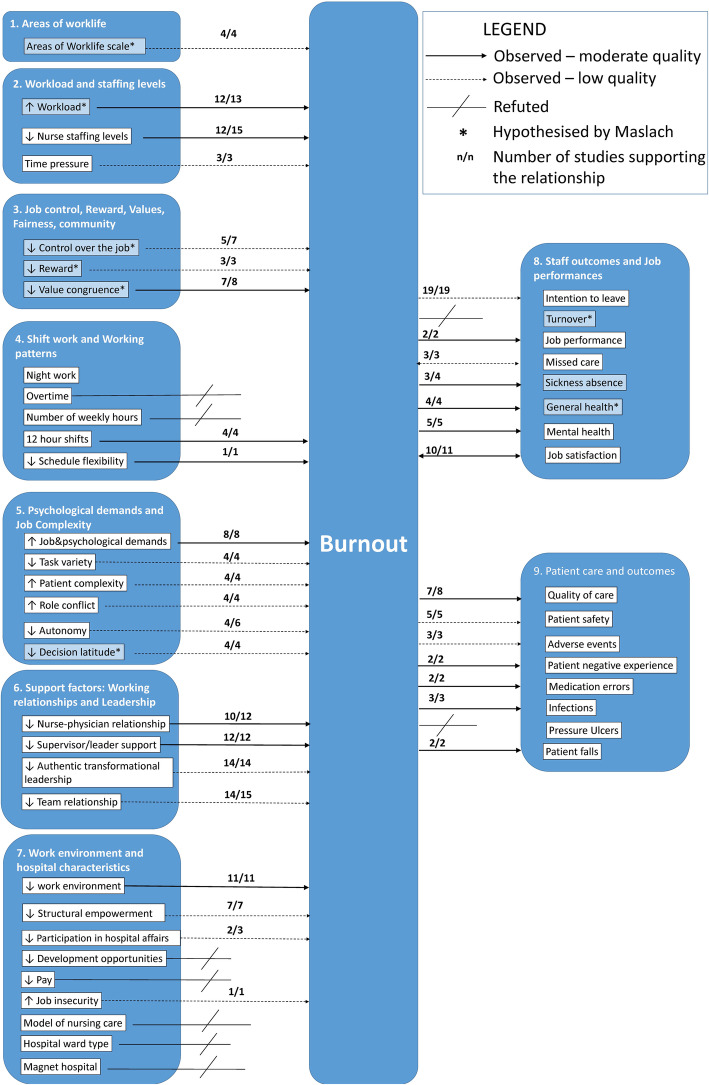
BACKGROUND: Workforce studies often identify burnout as a nursing 'outcome'. Yet, burnout itself-what constitutes it, what factors contribute to its development, and what the wider consequences are for individuals, organisations, or their patients-is rarely made explicit. We aimed to provide a comprehensive summary of research that examines theorised relationships between burnout and other variables, in order to determine what is known (and not known) about the causes and consequences of burnout in nursing, and how this relates to theories of burnout. METHODS: We searched MEDLINE, CINAHL, and PsycINFO. We included quantitative primary empirical studies (published in English) which examined associations between burnout and work-related factors in the nursing workforce. RESULTS: Ninety-one papers were identified. The majority (n = 87) were cross-sectional studies; 39 studies used all three subscales of the Maslach Burnout Inventory (MBI) Scale to measure burnout. As hypothesised by Maslach, we identified high workload, value incongruence, low control over the job, low decision latitude, poor social climate/social support, and low rewards as predictors of burnout. Maslach suggested that turnover, sickness absence, and general health were effects of burnout; however, we identified relationships only with general health and sickness absence. Other factors that were classified as predictors of burnout in the nursing literature were low/inadequate nurse staffing levels, ≥ 12-h shifts, low schedule flexibility, time pressure, high job and psychological demands, low task variety, role conflict, low autonomy, negative nurse-physician relationship, poor supervisor/leader support, poor leadership, negative team relationship, and job insecurity. Among the outcomes of burnout, we found reduced job performance, poor quality of care, poor patient safety, adverse events, patient negative experience, medication errors, infections, patient falls, and intention to leave. CONCLUSIONS: The patterns identified by these studies consistently show that adverse job characteristics-high workload, low staffing levels, long shifts, and low control-are associated with burnout in nursing. The potential consequences for staff and patients are severe. The literature on burnout in nursing partly supports Maslach's theory, but some areas are insufficiently tested, in particular, the association between burnout and turnover, and relationships were found for some MBI dimensions only.
Overview
CoChat Summary
TL;DR
This theoretical review of 91 quantitative studies found adverse job characteristics—high workload, low staffing levels, long shifts, and low control—are consistently associated with burnout in nursing, with severe potential consequences for staff and patients. The literature partly supports Maslach’s theory, but incomplete burnout measurement and mostly cross-sectional designs limit causal inference.
Key findings
- Across 91 studies, high workload was supported in 12/13 studies, low/inadequate nurse staffing in 12/15, ≥12-h shifts in 4/4, low control over the job in 5/7, low reward in 3/3, low value congruence in 7/8, low decision latitude in 4/4, poor supervisor/leader support in 12/12, negative team relationship in 14/15, and intention to leave in 19/19.
- Burnout was associated with reduced job performance (2/2), poor quality of care (7/8), poor patient safety (5/5), adverse events (3/3), medication errors (2/2), infections (3/3), and patient falls (2/2); no association was found with pressure ulcers. Turnover was refuted despite being hypothesised by Maslach, with only one small study finding Depersonalisation associated with turnover within 2 years.
- Most studies used the Maslach Burnout Inventory (n = 81), but only 39 (47%) measured and reported all three MBI subscales; 23 used Emotional Exhaustion only, 11 used Emotional Exhaustion and Depersonalisation, and 9 summed the three subscales despite advice against this. Maslach’s hypothesised predictors were generally supported, but often only for some MBI dimensions.
Methods
- Theoretical review conducted according to Campbell et al. and Pare et al.; systematic search of MEDLINE, CINAHL, and PsycINFO in May 2019 for English quantitative primary empirical studies examining associations between burnout and work-related factors or outcomes in nurses or nursing assistants in healthcare settings. Studies focused exclusively on personal factors, only comparing burnout levels across settings, or literature reviews, commentaries, and editorials were excluded.
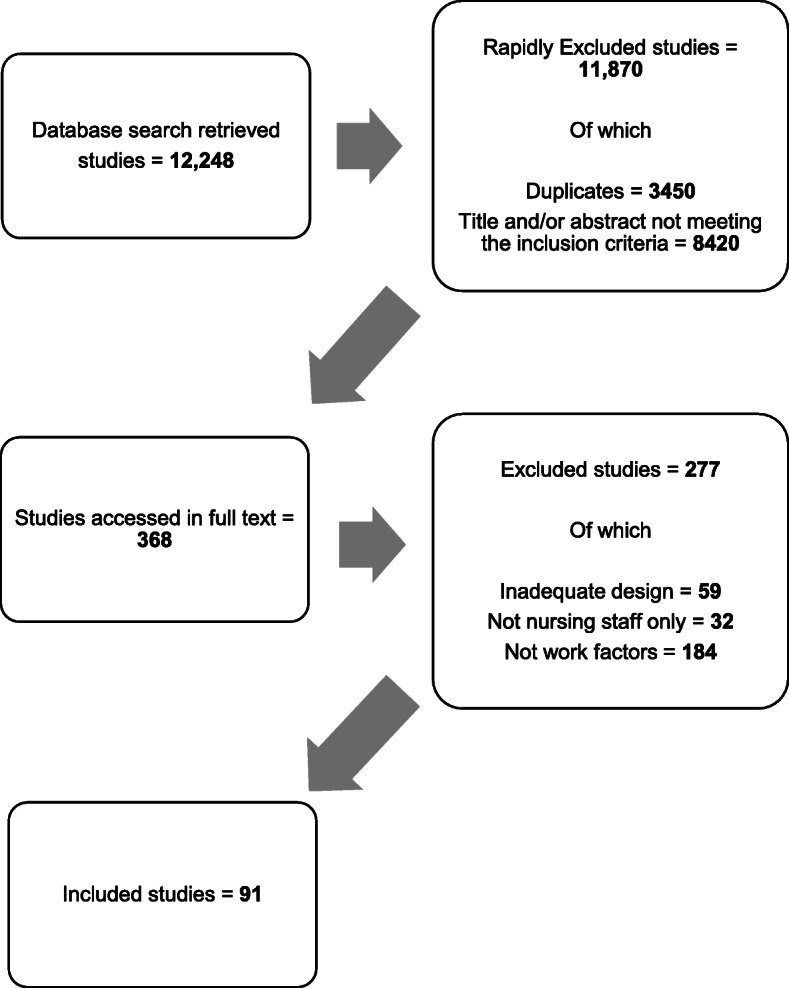
- The search yielded 12,248 records; 368 full texts were accessed, and 91 studies were included. Data were extracted on country, setting, sample size, staff group, burnout measure, variables tested, and findings; a coding frame starting from Maslach’s multidimensional theory produced nine broad categories. No formal quality appraisal was performed, but key quality aspects were summarised.
Limitations
- Stated by the authors: no formal quality appraisal instrument was applied; studies were reported without context or estimates such as ORs and 95% CIs; personality and other individual variables were not considered in data extraction; and studies indexed elsewhere or grey literature may have been missed.
- Evident from the text: 87/91 studies (97%) were cross-sectional, limiting temporal and causal inference and creating simultaneity bias, with factors such as missed care, job satisfaction, and mental health treated as both predictors and outcomes. Incomplete MBI measurement—only 39/91 studies used all three subscales, and 9 summed subscales—further limits testing of Maslach’s theory.
Model-written summary. Check it against the paper before relying on it.
Integrity signals
Registry
Cites
Statistics
Figures
Verification
Claims the paper makes
24 Valid · 3 Not valid · 199 Not checked · 100 Own results and interpretations
The sources with a verdict support this claim; the rest weren’t checked yet, have no full text we could read, or their verdicts aren’t rated yet.
In the paper
“high psychological demands were associated with higher odds of Emotional Exhaustion [62, 78]”
§ Burnout in nursing: a theoretical review > Results > Psychological demands and job complexity
What the sources say
- Supportedcites [62] Vidotti V Ribeiro RP Galdino MJQ Martins JT Burnout syndrome and shift work among the nursing staff Rev Lat Am Enfermagem 2018 26 e3022 30110099 PMC6091368 source
The Method section identifies psychological demands as a dimension of the Demand-Control-Support Questionnaire. In Results, Table 3 reports that high demand was associated with higher odds of emotional exhaustion among day-shift nursing staff (adjusted OR 2.50, 95% CI 1.44–4.35). The reported association is specific to the day shift. (LLM, conf=0.91)
- Not checked — no full text of the sourcecites [78] Bourbonnais R Comeau M Vezina M Dion G Job strain, psychological distress, and burnout in nurses Am J Ind Med 1998 34 1 20 28 9617384 doi:10.1002/(sici)1097-0274(199807)34:1
plainstates an association- Asserted: passes — The authors put it forward as true.
- Checkable: passes — It can be checked against evidence.
- Load-bearing: passes — The paper’s conclusions depend on it.
- Based: passes — The paper gives a reason why it holds.
- Supported
The cited sources support only part of this claim — read each source’s verdict below.
In the paper
“and Emotional Exhaustion and Personal Accomplishment [50]”
§ Burnout in nursing: a theoretical review > Results > Working relationships and leadership
What the sources say
- Partly supportedcites [50] Hanrahan NP Aiken LH McClaine L Hanlon AL Relationship between psychiatric nurse work environments and nurse burnout in acute care general hospitals Issues Ment Health Nurs 2010 31 3 198 207 20144031 PMC2856615 sourceExperimental — accuracy not yet measured
The Discussion (‘Strong Mangers and Leaders’) reports a significant relationship between manager skill and emotional exhaustion. The Results state that none of the work-environment factors, including manager skill, were associated with personal accomplishment in the adjusted or unadjusted models. The claim is therefore supported for emotional exhaustion but not personal accomplishment. (LLM, conf=0.92)
plainstates an association- Asserted: passes — The authors put it forward as true.
- Checkable: passes — It can be checked against evidence.
- Load-bearing: unclear — It is unclear whether the paper’s conclusions depend on it.
- Based: passes — The paper gives a reason why it holds.
- Partly supported
Every source the paper cites for this claim was checked and supports it.
In the paper
“The inability to establish a temporal link means limits the inference of causality [115].”
§ Burnout in nursing: a theoretical review > Discussion
What the sources say
- Supportedcites [115] Antonakis J Bendahan S Jacquart P Lalive R On making causal claims: a review and recommendations Leadersh Q 2010 21 6 1086 1120 source
Section 1, “What is Causality?”, lists temporal precedence as a condition for measuring a causal effect and explicitly calls temporal ordering necessary but not sufficient. Thus, inability to establish temporal order limits causal inference. (LLM, conf=0.93)
plain- Asserted: passes — The authors put it forward as true.
- Checkable: passes — It can be checked against evidence.
- Load-bearing: passes — The paper’s conclusions depend on it.
- Based: passes — The paper gives a reason why it holds.
- Supported
The sources with a verdict support this claim; the rest weren’t checked yet, have no full text we could read, or their verdicts aren’t rated yet.
In the paper
“| Night work | | | √ | |”
- Also stated in: § Working patterns and shift work · plain
“Working night shifts was associated with burnout (composite score) [68] and Emotional Exhaustion [62], but the relationship was not significant in two studies [69, 70].”
§ Burnout in nursing: a theoretical review > Results
What the sources say
- Not checked — no full text of the sourcecites [68] Anwar MM Elareed HR Burnout among Egyptian nurses Journal of Public Health-Heidelberg 2017 25 6 693 697 source
- Supportedcites [62] Vidotti V Ribeiro RP Galdino MJQ Martins JT Burnout syndrome and shift work among the nursing staff Rev Lat Am Enfermagem 2018 26 e3022 30110099 PMC6091368 source
The Results (Table 2) show that the relationship between work shift and burnout differs across dimensions: emotional exhaustion and professional realization differ significantly by shift, while depersonalization does not. The Discussion also reports higher overall burnout levels among day-shift than night-shift nursing staff. This supports the claim that night work is not consistently associated with burnout. (LLM, conf=0.86)
- Not checked — no full text of the sourcecites [69] Wisetborisut A Angkurawaranon C Jiraporncharoen W Uaphanthasath R Wiwatanadate P Shift work and burnout among health care workers Occup Med (Lond) 2014 64 4 279 286 24550196 source
- Not checked — no full text of the sourcecites [70] Ilhan MN Durukan E Taner E Maral I Bumin MA Burnout and its correlates among nursing staff: questionnaire survey J Adv Nurs 2008 61 1 100 106 18034813 source
plain- Asserted: passes — The authors put it forward as true.
- Checkable: passes — It can be checked against evidence.
- Load-bearing: unclear — It is unclear whether the paper’s conclusions depend on it.
- Based: passes — The paper gives a reason why it holds.
- Also stated in: § Working patterns and shift work · plain
Every source the paper cites for this claim was checked and supports it.
In the paper
“Long shifts of 12 h or more were associated with all MBI subscales [74]”
§ Burnout in nursing: a theoretical review > Results > Working patterns and shift work
What the sources say
- Supportedcites [74] Dall’Ora C Griffiths P Ball J Simon M Aiken LH Association of 12 h shifts and nurses’ job satisfaction, burnout and intention to leave: findings from a cross-sectional study of 12 European countries BMJ Open 2015 5 9 e008331 26359284 PMC4577950 source
The Measurements section identifies the three MBI subscales as emotional exhaustion, depersonalisation and personal accomplishment. The Discussion explicitly reports an association between shifts of 12 hours or more and all three subscales; the Shift length and nurse outcomes section reports the corresponding adjusted results. (LLM, conf=0.95)
plainstates an association- Asserted: passes — The authors put it forward as true.
- Checkable: passes — It can be checked against evidence.
- Load-bearing: passes — The paper’s conclusions depend on it.
- Based: passes — The paper gives a reason why it holds.
- Supported
201 more claims · 15 with their cited sources checked
Create a free account to see all 326 claims and to verify the 23 references still open.
- Probably not a substantial claim. 64
- It may state two separate claims as one. 72
- The quote only partly states this claim. 2
Claims other papers make about this one
Each is checked against this paper’s own text: does it say what the citing paper says it does?
The source backs part of the claim, not all of it — or backs it for a different population, condition or comparison.
In the citing paper
“Burnout among HPs is significantly associated with suicidal ideation [7], decreased job satisfaction [8], and increased turnover intention, ultimately resulting in a loss of HPs and deterioration in the quality of care, which is also negatively affected, as is patient safety and health status [9,10,11].”
From Effects of Third-Wave Cognitive Behavioral Therapy for Healthcare Professionals’ Burnout: A Systematic Review and Meta-Analysis (2025) · cites this paper as [9]
Experimental — accuracy not yet measuredThe source backs part of the claim, not all of it — or backs it for a different population, condition or comparison.
In the citing paper
“Reducing EE and DP may also contribute to improved workforce retention and lower absenteeism, ultimately benefiting healthcare providers and enhancing patient safety and care quality [9,10,11].”
From Effects of Third-Wave Cognitive Behavioral Therapy for Healthcare Professionals’ Burnout: A Systematic Review and Meta-Analysis (2025) · cites this paper as [9]
Experimental — accuracy not yet measuredThe cited source says what the claim attributes to it.
In the citing paper
“Last but not the least, some other organizational factors may also affect burnout, such as excessive workload, time pressure, high job demands, low rewards, low job autonomy, or negative team atmosphere [13].”
From The efficacy of applying the Interpersonal Effectiveness skills of dialectical behavior therapy into communication skills workshop for clinical nurses (2023) · cites this paper as [13]
Self-check
Percentages, sums and reported differences re-computed from the paper’s own numbers.
Each contradiction between two passages listed here was confirmed by an independent check.
Rated minor: it would not touch a result — a value no result rests on, a p-value that stays on the same side of the significance level, or a conflict that is clerical, resolved elsewhere in the paper, or outside its own findings.
In the paper
“The database search yielded 12 248 studies, of which 11 870 were rapidly excluded as either duplicates or titles and/or abstract not meeting the inclusion criteria. Of the 368 studies accessed in full text, 277 were excluded, and 91 studies were included in the review.”
§ Burnout in nursing: a theoretical review > Results
Reported 368 · recomputed 378
Rated minor: it would not touch a result — a value no result rests on, a p-value that stays on the same side of the significance level, or a conflict that is clerical, resolved elsewhere in the paper, or outside its own findings.
In the paper
§ Burnout in nursing: a theoretical review > Results
“| Overtime | | | √ | |”
§ Burnout in nursing: a theoretical review > Results > Working patterns and shift work
“One study found working that overtime was associated with composite MBI score [73].”
Rated minor: it would not touch a result — a value no result rests on, a p-value that stays on the same side of the significance level, or a conflict that is clerical, resolved elsewhere in the paper, or outside its own findings.
In the paper
“Most studies used the Maslach Burnout Inventory Scale (n = 81), which comprises three subscales reflecting the theoretical model: Emotional Exhaustion, Depersonalisation, and reduced Personal Accomplishment. However, less than half (47%, n = 39) of the papers measured and reported results with all three subscales.”
§ Burnout in nursing: a theoretical review > Results > Measures of burnout
Reported 47 · recomputed 48.148148
Citations
Cites
The measurement of experienced burnout
Maslach, C., & Jackson, S. E. (1981) · Journal of Organizational Behavior · doi:10.1002/job.4030020205 · Cited by 14,496
The job demands-resources model of burnout.
Demerouti, E., Bakker, A. B., Nachreiner, F., & Schaufeli, W. B. (2001) · Journal of Applied Psychology · doi:10.1037/0021-9010.86.3.499 · Cited by 13,643
Maslach, C., Schaufeli, W. B., & Leiter, M. P. (2001) · Annual Review of Psychology · doi:10.1146/annurev.psych.52.1.397 · Cited by 12,852
(1996) · Consulting Psychologists Press eBooks · Cited by 7,863
Freudenberger, H. J. (1974) · Journal of Social Issues · doi:10.1111/j.1540-4560.1974.tb00706.x · Cited by 5,463
Hospital Nurse Staffing and Patient Mortality, Nurse Burnout, and Job Dissatisfaction
Aiken, L. H. (2002) · JAMA · doi:10.1001/jama.288.16.1987 · Cited by 5,226
The Copenhagen Burnout Inventory: A new tool for the assessment of burnout
Kristensen, T. S., Borritz, M., Villadsen, E., & Christensen, K. B. (2005) · Work & Stress · doi:10.1080/02678370500297720 · Cited by 3,136
On making causal claims: A review and recommendations
Antonakis, J., Bendahan, S., Jacquart, P., & Lalive, R. (2010) · The Leadership Quarterly · doi:10.1016/j.leaqua.2010.10.010 · Cited by 2,441
Synthesizing information systems knowledge: A typology of literature reviews
Paré, G., Trudel, M.-C., Jaana, M., & Kitsiou, S. (2015) · Information & Management · doi:10.1016/j.im.2014.08.008 · Cited by 1,987
Burnout: 35 years of research and practice.
Schaufeli, W. B., Leiter, M. P., & Maslach, C. (2009) · Career Development International · doi:10.1108/13620430910966406 · Cited by 1,964
Research works printed but not linked: 4
- Ekstedt M Burnout and sleep: Institutionen för folkhälsovetenskap/Department of Public Health Sciences 2005
- Cherniss C Burnout in new professionals: a long-term follow-up study J Health Hum Resour Adm 1989 12 1 11 24
- Adali E Priami M Evagelou H Mougia V Ifanti M Alevizopoulos G Burnout in psychiatric nursing personnel in Greek hospitals European Journal of Psychiatry 2003 17 3 173 181
- Laschinger HKS Shamian J Thomson D Impact of magnet hospital characteristics on nurses’ perceptions of trust, burnout, quality of care, and work satisfaction Nurs Econ 2001 19 5 209 219
Cited by
Items 601–700 of 1,160
Recovering After COVID-19: A Comparison of Burnout Levels Among Care Aides From 2014 to 2024
Saeidzadeh, S., Angel, C., Nichani, V., Penconek, T., Norton, P., & Estabrooks, C. A. (2025) · Journal of the American Medical Directors Association · doi:10.1016/j.jamda.2025.105842 · Cited by 3
Fernemark, H., Skagerström, J., Seing, I., Karlsson, E. A., & Nilsén, P. (2025) · Journal of Healthcare Leadership · doi:10.2147/jhl.s533780 · Cited by 2
Sung, J. E., & Lee, N. (2025) · Healthcare · doi:10.3390/healthcare13192519 · Cited by 4
Weinstein, A. A., Goldberg, D. G., Shah, Z., Warner, M. E., & Maughan, E. D. (2025) · The Journal of School Nursing · doi:10.1177/10598405251386068 · Cited by 5
Knowledge mapping of burnout among nursing professionals: A bibliometric study
Chi, S., Wang, W., Wan, M., Xu, S., He, F., Zhang, L., Hu, S., & Liu, X. (2025) · International Journal of Nursing Studies Advances · doi:10.1016/j.ijnsa.2025.100427 · Cited by 5
“Three seminal works emerged as foundational contributors: Maslach and Leiter (2016) led with 67 citations, followed by Woo et al. (2020) and Dall ’ Ora et al. (2020) with 63 and 58 citations respectively, indicating their central role in shaping current theoretical frameworks.”
Cerela-Boltunova, O., & Klavina, K. (2025) · International Journal of Environmental Research and Public Health · doi:10.3390/ijerph22111736 · Cited by 2
“Up to 30% reduction in burnout [19,20]; • 25–35%. reduction in error rate [70,73]; Increased patient satisfaction and a more positive perception of the quality of care [41]; Reduced staff turnover and greater retention in the sector [14].”
Burnout, anxiety, and resilience among nurses during wartime: evidence from a cross-sectional study
Shalom, T., Ogni, L., Freud, T., & Bashkin, O. (2025) · BMC Nursing · doi:10.1186/s12912-025-04061-1 · Cited by 10
Achmet, V., & Lauzier, M. (2025) · Journal of Nursing Management · doi:10.1155/jonm/8865098 · Cited by 4
Petersen, J., & Melzer, M. (2026) · Scientific Reports · doi:10.1038/s41598-026-39178-z · Cited by 2
“…and 36% 9 whereas job demands like inadequate staffing, time pressure, low task variety, role conflict, low autonomy, negative nurse-physician relationship, poor supervisor/leader support, poor leadership, negative team relationship, job insecurity can be predictors of aggressive behavior 10,11 .”
Sampedro, C. S., Fernández‐Peña, R., Ruiz-Pellón, N., Martín-Melón, R., & Ortego, C. (2026) · Nursing Outlook · doi:10.1016/j.outlook.2026.102715 · Cited by 9
Trainum, K., Johnson, K., Xie, B., Heitkemper, E., & Hauser, E. (2026) · Digital Health · doi:10.1177/20552076261425494 · Cited by 3
Burnout among Pakistani nurses: a systematic review and meta-analysis
Mukhtar, M., Ebrahimi, H., & Ali, M. (2026) · BMC Nursing · doi:10.1186/s12912-026-04422-4 · Cited by 7
“Over the past two decades, healthcare systems world-wide have increasingly acknowledged burnout as a critical occupational health issue affecting nurse well-being, job satisfaction, clinical performance, and patient outcomes [10].”
Zaghini, F., Marti, F., González, C. I. A., Monaco, M. L., Bartoli, D., Figura, M., & Gioiello, G. (2026) · Healthcare · doi:10.3390/healthcare14070858 · Cited by 3
Xue, X., Wang, R., Xie, Y., Wu, H., Ling, Y., Mei, Y., Liu, R., Xu, J., & Li, J. (2026) · BMC Psychology · doi:10.1186/s40359-026-04447-z · Cited by 2
“A large amount of unfinished work leads to increased stress among shift nurses [42].”
Pan, Y., Huang, H., Fang, C., Sun, L., & Fan, W. (2026) · Frontiers in Public Health · doi:10.3389/fpubh.2026.1803470 · Cited by 3
“Major workplace factors include high workload, long working hours, interpersonal conflicts, unfair treatment, insufficient recognition, unfavorable work environment, and unresolved organizational issues (67, 68).”
Effects of Toxic Leadership Behavior and Emotional Exhaustion on Patient Safety Incident Reporting
Poku, C. A., Ahiadzese, Y. A., Oyortey, H. K., Lamptey, S. N. O., Asante, J. K., Lumor, D. A., & Hagan, D. (2026) · Journal of Nursing Management · doi:10.1155/jonm/5547937 · Cited by 3
“In addition, long working hours, high patient-to-nurse ratios, and insufcient stafng are every-day stressors for nurses worldwide [22, 23].”
Explainable AI for Equitable Nurse Scheduling: Pragmatic Pre-Post Implementation Study
Shia, B., Peng, S.-M., Chang, C.-Y., Lo, C.-Y., & WANG, S.-R. (2026) · JMIR Nursing · doi:10.2196/94450 · Cited by 3
Zhang, H., Wu, X., & Qiu, S. (2026) · Frontiers in Nutrition · doi:10.3389/fnut.2026.1831265 · Cited by 2
Work interruptions and nurse turnover intention mediated by burnout
Wang, C., & Zhu, H. (2026) · Frontiers in Public Health · doi:10.3389/fpubh.2026.1838436 · Cited by 2
Psychosocial determinants of a nurse's work
Tomaszewska, K., & Kłos, A. (2022) · Journal of Education Health and Sport · doi:10.12775/jehs.2023.13.01.033 · Cited by 3
Impact of nurses’ burnout on safety culture
Feliciano, A. Z., Feliciano, E. E., Feliciano, J. R. D., Gonzales, F., Cajigal, J. V., Tolentino, C. G., Magtubo, D. J. D., Monieno, C. L., & Nacpil, A. G. (2022) · International Journal of ADVANCED AND APPLIED SCIENCES · doi:10.21833/ijaas.2023.01.022 · Cited by 6
Khaneghai, K., Abbasi, P., Raygani, A. A. V., Abdi, A., Salari, N., & Mohammadi, M. M. (2023) · Nursing and Midwifery Journal · doi:10.52547/unmf.20.11.939 · Cited by 2
Caring Knowledge as a Strategy to Mitigate Violence against Nurses: A Discussion Paper
Brune, S., Killam, L. A., & Plazas, P. C. (2023) · Issues in Mental Health Nursing · doi:10.1080/01612840.2023.2205502 · Cited by 6
“One of the primary reasons for this is that nurses are burnt out, overburdened, and overworked (Dall’Ora et al., 2020; Shah et al., 2021).”
BackgroundCunha, L. D. M., Pestana‐Santos, M., Lomba, L., & Santos, M. R. (2023) · Journal of PeriAnesthesia Nursing · doi:10.1016/j.jopan.2023.08.024 · Cited by 4
Owusu, D., Arthur, F., Nkyi, A. K., Amponsah, M. O., Awabil, G., Fia, S. D., & Antiri, K. O. (2023) · International Journal of Changes in Education · doi:10.47852/bonviewijce32021809 · Cited by 2
Registered nurses’ management of depression in general wards
Mpetshu, M., & Maritz, J. (2023) · Health SA Gesondheid · doi:10.4102/hsag.v28i0.2328 · Cited by 2
Power-Horlick, A. (2023) · Witness The Canadian Journal of Critical Nursing Discourse · doi:10.25071/2291-5796.156 · Cited by 2
“…the conditions under which we 1 are expected to provide our professional care and the impact of those conditions on our professional morale, ethical and clinical judgement, and ultimately, patient care (Bourgeault, 2021; Dall’Ora et al., 2020; Needleman, 2017; Poindexter, 2022; Scott et al., 2014).”
BackgroundYusrawati, Y., Respati, T., Sekarwana, N., Serudji, J., & Dasman, H. (2023) · The Open Public Health Journal · doi:10.2174/0118749445273712231129053005 · Cited by 4
Ferber, M. F., Chen, T. H., McHowat, J., Charney, R. L., & Bitter, C. C. (2024) · Disaster Medicine and Public Health Preparedness · doi:10.1017/dmp.2023.240 · Cited by 4
“28 Flexibility was successfully implemented in 1 large academic medical center prior to the pandemic.”
BackgroundHalperin, O., Idilbi, N. M., Robes, D., Biderman, S. N., Malka-Zeevi, H., & Green, G. (2024) · Nursing Outlook · doi:10.1016/j.outlook.2024.102134 · Cited by 2
Stoicism and Cognitive Strategies for Nursing Professional Development
Schimmels, J., Schneider, J., Bucher, K. K., & Coty, M. (2024) · The Journal of Continuing Education in Nursing · doi:10.3928/00220124-20240328-02 · Cited by 5
Quality of life in nurses from neurological wards: The mediating role of burnout
Lima, S., Machado, J. C., Vilaça, M., & Pereira, M. G. (2024) · Journal of Workplace Behavioral Health · doi:10.1080/15555240.2024.2350444 · Cited by 3
“Previous research has focused on the mediating role of burnout in relation to job satisfaction, work conditions, stress, and coping strategies in the work context (e.g., Dall’Ora et al., 2020; Leiter & Maslach, 2009).”
Activity Recognition of Nursing Tasks in a Hospital: Requirements and Challenges
Hesselmann, F. T., Pauls, A., Koppelin, F., & Wallhoff, F. (2024) · Lecture notes of the Institute for Computer Sciences, Social Informatics and Telecommunications Engineering · doi:10.1007/978-3-031-59717-6_16 · Cited by 2
Ricker, M., Brooks, A. J., Chen, M., Weydert, J. A., Locke, A., Meehan, E. K., Cook, P., Lebensohn, P., & Maizes, V. (2024) · HCA Healthcare Journal of Medicine · doi:10.36518/2689-0216.1778 · Cited by 5
Allahverdi, F. Z., & BAYER, N. (2024) · Behavioral Sciences · doi:10.3390/bs14070605 · Cited by 5
“Excessive workload has been associated with lower nurse performance [3] and the intention to leave work [4].”
BackgroundWasielewska, E., Kordel, P., & Moskalewicz, M. (2024) · Nursing Reports · doi:10.3390/nursrep14030128 · Cited by 2
Li, J., Wang, F., Zhang, X., Zhang, H., Lan, M., Chen, S., Su, J., & Yang, L. (2024) · Journal of Clinical Nursing · doi:10.1111/jocn.17435 · Cited by 5
Lecocq, D. (2024) · Nursing Philosophy · doi:10.1111/nup.12510 · Cited by 7
Wu, H.-P., & Lu, L. (2024) · Journal of Managerial Psychology · doi:10.1108/jmp-10-2023-0585 · Cited by 6
Jung, H. R., Jang, M. H., & Sun, M. J. (2024) · Healthcare · doi:10.3390/healthcare12222247 · Cited by 7
Nursing Activity Recognition for Automated Care Documentation in Clinical Settings
Wallhoff, F., & Hesselmann, F. T. (2024) · Lecture notes in computer science · doi:10.1007/978-3-031-77918-3_19 · Cited by 2
Wixcey, H., Cropley, B., & Shearer, D. A. (2024) · Journal of Further and Higher Education · doi:10.1080/0309877x.2024.2440501 · Cited by 5
“Such discomfort accentuates the pressures experienced by learners during their educational journey, which can lead to academic burnout and potentially withdrawal from education (see Dall’ora et al. 2020).”
Kakyo, T. A., Xiao, L. D., & Chamberlain, D. J. (2025) · Nursing and Health Sciences · doi:10.1111/nhs.70034 · Cited by 4
Zafra-Agea, J. A., Ramírez‐Baraldes, E., Maldonado-Manzano, E., et al. (2025) · Healthcare · doi:10.3390/healthcare13030323 · Cited by 2
“This highlights the need for developing and communicating development opportunities across all sectors to enhance satisfaction and professional quality of life [32].”
Moon, S.-Y., & Park, H. (2025) · Behavioral Sciences · doi:10.3390/bs15040486 · Cited by 6
“…around burnout in nursing, burnout is associated with high work burdens, low staff numbers, long work times, low autonomy and sense of control, time pressures, high emotional burdens, role conflicts, negative nurse–physician relationships, and poor organisational support (Dall’Ora et al., 2020).”
Risk Factors Associated with Psychological Health and Workload among Clinical Nurses
Kangarlou, M. B., Dehdashti, A., Saleh, E., Dehnavi, N., & Davoodi, Z. (2025) · Iranian Journal of Nursing and Midwifery Research · doi:10.4103/ijnmr.ijnmr_201_21 · Cited by 3
Havaei, F., Ma, A., MacPhee, M., Kobekyaa, F. K., Kaulius, M., Boamah, S. A., Ahmadi, B., & Salmon, A. (2025) · Journal of Long-Term Care · doi:10.31389/jltc.261 · Cited by 2
Evidence-based nursing in action: A focused ethnographic study of knowledge use in acute care
Ominyi, J., Eze, U., Alabi, A., & Nwedu, A. B. (2025) · Next research. · doi:10.1016/j.nexres.2025.100584 · Cited by 5
Watanabe, R., Kida, R., & Takemura, Y. (2022) · Journal of Japan Academy of Nursing Science · doi:10.5630/jans.42.63 · Cited by 2
Burnout as a systemic challenge: job demands, loss cycles and the need for a workforce strategy
Sharplin, G. R. (2021) · Australian journal of advanced nursing · doi:10.37464/2020.384.721 · Cited by 2
Nurses’ Burnout and Its Associated Factors and Impact on the Quality of Nursing Services
Agustina, Tahlil, T., & Marlina, M. (2022) · International Journal of Nursing Education · doi:10.37506/ijone.v14i2.17982 · Cited by 2
Kitamura, Y., Nakai, H., & Teranishi, K. (2022) · Healthcare · doi:10.3390/healthcare10050959 · Cited by 4
Knowledge mobilization in critical care and the evolving communication role of nurses
Kelly, S., Garner, J., Treadway, V., & Sadera, G. (2022) · Nursing in Critical Care · doi:10.1111/nicc.12821 · Cited by 3
Nurses’ stress, anxiety, depression, and burnout in the workplace: A correlational study
al., F. E. (2022) · International Journal of ADVANCED AND APPLIED SCIENCES · doi:10.21833/ijaas.2022.09.012 · Cited by 2
Nurse Leader Perceptions of Data in the Veterans Health Administration: A Qualitative Evaluation
Wong, J. J., SoRelle, R., Yang, C., Knox, M. K., Hysong, S. J., Dorsey, L. E., O’Mahen, P. N., & Petersen, L. A. (2023) · CIN Computers Informatics Nursing · doi:10.1097/cin.0000000000001003 · Cited by 5
The Effect of COVID-19-related Occupational Stress and Burnout in Referral Hospital Nurses
Arif, Y., & Fadhani, M. (2023) · Kesmas National Public Health Journal · doi:10.21109/kesmas.v18i1.6372 · Cited by 4
Nursing Leadership and Management of Nursing Staff Burnout during the COVID-19 Pandemic
Gyekye, M. B. (2023) · OALib · doi:10.4236/oalib.1109754 · Cited by 3
Kim, S. J. (2023) · PLoS ONE · doi:10.1371/journal.pone.0287457 · Cited by 5
“Regardless of exposure status, healthcare professionals who provided care for patients admitted via an ambulance or older adults with multiple comorbidities during the COVID-19 pandemic showed greater fear of infecting their families [51,52,60].”
BackgroundDigital Detox: A Prescription for Nursing Well - Being
Maithani, A. (2023) · International Journal of Science and Research (IJSR) · doi:10.21275/sr231003130823 · Cited by 2
Colburn, V. F., Guerrazzi-Young, C., & Durant, D. J. (2025) · World Journal for Sand Therapy Practice® · doi:10.58997/wjstp.v1i12.59 · Cited by 3
Factores asociados al síndrome de burnout
Romero, O. S. C., Gallegos, L. A. M., Borbor, J. J. C., et al. (2023) · Revista Inclusiones · doi:10.58210/inclu3505 · Cited by 2
Attitude of cardiac surgery nurses on kinesiophobia management: a qualitative study
Wang, Y., Chen, Y., Zhang, X., et al. (2023) · BMJ Open · doi:10.1136/bmjopen-2023-074438 · Cited by 2
“10 11 Although nurses recognise the effectiveness of kinesiophobia management, external factors influence their motivation and commitment.”
BackgroundNursing Workload Influence on Nurses Job Injury and Patient Complication
Shahhat, Z. E., Ahmed, M., & El-Shaer, A. (2024) · Mansoura Nursing Journal · doi:10.21608/mnj.2024.350485 · Cited by 5
“It also can effect on nurses’ health as cardiovascular and respiratory problems, visual impairment and increased metabolic rates (Dall’Ora et al., 2020).”
BackgroundStudying the Relationship between Nurses' Burnout and the Empowering Behaviors of Nursing Leaders
Kohnen, D., Witte, H. D., Sermeus, W., & Schaufeli, W. B. (2021) · Journal of integrative nursing and palliative care · doi:10.51847/uyp4etmtlx · Cited by 3
“Depersonalization includes a negative and pessimistic attitude toward clients and a decrease in personal achievements, a negative evaluation of oneself, especially in dealing with clients [4, 5].”
Mental Health and Well-Being Amongst Healthcare Professionals in Clinical Training
Mitchell, A. E. P. (2024) · Integrated science · doi:10.1007/978-3-031-64288-3_2 · Cited by 3
Bagley, C., Sawyerr, A. A. A., & Abubaker, M. (2021) · European Journal of Business Management and Research · doi:10.24018/ejbmr.2021.6.2.829 · Cited by 1
“[26] Relationships between stress, incipient burnout, and poor professional performance in these studies were not absolute, or entirely predictable, since many nurses did not show signs of burnout despite multiple stressors.”
BackgroundIs resilience training the answer to burnout?
(2021) · Journal of Professional Nursing · doi:10.1016/j.profnurs.2021.12.002 · Cited by 2
“…these individuals are working in. Pertinent environmental interventions for nurses working on the frontlines include mandated nurse-to-patient ratios that account for patient acuity, adequate staffing, increased nurse autonomy, and discontinuation of mandatory overtime (Dall ’ Ora et al., 2020).”
Kotsakis, A., Avraam, D., Malliarou, M. M., Halkiopoulos, C., Galanakis, M., & Sfakianakis, M. (2024) · Preprints.org · doi:10.20944/preprints202407.1849.v1 · Cited by 2
The association between nurse staffing configurations and sickness absence: longitudinal studyPreprint
Dall’Ora, C., Meredith, P., Saville, C. E., et al. (2024) · medRxiv · doi:10.1101/2024.09.02.24312931 · Cited by 2
Self-citationAddressing Burnout among Healthcare Technology Management Professionals
Andiappan, M., Dufour, L., & Senkaiahliyan, S. (2023) · Biomedical Instrumentation & Technology · doi:10.2345/0899-8205-57.3.75 · Cited by 2
Exploring the effects of break nurses on nursing staff burnout
Zheng, D. (2023) · Journal of Hospital Administration · doi:10.5430/jha.v12n2p38 · Cited by 1
Psychosocial work environment and burnout among employees of a Ghanaian public university
Baidoo, M. A., Ansah, E. W., & Essien‐Baidoo, S. (2023) · International Journal of Health Promotion and Education · doi:10.1080/14635240.2023.2282129 · Cited by 5
“The findings revealed that a high job decision latitude has a significant influence on all the dimensions of burnout i.e. emotional exhaustion, deperso-nalization and personal accomplishment (Dall’ora et al. 2020).”
Relationship Between Empowering Behaviors of Nursing Managers and Nurses’ Job Burnout
Peighambari, M. M., Choobani, M., Fathollahi, M. S., Tabib, A., Alemzadeh‐Ansari, M. J., & Shabani, F. (2023) · Iran Journal of Nursing · doi:10.32598/ijn.36.141.2809 · Cited by 1
Student Nurse Simulation: Preparedness for the Care of People Living with Dementia – A Review
Price, R. (2023) · International Journal of Advanced Nursing Education and Research · doi:10.21742/ijaner.2023.8.1.04 · Cited by 1
Ding, L. (2024) · Medicine · doi:10.1097/md.0000000000037938 · Cited by 1
“[11,12] This study found that integrated collaborative scheduling can improve patient, physician and nursing satisfaction, which is a very important finding.”
BackgroundGonzález-López, M. M., Esquinas, C., Romero‐García, M., Benito-Aracil, L., Martínez-Momblán, M.-A., Villanueva-Cendán, M., Jaume-Literas, M., & Delgado‐Hito, P. (2024) · Enfermería Intensiva (English ed ) · doi:10.1016/j.enfie.2023.10.002 · Cited by 3
Nurses Navigating Mental Health During Uncharted Times: Self, Others, Systems (S.O.S)!
Akoo, C., Price, S. L., McMillan, K., Ingraham, K., Ayoub, A., Sands, S. R., Shankland, M., & Bourgeault, I. L. (2024) · Canadian Journal of Nursing Research · doi:10.1177/08445621241266291 · Cited by 3
“What is recognized however, is the concomitant pressures of work and caregiving responsibilities generate immense pressure (Dall ’ Ora et al., 2020).”
BackgroundStress, satisfaction and motivation of operating room nurses in Brazil
Oliveira, J. A. D. N., Gomes, E. T., da Silva, J. R. R., et al. (2024) · Acta Paulista de Enfermagem · doi:10.37689/acta-ape/2025ao0000331i · Cited by 1
Sobrecarga de trabajo y errores durante la administración de medicación: Revisión sistemática
Tipán, Y. E., Taipe, M. A. R., & Toapanta, L. M. T. (2025) · Revista Conectividad · doi:10.37431/conectividad.v5i4.211 · Cited by 1
Rhames, A., Lee, J., Haberski, J., & Slaten, C. D. (2025) · Professional School Counseling · doi:10.1177/2156759x251320911 · Cited by 7
“Over the years, researchers have consistently examined burnout and job stress among helping professionals, such as mental health professionals, nurses, and social workers (Cummings et al., 2021; Dall ’ Ora et al., 2020; Shepherd & Newell, 2020; Yang & Hayes, 2020).”
Gil‐Almagro, F., García-Hedrera, F. J., Carmona-Monge, F. J., & Peñacoba, C. (2025) · Enfermería Intensiva · doi:10.1016/j.enfi.2025.500524 · Cited by 2
Understanding Nurse Burnout in the Context of Alarm Fatigue
Gallaher, S. C. J., & Wung, S. (2025) · Critical Care Nursing Clinics of North America · doi:10.1016/j.cnc.2025.01.002 · Cited by 2
Backović, D., Jovanović, D., Tomás, A., Bukumirić, Z., & Tomović, K. (2025) · Journal of Clinical Medicine · doi:10.3390/jcm14103374 · Cited by 1
“Nurses, maintaining close and prolonged patient contact, are especially vulnerable due to physical demands, staffing shortages, and high patient loads [8].”
Emebo, A. (2025) · European Conference on Social Media · doi:10.34190/ecsm.12.1.3360 · Cited by 1
“While the JD-R model has been applied to professions like nursing and sales (Dall’Ora et al., 2020; Peasley et al., 2020), its adaptation to influencer careers is limited, especially as influencers must navigate between trans-parasocial relationships and brand demands while engaging in Influencer…”
Burnout prevention in the nursing profession
Baker, E. J. (2025) · British Journal of Community Nursing · doi:10.12968/bjcn.2025.0091 · Cited by 2
Kohanová, D., Sollárová, A., Gurová, Š., & Čakloš, M. (2025) · Central European Journal of Nursing and Midwifery · doi:10.15452/cejnm.2025.16.0013 · Cited by 3
A data-driven multicriteria decision model for healthcare workforce retention strategies
Caprio, D. D., Sironi, S., Lan, F., et al. (2025) · Healthcare Analytics · doi:10.1016/j.health.2025.100403 · Cited by 1
Lalovic, A., Hyde, M., Bergmans, Y., Kiriakidis, A., Ebegbare, N., Verduyn, A., & Rizvi, S. J. (2025) · Canadian Journal of Nursing Research · doi:10.1177/08445621251354918 · Cited by 2
“…burnout on patient care are well-documented, with studies showing increased patient safety incidents (e.g., errors in documentation, monitoring or dispensing of medication), reduced patient satisfaction and poor patient outcomes (Dall ’ Ora et al., 2020; Hodkinson et al., 2022; Li et al., 2024).”
The Pediatric Experience Collaborative: Paving the Way in Pediatric Experience
Hamilton, L. J., House, T., Sewell, T. B., et al. (2025) · Journal of Patient Experience · doi:10.1177/23743735251357481 · Cited by 1
Burnout and sleep problems among nurses working in a tertiary hospital in Kathmandu, Nepal
Kanak, M. P., & Pant, S. (2025) · PLOS Global Public Health · doi:10.1371/journal.pgph.0003879 · Cited by 2
Khan, A., Delgado, A. D., Ali, H., Ho, S., Doukas, A. M., Klepser, N., Pietrzak, R. H., Faherty, C., Marin, D. B., Sharma, V., et al. (2025) · Journal of Occupational and Environmental Medicine · doi:10.1097/jom.0000000000003518 · Cited by 2
Ahmed, N. (2025) · Knowledge and Performance Management · doi:10.21511/kpm.09(2).2025.04 · Cited by 2
Penciner, A., Iseman, R., Sheikh, H. I., Gilmour, K., & Odorizzi, S. (2025) · Journal of Emergency Nursing · doi:10.1016/j.jen.2025.07.007 · Cited by 1
Ma, J., Wang, S., Yang, A., Li, Y., & Chen, Y. (2025) · Medicine · doi:10.1097/md.0000000000043831 · Cited by 1
“Burnout will be comprehensively assessed using the Maslach Burnout Inventory (MBI) [10] to reflect different levels of burnout.”
Li, H., Luo, J., Zhong, Q., Duan, Y., & Liu, I. (2025) · IEEE International Conference on Human-Machine Systems (ICHMS) · doi:10.1109/ichms65439.2025.11154192 · Cited by 2
“It negatively affects healthcare workers by reducing job satisfaction, impairing emotional well-being, and diminishing their commitment to the profession [2].”
Missed Nursing Care Situations and Reasons: Intensive Care Nurses
GÜNGÖR, S., Bulmuş, E., & Akçoban, S. (2025) · Scandinavian Journal of Caring Sciences · doi:10.1111/scs.70119 · Cited by 1
Burnout in Nurses in Aotearoa New Zealand: A post-COVID Analysis
Toma, G., Fevre, D. M. L., Topp, M., & Rubie-Davies, C. M. (2025) · Nursing Praxis in Aotearoa New Zealand · doi:10.36951/001c.143520 · Cited by 1
Villacis-Alvarez, E., Noorloos, J., Wilson, S. J., Green, R. S., Fashan, S., Pritchett, C., John, C., & Yakubovich, A. R. (2025) · Frontiers in Reproductive Health · doi:10.3389/frph.2025.1598706 · Cited by 4
“A recent systematic review and meta-analysis found a significant positive correlation between moral distress and emotional exhaustion (63) which is a key indicator of burnout among health professionals (65).”
Leading Change for Culture and Well-Being in Academic Nursing
Bowen, F., Talley, M. H., Sample, N. S., et al. (2025) · Nurse Leader · doi:10.1016/j.mnl.2025.102546 · Cited by 1
Metadata
- Authors
- Dall’Ora, C., Ball, J., Reinius, M., & Griffiths, P.
- Affiliations
- University of Southampton (GB)
- Karolinska Institutet (SE)
- Corresponding author
- Dall’Ora, Chiara
- Venue
- Human Resources for Health
- Published
- 2020-06-05
- Volume
- 18
- Issue
- 1
- Pages
- 41-41
- ISSN
- 1478-4491 (ISSN-L)
- PMC
- PMC7273381
- OpenAlex
- W3011614181
- Cited by
- 1,181
- References
- 115
- Citations by year
- 2026: 239 · 2025: 276 · 2024: 211 · 2023: 211 · 2022: 148 · 2021: 79 · 2020: 14
- FWCI
- 27.93
- Type
- journal article
- Language
- en
- Open access
- gold
- doi.org
- Licence
- cc-by
- creativecommons.org/licenses/by/4.0 (tdm)
- creativecommons.org/licenses/by/4.0 (vor)
- Locations
- Human Resources for Health (publishedVersion, cc-by)
- PubMed Central (publishedVersion, cc-by)
- PubMed (publishedVersion)
- ePrints Soton (University of Southampton) (acceptedVersion)
- DOAJ (DOAJ: Directory of Open Access Journals) (submittedVersion, cc-by-sa)
- Funders
- National Institute for Health and Care Research (NF-SI-0616-10068)
- Topics
- Health Sciences › Medicine › Public Health, Environmental and Occupational Health › Occupational Health and Burnout
- Social Sciences › Psychology › Social Psychology › Stress and Burnout Research
- Health Sciences › Health Professions › General Health Professions › Healthcare professionals’ stress and burnout
- Keywords
- burnout, nursing workforce, workload, nurse staffing, job control, shift length, role conflict, job insecurity, leadership, turnover, sick leave, patient safety, quality of care, nurse-physician relationship
- MeSH terms
- Burnout, Professional, Health Status, Humans, Internal-External Control, Job Satisfaction, Leadership, Nurses, Personnel Turnover, Quality of Health Care, Time Factors, Workload, Workplace, Sick Leave, Nurse's Role, Patient Safety
About these checks
Registry, retraction, Cites and statistics results are computed, not judged, with one exception: a printed reference that no index lists is read once by a model before it counts as a citation error. Claims are extracted by a model and kept only when their quote appears verbatim in the text; each cited source is then checked, with a model’s help, for whether it says what the claim relies on. Those verdicts can be wrong — read the claim’s quote and the cited source before relying on one.
The claim verdicts this report counts are experimental: their accuracy is not yet measured.
A language model drew the claims from the paper on 2026-10-10, under version 3 of the claim definition (model deepseek-v4.1-flash, prompt extract-v3).
A second model labelled each claim on 2026-10-10 (model jev-1.13-20260917, definition revision gold-guideline-v0.2).
Cited sources are checked with a language model’s help (gpt-6-sol).
Statistics and arithmetic are recomputed, not judged.
Confidence bands are shown only for fields calibrated on our annotated test set. None is calibrated yet, so no band is shown.
What counts as a claim ›How we measure confidence ›How we check this ›
Are you an author, or do you see a problem with this page? Request a review
Data sources
Bibliographic data: Semantic Scholar, OpenAlex, Crossref.
Contains information from the Semantic Scholar Academic Graph Datasets, made available under the ODC Attribution License (ODC-BY 1.0).
Semantic Scholar’s data is described in: Kinney, R., et al. (2023). The Semantic Scholar Open Data Platform. arXiv:2301.10140.
