

Burnout in nursing: a theoretical review.
Open accessThe DOI matches its Crossref record; 113 of the 115 references it cites were found in a registry or an index; 27 of the 261 sources its claims cite were checked for support.
Abstract
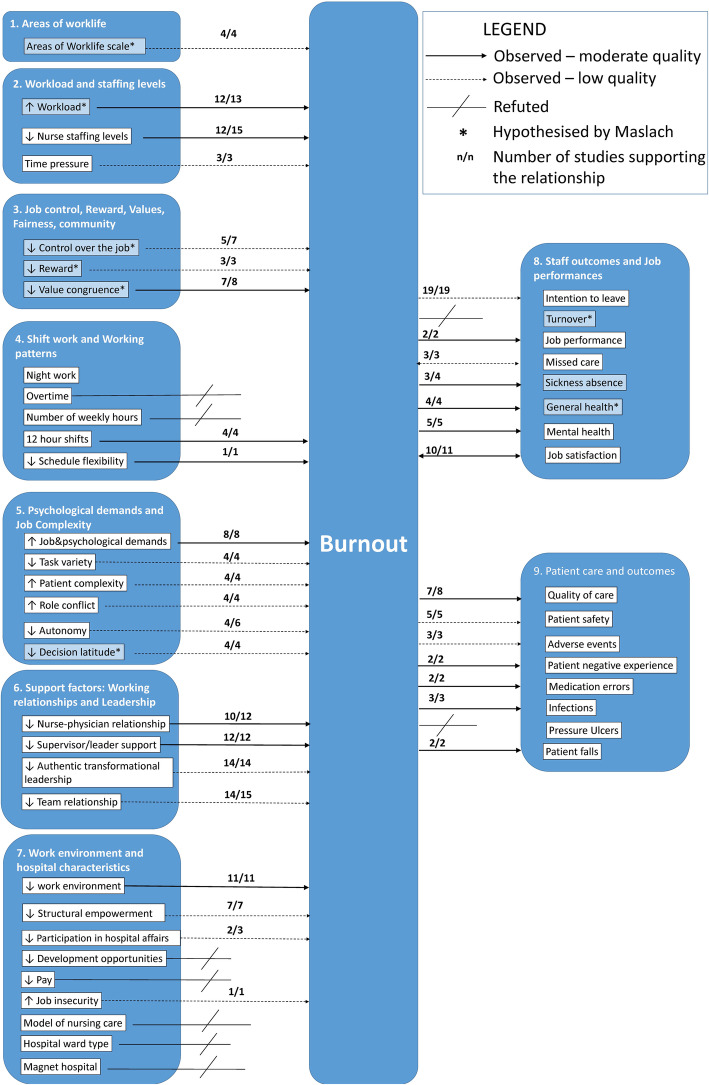
BACKGROUND: Workforce studies often identify burnout as a nursing 'outcome'. Yet, burnout itself-what constitutes it, what factors contribute to its development, and what the wider consequences are for individuals, organisations, or their patients-is rarely made explicit. We aimed to provide a comprehensive summary of research that examines theorised relationships between burnout and other variables, in order to determine what is known (and not known) about the causes and consequences of burnout in nursing, and how this relates to theories of burnout. METHODS: We searched MEDLINE, CINAHL, and PsycINFO. We included quantitative primary empirical studies (published in English) which examined associations between burnout and work-related factors in the nursing workforce. RESULTS: Ninety-one papers were identified. The majority (n = 87) were cross-sectional studies; 39 studies used all three subscales of the Maslach Burnout Inventory (MBI) Scale to measure burnout. As hypothesised by Maslach, we identified high workload, value incongruence, low control over the job, low decision latitude, poor social climate/social support, and low rewards as predictors of burnout. Maslach suggested that turnover, sickness absence, and general health were effects of burnout; however, we identified relationships only with general health and sickness absence. Other factors that were classified as predictors of burnout in the nursing literature were low/inadequate nurse staffing levels, ≥ 12-h shifts, low schedule flexibility, time pressure, high job and psychological demands, low task variety, role conflict, low autonomy, negative nurse-physician relationship, poor supervisor/leader support, poor leadership, negative team relationship, and job insecurity. Among the outcomes of burnout, we found reduced job performance, poor quality of care, poor patient safety, adverse events, patient negative experience, medication errors, infections, patient falls, and intention to leave. CONCLUSIONS: The patterns identified by these studies consistently show that adverse job characteristics-high workload, low staffing levels, long shifts, and low control-are associated with burnout in nursing. The potential consequences for staff and patients are severe. The literature on burnout in nursing partly supports Maslach's theory, but some areas are insufficiently tested, in particular, the association between burnout and turnover, and relationships were found for some MBI dimensions only.
Overview
CoChat Summary
TL;DR
This theoretical review of 91 quantitative studies found adverse job characteristics—high workload, low staffing levels, long shifts, and low control—are consistently associated with burnout in nursing, with severe potential consequences for staff and patients. The literature partly supports Maslach’s theory, but incomplete burnout measurement and mostly cross-sectional designs limit causal inference.
Key findings
- Across 91 studies, high workload was supported in 12/13 studies, low/inadequate nurse staffing in 12/15, ≥12-h shifts in 4/4, low control over the job in 5/7, low reward in 3/3, low value congruence in 7/8, low decision latitude in 4/4, poor supervisor/leader support in 12/12, negative team relationship in 14/15, and intention to leave in 19/19.
- Burnout was associated with reduced job performance (2/2), poor quality of care (7/8), poor patient safety (5/5), adverse events (3/3), medication errors (2/2), infections (3/3), and patient falls (2/2); no association was found with pressure ulcers. Turnover was refuted despite being hypothesised by Maslach, with only one small study finding Depersonalisation associated with turnover within 2 years.
- Most studies used the Maslach Burnout Inventory (n = 81), but only 39 (47%) measured and reported all three MBI subscales; 23 used Emotional Exhaustion only, 11 used Emotional Exhaustion and Depersonalisation, and 9 summed the three subscales despite advice against this. Maslach’s hypothesised predictors were generally supported, but often only for some MBI dimensions.
Methods
- Theoretical review conducted according to Campbell et al. and Pare et al.; systematic search of MEDLINE, CINAHL, and PsycINFO in May 2019 for English quantitative primary empirical studies examining associations between burnout and work-related factors or outcomes in nurses or nursing assistants in healthcare settings. Studies focused exclusively on personal factors, only comparing burnout levels across settings, or literature reviews, commentaries, and editorials were excluded.
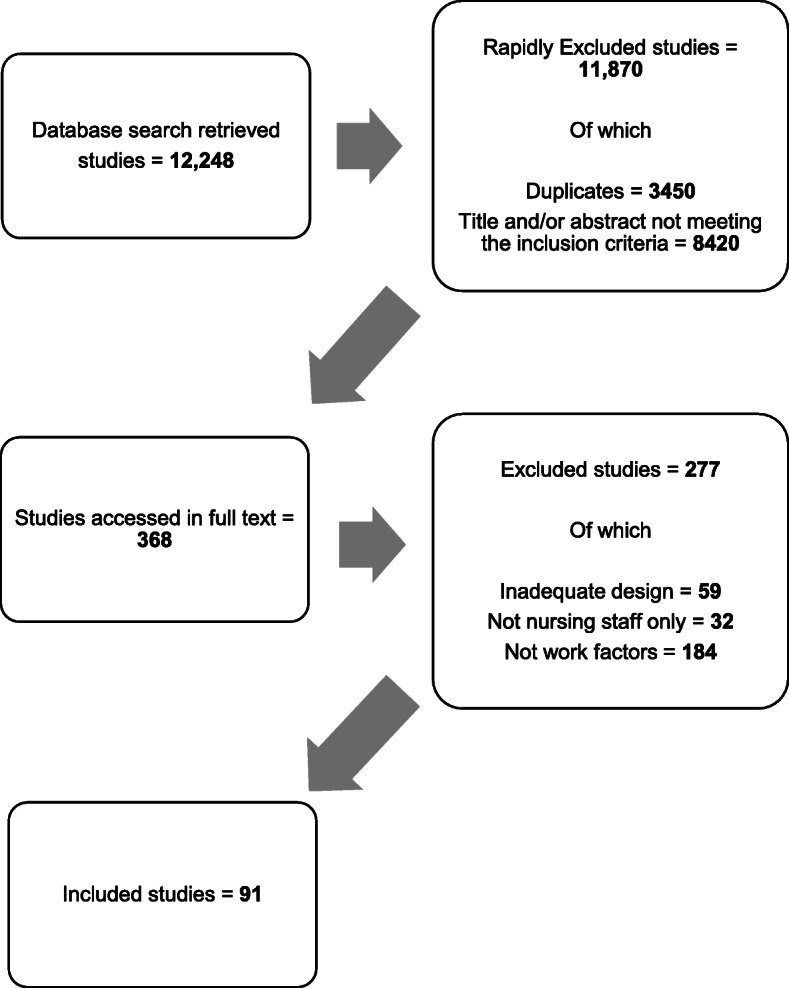
- The search yielded 12,248 records; 368 full texts were accessed, and 91 studies were included. Data were extracted on country, setting, sample size, staff group, burnout measure, variables tested, and findings; a coding frame starting from Maslach’s multidimensional theory produced nine broad categories. No formal quality appraisal was performed, but key quality aspects were summarised.
Limitations
- Stated by the authors: no formal quality appraisal instrument was applied; studies were reported without context or estimates such as ORs and 95% CIs; personality and other individual variables were not considered in data extraction; and studies indexed elsewhere or grey literature may have been missed.
- Evident from the text: 87/91 studies (97%) were cross-sectional, limiting temporal and causal inference and creating simultaneity bias, with factors such as missed care, job satisfaction, and mental health treated as both predictors and outcomes. Incomplete MBI measurement—only 39/91 studies used all three subscales, and 9 summed subscales—further limits testing of Maslach’s theory.
Model-written summary. Check it against the paper before relying on it.
Integrity signals
Registry
Cites
Statistics
Figures
Verification
Claims the paper makes
24 Valid · 3 Not valid · 199 Not checked · 100 Own results and interpretations
The sources with a verdict support this claim; the rest weren’t checked yet, have no full text we could read, or their verdicts aren’t rated yet.
In the paper
“high psychological demands were associated with higher odds of Emotional Exhaustion [62, 78]”
§ Burnout in nursing: a theoretical review > Results > Psychological demands and job complexity
What the sources say
- Supportedcites [62] Vidotti V Ribeiro RP Galdino MJQ Martins JT Burnout syndrome and shift work among the nursing staff Rev Lat Am Enfermagem 2018 26 e3022 30110099 PMC6091368 source
The Method section identifies psychological demands as a dimension of the Demand-Control-Support Questionnaire. In Results, Table 3 reports that high demand was associated with higher odds of emotional exhaustion among day-shift nursing staff (adjusted OR 2.50, 95% CI 1.44–4.35). The reported association is specific to the day shift. (LLM, conf=0.91)
- Not checked — no full text of the sourcecites [78] Bourbonnais R Comeau M Vezina M Dion G Job strain, psychological distress, and burnout in nurses Am J Ind Med 1998 34 1 20 28 9617384 doi:10.1002/(sici)1097-0274(199807)34:1
plainstates an association- Asserted: passes — The authors put it forward as true.
- Checkable: passes — It can be checked against evidence.
- Load-bearing: passes — The paper’s conclusions depend on it.
- Based: passes — The paper gives a reason why it holds.
- Supported
The cited sources support only part of this claim — read each source’s verdict below.
In the paper
“and Emotional Exhaustion and Personal Accomplishment [50]”
§ Burnout in nursing: a theoretical review > Results > Working relationships and leadership
What the sources say
- Partly supportedcites [50] Hanrahan NP Aiken LH McClaine L Hanlon AL Relationship between psychiatric nurse work environments and nurse burnout in acute care general hospitals Issues Ment Health Nurs 2010 31 3 198 207 20144031 PMC2856615 sourceExperimental — accuracy not yet measured
The Discussion (‘Strong Mangers and Leaders’) reports a significant relationship between manager skill and emotional exhaustion. The Results state that none of the work-environment factors, including manager skill, were associated with personal accomplishment in the adjusted or unadjusted models. The claim is therefore supported for emotional exhaustion but not personal accomplishment. (LLM, conf=0.92)
plainstates an association- Asserted: passes — The authors put it forward as true.
- Checkable: passes — It can be checked against evidence.
- Load-bearing: unclear — It is unclear whether the paper’s conclusions depend on it.
- Based: passes — The paper gives a reason why it holds.
- Partly supported
Every source the paper cites for this claim was checked and supports it.
In the paper
“The inability to establish a temporal link means limits the inference of causality [115].”
§ Burnout in nursing: a theoretical review > Discussion
What the sources say
- Supportedcites [115] Antonakis J Bendahan S Jacquart P Lalive R On making causal claims: a review and recommendations Leadersh Q 2010 21 6 1086 1120 source
Section 1, “What is Causality?”, lists temporal precedence as a condition for measuring a causal effect and explicitly calls temporal ordering necessary but not sufficient. Thus, inability to establish temporal order limits causal inference. (LLM, conf=0.93)
plain- Asserted: passes — The authors put it forward as true.
- Checkable: passes — It can be checked against evidence.
- Load-bearing: passes — The paper’s conclusions depend on it.
- Based: passes — The paper gives a reason why it holds.
- Supported
The sources with a verdict support this claim; the rest weren’t checked yet, have no full text we could read, or their verdicts aren’t rated yet.
In the paper
“| Night work | | | √ | |”
- Also stated in: § Working patterns and shift work · plain
“Working night shifts was associated with burnout (composite score) [68] and Emotional Exhaustion [62], but the relationship was not significant in two studies [69, 70].”
§ Burnout in nursing: a theoretical review > Results
What the sources say
- Not checked — no full text of the sourcecites [68] Anwar MM Elareed HR Burnout among Egyptian nurses Journal of Public Health-Heidelberg 2017 25 6 693 697 source
- Supportedcites [62] Vidotti V Ribeiro RP Galdino MJQ Martins JT Burnout syndrome and shift work among the nursing staff Rev Lat Am Enfermagem 2018 26 e3022 30110099 PMC6091368 source
The Results (Table 2) show that the relationship between work shift and burnout differs across dimensions: emotional exhaustion and professional realization differ significantly by shift, while depersonalization does not. The Discussion also reports higher overall burnout levels among day-shift than night-shift nursing staff. This supports the claim that night work is not consistently associated with burnout. (LLM, conf=0.86)
- Not checked — no full text of the sourcecites [69] Wisetborisut A Angkurawaranon C Jiraporncharoen W Uaphanthasath R Wiwatanadate P Shift work and burnout among health care workers Occup Med (Lond) 2014 64 4 279 286 24550196 source
- Not checked — no full text of the sourcecites [70] Ilhan MN Durukan E Taner E Maral I Bumin MA Burnout and its correlates among nursing staff: questionnaire survey J Adv Nurs 2008 61 1 100 106 18034813 source
plain- Asserted: passes — The authors put it forward as true.
- Checkable: passes — It can be checked against evidence.
- Load-bearing: unclear — It is unclear whether the paper’s conclusions depend on it.
- Based: passes — The paper gives a reason why it holds.
- Also stated in: § Working patterns and shift work · plain
Every source the paper cites for this claim was checked and supports it.
In the paper
“Long shifts of 12 h or more were associated with all MBI subscales [74]”
§ Burnout in nursing: a theoretical review > Results > Working patterns and shift work
What the sources say
- Supportedcites [74] Dall’Ora C Griffiths P Ball J Simon M Aiken LH Association of 12 h shifts and nurses’ job satisfaction, burnout and intention to leave: findings from a cross-sectional study of 12 European countries BMJ Open 2015 5 9 e008331 26359284 PMC4577950 source
The Measurements section identifies the three MBI subscales as emotional exhaustion, depersonalisation and personal accomplishment. The Discussion explicitly reports an association between shifts of 12 hours or more and all three subscales; the Shift length and nurse outcomes section reports the corresponding adjusted results. (LLM, conf=0.95)
plainstates an association- Asserted: passes — The authors put it forward as true.
- Checkable: passes — It can be checked against evidence.
- Load-bearing: passes — The paper’s conclusions depend on it.
- Based: passes — The paper gives a reason why it holds.
- Supported
201 more claims · 15 with their cited sources checked
Create a free account to see all 326 claims and to verify the 23 references still open.
- Probably not a substantial claim. 64
- It may state two separate claims as one. 72
- The quote only partly states this claim. 2
Claims other papers make about this one
Each is checked against this paper’s own text: does it say what the citing paper says it does?
The source backs part of the claim, not all of it — or backs it for a different population, condition or comparison.
In the citing paper
“Burnout among HPs is significantly associated with suicidal ideation [7], decreased job satisfaction [8], and increased turnover intention, ultimately resulting in a loss of HPs and deterioration in the quality of care, which is also negatively affected, as is patient safety and health status [9,10,11].”
From Effects of Third-Wave Cognitive Behavioral Therapy for Healthcare Professionals’ Burnout: A Systematic Review and Meta-Analysis (2025) · cites this paper as [9]
Experimental — accuracy not yet measuredThe source backs part of the claim, not all of it — or backs it for a different population, condition or comparison.
In the citing paper
“Reducing EE and DP may also contribute to improved workforce retention and lower absenteeism, ultimately benefiting healthcare providers and enhancing patient safety and care quality [9,10,11].”
From Effects of Third-Wave Cognitive Behavioral Therapy for Healthcare Professionals’ Burnout: A Systematic Review and Meta-Analysis (2025) · cites this paper as [9]
Experimental — accuracy not yet measuredThe cited source says what the claim attributes to it.
In the citing paper
“Last but not the least, some other organizational factors may also affect burnout, such as excessive workload, time pressure, high job demands, low rewards, low job autonomy, or negative team atmosphere [13].”
From The efficacy of applying the Interpersonal Effectiveness skills of dialectical behavior therapy into communication skills workshop for clinical nurses (2023) · cites this paper as [13]
Self-check
Percentages, sums and reported differences re-computed from the paper’s own numbers.
Each contradiction between two passages listed here was confirmed by an independent check.
Rated minor: it would not touch a result — a value no result rests on, a p-value that stays on the same side of the significance level, or a conflict that is clerical, resolved elsewhere in the paper, or outside its own findings.
In the paper
“The database search yielded 12 248 studies, of which 11 870 were rapidly excluded as either duplicates or titles and/or abstract not meeting the inclusion criteria. Of the 368 studies accessed in full text, 277 were excluded, and 91 studies were included in the review.”
§ Burnout in nursing: a theoretical review > Results
Reported 368 · recomputed 378
Rated minor: it would not touch a result — a value no result rests on, a p-value that stays on the same side of the significance level, or a conflict that is clerical, resolved elsewhere in the paper, or outside its own findings.
In the paper
§ Burnout in nursing: a theoretical review > Results
“| Overtime | | | √ | |”
§ Burnout in nursing: a theoretical review > Results > Working patterns and shift work
“One study found working that overtime was associated with composite MBI score [73].”
Rated minor: it would not touch a result — a value no result rests on, a p-value that stays on the same side of the significance level, or a conflict that is clerical, resolved elsewhere in the paper, or outside its own findings.
In the paper
“Most studies used the Maslach Burnout Inventory Scale (n = 81), which comprises three subscales reflecting the theoretical model: Emotional Exhaustion, Depersonalisation, and reduced Personal Accomplishment. However, less than half (47%, n = 39) of the papers measured and reported results with all three subscales.”
§ Burnout in nursing: a theoretical review > Results > Measures of burnout
Reported 47 · recomputed 48.148148
Citations
Cites
The measurement of experienced burnout
Maslach, C., & Jackson, S. E. (1981) · Journal of Organizational Behavior · doi:10.1002/job.4030020205 · Cited by 14,496
The job demands-resources model of burnout.
Demerouti, E., Bakker, A. B., Nachreiner, F., & Schaufeli, W. B. (2001) · Journal of Applied Psychology · doi:10.1037/0021-9010.86.3.499 · Cited by 13,643
Maslach, C., Schaufeli, W. B., & Leiter, M. P. (2001) · Annual Review of Psychology · doi:10.1146/annurev.psych.52.1.397 · Cited by 12,852
(1996) · Consulting Psychologists Press eBooks · Cited by 7,863
Freudenberger, H. J. (1974) · Journal of Social Issues · doi:10.1111/j.1540-4560.1974.tb00706.x · Cited by 5,463
Hospital Nurse Staffing and Patient Mortality, Nurse Burnout, and Job Dissatisfaction
Aiken, L. H. (2002) · JAMA · doi:10.1001/jama.288.16.1987 · Cited by 5,226
The Copenhagen Burnout Inventory: A new tool for the assessment of burnout
Kristensen, T. S., Borritz, M., Villadsen, E., & Christensen, K. B. (2005) · Work & Stress · doi:10.1080/02678370500297720 · Cited by 3,136
On making causal claims: A review and recommendations
Antonakis, J., Bendahan, S., Jacquart, P., & Lalive, R. (2010) · The Leadership Quarterly · doi:10.1016/j.leaqua.2010.10.010 · Cited by 2,441
Synthesizing information systems knowledge: A typology of literature reviews
Paré, G., Trudel, M.-C., Jaana, M., & Kitsiou, S. (2015) · Information & Management · doi:10.1016/j.im.2014.08.008 · Cited by 1,987
Burnout: 35 years of research and practice.
Schaufeli, W. B., Leiter, M. P., & Maslach, C. (2009) · Career Development International · doi:10.1108/13620430910966406 · Cited by 1,964
Research works printed but not linked: 4
- Ekstedt M Burnout and sleep: Institutionen för folkhälsovetenskap/Department of Public Health Sciences 2005
- Cherniss C Burnout in new professionals: a long-term follow-up study J Health Hum Resour Adm 1989 12 1 11 24
- Adali E Priami M Evagelou H Mougia V Ifanti M Alevizopoulos G Burnout in psychiatric nursing personnel in Greek hospitals European Journal of Psychiatry 2003 17 3 173 181
- Laschinger HKS Shamian J Thomson D Impact of magnet hospital characteristics on nurses’ perceptions of trust, burnout, quality of care, and work satisfaction Nurs Econ 2001 19 5 209 219
Cited by
Items 1,001–1,100 of 1,160
Tan, G., & Chao, J. (2026) · Behavioral Sciences · doi:10.3390/bs16030419
High prevalence and predictive modeling of compassion fatigue in geriatric nursing practice
Wang, J., Xiao, L., & Li, Z. (2026) · BMC Geriatrics · doi:10.1186/s12877-026-07223-1 · Cited by 1
“This could be attributed to the higher patient acuity and critical care demands typically characteristic of tertiary settings, which are well-documented contributors to nursing workload and stress [14, 15].”
Goliroshan, S., Nobahar, M., Raeisdana, N., et al. (2021) · Figshare · doi:10.6084/m9.figshare.16834990
Additional file 1 of The item network and domain network of burnout in Chinese nurses
Wu, L., Ren, L., Wang, Y., Zhang, K., Fang, P., Liu, X., Yang, Q., Wang, X., Wu, S., & Peng, J. (2021) · Figshare · doi:10.6084/m9.figshare.15184658
Kohnen, D., De Witte, H., Schaufeli, W. B., Dello, S. A. G., Bruyneel, L., & Sermeus, W. (2024) · Figshare · doi:10.6084/m9.figshare.25001637
Delafontaine, A.-C., Anders, R., Mathieu, B., Salathé, C. R., & Putois, B. (2024) · Figshare · doi:10.6084/m9.figshare.25414812
Scheepers, R. A., van den Broek, T., Cramm, J. M., Finkenflügel, H., & Nieboer, A. P. (2024) · Figshare · doi:10.6084/m9.figshare.26607229
Roth, C., Berger, S. J., Krug, K., Mahler, C., & Wensing, M. (2021) · Figshare · doi:10.6084/m9.figshare.14603078
Lucchi, E., Milder, M., Dardenne, A., et al. (2024) · Figshare · doi:10.6084/m9.figshare.26604988
Shin, S.-H., & Lee, E.-H. (2024) · Figshare · doi:10.6084/m9.figshare.26666707
Lucchi, E., Milder, M., Dardenne, A., et al. (2024) · Figshare · doi:10.6084/m9.figshare.26604985
Additional file 1 of Mental health and job stress of nurses in surgical system: what should we care
Wei, L., Guo, Z., Zhang, X., Niu, Y., Wang, X., Ma, L., Luo, M., & Lu, B. (2023) · Figshare · doi:10.6084/m9.figshare.24630237
Vpliv komunikacije v organizaciji na izgorelost zaposlenih v javni zdravstveni ustanovi
Žnidaršič, J., & Bernik, M. (2026) · International Conference on Organizational Science Development · doi:10.18690/um.fov.3.2026.67
THE IMPACT OF DIFFICULT PATIENTS ON HEALTHCARE WORKERS' PERFORMANCE
Büyükaslan, H., Eriş, H., & EKİNCİ, N. (2026) · Hacettepe sağlık idaresi dergisi · doi:10.61859/hacettepesid.1751961
Más allá de las condiciones laborales: la multidimensionalidad del Burnout en enfermería
Gamboa-Olivares, M., Orozco-Briceño, G., Estela-Vasquez, E. F., Sanchez-Gomez, S. M., & Chavarri-Chavarry, R. D. P. (2025) · Revista del Cuerpo Médico Hospital Nacional Almanzor Aguinaga Asenjo · doi:10.35434/rcmhnaaa.2025.182.2824
Stress Levels Among Primary Health Care Workers in Almaty, Kazakhstan: A Cross-Sectional Study
Qumar, A. B., Kuttybayev, A., Kulimbet, M., et al. (2026) · International Journal of Environmental Research and Public Health · doi:10.3390/ijerph23030403
Peng, Y., Zhao, Q., He, X., Yang, Y., Wang, L., Ma, L., Lu, R., Xie, C., & Wang, Y. (2026) · BMC Nursing · doi:10.1186/s12912-026-04547-6
“Compared with nurse managers, staff nurses were more likely to belong to the “low fatigue-stable group”, possibly due to reduced decision-making pressure and less exposure to organizational complexity [42].”
Tomé, F. J. B. (2026) · Enfermería Intensiva · doi:10.1016/j.enfi.2026.500597
Gece Vardiyasında Çalışan Hemşirelerde Mental İş Yükü ile Çalışma Ortamı Arasındaki İlişki
Tuğrul, E. (2026) · Doğu Karadeniz Sağlık Bilimleri Dergisi · doi:10.59312/ebshealth.1754434
Chen, C., Chen, X., Zhang, H., Lan, L., Zhong, L., Dai, M., & Yu, C. (2026) · Frontiers in Public Health · doi:10.3389/fpubh.2026.1791032 · Cited by 1
“Furthermore, burnout impairs nurses’ job performance, increasing the likelihood of errors and adverse events (8, 9).”
Brandeggen, T., Bodsberg, K. G., Ulfsby, K. J., Jensen, T. L., & Urstad, K. H. (2026) · The Journal of Continuing Education in Nursing · doi:10.3928/00220124-20251209-04
Gómez-Ramos, J. J., Pérez-Ruíz, M. E., Dávalos‐Rodríguez, I. P., Mata-Villafan, B. A., Antón-García, J. J., Flores-Jiménez, N. M., & Marín-Medina, A. (2026) · Nursing Reports · doi:10.3390/nursrep16040123 · Cited by 1
“These dimensions constitute the core components of burnout [6,7].”
Lucas, G. (2022) · theses.fr (ABES) · doi:10.70675/19160778z397bz44b1z95eez2e1ff852cc23 · Cited by 1
Bian, X. J., Gao, S. Y., Zhang, S. Q., Xue, F., Liu, F. L., & Chen, S. F. (2026) · Frontiers in Public Health · doi:10.3389/fpubh.2026.1775808 · Cited by 1
“It negatively impacts work behavior and attitudes, leading to reduced efficiency and diminished coping capacity, which in turn adversely affects nursing quality and patient safety (7, 8).”
Hadi, M., Rohita, T., Hasanah, I., Yen, M., Yoong, T. L., & Natashia, D. (2026) · SAGE Open Nursing · doi:10.1177/23779608261436807 · Cited by 2
“For instance, research across OECD countries and WHO data highlight burnout as a critical global issue (Dall ’ Ora et al., 2020; Li et al., 2022).”
On Being Someone Else to Become Oneself : towards a Theory of Distal Identities.
Eger, B. C. (2024) · theses.fr (ABES) · doi:10.70675/87016511z516fz4869zad71z5c38408ad8bc
Organizational determinants of missed nursing care in surgical
Şişman, H., Yurtseven, Ş., Alptekin, D., & Gezer, D. (2026) · Irish Journal of Medical Science (1971 -) · doi:10.1007/s11845-026-04306-1
Burnout and Psychological Resilience in Healthcare Professionals: A Protective Psychosocial Resource
Ulutaşdemi, N., & Günaydı, N. (2026) · IntechOpen eBooks · doi:10.5772/intechopen.1014960 · Cited by 2
Psychosocial health risks among nursing staff working in shifts
Rachubińska, K., Kupcewicz, E., Cybulska, A. M., Stępień, H., Grochans, E., & Schneider-Matyka, D. (2026) · Frontiers in Public Health · doi:10.3389/fpubh.2026.1749277 · Cited by 3
“By demonstrating the interrelated nature of these psychosocial risks and identifying sociodemographic and work-related factors associated with their severity, the findings extend current knowledge beyond studies examining single outcomes in isolation (59, 60).”
Roles and responsibilities of government chief nursing and midwifery officers in the Americas
Dias, B. M., Salma, J., Cooper, S. R., Murillo, N. A. H., Henry, P. E., Vásquez, S. A., Bolastig, E. V. C., Puertas, E. B., & Sealy, W. (2026) · Revista Panamericana de Salud Pública · doi:10.26633/rpsp.2026.34
“…health would align with the goals of establishing universal health coverage, advance the priorities of nursing and midwifery, and foster innovation and leadership, while addressing occupational risks, such as long shifts, irregular schedules, physical strain, stress and workplace violence (16–18).”
Factores de riesgo psicosocial en la categoría de enfermería de un hospital privado
Pousa, P. C. P., Rodrigues, C. A., & de Lucca, S. R. (2026) · Saúde em Debate · doi:10.1590/2358-2898202614810799e
Psychosocial risk factors in the nursin category of a private hospital
Pousa, P. C. P., Rodrigues, C. A., & de Lucca, S. R. (2026) · Saúde em Debate · doi:10.1590/2358-2898202614810799i · Cited by 1
Fatores de risco psicossociais na categoria de enfermagem de um hospital privado
Pousa, P. C. P., Rodrigues, C. A., & de Lucca, S. R. (2026) · Saúde em Debate · doi:10.1590/2358-2898202614810799p · Cited by 1
Aung, K. T., Salman, S. S., Tarmuzi, M. D. A., & Fadhli, M. F. I. M. F. @. (2026) · International Journal of Modern Trends in Social Sciences · doi:10.35631/ijmtss.933002
Liu, J., Dou, L., Peng, H., Yang, X., Zhang, Z., Luo, J., Xu, M., & WU, M. (2026) · BMC Nursing · doi:10.1186/s12912-026-04681-1 · Cited by 1
“Numerous studies have identified burnout as a key contributor to elevated nurse turnover intentions and reduced workforce stability [9, 10].”
InfluentialTapawan, A. M. K., Silang, J. P. B., Vallesteros, L. T., Jesus, D. H. D., Fabros, M., Rosa, R. D., Tomy, J., Ibrahem, R. A. S., & Lenjawi, B. A. (2026) · Belitung Nursing Journal · doi:10.33546/bnj.4386 · Cited by 1
“…pressures and work intensity to emotional exhaustion and with studies demonstrating the complex interplay of leadership demands, job resources, and burnout in nursing roles, consistent with job demands – resources perspectives ( Chi et al., 2025 ; Dall’Ora et al., 2020 ; Jiaqing et al., 2025 ).”
Alabdalhai, S. A., Kerari, A., & Ghulman, S. (2026) · Healthcare · doi:10.3390/healthcare14091188
“Nurses’ well-being is influenced by both their personal health status and the demands of caregiving roles [9,13].”
Huang, D., Zhang, L., Lu, S., Qin, J., Zhou, C., Tao, P., Pan, X., Zhang, G., Wei, J., Li, C., et al. (2026) · Frontiers in Public Health · doi:10.3389/fpubh.2026.1793432
Min, X., Kaneko, H., Takahama, T., Shono, Y., Tanaka, Y., & Inoue, S. (2026) · Healthcare · doi:10.3390/healthcare14091208 · Cited by 1
“Caregiving professions are widely recognized as emotionally demanding and vulnerable to burnout [33].”
Kwakye, I. N., Adom-Fynn, D., Roberts, C. O., Antwi, A. O., Opoku-Mensah, K., Vondee, S. E., & Kugbey, N. (2026) · BMC Nursing · doi:10.1186/s12912-026-04714-9
“…associated with higher distress scores, suggesting that the dual obligations of domestic and professional responsibilities may compound occupational stress in this cultural setting, contrasting with evidence from some higher-income contexts where marriage may serve a protective function [5, 6].”
Naranjo-Alban, J. F., Veliz-Alvarez, A. E., & Mora, G. D. P. C. (2026) · Innova Science Journal · doi:10.63618/omd/isj/v4/n2/305 · Cited by 2
Mlera, R. N., Munthali¹, M., Nyirenda¹, E., & Gundo, R. (2026) · Research Square · doi:10.21203/rs.3.rs-9119077/v1
Park, K., Lee, H., & Chu, H. S. (2026) · 한국생활환경학회지 · doi:10.21086/ksles.2026.4.33.2.188
Network analysis of burnout, depression, and insomnia among Iranian nurses
Kharatzadeh, H., Farahani, H., & Khorasani, P. (2026) · Journal of Workplace Behavioral Health · doi:10.1080/15555240.2026.2634139
“…a stressful work condition, which may contribute to burnout, reduced mental health and poor quality of life of nurses (Ananzeh & Miller, 2025; Boerner et al., 2017; Liu et al., 2019; Mosheva et al., 2021; Wlodarczyk & Lazarewicz, 2011; Dall’Ora et al., 2020; Yoon & Sok, 2016; Abbasi et al., 2019).”
Machine learning insights into nurse retention through job satisfaction and financial incentives
SARIDOĞAN, A. A., Küçükgergerli, N., Ertürk, M., et al. (2026) · Frontiers in Psychology · doi:10.3389/fpsyg.2026.1796483
Gynning, B. E., Brulin, E., Karlsson, E., Gustavsson, P., Christiansen, F., & Teoh, K. (2026) · International Journal of Nursing Studies · doi:10.1016/j.ijnurstu.2026.105554 · Cited by 4
Zadjali, A. M. A., Chen, Y. Y., Chew, K. S., et al. (2026) · Research Square · doi:10.21203/rs.3.rs-9341254/v1
Foundations of Retention: Influencing Organizational Factors for Employee Commitment
Gupta, S., & Panda, S. (2026) · IGI Global eBooks · doi:10.4018/979-8-3373-2287-2.ch001
Bella, V. D., Fiorini, J., & Sili, A. (2026) · Healthcare · doi:10.3390/healthcare14101350
“These conditions have been consistently associated with adverse outcomes, including burnout, stress, and reduced quality of care [9,12].”
InfluentialFostering Resilience Among Nurses: The Impact of Organisational Resources on Work Engagement
Staniškienė, E., Stankevičiūtė, Ž., Daunorienė, A., & Ramanauskaitė, J. (2026) · Sustainability · doi:10.3390/su18104855 · Cited by 2
Zhang, C., Li, Y., Nan, J., et al. (2026) · International Journal of Nursing Studies · doi:10.1016/j.ijnurstu.2026.105569
Chant, K., Nishimura, Y., Petrie, A., et al. (2026) · Intensive and Critical Care Nursing · doi:10.1016/j.iccn.2026.104439
Yi, W., Ma, Q., Liu, H., & Fang, R. (2026) · Frontiers in Public Health · doi:10.3389/fpubh.2026.1835397 · Cited by 1
“Establishing non-punitive reporting mechanisms during system updates encourages all healthcare professionals to voice technical obstacles rather than conceal errors—alleviating psychological burden and buffering the cynicism associated with job burnout (49).”
Keimol, C. R., Hammad, K., & Fanai, S. (2026) · The Open Nursing Journal · doi:10.2174/0118744346438424260515095052
Havaei, F., Song, C., Zou, D., Ben-Ahmed, H. E., Bookey‐Bassett, S., Boamah, S. A., MacPhee, M., & Wu, A. (2026) · Canadian Journal of Nursing Research · doi:10.1177/08445621261446777 · Cited by 1
Jun, X., Li, S., & Dandan, M. (2026) · PLoS ONE · doi:10.1371/journal.pone.0348584
“Characterized by emotional exhaustion, depersonalization, and reduced personal accomplishment, burnout erodes nurses’ professional passion and life satisfaction [20].”
Zhang, J., Zhang, H., & Feng, X. (2026) · Journal of Pediatric Nursing · doi:10.1016/j.pedn.2026.05.023
Professional quality of life of hospital nurses: A cross-sectional study
Oldenmenger, W. H., Otte-Paul, A., & Brinkman‐Stoppelenburg, A. (2026) · International Journal of Nursing Studies Advances · doi:10.1016/j.ijnsa.2026.100586
Jiang, Z., Cao, L., Xie, C., Li, Y., Han, X., Yi, K., & Zhang, X. (2026) · Journal of Pediatric Nursing · doi:10.1016/j.pedn.2026.05.043 · Cited by 2
Badahdah, A. M., Khamis, F. A., Aloud, N., & Bahrani, K. A. (2026) · Psychiatric Quarterly · doi:10.1007/s11126-026-10294-3 · Cited by 1
Kowalczuk, K., Tomaszewska, K., Kadučáková, H., Krátká, A., Durejova, E., Majchrowicz, B., Sobolewski, M., & Hermanowicz, J. M. (2026) · Frontiers in Public Health · doi:10.3389/fpubh.2026.1804266 · Cited by 1
Job characteristics and work engagement: the moderating role of tenure in non profit organizations
Lopes, S., Cerdeira, D., Pais, L., & Rodrigues, A. (2026) · Management Research The Journal of the Iberoamerican Academy of Management · doi:10.1108/mrjiam-10-2025-1842
Zeng, Z., He, Y., Liao, X., & Zhou, S. (2026) · Frontiers in Public Health · doi:10.3389/fpubh.2026.1847595
Beyond the Wrist: Wearables as Reflective Infrastructure for Nurse Well-Being
Lintvedt, O., Pedersen, R., Esquivel, K. M., et al. (2026) · Communications in computer and information science · doi:10.1007/978-3-032-28829-5_12
Aslani, A., Gholamveisi, B., Kashefi, H., Khaninezhad, L., & Seidi, J. (2026) · Iranian Journal of Nursing and Midwifery Research · doi:10.4103/ijnmr.ijnmr_114_25
“[28,29] This 22‑item instrument evaluates three dimensions: emotional exhaustion (9 items), depersonalization (5 items), and personal accomplishment (8 items), using a 7‑point Likert scale ranging from 0 (never) to 6 (every day).”
Liu, X., Wang, H., Tian, S., Guo, X., & Cao, H. (2026) · International Journal of Nursing Studies · doi:10.1016/j.ijnurstu.2026.105622 · Cited by 2
Burnout among care aides in long-term care: a systematic review and meta-analysis
Wei, C., Chen, X., Tan, E., Zhao, L., Liu, T., Ma, D., & Su, Y. (2026) · The Gerontologist · doi:10.1093/geront/gnag138
Nurses’ job insecurity: A neglected challenge in the quality of patient care
Seyednazari, M. A., Ferdosi, R., Soheili, A., & Dorosti, A. M. (2026) · Journal of Translational Medical Research · doi:10.66224/jbums.32.4.350
Ramezani, F., rabani, F., Yaghoubi, F., et al. (2026) · Iranian Journal of Psychiatry and Behavioral Sciences · doi:10.5812/ijpbs-153649
PMH Nurse Wellbeing Is Vital to Organizational Resilience
Neal, A. M. (2026) · Journal of the American Psychiatric Nurses Association · doi:10.1177/10783903261456182
“We also may experience unsafe staffing patterns – patterns that result in nurse-patient ratios that make us uncomfortable due to an environment where patients are more complex and require a higher level of care (Berlin et al., 2023; Chen et al., 2025; Dall’Ora et al., 2020).”
Zhao, J., Wang, L., Zhao, Y., Gu, J., Wu, Y., Chen, J., & Meng, X. (2026) · Nursing Open · doi:10.1002/nop2.70555
DeJonghe, Y., Deschodt, M., Trybou, J., Clays, E., & Wynendaele, H. (2026) · BMC Geriatrics · doi:10.1186/s12877-026-07878-w
“Beyond unfinished care and poorer care quality, burnout has also been associated with poorer health and well-being, absenteeism and turn-over intentions, which may further increase the workload and time pressure, exacerbating the demanding effects of job stress [5, 17, 19, 20].”
Yan, Z., Duan, L., Zhang, Z., Zhang, S., Wang, G., & Zhang, W. (2026) · Frontiers in Psychology · doi:10.3389/fpsyg.2026.1817637
Barani, A. (2026) · QUADERNI DI ECONOMIA DEL LAVORO · doi:10.3280/qua2022-116005
Hipel, I., Keefe, J. M., Duynisveld, A., Song, Y., Duan, Y., Estabrooks, C. A., Norton, P., Packiam, P., & Squires, J. (2026) · International Journal of Nursing Studies Advances · doi:10.1016/j.ijnsa.2026.100614
“Low job satisfaction has been linked to higher levels of burnout, increased turnover intentions, and decreased quality of care (Al Sabei et al., 2020; Dall ’ Ora et al., 2020).”
InfluentialPereira-Sánchez, M., Salcedo, A. Z., Vázquez‐Calatayud, M., & Saracíbar‐Razquin, M. (2026) · Journal of Nursing Management · doi:10.1155/jonm/1787140 · Cited by 1
“Prior studies confrm that high workloads harm nurse well-being and patient outcomes [57, 58].”
Wang, T., Zhang, L., Chen, X., & Cao (2026) · Nurse Education Today · doi:10.1016/j.nedt.2026.107251
Prevention of Burnout in healthcare workers: Literature review
Srećković, M., Ninković, Ž., Malbaša, J. D., Jovanović, Z., Vasić, A., & Beljić, N. (2026) · Glasnik javnog zdravlja · doi:10.5937/serbjph2602219s
Tatchell, Q. N., Fernihough, M., & Lippi, G. (2026) · Journal of the Colleges of Medicine of South Africa · doi:10.4102/jcmsa.v4i1.323
“5,10,12 Empathy is closely linked to the practice of medicine and may both influence and be influenced by burnout.”
Ejheisheh, M. A., Ayed, A., Aqtam, I. F., Alhalaiqa, F., Batran, A., Hammad, B. M., Farajallah, M., Khair, R., & Shouli, M. M. (2026) · Work · doi:10.1177/10519815261467022
Experiences of Saudi Registered Nurses Transitioning to Non‐Nursing Careers: A Qualitative Study
Salvador, J. T., Almuqeet, B. A., Al-Taleb, B. A., Abu-Gurain, H. J., Algharbi, A. M., Al‐Mousa, A. A., AlMustafa, M. S., Alsaeed, H. S., Helabi, R. S., Almotawa, A. E., et al. (2026) · Nursing Forum · doi:10.1155/nuf/5538859
Understanding Pressure in Healthcare
Riemma, F. (2026) · Emerald Group Publishing Limited eBooks · doi:10.1108/978-1-80686-897-120261019
What Organisations Get Wrong (and Right) About Stress
Riemma, F. (2026) · Emerald Group Publishing Limited eBooks · doi:10.1108/978-1-80686-897-120261005
Listening to the Frontline: Stories of Pressure and Coping
Riemma, F. (2026) · Emerald Group Publishing Limited eBooks · doi:10.1108/978-1-80686-897-120261004
The Perfect Storm: Stress and Complexity in Healthcare
Riemma, F. (2026) · Emerald Group Publishing Limited eBooks · doi:10.1108/978-1-80686-897-120261002
Riemma, F. (2026) · Emerald Group Publishing Limited eBooks · doi:10.1108/978-1-80686-897-120261014
Riemma, F. (2026) · Emerald Group Publishing Limited eBooks · doi:10.1108/978-1-80686-897-120261022
Inside the Experience of Healthcare Professionals
(2026) · Emerald Group Publishing Limited eBooks · doi:10.1108/978-1-80686-897-120261020
Alrashedi, H., Alnomasy, N., Banappagoudar, S. B., & Hashish, E. A. A. (2026) · Nursing Reports · doi:10.3390/nursrep16070239 · Cited by 1
“It reflects the extent of tiredness, energy depletion and emotional exhaustion experienced by professionals regardless of the causes related to their work [27,28].”
He, Z., Xiao, Q., Li, M., Chen, Z., & Ma, H. (2026) · Healthcare · doi:10.3390/healthcare14142088
“These adverse experiences may precipitate burnout [32], reduce job satisfaction [33], and prompt nurse managers to occasionally or more seriously consider other job and career options [29], and even resignation [34].”
Feelings of Guilt, Stress, and Self‐Compassion Among Nursing Staff in the Workplace
Hackert, B., Lumma, A., Andreas, J., & Weger, U. (2026) · Research in Nursing & Health · doi:10.1002/nur.70102
Ullah, M. A., Ameeq, M., Rehman, D. K., Kanwal, S., Hassan, M. M., & Kargbo, A. U. (2026) · International Health · doi:10.1093/inthealth/ihag070 · Cited by 1
Rest shame among clinical nursing postgraduates: an interpretive qualitative studyPreprint
Fan, X.-R., Feng, J., & Huang, X. (2026) · Research Square · doi:10.21203/rs.3.rs-9567482/v1
GLOBAL RESEARCH TRENDS ON NURSE BURNOUT WITHIN HEALTHCARE SYSTEMS: A BIBLIOMETRIC ANALYSIS
Kiprawi, M. S., Bakar, N. A. A., Rahman, R. A. A., & Ismail, H. (2026) · International Journal of Entrepreneurship and Management Practices · doi:10.35631/ijepc.1163048
Dong, M., Xu, L., Chen, Y., Yang, Y., 谢琪, Li, M., Ma, R., & Li, Y. (2026) · Frontiers in Public Health · doi:10.3389/fpubh.2026.1810766
“A broader theoretical review has synthesized occupational and organizational contributors to burnout in nursing (69).”
Tshelani, P. D., Munyadziwa, M., & Makhado, L. (2026) · JMIR Research Protocols · doi:10.2196/87562
“While task shifting has achieved impressive public health gains, it has also expanded the scope of professional nurses’ clinical and emotional responsibilities [17,18].”
Bilodeau, G., Boily, L.-A., Gagnon, J. P., Trépanier, S., Austin, S., & Fernet, C. (2026) · Journal of Nursing Management · doi:10.1155/jonm/8888713
“It is particularly prevalent among healthcare professionals, especially nurses, who are frequently exposed to emotionally demanding situations and chronic stressors [3, 4].”
Crawford, C. L. (2026) · Holistic Nursing Practice · doi:10.1097/hnp.0000000000000801 · Cited by 1
Die strukturelle Notwendigkeit internationaler Pflegekräfte in Deutschland
Hradecky, D. M. (2026) · Springer eBooks · doi:10.1007/978-3-658-52053-3_2
Mazur, J., Kosowski, M., Marciniak, J., Chołuj, D., Zarówna, K., Pura, W., Matecka, D., & Śliwiński, W. (2026) · International Journal of Innovative Technologies in Social Science · doi:10.31435/ijitss.3(51).2026.6238
Metadata
- Authors
- Dall’Ora, C., Ball, J., Reinius, M., & Griffiths, P.
- Affiliations
- University of Southampton (GB)
- Karolinska Institutet (SE)
- Corresponding author
- Dall’Ora, Chiara
- Venue
- Human Resources for Health
- Published
- 2020-06-05
- Volume
- 18
- Issue
- 1
- Pages
- 41-41
- ISSN
- 1478-4491 (ISSN-L)
- PMC
- PMC7273381
- OpenAlex
- W3011614181
- Semantic Scholar
- 098822447985b9396227e70a60b862b2820cf43d
- Cited by
- 1,181
- References
- 115
- Citations by year
- 2026: 239 · 2025: 276 · 2024: 211 · 2023: 211 · 2022: 148 · 2021: 79 · 2020: 14
- FWCI
- 27.93
- Type
- journal article
- Language
- en
- Open access
- gold
- doi.org
- Licence
- cc-by
- creativecommons.org/licenses/by/4.0 (tdm)
- creativecommons.org/licenses/by/4.0 (vor)
- Locations
- Human Resources for Health (publishedVersion, cc-by)
- PubMed Central (publishedVersion, cc-by)
- PubMed (publishedVersion)
- ePrints Soton (University of Southampton) (acceptedVersion)
- DOAJ (DOAJ: Directory of Open Access Journals) (submittedVersion, cc-by-sa)
- Funders
- National Institute for Health and Care Research (NF-SI-0616-10068)
- Topics
- Health Sciences › Medicine › Public Health, Environmental and Occupational Health › Occupational Health and Burnout
- Social Sciences › Psychology › Social Psychology › Stress and Burnout Research
- Health Sciences › Health Professions › General Health Professions › Healthcare professionals’ stress and burnout
- Keywords
- burnout, nursing workforce, workload, nurse staffing, job control, shift length, role conflict, job insecurity, leadership, turnover, sick leave, patient safety, quality of care, nurse-physician relationship
- MeSH terms
- Burnout, Professional, Health Status, Humans, Internal-External Control, Job Satisfaction, Leadership, Nurses, Personnel Turnover, Quality of Health Care, Time Factors, Workload, Workplace, Sick Leave, Nurse's Role, Patient Safety
About these checks
Registry, retraction, Cites and statistics results are computed, not judged, with one exception: a printed reference that no index lists is read once by a model before it counts as a citation error. Claims are extracted by a model and kept only when their quote appears verbatim in the text; each cited source is then checked, with a model’s help, for whether it says what the claim relies on. Those verdicts can be wrong — read the claim’s quote and the cited source before relying on one.
The claim verdicts this report counts are experimental: their accuracy is not yet measured.
A language model drew the claims from the paper on 2026-10-10, under version 3 of the claim definition (model deepseek-v4.1-flash, prompt extract-v3).
A second model labelled each claim on 2026-10-10 (model jev-1.13-20260917, definition revision gold-guideline-v0.2).
Cited sources are checked with a language model’s help (gpt-6-sol).
Statistics and arithmetic are recomputed, not judged.
Confidence bands are shown only for fields calibrated on our annotated test set. None is calibrated yet, so no band is shown.
What counts as a claim ›How we measure confidence ›How we check this ›
Are you an author, or do you see a problem with this page? Request a review
Data sources
Bibliographic data: Semantic Scholar, OpenAlex, Crossref.
Contains information from the Semantic Scholar Academic Graph Datasets, made available under the ODC Attribution License (ODC-BY 1.0).
Semantic Scholar’s data is described in: Kinney, R., et al. (2023). The Semantic Scholar Open Data Platform. arXiv:2301.10140.
