

Burnout in nursing: a theoretical review.
Open accessThe DOI matches its Crossref record; 113 of the 115 references it cites were found in a registry or an index; 27 of the 261 sources its claims cite were checked for support.
Abstract
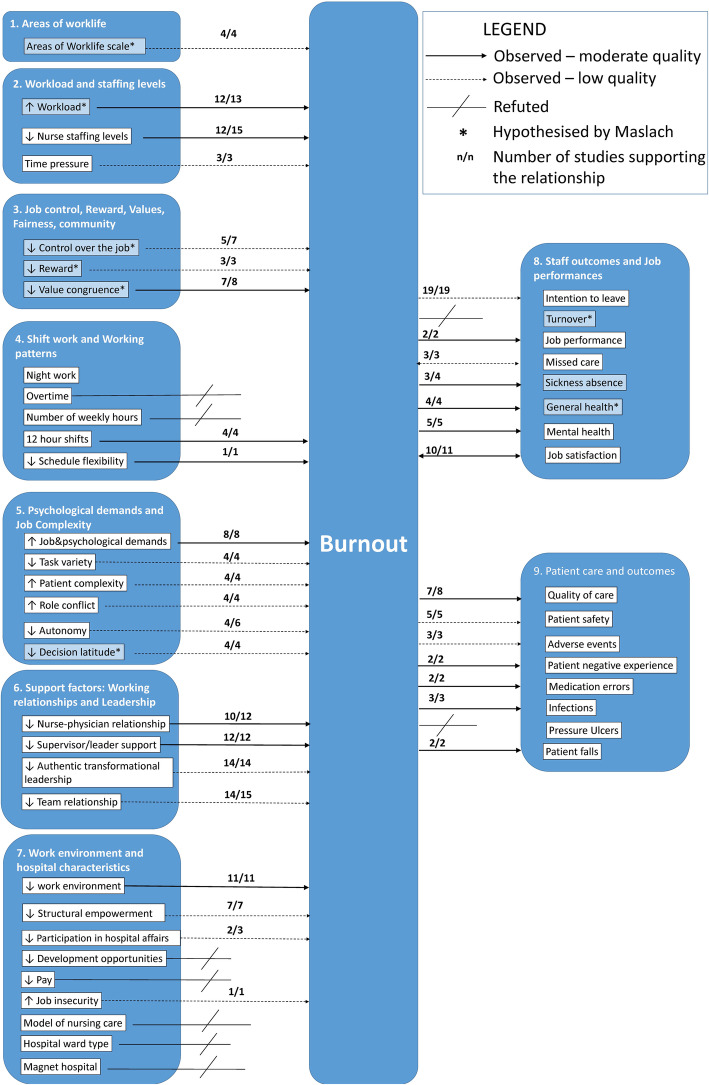
BACKGROUND: Workforce studies often identify burnout as a nursing 'outcome'. Yet, burnout itself-what constitutes it, what factors contribute to its development, and what the wider consequences are for individuals, organisations, or their patients-is rarely made explicit. We aimed to provide a comprehensive summary of research that examines theorised relationships between burnout and other variables, in order to determine what is known (and not known) about the causes and consequences of burnout in nursing, and how this relates to theories of burnout. METHODS: We searched MEDLINE, CINAHL, and PsycINFO. We included quantitative primary empirical studies (published in English) which examined associations between burnout and work-related factors in the nursing workforce. RESULTS: Ninety-one papers were identified. The majority (n = 87) were cross-sectional studies; 39 studies used all three subscales of the Maslach Burnout Inventory (MBI) Scale to measure burnout. As hypothesised by Maslach, we identified high workload, value incongruence, low control over the job, low decision latitude, poor social climate/social support, and low rewards as predictors of burnout. Maslach suggested that turnover, sickness absence, and general health were effects of burnout; however, we identified relationships only with general health and sickness absence. Other factors that were classified as predictors of burnout in the nursing literature were low/inadequate nurse staffing levels, ≥ 12-h shifts, low schedule flexibility, time pressure, high job and psychological demands, low task variety, role conflict, low autonomy, negative nurse-physician relationship, poor supervisor/leader support, poor leadership, negative team relationship, and job insecurity. Among the outcomes of burnout, we found reduced job performance, poor quality of care, poor patient safety, adverse events, patient negative experience, medication errors, infections, patient falls, and intention to leave. CONCLUSIONS: The patterns identified by these studies consistently show that adverse job characteristics-high workload, low staffing levels, long shifts, and low control-are associated with burnout in nursing. The potential consequences for staff and patients are severe. The literature on burnout in nursing partly supports Maslach's theory, but some areas are insufficiently tested, in particular, the association between burnout and turnover, and relationships were found for some MBI dimensions only.
Overview
CoChat Summary
TL;DR
This theoretical review of 91 quantitative studies found adverse job characteristics—high workload, low staffing levels, long shifts, and low control—are consistently associated with burnout in nursing, with severe potential consequences for staff and patients. The literature partly supports Maslach’s theory, but incomplete burnout measurement and mostly cross-sectional designs limit causal inference.
Key findings
- Across 91 studies, high workload was supported in 12/13 studies, low/inadequate nurse staffing in 12/15, ≥12-h shifts in 4/4, low control over the job in 5/7, low reward in 3/3, low value congruence in 7/8, low decision latitude in 4/4, poor supervisor/leader support in 12/12, negative team relationship in 14/15, and intention to leave in 19/19.
- Burnout was associated with reduced job performance (2/2), poor quality of care (7/8), poor patient safety (5/5), adverse events (3/3), medication errors (2/2), infections (3/3), and patient falls (2/2); no association was found with pressure ulcers. Turnover was refuted despite being hypothesised by Maslach, with only one small study finding Depersonalisation associated with turnover within 2 years.
- Most studies used the Maslach Burnout Inventory (n = 81), but only 39 (47%) measured and reported all three MBI subscales; 23 used Emotional Exhaustion only, 11 used Emotional Exhaustion and Depersonalisation, and 9 summed the three subscales despite advice against this. Maslach’s hypothesised predictors were generally supported, but often only for some MBI dimensions.
Methods
- Theoretical review conducted according to Campbell et al. and Pare et al.; systematic search of MEDLINE, CINAHL, and PsycINFO in May 2019 for English quantitative primary empirical studies examining associations between burnout and work-related factors or outcomes in nurses or nursing assistants in healthcare settings. Studies focused exclusively on personal factors, only comparing burnout levels across settings, or literature reviews, commentaries, and editorials were excluded.
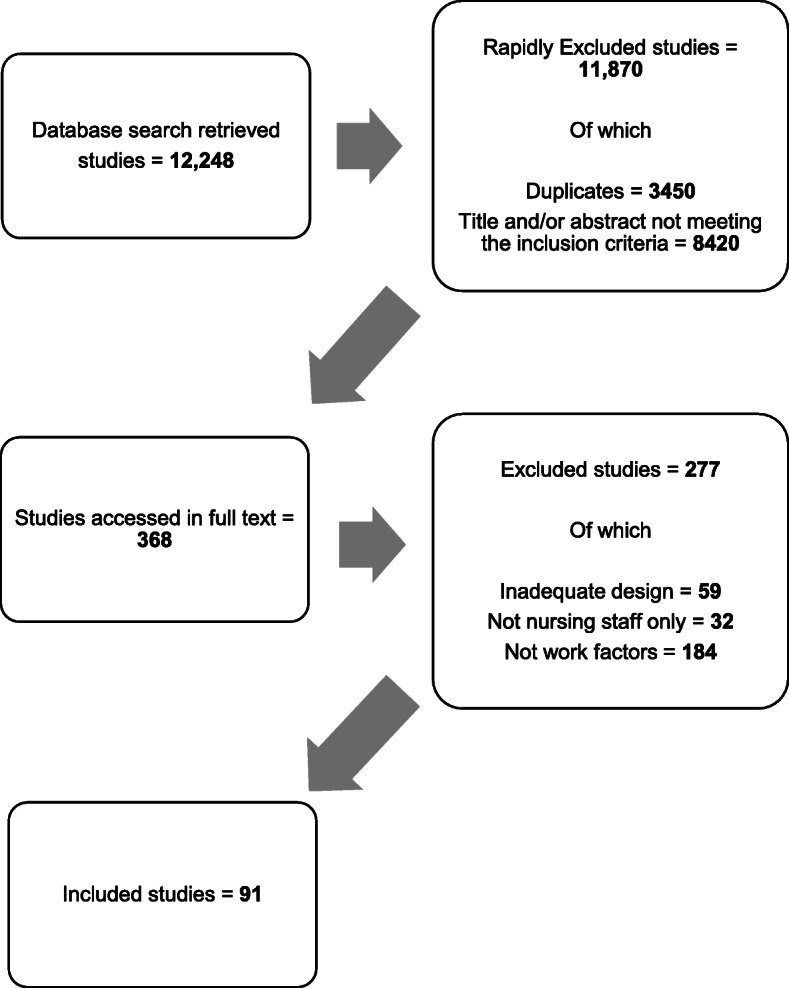
- The search yielded 12,248 records; 368 full texts were accessed, and 91 studies were included. Data were extracted on country, setting, sample size, staff group, burnout measure, variables tested, and findings; a coding frame starting from Maslach’s multidimensional theory produced nine broad categories. No formal quality appraisal was performed, but key quality aspects were summarised.
Limitations
- Stated by the authors: no formal quality appraisal instrument was applied; studies were reported without context or estimates such as ORs and 95% CIs; personality and other individual variables were not considered in data extraction; and studies indexed elsewhere or grey literature may have been missed.
- Evident from the text: 87/91 studies (97%) were cross-sectional, limiting temporal and causal inference and creating simultaneity bias, with factors such as missed care, job satisfaction, and mental health treated as both predictors and outcomes. Incomplete MBI measurement—only 39/91 studies used all three subscales, and 9 summed subscales—further limits testing of Maslach’s theory.
Model-written summary. Check it against the paper before relying on it.
Integrity signals
Registry
Cites
Statistics
Figures
Verification
Claims the paper makes
24 Valid · 3 Not valid · 199 Not checked · 100 Own results and interpretations
The sources with a verdict support this claim; the rest weren’t checked yet, have no full text we could read, or their verdicts aren’t rated yet.
In the paper
“high psychological demands were associated with higher odds of Emotional Exhaustion [62, 78]”
§ Burnout in nursing: a theoretical review > Results > Psychological demands and job complexity
What the sources say
- Supportedcites [62] Vidotti V Ribeiro RP Galdino MJQ Martins JT Burnout syndrome and shift work among the nursing staff Rev Lat Am Enfermagem 2018 26 e3022 30110099 PMC6091368 source
The Method section identifies psychological demands as a dimension of the Demand-Control-Support Questionnaire. In Results, Table 3 reports that high demand was associated with higher odds of emotional exhaustion among day-shift nursing staff (adjusted OR 2.50, 95% CI 1.44–4.35). The reported association is specific to the day shift. (LLM, conf=0.91)
- Not checked — no full text of the sourcecites [78] Bourbonnais R Comeau M Vezina M Dion G Job strain, psychological distress, and burnout in nurses Am J Ind Med 1998 34 1 20 28 9617384 doi:10.1002/(sici)1097-0274(199807)34:1
plainstates an association- Asserted: passes — The authors put it forward as true.
- Checkable: passes — It can be checked against evidence.
- Load-bearing: passes — The paper’s conclusions depend on it.
- Based: passes — The paper gives a reason why it holds.
- Supported
The cited sources support only part of this claim — read each source’s verdict below.
In the paper
“and Emotional Exhaustion and Personal Accomplishment [50]”
§ Burnout in nursing: a theoretical review > Results > Working relationships and leadership
What the sources say
- Partly supportedcites [50] Hanrahan NP Aiken LH McClaine L Hanlon AL Relationship between psychiatric nurse work environments and nurse burnout in acute care general hospitals Issues Ment Health Nurs 2010 31 3 198 207 20144031 PMC2856615 sourceExperimental — accuracy not yet measured
The Discussion (‘Strong Mangers and Leaders’) reports a significant relationship between manager skill and emotional exhaustion. The Results state that none of the work-environment factors, including manager skill, were associated with personal accomplishment in the adjusted or unadjusted models. The claim is therefore supported for emotional exhaustion but not personal accomplishment. (LLM, conf=0.92)
plainstates an association- Asserted: passes — The authors put it forward as true.
- Checkable: passes — It can be checked against evidence.
- Load-bearing: unclear — It is unclear whether the paper’s conclusions depend on it.
- Based: passes — The paper gives a reason why it holds.
- Partly supported
Every source the paper cites for this claim was checked and supports it.
In the paper
“The inability to establish a temporal link means limits the inference of causality [115].”
§ Burnout in nursing: a theoretical review > Discussion
What the sources say
- Supportedcites [115] Antonakis J Bendahan S Jacquart P Lalive R On making causal claims: a review and recommendations Leadersh Q 2010 21 6 1086 1120 source
Section 1, “What is Causality?”, lists temporal precedence as a condition for measuring a causal effect and explicitly calls temporal ordering necessary but not sufficient. Thus, inability to establish temporal order limits causal inference. (LLM, conf=0.93)
plain- Asserted: passes — The authors put it forward as true.
- Checkable: passes — It can be checked against evidence.
- Load-bearing: passes — The paper’s conclusions depend on it.
- Based: passes — The paper gives a reason why it holds.
- Supported
The sources with a verdict support this claim; the rest weren’t checked yet, have no full text we could read, or their verdicts aren’t rated yet.
In the paper
“| Night work | | | √ | |”
- Also stated in: § Working patterns and shift work · plain
“Working night shifts was associated with burnout (composite score) [68] and Emotional Exhaustion [62], but the relationship was not significant in two studies [69, 70].”
§ Burnout in nursing: a theoretical review > Results
What the sources say
- Not checked — no full text of the sourcecites [68] Anwar MM Elareed HR Burnout among Egyptian nurses Journal of Public Health-Heidelberg 2017 25 6 693 697 source
- Supportedcites [62] Vidotti V Ribeiro RP Galdino MJQ Martins JT Burnout syndrome and shift work among the nursing staff Rev Lat Am Enfermagem 2018 26 e3022 30110099 PMC6091368 source
The Results (Table 2) show that the relationship between work shift and burnout differs across dimensions: emotional exhaustion and professional realization differ significantly by shift, while depersonalization does not. The Discussion also reports higher overall burnout levels among day-shift than night-shift nursing staff. This supports the claim that night work is not consistently associated with burnout. (LLM, conf=0.86)
- Not checked — no full text of the sourcecites [69] Wisetborisut A Angkurawaranon C Jiraporncharoen W Uaphanthasath R Wiwatanadate P Shift work and burnout among health care workers Occup Med (Lond) 2014 64 4 279 286 24550196 source
- Not checked — no full text of the sourcecites [70] Ilhan MN Durukan E Taner E Maral I Bumin MA Burnout and its correlates among nursing staff: questionnaire survey J Adv Nurs 2008 61 1 100 106 18034813 source
plain- Asserted: passes — The authors put it forward as true.
- Checkable: passes — It can be checked against evidence.
- Load-bearing: unclear — It is unclear whether the paper’s conclusions depend on it.
- Based: passes — The paper gives a reason why it holds.
- Also stated in: § Working patterns and shift work · plain
Every source the paper cites for this claim was checked and supports it.
In the paper
“Long shifts of 12 h or more were associated with all MBI subscales [74]”
§ Burnout in nursing: a theoretical review > Results > Working patterns and shift work
What the sources say
- Supportedcites [74] Dall’Ora C Griffiths P Ball J Simon M Aiken LH Association of 12 h shifts and nurses’ job satisfaction, burnout and intention to leave: findings from a cross-sectional study of 12 European countries BMJ Open 2015 5 9 e008331 26359284 PMC4577950 source
The Measurements section identifies the three MBI subscales as emotional exhaustion, depersonalisation and personal accomplishment. The Discussion explicitly reports an association between shifts of 12 hours or more and all three subscales; the Shift length and nurse outcomes section reports the corresponding adjusted results. (LLM, conf=0.95)
plainstates an association- Asserted: passes — The authors put it forward as true.
- Checkable: passes — It can be checked against evidence.
- Load-bearing: passes — The paper’s conclusions depend on it.
- Based: passes — The paper gives a reason why it holds.
- Supported
201 more claims · 15 with their cited sources checked
Create a free account to see all 326 claims and to verify the 23 references still open.
- Probably not a substantial claim. 64
- It may state two separate claims as one. 72
- The quote only partly states this claim. 2
Claims other papers make about this one
Each is checked against this paper’s own text: does it say what the citing paper says it does?
The source backs part of the claim, not all of it — or backs it for a different population, condition or comparison.
In the citing paper
“Burnout among HPs is significantly associated with suicidal ideation [7], decreased job satisfaction [8], and increased turnover intention, ultimately resulting in a loss of HPs and deterioration in the quality of care, which is also negatively affected, as is patient safety and health status [9,10,11].”
From Effects of Third-Wave Cognitive Behavioral Therapy for Healthcare Professionals’ Burnout: A Systematic Review and Meta-Analysis (2025) · cites this paper as [9]
Experimental — accuracy not yet measuredThe source backs part of the claim, not all of it — or backs it for a different population, condition or comparison.
In the citing paper
“Reducing EE and DP may also contribute to improved workforce retention and lower absenteeism, ultimately benefiting healthcare providers and enhancing patient safety and care quality [9,10,11].”
From Effects of Third-Wave Cognitive Behavioral Therapy for Healthcare Professionals’ Burnout: A Systematic Review and Meta-Analysis (2025) · cites this paper as [9]
Experimental — accuracy not yet measuredThe cited source says what the claim attributes to it.
In the citing paper
“Last but not the least, some other organizational factors may also affect burnout, such as excessive workload, time pressure, high job demands, low rewards, low job autonomy, or negative team atmosphere [13].”
From The efficacy of applying the Interpersonal Effectiveness skills of dialectical behavior therapy into communication skills workshop for clinical nurses (2023) · cites this paper as [13]
Self-check
Percentages, sums and reported differences re-computed from the paper’s own numbers.
Each contradiction between two passages listed here was confirmed by an independent check.
Rated minor: it would not touch a result — a value no result rests on, a p-value that stays on the same side of the significance level, or a conflict that is clerical, resolved elsewhere in the paper, or outside its own findings.
In the paper
“The database search yielded 12 248 studies, of which 11 870 were rapidly excluded as either duplicates or titles and/or abstract not meeting the inclusion criteria. Of the 368 studies accessed in full text, 277 were excluded, and 91 studies were included in the review.”
§ Burnout in nursing: a theoretical review > Results
Reported 368 · recomputed 378
Rated minor: it would not touch a result — a value no result rests on, a p-value that stays on the same side of the significance level, or a conflict that is clerical, resolved elsewhere in the paper, or outside its own findings.
In the paper
§ Burnout in nursing: a theoretical review > Results
“| Overtime | | | √ | |”
§ Burnout in nursing: a theoretical review > Results > Working patterns and shift work
“One study found working that overtime was associated with composite MBI score [73].”
Rated minor: it would not touch a result — a value no result rests on, a p-value that stays on the same side of the significance level, or a conflict that is clerical, resolved elsewhere in the paper, or outside its own findings.
In the paper
“Most studies used the Maslach Burnout Inventory Scale (n = 81), which comprises three subscales reflecting the theoretical model: Emotional Exhaustion, Depersonalisation, and reduced Personal Accomplishment. However, less than half (47%, n = 39) of the papers measured and reported results with all three subscales.”
§ Burnout in nursing: a theoretical review > Results > Measures of burnout
Reported 47 · recomputed 48.148148
Citations
Cites
The measurement of experienced burnout
Maslach, C., & Jackson, S. E. (1981) · Journal of Organizational Behavior · doi:10.1002/job.4030020205 · Cited by 14,496
The job demands-resources model of burnout.
Demerouti, E., Bakker, A. B., Nachreiner, F., & Schaufeli, W. B. (2001) · Journal of Applied Psychology · doi:10.1037/0021-9010.86.3.499 · Cited by 13,643
Maslach, C., Schaufeli, W. B., & Leiter, M. P. (2001) · Annual Review of Psychology · doi:10.1146/annurev.psych.52.1.397 · Cited by 12,852
(1996) · Consulting Psychologists Press eBooks · Cited by 7,863
Freudenberger, H. J. (1974) · Journal of Social Issues · doi:10.1111/j.1540-4560.1974.tb00706.x · Cited by 5,463
Hospital Nurse Staffing and Patient Mortality, Nurse Burnout, and Job Dissatisfaction
Aiken, L. H. (2002) · JAMA · doi:10.1001/jama.288.16.1987 · Cited by 5,226
The Copenhagen Burnout Inventory: A new tool for the assessment of burnout
Kristensen, T. S., Borritz, M., Villadsen, E., & Christensen, K. B. (2005) · Work & Stress · doi:10.1080/02678370500297720 · Cited by 3,136
On making causal claims: A review and recommendations
Antonakis, J., Bendahan, S., Jacquart, P., & Lalive, R. (2010) · The Leadership Quarterly · doi:10.1016/j.leaqua.2010.10.010 · Cited by 2,441
Synthesizing information systems knowledge: A typology of literature reviews
Paré, G., Trudel, M.-C., Jaana, M., & Kitsiou, S. (2015) · Information & Management · doi:10.1016/j.im.2014.08.008 · Cited by 1,987
Burnout: 35 years of research and practice.
Schaufeli, W. B., Leiter, M. P., & Maslach, C. (2009) · Career Development International · doi:10.1108/13620430910966406 · Cited by 1,964
Research works printed but not linked: 4
- Ekstedt M Burnout and sleep: Institutionen för folkhälsovetenskap/Department of Public Health Sciences 2005
- Cherniss C Burnout in new professionals: a long-term follow-up study J Health Hum Resour Adm 1989 12 1 11 24
- Adali E Priami M Evagelou H Mougia V Ifanti M Alevizopoulos G Burnout in psychiatric nursing personnel in Greek hospitals European Journal of Psychiatry 2003 17 3 173 181
- Laschinger HKS Shamian J Thomson D Impact of magnet hospital characteristics on nurses’ perceptions of trust, burnout, quality of care, and work satisfaction Nurs Econ 2001 19 5 209 219
Cited by
Items 501–600 of 1,160
Supporting MRT mental health: Through COVID-19 and beyond
Corrente, M., Zychla, L., Given, M., & Mihailescu, M. (2022) · Journal of medical imaging and radiation sciences · doi:10.1016/j.jmir.2022.11.008 · Cited by 4
“In the recent Canadian mental health survey undertaken by CAMRT and its partners, emotional exhaustion, a component of burnout was prevalent across MRTs, with more than 57% of MRTs in every discipline reporting moderate or high levels of emotional exhaustion [10] .”
BackgroundAlbsoul, R. A., Hughes, J. A., Alshyyab, M. A., & FitzGerald, G. (2022) · Journal of Health Organization and Management · doi:10.1108/jhom-04-2022-0127 · Cited by 8
Girard, A., Carrier, J., Poitras, M.-È., Cormier, C., LESAGE, A. D., Berbiche, D., & Vaillancourt, V. T. (2022) · Science of Nursing and Health Practices · doi:10.7202/1095198ar · Cited by 4
“…we used a conceptual framework on integrated approaches to protecting and promoting worker health and safety (Sorensen et al., 2021), the job-demands resources models of burnout (Demerouti et al., 2001), and the results of a theoretical review regarding burnout in nurses (Dall’Ora et al., 2020).”
Alaseeri, R., Baker, O. G., & Banakhar, M. A. (2023) · Nurse Media Journal of Nursing · doi:10.14710/nmjn.v13i1.46399 · Cited by 10
El Burnout Post Pandemia COVID-19 en el Desempeño Laboral de las Instituciones de Educación Superior
Llagua-Arévalo, P., & Gamboa-Salinas, J. M. (2023) · 593 Digital Publisher CEIT · doi:10.33386/593dp.2023.4.1849 · Cited by 9
Areas of Work Life as Burnout Predictors in Dentists of Denpasar, Indonesia
Kurniawan, S. J., Putra, K. R., Rudijanto, A., & Pratama, I. W. A. W. (2023) · International Journal of Occupational Safety and Health · doi:10.3126/ijosh.v13i3.49673 · Cited by 4
LEADERSHIP STYLE INFLUENCE ON NURSES’ BURNOUT: A SYSTEMATIC REVIEW
Roshida, D. S., Paskarini, I., & Martiana, T. (2023) · The Indonesian Journal of Public Health · doi:10.20473/ijph.v18i2.2023.341-352 · Cited by 19
Rozveh, A. K., Sayadi, L., Hajibabaee, F., & Alzubaidi, S. S. I. (2023) · Journal of Multidisciplinary Care · doi:10.34172/jmdc.1222 · Cited by 6
Assessment of Cynicism and Burnout Syndrome Among Nurses; A Descriptive Study
Akyurt, G., & Doğan, S. (2023) · Medical Science and Discovery · doi:10.36472/msd.v10i10.1084 · Cited by 6
“It is often associated with high workload, value incongruence, low control over the job, low decision latitude, poor social climate/support, and low rewards (18).”
BackgroundJanampa-Delgado, Y., Alvarado, L. T., & Nuñez, O. (2024) · REVISTA PERUANA DE CIENCIAS DE LA SALUD · doi:10.37711/rpcs.2024.6.1.440 · Cited by 4
Sindrom sagorijevanja među zdravstvenim radnicima u pandemiji bolesti COVID-19
Drmić, S., & Murin, L. (2021) · Hrvatski časopis zdravstvenih znanosti · doi:10.48188/hczz.1.1.6 · Cited by 4
Gökçe, E. (2024) · IntechOpen eBooks · doi:10.5772/intechopen.1006555 · Cited by 7
The perfect nurse-patients' relationship and its impact on the care plan and patient’s outcomes
Ali, J. O., Ali, A. M., Ahmed, L. M., Yahya, O. A., Ali, A. H., & Hasan, H. I. (2024) · Journal of Bioscience and Applied Research/Journal of Bioscience and Applied Research · doi:10.21608/jbaar.2024.295122.1050 · Cited by 5
Effects of ageism on burnout among clinical nurses
Park, S. W., Lee, H., Seo, M., Kim, H. K., & Shin, E. (2024) · PLoS ONE · doi:10.1371/journal.pone.0313043 · Cited by 4
“The high workload and increased psychological demand experienced by nurses have been reported to cause burnout [42], which increases the emotional exhaustion of nurses [31].”
BackgroundPileri, J., Mondo, M., Sgualdini, A., & Simone, S. D. (2024) · Healthcare · doi:10.3390/healthcare12232324 · Cited by 7
Ilyas, S., Abid, G., Ashfaq, F., & Faseeh, A. (2025) · Public Organization Review · doi:10.1007/s11115-025-00874-5 · Cited by 3
“Moreover, research on burnout has become more popular recently (Dall’Ora et al., 2020; Moser et al., 2023; Torrès et al., 2022 ).”
Gilasi, H., Mohebbi, F., & Sharifi, N. (2025) · Iranian Journal of Nursing and Midwifery Research · doi:10.4103/ijnmr.ijnmr_372_23 · Cited by 3
“…shifts, insufficient salaries, lack of workplace control, poor supervision, conflicts with colleagues and patients, frequent demands, overtime, [7] and weak relationships with supervisors, colleagues, and doctors [8] have all been identified as sources of occupational stress among the nurses.”
Kwon, H.-K., Kim, S.-H., Lee, K. Y., Eunhee, J. U. N. G., & Lee, E. (2025) · Journal of Nursing Research · doi:10.1097/jnr.0000000000000697 · Cited by 4
“…during their fi rst year of work due to the complexities and uncertainties of fast-paced and unpredictable work environments (Edwards-Maddox, 2022; Fang et al., 2022), which have been identi fi ed as key factors in fl uencing turnover (Dall ’ Ora et al., 2020; Lee, 2019; Ten Hoeve et al., 2020).”
Kotsakis, A., Avraam, D., Malliarou, M. M., Soteriades, E. S., Halkiopoulos, C., Galanakis, M., & Sfakianakis, M. (2025) · Healthcare · doi:10.3390/healthcare13161980 · Cited by 3
“…flexibility, time pressure, high job and psychological demands, low task variety, role conflict, low autonomy, negative nurse—physician relationships, poor supervisor/leader support, poor leadership, negative team relationships, and job insecurity are associated with burnout in nursing [59].”
Alvarez-Peregrina, C. C., Valdés-Soria, G., & Sánchez‐Tena, M. Á. (2025) · Ophthalmic and Physiological Optics · doi:10.1111/opo.70004 · Cited by 4
“22,23 Several studies have assessed job satisfaction and stress of different healthcare professionals, with results varying based on promotion opportunities, working conditions, relationship with co-workers, the nature of the work, monot-ony, educational level and country of employment.”
Bibic, K., Frenzel, S. B., Kerschreiter, R., Lemoine, J. E., Steffens, N. K., Haslam, S. A., Monzani, L., Akfirat, S. A., Ballada, C. J. A., Bazarov, T. Y., et al. (2025) · Group Processes & Intergroup Relations · doi:10.1177/13684302251341818 · Cited by 8
“Though these studies all underline the importance of relationships and given that trust is known to play an elementary role in relationships (e.g., Rousseau et al., 1998), the role of trust in one’s leader was rarely included in the studies (Dall’Ora et al., 2020).”
Manzo, L. L., Wright, N., Rosenbaum, K. E. F., Kim, H. J., Christoph, E. N. I., & Costa, D. K. (2025) · Military Medicine · doi:10.1093/milmed/usaf444 · Cited by 4
Christianson, J., Aiyeku, K., & Keller, A. O. (2025) · AJN American Journal of Nursing · doi:10.1097/ajn.0000000000000003 · Cited by 3
“20 According to Leiter and Maslach’s Areas of Worklife theory, burnout can result from “chronic mis-matches” between people and some of or all six dimensions of their workplace: workload, control, rewards, community, fairness, and values.”
BARR, P. A. (2025) · Australian Critical Care · doi:10.1016/j.aucc.2025.101446 · Cited by 3
Self-compassion and secondary traumatic stress in pediatric oncology/hematology nurses.
Tokatlıoğlu, T. Ş., & Güner, P. (2025) · Journal of pediatric nursing · doi:10.1016/j.pedn.2025.11.015 · Cited by 5
The Role of Burnout in Mental Health Professionals’ Perception of Psychiatric Inpatient Care Quality
Schröder, A., Lundqvist, L., Moen, Ø. L., Skundberg‐Kletthagen, H., & Gonzalez, M. T. (2025) · Issues in Mental Health Nursing · doi:10.1080/01612840.2025.2582820 · Cited by 3
“Furthermore, burnout is often linked to workplace-related factors such as inadequate staffing, heavy workloads (Dall’Ora et al., 2020) and exposure to violence (Phillips, 2016; Wang et al., 2022).”
Xu, H., Li, Z., Wang, X., Wu, M., Liu, T., & Wu, Q. (2025) · Depression and Anxiety · doi:10.1155/da/9815503 · Cited by 4
“Our team fi rst identi fi ed EX as both the most central and bridge symptom in the ABDI network of HCWs exposed to WPV. Previous studies have shown that EX is the core dimension of burnout, with other dimensions serving as manifestations of EX or a continuation of this state [66, 67].”
Quiet quitting in nursing: a concept analysis
Jalali, R., Fatahi, S., & Kolehjoubi, A. A. (2026) · BMC Nursing · doi:10.1186/s12912-026-04335-2 · Cited by 11
“In nursing, burnout has been associated with decreased job performance, increased errors, absenteeism, and negative impacts on patient care quality [35].”
Wei, R., Zhang, Q., Li, X., Liang, Z., Liu, J., & Ma, H. (2026) · BMC Nursing · doi:10.1186/s12912-026-04334-3 · Cited by 4
Luca, A., Piccoli, T., Tomaselli, A., Marco, S. D., Nicoletti, A. S. Q., Coco, D. L., Rolandi, E., Sensi, S. L., Sucapane, P., Bruni, A. C., et al. (2026) · Journal of Alzheimer s Disease · doi:10.1177/13872877261435213 · Cited by 3
“49 These challenges can, in turn, heighten the perceived burden of care.”
Sabrina, A., Tusrini, W., & Tamara, M. D. (2023) · Sehat Masada Jurnal Penelitian Kesehatan Dharma Husada Bandung · doi:10.38037/jsm.v17i1.409 · Cited by 3
Hospital budgets vs. nurse staffing
Laskowski-Jones, L. (2023) · Nursing · doi:10.1097/01.nurse.0000936732.39102.4f · Cited by 3
Putri, P., Susanti, I. A., Mardijanto, S., & Mukhtar, M. (2023) · Jurnal Kesehatan Masyarakat · doi:10.15294/kemas.v18i4.41962 · Cited by 4
“It showed that extremely imposed time pressure, mental, and emotional effort in nurses harmed patient outcomes and the healing process (Koinis et al., 2015; Dall’Ora et al., 2020; Kibret et al., 2022).”
BackgroundDello, S., Bruyneel, L., Kohnen, D., Witte, H. D., Schaufeli, W. B., McHugh, M. D., Aiken, L. H., & Sermeus, W. (2023) · European Journal of Internal Medicine · doi:10.1016/j.ejim.2023.10.021 · Cited by 4
Exploring the impact of mindfulness-based training on the well-being of physical therapists
Patel, A. P., Bhargava, R., & Roman, G. (2023) · Journal of Clinical and Translational Science · doi:10.1017/cts.2023.666 · Cited by 4
González-López, M. M., Esquinas, C., Romero‐García, M., Benito‐Aracil, L., Martínez-Momblán, M.-A., Villanueva-Cendán, M., Jaume-Literas, M., & Delgado‐Hito, P. (2024) · Enfermería Intensiva · doi:10.1016/j.enfi.2023.10.002 · Cited by 4
Almezeiny, T. A., Alashaikh, A., Alnasser, R., Dammas, S. S., Alsubaie, N., Alhusaini, Y., & Alotaibi, T. (2024) · Medical Science · doi:10.54905/disssi.v28i145.e14ms3304 · Cited by 4
Jibril, M. B., Aliyu, D., Anyebe, E. E., Gabriel, I. O., Nasir, A., Mangari, A. S., Abubakar, F. S., & Wada, Y. H. (2024) · PLOS Global Public Health · doi:10.1371/journal.pgph.0003959 · Cited by 6
Developing nurse and midwife centred rostering principles using co-design: a mixed-methods study
Holton, S., Rasmussen, B. S., Long, K., Bellizia, M., Mathieson, J., Crowe, S., Mill, D., Pasion, H., Rankin, C., Woodhouse, M., et al. (2024) · BMC Nursing · doi:10.1186/s12912-024-02522-7 · Cited by 7
“Other studies have found that greater work schedule flexibility is associated with lower levels of emotional exhaustion and burnout among nurses [5, 45, 46], and higher levels of job satisfaction [46] and patient safety [47].”
Predictors of Nurses' Job Satisfaction in Home Care Settings: Findings From the AIDOMUS‐IT Study
Marcomini, I., Nitto, M. D., Zaghini, F., Caponnetto, V., Cesare, M., Iovino, P., Longobucco, Y., Alvaro, R., Lancia, L., Manara, D. F., et al. (2025) · Journal of Nursing Scholarship · doi:10.1111/jnu.13050 · Cited by 8
Porta, C. M., Johnson, E., Frerich, E. A., Dillon, T. C., & Hoffman, S. J. (2025) · Journal of Forensic Nursing · doi:10.1097/jfn.0000000000000536 · Cited by 3
Xiao, J., Liu, L., Peng, Y.-M., Lyu, X., Xing, C., Tao, Y., Zhu, S., Mai, A., Liang, L., Hu, H., et al. (2025) · BMC Nursing · doi:10.1186/s12912-025-02851-1 · Cited by 7
“Turnover theory emphasizes that turnover intention stems from workers’ dissatisfaction, and our study supports this theory [44].”
A Systematic Review of Instruments to Measure Nurses' Well‐Being in the Work Environment
Wati, S. G., Effendy, C., Alim, S., Martani, H. R., & Nisman, W. A. (2025) · Journal of Advanced Nursing · doi:10.1111/jan.16871 · Cited by 4
Urbańska, K. A., Naworska, B., & Drosdzol-Cop, A. B. (2025) · Nursing Reports · doi:10.3390/nursrep15040116 · Cited by 7
“Creating a work environment that encourages experience-sharing and emotional support can significantly improve the well-being of medical staff [49,50].”
Martins, T., Simon, M., Möckli, N., Meyer‐Massetti, C., Fischer, R., Serdaly, C., & Zúñiga, F. (2025) · Journal of Advanced Nursing · doi:10.1111/jan.16931 · Cited by 4
“These include long working hours, shift work, poor leadership, time pressure and understaff-ing, all of which have been associated with burnout (Dall'Ora et al. 2020).”
Analyzing Autonomy in Critical Care Nursing: Unveiling the Distinctive Aspects
Okpaluba, F., & Liu, F. (2025) · Nursing Forum · doi:10.1155/nuf/3396999 · Cited by 4
Labrague, L. J., Sabei, S. D. A., Rawajfah, O. A., Burney, I. A., & ABUALRUB, R. F. (2025) · International Journal of Nursing Practice · doi:10.1111/ijn.70026 · Cited by 5
Consequences, costs and cost-effectiveness of workforce configurations in English acute hospitals
Griffiths, P., Saville, C. E., Ball, J., Culliford, D. J., Jones, J., Lambert, F., Meredith, P., Rubbo, B., Turner, L., & Dall’Ora, C. (2025) · Health and Social Care Delivery Research · doi:10.3310/zbar9152 · Cited by 6
Self-citationAbundo, M. F., & Sav, A. (2025) · Healthcare · doi:10.3390/healthcare13172113 · Cited by 7
“Limited resources further compound these pressures, as nurses may lack adequate tools, staffing support, or administrative backing, contributing to a sense of helplessness and frustration [43].”
Oluoch, D., Odinga, N., Waithira, C., Ngaiza, G., Maluni, J., Mutua, E., Maina, M., Karumba, K., Molyneux, S. C., Fuller, S., et al. (2025) · International Journal of Nursing Studies · doi:10.1016/j.ijnurstu.2025.105222 · Cited by 7
The exacerbation of inequality during the COVID-19 pandemic
Sycamore, R. (2021) · British Journal of Nursing · doi:10.12968/bjon.2021.30.20.1208 · Cited by 3
Valimaki, M. A., Hipp, K., Chen, J., Huang, X., Guo, J., & Wong, M. S. (2021) · BMJ Open · doi:10.1136/bmjopen-2021-054408 · Cited by 7
Dash, K., Dixit, S., Ravan, J. R., Sahoo, P., & Swain, T. R. (2021) · NMIMS Management Review · doi:10.53908/nmmr.290404 · Cited by 3
“Similarly, perception of lack of personal accomplishment can manifest either through the tendency of negative self-assessment of capabilities, achievements, and professional success or by limiting opportunities and obligations to others, resulting in the development of an image of an incompetent and incapable professi…”
BackgroundCalmaestra, D. C., Luis-Pascual, J. C., Calmaestra, R. C., & Paniagua, A. M. (2022) · Revista de Investigación y Educación en Ciencias de la Salud (RIECS) · doi:10.37536/riecs.2022.7.1.299 · Cited by 9
“Se mide con la versión española validada del Maslach Burnout Inventory - Human Service Survey (MBI-HSS), desarrollada por Maslach, siendo a nivel internacional el instrumento más utilizado para medir el agotamiento, considerándose como el gold standard para evaluar el Burnout [33,34].”
BackgroundHazumi, M., Matsui, K., Tsuru, A., Otsuki, R., Nagao, K., Ayabe, N., Utsumi, T., Fukumizu, M., Kawamura, A., Izuhara, M., et al. (2022) · Heliyon · doi:10.1016/j.heliyon.2022.e10310 · Cited by 4
“Mental distress among HCWs can lead to medical errors, poor quality of care, and early retirement, resulting in a risk of patient safety (Anasori et al., 2021; Dall ’ Ora et al., 2020).”
BackgroundInvestment in Social Capital to Mitigate Nursing Shortages Post-Pandemic
Gilbert, J. H. (2022) · Nurse Leader · doi:10.1016/j.mnl.2022.10.011 · Cited by 3
Grant, A. M., MacIver, E., Adams, N., Teodorowski, P., & Kennedy, C. M. (2023) · Journal of Advanced Nursing · doi:10.1111/jan.15552 · Cited by 3
The Effect of Work Stressors on RN Exhaustion: The Role of Perceived Organizational Support
Filipova, A. A. (2023) · JONA The Journal of Nursing Administration · doi:10.1097/nna.0000000000001260 · Cited by 6
BURNOUT SYNDROME AND ITS PREDICTORS AMONG NURSES IN PRIMARY HEALTH CARE FACILITIES DURING COVID-19
El-Hegawy, M., Al-Haggar, S., Zidan, M., Magdy, H., & Elsherbeny, E. A. F. (2023) · Egyptian Journal of Occupational Medicine · doi:10.21608/ejom.2022.165164.1295 · Cited by 3
“Univariate analysis Multivariate analysis COR (95%CI) AOR (95%CI) Work related stress 202(91.0) 11.7(4.87-27.9) * 10.60(2.17-5.22) * Scheduling inflexibility 77(95.1) 4.32(1.47-12.7) * 3.71(1.07-12.84) * Administrative burden 168(84) 2.98(0.87-10.18) * PPE unavailability 70(93.3) 2.89(1.08-7.79) * 27.57(3.20-0.45) * A…”
BackgroundInfluentialConsiderations and Recommendations for Travel Nursing in Obstetrics and Well Neonatal Care
Hankins, H. H., Hickey, M. T., Galosi, G., & Baird, S. M. (2023) · Nursing for Women s Health · doi:10.1016/j.nwh.2023.05.003 · Cited by 3
Gasperini, G., Renzi, E., Massimi, A., Mazzotta, R., Stievano, A., Cianciulli, A., Villari, P., & Maria, M. D. (2023) · Nursing Ethics · doi:10.1177/09697330231204986 · Cited by 4
“9,15,16,18 Among primary care nurses are Family and Community Health Nurses (FCHNs), a workforce committed to the primary care fi eld and embodying one of the main resources available to address the public health challenges of our times.”
Role of professional activity in the development of emotional burnout syndrome in nurses
Smagulov, N. K., & Ageev, D. V. (2023) · Russian Journal of Occupational Health and Industrial Ecology · doi:10.31089/1026-9428-2023-63-10-642-649 · Cited by 6
Mndebele, S., Russell, K. P., & Coventry, T. (2023) · Australian Journal of Rural Health · doi:10.1111/ajr.13067 · Cited by 3
Nurses' Fear of Missing Out on Social Media and Tendency to Make Medical Errors: A Descriptive Study
Polat, H. T., Burucu, R., Aslan, T. K., & Katı, G. N. (2023) · Turkiye Klinikleri Journal of Nursing Sciences · doi:10.5336/nurses.2023-96042 · Cited by 3
Peng, B., Bunkaewsuk, P., Uppathampracha, R., Kumjumpa, P., & Bao, L. (2023) · ABAC Journal · doi:10.59865/abacj.2024.5 · Cited by 5
“The situation will more likely lead to a feeling of exhaustion (Dall ’ Ora et al., 2020).”
BackgroundBartmess, M. P., Myers, C. R., Thomas, S. P., Hardesty, P. D., & Atchley, K. P. (2024) · AJN American Journal of Nursing · doi:10.1097/01.naj.0001006368.29892.c7 · Cited by 4
Addiction interprofessional experiences of care: Stress, coping and transformation
Narciso, I. D. S. B., Albuquerque, S., & Nunes, S. (2024) · International Journal of Mental Health Nursing · doi:10.1111/inm.13289 · Cited by 6
Siddique, S., Gore, R. J., Zhang, Y., & Punnett, L. (2024) · Journal of Occupational and Environmental Medicine · doi:10.1097/jom.0000000000003063 · Cited by 8
Mansier-Kelderman, M., Lovink, M. H., & Persoon, A. (2024) · International Journal of Environmental Research and Public Health · doi:10.3390/ijerph21020238 · Cited by 3
Ju, C., Mo, N., Zhang, W., Jiang, X., & Xue, J. (2024) · Mindfulness · doi:10.1007/s12671-024-02308-7 · Cited by 3
“Additionally, healthcare practitioners were encouraged to pay attention to their physical and mental health to mitigate job-related burnout and compassion fatigue (Dall’Ora et al., 2020 ; Sinclair et al., 2017 ).”
Community‐based health programme for nurses and midwives: A mixed methods evaluation
Jarden, R., Jarden, A., Bujalka, H., Weiland, T. J., Brockenshire, N., Taylor, G., & Gerdtz, M. F. (2024) · Journal of Advanced Nursing · doi:10.1111/jan.16336 · Cited by 4
Studying the Relationship between Alexithymia and Job Burnout in Nurses
Berardis, D. D., Ceci, A., Zenobi, E., Rapacchietta, D., Pisanello, M., Bozzi, F., Ginaldi, L., Marasco, V., Giosia, M. D., Brucchi, M., et al. (2021) · Journal of integrative nursing and palliative care · doi:10.51847/wzmnyqc6a7 · Cited by 4
“The findings showed that nurses with a younger age and a bachelor's degree had more job burnout, which is consistent with the results of this study [27].”
ResultThe association between alarm burden and nurse burnout in U.S. hospitals
Ruppel, H., Dougherty, M., Kodavati, M., & Lasater, K. B. (2024) · Nursing Outlook · doi:10.1016/j.outlook.2024.102288 · Cited by 9
Burnout and Personality Profiles Among Chinese Nurses
Zhang, S., Xiao, K., & Tian, Z. (2024) · Behavioral Sciences · doi:10.3390/bs14121117 · Cited by 4
Liu, K., Patey, C., Norman, P., Moellekaer, A. B., Lim, R. K., Alvarez, A., & Heymann, E. P. (2024) · Internal and Emergency Medicine · doi:10.1007/s11739-024-03811-4 · Cited by 5
“…of burnout is also associated with decreased confidence in resolving patient safety concerns [16] Similar findings are found amongst nurses as well as burnout is associated with poor job performance, reduced patient safety, medication errors, adverse events, and voicing desires to quit [36, 37].”
Rosted, E., Christensen, H. G., Lanther, T., et al. (2025) · Frontiers in Health Services · doi:10.3389/frhs.2025.1583478 · Cited by 3
“Conversely, when healthcare workers are compelled to set aside their personal values in the workplace, it poses a signi fi cant risk for their well-being and retention (15, 16).”
Centring Human Connections in the Education of Health Professionals
Melrose, S., Park, C., & Perry, B. (2020) · Athabasca University Press eBooks · doi:10.15215/aupress/9781771992855.01 · Cited by 4
Psikoterapi Pemberdayaan: Berbagi Tiga Hal Baik untuk Mengatasi Burnout Perawat di Era COVID-19
Nining, S., Hariyati, R. T. S., Rahman, L. O. A., & Rayatin, L. (2021) · Journal of Telenursing (JOTING) · doi:10.31539/joting.v3i2.2985 · Cited by 5
Sabrina, A., Tusrini, W., & Tamara, M. D. (2022) · Sehat Masada Jurnal Penelitian Kesehatan Dharma Husada Bandung · doi:10.38037/jsm.v16i2.364 · Cited by 3
Detecting Burnout of Health Care Professionals in a COVID-19 Testing Laboratory
Leite, C. C. M., Chronopoulou, A., Yuceel, A. I., & Wooldridge, A. R. (2022) · Proceedings of the Human Factors and Ergonomics Society Annual Meeting · doi:10.1177/1071181322661066 · Cited by 4
“All of this may ultimately influence the quality of care, leading to a negative experience for the recipients of care (Dall’Ora et al., 2020).”
BackgroundCooper, A. L., Kelly, S., & Brown, J. A. (2023) · Applied Nursing Research · doi:10.1016/j.apnr.2023.151730 · Cited by 4
Felber, N. A., Tian, Y. J., Pageau, F., Elger, B. S., & Wangmo, T. (2023) · Research Square · doi:10.21203/rs.3.rs-2069142/v1 · Cited by 3
Satchell, E., & Jacobs, S. (2024) · Nursing Praxis in Aotearoa New Zealand · doi:10.36951/001c.120581 · Cited by 7
Han, J.-H., Lee, M., Cha, C., & Baek, G. (2025) · Healthcare · doi:10.3390/healthcare13243253 · Cited by 3
“Reducing EE and DP may also contribute to improved workforce retention and lower absenteeism, ultimately benefiting healthcare providers and enhancing patient safety and care quality [9–11].”
Fatores associados ao burnout em equipe multidisciplinar de um hospital oncológico
Saura, A. P. N. S., Valóta, I. A. D. C., da Silva, R. M., & Costa, A. L. S. (2022) · Revista da Escola de Enfermagem da USP · doi:10.1590/1980-220x-reeusp-2021-0448pt · Cited by 12
Simbolon, M., & Basabih, M. (2023) · Jurnal Psikiatri Surabaya · doi:10.20473/jps.v12i2.48468 · Cited by 13
İnternet Kullanımı Kaynaklı Sorunlara İlişkin Yayınlara Yönelik Bir İçerik Analizi
Eroğlu, D. T., Ayaz, F., & Ayaz, H. (2024) · Iğdır üniversitesi sosyal bilimler dergisi · doi:10.54600/igdirsosbilder.1439511 · Cited by 2
Connelly, D. M., Garnett, A., Prentice, K., Hay, M. E., Guitar, N. A., Snobelen, N., Smith-Carrier, T. A., McKay, S. M., King, E. C., Calver, J., et al. (2024) · BMC Health Services Research · doi:10.1186/s12913-024-11635-3 · Cited by 2
“The negative effects from the COVID-19 pandemic persist for nurses in HCC working conditions including burnout [29–31], heavy workloads and lower wages [7, 32].”
BackgroundBurnout among South African nurses during the peak of COVID-19 pandemic: a holistic investigation
Khamisa, N., Madala, S., & Fonka, C. B. (2025) · BMC Nursing · doi:10.1186/s12912-025-02938-9 · Cited by 3
“Nurses are known to be involved in direct patient care and this coupled with fear of infection and lack of protective equipment as well as higher rates of infection during the pandemic [29, 56], could explain the difference in burnout levels in the current study.”
Sinicization and validation of occupational burnout scale for nurses in operating room
Li, Y., Liu, Q., Jiang, Y., Cheng, D., & Yin, W. (2025) · Frontiers in Public Health · doi:10.3389/fpubh.2025.1559204 · Cited by 3
Wleh, C. J., & Nkoane, N. L. (2025) · Nursing Forum · doi:10.1155/nuf/9939848 · Cited by 3
Dada, O. D., Amankwaa, I., & Brownie, S. M. (2025) · Journal of Interprofessional Care · doi:10.1080/13561820.2025.2487032 · Cited by 19
“In agreement with findings from this study, existing research has demonstrated that role conflict and ambiguity contribute the most to role stress (Dall’ora et al., 2020; Fernando et al., 2019; Konstantinou et al., 2018).”
Italian nurses abroad: insights into motivations, challenges, and opportunities
Gazineo, D., Malfa, E. L., Torella, A., & Godino, L. (2025) · British Journal of Nursing · doi:10.12968/bjon.2024.0493 · Cited by 4
El-Kass, S. M. A., El-Kass, L. A., Alswarka, N., Behiri, S. A., Alderawy, A., Khair, T. A. E., Alaraj, M., & Aldahdouh, N. (2025) · SAGE Open Nursing · doi:10.1177/23779608251348827 · Cited by 8
The Work Engagement Among Nurses in an Urban-Based Tertiary Hospital
Vimonvattana, A., & Benjakul, N. (2025) · Nursing Reports · doi:10.3390/nursrep15070241 · Cited by 8
“Conversely, professional nurses who remain employed may retain a certain level of affiliation with the organization [5].”
Nursing students' experiences with compassion, self-compassion training in the academic setting
Gutiérrez-Carmona, A. A., Fernández, M. D. R., González-Pérez, M., & Ortega‐Galán, Á. M. (2025) · Teaching and learning in nursing · doi:10.1016/j.teln.2025.06.009 · Cited by 4
Ebrahimpour-Sadagheyani, H., & Tatari, F. (2025) · Iranian Journal of Nursing and Midwifery Research · doi:10.4103/ijnmr.ijnmr_228_24 · Cited by 2
“[7] Job burnout poses risks to medical staff, patients, and hospitals, including increased medical errors, higher infection rates, patient falls, [14] reduced time dedicated to clinical services, adverse effects on patient safety, and a higher mortality rate.”
Marsaa, K., & Kalluri, M. (2025) · Journal of General Internal Medicine · doi:10.1007/s11606-025-09749-3 · Cited by 3
Liu, P., Zhang, Y., & Meng, Q. (2025) · International Nursing Review · doi:10.1111/inr.70090 · Cited by 8
The relationship between operating room nurses' comfort and burnout levels: A cross-sectional study
Çiftçi, H., Korkut, S., Mart, M., et al. (2025) · Perioperative Care and Operating Room Management · doi:10.1016/j.pcorm.2025.100548 · Cited by 2
Metadata
- Authors
- Dall’Ora, C., Ball, J., Reinius, M., & Griffiths, P.
- Affiliations
- University of Southampton (GB)
- Karolinska Institutet (SE)
- Corresponding author
- Dall’Ora, Chiara
- Venue
- Human Resources for Health
- Published
- 2020-06-05
- Volume
- 18
- Issue
- 1
- Pages
- 41-41
- ISSN
- 1478-4491 (ISSN-L)
- PMC
- PMC7273381
- OpenAlex
- W3011614181
- Cited by
- 1,181
- References
- 115
- Citations by year
- 2026: 239 · 2025: 276 · 2024: 211 · 2023: 211 · 2022: 148 · 2021: 79 · 2020: 14
- FWCI
- 27.93
- Type
- journal article
- Language
- en
- Open access
- gold
- doi.org
- Licence
- cc-by
- creativecommons.org/licenses/by/4.0 (tdm)
- creativecommons.org/licenses/by/4.0 (vor)
- Locations
- Human Resources for Health (publishedVersion, cc-by)
- PubMed Central (publishedVersion, cc-by)
- PubMed (publishedVersion)
- ePrints Soton (University of Southampton) (acceptedVersion)
- DOAJ (DOAJ: Directory of Open Access Journals) (submittedVersion, cc-by-sa)
- Funders
- National Institute for Health and Care Research (NF-SI-0616-10068)
- Topics
- Health Sciences › Medicine › Public Health, Environmental and Occupational Health › Occupational Health and Burnout
- Social Sciences › Psychology › Social Psychology › Stress and Burnout Research
- Health Sciences › Health Professions › General Health Professions › Healthcare professionals’ stress and burnout
- Keywords
- burnout, nursing workforce, workload, nurse staffing, job control, shift length, role conflict, job insecurity, leadership, turnover, sick leave, patient safety, quality of care, nurse-physician relationship
- MeSH terms
- Burnout, Professional, Health Status, Humans, Internal-External Control, Job Satisfaction, Leadership, Nurses, Personnel Turnover, Quality of Health Care, Time Factors, Workload, Workplace, Sick Leave, Nurse's Role, Patient Safety
About these checks
Registry, retraction, Cites and statistics results are computed, not judged, with one exception: a printed reference that no index lists is read once by a model before it counts as a citation error. Claims are extracted by a model and kept only when their quote appears verbatim in the text; each cited source is then checked, with a model’s help, for whether it says what the claim relies on. Those verdicts can be wrong — read the claim’s quote and the cited source before relying on one.
The claim verdicts this report counts are experimental: their accuracy is not yet measured.
A language model drew the claims from the paper on 2026-10-10, under version 3 of the claim definition (model deepseek-v4.1-flash, prompt extract-v3).
A second model labelled each claim on 2026-10-10 (model jev-1.13-20260917, definition revision gold-guideline-v0.2).
Cited sources are checked with a language model’s help (gpt-6-sol).
Statistics and arithmetic are recomputed, not judged.
Confidence bands are shown only for fields calibrated on our annotated test set. None is calibrated yet, so no band is shown.
What counts as a claim ›How we measure confidence ›How we check this ›
Are you an author, or do you see a problem with this page? Request a review
Data sources
Bibliographic data: Semantic Scholar, OpenAlex, Crossref.
Contains information from the Semantic Scholar Academic Graph Datasets, made available under the ODC Attribution License (ODC-BY 1.0).
Semantic Scholar’s data is described in: Kinney, R., et al. (2023). The Semantic Scholar Open Data Platform. arXiv:2301.10140.
