

The share of ultra-processed foods and the overall nutritional quality of diets in the US: evidence from a nationally representative cross-sectional study
Open accessThe DOI matches its Crossref record; 43 of the 43 references it cites were found in a registry or an index.
Abstract
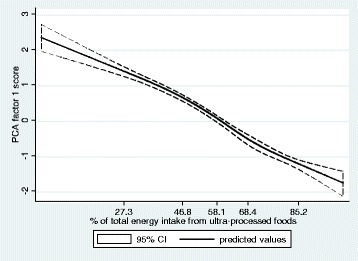
BACKGROUND: Recent population dietary studies indicate that diets rich in ultra-processed foods, increasingly frequent worldwide, are grossly nutritionally unbalanced, suggesting that the dietary contribution of these foods largely determines the overall nutritional quality of contemporaneous diets. Yet, these studies have focused on individual nutrients (one at a time) rather than the overall nutritional quality of the diets. Here we investigate the relationship between the energy contribution of ultra-processed foods in the US diet and its content of critical nutrients, individually and overall. METHODS: We evaluated dietary intakes of 9,317 participants from 2009 to 2010 NHANES aged 1+ years. Food items were classified into unprocessed or minimally processed foods, processed culinary ingredients, processed foods, and ultra-processed foods. First, we examined the average dietary content of macronutrients, micronutrients, and fiber across quintiles of the energy contribution of ultra-processed foods. Then, we used Principal Component Analysis (PCA) to identify a nutrient-balanced dietary pattern to enable the assessment of the overall nutritional quality of the diet. Linear regression was used to explore the association between the dietary share of ultra-processed foods and the balanced-pattern PCA factor score. The scores were thereafter categorized into tertiles, and their distribution was examined across ultra-processed food quintiles. All models incorporated survey sample weights and were adjusted for age, sex, race/ethnicity, family income, and educational attainment. RESULTS: The average content of protein, fiber, vitamins A, C, D, and E, zinc, potassium, phosphorus, magnesium, and calcium in the US diet decreased significantly across quintiles of the energy contribution of ultra-processed foods, while carbohydrate, added sugar, and saturated fat contents increased. An inverse dose-response association was found between ultra-processed food quintiles and overall dietary quality measured through a nutrient-balanced-pattern PCA-derived factor score characterized by being richer in fiber, potassium, magnesium and vitamin C, and having less saturated fat and added sugars. CONCLUSIONS: This study suggests that decreasing the dietary share of ultra-processed foods is a rational and effective way to improve the nutritional quality of US diets.
Overview
The claims and statistics of this paper haven’t been checked yet.
Free: it reads the open-access text and checks the first 5 claims that cite a source we can check. Create a free account to check every claim.
Integrity signals
Registry
Cites
Statistics
Figures
Verification
Claims the paper makes
The claims and statistics of this paper haven’t been checked yet.
Free: it reads the open-access text and checks the first 5 claims that cite a source we can check. Create a free account to check every claim.
Claims other papers make about this one
Each is checked against this paper’s own text: does it say what the citing paper says it does?
The source backs part of the claim, not all of it — or backs it for a different population, condition or comparison.
In the citing paper
“Moreover, refined sugars constitute approximately 20% of caloric intake.”
From The oral microbiome: Role of key organisms and complex networks in oral health and disease (2021) · cites this paper as [252]
Experimental — accuracy not yet measuredIn the citing paper
“In the United States, carbohydrates constitute > 50% of total energy intake, with refined cereal grains representing > 85% of total cereal grains consumed.”
From The oral microbiome: Role of key organisms and complex networks in oral health and disease (2021) · cites this paper as [252]
Self-check
Percentages, sums and reported differences re-computed from the paper’s own numbers.
The self-check needs the paper’s full text.
Citations
Cites
Sontrop, J. M., Dixon, S. N., Garg, A. X., Buendia-Jimenez, I., Dohein, O., Huang, S.-H. S., & Clark, W. F. (2013) · American Journal of Nephrology · doi:10.1159/000350377 · Cited by 5,871
Dietary pattern analysis: a new direction in nutritional epidemiology
Hu, F. B. (2002) · Current Opinion in Lipidology · doi:10.1097/00041433-200202000-00002 · Cited by 4,029 · cited 2×
“linear combinations of them referred to as “components” and which maximize the explained variance [19, 42].”
BackgroundMoshfegh, A. J., Rhodes, D. G., Baer, D. J., Murayi, T., Clemens, J. C., Rumpler, W. V., Paul, D. R., Sebastian, R. S., Kuczynski, K. J., Ingwersen, L. A., et al. (2008) · The American Journal of Clinical Nutrition · doi:10.1093/ajcn/88.2.324 · Cited by 1,982
Ultra‐processed products are becoming dominant in the global food system
Monteiro, C. A., Moubarac, J. ‐., Cannon, G., Ng, S. W., & Popkin, B. (2013) · Obesity Reviews · doi:10.1111/obr.12107 · Cited by 1,827
Self-citationMoodie, R., Stuckler, D., Monteiro, C., Sheron, N., Neal, B., Thamarangsi, T., Lincoln, P., & Casswell, S. (2013) · The Lancet · doi:10.1016/s0140-6736(12)62089-3 · Cited by 1,663
Self-citationNational health and nutrition examination survey: analytic guidelines, 1999-2010.
Cl, J., Paulose‐Ram, R., Ogden, C. L., Carroll, Kruszon‐Moran, D., Dohrmann, S. M., & Curtin, L. R. (2013) · PubMed · Cited by 1,522
USDA National Nutrient Database for Standard Reference, Release 22
(2018) · Cited by 1,285
Monteiro, C. A., Levy, R. B., Claro, R. M., de Castro, I. R. R., & Cannon, G. (2010) · Public Health Nutrition · doi:10.1017/s1368980010003241 · Cited by 1,060 · cited 1×
“Our investigation was based on total effective individual consumption data, rather than on household purchasing data [7, 10, 47], which do not evaluate the fraction of wasted food or purchases at restaurants.”
MethodSelf-citationDietary patterns and health outcomes
Kant, A. K. (2004) · Journal of the American Dietetic Association · doi:10.1016/j.jada.2004.01.010 · Cited by 1,028 · cited 1×
“The PCA method also has limitations such as subjective decisions regarding the number of extracted components, method of rotation, naming of components, and cutoffs for factor loadings [23, 31, 49].”
MethodA new classification of foods based on the extent and purpose of their processing
Monteiro, C. A., Levy, R. B., Claro, R. M., Castro, I. R. R. D., & Cannon, G. (2010) · Cadernos de Saúde Pública · doi:10.1590/s0102-311x2010001100005 · Cited by 991 · cited 2×
“We classified all recorded food items (N = 280,132 Food Codes) according to Nova, a food classification based on the extent and purpose of industrial food processing [4, 17].”
BackgroundMethodSelf-citationMartínez Steele, E., Baraldi, L. G., Louzada, M. L. D. C., Moubarac, J.-C., Mozaffarian, D., & Monteiro, C. A. (2016) · BMJ Open · doi:10.1136/bmjopen-2015-009892 · Cited by 838 · cited 3×
“A detailed definition of each Nova food group and examples of food items classified in each group are shown elsewhere [11].”
BackgroundMethodInfluentialSelf-citationThe USDA Automated Multiple-Pass Method Accurately Estimates Group Total Energy and Nutrient Intake
Blanton, C. A., Moshfegh, A. J., Baer, D. J., & Kretsch, M. J. (2006) · The Journal of Nutrition · doi:10.1093/jn/136.10.2594 · Cited by 769
Nutrition and health. The issue is not food, nor nutrients, so much as processing
Monteiro, C. A. (2009) · Public Health Nutrition · doi:10.1017/s1368980009005291 · Cited by 730 · cited 1×
“Based on the detrimental effects of ultra-processed foods on the dietary content of critical nutrients and taking into account their increasing predominance in global food supplies [3, 6, 13–16], the dietary share of ultra-processed foods, expressed as a percentage of total energy intake, has been proposed [1, 4, 17]…”
BackgroundSelf-citationAn Introduction to Applied Multivariate Analysis
Raykov, T., & Marcoulides, G. A. (2008) · doi:10.4324/9780203809532 · Cited by 716
Stuckler, D., McKee, M., Ebrahim, S., & Basu, S. (2012) · PLoS Medicine · doi:10.1371/journal.pmed.1001235 · Cited by 666
Indexes of Overall Diet Quality
KANT, A. K. (1996) · Journal of the American Dietetic Association · doi:10.1016/s0002-8223(96)00217-9 · Cited by 650
Ultra-processed foods and the nutritional dietary profile in Brazil
Louzada, M. L. D. C., Martins, A. P. B., Canella, D. S., Baraldi, L. G., Levy, R. B., Claro, R. M., Moubarac, J.-C., Cannon, G., & Monteiro, C. A. (2015) · Revista de Saúde Pública · doi:10.1590/s0034-8910.2015049006132 · Cited by 573 · cited 1×
“A study carried out in Brazil using 2008–2009 national food intake data found that protein, fiber, sodium, and potassium decreased significantly across quintiles of the dietary contribution of ultra-processed foods, while free sugars, total fats, and saturated fats increased [8].”
BackgroundSelf-citationMoubarac, J.-C., Parra, D. C., Cannon, G., & Monteiro, C. A. (2014) · Current Obesity Reports · doi:10.1007/s13679-014-0092-0 · Cited by 542
Self-citationPoti, J. M., Mendez, M. A., Ng, S. W., & Popkin, B. M. (2015) · The American Journal of Clinical Nutrition · doi:10.3945/ajcn.114.100925 · Cited by 525 · cited 2×
“” Another study evaluated US household barcoded purchasing data from 2000 to 2012 using a classification system guided by the one used in our study [12].”
BackgroundMethodSelf-citationConsumption of ultra-processed foods and likely impact on human health. Evidence from Canada
Moubarac, J.-C., Martins, A. P. B., Claro, R. M., Levy, R. B., Cannon, G., & Monteiro, C. A. (2013) · Public Health Nutrition · doi:10.1017/s1368980012005009 · Cited by 493 · cited 3×
“In Canada, similar results have been documented regarding free sugars, total fats, protein, and fiber [10].”
MethodResultSelf-citationDiet quality index: Capturing a multidimensional behavior
Patterson, R. E., Haines, P. S., & Popkin, B. M. (1994) · Journal of the American Dietetic Association · doi:10.1016/0002-8223(94)92042-7 · Cited by 487
Self-citationRationale and design of the Dietary Approaches to Stop Hypertension trial (DASH)
Sacks, F. M., Obarzanek, E., Windhauser, M. M., Svetkey, L. P., Vollmer, W. M., McCullough, M., Karanja, N., Lin, P.-H., Steele, P., Proschan, M. A., et al. (1995) · Annals of Epidemiology · doi:10.1016/1047-2797(94)00055-x · Cited by 475
Dietary Patterns: Challenges and Opportunities in Dietary Patterns Research
Moeller, S. M., Reedy, J., Millen, A. E., Dixon, L. B., Newby, P. K., Tucker, K. L., Krebs-Smith, S. M., & Guenther, P. M. (2007) · Journal of the American Dietetic Association · doi:10.1016/j.jada.2007.03.014 · Cited by 368
Impact of ultra-processed foods on micronutrient content in the Brazilian diet
Louzada, M. L. D. C., Martins, A. P. B., Canella, D. S., Baraldi, L. G., Levy, R. B., Claro, R. M., Moubarac, J.-C., Cannon, G., & Monteiro, C. A. (2015) · Revista de Saúde Pública · doi:10.1590/s0034-8910.2015049006211 · Cited by 349 · cited 1×
“After adjusting for family income, there was a significant drop in the dietary content of vitamin D, vitamin E, phosphorus, magnesium, and zinc, and an increase in calcium [9].”
BackgroundSelf-citationThe Impact of Transnational “Big Food” Companies on the South: A View from Brazil
Monteiro, C. A., & Cannon, G. (2012) · PLoS Medicine · doi:10.1371/journal.pmed.1001252 · Cited by 334
Self-citationInvited Commentary: Factor Analysis and the Search for Objectivity
Mart nez, M. A. E., Marshall, J. R., & Sechrest, L. (1998) · American Journal of Epidemiology · doi:10.1093/oxfordjournals.aje.a009552 · Cited by 332 · cited 1×
“The PCA method also has limitations such as subjective decisions regarding the number of extracted components, method of rotation, naming of components, and cutoffs for factor loadings [23, 31, 49].”
MethodUSDA Food and Nutrient Database for Dietary Studies (FNDDS), 5.0
Montville, J. B., Ahuja, J. K. C., Martin, C. L., Heendeniya, K. Y., Omolewa-Tomobi, G., Steinfeldt, L. C., Anand, J., Adler, M. E., LaComb, R. P., & Moshfegh, A. (2013) · Procedia Food Science · doi:10.1016/j.profoo.2013.04.016 · Cited by 261
Trends in consumption of ultra-processed foods and obesity in Sweden between 1960 and 2010
Juul, F., & Hemmingsson, E. (2015) · Public Health Nutrition · doi:10.1017/s1368980015000506 · Cited by 248
Reedy, J., Wirfalt, E., Flood, A., Mitrou, P. N., Krebs-Smith, S. M., Kipnis, V., Midthune, D., Leitzmann, M., Hollenbeck, A., Schatzkin, A., et al. (2010) · American Journal of Epidemiology · doi:10.1093/aje/kwp393 · Cited by 234
Eicher‐Miller, H. A., Fulgoni, V. L. I., & Keast, D. R. (2012) · Journal of Nutrition · doi:10.3945/jn.112.164442 · Cited by 178
Technology, Diet, and the Burden of Chronic Disease
Ludwig, D. S. (2011) · JAMA · doi:10.1001/jama.2011.380 · Cited by 168
Food group intake patterns and associated nutrient profiles of the US population
Kant, A. K., Schatzkin, A., Block, G., Ziegler, R. G., & Nestle, M. (1991) · Journal of the American Dietetic Association · doi:10.1016/s0002-8223(21)01429-2 · Cited by 132
Identifying sources of reporting error using measured food intake
Rumpler, W. V., Kramer, M., Rhodes, D., Moshfegh, A. J., & Paul, D. (2007) · European Journal of Clinical Nutrition · doi:10.1038/sj.ejcn.1602742 · Cited by 127
Patterns in food use and their associations with nutrient intakes
Randall, E., Marshall, J., Graham, S., & Brasure, J. (1990) · American Journal of Clinical Nutrition · doi:10.1093/ajcn/52.4.739 · Cited by 127
Monitoring and benchmarking population diet quality globally: a step‐wise approach
Vandevijvere, S., Monteiro, C., Krebs‐Smith, S. M., Lee, A., Swinburn, B., Kelly, B., Neal, B., Snowdon, W., Sacks, G., & INFORMAS (2013) · Obesity Reviews · doi:10.1111/obr.12082 · Cited by 97
Self-citationCluster analysis of food consumption patterns of older Americans
Akin, J. S., Guilkey, D. K., Popkin, B. M., & Fanelli, M. T. (1986) · Journal of the American Dietetic Association · doi:10.1016/s0002-8223(21)03991-2 · Cited by 84
Self-citationDiet and 20-y mortality in two rural population groups of middle-aged men in Italy
Farchi, G., Mariotti, S., Menotti, A., Seccareccia, F., Torsello, S., & Fidanza, F. (1989) · American Journal of Clinical Nutrition · doi:10.1093/ajcn/50.5.1095 · Cited by 75
Crovetto M, M., Uauy, R., Martins, A. P., & Moubarac, J. C. (2014) · Revista médica de Chile · doi:10.4067/s0034-98872014000700005 · Cited by 68
Introduction to the US Food System: Public Health, Environment, and Equity.
Mott, T. F. (2016) · PubMed · Cited by 66
Eicher‐Miller, H. A., Fulgoni, V. L. I., & Keast, D. R. (2015) · Nutrients · doi:10.3390/nu7125503 · Cited by 52
Eicher‐Miller, H. A., Fulgoni, V. L. I., & Keast, D. R. (2015) · Journal of the Academy of Nutrition and Dietetics · doi:10.1016/j.jand.2014.11.004 · Cited by 45 · cited 1×
“Analyses of the same data restricted to children and adolescents [45] and to adults [46] showed similar results.”
ResultLee, C. N., REED, D. M., MacLean, C. J., Yano, K., & Chiu, D. (1988) · New England Journal of Medicine · doi:10.1056/nejm198804143181516 · Cited by 41
An Approach to Monitor Food and Nutrition from “Factory to Fork”
Slining, M. M., Yoon, E. F., Davis, J., Hollingsworth, B., Miles, D., & Ng, S. W. (2015) · Journal of the Academy of Nutrition and Dietetics · doi:10.1016/j.jand.2014.09.002 · Cited by 27 · cited 1×
“Also, as some authors have highlighted, the number of food items reported in NHANES is smaller than the number available in the marketplace, and national food composition data are not updated as required to include all brand-specific products and to examine dietary profiles sensitive to brand preferences [48].”
Background
Research works printed but not linked: 3
- FAO. Guidelines on the collection of information on food processing through food consumption surveys. Rome: FAO; 2015.
- Diet and health: implication for reducing chronic disease risk. National Academy Press, Washington, DC; 1989.
- Monteiro CA, Cannon G, Levy RB, Claro R, Moubarac JC, Martins AP, Louzada ML, Baraldi L, Canella D. The Food System. Processing. The big issue for disease, good health, well-being. World Nutr. 2012;3:527–69. www.wphna.org (accessed Jan 2017).
Cited by
Ultra-processed foods: What they are and how to identify them
Monteiro, C. A., Cannon, G., Levy, R. B., Moubarac, J.-C., Louzada, M. L., Rauber, F., Khandpur, N., Cediel, G., Neri, D., Martinez-Steele, E., et al. (2019) · Public Health Nutrition · doi:10.1017/s1368980018003762 · Cited by 2,964
Self-citationThe UN Decade of Nutrition, the NOVA food classification and the trouble with ultra-processing
Monteiro, C. A., Cannon, G., Moubarac, J.-C., Levy, R. B., Louzada, M. L. C., & Jaime, P. C. (2018) · Public Health Nutrition · doi:10.1017/s1368980017000234 · Cited by 2,333
“In the USA, NOVA has been used to describe population dietary patterns and to assess the impact of ultraprocessed products on the overall consumption of added sugar((53)), on the dietary content of other critical macronutrients and micronutrients((54)), and on urinary levels of phyto-oestrogens((55)).”
Self-citationBaker, P., Machado, P., Santos, T., Sievert, K., Backholer, K., Hadjikakou, M., Russell, C., Huse, O., Bell, C., Scrinis, G., et al. (2020) · Obesity Reviews · doi:10.1111/obr.13126 · Cited by 1,194
Consumption of ultra-processed foods and health status: a systematic review and meta-analysis
Pagliai, G., Dinu, M., Madarena, M. P., Bonaccio, M., Iacoviello, L., & Sofi, F. (2021) · British Journal of Nutrition · doi:10.1017/s0007114520002688 · Cited by 918
“Since Monteiro coined the term UPF, there have been an increasing number of studies that have associated UPF consumption with negative health outcomes in adult subjects (3,39) , including cardiometabolic risk factors (40) , CVD (35) , cancer (16) and many other outcomes (15,25,32) .”
BackgroundThe Western Diet–Microbiome-Host Interaction and Its Role in Metabolic Disease
Zinöcker, M. K., & Lindseth, I. A. (2018) · doi:10.20944/preprints201803.0064.v1 · Cited by 776
Metadata
- Authors
- Martínez Steele, E., Popkin, B. M., Swinburn, B., & Monteiro, C. A.
- Affiliations
- University of North Carolina at Chapel Hill (US)
- University of Auckland (NZ)
- Universidade de São Paulo (BR)
- Corresponding author
- Swinburn, Boyd
- Venue
- Population Health Metrics
- Published
- 2017-02-14
- Volume
- 15
- Issue
- 1
- Pages
- 6-6
- ISSN
- 1478-7954 (ISSN-L)
- PMC
- PMC5307821
- OpenAlex
- W2588919095
- Cited by
- 585
- References
- 43
- Citations by year
- 2026: 38 · 2025: 59 · 2024: 78 · 2023: 52 · 2022: 78 · 2021: 111 · 2020: 53 · 2019: 65 · 2018: 29 · 2017: 19
- FWCI
- 42.56
- Type
- journal article
- Language
- en
- Open access
- gold
- doi.org
- Licence
- cc-by
- Locations
- Population Health Metrics (publishedVersion, cc-by)
- PubMed Central (publishedVersion, cc-by)
- PubMed (publishedVersion)
- Portuguese National Funding Agency for Science, Research and Technology (RCAAP Project by FCT) (publishedVersion)
- Figshare (submittedVersion, cc-by)
- ResearchSpace (University of Auckland) (submittedVersion, cc-by)
- Funders
- Conselho Nacional de Desenvolvimento Científico e Tecnológico (443477/2014-0)
- Fundação de Amparo à Pesquisa do Estado de São Paulo (2015/14900-9)
- Topics
- Health Sciences › Medicine › Public Health, Environmental and Occupational Health › Consumer Attitudes and Food Labeling
- Health Sciences › Medicine › Public Health, Environmental and Occupational Health › Nutritional Studies and Diet
- Life Sciences › Agricultural and Biological Sciences › Food Science › Food Nutrient Composition and Product Development
- Keywords
- ultra-processed foods, diet quality, energy contribution, nutrient balance, macronutrients, micronutrients, dietary fiber, added sugars, saturated fat, NHANES
- MeSH terms
- Adolescent, Adult, Aged, Energy Intake, Child, Child, Preschool, Cross-Sectional Studies, Diet, Dietary Fiber, Dietary Proteins, Feeding Behavior, Female, Food Handling, Humans, Infant, Male, Middle Aged, Nutrition Surveys, Nutritive Value, Linear Models, Micronutrients, Principal Component Analysis, Young Adult, Fast Foods
About these checks
Registry, retraction, Cites and statistics results are computed, not judged, with one exception: a printed reference that no index lists is read once by a model before it counts as a citation error. Claims are extracted by a model and kept only when their quote appears verbatim in the text; each cited source is then checked, with a model’s help, for whether it says what the claim relies on. Those verdicts can be wrong — read the claim’s quote and the cited source before relying on one.
Statistics and arithmetic are recomputed, not judged.
Confidence bands are shown only for fields calibrated on our annotated test set. None is calibrated yet, so no band is shown.
What counts as a claim ›How we measure confidence ›How we check this ›
Are you an author, or do you see a problem with this page? Request a review
Data sources
Bibliographic data: Semantic Scholar, OpenAlex, Crossref.
Contains information from the Semantic Scholar Academic Graph Datasets, made available under the ODC Attribution License (ODC-BY 1.0).
Semantic Scholar’s data is described in: Kinney, R., et al. (2023). The Semantic Scholar Open Data Platform. arXiv:2301.10140.
