

A review and content analysis of engagement, functionality, aesthetics, information quality, and change techniques in the most popular commercial apps for weight management
Open accessThe DOI matches its Crossref record; 43 of the 43 references it cites were found in a registry or an index.
Abstract
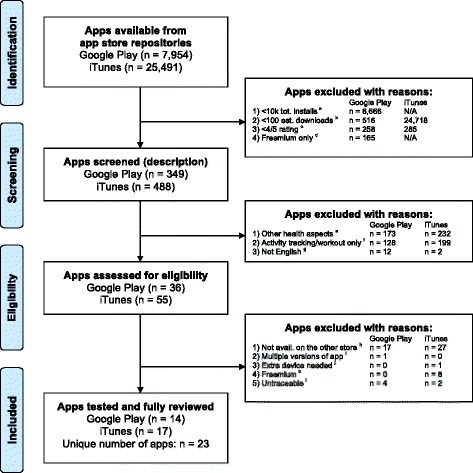
BACKGROUND: There are thousands of apps promoting dietary improvement, increased physical activity (PA) and weight management. Despite a growing number of reviews in this area, popular apps have not been comprehensively analysed in terms of features related to engagement, functionality, aesthetics, information quality, and content, including the types of change techniques employed. METHODS: The databases containing information about all Health and Fitness apps on GP and iTunes (7,954 and 25,491 apps) were downloaded in April 2015. Database filters were applied to select the most popular apps available in both stores. Two researchers screened the descriptions selecting only weight management apps. Features, app quality and content were independently assessed using the Mobile App Rating Scale (MARS) and previously-defined categories of techniques relevant to behaviour change. Inter-coder reliabilities were calculated, and correlations between features explored. RESULTS: Of the 23 popular apps included in the review 16 were free (70%), 15 (65%) addressed weight control, diet and PA combined; 19 (83%) allowed behavioural tracking. On 5-point MARS scales, apps were of average quality (Md = 3.2, IQR = 1.4); "functionality" (Md = 4.0, IQR = 1.1) was the highest and "information quality" (Md = 2.0, IQR = 1.1) was the lowest domain. On average, 10 techniques were identified per app (range: 1-17) and of the 34 categories applied, goal setting and self-monitoring techniques were most frequently identified. App quality was positively correlated with number of techniques included (rho = .58, p < .01) and number of "technical" features (rho = .48, p < .05), which was also associated with the number of techniques included (rho = .61, p < .01). Apps that provided tracking used significantly more techniques than those that did not. Apps with automated tracking scored significantly higher in engagement, aesthetics, and overall MARS scores. Those that used change techniques previously associated with effectiveness (i.e., goal setting, self-monitoring and feedback) also had better "information quality". CONCLUSIONS: Popular apps assessed have overall moderate quality and include behavioural tracking features and a range of change techniques associated with behaviour change. These apps may influence behaviour, although more attention to information quality and evidence-based content are warranted to improve their quality.
Overview
The claims and statistics of this paper haven’t been checked yet.
Free: it reads the open-access text and checks the first 5 claims that cite a source we can check. Create a free account to check every claim.
Integrity signals
Registry
Cites
Statistics
Figures
Verification
Claims the paper makes
The claims and statistics of this paper haven’t been checked yet.
Free: it reads the open-access text and checks the first 5 claims that cite a source we can check. Create a free account to check every claim.
Claims other papers make about this one
Each is checked against this paper’s own text: does it say what the citing paper says it does?
The source backs part of the claim, not all of it — or backs it for a different population, condition or comparison.
In the citing paper
“most commercial mobile apps for weight loss/management seem suboptimal in quality: inadequate scientific coverage, inaccurate weight-related information, lack important evidence-based features, do not involve health-care experts in their development process, overlook behavior change techniques, and have not undergone rigorous scientific testing [29–32]”
From Mobile Apps for the Management of Comorbid Overweight/Obesity and Depression/Anxiety: A Systematic Review (2020) · cites this paper as [31]
Experimental — accuracy not yet measuredThe cited source says what the claim attributes to it.
In the citing paper
“In addition, MARS has been diversely and widely used in evaluating smartphone-based health apps, for instance, pain management apps [31], weight management apps [32], diabetes management apps [33], and rheumatology apps [34,35].”
From Smartphone and mobile health apps for tinnitus: Systematic identification, analysis, and assessment (2020) · cites this paper as [32]
Self-check
Percentages, sums and reported differences re-computed from the paper’s own numbers.
The self-check needs the paper’s full text.
Citations
Cites
Michie, S., Richardson, M., Johnston, M., Abraham, C., Francis, J., Hardeman, W., Eccles, M. P., Cane, J., & Wood, C. E. (2013) · Annals of Behavioral Medicine · doi:10.1007/s12160-013-9486-6 · Cited by 7,629 · cited 1×
“Several systematic reviews of weight loss interventions in general have identified various techniques, which were associated with greater effectiveness [35].”
BackgroundSelf-citationNielsen, J. (1994) · Conference companion on Human factors in computing systems - CHI '94 · doi:10.1145/259963.260531 · Cited by 2,759
Carver, C. S., & Scheier, M. F. (1982) · Psychological Bulletin · doi:10.1037//0033-2909.92.1.111 · Cited by 2,650 · cited 1×
“From a psychological perspective, then, these apps generally target change mechanisms specified by Control Theory [47].”
BackgroundNielsen, J. (1995) · Conference companion on Human factors in computing systems - CHI '95 · doi:10.1145/223355.223730 · Cited by 2,620
A taxonomy of behavior change techniques used in interventions
Abraham, C., & Michie, S. (2008) · Health Psychology · doi:10.1037/0278-6133.27.3.379 · Cited by 2,525 · cited 3×
“, goal setting, self-monitoring, feedback [33, 37, 43]) were included in the analyses.”
BackgroundMethodSelf-citationMobile app rating scale: a new tool for assessing the quality of health mobile apps
Stoyanov, S. R., Hides, L., Kavanagh, D. J., Zelenko, O., Tjondronegoro, D., & Mani, M. (2015) · JMIR mHealth and uHealth · doi:10.2196/mhealth.3422 · Cited by 2,233 · cited 5×
“This instrument has been validated with mental health apps [40] but has not been applied to weight management apps.”
BackgroundMethodInfluentialMichie, S., Ashford, S., Sniehotta, F. F., Dombrowski, S. U., Bishop, A., & French, D. P. (2011) · Psychology & Health · doi:10.1080/08870446.2010.540664 · Cited by 1,756 · cited 2×
“Definitions were derived from taxonomies presenting definitions of technique types [33, 34] and 34 relevant categories were applied.”
BackgroundMethodFinding usability problems through heuristic evaluation
Nielsen, J. (1992) · Proceedings of the SIGCHI conference on Human factors in computing systems - CHI '92 · doi:10.1145/142750.142834 · Cited by 1,060 · cited 1×
“Additionally, the reviews assessing “usability” of apps provide evaluations based on heuristics for general user interfaces developed by Jacob Nielsen almost 20 years ago [38, 39], or use inductively-developed approaches [12, 17].”
BackgroundThe role of exercise and physical activity in weight loss and maintenance
Swift, D. L., Johannsen, N. M., Lavie, C. J., Earnest, C. P., & Church, T. S. (2014) · Progress in Cardiovascular Diseases · doi:10.1016/j.pcad.2013.09.012 · Cited by 855 · cited 1×
“Apps were included if they addressed “weight management”, which consists of both PA and dietary behavioural strategies [28], considering the limited role of PA and the predominant role of dietary strategies for effective weight loss [25, 27], and the importance of the combination of PA and diet for long-term effects o…”
BackgroundComputing Krippendorff's Alpha-Reliability
Krippendorff, K. (2011) · ScholarlyCommons (University of Pennsylvania) · Cited by 809
Lyons, E. J., Lewis, Z. H., Mayrsohn, B. G., & Rowland, J. L. (2014) · Journal of Medical Internet Research · doi:10.2196/jmir.3469 · Cited by 547 · cited 5×
“The four reviews that explicitly assessed technique content in PA and fitness apps [8, 11, 13, 14] identified varying numbers of techniques, ranging from 1 [8] to 18 per app [11].”
BackgroundMethodResultInfluentialApps to promote physical activity among adults: a review and content analysis
Middelweerd, A., Mollee, J. S., van der Wal, C. N., Brug, J., & te Velde, S. J. (2014) · International Journal of Behavioral Nutrition and Physical Activity · doi:10.1186/s12966-014-0097-9 · Cited by 546 · cited 5×
“The four reviews that explicitly assessed technique content in PA and fitness apps [8, 11, 13, 14] identified varying numbers of techniques, ranging from 1 [8] to 18 per app [11].”
BackgroundMethodResultInfluentialJakicic, J. M., Marcus, B. H., Gallagher, K. I., Napolitano, M., & Lang, W. (2003) · JAMA · doi:10.1001/jama.290.10.1323 · Cited by 519
Dombrowski, S. U., Sniehotta, F. F., Avenell, A., Johnston, M., MacLennan, G., & Araújo-Soares, V. (2012) · Health Psychology Review · doi:10.1080/17437199.2010.513298 · Cited by 504 · cited 2×
“Categories of change techniques were derived from systematic reviews of weight loss interventions [2, 36, 37] and similar recent reviews of apps for diet and PA [8, 11, 13, 14].”
BackgroundMethodBehavior Change Techniques in Top-Ranked Mobile Apps for Physical Activity
Conroy, D. E., Yang, C.-H., & Maher, J. P. (2014) · American Journal of Preventive Medicine · doi:10.1016/j.amepre.2014.01.010 · Cited by 466 · cited 5×
“The four reviews that explicitly assessed technique content in PA and fitness apps [8, 11, 13, 14] identified varying numbers of techniques, ranging from 1 [8] to 18 per app [11].”
BackgroundMethodResultInfluentialMobile Applications for Weight Management
Azar, K. M. J., Lesser, L. I., Laing, B. Y., Stephens, J., Aurora, M. S., Burke, L. E., & Palaniappan, L. P. (2013) · American Journal of Preventive Medicine · doi:10.1016/j.amepre.2013.07.005 · Cited by 334 · cited 3×
“The reviews of theoretical components assessed in particular the presence of constructs derived from behavioural theories [6, 9, 22, 23], tailoring principles [5], evidence-based strategies [7, 16, 18, 21], or techniques designed to promote behaviour change [8, 11, 13, 14], without evaluating functionality and usabili…”
BackgroundMethodResultEvidence-Based Strategies in Weight-Loss Mobile Apps
Pagoto, S., Schneider, K., Jojic, M., DeBiasse, M., & Mann, D. (2013) · American Journal of Preventive Medicine · doi:10.1016/j.amepre.2013.04.025 · Cited by 325 · cited 2×
“The reviews of theoretical components assessed in particular the presence of constructs derived from behavioural theories [6, 9, 22, 23], tailoring principles [5], evidence-based strategies [7, 16, 18, 21], or techniques designed to promote behaviour change [8, 11, 13, 14], without evaluating functionality and usabili…”
BackgroundResultThere’s an App for That: Content Analysis of Paid Health and Fitness Apps
West, J. H., Hall, P. C., Hanson, C. L., Barnes, M. D., Giraud-Carrier, C., & Barrett, J. (2012) · Journal of Medical Internet Research · doi:10.2196/jmir.1977 · Cited by 314 · cited 1×
“The reviews of theoretical components assessed in particular the presence of constructs derived from behavioural theories [6, 9, 22, 23], tailoring principles [5], evidence-based strategies [7, 16, 18, 21], or techniques designed to promote behaviour change [8, 11, 13, 14], without evaluating functionality and usabili…”
Direito, A., Pfaeffli Dale, L., Shields, E., Dobson, R., Whittaker, R., & Maddison, R. (2014) · BMC Public Health · doi:10.1186/1471-2458-14-646 · Cited by 305
Weight loss—there is an app for that! But does it adhere to evidence-informed practices?
Breton, E. R., Fuemmeler, B. F., & Abroms, L. C. (2011) · Translational Behavioral Medicine · doi:10.1007/s13142-011-0076-5 · Cited by 276 · cited 3×
“The reviews of theoretical components assessed in particular the presence of constructs derived from behavioural theories [6, 9, 22, 23], tailoring principles [5], evidence-based strategies [7, 16, 18, 21], or techniques designed to promote behaviour change [8, 11, 13, 14], without evaluating functionality and usabili…”
BackgroundMethodResultCowan, L. T., Van Wagenen, S. A., Brown, B. A., Hedin, R. J., Seino-Stephan, Y., Hall, P. C., & West, J. H. (2013) · Health Education & Behavior · doi:10.1177/1090198112452126 · Cited by 264 · cited 3×
“The reviews of theoretical components assessed in particular the presence of constructs derived from behavioural theories [6, 9, 22, 23], tailoring principles [5], evidence-based strategies [7, 16, 18, 21], or techniques designed to promote behaviour change [8, 11, 13, 14], without evaluating functionality and usabili…”
BackgroundMethodResultInferring App Demand from Publicly Available Data1
Garg, R., & Telang, R. (2013) · MIS Quarterly · doi:10.25300/misq/2013/37.4.12 · Cited by 227 · cited 3×
“Garg R, Telang R: Inferring App Demand from Publicly Available Data.”
MethodInfluentialHartmann‐Boyce, J., Johns, D. J., Jebb, S. A., Aveyard, P., & Behavioural Weight Management Review Group (2014) · Obesity Reviews · doi:10.1111/obr.12165 · Cited by 221
Tailoring real-time physical activity coaching systems: a literature survey and model
den Akker, H. O., Jones, V. M., & Hermens, H. J. (2014) · User Modeling and User-Adapted Interaction · doi:10.1007/s11257-014-9146-y · Cited by 175 · cited 1×
“The reviews of theoretical components assessed in particular the presence of constructs derived from behavioural theories [6, 9, 22, 23], tailoring principles [5], evidence-based strategies [7, 16, 18, 21], or techniques designed to promote behaviour change [8, 11, 13, 14], without evaluating functionality and usabili…”
BackgroundSchoffman, D. E., Turner-McGrievy, G., Jones, S. J., & Wilcox, S. (2013) · Translational Behavioral Medicine · doi:10.1007/s13142-013-0206-3 · Cited by 147 · cited 3×
“The reviews of theoretical components assessed in particular the presence of constructs derived from behavioural theories [6, 9, 22, 23], tailoring principles [5], evidence-based strategies [7, 16, 18, 21], or techniques designed to promote behaviour change [8, 11, 13, 14], without evaluating functionality and usabili…”
BackgroundResultmHealthApps: A Repository and Database of Mobile Health Apps
Xu, W., & Liu, Y. (2015) · JMIR mHealth and uHealth · doi:10.2196/mhealth.4026 · Cited by 130 · cited 1×
“First, the mHealthApps repository [41], available in the first quarter of 2015 was downloaded and imported into Excel.”
MethodLyzwinski, L. (2014) · Journal of Personalized Medicine · doi:10.3390/jpm4030311 · Cited by 121 · cited 3×
“With so many apps available, it has become challenging to identify those with most potential to support weight loss and reduce obesity [1, 2].”
BackgroundMethodSmartphone Apps and the Mobile Privatization of Health and Fitness
Millington, B. (2014) · Critical Studies in Media Communication · doi:10.1080/15295036.2014.973429 · Cited by 101 · cited 1×
“0 technologies for weight management [4], we identified 20 reviews and content analyses of apps [5–24].”
BackgroundSmartphone Medical Applications for Women’s Health: What Is the Evidence-Base and Feedback?
Derbyshire, E., & Dancey, D. (2013) · International Journal of Telemedicine and Applications · doi:10.1155/2013/782074 · Cited by 100 · cited 2×
“0 technologies for weight management [4], we identified 20 reviews and content analyses of apps [5–24].”
BackgroundAppAware: which mobile applications are hot?
Girardello, A., & Michahelles, F. (2010) · Proceedings of the 12th international conference on Human computer interaction with mobile devices and services · doi:10.1145/1851600.1851698 · Cited by 93
Functionalities and input methods for recording food intake: A systematic review
Rusin, M., Årsand, E., & Hartvigsen, G. (2013) · International Journal of Medical Informatics · doi:10.1016/j.ijmedinf.2013.01.007 · Cited by 89 · cited 1×
“Additionally, the reviews assessing “usability” of apps provide evaluations based on heuristics for general user interfaces developed by Jacob Nielsen almost 20 years ago [38, 39], or use inductively-developed approaches [12, 17].”
BackgroundAnalysis of mobile health applications for a broad spectrum of consumers: A user experience approach
García-Gómez, J. M., de la Torre-Díez, I., Vicente, J., Robles, M., López-Coronado, M., & Rodrigues, J. J. (2014) · Health Informatics Journal · doi:10.1177/1460458213479598 · Cited by 83 · cited 1×
“The majority of these (14/20, 70 %) assessed the presence of theoretical components [5–9, 11, 13, 14, 16, 18, 21–23]; the remainder focused either on evaluating the apps’ design and usability qualities [12, 19, 20, 24], or technical functionalities (e.”
BackgroundSelf-Directed Interventions to Promote Weight Loss: A Systematic Review of Reviews
Tang, J., Abraham, C., Greaves, C., & Yates, T. (2014) · Journal of Medical Internet Research · doi:10.2196/jmir.2857 · Cited by 78 · cited 2×
“This is consistent with the literature on weight management interventions generally [43] and similar reviews on apps for PA [8, 13, 14] and PA and diet [11].”
MethodResultSelf-citationUse of mobile phones as a tool for weight loss: a systematic review
Aguilar-Martínez, A., Solé-Sedeño, J. M., Mancebo-Moreno, G., Medina, F. X., Carreras-Collado, R., & Saigí-Rubió, F. (2014) · Journal of Telemedicine and Telecare · doi:10.1177/1357633x14537777 · Cited by 77 · cited 1×
“With so many apps available, it has become challenging to identify those with most potential to support weight loss and reduce obesity [1, 2].”
BackgroundMobile Phone and Web 2.0 Technologies for Weight Management: A Systematic Scoping Review
Bardus, M., Smith, J. R., Samaha, L., & Abraham, C. (2015) · Journal of Medical Internet Research · doi:10.2196/jmir.5129 · Cited by 75 · cited 1×
“0 technologies for weight management [4], we identified 20 reviews and content analyses of apps [5–24].”
BackgroundSelf-citationWashburn, R. A., Szabo, A. N., Lambourne, K., Willis, E. A., Ptomey, L. T., Honas, J. J., Herrmann, S. D., & Donnelly, J. E. (2014) · PLoS ONE · doi:10.1371/journal.pone.0109849 · Cited by 74
Health Behavior Theories in Diet Apps
West, J. H., Hall, P. C., Arredondo, V., Berrett, B., Guerra, B., & Farrell, J. (2013) · Journal of Consumer Health On the Internet · doi:10.1080/15398285.2013.756343 · Cited by 72
Effectiveness of a worksite mindfulness-based multi-component intervention on lifestyle behaviors
van Berkel, J., Boot, C. R., Proper, K. I., Bongers, P. M., & van der Beek, A. J. (2014) · International Journal of Behavioral Nutrition and Physical Activity · doi:10.1186/1479-5868-11-9 · Cited by 58
Smartphones, Smart Seniors, But Not-So-Smart Apps: A Heuristic Evaluation of Fitness Apps
Silva, P. A., Holden, K., & Nii, A. (2014) · Lecture notes in computer science · doi:10.1007/978-3-319-07527-3_33 · Cited by 51
iPhone App Adherence to Expert-Recommended Guidelines for Pediatric Obesity Prevention
Wearing, J. R., Nollen, N., Befort, C., Davis, A. M., & Agemy, C. K. (2014) · Childhood Obesity · doi:10.1089/chi.2013.0084 · Cited by 49 · cited 2×
“The reviews of theoretical components assessed in particular the presence of constructs derived from behavioural theories [6, 9, 22, 23], tailoring principles [5], evidence-based strategies [7, 16, 18, 21], or techniques designed to promote behaviour change [8, 11, 13, 14], without evaluating functionality and usabili…”
BackgroundResultHermawati, S., & Lawson, G. (2014) · Personal and Ubiquitous Computing · doi:10.1007/s00779-014-0757-4 · Cited by 48 · cited 2×
“Additionally, the reviews assessing “usability” of apps provide evaluations based on heuristics for general user interfaces developed by Jacob Nielsen almost 20 years ago [38, 39], or use inductively-developed approaches [12, 17].”
BackgroundHeuristic Evaluation of Healthy Eating Apps for Older Adults
Watkins, I., Kules, B., Yuan, X., & Xie, B. (2014) · Journal of Consumer Health On the Internet · doi:10.1080/15398285.2014.902267 · Cited by 41 · cited 1×
“The majority of these (14/20, 70 %) assessed the presence of theoretical components [5–9, 11, 13, 14, 16, 18, 21–23]; the remainder focused either on evaluating the apps’ design and usability qualities [12, 19, 20, 24], or technical functionalities (e.”
BackgroundArmstrong, S. (2015) · BMJ · doi:10.1136/bmj.h4597 · Cited by 28
Research works printed but not linked: 1
- 44. Gwet KL. Handbook of inter-rater reliability: the definitive guide to measuring the extent of agreement among multiple raters, 3rd edition. 3rd ed. Gaithersburg: Advanced Analytics, LLC; 2012.
Cited by
Schoeppe, S., Alley, S., Van Lippevelde, W., Bray, N. A., Williams, S. L., Duncan, M. J., & Vandelanotte, C. (2016) · International Journal of Behavioral Nutrition and Physical Activity · doi:10.1186/s12966-016-0454-y · Cited by 949
“determine user engagement, retention and ultimately intervention efficacy [22].”
BackgroundAdams, J., Hillier-Brown, F. C., Moore, H. J., Lake, A. A., Araujo-Soares, V., White, M., & Summerbell, C. (2016) · Systematic Reviews · doi:10.1186/s13643-016-0337-y · Cited by 486
“Similar to other reviews [21], our synthesis focused on categorising interventions according to delivery setting and training model and summarising the training delivered, throughput, setup and running costs, funding, and behaviour change techniques used [22].”
ResultEvaluating mobile phone applications for health behaviour change: A systematic review
McKay, F. H., Cheng, C., Wright, A., Shill, J., Stephens, H., & Uccellini, M. (2018) · Journal of Telemedicine and Telecare · doi:10.1177/1357633x16673538 · Cited by 364
Villinger, K., Wahl, D. R., Boeing, H., Schupp, H. T., & Renner, B. (2019) · Obesity Reviews · doi:10.1111/obr.12903 · Cited by 292
“So far, however, most users and patients have relied on commercially available app‐based mobile health interventions that have not been empirically evaluated and rarely include evidence‐based strategies for behaviour change.(16,17) The effectiveness of app‐based mobile health interventions must be determined to enable…”
BackgroundSzinay, D., Jones, A., Chadborn, T., Brown, J., & Naughton, F. (2020) · Journal of Medical Internet Research · doi:10.2196/17572 · Cited by 289
“For example, there have been promising studies of apps, including (1) delivering health prevention messages for men who have sex with men [3], (2) self-managing diabetes [4] and cardiovascular diseases [5], (3) weight management [6-8], (4) alcohol reduction [9-11], (5) mental health interventions [12], and (6) managin…”
Background
Metadata
- Authors
- Bardus, M., van Beurden, S. B., Smith, J. R., & Abraham, C.
- Affiliations
- University of Exeter (GB)
- Corresponding author
- Bardus, Marco
- Venue
- International Journal of Behavioral Nutrition and Physical Activity
- Published
- 2016-03-10
- Volume
- 13
- Issue
- 1
- Pages
- 35-35
- ISSN
- 1479-5868 (ISSN-L)
- PMC
- PMC4785735
- OpenAlex
- W2296522110
- Cited by
- 350
- References
- 43
- Citations by year
- 2026: 10 · 2025: 33 · 2024: 23 · 2023: 30 · 2022: 38 · 2021: 52 · 2020: 39 · 2019: 36 · 2018: 44 · 2017: 36 · 2016: 9
- FWCI
- 7.95
- Type
- journal article
- Language
- en
- Open access
- gold
- doi.org
- Licence
- cc-by
- Locations
- International Journal of Behavioral Nutrition and Physical Activity (publishedVersion, cc-by)
- Europe PMC (PubMed Central) (publishedVersion, cc-by)
- PubMed Central (publishedVersion, cc-by)
- PubMed (publishedVersion)
- Open Research Exeter (University of Exeter) (publishedVersion, cc-by)
- University of Birmingham Research Portal (University of Birmingham) (publishedVersion, other-oa)
- Minerva Access (University of Melbourne) (submittedVersion, cc-by)
- Own your potential (DEAKIN) (submittedVersion)
- Figshare (submittedVersion, cc-by)
- Figshare (submittedVersion)
- Funders
- Schweizerischer Nationalfonds zur Förderung der Wissenschaftlichen Forschung (CH) (152290)
- Topics
- Health Sciences › Health Professions › General Health Professions › Mobile Health and mHealth Applications
- Social Sciences › Psychology › Applied Psychology › Digital Mental Health Interventions
- Physical Sciences › Computer Science › Human-Computer Interaction › Innovative Human-Technology Interaction
- Keywords
- mobile health apps, app quality, behaviour change techniques, self-monitoring, goal setting, feedback, information quality, app functionality, app aesthetics, user engagement, dietary improvement, physical activity, behavioral tracking, Mobile App Rating Scale, evidence-based content, health information quality, fitness apps, diet apps, exercise apps
- MeSH terms
- Body Weight Maintenance, Commerce, Diet, Esthetics, Humans, Obesity, Health Behavior, Exercise, Mobile Applications
About these checks
Registry, retraction, Cites and statistics results are computed, not judged, with one exception: a printed reference that no index lists is read once by a model before it counts as a citation error. Claims are extracted by a model and kept only when their quote appears verbatim in the text; each cited source is then checked, with a model’s help, for whether it says what the claim relies on. Those verdicts can be wrong — read the claim’s quote and the cited source before relying on one.
Statistics and arithmetic are recomputed, not judged.
Confidence bands are shown only for fields calibrated on our annotated test set. None is calibrated yet, so no band is shown.
What counts as a claim ›How we measure confidence ›How we check this ›
Are you an author, or do you see a problem with this page? Request a review
Data sources
Bibliographic data: Semantic Scholar, OpenAlex, Crossref.
Contains information from the Semantic Scholar Academic Graph Datasets, made available under the ODC Attribution License (ODC-BY 1.0).
Semantic Scholar’s data is described in: Kinney, R., et al. (2023). The Semantic Scholar Open Data Platform. arXiv:2301.10140.
