

The association between social support and physical activity in older adults: a systematic review
Open accessThe DOI matches its Crossref record; 110 of the 112 references it cites were found in a registry or an index; 16 of the 97 sources its claims cite were checked for support.
Abstract
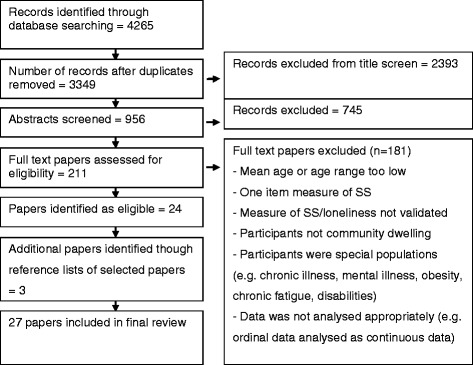
BACKGROUND: The promotion of active and healthy ageing is becoming increasingly important as the population ages. Physical activity (PA) significantly reduces all-cause mortality and contributes to the prevention of many chronic illnesses. However, the proportion of people globally who are active enough to gain these health benefits is low and decreases with age. Social support (SS) is a social determinant of health that may improve PA in older adults, but the association has not been systematically reviewed. This review had three aims: 1) Systematically review and summarise studies examining the association between SS, or loneliness, and PA in older adults; 2) clarify if specific types of SS are positively associated with PA; and 3) investigate whether the association between SS and PA differs between PA domains. METHODS: Quantitative studies examining a relationship between SS, or loneliness, and PA levels in healthy, older adults over 60 were identified using MEDLINE, PSYCInfo, SportDiscus, CINAHL and PubMed, and through reference lists of included studies. Quality of these studies was rated. RESULTS: This review included 27 papers, of which 22 were cross sectional studies, three were prospective/longitudinal and two were intervention studies. Overall, the study quality was moderate. Four articles examined the relation of PA with general SS, 17 with SS specific to PA (SSPA), and six with loneliness. The results suggest that there is a positive association between SSPA and…
Overview
CoChat Summary
## TL;DR
This systematic review of 27 papers found that social support specific to physical activity is generally positively associated with physical activity in older adults, especially support from family. In contrast, general social support showed no clear association, while loneliness was generally negatively associated with physical activity, though measurement variability limited firm conclusions.
## Key findings
- The review included 27 papers: 22 cross-sectional, 3 prospective/longitudinal, and 2 intervention studies; overall study quality was moderate.
- Of the 21 studies examining general or PA-specific social support, 13 found a significant positive association with physical activity and 1 found a significant negative association.
- For social support specific to physical activity (SSPA), 11 of 17 studies reported at least one significant positive association; the review concludes the association is especially positive when support comes from family members.
- Among the 6 loneliness studies, 4 of 6 found a significant negative association with physical activity; when the low-quality study was removed, the pattern was 67% significant and negative.
- For leisure-time physical activity (LTPA), the review reports a more consistent positive association with support: among studies assessing SSPA from friends and family, 67% of friend-support results and 83% of family-support results were positive for LTPA.
## Methods
- Design: Systematic review following PRISMA; studies were rated for quality using the Gyorkos risk assessment tool and synthesized by direction/significance of association.
- Data/sample: Quantitative, peer-reviewed studies in English, German, French, or Dutch on generally healthy community-dwelling older adults with mean age at least 60 years (minimum age no less than 50), identified from MEDLINE, PSYCInfo, SportDiscus, CINAHL, PubMed, plus reference lists.
- Main analysis: Studies were grouped into general social support, social support specific to physical activity, and loneliness; associations were coded as positive/negative/no association and summarized using the review’s overall rating scheme.
## Limitations
- The paper states that high variability in measurement methods for both social support and physical activity made studies difficult to compare.
- It states that the review excluded older adults with specific medical conditions, mental illness, or disabilities, and excluded qualitative studies; this likely omitted potentially relevant evidence.
- Evident from the text: the evidence base was mostly cross-sectional (22 of 27 studies), so the direction of association cannot be established well, and the paper notes this explicitly in discussing future research.
Model-written summary. Check it against the paper before relying on it.
Integrity signals
Registry
Cites
Statistics
Figures
Verification
Claims the paper makes
12 Valid · 6 Not valid · 45 Not checked · 73 Own results and interpretations
Every source the paper cites for this claim was checked and supports it.
In the paper
“One study found a negative association between SS from family and PA [75].”
§ The association between social support and physical activity in older adults: a systematic review > Results > Social support specific to PA
What the sources say
- Supportedcites [75] Park CH Elavsky S Koo KM Factors influencing physical activity in older adults J Exerc Rehabil 2014 10 1 45 52 10.12965/jer.140089 24678504 PMC3952835 source
The Results report a negative, statistically significant regression coefficient for family support for exercise as a predictor of physical activity (β=−0.220, P<0.01). This supports the claimed negative association, specifically in the study’s multiple-regression analysis. (LLM, conf=0.93)
plainstates an association- Asserted: passes — The authors put it forward as true.
- Checkable: passes — It can be checked against evidence.
- Load-bearing: unclear — It is unclear whether the paper’s conclusions depend on it.
- Based: passes — The paper gives a reason why it holds.
- Supported
The cited sources support only part of this claim — read each source’s verdict below.
In the paper
“Four of the six loneliness studies [58, 59, 61, 63] found a significant negative association.”
§ The association between social support and physical activity in older adults: a systematic review > Results > Relationship between SS, loneliness and PA
What the sources say
- Partly supportedcites [58] Luo Y Waite LJ Loneliness and mortality among older adults in China J Gerontol Series B Psychol Sci Soc Sci 2014 69 4 633 45 10.1093/geronb/gbu007 PMC4049147 24550354 sourceExperimental — accuracy not yet measured
The Results report significant negative associations between loneliness and physical exercise, self-rated health, and emotional health. The cited paper is one study, however, and does not establish the citing sentence’s count of four out of six studies; the sentence also does not specify which outcome the negative association concerns. No page number is available in our copy. (LLM, conf=0.70)
- Not checked — no full text of the sourcecites [59] Netz Y Goldsmith R Shimony T Arnon M Zeev A Loneliness is associated with an increased risk of sedentary life in older Israelis Aging Ment Health 2013 17 1 40 7 10.1080/13607863.2012.715140 22913477 source
- Not checked — no full text of the sourcecites [61] Shankar A McMunn A Banks J Steptoe A Loneliness, social isolation, and behavioral and biological health indicators in older adults Health Psychol 2011 30 4 377 85 10.1037/a0022826 21534675 source
- Not checked yetcites [63] Theeke LA Sociodemographic and health-related risks for loneliness and outcome differences by loneliness status in a sample of U.S. older adults Res Gerontol Nurs 2010 3 2 113 25 10.3928/19404921-20091103-99 20415360 source
Checked before — its earlier verdict is held back until a new check runs.
plainstates an association- Asserted: passes — The authors put it forward as true.
- Checkable: passes — It can be checked against evidence.
- Load-bearing: unclear — It is unclear whether the paper’s conclusions depend on it.
- Based: passes — The paper gives a reason why it holds.
- Partly supported
The cited sources support only part of this claim — read each source’s verdict below.
In the paper
“but only two of four in males [58, 63].”
§ The association between social support and physical activity in older adults: a systematic review > Results > Association between SS, loneliness and specific PA domains
What the sources say
- Partly supportedcites [58] Luo Y Waite LJ Loneliness and mortality among older adults in China J Gerontol Series B Psychol Sci Soc Sci 2014 69 4 633 45 10.1093/geronb/gbu007 PMC4049147 24550354 sourceExperimental — accuracy not yet measured
The Results (page unavailable) report negative, significant lagged effects in both directions between physical exercise and loneliness. They do not report that two of four associations were significant among males; the Methods (page unavailable) describe controlling for gender, not a male-specific result. (LLM, conf=0.87)
- Could not verifycites [63] Theeke LA Sociodemographic and health-related risks for loneliness and outcome differences by loneliness status in a sample of U.S. older adults Res Gerontol Nurs 2010 3 2 113 25 10.3928/19404921-20091103-99 20415360 sourceExperimental — accuracy not yet measured
Our copy of Theeke (2010) reports only whole-sample comparisons of loneliness groups (never/briefly/chronically lonely) on moderate activity/exercise — e.g., Results for Outcomes Reported with Loneliness ('The chronically lonely group reported less exercise...'; 49.8% vs 33.1% exercising more than once weekly) — and no sex-stratified set of activity-loneliness associations. Searched for 'leisure-time physical activity', 'gender/sex differences in exercise and loneliness', and 'negative correlation between physical activity and loneliness': the nearest passages are Gender and Loneliness and Unanticipated Findings, which state gender was not predictive of loneliness and that men and women may experience loneliness differently, but nothing about four associations of which two were negative and significant in males. The paper therefore neither supports nor contradicts the specific claim attributed to it. (LLM, conf=0.70)
plainstates an association- Asserted: passes — The authors put it forward as true.
- Checkable: passes — It can be checked against evidence.
- Load-bearing: unclear — It is unclear whether the paper’s conclusions depend on it.
- Based: passes — The paper gives a reason why it holds.
- Partly supported
The cited sources support only part of this claim — read each source’s verdict below.
In the paper
“with three of four associations [58, 59, 63] being negative and significant in females”
§ The association between social support and physical activity in older adults: a systematic review > Results > Association between SS, loneliness and specific PA domains
What the sources say
- Partly supportedcites [58] Luo Y Waite LJ Loneliness and mortality among older adults in China J Gerontol Series B Psychol Sci Soc Sci 2014 69 4 633 45 10.1093/geronb/gbu007 PMC4049147 24550354 sourceExperimental — accuracy not yet measured
The Results report that the three-year lagged associations between physical exercise and loneliness were negative and significant. They do not report those associations separately for females or establish the claimed count of three out of four associations. (LLM, conf=0.84)
- Not checked — no full text of the sourcecites [59] Netz Y Goldsmith R Shimony T Arnon M Zeev A Loneliness is associated with an increased risk of sedentary life in older Israelis Aging Ment Health 2013 17 1 40 7 10.1080/13607863.2012.715140 22913477 source
- Not checked yetcites [63] Theeke LA Sociodemographic and health-related risks for loneliness and outcome differences by loneliness status in a sample of U.S. older adults Res Gerontol Nurs 2010 3 2 113 25 10.3928/19404921-20091103-99 20415360 source
Checked before — its earlier verdict is held back until a new check runs.
plainstates an association- Asserted: passes — The authors put it forward as true.
- Checkable: passes — It can be checked against evidence.
- Load-bearing: unclear — It is unclear whether the paper’s conclusions depend on it.
- Based: passes — The paper gives a reason why it holds.
- Partly supported
The cited sources support only part of this claim — read each source’s verdict below.
In the paper
“Four (57%) of these were significant and negative [58, 59, 61, 63]”
§ The association between social support and physical activity in older adults: a systematic review > Results > Loneliness and PA levels
What the sources say
- Supportedcites [58] Luo Y Waite LJ Loneliness and mortality among older adults in China J Gerontol Series B Psychol Sci Soc Sci 2014 69 4 633 45 10.1093/geronb/gbu007 PMC4049147 24550354 source
The Results report that the three-year lagged effect of loneliness on physical exercise was negative and significant. This supports citing the paper as one of the studies with a significant negative association; the four-of-seven tally is the citing paper’s synthesis, not a count attributed to this individual source. (LLM, conf=0.91)
- Not checked — no full text of the sourcecites [59] Netz Y Goldsmith R Shimony T Arnon M Zeev A Loneliness is associated with an increased risk of sedentary life in older Israelis Aging Ment Health 2013 17 1 40 7 10.1080/13607863.2012.715140 22913477 source
- Not checked — no full text of the sourcecites [61] Shankar A McMunn A Banks J Steptoe A Loneliness, social isolation, and behavioral and biological health indicators in older adults Health Psychol 2011 30 4 377 85 10.1037/a0022826 21534675 source
- Partly supportedcites [63] Theeke LA Sociodemographic and health-related risks for loneliness and outcome differences by loneliness status in a sample of U.S. older adults Res Gerontol Nurs 2010 3 2 113 25 10.3928/19404921-20091103-99 20415360 sourceExperimental — accuracy not yet measured
In 'Results for Outcomes Reported with Loneliness' (ANCOVA paragraph, and the Table 14/15/16 discussion) Theeke (2010) does report a significant negative loneliness–physical activity association: the chronically lonely reported less moderate activity/exercise than the never lonely (33.1% vs 49.8% exercising more than once weekly), and this held after controlling for marital status, self-rated health, education, functional status, chronic illness count, age, income and household size. However, our copy contains no 'seven associations between loneliness and physical activity' and no four-of-seven (57%) count: the paper's seven hypotheses spanned research questions three through nine (activity level, smoking, alcohol use, increase in chronic illness, depression, physician contacts, nursing home stays) and FIVE of those seven were supported. The pooled 4/7 (57%) figure and the restriction to physical activity are therefore not attributable to this source. (LLM, conf=0.75)
plainstates an association- Asserted: passes — The authors put it forward as true.
- Checkable: passes — It can be checked against evidence.
- Load-bearing: passes — The paper’s conclusions depend on it.
- Based: passes — The paper gives a reason why it holds.
- Supported
65 more claims · 2 with their cited sources checked
Create a free account to see all 136 claims and to verify the 6 references still open.
- Probably not a substantial claim. 33
- It may state two separate claims as one. 42
- The quote only partly states this claim. 2
Claims other papers make about this one
Each is checked against this paper’s own text: does it say what the citing paper says it does?
The source backs part of the claim, not all of it — or backs it for a different population, condition or comparison.
In the citing paper
“Previous research has also indicated social support to be an important determinant of physical activity engagement [242–244].”
From Rates of compliance and adherence to high-intensity interval training: a systematic review and Meta-analyses (2023) · cites this paper as [244]
Experimental — accuracy not yet measured
Citations
Cites
The theory of planned behavior
Ajzen, I. (1991) · Organizational Behavior and Human Decision Processes · doi:10.1016/0749-5978(91)90020-t · Cited by 134,657
The CES-D Scale: A Self-Report Depression Scale for Research in the General Population
Radloff, L. S. (1977) · Applied Psychological Measurement · doi:10.1177/014662167700100306 · Cited by 53,267
Liberati, A., Altman, D. G., Tetzlaff, J., Mulrow, C., Gøtzsche, P. C., Ioannidis, J. P. A., Clarke, M., Devereaux, P. J., Kleijnen, J., & Moher, D. (2009) · PLoS Medicine · doi:10.1371/journal.pmed.1000100 · Cited by 28,164 · cited 1×
“Methods Protocol The Preferred Reporting Items for Systematic Reviews and Meta-Analyses (PRISMA) checklist has been followed to undertake this systematic review [52].”
MethodToward an experimental ecology of human development.
Bronfenbrenner, U. (1977) · American Psychologist · doi:10.1037/0003-066x.32.7.513 · Cited by 10,853 · cited 1×
“However, many behaviour change theories, including the Social Cognitive Theory [19], Social-Ecological Model [20, 21], Theory of Planned Behaviour [22] and the Health Belief Model [23], highlight the importance of social factors such as social support (SS) and social connectedness in maintaining and/or initiating beha…”
BackgroundLiberati, A., Altman, D. G., Tetzlaff, J., Mulrow, C., Gøtzsche, P. C., Ioannidis, J. P. A., Clarke, M., Devereaux, P. J., Kleijnen, J., & Moher, D. (2009) · Annals of Internal Medicine · doi:10.7326/0003-4819-151-4-200908180-00136 · Cited by 10,349
‘Small Changes' to Diet and Physical Activity Behaviors for Weight Management
Hills, A. P., Byrne, N. M., Lindstrom, R., & Hill, J. O. (2013) · Obesity Facts · doi:10.1159/000345030 · Cited by 9,493
An ecological perspective on health promotion programs
McLeroy, K. R., Bibeau, D., Steckler, A., & Glanz, K. (1988) · Health Education Quarterly · doi:10.1177/109019818801500401 · Cited by 8,502 · cited 1×
“However, many behaviour change theories, including the Social Cognitive Theory [19], Social-Ecological Model [20, 21], Theory of Planned Behaviour [22] and the Health Belief Model [23], highlight the importance of social factors such as social support (SS) and social connectedness in maintaining and/or initiating beha…”
BackgroundHuman agency in social cognitive theory.
Bandura, A. (1989) · American Psychologist · doi:10.1037/0003-066x.44.9.1175 · Cited by 8,263
What good are positive emotions?
Fredrickson, B. L. (1998) · Review of General Psychology · doi:10.1037/1089-2680.2.3.300 · Cited by 6,066
Social Learning Theory and the Health Belief Model
Rosenstock, I. M., Strecher, V. J., & Becker, M. H. (1988) · Health Education Quarterly · doi:10.1177/109019818801500203 · Cited by 5,564 · cited 1×
“However, many behaviour change theories, including the Social Cognitive Theory [19], Social-Ecological Model [20, 21], Theory of Planned Behaviour [22] and the Health Belief Model [23], highlight the importance of social factors such as social support (SS) and social connectedness in maintaining and/or initiating beha…”
Background
Research works printed but not linked: 8
- World Health Organisation, US National Institute of Aging Global Health and Ageing 2011 Geneva World Health Organisation
- Aging NACo Seniors in Canada, 2006 Report Card 2006 Ottawa Government of Canada
- Organization WH. Global recommendations on physical activity for health. 2010 26180873
- Wood YR Social support and social networks: nature and measurement Adv Psychol Assess 1984 6 312 53
- Chinuntuya P A causal model of exercise behavior of the elderly in Bangkok Metropolis 2001 Mahidol University Faculty of Graduate Studies
- Washburn R Smith K Jette A Janney C Physical Activity Scale for the Elderly: administration and scoring instruction manual 1991 Watertown New England Research Institute
- Cutrona CE Russell DW The provisions of social relationships and adaptation to stress Adv Pers Relat 1987 1 1 37 67
- Itakura M Oka K Takeda N Watanabe Y Nakamura Y Exercise behavior and social support for exercise among adults Walking Res 2003 7 151 7
Cited by
Items 201–300 of 861
Molina, M. D., Zhan, E. S., Agnihotri, D., Abdullah, S., & Deka, P. (2023) · CHI Conference on Human Factors in Computing Systems · doi:10.1145/3544548.3581200 · Cited by 24
Alanazi, H. M. N. (2024) · Humanities and Social Sciences Communications · doi:10.1057/s41599-024-03126-x · Cited by 22
“For social bene fi ts, the study ’ s fi ndings align with Lindsay Smith et al. (2017), though the impact in Saudi Arabia may be nuanced by the society ’ s existing solid communal ties.”
Schott, N., & Tietjens, M. (2018) · Journal of Aging and Physical Activity · doi:10.1123/japa.2017-0378 · Cited by 19
Nieboer, A. P., & Cramm, J. M. (2019) · BMC Public Health · doi:10.1186/s12889-019-6670-z · Cited by 19
Jaeschke, L., Steinbrecher, A., Boeing, H., Gastell, S., Ahrens, W., Berger, K., Brenner, H., Ebert, N., Fischer, B., Greiser, K. H., et al. (2020) · Scientific Reports · doi:10.1038/s41598-020-57648-w · Cited by 20
Gneezy, U., Kajackaite, A., & Meier, S. (2020) · Cambridge University Press eBooks · doi:10.1017/9781108677318.036 · Cited by 28
Stewart, A. L., Magnani, J. W., Barinas‐Mitchell, E., Matthews, K. A., Khoudary, S. R. E., Jackson, E. A., & Brooks, M. M. (2020) · Journal of the American Heart Association · doi:10.1161/jaha.120.017489 · Cited by 17
Zimmer, C., & McDonough, M. H. (2021) · Journal of Aging and Physical Activity · doi:10.1123/japa.2020-0393 · Cited by 33
Marthammuthu, T., Hairi, F. M., Choo, W. Y., Salleh, N. A. M., & Hairi, N. N. (2021) · International Journal of Environmental Research and Public Health · doi:10.3390/ijerph18189609 · Cited by 21
“In line with this, social support, which is a social determinant of health, identified as an important modifiable factor influencing physical activity levels among older adults [24,25].”
BackgroundPauly, T., Ashe, M. C., Murphy, R. A., Gerstorf, D., Linden, W., Madden, K. M., & Hoppmann, C. A. (2021) · Frontiers in Public Health · doi:10.3389/fpubh.2021.754046 · Cited by 20
Cody, R., Beck, J., Brand, S., Donath, L., Eckert, A., Faude, O., Hatzinger, M., Holsboer‐Trachsler, E., Imboden, C., Kreppke, J.-N., et al. (2022) · Psychology of sport and exercise · doi:10.1016/j.psychsport.2022.102294 · Cited by 22
Zhou, J., Wu, B., Su, L., & Ma, X. (2024) · Frontiers in Psychology · doi:10.3389/fpsyg.2023.1303524 · Cited by 29
Zhou, X., Zhang, M., Li, B., & Ma, S. (2024) · Frontiers in Psychology · doi:10.3389/fpsyg.2024.1439252 · Cited by 22
la Cámara, M. Á. D., Higueras‐Fresnillo, S., Martínez‐Gómez, D., & Veiga, Ó. L. (2018) · Journal of Aging and Physical Activity · doi:10.1123/japa.2017-0365 · Cited by 17
An investigation of physical activity among adults in Turkey using the Omaha System
Şura, K. A. Y. A., Seçginli, S., & Olsen, J. M. (2019) · Public Health Nursing · doi:10.1111/phn.12672 · Cited by 16
Ruiter, R. A. C., Crutzen, R., de Leeuw, E., & Kok, G. (2020) · Cambridge University Press eBooks · doi:10.1017/9781108677318.018 · Cited by 22
McKeon, G., Tiedemann, A., Sherrington, C., Teasdale, S. B., Mastrogiovanni, C., Wells, R., Steel, Z., & Rosenbaum, S. (2021) · Health Promotion Journal of Australia · doi:10.1002/hpja.538 · Cited by 20
Exploring Factors Associated With Physical Activity in Older Adults: An Ecological Approach
Rai, R., Jongenelis, M. I., Jackson, B., Newton, R. U., & Pettigrew, S. (2018) · Journal of Aging and Physical Activity · doi:10.1123/japa.2018-0148 · Cited by 18
Social participation, loneliness, and physical inactivity over time: evidence from SHARE
Torres, Z., Tomás, J. M., Sentandreu‐Mañó, T., Fernández, I., & Pla-Sanz, N. (2024) · International Psychogeriatrics · doi:10.1017/s1041610224000504 · Cited by 17
“Some studies show that physical inactivity is associated with feelings of loneliness (Beutel et al ., 2017; Giné-Garriga et al ., 2021), and other studies indicate no association (Schrempft et al ., 2019; Smith et al ., 2017).”
Perceptions of safety during everyday travel shaping older adults’ mobility in Bengaluru, India
Patil, D. S., Bailey, A., George, S., Ashok, L., & Ettema, D. (2024) · BMC Public Health · doi:10.1186/s12889-024-19455-0 · Cited by 22
Faronbi, J. O., Eromosele, B., Fawole, H. O., Idowu, O. A., Akinrolie, O., Akinsulore, A., Adeniji, T., Ibekaku, M. C., Oyinlola, O., Faronbi, G. O., et al. (2025) · BMC Geriatrics · doi:10.1186/s12877-025-06146-7 · Cited by 23
Turska, E., & Stępień-Lampa, N. (2021) · PLoS ONE · doi:10.1371/journal.pone.0259296 · Cited by 23
Krok‐Schoen, J. L., Pennell, M. L., Saquib, N., Naughton, M. J., Zhang, X., Shadyab, A. H., Kroenke, C. H., Bea, J. W., Peterson, L. L., Crane, T. E., et al. (2021) · Journal of Geriatric Oncology · doi:10.1016/j.jgo.2021.11.012 · Cited by 15
Zhou, W., Zhang, L., Wang, T., Li, Q., & Jian, W. (2022) · Frontiers in Public Health · doi:10.3389/fpubh.2022.958189 · Cited by 19
Yang, D., Yang, S.-H., Jae-Moo, L., Lee, J. M., & Kim, J. (2023) · Frontiers in Public Health · doi:10.3389/fpubh.2023.1241027 · Cited by 21
Zmerly, H., Milanese, C., Ghoch, M. E., Itani, L., Tannir, H., Kreidieh, D., Yumuk, V., & Pellegrini, M. (2023) · Diseases · doi:10.3390/diseases11040182 · Cited by 20
“For instance, walking (i.e., an active lifestyle) is the preferred PA for patients with KOA [39,40,78] since it is a form of unstructured PA that can be easily implemented in a daily routine, with a goal to increase daily steps by 500 a day to reach 10,000 daily steps.”
BackgroundCanjuga, I., Železnik, D., Neuberg, M., Božičević, M., & Cikač, T. (2018) · Working with Older People · doi:10.1108/wwop-01-2018-0001 · Cited by 23
“Elderly people are faced with important life events such as retirement, which potentially reduces the level of physical activity (Smith et al., 2017).”
BackgroundPossmark, S., Berglind, D., Sellberg, F., Ghaderi, A., & Persson, M. (2019) · International Journal of Qualitative Studies on Health and Well-Being · doi:10.1080/17482631.2019.1612704 · Cited by 19
Changing Behavior Using Social Identity Processes
Reynolds, K. J., Branscombe, N. R., Subašić, E., & Willis, L. (2020) · Cambridge University Press eBooks · doi:10.1017/9781108677318.016 · Cited by 24
Home-Based Exergames for Older Adults Balance and Falls Risk: A Systematic Review
Alhagbani, A., & Williams, A. L. (2021) · Physical & Occupational Therapy In Geriatrics · doi:10.1080/02703181.2020.1867286 · Cited by 20
Klicnik, I., Andrawes, R. R., Bell, L., Manafo, J., Miller, E. M., Sun, W., Widener, M. J., & Dogra, S. (2024) · Health & Place · doi:10.1016/j.healthplace.2024.103339 · Cited by 17
Mao, L., Tian, Y., Zhang, L., Lei, F., Wang, G., He, J., Lin, L., & Peng, D. (2025) · BMC Geriatrics · doi:10.1186/s12877-025-06025-1 · Cited by 17
A cluster randomized controlled trial of a positive physical activity intervention.
Ho, H. C. Y., Mui, M. W.-K., Wan, A., Yew, C. W.-S., & Lam, T. (2020) · Health Psychology · doi:10.1037/hea0000885 · Cited by 14
Alghafri, T. S., Harthi, S. A., Ajmi, F. A., Al-Farsi, Y. M., Craigie, A. M., Bannerman, E., & Anderson, A. S. (2020) · BMC Public Health · doi:10.1186/s12889-020-09029-1 · Cited by 15
Yi, H., Ng, S. T., Chang, C. M., Low, C. X. E., & Tan, C. S. (2022) · BMC Geriatrics · doi:10.1186/s12877-022-03679-z · Cited by 16
Wieczorek, M., Meier, C., Kliegel, M., & Maurer, J. (2023) · International Journal of Public Health · doi:10.3389/ijph.2023.1606210 · Cited by 20
Mehrabi, S., Drisdelle, S., Dutt, H. R., & Middleton, L. E. (2024) · Frontiers in Public Health · doi:10.3389/fpubh.2024.1328492 · Cited by 23
Ahamad, V., Bhagat, R. B., Manisha, & Pal, S. K. (2024) · BMC Public Health · doi:10.1186/s12889-024-19165-7 · Cited by 16
“It is well known that increasing age is an independent risk factor for developing non-communicable diseases (NCDs) such as cardiovascular disease, cancer, diabetes, and dementia [1, 7].”
BackgroundSocial frailty in older adults: A concept analysis
Pradana, A. A., Gobbens, R. J. J., Chiu, H., Lin, C., & Lee, S. (2024) · Archives of Gerontology and Geriatrics · doi:10.1016/j.archger.2024.105729 · Cited by 19
Longevity, Metabolic Disease, and Community Health
Spann, S. J., & Ottinger, M. A. (2018) · Progress in molecular biology and translational science · doi:10.1016/bs.pmbts.2017.11.015 · Cited by 18
Kim, C., Kang, H. S., Kim, J. S., Won, Y., & Schlenk, E. A. (2020) · Nursing Open · doi:10.1002/nop2.500 · Cited by 14
Schafer, M. H., & Sun, H. (2021) · Social Science Research · doi:10.1016/j.ssresearch.2021.102643 · Cited by 18
McCormack, G. R., Petersen, J. A., Ghoneim, D., Blackstaffe, A., Naish, C., & Doyle–Baker, P. K. (2022) · JMIR Formative Research · doi:10.2196/37348 · Cited by 15
“This finding aligns with previous evidence suggesting that the social environment can influence physical activity in adults [52,53] and children [54,55].”
ResultSponselee, H. C. S., Kroeze, W., Robroek, S. J., Renders, C. M., & Steenhuis, I. H. (2022) · BMC Public Health · doi:10.1186/s12889-022-13976-2 · Cited by 21
Nettlefold, L., Gray, S. M., Sims‐Gould, J., & McKay, H. A. (2023) · Kinesiology Review · doi:10.1123/kr.2022-0034 · Cited by 14
Instructor Social Support in the Group Physical Activity Context: Older Participants’ Perspectives
Morrison, L., McDonough, M. H., Zimmer, C., Din, C., Hewson, J., Toohey, A. M., Crocker, P. R. E., & Bennett, E. (2023) · Journal of Aging and Physical Activity · doi:10.1123/japa.2022-0140 · Cited by 19
Bortone, I., Castellana, F., Lampignano, L., Zupo, R., Moretti, B., Giannelli, G., Panza, F., & Sardone, R. (2020) · Sensors · doi:10.3390/s20164585 · Cited by 15
“Furthermore, psychosocial barriers such as reduced social support for PA or feeling “too old” for high-intensity PA may contribute to the significant decrease in moderate-to-vigorous activity and the simultaneous increase in low-intensity activity with higher age [47].”
BackgroundWebb, T. L., & de Bruin, M. (2020) · Cambridge University Press eBooks · doi:10.1017/9781108677318.037 · Cited by 17
Alshehri, M. A., Kruse‐Diehr, A. J., McDaniel, J. T., Partridge, J. A., & Null, D. (2021) · International journal of exercise science · doi:10.70252/omte6688 · Cited by 20
“Specifically, researchers have examined the effect of social support on the physical activity behaviors of individuals and reported that individuals with higher social support had higher mean physical activity scores compared to individuals with lower support (4, 29, 36).”
BackgroundPhysical Capacity and Activity in Patients With Idiopathic Normal Pressure Hydrocephalus
Rydja, J., Kollén, L., Ulander, M., Tullberg, M., & Lundin, F. (2022) · Frontiers in Neurology · doi:10.3389/fneur.2022.845976 · Cited by 14
Type D Personality and Health Behaviors in People Living with Obesity
Buczkowska, M., Górski, M. K., Domagalska, J., Buczkowski, K., & Nowak, P. G. (2022) · International Journal of Environmental Research and Public Health · doi:10.3390/ijerph192214650 · Cited by 18
“A meta-analysis published in 2017 suggested that older people with more social support are significantly more likely to engage in physical activity [102].”
Backgrounddos Santos, Í. K., Cobucci, R. N., de Medeiros, J. A., de Assis, G. G., de Medeiros, R. C. D. S. C., Knackfuss, M. I., Cabral, B. G. D. A. T., dos Santos, R. V. T., & Dantas, P. M. S. (2023) · Sports Health A Multidisciplinary Approach · doi:10.1177/19417381231175665 · Cited by 22
Drăguleasa, I.-A., Niță, A., MAZILU, M. E., et al. (2024) · Religions · doi:10.3390/rel15030294 · Cited by 13
Hendrickx, W., Wondergem, R., Veenhof, C., English, C., Visser‐Meily, J. M. A., & Pisters, M. F. (2024) · Journal of Clinical Medicine · doi:10.3390/jcm13154341 · Cited by 14
“Therefore, participatory support, where a member of the participant’s immediate social environment participates as a participatory support person in the intervention, may contribute to adherence and improved movement behavior [29,30].”
BackgroundResultKim, M. A., Yi, J., Bradbury, L., et al. (2021) · Journal of Applied Research in Intellectual Disabilities · doi:10.1111/jar.12870 · Cited by 13
Kodama, S., Hoshi, T., & Kurimori, S. (2021) · BMC Geriatrics · doi:10.1186/s12877-021-02332-5 · Cited by 13
Nanthamongkolchai, S., Tojeen, A., Munsawaengsub, C., Yodmai, K., & Suksatan, W. (2022) · Sustainability · doi:10.3390/su14148525 · Cited by 18
Frensham, L. J., Parfitt, G., Stanley, R. M., & Dollman, J. (2018) · International Journal of Environmental Research and Public Health · doi:10.3390/ijerph15122824 · Cited by 15
“Social support has been consistently reported as a predictor of maintained behavior change in lifestyle promotion [21,22].”
BackgroundBeselt, L. J., Patterson, M. C., McDonough, M. H., Hewson, J., & MacKay, S. (2021) · Kinesiology Review · doi:10.1123/kr.2020-0005 · Cited by 18
Ketigian, L. A., Piniella, N. R., McGivney, K., Lui, S., Dukat, A., Jung, M.-K., Gallagher, R., & Leder, A. N. (2022) · Frontiers in Public Health · doi:10.3389/fpubh.2021.772805 · Cited by 13
Sjöberg, L., Triolo, F., Saadeh, M., Dekhtyar, S., Calderón‐Larrañaga, A., & Welmer, A. (2022) · European Review of Aging and Physical Activity · doi:10.1186/s11556-022-00287-z · Cited by 15
“Previous studies on the association between social support and PA in older adults have produced inconsistent results [42].”
ResultWinzer, E., Dorner, T. E., Grabovac, I., Haider, S., Kapan, A., Lackinger, C., & Schindler, K. (2019) · Geriatrics and gerontology international/Geriatrics & gerontology international · doi:10.1111/ggi.13616 · Cited by 21
Relationship between physical activities and mental health in older people: a bibliometric analysis
Zhang, Y., Zhou, M., Yin, Z., Zhuang, W., & Wang, Y. (2024) · Frontiers in Psychiatry · doi:10.3389/fpsyt.2024.1424745 · Cited by 22
“Empirical evidence suggests that regular physical activity among people aged over 65 years has a positive impact on life satisfaction (48).”
BackgroundZhu, X., Niu, H., Zhu, Q., & Chen, W. (2025) · Frontiers in Psychology · doi:10.3389/fpsyg.2025.1545440 · Cited by 17
Huang, J., Lv, Q., & Zeng, X. (2025) · Acta Psychologica · doi:10.1016/j.actpsy.2025.105086 · Cited by 24
Experiences with social support among older adult women participating in gay square dancing
Beselt, L. J., McDonough, M. H., Walsh, C. A., & Kenny, S. J. (2023) · Psychology of sport and exercise · doi:10.1016/j.psychsport.2023.102443 · Cited by 17
Review of Ecological Approach Factors Affecting Physical Activity among Older People
Noh, W., & Kim, K. Y. (2021) · Western Journal of Nursing Research · doi:10.1177/01939459211017530 · Cited by 14
“Social support, which includes family, friends, neighbors, coworkers, or organizations has been known to improve physical activity in older people (Böhm et al., 2016; Gottlieb & Bergen, 2010; Lindsay Smith et al., 2017).”
BackgroundArdle, R. M., Din, S. D., Morris, R., Alcock, L., Yarnall, A. J., Burn, D. J., Rochester, L., Lawson, R. A., & on behalf of the ICICLE-PD Study Group (2022) · Sensors · doi:10.3390/s22030871 · Cited by 15
“Similarly, a moderate level of social support is associated with more time spent in leisure-based PA and greater enjoyment in HPA participation [37].”
BackgroundEngaging primary care patients with existing online tools for weight loss: A pilot trial
McVay, M. A., Cooper, K. B., Donahue, M. L., Seoane, M. C., Shah, N. R., Webb, F. J., Perri, M. G., & Jake‐Schoffman, D. E. (2022) · Obesity Science & Practice · doi:10.1002/osp4.592 · Cited by 10
“Interactions with other community members may help support increased self‐efficacy through social modeling(10,11) and provide opportunities for observational learning as well as reinforcement of weight‐control behaviors.(12,13) Indeed, participants in social media communities report receiving support, information, and…”
BackgroundExperiences of older adults leisure-time physical activity in aquatic and leisure facilities
Butson, M. L., Jeanes, R., & O’Connor, J. P. (2024) · World Leisure Journal · doi:10.1080/16078055.2024.2351077 · Cited by 12
“Emotional support from others encourages greater enjoyment in PA, which in turn makes older adults feel more motivated to participate in PA (Lindsay Smith et al., 2017).”
Perceived social support impacts on exercise adherence in patients with chronic low back pain
Roberts, K. E., Ho, E. K., Fritsch, C. G., Halliday, M. H., Mittinty, M. M., & Ferreira, P. H. (2024) · Journal of Back and Musculoskeletal Rehabilitation · doi:10.3233/bmr-230239 · Cited by 21
Bhuiyan, N., Kang, J. H., Papalia, Z., Bopp, C. M., Bopp, M., & Mama, S. K. (2020) · Journal of American College Health · doi:10.1080/07448481.2020.1810055 · Cited by 12
Asiamah, N., Petersen, C. J., Kouveliotis, K., & Eduafo, R. (2020) · Journal of Cross-Cultural Gerontology · doi:10.1007/s10823-020-09417-5 · Cited by 14
“These explanations can hardly be applied to developed countries, where social and care homes often engage older people in programs (e.g. activity-based volunteering) and give them the opportunity to increase social and physical activity and reduce sedentary time (Asiamah 2017; Smith et al. 2017).”
BackgroundResultSociodemographic Characteristics and Physical Activity in Patients with COPD: A 3-Month Cohort Study
Dragnich, A. G., Yee, N. K., Gylys-Colwell, I., Locke, E. R., Nguyen, H. Q., Moy, M. L., Magzamen, S. L., & Fan, V. S. (2021) · COPD Journal of Chronic Obstructive Pulmonary Disease · doi:10.1080/15412555.2021.1920902 · Cited by 15
“One possible mechanism was suggested by Mesquita et al. in a study that found participants with COPD living with someone more physically active are more likely to have higher levels of moderate to vigorous PA compared to those living with someone who is more sedentary.36 Loneliness is associated with decreased social…”
BackgroundInfluentialMcIntosh, J., Marques, B., Cornwall, J., Kershaw, C., & Mwipiko, R. (2021) · Ageing International · doi:10.1007/s12126-021-09452-8 · Cited by 18
Why do so many pregnant women give up exercise? An Italian cross-sectional study
Skjold, I., Benvenuti, M. B., & Haakstad, L. A. H. (2022) · Women s Health · doi:10.1177/17455057221117967 · Cited by 18
Sanders, G. J., Roe, B. H., Knowles, Z. R., Kaehne, A., & Fairclough, S. J. (2018) · Primary Health Care Research & Development · doi:10.1017/s1463423618000373 · Cited by 17
Importance and Severity Dependence of Physical Activity by GPS-Tracked Location in Glaucoma Patients
Jian‐Yu, E., Mihailović, A., Garzón, C., Schrack, J. A., Li, T., West, S. K., Friedman, D. S., Gitlin, L. N., & Ramulu, P. Y. (2021) · American Journal of Ophthalmology · doi:10.1016/j.ajo.2021.04.032 · Cited by 12
Lusmägi, P., & Aavik, K. (2021) · SAGE Open · doi:10.1177/21582440211032943 · Cited by 15
“McNeill et al. (2006) and Smith et al. (2017) in their systematic overview pointed out that for older adults, this mainly means the support of their family.”
BackgroundKiyoshige, E., Kabayama, M., Gondo, Y., Masui, Y., Ryuno, H., Sawayama, Y., Inoue, T., Akagi, Y., Sekiguchi, T., Tanaka, K., et al. (2018) · Archives of Gerontology and Geriatrics · doi:10.1016/j.archger.2018.12.010 · Cited by 13
Law, R., Williams, L., Langley, J., Burton, C. R., Hall, B., Hiscock, J., Morrison, V., LEMMEY, A. B., Partridge, R., Lovell-Smith, C., et al. (2020) · BMJ Open · doi:10.1136/bmjopen-2019-035686 · Cited by 10
Social Factors of Dietary Risk Behavior in Older German Adults: Results of a Multivariable Analysis
Geigl, C., Loss, J., Leitzmann, M. F., & Janßen, C. (2022) · Nutrients · doi:10.3390/nu14051057 · Cited by 14
“In addition, a positive association between social support and physical activity was found in a systematic review of older adults aged 50 years or older [39].”
BackgroundHuang, Y., Ng, O., & Ha, A. S. C. (2022) · International Journal of Environmental Research and Public Health · doi:10.3390/ijerph19063495 · Cited by 20
Bytyçi-Katanolli, A., Merten, S., Kwiatkowski, M., Obas, K. A., Gerold, J., Zahorka, M., Jerliu, N., Ramadani, Q., Fota, N., & Probst-Hensch, N. M. (2022) · BMC Health Services Research · doi:10.1186/s12913-022-07969-5 · Cited by 15
“Therefore, interventions for older adults should take into consideration the promotion of the social benefits of physical activity participation [45].”
BackgroundWidyastari, D. A., Khanawapee, A., Charoenrom, W., Saonuam, P., & Katewongsa, P. (2022) · International Journal for Equity in Health · doi:10.1186/s12939-022-01725-1 · Cited by 10
Stevens, C. J., Liao, Y., Chen, M., Heredia, N. I., Arem, H. E., Sukumar, J. S., Joffe, L., Schmitz, K. H., & Mama, S. K. (2023) · JNCI Monographs · doi:10.1093/jncimonographs/lgad004 · Cited by 12
Yang, Y., Liang, S., Fan, S., Liu, Y., Li, Y., Xi, J., Yuan, D., & Xiao, J. (2023) · BMC Infectious Diseases · doi:10.1186/s12879-023-08178-z · Cited by 11
“Elderly population with greater social support are more likely to do physical activities at their leisure time [38], and reduce depression (around 13.”
BackgroundValidity and Reliability of Proximity Detection with Bluetooth-Enabled Accelerometers among Adults
Dlugonski, D., Wood, A. P., DuBose, K. D., Rider, P. M., & Schoemann, A. M. (2019) · Measurement in Physical Education and Exercise Science · doi:10.1080/1091367x.2019.1615925 · Cited by 10
Critical and Qualitative Approaches to Behavior Change
Chamberlain, K., & Lyons, A. C. (2020) · Cambridge University Press eBooks · doi:10.1017/9781108677318.030 · Cited by 16
The Science of Behavior Change: The Road Ahead
Hagger, M. S., Cameron, L. D., Hamilton, K., Hankonen, N. E., & Lintunen, T. (2020) · Cambridge University Press eBooks · doi:10.1017/9781108677318.046 · Cited by 16
McMahon, S., Lewis, B. A., Guan, W., Wyman, J. F., & Rothman, A. J. (2020) · Contemporary Clinical Trials · doi:10.1016/j.cct.2020.106238 · Cited by 13
Social Support Associated with Condom Use Behavior Among Female Sex Workers in Iran
Shushtari, Z. J., Mirzazadeh, A., SeyedAlinaghi, S., Hosseini, S. A., Sajjadi, H., Salimi, Y., & Snijders, T. A. B. (2021) · International Journal of Behavioral Medicine · doi:10.1007/s12529-021-10017-x · Cited by 13
“Despite the growing body of literature on the concept of social support [32, 48], there is a lack of information about the role of social support for condom use as a HIV-related risk-reducing behavior among FSWs in Iran.”
BackgroundKitreerawutiwong, N., Keeratisiroj, O., & Mekrungrongwong, S. (2021) · SAGE Open · doi:10.1177/21582440211061368 · Cited by 14
“Additionally, people who feel encouraged to engage PA in their leisure time (i.e., social support) are more likely to perform PA, especially when the support comes from their family members (Lindsay Smith et al., 2017).”
BackgroundOnline and Offline Behavior Change Techniques to Promote a Healthy Lifestyle: A Qualitative Study
Bossen, D., Bak, M., Braam, K. I., Wentink, M. M., Holla, J., Visser, B., & Dallinga, J. M. (2022) · International Journal of Environmental Research and Public Health · doi:10.3390/ijerph19010521 · Cited by 17
“Strong evidence indicates that social support from peers, friends, and family is important for successful weight loss [30] and increased physical activity [31,32].”
BackgroundHu, R., Hui, S. S., Lee, E. K. P., Stoutenberg, M., Wong, S. Y. S., & Yang, Y. (2023) · Patient Education and Counseling · doi:10.1016/j.pec.2023.107641 · Cited by 11
Zachariae, R. H. (2020) · Healthy ageing and longevity · doi:10.1007/978-3-030-52663-4_22 · Cited by 14
Abdullah, M. F. I. L. B., Murad, N. S., Teoh, S. H., & Mohamad, M. A. (2020) · Research Square · doi:10.21203/rs.3.rs-104496/v2 · Cited by 14
“In addition, greater family and friend support is related to increased moderate-and vigorous-intensity physical activity, which may enhance physical health–related QoL [26, 27].”
BackgroundPredictors of post‐stroke depression: the perspective from the social convoy model
Wang, B., Ding, X., Zhang, H., Liu, Z., Duan, P., & Dong, Y. (2023) · Psychogeriatrics · doi:10.1111/psyg.13011 · Cited by 12
Tarkar, P., Pandoi, D., Asif, M., & Johri, A. (2023) · Leisure Studies · doi:10.1080/02614367.2023.2277721 · Cited by 13
“…and anxiety of older people, cultivates their emotions by communicating with friends and relatives, and also provides spiritual comfort to them (Lindsay Smith et al., 2017), at the same time, leisure participation improves the positive emotions and subjective well-being of older adults…”
McMahon, S., Lewis, B. A., Guan, W., Wang, Q., Hayes, S. M., Wyman, J. F., & Rothman, A. J. (2024) · JAMA Network Open · doi:10.1001/jamanetworkopen.2024.0298 · Cited by 18
Metadata
- Authors
- Lindsay Smith, G., Banting, L., Eime, R., O’Sullivan, G., & van Uffelen, J. G. Z.
- Affiliations
- Victoria University (AU)
- Federation University (AU)
- Venue
- International Journal of Behavioral Nutrition and Physical Activity
- Published
- 2017-04-27
- Volume
- 14
- Issue
- 1
- Pages
- 56-56
- ISSN
- 1479-5868 (ISSN-L)
- PMC
- PMC5408452
- OpenAlex
- W2608453219
- Semantic Scholar
- 9460aa6e600e66166f1c9299a6160f9cbae4576d
- Cited by
- 889
- References
- 112
- Citations by year
- 2026: 79 · 2025: 123 · 2024: 114 · 2023: 106 · 2022: 123 · 2021: 128 · 2020: 123 · 2019: 50 · 2018: 36 · 2017: 6
- FWCI
- 7.21
- Type
- journal article
- Language
- en
- Open access
- gold
- doi.org
- Licence
- cc-by
- Locations
- International Journal of Behavioral Nutrition and Physical Activity (publishedVersion, cc-by)
- Europe PMC (PubMed Central) (publishedVersion, cc-by)
- PubMed Central (publishedVersion, cc-by)
- PubMed (publishedVersion)
- Victoria University Research Repository (Victoria University) (submittedVersion, cc-by)
- FedUni ResearchOnline (Federation University Australia) (submittedVersion, cc-by)
- DOAJ (DOAJ: Directory of Open Access Journals) (submittedVersion, cc-by-sa)
- Deakin Research Online (Deakin University) (submittedVersion)
- Figshare (submittedVersion, cc-by)
- Funders
- Victoria University (Victoria University postgraduate research Scholarship)
- Topics
- Health Sciences › Medicine › Public Health, Environmental and Occupational Health › Physical Activity and Health
- Social Sciences › Health › Health disparities and outcomes
- Health Sciences › Medicine › Public Health, Environmental and Occupational Health › Aging, Health, and Disability
- Keywords
- social support, physical activity, older adults, loneliness, family support, leisure-time physical activity, active ageing, social determinants of health
- MeSH terms
- Aged, Family, Female, Humans, Loneliness, Male, Middle Aged, Social Support, Exercise, Friends
About these checks
Registry, retraction, Cites and statistics results are computed, not judged, with one exception: a printed reference that no index lists is read once by a model before it counts as a citation error. Claims are extracted by a model and kept only when their quote appears verbatim in the text; each cited source is then checked, with a model’s help, for whether it says what the claim relies on. Those verdicts can be wrong — read the claim’s quote and the cited source before relying on one.
The claim verdicts this report counts are experimental: their accuracy is not yet measured.
A language model drew the claims from the paper on 2026-10-10, under version 3 of the claim definition (model deepseek-v4.1-flash, prompt extract-v3).
A second model labelled each claim on 2026-10-10 (model jev-1.13-20260917, definition revision gold-guideline-v0.2).
Cited sources are checked with a language model’s help (gpt-6-sol and qwen3.8-omni-flash).
Statistics and arithmetic are recomputed, not judged.
Confidence bands are shown only for fields calibrated on our annotated test set. None is calibrated yet, so no band is shown.
What counts as a claim ›How we measure confidence ›How we check this ›
Are you an author, or do you see a problem with this page? Request a review
Data sources
Bibliographic data: Semantic Scholar, OpenAlex, Crossref.
Contains information from the Semantic Scholar Academic Graph Datasets, made available under the ODC Attribution License (ODC-BY 1.0).
Semantic Scholar’s data is described in: Kinney, R., et al. (2023). The Semantic Scholar Open Data Platform. arXiv:2301.10140.
