

The association between social support and physical activity in older adults: a systematic review
Open accessThe DOI matches its Crossref record; 110 of the 112 references it cites were found in a registry or an index; 16 of the 97 sources its claims cite were checked for support.
Abstract
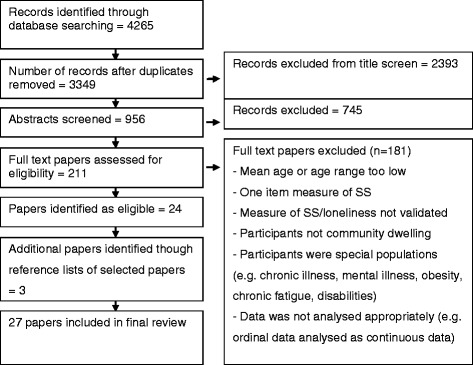
BACKGROUND: The promotion of active and healthy ageing is becoming increasingly important as the population ages. Physical activity (PA) significantly reduces all-cause mortality and contributes to the prevention of many chronic illnesses. However, the proportion of people globally who are active enough to gain these health benefits is low and decreases with age. Social support (SS) is a social determinant of health that may improve PA in older adults, but the association has not been systematically reviewed. This review had three aims: 1) Systematically review and summarise studies examining the association between SS, or loneliness, and PA in older adults; 2) clarify if specific types of SS are positively associated with PA; and 3) investigate whether the association between SS and PA differs between PA domains. METHODS: Quantitative studies examining a relationship between SS, or loneliness, and PA levels in healthy, older adults over 60 were identified using MEDLINE, PSYCInfo, SportDiscus, CINAHL and PubMed, and through reference lists of included studies. Quality of these studies was rated. RESULTS: This review included 27 papers, of which 22 were cross sectional studies, three were prospective/longitudinal and two were intervention studies. Overall, the study quality was moderate. Four articles examined the relation of PA with general SS, 17 with SS specific to PA (SSPA), and six with loneliness. The results suggest that there is a positive association between SSPA and…
Overview
CoChat Summary
## TL;DR
This systematic review of 27 papers found that social support specific to physical activity is generally positively associated with physical activity in older adults, especially support from family. In contrast, general social support showed no clear association, while loneliness was generally negatively associated with physical activity, though measurement variability limited firm conclusions.
## Key findings
- The review included 27 papers: 22 cross-sectional, 3 prospective/longitudinal, and 2 intervention studies; overall study quality was moderate.
- Of the 21 studies examining general or PA-specific social support, 13 found a significant positive association with physical activity and 1 found a significant negative association.
- For social support specific to physical activity (SSPA), 11 of 17 studies reported at least one significant positive association; the review concludes the association is especially positive when support comes from family members.
- Among the 6 loneliness studies, 4 of 6 found a significant negative association with physical activity; when the low-quality study was removed, the pattern was 67% significant and negative.
- For leisure-time physical activity (LTPA), the review reports a more consistent positive association with support: among studies assessing SSPA from friends and family, 67% of friend-support results and 83% of family-support results were positive for LTPA.
## Methods
- Design: Systematic review following PRISMA; studies were rated for quality using the Gyorkos risk assessment tool and synthesized by direction/significance of association.
- Data/sample: Quantitative, peer-reviewed studies in English, German, French, or Dutch on generally healthy community-dwelling older adults with mean age at least 60 years (minimum age no less than 50), identified from MEDLINE, PSYCInfo, SportDiscus, CINAHL, PubMed, plus reference lists.
- Main analysis: Studies were grouped into general social support, social support specific to physical activity, and loneliness; associations were coded as positive/negative/no association and summarized using the review’s overall rating scheme.
## Limitations
- The paper states that high variability in measurement methods for both social support and physical activity made studies difficult to compare.
- It states that the review excluded older adults with specific medical conditions, mental illness, or disabilities, and excluded qualitative studies; this likely omitted potentially relevant evidence.
- Evident from the text: the evidence base was mostly cross-sectional (22 of 27 studies), so the direction of association cannot be established well, and the paper notes this explicitly in discussing future research.
Model-written summary. Check it against the paper before relying on it.
Integrity signals
Registry
Cites
Statistics
Figures
Verification
Claims the paper makes
12 Valid · 6 Not valid · 45 Not checked · 73 Own results and interpretations
Every source the paper cites for this claim was checked and supports it.
In the paper
“One study found a negative association between SS from family and PA [75].”
§ The association between social support and physical activity in older adults: a systematic review > Results > Social support specific to PA
What the sources say
- Supportedcites [75] Park CH Elavsky S Koo KM Factors influencing physical activity in older adults J Exerc Rehabil 2014 10 1 45 52 10.12965/jer.140089 24678504 PMC3952835 source
The Results report a negative, statistically significant regression coefficient for family support for exercise as a predictor of physical activity (β=−0.220, P<0.01). This supports the claimed negative association, specifically in the study’s multiple-regression analysis. (LLM, conf=0.93)
plainstates an association- Asserted: passes — The authors put it forward as true.
- Checkable: passes — It can be checked against evidence.
- Load-bearing: unclear — It is unclear whether the paper’s conclusions depend on it.
- Based: passes — The paper gives a reason why it holds.
- Supported
The cited sources support only part of this claim — read each source’s verdict below.
In the paper
“Four of the six loneliness studies [58, 59, 61, 63] found a significant negative association.”
§ The association between social support and physical activity in older adults: a systematic review > Results > Relationship between SS, loneliness and PA
What the sources say
- Partly supportedcites [58] Luo Y Waite LJ Loneliness and mortality among older adults in China J Gerontol Series B Psychol Sci Soc Sci 2014 69 4 633 45 10.1093/geronb/gbu007 PMC4049147 24550354 sourceExperimental — accuracy not yet measured
The Results report significant negative associations between loneliness and physical exercise, self-rated health, and emotional health. The cited paper is one study, however, and does not establish the citing sentence’s count of four out of six studies; the sentence also does not specify which outcome the negative association concerns. No page number is available in our copy. (LLM, conf=0.70)
- Not checked — no full text of the sourcecites [59] Netz Y Goldsmith R Shimony T Arnon M Zeev A Loneliness is associated with an increased risk of sedentary life in older Israelis Aging Ment Health 2013 17 1 40 7 10.1080/13607863.2012.715140 22913477 source
- Not checked — no full text of the sourcecites [61] Shankar A McMunn A Banks J Steptoe A Loneliness, social isolation, and behavioral and biological health indicators in older adults Health Psychol 2011 30 4 377 85 10.1037/a0022826 21534675 source
- Not checked yetcites [63] Theeke LA Sociodemographic and health-related risks for loneliness and outcome differences by loneliness status in a sample of U.S. older adults Res Gerontol Nurs 2010 3 2 113 25 10.3928/19404921-20091103-99 20415360 source
Checked before — its earlier verdict is held back until a new check runs.
plainstates an association- Asserted: passes — The authors put it forward as true.
- Checkable: passes — It can be checked against evidence.
- Load-bearing: unclear — It is unclear whether the paper’s conclusions depend on it.
- Based: passes — The paper gives a reason why it holds.
- Partly supported
The cited sources support only part of this claim — read each source’s verdict below.
In the paper
“but only two of four in males [58, 63].”
§ The association between social support and physical activity in older adults: a systematic review > Results > Association between SS, loneliness and specific PA domains
What the sources say
- Partly supportedcites [58] Luo Y Waite LJ Loneliness and mortality among older adults in China J Gerontol Series B Psychol Sci Soc Sci 2014 69 4 633 45 10.1093/geronb/gbu007 PMC4049147 24550354 sourceExperimental — accuracy not yet measured
The Results (page unavailable) report negative, significant lagged effects in both directions between physical exercise and loneliness. They do not report that two of four associations were significant among males; the Methods (page unavailable) describe controlling for gender, not a male-specific result. (LLM, conf=0.87)
- Could not verifycites [63] Theeke LA Sociodemographic and health-related risks for loneliness and outcome differences by loneliness status in a sample of U.S. older adults Res Gerontol Nurs 2010 3 2 113 25 10.3928/19404921-20091103-99 20415360 sourceExperimental — accuracy not yet measured
Our copy of Theeke (2010) reports only whole-sample comparisons of loneliness groups (never/briefly/chronically lonely) on moderate activity/exercise — e.g., Results for Outcomes Reported with Loneliness ('The chronically lonely group reported less exercise...'; 49.8% vs 33.1% exercising more than once weekly) — and no sex-stratified set of activity-loneliness associations. Searched for 'leisure-time physical activity', 'gender/sex differences in exercise and loneliness', and 'negative correlation between physical activity and loneliness': the nearest passages are Gender and Loneliness and Unanticipated Findings, which state gender was not predictive of loneliness and that men and women may experience loneliness differently, but nothing about four associations of which two were negative and significant in males. The paper therefore neither supports nor contradicts the specific claim attributed to it. (LLM, conf=0.70)
plainstates an association- Asserted: passes — The authors put it forward as true.
- Checkable: passes — It can be checked against evidence.
- Load-bearing: unclear — It is unclear whether the paper’s conclusions depend on it.
- Based: passes — The paper gives a reason why it holds.
- Partly supported
The cited sources support only part of this claim — read each source’s verdict below.
In the paper
“with three of four associations [58, 59, 63] being negative and significant in females”
§ The association between social support and physical activity in older adults: a systematic review > Results > Association between SS, loneliness and specific PA domains
What the sources say
- Partly supportedcites [58] Luo Y Waite LJ Loneliness and mortality among older adults in China J Gerontol Series B Psychol Sci Soc Sci 2014 69 4 633 45 10.1093/geronb/gbu007 PMC4049147 24550354 sourceExperimental — accuracy not yet measured
The Results report that the three-year lagged associations between physical exercise and loneliness were negative and significant. They do not report those associations separately for females or establish the claimed count of three out of four associations. (LLM, conf=0.84)
- Not checked — no full text of the sourcecites [59] Netz Y Goldsmith R Shimony T Arnon M Zeev A Loneliness is associated with an increased risk of sedentary life in older Israelis Aging Ment Health 2013 17 1 40 7 10.1080/13607863.2012.715140 22913477 source
- Not checked yetcites [63] Theeke LA Sociodemographic and health-related risks for loneliness and outcome differences by loneliness status in a sample of U.S. older adults Res Gerontol Nurs 2010 3 2 113 25 10.3928/19404921-20091103-99 20415360 source
Checked before — its earlier verdict is held back until a new check runs.
plainstates an association- Asserted: passes — The authors put it forward as true.
- Checkable: passes — It can be checked against evidence.
- Load-bearing: unclear — It is unclear whether the paper’s conclusions depend on it.
- Based: passes — The paper gives a reason why it holds.
- Partly supported
The cited sources support only part of this claim — read each source’s verdict below.
In the paper
“Four (57%) of these were significant and negative [58, 59, 61, 63]”
§ The association between social support and physical activity in older adults: a systematic review > Results > Loneliness and PA levels
What the sources say
- Supportedcites [58] Luo Y Waite LJ Loneliness and mortality among older adults in China J Gerontol Series B Psychol Sci Soc Sci 2014 69 4 633 45 10.1093/geronb/gbu007 PMC4049147 24550354 source
The Results report that the three-year lagged effect of loneliness on physical exercise was negative and significant. This supports citing the paper as one of the studies with a significant negative association; the four-of-seven tally is the citing paper’s synthesis, not a count attributed to this individual source. (LLM, conf=0.91)
- Not checked — no full text of the sourcecites [59] Netz Y Goldsmith R Shimony T Arnon M Zeev A Loneliness is associated with an increased risk of sedentary life in older Israelis Aging Ment Health 2013 17 1 40 7 10.1080/13607863.2012.715140 22913477 source
- Not checked — no full text of the sourcecites [61] Shankar A McMunn A Banks J Steptoe A Loneliness, social isolation, and behavioral and biological health indicators in older adults Health Psychol 2011 30 4 377 85 10.1037/a0022826 21534675 source
- Partly supportedcites [63] Theeke LA Sociodemographic and health-related risks for loneliness and outcome differences by loneliness status in a sample of U.S. older adults Res Gerontol Nurs 2010 3 2 113 25 10.3928/19404921-20091103-99 20415360 sourceExperimental — accuracy not yet measured
In 'Results for Outcomes Reported with Loneliness' (ANCOVA paragraph, and the Table 14/15/16 discussion) Theeke (2010) does report a significant negative loneliness–physical activity association: the chronically lonely reported less moderate activity/exercise than the never lonely (33.1% vs 49.8% exercising more than once weekly), and this held after controlling for marital status, self-rated health, education, functional status, chronic illness count, age, income and household size. However, our copy contains no 'seven associations between loneliness and physical activity' and no four-of-seven (57%) count: the paper's seven hypotheses spanned research questions three through nine (activity level, smoking, alcohol use, increase in chronic illness, depression, physician contacts, nursing home stays) and FIVE of those seven were supported. The pooled 4/7 (57%) figure and the restriction to physical activity are therefore not attributable to this source. (LLM, conf=0.75)
plainstates an association- Asserted: passes — The authors put it forward as true.
- Checkable: passes — It can be checked against evidence.
- Load-bearing: passes — The paper’s conclusions depend on it.
- Based: passes — The paper gives a reason why it holds.
- Supported
65 more claims · 2 with their cited sources checked
Create a free account to see all 136 claims and to verify the 6 references still open.
- Probably not a substantial claim. 33
- It may state two separate claims as one. 42
- The quote only partly states this claim. 2
Claims other papers make about this one
Each is checked against this paper’s own text: does it say what the citing paper says it does?
The source backs part of the claim, not all of it — or backs it for a different population, condition or comparison.
In the citing paper
“Previous research has also indicated social support to be an important determinant of physical activity engagement [242–244].”
From Rates of compliance and adherence to high-intensity interval training: a systematic review and Meta-analyses (2023) · cites this paper as [244]
Experimental — accuracy not yet measured
Citations
Cites
The theory of planned behavior
Ajzen, I. (1991) · Organizational Behavior and Human Decision Processes · doi:10.1016/0749-5978(91)90020-t · Cited by 134,657
The CES-D Scale: A Self-Report Depression Scale for Research in the General Population
Radloff, L. S. (1977) · Applied Psychological Measurement · doi:10.1177/014662167700100306 · Cited by 53,267
Liberati, A., Altman, D. G., Tetzlaff, J., Mulrow, C., Gøtzsche, P. C., Ioannidis, J. P. A., Clarke, M., Devereaux, P. J., Kleijnen, J., & Moher, D. (2009) · PLoS Medicine · doi:10.1371/journal.pmed.1000100 · Cited by 28,164 · cited 1×
“Methods Protocol The Preferred Reporting Items for Systematic Reviews and Meta-Analyses (PRISMA) checklist has been followed to undertake this systematic review [52].”
MethodToward an experimental ecology of human development.
Bronfenbrenner, U. (1977) · American Psychologist · doi:10.1037/0003-066x.32.7.513 · Cited by 10,853 · cited 1×
“However, many behaviour change theories, including the Social Cognitive Theory [19], Social-Ecological Model [20, 21], Theory of Planned Behaviour [22] and the Health Belief Model [23], highlight the importance of social factors such as social support (SS) and social connectedness in maintaining and/or initiating beha…”
BackgroundLiberati, A., Altman, D. G., Tetzlaff, J., Mulrow, C., Gøtzsche, P. C., Ioannidis, J. P. A., Clarke, M., Devereaux, P. J., Kleijnen, J., & Moher, D. (2009) · Annals of Internal Medicine · doi:10.7326/0003-4819-151-4-200908180-00136 · Cited by 10,349
‘Small Changes' to Diet and Physical Activity Behaviors for Weight Management
Hills, A. P., Byrne, N. M., Lindstrom, R., & Hill, J. O. (2013) · Obesity Facts · doi:10.1159/000345030 · Cited by 9,493
An ecological perspective on health promotion programs
McLeroy, K. R., Bibeau, D., Steckler, A., & Glanz, K. (1988) · Health Education Quarterly · doi:10.1177/109019818801500401 · Cited by 8,502 · cited 1×
“However, many behaviour change theories, including the Social Cognitive Theory [19], Social-Ecological Model [20, 21], Theory of Planned Behaviour [22] and the Health Belief Model [23], highlight the importance of social factors such as social support (SS) and social connectedness in maintaining and/or initiating beha…”
BackgroundHuman agency in social cognitive theory.
Bandura, A. (1989) · American Psychologist · doi:10.1037/0003-066x.44.9.1175 · Cited by 8,263
What good are positive emotions?
Fredrickson, B. L. (1998) · Review of General Psychology · doi:10.1037/1089-2680.2.3.300 · Cited by 6,066
Social Learning Theory and the Health Belief Model
Rosenstock, I. M., Strecher, V. J., & Becker, M. H. (1988) · Health Education Quarterly · doi:10.1177/109019818801500203 · Cited by 5,564 · cited 1×
“However, many behaviour change theories, including the Social Cognitive Theory [19], Social-Ecological Model [20, 21], Theory of Planned Behaviour [22] and the Health Belief Model [23], highlight the importance of social factors such as social support (SS) and social connectedness in maintaining and/or initiating beha…”
Background
Research works printed but not linked: 8
- World Health Organisation, US National Institute of Aging Global Health and Ageing 2011 Geneva World Health Organisation
- Aging NACo Seniors in Canada, 2006 Report Card 2006 Ottawa Government of Canada
- Organization WH. Global recommendations on physical activity for health. 2010 26180873
- Wood YR Social support and social networks: nature and measurement Adv Psychol Assess 1984 6 312 53
- Chinuntuya P A causal model of exercise behavior of the elderly in Bangkok Metropolis 2001 Mahidol University Faculty of Graduate Studies
- Washburn R Smith K Jette A Janney C Physical Activity Scale for the Elderly: administration and scoring instruction manual 1991 Watertown New England Research Institute
- Cutrona CE Russell DW The provisions of social relationships and adaptation to stress Adv Pers Relat 1987 1 1 37 67
- Itakura M Oka K Takeda N Watanabe Y Nakamura Y Exercise behavior and social support for exercise among adults Walking Res 2003 7 151 7
Cited by
Items 701–800 of 861
Yang, C., Mpofu, E., Li, X., Dorstyn, D., Li, Q., & Brock, K. E. (2021) · Australian Journal of Rehabilitation Counselling · doi:10.1017/jrc.2021.7 · Cited by 1
Perspective Chapter: Psychological Effects of COVID-19 Pandemic
Değer, V. B. (2023) · IntechOpen eBooks · doi:10.5772/intechopen.101498 · Cited by 1
Doran, K., & Resnick, B. M. (2022) · Journal of Aging and Physical Activity · doi:10.1123/japa.2021-0299 · Cited by 2
Galeano, I. O., Achinelli, C. E. C., Brizuela, M. G., Cárdenas, M. G., Rivas, M. E., Rodríguez-Riveros, M. I., & Velázquez, G. (2022) · Memorias del Instituto de Investigaciones en Ciencias de la Salud · doi:10.18004/mem.iics/1812-9528/2022.020.01.64 · Cited by 2
Lanou, A. J., Jones, J. A., Noble, L. W., Smythe, T., Gambrill, L. A., Olson, E., & Woodall, T. (2023) · IntechOpen eBooks · doi:10.5772/intechopen.104997 · Cited by 2
Banman, L. (2018) · Mspace (University of Manitoba) · Cited by 1
Pulmonary Resection in the Presence of Localized Empyema: (Report of Four Cases).
Lindskog, G. E. (1943) · PubMed Central · Cited by 1
Lin, S. (2020) · DR-NTU (Nanyang Technological University) · doi:10.32657/10356/151433 · Cited by 1
Sung, E.-S., & Park, J. (2022) · Research Square · doi:10.21203/rs.3.rs-1821766/v1 · Cited by 1
Aloko, E. A., Seibu, M., Apaak, D., Sarpong, E. O., Sorkpor, R. S., & Ansah, E. W. (2023) · Research Square · doi:10.1101/2023.06.05.23291006 · Cited by 2
Factors Related to Physical Activity Among Older Adults: A Loughborough-Based StudyPreprint
Guan, J., Zitkus, E., de Bont, C. J. P. M., & Dong, H. (2023) · Research Square · doi:10.21203/rs.3.rs-3328424/v1 · Cited by 1
Study protocol: process and outcome evaluation of the Walk with Ease program for fall prevention
Lamoureux, N. R., Lansing, J. E., Dixon, P. M., Phillips, L. A., Radske-Suchan, T., Dorneich, M. C., Chou, L., & Welk, G. J. (2024) · BMC Public Health · doi:10.1186/s12889-024-20138-z · Cited by 1
Meigh, N. J., Davidson, A. R., Thomson, O. P., Keogh, J., Hing, W. A., Schram, B. L., & Mickan, S. M. (2024) · medRxiv · doi:10.1101/2024.12.15.24319060 · Cited by 2
Anderson, C. (2018) · FIU - Digital Commons (Florida International University) · doi:10.25148/etd.fidc007031 · Cited by 2
Klebbe, R., Steinert, A., Buchem, I., & Müller‐Werdan, U. (2019) · Lecture notes in computer science · doi:10.1007/978-3-030-21817-1_24
Strategies to Improve Employee Exercise Participation in Corporate Fitness Centres
Brandner, J. K. (2018) · Victoria University Research Repository (Victoria University)
Fatores psicossociais relacionados ao engajamento em atividade física: um estudo com trabalhadores
de Almeida, L. Y. (2019) · Digital Library of Theses and Dissertations (Universidade de São Paulo) · doi:10.11606/t.22.2019.tde-23072019-103440
de Oliveira, D. V., Cunha, P. M., Freire, G. L. M., et al. (2019) · Revista Contexto & Saúde · doi:10.21527/2176-7114.2019.37.142-148
Singh, C. (2019) · SHAREOK (University of Oklahoma; Oklahoma State University; Central Oklahoma University)
Changing Behavior Using Control Theory
Mansell, W. (2020) · Cambridge University Press eBooks · doi:10.1017/9781108677318.009 · Cited by 13
How Community Health Workers Can Improve Workforce Diversity and Dietary Outcomes
Burt, K. G., & Sisselman-Borgia, A. (2020) · Nutrition Today · doi:10.1097/nt.0000000000000434
Lee, S. (2020) · ThinkIR: The University of Louisville's Institutional Repository (University of Louisville) · doi:10.18297/etd/3375
The Relationship between Social Isolation and Wellbeing in Older Adults
Sen, K. (2020) · University of North Texas Digital Library (University of North Texas) · doi:10.12794/metadc1707364
Gómez, T. B., Salas, M. C., Ramírez-Olivares, R., Machuca, L. H. L., Aguilar, C. Á., & Muñoz, N. G. (2020) · Revista Chilena de Enfermería · doi:10.5354/2452-5839.2020.60247
Psychosocial Factors Related to Physical Activity in Frail and Prefrail Elderly People.Preprint
Jiménez-Zazo, F., Navarrete‐Villanueva, D., Gómez‐Cabello, A., et al. (2021) · Research Square · doi:10.21203/rs.3.rs-151852/v1
Physical Activity Frequency and Mental Health in Old Age: A Bidirectional Association
Juhendra, J., EkaIzzaty, R., & Wibowo, Y. S. (2020) · Journal of Educational Health and Community Psychology · doi:10.12928/jehcp.v9i4.18113
Zaragoza, L. M. M., & Molina‐García, J. (2020) · Actividad física y deporte: ciencia y profesión
Community-based exercise rehabilitation in a diverse chronic disease population
Skelly, F. (2021) · Dublin City University Open Access Institutional Repository (Dublin City University) · Cited by 6
Biopsychosocial Inequality, Active Lifestyle and Chronic Health Conditions In BraziliansPreprint
Guedes, M. B. O. G., Lopes, J. M., da Silva, L., et al. (2021) · Research Square · doi:10.21203/rs.3.rs-537309/v1
Asiamah, N., Vieira, E. R., Gasana, J., Conduah, A. K., & Eduafo, R. (2021) · Journal of Public Health · doi:10.1007/s10389-021-01582-2 · Cited by 2
“…individual who once served as active social network members can be particularly instrumental in providing reminders and encouragements for physical activity in the community (e.g. ‘go do your exercises because you do not want to end up like me’) (Greenfield et al. 2015; Lindsay Smith et al. 2017).”
BackgroundSabzmakan, L., Rajapour, R., & Kordasiabi, M. C. (2020) · Research Square · doi:10.21203/rs.2.23725/v1
“Previous studies confirmed the importance of social support and outcome expectation in PA behavior change (18, 40, 41).”
BackgroundPhysical Activity Promotion in the Home Health Setting
Greenwalt, D., Phillips, S. A., & Severin, R. S. (2021) · Home Healthcare Now · doi:10.1097/nhh.0000000000001025
Correlates of Physical Activity Based on the Social Ecological Model: A Meta-Analysis
Kim, Y., Lee, J., & Kang, S. (2022) · The Asian Journal of Kinesiology · doi:10.15758/ajk.2022.24.1.3
“구체적으로 본 연구에서 청소년들은 친구의 지지가 그들의 신체활동 참여에 보다 중요한 사 회적 요인이라고 인식하고 있는 반면, 노인들은 가족의 지지가 신체활동과 보다 더 유의한 상관이 있는 것으로 보고하였다 [19].”
Fox, M. T., Butler, J. I., Sidani, S., & Nguyen, A. M. (2022) · Research Square · doi:10.21203/rs.3.rs-1417221/v1
Social Support for Exercise and Its Effect on Physical Activity Level among Female Teachers
Abdolkarimi, M., Heydari, F. A., Rafsanjani, S. S. L., & Eslami, H. (2021) · Social behavior research and health · doi:10.18502/sbrh.v5i1.6730
Hagger, M. S., Cameron, L. D., Hamilton, K., Hankonen, N. E., & Lintunen, T. (2020) · Cambridge University Press eBooks · doi:10.1017/9781108677318.047
Correlates of Physical Activity Older Adults Attending to Senior Citizens’ Clubs
Sas-Nowosielski, K., & Szopa-Wiśnios, S. (2022) · The New Educational Review · doi:10.15804/tner.22.67.1.06 · Cited by 1
ON THE IMPORTANCE TO STUDY OLDER ADULT’S WELL-BEING
SÎRBU, A.-C. (2022) · Journal of Public Administration Finance and Law · doi:10.47743/jopafl-2022-23-20 · Cited by 1
“It is also noted that social networks and social support are factors that make older adults adhere to exercise more often (Smith et al., 2017).”
BackgroundMehrabi, S., Drisdelle, S., Dutt, H. R., & Middleton, L. E. (2022) · Research Square · doi:10.21203/rs.3.rs-1938432/v1
Marineci, C. D. (2022) · Farmacist ro · doi:10.26416/farm.207.4.2022.7088
Streur-Kranenburg, M. (2023) · Bohn Stafleu van Loghum eBooks · doi:10.1007/978-90-368-2863-5_10
Ghorbani, S., Farhangnia, S., Zanganeh, F., Noohpisheh, S., & Shakki, M. (2021) · Journal of Research Development in Nursing and Midwifery · doi:10.52547/jgbfnm.18.2.1
Shared Roles and Responsibilities of Older Adults in Jaffna, Sri Lanka
Sivakumaran, S., & Jeevasuthan, S. (2023) · doi:10.1093/oso/9780197677216.003.0020
Brinkhof, L. P., Huth, K. B. S., Murre, J. M. J., de Wit, S., Krugers, H. J., & Ridderinkhof, K. R. (2023) · Frontiers in Psychology · doi:10.3389/fpsyg.2023.1264753
Lohana, C. K., & Kumar, V. (2023) · International Journal of Research in Medical Sciences · doi:10.18203/2320-6012.ijrms20232761
Voelcker‐Rehage, C., Janssen, T. I., Cordes, T., & Wollesen, B. (2023) · Springer eBooks · doi:10.1007/978-3-662-67020-0_13 · Cited by 1
Apoio social na prática de atividade física de trabalhadores
de Almeida, L. Y., de Almeida, J. C. P., de Oliveira, J. L., et al. (2023) · Acta Paulista de Enfermagem · doi:10.37689/acta-ape/2024ao0000521
4. Community-Based Interventions
McDermott, R. J., Mayer, A. B., Martinasek, M. P., Loi, C. A., Vamos, S., Mahmooda K. Pasha, P., & McDaniel, J. T. (2023) · American Public Health Association eBooks · doi:10.2105/9780875533377ch04
THE EXPERIENCE OF THAI OLDER ADULTS PARTICIPATING IN LONG-TERM EXERCISE : A QUALITATIVE STUDY
Sithichoksakulchai, S., Tonapa, S. I., & Hsu, M. (2023) · Proceeding B-ICON · doi:10.33088/bicon.v2i1.213
Balikuddembe, J. K., Zheng, Y., Fu, P., Ogaya, J. B., & Lucero‐Prisno, D. E. (2024) · Research Square · doi:10.21203/rs.3.rs-4021080/v1
Ubiquity of Hypertension- Systematic Review
Kumar, S., Gohri, S., & Bhumika, B. (2023) · International Journal of Pharma Professional’s Research (IJPPR) · doi:10.48165/ijppronline.2023.14301
Siegrist, M., Schaller, N., Weiß, M., Isaak, J., Schmid, V., Köppel, E., Weichenberger, M., Mende, E., Haller, B., & Halle, M. (2023) · Figshare · doi:10.6084/m9.figshare.24002730
Impact of COVID-19 lockdown on physical activity behavior among students in Somalia
Al-Mhanna, S. B., Batrakoulis, A., Sheikh, A. M., Aldayel, A. A., Sabo, A., Mohamed, M., Afolabi, H. A., Ahmed, A. Y., Mohamed, S. I., Gülü, M., et al. (2024) · AIMS Public Health · doi:10.3934/publichealth.2024023 · Cited by 1
“Maintaining a healthy lifestyle and reducing mortality rates hinge on essential factors such as social support, confidence, and the availability of chances to participate in PA [69].”
BackgroundYang, Y. C., Li, Y., Fan, S., He, J., Xi, J., & He, S. (2024) · BMJ Public Health · doi:10.1136/bmjph-2023-000781
Çetinkaya, A., & Yıldızer, G. (2024) · Gaziantep Üniversitesi Spor Bilimleri Dergisi · doi:10.31680/gaunjss.1439627
Physical Activity and Heart Health
Bavis, M. P., Wilbur, J., & Tracy, M. J. (2024) · Springer eBooks · doi:10.1007/978-3-031-53705-9_11 · Cited by 1
Hammond, L., & Moseley, K. (2024) · Nursing Made Incredibly Easy! · doi:10.1097/nme.0000000000000047
Hasan, S., Anis, T., Saeed, H., Aroofa, H., Raza, A., Arshad, M. Z., Tabassum, S., & Imtiaz, R. (2024) · Journal of Health and Rehabilitation Research · doi:10.61919/jhrr.v4i2.791
Arita, K., Ishibashi, Y., Tajima, T., Ikechi, Y., & Ishibashi, H. (2024) · Psychogeriatrics · doi:10.1111/psyg.13189
Walters, R., & Özakinci, G. (2024) · doi:10.2196/preprints.66433
A Bibliometric Analysis of Research Trends in Aging and Leisure Activities from 2000 to 2023
Begam, J. M., & Azeez, E. P. A. (2024) · Current Aging Science · doi:10.2174/0118746098351035241009100118
Enhancing social skills: the impact of advanced physical education program development
Amirudin, Nurdin, A., Zahara, Z., Nugraha, H., & Masyitah (2024) · Edu Sportivo/Edu Sportivo · doi:10.25299/esijope.2024.vol5(3).16546 · Cited by 5
The Impact of Executive Function on Retention and Compliance in Physical Therapy in Veterans
Ogawa, E. F., Harris, R., Ward, R. E., Palleschi, M. K., Milberg, W., GAGNON, D. R., Halasz, I., & Bean, J. F. (2024) · Archives of Rehabilitation Research and Clinical Translation · doi:10.1016/j.arrct.2024.100383 · Cited by 1
Nikbakhsh, B., & Birghani, M. H. (2024) · Majmū’ah-i musavvabāt-i majlis-i showrā-yi millī. · doi:10.61186/scds.12.3.37
Chen, J., Lai, T., Chung, Y.-Y., Park, J., & Liao, Y. (2024) · BMJ Open · doi:10.1136/bmjopen-2024-086240 · Cited by 1
Daungsupha, K., Pansakun, N., Srisookkum, T., Manotham, M., Promma, N., Somjit, P., & Lidchiwwong, P. (2025) · Universal Journal of Public Health · doi:10.13189/ujph.2025.130116 · Cited by 5
Gholipoor, M., Ghafouri, F., & Preuß, H. (2025) · Leisure/Loisir · doi:10.1080/14927713.2025.2461771
“The results of this research align with other studies (Gaskin & Orellana, 2018; Lindsay Smith et al., 2017), specifically supporting items related to social support.”
Ying, J., Zhang, L., Chen, Y., Jia, Y., & Zheng, P. (2025) · Geriatric Nursing · doi:10.1016/j.gerinurse.2025.01.032
Noviello, C., Riformato, G., Palattella, M. M., Lattanzio, S., Cuscianna, E., & Tafuri, S. (2025) · The Journal of Sports Medicine and Physical Fitness · doi:10.23736/s0022-4707.25.16125-2 · Cited by 2
John, J. C., Lee, M., Park, S. K., McNeill, L. H., Hoelscher, D. M., Schembre, S. M., Reininger, B. M., & Strong, L. L. (2025) · Health Education & Behavior · doi:10.1177/10901981251322379 · Cited by 1
Depression, Exercise, and HIV/AIDS: Implications for Neurorehabilitation and Community Health
Ibeneme, S. C., Nwosu, A. O., Ibeneme, G. C., & Uwakwe, V. C. (2024) · Springer eBooks · doi:10.1007/978-3-031-32046-0_89-1
Patient-Related Barriers to Chronic Pain Management Among Cancer Survivors: A Narrative SynthesisPreprint
Zhu, J. J. H., Ulrich, C. M., Compton, P. A., & Deng, J. F. (2025) · Research Square · doi:10.21203/rs.3.rs-6296813/v1
“Studies have found signi�cant correlations between higher levels of social support and likelihood of engaging in physical activity [79, 80].”
Oduro, J. K. (2025) · Health & Social Care in the Community · doi:10.1155/hsc/5023600 · Cited by 1
Morikawa, M., Harada, K., Nishijima, C., Fujii, K., Kakita, D., Okuya, T., Soma, K., Yamashiro, Y., Takayanagi, N., Sudo, M., et al. (2025) · Research Square · doi:10.21203/rs.3.rs-6769060/v1
Dunne, A., Bullas, A. M., Quirk, H., & Haake, S. J. (2025) · medRxiv · doi:10.1101/2025.06.18.25329855 · Cited by 1
Salih, S. A., Koo, A., Boland, N., & Reid, N. (2025) · International Journal of Environmental Research and Public Health · doi:10.3390/ijerph22081162 · Cited by 1
“These findings reiterate the importance of underlying mechanisms associated with community participation, namely physical activity and social connectedness, to promote the achievement of key TCP objectives such as independence, companionship and quality of life [29,30].”
Lived Experiences of Married Persons with Physical Disabilities
Velez, R. G. J. P. (2025) · doi:10.38124/ijisrt/25jul572
Geraldes, A. A. R., Vieira, G. A. D. B., & Farinatti, P. (2025) · Journal of Aging and Physical Activity · doi:10.1123/japa.2024-0202
Powell, L., Ellis, J., Kipling, K., Longster, H., Roden, A., & Azevedo, L. B. (2025) · Physical Therapy Reviews · doi:10.1080/10833196.2025.2543159 · Cited by 2
Hooı, L. B., Yau, Y., Shen, Y. C., Lee, K.-F., & Raj, A. (2025) · International Journal of Statistics in Medical Research · doi:10.6000/1929-6029.2025.14.43
Sun, M., Zhang, N., Zhang, Y., Chang, W., Cao, H., Zhou, Q., Li, L., Tang, Z., Zhou, Y., Li, H., et al. (2025) · Frontiers in Public Health · doi:10.3389/fpubh.2025.1598440
Gao, Y., Song, J., Cui, C., & Li, Y. (2025) · Sustainability · doi:10.3390/su17188281
Vennu, V. S., & Bindawas, S. M. (2025) · Work · doi:10.1177/10519815251377028
Depression, Exercise, and HIV/AIDS: Implications for Neurorehabilitation and Community Health
Ibeneme, S. C., Nwosu, A. O., Ibeneme, G. C., & Uwakwe, V. C. (2025) · Springer eBooks · doi:10.1007/978-3-031-73363-5_89
Liu, Z., Li, Y., Mei, Z., Li, J., Yan, X., & Cao, C. (2025) · Social Psychiatry and Psychiatric Epidemiology · doi:10.1007/s00127-025-03001-3 · Cited by 3
Shankar, R., Devi, F., & Qian, X. (2025) · medRxiv · doi:10.1101/2025.09.30.25337030
“Furthermore, the pathway from social isolation to physical activity participation is mediated by complex psychological, social, and environmental factors that require systematic examination to inform effective intervention strategies [8].”
Preferences and Willingness to Pay for Physical Activity: A Discrete Choice Experiment StudyPreprint
Veisi, M. S., Daroudi, R., & Sari, A. A. (2025) · Research Square · doi:10.21203/rs.3.rs-7614264/v1
Cohen, H. R., & Holtzer, R. (2025) · Archives of Clinical Neuropsychology · doi:10.1093/arclin/acaf088
Effect of the BFR-7211 on lower limb muscle strength in older adults: A randomized controlled trial
Kim, Y., Kang, S., Kim, M., Kim, J., & Youn, B.-Y. (2025) · The journal of nutrition health & aging · doi:10.1016/j.jnha.2025.100692 · Cited by 1
“Therefore, maintaining and enhancing lower limb strength is essential for preserving health in older age, underscoring the importance of developing suitable exercise interventions and supportive environments specifically tailored for older adults [10,11].”
Lee, G., & Martin, P. (2025) · Journal of Elder Policy · doi:10.1002/jey2.70003
Kim, G., Roh, S.-Y., & Hwang, S.-H. (2025) · Medicina · doi:10.3390/medicina61111898 · Cited by 1
“In addition, in multi-person households, healthy lifestyles can be reinforced through mutual monitoring and encouragement of lifestyle habits among family members [39].”
Harris, D., Gluchowski, A., Hall, A., Elliott, E., & Munford, L. A. (2025) · BMC Public Health · doi:10.1186/s12889-025-24981-6
“…review, with included studies from North America, Europe, Asia and Australia, which found that older adults with greater levels of social support for physical activity, were more likely to engage in leisure time physical activity, especially when this social support came from family members [58].”
田, 由. (2025) · Advances in Social Sciences · doi:10.12677/ass.2025.14111004
Couple synchrony in physical activity: effects on individuals with knee osteoarthritis
Cho, Y. W., Huang, Y., Chow, S., & Martire, L. M. (2025) · Annals of Behavioral Medicine · doi:10.1093/abm/kaaf092
Metadata
- Authors
- Lindsay Smith, G., Banting, L., Eime, R., O’Sullivan, G., & van Uffelen, J. G. Z.
- Affiliations
- Victoria University (AU)
- Federation University (AU)
- Venue
- International Journal of Behavioral Nutrition and Physical Activity
- Published
- 2017-04-27
- Volume
- 14
- Issue
- 1
- Pages
- 56-56
- ISSN
- 1479-5868 (ISSN-L)
- PMC
- PMC5408452
- OpenAlex
- W2608453219
- Semantic Scholar
- 9460aa6e600e66166f1c9299a6160f9cbae4576d
- Cited by
- 889
- References
- 112
- Citations by year
- 2026: 79 · 2025: 123 · 2024: 114 · 2023: 106 · 2022: 123 · 2021: 128 · 2020: 123 · 2019: 50 · 2018: 36 · 2017: 6
- FWCI
- 7.21
- Type
- journal article
- Language
- en
- Open access
- gold
- doi.org
- Licence
- cc-by
- Locations
- International Journal of Behavioral Nutrition and Physical Activity (publishedVersion, cc-by)
- Europe PMC (PubMed Central) (publishedVersion, cc-by)
- PubMed Central (publishedVersion, cc-by)
- PubMed (publishedVersion)
- Victoria University Research Repository (Victoria University) (submittedVersion, cc-by)
- FedUni ResearchOnline (Federation University Australia) (submittedVersion, cc-by)
- DOAJ (DOAJ: Directory of Open Access Journals) (submittedVersion, cc-by-sa)
- Deakin Research Online (Deakin University) (submittedVersion)
- Figshare (submittedVersion, cc-by)
- Funders
- Victoria University (Victoria University postgraduate research Scholarship)
- Topics
- Health Sciences › Medicine › Public Health, Environmental and Occupational Health › Physical Activity and Health
- Social Sciences › Health › Health disparities and outcomes
- Health Sciences › Medicine › Public Health, Environmental and Occupational Health › Aging, Health, and Disability
- Keywords
- social support, physical activity, older adults, loneliness, family support, leisure-time physical activity, active ageing, social determinants of health
- MeSH terms
- Aged, Family, Female, Humans, Loneliness, Male, Middle Aged, Social Support, Exercise, Friends
About these checks
Registry, retraction, Cites and statistics results are computed, not judged, with one exception: a printed reference that no index lists is read once by a model before it counts as a citation error. Claims are extracted by a model and kept only when their quote appears verbatim in the text; each cited source is then checked, with a model’s help, for whether it says what the claim relies on. Those verdicts can be wrong — read the claim’s quote and the cited source before relying on one.
The claim verdicts this report counts are experimental: their accuracy is not yet measured.
A language model drew the claims from the paper on 2026-10-10, under version 3 of the claim definition (model deepseek-v4.1-flash, prompt extract-v3).
A second model labelled each claim on 2026-10-10 (model jev-1.13-20260917, definition revision gold-guideline-v0.2).
Cited sources are checked with a language model’s help (gpt-6-sol and qwen3.8-omni-flash).
Statistics and arithmetic are recomputed, not judged.
Confidence bands are shown only for fields calibrated on our annotated test set. None is calibrated yet, so no band is shown.
What counts as a claim ›How we measure confidence ›How we check this ›
Are you an author, or do you see a problem with this page? Request a review
Data sources
Bibliographic data: Semantic Scholar, OpenAlex, Crossref.
Contains information from the Semantic Scholar Academic Graph Datasets, made available under the ODC Attribution License (ODC-BY 1.0).
Semantic Scholar’s data is described in: Kinney, R., et al. (2023). The Semantic Scholar Open Data Platform. arXiv:2301.10140.
