

The association between social support and physical activity in older adults: a systematic review
Open accessThe DOI matches its Crossref record; 110 of the 112 references it cites were found in a registry or an index; 16 of the 97 sources its claims cite were checked for support.
Abstract
BACKGROUND: The promotion of active and healthy ageing is becoming increasingly important as the population ages. Physical activity (PA) significantly reduces all-cause mortality and contributes to the prevention of many chronic illnesses. However, the proportion of people globally who are active enough to gain these health benefits is low and decreases with age. Social support (SS) is a social determinant of health that may improve PA in older adults, but the association has not been systematically reviewed. This review had three aims: 1) Systematically review and summarise studies examining the association between SS, or loneliness, and PA in older adults; 2) clarify if specific types of SS are positively associated with PA; and 3) investigate whether the association between SS and PA differs between PA domains. METHODS: Quantitative studies examining a relationship between SS, or loneliness, and PA levels in healthy, older adults over 60 were identified using MEDLINE, PSYCInfo, SportDiscus, CINAHL and PubMed, and through reference lists of included studies. Quality of these studies was rated. RESULTS: This review included 27 papers, of which 22 were cross sectional studies, three were prospective/longitudinal and two were intervention studies. Overall, the study quality was moderate. Four articles examined the relation of PA with general SS, 17 with SS specific to PA (SSPA), and six with loneliness. The results suggest that there is a positive association between SSPA and…
Overview
CoChat Summary
## TL;DR
This systematic review of 27 papers found that social support specific to physical activity is generally positively associated with physical activity in older adults, especially support from family. In contrast, general social support showed no clear association, while loneliness was generally negatively associated with physical activity, though measurement variability limited firm conclusions.
## Key findings
- The review included 27 papers: 22 cross-sectional, 3 prospective/longitudinal, and 2 intervention studies; overall study quality was moderate.
- Of the 21 studies examining general or PA-specific social support, 13 found a significant positive association with physical activity and 1 found a significant negative association.
- For social support specific to physical activity (SSPA), 11 of 17 studies reported at least one significant positive association; the review concludes the association is especially positive when support comes from family members.
- Among the 6 loneliness studies, 4 of 6 found a significant negative association with physical activity; when the low-quality study was removed, the pattern was 67% significant and negative.
- For leisure-time physical activity (LTPA), the review reports a more consistent positive association with support: among studies assessing SSPA from friends and family, 67% of friend-support results and 83% of family-support results were positive for LTPA.
## Methods
- Design: Systematic review following PRISMA; studies were rated for quality using the Gyorkos risk assessment tool and synthesized by direction/significance of association.
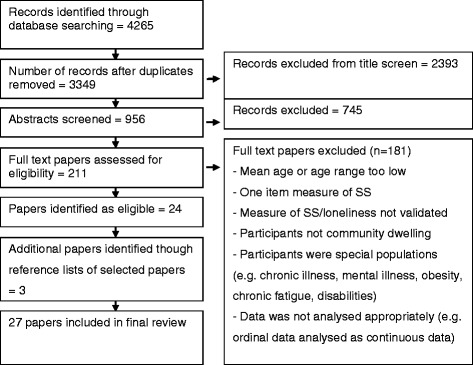
- Data/sample: Quantitative, peer-reviewed studies in English, German, French, or Dutch on generally healthy community-dwelling older adults with mean age at least 60 years (minimum age no less than 50), identified from MEDLINE, PSYCInfo, SportDiscus, CINAHL, PubMed, plus reference lists.
- Main analysis: Studies were grouped into general social support, social support specific to physical activity, and loneliness; associations were coded as positive/negative/no association and summarized using the review’s overall rating scheme.
## Limitations
- The paper states that high variability in measurement methods for both social support and physical activity made studies difficult to compare.
- It states that the review excluded older adults with specific medical conditions, mental illness, or disabilities, and excluded qualitative studies; this likely omitted potentially relevant evidence.
- Evident from the text: the evidence base was mostly cross-sectional (22 of 27 studies), so the direction of association cannot be established well, and the paper notes this explicitly in discussing future research.
Model-written summary. Check it against the paper before relying on it.
Integrity signals
Registry
Cites
Statistics
Figures
Verification
Claims the paper makes
12 Valid · 6 Not valid · 45 Not checked · 73 Own results and interpretations
Every source the paper cites for this claim was checked and supports it.
In the paper
“One study found a negative association between SS from family and PA [75].”
§ The association between social support and physical activity in older adults: a systematic review > Results > Social support specific to PA
What the sources say
- Supportedcites [75] Park CH Elavsky S Koo KM Factors influencing physical activity in older adults J Exerc Rehabil 2014 10 1 45 52 10.12965/jer.140089 24678504 PMC3952835 source
The Results report a negative, statistically significant regression coefficient for family support for exercise as a predictor of physical activity (β=−0.220, P<0.01). This supports the claimed negative association, specifically in the study’s multiple-regression analysis. (LLM, conf=0.93)
plainstates an association- Asserted: passes — The authors put it forward as true.
- Checkable: passes — It can be checked against evidence.
- Load-bearing: unclear — It is unclear whether the paper’s conclusions depend on it.
- Based: passes — The paper gives a reason why it holds.
- Supported
The cited sources support only part of this claim — read each source’s verdict below.
In the paper
“Four of the six loneliness studies [58, 59, 61, 63] found a significant negative association.”
§ The association between social support and physical activity in older adults: a systematic review > Results > Relationship between SS, loneliness and PA
What the sources say
- Partly supportedcites [58] Luo Y Waite LJ Loneliness and mortality among older adults in China J Gerontol Series B Psychol Sci Soc Sci 2014 69 4 633 45 10.1093/geronb/gbu007 PMC4049147 24550354 sourceExperimental — accuracy not yet measured
The Results report significant negative associations between loneliness and physical exercise, self-rated health, and emotional health. The cited paper is one study, however, and does not establish the citing sentence’s count of four out of six studies; the sentence also does not specify which outcome the negative association concerns. No page number is available in our copy. (LLM, conf=0.70)
- Not checked — no full text of the sourcecites [59] Netz Y Goldsmith R Shimony T Arnon M Zeev A Loneliness is associated with an increased risk of sedentary life in older Israelis Aging Ment Health 2013 17 1 40 7 10.1080/13607863.2012.715140 22913477 source
- Not checked — no full text of the sourcecites [61] Shankar A McMunn A Banks J Steptoe A Loneliness, social isolation, and behavioral and biological health indicators in older adults Health Psychol 2011 30 4 377 85 10.1037/a0022826 21534675 source
- Not checked yetcites [63] Theeke LA Sociodemographic and health-related risks for loneliness and outcome differences by loneliness status in a sample of U.S. older adults Res Gerontol Nurs 2010 3 2 113 25 10.3928/19404921-20091103-99 20415360 source
Checked before — its earlier verdict is held back until a new check runs.
plainstates an association- Asserted: passes — The authors put it forward as true.
- Checkable: passes — It can be checked against evidence.
- Load-bearing: unclear — It is unclear whether the paper’s conclusions depend on it.
- Based: passes — The paper gives a reason why it holds.
- Partly supported
The cited sources support only part of this claim — read each source’s verdict below.
In the paper
“but only two of four in males [58, 63].”
§ The association between social support and physical activity in older adults: a systematic review > Results > Association between SS, loneliness and specific PA domains
What the sources say
- Partly supportedcites [58] Luo Y Waite LJ Loneliness and mortality among older adults in China J Gerontol Series B Psychol Sci Soc Sci 2014 69 4 633 45 10.1093/geronb/gbu007 PMC4049147 24550354 sourceExperimental — accuracy not yet measured
The Results (page unavailable) report negative, significant lagged effects in both directions between physical exercise and loneliness. They do not report that two of four associations were significant among males; the Methods (page unavailable) describe controlling for gender, not a male-specific result. (LLM, conf=0.87)
- Could not verifycites [63] Theeke LA Sociodemographic and health-related risks for loneliness and outcome differences by loneliness status in a sample of U.S. older adults Res Gerontol Nurs 2010 3 2 113 25 10.3928/19404921-20091103-99 20415360 sourceExperimental — accuracy not yet measured
Our copy of Theeke (2010) reports only whole-sample comparisons of loneliness groups (never/briefly/chronically lonely) on moderate activity/exercise — e.g., Results for Outcomes Reported with Loneliness ('The chronically lonely group reported less exercise...'; 49.8% vs 33.1% exercising more than once weekly) — and no sex-stratified set of activity-loneliness associations. Searched for 'leisure-time physical activity', 'gender/sex differences in exercise and loneliness', and 'negative correlation between physical activity and loneliness': the nearest passages are Gender and Loneliness and Unanticipated Findings, which state gender was not predictive of loneliness and that men and women may experience loneliness differently, but nothing about four associations of which two were negative and significant in males. The paper therefore neither supports nor contradicts the specific claim attributed to it. (LLM, conf=0.70)
plainstates an association- Asserted: passes — The authors put it forward as true.
- Checkable: passes — It can be checked against evidence.
- Load-bearing: unclear — It is unclear whether the paper’s conclusions depend on it.
- Based: passes — The paper gives a reason why it holds.
- Partly supported
The cited sources support only part of this claim — read each source’s verdict below.
In the paper
“with three of four associations [58, 59, 63] being negative and significant in females”
§ The association between social support and physical activity in older adults: a systematic review > Results > Association between SS, loneliness and specific PA domains
What the sources say
- Partly supportedcites [58] Luo Y Waite LJ Loneliness and mortality among older adults in China J Gerontol Series B Psychol Sci Soc Sci 2014 69 4 633 45 10.1093/geronb/gbu007 PMC4049147 24550354 sourceExperimental — accuracy not yet measured
The Results report that the three-year lagged associations between physical exercise and loneliness were negative and significant. They do not report those associations separately for females or establish the claimed count of three out of four associations. (LLM, conf=0.84)
- Not checked — no full text of the sourcecites [59] Netz Y Goldsmith R Shimony T Arnon M Zeev A Loneliness is associated with an increased risk of sedentary life in older Israelis Aging Ment Health 2013 17 1 40 7 10.1080/13607863.2012.715140 22913477 source
- Not checked yetcites [63] Theeke LA Sociodemographic and health-related risks for loneliness and outcome differences by loneliness status in a sample of U.S. older adults Res Gerontol Nurs 2010 3 2 113 25 10.3928/19404921-20091103-99 20415360 source
Checked before — its earlier verdict is held back until a new check runs.
plainstates an association- Asserted: passes — The authors put it forward as true.
- Checkable: passes — It can be checked against evidence.
- Load-bearing: unclear — It is unclear whether the paper’s conclusions depend on it.
- Based: passes — The paper gives a reason why it holds.
- Partly supported
The cited sources support only part of this claim — read each source’s verdict below.
In the paper
“Four (57%) of these were significant and negative [58, 59, 61, 63]”
§ The association between social support and physical activity in older adults: a systematic review > Results > Loneliness and PA levels
What the sources say
- Supportedcites [58] Luo Y Waite LJ Loneliness and mortality among older adults in China J Gerontol Series B Psychol Sci Soc Sci 2014 69 4 633 45 10.1093/geronb/gbu007 PMC4049147 24550354 source
The Results report that the three-year lagged effect of loneliness on physical exercise was negative and significant. This supports citing the paper as one of the studies with a significant negative association; the four-of-seven tally is the citing paper’s synthesis, not a count attributed to this individual source. (LLM, conf=0.91)
- Not checked — no full text of the sourcecites [59] Netz Y Goldsmith R Shimony T Arnon M Zeev A Loneliness is associated with an increased risk of sedentary life in older Israelis Aging Ment Health 2013 17 1 40 7 10.1080/13607863.2012.715140 22913477 source
- Not checked — no full text of the sourcecites [61] Shankar A McMunn A Banks J Steptoe A Loneliness, social isolation, and behavioral and biological health indicators in older adults Health Psychol 2011 30 4 377 85 10.1037/a0022826 21534675 source
- Partly supportedcites [63] Theeke LA Sociodemographic and health-related risks for loneliness and outcome differences by loneliness status in a sample of U.S. older adults Res Gerontol Nurs 2010 3 2 113 25 10.3928/19404921-20091103-99 20415360 sourceExperimental — accuracy not yet measured
In 'Results for Outcomes Reported with Loneliness' (ANCOVA paragraph, and the Table 14/15/16 discussion) Theeke (2010) does report a significant negative loneliness–physical activity association: the chronically lonely reported less moderate activity/exercise than the never lonely (33.1% vs 49.8% exercising more than once weekly), and this held after controlling for marital status, self-rated health, education, functional status, chronic illness count, age, income and household size. However, our copy contains no 'seven associations between loneliness and physical activity' and no four-of-seven (57%) count: the paper's seven hypotheses spanned research questions three through nine (activity level, smoking, alcohol use, increase in chronic illness, depression, physician contacts, nursing home stays) and FIVE of those seven were supported. The pooled 4/7 (57%) figure and the restriction to physical activity are therefore not attributable to this source. (LLM, conf=0.75)
plainstates an association- Asserted: passes — The authors put it forward as true.
- Checkable: passes — It can be checked against evidence.
- Load-bearing: passes — The paper’s conclusions depend on it.
- Based: passes — The paper gives a reason why it holds.
- Supported
65 more claims · 2 with their cited sources checked
Create a free account to see all 136 claims and to verify the 6 references still open.
- Probably not a substantial claim. 33
- It may state two separate claims as one. 42
- The quote only partly states this claim. 2
Claims other papers make about this one
Each is checked against this paper’s own text: does it say what the citing paper says it does?
The source backs part of the claim, not all of it — or backs it for a different population, condition or comparison.
In the citing paper
“Previous research has also indicated social support to be an important determinant of physical activity engagement [242–244].”
From Rates of compliance and adherence to high-intensity interval training: a systematic review and Meta-analyses (2023) · cites this paper as [244]
Experimental — accuracy not yet measured
Citations
Cites
The theory of planned behavior
Ajzen, I. (1991) · Organizational Behavior and Human Decision Processes · doi:10.1016/0749-5978(91)90020-t · Cited by 134,657
The CES-D Scale: A Self-Report Depression Scale for Research in the General Population
Radloff, L. S. (1977) · Applied Psychological Measurement · doi:10.1177/014662167700100306 · Cited by 53,267
Liberati, A., Altman, D. G., Tetzlaff, J., Mulrow, C., Gøtzsche, P. C., Ioannidis, J. P. A., Clarke, M., Devereaux, P. J., Kleijnen, J., & Moher, D. (2009) · PLoS Medicine · doi:10.1371/journal.pmed.1000100 · Cited by 28,164 · cited 1×
“Methods Protocol The Preferred Reporting Items for Systematic Reviews and Meta-Analyses (PRISMA) checklist has been followed to undertake this systematic review [52].”
MethodToward an experimental ecology of human development.
Bronfenbrenner, U. (1977) · American Psychologist · doi:10.1037/0003-066x.32.7.513 · Cited by 10,853 · cited 1×
“However, many behaviour change theories, including the Social Cognitive Theory [19], Social-Ecological Model [20, 21], Theory of Planned Behaviour [22] and the Health Belief Model [23], highlight the importance of social factors such as social support (SS) and social connectedness in maintaining and/or initiating beha…”
BackgroundLiberati, A., Altman, D. G., Tetzlaff, J., Mulrow, C., Gøtzsche, P. C., Ioannidis, J. P. A., Clarke, M., Devereaux, P. J., Kleijnen, J., & Moher, D. (2009) · Annals of Internal Medicine · doi:10.7326/0003-4819-151-4-200908180-00136 · Cited by 10,349
‘Small Changes' to Diet and Physical Activity Behaviors for Weight Management
Hills, A. P., Byrne, N. M., Lindstrom, R., & Hill, J. O. (2013) · Obesity Facts · doi:10.1159/000345030 · Cited by 9,493
An ecological perspective on health promotion programs
McLeroy, K. R., Bibeau, D., Steckler, A., & Glanz, K. (1988) · Health Education Quarterly · doi:10.1177/109019818801500401 · Cited by 8,502 · cited 1×
“However, many behaviour change theories, including the Social Cognitive Theory [19], Social-Ecological Model [20, 21], Theory of Planned Behaviour [22] and the Health Belief Model [23], highlight the importance of social factors such as social support (SS) and social connectedness in maintaining and/or initiating beha…”
BackgroundHuman agency in social cognitive theory.
Bandura, A. (1989) · American Psychologist · doi:10.1037/0003-066x.44.9.1175 · Cited by 8,263
What good are positive emotions?
Fredrickson, B. L. (1998) · Review of General Psychology · doi:10.1037/1089-2680.2.3.300 · Cited by 6,066
Social Learning Theory and the Health Belief Model
Rosenstock, I. M., Strecher, V. J., & Becker, M. H. (1988) · Health Education Quarterly · doi:10.1177/109019818801500203 · Cited by 5,564 · cited 1×
“However, many behaviour change theories, including the Social Cognitive Theory [19], Social-Ecological Model [20, 21], Theory of Planned Behaviour [22] and the Health Belief Model [23], highlight the importance of social factors such as social support (SS) and social connectedness in maintaining and/or initiating beha…”
Background
Research works printed but not linked: 8
- World Health Organisation, US National Institute of Aging Global Health and Ageing 2011 Geneva World Health Organisation
- Aging NACo Seniors in Canada, 2006 Report Card 2006 Ottawa Government of Canada
- Organization WH. Global recommendations on physical activity for health. 2010 26180873
- Wood YR Social support and social networks: nature and measurement Adv Psychol Assess 1984 6 312 53
- Chinuntuya P A causal model of exercise behavior of the elderly in Bangkok Metropolis 2001 Mahidol University Faculty of Graduate Studies
- Washburn R Smith K Jette A Janney C Physical Activity Scale for the Elderly: administration and scoring instruction manual 1991 Watertown New England Research Institute
- Cutrona CE Russell DW The provisions of social relationships and adaptation to stress Adv Pers Relat 1987 1 1 37 67
- Itakura M Oka K Takeda N Watanabe Y Nakamura Y Exercise behavior and social support for exercise among adults Walking Res 2003 7 151 7
Cited by
Items 601–700 of 861
Psychosocial and Environmental Correlates of Physical Activity in Korean Adults
Lee, J.-H., An, D., Singnoy, C., & Kim, Y. (2024) · Perceptual and Motor Skills · doi:10.1177/00315125241229877 · Cited by 4
“As PA is performed within a physical environment, physical environmental factors are critical to sustaining it, and they include the spatial accessibility of exercise facilities, convenience of exercise facilities, and neighborhood safety (Smith et al., 2017).”
BackgroundRuan, Y., & Wang, J. (2024) · Health & Social Care in the Community · doi:10.1155/2024/8306062 · Cited by 2
Politis, M., Kosidou, K., Fors, S., & Nord, M. (2024) · Sexual Medicine · doi:10.1093/sexmed/qfae022 · Cited by 2
Kringle, E. A., Kersey, J., Lewis, M. A., Gibbs, B. B., & Skidmore, E. R. (2024) · Disability and Rehabilitation · doi:10.1080/09638288.2024.2341867 · Cited by 4
Huang, G., Wabe, N., Raban, M. Z., Silva, S. S. M., Seaman, K. L., Nguyen, A., Meulenbroeks, I., & Westbrook, J. I. (2024) · PLoS ONE · doi:10.1371/journal.pone.0302678 · Cited by 4
Rabia, R. A., Alfayumi‐Zeadna, S., Hendel, T., & Kagan, I. (2024) · Journal of Racial and Ethnic Health Disparities · doi:10.1007/s40615-024-02022-z · Cited by 2
“Finances, lack of support for women suffering from chronic diseases, lack of awareness, and educational programs are the most important barriers that directly affect their levels of health promotion activities [11–13].”
Lesser, I., & Thomson, C. J. (2024) · Journal of Aging and Physical Activity · doi:10.1123/japa.2023-0347 · Cited by 3
Kuzmik, A., Liu, Y., Cuffee, Y., Kong, L., Sciamanna, C., & Rovniak, L. S. (2024) · International journal of exercise science · doi:10.70252/uiet7593 · Cited by 3
Mohammadi, M., Mohammadnabizadeh, S., Mowlaei, L., Ramezankhani, A., Rakhshan, F., & Soleimanzadeh, M. (2024) · Health Education Journal · doi:10.1177/00178969241279272 · Cited by 2
“Social support too (from family, spouses, children and friends) has been shown to be effective in helping older women to develop a health-promoting lifestyle (Lindsay Smith et al., 2017).”
Abreu, T. C., Mackenbach, J. D., Beulens, J. W. J., Vaartjes, I. C. H., & Kawachi, I. I. (2024) · SSM - Population Health · doi:10.1016/j.ssmph.2024.101715 · Cited by 5
Garza, E. Z., Pauly, T., Choi, Y., Murphy, R. A., Linden, W., Ashe, M. C., Madden, K. M., Jakobi, J. M., Gerstorf, D., & Hoppmann, C. A. (2024) · Canadian Journal on Aging / La Revue canadienne du vieillissement · doi:10.1017/s0714980824000412 · Cited by 5
“A reviewof 27papers revealed that both more emotional and more instrumental support were associated with more physical activity levels in healthy, older adults, though the support was not assessed in a health behaviour-specific way (Lindsay Smith et al., 2017).”
Leung, K. M., & Shi, Y. (2025) · JMIR Aging · doi:10.2196/62886 · Cited by 3
Marchant, G., Guillet‐Descas, E., & Heutte, N. (2025) · Frontiers in Psychology · doi:10.3389/fpsyg.2025.1529463 · Cited by 2
Azarfarin, M., Moradikor, N., Salatin, S., Sarailoo, M., & Dadkhah, M. (2025) · Progress in brain research · doi:10.1016/bs.pbr.2025.01.011 · Cited by 3
Online and In-Person Equally Effective for Older Adults’ Functional Fitness
Neda, R., Barcelona, J., Martin, J. J., Ladanyi, H., Renaud, M., Malesky, C. M., Ketcheson, L. R., & FAHLMAN, M. M. (2025) · Activities Adaptation & Aging · doi:10.1080/01924788.2025.2471708 · Cited by 3
Jansen, C.-P., Nijland, D., Oppert, J., Alcan, V., Keskinen, K. E., Matikainen-Tervola, E., Pajalić, Z., Rantakokko, M., Tomsone, S., Tuomola, E.-M., et al. (2025) · JMIR mhealth and uhealth · doi:10.2196/59570 · Cited by 3
“Previous research has emphasized that a variety of physical, social, socioeconomic, and systemic environmental factors play a crucial role in facilitating or hindering PA in older adults [18-20].”
Evaluating the Effects of Sensorimotor Training on the Physical Capacities of Older People
Cabo, C. A., Hernández-Beltrán, V., Fernandes, O., Mendes, C., Gamonales, J. M., Espada, M. C., & Parraça, J. A. (2025) · European Journal of Investigation in Health Psychology and Education · doi:10.3390/ejihpe15040050 · Cited by 5
Xie, W. F., Dong, Z., Yang, L., Ye, Z., Xu, J., & Li, J. (2025) · Geriatric Nursing · doi:10.1016/j.gerinurse.2025.103391 · Cited by 2
Rauzi, M. R., Tran, M. K., Plew, J. T., Abbate, L. M., Christiansen, C. L., Stevens‐Lapsley, J. E., Mealer, M. L., & Nearing, K. A. J. (2025) · Journal of Geriatric Physical Therapy · doi:10.1519/jpt.0000000000000469 · Cited by 2
Multilevel Risk Factors Associated with Obesity in Older Latinos Ages 65 Years and Over
Crespo, N. C., Behar, A. I., Juarez, J., & Elder, J. P. (2018) · Current Geriatrics Reports · doi:10.1007/s13670-018-0260-2 · Cited by 2
Ortega, F. Z., Cuberos, R. C., Fernández-Sánchez, M., & Sánchez, M. C. (2019) · Retos · doi:10.47197/retos.v0i35.64370 · Cited by 4
Witcomb, G. L., & Zoe, H. (2018) · Archives of Sports Medicine · doi:10.36959/987/238 · Cited by 1
Behavior Change in Community Contexts
Trickett, E. J., & Paterson, S. E. (2020) · Cambridge University Press eBooks · doi:10.1017/9781108677318.028 · Cited by 2
Vahedparast, H., Nazarian, R., Bagherzadeh, R., & Farhadi, A. (2021) · Advances in Gerontology · doi:10.1134/s2079057021020168 · Cited by 4
Widiantoro, F. X., Wang, J., Yang, Y., Chou, C., & Wang, C. (2021) · Healthcare · doi:10.3390/healthcare9111467 · Cited by 2
“The evidence suggests that among older adults, those with more social support for physical activity are more likely to engage in leisure physical activity, especially when social support comes from family members [39].”
BackgroundKaya, G., & Zeren, M. (2022) · Journal of Basic and Clinical Health Sciences · doi:10.30621/jbachs.1000969 · Cited by 3
Walker, R. A. J., & Harada, K. (2022) · Journal of Aging and Physical Activity · doi:10.1123/japa.2021-0218 · Cited by 3
Physical Activity Intervention Adaptation: Recommendations from Rural American Indian Older Adults
Pedersen, M., Harris, K. J., Brown, B. D., Grant, M., Kleinmeyer, C., Glass, A., Graham, N., & King, D. K. (2022) · Prevention Science · doi:10.1007/s11121-022-01342-y · Cited by 2
Affective judgments, environmental determinants, and physical activity in emerging and young adults
Turrisi, T. B., Lagoa, C. M., & Conroy, D. E. (2022) · Psychology and Health · doi:10.1080/08870446.2022.2074419 · Cited by 3
“Friend-based social support towards exercise and measures of physical activity volume activity have demonstrated similar associations in youth and older adults but remains understudied in young and emerging adults (Mendonça et al., 2014; Smith et al., 2017).”
MethodEime, R., Harvey, J. T., Charity, M. J., Elliott, S., Drummond, M., Pankowiak, A., & Westerbeek, H. M. (2022) · Journal of Aging and Physical Activity · doi:10.1123/japa.2022-0046 · Cited by 2
Self-citationNechuta, S., Lipworth, L. P., Chen, W. Y., Shu, X. O., Zheng, W., & Blot, W. J. (2022) · Cancer Causes & Control · doi:10.1007/s10552-022-01663-x · Cited by 3
Morais, E., & Pinheira, V. M. B. (2023) · Lecture notes in bioengineering · doi:10.1007/978-3-031-22273-3_9 · Cited by 3
Okan, F. (2023) · Women & Health · doi:10.1080/03630242.2023.2165601 · Cited by 2
E. VERMICULARIS – PROSPECTS FOR FUTURE RESEARCH
Kaneva, E. M., Harizanov, R., Tsvetkova, N., et al. (2023) · PROBLEMS of Infectious and Parasitic Diseases · doi:10.58395/pipd.v50i2.92 · Cited by 2
Scoping Review on Impact of Covid-19 Pandemic on Physical Activity in Older Adults
Kharde, E., Madiha, K., & Bidve, J. L. (2023) · International Journal of Current Science Research and Review · doi:10.47191/ijcsrr/v6-i7-14 · Cited by 2
“(6) Physical activity should be promoted to everyone, but especially to older persons and other at-risk individuals, such as those with chronic diseases connected with age and lifestyle.”
BackgroundSusanto, A., Pravesti, C. A., Nikmala, H. D., Wati, I. R. N., Amaliyah, K., Anggraini, R. D., Tyas, O. S. N., Illahi, W., Kusherlambang, R. M., Rizanto, A. S., et al. (2023) · GANDRUNG Jurnal Pengabdian Kepada Masyarakat · doi:10.36526/gandrung.v4i2.2623 · Cited by 3
“Selain itu, keterlibatan dan dukungan sosial memberikan nilai tambah positif dalam meningkatkan kondisi fisik lansia (Smith et al., 2017).”
BackgroundPerceptions of Senior Center and Psychosocial Wellbeing During COVID-19
Lee, S. Y., Lim, X. J., Koh, H. Q. H., Yeo, P. A., Zhong, E. Y., & Wee, S. L. (2023) · Activities Adaptation & Aging · doi:10.1080/01924788.2023.2247718 · Cited by 3
“For example, group-based physical activity could have positive effects on reducing loneliness and improving social support and networks, while craft-based programs could improve psychological outcomes (Lindsay Smith et al., 2017; Stuckey & Nobel, 2010).”
Oral health related systemic disease education for elderly age group
Palupi, R., Berniyanti, T., Bramantoro, T., et al. (2019) · Journal of international oral health · doi:10.4103/jioh.jioh_227_18 · Cited by 2
Social Support for Exercise and Its Effect on Physical Activity Level among Female Teachers
Abdolkarimi, M., Heydari, F. A., Rafsanjani, S. S. L., & Eslami, H. (2021) · Journal of Social Behavior and Community Health · doi:10.18502/jsbch.v5i1.6730 · Cited by 2
Ageing, Social Distancing, and COVID-19 Risk: Who is more Vulnerable?Preprint
Faraji, J., & Metz, G. A. S. (2021) · doi:10.31234/osf.io/8k56a · Cited by 2
A motivação está associada à duração e frequência da prática de atividade física em idosos?
Ladeira, Â., Giacomin, L. L., Freire, G. L. M., Júnior, J. R. A. D. N., & de Oliveira, D. V. (2019) · Psicologia Revista · doi:10.23925/2594-3871.2019v28i2p339-355 · Cited by 5
Cost-Effectiveness Evaluations of Behavior Change Interventions
Wang, T., Downes, M., Byrnes, J., & Scuffham, P. (2020) · Cambridge University Press eBooks · doi:10.1017/9781108677318.026 · Cited by 1
Physical activity and subjective well-being in old age in Indonesia
Salam, F. A., Yuliarto, H., & Ariestika, E. (2021) · JOURNAL SPORT AREA · doi:10.25299/sportarea.2021.vol6(3).6948 · Cited by 1
The Effect of Physical Activity on Loneliness in the Elderly
Tosun, A. S., Lök, N., & Lök, S. (2021) · GYMNASIUM · doi:10.29081/gsjesh.2021.22.1.10 · Cited by 2
“In a systematic review, it is emphasized that there is a negative relationship between loneliness and physical activity levels in middle-quality loneliness studies, especially in women (Smith et al., 2017).”
BackgroundDubash, S., & Schafer, M. H. (2023) · Research Quarterly for Exercise and Sport · doi:10.1080/02701367.2023.2205910 · Cited by 2
“…of the interpersonal environment document the role of social support and social capital in promoting PA for adults of all ages (Child et al., 2017; Legh-Jones & Moore, 2012; Lindsay Smith et al., 2017; Scarapicchia et al., 2017; Sørensen & Gill, 2008; Ståhl et al., 2001; Treiber et al., 1991).”
BackgroundPeningkatan Motivasi Belajar Siswa Kelas VII dengan Pendekatan Bermain Pada Mata Pelajaran PJOK
Putera, P. H., Ridwan, M., & Juheri (2023) · SPRINTER Jurnal Ilmu Olahraga · doi:10.46838/spr.v4i2.304 · Cited by 1
“Namun seiring bertambahnya umur aktivitas fisik menjadi berkurang, sehingga manfaatnya juga berkurang (Smith et al., 2017).”
BackgroundFallahi, A., Rahmani, A., Yousif, P. H. A., Gheshlagh, R. G., Allahqoli, L., Nemat, B., & Alkatout, İ. (2023) · Journal of Education and Community Health · doi:10.34172/jech.2291 · Cited by 2
“Smith reported that social support in the form of verbal encouragement increased EB (20).”
BackgroundEngelbrektsson, L., Ottesen, H., Daivadanam, M., Matta, L., & Alvesson, H. M. (2024) · BMJ Open · doi:10.1136/bmjopen-2024-085356 · Cited by 3
Akaida, S., Makizako, H., Tateishi, M., Shiratsuchi, D., Taniguchi, Y., Kiuchi, Y., Kiyama, R., Takenaka, T., Kubozono, T., & Ohishi, M. (2024) · Journal of Applied Gerontology · doi:10.1177/07334648241277043 · Cited by 2
“Social support may bene fi t older adults ’ cognitive function and physical activity (Kelly et al., 2017; Lindsay Smith et al., 2017).”
Sun, J., Zhao, Y., & Wang, A. (2024) · Psychogeriatrics · doi:10.1111/psyg.13212 · Cited by 2
Association of personality and social support with subjective well‐being among Japanese older adults
Iwasa, H., Inagaki, H., Masui, Y., & Gondo, Y. (2024) · Geriatrics and gerontology international/Geriatrics & gerontology international · doi:10.1111/ggi.15043 · Cited by 2
“34 The term “ social support ” refers to the functional aspects of social relationships surrounding individuals and all kinds of support and assistance exchanged with others.”
Exploring novel determinants of exercise behavior: a lagged exposure-wide approach
Lee, H., Kim, E. S., Kim, Y., Conroy, D. E., & VanderWeele, T. J. (2025) · Annals of Behavioral Medicine · doi:10.1093/abm/kaae082 · Cited by 3
“…strength of association on the risk ratio scale that an unmeasured confounder would need to have with both the exposure and the outcome to shift the CI to include the null value, conditional on the measured covariates. well-being 46,47 and social factors, 48 as well as reduced psychological stress.”
Zeng, Y., Tan, Y., Jia, C. X., & Li, L. (2025) · Healthcare · doi:10.3390/healthcare13030232 · Cited by 1
Özsaydı, Ş., & Görücü, A. (2025) · Avrasya Spor Bilimleri ve Eğitim Dergisi · doi:10.47778/ejsse.1525982 · Cited by 2
Abdi, A., & O’Hern, S. (2025) · Journal of Transport & Health · doi:10.1016/j.jth.2025.102032 · Cited by 1
Wiertsema, S., Kraaykamp, G., & Hoekman, R. (2025) · International Review for the Sociology of Sport · doi:10.1177/10126902251328439 · Cited by 2
Suwankhong, D., & Liamputtong, P. (2025) · Springer eBooks · doi:10.1007/978-981-97-0821-5_162-2 · Cited by 2
Jia, K., Fang, Y., Gan, K.-P., & Yang, Y.-N. (2025) · BMC Public Health · doi:10.1186/s12889-025-23271-5 · Cited by 4
Testing the HAPA model for predicting daily physical activity of women survivors of breast cancer
Sequeira, M., Pereira, C. R., & Alvarez, M. (2025) · Journal of Health Psychology · doi:10.1177/13591053251347143 · Cited by 2
“…support is not always critical for fostering PA intentions and may not be universally beneficial for every breast cancer survivor PA behavior (Lindsay Smith et al., 2017; McDonough et al., 2021; Scarapicchia et al., 2017), suggesting an individualized approach to this construct in general…”
Gale, J. T., Bauman, A. E., & Richards, J. A. (2025) · Mental health and physical activity · doi:10.1016/j.mhpa.2025.100718 · Cited by 2
Christensen, K. K., Bøggild, H., Weinreich, U. M., & Stoustrup, A. L. (2025) · JMIR Formative Research · doi:10.2196/71234 · Cited by 1
Mehrabi, S., Drisdelle, S., Dutt, H. R., & Middleton, L. E. (2025) · Frontiers in Public Health · doi:10.3389/fpubh.2025.1643477 · Cited by 3
“Existing literature confirms that social contact with peers and exercise providers is a key motivator for physical activity among older adults (12, 50–52), with group settings fostering a sense of belonging and accountability (53, 54).”
Samaisong, N., Somprasert, C., & Pawloski, L. R. (2025) · Nursing Reports · doi:10.3390/nursrep15100357 · Cited by 1
Seguin‐Fowler, R. A., Marshall, G. A., Eldridge, G. D., Hanson, K. L., Maddock, J. E., Graham, M. L., Nelson, M. E., & Villarreal, D. L. (2025) · Journal of Physical Activity and Health · doi:10.1123/jpah.2025-0325 · Cited by 3
Social networks and levels of physical activity in Dutch adults – the SaNAE study
Steijvers, L. C., Wagner, S., Bruinsma, J., Hoebe, C. J. P. A., & Dukers–Muijrers, N. H. T. M. (2025) · International Journal of Sport and Exercise Psychology · doi:10.1080/1612197x.2025.2570184 · Cited by 1
Awlime-Ableh, E., Antiri, E. O., Paku, J. E., & Hormenu, T. (2025) · Archives of Public Health · doi:10.1186/s13690-025-01797-9 · Cited by 1
Konlan, K. D., Nukpezah, R. N., Anaman, M. F. N. A., Dartey, A. F., Kale, E. R., & Anaman-Torgbor, J. A. (2025) · PLoS ONE · doi:10.1371/journal.pone.0337053 · Cited by 2
Tomaz, S. A., Shore, C. B., Ryde, G. C., Cooper, L., Coffee, P., Bradwell, H. L., Hennessy, C. H., Jones, R. B., Haynes, R. F., & Phillips, A. C. (2026) · Journal of Physical Activity and Health · doi:10.1123/jpah.2024-0799 · Cited by 2
Sudnongbua, S., & Chuamuangphan, S. (2026) · BMC Geriatrics · doi:10.1186/s12877-026-07078-6 · Cited by 1
“In addition, health-promoting behaviors—including physical activity, adherence to medical treatment, balanced nutrition, and cognitively stimulating activities— play a critical role in sustaining mental well-being and are reinforced by self-efficacy and self-regulation [29, 30].”
Huang, D., Lei, H. C., Chao, T., & Koh, D. (2026) · Frontiers in Psychology · doi:10.3389/fpsyg.2026.1752353 · Cited by 3
Memon, A. R., Rachele, J. N., Grgić, J., Matolić, T., Jurakić, D., Kim, Y., & Pedišić, Ž. (2026) · Journal of Public Health · doi:10.1007/s10389-026-02734-y · Cited by 2
Qiu, J., Liu, M., Chen, J., Zhang, J., Tang, S., & Zhou, Z. (2026) · PLoS ONE · doi:10.1371/journal.pone.0348566 · Cited by 1
“…feed-back on the exercise outcomes but also feel the recognition from their support network, forming a virtuous cycle of support → active coping → behavioral success → more support [43,80], thus facilitating the transformation of exercise behavior from occasional participation to a stable habit.”
InfluentialShah, S., Chen, Y., owen, A., Ekegren, C. L., Talic, S., Ilić, D., & Gašević, D. (2026) · American Journal of Health Promotion · doi:10.1177/08901171261438402 · Cited by 5
Climate change and social health
Bower, M., Filia, K., Lawrance, E. L., Card, K. G., Teesson, L., Smout, S., Gao, C., Naderpajouh, N., Donohoe‐Bales, A., Lagi, R., et al. (2026) · Nature Human Behaviour · doi:10.1038/s41562-026-02455-y · Cited by 2
“It has been linked to both physical and mental health outcomes 172,173 .”
Stuckenschneider, T., Oswald, F., Grenz, A., Himmelmann, L., Schmidt, N. M., Speckmann, E.-M., Zieschang, T., & Boerner, K. (2026) · Frontiers in Public Health · doi:10.3389/fpubh.2026.1839024 · Cited by 1
“Previous research has often described higher physical activity levels and better functional status as drivers of social participation and engagement (47, 48).”
Ye, S., & Ho, K. K. W. (2026) · Behavioral Sciences · doi:10.3390/bs16060933 · Cited by 1
“…effects are often explained through stress-buffering mechanisms—whereby social support reduces psychological stress and its physiological consequences—as well as through behavioral pathways that promote healthier lifestyles, such as increased physical activity (Uchino, 2006; Smith et al., 2017).”
Davis, N., Thorpe, D. L., Herring, P., Beeson, W. L., & Fraser, G. E. (2018) · Journal of Physical Activity Research · doi:10.12691/jpar-4-1-2 · Cited by 1
“Widowed adults may benefit from participation in activities that promote interaction and socialization with other adults which may include or encourage PA [47,48].”
BackgroundGeriatric Medicine and Healthy Aging
Gouveia, É. R., de Gouveia, B. R. F. O., Marques, A., & Ihle, A. (2022) · IntechOpen eBooks · doi:10.5772/intechopen.98018 · Cited by 2
The development and psychometric examination of the partner investment in health scale
Callan, S., Ulrich, G. R., Wooldridge, J. S., et al. (2022) · Psychology and Health · doi:10.1080/08870446.2022.2112581 · Cited by 1
Powell, A. J., & Nyman, S. R. (2022) · The Open Public Health Journal · doi:10.2174/18749445-v15-e221219-2022-147 · Cited by 1
Eime, R., Harvey, J. T., Charity, M. J., & Westerbeek, H. M. (2023) · Manchester University Press eBooks · doi:10.7765/9781526161642.00029 · Cited by 2
Self-citationReach and Impact of In-Person and Remote Delivery Formats of Walk with Ease
Mazza, N. Z., Lanou, A. J., & Weisner, S. E. (2023) · INQUIRY The Journal of Health Care Organization Provision and Financing · doi:10.1177/00469580231152314 · Cited by 1
Göbel, P., & Güney, H. D. (2023) · GOBEKLITEPE Saglik Bilimleri Dergisi · doi:10.55433/gsbd/115 · Cited by 1
Cultivating an Active Living Plan Through a Social-Ecological Evaluation
Prochnow, T. M., Patterson, M. S., Amo, C., Curran, L. S., Francis, A. N., & Green, E. (2023) · Family & Community Health · doi:10.1097/fch.0000000000000368 · Cited by 1
Vasudevan, J., Chellamuthu, L., Swarnalatha, R., & Ramanathan, M. (2023) · Journal of Family Medicine and Primary Care · doi:10.4103/jfmpc.jfmpc_217_23 · Cited by 2
Suzuki, R., & McCarthy, M. J. (2023) · Journal of Gerontology and Geriatrics · doi:10.36150/2499-6564-n288 · Cited by 1
Lin, C., & Hwahng, S. (2024) · Global LGBTQ health · doi:10.1007/978-3-031-36204-0_6 · Cited by 5
Arita, K., Ishibashi, Y., & Ishibashi, H. (2024) · Psychogeriatrics · doi:10.1111/psyg.13082 · Cited by 1
“As a result of the literature search, we identi fi ed four systematic reviews about the factors related to physical activity, 19,36,37,38 especially for older adults, and one systematic review 39 for adults (aged ≧ 18) and children or adolescents.”
BackgroundBuckinx, F., Leroy, Z., & Bruyère, O. (2024) · Journal of Public Health · doi:10.1007/s10389-024-02233-y · Cited by 1
“A systematic review has also shown that people who have more support from family members for exercising are more likely to be active (Lindsay Smith et al. 2017).”
Exercise referral schemes in the UK: mapping provision and aims
Jane, B., & Downey, J. A. (2024) · Journal of Public Health · doi:10.1093/pubmed/fdae057 · Cited by 3
Morowatisharifabad, M. A., Mozaffari, F., Jambarsang, S., & Bidaki, R. (2024) · Elderly Health Journal · doi:10.18502/ehj.v10i1.15962
Robinson-Dooley, V., Sterling, E. W., Collard, C. S., Williams, J. W., & Collette, T. (2024) · Social Work in Public Health · doi:10.1080/19371918.2024.2387021 · Cited by 1
Low, T. Q. Y., Teerawichitchainan, B., Zimmer, Z., & Toàn, T. K. (2024) · Social Science & Medicine · doi:10.1016/j.socscimed.2024.117465 · Cited by 1
The effectiveness of aquatic and leisure facility advertising: an older adult perspective
Butson, M. L., Jeanes, R., & O’Connor, J. P. (2025) · Annals of Leisure Research · doi:10.1080/11745398.2025.2450774 · Cited by 2
“Social support that might be achieved when participating in LTPA in groups is a social determinant of health that may improve PA participation among older adults (Lindsay Smith et al. 2017).”
Tang, J. Y. ‐., Luo, H., Tse, M. A., Kwan, J. S. K., Leung, A. Y. M., Wong, T. B.-K. T., Lum, T. Y. S., & Wong, G. H. Y. (2025) · JMIR Aging · doi:10.2196/65636 · Cited by 2
“The results echoed our hypothesis that active physical or psychosocial interventions might enhance social support for older adults at high risk of vulnerability and social isolation [34].”
Arovah, N. I., Kurniawaty, J., & Haroen, H. (2025) · The Indonesian Journal of Public Health · doi:10.20473/ijph.v20i1.2025.133-146 · Cited by 2
Filho, F. Á. N., da Silva, A. M., de Lima, F. C., de Miranda, S. B. D. A., Dias, G. F. D. M., Rodrigues, N. F. D. S., da Costa, R. O. S., Dias, R. R. C., Gama, L. H. O. M., & Paiva, P. F. P. R. (2020) · Research Society and Development · doi:10.33448/rsd-v9i12.10463 · Cited by 1
Measurement of Social Engagement of Nursing Home Residents During an Exercise Program
Neils‐Strunjas, J., Crandall, K. J., Weiler, B. K., Gabbard, A., Wood, C., & Ding, X. (2021) · Perspectives of the ASHA Special Interest Groups · doi:10.1044/2021_persp-20-00302 · Cited by 1
Colon Cancer: Survivorship Care Case Study, Care Plan, and Commentaries
Howlett, K., Schmitt, M., Bodmann, J. W., & Mahon, S. M. (2021) · Clinical journal of oncology nursing · doi:10.1188/21.cjon.s2.43-49 · Cited by 1
Metadata
- Authors
- Lindsay Smith, G., Banting, L., Eime, R., O’Sullivan, G., & van Uffelen, J. G. Z.
- Affiliations
- Victoria University (AU)
- Federation University (AU)
- Venue
- International Journal of Behavioral Nutrition and Physical Activity
- Published
- 2017-04-27
- Volume
- 14
- Issue
- 1
- Pages
- 56-56
- ISSN
- 1479-5868 (ISSN-L)
- PMC
- PMC5408452
- OpenAlex
- W2608453219
- Semantic Scholar
- 9460aa6e600e66166f1c9299a6160f9cbae4576d
- Cited by
- 889
- References
- 112
- Citations by year
- 2026: 79 · 2025: 123 · 2024: 114 · 2023: 106 · 2022: 123 · 2021: 128 · 2020: 123 · 2019: 50 · 2018: 36 · 2017: 6
- FWCI
- 7.21
- Type
- journal article
- Language
- en
- Open access
- gold
- doi.org
- Licence
- cc-by
- Locations
- International Journal of Behavioral Nutrition and Physical Activity (publishedVersion, cc-by)
- Europe PMC (PubMed Central) (publishedVersion, cc-by)
- PubMed Central (publishedVersion, cc-by)
- PubMed (publishedVersion)
- Victoria University Research Repository (Victoria University) (submittedVersion, cc-by)
- FedUni ResearchOnline (Federation University Australia) (submittedVersion, cc-by)
- DOAJ (DOAJ: Directory of Open Access Journals) (submittedVersion, cc-by-sa)
- Deakin Research Online (Deakin University) (submittedVersion)
- Figshare (submittedVersion, cc-by)
- Funders
- Victoria University (Victoria University postgraduate research Scholarship)
- Topics
- Health Sciences › Medicine › Public Health, Environmental and Occupational Health › Physical Activity and Health
- Social Sciences › Health › Health disparities and outcomes
- Health Sciences › Medicine › Public Health, Environmental and Occupational Health › Aging, Health, and Disability
- Keywords
- social support, physical activity, older adults, loneliness, family support, leisure-time physical activity, active ageing, social determinants of health
- MeSH terms
- Aged, Family, Female, Humans, Loneliness, Male, Middle Aged, Social Support, Exercise, Friends
About these checks
Registry, retraction, Cites and statistics results are computed, not judged, with one exception: a printed reference that no index lists is read once by a model before it counts as a citation error. Claims are extracted by a model and kept only when their quote appears verbatim in the text; each cited source is then checked, with a model’s help, for whether it says what the claim relies on. Those verdicts can be wrong — read the claim’s quote and the cited source before relying on one.
The claim verdicts this report counts are experimental: their accuracy is not yet measured.
A language model drew the claims from the paper on 2026-10-10, under version 3 of the claim definition (model deepseek-v4.1-flash, prompt extract-v3).
A second model labelled each claim on 2026-10-10 (model jev-1.13-20260917, definition revision gold-guideline-v0.2).
Cited sources are checked with a language model’s help (gpt-6-sol and qwen3.8-omni-flash).
Statistics and arithmetic are recomputed, not judged.
Confidence bands are shown only for fields calibrated on our annotated test set. None is calibrated yet, so no band is shown.
What counts as a claim ›How we measure confidence ›How we check this ›
Are you an author, or do you see a problem with this page? Request a review
Data sources
Bibliographic data: Semantic Scholar, OpenAlex, Crossref.
Contains information from the Semantic Scholar Academic Graph Datasets, made available under the ODC Attribution License (ODC-BY 1.0).
Semantic Scholar’s data is described in: Kinney, R., et al. (2023). The Semantic Scholar Open Data Platform. arXiv:2301.10140.
