

The association between social support and physical activity in older adults: a systematic review
Open accessThe DOI matches its Crossref record; 110 of the 112 references it cites were found in a registry or an index; 16 of the 97 sources its claims cite were checked for support.
Abstract
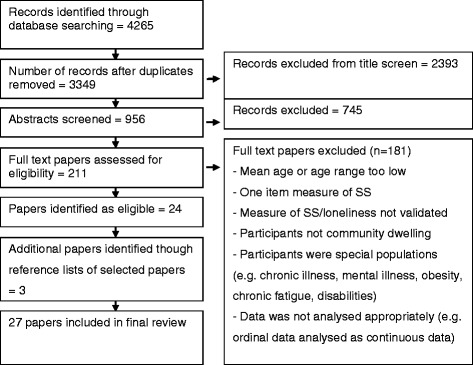
BACKGROUND: The promotion of active and healthy ageing is becoming increasingly important as the population ages. Physical activity (PA) significantly reduces all-cause mortality and contributes to the prevention of many chronic illnesses. However, the proportion of people globally who are active enough to gain these health benefits is low and decreases with age. Social support (SS) is a social determinant of health that may improve PA in older adults, but the association has not been systematically reviewed. This review had three aims: 1) Systematically review and summarise studies examining the association between SS, or loneliness, and PA in older adults; 2) clarify if specific types of SS are positively associated with PA; and 3) investigate whether the association between SS and PA differs between PA domains. METHODS: Quantitative studies examining a relationship between SS, or loneliness, and PA levels in healthy, older adults over 60 were identified using MEDLINE, PSYCInfo, SportDiscus, CINAHL and PubMed, and through reference lists of included studies. Quality of these studies was rated. RESULTS: This review included 27 papers, of which 22 were cross sectional studies, three were prospective/longitudinal and two were intervention studies. Overall, the study quality was moderate. Four articles examined the relation of PA with general SS, 17 with SS specific to PA (SSPA), and six with loneliness. The results suggest that there is a positive association between SSPA and…
Overview
CoChat Summary
## TL;DR
This systematic review of 27 papers found that social support specific to physical activity is generally positively associated with physical activity in older adults, especially support from family. In contrast, general social support showed no clear association, while loneliness was generally negatively associated with physical activity, though measurement variability limited firm conclusions.
## Key findings
- The review included 27 papers: 22 cross-sectional, 3 prospective/longitudinal, and 2 intervention studies; overall study quality was moderate.
- Of the 21 studies examining general or PA-specific social support, 13 found a significant positive association with physical activity and 1 found a significant negative association.
- For social support specific to physical activity (SSPA), 11 of 17 studies reported at least one significant positive association; the review concludes the association is especially positive when support comes from family members.
- Among the 6 loneliness studies, 4 of 6 found a significant negative association with physical activity; when the low-quality study was removed, the pattern was 67% significant and negative.
- For leisure-time physical activity (LTPA), the review reports a more consistent positive association with support: among studies assessing SSPA from friends and family, 67% of friend-support results and 83% of family-support results were positive for LTPA.
## Methods
- Design: Systematic review following PRISMA; studies were rated for quality using the Gyorkos risk assessment tool and synthesized by direction/significance of association.
- Data/sample: Quantitative, peer-reviewed studies in English, German, French, or Dutch on generally healthy community-dwelling older adults with mean age at least 60 years (minimum age no less than 50), identified from MEDLINE, PSYCInfo, SportDiscus, CINAHL, PubMed, plus reference lists.
- Main analysis: Studies were grouped into general social support, social support specific to physical activity, and loneliness; associations were coded as positive/negative/no association and summarized using the review’s overall rating scheme.
## Limitations
- The paper states that high variability in measurement methods for both social support and physical activity made studies difficult to compare.
- It states that the review excluded older adults with specific medical conditions, mental illness, or disabilities, and excluded qualitative studies; this likely omitted potentially relevant evidence.
- Evident from the text: the evidence base was mostly cross-sectional (22 of 27 studies), so the direction of association cannot be established well, and the paper notes this explicitly in discussing future research.
Model-written summary. Check it against the paper before relying on it.
Integrity signals
Registry
Cites
Statistics
Figures
Verification
Claims the paper makes
12 Valid · 6 Not valid · 45 Not checked · 73 Own results and interpretations
Every source the paper cites for this claim was checked and supports it.
In the paper
“One study found a negative association between SS from family and PA [75].”
§ The association between social support and physical activity in older adults: a systematic review > Results > Social support specific to PA
What the sources say
- Supportedcites [75] Park CH Elavsky S Koo KM Factors influencing physical activity in older adults J Exerc Rehabil 2014 10 1 45 52 10.12965/jer.140089 24678504 PMC3952835 source
The Results report a negative, statistically significant regression coefficient for family support for exercise as a predictor of physical activity (β=−0.220, P<0.01). This supports the claimed negative association, specifically in the study’s multiple-regression analysis. (LLM, conf=0.93)
plainstates an association- Asserted: passes — The authors put it forward as true.
- Checkable: passes — It can be checked against evidence.
- Load-bearing: unclear — It is unclear whether the paper’s conclusions depend on it.
- Based: passes — The paper gives a reason why it holds.
- Supported
The cited sources support only part of this claim — read each source’s verdict below.
In the paper
“Four of the six loneliness studies [58, 59, 61, 63] found a significant negative association.”
§ The association between social support and physical activity in older adults: a systematic review > Results > Relationship between SS, loneliness and PA
What the sources say
- Partly supportedcites [58] Luo Y Waite LJ Loneliness and mortality among older adults in China J Gerontol Series B Psychol Sci Soc Sci 2014 69 4 633 45 10.1093/geronb/gbu007 PMC4049147 24550354 sourceExperimental — accuracy not yet measured
The Results report significant negative associations between loneliness and physical exercise, self-rated health, and emotional health. The cited paper is one study, however, and does not establish the citing sentence’s count of four out of six studies; the sentence also does not specify which outcome the negative association concerns. No page number is available in our copy. (LLM, conf=0.70)
- Not checked — no full text of the sourcecites [59] Netz Y Goldsmith R Shimony T Arnon M Zeev A Loneliness is associated with an increased risk of sedentary life in older Israelis Aging Ment Health 2013 17 1 40 7 10.1080/13607863.2012.715140 22913477 source
- Not checked — no full text of the sourcecites [61] Shankar A McMunn A Banks J Steptoe A Loneliness, social isolation, and behavioral and biological health indicators in older adults Health Psychol 2011 30 4 377 85 10.1037/a0022826 21534675 source
- Not checked yetcites [63] Theeke LA Sociodemographic and health-related risks for loneliness and outcome differences by loneliness status in a sample of U.S. older adults Res Gerontol Nurs 2010 3 2 113 25 10.3928/19404921-20091103-99 20415360 source
Checked before — its earlier verdict is held back until a new check runs.
plainstates an association- Asserted: passes — The authors put it forward as true.
- Checkable: passes — It can be checked against evidence.
- Load-bearing: unclear — It is unclear whether the paper’s conclusions depend on it.
- Based: passes — The paper gives a reason why it holds.
- Partly supported
The cited sources support only part of this claim — read each source’s verdict below.
In the paper
“but only two of four in males [58, 63].”
§ The association between social support and physical activity in older adults: a systematic review > Results > Association between SS, loneliness and specific PA domains
What the sources say
- Partly supportedcites [58] Luo Y Waite LJ Loneliness and mortality among older adults in China J Gerontol Series B Psychol Sci Soc Sci 2014 69 4 633 45 10.1093/geronb/gbu007 PMC4049147 24550354 sourceExperimental — accuracy not yet measured
The Results (page unavailable) report negative, significant lagged effects in both directions between physical exercise and loneliness. They do not report that two of four associations were significant among males; the Methods (page unavailable) describe controlling for gender, not a male-specific result. (LLM, conf=0.87)
- Could not verifycites [63] Theeke LA Sociodemographic and health-related risks for loneliness and outcome differences by loneliness status in a sample of U.S. older adults Res Gerontol Nurs 2010 3 2 113 25 10.3928/19404921-20091103-99 20415360 sourceExperimental — accuracy not yet measured
Our copy of Theeke (2010) reports only whole-sample comparisons of loneliness groups (never/briefly/chronically lonely) on moderate activity/exercise — e.g., Results for Outcomes Reported with Loneliness ('The chronically lonely group reported less exercise...'; 49.8% vs 33.1% exercising more than once weekly) — and no sex-stratified set of activity-loneliness associations. Searched for 'leisure-time physical activity', 'gender/sex differences in exercise and loneliness', and 'negative correlation between physical activity and loneliness': the nearest passages are Gender and Loneliness and Unanticipated Findings, which state gender was not predictive of loneliness and that men and women may experience loneliness differently, but nothing about four associations of which two were negative and significant in males. The paper therefore neither supports nor contradicts the specific claim attributed to it. (LLM, conf=0.70)
plainstates an association- Asserted: passes — The authors put it forward as true.
- Checkable: passes — It can be checked against evidence.
- Load-bearing: unclear — It is unclear whether the paper’s conclusions depend on it.
- Based: passes — The paper gives a reason why it holds.
- Partly supported
The cited sources support only part of this claim — read each source’s verdict below.
In the paper
“with three of four associations [58, 59, 63] being negative and significant in females”
§ The association between social support and physical activity in older adults: a systematic review > Results > Association between SS, loneliness and specific PA domains
What the sources say
- Partly supportedcites [58] Luo Y Waite LJ Loneliness and mortality among older adults in China J Gerontol Series B Psychol Sci Soc Sci 2014 69 4 633 45 10.1093/geronb/gbu007 PMC4049147 24550354 sourceExperimental — accuracy not yet measured
The Results report that the three-year lagged associations between physical exercise and loneliness were negative and significant. They do not report those associations separately for females or establish the claimed count of three out of four associations. (LLM, conf=0.84)
- Not checked — no full text of the sourcecites [59] Netz Y Goldsmith R Shimony T Arnon M Zeev A Loneliness is associated with an increased risk of sedentary life in older Israelis Aging Ment Health 2013 17 1 40 7 10.1080/13607863.2012.715140 22913477 source
- Not checked yetcites [63] Theeke LA Sociodemographic and health-related risks for loneliness and outcome differences by loneliness status in a sample of U.S. older adults Res Gerontol Nurs 2010 3 2 113 25 10.3928/19404921-20091103-99 20415360 source
Checked before — its earlier verdict is held back until a new check runs.
plainstates an association- Asserted: passes — The authors put it forward as true.
- Checkable: passes — It can be checked against evidence.
- Load-bearing: unclear — It is unclear whether the paper’s conclusions depend on it.
- Based: passes — The paper gives a reason why it holds.
- Partly supported
The cited sources support only part of this claim — read each source’s verdict below.
In the paper
“Four (57%) of these were significant and negative [58, 59, 61, 63]”
§ The association between social support and physical activity in older adults: a systematic review > Results > Loneliness and PA levels
What the sources say
- Supportedcites [58] Luo Y Waite LJ Loneliness and mortality among older adults in China J Gerontol Series B Psychol Sci Soc Sci 2014 69 4 633 45 10.1093/geronb/gbu007 PMC4049147 24550354 source
The Results report that the three-year lagged effect of loneliness on physical exercise was negative and significant. This supports citing the paper as one of the studies with a significant negative association; the four-of-seven tally is the citing paper’s synthesis, not a count attributed to this individual source. (LLM, conf=0.91)
- Not checked — no full text of the sourcecites [59] Netz Y Goldsmith R Shimony T Arnon M Zeev A Loneliness is associated with an increased risk of sedentary life in older Israelis Aging Ment Health 2013 17 1 40 7 10.1080/13607863.2012.715140 22913477 source
- Not checked — no full text of the sourcecites [61] Shankar A McMunn A Banks J Steptoe A Loneliness, social isolation, and behavioral and biological health indicators in older adults Health Psychol 2011 30 4 377 85 10.1037/a0022826 21534675 source
- Partly supportedcites [63] Theeke LA Sociodemographic and health-related risks for loneliness and outcome differences by loneliness status in a sample of U.S. older adults Res Gerontol Nurs 2010 3 2 113 25 10.3928/19404921-20091103-99 20415360 sourceExperimental — accuracy not yet measured
In 'Results for Outcomes Reported with Loneliness' (ANCOVA paragraph, and the Table 14/15/16 discussion) Theeke (2010) does report a significant negative loneliness–physical activity association: the chronically lonely reported less moderate activity/exercise than the never lonely (33.1% vs 49.8% exercising more than once weekly), and this held after controlling for marital status, self-rated health, education, functional status, chronic illness count, age, income and household size. However, our copy contains no 'seven associations between loneliness and physical activity' and no four-of-seven (57%) count: the paper's seven hypotheses spanned research questions three through nine (activity level, smoking, alcohol use, increase in chronic illness, depression, physician contacts, nursing home stays) and FIVE of those seven were supported. The pooled 4/7 (57%) figure and the restriction to physical activity are therefore not attributable to this source. (LLM, conf=0.75)
plainstates an association- Asserted: passes — The authors put it forward as true.
- Checkable: passes — It can be checked against evidence.
- Load-bearing: passes — The paper’s conclusions depend on it.
- Based: passes — The paper gives a reason why it holds.
- Supported
65 more claims · 2 with their cited sources checked
Create a free account to see all 136 claims and to verify the 6 references still open.
- Probably not a substantial claim. 33
- It may state two separate claims as one. 42
- The quote only partly states this claim. 2
Claims other papers make about this one
Each is checked against this paper’s own text: does it say what the citing paper says it does?
The source backs part of the claim, not all of it — or backs it for a different population, condition or comparison.
In the citing paper
“Previous research has also indicated social support to be an important determinant of physical activity engagement [242–244].”
From Rates of compliance and adherence to high-intensity interval training: a systematic review and Meta-analyses (2023) · cites this paper as [244]
Experimental — accuracy not yet measured
Citations
Cites
The theory of planned behavior
Ajzen, I. (1991) · Organizational Behavior and Human Decision Processes · doi:10.1016/0749-5978(91)90020-t · Cited by 134,657
The CES-D Scale: A Self-Report Depression Scale for Research in the General Population
Radloff, L. S. (1977) · Applied Psychological Measurement · doi:10.1177/014662167700100306 · Cited by 53,267
Liberati, A., Altman, D. G., Tetzlaff, J., Mulrow, C., Gøtzsche, P. C., Ioannidis, J. P. A., Clarke, M., Devereaux, P. J., Kleijnen, J., & Moher, D. (2009) · PLoS Medicine · doi:10.1371/journal.pmed.1000100 · Cited by 28,164 · cited 1×
“Methods Protocol The Preferred Reporting Items for Systematic Reviews and Meta-Analyses (PRISMA) checklist has been followed to undertake this systematic review [52].”
MethodToward an experimental ecology of human development.
Bronfenbrenner, U. (1977) · American Psychologist · doi:10.1037/0003-066x.32.7.513 · Cited by 10,853 · cited 1×
“However, many behaviour change theories, including the Social Cognitive Theory [19], Social-Ecological Model [20, 21], Theory of Planned Behaviour [22] and the Health Belief Model [23], highlight the importance of social factors such as social support (SS) and social connectedness in maintaining and/or initiating beha…”
BackgroundLiberati, A., Altman, D. G., Tetzlaff, J., Mulrow, C., Gøtzsche, P. C., Ioannidis, J. P. A., Clarke, M., Devereaux, P. J., Kleijnen, J., & Moher, D. (2009) · Annals of Internal Medicine · doi:10.7326/0003-4819-151-4-200908180-00136 · Cited by 10,349
‘Small Changes' to Diet and Physical Activity Behaviors for Weight Management
Hills, A. P., Byrne, N. M., Lindstrom, R., & Hill, J. O. (2013) · Obesity Facts · doi:10.1159/000345030 · Cited by 9,493
An ecological perspective on health promotion programs
McLeroy, K. R., Bibeau, D., Steckler, A., & Glanz, K. (1988) · Health Education Quarterly · doi:10.1177/109019818801500401 · Cited by 8,502 · cited 1×
“However, many behaviour change theories, including the Social Cognitive Theory [19], Social-Ecological Model [20, 21], Theory of Planned Behaviour [22] and the Health Belief Model [23], highlight the importance of social factors such as social support (SS) and social connectedness in maintaining and/or initiating beha…”
BackgroundHuman agency in social cognitive theory.
Bandura, A. (1989) · American Psychologist · doi:10.1037/0003-066x.44.9.1175 · Cited by 8,263
What good are positive emotions?
Fredrickson, B. L. (1998) · Review of General Psychology · doi:10.1037/1089-2680.2.3.300 · Cited by 6,066
Social Learning Theory and the Health Belief Model
Rosenstock, I. M., Strecher, V. J., & Becker, M. H. (1988) · Health Education Quarterly · doi:10.1177/109019818801500203 · Cited by 5,564 · cited 1×
“However, many behaviour change theories, including the Social Cognitive Theory [19], Social-Ecological Model [20, 21], Theory of Planned Behaviour [22] and the Health Belief Model [23], highlight the importance of social factors such as social support (SS) and social connectedness in maintaining and/or initiating beha…”
Background
Research works printed but not linked: 8
- World Health Organisation, US National Institute of Aging Global Health and Ageing 2011 Geneva World Health Organisation
- Aging NACo Seniors in Canada, 2006 Report Card 2006 Ottawa Government of Canada
- Organization WH. Global recommendations on physical activity for health. 2010 26180873
- Wood YR Social support and social networks: nature and measurement Adv Psychol Assess 1984 6 312 53
- Chinuntuya P A causal model of exercise behavior of the elderly in Bangkok Metropolis 2001 Mahidol University Faculty of Graduate Studies
- Washburn R Smith K Jette A Janney C Physical Activity Scale for the Elderly: administration and scoring instruction manual 1991 Watertown New England Research Institute
- Cutrona CE Russell DW The provisions of social relationships and adaptation to stress Adv Pers Relat 1987 1 1 37 67
- Itakura M Oka K Takeda N Watanabe Y Nakamura Y Exercise behavior and social support for exercise among adults Walking Res 2003 7 151 7
Cited by
Items 301–400 of 861
Maximizing User Engagement with Behavior Change Interventions
Yardley, L., Morrison, L. G., Müller, I., & Bradbury, K. J. (2020) · Cambridge University Press eBooks · doi:10.1017/9781108677318.025 · Cited by 13
Autonomy-Supportive Interventions
Reeve, J., & Cheon, S. H. (2020) · Cambridge University Press eBooks · doi:10.1017/9781108677318.035 · Cited by 15
Lifestyle and Self-Perceived Quality of Life in Sports Students: A Case Study
González, J. G., Pérez, A. T., Gálvez-Fernández, I., & Fernández‐García, J. C. (2022) · International Journal of Environmental Research and Public Health · doi:10.3390/ijerph19031598 · Cited by 13
Bazargan, M., Cobb, S., Assari, S., & Bazargan‐Hejazi, S. (2022) · Ethnicity and Health · doi:10.1080/13557858.2022.2027886 · Cited by 12
“…of physical and mental health, lifestyle factors, social support and loneliness, as well as personality traits and thoughts about death and dying, have predicted HRQoL among older adults (Stewart et al. 2021; Batmani et al. 2021; Cunningham et al. 2020; Moradi et al. 2020; Smith et al. 2017).”
BackgroundVandelanotte, C., Duncan, M. J., Plotnikoff, R. C., Rebar, A. L., Alley, S., Schöeppe, S., To, Q. G., Mummery, W. K., & Short, C. E. (2022) · Mental health and physical activity · doi:10.1016/j.mhpa.2022.100477 · Cited by 14
Ma, C. (2022) · Clinical Nursing Research · doi:10.1177/10547738221128700 · Cited by 15
“Patients with chronic diseases and older adults who receive better social support from family members and friends and who insist on performing daily physical activity exhibit improved health outcomes (Stevens et al., 2020; Lindsay Smith et al, 2017).”
BackgroundInfluentialBelay, G. J., Fentanew, M., Belay, M., Gobezie, M., Bekele, G., Getie, K., Shiferaw, K. B., Takele, M. D., Cherkos, K., & Zemariam, A. B. (2023) · BMJ Open · doi:10.1136/bmjopen-2023-073018 · Cited by 13
Research Centers Collaborative Network Workshop on Digital Health Approaches to Research in Aging
Fanning, J. T., Brinkley, T. E., Campbell, L. M., Colón-Semenza, C., Czaja, S. J., Moore, R. C., Pajewski, N. M., & Kritchevsky, S. B. (2024) · Innovation in Aging · doi:10.1093/geroni/igae012 · Cited by 10
“Social support specific to physical activity (46), larger social networks, and engaging in social activities is associated with higher levels of physical activity in older adults (47).”
BackgroundBellón, D., Rodríguez‐Ayllón, M., Solis‐Urra, P., Fernandez‐Gamez, B., Olvera‐Rojas, M., Coca‐Pulido, A., Toval, Á., Martín‐Fuentes, I., Bakker, E. A., Sclafani, A., et al. (2024) · International Journal of Clinical and Health Psychology · doi:10.1016/j.ijchp.2024.100450 · Cited by 16
“The correlation between muscular strength and other mental health variables, such as loneliness, has not been established, despite initial expectations of a potential relationship with physical activity (Lindsay Smith et al., 2017; Noh & Park, 2020).”
BackgroundHarada, K., Lee, S., Bae, S., Bae, S., Harada, K., Suzuki, T., & Shimada, H. (2019) · Perceptual and Motor Skills · doi:10.1177/0031512519846026 · Cited by 10
Maes, I. H. L., Dyck, D. V., Cauwenberg, J. V., & Mertens, L. (2020) · Health & Place · doi:10.1016/j.healthplace.2020.102492 · Cited by 12
Deraas, T., Hopstock, L. A., Henriksen, A., Morseth, B., Sand, A.-S., Njølstad, I., Pedersen, S., Sagelv, E. H., Johansson, J., & Grimsgaard, S. (2021) · Pilot and Feasibility Studies · doi:10.1186/s40814-021-00921-0 · Cited by 13
Pandemi Sürecinde Yaşlılık ve Rekreasyon
AYDIN, İ., & Tütüncü, Ö. (2021) · Anatolia Turizm Araştırmaları Dergisi · doi:10.17123/atad.948495 · Cited by 12
Ginossar, T., Brakey, H. R., Sussman, A. L., Price, B., Kano, M. A., Davis, S. M., & Blair, C. K. (2021) · International Journal of Environmental Research and Public Health · doi:10.3390/ijerph18178929 · Cited by 10
“This finding is consistent with research on the relationship between social support and physical activity among older adults [65], and on the importance of social networks in reducing difficulty of online health information seeking [66].”
ResultHuang, W.-Y., & Wu, C.-E. R. (2021) · Science Progress · doi:10.1177/00368504211042468 · Cited by 12
Wang, C., Roos, A. J. D., Fujishiro, K., Allison, M., Wallace, R. B., Seguin‐Fowler, R. A., Nassir, R., & Michael, Y. L. (2018) · The Journals of Gerontology Series A · doi:10.1093/gerona/gly288 · Cited by 12
“did not distinguish occupational and non-occupational physical activity, and the potential effect of OPA on CHD in older people is still unclear (10).”
BackgroundBoekhout, J. M., Berendsen, B., Peels, D. A., Bolman, C. A. W., & Lechner, L. (2019) · Journal of Aging and Physical Activity · doi:10.1123/japa.2018-0325 · Cited by 12
Robertson, M. C., Baranowski, T., Thompson, D. I., Basen‐Engquist, K., Swartz, M. C., & Lyons, E. (2021) · JMIR Serious Games · doi:10.2196/29964 · Cited by 17
“Yes; social support is a strong predictor of physical activity, and older women want social physical activity interventions [55,57] Participant feels supported by others regarding her physical activity Perceived relatedness”
BackgroundCholerton, R., Butt, J., Quirk, H., & Breckon, J. D. (2022) · Journal of Aging and Physical Activity · doi:10.1123/japa.2021-0305 · Cited by 11
Zhang, Y., Ghaziri, M. E., & de Castillero, E. R. (2022) · International Journal of Nursing Practice · doi:10.1111/ijn.13087 · Cited by 11
Croff, R. L., Aron, S., Wachana, A., Fuller, P., Mattek, N., Towns, J., & Kaye, J. A. (2024) · The Gerontologist · doi:10.1093/geront/gnae019 · Cited by 11
Raihansyah, Lestari, Y. D., & Lubis, Y. F. A. (2022) · Jurnal Komputer Teknologi Informasi Sistem Komputer (JUKTISI) · doi:10.62712/juktisi.v1i2.14 · Cited by 9
Dubash, S. (2024) · Mental health and physical activity · doi:10.1016/j.mhpa.2024.100599 · Cited by 12
Burgess, C., Tian, E. J., Tyack, E., & Kumar, S. (2024) · Brain Injury · doi:10.1080/02699052.2024.2381053 · Cited by 11
“…impacts the family’s ability to provide desired social support (47), an important factor identified within the current review and other literature (48) that is associated with improved PA. Strategies such as implementation of home-based skills and education sessions for family members, friends,…”
Li, W., Hong, S., Chen, Y., Zhao, Y., & Wang, L. (2024) · Frontiers in Public Health · doi:10.3389/fpubh.2024.1409614 · Cited by 11
“It serves as a comprehensive indicator for evaluating social support for physical activity in older adults with SCD, addressing a broader range compared to previous studies that often focused more on support from family or friends while overlooking informational and instrumental support (48, 49).”
BackgroundFang, W., Fan, S., Zheng, H., Fang, Z., You, Y., Yin, B., Li, B., & Ye, X. (2025) · Humanities and Social Sciences Communications · doi:10.1057/s41599-025-05155-6 · Cited by 12
“This marks a shift from earlier studies, which primarily examined physical activity ’ s in fl uence on mental health (Forberger et al. 2017; Lindsay Smith et al. 2017), This network re fl ects a higher level of complexity and depth.”
Ominyi, J., Clifton, A., & Nwedu, A. B. (2025) · BMC Public Health · doi:10.1186/s12889-025-23189-y · Cited by 14
Characteristics of the social network of bike share members in New York City
Reilly, K. H., Wang, S. M., Gould, L. H., Baquero, M., & Crossa, A. (2021) · Journal of Transport & Health · doi:10.1016/j.jth.2021.101128 · Cited by 10
Fathi, B., Nadrian, H., Hashemiparast, M., Nikookheslat, S. D., Esmaeilzadeh, S., & Zarnaq, R. K. (2021) · Health Promotion Perspectives · doi:10.34172/hpp.2021.60 · Cited by 12
Sport and well-being: Frequency of physical activity and life satisfaction
Hermawansyah, A., Sumaryanto, S., Ariestika, E., & Hita, I. P. A. D. (2021) · JOURNAL SPORT AREA · doi:10.25299/sportarea.2021.vol6(3).6583 · Cited by 14
Blakoe, M., Petrova, D., García‐Retamero, R., Gonçalves, K. D. S., Catena, A., Hernández, J. A. R., & Sánchez, M. (2023) · Annals of Behavioral Medicine · doi:10.1093/abm/kaad030 · Cited by 12
Patel, M. I., Agrawal, M., Blayney, D. W., Bundorf, M. K., & Milstein, A. S. (2024) · JAMA Oncology · doi:10.1001/jamaoncol.2024.1221 · Cited by 13
Storm, V., Reinwand, D. A., Wienert, J., Tan, S. L., & Lippke, S. (2018) · JMIR Mental Health · doi:10.2196/11124 · Cited by 9
“Studies revealed that perceived social support from significant others (eg, family and friends) is positively related to physical activity [48].”
BackgroundKim, J., Kim, J., Williams, R. D., & Han, A. (2020) · American Journal of Health Promotion · doi:10.1177/0890117120961321 · Cited by 8
Huang, X., Zhu, W., Gao, X., Yu, D., Jin, H., Huang, J., Yu, W., Lv, Y., Zhou, L., Chen, N., et al. (2022) · Frontiers in Public Health · doi:10.3389/fpubh.2022.865328 · Cited by 12
Müller, A. M., Tan, C. S., Chu, A. H. Y., van Dam, R. M., & Müller‐Riemenschneider, F. (2019) · International Journal of Public Health · doi:10.1007/s00038-019-01203-6 · Cited by 10
Does religious involvement affect mortality in low-income Americans? A prospective cohort study
Wen, W., Schlundt, D. G., Andersen, S. W., Blot, W. J., & Zheng, W. (2019) · BMJ Open · doi:10.1136/bmjopen-2018-028200 · Cited by 53
Kubota, A., Carver, A., & Sugiyama, T. (2019) · Journal of Aging and Physical Activity · doi:10.1123/japa.2018-0321 · Cited by 9
Davis, C. M. A., Sentell, T. L., Barbosa, J. F. D. S., Ylli, A., Curcio, C., & Pirkle, C. M. (2019) · Journal of Aging and Physical Activity · doi:10.1123/japa.2018-0463 · Cited by 11
Implementation Science and Translation in Behavior Change
Łuszczyńska, A., Łobczowska, K., & Horodyska, K. (2020) · Cambridge University Press eBooks · doi:10.1017/9781108677318.023 · Cited by 13
Lack of Association between the Reasons for and Time Spent Doing Physical Activity
Amorós, M. D., & Aparicio-Chueca, P. (2020) · International Journal of Environmental Research and Public Health · doi:10.3390/ijerph17186777 · Cited by 8
Musau, E. G., Pisa, N., & Masoumi, H. (2023) · Transportation Research Interdisciplinary Perspectives · doi:10.1016/j.trip.2023.100928 · Cited by 14
Lamoureux, N. R., Lansing, J. E., & Welk, G. J. (2023) · Archives of Public Health · doi:10.1186/s13690-023-01219-8 · Cited by 10
Loneliness predicts decreased physical activity in widowed but not married or unmarried individuals
Pollak, C., Verghese, J., & Blumen, H. M. (2024) · Frontiers in Public Health · doi:10.3389/fpubh.2024.1295128 · Cited by 10
“Loneliness is associated with decreased physical activity in older adults cross-sectionally; however, the underlying mechanisms for this association are unclear (7, 8).”
BackgroundHealth and fitness marketing appeals to older consumers
Badham, S. P., Taheri, B., Magistro, D., Grant, N., May, N., & Goddard, A. (2024) · Service Industries Journal · doi:10.1080/02642069.2024.2355255 · Cited by 10
Mappanasingam, A., Madigan, K., Kalu, M. E., Maximos, M., & Bello-Haas, V. P. M. D. (2024) · Journal of Ageing and Longevity · doi:10.3390/jal4020011 · Cited by 11
Shen, Y., Lu, C., & Wang, B. (2025) · Frontiers in Public Health · doi:10.3389/fpubh.2025.1492188 · Cited by 13
“Previous research has emphasized that social support from relatives and friends plays a dominant role in influencing old adults individuals’ engagement in physical activities (62), and has identified these forms of support as key drivers of their participation in exercise (63).”
Yang, Q., Lin, S., Zhang, Z., Du, S., & Zhou, D. (2025) · Frontiers in Public Health · doi:10.3389/fpubh.2024.1506484 · Cited by 15
Alghafri, T. S., Al-Harthi, S., Al-Farsi, Y. M., Craigie, A. M., Bannerman, E., & Anderson, A. S. (2021) · Sultan Qaboos University medical journal · doi:10.18295/squmj.2021.21.01.006 · Cited by 11
Engaging adults in organized physical activity: a scoping review of recruitment strategies
Mackenzie‐Stewart, R., de Lacy‐Vawdon, C., Murphy, N. M., & Smith, B. J. (2023) · Health Promotion International · doi:10.1093/heapro/daad050 · Cited by 8
Beselt, L. J., McDonough, M. H., Hewson, J., & Din, C. (2023) · Qualitative Research in Sport, Exercise and Health · doi:10.1080/2159676x.2023.2230216 · Cited by 9
Wicklum, S., Sampson, M., Henderson, R., Wiart, S., Perez, G., McGuire, A., Cameron, E., Crowshoe, L. L., McBrien, K., & Willis, E. (2019) · International Journal of Indigenous Health · doi:10.32799/ijih.v14i2.31890 · Cited by 10
Tran, D.-M. T., Dingley, C., & Arenas, R. A. (2020) · Canadian Journal of Nursing Research · doi:10.1177/0844562119899310 · Cited by 11
Huffman, M. K., Reed, J. B., Carpenter, T. K., & Amireault, S. (2020) · BMJ Open · doi:10.1136/bmjopen-2019-032605 · Cited by 10
de Ridder, D. T. D., Gillebaart, M., & Friese, M. (2020) · Cambridge University Press eBooks · doi:10.1017/9781108677318.040 · Cited by 11
Lei, L., Zhang, H., & Wang, X. (2020) · Complexity · doi:10.1155/2020/4938161 · Cited by 11
Manea, V. C., & Wac, K. (2020) · Journal of Personalized Medicine · doi:10.3390/jpm10040203 · Cited by 8
“When we aligned PROs with TechROs of increasing durations, the number of paired observations decreased; we thus required a minimum of 10 observations to have a nontrivial size [69].”
MethodDumitrache, C. G., Rubio, L., Casado, J. L. C., & Pozo, E. C. (2021) · European Journal of Ageing · doi:10.1007/s10433-021-00612-y · Cited by 13
Social support, relationships, and physical activity
WILSON, K. S. (2021) · Society for Transparency, Openness, and Replication in Kinesiology eBooks · doi:10.51224/b1010 · Cited by 12
“Social support, especially if it is from family, appears to have a positive influence on physical activity behavior (Scarapicchia et al., 2017; Smith et al., 2017).”
BackgroundInfluentialKatito, G., & Davies, E. (2021) · Health Education · doi:10.1108/he-01-2021-0014 · Cited by 9
Kimura, Y., Akasaka, H., Takahashi, T., Yasumoto, S., Kamide, K., Ikebe, K., Kabayama, M., Kasuga, A., Rakugi, H., & Gondo, Y. (2022) · International Journal of Environmental Research and Public Health · doi:10.3390/ijerph19106008 · Cited by 11
“Social connections are reported to be essential factors in enhancing physical activity [31].”
BackgroundImpact of the COVID-19 pandemic on the quality of life of older adults
González, M. C., Flores-Garnica, A., Ramos, M. Á. S., Ortiz-Rodríguez, M. A., Arenas-Ocampo, M. L., Serrano, L. A. G., & Camacho‐Díaz, B. H. (2022) · Journal of Global Health Reports · doi:10.29392/001c.37468 · Cited by 16
Huang, W.-Y., & Wu, C.-E. R. (2024) · SAGE Open · doi:10.1177/21582440241263638 · Cited by 13
“In this study, HPI’s social support most correlated with exercise behavior, which was consistent with many empirical pieces of evidence (Huang et al., 2022; Lindsay Smith et al., 2017; Resnick et al., 2002; Zimmer et al., 2023).”
Zamri, L. A., Appannah, G., Zahari-Sham, S. Y., Mansor, F., Nor, N. S. M., Ambak, R., Samad, A. A., Dahlan, N. Y., & Aris, T. (2018) · BMC Women s Health · doi:10.1186/s12905-018-0593-1 · Cited by 10
Leung, K. M., Chung, P., Chan, A. W. K., Ransdell, L. B., Siu, P. M., Sun, P., Yang, J., & Chen, T. C. (2020) · BMC Sports Science Medicine and Rehabilitation · doi:10.1186/s13102-019-0151-7 · Cited by 9
“less social isolation) are likely to continue exercising [19].”
Backgroundvan de Vijver, P. L., Schalkwijk, F. H., Numans, M. E., Slaets, J. P. J., & van Bodegom, D. (2020) · Preventive Medicine Reports · doi:10.1016/j.pmedr.2020.101181 · Cited by 10
McDowell, C. P., Gordon, B. R., MacDonncha, C., & Herring, M. P. (2019) · General Hospital Psychiatry · doi:10.1016/j.genhosppsych.2019.04.012 · Cited by 7
The Importance of Social Networks for Support and Health Beliefs throughout Pregnancy
Prochnow, T. M., Arlinghaus, K. R., & Johnston, C. A. (2022) · American Journal of Lifestyle Medicine · doi:10.1177/15598276221129821 · Cited by 13
Parra-Rizo, M. A., & Sanchís-Soler, G. (2023) · Cuadernos de Psicología del Deporte · doi:10.6018/cpd.515721 · Cited by 10
Marcos, T., Crutzen, R., Leitner, V., Smeddinck, J. D., Strumegger, E.-M., Wurhofer, D., & Kulnik, S. T. (2024) · Digital Health · doi:10.1177/20552076241260974 · Cited by 10
“Similarly, social support has been associated with greater leisure-time physical activity in older adults, 75 but aktiv plan did not include any features to increase or leverage social support.”
BackgroundCollombon, E. H. G. M., Bolman, C. A. W., de Bruijn, G., Peels, D. A., Verboon, P., & Lechner, L. (2024) · Applied Psychology Health and Well-Being · doi:10.1111/aphw.12568 · Cited by 11
Batalha, A. P. D. B., Main, E., & Ghisi, G. L. D. M. (2024) · Journal of Cardiopulmonary Rehabilitation and Prevention · doi:10.1097/hcr.0000000000000899 · Cited by 11
Demirel, H., & Ayaz‐Alkaya, S. (2024) · Journal of Advanced Nursing · doi:10.1111/jan.16586 · Cited by 7
“In older adults, experiencing major life events at the same time, such as retirement, loss of a spouse or friend, financial problems and health problems, may lead to an increase in the level of loneliness and a decrease in social support (Czaja, Moxley, and Rogers 2021; Lindsay Smith et al. 2017).”
Tavares, V. D. D. O., Cuthbert, C. A., Teychenne, M. J., Schuch, F. B., Cabral, D. A. R., de Sousa, G. M., Prado, C. M. M., Patten, S. B., Coelho, N. L. G., & Hallgren, M. Å. (2024) · Journal of Psychosocial Oncology · doi:10.1080/07347332.2024.2441693 · Cited by 12
“59,60”
Social support in a large general population sample over the course of six years
Hinz, A., Esser, P., Richter, D., Schönfelder, A., Glaesmer, H., Lehmann‐Laue, A., Heyne, S., Leuteritz, K., Sender, A., Springer, F., et al. (2025) · Scientific Reports · doi:10.1038/s41598-025-90703-y · Cited by 13
Barriers to Physical Activity in Low-Income Older Adults Living in Senior Housing
Kalata, C., Reyes, R., Kuhail, K., Larson, J. L., & Chen, W. (2025) · Healthcare · doi:10.3390/healthcare13101159 · Cited by 8
“A systematic review of 27 articles reported that older adults who had greater social support for PA from their family members were more likely to engage in leisure-time PA [7].”
Kang, B., Park, M. K., Kim, J. I., Yoon, S., Heo, S., Kang, C., Lee, S., Choi, Y.-S., & Hong, D. (2025) · Journal of Medical Internet Research · doi:10.2196/69379 · Cited by 9
“While individuals experiencing loneliness often demonstrate lower levels of physical activity [80], some studies suggest that the association between physical movement and loneliness remains uncertain and generally unclear [81].”
Padel, pickleball and wellbeing: a systematic review
Lauxtermann, L., & Stubbs, B. (2025) · Frontiers in Psychology · doi:10.3389/fpsyg.2025.1614448 · Cited by 22
Zhang, X., Li, Y., Ma, Q., Jiang, Z., Han, X., Yi, K., & Cao, L. (2025) · Frontiers in Psychiatry · doi:10.3389/fpsyt.2025.1551758 · Cited by 10
Xiang, L., Yang, J., Gou, H., & Hu, C. (2026) · Frontiers in Public Health · doi:10.3389/fpubh.2025.1736019 · Cited by 10
Determinants of Physical Activity in Older Adults in South-Eastern Poland
Wiśniowska-Szurlej, A., Ćwirlej-Sozańska, A. B., Wilmowska-Pietruszyńska, A., & Sozański, B. (2022) · International Journal of Environmental Research and Public Health · doi:10.3390/ijerph192416922 · Cited by 11
“The support of friends and family is important for undertaking PA in leisure time [38].”
BackgroundDeterminants of exercise adherence in sedentary middle‐aged and older adults
Cabral, D. F., Fried, P. J., Bigliassi, M., Cahalin, L. P., & Gomes‐Osman, J. (2024) · Psychophysiology · doi:10.1111/psyp.14591 · Cited by 11
Delobelle, J., Compernolle, S., Větrovský, T., Cauwenberg, J. V., & Dyck, D. V. (2025) · International Journal of Behavioral Nutrition and Physical Activity · doi:10.1186/s12966-025-01724-9 · Cited by 10
Examining Potential Psychosocial Mediators in a Physical Activity Intervention for Older Adults
McMahon, S., Lewis, B. A., Oakes, J. M., Wyman, J. F., Guan, W., & Rothman, A. J. (2019) · Western Journal of Nursing Research · doi:10.1177/0193945919871697 · Cited by 10
Dugan, K. F., Hidde, M. C., Chard, C. A., Graham, D. J., Withycombe, J. S., & Leach, H. J. (2021) · Journal of Adolescent and Young Adult Oncology · doi:10.1089/jayao.2019.0169 · Cited by 8
“…microsystem factor, emerged as a common theme with regard to facilitating PA, whereas lack of social support was not mentioned as a barrier for PA. 41 The qualitative data collected in this study adds to the literature by specifying who in particular (e.g., family and/or friends) are important…”
Epton, T., & Armitage, C. J. (2020) · Cambridge University Press eBooks · doi:10.1017/9781108677318.038 · Cited by 8
Evaluation of Behavior Change Interventions
Matthews, L., & Simpson, S. A. (2020) · Cambridge University Press eBooks · doi:10.1017/9781108677318.022 · Cited by 10
Percepção de pessoas com hipertensão arterial sobre aspectos que influenciam a adesão ao tratamento
Miranda, P. R. D. O., Sacramento, D. D. O., Diaz, F. B. B. D. S., Toledo, L. V., Pereira, R. S. F., & Alves, K. R. (2021) · Revista de Enfermagem da UFSM · doi:10.5902/2179769242403 · Cited by 12
“A prática, realizada em grupo, pode promover a interação social, construir e fortalecer amizades, além de um membro do grupo incentivar outro, potencializando seu empenho no autocuidado.(14) Outro aspecto facilitador foi a utilização do percurso para o trabalho ou para levar filhos à escola para abandonar o sedentaris…”
BackgroundNickerson, G. Y., & Shade, K. (2021) · Journal of Gerontological Nursing · doi:10.3928/00989134-20210401-01 · Cited by 9
Who is at Risk? Social Support, Relationship Dissolution, and Illness in a Rural Context*
Ralston, M. L., Jennings, E. A., & Schatz, E. J. (2021) · Sociological Inquiry · doi:10.1111/soin.12456 · Cited by 8
Law, R., Langley, J., Hall, B., Burton, C. R., Hiscock, J., Williams, L., Morrison, V., LEMMEY, A. B., Lovell-Smith, C., Gallanders, J., et al. (2021) · Health Services and Delivery Research · doi:10.3310/hsdr09160 · Cited by 8
Self-efficacy in health among university students: the role of social support and place
Thériault, É. R., Walsh, A., MacIntyre, P. D., & Catherine O’Brien, P. (2021) · Journal of American College Health · doi:10.1080/07448481.2021.1978455 · Cited by 15
Takeda, H., & Takatori, K. (2021) · Clinical Rehabilitation · doi:10.1177/02692155211041104 · Cited by 9
“Smith et al.21 reported that social support from friends and family and leisure-time physical activity were associated.”
BackgroundAssociations of financial inclusion with physical activity participation in later life
Gyasi, R. M., Frimpong, S., Lamptey, R. B., Amoako, G. K., Asiki, G., & Adam, A. M. (2022) · Heliyon · doi:10.1016/j.heliyon.2022.e09901 · Cited by 9
Roh, H. W., Cho, E. J., Son, S. J., & Hong, C. H. (2022) · Journal of Affective Disorders · doi:10.1016/j.jad.2022.08.117 · Cited by 7
Marthammuthu, T., Hairi, F. M., Choo, W. Y., Salleh, N. A. M., & Hairi, N. N. (2023) · Journal of Aging and Physical Activity · doi:10.1123/japa.2022-0201 · Cited by 10
Beliefs and interests in physical activity programs of cancer survivors and their romantic partners
Ulrich, G. R., Callan, S., & Ranby, K. W. (2021) · Journal of Cancer Survivorship · doi:10.1007/s11764-021-00996-x · Cited by 8
Sustaining or Declining Physical Activity: Reports from an Ethnically Diverse Sample of Older Adults
Tappen, R. M., Vieira, E. R., Gropper, S. S., Newman, D., & Horne, C. V. (2021) · Geriatrics · doi:10.3390/geriatrics6020057 · Cited by 7
“An abundance of research has been done examining factors associated with participation in physical activity among older adults [4–8].”
Bell, A., Barrett, N., & Haintz, G. L. (2021) · Health Promotion Journal of Australia · doi:10.1002/hpja.511 · Cited by 9
Xu, S., Wang, Y., & Yu, H. (2021) · Frontiers in Psychiatry · doi:10.3389/fpsyt.2021.702603 · Cited by 7
Metadata
- Authors
- Lindsay Smith, G., Banting, L., Eime, R., O’Sullivan, G., & van Uffelen, J. G. Z.
- Affiliations
- Victoria University (AU)
- Federation University (AU)
- Venue
- International Journal of Behavioral Nutrition and Physical Activity
- Published
- 2017-04-27
- Volume
- 14
- Issue
- 1
- Pages
- 56-56
- ISSN
- 1479-5868 (ISSN-L)
- PMC
- PMC5408452
- OpenAlex
- W2608453219
- Semantic Scholar
- 9460aa6e600e66166f1c9299a6160f9cbae4576d
- Cited by
- 889
- References
- 112
- Citations by year
- 2026: 79 · 2025: 123 · 2024: 114 · 2023: 106 · 2022: 123 · 2021: 128 · 2020: 123 · 2019: 50 · 2018: 36 · 2017: 6
- FWCI
- 7.21
- Type
- journal article
- Language
- en
- Open access
- gold
- doi.org
- Licence
- cc-by
- Locations
- International Journal of Behavioral Nutrition and Physical Activity (publishedVersion, cc-by)
- Europe PMC (PubMed Central) (publishedVersion, cc-by)
- PubMed Central (publishedVersion, cc-by)
- PubMed (publishedVersion)
- Victoria University Research Repository (Victoria University) (submittedVersion, cc-by)
- FedUni ResearchOnline (Federation University Australia) (submittedVersion, cc-by)
- DOAJ (DOAJ: Directory of Open Access Journals) (submittedVersion, cc-by-sa)
- Deakin Research Online (Deakin University) (submittedVersion)
- Figshare (submittedVersion, cc-by)
- Funders
- Victoria University (Victoria University postgraduate research Scholarship)
- Topics
- Health Sciences › Medicine › Public Health, Environmental and Occupational Health › Physical Activity and Health
- Social Sciences › Health › Health disparities and outcomes
- Health Sciences › Medicine › Public Health, Environmental and Occupational Health › Aging, Health, and Disability
- Keywords
- social support, physical activity, older adults, loneliness, family support, leisure-time physical activity, active ageing, social determinants of health
- MeSH terms
- Aged, Family, Female, Humans, Loneliness, Male, Middle Aged, Social Support, Exercise, Friends
About these checks
Registry, retraction, Cites and statistics results are computed, not judged, with one exception: a printed reference that no index lists is read once by a model before it counts as a citation error. Claims are extracted by a model and kept only when their quote appears verbatim in the text; each cited source is then checked, with a model’s help, for whether it says what the claim relies on. Those verdicts can be wrong — read the claim’s quote and the cited source before relying on one.
The claim verdicts this report counts are experimental: their accuracy is not yet measured.
A language model drew the claims from the paper on 2026-10-10, under version 3 of the claim definition (model deepseek-v4.1-flash, prompt extract-v3).
A second model labelled each claim on 2026-10-10 (model jev-1.13-20260917, definition revision gold-guideline-v0.2).
Cited sources are checked with a language model’s help (gpt-6-sol and qwen3.8-omni-flash).
Statistics and arithmetic are recomputed, not judged.
Confidence bands are shown only for fields calibrated on our annotated test set. None is calibrated yet, so no band is shown.
What counts as a claim ›How we measure confidence ›How we check this ›
Are you an author, or do you see a problem with this page? Request a review
Data sources
Bibliographic data: Semantic Scholar, OpenAlex, Crossref.
Contains information from the Semantic Scholar Academic Graph Datasets, made available under the ODC Attribution License (ODC-BY 1.0).
Semantic Scholar’s data is described in: Kinney, R., et al. (2023). The Semantic Scholar Open Data Platform. arXiv:2301.10140.
