

Barriers and facilitators to implementation of menu labelling interventions from a food service industry perspective: a mixed methods systematic review
Open accessThe DOI matches its Crossref record; 95 of the 95 references it cites were found in a registry or an index.
Abstract
Background: Eating outside the home contributes to poor dietary habits worldwide and is associated with increased body fat and weight gain. Evidence shows menu labelling is effective in promoting healthier food choices; however, implementation issues have arisen. The purpose of this systematic review was to synthesise the evidence on the perceived barriers and facilitators to implementation of menu labelling interventions from the perspective of the food service industry. Methods: Peer-reviewed and grey literature were searched using databases, specialised search engines and public health organisation websites. Screening reference lists, citation chaining and contacting authors of all included studies were undertaken. Primary research studies relevant to direct supply-side stakeholders were eligible for inclusion. There were no restrictions on menu labelling scheme or format, study methods, publication year or language. At least two independent reviewers performed study selection, data extraction and quality appraisal. The results were synthesised using the ‘best fit’ framework synthesis approach, with reference to the Consolidated Framework for Implementation Research (CFIR). Results: Seventeen studies met the eligibility criteria, with the majority rated as average quality (n = 10). The most frequently cited barriers were coded to the CFIR constructs ‘Consumer Needs & Resources’ (e.g. lack of customer demand for/interest in menu labelling, risk of overwhelmed/confused customers) and ‘Compatibility’ with organisation work processes (e.g. lack of standardised recipes, limited space on menus). Frequently cited facilitators were coded to the CFIR constructs ‘Relative Advantage’ of menu labelling (e.g. improved business image/reputation) and ‘Consumer Needs & Resources’ (e.g. customer demand for/interest in menu labelling, providing nutrition information to customers). An adapted framework consisting of a priori and new constructs was developed, which illustrates the relationships between domains. Conclusion: This review generates an adapted CFIR framework for understanding implementation of menu labelling interventions. It highlights that implementation is influenced by multiple interdependent factors, particularly related to the external and internal context of food businesses, and features of the menu labelling intervention. The findings can be used by researchers and practitioners to develop or select strategies to address barriers that impede implementation and to leverage facilitators that assist with implementation effort. Trial registration: Systematic review registration: PROSPERO CRD42017083306.
Overview
The claims and statistics of this paper haven’t been checked yet.
Free: it reads the open-access text and checks the first 5 claims that cite a source we can check. Create a free account to check every claim.
Integrity signals
Registry
Cites
Statistics
Figures
Verification
Claims the paper makes
The claims and statistics of this paper haven’t been checked yet.
Free: it reads the open-access text and checks the first 5 claims that cite a source we can check. Create a free account to check every claim.
Claims other papers make about this one
Each is checked against this paper’s own text: does it say what the citing paper says it does?
The source backs part of the claim, not all of it — or backs it for a different population, condition or comparison.
In the citing paper
“The updated CFIR adds constructs to capture the potential influence of Local Attitudes, i.e., sociocultural values and beliefs, and Local Conditions, i.e., economic, environmental, political, and/or technological conditions, on the willingness and ability of entities within the Outer Setting to support implementation and delivery of the innovation [42–47]”
From The updated consolidated framework for implementation research based on user feedback (2022) · cites this paper as [45]
Experimental — accuracy not yet measuredThe source backs part of the claim, not all of it — or backs it for a different population, condition or comparison.
In the citing paper
“Many users felt the CFIR did not provide “sufficient individual-level constructs” [45] and were unclear about which individuals were included [45–47, 56–59].”
From The updated consolidated framework for implementation research based on user feedback (2022) · cites this paper as [45]
Experimental — accuracy not yet measuredThe source backs part of the claim, not all of it — or backs it for a different population, condition or comparison.
In the citing paper
“The updated CFIR also better captures diverse sources of External Pressures [46], including Societal Pressure (e.g., pressure from social movements and protests) [45], Market Pressure (e.g., pressure to compete with and/or imitate peer entities), and Performance Measurement Pressure (e.g., pressure to meet publicly reported goals).”
From The updated consolidated framework for implementation research based on user feedback (2022) · cites this paper as [45]
Experimental — accuracy not yet measured
Self-check
Percentages, sums and reported differences re-computed from the paper’s own numbers.
The self-check needs the paper’s full text.
Citations
Cites
Preferred Reporting Items for Systematic Reviews and Meta-Analyses: the PRISMA statement
Moher, D., Liberati, A., Tetzlaff, J., Altman, D. G., & for the PRISMA Group (2009) · BMJ · doi:10.1136/bmj.b2535 · Cited by 83,823
Preferred reporting items for systematic reviews and meta-analyses: the PRISMA Statement.
(2009) · PubMed Central · Cited by 44,859
Preferred reporting items for systematic reviews and meta-analyses: The PRISMA statement
Moher, D., Liberati, A., Tetzlaff, J., Altman, D. G., & the PRISMA Group* (2009) · Annals of Internal Medicine · doi:10.7326/0003-4819-151-4-200908180-00135 · Cited by 37,554
Damschroder, L. J., Aron, D. C., Keith, R. E., Kirsh, S. R., Alexander, J. A., & Lowery, J. C. (2009) · Implementation Science · doi:10.1186/1748-5908-4-50 · Cited by 14,496 · cited 3×
“Few implementation models/frameworks, including the CFIR [39], recognise that different factors may influence implementation at different points in the implementation process [105].”
BackgroundMethodMethods for the thematic synthesis of qualitative research in systematic reviews
Thomas, J., & Harden, A. (2008) · BMC Medical Research Methodology · doi:10.1186/1471-2288-8-45 · Cited by 9,312
The New Institutionalism in Organizational Analysis.
Andrews, A. O., Powell, W. W., & DiMaggio, P. J. (1993) · Administrative Science Quarterly · doi:10.2307/2393344 · Cited by 8,261 · cited 2×
“While it is recognised that regulation is required to advance public health [19, 38, 103], the risk of tokenism, that is the superficial implementation of menu labelling, in response to regulation needs to be averted [102].”
BackgroundResultThe New Institutionalism in Organizational Analysis
Powell, W. W., & DiMaggio, P. J. (1991) · University of Chicago Press eBooks · doi:10.7208/chicago/9780226185941.001.0001 · Cited by 7,617
The Population Ecology of Organizations
Hannan, M. T., & Freeman, J. (1977) · American Journal of Sociology · doi:10.1086/226424 · Cited by 7,568 · cited 2×
“Similarly, in an effort to promote survival, organisations will minimise costs; adhere to norms, values and expectations adopted by institutions in their environment; develop characteristics that differentiate them from competitors; and acquire/maintain resources and autonomy [84].”
BackgroundDiffusion of Innovations in Service Organizations: Systematic Review and Recommendations
GREENHALGH, T., ROBERT, G., MACFARLANE, F., BATE, P., & KYRIAKIDOU, O. (2004) · The Milbank Quarterly · doi:10.1111/j.0887-378x.2004.00325.x · Cited by 7,448
Why Don't Physicians Follow Clinical Practice Guidelines?: A Framework for Improvement
Cabana, M. D., Rand, C. S., Powe, N. R., Wu, A. W., Wilson, M. H., Abboud, P.-A. C., & Rubin, H. R. (1999) · JAMA · doi:10.1001/jama.282.15.1458 · Cited by 6,677
Powell, B. J., Waltz, T. J., Chinman, M. J., Damschroder, L. J., Smith, J. L., Matthieu, M. M., Proctor, E. K., & Kirchner, J. E. (2015) · Implementation Science · doi:10.1186/s13012-015-0209-1 · Cited by 4,963 · cited 1×
“The Expert Recommendations for Implementing Change (ERIC) project provides a taxonomy of discrete implementation strategies that can be used in isolation or in combination to target factors influencing implementation at different levels [90].”
BackgroundMaking sense of implementation theories, models and frameworks
Nilsen, P. (2015) · Implementation Science · doi:10.1186/s13012-015-0242-0 · Cited by 4,447 · cited 2×
“To date, many implementation studies have assessed determinants individually, assuming a linear relationship between the determinants and the outcomes [106].”
Background(2005) · Cited by 3,748
Advancing a Conceptual Model of Evidence-Based Practice Implementation in Public Service Sectors
Aarons, G. A., Hurlburt, M., & Horwitz, S. M. (2011) · Administration and Policy in Mental Health and Mental Health Services Research · doi:10.1007/s10488-010-0327-7 · Cited by 3,240 · cited 1×
“Few implementation models/frameworks, including the CFIR [39], recognise that different factors may influence implementation at different points in the implementation process [105].”
BackgroundThe Global Syndemic of Obesity, Undernutrition, and Climate Change: The Lancet Commission report
Swinburn, B. A., Kraak, V. I., Allender, S., Atkins, V. J., Baker, P. I., Bogard, J. R., Brinsden, H., Calvillo, A., De Schutter, O., Devarajan, R., et al. (2019) · The Lancet · doi:10.1016/s0140-6736(18)32822-8 · Cited by 3,081 · cited 2×
“While it is recognised that regulation is required to advance public health [19, 38, 103], the risk of tokenism, that is the superficial implementation of menu labelling, in response to regulation needs to be averted [102].”
BackgroundA Guide to Conducting Consensual Qualitative Research
Hill, C. E., Thompson, B. J., & Williams, E. N. (1997) · The Counseling Psychologist · doi:10.1177/0011000097254001 · Cited by 2,884 · cited 1×
“Data synthesis was led by one reviewer (CK) using a mix of deductive and inductive analysis techniques, with regular consultation with review team members (SMH, CMR, CKelly) through a consensus decision making process [53, 54].”
MethodConsensual qualitative research: An update.
Hill, C. E., Knox, S., Thompson, B. J., Williams, E. N., Hess, S. A., & Ladany, N. (2005) · Journal of Counseling Psychology · doi:10.1037/0022-0167.52.2.196 · Cited by 2,841 · cited 1×
“Data synthesis was led by one reviewer (CK) using a mix of deductive and inductive analysis techniques, with regular consultation with review team members (SMH, CMR, CKelly) through a consensus decision making process [53, 54].”
MethodImplementation strategies: recommendations for specifying and reporting
Proctor, E. K., Powell, B. J., & McMillen, J. C. (2013) · Implementation Science · doi:10.1186/1748-5908-8-139 · Cited by 2,585 · cited 1×
“Our identification of the influential factors in the implementation of menu labelling can help guide policy/ decision makers in selecting and tailoring implementation strategies [40, 89].”
BackgroundPlanning health promotion programs an intervention mapping approach
Bartholomew, L. K., Parcel, G. S., Kok, G., & Gottlieb, N. (2006) · Research Publications (Maastricht University) · Cited by 2,321
Planning Health Promotion Programs: An Intervention Mapping Approach
Hicking-Woodison, L. (2017) · Nursing Standard · doi:10.7748/ns.32.6.33.s38 · Cited by 1,841
A systematic review of the use of the Consolidated Framework for Implementation Research
Kirk, M. A., Kelley, C., Yankey, N., Birken, S. A., Abadie, B., & Damschroder, L. (2015) · Implementation Science · doi:10.1186/s13012-016-0437-z · Cited by 1,496 · cited 1×
“The CFIR provides a common language and clear consensual definitions which allows for comparison across diverse studies [49, 50].”
BackgroundWiltsey Stirman, S., Kimberly, J., Cook, N., Calloway, A., Castro, F., & Charns, M. (2012) · Implementation Science · doi:10.1186/1748-5908-7-17 · Cited by 1,355
A taxonomy of behaviour change methods: an Intervention Mapping approach
Kok, G., Gottlieb, N. H., Peters, G.-J. Y., Mullen, P. D., Parcel, G. S., Ruiter, R. A. C., Fernández, M. E., Markham, C., & Bartholomew, L. K. (2016) · Health Psychology Review · doi:10.1080/17437199.2015.1077155 · Cited by 1,137
Waltz, T. J., Powell, B. J., Fernández, M. E., Abadie, B., & Damschroder, L. J. (2019) · Implementation Science · doi:10.1186/s13012-019-0892-4 · Cited by 1,136 · cited 2×
“More recently, the CFIR-ERIC Implementation Strategy Matching Tool has been developed to match ERIC implementation strategies to address CFIR-based barriers [91].”
MethodShediac-Rizkallah, M. C., & Bone, L. R. (1998) · Health Education Research · doi:10.1093/her/13.1.87 · Cited by 1,129
Pluye, P., Gagnon, M.-P., Griffiths, F., & Johnson-Lafleur, J. (2009) · International Journal of Nursing Studies · doi:10.1016/j.ijnurstu.2009.01.009 · Cited by 1,119 · cited 3×
“Abbreviations CFIR: Consolidated Framework for Implementation Research; ERIC: Expert Recommendations for Implementing Change; MMAT: Mixed Methods Appraisal Tool; NCDs: Non-communicable diseases; PRISMA: Preferred Reporting Items for Systematic Reviews and Meta-Analyses Acknowledgments We are grateful to Dr. Laura Dams…”
MethodInfluentialNilsen, P., & Bernhardsson, S. (2019) · BMC Health Services Research · doi:10.1186/s12913-019-4015-3 · Cited by 1,014 · cited 1×
“individual, organisational and system-level factors) [48, 83].”
Methods to Improve the Selection and Tailoring of Implementation Strategies
Powell, B. J., Beidas, R. S., Lewis, C. C., Aarons, G. A., McMillen, J. C., Proctor, E. K., & Mandell, D. S. (2017) · The Journal of Behavioral Health Services & Research · doi:10.1007/s11414-015-9475-6 · Cited by 967 · cited 1×
“Nevertheless, the tool can be used alongside implementation mapping [92], a systematic and rigorous approach based on intervention mapping [93, 94], to help further develop or identify strategies to address contextual determinants of menu labelling implementation.”
MethodImplementation Mapping: Using Intervention Mapping to Develop Implementation Strategies
Fernandez, M. E., ten Hoor, G. A., van Lieshout, S., Rodriguez, S. A., Beidas, R. S., Parcel, G., Ruiter, R. A. C., Markham, C. M., & Kok, G. (2019) · Frontiers in Public Health · doi:10.3389/fpubh.2019.00158 · Cited by 914 · cited 1×
“Nevertheless, the tool can be used alongside implementation mapping [92], a systematic and rigorous approach based on intervention mapping [93, 94], to help further develop or identify strategies to address contextual determinants of menu labelling implementation.”
MethodEnhancing the Impact of Implementation Strategies in Healthcare: A Research Agenda
Powell, B. J., Fernandez, M. E., Williams, N. J., Aarons, G. A., Beidas, R. S., Lewis, C. C., McHugh, S. M., & Weiner, B. J. (2019) · Frontiers in Public Health · doi:10.3389/fpubh.2019.00003 · Cited by 775 · cited 2×
“Our identification of the influential factors in the implementation of menu labelling can help guide policy/ decision makers in selecting and tailoring implementation strategies [40, 89].”
BackgroundSelf-citationEating out of home and its association with dietary intake: a systematic review of the evidence
Lachat, C., Nago, E., Verstraeten, R., Roberfroid, D., Van Camp, J., & Kolsteren, P. (2012) · Obesity Reviews · doi:10.1111/j.1467-789x.2011.00953.x · Cited by 755
World Cancer Research Fund International
(2019) · The Grants Register 2019 · doi:10.1007/978-1-349-95810-8_1325 · Cited by 746
“Best fit” framework synthesis: refining the method
Carroll, C., Booth, A., Leaviss, J., & Rick, J. (2013) · BMC Medical Research Methodology · doi:10.1186/1471-2288-13-37 · Cited by 649 · cited 3×
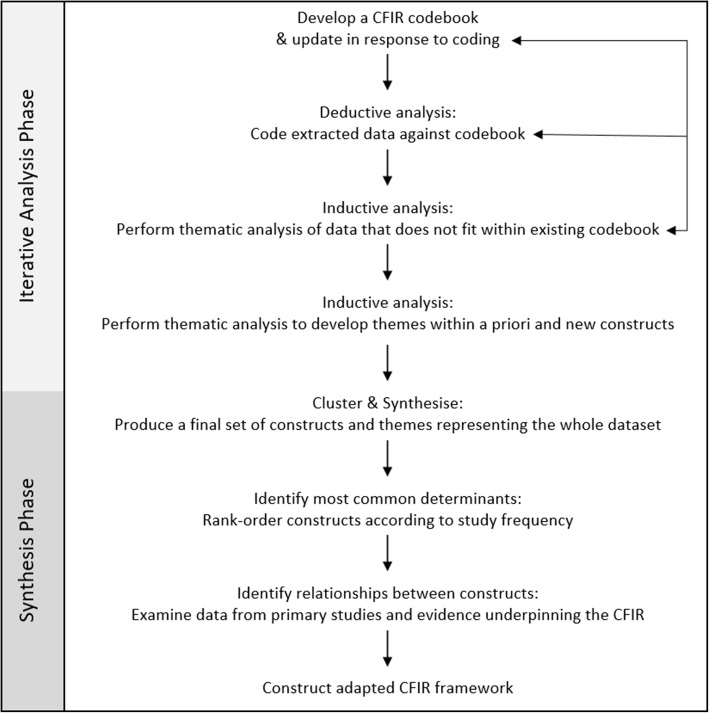
“Following the construction of an adapted CFIR framework, one reviewer (CK) assessed the potential for bias by examining differences between the a priori and adapted framework, and seeking evidence of negative cases, and conducted a sensitivity analysis to determine if the synthesis was sensitive to study methodology,…”
MethodInfluentialSmith, L. P., Ng, S. W., & Popkin, B. M. (2013) · Nutrition Journal · doi:10.1186/1475-2891-12-45 · Cited by 526
Role of government policy in nutrition—barriers to and opportunities for healthier eating
Mozaffarian, D., Angell, S. Y., Lang, T., & Rivera, J. A. (2018) · BMJ · doi:10.1136/bmj.k2426 · Cited by 509 · cited 2×
“While it is recognised that regulation is required to advance public health [19, 38, 103], the risk of tokenism, that is the superficial implementation of menu labelling, in response to regulation needs to be averted [102].”
BackgroundTransformational change in health care systems: An organizational model
Lukas, C. V., Holmes, S. K., Cohen, A. B., Restuccia, J., Cramer, I. E., Shwartz, M., & Charns, M. P. (2007) · Health Care Management Review · doi:10.1097/01.hmr.0000296785.29718.5d · Cited by 462
A Meta-Analysis of Food Labeling Effects on Consumer Diet Behaviors and Industry Practices
Shangguan, S., Afshin, A., Shulkin, M., Ma, W., Marsden, D., Smith, J., Saheb-Kashaf, M., Shi, P., Micha, R., Imamura, F., et al. (2019) · American Journal of Preventive Medicine · doi:10.1016/j.amepre.2018.09.024 · Cited by 430 · cited 4×
“While research shows menu labelling effects consumer behaviour [21, 22], the review findings suggest food businesses rely more on evidence from consumers/business activity than scientific research.”
BackgroundInfluentialClarity out of chaos: Use of theory in implementation research
Damschroder, L. J. (2020) · Psychiatry Research · doi:10.1016/j.psychres.2019.06.036 · Cited by 422 · cited 1×
“The CFIR provides a common language and clear consensual definitions which allows for comparison across diverse studies [49, 50].”
BackgroundA systematic review of adaptations of evidence-based public health interventions globally
Escoffery, C., Lebow-Skelley, E., Haardoerfer, R., Boing, E., Udelson, H., Wood, R., Hartman, M., Fernandez, M. E., & Mullen, P. D. (2018) · Implementation Science · doi:10.1186/s13012-018-0815-9 · Cited by 386 · cited 1×
“While adaptation can be viewed as a key step in the implementation process [98, 99], the risk of compromising fidelity to core intervention components and potentially reducing the effects needs to be considered [100].”
BackgroundGlisson, C., & Schoenwald, S. K. (2005) · Mental Health Services Research · doi:10.1007/s11020-005-7456-1 · Cited by 373
Nilsen, P., Ståhl, C., Roback, K., & Cairney, P. (2013) · Implementation Science · doi:10.1186/1748-5908-8-63 · Cited by 346 · cited 3×
“Moreover, policy implementation research has emphasised the inherent interdependency between factors as well as the crucial importance of context [83].”
BackgroundNutritional labelling for healthier food or non-alcoholic drink purchasing and consumption
Crockett, R. A., King, S. E., Marteau, T. M., Prevost, A. T., Bignardi, G., Roberts, N. W., Stubbs, B., Hollands, G. J., & Jebb, S. A. (2018) · Cochrane Database of Systematic Reviews · doi:10.1002/14651858.cd009315.pub2 · Cited by 298 · cited 3×
“While research shows menu labelling effects consumer behaviour [21, 22], the review findings suggest food businesses rely more on evidence from consumers/business activity than scientific research.”
Association between eating out of home and body weight
Bezerra, I. N., Curioni, C., & Sichieri, R. (2012) · Nutrition Reviews · doi:10.1111/j.1753-4887.2011.00459.x · Cited by 274
Carroll, C., Booth, A., & Lloyd-Jones, M. (2012) · Qualitative Health Research · doi:10.1177/1049732312452937 · Cited by 248 · cited 1×
“No studies were excluded based on quality scores; the quality cut-off points outlined in Appendix 6 were used as part of the sensitivity analysis to explore whether studies with different quality scores affected the presence of any constructs or domains in the adapted framework [52].”
MethodNago, E. S., Lachat, C. K., Dossa, R. A. M., & Kolsteren, P. W. (2014) · Critical Reviews in Food Science and Nutrition · doi:10.1080/10408398.2011.627095 · Cited by 216
TIDieR-PHP: a reporting guideline for population health and policy interventions
Campbell, M., Katikireddi, S. V., Hoffmann, T., Armstrong, R., Waters, E., & Craig, P. (2018) · BMJ · doi:10.1136/bmj.k1079 · Cited by 197 · cited 1×
“Few of the included studies adequately reported on the intervention components of their menu labelling scheme; thus future studies should report on same using the TIDieR-PHP checklist [101].”
MethodThe advantages and limitations of guideline adaptation frameworks
Wang, Z., Norris, S. L., & Bero, L. (2018) · Implementation Science · doi:10.1186/s13012-018-0763-4 · Cited by 193 · cited 1×
“While adaptation can be viewed as a key step in the implementation process [98, 99], the risk of compromising fidelity to core intervention components and potentially reducing the effects needs to be considered [100].”
BackgroundBlock, J. P., Condon, S. K., Kleinman, K., Mullen, J., Linakis, S., Rifas-Shiman, S., & Gillman, M. W. (2013) · BMJ · doi:10.1136/bmj.f2907 · Cited by 164 · cited 1×
“In addition, consumers tend to underestimate the energy, fat and sodium content of meals when eating outside the home [14, 15].”
The impact of key modifiable risk factors on leading chronic conditions
Adams, M. L., Grandpre, J., Katz, D. L., & Shenson, D. (2019) · Preventive Medicine · doi:10.1016/j.ypmed.2019.01.006 · Cited by 163 · cited 1×
“Poor diet is a leading risk factor for chronic disease and premature death [1, 2].”
BackgroundOrganizational theory for dissemination and implementation research
Birken, S. A., Bunger, A. C., Powell, B. J., Turner, K., Clary, A. S., Klaman, S. L., Yu, Y., Whitaker, D. J., Self, S. R., Rostad, W. L., et al. (2017) · Implementation Science · doi:10.1186/s13012-017-0592-x · Cited by 156 · cited 2×
“3 & 4) somewhat reflects some of the theories/models underpinning the CFIR [73–76] as well as key organisational theories [77].”
Background(Over)eating out at major UK restaurant chains: observational study of energy content of main meals
Robinson, E., Jones, A., Whitelock, V., Mead, B. R., & Haynes, A. (2018) · BMJ · doi:10.1136/bmj.k4982 · Cited by 147 · cited 1×
“600 kcal or less for main lunch/dinner meals) [12, 13].”
BackgroundCoxon, K., Chisholm, A., Malouf, R. S., Rowe, R. E., & Hollowell, J. (2017) · BMC Pregnancy and Childbirth · doi:10.1186/s12884-017-1279-7 · Cited by 124
Survivorship Care Plans: Prevalence and Barriers to Use
Birken, S. A., Mayer, D. K., & Weiner, B. J. (2013) · Journal of Cancer Education · doi:10.1007/s13187-013-0469-x · Cited by 119 · cited 1×
“For example, organisations will implement innovations to comply with accrediting bodies [85], to respond to changing patient needs [86] and to offer a valuable service to patients [87].”
BackgroundBes-Rastrollo, M., Basterra-Gortari, F. J., Sánchez-Villegas, A., Marti, A., Martínez, J. A., & Martínez-González, M. A. (2010) · Public Health Nutrition · doi:10.1017/s1368980009992783 · Cited by 118
Vyth, E. L., Steenhuis, I. H. M., Heymans, M. W., Roodenburg, A. J. C., Brug, J., & Seidell, J. C. (2011) · Journal of the American Dietetic Association · doi:10.1016/j.jada.2010.10.003 · Cited by 113
Orfanos, P., Naska, A., Trichopoulou, A., Grioni, S., Boer, J. M. A., van Bakel, M. M. E., Ericson, U., Rohrmann, S., Boeing, H., Rodríguez, L., et al. (2009) · European Journal of Clinical Nutrition · doi:10.1038/ejcn.2009.84 · Cited by 112
Mills, S., Adams, J., Wrieden, W. L., White, M., & Brown, H. (2018) · Public Health Nutrition · doi:10.1017/s1368980018000812 · Cited by 108 · cited 1×
“Over the last decades eating outside the home has steadily increased, with fewer meals being prepared at home [5, 16, 17].”
BackgroundStokes, T., Shaw, E. J., Camosso‐Stefinovic, J., Imamura, M., Kanguru, L., & Hussein, J. (2016) · Implementation Science · doi:10.1186/s13012-016-0508-1 · Cited by 105
Does nutrition information on menus impact food choice? Comparisons across two hospital cafeterias
Vanderlee, L., & Hammond, D. (2014) · Public Health Nutrition · doi:10.1017/s136898001300164x · Cited by 104
Bhutani, S., Schoeller, D. A., Walsh, M. C., & McWilliams, C. (2016) · American Journal of Health Promotion · doi:10.1177/0890117116660772 · Cited by 101
Roberts, S. B., Das, S. K., Suen, V. M. M., Pihlajamäki, J., Kuriyan, R., Steiner‐Asiedu, M., Taetzsch, A., Anderson, A. K., Silver, R. E., Barger, K., et al. (2018) · BMJ · doi:10.1136/bmj.k4864 · Cited by 89
Todd, J. E. (2017) · Public Health Nutrition · doi:10.1017/s1368980017002403 · Cited by 87
Health Public Policy Public opinion on food-related obesity prevention policy initiatives
Morley, B., Martin, J. E., Niven, P., & Wakefield, M. A. (2012) · Health Promotion Journal of Australia · doi:10.1071/he12086 · Cited by 84 · cited 1×
“Despite their being evidence of public support for menu labelling [64, 65, 95], further efforts are required to engage consumers in order to increase uptake and demand (e.”
BackgroundAccuracy of Stated Energy Contents of Restaurant Foods
Urban, L. E., McCrory, M. A., Dallal, G. E., Das, S. K., Saltzman, E., Weber, J. L., & Roberts, S. B. (2011) · JAMA · doi:10.1001/jama.2011.993 · Cited by 79
Obstacles to Nutrition Labeling in Restaurants
Almanza, B. A., Nelson, D. C., & CHAI, S. (1997) · Journal of the American Dietetic Association · doi:10.1016/s0002-8223(97)00041-2 · Cited by 77 · cited 2×
“Goals and feedback [58, 61, 69] [59, 61, 62, 64, 67–71]”
BackgroundShaw, R. L., Holland, C., Pattison, H. M., & Cooke, R. W. I. (2016) · Social Science & Medicine · doi:10.1016/j.socscimed.2016.03.015 · Cited by 73
Willging, C. E., Aarons, G. A., Trott, E. M., Green, A. E., Finn, N., Ehrhart, M. G., & Hecht, D. B. (2016) · Administration and Policy in Mental Health and Mental Health Services Research · doi:10.1007/s10488-015-0681-6 · Cited by 71
Global Governance of Front-of-Pack Nutrition Labelling: A Qualitative Analysis
Thow, A. M., Jones, A., Schneider, C. H., & Labonté, R. (2019) · Nutrients · doi:10.3390/nu11020268 · Cited by 67 · cited 2×
“According to public health advocates, industry actors should not be involved in nutrition policy development due to concerns over conflict of interest; however, they should be involved during implementation [38, 97, 103, 104].”
BackgroundThe Accuracy of Stated Energy Contents of Reduced-Energy, Commercially Prepared Foods
Urban, L. E., Dallal, G. E., Robinson, L. M., Ausman, L. M., Saltzman, E., & Roberts, S. B. (2010) · Journal of the American Dietetic Association · doi:10.1016/j.jada.2009.10.003 · Cited by 65
Implementation plans included in World Health Organisation guidelines
Wang, Z., Norris, S. L., & Bero, L. (2015) · Implementation Science · doi:10.1186/s13012-016-0440-4 · Cited by 65 · cited 1×
“While adaptation can be viewed as a key step in the implementation process [98, 99], the risk of compromising fidelity to core intervention components and potentially reducing the effects needs to be considered [100].”
BackgroundIncreasing healthy life expectancy equitably in England by 5 years by 2035: could it be achieved?
Marteau, T. M., White, M., Rutter, H., Petticrew, M., Mytton, O. T., McGowan, J. G., & Aldridge, R. W. (2019) · The Lancet · doi:10.1016/s0140-6736(19)31510-7 · Cited by 64 · cited 1×
“To help increase transparency in the nutritional value of meals outside the home and to assist consumers in making both informed and healthier food choices, menu labelling is recommended as part of a comprehensive approach to reduce diet-related non-communicable diseases (NCDs) [19, 20].”
BackgroundBurton, S., Tangari, A. H., Howlett, E. A., & Turri, A. M. (2013) · Journal of Consumer Affairs · doi:10.1111/joca.12015 · Cited by 45 · cited 1×
“In addition, consumers tend to underestimate the energy, fat and sodium content of meals when eating outside the home [14, 15].”
BackgroundFeasibility of Voluntary Menu Labeling Among Locally Owned Restaurants
Britt, J., Frandsen, K., Leng, K., Evans, D., & Pulos, E. (2010) · Health Promotion Practice · doi:10.1177/1524839910386182 · Cited by 40 · cited 3×
“Outer Setting Media & societal pressure [58, 67] No data”
BackgroundKerins, C., McSharry, J., Hayes, C. B., Perry, I. J., Geaney, F., & Kelly, C. N. M. (2018) · Systematic Reviews · doi:10.1186/s13643-018-0752-3 · Cited by 39
Self-citationFarrell, L. C., Moore, V., Warin, M. J., & Street, J. (2018) · Health Promotion Journal of Australia · doi:10.1002/hpja.185 · Cited by 38 · cited 1×
“through consumer education mass media campaigns) [96, 97].”
Robinson, E., Burton, S. P., Gough, T., Jones, A., & Haynes, A. (2019) · BMC Public Health · doi:10.1186/s12889-019-7017-5 · Cited by 37 · cited 1×
“Challenges relate to delays in legislation implementation [31], lack of monitoring/enforcement [32], poor uptake by food service businesses [33, 34] and inaccurate nutritional information being presented on menus due to cited reasons such as inconsistent portioning, lack of training and difficulties in sourcing nutrit…”
BackgroundFoods and Beverages Obtained at Worksites in the United States
Onufrak, S. J., Zaganjor, H., Pan, L., Lee, S. H., Park, S., & Harris, D. M. (2019) · Journal of the Academy of Nutrition and Dietetics · doi:10.1016/j.jand.2018.11.011 · Cited by 36
Ready for Policy? Stakeholder Attitudes Toward Menu Labelling in Toronto, Canada
Mah, C. L., Vanderlinden, L. D., Mamatis, D., Ansara, D. L., Levy, J. M., & Swimmer, L. (2013) · Canadian Journal of Public Health · doi:10.17269/cjph.104.3708 · Cited by 35
Restaurant Operator's Receptiveness towards Providing Nutritional Information on Menu
Din, N., Zahari, M. S. M., Othman, C. N., & Abas, R. (2012) · Procedia - Social and Behavioral Sciences · doi:10.1016/j.sbspro.2012.08.073 · Cited by 32 · cited 1×
“Design quality and packaging [63, 67] [59, 61, 65, 68]”
Menu label accuracy at a university's foodservices. An exploratory recipe nutrition analysis
Feldman, C. H., Murray, D. W., Chavarria, S., & Zhao, H. (2015) · Appetite · doi:10.1016/j.appet.2015.05.001 · Cited by 30
Health care industry, customer orientation and organizational innovation
Tsai, Y. (2013) · Chinese Management Studies · doi:10.1108/cms-oct-2011-0086 · Cited by 29 · cited 1×
“For example, organisations will implement innovations to comply with accrediting bodies [85], to respond to changing patient needs [86] and to offer a valuable service to patients [87].”
BackgroundThe Calorie-Labeling Saga — Federal Preemption and Delayed Implementation of Public Health Law
Block, J. P. (2018) · New England Journal of Medicine · doi:10.1056/nejmp1802953 · Cited by 29 · cited 1×
“Challenges relate to delays in legislation implementation [31], lack of monitoring/enforcement [32], poor uptake by food service businesses [33, 34] and inaccurate nutritional information being presented on menus due to cited reasons such as inconsistent portioning, lack of training and difficulties in sourcing nutrit…”
BackgroundVyth, E. L., van der Meer, E. W. C., Seidell, J. C., & Steenhuis, I. H. (2011) · Health Promotion International · doi:10.1093/heapro/dar034 · Cited by 28 · cited 2×
“Reflecting and evaluating [56] No data Kerins et al.”
MethodCavalcante, J. B., Moreira, T. M. V., Mota, C. D. C., Pontes, C. R., & Bezerra, I. N. (2017) · Revista Brasileira de Epidemiologia · doi:10.1590/1980-5497201700010010 · Cited by 24
Global Non-Communicable Diseases—The Nutrition Conundrum
Khandelwal, S., Kurpad, A. V., & Narayan, K. M. V. (2018) · Frontiers in Public Health · doi:10.3389/fpubh.2018.00009 · Cited by 22
Innovation Pilot Study: Acute Care for Elderly (ACE) Unit—Promoting Patient-Centric Care
Krall, E., Close, J., Parker, J., Sudak, M., Lampert, S., & Colonnelli, K. (2012) · HERD Health Environments Research & Design Journal · doi:10.1177/193758671200500309 · Cited by 21 · cited 1×
“For example, organisations will implement innovations to comply with accrediting bodies [85], to respond to changing patient needs [86] and to offer a valuable service to patients [87].”
BackgroundRaine, K. D., Ferdinands, A. R., Atkey, K. M., Hobin, E. P., Jeffery, B., Nykiforuk, C. I. J., Vanderlee, L., Vogel, E., & von Tigerstrom, B. (2017) · Canadian Journal of Public Health · doi:10.17269/cjph.108.6076 · Cited by 21 · cited 2×
“This highlights the need for effective mechanisms to be put in place to ensure rigorous enforcement alongside regulation [32, 104].”
BackgroundFitzgerald, S., Gilgan, L., McCarthy, M. B., Perry, I. J., & Geaney, F. (2018) · Public Health Nutrition · doi:10.1017/s1368980018001969 · Cited by 21 · cited 1×
“Challenges relate to delays in legislation implementation [31], lack of monitoring/enforcement [32], poor uptake by food service businesses [33, 34] and inaccurate nutritional information being presented on menus due to cited reasons such as inconsistent portioning, lack of training and difficulties in sourcing nutrit…”
BackgroundSelf-citationVeinot, T. C., Senteio, C. R., Hanauer, D. A., & Lowery, J. C. (2017) · Journal of the American Medical Informatics Association · doi:10.1093/jamia/ocx085 · Cited by 20
Effective National Menu Labeling Requires Accuracy and Enforcement
Huang, Y., Pomeranz, J. L., & Cash, S. B. (2018) · Journal of the Academy of Nutrition and Dietetics · doi:10.1016/j.jand.2018.03.001 · Cited by 19 · cited 3×
“In the absence of monitoring and enforcement, food businesses may present inaccurate nutrition information on menus [32].”
BackgroundHamilton, A. B., Mittman, B. S., Eccles, A. M., Hutchinson, C. S., & Wyatt, G. E. (2015) · Implementation Science · doi:10.1186/1748-5908-10-s1-a72 · Cited by 15
Maestro, V., & Salay, E. (2008) · Journal of Foodservice · doi:10.1111/j.1748-0159.2008.00113.x · Cited by 15
Nutrition labelling in restaurants: a UK‐based case study
Zick, A., Wake, Y., & Reeves, S. (2010) · Nutrition & Food Science · doi:10.1108/00346651011090365 · Cited by 13 · cited 1×
“Networks and communications [70] No data”
The impact of a complex workplace dietary intervention on Irish employees’ off-duty dietary intakes
Fitzgerald, S., Buckley, L., Perry, I. J., & Geaney, F. (2019) · Health Promotion International · doi:10.1093/heapro/daz051 · Cited by 13 · cited 1×
“The food service industry, with responsibility for meals prepared outside the home, has an important role in promoting healthy dietary behaviours [18].”
BackgroundSelf-citationCalorie menu labelling in Ireland: a survey of food service businesses
Logue, D. M., Kennelly, J. P., Keaveney, E. M., O'Connor, D. M., Bhriain, S. M. N., & Flynn, M. (2013) · Proceedings of The Nutrition Society · doi:10.1017/s0029665113001900 · Cited by 5 · cited 1×
“Characteristics of Individuals Knowledge and beliefs [61, 63, 67] [60, 62, 65, 69, 71, 72]”
Background
Research works printed but not linked: 12
- Ontario Ministry of Health and Long-Term Care. New menu labelling regulation. http://health.gov.on.ca/en/news/bulletin/2016/hb_20160927.aspx. Accessed 1 May 2019.
- Food Safety Authority of Ireland (FSAI) Putting calories on menus in Ireland - technical guidance for food businesses 2012 Dublin FSAI
- Health Service Executive (HSE) Guidance for calorie posting implementation 2015 Dublin HSE
- Roodenburg AC Payens IJ Vrijhof C Menu labeling in “out-of-home” sector: opportunities, barriers, and needs with respect to use of health communication in restaurants Ann Nutr Metab 2013 63 suppl1 1054
- Jeong JY Kim E Yang IS Ham S Motivators and barriers to provision of nutritional information in restaurants Korean J Hosp Tourism 2015 24 227 243
- Clegg S Jordan E Slade Z An evaluation of provision of calorie information by catering outlets 2009 United Kingdom Food Standards Agency
- Toronto Public Health Voluntary menu labelling pilot project: final report 2015 Ontario Toronto Public Health
- Geaney F Kelly C Scotto Di Marrazzo J Gilgan L McCarthy M Perry IJ Evaluation of the uptake of voluntary calorie posting on menus in Ireland 2015 Dublin Department of Health
- Ottawa Public Health Report on Ottawa restaurant survey 2013 Ottawa Ottawa Public Health
- Ray K Clegg S Davidson R Vegeris S Evaluation of Caloriewise: a Northern Ireland pilot of the display of calorie information in food catering businesses 2013 Northern Ireland Food Standards Agency
- Food Safety Authority of Ireland (FSAI) Calories on menus in Ireland. A report on a national consultation 2012 Dublin FSAI
- Shupe E Obstacles to participation in menu labeling observed by the independent foodservice establishments [degree of doctor of philosophy] 2013 Minnesota Walden University
Cited by
The updated consolidated framework for implementation research based on user feedback
Damschroder, L. J., Reardon, C. M., Widerquist, M. A. O., & Lowery, J. (2022) · Implementation Science · doi:10.1186/s13012-022-01245-0 · Cited by 4,452
“Published guidance highlights the importance of Adapting the innovation [76], and the updated CFIR notes the importance of adapting the setting as well [77].”
BackgroundMethodInfluentialSelf-citationReardon, C. M., Damschroder, L. J., Ashcraft, L. E., Kerins, C., Bachrach, R. L., Nevedal, A. L., Domlyn, A. M., Dodge, J., Chinman, M., & Rogal, S. (2025) · Implementation Science · doi:10.1186/s13012-025-01450-7 · Cited by 172
“In addition to coding individual CFIR constructs, analysts can employ causation coding [46] and relationship coding [43, 47] to capture how constructs interact within a project.”
Self-citationThe impact of key modifiable risk factors on leading chronic conditions
Adams, M. L., Grandpre, J., Katz, D. L., & Shenson, D. (2019) · Preventive Medicine · doi:10.1016/j.ypmed.2019.01.006 · Cited by 163
Gupta, A., Alston, L. V., Needham, C., Robinson, E., Marshall, J. M., Boelsen‐Robinson, T., Blake, M. R., Huggins, C. E., & Peeters, A. (2022) · Nutrients · doi:10.3390/nu14020294 · Cited by 81
“, qualitative and quantitative) systematic review [8] identified studies that reported retailers’ knowledge and beliefs as both barriers and facilitators to implementation of menu labelling interventions, using an existing conceptual implementation framework.”
BackgroundMethodResultInfluentialPatiño, S. R., Zhou, M., Gomes, F. D. S., Lemaire, R. H., Hedrick, V. E., Serrano, E. L., & Kraak, V. I. (2020) · Nutrients · doi:10.3390/nu12061544 · Cited by 73
“A compelling business case must be made to persuade chain restaurants to adopt these strategies to improve their corporate image and attract new customers who want healthy meals [95].”
Background
Metadata
- Authors
- Kerins, C., McHugh, S., McSharry, J., Reardon, C. M., Hayes, C., Perry, I. J., Geaney, F., Seery, S., & Kelly, C.
- Affiliations
- Ollscoil na Gaillimhe – University of Galway (IE)
- University College Cork (IE)
- VA Center for Clinical Management Research (US)
- Trinity College Dublin (IE)
- Croí (IE)
- Corresponding author
- Kerins, Claire
- ORCID
- Venue
- International Journal of Behavioral Nutrition and Physical Activity
- Published
- 2020-04-15
- Volume
- 17
- Issue
- 1
- Pages
- 48-48
- ISSN
- 1479-5868 (ISSN-L)
- PMC
- PMC7161210
- OpenAlex
- W3016316110
- Cited by
- 30
- References
- 95
- Citations by year
- 2026: 4 · 2025: 5 · 2024: 2 · 2023: 4 · 2022: 7 · 2021: 6 · 2020: 1
- FWCI
- 0.85
- Type
- journal article
- Language
- en
- Open access
- gold
- doi.org
- Licence
- cc-by
- creativecommons.org/licenses/by/4.0/ (tdm)
- creativecommons.org/licenses/by/4.0/ (vor)
- Locations
- International Journal of Behavioral Nutrition and Physical Activity (publishedVersion, cc-by)
- PubMed Central (publishedVersion, cc-by)
- PubMed (publishedVersion)
- Cork Open Research Archive (University College Cork, Ireland) (submittedVersion, cc-by)
- DOAJ (DOAJ: Directory of Open Access Journals) (submittedVersion, cc-by-sa)
- Trinity's Access to Research Output (TARA) (Trinity College Dublin) (submittedVersion, cc-by-nc-sa)
- Funders
- Health Research Board (SPHeRE/2013/1)
- Topics
- Health Sciences › Health Professions › General Health Professions › Health Policy Implementation Science
- Health Sciences › Medicine › Public Health, Environmental and Occupational Health › Consumer Attitudes and Food Labeling
- Health Sciences › Medicine › Public Health, Environmental and Occupational Health › Global Public Health Policies and Epidemiology
- Keywords
- menu labeling, implementation barriers and facilitators, food service industry, food business, Consolidated Framework for Implementation Research, corporate reputation, eating out, healthy food choices
- MeSH terms
- Consumer Behavior, Food Labeling, Food Preferences, Food Services, Humans, Menu Planning, Restaurants
About these checks
Registry, retraction, Cites and statistics results are computed, not judged, with one exception: a printed reference that no index lists is read once by a model before it counts as a citation error. Claims are extracted by a model and kept only when their quote appears verbatim in the text; each cited source is then checked, with a model’s help, for whether it says what the claim relies on. Those verdicts can be wrong — read the claim’s quote and the cited source before relying on one.
Statistics and arithmetic are recomputed, not judged.
Confidence bands are shown only for fields calibrated on our annotated test set. None is calibrated yet, so no band is shown.
What counts as a claim ›How we measure confidence ›How we check this ›
Are you an author, or do you see a problem with this page? Request a review
Data sources
Bibliographic data: Semantic Scholar, OpenAlex, Crossref.
Contains information from the Semantic Scholar Academic Graph Datasets, made available under the ODC Attribution License (ODC-BY 1.0).
Semantic Scholar’s data is described in: Kinney, R., et al. (2023). The Semantic Scholar Open Data Platform. arXiv:2301.10140.
