

The DOI matches its Crossref record; 66 of the 70 references it cites were found in a registry or an index; none of the 70 sources its claims cite is checked for support yet.
Combinations of physical activity, sedentary time, and sleep duration and their associations with depressive symptoms and other mental health problems in children and adolescents: a systematic review
Open accessAbstract
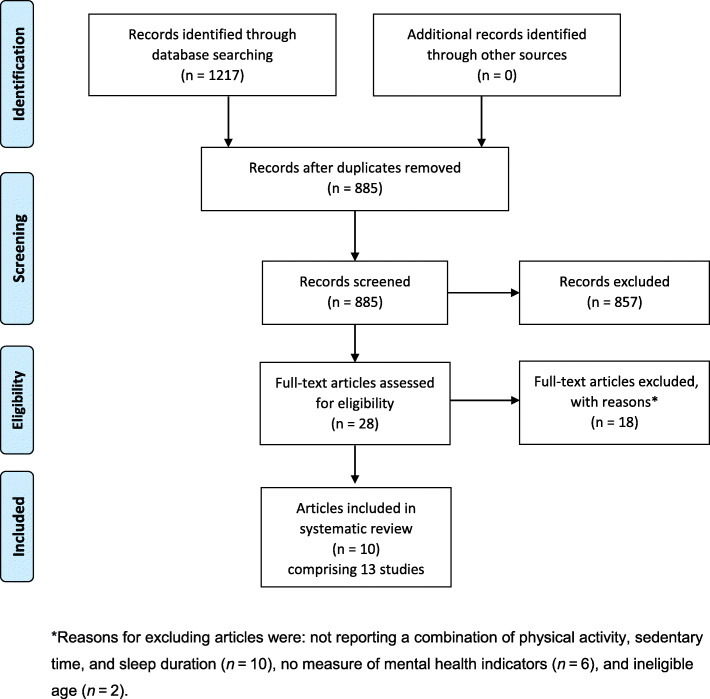
Background: For optimal health benefits, the Canadian 24-Hour Movement Guidelines for Children and Youth (aged 5–17 years) recommend an achievement of high levels of physical activity (≥60 min of moderate-to-vigorous physical activity), low levels of sedentary behaviour (≤2 h of recreational screen time), and sufficient sleep (9–11 h for children or 8–10 h for adolescents) each day. The objective of this systematic review was to examine how combinations of physical activity, sedentary time, and sleep duration relate to depressive symptoms and other mental health indicators among children and adolescents. Methods: Literature was obtained through searching Medline, EMBASE, PsycINFO, and SportDiscus up to September 30, 2019. Peer-reviewed studies published in English or French were included if they met the following criteria: population (apparently healthy children and adolescents with a mean age of 5–17 years), intervention/exposure (combinations of physical activity, sedentary time, and sleep duration), and outcomes (depressive symptoms and other mental health indicators). A risk of bias assessment was completed for all included studies using the methods described in the Cochrane Handbook. The Grading of Recommendations Assessment, Development and Evaluation (GRADE) framework was used to assess the quality of evidence for each health indicator. Narrative syntheses were employed to describe the results due to high levels of heterogeneity across studies. Results: A total of 13 cross-sectional studies comprised in 10 papers met inclusion criteria. Data across studies involved 115,540 children and adolescents from 12 countries. Overall, the findings indicated favourable associations between meeting all 3 recommendations and better mental health indicators among children and adolescents when compared with meeting none of the recommendations. There was evidence of a dose-response gradient between an increasing number of recommendations met and better mental health indicators. Meeting the screen time and sleep duration recommendations appeared to be associated with more mental health benefits than meeting the physical activity recommendation. The quality of evidence reviewed was “very low” according to GRADE. Conclusions: The findings indicate favourable associations between meeting all 3 movement behaviour recommendations in the 24-h guidelines and better mental health indicators among children and adolescents. There is a clear need for high-quality studies that use robust measures of all movement behaviours and validated measures of mental health to increase our understanding in this topic area.
Overview
AI snapshot
Written from the paper’s full text.
TL;DR
This systematic review of 13 cross-sectional studies (10 papers; 115,540 children and adolescents from 12 countries) found that meeting all three Canadian 24-hour movement recommendations was associated with better mental health indicators, including lower odds of depressive symptoms, than meeting none. The quality of evidence was rated “very low” by GRADE, and the authors call for higher-quality longitudinal and experimental studies.
Key findings
- Across 3 studies of depressive symptoms (84,004 participants aged 6–20 years), meeting all 3 recommendations versus none was associated with lower odds of depressive symptoms among male and female adolescents; among children aged 6–11 years, meeting screen time alone, screen time + sleep, or physical activity + sleep was associated with lower odds of depressive symptoms than meeting none or all three guidelines.
- Across 10 studies of other mental health indicators (111,641 participants aged 6–20 years), all 10 found better outcomes when meeting all 3 recommendations versus none; 3/10 found screen time alone or screen time + sleep consistently associated with better cognitive function, impulsivity scores, and health-related quality of life, and 2/10 documented a dose-response gradient (3 > 2 > 1 > 0 recommendations met).
- Meeting prevalence ranged from 4.1–40.5% for physical activity, 8–48.2% for screen time, and 41.9–89.3% for sleep; meeting all three recommendations ranged from 2.6–17.1%. Depressive symptom prevalence examples were 42.7% in >59,000 US adolescents, 14.4% in nearly 4,000 UK adolescents, and 10.3% in >35,000 US children and adolescents.
- GRADE quality was “very low” for both depressive symptoms and other mental health indicators.
Methods
- Systematic review registered with PROSPERO (registration pending) and reported per PRISMA; searched Medline, EMBASE, PsycINFO, and SportDiscus up to September 30, 2019, limited to English or French. Eligible studies included apparently healthy children and adolescents with mean age 5–17 years, reported all three movement behaviours, and assessed depressive symptoms or other mental health indicators.
- Included 13 cross-sectional studies from 10 papers; risk of bias was assessed using Cochrane Handbook methods, evidence quality was assessed with GRADE, and narrative synthesis was used because meta-analysis was not possible due to heterogeneity.
- Primary outcome was depressive symptoms; secondary outcomes included anxiety, social and emotional health, health-related quality of life, substance use, impulsivity, cognitive functions, life satisfaction, and prosocial behaviour.
Limitations
- Stated in the paper: GRADE quality was “very low” mainly because all included studies were cross-sectional and most used subjective measures of physical activity, recreational sedentary time, and sleep duration with no psychometric properties reported; many studies used single-item mental health measures; cross-sectional designs preclude temporality and causal inference; only English/French articles were included; meta-analysis was not possible due to heterogeneous data; and conclusions are limited by the small number of included studies and lack of longitudinal or intervention studies.
- Evident from the text: all included studies were cross-sectional, most movement behaviour measures were self- or parent-reported, and only one depressive-symptoms study used an objective physical activity measure and a validated depression instrument.
Model-written summary. Check it against the paper before relying on it.
Integrity signals
Registry
Cites
Statistics
Figures
Verification
Claims the paper makes
42 Not checked yet · 20 Own method · 13 Own result · 3 Own interpretation · 2 No basis given
A result the paper reports from its own data — it cites no other source for it, so there is none to check. The quote shows it is in the paper.
In the paper
“Data across studies involved 115,540 children and adolescents from 12 countries.”
- Also stated in: § Description of studies · plain
“Data across studies involved 115,540 children and adolescents from 12 countries.”
§ Combinations of physical activity, sedentary time, and sleep duration and their associations with depressive symptoms and other mental health problems in children and adolescents: a systematic review > Abstract > Results
plainn = 115,540- Asserted: passes — The authors put it forward as true.
- Checkable: passes — It can be checked against evidence.
- Load-bearing: unclear — It is unclear whether the paper’s conclusions depend on it.
- Based: passes — The paper gives a reason why it holds.
- Also stated in: § Description of studies · plain
In the paper
“Among adolescents, meeting all three guidelines was associated with lower odds of anxiety compared to meeting none of the recommendations”
§ Combinations of physical activity, sedentary time, and sleep duration and their associations with depressive symptoms and other mental health problems in children and adolescents: a systematic review > Results > Other mental health indicators (secondary indicators)
What the sources say
- Not checked yetcites [39] Zhu X, Haegele JA, Healy S. Movement and mental health: Behavioral correlates of anxiety and depression among children of 6–17 years old in the U.S. Ment Health Phys Act. 2019;16:60–5. source
plaincorrelational- Asserted: passes — The authors put it forward as true.
- Checkable: passes — It can be checked against evidence.
- Load-bearing: passes — The paper’s conclusions depend on it.
- Based: passes — The paper gives a reason why it holds.
In the paper
“Among children, meeting all three guidelines was associated with lower odds of anxiety compared to meeting the physical activity, and the screen time recommendations.”
§ Combinations of physical activity, sedentary time, and sleep duration and their associations with depressive symptoms and other mental health problems in children and adolescents: a systematic review > Results > Other mental health indicators (secondary indicators)
What the sources say
- Not checked yetcites [39] Zhu X, Haegele JA, Healy S. Movement and mental health: Behavioral correlates of anxiety and depression among children of 6–17 years old in the U.S. Ment Health Phys Act. 2019;16:60–5. source
plaincorrelational- Asserted: passes — The authors put it forward as true.
- Checkable: passes — It can be checked against evidence.
- Load-bearing: unclear — It is unclear whether the paper’s conclusions depend on it.
- Based: passes — The paper gives a reason why it holds.
In the paper
“2/10 studies used compositional data analyses and found that the composition of movement behaviours was associated with social and emotional health [34] and with HRQoL [35]”
§ Combinations of physical activity, sedentary time, and sleep duration and their associations with depressive symptoms and other mental health problems in children and adolescents: a systematic review > Results > Other mental health indicators (secondary indicators)
What the sources say
- Not checked yetcites [35] Dumuid D, Maher C, Lewis LK, Stanford TE, Fernández JAM, Ratcliffe J, et al. Human development index, children’s health-related quality of life and movement behaviors: a compositional data analysis. Qual Life Res. 2018;27(6):1473–82. source
plaincorrelational- Asserted: passes — The authors put it forward as true.
- Checkable: passes — It can be checked against evidence.
- Load-bearing: unclear — It is unclear whether the paper’s conclusions depend on it.
- Based: passes — The paper gives a reason why it holds.
In the paper
“1/1 study found that meeting all 3 recommendations was associated with better impulsivity scores compared with meeting none.”
§ Combinations of physical activity, sedentary time, and sleep duration and their associations with depressive symptoms and other mental health problems in children and adolescents: a systematic review > Results > Other mental health indicators (secondary indicators)
What the sources say
- Not checked yetcites [36] Guerrero MD, Barnes JD, Walsh JJ, Chaput JP, Tremblay MS, Goldfield GS. 24-Hour Movement Behaviors and Impulsivity. Pediatrics. 2019;144(3):e20190187. source
plaincorrelationalSingle case- Asserted: passes — The authors put it forward as true.
- Checkable: passes — It can be checked against evidence.
- Load-bearing: unclear — It is unclear whether the paper’s conclusions depend on it.
- Based: passes — The paper gives a reason why it holds.
A result the paper reports from its own data — it cites no other source for it, so there is none to check. The quote shows it is in the paper.
In the paper
“10/10 studies found that meeting all 3 recommendations was associated with lower odds of mental outcomes among children and adolescents compared with meeting none.”
- Also stated in: § Discussion · hedged
“Collectively, the findings indicate favourable associations between meeting all 3 recommendations and better mental health indicators among children and adolescents when compared with meeting none of the recommendations.”
§ Combinations of physical activity, sedentary time, and sleep duration and their associations with depressive symptoms and other mental health problems in children and adolescents: a systematic review > Results > Other mental health indicators (secondary indicators)
plaincorrelational- Asserted: passes — The authors put it forward as true.
- Checkable: passes — It can be checked against evidence.
- Load-bearing: passes — The paper’s conclusions depend on it.
- Based: passes — The paper gives a reason why it holds.
- Also stated in: § Discussion · hedged
In the paper
“Meeting all 3 recommendations was also associated with greater odds of smoking cigarette among males”
§ Combinations of physical activity, sedentary time, and sleep duration and their associations with depressive symptoms and other mental health problems in children and adolescents: a systematic review > Results > Other mental health indicators (secondary indicators)
What the sources say
- Not checked yetcites [18] Knell G, Durand CP, Kohl HW 3rd, Wu IHC, Pettee GK. Prevalence and likelihood of meeting sleep, physical activity, and screen-time guidelines among US youth. JAMA Pediatr. 2019;173(4):387–9. source
plaincorrelational- Asserted: passes — The authors put it forward as true.
- Checkable: passes — It can be checked against evidence.
- Load-bearing: unclear — It is unclear whether the paper’s conclusions depend on it.
- Based: passes — The paper gives a reason why it holds.
The paper states this without a source or data behind it here, so there is nothing to check it against. The quote shows it is in the paper.
In the paper
“Meeting the screen time and sleep duration recommendations appeared to be associated with more mental health benefits than meeting the physical activity recommendation.”
§ Combinations of physical activity, sedentary time, and sleep duration and their associations with depressive symptoms and other mental health problems in children and adolescents: a systematic review > Abstract > Results
hedgedcorrelational- Asserted: passes — The authors put it forward as true.
- Checkable: passes — It can be checked against evidence.
- Load-bearing: passes — The paper’s conclusions depend on it.
- Based: passes — The paper gives a reason why it holds.
None of the sources cited for this claim have been checked yet.
In the paper
“3/3 studies found that participants achieving all 3 recommendations had preferable scores for the health outcomes compared with participants who did not meet the recommendations.”
§ Combinations of physical activity, sedentary time, and sleep duration and their associations with depressive symptoms and other mental health problems in children and adolescents: a systematic review > Results > Other mental health indicators (secondary indicators)
What the sources say
- Not checked yetcites [33] Carson V, Chaput J-P, Janssen I, Tremblay MS. Health associations with meeting new 24-hour movement guidelines for Canadian children and youth. Prev Med. 2017;95:7–13. source
- Not checked yetcites [34] Carson V, Tremblay MS, Chaput J-P, Chastin SF. Associations between sleep duration, sedentary time, physical activity, and health indicators among Canadian children and youth using compositional analyses. Appl Physiol Nutr Metab. 2016;41(6):S294–302. source
- Not checked yetcites [37] Janssen I, Roberts KC, Thompson W. Is adherence to the Canadian 24-hour movement behaviour guidelines for children and youth associated with improved indicators of physical, mental, and social health? Appl Physiol Nutr Metab. 2017;42(7):725–31. source
plaincorrelationaln = 3- Asserted: passes — The authors put it forward as true.
- Checkable: passes — It can be checked against evidence.
- Load-bearing: passes — The paper’s conclusions depend on it.
- Based: passes — The paper gives a reason why it holds.
In the paper
“Meeting all three recommendations was associated with significantly lower odds of depressive symptoms among adolescents than meeting none, one, or any combination of two recommendations among adolescents [39].”
§ Combinations of physical activity, sedentary time, and sleep duration and their associations with depressive symptoms and other mental health problems in children and adolescents: a systematic review > Results > Depressive symptoms (primary outcome)
What the sources say
- Not checked yetcites [39] Zhu X, Haegele JA, Healy S. Movement and mental health: Behavioral correlates of anxiety and depression among children of 6–17 years old in the U.S. Ment Health Phys Act. 2019;16:60–5. source
plaincorrelational- Asserted: passes — The authors put it forward as true.
- Checkable: passes — It can be checked against evidence.
- Load-bearing: passes — The paper’s conclusions depend on it.
- Based: passes — The paper gives a reason why it holds.
- It may state two separate claims as one. 26
- Probably not a substantial claim. 22
- The quote only partly states this claim. 1
A result the paper reports from its own data — it cites no other source for it, so there is none to check. The quote shows it is in the paper.
In the paper
“The prevalence of children and adolescents who met the physical activity recommendation in the included studies ranged from 4.1 to 40.5%, with the majority in the 33.3–40.5% bracket; those who met the screen time recommendation ranged from 8 to 48.2%, with the majority in the 36.5–48.2% bracket; and those who met the sleep duration recommendation ranged from 41.9 to 89.3%, with the majority in the”
§ Combinations of physical activity, sedentary time, and sleep duration and their associations with depressive symptoms and other mental health problems in children and adolescents: a systematic review > Results > Description of studies
plain- Asserted: passes — The authors put it forward as true.
- Checkable: passes — It can be checked against evidence.
- Load-bearing: unclear — It is unclear whether the paper’s conclusions depend on it.
- Based: passes — The paper gives a reason why it holds.
It may state two separate claims as one.
A result the paper reports from its own data — it cites no other source for it, so there is none to check. The quote shows it is in the paper.
In the paper
“All studies were cross-sectional, and were published in 2016 or later, with participants’ age ranging from 6 to 20 years.”
§ Combinations of physical activity, sedentary time, and sleep duration and their associations with depressive symptoms and other mental health problems in children and adolescents: a systematic review > Results > Description of studies
plainn = 115,540- Asserted: passes — The authors put it forward as true.
- Checkable: passes — It can be checked against evidence.
- Load-bearing: unclear — It is unclear whether the paper’s conclusions depend on it.
- Based: passes — The paper gives a reason why it holds.
It may state two separate claims as one.
None of the sources cited for this claim have been checked yet.
In the paper
“3/10 studies found that meeting the screen time recommendation alone, and both the screen time and sleep duration recommendations, were consistently associated with better cognitive functions, impulsivity scores and HRQoL [20, 36, 38].”
§ Combinations of physical activity, sedentary time, and sleep duration and their associations with depressive symptoms and other mental health problems in children and adolescents: a systematic review > Results > Other mental health indicators (secondary indicators)
What the sources say
- Not checked yetcites [20] Walsh JJ, Barnes JD, Cameron JD, Goldfield GS, Chaput JP, Gunnell KE, et al. Associations between 24 hour movement behaviours and global cognition in US children: a cross-sectional observational study. Lancet Child Adolesc Health. 2018;2(11):783–91. source
- Not checked yetcites [36] Guerrero MD, Barnes JD, Walsh JJ, Chaput JP, Tremblay MS, Goldfield GS. 24-Hour Movement Behaviors and Impulsivity. Pediatrics. 2019;144(3):e20190187. source
- Not checked yetcites [38] Sampasa-Kanyinga H, Standage M, Tremblay MS, Katzmarzyk PT, Hu G, Kuriyan R, et al. Associations between meeting combinations of 24-h movement guidelines and health-related quality of life in children from 12 countries. Public Health. 2017;153:16–24. source
plaincorrelational- Asserted: passes — The authors put it forward as true.
- Checkable: passes — It can be checked against evidence.
- Load-bearing: unclear — It is unclear whether the paper’s conclusions depend on it.
- Based: passes — The paper gives a reason why it holds.
It may state two separate claims as one.
None of the sources cited for this claim have been checked yet.
In the paper
“Depressive symptoms were reported in 3 studies [18, 19, 39], representing 3 unique datasets, and 84,004 individual participants with age ranging from 6 to 20 years (Table 2).”
§ Combinations of physical activity, sedentary time, and sleep duration and their associations with depressive symptoms and other mental health problems in children and adolescents: a systematic review > Results > Depressive symptoms (primary outcome)
What the sources say
- Not checked yetcites [18] Knell G, Durand CP, Kohl HW 3rd, Wu IHC, Pettee GK. Prevalence and likelihood of meeting sleep, physical activity, and screen-time guidelines among US youth. JAMA Pediatr. 2019;173(4):387–9. source
- Not checked yetcites [19] Pearson N, Sherar LB, Hamer M. Prevalence and correlates of meeting sleep, screen-time, and physical activity guidelines among adolescents in the United Kingdom. JAMA Pediatr. 2019;173(10):993–4. source
- Not checked yetcites [39] Zhu X, Haegele JA, Healy S. Movement and mental health: Behavioral correlates of anxiety and depression among children of 6–17 years old in the U.S. Ment Health Phys Act. 2019;16:60–5. source
plainn = 84,004- Asserted: passes — The authors put it forward as true.
- Checkable: passes — It can be checked against evidence.
- Load-bearing: unclear — It is unclear whether the paper’s conclusions depend on it.
- Based: passes — The paper gives a reason why it holds.
It may state two separate claims as one.
A result the paper reports from its own data — it cites no other source for it, so there is none to check. The quote shows it is in the paper.
In the paper
“Of those, 3 reported on depressive symptoms [18, 19, 39], 3 on social and emotional health [33, 34, 37], 2 on health-related quality of life [35, 38], 1 on anxiety [39], 1 on substance use (including cigarette smoking, alcohol consumption, and cannabis use) [18], 1 on impulsivity [36], 1 on cognitive functions [20], and 1 on life satisfaction and prosocial behaviour [37].”
§ Combinations of physical activity, sedentary time, and sleep duration and their associations with depressive symptoms and other mental health problems in children and adolescents: a systematic review > Results > Description of studies
plain- Asserted: passes — The authors put it forward as true.
- Checkable: passes — It can be checked against evidence.
- Load-bearing: fails — The paper’s conclusions may not depend on it.
- Based: passes — The paper gives a reason why it holds.
Probably not a substantial claim. The paper’s conclusions may not depend on it. It may state two separate claims as one.
A result the paper reports from its own data — it cites no other source for it, so there is none to check. The quote shows it is in the paper.
In the paper
“The proportion of children and adolescents who met any one recommendation in the included studies ranged from 34.9 to 51.1%, those who met any two recommendations ranged from 18.4 to 37.0%, and those who met all three recommendations ranged from 2.6 to 17.1%.”
§ Combinations of physical activity, sedentary time, and sleep duration and their associations with depressive symptoms and other mental health problems in children and adolescents: a systematic review > Results > Description of studies
plain- Asserted: passes — The authors put it forward as true.
- Checkable: passes — It can be checked against evidence.
- Load-bearing: unclear — It is unclear whether the paper’s conclusions depend on it.
- Based: passes — The paper gives a reason why it holds.
It may state two separate claims as one.
None of the sources cited for this claim have been checked yet.
In the paper
“Overall, the prevalence of depressive symptoms was 42.7% (unweighted) in a sample of more than 59,000 adolescents in the United States [18], 14.4% in a sample of nearly 4000 adolescents in the United Kingdom [19], and 10.3% in a sample of more than 35,000 children and adolescents from the United States [39].”
§ Combinations of physical activity, sedentary time, and sleep duration and their associations with depressive symptoms and other mental health problems in children and adolescents: a systematic review > Results > Description of studies
What the sources say
- Not checked yetcites [18] Knell G, Durand CP, Kohl HW 3rd, Wu IHC, Pettee GK. Prevalence and likelihood of meeting sleep, physical activity, and screen-time guidelines among US youth. JAMA Pediatr. 2019;173(4):387–9. source
- Not checked yetcites [19] Pearson N, Sherar LB, Hamer M. Prevalence and correlates of meeting sleep, screen-time, and physical activity guidelines among adolescents in the United Kingdom. JAMA Pediatr. 2019;173(10):993–4. source
- Not checked yetcites [39] Zhu X, Haegele JA, Healy S. Movement and mental health: Behavioral correlates of anxiety and depression among children of 6–17 years old in the U.S. Ment Health Phys Act. 2019;16:60–5. source
plain- Asserted: passes — The authors put it forward as true.
- Checkable: passes — It can be checked against evidence.
- Load-bearing: fails — The paper’s conclusions may not depend on it.
- Based: passes — The paper gives a reason why it holds.
Probably not a substantial claim. The paper’s conclusions may not depend on it. It may state two separate claims as one.
A result the paper reports from its own data — it cites no other source for it, so there is none to check. The quote shows it is in the paper.
In the paper
“A total of 13 cross-sectional studies comprised in 10 papers met inclusion criteria.”
- Also stated in: § Description of studies · plain
“After titles and abstracts were screened, 28 full-text articles were obtained for further review and 10 articles met the inclusion criteria (7 unique samples).”
- Also stated in: § Description of studies · plain
“The 10 articles comprised 13 studies because some papers had more than one mental health outcome.”
§ Combinations of physical activity, sedentary time, and sleep duration and their associations with depressive symptoms and other mental health problems in children and adolescents: a systematic review > Abstract > Results
plainn = 7- Asserted: passes — The authors put it forward as true.
- Checkable: passes — It can be checked against evidence.
- Load-bearing: unclear — It is unclear whether the paper’s conclusions depend on it.
- Based: passes — The paper gives a reason why it holds.
It may state two separate claims as one. The quote only partly states this claim.
- Also stated in: § Description of studies · plain
What the paper did — it cites no source for this, so there is none to check. The quote shows it is in the paper.
In the paper
“The electronic search strategy was created by a research librarian with expertise in systematic review.”
§ Combinations of physical activity, sedentary time, and sleep duration and their associations with depressive symptoms and other mental health problems in children and adolescents: a systematic review > Materials and methods > Information sources and search strategy
plain- Asserted: passes — The authors put it forward as true.
- Checkable: passes — It can be checked against evidence.
- Load-bearing: fails — The paper’s conclusions may not depend on it.
- Based: passes — The paper gives a reason why it holds.
Probably not a substantial claim. The paper’s conclusions may not depend on it.
In the paper
“The systematic review by Saunders et al. [25] on the associations between different combinations of physical activity, sedentary time, and sleep duration with health indicators in children and adolescents is 5 years old and only included studies with objectively-measured physical activity.”
§ Combinations of physical activity, sedentary time, and sleep duration and their associations with depressive symptoms and other mental health problems in children and adolescents: a systematic review > Background
What the sources say
- Not checked yetcites [25] Saunders TJ, Gray CE, Poitras VJ, Chaput J-P, Janssen I, Katzmarzyk PT, et al. Combinations of physical activity, sedentary behaviour and sleep: relationships with health indicators in school-aged children and youth. Appl Physiol Nutr Metab. 2016;41(6):S283–S93. source
plain- Asserted: passes — The authors put it forward as true.
- Checkable: passes — It can be checked against evidence.
- Load-bearing: passes — The paper’s conclusions depend on it.
- Based: passes — The paper gives a reason why it holds.
It may state two separate claims as one.
In the paper
“A risk of bias assessment was completed for each outcome within each study using the methods described in the Cochrane Handbook [31].”
§ Combinations of physical activity, sedentary time, and sleep duration and their associations with depressive symptoms and other mental health problems in children and adolescents: a systematic review > Materials and methods > Risk of bias and study quality assessment
What the sources say
- Not checked yetcites [31] Higgins J, Green S. Cochrane handbook for systematic reviews of interventions, version 5.1.0. The Cochrane Collaboration. 2010. http://www.cochrane-handbook.org. Accessed 21 Apr 2020.
plain- Asserted: passes — The authors put it forward as true.
- Checkable: passes — It can be checked against evidence.
- Load-bearing: passes — The paper’s conclusions depend on it.
- Based: passes — The paper gives a reason why it holds.
Probably not a substantial claim.
What the paper did — it cites no source for this, so there is none to check. The quote shows it is in the paper.
In the paper
“One reviewer completed the data extraction electronically in Microsoft Excel. A second reviewer independently extracted data from eligible articles and entered this information into the extraction form. Forms were compared afterwards, and discrepancies were resolved by consensus.”
§ Combinations of physical activity, sedentary time, and sleep duration and their associations with depressive symptoms and other mental health problems in children and adolescents: a systematic review > Materials and methods > Data extraction
plain- Asserted: passes — The authors put it forward as true.
- Checkable: passes — It can be checked against evidence.
- Load-bearing: fails — The paper’s conclusions may not depend on it.
- Based: passes — The paper gives a reason why it holds.
Probably not a substantial claim. The paper’s conclusions may not depend on it. It may state two separate claims as one.
In the paper
“we assessed the risk of selection bias, performance bias, selective reporting bias, detection bias, attrition bias, and potential confounding [32].”
§ Combinations of physical activity, sedentary time, and sleep duration and their associations with depressive symptoms and other mental health problems in children and adolescents: a systematic review > Materials and methods > Risk of bias and study quality assessment
What the sources say
- Not checked yetcites [32] Guyatt GH, Oxman AD, Vist G, Kunz R, Brozek J, Alonso-Coello P, et al. GRADE guidelines: 4. Rating the quality of evidence--study limitations (risk of bias). J Clin Epidemiol. 2011;64(4):407–15. source
plain- Asserted: passes — The authors put it forward as true.
- Checkable: passes — It can be checked against evidence.
- Load-bearing: fails — The paper’s conclusions may not depend on it.
- Based: passes — The paper gives a reason why it holds.
Probably not a substantial claim. The paper’s conclusions may not depend on it.
What the paper did — it cites no source for this, so there is none to check. The quote shows it is in the paper.
In the paper
“Results were extracted from the most fully adjusted models for studies that reported findings from multiple models.”
§ Combinations of physical activity, sedentary time, and sleep duration and their associations with depressive symptoms and other mental health problems in children and adolescents: a systematic review > Materials and methods > Data extraction
plain- Asserted: passes — The authors put it forward as true.
- Checkable: passes — It can be checked against evidence.
- Load-bearing: passes — The paper’s conclusions depend on it.
- Based: passes — The paper gives a reason why it holds.
Probably not a substantial claim.
In the paper
“the Canadian 24-Hour Movement Guidelines for Children and Youth (aged 5 to 17 years) have been released in 2016 and recommend ≥60 min/day of moderate-to-vigorous physical activity (MVPA), ≤2 h/day of recreational screen time, and 9 to 11 h of sleep per day for 5- to 13-year-olds or 8 to 10 h of sleep per day for 14- to 17-year-olds to support healthy development [17].”
§ Combinations of physical activity, sedentary time, and sleep duration and their associations with depressive symptoms and other mental health problems in children and adolescents: a systematic review > Background
What the sources say
- Not checked yetcites [17] Tremblay MS, Carson V, Chaput JP, Connor Gorber S, Dinh T, Duggan M, et al. Canadian 24-hour movement guidelines for children and youth: an integration of physical activity, sedentary behaviour, and sleep. Appl Physiol Nutr Metab. 2016;41(6 Suppl 3):S311–27. source
plain- Asserted: passes — The authors put it forward as true.
- Checkable: passes — It can be checked against evidence.
- Load-bearing: passes — The paper’s conclusions depend on it.
- Based: passes — The paper gives a reason why it holds.
Probably not a substantial claim. It may state two separate claims as one.
None of the sources cited for this claim have been checked yet.
In the paper
“Achieving high levels of physical activity, low levels of sedentary behaviour, and getting sufficient sleep have been individually associated with better mental health among children and adolescents [12–14].”
§ Combinations of physical activity, sedentary time, and sleep duration and their associations with depressive symptoms and other mental health problems in children and adolescents: a systematic review > Background
What the sources say
- Not checked yetcites [12] Poitras VJ, Gray CE, Borghese MM, Carson V, Chaput J-P, Janssen I, et al. Systematic review of the relationships between objectively measured physical activity and health indicators in school-aged children and youth. Appl Physiol Nutr Metab. 2016;41(6):S197–239. source
- Not checked yetcites [13] Chaput JP, Gray CE, Poitras VJ, Carson V, Gruber R, Olds T, et al. Systematic review of the relationships between sleep duration and health indicators in school-aged children and youth. Appl Physiol Nutr Metab. 2016;41(6 Suppl 3):S266–82. source
- Not checked yetcites [14] Carson V, Hunter S, Kuzik N, Gray CE, Poitras VJ, Chaput J-P, et al. Systematic review of sedentary behaviour and health indicators in school-aged children and youth: an update. Appl Physiol Nutr Metab. 2016;41(6):S240–S65. source
plaincorrelational- Asserted: passes — The authors put it forward as true.
- Checkable: passes — It can be checked against evidence.
- Load-bearing: passes — The paper’s conclusions depend on it.
- Based: passes — The paper gives a reason why it holds.
It may state two separate claims as one.
None of the sources cited for this claim have been checked yet.
In the paper
“research has shown that these three behaviours are codependent and should be considered simultaneously [15, 16].”
§ Combinations of physical activity, sedentary time, and sleep duration and their associations with depressive symptoms and other mental health problems in children and adolescents: a systematic review > Background
What the sources say
- Not checked yetcites [15] Pedišić Ž. Measurement issues and poor adjustments for physical activity and sleep undermine sedentary behaviour research—the focus should shift to the balance between sleep, sedentary behaviour, standing and activity. Kinesiology. 2014;46(1):135–46.
- Not checked yetcites [16] Chastin SFM, Palarea-Albaladejo J, Dontje ML, Skelton DA. Combined effects of time spent in physical activity, sedentary behaviors and sleep on obesity and cardio-metabolic health markers: a novel compositional data analysis approach. PLoS One. 2015;10(10):e0139984. source
plaincorrelational- Asserted: passes — The authors put it forward as true.
- Checkable: passes — It can be checked against evidence.
- Load-bearing: passes — The paper’s conclusions depend on it.
- Based: passes — The paper gives a reason why it holds.
It may state two separate claims as one.
What the paper did — it cites no source for this, so there is none to check. The quote shows it is in the paper.
In the paper
“Reviewers were not blinded to the authors or journals when extracting data.”
§ Combinations of physical activity, sedentary time, and sleep duration and their associations with depressive symptoms and other mental health problems in children and adolescents: a systematic review > Materials and methods > Data extraction
plain- Asserted: passes — The authors put it forward as true.
- Checkable: passes — It can be checked against evidence.
- Load-bearing: fails — The paper’s conclusions may not depend on it.
- Based: passes — The paper gives a reason why it holds.
Probably not a substantial claim. The paper’s conclusions may not depend on it.
None of the sources cited for this claim have been checked yet.
In the paper
“The searches looked for journal articles reporting on sleep, sedentary time and physical activity using previously developed and validated searches [12–14, 30].”
§ Combinations of physical activity, sedentary time, and sleep duration and their associations with depressive symptoms and other mental health problems in children and adolescents: a systematic review > Materials and methods > Information sources and search strategy
What the sources say
- Not checked yetcites [12] Poitras VJ, Gray CE, Borghese MM, Carson V, Chaput J-P, Janssen I, et al. Systematic review of the relationships between objectively measured physical activity and health indicators in school-aged children and youth. Appl Physiol Nutr Metab. 2016;41(6):S197–239. source
- Not checked yetcites [13] Chaput JP, Gray CE, Poitras VJ, Carson V, Gruber R, Olds T, et al. Systematic review of the relationships between sleep duration and health indicators in school-aged children and youth. Appl Physiol Nutr Metab. 2016;41(6 Suppl 3):S266–82. source
- Not checked yetcites [14] Carson V, Hunter S, Kuzik N, Gray CE, Poitras VJ, Chaput J-P, et al. Systematic review of sedentary behaviour and health indicators in school-aged children and youth: an update. Appl Physiol Nutr Metab. 2016;41(6):S240–S65. source
- Not checked yetcites [30] Kuzik N, Poitras VJ, Tremblay MS, Lee EY, Hunter S, Carson V. Systematic review of the relationships between combinations of movement behaviours and health indicators in the early years (0-4 years). BMC Public Health. 2017;17(Suppl 5):849. source
plain- Asserted: passes — The authors put it forward as true.
- Checkable: passes — It can be checked against evidence.
- Load-bearing: fails — The paper’s conclusions may not depend on it.
- Based: passes — The paper gives a reason why it holds.
Probably not a substantial claim. The paper’s conclusions may not depend on it.
What the paper did — it cites no source for this, so there is none to check. The quote shows it is in the paper.
In the paper
“At level 2, two independent reviewers performed full-text review of potentially eligible articles. Consensus was required for articles to be included; discrepancies between reviewers were resolved by discussion between them or with a third reviewer, if needed.”
§ Combinations of physical activity, sedentary time, and sleep duration and their associations with depressive symptoms and other mental health problems in children and adolescents: a systematic review > Materials and methods > Study selection
plain- Asserted: passes — The authors put it forward as true.
- Checkable: passes — It can be checked against evidence.
- Load-bearing: fails — The paper’s conclusions may not depend on it.
- Based: passes — The paper gives a reason why it holds.
Probably not a substantial claim. The paper’s conclusions may not depend on it. It may state two separate claims as one.
What the paper did — it cites no source for this, so there is none to check. The quote shows it is in the paper.
In the paper
“Titles and abstracts of potentially relevant articles were imported to Covidence (a secure, internet-based software; Evidence Partners, Ottawa, Ontario, Canada) where two reviewers screened them independently. Exclusion by both reviewers was required for a study to be excluded at level 1 (title and abstract) screening.”
§ Combinations of physical activity, sedentary time, and sleep duration and their associations with depressive symptoms and other mental health problems in children and adolescents: a systematic review > Materials and methods > Study selection
plain- Asserted: passes — The authors put it forward as true.
- Checkable: passes — It can be checked against evidence.
- Load-bearing: fails — The paper’s conclusions may not depend on it.
- Based: passes — The paper gives a reason why it holds.
Probably not a substantial claim. The paper’s conclusions may not depend on it. It may state two separate claims as one.
In the paper
“This review was registered a priori with the International Prospective Register of Ongoing Systematic Reviews (PROSPERO; submitted 25/11/2019, registration pending), and was conducted following the Preferred Reporting Items for Systematic Reviews and Meta-Analyses (PRISMA) statement for reporting systematic reviews and meta-analyses [26].”
§ Combinations of physical activity, sedentary time, and sleep duration and their associations with depressive symptoms and other mental health problems in children and adolescents: a systematic review > Materials and methods > Protocol and registration
What the sources say
- Not checked yetcites [26] Moher D, Liberati A, Tetzlaff J, Altman DG. Preferred reporting items for systematic reviews and meta-analyses: the PRISMA statement. Ann Intern Med. 2009;151(4):264–9 w64. source
plain- Asserted: passes — The authors put it forward as true.
- Checkable: passes — It can be checked against evidence.
- Load-bearing: fails — The paper’s conclusions may not depend on it.
- Based: passes — The paper gives a reason why it holds.
Probably not a substantial claim. The paper’s conclusions may not depend on it. It may state two separate claims as one.
In the paper
“The population, interventions, comparisons, outcomes, and study design (PICOS) framework [27] was followed to identify key study concepts in the research question a priori, and to facilitate the search process.”
§ Combinations of physical activity, sedentary time, and sleep duration and their associations with depressive symptoms and other mental health problems in children and adolescents: a systematic review > Materials and methods > Eligibility criteria
What the sources say
- Not checked yetcites [27] Schardt C, Adams MB, Owens T, Keitz S, Fontelo P. Utilization of the PICO framework to improve searching PubMed for clinical questions. BMC Med Inform Decis Mak. 2007;7:16 Epub 2007/06/19. source
plain- Asserted: passes — The authors put it forward as true.
- Checkable: passes — It can be checked against evidence.
- Load-bearing: fails — The paper’s conclusions may not depend on it.
- Based: passes — The paper gives a reason why it holds.
Probably not a substantial claim. The paper’s conclusions may not depend on it.
What the paper did — it cites no source for this, so there is none to check. The quote shows it is in the paper.
In the paper
“Data extraction forms were created by the study coordinators, reviewed by study collaborators, and pilot tested by all reviewers.”
§ Combinations of physical activity, sedentary time, and sleep duration and their associations with depressive symptoms and other mental health problems in children and adolescents: a systematic review > Materials and methods > Data extraction
plain- Asserted: passes — The authors put it forward as true.
- Checkable: passes — It can be checked against evidence.
- Load-bearing: fails — The paper’s conclusions may not depend on it.
- Based: passes — The paper gives a reason why it holds.
Probably not a substantial claim. The paper’s conclusions may not depend on it. It may state two separate claims as one.
In the paper
“Following the GRADE protocol, the quality of evidence for the three studies examining the association between the 24-h movement guidelines and depressive symptoms began with a low-quality rating due to their observational design. Given that only one study used an objective measure of physical activity and a reliable and valid measure of depression in children [19], the quality of evidence was”
§ Combinations of physical activity, sedentary time, and sleep duration and their associations with depressive symptoms and other mental health problems in children and adolescents: a systematic review > Results > Depressive symptoms (primary outcome)
What the sources say
- Not checked yetcites [19] Pearson N, Sherar LB, Hamer M. Prevalence and correlates of meeting sleep, screen-time, and physical activity guidelines among adolescents in the United Kingdom. JAMA Pediatr. 2019;173(10):993–4. source
plain- Asserted: passes — The authors put it forward as true.
- Checkable: passes — It can be checked against evidence.
- Load-bearing: passes — The paper’s conclusions depend on it.
- Based: passes — The paper gives a reason why it holds.
It may state two separate claims as one.
What the paper did — it cites no source for this, so there is none to check. The quote shows it is in the paper.
In the paper
“The quality of evidence assessment was evaluated by one reviewer and verified by the larger review team. Disagreements were resolved by discussion among the team members, if needed.”
§ Combinations of physical activity, sedentary time, and sleep duration and their associations with depressive symptoms and other mental health problems in children and adolescents: a systematic review > Materials and methods > Risk of bias and study quality assessment
plain- Asserted: passes — The authors put it forward as true.
- Checkable: passes — It can be checked against evidence.
- Load-bearing: fails — The paper’s conclusions may not depend on it.
- Based: passes — The paper gives a reason why it holds.
Probably not a substantial claim. The paper’s conclusions may not depend on it. It may state two separate claims as one.
What the paper did — it cites no source for this, so there is none to check. The quote shows it is in the paper.
In the paper
“Therefore, the quality of evidence was downgraded from “low” to “very low” because of a serious risk of bias (i.e., most studies used a subjective assessment of physical activity, screen time, and sleep duration”
§ Combinations of physical activity, sedentary time, and sleep duration and their associations with depressive symptoms and other mental health problems in children and adolescents: a systematic review > Results > Other mental health indicators (secondary indicators)
plainn = 111,641- Asserted: passes — The authors put it forward as true.
- Checkable: passes — It can be checked against evidence.
- Load-bearing: passes — The paper’s conclusions depend on it.
- Based: passes — The paper gives a reason why it holds.
It may state two separate claims as one.
What the paper did — it cites no source for this, so there is none to check. The quote shows it is in the paper.
In the paper
“Fourth, the present systematic review included only articles published in English or French.”
§ Combinations of physical activity, sedentary time, and sleep duration and their associations with depressive symptoms and other mental health problems in children and adolescents: a systematic review > Discussion > Strengths and limitations
plain- Asserted: passes — The authors put it forward as true.
- Checkable: passes — It can be checked against evidence.
- Load-bearing: fails — The paper’s conclusions may not depend on it.
- Based: passes — The paper gives a reason why it holds.
Probably not a substantial claim. The paper’s conclusions may not depend on it.
In the paper
“The overall quality of research evidence for mental health indicators was assessed using the Grading of Recommendations Assessment, Development and Evaluation (GRADE) framework [32].”
§ Combinations of physical activity, sedentary time, and sleep duration and their associations with depressive symptoms and other mental health problems in children and adolescents: a systematic review > Materials and methods > Risk of bias and study quality assessment
What the sources say
- Not checked yetcites [32] Guyatt GH, Oxman AD, Vist G, Kunz R, Brozek J, Alonso-Coello P, et al. GRADE guidelines: 4. Rating the quality of evidence--study limitations (risk of bias). J Clin Epidemiol. 2011;64(4):407–15. source
plain- Asserted: passes — The authors put it forward as true.
- Checkable: passes — It can be checked against evidence.
- Load-bearing: passes — The paper’s conclusions depend on it.
- Based: passes — The paper gives a reason why it holds.
Probably not a substantial claim.
What the paper did — it cites no source for this, so there is none to check. The quote shows it is in the paper.
In the paper
“Finally, the strength of our conclusions is limited by the small number of included studies and lack of longitudinal and intervention studies examining the associations between 24-h movement guidelines and mental health indicators in children and adolescents.”
§ Combinations of physical activity, sedentary time, and sleep duration and their associations with depressive symptoms and other mental health problems in children and adolescents: a systematic review > Discussion > Strengths and limitations
plain- Asserted: passes — The authors put it forward as true.
- Checkable: passes — It can be checked against evidence.
- Load-bearing: passes — The paper’s conclusions depend on it.
- Based: passes — The paper gives a reason why it holds.
It may state two separate claims as one.
What the paper did — it cites no source for this, so there is none to check. The quote shows it is in the paper.
In the paper
“First, it uses a comprehensive electronic search process that was created by an experienced research librarian, with the inclusion of a broad range of mental health indicators, comprising emotional, psychosocial, and cognitive health.”
§ Combinations of physical activity, sedentary time, and sleep duration and their associations with depressive symptoms and other mental health problems in children and adolescents: a systematic review > Discussion > Strengths and limitations
plain- Asserted: passes — The authors put it forward as true.
- Checkable: passes — It can be checked against evidence.
- Load-bearing: fails — The paper’s conclusions may not depend on it.
- Based: passes — The paper gives a reason why it holds.
Probably not a substantial claim. The paper’s conclusions may not depend on it.
What the paper did — it cites no source for this, so there is none to check. The quote shows it is in the paper.
In the paper
“Risk of bias was assessed by one reviewer for all included articles, and then verified by another reviewer.”
§ Combinations of physical activity, sedentary time, and sleep duration and their associations with depressive symptoms and other mental health problems in children and adolescents: a systematic review > Materials and methods > Risk of bias and study quality assessment
plain- Asserted: passes — The authors put it forward as true.
- Checkable: passes — It can be checked against evidence.
- Load-bearing: fails — The paper’s conclusions may not depend on it.
- Based: passes — The paper gives a reason why it holds.
Probably not a substantial claim. The paper’s conclusions may not depend on it. It may state two separate claims as one.
What the paper did — it cites no source for this, so there is none to check. The quote shows it is in the paper.
In the paper
“Therefore, the quality of evidence was downgraded from “low” to “very low” because of a serious risk of bias (i.e., most studies used a subjective assessment of physical activity, screen time, and sleep duration with no psychometric properties reported)”
- Also stated in: § Strengths and limitations · hedged
“mainly because of the cross-sectional nature of all included studies, and the use of subjective measures for physical activity, recreational sedentary time, and sleep duration with no psychometric properties reported, raising concerns about possibility of risk of bias.”
§ Combinations of physical activity, sedentary time, and sleep duration and their associations with depressive symptoms and other mental health problems in children and adolescents: a systematic review > Results > Other mental health indicators (secondary indicators)
plain- Asserted: passes — The authors put it forward as true.
- Checkable: passes — It can be checked against evidence.
- Load-bearing: passes — The paper’s conclusions depend on it.
- Based: passes — The paper gives a reason why it holds.
It may state two separate claims as one.
- Also stated in: § Strengths and limitations · hedged
What the paper did — it cites no source for this, so there is none to check. The quote shows it is in the paper.
In the paper
“Meta-analyses were planned if data were sufficiently homogenous with regards to methodological, statistical, and clinical characteristics. However, a meta-analysis was not possible due to heterogeneous data for the above characteristics. Therefore, a narrative synthesis was used to describe each health indicator.”
§ Combinations of physical activity, sedentary time, and sleep duration and their associations with depressive symptoms and other mental health problems in children and adolescents: a systematic review > Materials and methods > Data synthesis
plain- Asserted: passes — The authors put it forward as true.
- Checkable: passes — It can be checked against evidence.
- Load-bearing: passes — The paper’s conclusions depend on it.
- Based: passes — The paper gives a reason why it holds.
It may state two separate claims as one.
What the paper did — it cites no source for this, so there is none to check. The quote shows it is in the paper.
In the paper
“Likewise, the current review focussed on sedentary time, particularly total recreational screen time, and did not look at the time spent in specific types of sedentary behaviours (e.g., watching television, using social media, playing games, reading, eating, travelling in a car).”
§ Combinations of physical activity, sedentary time, and sleep duration and their associations with depressive symptoms and other mental health problems in children and adolescents: a systematic review > Discussion
plain- Asserted: passes — The authors put it forward as true.
- Checkable: passes — It can be checked against evidence.
- Load-bearing: passes — The paper’s conclusions depend on it.
- Based: passes — The paper gives a reason why it holds.
Probably not a substantial claim. It may state two separate claims as one.
None of the sources cited for this claim have been checked yet.
In the paper
“Second, the review used a rigorous methodology following the PRISMA statement for reporting systematic reviews and meta-analyses [26] and GRADE framework [32].”
§ Combinations of physical activity, sedentary time, and sleep duration and their associations with depressive symptoms and other mental health problems in children and adolescents: a systematic review > Discussion > Strengths and limitations
What the sources say
- Not checked yetcites [26] Moher D, Liberati A, Tetzlaff J, Altman DG. Preferred reporting items for systematic reviews and meta-analyses: the PRISMA statement. Ann Intern Med. 2009;151(4):264–9 w64. source
- Not checked yetcites [32] Guyatt GH, Oxman AD, Vist G, Kunz R, Brozek J, Alonso-Coello P, et al. GRADE guidelines: 4. Rating the quality of evidence--study limitations (risk of bias). J Clin Epidemiol. 2011;64(4):407–15. source
plain- Asserted: passes — The authors put it forward as true.
- Checkable: passes — It can be checked against evidence.
- Load-bearing: unclear — It is unclear whether the paper’s conclusions depend on it.
- Based: passes — The paper gives a reason why it holds.
It may state two separate claims as one.
In the paper
“However, the possibility of reverse causation is not excluded, as excessive screen time may be a coping strategy for individuals who are already suffering from mental health problems [43].”
§ Combinations of physical activity, sedentary time, and sleep duration and their associations with depressive symptoms and other mental health problems in children and adolescents: a systematic review > Discussion
What the sources say
- Not checked yetcites [43] Domingues-Montanari S. Clinical and psychological effects of excessive screen time on children. J Paediatr Child Health. 2017;53(4):333–8. source
hedgedconditional- Asserted: passes — The authors put it forward as true.
- Checkable: passes — It can be checked against evidence.
- Load-bearing: fails — The paper’s conclusions may not depend on it.
- Based: passes — The paper gives a reason why it holds.
Probably not a substantial claim. The paper’s conclusions may not depend on it.
Claims other papers make about this one
Each is checked against this paper’s own text: does it say what the citing paper says it does?
In the citing paper
“Sleep problems lead to a series of adverse outcomes, including decreased immune function, obesity, traffic accidents, substance abuse, depression, and suicidal tendency [1–3].”
From Adolescents’ short-form video addiction and sleep quality: the mediating role of social anxiety (2024) · cites this paper as [2]
Self-check
Percentages, sums and reported differences re-computed from the paper’s own numbers.
Each contradiction between two passages listed here was confirmed by an independent check.
Rated minor: it would not touch a result — a value no result rests on, a p-value that stays on the same side of the significance level, or a conflict that is clerical, resolved elsewhere in the paper, or outside its own findings.
In the paper
§ Combinations of physical activity, sedentary time, and sleep duration and their associations with depressive symptoms and other mental health problems in children and adolescents: a systematic review > Results > Description of studies
“10.3% in a sample of more than 35,000 children and adolescents from the United States [39].”
§ Combinations of physical activity, sedentary time, and sleep duration and their associations with depressive symptoms and other mental health problems in children and adolescents: a systematic review > Results > Description of studies
“Zhu et al. [39]Cross-sectional | 2019 | United States | 6–17 | 20,708Logistic regression”
Rated minor: it would not touch a result — a value no result rests on, a p-value that stays on the same side of the significance level, or a conflict that is clerical, resolved elsewhere in the paper, or outside its own findings.
In the paper
§ Combinations of physical activity, sedentary time, and sleep duration and their associations with depressive symptoms and other mental health problems in children and adolescents: a systematic review > Results > Other mental health indicators (secondary indicators)
“1/2 study found that meeting all three recommendations was associated with significantly better HRQoL than not meeting any of these guidelines [35].”
§ Combinations of physical activity, sedentary time, and sleep duration and their associations with depressive symptoms and other mental health problems in children and adolescents: a systematic review > Results > Description of studies
“Children meeting the screen time recommendation, the screen time and sleep recommendation, and all three recommendations had significantly better HRQoL than children not meeting any of these guidelines.”
Rated minor: it would not touch a result — a value no result rests on, a p-value that stays on the same side of the significance level, or a conflict that is clerical, resolved elsewhere in the paper, or outside its own findings.
In the paper
§ Combinations of physical activity, sedentary time, and sleep duration and their associations with depressive symptoms and other mental health problems in children and adolescents: a systematic review > Results > Description of studies
“0.72 (0.04), 0.48 (0.03), 0.30 (0.04) and 0.08 (0.07) for emotional problems”
§ Combinations of physical activity, sedentary time, and sleep duration and their associations with depressive symptoms and other mental health problems in children and adolescents: a systematic review > Results > Description of studies
“− 0.37 (0.05), − 0.20 (0.05), − 0.02 (0.06) and 0.11 (0.09) for emotional problems.”
Citations
Cites
Preferred Reporting Items for Systematic Reviews and Meta-Analyses: the PRISMA statement
Moher, D., Liberati, A., Tetzlaff, J., Altman, D. G., & for the PRISMA Group (2009) · BMJ · doi:10.1136/bmj.b2535 · Cited by 83,823
Preferred reporting items for systematic reviews and meta-analyses: the PRISMA Statement.
(2009) · PubMed Central · Cited by 44,859
Preferred reporting items for systematic reviews and meta-analyses: The PRISMA statement
Moher, D., Liberati, A., Tetzlaff, J., Altman, D. G., & the PRISMA Group* (2009) · Annals of Internal Medicine · doi:10.7326/0003-4819-151-4-200908180-00135 · Cited by 37,554
Whiteford, H. A., Degenhardt, L., Rehm, J., Baxter, A. J., Ferrari, A. J., Erskine, H. E., Charlson, F. J., Norman, R. E., Flaxman, A. D., Johns, N., et al. (2013) · The Lancet · doi:10.1016/s0140-6736(13)61611-6 · Cited by 6,006
Cochrane Handbook for Systematic Reviews of Interventions Version 5.0.1. The Cochrane Collaboration
Higgins, J., Green, S. R., & Higgins, J. (2008) · Cited by 5,544
Sedentary Behavior Research Network (SBRN)—Terminology Consensus Project process and outcome
on behalf of SBRN Terminology Consensus Project Participants, Tremblay, M. S., Aubert, S., Barnes, J. D., Saunders, T. J., Carson, V., Latimer-Cheung, A. E., Chastin, S. F. M., Altenburg, T. M., & Chinapaw, M. J. M. (2017) · International Journal of Behavioral Nutrition and Physical Activity · doi:10.1186/s12966-017-0525-8 · Cited by 3,793
Self-citationWhy do many psychiatric disorders emerge during adolescence?
Paus, T., Keshavan, M., & Giedd, J. N. (2008) · Nature Reviews Neuroscience · doi:10.1038/nrn2513 · Cited by 3,123
Utilization of the PICO framework to improve searching PubMed for clinical questions
Schardt, C., Adams, M. B., Owens, T., Keitz, S., & Fontelo, P. (2007) · BMC Medical Informatics and Decision Making · doi:10.1186/1472-6947-7-16 · Cited by 3,053
GRADE guidelines: 4. Rating the quality of evidence—study limitations (risk of bias)
Guyatt, G. H., Oxman, A. D., Vist, G., Kunz, R., Brozek, J., Alonso-Coello, P., Montori, V., Akl, E. A., Djulbegovic, B., & Falck-Ytter, Y. (2011) · Journal of Clinical Epidemiology · doi:10.1016/j.jclinepi.2010.07.017 · Cited by 2,798
Thapar, A., Collishaw, S., Pine, D. S., & Thapar, A. K. (2012) · The Lancet · doi:10.1016/s0140-6736(11)60871-4 · Cited by 2,365
Cited by
Sorted by citations
Sümen, A., & Evgin, D. (2021) · Child Indicators Research · doi:10.1007/s12187-021-09838-9 · Cited by 122
Physical activity and pregnancy outcomes: an expert review
Gascoigne, E. L., Webster, C., Honart, A. W., Wang, P., Smith‐Ryan, A. E., & Manuck, T. A. (2022) · American Journal of Obstetrics & Gynecology MFM · doi:10.1016/j.ajogmf.2022.100758 · Cited by 157
Wunsch, K., Nigg, C., Niessner, C., Schmidt, S., Oriwol, D., Hanssen‐Doose, A., Burchartz, A., Eichsteller, A., Kolb, S., Worth, A., et al. (2021) · Children · doi:10.3390/children8020098 · Cited by 125
“For example, a recent systematic review revealed that meeting recommendations for sedentary behavior, operationalized through less than 2 h of recreational ST per day, was associated with more mental health benefits than meeting the PA recommendations [21].”
BackgroundAdolescents’ short-form video addiction and sleep quality: the mediating role of social anxiety
Jiang, L., & Yoo, Y. (2024) · BMC Psychology · doi:10.1186/s40359-024-01865-9 · Cited by 76
“Adolescents are in a special period of physical, cognitive, emotional, and interpersonal changes, during which sleep has unique implications for their growth [2].”
BackgroundMarciano, L., & Camerini, A.-L. (2021) · Public Health · doi:10.1016/j.puhe.2021.07.027 · Cited by 77
Metadata
- Authors
- Sampasa-Kanyinga, H., Colman, I., Goldfield, G. S., Janssen, I., Wang, J., Podinic, I., Tremblay, M. S., Saunders, T. J., Sampson, M., & Chaput, J.-P.
- Affiliations
- Norwegian Institute of Public Health (NO)
- University of Ottawa (CA)
- Queen's University (CA)
- University of Prince Edward Island (CA)
- Children's Hospital of Eastern Ontario (CA)
- ORCID
- Venue
- International Journal of Behavioral Nutrition and Physical Activity
- Published
- 2020-06-05
- Volume
- 17
- Issue
- 1
- Pages
- 72-72
- ISSN
- 1479-5868 (ISSN-L)
- PMC
- PMC7273653
- OpenAlex
- W3034038324
- Semantic Scholar
- bc1e95a028d1b38fe304ac599bf9aca35dd6c27e
- Cited by
- 430
- References
- 70
- Citations by year
- 2026: 67 · 2025: 98 · 2024: 104 · 2023: 74 · 2022: 55 · 2021: 27 · 2020: 4
- FWCI
- 5.10
- Type
- journal article
- Language
- en
- Open access
- gold
- doi.org
- Locations
- International Journal of Behavioral Nutrition and Physical Activity (publishedVersion, cc-by)
- PubMed Central (publishedVersion, cc-by)
- PubMed (publishedVersion)
- uO Research (University of Ottawa) (submittedVersion, public-domain)
- DOAJ (DOAJ: Directory of Open Access Journals) (submittedVersion, cc-by-sa)
- NORA - Norwegian Open Research Archives (submittedVersion, other-oa)
- Funders
- Norges Forskningsråd (262700.)
- Topics
- Health Sciences › Medicine › Public Health, Environmental and Occupational Health › Physical Activity and Health
- Social Sciences › Psychology › Clinical Psychology › Child and Adolescent Psychosocial and Emotional Development
- Social Sciences › Psychology › Experimental and Cognitive Psychology › Sleep and related disorders
- Keywords
- physical activity, sedentary behavior, sleep duration, depressive symptoms, mental health, children, adolescents, screen time, dose-response relationship
- MeSH terms
- Adolescent, Child, Child, Preschool, Depression, Humans, Mental Health, Sleep, Exercise, Sedentary Behavior
About these checks
Registry, retraction, Cites and statistics results are computed, not judged, with one exception: a printed reference that no index lists is read once by a model before it counts as a citation error. Claims are extracted by a model and kept only when their quote appears verbatim in the text; each cited source is then checked, with a model’s help, for whether it says what the claim relies on. Those verdicts can be wrong — read the claim’s quote and the cited source before relying on one.
A language model drew the claims from the paper on 2026-10-10, under version 3 of the claim definition (model deepseek-v4.1-flash, prompt extract-v3).
A second model labelled each claim on 2026-10-10 (model jev-1.13-20260917, definition revision gold-guideline-v0.2).
Statistics and arithmetic are recomputed, not judged.
Confidence bands are shown only for fields calibrated on our annotated test set. None is calibrated yet, so no band is shown.
What counts as a claim ›How we measure confidence ›How we check this ›
Are you an author, or do you see a problem with this page? Request a review
