

Energy availability discriminates clinical menstrual status in exercising women
Open accessThe DOI matches its Crossref record; 40 of the 40 references it cites were found in a registry or an index.
Abstract
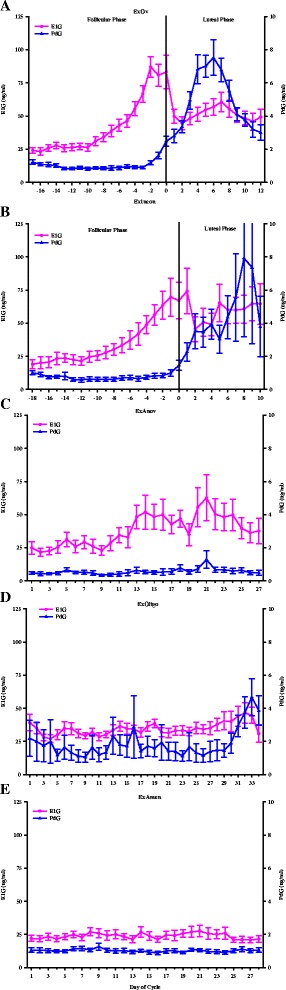
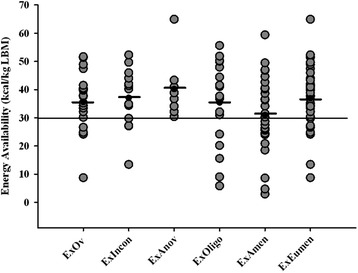
BACKGROUND: Conditions of low energy availability (EA) (<30 kcal/kgLBM) have been associated with suppressed metabolic hormones and reductions in LH pulsatility in previously sedentary women during short-term manipulations of energy intake (EI) and exercise energy expenditure (EEE) in a controlled laboratory setting. The purpose of this study was to examine if EA, defined as EA = (EI-EEE)/kgLBM, is associated with disruptions in ovarian function in exercising women. METHODS: Menstrual status was confirmed with daily measures of urinary reproductive metabolites across 1-3 menstrual cycles or 28-day monitoring periods. EA was calculated for exercise days using EI from 3-day diet logs, EEE from heart-rate monitors and/or exercise logs for a 7-day period, and body composition from DXA. Resting energy expenditure (REE) was measured by indirect calorimetry. Total triiodothyronine (TT3) was measured from a fasting blood sample. RESULTS: 91 exercising women (23.1 ± 0.5 years) were categorized clinically as either exercising amenorrheic (ExAmen, n = 30), exercising oligomenorrheic (ExOligo, n = 20) or exercising eumenorrheic (ExEumen, n = 41). The eumenorrheic group was further divided into more specific subclinical groups as either exercising ovulatory (ExOv, n = 20), exercising inconsistent (ExIncon, n = 13), or exercising anovulatory (ExAnov, n = 8). An EA threshold of 30 kcal/kgLBM did not distinguish subclinical menstrual status (χ (2) = 0.557, p = 0.46) nor did EA differ across subclinical disturbance groups (p > 0.05). EA was lower in the ExAmen vs. ExEumen (30.9 ± 2.4 vs. 36.9 ± 1.7 kcal/kgLBM, p = 0.04). The ratio of REE/predicted REE was lower in the ExAmen vs. ExEumen (0.85 ± 0.02 vs. 0.92 ± 0.01, p = 0.001) as was TT3 (79.6 ± 4.1 vs. 95.3 ± 2.9 ng/mL, p = 0.002). CONCLUSIONS: EA did not differ among subclinical forms of menstrual disturbances in a large sample of exercising women, but EA did discriminate clinical menstrual status, i.e., amenorrhea from eumenorrhea.
Overview
The claims and statistics of this paper haven’t been checked yet.
Free: it reads the open-access text and checks the first 5 claims that cite a source we can check. Create a free account to check every claim.
Integrity signals
Registry
Cites
Statistics
Figures
Verification
Claims the paper makes
The claims and statistics of this paper haven’t been checked yet.
Free: it reads the open-access text and checks the first 5 claims that cite a source we can check. Create a free account to check every claim.
Claims other papers make about this one
Each is checked against this paper’s own text: does it say what the citing paper says it does?
The source backs part of the claim, not all of it — or backs it for a different population, condition or comparison.
In the citing paper
“In clinical studies, it has been established that EA of 30 kcal kg−1 FFM·day−1 is the threshold at and below which suppressed metabolic hormones and reductions in luteinizing hormone pulsatility is observed after as little as 5 days in healthy females [64,65,129,140,141].”
From International society of sports nutrition position stand: nutritional concerns of the female athlete (2023) · cites this paper as [140]
Experimental — accuracy not yet measured
Self-check
Percentages, sums and reported differences re-computed from the paper’s own numbers.
The self-check needs the paper’s full text.
Citations
Cites
Compendium of physical activities: an update of activity codes and MET intensities
AINSWORTH, B. E., HASKELL, W. L., WHITT, M. C., IRWIN, M. L., SWARTZ, A. M., STRATH, S. J., O???BRIEN, W. L., BASSETT, D. R., SCHMITZ, K. H., EMPLAINCOURT, P. O., et al. (2000) · Medicine & Science in Sports & Exercise · doi:10.1097/00005768-200009001-00009 · Cited by 8,497 · cited 1×
“[28] compendiums of physical activities were used to determine the appropriate metabolic equivalent (MET) level for the exercise performed.”
Loucks, A. B., & Thuma, J. R. (2003) · The Journal of Clinical Endocrinology & Metabolism · doi:10.1210/jc.2002-020369 · Cited by 760 · cited 7×
“EA was operationally defined as EI minus EEE normalized to kilograms of LBM (EA = (EI–EEE)/LBM) [14] and calculated using the data described above for EI, EEE, and LBM.”
MethodInfluentialMetabolic fuels and reproduction in female mammals
Wade, G. N., & Schneider, J. E. (1992) · Neuroscience & Biobehavioral Reviews · doi:10.1016/s0149-7634(05)80183-6 · Cited by 686 · cited 1×
“locomotion, and growth [15].”
Dose-Response Relationships Between Energy Availability and Bone Turnover in Young Exercising Women
Ihle, R., & Loucks, A. B. (2004) · Journal of Bone and Mineral Research · doi:10.1359/jbmr.040410 · Cited by 523 · cited 2×
“Although these studies [14,16] define a critical EA threshold of 30 kcal/kg LBM for the initiation of reduced LH pulsatility, few investigators have examined whether an EA of 30 kcal/kg LBM discriminates normal ovarian function from either subtle (luteal phase defects or anovulation) or severe (oligomenorrhea or ameno…”
Induction of Menstrual Disorders by Strenuous Exercise in Untrained Women
Bullen, B. A., Skrinar, G. S., Beitins, I. Z., von Mering, G., Turnbull, B. A., & McArthur, J. W. (1985) · New England Journal of Medicine · doi:10.1056/nejm198505233122103 · Cited by 483 · cited 1×
“Prospective exercise training studies show that low energy availability (EA) is causally related to menstrual disturbances in exercising females [8-12], as increases in EA are associated with the reversal of menstrual disturbances when exercise training persists [13].”
Miller, R. C., Brindle, E., Holman, D. J., Shofer, J., Klein, N. A., Soules, M. R., & O’Connor, K. A. (2004) · Clinical Chemistry · doi:10.1373/clinchem.2004.032292 · Cited by 317 · cited 1×
“All urine samples were corrected for specific gravity using a hand refractometer (NSG Precision Cells) to account for hydration status [29] which has been reported to perform as well as creatinine correction for adjusting urinary hormone concentrations.”
De Souza, M. J., Miller, B. E., Loucks, A. B., Luciano, A. A., Pescatello, L. S., Campbell, C. G., & Lasley, B. L. (1998) · The Journal of Clinical Endocrinology & Metabolism · doi:10.1210/jcem.83.12.5334 · Cited by 315 · cited 10×
“Most studies have used self-reported diet logs for various lengths of time to estimate EI [2,21,24].”
InfluentialDe Souza, M. J., Toombs, R. J., Scheid, J. L., O'Donnell, E., West, S. L., & Williams, N. I. (2010) · Human Reproduction · doi:10.1093/humrep/dep411 · Cited by 305
Self-citationWilliams, N. I., Helmreich, D. L., Parfitt, D. B., Caston-Balderrama, A., & Cameron, J. L. (2001) · The Journal of Clinical Endocrinology & Metabolism · doi:10.1210/jcem.86.11.8024 · Cited by 275 · cited 1×
“Prospective exercise training studies show that low energy availability (EA) is causally related to menstrual disturbances in exercising females [8-12], as increases in EA are associated with the reversal of menstrual disturbances when exercise training persists [13].”
Self-citationDe Souza, M. J., West, S. L., Jamal, S. A., Hawker, G. A., Gundberg, C. M., & Williams, N. I. (2008) · Bone · doi:10.1016/j.bone.2008.03.013 · Cited by 236 · cited 1×
“In women with exercise associated menstrual disturbances (EAMD), a spectrum of clinical sequelae has been observed and includes low bone mineral density [3], stress fractures [4], disordered eating [5], altered vascular function [6],”
Self-citationNutritional and endocrine-metabolic aberrations in amenorrheic athletes
Laughlin, G. A. (1996) · Journal of Clinical Endocrinology & Metabolism · doi:10.1210/jc.81.12.4301 · Cited by 233 · cited 6×
“Moreover, of investigators who examined the components of EA [30-32], neither Myerson et al.”
InfluentialPrevalence of the Female Athlete Triad in High School Athletes and Sedentary Students
Hoch, A. Z., Pajewski, N. M., Moraski, L., Carrera, G. F., Wilson, C. R., Hoffmann, R. G., Schimke, J. E., & Gutterman, D. D. (2009) · Clinical Journal of Sport Medicine · doi:10.1097/jsm.0b013e3181b8c136 · Cited by 223 · cited 15×
“The majority of participants were scanned on either a GE Lunar Prodigy DXA scanner (n = 57) (GE Lunar Corporation, Madison, WI, enCORE 2002 software, version 6.50.069) or a GE Lunar iDXA scanner (n = 26) (General Electric Lunar Corporation, Madison, WI, enCORE 2008 software version 12.10.113).”
MethodInfluentialMethodology of dietary assessment in athletes: concepts and pitfalls
Magkos, F., & Yannakoulia, M. (2003) · Current Opinion in Clinical Nutrition and Metabolic Care · doi:10.1097/00075197-200309000-00007 · Cited by 202 · cited 1×
“EI was assessed for 3 days instead of 7 as a shorter 3-day diet log has been shown to reduce participant burden and improve compliance [26].”
Resting metabolic rate and energy balance in amenorrheic and eumenorrheic runners
MYERSON, M., GUTIN, B., WARREN, M. P., MAY, M. T., CONTENTO, I., LEE, M., PI-SUNYER, F. X., PIERSON, R. N., & BROOKS-GUNN, J. (1991) · Medicine & Science in Sports & Exercise · doi:10.1249/00005768-199101000-00004 · Cited by 195 · cited 9×
“Moreover, of investigators who examined the components of EA [30-32], neither Myerson et al.”
InfluentialAltered Neuroendocrine Regulation of Gonadotropin Secretion in Women Distance Runners*
VELDHUIS, J. D., EVANS, DEMERS, THORNER, M. O., WAKAT, D., & ROGOL, A. D. (1985) · The Journal of Clinical Endocrinology & Metabolism · doi:10.1210/jcem-61-3-557 · Cited by 187 · cited 2×
“Severe reductions in LH pulsatility have been observed in amenorrheic runners [17].”
Low Energy Availability in the Marathon and Other Endurance Sports
Loucks, A. B. (2007) · Sports Medicine · doi:10.2165/00007256-200737040-00019 · Cited by 176 · cited 1×
“[38] estimated EA values ranging from 12 to 29 kcal/kg FFM in female athletes.”
Acute effects of exercise on food intake in obese and nonobese women
Kissileff, H. R., Pi-Sunyer, F., Segal, K., Meltzer, S., & Foelsch, P. (1990) · American Journal of Clinical Nutrition · doi:10.1093/ajcn/52.2.240 · Cited by 170 · cited 4×
“"inadequate compensation" has been observed in obese and non-obese men and women [35-37].”
InfluentialWilliams, N. I., Berga, S. L., & Cameron, J. L. (2007) · American Journal of Physiology-Endocrinology and Metabolism · doi:10.1152/ajpendo.00108.2007 · Cited by 169 · cited 1×
“Alternatively, factors such as psychological stress [34] or hyperandrogenemia [25] may also account for a proportion of the observed EAMD and this could thus weaken any suspected association between EA and menstrual disturbances.”
Self-citationWhybrow, S., Hughes, D. A., Ritz, P., Johnstone, A. M., Horgan, G. W., King, N., Blundell, J. E., & Stubbs, R. J. (2008) · British Journal of Nutrition · doi:10.1017/s0007114508968240 · Cited by 164 · cited 4×
“"inadequate compensation" has been observed in obese and non-obese men and women [35-37].”
InfluentialAcute Effects of Exercise or Sauna on Appetite in Obese and Nonobese Men
Westerterp‐Plantenga, M. S., Verwegen, C. R. T., Mj, I., Wijckmans, N. E. G., & Saris, W. H. M. (1997) · Physiology & Behavior · doi:10.1016/s0031-9384(97)00353-3 · Cited by 154 · cited 4×
“"inadequate compensation" has been observed in obese and non-obese men and women [35-37].”
InfluentialWilliams, N. I., Caston-Balderrama, A. L., Helmreich, D. L., Parfitt, D. B., Nosbisch, C., & Cameron, J. L. (2001) · Endocrinology · doi:10.1210/en.142.6.2381 · Cited by 152 · cited 1×
“Prospective exercise training studies show that low energy availability (EA) is causally related to menstrual disturbances in exercising females [8-12], as increases in EA are associated with the reversal of menstrual disturbances when exercise training persists [13].”
Self-citationAccuracy of Polar S410 Heart Rate Monitor to Estimate Energy Cost of Exercise
CROUTER, S. E., ALBRIGHT, C., & BASSETT, D. R. (2004) · Medicine & Science in Sports & Exercise · doi:10.1249/01.mss.0000135794.01507.48 · Cited by 140 · cited 2×
“The OwnCal feature has been validated for calculating EEE from heart rate in University age females running, cycling, and rowing at various submaximal intensities [27].”
MethodDe Souza, M. J., Lee, D. K., VanHeest, J. L., Scheid, J. L., West, S. L., & Williams, N. I. (2007) · Fertility and Sterility · doi:10.1016/j.fertnstert.2006.11.171 · Cited by 120 · cited 17×
“REE was measured on a single occasion during the study period for all participants.”
MethodInfluentialSelf-citationRickenlund, A., Carlström, K., Ekblom, B. J., Brismar, T. B., von Schoultz, B. O., & Lindén Hirschberg, A. (2003) · Fertility and Sterility · doi:10.1016/s0015-0282(02)04850-1 · Cited by 120 · cited 2×
“An FAI greater than 6 has been reported to be consistent with hyperandrogenemia [25] and represents values greater than three standard deviations in our reference sample (n = 37) which consisted of healthy premenopausal exercising women (18–35 years) with documented ovulatory menstrual status [1].”
DEFECTS IN PULSATILE LH RELEASE IN NORMALLY MENSTRUATING RUNNERS
CUMMING, D. C., VICKOVIC, M. M., WALL, S. R., & FLUKER, M. R. (1985) · The Journal of Clinical Endocrinology & Metabolism · doi:10.1210/jcem-60-4-810 · Cited by 115 · cited 1×
“Reductions in LH pulsatility have also been documented in exercising women with eumenorrhea [18], anovulatory menstrual cycles [19], and oligomenorrhea [17].”
Is there energy conservation in amenorrheic compared with eumenorrheic distance runners?
Wilmore, J. H., Wambsgans, K. C., Brenner, M., Broeder, C. E., Paijmans, I., Volpe, J. A., & Wilmore, K. M. (1992) · Journal of Applied Physiology · doi:10.1152/jappl.1992.72.1.15 · Cited by 109 · cited 4×
“[31], nor Laughlin and Yen [32] observed significant differences in EI, EEE, or body composition between amenorrheic and eumenorrheic athletes.”
InfluentialGibbs, J. C., Williams, N. I., Scheid, J. L., Toombs, R. J., & De Souza, M. J. (2011) · International Journal of Sport Nutrition and Exercise Metabolism · doi:10.1123/ijsnem.21.4.280 · Cited by 106 · cited 5×
“A lower measured to predicted REE ratio has been associated with a high drive for thinness and with menstrual disturbances in exercising women [5].”
MethodInfluentialSelf-citationChanges in energy availability across the season in division I female soccer players
Reed, J. L., De Souza, M. J., & Williams, N. I. (2013) · Journal of Sports Sciences · doi:10.1080/02640414.2012.733019 · Cited by 88 · cited 13×
“The majority of participants were scanned on either a GE Lunar Prodigy DXA scanner (n = 57) (GE Lunar Corporation, Madison, WI, enCORE 2002 software, version 6.50.069) or a GE Lunar iDXA scanner (n = 26) (General Electric Lunar Corporation, Madison, WI, enCORE 2008 software version 12.10.113).”
MethodInfluentialSelf-citationStrenuous exercise with caloric restriction: effect on luteinizing hormone secretion.
Williams, N. I., Young, J. C., McArthur, J. W., Bullen, B. A., Skrinar, G. S., & Turnbull, B. A. (1995) · PubMed · Cited by 74
Self-citationNutritional practices associated with low energy availability in Division I female soccer players
Reed, J. L., De Souza, M. J., Kindler, J. M., & Williams, N. I. (2014) · Journal of Sports Sciences · doi:10.1080/02640414.2014.908321 · Cited by 73 · cited 1×
“We did not eliminate possible under reporters in the current study as: a gold standard for accounting for under reporters does not exist; other prior publications examining EA in exercising females have not employed a cut off method to eliminate under reporters from analyses [4,20,39]; a cut off for under reporting do…”
Self-citationKoehler, K., Achtzehn, S., Braun, H., Mester, J., & Schaenzer, W. (2013) · Applied Physiology, Nutrition, and Metabolism · doi:10.1139/apnm-2012-0373 · Cited by 60 · cited 5×
“Most studies have used self-reported diet logs for various lengths of time to estimate EI [2,21,24].”
InfluentialWilliams, N. I., Reed, J. L., Leidy, H. J., Legro, R. S., & De Souza, M. J. (2010) · Human Reproduction · doi:10.1093/humrep/deq172 · Cited by 51 · cited 1×
“Prospective exercise training studies show that low energy availability (EA) is causally related to menstrual disturbances in exercising females [8-12], as increases in EA are associated with the reversal of menstrual disturbances when exercise training persists [13].”
Self-citationReduced Catecholamine Response to Exercise in Amenorrheic Athletes
SCHAAL, K., VAN LOAN, M. D., & CASAZZA, G. A. (2011) · Medicine & Science in Sports & Exercise · doi:10.1249/mss.0b013e3181e91ece · Cited by 45 · cited 17×
“The majority of participants were scanned on either a GE Lunar Prodigy DXA scanner (n = 57) (GE Lunar Corporation, Madison, WI, enCORE 2002 software, version 6.50.069) or a GE Lunar iDXA scanner (n = 26) (General Electric Lunar Corporation, Madison, WI, enCORE 2008 software version 12.10.113).”
MethodInfluentialO'Donnell, E., Harvey, P. J., & De Souza, M. J. (2009) · Clinical Endocrinology · doi:10.1111/j.1365-2265.2008.03332.x · Cited by 39
Effects of short-term strenuous endurance exercise upon corpus luteum function
WILLIAMS, N. I., BULLEN, B. A., McARTHUR, J. W., SKRINAR, G. S., & TURNBULL, B. A. (1999) · Medicine & Science in Sports & Exercise · doi:10.1097/00005768-199907000-00006 · Cited by 37 · cited 1×
“Prospective exercise training studies show that low energy availability (EA) is causally related to menstrual disturbances in exercising females [8-12], as increases in EA are associated with the reversal of menstrual disturbances when exercise training persists [13].”
Self-citationEnergy Availability of Female Varsity Volleyball Players
Woodruff, S. J., & Meloche, R. D. (2013) · International Journal of Sport Nutrition and Exercise Metabolism · doi:10.1123/ijsnem.23.1.24 · Cited by 35 · cited 4×
“Likewise, a number of methods such as dual energy x-ray absorptiometry (DXA) [4,20,21,23], air-displacement plethysmography [22], bioelectrical impedance [24], and skin fold measurements [2] have been used to estimate body composition.”
InfluentialExercising women with menstrual disturbances consume low energy dense foods and beverages
Reed, J. L., Bowell, J. L., Hill, B. R., Williams, B. A., De Souza, M. J., & Williams, N. I. (2011) · Applied Physiology, Nutrition, and Metabolism · doi:10.1139/h11-030 · Cited by 33 · cited 15×
“The majority of participants were scanned on either a GE Lunar Prodigy DXA scanner (n = 57) (GE Lunar Corporation, Madison, WI, enCORE 2002 software, version 6.50.069) or a GE Lunar iDXA scanner (n = 26) (General Electric Lunar Corporation, Madison, WI, enCORE 2008 software version 12.10.113).”
MethodInfluentialSelf-citationPirke, K., Schweiger, U., Broocks, A., Tuschl, R. J., & Laessle, R. G. (1990) · Clinical Endocrinology · doi:10.1111/j.1365-2265.1990.tb00499.x · Cited by 32 · cited 1×
“Reductions in LH pulsatility have also been documented in exercising women with eumenorrhea [18], anovulatory menstrual cycles [19], and oligomenorrhea [17].”
You’ve told me what you have found, but you haven’t told me the so-what
Winter, E., & Nevill, A. M. (2014) · Journal of Sports Sciences · doi:10.1080/02640414.2013.870698 · Cited by 29
Koehler, K., Braun, H., De Marées, M., Fusch, G., Fusch, C., Mester, J., & Schaenzer, W. (2010) · Journal of Sports Sciences · doi:10.1080/02640414.2010.513482 · Cited by 27 · cited 2×
“Several studies have shown inaccuracies when measuring EI with self-reported diet logs, particularly related to under reporting [33] and EEE with self-reported exercise logs [33].”
Cited by
IOC consensus statement on relative energy deficiency in sport (RED-S): 2018 update
Mountjoy, M., Sundgot-Borgen, J. K., Burke, L. M., Ackerman, K. E., Blauwet, C., Constantini, N., Lebrun, C., Lundy, B., Melin, A. K., Meyer, N. L., et al. (2018) · British Journal of Sports Medicine · doi:10.1136/bjsports-2018-099193 · Cited by 883
Mountjoy, M., Ackerman, K. E., Bailey, D. M., Burke, L. M., Constantini, N., Hackney, A. C., Heikura, I. A., Melin, A., Pensgaard, A. M., Stellingwerff, T., et al. (2023) · British Journal of Sports Medicine · doi:10.1136/bjsports-2023-106994 · Cited by 974
Functional Hypothalamic Amenorrhea: An Endocrine Society Clinical Practice Guideline
Gordon, C. M., Ackerman, K. E., Berga, S. L., Kaplan, J. R., Mastorakos, G., Misra, M., Murad, M. H., Santoro, N. F., & Warren, M. P. (2017) · The Journal of Clinical Endocrinology & Metabolism · doi:10.1210/jc.2017-00131 · Cited by 600
Mountjoy, M., Sundgot-Borgen, J., Burke, L., Ackerman, K. E., Blauwet, C., Constantini, N., Lebrun, C., Lundy, B., Melin, A., Meyer, N., et al. (2018) · International Journal of Sport Nutrition and Exercise Metabolism · doi:10.1123/ijsnem.2018-0136 · Cited by 447
“Each male experienced 4 separate 4-day conditions: LEA (15 kcal/kg FFM/day with and without exercise) and adequate EA (40 kcal/kg FFM/day with and without exercise).”
MethodResultInfluentialLogue, D. M., Madigan, S. M., Melin, A., Delahunt, E., Heinen, M., Donnell, S.-J. M., & Corish, C. A. (2020) · Nutrients · doi:10.3390/nu12030835 · Cited by 321
Metadata
- Authors
- Reed, J. L., De Souza, M. J., Mallinson, R. J., Scheid, J. L., & Williams, N. I.
- Affiliations
- Pennsylvania State University (US)
- Department of Kinesiology, Women’s Health and Exercise Laboratory, 108 Noll Laboratory
- Corresponding author
- Williams, Nancy I
- Venue
- Journal of the International Society of Sports Nutrition
- Publisher
- Informa UK Limited
- Published
- 2015-10-20
- Volume
- 12
- Issue
- 1
- Pages
- 11-11
- ISSN
- 1550-2783 (ISSN-L)
- PMC
- PMC4342163
- OpenAlex
- W2139494743
- Cited by
- 86
- References
- 40
- Citations by year
- 2026: 2 · 2025: 9 · 2024: 10 · 2023: 11 · 2022: 7 · 2021: 14 · 2020: 9 · 2019: 12 · 2018: 5 · 2017: 3 · 2016: 2 · 2015: 1
- FWCI
- 4.19
- Type
- journal article
- Language
- en
- Open access
- gold
- doi.org
- Licence
- Locations
- Journal of the International Society of Sports Nutrition (publishedVersion, cc-by)
- PubMed Central (publishedVersion, cc-by)
- PubMed (publishedVersion)
- uO Research (University of Ottawa) (submittedVersion, public-domain)
- Funders
- U.S. Department of Defense (PR054531)
- National Institutes of Health (UL1TR000077)
- National Center for Advancing Translational Sciences
- Medical Research and Materiel Command (PR054531)
- Topics
- Health Sciences › Medicine › Reproductive Medicine › Hypothalamic control of reproductive hormones
- Health Sciences › Medicine › Reproductive Medicine › Ovarian function and disorders
- Social Sciences › Psychology › Clinical Psychology › Eating Disorders and Behaviors
- Keywords
- energy availability, menstrual status, amenorrhea, oligomenorrhea, ovarian function, exercise energy expenditure, resting energy expenditure, triiodothyronine, thyroid function
About these checks
Registry, retraction, Cites and statistics results are computed, not judged, with one exception: a printed reference that no index lists is read once by a model before it counts as a citation error. Claims are extracted by a model and kept only when their quote appears verbatim in the text; each cited source is then checked, with a model’s help, for whether it says what the claim relies on. Those verdicts can be wrong — read the claim’s quote and the cited source before relying on one.
Statistics and arithmetic are recomputed, not judged.
Confidence bands are shown only for fields calibrated on our annotated test set. None is calibrated yet, so no band is shown.
What counts as a claim ›How we measure confidence ›How we check this ›
Are you an author, or do you see a problem with this page? Request a review
Data sources
Bibliographic data: Semantic Scholar, OpenAlex, Crossref.
Contains information from the Semantic Scholar Academic Graph Datasets, made available under the ODC Attribution License (ODC-BY 1.0).
Semantic Scholar’s data is described in: Kinney, R., et al. (2023). The Semantic Scholar Open Data Platform. arXiv:2301.10140.
