

The DOI matches its Crossref record; 48 of the 48 references it cites were found in a registry or an index.
Effects of powdered Montmorency tart cherry supplementation on acute endurance exercise performance in aerobically trained individuals
Open accessAbstract
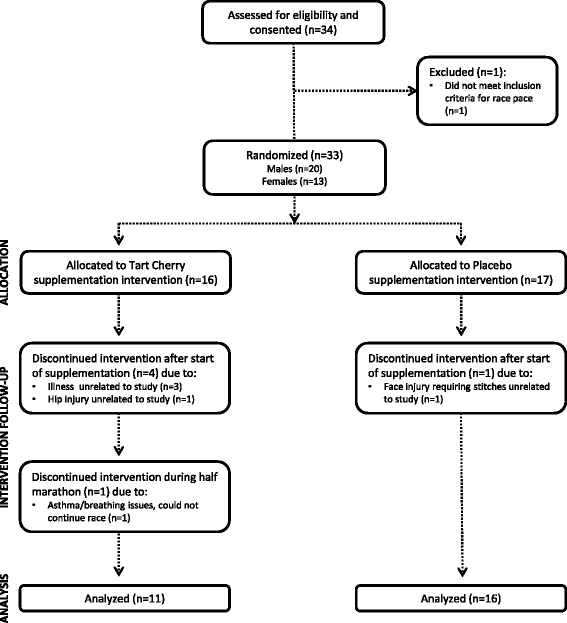
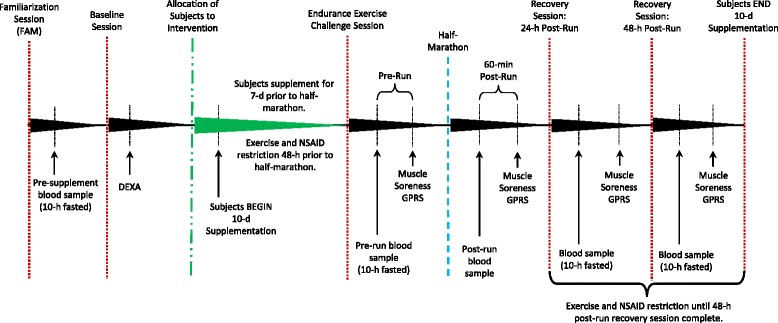
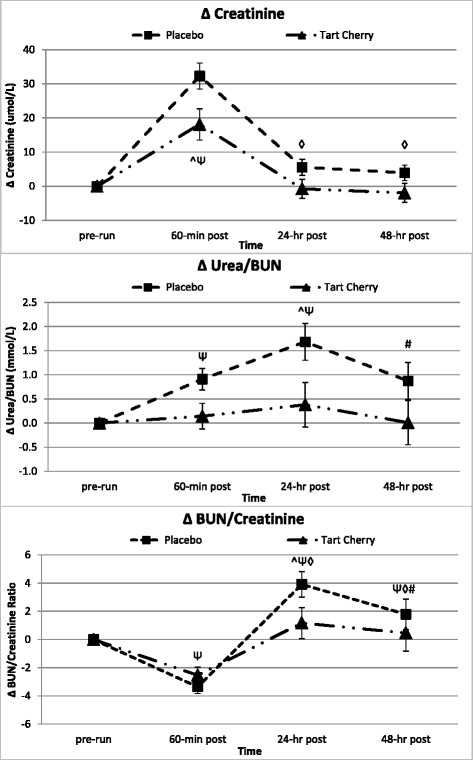
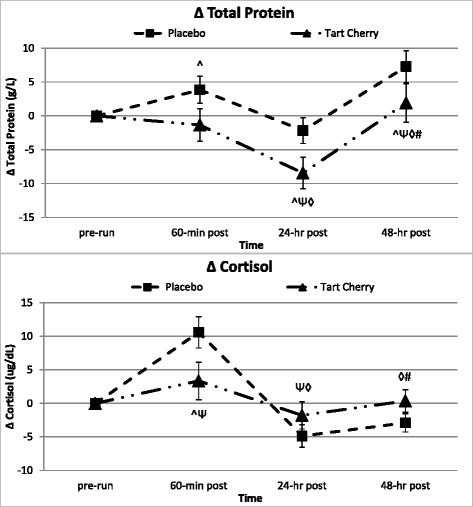
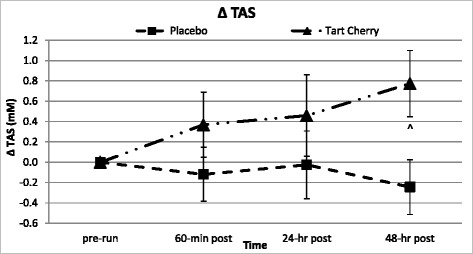
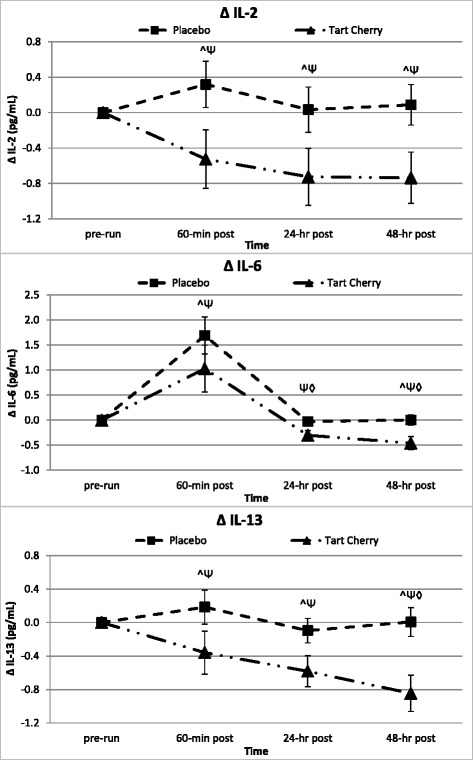
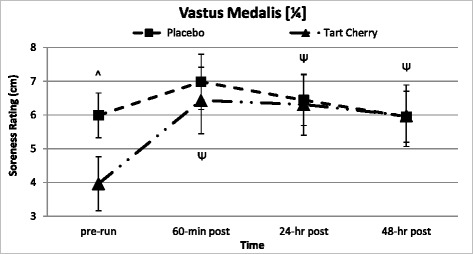
BACKGROUND: The purpose of this study was to determine whether short-term supplementation of a powdered tart cherry supplement prior to and following stressful endurance exercise would affect markers of muscle damage, inflammation, oxidative stress, and/or muscle soreness. METHODS: 27 endurance-trained runners or triathlete (21.8 ± 3.9 years, 15.0 ± 6.0 % body fat, 67.4 ± 11.8 kg) men (n = 18) and women (n = 9) were matched based on average reported race pace, age, body mass, and fat free mass. Subjects were randomly assigned to ingest, in a double-blind manner, capsules containing 480 mg of a rice flour placebo (P, n = 16) or powdered tart cherries [CherryPURE®] (TC, n = 11). Subjects supplemented one time daily (480 mg/day) for 10-d, including race day, up to 48-hr post-run. Subjects completed a half-marathon run (21.1 km) under 2-hr (111.98 ± 11.9 min). Fasting blood samples and quadriceps muscle soreness ratings using an algometer with a graphic pain rating scale were taken pre-run, 60-min, 24 and 48-h post-run and analyzed by MANOVA with repeated measures. RESULTS: Subjects in the TC group averaged 13 % faster half-marathon race finish times (p = 0.001) and tended to have smaller deviations from predicted race pace (p = 0.091) compared to P. Attenuations in TC muscle catabolic markers were reported over time for creatinine (p = 0.047), urea/blood urea nitrogen (p = 0.048), total protein (p = 0.081), and cortisol (p = 0.016) compared to P. Despite lower antioxidant activity pre-run in TC compared to P, changes from pre-run levels revealed a linear increase in antioxidant activity at 24 and 48-h of recovery in TC that was statistically different (16-39 %) from P and pre-run levels. Inflammatory markers were 47 % lower in TC compared to P over time (p = 0.053) coupled with a significant difference between groups (p = 0.017). Soreness perception between the groups was different over time in the medial quadriceps (p = 0.035) with 34 % lower pre-run soreness in TC compared to P. Over the 48-h recovery period, P changes in medial quadriceps soreness from pre-run measures were smaller compared to TC. CONCLUSION: Results revealed that short-term supplementation of Montmorency powdered tart cherries surrounding an endurance challenge attenuated markers of muscle catabolism, reduced immune and inflammatory stress, better maintained redox balance, and increased performance in aerobically trained individuals.
Overview
The claims and statistics of this paper haven’t been checked yet.
Run the check — free, no account needed. It reads the open-access text and checks the sources it cites.
Integrity signals
Registry
Cites
Statistics
Figures
Verification
Claims the paper makes
The claims and statistics of this paper haven’t been checked yet.
Run the check — free, no account needed. It reads the open-access text and checks the sources it cites.
Claims other papers make about this one
Each is checked against this paper’s own text: does it say what the citing paper says it does?
In the citing paper
“For example, Levers et al. (2015) found significant beneficial effects on serum markers of muscle catabolism, physiological stress, and inflammatory mechanisms after a short-term supplementation with 480 mg·day−1 of Montmorency powdered tart cherries surrounding a single bout of resistance exercise [103].”
From The 4R’s Framework of Nutritional Strategies for Post-Exercise Recovery: A Review with Emphasis on New Generation of Carbohydrates (2020) · cites this paper as [103]
Self-check
Percentages, sums and reported differences re-computed from the paper’s own numbers.
The self-check needs the paper’s full text.
Citations
Cites
Exercise-Induced Oxidative Stress: Cellular Mechanisms and Impact on Muscle Force Production
Powers, S. K., & Jackson, M. J. (2008) · Physiological Reviews · doi:10.1152/physrev.00031.2007 · Cited by 2,459
Antioxidants prevent health-promoting effects of physical exercise in humans
Ristow, M., Zarse, K., Oberbach, A., Klöting, N., Birringer, M., Kiehntopf, M., Stumvoll, M., Kahn, C. R., & Blüher, M. (2009) · Proceedings of the National Academy of Sciences · doi:10.1073/pnas.0903485106 · Cited by 1,582
Proske, U., & Morgan, D. L. (2001) · The Journal of Physiology · doi:10.1111/j.1469-7793.2001.00333.x · Cited by 1,418
Oxidative stress, exercise, and antioxidant supplementation
Urso, M. L., & Clarkson, P. M. (2003) · Toxicology · doi:10.1016/s0300-483x(03)00151-3 · Cited by 1,067
Immune function in sport and exercise
Gleeson, M. (2007) · Journal of Applied Physiology · doi:10.1152/japplphysiol.00008.2007 · Cited by 1,016
Gomez-Cabrera, M.-C., Domenech, E., Romagnoli, M., Arduini, A., Borras, C., Pallardo, F. V., Sastre, J., & Viña, J. (2008) · The American Journal of Clinical Nutrition · doi:10.1093/ajcn/87.1.142 · Cited by 844
Wang, H., Nair, M. G., Strasburg, G. M., Chang, Y.-C., Booren, A. M., Gray, J. I., & DeWitt, D. L. (1999) · Journal of Natural Products · doi:10.1021/np990184z · Cited by 633
Wang, H., Nair, M. G., Strasburg, G. M., Chang, Y.-C., Booren, A. M., Gray, J. I., & DeWitt, D. L. (1999) · Journal of Natural Products · doi:10.1021/np980501m · Cited by 501
Reactive Oxygen Species Are Signalling Molecules for Skeletal Muscle Adaptation
Powers, S. K., Duarte, J., Kavazis, A. N., & Talbert, E. E. (2010) · Experimental Physiology · doi:10.1113/expphysiol.2009.050526 · Cited by 440
Effects of exercise on lymphocytes and cytokines
Pedersen, B. K., & Toft, A. D. (2000) · British Journal of Sports Medicine · doi:10.1136/bjsm.34.4.246 · Cited by 402
Research works printed but not linked: 3
- Lafay S, 2009, J Sports Sci Med, 8, 468
- Almada A, Kreider R, Ransom J, Rasmussen C. Comparison of the reliability of repeated whole body DEXA scans to repeated spine and hip scans. J Bone Miner Res. 1999;14(9):S369.
- Skarpanska-Stejnborn A, 2009, Int J Sport Nutr, 19, 186
Cited by
Sorted by citations
Items 101–110 of 110
Vilella, R. C., & Carvalho, V. C. (2020) · Open Journal of Pharmacology and Pharmacotherapeutics · doi:10.17352/ojpp.000012
Luis Vergara, G., Lizárraga-Dallo, A., & Grivé, R. P. (2020) · Apunts Educación Física y Deportes · doi:10.5672/apunts.2014-0983.es.(2020/4).142.02
Abdollahi, S., Azarbayjani, M. A., Peeri, M., & Rahmati-Ahmadabad, S. (2021) · Health Research Journal · doi:10.52547/hrjbaq.6.4.319
Optimizing Nutrition for Exercise and Sports
Gonzalez, D. E., Latt, S. L., Blalock, T., Leutholtz, B., & Kreider, R. B. (2023) · Nutrition and health · doi:10.1007/978-3-031-24663-0_29
Lamb, K. L. (2023) · Sheffield Hallam University · doi:10.7190/shu-thesis-00517
Huang, X., Zhu, J., Zang, P., Chen, J., Chen, P., Xu, N., & Liu, W. (2026) · Frontiers in Sports and Active Living · doi:10.3389/fspor.2026.1819117
Kakouris, V., Piagkou, M., Triantafyllou, G., & Akinosoglou, K. (2026) · Sports · doi:10.3390/sports14070285
Giles, L. V., & Brandenburg, J. P. (2026) · International Journal of Sport Nutrition and Exercise Metabolism · doi:10.1123/ijsnem.2026-0036
Kai-xuan, X., Chang, J., Wu, Y.-J., Chen, H.-W., Zheng, J.-W., & Liu, C. (2026) · Frontiers in Nutrition · doi:10.3389/fnut.2026.1857527
Harriden, B., McKune, A. J., & Naumovski, N. (2026) · Nutrition and Health · doi:10.1177/02601060261478366
Metadata
- Authors
- Levers, K., Dalton, R., Galvan, E., O’Connor, A., Goodenough, C., Simbo, S., Mertens-Talcott, S. U., Rasmussen, C., Greenwood, M., Riechman, S., Crouse, S., & Kreider, R. B.
- Affiliations
- Texas A&M University (US)
- Department of Nutrition and Food Science, Institute for Obesity Research and Program EvaluationTexas A&M University 77843-4243 College Station TX USA
- Corresponding author
- Kreider, Richard B.
- ORCID
- Venue
- Journal of the International Society of Sports Nutrition
- Publisher
- Informa UK Limited
- Published
- 2016-01-05
- Volume
- 13
- Issue
- 1
- Pages
- 22-22
- ISSN
- 1550-2783 (ISSN-L)
- PMC
- PMC4880859
- OpenAlex
- W2404670370
- Cited by
- 111
- References
- 48
- Citations by year
- 2026: 11 · 2025: 5 · 2024: 10 · 2023: 7 · 2022: 9 · 2021: 17 · 2020: 18 · 2019: 15 · 2018: 10 · 2017: 8
- FWCI
- 11.76
- Type
- journal article
- Language
- en
- Open access
- gold
- doi.org
- Licence
- Locations
- Journal of the International Society of Sports Nutrition (publishedVersion, cc-by)
- Europe PMC (PubMed Central) (publishedVersion, cc-by)
- PubMed Central (publishedVersion, cc-by)
- PubMed (publishedVersion)
- OakTrust (Texas A&M University Libraries) (submittedVersion)
- Funders
- Anderson Global Group (M1301858)
- Topics
- Health Sciences › Medicine › Physiology (medical) › Exercise and Physiological Responses
- Health Sciences › Nursing › Nutrition and Dietetics › Muscle metabolism and nutrition
- Health Sciences › Medicine › Orthopedics and Sports Medicine › Sports Performance and Training
- Keywords
- acute endurance exercise, half marathon, exercise performance, muscle damage, delayed onset muscle soreness, oxidative stress, antioxidant activity, inflammation, cortisol, creatine kinase, blood urea nitrogen, endurance-trained runners, triathletes, muscle catabolism
- MeSH terms
- Prunus avium, Adolescent, Adult, Antioxidants, Double-Blind Method, Female, Humans, Immunity, Inflammation, Male, Phytotherapy, Oxidation-Reduction, Physical Endurance, Placebos, Running, Biomarkers, Muscle, Skeletal, Dietary Supplements, Quadriceps Muscle, Young Adult, Myalgia
About these checks
Registry, retraction, Cites and statistics results are computed, not judged, with one exception: a printed reference that no index lists is read once by a model before it counts as a citation error. Claims are extracted by a model and kept only when their quote appears verbatim in the text; each cited source is then checked, with a model’s help, for whether it says what the claim relies on. Those verdicts can be wrong — read the claim’s quote and the cited source before relying on one.
Statistics and arithmetic are recomputed, not judged.
Confidence bands are shown only for fields calibrated on our annotated test set. None is calibrated yet, so no band is shown.
What counts as a claim ›How we measure confidence ›How we check this ›
Are you an author, or do you see a problem with this page? Request a review
