

Microglial activation mediates chronic mild stress-induced depressive- and anxiety-like behavior in adult rats
Open accessThe DOI matches its Crossref record; 54 of the 54 references it cites were found in a registry or an index.
Abstract
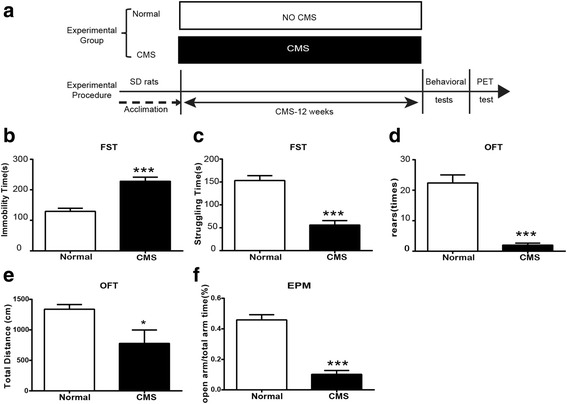
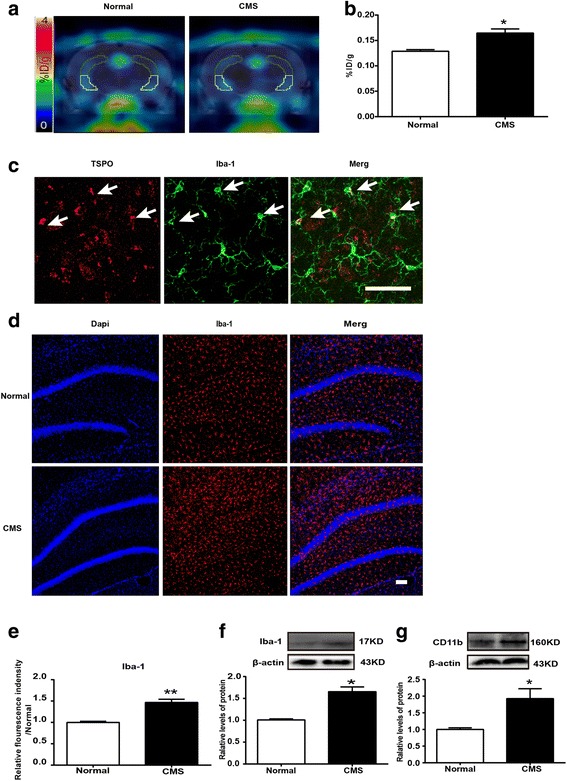
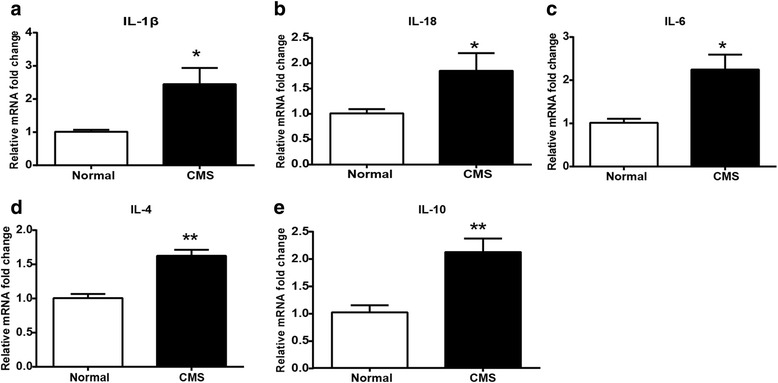
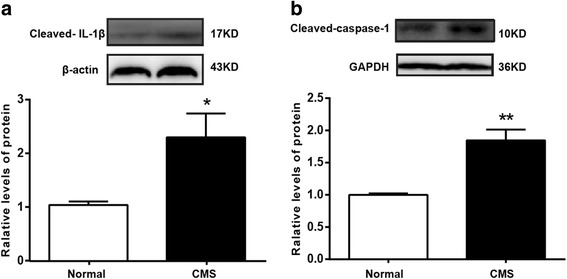
BACKGROUND: Depression is a heterogeneous disorder, with the exact neuronal mechanisms causing the disease yet to be discovered. Recent work suggests it is accompanied by neuro-inflammation, characterized, in particular, by microglial activation. However, microglial activation and its involvement in neuro-inflammation and stress-related depressive disorders are far from understood. METHODS: We utilized multiple detection methods to detect the neuro-inflammation in the hippocampus of rats after exposure to chronic mild stress (CMS). Male Sprague Dawley (SD) rats were subjected to chronic mild stressors for 12 weeks. Microglial activation and hippocampal neuro-inflammation were detected by using a combinatory approach of in vivo [18F] DPA-714 positron emission computed tomography (PET) imaging, ionized calcium-binding adapter molecule 1 and translocator protein (TSPO) immunohistochemistry, and detection of NOD-like receptor protein 3 (NLRP3) inflammasome and some inflammatory mediators. Then, the rats were treated with minocycline during the last 4 weeks to observe its effect on hippocampal neuro-inflammation and depressive-like behavior induced by chronic mild stress. RESULTS: The results show that 12 weeks of chronic mild stress induced remarkable depressive- and anxiety-like behavior, simultaneously causing hippocampal microglial activation detected by PET, immunofluorescence staining, and western blotting. Likewise, activation of NLRP3 inflammasome and upregulation of inflammatory mediators, such as interleukin-1β (IL-1β), IL-6, and IL-18, were also observed in the hippocampus after exposure to chronic stress. Interestingly, the anti-inflammatory mediators, such as IL-4 and IL-10, were also increased in the hippocampus following chronic mild stress, which may hint that chronic stress activates different types of microglia, which produce pro-inflammatory cytokines or anti-inflammatory cytokines. Furthermore, chronic minocycline treatment alleviated the depressive-like behavior induced by chronic stress and significantly inhibited microglial activation. Similarly, the activation of NLRP3 inflammasome and the increase of inflammatory mediators were not exhibited or significantly less marked in the minocycline treatment group. CONCLUSION: These results together indicate that microglial activation mediates the chronic mild stress-induced depressive- and anxiety-like behavior and hippocampal neuro-inflammation.
Overview
The claims and statistics of this paper haven’t been checked yet.
Free: it reads the open-access text and checks the first 5 claims that cite a source we can check. Create a free account to check every claim.
Integrity signals
Registry
Cites
Statistics
Figures
Verification
Claims the paper makes
The claims and statistics of this paper haven’t been checked yet.
Free: it reads the open-access text and checks the first 5 claims that cite a source we can check. Create a free account to check every claim.
Claims other papers make about this one
Each is checked against this paper’s own text: does it say what the citing paper says it does?
The source backs part of the claim, not all of it — or backs it for a different population, condition or comparison.
In the citing paper
“The pathophysiology of MDD, as an inflammatory CNS disease, can be better understood by PET/CT imaging [57].”
From Neuron secrete exosomes containing miR-9-5p to promote polarization of M1 microglia in depression (2022) · cites this paper as [57]
Experimental — accuracy not yet measuredThe cited source says what the claim attributes to it.
In the citing paper
“Microglia, which were traditionally considered passive support cells, are now recognized as active players in synaptic plasticity and mood regulation [82].”
From Variations in BDNF and Their Role in the Neurotrophic Antidepressant Mechanisms of Ketamine and Esketamine: A Review (2024) · cites this paper as [82]
The cited source says what the claim attributes to it.
In the citing paper
“Moreover, [18F]DPA-714 has the advantages of a high binding affinity and target-to-background ratio [57].”
From Neuron secrete exosomes containing miR-9-5p to promote polarization of M1 microglia in depression (2022) · cites this paper as [57]
Self-check
Percentages, sums and reported differences re-computed from the paper’s own numbers.
The self-check needs the paper’s full text.
Citations
Cites
Molecular Mechanisms of Depression: Perspectives on New Treatment Strategies
Lang, U. E., & Borgwardt, S. (2013) · Cellular Physiology and Biochemistry · doi:10.1159/000350094 · Cited by 8,475
Kessler, R. C., Berglund, P., Demler, O., Jin, R., Koretz, D., Merikangas, K. R., Rush, A. J., Walters, E. E., & Wang, P. S. (2003) · JAMA · doi:10.1001/jama.289.23.3095 · Cited by 7,988 · cited 2×
“Oligonucleotide primers specific for rat are IL-1β (F 5′ TTCTTTGAGGCTGACAGACC 3′; R 5′ CGTCTTTCATCACACAGGAC 3′), NLRP3 (F 5′ AGTGGATAGGTTTGCTGGGATA 3′; R 5′ CTGGGTGTAGCGTCTGTTGAG 3′), ASC (F 5′ GAAGAGTCTGGAGCTGTGG 3′; R 5′ AATGAGTG Wang et al. Journal of Neuroinflammation (2018) 15:21 Page 4 of 14”
BackgroundInfluentialA Meta-Analysis of Cytokines in Major Depression
Dowlati, Y., Herrmann, N., Swardfager, W., Liu, H., Sham, L., Reim, E. K., & Lanctôt, K. L. (2010) · Biological Psychiatry · doi:10.1016/j.biopsych.2009.09.033 · Cited by 4,729
Franchi, L., Eigenbrod, T., Muñoz-Planillo, R., & Nuñez, G. (2009) · Nature Immunology · doi:10.1038/ni.1703 · Cited by 1,834
Global burden of depressive disorders in the year 2000
Üstün, T. B., Ayuso-Mateos, J. L., Chatterji, S., Mathers, C., & Murray, C. J. L. (2004) · British Journal of Psychiatry · doi:10.1192/bjp.184.5.386 · Cited by 1,735 · cited 1×
“This finding was compatible with several studies in patients with depression, and animal models [44, 45]. Our data also demonstrated that IL-1β might play a key role in CMS-induced depressive-like behavior in rats. Wang et al. Journal of Neuroinflammation (2018) 15:21 Page 11 of 14”
ResultThe NLRP3 Inflammasome: A Sensor for Metabolic Danger?
Schroder, K., Zhou, R., & Tschopp, J. (2010) · Science · doi:10.1126/science.1184003 · Cited by 1,134
Microglial cell origin and phenotypes in health and disease
Saijo, K., & Glass, C. K. (2011) · Nature Reviews Immunology · doi:10.1038/nri3086 · Cited by 1,100
Evidence for an immune response in major depression: A review and hypothesis
Maes, M. (1995) · Progress in Neuro-Psychopharmacology and Biological Psychiatry · doi:10.1016/0278-5846(94)00101-m · Cited by 1,003
The Role of Microglia in the Healthy Brain: Figure 1.
Tremblay, M.-È., Stevens, B., Sierra, A., Wake, H., Bessis, A., & Nimmerjahn, A. (2011) · The Journal of Neuroscience · doi:10.1523/jneurosci.4158-11.2011 · Cited by 992
Depression as a Microglial Disease
Yirmiya, R., Rimmerman, N., & Reshef, R. (2015) · Trends in Neurosciences · doi:10.1016/j.tins.2015.08.001 · Cited by 944
Cited by
Items 401–484 of 484
Effects of uniform rocking exercise on anxiety and its related nuclei in acutely stressed ratsPreprint
Luo, G., Jiang, X. L., Zhang, Y., Jin, Y., Wen, B., & guo, T. (2023) · Research Square · doi:10.21203/rs.3.rs-2935942/v1
de Souza, F. J. C. (2023) · Digital Library of Theses and Dissertations (Universidade de São Paulo) · doi:10.11606/d.17.2023.tde-10112023-160939
Coptisine Improves Anxiety-Like Behaviors by Regulating the Warburg Effect in Microglia Via Pkm2Preprint
Qi, Y., Zhao, X., Wu, W., Wang, N., Ge, P., Guo, S., Lei, S., Zhou, P., Zhao, L., Tang, Z., et al. (2024) · SSRN Electronic Journal · doi:10.2139/ssrn.4743962
Zhang, L., Tang, M.-M., Xie, X., Zhao, Q., Hu, N., He, H., Liu, G., Huang, S., Peng, C. Y., Xiao, Y., et al. (2021) · Figshare · doi:10.6084/m9.figshare.15139205
Tyurenkov, I. N., Smirnov, A. V., Ekova, M., Grigorieva, N. V., & Медников, Д. С. (2024) · Кубанский научный медицинский вестник · doi:10.25207/1608-6228-2024-31-2-80-94
Ullah, A., Irfan, H. M., Siddiqui, S., & Khan, I. (2022) · Phytopharmacological communications. · doi:10.55627/ppc.002.01.0043
Jaya, M. A., Gayatri, S. W., Wijaya, M. F., Pratama, M. A., & Nurhikma, N. (2025) · Action Research Literate · doi:10.46799/arl.v9i1.2583
“(Elgarf et al. , 2014; Wang et al. , 2018) Efek Fluoxetine pada Model CMS Kelompok kontrol positif yang menerima fluoxetine (0,05 mg/kgBB) menunjukkan penurunan waktu imobilitas secara signifikan dibandingkan kelompok kontrol negatif.”
Association Between Mental Health Symptoms and Chronic Rhinosinusitis With Nasal PolypsPreprint
Ge, J., Yinfen, Z., Shi, Q., Liu, L., Sun, C., Zhou, P., & liu, J. (2025) · Authorea · doi:10.22541/au.174037877.71403076/v1
Neuropharmacological Intervention for Severe Mental Illness and Suicide Prevention
(2025) · Frontiers research topics · doi:10.3389/978-2-8325-6269-7
STAG2 Alleviates Anxiety Disorder via Inhibiting cGAS‐STING Pathway
Yang, F., Zhai, T., & Huang, X. (2025) · Journal of Biochemical and Molecular Toxicology · doi:10.1002/jbt.70401
“Furthermore, pro ‐ inflammatory factor production and activation of microglia in the brain are indicators of anxiety and depression [22, 25, 26].”
Haghipanah, M., Saadat, M., Safarbalou, A., Budde, T., Mohamed, W. M. Y., Afraz, E. S., & Moradikor, N. (2023) · Neuroscience Updates · doi:10.47176/update.2023.01
Cahayani, W. A. (2025) · Journal of Psychiatry Psychology and Behavioral Research · doi:10.21776/ub.jppbr.2025.006.02.2
Bi, Y., Gao, H. J., Bi, Y., & Uludağ, K. (2025) · Current Topics in Medicinal Chemistry · doi:10.2174/0115680266347602250715005258
Sex Dependent Effects of Minocycline on Contextual Fear MemoryPreprint
Lin, T. E., Hall, J., & Thomas, K. L. (2025) · Research Square · doi:10.1101/2025.11.11.687783
Chang, Q., Gong, H., Pan, L., Zhang, J., Zhang, J., Laghari, F., Li, X., Bao, J., & Zhang, R. (2025) · Poultry Science · doi:10.1016/j.psj.2025.106207
Darwish, B., Masri, J. E., Hourieh, L., Nahas, Z. H., Abou-Kheir, W. G., & Chamaa, F. (2025) · Neuroscience · doi:10.1016/j.neuroscience.2025.12.017
Hersey, M., Reneaux, M., Berger, S. N., Mena, S., Buchanan, A. M., Ou, Y., Tavakoli, N., Reagan, L. P., Clopath, C., & Hashemi, P. (2022) · Figshare · doi:10.6084/m9.figshare.20164729
Wang, H., He, Y., Sun, Z., Ren, S., Liu, M., Wang, G., & Yang, J. (2022) · Figshare · doi:10.6084/m9.figshare.20012331
Luo, A., Wu, Z., Li, S., McReynolds, C. B., Wang, D., Liu, H., Huang, C., He, T., Zhang, X., Wang, Y., et al. (2024) · Figshare · doi:10.6084/m9.figshare.26565824
Self-citationAdams, L. O. (2023) · Carolina Digital Repository (University of North Carolina at Chapel Hill) · doi:10.17615/2wwf-xq06
Hall, M. B. (2024) · Library, Museums and Press - UDSpace (University of Delaware) · doi:10.58088/at11-n282
Zhang, L., Tang, M., Xie, X., Zhao, Q., Hu, N., He, H., Liu, G., Huang, S., Peng, C., Xiao, Y., et al. (2021) · Figshare · doi:10.6084/m9.figshare.15139190
Wang, X., Wu, Y., Tian, Y., Hu, H., Zhao, Y., Xue, B., Sun, Z., Wei, A., Xie, F., & 钱令嘉 (2024) · Figshare · doi:10.6084/m9.figshare.25621969
Jiang, X., Yi, S., Liu, Q., Su, D., Li, L., Xiao, C., & Zhang, J. (2022) · Figshare · doi:10.6084/m9.figshare.19863054
Self-citationINVESTIGATING MINOCYCLINE AS A MODULATOR OF PERCEIVED STRESS AMONG CHRONICALLY-STRESSED ADULTS
Somers, M. (2024) · Carolina Digital Repository (University of North Carolina at Chapel Hill) · doi:10.17615/vv6m-s666
The role of inflammation in hereditary spastic paraplegia type 11
Hörner, M. (2024) · Online Publication Service of Würzburg University (Würzburg University) · doi:10.25972/opus-30336
Zhang, L., Tang, M., Xie, X., Zhao, Q., Hu, N., He, H., Liu, G., Huang, S., Peng, C., Xiao, Y., et al. (2021) · Figshare · doi:10.6084/m9.figshare.15139199
Zhang, L., Tang, M., Xie, X., Zhao, Q., Hu, N., He, H., Liu, G., Huang, S., Peng, C., Xiao, Y., et al. (2021) · Figshare · doi:10.6084/m9.figshare.15139196
Bao, H., Yan, J., Huang, J., Deng, W., Zhang, C., Liu, C., Huang, A., Zhang, Q., Xiong, Y., Wang, Q., et al. (2024) · Figshare · doi:10.6084/m9.figshare.26568898
The role of GPR120 in diet induced obesity, mood dysregulation, and microglial function
Dashtehei pour, Z. (2020) · doi:10.71781/30028
Carreira, J. (2022) · Portuguese National Funding Agency for Science, Research and Technology (RCAAP Project by FCT)
Kerdsan-Phusan, W., Veerasakul, S., Thanoi, S., Reynolds, G. P., Jiamyangyuen, S., & Nudmamud‐Thanoi, S. (2025) · Trends in Sciences · doi:10.48048/tis.2026.12104
“The hippocampus is closely related to anxiety modulation, and damage has a significant impact on anxiety-related functions [32].”
Lei, H.-W., Zhang, F., Chai, R.-T., Lin, J.-W., Xie, J.-C., Zhang, S.-L., Zhang, J. I.-X., Ni, M.-Y., Zhao, J., Chen, M.-M., et al. (2026) · World Journal of Traditional Chinese Medicine · doi:10.4103/wjtcm.wjtcm_39_25
Yu, J., Feng, X., Zhang, H., Cao, L., Jia, L., Ma, P., Zhang, N., & Zhao, T. (2026) · Computational Biology and Chemistry · doi:10.1016/j.compbiolchem.2026.108931
Self-citationMicroglial senescence and senolytic drugs
Ben-Azu, B., Sabbah, S., Awogbindin, I. O., Chidebe, E. O., Oritsemuelebi, B., Patel, D., Frenkel, D., & Tremblay, M. (2026) · Elsevier eBooks · doi:10.1016/b978-0-443-27340-7.00010-3
Plasma Circular RNAs as Potential Biomarkers to Assist in the Diagnosis of Postpartum Depression
Zhang, F., Zhang, Y., Qiao, D., Yu, H., Wu, X., & Yu, H. (2026) · Clinical and Experimental Obstetrics & Gynecology · doi:10.31083/ceog47150
Li, W., Wang, J., Ji, G., Li, H., Wang, M., Xi, Y., Mu, Z., & Liu, X. (2026) · Food Science and Human Wellness · doi:10.26599/fshw.2026.9250955
Chen, J., Xiao, C., Cao, M., Hu, Y., Yan, Y., Tong, J., Cheng, C., & Huang, J. (2026) · Brain Behavior and Immunity · doi:10.1016/j.bbi.2026.106532
Yan, Z., Zhou, Y., Huang, Y., Lv, H., Li, S., Zhang, Y., He, Y., Jiang, X., Deng, H., 沈玉娟, et al. (2026) · PLoS neglected tropical diseases · doi:10.1371/journal.pntd.0014077
“Neuroinflammation, as a primary immune response to cerebral infections, is closely linked to the development of anxiety-like behavior [14–16].”
Liang, X., Lohkamp, K. J., van den Hoek, A. M., Geenen, B., Verweij, V., Morrison, M. C., Kleemann, R., Kiliaan, A. J., Wiesmann, M., & Guardia, G. S. (2026) · Brain Behavior and Immunity · doi:10.1016/j.bbi.2026.106539
Hermes, M., Buhai, D.-V., Beiner, E., Eich, W., Dinger, U., Nikendei, C., Friederich, H., Zimmermann‐Schlegel, V., Gaul, C., & Tesarz, J. (2025) · Pain · doi:10.1097/j.pain.0000000000003847
Wang, Q., Ma, S., Qi, X., Cai, M., Ma, K., Zhang, L., Liu, S., Jia, Y., Liang, T., Liang, W., et al. (2026) · Frontiers in Nutrition · doi:10.3389/fnut.2026.1773531
“Additionally, excessive sodium consumption is associated with disruption of the gut microbiota, which may trigger the production of inflammatory cytokines and induce neuroglial cell changes across the blood–brain barrier (44–48).”
Neng, T. P., Antoine, K. S., Ngenteh, M. L., Fubi, B. B. L., Nchang, N. R., Nsah, K. B., & Mahamat, O. (2026) · International Journal of Inflammation · doi:10.1155/ijin/7890368
Shi, J., Pan, Y., Tao, Y., Wang, J., Huang, J., & Liu, W. W. (2026) · Psychopharmacology · doi:10.1007/s00213-026-07051-6
Impact de la consommation de fructose sur la microglie et la santé cérébrale
Coursan, A. (2024) · theses.fr (ABES) · doi:10.70675/c509f961z7098z4c0bz92b0z8ba14be2e725
Xu, H., Gao, Y., Yuan, J., Huang, L., Yu, Y., & Jin, X. (2026) · Frontiers in Psychiatry · doi:10.3389/fpsyt.2026.1744704
“Furthermore, elevated in fl ammatory biomarkers and microglial activation observed in depression have been linked to depressive behaviors in animal studies (40 – 42).”
ARHGAP39 plays an essential role in anxiety-like behavior and stress response
Deng, S., Chen, Y.-J., Hung, W.-C., Wu, K., Chang, W.-C., Cheng, I. H.-J., Chang, M.-S., & Huang, G. (2026) · Translational Psychiatry · doi:10.1038/s41398-026-04088-1
Anxiolytic and Anti-Inflammatory Effects of Agomelatine in a LPS-Induced In vivo Model
Polat, E. B., Kiyak‐Kirmaci, H., Ertaş, B., & Elcioğlu, K. (2026) · Journal of Research in Pharmacy · doi:10.12991/jrespharm.1804622
Tao, W., Qiaolin, Z., Ning, X., & Caiy, Z. (2026) · Neuromodulation Technology at the Neural Interface · doi:10.1016/j.neurom.2026.04.021
chen, M., Xiao, Y., Yang, C., Pan, X., Xu, W., Zhao, Y., Yang, X., Wu, D., Xu, Y., & Wang, L. (2026) · Research Square · doi:10.21203/rs.3.rs-9384634/v1
Self-citationLiang, W., Zhang, M., Cheng, L., Huang, Z., Zhang, L., Tan, Q., Liu, W., Cheng, Z., Zhang, C., 董世芬, et al. (2026) · International Immunopharmacology · doi:10.1016/j.intimp.2026.116986
Liu, Y., Wang, T., Zhao, W., Yang, C., ZHAO, Y., Lu, F., Xiao, C., Wang, L., Li, S., Zhou, J., et al. (2026) · Neurochemical Research · doi:10.1007/s11064-026-04819-2
“Given its critical role in anxiodepression, the hippocampus has been extensively studied in affected individuals [ 11].”
Self-citationGe, Y., Yang, C., Wang, M., Liu, P., Zhao, Z., Zhang, H., Lu, S., He, H., Fu, Y., Xiao, C., et al. (2026) · Journal of Advanced Research · doi:10.1016/j.jare.2026.06.025
Zhang, Y., Ma, K., Hu, T., Ma, Y., Zhao, H., Peng, X., Yin, G., Zhang, H., Lin, F., Pan, Y., et al. (2026) · Communications Biology · doi:10.1038/s42003-026-10628-8
Wu, J., Li, T., Wang, A., Li, M., Song, Y., Hu, R., Tao, Y., Qiao, C.-M., Cui, C., Zhao, W.-J., et al. (2026) · Brain Behavior and Immunity · doi:10.1016/j.bbi.2026.106924
Kim, L. Y., Renna, M. E., Shrout, M. R., Sheridan, J. F., Wesolowski, R., Noonan, A. M., Reinbolt, R. E., Malarkey, W. B., Kiecolt‐Glaser, J. K., & Madison, A. A. (2026) · Brain Behavior and Immunity · doi:10.1016/j.bbi.2026.106925
Monocyte-derived macrophages dysfunction in chronic ischemic stroke
Carofiglio, O. (2026) · Electronic Theses of LMU Munich (Ludwig-Maximilians-Universität München) · doi:10.5282/edoc.37514
Guo, X., Zhang, J., Dong, S., Li, W., Han, T., Wang, X., Xing, Y., & Sang, Y. (2026) · BMC Psychiatry · doi:10.1186/s12888-026-08503-1
Luo, J., Tan, L., Xiao, K., Hu, Y., Wang, Q., Qin, Y., Zhang, H., Zhou, H., Tang, X., & Fan, X. (2026) · Food Science and Human Wellness · doi:10.26599/fshw.2026.9251179
Dinh, A. (2025) · Brock University Digital Repository (Brock University)
Zimmerly, J. R. (2026) · UNM’s Digital Repository (University of New Mexico)
Nicholson, K. (2024) · The Atrium (University of Guelph)
Hashioka, S. (2026) · International Journal of Molecular Sciences · doi:10.3390/ijms27198533
بررسی ارتباط عملکردی آمیگدال-هیپوکمپ در شرایط استرس در موش های صحرایی آسمی
دهدار, ک., & . (2021) · Nafas Journal
Zhou, P., Ma, Y., Hou, C., Chen, C., & Deng, S. (2026) · Frontiers in Cardiovascular Medicine · doi:10.3389/fcvm.2026.1924945
Inga, P. (2026) · Journal of chemical health risks
Wang, H., Li, X., Chen, Z., Ji, L., Li, S., Qian, H., & Zhang, D. (2026) · Frontiers in Medicine · doi:10.3389/fmed.2026.1942569
Doty, C., Brady, D. J., Barb, J. J., Thompson, S. L., Rincon, N., Browning, B., Kelly, D. L., Bennett, M. E., Elmer, G., Leggio, L., et al. (2026) · bioRxiv (Cold Spring Harbor Laboratory) · doi:10.64898/2026.10.09.758026
代宇, Song, P., Cheng, C., Cheng, L., Dai, C., & Lu, W. (2026) · Food & Function · doi:10.1039/d6fo04156f
Mitochondrial dysfunction in microglia: a novel perspective of depression pathogenesis
Jia, Y., Zhao, S., Miao, F., Yang, Z., Zhao, S., Wu, Q., Wang, Y., & Xia, X. (2026) · Inflammation and Regeneration · doi:10.1186/s41232-026-00444-2
“Moreover, increased glycolysis also activates the NLRP3 inflammasome via lactate accumulation, further promoting neuroinflammation [103].”
Self-citationGibson, C. R., Routh, B. N., & Fonken, L. K. (2026) · Hormones and Behavior · doi:10.1016/j.yhbeh.2026.106016
Gut microbial metabolites: linking gut–immune–brain crosstalk to mental and neuropsychiatric health
Wu, Y., Xie, X., Lyu, W., Xu, J.-E., Fan, F., Mao, R., Pan, S., Zhang, L., & Fu, M. (2026) · Frontiers in Immunology · doi:10.3389/fimmu.2026.1993237
Neuropeptide W ameliorates brain damage induced by chronic unpredictable stress in rats
Köroğlu, A. K. (2025) · Marmara University Open Access System
Börchers, S., Sotzen, M. R., Byun, S., Olekanma, D. I., Hao, F., Patterson, A. D., & Skibicka, K. P. (2026) · Comprehensive physiology · doi:10.1002/cph4.70297
Souza, R. F., Caetano, M. A. F., de Paulo, C. B., & Castelucci, P. (2026) · Neurogastroenterology & Motility · doi:10.1111/nmo.70499
Liu, P., Gao, Y., Cheng, J., & Zhou, J. (2026) · Neuropsychiatric Disease and Treatment · doi:10.2147/ndt.s642238
Zhang, L., Yao, Y., & Cai, X. T. (2026) · The FASEB Journal · doi:10.1096/fj.202602926r
Su, Q., Ren, Y.-H., Liu, G.-W., Gao, Y.-P., Zhang, J.-X., Zhang, J.-N., Pei, X.-X., & Li, T. (2024) · doi:10.3389/fphar.2024.1333235.s005
Chen, L., Jiang, H., Bao, T., Wang, Y., Meng, H., Sun, Y., Liu, P., Quan, S., Li, W., Qi, S., et al. (2022) · doi:10.3389/fpsyt.2022.903004.s001
Self-citationHu, X., Zhang, Y., Wang, L., Ding, J., Li, M., Li, H., Wu, L., Zeng, Z., & Xia, H. (2022) · doi:10.3389/fncel.2022.956079.s003
Self-citationGigliotta, A., Kalevi Trontti, and, J. V., & Hovatta, I. (2023) · doi:10.3389/fgene.2023.1173376.s003
Re, G.-F., Li, H., Yang, J.-Q., Li, Y., Zhang, Z., Wu, X., Zhou, R., Kong, D., Luo, H., Kuang, Y.-Q., et al. (2022) · doi:10.3389/fnmol.2022.955799.s001
Metadata
- Authors
- Wang, Y.-L., Han, Q.-Q., Gong, W.-Q., Pan, D.-H., Wang, L.-Z., Hu, W., Yang, M., Li, B., Yu, J., & Liu, Q.
- Affiliations
- Shanghai Medical College of Fudan University (CN)
- Fudan University (CN)
- Corresponding author
- Yu, Jin
- Liu, Qiong
- Venue
- Journal of Neuroinflammation
- Published
- 2018-01-17
- Volume
- 15
- Issue
- 1
- Pages
- 21-21
- ISSN
- 1742-2094 (ISSN-L)
- PMC
- PMC5773028
- OpenAlex
- W2787368117
- Cited by
- 438
- References
- 54
- Citations by year
- 2026: 46 · 2025: 63 · 2024: 52 · 2023: 46 · 2022: 73 · 2021: 54 · 2020: 54 · 2019: 35 · 2018: 14
- FWCI
- 17.72
- Type
- journal article
- Language
- en
- Open access
- gold
- doi.org
- Licence
- cc-by
- Locations
- Journal of Neuroinflammation (publishedVersion, cc-by)
- PubMed Central (publishedVersion, cc-by)
- PubMed (publishedVersion)
- DOAJ (DOAJ: Directory of Open Access Journals) (submittedVersion)
- Funders
- National Natural Science Foundation of China (81671349, 81271500, 31371083, 81473437)
- National Key Research and Development Program of China (2017YFB0403803, 2016YFC1306600)
- Development Project of Shanghai Peak Disciplines-Integrated Chinese and Western Medicine, Natural Science Fund of Shanghai (14ZR1405200)
- Topics
- Life Sciences › Neuroscience › Neurology › Neuroinflammation and Neurodegeneration Mechanisms
- Life Sciences › Neuroscience › Biological Psychiatry › Tryptophan and brain disorders
- Life Sciences › Neuroscience › Behavioral Neuroscience › Stress Responses and Cortisol
- Keywords
- microglial activation, chronic mild stress, depression, anxiety-like behavior, neuroinflammation, hippocampus, NLRP3 inflammasome, minocycline, IL-1β, interleukin-6, IL-18, IL-4, IL-10, translocator protein (TSPO)
- MeSH terms
- Animals, Anxiety, Chronic Disease, Depression, Disease Models, Animal, Hippocampus, Male, Random Allocation, Stress, Psychological, Rats, Sprague-Dawley, Microglia, Inflammation Mediators, Rats
About these checks
Registry, retraction, Cites and statistics results are computed, not judged, with one exception: a printed reference that no index lists is read once by a model before it counts as a citation error. Claims are extracted by a model and kept only when their quote appears verbatim in the text; each cited source is then checked, with a model’s help, for whether it says what the claim relies on. Those verdicts can be wrong — read the claim’s quote and the cited source before relying on one.
Statistics and arithmetic are recomputed, not judged.
Confidence bands are shown only for fields calibrated on our annotated test set. None is calibrated yet, so no band is shown.
What counts as a claim ›How we measure confidence ›How we check this ›
Are you an author, or do you see a problem with this page? Request a review
Data sources
Bibliographic data: Semantic Scholar, OpenAlex, Crossref.
Contains information from the Semantic Scholar Academic Graph Datasets, made available under the ODC Attribution License (ODC-BY 1.0).
Semantic Scholar’s data is described in: Kinney, R., et al. (2023). The Semantic Scholar Open Data Platform. arXiv:2301.10140.
