

Restoration of motor control and proprioceptive and cutaneous sensation in humans with prior upper-limb amputation via multiple Utah Slanted Electrode Arrays (USEAs) implanted in residual peripheral arm nerves
Open accessThe DOI matches its Crossref record; 38 of the 41 references it cites were found in a registry or an index.
Abstract
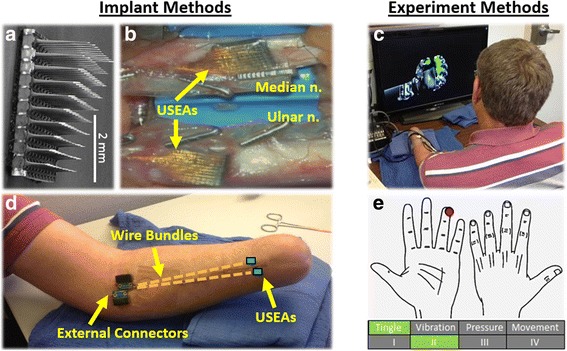
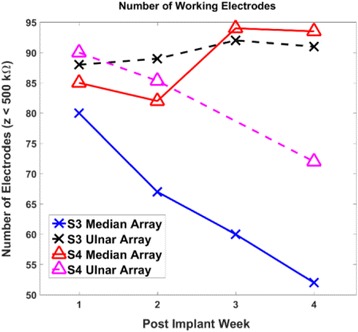
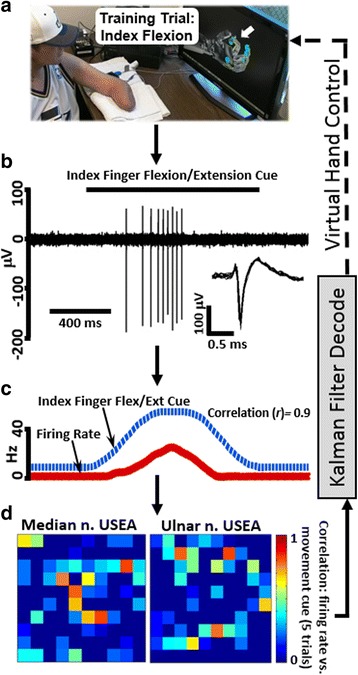
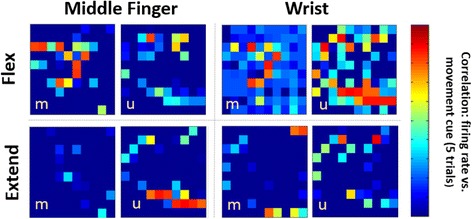
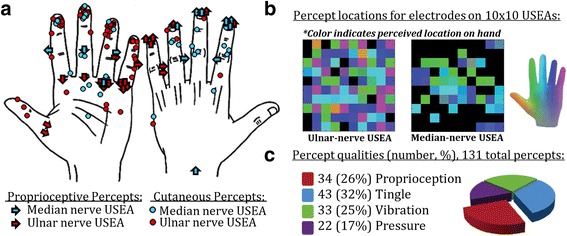
BACKGROUND: Despite advances in sophisticated robotic hands, intuitive control of and sensory feedback from these prostheses has been limited to only 3-degrees-of-freedom (DOF) with 2 sensory percepts in closed-loop control. A Utah Slanted Electrode Array (USEA) has been used in the past to provide up to 81 sensory percepts for human amputees. Here, we report on the advanced capabilities of multiple USEAs implanted in the residual peripheral arm nerves of human amputees for restoring control of 5 DOF and sensation of up to 131 proprioceptive and cutaneous hand sensory percepts. We also demonstrate that USEA-restored sensory percepts provide a useful source of feedback during closed-loop virtual prosthetic hand control. METHODS: Two 100-channel USEAs were implanted for 4-5 weeks, one each in the median and ulnar arm nerves of two human subjects with prior long-duration upper-arm amputations. Intended finger and wrist positions were decoded from neuronal firing patterns via a modified Kalman filter, allowing subjects to control many movements of a virtual prosthetic hand. Additionally, USEA microstimulation was used to evoke numerous sensory percepts spanning the phantom hand. Closed-loop control was achieved by stimulating via an electrode of the ulnar-nerve USEA while recording and decoding movement via the median-nerve USEA. RESULTS: Subjects controlled up to 12 degrees-of-freedom during informal, 'freeform' online movement decode sessions, and experienced up to 131 USEA-evoked proprioceptive and cutaneous sensations spanning the phantom hand. Independent control was achieved for a 5-DOF real-time decode that included flexion/extension of the thumb, index, middle, and ring fingers, and the wrist. Proportional control was achieved for a 4-DOF real-time decode. One subject used a USEA-evoked hand sensation as feedback to complete a 1-DOF closed-loop virtual-hand movement task. There were no observed long-term functional deficits due to the USEA implants. CONCLUSIONS: Implantation of high-channel-count USEAs enables multi-degree-of-freedom control of virtual prosthetic hand movement and restoration of a rich selection of both proprioceptive and cutaneous sensory percepts spanning the hand during the short 4-5 week post-implant period. Future USEA use in longer-term implants and in closed-loop may enable restoration of many of the capabilities of an intact hand while contributing to a meaningful embodiment of the prosthesis.
Overview
The claims and statistics of this paper haven’t been checked yet.
Free: it reads the open-access text and checks the first 5 claims that cite a source we can check. Create a free account to check every claim.
Integrity signals
Registry
Cites
Statistics
Figures
Verification
Claims the paper makes
The claims and statistics of this paper haven’t been checked yet.
Free: it reads the open-access text and checks the first 5 claims that cite a source we can check. Create a free account to check every claim.
Claims other papers make about this one
Each is checked against this paper’s own text: does it say what the citing paper says it does?
The source backs part of the claim, not all of it — or backs it for a different population, condition or comparison.
In the citing paper
“Electrodes placed within a peripheral nerve can record distinct efferent motor action potentials but over time are susceptible to decline in signal amplitude (3, 4).”
From A regenerative peripheral nerve interface allows real-time control of an artificial hand in upper limb amputees (2020) · cites this paper as [4]
Experimental — accuracy not yet measuredThe source backs part of the claim, not all of it — or backs it for a different population, condition or comparison.
In the citing paper
“In addition, intraneural probes, such as the Utah slanted electrode array, can provide large signals but currently run into issues of signal stability over time (4).”
From A regenerative peripheral nerve interface allows real-time control of an artificial hand in upper limb amputees (2020) · cites this paper as [4]
Experimental — accuracy not yet measuredThe cited source says what the claim attributes to it.
In the citing paper
“Together with a growing interest in the translation of these technologies into human clinical use (Wendelken et al., 2017; D'Anna et al., 2019; Petrini et al., 2019), FBR has become a dominant problem that needs to be actively addressed at the implant design stage.”
From Foreign Body Reaction to Implanted Biomaterials and Its Impact in Nerve Neuroprosthetics (2021) · cites this paper as Wendelken et al., 2017
Self-check
Percentages, sums and reported differences re-computed from the paper’s own numbers.
The self-check needs the paper’s full text.
Citations
Cites
Neural Stimulation and Recording Electrodes
Cogan, S. F. (2008) · Annual Review of Biomedical Engineering · doi:10.1146/annurev.bioeng.10.061807.160518 · Cited by 2,243 · cited 1×
“6 V before the end of the interphase interval [32].”
BackgroundSynaesthesia in phantom limbs induced with mirrors
(1996) · Proceedings of the Royal Society of London. Series B: Biological Sciences · doi:10.1098/rspb.1996.0058 · Cited by 1,246 · cited 1×
“given a mirror box in order to practice the phantom-hand movements to be performed in the study [2].”
Restoring natural sensory feedback in real-time bidirectional hand prostheses
Raspopovic, S., Capogrosso, M., Petrini, F. M., Bonizzato, M., Rigosa, J., Di Pino, G., Carpaneto, J., Controzzi, M., Boretius, T., Fernandez, E., et al. (2014) · Science Translational Medicine · doi:10.1126/scitranslmed.3006820 · Cited by 1,001 · cited 1×
“Finally, a recent closed-loop system has been demonstrated in which an amputee achieved 3-DOF control of a prosthetic hand using surface electromyography (sEMG) for motor control and transverse intra-fascicular multichannel electrodes (TIMEs) implanted in residual arm nerves to provide sensory feedback in two phantom-…”
MethodGray, H., Gray, H., & Lewis, W. H. (1918) · Lea & Febiger eBooks · doi:10.5962/bhl.title.20311 · Cited by 840
A neural interface provides long-term stable natural touch perception
Tan, D. W., Schiefer, M. A., Keith, M. W., Anderson, J. R., Tyler, J., & Tyler, D. J. (2014) · Science Translational Medicine · doi:10.1126/scitranslmed.3008669 · Cited by 751 · cited 1×
“Cuff electrodes (flat interface nerve electrodes, FINEs), implanted around each of the three major residual arm nerves of an amputee, have also been used to evoke 19 sensory percepts, and these percepts have been shown to be stable for up to 2 years [10].”
MethodDirect neural sensory feedback and control of a prosthetic arm
Dhillon, G. S., & Horch, K. W. (2005) · IEEE Transactions on Neural Systems and Rehabilitation Engineering · doi:10.1109/tnsre.2005.856072 · Cited by 573
A high-performance neural prosthesis enabled by control algorithm design
Gilja, V., Nuyujukian, P., Chestek, C. A., Cunningham, J. P., Yu, B. M., Fan, J. M., Churchland, M. M., Kaufman, M. T., Kao, J. C., Ryu, S. I., et al. (2012) · Nature Neuroscience · doi:10.1038/nn.3265 · Cited by 564 · cited 1×
“Offline decodes were performed using both automated electrode selection and manual electrode selection for both a standard Kalman filter algorithm [30], or the ReFIT Kalman filter algorithm [31] (available for S4 only).”
MethodOrtiz-Catalan, M., Håkansson, B., & Brånemark, R. (2014) · Science Translational Medicine · doi:10.1126/scitranslmed.3008933 · Cited by 484 · cited 1×
“, no percutaneous wires) with USEAenabled closed-loop control of a physical robotic hand that subjects may take home for use in activities of daily living [42].”
BackgroundDouble nerve intraneural interface implant on a human amputee for robotic hand control
Rossini, P. M., Micera, S., Benvenuto, A., Carpaneto, J., Cavallo, G., Citi, L., Cipriani, C., Denaro, L., Denaro, V., Di Pino, G., et al. (2010) · Clinical Neurophysiology · doi:10.1016/j.clinph.2010.01.001 · Cited by 396
Selective Stimulation of Cat Sciatic Nerve Using an Array of Varying-Length Microelectrodes
Branner, A., Stein, R. B., & Normann, R. A. (2001) · Journal of Neurophysiology · doi:10.1152/jn.2001.85.4.1585 · Cited by 359 · cited 1×
“a Scanning electron microscope image of a USEA [21].”
Research works printed but not linked: 4
- Clark GA, et al. Restoring cutaneous and proprioceptive somatosensory function with nerve stimulation after hand amputations. In: 2016 4th International Conference on Medical Bionics hosted by the Bionics Institute; Brisbane; 2016.
- Clark GA Warren DJ Ledbetter NM Lloyd M Normann RA Microelectrode array system with integrated reference microelectrodes to reduce detected electrical noise and improve selectivity of activation 2013
- Gescheider G Chapter 3. The classical psychophysical methods Psychophys. Fundam. 3rd Ed Mahwah Lawrence Erlbaum Assoc. 1997
- Wendelken SM, et al. Motor decoding and sensory stimulation for upper-limb prostheses using implanted neural and muscular electrode arrays. In: NANS2-Neural Interface Conference (NIC). Baltimore; 2016.
Cited by
Items 201–237 of 237
Emerging trends in the literature on psychological and job performance: a bibliometric analysis
Correa, B. H. O., & Ramos-Tomalá, D. (2024) · Revista Tecnológica Ciencia y Educación Edwards Deming · doi:10.37957/rfd.v8i1.127 · Cited by 1
Brain-Controlled Assistive Robotics and Prosthetics
Puthuveetil, K. P., & Krusienski, D. J. (2024) · Elsevier eBooks · doi:10.1016/b978-0-323-87865-4.00010-8 · Cited by 1
Chen, W., Bao, J., Xing, Y., Han, L., Yu, B., Wang, C., Hao, Y., Wang, Y., & Xu, K. (2025) · Annual International Conference of the IEEE Engineering in Medicine and Biology Society (EMBC) · doi:10.1109/embc58623.2025.11254094 · Cited by 1
“…electrodes, including Utah slanted electrode arrays (USEA), longitudinal intrafascicular electrode (LIFE), and transversal intrafascicular multi-channel electrode (TIME), which are penetrated the epineurium and implanted within nerve bundles to stimulate or record from nearby nerve fibers [6]–[8].”
Understanding factors affecting perception and utilization of artificial sensory location
Cuberovic, I. (2020) · OhioLink ETD Center (Ohio Library and Information Network) · Cited by 1
Restoring Fine Motor Prosthetic Hand Control via Peripheral Neural Technology
Vu, P. P. (2019) · Deep Blue (University of Michigan) · Cited by 1
Modulation Ranges of Different Sensations for Coding Electrically Evoked Tactile Sensory FeedbackPreprint
Zhang, J., Hao, M., Yang, F., Liang, W., Bi, S., Chou, C.-H., & Lan, N. (2021) · doi:10.36227/techrxiv.14693934.v1 · Cited by 1
Modulation Ranges of Different Sensations for Coding Electrically Evoked Tactile Sensory FeedbackPreprint
Zhang, J., Hao, M., Yang, F., Liang, W., Bi, S., Chou, C.-H., & Lan, N. (2021) · doi:10.36227/techrxiv.14693934 · Cited by 1
Biocompatibility and functionality of graphene-based neural interfaces
Rodríguez‐Meana, B. (2023) · Dipòsit Digital de Documents de la UAB (Universitat Autònoma de Barcelona) · Cited by 1
Brocco, M. D., Ansah, G. J., Durán, M., Bhowmick, S., Gopinath, C., Jantz, M., Bose, R., Lempka, S. F., & Fisher, L. E. (2026) · bioRxiv (Cold Spring Harbor Laboratory) · doi:10.64898/2026.06.18.733242 · Cited by 1
“Techniques such as flat -interface nerve electrodes [4], [7], [8], intrafascicular arrays [5], [6], [9], and targeted sensory reinnervation [10] have demonstrated restored tactile and proprioceptive sensations.”
Direct stimulation of peripheral nerves to provide sensory feedback
Günter, C. (2019) · Chalmers Publication Library (Chalmers University of Technology)
Decoding, Modulating, and Imaging Sensorimotor Pathways in the Brain
Willsey, M. S. (2020) · Deep Blue (University of Michigan)
Detection and discrimination of electrical stimuli from an upper limb cuff electrode in M. Mulatta
Schlichenmeyer, T. C., Zellmer, E. R., Burton, H., Ray, W. Z., & Moran, D. W. (2022) · Journal of Neural Engineering · doi:10.1088/1741-2552/ac9e76
“…loss (Wilson et al 1991), bladder prostheses to assist autonomic nervous system function (Brindley et al 1986), and upper limb sensorimotor prostheses for limb loss or spinal cord damage (Tyler and Durand 2002, Dhillon and Horch 2006, Tan et al 2014, 2015, Graczyk et al 2016, Wendelken et al 2017).”
Brain-Machine Interfaces for Upper and Lower Limb Prostheses
Brantley, J. A., Paek, A. Y., Steele, A. G., & Contreras-Vidal, J. L. (2023) · Handbook of Neuroengineering · doi:10.1007/978-981-16-5540-1_35
Advancements in Implantable Microelectrodes: Opportunities and Risks for Neural Interface TechnologyPreprint
Ali, S. A., & Khan, R. (2023) · Preprints.org · doi:10.20944/preprints202303.0237.v1
Closing the Loop: How Sensation Impacts Prosthetic Function and Control
Gonzalez, M. (2023) · Deep Blue (University of Michigan) · doi:10.7302/7420
Realizing Upper Extremity Bionic Limbs: Leveraging Neuroprosthetic Control Strategies
Kumar, N. G., Chestek, C. A., Cederna, P. S., & Kung, T. A. (2023) · Plastic & Reconstructive Surgery · doi:10.1097/prs.0000000000011183
“44 However, these intraneural electrodes have not been demonstrated to be stable and reliable over the long term due to device encapsulation, inflammation, fibrosis, micromotion, delamination, and signal degradation over time.”
Review of Neural Sensing Methods in the Peripheral Nervous System
Petrou, M. N., Ribeiro, M., Koh, R. G. L., Jabban, L., & Metcalfe, B. (2024) · IEEE International Conference on Metrology for eXtended Reality, Artificial Intelligence and Neural Engineering (MetroXRAINE) · doi:10.1109/metroxraine62247.2024.10797198
Kineticomyography for Hand Gesture Recognition: Experimental Implementation
Sarani, B., Gholami-Z, M.-R., Eshtiagh‐Hosseini, H., Akbarzadeh-T, M.-R., & Akbarzadeh, A. (2024) · Iranian Conference on Intelligent Systems (ICIS) · doi:10.1109/icis64839.2024.10887491
“…(EEG) [8], magnetoencephalography (MEG) [9], functional magnetic resonance imaging (fMRI) [10], electrocorticography (ECoG) [11], electroneurography (ENG) [12], force myography (FMG) [13], mechanomyography (MMG) [14], sonomyography (SMG) [15], and intramuscular electromyography (iEMG) [16].”
Takashita, S., Steimle, J., & İnami, M. (2025) · ACM SIGGRAPH Emerging Technologies · doi:10.1145/3721257.3734036
Shu, T., Huang, S. S., Shallal, C., & Herr, H. (2021) · Figshare · doi:10.6084/m9.figshare.14052873
Sharma, D. (2023) · UNSWorks (University of New South Wales, Sydney, Australia) · doi:10.26190/unsworks/25062
Shu, T., Huang, S. S., Shallal, C., & Herr, H. (2021) · Figshare · doi:10.6084/m9.figshare.14583545
Shu, T., Huang, S. S., Shallal, C., & Herr, H. (2021) · Figshare · doi:10.6084/m9.figshare.14583539
Wu, B. (2025) · D-Scholarship@Pitt (University of Pittsburgh)
Closed-loop Control of Peripheral Nerve Stimulation using Resource-efficient Neural Networks
Hwang, Y.-C. E. (2022) · TSpace (University of Toronto) · Cited by 1
Sammut, S. (2020) · TSpace (University of Toronto)
Non-invasive somatotopic proprioceptive feedback for closed-loop robotic hand aperture control
Lecompte, O., Achiche, S., Haddad, M., Gesta, A., & Mohebbi, A. (2026) · Journal of Neural Engineering · doi:10.1088/1741-2552/ae6d76
“To date, such strategies have been implemented primarily through invasive electrical stimulation of peripheral nerves using implanted electrodes [37, 38].”
Trends in neuroprosthetic technologies to restore sensations
Park, B., Butterworth, W., Lee, N., & Kim, S. (2026) · Biomedical Engineering Letters · doi:10.1007/s13534-026-00603-x
Stimulation-stability and preclinical bench testing of a new auditory nerve interface
Stump, T., Strahl, S., Crew, J. D., Leber, M., Hübner, K., Negi, S., Vankirk, J., Adams, M. E., Lenarz, T., Solzbacher, F., et al. (2026) · Bioelectronic Medicine · doi:10.1186/s42234-026-00215-x
“While the mechanics of replacement and retainment are more challenging than the standard CI, we have achieved good retainment in preclinical studies (George et al. 2020; Flesher et al. 2016; Wendelken et al. 2017).”
InfluentialToni, L., Fossati, V., Verardo, C., Losanno, E., Micera, S., & Romeni, S. (2026) · Research Square · doi:10.21203/rs.3.rs-10943457/v1
Phantom pains (relevance, history, modern views)
Voropaev, A. A., Goncharova, N. N., & Chernyaeva, M. M. (2026) · Fizioterapevt (Physiotherapist) · doi:10.33920/med-14-2604-15
Budi, A. S., & Pering, R. M. (2025) · Journal of Regenerative Medicine and Molecular Innovation
Hocaoğlu, E. (2026) · Frontiers in Neurorobotics · doi:10.3389/fnbot.2026.1910158
“Mechanotactile feedback has been shown to enhance feelings of ownership and agency during active prosthetic control, increase user confidence, and reduce reliance on visual cues (Risso and Valle, 2022; Shehata et al., 2020; Wendelken et al., 2017).”
Huynh, N., Arribart, K., & Guémann, M. (2026) · JPO Journal of Prosthetics and Orthotics · doi:10.1097/jpo.0000000000000670
Valle, G., Iberite, F., Strauss, I., D'Anna, E., Granata, G., Iorio, R. D., Stieglitz, T., Raspopovic, S., Petrini, F. M., Rossini, P. M., et al. (2021) · doi:10.3389/fmedt.2021.619280.s001
Metadata
- Authors
- Wendelken, S., Page, D. M., Davis, T., Wark, H. A. C., Kluger, D. T., Duncan, C., Warren, D. J., Hutchinson, D. T., & Clark, G. A.
- Affiliations
- University of Utah (US)
- Corresponding author
- Clark, Gregory A.
- ORCID
- Venue
- Journal of NeuroEngineering and Rehabilitation
- Published
- 2017-11-25
- Volume
- 14
- Issue
- 1
- Pages
- 121-121
- ISSN
- 1743-0003 (ISSN-L)
- PMC
- PMC5702130
- OpenAlex
- W2769345133
- Cited by
- 216
- References
- 41
- Citations by year
- 2026: 7 · 2025: 26 · 2024: 20 · 2023: 22 · 2022: 25 · 2021: 42 · 2020: 30 · 2019: 33 · 2018: 11
- FWCI
- 9.90
- Type
- journal article
- Language
- en
- Open access
- gold
- doi.org
- Licence
- cc-by
- creativecommons.org/licenses/by/4.0/ (tdm)
- creativecommons.org/licenses/by/4.0/ (vor)
- Locations
- Journal of NeuroEngineering and Rehabilitation (publishedVersion, cc-by)
- PubMed Central (publishedVersion, cc-by)
- PubMed (publishedVersion)
- DOAJ (DOAJ: Directory of Open Access Journals) (submittedVersion, cc-by-sa)
- Funders
- Defense Advanced Research Projects Agency (N66001-12-C-4042, N66001-15-C-4017)
- National Center for Advancing Translational Sciences (1ULTR001067)
- Topics
- Life Sciences › Neuroscience › Cellular and Molecular Neuroscience › Neuroscience and Neural Engineering
- Physical Sciences › Engineering › Biomedical Engineering › Muscle activation and electromyography studies
- Life Sciences › Neuroscience › Cognitive Neuroscience › EEG and Brain-Computer Interfaces
- Keywords
- upper limb amputation, peripheral nerve stimulation, sensory feedback, multi-degree-of-freedom control, proprioception, skin sensation, median nerve, ulnar nerve, feedback control, phantom hand, neuroprosthetics, microstimulation, prosthetic hand control
- MeSH terms
- Adult, Amputees, Arm, Artificial Limbs, Electrodes, Implanted, Electric Stimulation Therapy, Humans, Male, Middle Aged, Proprioception, Prosthesis Design, Utah, Feedback, Sensory
About these checks
Registry, retraction, Cites and statistics results are computed, not judged, with one exception: a printed reference that no index lists is read once by a model before it counts as a citation error. Claims are extracted by a model and kept only when their quote appears verbatim in the text; each cited source is then checked, with a model’s help, for whether it says what the claim relies on. Those verdicts can be wrong — read the claim’s quote and the cited source before relying on one.
Statistics and arithmetic are recomputed, not judged.
Confidence bands are shown only for fields calibrated on our annotated test set. None is calibrated yet, so no band is shown.
What counts as a claim ›How we measure confidence ›How we check this ›
Are you an author, or do you see a problem with this page? Request a review
Data sources
Bibliographic data: Semantic Scholar, OpenAlex, Crossref.
Contains information from the Semantic Scholar Academic Graph Datasets, made available under the ODC Attribution License (ODC-BY 1.0).
Semantic Scholar’s data is described in: Kinney, R., et al. (2023). The Semantic Scholar Open Data Platform. arXiv:2301.10140.
