

Restoration of motor control and proprioceptive and cutaneous sensation in humans with prior upper-limb amputation via multiple Utah Slanted Electrode Arrays (USEAs) implanted in residual peripheral arm nerves
Open accessThe DOI matches its Crossref record; 38 of the 41 references it cites were found in a registry or an index.
Abstract
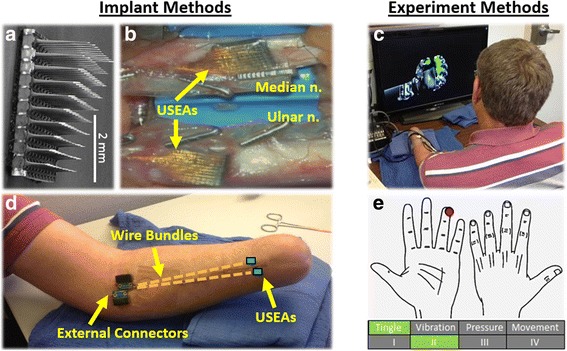
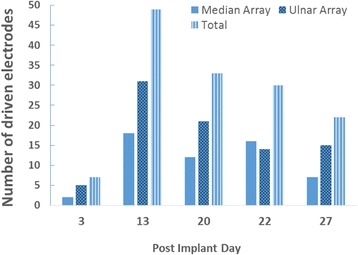
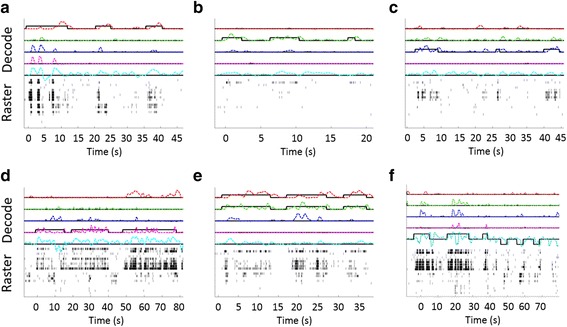
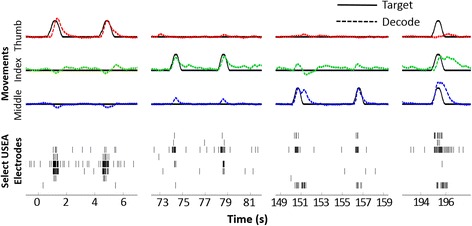
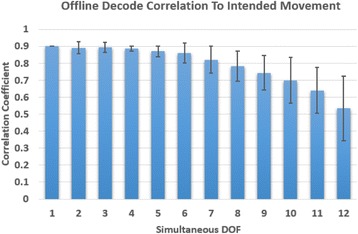
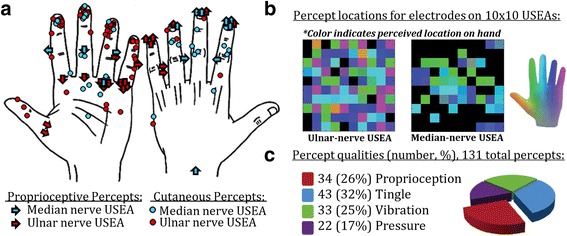
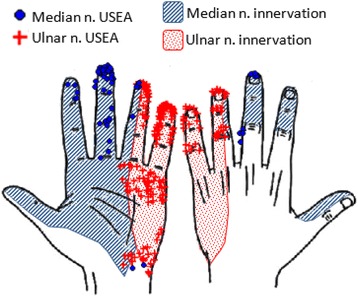
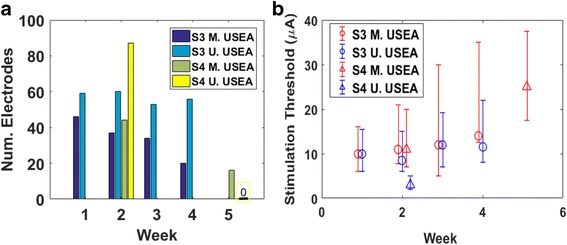
BACKGROUND: Despite advances in sophisticated robotic hands, intuitive control of and sensory feedback from these prostheses has been limited to only 3-degrees-of-freedom (DOF) with 2 sensory percepts in closed-loop control. A Utah Slanted Electrode Array (USEA) has been used in the past to provide up to 81 sensory percepts for human amputees. Here, we report on the advanced capabilities of multiple USEAs implanted in the residual peripheral arm nerves of human amputees for restoring control of 5 DOF and sensation of up to 131 proprioceptive and cutaneous hand sensory percepts. We also demonstrate that USEA-restored sensory percepts provide a useful source of feedback during closed-loop virtual prosthetic hand control. METHODS: Two 100-channel USEAs were implanted for 4-5 weeks, one each in the median and ulnar arm nerves of two human subjects with prior long-duration upper-arm amputations. Intended finger and wrist positions were decoded from neuronal firing patterns via a modified Kalman filter, allowing subjects to control many movements of a virtual prosthetic hand. Additionally, USEA microstimulation was used to evoke numerous sensory percepts spanning the phantom hand. Closed-loop control was achieved by stimulating via an electrode of the ulnar-nerve USEA while recording and decoding movement via the median-nerve USEA. RESULTS: Subjects controlled up to 12 degrees-of-freedom during informal, 'freeform' online movement decode sessions, and experienced up to 131 USEA-evoked proprioceptive and cutaneous sensations spanning the phantom hand. Independent control was achieved for a 5-DOF real-time decode that included flexion/extension of the thumb, index, middle, and ring fingers, and the wrist. Proportional control was achieved for a 4-DOF real-time decode. One subject used a USEA-evoked hand sensation as feedback to complete a 1-DOF closed-loop virtual-hand movement task. There were no observed long-term functional deficits due to the USEA implants. CONCLUSIONS: Implantation of high-channel-count USEAs enables multi-degree-of-freedom control of virtual prosthetic hand movement and restoration of a rich selection of both proprioceptive and cutaneous sensory percepts spanning the hand during the short 4-5 week post-implant period. Future USEA use in longer-term implants and in closed-loop may enable restoration of many of the capabilities of an intact hand while contributing to a meaningful embodiment of the prosthesis.
Overview
The claims and statistics of this paper haven’t been checked yet.
Free: it reads the open-access text and checks the first 5 claims that cite a source we can check. Create a free account to check every claim.
Integrity signals
Registry
Cites
Statistics
Figures
Verification
Claims the paper makes
The claims and statistics of this paper haven’t been checked yet.
Free: it reads the open-access text and checks the first 5 claims that cite a source we can check. Create a free account to check every claim.
Claims other papers make about this one
Each is checked against this paper’s own text: does it say what the citing paper says it does?
The source backs part of the claim, not all of it — or backs it for a different population, condition or comparison.
In the citing paper
“Electrodes placed within a peripheral nerve can record distinct efferent motor action potentials but over time are susceptible to decline in signal amplitude (3, 4).”
From A regenerative peripheral nerve interface allows real-time control of an artificial hand in upper limb amputees (2020) · cites this paper as [4]
Experimental — accuracy not yet measuredThe source backs part of the claim, not all of it — or backs it for a different population, condition or comparison.
In the citing paper
“In addition, intraneural probes, such as the Utah slanted electrode array, can provide large signals but currently run into issues of signal stability over time (4).”
From A regenerative peripheral nerve interface allows real-time control of an artificial hand in upper limb amputees (2020) · cites this paper as [4]
Experimental — accuracy not yet measuredThe cited source says what the claim attributes to it.
In the citing paper
“Together with a growing interest in the translation of these technologies into human clinical use (Wendelken et al., 2017; D'Anna et al., 2019; Petrini et al., 2019), FBR has become a dominant problem that needs to be actively addressed at the implant design stage.”
From Foreign Body Reaction to Implanted Biomaterials and Its Impact in Nerve Neuroprosthetics (2021) · cites this paper as Wendelken et al., 2017
Self-check
Percentages, sums and reported differences re-computed from the paper’s own numbers.
The self-check needs the paper’s full text.
Citations
Cites
Neural Stimulation and Recording Electrodes
Cogan, S. F. (2008) · Annual Review of Biomedical Engineering · doi:10.1146/annurev.bioeng.10.061807.160518 · Cited by 2,243 · cited 1×
“6 V before the end of the interphase interval [32].”
BackgroundSynaesthesia in phantom limbs induced with mirrors
(1996) · Proceedings of the Royal Society of London. Series B: Biological Sciences · doi:10.1098/rspb.1996.0058 · Cited by 1,246 · cited 1×
“given a mirror box in order to practice the phantom-hand movements to be performed in the study [2].”
Restoring natural sensory feedback in real-time bidirectional hand prostheses
Raspopovic, S., Capogrosso, M., Petrini, F. M., Bonizzato, M., Rigosa, J., Di Pino, G., Carpaneto, J., Controzzi, M., Boretius, T., Fernandez, E., et al. (2014) · Science Translational Medicine · doi:10.1126/scitranslmed.3006820 · Cited by 1,001 · cited 1×
“Finally, a recent closed-loop system has been demonstrated in which an amputee achieved 3-DOF control of a prosthetic hand using surface electromyography (sEMG) for motor control and transverse intra-fascicular multichannel electrodes (TIMEs) implanted in residual arm nerves to provide sensory feedback in two phantom-…”
MethodGray, H., Gray, H., & Lewis, W. H. (1918) · Lea & Febiger eBooks · doi:10.5962/bhl.title.20311 · Cited by 840
A neural interface provides long-term stable natural touch perception
Tan, D. W., Schiefer, M. A., Keith, M. W., Anderson, J. R., Tyler, J., & Tyler, D. J. (2014) · Science Translational Medicine · doi:10.1126/scitranslmed.3008669 · Cited by 751 · cited 1×
“Cuff electrodes (flat interface nerve electrodes, FINEs), implanted around each of the three major residual arm nerves of an amputee, have also been used to evoke 19 sensory percepts, and these percepts have been shown to be stable for up to 2 years [10].”
MethodDirect neural sensory feedback and control of a prosthetic arm
Dhillon, G. S., & Horch, K. W. (2005) · IEEE Transactions on Neural Systems and Rehabilitation Engineering · doi:10.1109/tnsre.2005.856072 · Cited by 573
A high-performance neural prosthesis enabled by control algorithm design
Gilja, V., Nuyujukian, P., Chestek, C. A., Cunningham, J. P., Yu, B. M., Fan, J. M., Churchland, M. M., Kaufman, M. T., Kao, J. C., Ryu, S. I., et al. (2012) · Nature Neuroscience · doi:10.1038/nn.3265 · Cited by 564 · cited 1×
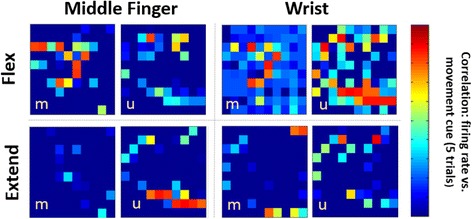
“Offline decodes were performed using both automated electrode selection and manual electrode selection for both a standard Kalman filter algorithm [30], or the ReFIT Kalman filter algorithm [31] (available for S4 only).”
MethodOrtiz-Catalan, M., Håkansson, B., & Brånemark, R. (2014) · Science Translational Medicine · doi:10.1126/scitranslmed.3008933 · Cited by 484 · cited 1×
“, no percutaneous wires) with USEAenabled closed-loop control of a physical robotic hand that subjects may take home for use in activities of daily living [42].”
BackgroundDouble nerve intraneural interface implant on a human amputee for robotic hand control
Rossini, P. M., Micera, S., Benvenuto, A., Carpaneto, J., Cavallo, G., Citi, L., Cipriani, C., Denaro, L., Denaro, V., Di Pino, G., et al. (2010) · Clinical Neurophysiology · doi:10.1016/j.clinph.2010.01.001 · Cited by 396
Selective Stimulation of Cat Sciatic Nerve Using an Array of Varying-Length Microelectrodes
Branner, A., Stein, R. B., & Normann, R. A. (2001) · Journal of Neurophysiology · doi:10.1152/jn.2001.85.4.1585 · Cited by 359 · cited 1×
“a Scanning electron microscope image of a USEA [21].”
Dhillon, G. S., Lawrence, S. M., Hutchinson, D. T., & Horch, K. W. (2004) · The Journal of Hand Surgery · doi:10.1016/j.jhsa.2004.02.006 · Cited by 354 · cited 2×
“More recently, implanted longitudinal intrafascicular electrodes (LIFEs) were implanted into the peripheral arm nerves of several transradial amputees, and recordings from these electrodes provided subjects with one-degree-of-freedom (DOF) online control of a prosthesis [4].”
BackgroundSelf-citationRobotic touch shifts perception of embodiment to a prosthesis in targeted reinnervation amputees
Marasco, P. D., Kim, K., Colgate, J. E., Peshkin, M. A., & Kuiken, T. A. (2011) · Brain · doi:10.1093/brain/awq361 · Cited by 335 · cited 1×
“In addition to restoring much of the functionality of an intact hand to amputees, quasi-continuous restoration of the sense of proprioception and cutaneous touch may help amputees perceive their prosthesis as an embodied replacement limb rather than a tool [1], which may decrease prosthesis rejection rates and improve…”
BackgroundZhong, Y., & Bellamkonda, R. V. (2007) · Brain Research · doi:10.1016/j.brainres.2007.02.024 · Cited by 321 · cited 1×
“1 mg/kg of dexamethasone intravenously to potentially mitigate the foreign body response and improve neural recording capability [25, 26].”
BackgroundDavis, T. S., Wark, H. A. C., Hutchinson, D. T., Warren, D. J., O’Neill, K., Scheinblum, T., Clark, G. A., Normann, R. A., & Greger, B. (2016) · Journal of Neural Engineering · doi:10.1088/1741-2560/13/3/036001 · Cited by 314 · cited 2×
“cutaneous percepts on the hand and provide proportional motor control of up to two DOFs [14].”
BackgroundSelf-citationA method for pneumatically inserting an array of penetrating electrodes into cortical tissue
Rousche, P. J., & Normann, R. A. (1992) · Annals of Biomedical Engineering · doi:10.1007/bf02368133 · Cited by 306 · cited 1×
“In both subjects, the epineurium was dissected from the surface of the nerves prior to pneumatic insertion of the USEAs [24].”
MethodTouch is a team effort: interplay of submodalities in cutaneous sensibility
Saal, H. P., & Bensmaia, S. J. (2014) · Trends in Neurosciences · doi:10.1016/j.tins.2014.08.012 · Cited by 280 · cited 1×
“, slowly-adapting I type or II, rapidly-adapting type I or II, or group Ia or II intrafusal muscle fibers) may improve the naturalism, discriminability, and stability of percepts [39].”
BackgroundThe importance of affective quality
Zhang, P., & Li, N. (2005) · Communications of the ACM · doi:10.1145/1081992.1081997 · Cited by 231
Spataro, L., Dilgen, J., Retterer, S., Spence, A. J., Isaacson, M., Turner, J. N., & Shain, W. (2005) · Experimental Neurology · doi:10.1016/j.expneurol.2004.08.037 · Cited by 215 · cited 1×
“1 mg/kg of dexamethasone intravenously to potentially mitigate the foreign body response and improve neural recording capability [25, 26].”
BackgroundModeling and Decoding Motor Cortical Activity Using a Switching Kalman Filter
Wu, W., Black, M. J., Mumford, D., Gao, Y., Bienenstock, E., & Donoghue, J. P. (2004) · IEEE Transactions on Biomedical Engineering · doi:10.1109/tbme.2004.826666 · Cited by 213 · cited 2×
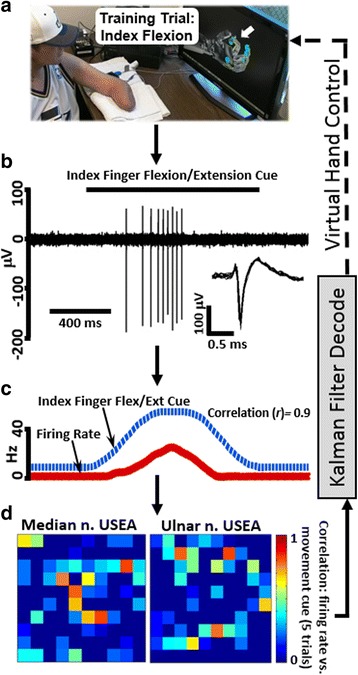
“Further details of the decoding algorithm are discussed elsewhere [19, 30].”
MethodThe application of implant technology for cybernetic systems
Warwick, K., Gasson, M., Hutt, B., Goodhew, I., Kyberd, P., Andrews, B., Teddy, P., & Shad, A. (2003) · Archives of Neurology · doi:10.1001/archneur.60.10.1369 · Cited by 206 · cited 1×
“The Utah Electrode Array (UEA) has been previously implanted in the distal median nerve of an intact individual and used to provide 1-DOF decode and limited sensory feedback in a closed-loop interface [11, 12].”
MethodHorch, K., Meek, S., Taylor, T. G., & Hutchinson, D. T. (2011) · IEEE Transactions on Neural Systems and Rehabilitation Engineering · doi:10.1109/tnsre.2011.2162635 · Cited by 194 · cited 3×
“More recently, implanted longitudinal intrafascicular electrodes (LIFEs) were implanted into the peripheral arm nerves of several transradial amputees, and recordings from these electrodes provided subjects with one-degree-of-freedom (DOF) online control of a prosthesis [4].”
MethodSelf-citationDhillon, G. S., Krüger, T. B., Sandhu, J. S., & Horch, K. W. (2005) · Journal of Neurophysiology · doi:10.1152/jn.00937.2004 · Cited by 183
Sensory feedback prosthesis reduces phantom limb pain: Proof of a principle
Dietrich, C., Walter-Walsh, K., Preißler, S., Hofmann, G. O., Witte, O. W., Miltner, W. H. R., & Weiss, T. (2012) · Neuroscience Letters · doi:10.1016/j.neulet.2011.10.068 · Cited by 180
Applications of sensory feedback in motorized upper extremity prosthesis: a review
Schofield, J. S., Evans, K. R., Carey, J. P., & Hebert, J. S. (2014) · Expert Review of Medical Devices · doi:10.1586/17434440.2014.929496 · Cited by 155
Minocycline increases quality and longevity of chronic neural recordings
Rennaker, R. L., Miller, J., Tang, H., & Wilson, D. A. (2007) · Journal of Neural Engineering · doi:10.1088/1741-2560/4/2/l01 · Cited by 108 · cited 1×
“, starting the day before the implant surgery) which potentially improves the quality of chronic neuronal recordings [23].”
BackgroundMicera, S., Rossini, P. M., Rigosa, J., Citi, L., Carpaneto, J., Raspopovic, S., Tombini, M., Cipriani, C., Assenza, G., Carrozza, M. C., et al. (2011) · Journal of NeuroEngineering and Rehabilitation · doi:10.1186/1743-0003-8-53 · Cited by 100
(1974) · PubMed · Cited by 89
Cipriani, C., Segil, J. L., Birdwell, J. A., & Weir, R. F. F. (2014) · IEEE Transactions on Neural Systems and Rehabilitation Engineering · doi:10.1109/tnsre.2014.2301234 · Cited by 81 · cited 1×
“using EMG signals and/or classifier decodes, which have been limited to only 4 DOFs [36].”
MethodClark, G. A., Wendelken, S., Page, D. M., Davis, T., Wark, H. A. C., Normann, R. A., Warren, D. J., & Hutchinson, D. T. (2014) · 2014 36th Annual International Conference of the IEEE Engineering in Medicine and Biology Society · doi:10.1109/embc.2014.6944001 · Cited by 78 · cited 1×
“Subjects also successfully discriminated among sensory percepts of different locations and qualities (a preliminary report for S3 has been provided [15], and a comprehensive report across multiple subjects is pending future publication).”
BackgroundSelf-citationInvasive neural prosthesis for neural signal detection and nerve stimulation
Gasson, M., Hutt, B., Goodhew, I., Kyberd, P., & Warwick, K. (2005) · International Journal of Adaptive Control and Signal Processing · doi:10.1002/acs.854 · Cited by 66 · cited 1×
“The Utah Electrode Array (UEA) has been previously implanted in the distal median nerve of an intact individual and used to provide 1-DOF decode and limited sensory feedback in a closed-loop interface [11, 12].”
MethodModel-Based Development of Neural Prostheses for Movement
Davoodi, R., Urata, C., Hauschild, M., Khachani, M., & Loeb, G. E. (2007) · IEEE Transactions on Biomedical Engineering · doi:10.1109/tbme.2007.902252 · Cited by 53
Recording and decoding for neural prostheses
Warren, D. J., Kellis, S., Nieveen, J. G., Wendelken, S. M., Dantas, H., Davis, T. S., Hutchinson, D. T., Normann, R. A., Clark, G. A., & Mathews, V. J. (2016) · Proceedings of the IEEE · doi:10.1109/jproc.2015.2507180 · Cited by 52 · cited 3×
“In subsequent work, we have begun to implement on-line automated channel selection [18, 19, 37].”
MethodSelf-citationChristensen, M. B., Wark, H. A. C., & Hutchinson, D. T. (2016) · Biomaterials · doi:10.1016/j.biomaterials.2015.11.012 · Cited by 49
Self-citationPerruchoud, D., Pisotta, I., Carda, S., Murray, M. M., & Ionta, S. (2016) · Journal of Neural Engineering · doi:10.1088/1741-2560/13/4/041001 · Cited by 35 · cited 1×
“Naturalistic touch, such as the sensation experienced during motor task phase transitions, activates a diverse subpopulation of axons in distinct patterns, producing a fused population and temporal code [40].”
BackgroundGunalan, K., Warren, D. J., Perry, J. D., Normann, R. A., & Clark, G. A. (2008) · Journal of Neuroscience Methods · doi:10.1016/j.jneumeth.2008.12.020 · Cited by 28 · cited 1×
“soak-testing using a custom-built impedance tester, at 1 kHz [28].”
MethodSelf-citationLinear methods for reducing EMG contamination in peripheral nerve motor decodes
KAGAN, Z. B., Wendelken, S., Page, D. M., Davis, T. S., Hutchinson, D. T., Clark, G. A., & Warren, D. J. (2016) · Annual International Conference of the IEEE Engineering in Medicine and Biology Society (EMBC) · doi:10.1109/embc.2016.7591463 · Cited by 6
Self-citationChannel Selection of Neural and Electromyographic Signals for Decoding Motor Intent
Nieveen, J., Warren, D., Wendelken, S., Davis, T., Kluger, D. T., Page, D., George, J. A., Duncan, C. C., Hutchinson, D. T., Mathews, V. J., et al. (2017) · doi:10.13140/rg.2.2.13423.69288 · Cited by 6
Self-citationPage, D. M. (2018) · J. Willard Marriott Library · doi:10.26053/0h-883s-cmg0 · Cited by 4
Self-citation
Research works printed but not linked: 4
- Clark GA, et al. Restoring cutaneous and proprioceptive somatosensory function with nerve stimulation after hand amputations. In: 2016 4th International Conference on Medical Bionics hosted by the Bionics Institute; Brisbane; 2016.
- Clark GA Warren DJ Ledbetter NM Lloyd M Normann RA Microelectrode array system with integrated reference microelectrodes to reduce detected electrical noise and improve selectivity of activation 2013
- Gescheider G Chapter 3. The classical psychophysical methods Psychophys. Fundam. 3rd Ed Mahwah Lawrence Erlbaum Assoc. 1997
- Wendelken SM, et al. Motor decoding and sensory stimulation for upper-limb prostheses using implanted neural and muscular electrode arrays. In: NANS2-Neural Interface Conference (NIC). Baltimore; 2016.
Cited by
A brain-computer interface that evokes tactile sensations improves robotic arm control
Flesher, S. N., Downey, J. E., Weiss, J. M., Hughes, C. L., Herrera, A. J., Tyler-Kabara, E. C., Boninger, M. L., Collinger, J. L., & Gaunt, R. A. (2021) · Science · doi:10.1126/science.abd0380 · Cited by 617
Foreign Body Reaction to Implanted Biomaterials and Its Impact in Nerve Neuroprosthetics
Carnicer-Lombarte, A., Chen, S.-T., Malliaras, G. G., & Barone, D. G. (2021) · Frontiers in Bioengineering and Biotechnology · doi:10.3389/fbioe.2021.622524 · Cited by 454
“Despite this and other prior translational successes (Clark et al., 2014; Davis et al., 2016; Wendelken et al., 2017), the large degree of trauma and FBR associated with current Utah array designs poses difficult challenges for their widespread clinical use.”
BackgroundMethodProsthesis with neuromorphic multilayered e-dermis perceives touch and pain
Osborn, L. E., Dragomir, A., Betthauser, J. L., Hunt, C. L., Nguyen, H. H., Kaliki, R. R., & Thakor, N. V. (2018) · Science Robotics · doi:10.1126/scirobotics.aat3818 · Cited by 427
“Although important,methods of sensory feedback have been limited to sensations of pressure (21), proprioception (23), and texture (26), even though our perception of tactile information culminates in a sophisticated, multifaceted sensation that also includes stretch, temperature, and pain.”
George, J. A., Kluger, D. T., Davis, T. S., Wendelken, S. M., Okorokova, E. V., He, Q., Duncan, C. C., Hutchinson, D. T., Thumser, Z. C., Beckler, D. T., et al. (2019) · Science Robotics · doi:10.1126/scirobotics.aax2352 · Cited by 388
“Previous studies from this group (6, 51, 52) were limited in duration (less than 5weeks) for safety considerations; because no health risks emerged from these previous studies, the University of Utah Institutional Review Board and the participant agreed to a 14-month duration for this study.”
BackgroundMethodSelf-citationValle, G., Mazzoni, A., Iberite, F., D’Anna, E., Strauss, I., Granata, G., Controzzi, M., Clemente, F., Rognini, G., Cipriani, C., et al. (2018) · Neuron · doi:10.1016/j.neuron.2018.08.033 · Cited by 345
Metadata
- Authors
- Wendelken, S., Page, D. M., Davis, T., Wark, H. A. C., Kluger, D. T., Duncan, C., Warren, D. J., Hutchinson, D. T., & Clark, G. A.
- Affiliations
- University of Utah (US)
- Corresponding author
- Clark, Gregory A.
- ORCID
- Venue
- Journal of NeuroEngineering and Rehabilitation
- Published
- 2017-11-25
- Volume
- 14
- Issue
- 1
- Pages
- 121-121
- ISSN
- 1743-0003 (ISSN-L)
- PMC
- PMC5702130
- OpenAlex
- W2769345133
- Cited by
- 216
- References
- 41
- Citations by year
- 2026: 7 · 2025: 26 · 2024: 20 · 2023: 22 · 2022: 25 · 2021: 42 · 2020: 30 · 2019: 33 · 2018: 11
- FWCI
- 9.90
- Type
- journal article
- Language
- en
- Open access
- gold
- doi.org
- Licence
- cc-by
- creativecommons.org/licenses/by/4.0/ (tdm)
- creativecommons.org/licenses/by/4.0/ (vor)
- Locations
- Journal of NeuroEngineering and Rehabilitation (publishedVersion, cc-by)
- PubMed Central (publishedVersion, cc-by)
- PubMed (publishedVersion)
- DOAJ (DOAJ: Directory of Open Access Journals) (submittedVersion, cc-by-sa)
- Funders
- Defense Advanced Research Projects Agency (N66001-12-C-4042, N66001-15-C-4017)
- National Center for Advancing Translational Sciences (1ULTR001067)
- Topics
- Life Sciences › Neuroscience › Cellular and Molecular Neuroscience › Neuroscience and Neural Engineering
- Physical Sciences › Engineering › Biomedical Engineering › Muscle activation and electromyography studies
- Life Sciences › Neuroscience › Cognitive Neuroscience › EEG and Brain-Computer Interfaces
- Keywords
- upper limb amputation, peripheral nerve stimulation, sensory feedback, multi-degree-of-freedom control, proprioception, skin sensation, median nerve, ulnar nerve, feedback control, phantom hand, neuroprosthetics, microstimulation, prosthetic hand control
- MeSH terms
- Adult, Amputees, Arm, Artificial Limbs, Electrodes, Implanted, Electric Stimulation Therapy, Humans, Male, Middle Aged, Proprioception, Prosthesis Design, Utah, Feedback, Sensory
About these checks
Registry, retraction, Cites and statistics results are computed, not judged, with one exception: a printed reference that no index lists is read once by a model before it counts as a citation error. Claims are extracted by a model and kept only when their quote appears verbatim in the text; each cited source is then checked, with a model’s help, for whether it says what the claim relies on. Those verdicts can be wrong — read the claim’s quote and the cited source before relying on one.
Statistics and arithmetic are recomputed, not judged.
Confidence bands are shown only for fields calibrated on our annotated test set. None is calibrated yet, so no band is shown.
What counts as a claim ›How we measure confidence ›How we check this ›
Are you an author, or do you see a problem with this page? Request a review
Data sources
Bibliographic data: Semantic Scholar, OpenAlex, Crossref.
Contains information from the Semantic Scholar Academic Graph Datasets, made available under the ODC Attribution License (ODC-BY 1.0).
Semantic Scholar’s data is described in: Kinney, R., et al. (2023). The Semantic Scholar Open Data Platform. arXiv:2301.10140.
