

Can psychological flexibility and prosociality mitigate illness perceptions toward COVID-19 on mental health? A cross-sectional study among Hong Kong adults
Open accessThe DOI matches its Crossref record; 62 of the 63 references it cites were found in a registry or an index.
Abstract
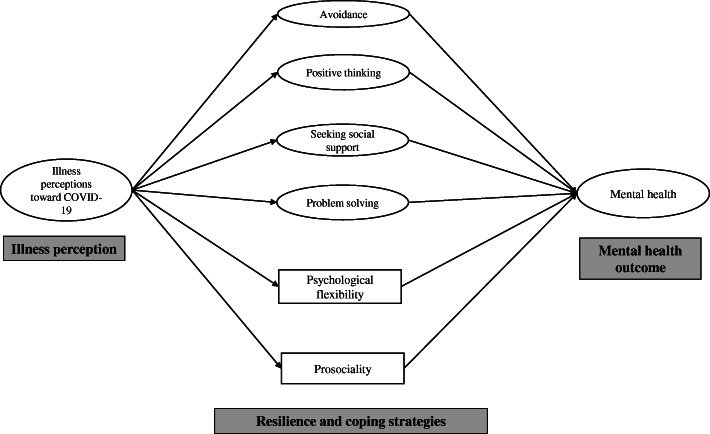
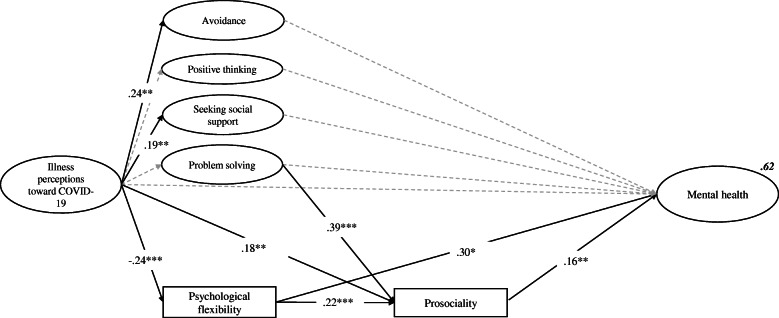
Background: The negative impact of COVID-19 pandemic on public mental health can be persistent and substantial over a long period of time, but little is known regarding what psychological factors or processes can buffer such impact. The present study aimed to examine the mediating roles of coping, psychological flexibility and prosociality in the impacts of perceived illness threats toward COVID-19 on mental health. Method: Five-hundred and fourteen Hong Kong citizens (18 years or above) completed an online survey to measure illness perceptions toward COVID-19, coping, psychological flexibility, prosociality, and mental health, together with their socio-demographic variables. Structural equation modelling was used to explore the explanatory model that was the best-fit to illustrate the relationships between these constructs. Results: Serial mediation structural equation model showed that only psychological flexibility (unstandardised beta coefficient, β = − 0.12, 95% CI [− 0.20, − 0.02], p = 0.031) and prosociality (unstandardised β = 0.04, 95% CI [0.01, 0.08], p = 0.001) fully mediated the relationship between illness perceptions toward COVID-19 and mental health. In addition, psychological flexibility exerted a direct effect on prosociality (standardised β = 0.22, 95% CI [0.12, 0.32], p < 0.001). This best-fit model explained 62% of the variance of mental health. Conclusions: Fostering psychological flexibility and prosocial behaviour may play significant roles in mitigating the adverse effects of COVID-19 and its perceived threats on public mental health.
Overview
The claims and statistics of this paper haven’t been checked yet.
Free: it reads the open-access text and checks the first 5 claims that cite a source we can check. Create a free account to check every claim.
Integrity signals
Registry
Cites
Statistics
Figures
Verification
Claims the paper makes
The claims and statistics of this paper haven’t been checked yet.
Free: it reads the open-access text and checks the first 5 claims that cite a source we can check. Create a free account to check every claim.
Claims other papers make about this one
Each is checked against this paper’s own text: does it say what the citing paper says it does?
The cited source doesn’t support the claim as written.
In the citing paper
“and a moderating role between the psychological impacts of COVID-19 and mental health outcomes and wellbeing (Chong et al., 2021; Crasta et al., 2020; Daks et al., 2020; Pakenham et al., 2020; Smith et al., 2020).”
From Behind the masks: A cross-sectional study on intolerance of uncertainty, perceived vulnerability to disease and psychological flexibility in relation to state anxiety and wellbeing during the COVID-19 pandemic (2021) · cites this paper as Chong et al., 2021
Checked by a reasoning model — may be wrong.
Experimental — accuracy not yet measuredThe cited source says what the claim attributes to it.
In the citing paper
“However, a number of studies have found psychological flexibility to be associated with greater wellbeing during the pandemic and to be protective against the negative psychological impacts of the COVID-19 situation (e.g. Chong et al., 2021; Gloster, Lamnisos et al., 2020; McCracken et al., 2021).”
From Behind the masks: A cross-sectional study on intolerance of uncertainty, perceived vulnerability to disease and psychological flexibility in relation to state anxiety and wellbeing during the COVID-19 pandemic (2021) · cites this paper as Chong et al., 2021
The cited source says what the claim attributes to it.
In the citing paper
“Chong et al. (2021) found PF and prosociality mediated the relationship between illness perceptions toward COVID-19 and mental health with PF additionally exerting a direct effect on prosociality.”
From Behind the masks: A cross-sectional study on intolerance of uncertainty, perceived vulnerability to disease and psychological flexibility in relation to state anxiety and wellbeing during the COVID-19 pandemic (2021) · cites this paper as Chong et al. (2021)
Self-check
Percentages, sums and reported differences re-computed from the paper’s own numbers.
The self-check needs the paper’s full text.
Citations
Cites
Hu, L., & Bentler, P. M. (1999) · Structural Equation Modeling A Multidisciplinary Journal · doi:10.1080/10705519909540118 · Cited by 108,788 · cited 1×
“08] indicating an acceptable model fit [49].”
Structural equation modeling in practice: A review and recommended two-step approach
Anderson, J. C., & Gerbing, D. W. (1988) · Psychological Bulletin · doi:10.1037/0033-2909.103.3.411 · Cited by 41,941 · cited 3×
“As suggested by Anderson and Gerbing [47], confirmatory factor analyses (CFA) were first performed to establish the measurement models of the latent constructs, including illness perceptions toward COVID-19, coping (i.”
MethodInfluentialHolmes, E. A., O'Connor, R. C., Perry, V. H., Tracey, I., Wessely, S., Arseneault, L., Ballard, C., Christensen, H., Cohen Silver, R., Everall, I., et al. (2020) · The Lancet Psychiatry · doi:10.1016/s2215-0366(20)30168-1 · Cited by 5,715 · cited 2×
“Identifying the specific pathways of these relations is important not only to acquire a further understanding on how the public psychologically responds to the COVID-19 pandemic but also, more importantly, inform the development of mechanism- or model-based psychological interventions adopting specific coping factors…”
BackgroundSocial Learning Theory and the Health Belief Model
Rosenstock, I. M., Strecher, V. J., & Becker, M. H. (1988) · Health Education Quarterly · doi:10.1177/109019818801500203 · Cited by 5,564 · cited 2×
“The Brief Illness Perception Questionnaire (IPQ) items assessing the perceived consequences, timeline, concern and emotional responses toward COVID-19 (4 items, 10-point Likert scale) [9], as well as the items assessing the perceived susceptibility (3 items, 6-point Likert scale) and severity of COVID-19 (3 items, 6-p…”
MethodImpact of COVID-19 pandemic on mental health in the general population: a systematic review
Xiong, J., Lipsitz, O., Nasri, F., Lui, L. M. W., Gill, H., Phan, L., Chen-Li, D., Iacobucci, M., Ho, R., Majeed, A., et al. (2020) · Journal of Affective Disorders · doi:10.1016/j.jad.2020.08.001 · Cited by 5,204 · cited 2×
“Evidence from systematic reviews has indicated that over one-third of the global populations report high levels of psychological distress [2, 3].”
BackgroundUsing social and behavioural science to support COVID-19 pandemic response
Bavel, J. J. V., Baicker, K., Boggio, P. S., Capraro, V., Cichocka, A., Cikara, M., Crockett, M. J., Crum, A. J., Douglas, K. M., Druckman, J. N., et al. (2020) · Nature Human Behaviour · doi:10.1038/s41562-020-0884-z · Cited by 4,964 · cited 3×
“For example, those who are more psychologically flexible may acquire better perspective-taking skills, that is better attention capacities to observe other peoples’ needs during the COVID-19 pandemic, understanding the suffering of others and responding to them by helping [15, 32].”
BackgroundCOVID-19 pandemic and mental health consequences: Systematic review of the current evidence
Vindegaard, N., & Benros, M. E. (2020) · Brain, Behavior, and Immunity · doi:10.1016/j.bbi.2020.05.048 · Cited by 3,221 · cited 1×
“, working as health care professions, poor household income and high social media exposure) and pre-existing psychiatric illnesses, which increased the risks of anxiety and depression during the COVID-19 pandemic [1, 3, 15].”
BackgroundPsychological flexibility as a fundamental aspect of health
Kashdan, T. B., & Rottenberg, J. (2010) · Clinical Psychology Review · doi:10.1016/j.cpr.2010.03.001 · Cited by 3,054 · cited 3×
“Psychological flexibility, which refers to the capacity to be open to difficult experiences while engaging in behaviours consistent with selfchosen values [20], is one of the aforementioned constructs which has been consistently associated with better mental health outcomes under different population groups and contex…”
BackgroundMethodLuo, M., Guo, L., Yu, M., Jiang, W., & Wang, H. (2020) · Psychiatry Research · doi:10.1016/j.psychres.2020.113190 · Cited by 1,615 · cited 1×
“Evidence from systematic reviews has indicated that over one-third of the global populations report high levels of psychological distress [2, 3].”
BackgroundEvaluating the psychometric properties of the mental health continuum-short form (MHC-SF)
Lamers, S. M. A., Westerhof, G. J., Bohlmeijer, E. T., ten Klooster, P. M., & Keyes, C. L. M. (2011) · Journal of Clinical Psychology · doi:10.1002/jclp.20741 · Cited by 1,402 · cited 2×
“The Mental Health Continuum Short Form for Adults (MHC-SF, 14 items, 6-point Likert scale) was used to assess the mental health of the participants, focusing on emotional, social and psychological well-being [37].”
BackgroundMethod
Research works printed but not linked: 1
- Hayes SC, Strosahl KD, Wilson KG. Acceptance and commitment therapy: the process and practice of mindful change: The Guilford Press; 2011.
Cited by
Haller, E., Ļubenko, J., Presti, G., Squatrito, V., Constantinou, M., Nicolaou, C., Papacostas, S., Aydın, G., Chong, Y. Y., Chien, W. T., et al. (2022) · Frontiers in Psychology · doi:10.3389/fpsyg.2021.775032 · Cited by 103
Self-citationKretchy, I. A., Boadu, J. A., Kretchy, J., Agyabeng, K., Passah, A. A., Koduah, A., & Opuni, K. F. M. (2021) · Preventive Medicine Reports · doi:10.1016/j.pmedr.2021.101633 · Cited by 52
“…perception during the COVID-19 pandemic as well as the role of CAM and integrative therapies as coping health behaviours in response to perceptions about COVID-19 have also been reported (Kristoffersen et al.; Man et al., 2020; Chong et al., 2021; Skapinakis et al., 2020; Dias Neto et al., 2021).”
Mallett, R., Coyle, C., Kuang, Y., & Gillanders, D. T. (2021) · Journal of Contextual Behavioral Science · doi:10.1016/j.jcbs.2021.09.003 · Cited by 46
Chong, Y. Y., Frey, E., Chien, W. T., Cheng, H. Y., & Gloster, A. T. (2023) · Journal of Nursing Scholarship · doi:10.1111/jnu.12874 · Cited by 42
Self-citationAttachment anxiety and resilience: The mediating role of coping
Kural, A. I., & Kovács, M. E. (2021) · Acta Psychologica · doi:10.1016/j.actpsy.2021.103447 · Cited by 57
Ferber, S. G., Weller, A., Maor, R., Feldman, Y., Harel‐Fisch, Y., & Mikulincer, M. (2021) · Anxiety Stress & Coping · doi:10.1080/10615806.2021.1987418 · Cited by 39
Helping Others Helps Me: Prosocial Behavior and Satisfaction With Life During the COVID-19 Pandemic
Espinosa, J. C., Rubio, C. A., & Hinestroza, M. P. G. (2022) · Frontiers in Psychology · doi:10.3389/fpsyg.2022.762445 · Cited by 35
Avsec, A., Eisenbeck, N., Carreno, D. F., Kocjan, G. Z., & Kavčič, T. (2022) · Journal of Contextual Behavioral Science · doi:10.1016/j.jcbs.2022.10.001 · Cited by 43
“Psychological inflexibility also had a significant mediating role in the association be-tween perceptions of COVID-19 illness threat and well-being in a sample of Hong Kong citizens (Chong et al., 2021).”
Lindner, C., Kotta, I., Marschalkó, E. E., Szabó, K., Kálcza-Jánosi, K., & Retelsdorf, J. (2022) · International Journal of Environmental Research and Public Health · doi:10.3390/ijerph19095098 · Cited by 33
“First, psychological flexibility, the ability to adapt and to respond effectively to fluctuating situational demands by reconfiguring mental resources [42], predicted higher levels of well-being and lower COVID-19-related distress, anxiety [43,44] and problems due to social isolation [45].”
BackgroundChong, Y. Y., Chien, W. T., Cheng, H. Y., Lamnisos, D., Ļubenko, J., Presti, G., Squatrito, V., Constantinou, M., Nicolaou, C., Papacostas, S., et al. (2021) · International Journal of Environmental Research and Public Health · doi:10.3390/ijerph18084143 · Cited by 26
“Similar to our previous reports [18,24], the measuring items corresponding to the latent constructs were all adequately fit to the data representing the total sample.”
BackgroundMethodResultInfluentialSelf-citationLiu, C., Chen, X., Huang, M., Xie, Q., Lin, Q., Chen, S., & Shi, D. (2021) · Journal of Healthcare Engineering · doi:10.1155/2021/1904752 · Cited by 18
“*e PsyFlex questionnaire [19, 21] was used to assess the psychological flexibility, including contacting the present moment, diffusion, acceptance, selfas-context, values, and committed action, of an individual (6 items, 5-point Likert scale).”
MethodDoes person-job fit buffer employees from rumination about customer incivility?
Shin, G., Hur, W., & Shin, Y. (2023) · Current Psychology · doi:10.1007/s12144-023-04930-5 · Cited by 18
“Prior research has demonstrated that employees experience high needs-supplies fit when their organization provides resources, including autonomy and social support (Chong et al., 2021; van Vianen, 2018).”
Gesto, C. D., Policardo, G. R., Benucci, S. B., Çela, E., & Grano, C. (2025) · Healthcare · doi:10.3390/healthcare13131575 · Cited by 15
“Furthermore, Fledderus et al. [7] reported reductions in psychological inflexibility and distress through self-guided ACT protocols, and Chong et al. [52,56] observed similar benefits in community samples.”
Prosocial Orientation of Russians During the COVID-19 Pandemic: Caring for Others and Yourself
Kislyakov, P. A., & Shmeleva, E. A. (2021) · Frontiers in Psychology · doi:10.3389/fpsyg.2021.629467 · Cited by 15
“Studies conducted in China have shown that prosocial coping with psychological pressures and stresses caused by the COVID-19 pandemic contributed to reducing mental health problems (Guo et al., 2020; Chong et al., 2021).”
BackgroundLiu, J., Xu, Z., Li, X., Song, R., Wei, N., Yuan, J., Liu, L., Pan, G., & Su, H. (2024) · Current Psychology · doi:10.1007/s12144-023-05580-3 · Cited by 16
“We used Comparative Fit Index (CFI) > 0.9, Tucker-Lewis Index (TLI) > 0.9, and Root Means Square Error Approximation (RMSEA) < 0.08 as criteria to determine whether the model fit is up to standard (Chong et al., 2021; Hu and Bentler, 1999).”
InfluentialMiao, C., Yan, B., Xu, J., Wu, Y., Shen, J., Fan, J., Wang, Y., & Li, W. T. (2023) · American Journal of Health Behavior · doi:10.5993/ajhb.47.4.13 · Cited by 12
Chong, Y. Y., Chien, W. T., Cheng, H. Y., Lamnisos, D., Ļubenko, J., Presti, G., Squatrito, V., Constantinou, M., Nicolaou, C., Papacostas, S., et al. (2023) · Globalization and Health · doi:10.1186/s12992-023-00928-7 · Cited by 12
Self-citationDempsey, M., & Burke, J. (2021) · Journal of Happiness and Health · Cited by 20
Frey, E., Chong, Y. Y., Chien, W. T., & Gloster, A. T. (2025) · Nursing Reports · doi:10.3390/nursrep15020052 · Cited by 14
“…flexibility could mitigate the impact of ill perceptions toward COVID-19 on mental health and had a significant mediating role over and above the contributions of other known coping-style variables, such as avoidance, positive thinking, seeking social support, and problem-solving [47,48].”
Self-citationResilience and Flexibility for Clinical Nurses: A Latent Class Analysis
Zhao, S., Zhang, Z., Duan, X., Shao, Y., Wang, F., Chen, Y., Yang, C., Chen, L., Wang, F., Zhang, J., et al. (2024) · Journal of Nursing Management · doi:10.1155/2024/6171305 · Cited by 10
Han, A., Wilroy, J. D., Jenkins, J., & Yuen, H. K. (2023) · Disability and Rehabilitation · doi:10.1080/09638288.2022.2038283 · Cited by 10
Stress and Bio-Ethical Issues Perceived by Romanian Healthcare Practitioners in the COVID-19 Era
Reisz, D., Crișan, I., Reisz, A., Tudor, R., & Georgescu, D. (2021) · International Journal of Environmental Research and Public Health · doi:10.3390/ijerph182312749 · Cited by 6
“Consistent with such results, a cross-sectional survey on Hong Kong citizens revealed that psychosocial flexibility and a prosocial attitude mediated the relation between mental health and perception of COVID-19 [10].”
ResultChung, E. K. H., Ho, A., Lam, A. H. K., & Yeung, D. Y.-L. (2023) · Current Psychology · doi:10.1007/s12144-023-04514-3 · Cited by 5
“…level of perceived COVID-19 risk (Figueiras et al., 2022) and that illness perceptions about COVID-19 negatively predicted mental health outcomes (Chong et al., 2021), the present research found that health-promoting behaviors could improve one’s SOC, which subsequently led to a lower level of…”
Chong, Y. Y., Lam, W. C., Wong, K. S., Wong, C., Lam, P. C. M., Hsu, S. M., & Chien, W. T. (2024) · Journal of Contextual Behavioral Science · doi:10.1016/j.jcbs.2024.100806 · Cited by 5
Self-citationSchneider, A., & Kroska, E. B. (2021) · International Journal of Environmental Research and Public Health · doi:10.3390/ijerph18168247 · Cited by 5
“In Hong Kong, researchers found that fostering psychological flexibility ultimately mitigated the adverse mental health effects of the COVID-19 pandemic [24].”
BackgroundÁlvarez‐Gálvez, J., Anastasiou, A., Lamnisos, D., Constantinou, M., Nicolaou, C., Papacostas, S., Vasiliou, V. S., McHugh, L., Ļubenko, J., Ruiz, F. J., et al. (2023) · PLoS ONE · doi:10.1371/journal.pone.0284433 · Cited by 3
Self-citationChong, Y. Y., Cheng, H. Y., Lam, S. K. K., Liu, X., Temesgen, W. A., & Chien, W. T. (2024) · SSRN Electronic Journal · doi:10.2139/ssrn.4865319 · Cited by 2
Self-citationPadmanabhanunni, A., & Pretorius, T. B. (2022) · South African Journal of Psychology · doi:10.1177/00812463221137876 · Cited by 2
“In addition to in-person sessions, alternative modes of delivering these interventions, such as via smartphone applications and video conferencing technology, could reach a wider audience and help to protect mental health during public health emergencies (Chong et al., 2021).”
BackgroundLahiri, A., Sutar, R. F., & Singh, G. (2023) · Indian Journal of Behavioural Sciences · doi:10.55229/ijbs.v26i1.03 · Cited by 1
Pramudita, A. J. N., & Setiasih, S. (2023) · Jurnal Psikologi · doi:10.35760/psi.2023.v16i2.7818 · Cited by 2
Ferber, S. G., Weller, A., Maor, R., Feldman, Y., Harel‐Fisch, Y., & Mikulincer, M. (2025) · SSRN Electronic Journal · doi:10.2139/ssrn.5124063
Chong, Y. Y., Chien, W. T., Cheng, H. Y., Lamnisos, D., Ļubenko, J., Presti, G., Squatrito, V., Constantinou, M., Nicolaou, C., Papacostas, S., et al. (2023) · Figshare · doi:10.6084/m9.figshare.22649276
Self-citationChong, Y. Y., Chien, W. T., Cheng, H. Y., Lamnisos, D., Ļubenko, J., Presti, G., Squatrito, V., Constantinou, M., Nicolaou, C., Papacostas, S., et al. (2023) · Figshare · doi:10.6084/m9.figshare.22649273
Self-citationÖZÇELİK, Z., & GAYIR, G. B. (2025) · Psychology Health & Medicine · doi:10.1080/13548506.2025.2604270
“…resilience, is widely recognized as an adaptive coping mechanism that enables individuals to effectively manage distressing internal experiences, such as unwanted thoughts, emotions, and worries, and to engage in goal-directed behaviors (Bond et al., 2011; Chong et al., 2021; Hayes et al., 2004).”
Manoli, A., Kyprianidou, M., Lamnisos, D., Ļubenko, J., Presti, G., Squatrito, V., Constantinou, M., Nicolaou, C., Papacostas, S., Aydın, G., et al. (2026) · PLOS Global Public Health · doi:10.1371/journal.pgph.0005668 · Cited by 1
Self-citation
Metadata
- Authors
- Chong, Y. Y., Chien, W. T., Cheng, H. Y., Kassianos, A. P., Gloster, A. T., & Karekla, M.
- Affiliations
- Chinese University of Hong Kong (HK)
- University of Cyprus (CY)
- University of Basel (CH)
- Corresponding author
- Chong, Yuen Yu
- Venue
- Globalization and Health
- Published
- 2021-04-08
- Volume
- 17
- Issue
- 1
- Pages
- 43-43
- ISSN
- 1744-8603 (ISSN-L)
- PMC
- PMC8027974
- OpenAlex
- W3149055442
- Cited by
- 35
- References
- 63
- Citations by year
- 2026: 1 · 2025: 4 · 2024: 4 · 2023: 10 · 2022: 6 · 2021: 10
- FWCI
- 5.11
- Type
- journal article
- Language
- en
- Open access
- gold
- doi.org
- Licence
- cc-by
- creativecommons.org/licenses/by/4.0/ (tdm)
- creativecommons.org/licenses/by/4.0/ (vor)
- Locations
- Globalization and Health (publishedVersion, cc-by)
- PubMed Central (publishedVersion, cc-by)
- PubMed (publishedVersion)
- edoc (University of Basel) (acceptedVersion)
- Ktisis at Cyprus University of Technology (Cyprus University of Technology) (submittedVersion, cc-by-nc-nd)
- DOAJ (DOAJ: Directory of Open Access Journals) (submittedVersion, cc-by-sa)
- UCL Discovery (University College London) (submittedVersion)
- edoc (University of Basel)
- Funders
- Seeding Research Money, The Nethersole School of Nursing, Faculty of Medicine, The Chinese University of Hong Kong. (Not applicable)
- Topics
- Social Sciences › Psychology › Clinical Psychology › COVID-19 and Mental Health
- Social Sciences › Psychology › Clinical Psychology › Mindfulness and Compassion Interventions
- Social Sciences › Psychology › Clinical Psychology › Resilience and Mental Health
- Keywords
- COVID-19 pandemic, illness perception, psychological flexibility, prosocial behavior, coping, mental health, psychological buffering, Hong Kong adults
- MeSH terms
- COVID-19, SARS-CoV-2, Adaptation, Psychological, Adolescent, Adult, Cross-Sectional Studies, Female, Hong Kong, Humans, Male, Mental Health, Social Behavior, Young Adult
About these checks
Registry, retraction, Cites and statistics results are computed, not judged, with one exception: a printed reference that no index lists is read once by a model before it counts as a citation error. Claims are extracted by a model and kept only when their quote appears verbatim in the text; each cited source is then checked, with a model’s help, for whether it says what the claim relies on. Those verdicts can be wrong — read the claim’s quote and the cited source before relying on one.
Statistics and arithmetic are recomputed, not judged.
Confidence bands are shown only for fields calibrated on our annotated test set. None is calibrated yet, so no band is shown.
What counts as a claim ›How we measure confidence ›How we check this ›
Are you an author, or do you see a problem with this page? Request a review
Data sources
Bibliographic data: Semantic Scholar, OpenAlex, Crossref.
Contains information from the Semantic Scholar Academic Graph Datasets, made available under the ODC Attribution License (ODC-BY 1.0).
Semantic Scholar’s data is described in: Kinney, R., et al. (2023). The Semantic Scholar Open Data Platform. arXiv:2301.10140.
