

Can psychological flexibility and prosociality mitigate illness perceptions toward COVID-19 on mental health? A cross-sectional study among Hong Kong adults
Open accessThe DOI matches its Crossref record; 62 of the 63 references it cites were found in a registry or an index.
Abstract
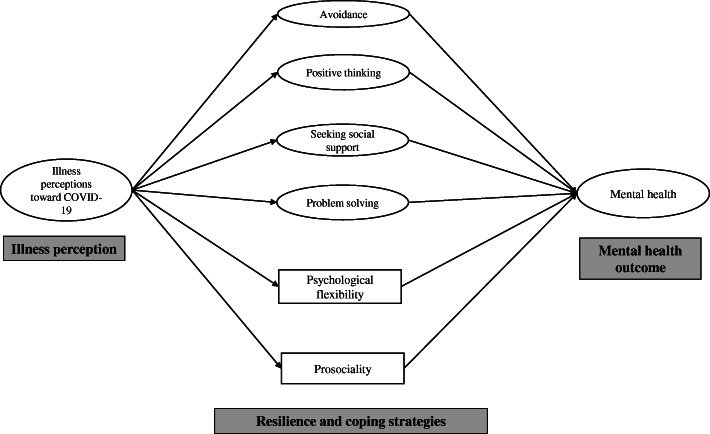
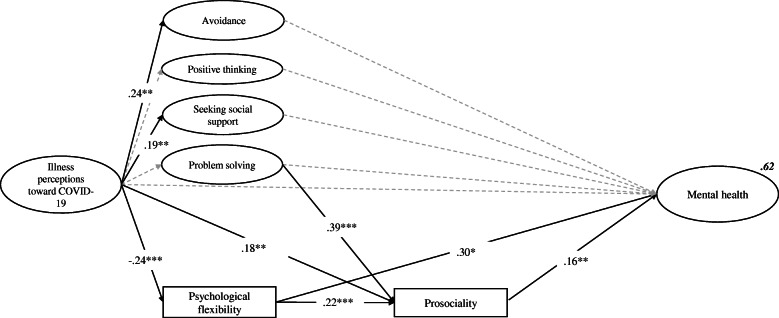
Background: The negative impact of COVID-19 pandemic on public mental health can be persistent and substantial over a long period of time, but little is known regarding what psychological factors or processes can buffer such impact. The present study aimed to examine the mediating roles of coping, psychological flexibility and prosociality in the impacts of perceived illness threats toward COVID-19 on mental health. Method: Five-hundred and fourteen Hong Kong citizens (18 years or above) completed an online survey to measure illness perceptions toward COVID-19, coping, psychological flexibility, prosociality, and mental health, together with their socio-demographic variables. Structural equation modelling was used to explore the explanatory model that was the best-fit to illustrate the relationships between these constructs. Results: Serial mediation structural equation model showed that only psychological flexibility (unstandardised beta coefficient, β = − 0.12, 95% CI [− 0.20, − 0.02], p = 0.031) and prosociality (unstandardised β = 0.04, 95% CI [0.01, 0.08], p = 0.001) fully mediated the relationship between illness perceptions toward COVID-19 and mental health. In addition, psychological flexibility exerted a direct effect on prosociality (standardised β = 0.22, 95% CI [0.12, 0.32], p < 0.001). This best-fit model explained 62% of the variance of mental health. Conclusions: Fostering psychological flexibility and prosocial behaviour may play significant roles in mitigating the adverse effects of COVID-19 and its perceived threats on public mental health.
Overview
The claims and statistics of this paper haven’t been checked yet.
Free: it reads the open-access text and checks the first 5 claims that cite a source we can check. Create a free account to check every claim.
Integrity signals
Registry
Cites
Statistics
Figures
Verification
Claims the paper makes
The claims and statistics of this paper haven’t been checked yet.
Free: it reads the open-access text and checks the first 5 claims that cite a source we can check. Create a free account to check every claim.
Claims other papers make about this one
Each is checked against this paper’s own text: does it say what the citing paper says it does?
The cited source doesn’t support the claim as written.
In the citing paper
“and a moderating role between the psychological impacts of COVID-19 and mental health outcomes and wellbeing (Chong et al., 2021; Crasta et al., 2020; Daks et al., 2020; Pakenham et al., 2020; Smith et al., 2020).”
From Behind the masks: A cross-sectional study on intolerance of uncertainty, perceived vulnerability to disease and psychological flexibility in relation to state anxiety and wellbeing during the COVID-19 pandemic (2021) · cites this paper as Chong et al., 2021
Checked by a reasoning model — may be wrong.
Experimental — accuracy not yet measuredThe cited source says what the claim attributes to it.
In the citing paper
“However, a number of studies have found psychological flexibility to be associated with greater wellbeing during the pandemic and to be protective against the negative psychological impacts of the COVID-19 situation (e.g. Chong et al., 2021; Gloster, Lamnisos et al., 2020; McCracken et al., 2021).”
From Behind the masks: A cross-sectional study on intolerance of uncertainty, perceived vulnerability to disease and psychological flexibility in relation to state anxiety and wellbeing during the COVID-19 pandemic (2021) · cites this paper as Chong et al., 2021
The cited source says what the claim attributes to it.
In the citing paper
“Chong et al. (2021) found PF and prosociality mediated the relationship between illness perceptions toward COVID-19 and mental health with PF additionally exerting a direct effect on prosociality.”
From Behind the masks: A cross-sectional study on intolerance of uncertainty, perceived vulnerability to disease and psychological flexibility in relation to state anxiety and wellbeing during the COVID-19 pandemic (2021) · cites this paper as Chong et al. (2021)
Self-check
Percentages, sums and reported differences re-computed from the paper’s own numbers.
The self-check needs the paper’s full text.
Citations
Cites
Hu, L., & Bentler, P. M. (1999) · Structural Equation Modeling A Multidisciplinary Journal · doi:10.1080/10705519909540118 · Cited by 108,788 · cited 1×
“08] indicating an acceptable model fit [49].”
Structural equation modeling in practice: A review and recommended two-step approach
Anderson, J. C., & Gerbing, D. W. (1988) · Psychological Bulletin · doi:10.1037/0033-2909.103.3.411 · Cited by 41,941 · cited 3×
“As suggested by Anderson and Gerbing [47], confirmatory factor analyses (CFA) were first performed to establish the measurement models of the latent constructs, including illness perceptions toward COVID-19, coping (i.”
MethodInfluentialHolmes, E. A., O'Connor, R. C., Perry, V. H., Tracey, I., Wessely, S., Arseneault, L., Ballard, C., Christensen, H., Cohen Silver, R., Everall, I., et al. (2020) · The Lancet Psychiatry · doi:10.1016/s2215-0366(20)30168-1 · Cited by 5,715 · cited 2×
“Identifying the specific pathways of these relations is important not only to acquire a further understanding on how the public psychologically responds to the COVID-19 pandemic but also, more importantly, inform the development of mechanism- or model-based psychological interventions adopting specific coping factors…”
BackgroundSocial Learning Theory and the Health Belief Model
Rosenstock, I. M., Strecher, V. J., & Becker, M. H. (1988) · Health Education Quarterly · doi:10.1177/109019818801500203 · Cited by 5,564 · cited 2×
“The Brief Illness Perception Questionnaire (IPQ) items assessing the perceived consequences, timeline, concern and emotional responses toward COVID-19 (4 items, 10-point Likert scale) [9], as well as the items assessing the perceived susceptibility (3 items, 6-point Likert scale) and severity of COVID-19 (3 items, 6-p…”
MethodImpact of COVID-19 pandemic on mental health in the general population: a systematic review
Xiong, J., Lipsitz, O., Nasri, F., Lui, L. M. W., Gill, H., Phan, L., Chen-Li, D., Iacobucci, M., Ho, R., Majeed, A., et al. (2020) · Journal of Affective Disorders · doi:10.1016/j.jad.2020.08.001 · Cited by 5,204 · cited 2×
“Evidence from systematic reviews has indicated that over one-third of the global populations report high levels of psychological distress [2, 3].”
BackgroundUsing social and behavioural science to support COVID-19 pandemic response
Bavel, J. J. V., Baicker, K., Boggio, P. S., Capraro, V., Cichocka, A., Cikara, M., Crockett, M. J., Crum, A. J., Douglas, K. M., Druckman, J. N., et al. (2020) · Nature Human Behaviour · doi:10.1038/s41562-020-0884-z · Cited by 4,964 · cited 3×
“For example, those who are more psychologically flexible may acquire better perspective-taking skills, that is better attention capacities to observe other peoples’ needs during the COVID-19 pandemic, understanding the suffering of others and responding to them by helping [15, 32].”
BackgroundCOVID-19 pandemic and mental health consequences: Systematic review of the current evidence
Vindegaard, N., & Benros, M. E. (2020) · Brain, Behavior, and Immunity · doi:10.1016/j.bbi.2020.05.048 · Cited by 3,221 · cited 1×
“, working as health care professions, poor household income and high social media exposure) and pre-existing psychiatric illnesses, which increased the risks of anxiety and depression during the COVID-19 pandemic [1, 3, 15].”
BackgroundPsychological flexibility as a fundamental aspect of health
Kashdan, T. B., & Rottenberg, J. (2010) · Clinical Psychology Review · doi:10.1016/j.cpr.2010.03.001 · Cited by 3,054 · cited 3×
“Psychological flexibility, which refers to the capacity to be open to difficult experiences while engaging in behaviours consistent with selfchosen values [20], is one of the aforementioned constructs which has been consistently associated with better mental health outcomes under different population groups and contex…”
BackgroundMethodLuo, M., Guo, L., Yu, M., Jiang, W., & Wang, H. (2020) · Psychiatry Research · doi:10.1016/j.psychres.2020.113190 · Cited by 1,615 · cited 1×
“Evidence from systematic reviews has indicated that over one-third of the global populations report high levels of psychological distress [2, 3].”
BackgroundEvaluating the psychometric properties of the mental health continuum-short form (MHC-SF)
Lamers, S. M. A., Westerhof, G. J., Bohlmeijer, E. T., ten Klooster, P. M., & Keyes, C. L. M. (2011) · Journal of Clinical Psychology · doi:10.1002/jclp.20741 · Cited by 1,402 · cited 2×
“The Mental Health Continuum Short Form for Adults (MHC-SF, 14 items, 6-point Likert scale) was used to assess the mental health of the participants, focusing on emotional, social and psychological well-being [37].”
BackgroundMethodIncreasing Vaccination: Putting Psychological Science Into Action
Brewer, N. T., Chapman, G. B., Rothman, A. J., Leask, J., & Kempe, A. (2017) · Psychological Science in the Public Interest · doi:10.1177/1529100618760521 · Cited by 1,233 · cited 1×
“Recent studies have suggested that vaccinating can be interpreted and promoted as a prosocial act, in which adding prosocial messaging into influenza vaccination intervention may drive people to get vaccinated not only because of self-interest, but also for the benefits towards their families, neighbourhood and commun…”
BackgroundDepression and Anxiety in Hong Kong during COVID-19
Choi, E. P. H., Hui, B. P. H., & Wan, E. Y. F. (2020) · International Journal of Environmental Research and Public Health · doi:10.3390/ijerph17103740 · Cited by 893
Han, E., Tan, M. M. J., Turk, E., Sridhar, D., Leung, G. M., Shibuya, K., Asgari, N., Oh, J., García-Basteiro, A. L., Hanefeld, J., et al. (2020) · The Lancet · doi:10.1016/s0140-6736(20)32007-9 · Cited by 814 · cited 1×
“Different from other cities that implement a complete/regional lock-down or massive screening, Hong Kong has been adopting a “suppress and lift” anti-pandemic strategy, in which the COVID-19 precautionary measures such as border control, physical distancing, contact tracing, and COVID-19 screening for high-risk groups…”
BackgroundA systematic review and meta-analysis of the Brief Illness Perception Questionnaire
Broadbent, E., Wilkes, C., Koschwanez, H., Weinman, J., Norton, S., & Petrie, K. J. (2015) · Psychology & Health · doi:10.1080/08870446.2015.1070851 · Cited by 706 · cited 2×
“The Brief Illness Perception Questionnaire (IPQ) items assessing the perceived consequences, timeline, concern and emotional responses toward COVID-19 (4 items, 10-point Likert scale) [9], as well as the items assessing the perceived susceptibility (3 items, 6-point Likert scale) and severity of COVID-19 (3 items, 6-p…”
BackgroundMethodThe empirical status of acceptance and commitment therapy: A review of meta-analyses
Gloster, A. T., Walder, N., Levin, M. E., Twohig, M. P., & Karekla, M. (2020) · Journal of Contextual Behavioral Science · doi:10.1016/j.jcbs.2020.09.009 · Cited by 622 · cited 10×
“A systematic review of the use of acceptance and commitment therapy (ACT) in chronic disease and longterm conditions.”
BackgroundSelf-citationCommunity Responses during Early Phase of COVID-19 Epidemic, Hong Kong
Kwok, K. O., Li, K. K., Chan, H. H. H., Yi, Y. Y., Tang, A., Wei, W. I., & Wong, S. Y. S. (2020) · Emerging Infectious Diseases · doi:10.3201/eid2607.200500 · Cited by 582
The common sense model of self-regulation: Meta-analysis and test of a process model.
Hagger, M. S., Koch, S., Chatzisarantis, N. L. D., & Orbell, S. (2017) · Psychological Bulletin · doi:10.1037/bul0000118 · Cited by 579 · cited 6×
“As stated in the Leventhal’s Common Sense Model of SelfRegulation [14], an infection outbreak can activate an individual’s schema or perception of the illness.”
BackgroundMethodResultInfluentialA New Scale for Measuring Adults' Prosocialness
Caprara, G. V., Steca, P., Zelli, A., & Capanna, C. (2005) · European Journal of Psychological Assessment · doi:10.1027/1015-5759.21.2.77 · Cited by 566 · cited 1×
“Six items (5-point Likert scale) adapted from the Prosocialness Scale were used to assess prosociality in terms of prosocial behaviours, including sharing, helping, taking care of, and feeling empathic with others, which were carried out by the participants during the COVID-19 pandemic [46].”
MethodGraham, C. D., Gouick, J., Krahé, C., & Gillanders, D. (2016) · Clinical Psychology Review · doi:10.1016/j.cpr.2016.04.009 · Cited by 476
Dawson, D. L., & Golijani-Moghaddam, N. (2020) · Journal of Contextual Behavioral Science · doi:10.1016/j.jcbs.2020.07.010 · Cited by 445 · cited 1×
“This echoes with recent mediational analyses by Dawson and GolijaniMoghaddam (2020) highlighting the role of psychological flexibility in mental health among the people in the United Kingdom [50], and our findings further support that psychological flexibility is independent of, but overlapping with other coping respo…”
MethodEisenberg, N., Spinrad, T. L., & Knafo‐Noam, A. (2015) · Handbook of Child Psychology and Developmental Science · doi:10.1002/9781118963418.childpsy315 · Cited by 412
Cheung, Y. T., Chau, P. H., & Yip, P. S. F. (2008) · International Journal of Geriatric Psychiatry · doi:10.1002/gps.2056 · Cited by 385 · cited 1×
“The increased incidence of post-traumatic stress disorder and suicide among people in Hong Kong during the 2003 severe acute respiratory syndrome (SARS) epidemic provides clear and affirmed examples of the adverse consequences on public mental health, which may likely be mirrored or intensified during the COVID-19 pan…”
BackgroundDonald, J. N., Sahdra, B. K., Van Zanden, B., Duineveld, J. J., Atkins, P. W. B., Marshall, S. L., & Ciarrochi, J. (2019) · British Journal of Psychology · doi:10.1111/bjop.12338 · Cited by 371 · cited 1×
“Within a helping situation, the non-judgmental acceptance attitude of a psychologically flexible person may allow a temporarily disengagement of his/her own emotions and focus on those in need of help [54].”
BackgroundThe origins of altruism in offspring care.
Preston, S. D. (2013) · Psychological Bulletin · doi:10.1037/a0031755 · Cited by 368 · cited 1×
“In addition, prosociality expressed as engaging in affiliating behaviours or nurturing others has been considered as an effective way of coping when experienced distress through influencing neuro-physiological systems, such as the oxytocin and reward circuitry system in the brain [34, 35].”
BackgroundUsing the Modification Index and Standardized Expected Parameter Change for Model Modification
Whittaker, T. A. (2012) · The Journal of Experimental Education · doi:10.1080/00220973.2010.531299 · Cited by 357 · cited 1×
“Attempts were made to improve the goodness of fit of the model by adding covariance paths and/or direct paths to explore the interrelationships between the aforementioned latent constructs, psychological flexibility and prosociality, if a significant modification index (MI) coincided with a large expected parameter ch…”
MethodRahman, M. A., Hoque, N., Alif, S. M., Salehin, M., Islam, S. M. S., Banik, B., Sharif, A., Nazim, N. B., Sultana, F., & Cross, W. (2020) · Globalization and Health · doi:10.1186/s12992-020-00624-w · Cited by 327
On the benefits of explaining herd immunity in vaccine advocacy
Betsch, C., Böhm, R., Korn, L., & Holtmann, C. (2017) · Nature Human Behaviour · doi:10.1038/s41562-017-0056 · Cited by 325 · cited 1×
“Recent studies have suggested that vaccinating can be interpreted and promoted as a prosocial act, in which adding prosocial messaging into influenza vaccination intervention may drive people to get vaccinated not only because of self-interest, but also for the benefits towards their families, neighbourhood and commun…”
BackgroundTyndall, I., Waldeck, D., Pancani, L., Whelan, R., Roche, B., & Dawson, D. L. (2019) · Journal of Contextual Behavioral Science · doi:10.1016/j.jcbs.2018.09.005 · Cited by 303
Prosocial Behavior Mitigates the Negative Effects of Stress in Everyday Life
Raposa, E. B., Laws, H. B., & Ansell, E. B. (2016) · Clinical Psychological Science · doi:10.1177/2167702615611073 · Cited by 282 · cited 2×
“Although we relied on logical and theoretical basis for interpreting illness perceptions toward COVID19 as a predictor, coping, psychological flexibility and prosociality as potential mediators and public mental health as an outcome of interest [14, 20, 34], our ability to draw robust conclusions regarding the directi…”
BackgroundMethodPsychological flexibility as a malleable public health target: Evidence from a representative sample
Gloster, A. T., Meyer, A. H., & Lieb, R. (2017) · Journal of Contextual Behavioral Science · doi:10.1016/j.jcbs.2017.02.003 · Cited by 272 · cited 2×
“Recent studies have also shown that psychological flexibility can alleviate the adversities or negative impacts of recent life stressors on mental health and well-being [23, 24].”
BackgroundResultSelf-citationAssessment of coping: a new french four-factor structure of the brief COPE inventory
Baumstarck, K., Alessandrini, M., Hamidou, Z., Auquier, P., Leroy, T., & Boyer, L. (2017) · Health and Quality of Life Outcomes · doi:10.1186/s12955-016-0581-9 · Cited by 242
Guo, J., Feng, X. L., Wang, X. H., & van IJzendoorn, M. H. (2020) · International Journal of Environmental Research and Public Health · doi:10.3390/ijerph17113857 · Cited by 227
Pakenham, K. I., Landi, G., Boccolini, G., Furlani, A., Grandi, S., & Tossani, E. (2020) · Journal of Contextual Behavioral Science · doi:10.1016/j.jcbs.2020.07.003 · Cited by 210
Assessing Psychological Flexibility: What Does It Add Above and Beyond Existing Constructs?
Gloster, A. T., Klotsche, J., Chaker, S., Hummel, K. V., & Hoyer, J. (2011) · Psychological Assessment · doi:10.1037/a0024135 · Cited by 206 · cited 1×
“This echoes with recent mediational analyses by Dawson and GolijaniMoghaddam (2020) highlighting the role of psychological flexibility in mental health among the people in the United Kingdom [50], and our findings further support that psychological flexibility is independent of, but overlapping with other coping respo…”
MethodSelf-citationMariani, R., Renzi, A., Di Trani, M., Trabucchi, G., Danskin, K., & Tambelli, R. (2020) · Frontiers in Psychiatry · doi:10.3389/fpsyt.2020.587724 · Cited by 199
Coping and experiential avoidance: Unique or overlapping constructs?
Karekla, M., & Panayiotou, G. (2011) · Journal of Behavior Therapy and Experimental Psychiatry · doi:10.1016/j.jbtep.2010.10.002 · Cited by 196 · cited 1×
“This echoes with recent mediational analyses by Dawson and GolijaniMoghaddam (2020) highlighting the role of psychological flexibility in mental health among the people in the United Kingdom [50], and our findings further support that psychological flexibility is independent of, but overlapping with other coping respo…”
MethodSelf-citationThompson, E. M., Destree, L., Albertella, L., & Fontenelle, L. F. (2021) · Behavior Therapy · doi:10.1016/j.beth.2020.07.002 · Cited by 177
The importance of (shared) human values for containing the COVID‐19 pandemic
Wolf, L. J., Haddock, G., Manstead, A. S. R., & Maio, G. R. (2020) · British Journal of Social Psychology · doi:10.1111/bjso.12401 · Cited by 164 · cited 5×
“societal good, leading to increased feelings of connectedness and better emotional well-being [32].”
BackgroundInfluentialResilience is spreading: Mental health within the COVID-19 pandemic.
PeConga, E. K., Gauthier, G. M., Holloway, A., Walker, R. S. W., Rosencrans, P. L., Zoellner, L. A., & Bedard-Gilligan, M. (2020) · Psychological Trauma: Theory, Research, Practice, and Policy · doi:10.1037/tra0000874 · Cited by 139 · cited 1×
“, wearing a face mask to prevent COVID-19 spread) rather than benefiting the self only [15, 31, 32].”
BackgroundIllness perception and high readmission health outcomes
Sawyer, A. T., Harris, S. L., & Koenig, H. G. (2019) · Health Psychology Open · doi:10.1177/2055102919844504 · Cited by 133
Skapinakis, P., Bellos, S., Oikonomou, A., Dimitriadis, G., Gkikas, P., Perdikari, E., & Mavreas, V. (2020) · Depression Research and Treatment · doi:10.1155/2020/3158954 · Cited by 133
Mental health crisis under COVID-19 pandemic in Hong Kong, China
Zhao, S. Z., Wong, J. Y. H., Luk, T. T., Wai, A. K. C., Lam, T. H., & Wang, M. P. (2020) · International Journal of Infectious Diseases · doi:10.1016/j.ijid.2020.09.030 · Cited by 133
Guo, C., Tomson, G., Guo, J., Li, X., Keller, C., & Söderqvist, F. (2015) · Health and Quality of Life Outcomes · doi:10.1186/s12955-015-0394-2 · Cited by 130 · cited 1×
“89) in both Chinese and Western samples [37, 38] and our sample (α = 0.”
BackgroundChew, Q. H., Chia, F. L.-A., Ng, W. K., Lee, W. C. I., Tan, P. L. L., Wong, C. S., Puah, S. H., Shelat, V. G., Seah, E.-J. D., Huey, C. W. T., et al. (2020) · International Journal of Environmental Research and Public Health · doi:10.3390/ijerph17186572 · Cited by 127
Psychological flexibility in the context of COVID-19 adversity: Associations with distress
Kroska, E. B., Roche, A. I., Adamowicz, J. L., & Stegall, M. S. (2020) · Journal of Contextual Behavioral Science · doi:10.1016/j.jcbs.2020.07.011 · Cited by 108
Chong, Y. Y., Chien, W. T., Cheng, H. Y., Chow, K. M., Kassianos, A. P., Karekla, M., & Gloster, A. T. (2020) · International Journal of Environmental Research and Public Health · doi:10.3390/ijerph17186540 · Cited by 107 · cited 6×
“As indicated in one of the related reports [36], the demographic characteristics of the sample (i.”
BackgroundMethodSelf-citationFrench, K., Golijani-Moghaddam, N., & Schröder, T. (2017) · Journal of Contextual Behavioral Science · doi:10.1016/j.jcbs.2017.08.002 · Cited by 100 · cited 1×
“If a prosocial-oriented ACT intervention is proposed to fight the COVID-19 pandemic, alternative modes of delivery to face-to-face sessions, such as smartphone applications, video-conferencing or even self-help ACT, are recommended [21, 59].”
BackgroundFonseca, S., Trindade, I. A., Mendes, A. L., & Ferreira, C. (2020) · Clinical Psychologist · doi:10.1111/cp.12194 · Cited by 89 · cited 1×
“Recent studies have also shown that psychological flexibility can alleviate the adversities or negative impacts of recent life stressors on mental health and well-being [23, 24].”
BackgroundStenhoff, A., Steadman, L., Nevitt, S., Benson, L., & White, R. G. (2020) · Journal of Contextual Behavioral Science · doi:10.1016/j.jcbs.2020.08.008 · Cited by 77 · cited 1×
“Indeed, a growing body of evidence from systematic reviews have indicated the positive effects of ACT for depression [56], anxiety [56] and subjective well-being [57] through fostering psychological flexibility among clinical and non-clinical populations with small-to-medium effect sizes (Cohen’s d = 0.”
BackgroundInterventions stimulating prosocial helping behavior: A systematic review
Laguna, M., Mazur, Z., Kędra, M., & Ostrowski, K. (2020) · Journal of Applied Social Psychology · doi:10.1111/jasp.12704 · Cited by 57 · cited 1×
“In fact, interventions that stimulate prosocial behaviours have been recently reviewed by Mariola and colleagues (2020), showing that psychological approaches which focus on emotional regulation, cultivation of empathy, perspective-taking, gratitude, and compassion increase the altruistically motivated prosocial behav…”
BackgroundPoliti, E., Assche, J. V., Caprara, G. V., & Phalet, K. (2020) · Personality and Individual Differences · doi:10.1016/j.paid.2020.110534 · Cited by 56 · cited 1×
“It has been suggested that people who perceived others as having similar shared values in times of crisis are more likely to elicit a sense of common purpose in working towards the collective goal [32, 55].”
BackgroundNielsen, E., Sayal, K., & Townsend, E. (2016) · PLoS ONE · doi:10.1371/journal.pone.0159854 · Cited by 53
Chan, R. C. H., & Mak, W. W. S. (2016) · Psychiatry Research · doi:10.1016/j.psychres.2016.09.013 · Cited by 48
Action Type-Based Factorial Structure of Brief COPE among Hong Kong Chinese
Tang, K. N. S., Chan, C. S., Ng, J., & Yip, C.-H. (2016) · Journal of Psychopathology and Behavioral Assessment · doi:10.1007/s10862-016-9551-0 · Cited by 46 · cited 2×
“The Brief COPE showed adequate convergent validity [40] and has been used in Hong Kong samples [36, 40].”
MethodSerres, M., Boyer, L., Alessandrini, M., Leroy, T., Karine, B., Auquier, P., & Xavier, Z. (2017) · Psychiatry Research · doi:10.1016/j.psychres.2017.08.082 · Cited by 44
Huang, C., Liao, J., Hsu, H., Lin, C.-Y., & Guo, J. (2020) · International Journal of Environmental Research and Public Health · doi:10.3390/ijerph17155621 · Cited by 30
Increasing prosocial behavior and decreasing selfishness in the lab and everyday life
Gloster, A. T., Rinner, M. T. B., & Meyer, A. H. (2020) · Scientific Reports · doi:10.1038/s41598-020-78251-z · Cited by 28 · cited 1×
“Apart from adopting ACT interventions, a recent study has found that even a very brief psychological flexibility training, for example using one experiential metaphorical exercise that targets at practising present-moment awareness, acceptance and values clarification, has been found to increase prosocial behaviour [6…”
BackgroundSelf-citationHandbook of child psychology and developmental science: Socioemotional processes, Vol. 3, 7th ed.
Lamb, M. E., & Lerner, R. M. (2015) · Cited by 27
Villanueva, J., Meyer, A. H., Rinner, M. T. B., Firsching, V. J., Benoy, C., Brogli, S., Walter, M., Bader, K., & Gloster, A. T. (2019) · BMC Psychiatry · doi:10.1186/s12888-019-2109-4 · Cited by 25 · cited 1×
“The PsyFlex questionnaire was used to assess all the six processes of psychological flexibility, including contacting the present moment, defusion, acceptance, self-ascontext, values and committed action, of an individual (6 items, 5-point Likert scale) [44, 45].”
MethodSelf-citationFerentinos, P. P., Yotsidi, V., Porichi, E., Douzenis, A., Papageorgiou, C., & Stalikas, A. (2019) · Journal of Clinical Psychology · doi:10.1002/jclp.22780 · Cited by 23 · cited 1×
“However, it is bear noting that mental health/well-being and mental illness/symptoms do not stand at opposite ends of the health spectrum [61], implying the need for further studies to examine whether our proposed model remains in good fit if other aspects of mental health, such as symptoms of depression and anxiety,…”
BackgroundPatients’ Illness Perceptions of Type 2 Diabetes: A Scoping Review
Dimova, E. D., Ward, A. L., Swanson, V., & Evans, J. M. M. (2017) · Current Diabetes Reviews · doi:10.2174/1573399814666171227214845 · Cited by 22
Exploration of illness perception among patients with mental illness in a multi-ethnic Asian sample
Subramaniam, M., Abdin, E., Jeyagurunathan, A., Chang, S. S. H., Samari, E., Shafie, S., Wei, K., Verma, S. K., & Chong, S. A. (2018) · Psychiatry Research · doi:10.1016/j.psychres.2018.06.032 · Cited by 15
Research works printed but not linked: 1
- Hayes SC, Strosahl KD, Wilson KG. Acceptance and commitment therapy: the process and practice of mindful change: The Guilford Press; 2011.
Cited by
Haller, E., Ļubenko, J., Presti, G., Squatrito, V., Constantinou, M., Nicolaou, C., Papacostas, S., Aydın, G., Chong, Y. Y., Chien, W. T., et al. (2022) · Frontiers in Psychology · doi:10.3389/fpsyg.2021.775032 · Cited by 103
Self-citationKretchy, I. A., Boadu, J. A., Kretchy, J., Agyabeng, K., Passah, A. A., Koduah, A., & Opuni, K. F. M. (2021) · Preventive Medicine Reports · doi:10.1016/j.pmedr.2021.101633 · Cited by 52
“…perception during the COVID-19 pandemic as well as the role of CAM and integrative therapies as coping health behaviours in response to perceptions about COVID-19 have also been reported (Kristoffersen et al.; Man et al., 2020; Chong et al., 2021; Skapinakis et al., 2020; Dias Neto et al., 2021).”
Mallett, R., Coyle, C., Kuang, Y., & Gillanders, D. T. (2021) · Journal of Contextual Behavioral Science · doi:10.1016/j.jcbs.2021.09.003 · Cited by 46
Chong, Y. Y., Frey, E., Chien, W. T., Cheng, H. Y., & Gloster, A. T. (2023) · Journal of Nursing Scholarship · doi:10.1111/jnu.12874 · Cited by 42
Self-citationAttachment anxiety and resilience: The mediating role of coping
Kural, A. I., & Kovács, M. E. (2021) · Acta Psychologica · doi:10.1016/j.actpsy.2021.103447 · Cited by 57
Metadata
- Authors
- Chong, Y. Y., Chien, W. T., Cheng, H. Y., Kassianos, A. P., Gloster, A. T., & Karekla, M.
- Affiliations
- Chinese University of Hong Kong (HK)
- University of Cyprus (CY)
- University of Basel (CH)
- Corresponding author
- Chong, Yuen Yu
- Venue
- Globalization and Health
- Published
- 2021-04-08
- Volume
- 17
- Issue
- 1
- Pages
- 43-43
- ISSN
- 1744-8603 (ISSN-L)
- PMC
- PMC8027974
- OpenAlex
- W3149055442
- Cited by
- 35
- References
- 63
- Citations by year
- 2026: 1 · 2025: 4 · 2024: 4 · 2023: 10 · 2022: 6 · 2021: 10
- FWCI
- 5.11
- Type
- journal article
- Language
- en
- Open access
- gold
- doi.org
- Licence
- cc-by
- creativecommons.org/licenses/by/4.0/ (tdm)
- creativecommons.org/licenses/by/4.0/ (vor)
- Locations
- Globalization and Health (publishedVersion, cc-by)
- PubMed Central (publishedVersion, cc-by)
- PubMed (publishedVersion)
- edoc (University of Basel) (acceptedVersion)
- Ktisis at Cyprus University of Technology (Cyprus University of Technology) (submittedVersion, cc-by-nc-nd)
- DOAJ (DOAJ: Directory of Open Access Journals) (submittedVersion, cc-by-sa)
- UCL Discovery (University College London) (submittedVersion)
- edoc (University of Basel)
- Funders
- Seeding Research Money, The Nethersole School of Nursing, Faculty of Medicine, The Chinese University of Hong Kong. (Not applicable)
- Topics
- Social Sciences › Psychology › Clinical Psychology › COVID-19 and Mental Health
- Social Sciences › Psychology › Clinical Psychology › Mindfulness and Compassion Interventions
- Social Sciences › Psychology › Clinical Psychology › Resilience and Mental Health
- Keywords
- COVID-19 pandemic, illness perception, psychological flexibility, prosocial behavior, coping, mental health, psychological buffering, Hong Kong adults
- MeSH terms
- COVID-19, SARS-CoV-2, Adaptation, Psychological, Adolescent, Adult, Cross-Sectional Studies, Female, Hong Kong, Humans, Male, Mental Health, Social Behavior, Young Adult
About these checks
Registry, retraction, Cites and statistics results are computed, not judged, with one exception: a printed reference that no index lists is read once by a model before it counts as a citation error. Claims are extracted by a model and kept only when their quote appears verbatim in the text; each cited source is then checked, with a model’s help, for whether it says what the claim relies on. Those verdicts can be wrong — read the claim’s quote and the cited source before relying on one.
Statistics and arithmetic are recomputed, not judged.
Confidence bands are shown only for fields calibrated on our annotated test set. None is calibrated yet, so no band is shown.
What counts as a claim ›How we measure confidence ›How we check this ›
Are you an author, or do you see a problem with this page? Request a review
Data sources
Bibliographic data: Semantic Scholar, OpenAlex, Crossref.
Contains information from the Semantic Scholar Academic Graph Datasets, made available under the ODC Attribution License (ODC-BY 1.0).
Semantic Scholar’s data is described in: Kinney, R., et al. (2023). The Semantic Scholar Open Data Platform. arXiv:2301.10140.
