

Behavioral phenotyping identifies autism-like repetitive stereotypies in a Tsc2 haploinsufficient rat model
Open accessPublished version of a preprint
The DOI matches its Crossref record; 104 of the 104 references it cites were found in a registry or an index; none of the 65 sources its claims cite is checked for support yet.
Abstract
Besides deficits in social communication and interaction, repetitive behavior patterns are core manifestations of autism spectrum disorder (ASD). Phenotypes are heterogeneous and can range from simple lower-order motor stereotypies to more complex higher-order cognitive inflexibility and fixated interests. Due to ASD’s multifaceted etiology, animal models are often generated from monogenic diseases associated with ASD, such as Tuberous Sclerosis Complex (TSC), and are expected to copy behavioral core deficits to increase the model´s translational value for ASD disease research and novel treatment development. The global haploinsufficient Tsc2 +/− Eker rat model has been shown to display ASD core symptoms in the social domain. However, the presence and extent of aberrant repetitive behavior patterns in the Eker rat remain to be investigated. Thus, the present study applied a set of behavioral tests to determine the repetitive behavioral profile in Tsc2 +/− Eker rats and used brain-region-specific neurotransmitter analysis to support findings on a molecular level. Tsc2 +/− animals demonstrated lower-order repetitive behavior in the form of excessive self-grooming and nestlet shredding under non-stressful conditions that co-occurred alongside social interaction deficits. However, no higher-order repetitive behavior was detected in Tsc2 +/− rats. Interestingly, Tsc2 +/− rats exhibited increased levels of homeostatic dopamine in the prefrontal cortex, supporting the link between aberrant cortical dopaminergic transmission and the appearance of lower-order repetitive phenotypes. Together, our results support the Tsc2 +/− Eker rat as a model of ASD-like behavior for further investigation of ASD-related development and neurobiology.
Overview
CoChat Summary
TL;DR
In Tsc2+/− Eker rats, behavioral phenotyping found increased lower-order repetitive behaviors—nestlet shredding and grooming—alongside social interaction deficits, but no higher-order repetitive behavior. PFC dopamine was increased and correlated with lower-order stereotypies.
Key findings
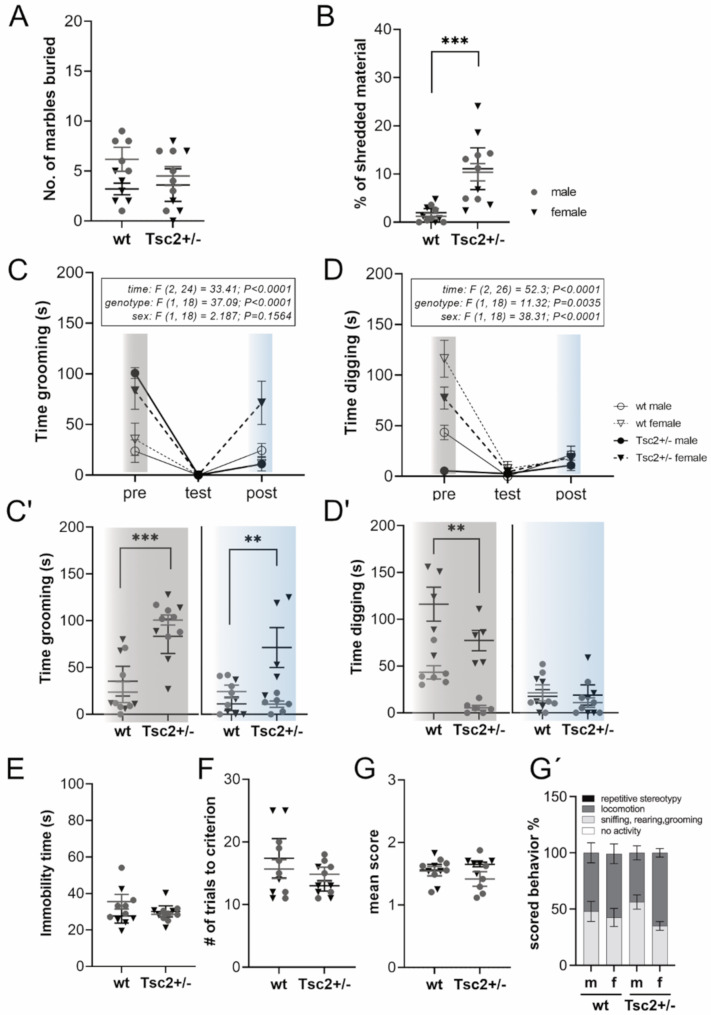
- Tsc2+/− rats showed significantly increased nestlet shredding versus wild-type (F(1, 18) = 16.39, p = 0.001), while marble burying did not differ by genotype (p = 0.589).
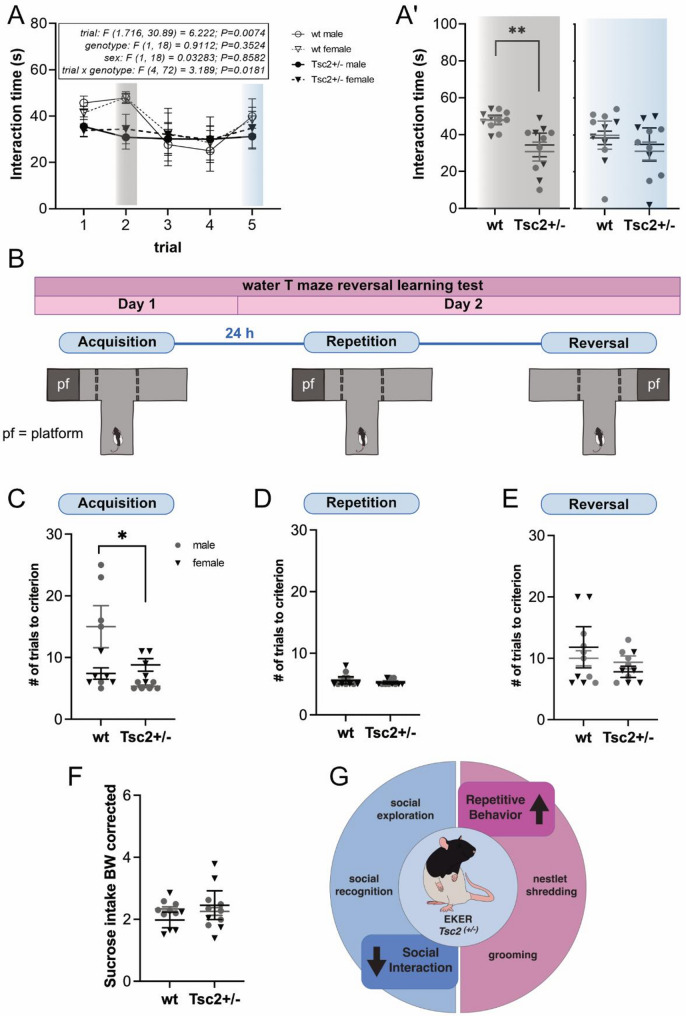
- In the light-sound-confinement pre-test, Tsc2+/− rats showed increased grooming (F(1, 18) = 23.47, p = 0.001) and reduced digging (F(1, 18) = 13.43, p = 0.002); during stressor application neither genotype groomed or dug, and in post-test recovery female Tsc2+/− rats showed increased grooming (sex × genotype interaction F(1, 18) = 11.22, p = 0.004). No genotype effect was found in the forced swim test (p = 0.497), water-T-maze reversal (p = 0.163), or amphetamine-induced stereotypy test (p = 0.846).
- Social recognition was impaired: Tsc2+/− rats had decreased interaction time in trial 2 (F(1, 18) = 12.47, p = 0.003) and did not show the wild-type pattern of habituation to a familiar partner or increased interaction with a novel partner. Sucrose consumption did not differ by genotype (p = 0.441).
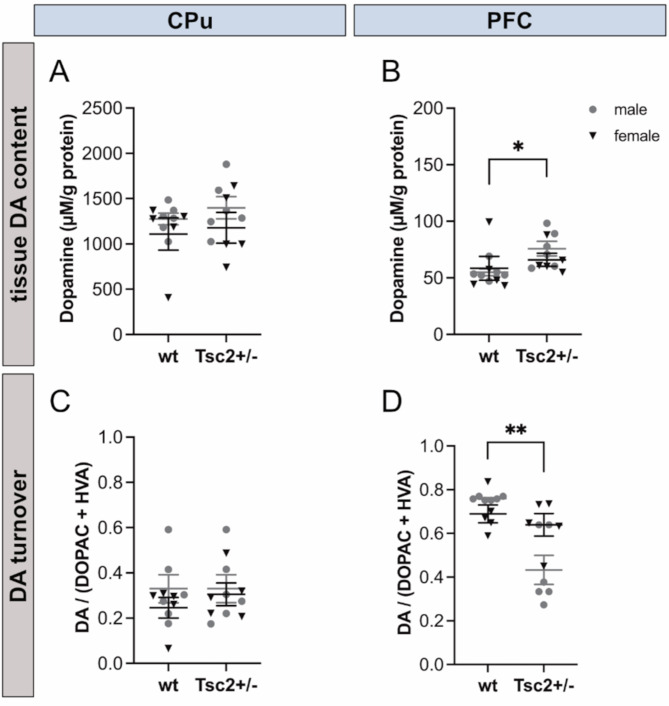
- HPLC showed increased PFC dopamine in Tsc2+/− rats (F(1, 18) = 4.478, p = 0.0485), no significant CPu dopamine change (p = 0.484), and increased overall PFC dopamine turnover in Tsc2+/− rats (F(1, 18) = 15, p = 0.001), with a sex × genotype interaction (F(1, 18) = 8.5, p = 0.01) indicating increased turnover in male Tsc2+/− rats. PFC dopamine correlated with nestlet shredding (rs(19) = 0.551, p = 0.01) and grooming (rs(19) = 0.514, p = 0.02).
Methods
- Heterozygous Tsc2+/− Eker rats on a Long-Evans background and wild-type littermates were used: 11 Tsc2+/− and 11 wild-type rats, with both sexes (n = 6 male, n = 5 female per genotype), tested starting at 12 weeks of age across two birth cohorts; experimenters were blinded.
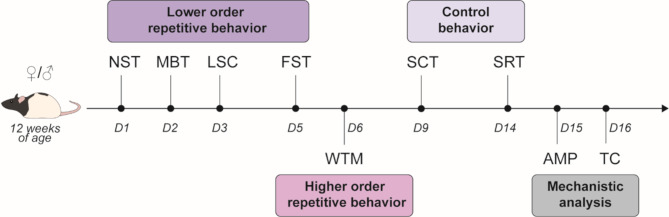
- A fixed-sequence behavioral battery assessed lower-order repetitive behavior (nestlet shredding, marble burying, light-sound-confinement, forced swim), higher-order repetitive behavior/cognition (water-T-maze), social behavior (social recognition), reward function (sucrose consumption), and amphetamine-induced stereotypy, with at least 24 h between tests.
- Post-mortem HPLC measured dopamine, DOPAC, and HVA in prefrontal cortex and striatum (caudate putamen), with dopamine turnover calculated as DA/(DOPAC + HVA). Behavioral and HPLC data were analyzed by two-way ANOVA for genotype and sex, with Tukey’s HSD for post hoc comparisons and Spearman correlations for significant genotype effects; significance was p < 0.05.
Limitations
- Stated: the dataset was small and normality was not formally tested, relying instead on visual inspection of qq-plots and ANOVA robustness; the fixed test sequence allowed at least 24 h between tests but interferences with following tests cannot be fully excluded; sex effects were interpreted cautiously because male and female numbers were too small for meaningful conclusions; the study lacks experimental evidence causally connecting dopamine alterations to behavioral alterations; only PFC and CPu were examined, while other regions implicated in repetitive behavior were not addressed; HPLC animals had undergone behavioral testing, raising possible interference, mitigated by a single low amphetamine dose and one-day rest; heterozygous models do not recapitulate spontaneous seizures, and the phenotype remains mild, with “second hit” paradigms suggested as potentially needed.
- Evident from the text: the sample size of 11 per genotype limits robust sex-specific and subgroup conclusions; the correlational dopamine findings cannot establish causality without direct dopaminergic manipulation; and the behavioral battery order may still carry carryover effects despite the rest periods.
Model-written summary. Check it against the paper before relying on it.
Integrity signals
Registry
Cites
Statistics
Figures
Verification
Claims the paper makes
0 Valid · 0 Not valid · 38 Not checked · 86 Own results and interpretations
A result the paper reports from its own data — it cites no other source for it, so there is none to check. The quote shows it is in the paper.
In the paper
“significantly increased levels of DA were present within the PFC of Tsc2+/− animals compared to wt (Fig. 4B; F(1, 18) = 4.478, p = 0.0485).”
§ Behavioral phenotyping identifies autism-like repetitive stereotypies in a Tsc2 haploinsufficient rat model > Results > Eker rats show evidence for impaired PFC-dependent dopaminergic signaling
plainstates an association- Asserted: passes — The authors put it forward as true.
- Checkable: passes — It can be checked against evidence.
- Load-bearing: passes — The paper’s conclusions depend on it.
- Based: passes — The paper gives a reason why it holds.
A result the paper reports from its own data — it cites no other source for it, so there is none to check. The quote shows it is in the paper.
In the paper
“Here, we report a significant effect of sex before stress application in the LSC test, with increased digging behavior in female compared to male animals.”
§ Behavioral phenotyping identifies autism-like repetitive stereotypies in a Tsc2 haploinsufficient rat model > Discussion
plainstates an association- Asserted: passes — The authors put it forward as true.
- Checkable: passes — It can be checked against evidence.
- Load-bearing: unclear — It is unclear whether the paper’s conclusions depend on it.
- Based: passes — The paper gives a reason why it holds.
A result the paper reports from its own data — it cites no other source for it, so there is none to check. The quote shows it is in the paper.
In the paper
“digging behavior did not significantly differ between genotypes or sex during recovery in the post-test phase (Fig. 2D, D´).”
§ Behavioral phenotyping identifies autism-like repetitive stereotypies in a Tsc2 haploinsufficient rat model > Results > Tsc2 haploinsufficiency increases lower-order repetitive behavior patterns
plain- Asserted: passes — The authors put it forward as true.
- Checkable: passes — It can be checked against evidence.
- Load-bearing: unclear — It is unclear whether the paper’s conclusions depend on it.
- Based: passes — The paper gives a reason why it holds.
A result the paper reports from its own data — it cites no other source for it, so there is none to check. The quote shows it is in the paper.
In the paper
“No significant effect on the extent and type of locomotion was found between wt and Tsc2+/− animals after amphetamine injection (Fig. 2G, G´).”
§ Behavioral phenotyping identifies autism-like repetitive stereotypies in a Tsc2 haploinsufficient rat model > Results > Tsc2 haploinsufficiency increases lower-order repetitive behavior patterns
plain- Asserted: passes — The authors put it forward as true.
- Checkable: passes — It can be checked against evidence.
- Load-bearing: passes — The paper’s conclusions depend on it.
- Based: passes — The paper gives a reason why it holds.
A result the paper reports from its own data — it cites no other source for it, so there is none to check. The quote shows it is in the paper.
In the paper
“Neither genotype demonstrated grooming behavior nor digging behavior during stressor application (Fig. 2C, D).”
§ Behavioral phenotyping identifies autism-like repetitive stereotypies in a Tsc2 haploinsufficient rat model > Results > Tsc2 haploinsufficiency increases lower-order repetitive behavior patterns
plain- Asserted: passes — The authors put it forward as true.
- Checkable: passes — It can be checked against evidence.
- Load-bearing: passes — The paper’s conclusions depend on it.
- Based: passes — The paper gives a reason why it holds.
56 more claims
Create a free account to see all 124 claims and to verify the 63 references still open.
- It may state two separate claims as one. 38
- Probably not a substantial claim. 36
Statistics that don’t add up
Each reported p-value recomputed from its test statistic and degrees of freedom, each partial η² from its F, and each ratio, mean difference or B printed with a p checked against its own confidence interval.
Rated major: it would touch a result — a value a result rests on, reported and recomputed p-values on opposite sides of the significance level, two passages that conflict with no sign which is right, or a cited work retracted before this paper was published.
In the paper
“F(1, 18) = 4.353, p = 0.012”
§ Behavioral phenotyping identifies autism-like repetitive stereotypies in a Tsc2 haploinsufficient rat model > Results > Repetitive behavior alterations in the Eker rat are observed in a context of impaired social behavior
Reported p = .012 · recomputed p = .051
Rated minor: it would not touch a result — a value no result rests on, a p-value that stays on the same side of the significance level, or a conflict that is clerical, resolved elsewhere in the paper, or outside its own findings.
In the paper
“F(1, 18) = 12.47, p = 0.003”
§ Behavioral phenotyping identifies autism-like repetitive stereotypies in a Tsc2 haploinsufficient rat model > Results > Repetitive behavior alterations in the Eker rat are observed in a context of impaired social behavior
Reported p = .003 · recomputed p = .002
Statistics recomputed
Every reported test result, recomputed from its test statistic and degrees of freedom. A result shows as not adding up only once an independent check has confirmed it.
- Doesn’t add upF(1, 18) = 4.353reported p = .012 · recomputed p = .051The two fall on opposite sides of .05
“F(1, 18) = 4.353, p = .012”
- Doesn’t add upF(1, 18) = 12.47reported p = .003 · recomputed p = .002
“F(1, 18) = 12.47, p = .003”
- ConsistentF(1, 18) = 16.39reported p = .001 · recomputed p < .001
“F(1, 18) = 16.39, p = .001”
- ConsistentF(1, 18) = 23.47reported p = .001 · recomputed p < .001
“F(1, 18) = 23.47, p = .001”
The paper prints p at a floor (such as p < .001)
- ConsistentF(1, 18) = 13.43reported p = .002 · recomputed p = .002
“F(1, 18) = 13.43, p = .002”
5 more recomputed tests
Create a free account to see every test the Stats check recomputed.
Self-check
Percentages, sums and reported differences re-computed from the paper’s own numbers.
Each contradiction between two passages listed here was confirmed by an independent check.
Rated minor: it would not touch a result — a value no result rests on, a p-value that stays on the same side of the significance level, or a conflict that is clerical, resolved elsewhere in the paper, or outside its own findings.
In the paper
§ Behavioral phenotyping identifies autism-like repetitive stereotypies in a Tsc2 haploinsufficient rat model > Methods > Post-mortem high-performance liquid chromatography
“Dopamine turnover was calculated from concentration levels, adjusted to the protein content of the sample, as neurotransmitter to metabolite ratio (DA/(DOPAC + HVA)).”
§ Behavioral phenotyping identifies autism-like repetitive stereotypies in a Tsc2 haploinsufficient rat model > Discussion
“Interestingly, DA/(DOPAC/HVA) rates showed differences between sexes in Tsc2+/− animals”
Citations
Cites
Diagnostic and Statistical Manual of Mental Disorders
American Psychiatric Association (2013) · doi:10.1176/appi.books.9780890425596 · Cited by 116,369
Behavioural despair in rats: A new model sensitive to antidepressant treatments
Porsolt, R. D., Anton, G., Blavet, N., & Jalfre, M. (1978) · European Journal of Pharmacology · doi:10.1016/0014-2999(78)90118-8 · Cited by 3,138
Global prevalence of autism: A systematic review update
Zeidan, J., Fombonne, E., Scorah, J., Ibrahim, A., Durkin, M. S., Saxena, S., Yusuf, A., Shih, A., & Elsabbagh, M. (2022) · Autism Research · doi:10.1002/aur.2696 · Cited by 3,117
Satterstrom, F. K., Kosmicki, J. A., Wang, J., Breen, M. S., De Rubeis, S., An, J.-Y., Peng, M., Collins, R., Grove, J., Klei, L., et al. (2020) · Cell · doi:10.1016/j.cell.2019.12.036 · Cited by 2,321
The Tuberous Sclerosis Complex
Crino, P. B., Nathanson, K. L., & Henske, E. P. (2006) · New England Journal of Medicine · doi:10.1056/nejmra055323 · Cited by 1,793
Kelly, P. H., Seviour, P. W., & Iversen, S. D. (1975) · Brain Research · doi:10.1016/0006-8993(75)90233-4 · Cited by 1,731
Non-normal data: Is ANOVA still a valid option?
Blanca, M., Alarcón, R., Arnau, J., Bono, R., & Bendayan, R. (2017) · Psicothema · doi:10.7334/psicothema2016.383 · Cited by 1,624
Shank3 mutant mice display autistic-like behaviours and striatal dysfunction
Peça, J., Feliciano, C., Ting, J. T., Wang, W., Wells, M. F., Venkatraman, T. N., Lascola, C. D., Fu, Z., & Feng, G. (2011) · Nature · doi:10.1038/nature09965 · Cited by 1,570
Sex differences in autism spectrum disorders
Werling, D. M., & Geschwind, D. H. (2013) · Current Opinion in Neurology · doi:10.1097/wco.0b013e32835ee548 · Cited by 1,245
Most genetic risk for autism resides with common variation
Gaugler, T., Klei, L., Sanders, S. J., Bodea, C. A., Goldberg, A. P., Lee, A. B., Mahajan, M., Manaa, D., Pawitan, Y., Reichert, J., et al. (2014) · Nature Genetics · doi:10.1038/ng.3039 · Cited by 1,239
Using the rat forced swim test to assess antidepressant-like activity in rodents
Slattery, D. A., & Cryan, J. F. (2012) · Nature Protocols · doi:10.1038/nprot.2012.044 · Cited by 903
Neurobiology of rodent self-grooming and its value for translational neuroscience
Kalueff, A. V., Stewart, A. M., Song, C., Berridge, K. C., Graybiel, A. M., & Fentress, J. C. (2016) · Nature Reviews Neuroscience · doi:10.1038/nrn.2015.8 · Cited by 852
Lipton, J. O., & Sahin, M. (2014) · Neuron · doi:10.1016/j.neuron.2014.09.034 · Cited by 736
Marble burying reflects a repetitive and perseverative behavior more than novelty-induced anxiety
Thomas, A., Burant, A., Bui, N., Graham, D., Yuva-Paylor, L. A., & Paylor, R. (2009) · Psychopharmacology · doi:10.1007/s00213-009-1466-y · Cited by 698
Genetics of autism spectrum disorders
Geschwind, D. H. (2011) · Trends in Cognitive Sciences · doi:10.1016/j.tics.2011.07.003 · Cited by 696
Jamain, S., Radyushkin, K., Hammerschmidt, K., Granon, S., Boretius, S., Varoqueaux, F., Ramanantsoa, N., Gallego, J., Ronnenberg, A., Winter, D., et al. (2008) · Proceedings of the National Academy of Sciences · doi:10.1073/pnas.0711555105 · Cited by 556
The Rodent Forced Swim Test Measures Stress-Coping Strategy, Not Depression-like Behavior
Commons, K. G., Cholanians, A. B., Babb, J. A., & Ehlinger, D. G. (2017) · ACS Chemical Neuroscience · doi:10.1021/acschemneuro.7b00042 · Cited by 525
Christensen, D. L., Bilder, D. A., Zahorodny, W., Pettygrove, S., Durkin, M. S., Fitzgerald, R. T., Rice, C., Kurzius-Spencer, M., Baio, J., & Yeargin-Allsopp, M. (2016) · Journal of Developmental & Behavioral Pediatrics · doi:10.1097/dbp.0000000000000235 · Cited by 390
Marble Burying and Nestlet Shredding as Tests of Repetitive, Compulsive-like Behaviors in Mice
Angoa-Pérez, M., Kane, M. J., Briggs, D. I., Francescutti, D. M., & Kuhn, D. M. (2013) · Journal of Visualized Experiments · doi:10.3791/50978 · Cited by 388
Molecular neurobiology of mTOR
Switon, K., Kotulska, K., Janusz-Kaminska, A., Zmorzynska, J., & Jaworski, J. (2017) · Neuroscience · doi:10.1016/j.neuroscience.2016.11.017 · Cited by 387
Neuroligin‐3‐deficient mice: model of a monogenic heritable form of autism with an olfactory deficit
Radyushkin, K., Hammerschmidt, K., Boretius, S., Varoqueaux, F., El‐Kordi, A., Ronnenberg, A., Winter, D., Frahm, J., Fischer, J., Brose, N., et al. (2009) · Genes, Brain and Behavior · doi:10.1111/j.1601-183x.2009.00487.x · Cited by 358
Onda, H., Lueck, A., Marks, P. W., Warren, H. B., & Kwiatkowski, D. J. (1999) · Journal of Clinical Investigation · doi:10.1172/jci7319 · Cited by 349
Yeung, R. S., Xiao, G. H., Jin, F., Lee, W. C., Testa, J. R., & Knudson, A. G. (1994) · Proceedings of the National Academy of Sciences · doi:10.1073/pnas.91.24.11413 · Cited by 307
Vanderschuren, L. J. M. J., Schmidt, E. D., De Vries, T. J., Van Moorsel, C. A. P., Tilders, F. J. H., & Schoffelmeer, A. N. M. (1999) · The Journal of Neuroscience · doi:10.1523/jneurosci.19-21-09579.1999 · Cited by 290
Regulation of autism-relevant behaviors by cerebellar-prefrontal cortical circuits
Kelly, E., Meng, F., Fujita, H., Morgado, F., Kazemi, Y., Rice, L. C., Ren, C., Escamilla, C. O., Gibson, J. M., Sajadi, S., et al. (2020) · Nature Neuroscience · doi:10.1038/s41593-020-0665-z · Cited by 280
Han, S., Tai, C., Jones, C. J., Scheuer, T., & Catterall, W. A. (2014) · Neuron · doi:10.1016/j.neuron.2014.01.016 · Cited by 231
Cognitive deficits in Tsc1+/−mice in the absence of cerebral lesions and seizures
Goorden, S. M. I., van Woerden, G. M., van der Weerd, L., Cheadle, J. P., & Elgersma, Y. (2007) · Annals of Neurology · doi:10.1002/ana.21317 · Cited by 230
Genomics, convergent neuroscience and progress in understanding autism spectrum disorder
Willsey, H. R., Willsey, A. J., Wang, B., & State, M. W. (2022) · Nature Reviews Neuroscience · doi:10.1038/s41583-022-00576-7 · Cited by 229
Instructional control of reinforcement learning: A behavioral and neurocomputational investigation
Doll, B. B., Jacobs, W. J., Sanfey, A. G., & Frank, M. J. (2009) · Brain Research · doi:10.1016/j.brainres.2009.07.007 · Cited by 215
Reith, R. M., McKenna, J., Wu, H., Hashmi, S. S., Cho, S.-H., Dash, P. K., & Gambello, M. J. (2013) · Neurobiology of Disease · doi:10.1016/j.nbd.2012.10.014 · Cited by 194
Amodeo, D. A., Jones, J. H., Sweeney, J. A., & Ragozzino, M. E. (2012) · Behavioural Brain Research · doi:10.1016/j.bbr.2011.10.032 · Cited by 191
Betancur, C., & Buxbaum, J. D. (2013) · Molecular Autism · doi:10.1186/2040-2392-4-17 · Cited by 189
Bouwknecht, J. A., Spiga, F., Staub, D. R., Hale, M. W., Shekhar, A., & Lowry, C. A. (2007) · Brain Research Bulletin · doi:10.1016/j.brainresbull.2006.12.009 · Cited by 183
de Brouwer, G., Fick, A., Harvey, B. H., & Wolmarans, D. W. (2019) · Cognitive, Affective, & Behavioral Neuroscience · doi:10.3758/s13415-018-00653-4 · Cited by 179
Behavioral phenotypes of genetic mouse models of autism
Kazdoba, T. M., Leach, P. T., & Crawley, J. N. (2016) · Genes, Brain and Behavior · doi:10.1111/gbb.12256 · Cited by 178
Motor and cognitive stereotypies in the BTBR T+tf/J mouse model of autism
Pearson, B. L., Pobbe, R. L. H., Defensor, E. B., Oasay, L., Bolivar, V. J., Blanchard, D. C., & Blanchard, R. J. (2011) · Genes, Brain and Behavior · doi:10.1111/j.1601-183x.2010.00659.x · Cited by 171
Winslow, J. T., & Camacho, F. (1995) · Psychopharmacology · doi:10.1007/bf02245626 · Cited by 156
Habituation and Prepulse Inhibition of Acoustic Startle in Rodents
Valsamis, B., & Schmid, S. (2011) · Journal of Visualized Experiments · doi:10.3791/3446 · Cited by 155
Social circuits and their dysfunction in autism spectrum disorder
Sato, M., Nakai, N., Fujima, S., Choe, K. Y., & Takumi, T. (2023) · Molecular Psychiatry · doi:10.1038/s41380-023-02201-0 · Cited by 151
Abbott, A. E., Linke, A. C., Nair, A., Jahedi, A., Alba, L. A., Keown, C. L., Fishman, I., & Müller, R. (2017) · Social Cognitive and Affective Neuroscience · doi:10.1093/scan/nsx129 · Cited by 148
Kim, H., Lim, C.-S., & Kaang, B.-K. (2016) · Behavioral and Brain Functions · doi:10.1186/s12993-016-0087-y · Cited by 141
Kas, M. J., Glennon, J. C., Buitelaar, J., Ey, E., Biemans, B., Crawley, J., Ring, R. H., Lajonchere, C., Esclassan, F., Talpos, J., et al. (2014) · Psychopharmacology · doi:10.1007/s00213-013-3268-5 · Cited by 132
Spine pruning drives antipsychotic-sensitive locomotion via circuit control of striatal dopamine
Kim, I. H., Rossi, M. A., Aryal, D. K., Racz, B., Kim, N., Uezu, A., Wang, F., Wetsel, W. C., Weinberg, R. J., Yin, H., et al. (2015) · Nature Neuroscience · doi:10.1038/nn.4015 · Cited by 127
Dysfunction of the corticostriatal pathway in autism spectrum disorders
Li, W., & Pozzo‐Miller, L. D. (2019) · Journal of Neuroscience Research · doi:10.1002/jnr.24560 · Cited by 125
A Dominant Gene for Renal Adenomas in the Rat
EKER, R., & MOSSIGE, J. (1961) · Nature · doi:10.1038/189858b0 · Cited by 124
El-Kordi, A., Winkler, D., Hammerschmidt, K., Kästner, A., Krueger, D., Ronnenberg, A., Ritter, C., Jatho, J., Radyushkin, K., Bourgeron, T., et al. (2013) · Behavioural Brain Research · doi:10.1016/j.bbr.2012.11.016 · Cited by 118
Symptom profiles of autism spectrum disorder in tuberous sclerosis complex
Jeste, S. S., Varcin, K. J., Hellemann, G. S., Gulsrud, A. C., Bhatt, R., Kasari, C., Wu, J. Y., Sahin, M., & Nelson, C. A. (2016) · Neurology · doi:10.1212/wnl.0000000000003002 · Cited by 109
Parr‐Brownlie, L. C., & Hyland, B. I. (2005) · Journal of Neuroscience · doi:10.1523/jneurosci.0523-05.2005 · Cited by 103
Drug development for Autism Spectrum Disorder (ASD): Progress, challenges, and future directions
McCracken, J. T., Anagnostou, E. A., Arango, C., Dawson, G., Farchione, T. R., Mantua, V., McPartland, J. C., Murphy, D., Pandina, G., & Veenstra-VanderWeele, J. M. (2021) · European Neuropsychopharmacology · doi:10.1016/j.euroneuro.2021.05.010 · Cited by 98
Probabilistic reinforcement learning in adults with autism spectrum disorders
Solomon, M., Smith, A. C., Frank, M. J., Ly, S., & Carter, C. S. (2011) · Autism Research · doi:10.1002/aur.177 · Cited by 97
Autism Symptoms in Fragile X Syndrome
Niu, M., Han, Y., Dy, A. B. C., Du, J., Jin, H., Qin, J., Zhang, J., Li, Q., & Hagerman, R. J. (2017) · Journal of Child Neurology · doi:10.1177/0883073817712875 · Cited by 96
Rennebeck, G., Kleymenova, E. V., Anderson, R., Yeung, R. S., Artzt, K., & Walker, C. L. (1998) · Proceedings of the National Academy of Sciences · doi:10.1073/pnas.95.26.15629 · Cited by 92
Homberg, J. R., Van Den Akker, M., Raasø, H. S., Wardeh, G., Binnekade, R., Schoffelmeer, A. N. M., & De Vries, T. J. (2002) · European Journal of Neuroscience · doi:10.1046/j.1460-9568.2002.01976.x · Cited by 91
Impaired synaptic plasticity in a rat model of tuberous sclerosis
Von Der Brelie, C., Waltereit, R., Zhang, L., Beck, H., & Kirschstein, T. (2006) · European Journal of Neuroscience · doi:10.1111/j.1460-9568.2006.04594.x · Cited by 89
Self-citationNeural Mechanisms Underlying Repetitive Behaviors in Rodent Models of Autism Spectrum Disorders
Gandhi, T., & Lee, C. C. (2021) · Frontiers in Cellular Neuroscience · doi:10.3389/fncel.2020.592710 · Cited by 88
O’Neill, M., & Brown, V. J. (2007) · Neurobiology of Learning and Memory · doi:10.1016/j.nlm.2007.03.003 · Cited by 83
Marble burying as compulsive behaviors in male and female mice
Taylor, G. T., Lerch, S., & Chourbaji, S. (2017) · Acta Neurobiologiae Experimentalis · doi:10.21307/ane-2017-059 · Cited by 80
Shin, W., Kweon, H., Kang, R., Kim, D., Kim, K., Kang, M., Kim, S. Y., Hwang, S. N., Kim, J. Y., Yang, E., et al. (2019) · Frontiers in Molecular Neuroscience · doi:10.3389/fnmol.2019.00145 · Cited by 77
Abnormal repetitive behaviours: shared phenomenology and pathophysiology
Muehlmann, A. M., & Lewis, M. H. (2012) · Journal of Intellectual Disability Research · doi:10.1111/j.1365-2788.2011.01519.x · Cited by 75
Autism and Epilepsy in Patients With Tuberous Sclerosis Complex
Specchio, N., Pietrafusa, N., Trivisano, M., Moavero, R., De Palma, L., Ferretti, A., Vigevano, F., & Curatolo, P. (2020) · Frontiers in Neurology · doi:10.3389/fneur.2020.00639 · Cited by 75
Enhanced episodic‐like memory and kindling epilepsy in a rat model of tuberous sclerosis
Waltereit, R., Welzl, H., Dichgans, J., Lipp, H., Schmidt, W. J., & Weller, M. (2006) · Journal of Neurochemistry · doi:10.1111/j.1471-4159.2005.03538.x · Cited by 72
Self-citationEstrogenic involvement in social learning, social recognition and pathogen avoidance
Choleris, E., Clipperton-Allen, A. E., Phan, A., Valsecchi, P., & Kavaliers, M. (2012) · Frontiers in Neuroendocrinology · doi:10.1016/j.yfrne.2012.02.001 · Cited by 70
Repetitive behavior profile and supersensitivity to amphetamine in the C58/J mouse model of autism
Moy, S. S., Riddick, N. V., Nikolova, V. D., Teng, B. L., Agster, K. L., Nonneman, R. J., Young, N. B., Baker, L. K., Nadler, J. J., & Bodfish, J. W. (2014) · Behavioural Brain Research · doi:10.1016/j.bbr.2013.10.052 · Cited by 68
Water T-maze: A useful assay for determination of repetitive behaviors in mice
Guariglia, S. R., & Chadman, K. K. (2013) · Journal of Neuroscience Methods · doi:10.1016/j.jneumeth.2013.08.019 · Cited by 68
Epilepsy and Tsc2 Haploinsufficiency Lead to Autistic-Like Social Deficit Behaviors in Rats
Waltereit, R., Japs, B., Schneider, M., de Vries, P. J., & Bartsch, D. (2011) · Behavior Genetics · doi:10.1007/s10519-010-9399-0 · Cited by 66
Self-citationTowards understanding sex differences in autism spectrum disorders
Leow, K. Q., Tonta, M. A., Lü, J., Coleman, H. A., & Parkington, H. C. (2024) · Brain Research · doi:10.1016/j.brainres.2024.148877 · Cited by 65
Sex-specific Behavioral Features of Rodent Models of Autism Spectrum Disorder
Jeon, S. J., Gonzales, E. L., Mabunga, D. F. N., Valencia, S. T., Kim, D. G., Kim, Y., Adil, K. J. L., Shin, D., Park, D., & Shin, C. Y. (2018) · Experimental Neurobiology · doi:10.5607/en.2018.27.5.321 · Cited by 60
Sun, J., Yuan, Y., Wu, X., Liu, A., Wang, J., Yang, S., Liu, B., Kong, Y., Wang, L., Zhang, K., et al. (2022) · Neuron · doi:10.1016/j.neuron.2022.08.010 · Cited by 59
What we can learn from a genetic rodent model about autism
Möhrle, D., Fernández, M., Peñagarikano, O., Frick, A., Allman, B., & Schmid, S. (2020) · Neuroscience & Biobehavioral Reviews · doi:10.1016/j.neubiorev.2019.12.015 · Cited by 58
Stress induced grooming in the rat — An endorphin mediated syndrome
Katz, R. J., & Roth, K. A. (1979) · Neuroscience Letters · doi:10.1016/0304-3940(79)90043-0 · Cited by 53
Palavra, F., Robalo, C., & Reis, F. (2017) · Oxidative Medicine and Cellular Longevity · doi:10.1155/2017/9820181 · Cited by 53
Cerebellar Development and Autism Spectrum Disorder in Tuberous Sclerosis Complex
Sundberg, M., & Şahin, M. (2015) · Journal of Child Neurology · doi:10.1177/0883073815600870 · Cited by 50
Dopamine Dysregulation in Reward and Autism Spectrum Disorder
Blum, K., Bowirrat, A., Sunder, K., Thanos, P. K., Hanna, C., Gold, M. S., Dennen, C. A., Elman, I., Murphy, K. T., & Makale, M. T. (2024) · Brain Sciences · doi:10.3390/brainsci14070733 · Cited by 47
Yoo, T., Cho, H., Lee, J., Park, H., Yoo, Y.-E., Yang, E., Kim, J. Y., Kim, H., & Kim, E. (2018) · Frontiers in Cellular Neuroscience · doi:10.3389/fncel.2018.00341 · Cited by 46
Jung, S., & Park, M. (2022) · Pharmacological Research · doi:10.1016/j.phrs.2022.106340 · Cited by 42
Schneider, M., de Vries, P. J., Schönig, K., Rößner, V., & Waltereit, R. (2017) · European Archives of Psychiatry and Clinical Neuroscience · doi:10.1007/s00406-016-0703-8 · Cited by 41
Self-citationAbnormal Cortical Cells and Astrocytomas in the Eker Rat Model of Tuberous Sclerosis Complex
Takahashi, D. K., Dinday, M. T., Barbaro, N. M., & Baraban, S. C. (2004) · Epilepsia · doi:10.1111/j.0013-9580.2004.23004.x · Cited by 39
Repetitive Behavior in Neurodevelopmental Disorders: Clinical and Translational Findings
Whitehouse, C. M., & Lewis, M. H. (2015) · The Behavior Analyst · doi:10.1007/s40614-015-0029-2 · Cited by 37
Reversal learning in C58 mice: Modeling higher order repetitive behavior
Whitehouse, C. M., Curry-Pochy, L. S., Shafer, R. L., Rudy, J., & Lewis, M. H. (2017) · Behavioural Brain Research · doi:10.1016/j.bbr.2017.06.014 · Cited by 37
García‐Villamisar, D., & Rojahn, J. (2015) · Journal of Intellectual Disability Research · doi:10.1111/jir.12083 · Cited by 34
Neuropathology and Animal Models of Autism: Genetic and Environmental Factors
Gadad, B. S., Hewitson, L., Young, K. A., & German, D. C. (2013) · Autism Research and Treatment · doi:10.1155/2013/731935 · Cited by 33
Petrasek, T., Vojtechova, I., Klovrza, O., Tuckova, K., Vejmola, C., Rak, J., Sulakova, A., Kaping, D., Bernhardt, N., de Vries, P. J., et al. (2021) · Journal of Neurodevelopmental Disorders · doi:10.1186/s11689-021-09357-2 · Cited by 30
Self-citationVaccarino, F. J., & Franklin, K. B. J. (1982) · Behavioural Brain Research · doi:10.1016/0166-4328(82)90034-1 · Cited by 29
Meyerolbersleben, L. S., Winter, C., & Bernhardt, N. R. (2019) · Behavioural Brain Research · doi:10.1016/j.bbr.2019.112244 · Cited by 27
Self-citationThe genetic landscape of autism spectrum disorder in an ancestrally diverse cohort
Gogate, A., Kaur, K. J., Khalil, R., Bashtawi, M. A., Morris, M. A., Goodspeed, K., Evans, P., & Chahrour, M. H. (2024) · npj Genomic Medicine · doi:10.1038/s41525-024-00444-6 · Cited by 26
Morency, M. A., Stewart, R. J., & Beninger, R. J. (1985) · Progress in Neuro-Psychopharmacology and Biological Psychiatry · doi:10.1016/0278-5846(85)90051-x · Cited by 24
Genetic ancestry and diagnostic yield of exome sequencing in a diverse population
Mavura, Y., Sahin‐Hodoglugil, N., Hodoğlugil, U., Kvale, M. N., Martin, P.-M., Ziffle, J. V., Devine, W. P., Ackerman, S., Koenig, B. A., Kwok, P., et al. (2024) · npj Genomic Medicine · doi:10.1038/s41525-023-00385-6 · Cited by 23
The anterior insular cortex processes social recognition memory
Min, J.-Y., Park, S., Cho, J., & Huh, Y. (2023) · Scientific Reports · doi:10.1038/s41598-023-38044-6 · Cited by 21
Hadar, R., Edemann-Callesen, H., Reinel, C., Wieske, F., Voget, M., Popova, E., Sohr, R., Avchalumov, Y., Priller, J., van Riesen, C., et al. (2016) · Scientific Reports · doi:10.1038/srep39145 · Cited by 20
Kim, S.-H., An, K., Namkung, H., Saito, A., Rannals, M. D., Moore, J. R., Mihaljevic, M., Saha, S., Oh, S., Kondo, M. A., et al. (2023) · American Journal of Psychiatry · doi:10.1176/appi.ajp.21010053 · Cited by 20
Kútna, V., Uttl, L., Waltereit, R., Krištofiková, Z., Kaping, D., Petrásek, T., Hoschl, C., & Ovsepian, S. V. (2020) · Neurotherapeutics · doi:10.1007/s13311-019-00812-6 · Cited by 13
Self-citationMurta, V., Seiffe, A., & Depino, A. M. (2023) · Sexes · doi:10.3390/sexes4030024 · Cited by 13
Kozlova, A. A., Rubets, E., Vareltzoglou, M. R., Jarzebska, N., Ragavan, V. N., Chen, Y., Martens‐Lobenhoffer, J., Bode‐Böger, S. M., Gainetdinov, R. R., Rodionov, R. N., et al. (2023) · Journal of Neural Transmission · doi:10.1007/s00702-023-02597-7 · Cited by 12
Self-citationCHI, O. Z., Wu, C., Liu, X., Rah, K. H., Jacinto, E., & Weiss, H. R. (2015) · NeuroMolecular Medicine · doi:10.1007/s12017-015-8359-5 · Cited by 11
Sex-Selective Effects on Behavior in a Mouse Model of Tuberous Sclerosis Complex
Saré, R. M., Lemons, A., Figueroa, C., Song, A., Levine, M., & Beebe Smith, C. (2020) · eneuro · doi:10.1523/eneuro.0379-19.2020 · Cited by 11
Kútna, V., O'Leary, V. B., Newman, E., Hoschl, C., & Ovsepian, S. V. (2021) · Neurotherapeutics · doi:10.1007/s13311-020-01000-7 · Cited by 11
Bauer, H. F., Delling, J. P., Bockmann, J., Boeckers, T. M., & Schön, M. (2023) · Frontiers in Behavioral Neuroscience · doi:10.3389/fnbeh.2022.1051175 · Cited by 11
Bové, M., Sikora, V., Santoro, M., Agosti, L. P., Palmieri, M. A., Dimonte, S., Tucci, P., Schiavone, S., Morgese, M. G., & Trabace, L. (2024) · Neuropharmacology · doi:10.1016/j.neuropharm.2024.110134 · Cited by 11
Establishment of a two-hit mouse model of environmental factor induced autism spectrum disorder
Zheng, W., Wang, M., Cui, Y., Xu, Q., Chen, Y., Xian, P., Yang, Q., Wu, S., & Wang, Y. (2024) · Heliyon · doi:10.1016/j.heliyon.2024.e30617 · Cited by 9
Granak, S., Tuckova, K., Kútna, V., Vojtěchová, I., Bajkova, L., Petrásek, T., & Ovsepian, S. V. (2022) · European Journal of Neuroscience · doi:10.1111/ejn.15864 · Cited by 7
Taracha, E., Czarna, M., Turzyńska, D., & Maciejak, P. (2023) · Pharmacological Reports · doi:10.1007/s43440-023-00472-6 · Cited by 6
Apparatus and General Methods for Exposing Rats to Audiogenic Stress
Campeau, S. (2016) · BIO-PROTOCOL · doi:10.21769/bioprotoc.1994 · Cited by 5
CHI, O. Z., Liu, X., Fortus, H., Werlen, G., Jacinto, E., & Weiss, H. R. (2024) · NeuroMolecular Medicine · doi:10.1007/s12017-024-08780-7 · Cited by 2
Habituation and Prepulse Inhibition of Acoustic Startle in Rodents
Valsamis, B., & Schmid, S. (2011) · Journal of Visualized Experiments · doi:10.3791/3446-v
Cited by
Guo, Y. (2026) · Research Square · doi:10.21203/rs.3.rs-10784918/v1
Metadata
- Authors
- Ramme, A., Zachow, M., Habelt, B., Vojtechova, I., Petrasek, T., Waltereit, R., & Bernhardt, N.
- Affiliations
- University Hospital Carl Gustav Carus (DE)
- Universitätsmedizin Göttingen (DE)
- Corresponding author
- Bernhardt, Nadine
- Venue
- Behavioral and Brain Functions
- Published
- 2025-07-03
- Volume
- 21
- Issue
- 1
- Pages
- 20-20
- ISSN
- 1744-9081 (ISSN-L)
- PMC
- PMC12225118
- OpenAlex
- W4411974876
- Semantic Scholar
- b477b92400c539469f0fe6b4b0425babed40ec9a
- Cited by
- 1
- References
- 103
- Citations by year
- 2026: 1
- FWCI
- 0.33
- Type
- journal article
- Language
- en
- Open access
- gold
- doi.org
- Licence
- cc-by
- creativecommons.org/licenses/by/4.0 (tdm)
- creativecommons.org/licenses/by/4.0 (vor)
- Locations
- Behavioral and Brain Functions (publishedVersion, cc-by)
- Research Square (submittedVersion, cc-by)
- PubMed (publishedVersion)
- PubMed Central (publishedVersion, cc-by)
- DOAJ (DOAJ: Directory of Open Access Journals) (submittedVersion, cc-by-sa)
- GoeScholar The Publication Server of the Georg-August-Universität Göttingen (Georg-August-Universität Göttingen) (submittedVersion, cc-by)
- Funders
- Technische Universität Dresden
- Topics
- Life Sciences › Neuroscience › Cognitive Neuroscience › Autism Spectrum Disorder Research
- Life Sciences › Biochemistry, Genetics and Molecular Biology › Genetics › Genetics and Neurodevelopmental Disorders
- Health Sciences › Medicine › Genetics (clinical) › Tuberous Sclerosis Complex Research
- Keywords
- autism spectrum disorder, repetitive behavior, stereotypy, Eker rat, tuberous sclerosis complex, self-grooming, social interaction deficits, dopamine, prefrontal cortex, animal models of autism
- MeSH terms
- Autism Spectrum Disorder, Tuberous Sclerosis Complex 2 Protein, Social Interaction, Animals, Autistic Disorder, Behavior, Animal, Brain, Disease Models, Animal, Dopamine, Grooming, Male, Phenotype, Social Behavior, Stereotyped Behavior, Tuberous Sclerosis, Rats, Rats, Transgenic, Haploinsufficiency
About these checks
Registry, retraction, Cites and statistics results are computed, not judged, with one exception: a printed reference that no index lists is read once by a model before it counts as a citation error. Claims are extracted by a model and kept only when their quote appears verbatim in the text; each cited source is then checked, with a model’s help, for whether it says what the claim relies on. Those verdicts can be wrong — read the claim’s quote and the cited source before relying on one.
A language model drew the claims from the paper on 2026-11-19, under version 3 of the claim definition (model deepseek-v4.1-flash, prompt extract-v3).
A second model labelled each claim on 2026-11-19 (model jev-1.13-20260917, definition revision gold-guideline-v0.2).
Statistics and arithmetic are recomputed, not judged.
Confidence bands are shown only for fields calibrated on our annotated test set. None is calibrated yet, so no band is shown.
What counts as a claim ›How we measure confidence ›How we check this ›
Are you an author, or do you see a problem with this page? Request a review
Data sources
Bibliographic data: Semantic Scholar, OpenAlex, Crossref.
Contains information from the Semantic Scholar Academic Graph Datasets, made available under the ODC Attribution License (ODC-BY 1.0).
Semantic Scholar’s data is described in: Kinney, R., et al. (2023). The Semantic Scholar Open Data Platform. arXiv:2301.10140.
