

The DOI matches its Crossref record; 48 of the 50 references it cites were found in a registry or an index; 8 of the 82 sources its claims cite were checked for support.
Methods for designing interventions to change healthcare professionals’ behaviour: a systematic review
Open accessAbstract
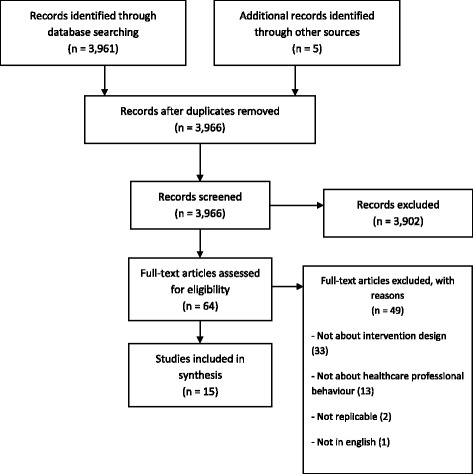
BACKGROUND: Systematic reviews consistently indicate that interventions to change healthcare professional (HCP) behaviour are haphazardly designed and poorly specified. Clarity about methods for designing and specifying interventions is needed. The objective of this review was to identify published methods for designing interventions to change HCP behaviour. METHODS: A search of MEDLINE, Embase, and PsycINFO was conducted from 1996 to April 2015. Using inclusion/exclusion criteria, a broad screen of abstracts by one rater was followed by a strict screen of full text for all potentially relevant papers by three raters. An inductive approach was first applied to the included studies to identify commonalities and differences between the descriptions of methods across the papers. Based on this process and knowledge of related literatures, we developed a data extraction framework that included, e.g. level of change (e.g. individual versus organization); context of development; a brief description of the method; tasks included in the method (e.g. barrier identification, component selection, use of theory). RESULTS: 3966 titles and abstracts and 64 full-text papers were screened to yield 15 papers included in the review, each outlining one design method. All of the papers reported methods developed within a specific context. Thirteen papers included barrier identification and 13 included linking barriers to intervention components; although not the same 13 papers. Thirteen papers targeted individual HCPs with only one paper targeting change across individual, organization, and system levels. The use of theory and user engagement were included in 13/15 and 13/15 papers, respectively. CONCLUSIONS: There is an agreement across methods of four tasks that need to be completed when designing individual-level interventions: identifying barriers, selecting intervention components, using theory, and engaging end-users. Methods also consist of further additional tasks. Examples of methods for designing the organisation and system-level interventions were limited. Further analysis of design tasks could facilitate the development of detailed guidelines for designing interventions.
Overview
AI snapshot
Written from the paper’s full text.
TL;DR
This systematic review identified 15 published methods for designing interventions to change healthcare professionals’ behaviour. Across these methods, four design tasks were commonly included: barrier identification, linking barriers to intervention components, using theory, and engaging end-users.
Key findings
- From 3966 screened citations and 64 full-text papers, 15 papers were included, each outlining one design method; methods were published between 2001 and 2014.
- 13/15 papers included barrier identification and 13/15 linked barriers to intervention components, though these were not the same 13 papers; 13/15 used theory and 13/15 included user engagement.
- 13/15 methods targeted individual healthcare professionals, while only one method targeted change across individual, organization, and system levels.
- Design tasks ranged from 2 to 7 steps, with a median of 5 tasks; 11/15 methods incorporated other published approaches, tools, or resources.
Methods
- Systematic review searching MEDLINE, Embase, and PsycINFO from 1996 to April 2015, with no published protocol; inclusion required a paper to describe a method for designing interventions to change healthcare professionals’ behaviour and focus primarily on the intervention design process.
- Title/abstract screening was done by one rater, followed by full-text screening by three raters independently; mean Kappa across all pairs was .43, indicating moderate agreement.
- Data extraction used a two-stage process: an inductive framework was developed by three reviewers, then data were extracted by two individuals independently followed by consensus discussion for discrepancies.
Limitations
- The paper states that only one rater screened titles and abstracts, which may have increased the possibility of omitting relevant studies; it also did not include books or book chapters, excluded studies that reported intervention testing alongside development, did not search grey literature, and used only three databases, making the review susceptible to publication bias.
- The paper states that all included methods were developed specifically for healthcare environments, and methods from other disciplines or before 1996 may have been missed.
- The paper notes that it did not measure the degree to which the identified methods are used; the text also makes evident that the search ended in April 2015 and excluded non-English articles.
Model-written summary. Check it against the paper before relying on it.
Integrity signals
Registry
Cites
Statistics
Figures
Verification
Claims the paper makes
31 Not checked yet · 24 Own result · 13 Own method · 7 Own interpretation · 4 No basis given · 1 Partly supported · 1 Mixed support · accuracy not yet measured
Some cited sources support this claim and some don’t — read each source’s verdict below.
In the paper
“Six papers used the structured interview processes outlined in the TDF [19, 21, 25] or in Intervention Mapping [20, 26, 27].”
§ Methods for designing interventions to change healthcare professionals’ behaviour: a systematic review > Results > Design tasks in the methods
What the sources say
- Partly supportedcites [19] Taylor N, Lawton R, Slater B, Foy R. The demonstration of a theory-based approach to the design of localized patient safety interventions. Implement Sci. 2013;8(1):123. sourceExperimental — accuracy not yet measured
The Methods sections on the TDFI approach and focus group schedule describe TDF-guided focus groups with prompts to discuss barriers and generate intervention ideas. The paper also reports exit interviews, but describes those as assessing the implementation process, not as TDF-structured interviews. Thus it supports a structured TDF-guided discussion process, but not the more specific characterization of TDF-structured interviews. (LLM, conf=0.78)
- Supportedcites [21] French SD, Green SE, O’Connor DA, McKenzie JE, Francis JJ, Michie S, Buchbinder R, Schattner P, Spike N, Grimshaw JM. Developing theory-informed behaviour change interventions to implement evidence into practice: a systematic approach using the Theoretical Domains Framework. Implement Sci. 2012;7(1):38. source
The Results section describes focus-group interviews with questions designed to explore TDF domains, supporting this paper as an example of a TDF-guided interview process. The count of six papers is the citing authors’ summary, not a finding attributed specifically to this source. (LLM, conf=0.90)
- Disputedcites [25] Porcheret M, Main C, Croft P, McKinley R, Hassell A, Dziedzic K. Development of a behaviour change intervention: a case study on the practical application of theory. Implement Sci. 2014;9(1):42. sourceExperimental — accuracy not yet measured
The Methods (‘Applying the models,’ Step 2) say the researchers asked GP advisory groups about their practice and mapped their responses to TDF domains. The Discussion (‘Strengths and possible limitations’) explicitly says the meetings’ topic guide was developed before the decision to use TDF and was not developed from it. This paper therefore does not exemplify use of a TDF-structured interview process. (LLM, conf=0.87)
Checked by a reasoning model — may be wrong.
- Not checked yetcites [20] Van Bokhoven M, Kok G, Van der Weijden T. Designing a quality improvement intervention: a systematic approach. Qual Saf Health Care. 2003;12(3):215–20. source
- Supportedcites [26] Sassen B, Kok G, Mesters I, Crutzen R, Cremers A, Vanhees L. A web-based intervention for health professionals and patients to decrease cardiovascular risk attributable to physical inactivity: development process. JMIR Res Protocols. 2012;1(2):e21. source
The Introduction describes Intervention Mapping as the framework used to develop the intervention. In Results, Step 1: Needs Assessment, the authors report focus group interviews with health professionals and small group interviews with patients. This supports identifying this paper as one that used interviews within an Intervention Mapping process; the count of six papers belongs to the citing document, not this source alone. (LLM, conf=0.90)
- Supportedcites [27] Schmid AA, Andersen J, Kent T, Williams LS, Damush TM. Using intervention mapping to develop and adapt a secondary stroke prevention program in Veterans Health Administration medical centers. Implement Sci. 2010;5(1):11. source
The Methods section (Intervention Mapping, Step 0: Needs assessment; page unavailable) says the authors used semi-structured interviews to guide their Intervention Mapping process. The Interview section describes the structured guides and probes. This supports citing the paper as an example of interviews used within Intervention Mapping; the count of six papers is the citing authors’ review finding, not a finding attributed to this individual paper. (LLM, conf=0.88)
plain- Asserted: passes — The authors put it forward as true.
- Checkable: passes — It can be checked against evidence.
- Load-bearing: unclear — It is unclear whether the paper’s conclusions depend on it.
- Based: passes — The paper gives a reason why it holds.
- Partly supported
The cited sources support only part of this claim — read each source’s verdict below.
In the paper
“Four of these [20, 23, 26, 27] incorporated Intervention Mapping [29]”
§ Methods for designing interventions to change healthcare professionals’ behaviour: a systematic review > Results > Contexts, target levels, and incorporating other processes/steps/tools/resources
What the sources say
- Not checked yetcites [20] Van Bokhoven M, Kok G, Van der Weijden T. Designing a quality improvement intervention: a systematic approach. Qual Saf Health Care. 2003;12(3):215–20. source
- Supportedcites [23] Cabassa LJ, Druss B, Wang Y, Lewis-Fernández R. Collaborative planning approach to inform the implementation of a healthcare manager intervention for Hispanics with serious mental illness: a study protocol. Implement Sci. 2011;6:80. source
The Introduction says the study combined community-based participatory research with Intervention Mapping. The Methods (‘Study design overview’) also says the project applies Intervention Mapping steps. This supports citing the paper as one that incorporated Intervention Mapping; the count of four papers is the citing authors’ synthesis, not a finding attributed to this source. (LLM, conf=0.92)
- Partly supportedcites [26] Sassen B, Kok G, Mesters I, Crutzen R, Cremers A, Vanhees L. A web-based intervention for health professionals and patients to decrease cardiovascular risk attributable to physical inactivity: development process. JMIR Res Protocols. 2012;1(2):e21. sourceExperimental — accuracy not yet measured
The Methods and Results sections show that this paper used Intervention Mapping to develop its intervention. They do not establish that four of the citing document’s 15 included papers used it; that count concerns the citing document’s own set of papers. (LLM, conf=0.83)
- Supportedcites [27] Schmid AA, Andersen J, Kent T, Williams LS, Damush TM. Using intervention mapping to develop and adapt a secondary stroke prevention program in Veterans Health Administration medical centers. Implement Sci. 2010;5(1):11. source
The citation [29] follows “Intervention Mapping,” while the four included papers are identified by separate citations. The Methods > Intervention Mapping passage states that Schmid and colleagues used the five steps of Intervention Mapping to develop their program. The count of four is the citing authors’ characterization of their included papers, not a finding attributed to this source. (LLM, conf=0.88)
- Not checked yetcites [29] Bartholomew LK, Parcel GS, Kok G, Gottlieb NH. Planning health promotion programs: an intervention mapping approach. San Francisco: John Wiley & Sons; 2011.
plain- Asserted: passes — The authors put it forward as true.
- Checkable: passes — It can be checked against evidence.
- Load-bearing: unclear — It is unclear whether the paper’s conclusions depend on it.
- Based: passes — The paper gives a reason why it holds.
A result the paper reports from its own data — it cites no other source for it, so there is none to check. The quote shows it is in the paper.
In the paper
“Thirteen papers targeted individual HCPs with only one paper targeting change across individual, organization, and system levels.”
§ Methods for designing interventions to change healthcare professionals’ behaviour: a systematic review > Abstract > Results
plainn = 15- Asserted: passes — The authors put it forward as true.
- Checkable: passes — It can be checked against evidence.
- Load-bearing: unclear — It is unclear whether the paper’s conclusions depend on it.
- Based: passes — The paper gives a reason why it holds.
The paper states this without a source or data behind it here, so there is nothing to check it against. The quote shows it is in the paper.
In the paper
“Thirteen papers included barrier identification and 13 included linking barriers to intervention components; although not the same 13 papers.”
§ Methods for designing interventions to change healthcare professionals’ behaviour: a systematic review > Abstract > Results
plainn = 13- Asserted: passes — The authors put it forward as true.
- Checkable: passes — It can be checked against evidence.
- Load-bearing: unclear — It is unclear whether the paper’s conclusions depend on it.
- Based: passes — The paper gives a reason why it holds.
A result the paper reports from its own data — it cites no other source for it, so there is none to check. The quote shows it is in the paper.
In the paper
“The use of theory and user engagement were included in 13/15 and 13/15 papers, respectively.”
§ Methods for designing interventions to change healthcare professionals’ behaviour: a systematic review > Abstract > Results
plainn = 13- Asserted: passes — The authors put it forward as true.
- Checkable: passes — It can be checked against evidence.
- Load-bearing: unclear — It is unclear whether the paper’s conclusions depend on it.
- Based: passes — The paper gives a reason why it holds.
A result the paper reports from its own data — it cites no other source for it, so there is none to check. The quote shows it is in the paper.
In the paper
“Thirteen papers included barrier identification and 13 included linking barriers to intervention components; although not the same 13 papers.”
§ Methods for designing interventions to change healthcare professionals’ behaviour: a systematic review > Abstract > Results
plainn = 13- Asserted: passes — The authors put it forward as true.
- Checkable: passes — It can be checked against evidence.
- Load-bearing: unclear — It is unclear whether the paper’s conclusions depend on it.
- Based: passes — The paper gives a reason why it holds.
A result the paper reports from its own data — it cites no other source for it, so there is none to check. The quote shows it is in the paper.
In the paper
“All of the papers reported methods developed within a specific context.”
§ Methods for designing interventions to change healthcare professionals’ behaviour: a systematic review > Abstract > Results
plain- Asserted: passes — The authors put it forward as true.
- Checkable: passes — It can be checked against evidence.
- Load-bearing: unclear — It is unclear whether the paper’s conclusions depend on it.
- Based: passes — The paper gives a reason why it holds.
A result the paper reports from its own data — it cites no other source for it, so there is none to check. The quote shows it is in the paper.
In the paper
“Thirteen papers targeted individual HCPs with only one paper targeting change across individual, organization, and system levels.”
§ Methods for designing interventions to change healthcare professionals’ behaviour: a systematic review > Abstract > Results
plainn = 13- Asserted: passes — The authors put it forward as true.
- Checkable: passes — It can be checked against evidence.
- Load-bearing: unclear — It is unclear whether the paper’s conclusions depend on it.
- Based: passes — The paper gives a reason why it holds.
None of the sources cited for this claim have been checked yet.
In the paper
“Eleven of the 15 papers incorporated other approaches, tools, or resources as a component of the intervention design process [14, 19–28].”
§ Methods for designing interventions to change healthcare professionals’ behaviour: a systematic review > Results > Contexts, target levels, and incorporating other processes/steps/tools/resources
What the sources say
- Not checked yetcites [14] Curran GM, Mukherjee S, Allee E, Owen RR. A process for developing an implementation intervention: QUERI Series. Implement Sci. 2008;3(1):17. source
- Not checked yetcites [19] Taylor N, Lawton R, Slater B, Foy R. The demonstration of a theory-based approach to the design of localized patient safety interventions. Implement Sci. 2013;8(1):123. source
- Not checked yetcites [20] Van Bokhoven M, Kok G, Van der Weijden T. Designing a quality improvement intervention: a systematic approach. Qual Saf Health Care. 2003;12(3):215–20. source
- Not checked yetcites [21] French SD, Green SE, O’Connor DA, McKenzie JE, Francis JJ, Michie S, Buchbinder R, Schattner P, Spike N, Grimshaw JM. Developing theory-informed behaviour change interventions to implement evidence into practice: a systematic approach using the Theoretical Domains Framework. Implement Sci. 2012;7(1):38. source
- Not checked yetcites [22] Kolehmainen N, Francis JJ. Specifying content and mechanisms of change in interventions to change professionals’ practice: an illustration from the Good Goals study in occupational therapy. Implement Sci. 2012;7(1):100. source
- Not checked yetcites [23] Cabassa LJ, Druss B, Wang Y, Lewis-Fernández R. Collaborative planning approach to inform the implementation of a healthcare manager intervention for Hispanics with serious mental illness: a study protocol. Implement Sci. 2011;6:80. source
- Not checked yetcites [24] Clyne B, Bradley MC, Hughes CM, Clear D, McDonnell R, Williams D, Fahey T, Smith SM. Addressing potentially inappropriate prescribing in older patients: development and pilot study of an intervention in primary care (the OPTI-SCRIPT study). BMC Health Serv Res. 2013;13(1):307. source
- Not checked yetcites [25] Porcheret M, Main C, Croft P, McKinley R, Hassell A, Dziedzic K. Development of a behaviour change intervention: a case study on the practical application of theory. Implement Sci. 2014;9(1):42. source
- Not checked yetcites [26] Sassen B, Kok G, Mesters I, Crutzen R, Cremers A, Vanhees L. A web-based intervention for health professionals and patients to decrease cardiovascular risk attributable to physical inactivity: development process. JMIR Res Protocols. 2012;1(2):e21. source
- Not checked yetcites [27] Schmid AA, Andersen J, Kent T, Williams LS, Damush TM. Using intervention mapping to develop and adapt a secondary stroke prevention program in Veterans Health Administration medical centers. Implement Sci. 2010;5(1):11. source
plain- Asserted: passes — The authors put it forward as true.
- Checkable: passes — It can be checked against evidence.
- Load-bearing: unclear — It is unclear whether the paper’s conclusions depend on it.
- Based: passes — The paper gives a reason why it holds.
A result the paper reports from its own data — it cites no other source for it, so there is none to check. The quote shows it is in the paper.
In the paper
“Examples of methods for designing the organisation and system-level interventions were limited.”
§ Methods for designing interventions to change healthcare professionals’ behaviour: a systematic review > Abstract > Conclusions
plain- Asserted: passes — The authors put it forward as true.
- Checkable: passes — It can be checked against evidence.
- Load-bearing: passes — The paper’s conclusions depend on it.
- Based: passes — The paper gives a reason why it holds.
- Rests on an assumption: The search strategy and databases used were sufficient to identify all relevant published methods for designing interventions to change healthcare professionals' behaviour.
- Probably not a substantial claim. 25
- It may state two separate claims as one. 18
A result the paper reports from its own data — it cites no other source for it, so there is none to check. The quote shows it is in the paper.
In the paper
“Thirteen papers included barrier identification and 13 included linking barriers to intervention components; although not the same 13 papers.”
§ Methods for designing interventions to change healthcare professionals’ behaviour: a systematic review > Abstract > Results
plaincorrelationaln = 13- Asserted: fails — The authors may not put it forward as true.
- Checkable: passes — It can be checked against evidence.
- Load-bearing: fails — The paper’s conclusions may not depend on it.
- Based: fails — The paper may give no reason why it holds.
Probably not a substantial claim. The authors may not put it forward as true. The paper’s conclusions may not depend on it. The paper may give no reason why it holds.
A result the paper reports from its own data — it cites no other source for it, so there is none to check. The quote shows it is in the paper.
In the paper
“3966 titles and abstracts and 64 full-text papers were screened to yield 15 papers included in the review, each outlining one design method.”
§ Methods for designing interventions to change healthcare professionals’ behaviour: a systematic review > Abstract > Results
plain- Asserted: passes — The authors put it forward as true.
- Checkable: passes — It can be checked against evidence.
- Load-bearing: passes — The paper’s conclusions depend on it.
- Based: passes — The paper gives a reason why it holds.
It may state two separate claims as one.
- Rests on an assumption: The search strategy and databases used were sufficient to identify all relevant published methods for designing interventions to change healthcare professionals' behaviour.
None of the sources cited for this claim have been checked yet.
In the paper
“In the papers where barrier identification was covered, the methods included observations, interviews and/or focus groups [14, 18, 30–32], surveys [32], literature reviews [24], structured reflection by the researchers [32], job analysis and expert consensus [18], and undertaking a predictive study to identify factors influencing the behaviour [28].”
§ Methods for designing interventions to change healthcare professionals’ behaviour: a systematic review > Results > Design tasks in the methods
What the sources say
- Not checked yetcites [14] Curran GM, Mukherjee S, Allee E, Owen RR. A process for developing an implementation intervention: QUERI Series. Implement Sci. 2008;3(1):17. source
- Not checked yetcites [18] Battles J. Improving patient safety by instructional systems design. Qual Saf Health Care. 2006;15 suppl 1:i25–9. source
- Not checked yetcites [30] Chandler C, Meta J, Ponzo C, Nasuwa F, Kessy J, Mbakilwa H, Haaland A, Reyburn H. The development of effective behaviour change interventions to support the use of malaria rapid diagnostic tests by Tanzanian clinicians. Implement Sci. 2014;9:83. source
- Not checked yetcites [31] McDermott L, Yardley L, Little P, Ashworth M, Gulliford M. Developing a computer delivered, theory based intervention for guideline implementation in general practice. BMC Fam Pract. 2010;11(1):90. source
- Not checked yetcites [32] Fretheim A, Oxman AD, Flottorp S. Improving prescribing of antihypertensive and cholesterol-lowering drugs: a method for identifying and addressing barriers to change. BMC Health Serv Res. 2004;4(1):23. source
- Not checked yetcites [24] Clyne B, Bradley MC, Hughes CM, Clear D, McDonnell R, Williams D, Fahey T, Smith SM. Addressing potentially inappropriate prescribing in older patients: development and pilot study of an intervention in primary care (the OPTI-SCRIPT study). BMC Health Serv Res. 2013;13(1):307. source
- Not checked yetcites [28] Foy R, Francis JJ, Johnston M, Eccles M, Lecouturier J, Bamford C, Grimshaw J. The development of a theory-based intervention to promote appropriate disclosure of a diagnosis of dementia. BMC Health Serv Res. 2007;7:207. source
plain- Asserted: passes — The authors put it forward as true.
- Checkable: passes — It can be checked against evidence.
- Load-bearing: unclear — It is unclear whether the paper’s conclusions depend on it.
- Based: passes — The paper gives a reason why it holds.
It may state two separate claims as one.
In the paper
“One of these papers [22] reported an assumption that barriers had already been identified in previous work and provided a method for linking barriers to intervention components.”
§ Methods for designing interventions to change healthcare professionals’ behaviour: a systematic review > Results > Design tasks in the methods
What the sources say
- Not checked yetcites [22] Kolehmainen N, Francis JJ. Specifying content and mechanisms of change in interventions to change professionals’ practice: an illustration from the Good Goals study in occupational therapy. Implement Sci. 2012;7(1):100. source
plaincorrelational- Asserted: passes — The authors put it forward as true.
- Checkable: passes — It can be checked against evidence.
- Load-bearing: unclear — It is unclear whether the paper’s conclusions depend on it.
- Based: passes — The paper gives a reason why it holds.
It may state two separate claims as one.
None of the sources cited for this claim have been checked yet.
In the paper
“Five of 15 incorporated just one other published tool [20, 24, 26–28]”
§ Methods for designing interventions to change healthcare professionals’ behaviour: a systematic review > Results > Contexts, target levels, and incorporating other processes/steps/tools/resources
What the sources say
- Not checked yetcites [20] Van Bokhoven M, Kok G, Van der Weijden T. Designing a quality improvement intervention: a systematic approach. Qual Saf Health Care. 2003;12(3):215–20. source
- Not checked yetcites [24] Clyne B, Bradley MC, Hughes CM, Clear D, McDonnell R, Williams D, Fahey T, Smith SM. Addressing potentially inappropriate prescribing in older patients: development and pilot study of an intervention in primary care (the OPTI-SCRIPT study). BMC Health Serv Res. 2013;13(1):307. source
- Not checked yetcites [26] Sassen B, Kok G, Mesters I, Crutzen R, Cremers A, Vanhees L. A web-based intervention for health professionals and patients to decrease cardiovascular risk attributable to physical inactivity: development process. JMIR Res Protocols. 2012;1(2):e21. source
- Not checked yetcites [27] Schmid AA, Andersen J, Kent T, Williams LS, Damush TM. Using intervention mapping to develop and adapt a secondary stroke prevention program in Veterans Health Administration medical centers. Implement Sci. 2010;5(1):11. source
- Not checked yetcites [28] Foy R, Francis JJ, Johnston M, Eccles M, Lecouturier J, Bamford C, Grimshaw J. The development of a theory-based intervention to promote appropriate disclosure of a diagnosis of dementia. BMC Health Serv Res. 2007;7:207. source
plain- Asserted: passes — The authors put it forward as true.
- Checkable: passes — It can be checked against evidence.
- Load-bearing: fails — The paper’s conclusions may not depend on it.
- Based: passes — The paper gives a reason why it holds.
Probably not a substantial claim. The paper’s conclusions may not depend on it.
In the paper
“and one incorporated three published tools [25].”
§ Methods for designing interventions to change healthcare professionals’ behaviour: a systematic review > Results > Contexts, target levels, and incorporating other processes/steps/tools/resources
What the sources say
- Not checked yetcites [25] Porcheret M, Main C, Croft P, McKinley R, Hassell A, Dziedzic K. Development of a behaviour change intervention: a case study on the practical application of theory. Implement Sci. 2014;9(1):42. source
plain- Asserted: passes — The authors put it forward as true.
- Checkable: passes — It can be checked against evidence.
- Load-bearing: fails — The paper’s conclusions may not depend on it.
- Based: passes — The paper gives a reason why it holds.
Probably not a substantial claim. The paper’s conclusions may not depend on it.
None of the sources cited for this claim have been checked yet.
In the paper
“and two incorporated the Medical Research Council (MRC) framework [22, 24].”
§ Methods for designing interventions to change healthcare professionals’ behaviour: a systematic review > Results > Contexts, target levels, and incorporating other processes/steps/tools/resources
What the sources say
- Not checked yetcites [22] Kolehmainen N, Francis JJ. Specifying content and mechanisms of change in interventions to change professionals’ practice: an illustration from the Good Goals study in occupational therapy. Implement Sci. 2012;7(1):100. source
- Not checked yetcites [24] Clyne B, Bradley MC, Hughes CM, Clear D, McDonnell R, Williams D, Fahey T, Smith SM. Addressing potentially inappropriate prescribing in older patients: development and pilot study of an intervention in primary care (the OPTI-SCRIPT study). BMC Health Serv Res. 2013;13(1):307. source
plain- Asserted: passes — The authors put it forward as true.
- Checkable: passes — It can be checked against evidence.
- Load-bearing: fails — The paper’s conclusions may not depend on it.
- Based: passes — The paper gives a reason why it holds.
Probably not a substantial claim. The paper’s conclusions may not depend on it.
In the paper
“The other paper [23] focused on adapting an intervention using stakeholder engagement and did not address barrier identification specifically.”
§ Methods for designing interventions to change healthcare professionals’ behaviour: a systematic review > Results > Design tasks in the methods
What the sources say
- Not checked yetcites [23] Cabassa LJ, Druss B, Wang Y, Lewis-Fernández R. Collaborative planning approach to inform the implementation of a healthcare manager intervention for Hispanics with serious mental illness: a study protocol. Implement Sci. 2011;6:80. source
plain- Asserted: passes — The authors put it forward as true.
- Checkable: passes — It can be checked against evidence.
- Load-bearing: unclear — It is unclear whether the paper’s conclusions depend on it.
- Based: passes — The paper gives a reason why it holds.
It may state two separate claims as one.
In the paper
“One of these was Eccles et al. [38] which includes a description of using a theory to design a KT intervention.”
§ Methods for designing interventions to change healthcare professionals’ behaviour: a systematic review > Discussion
What the sources say
- Not checked yetcites [38] Eccles M, Grimshaw J, Walker A, Johnston M, Pitts N. Changing the behavior of healthcare professionals: the use of theory in promoting the uptake of research findings. J Clin Epidemiol. 2005;58(2):107–12. source
plain- Asserted: passes — The authors put it forward as true.
- Checkable: passes — It can be checked against evidence.
- Load-bearing: fails — The paper’s conclusions may not depend on it.
- Based: passes — The paper gives a reason why it holds.
Probably not a substantial claim. The paper’s conclusions may not depend on it.
None of the sources cited for this claim have been checked yet.
In the paper
“Methods to link barriers to intervention components included mapping TDF-barriers to the BCT taxonomy [19, 21, 25], as well as using the structured approaches described in Intervention Mapping [20, 26, 27].”
§ Methods for designing interventions to change healthcare professionals’ behaviour: a systematic review > Results > Design tasks in the methods
What the sources say
- Not checked yetcites [19] Taylor N, Lawton R, Slater B, Foy R. The demonstration of a theory-based approach to the design of localized patient safety interventions. Implement Sci. 2013;8(1):123. source
- Not checked yetcites [21] French SD, Green SE, O’Connor DA, McKenzie JE, Francis JJ, Michie S, Buchbinder R, Schattner P, Spike N, Grimshaw JM. Developing theory-informed behaviour change interventions to implement evidence into practice: a systematic approach using the Theoretical Domains Framework. Implement Sci. 2012;7(1):38. source
- Not checked yetcites [25] Porcheret M, Main C, Croft P, McKinley R, Hassell A, Dziedzic K. Development of a behaviour change intervention: a case study on the practical application of theory. Implement Sci. 2014;9(1):42. source
- Not checked yetcites [20] Van Bokhoven M, Kok G, Van der Weijden T. Designing a quality improvement intervention: a systematic approach. Qual Saf Health Care. 2003;12(3):215–20. source
- Not checked yetcites [26] Sassen B, Kok G, Mesters I, Crutzen R, Cremers A, Vanhees L. A web-based intervention for health professionals and patients to decrease cardiovascular risk attributable to physical inactivity: development process. JMIR Res Protocols. 2012;1(2):e21. source
- Not checked yetcites [27] Schmid AA, Andersen J, Kent T, Williams LS, Damush TM. Using intervention mapping to develop and adapt a secondary stroke prevention program in Veterans Health Administration medical centers. Implement Sci. 2010;5(1):11. source
plaincorrelational- Asserted: passes — The authors put it forward as true.
- Checkable: passes — It can be checked against evidence.
- Load-bearing: unclear — It is unclear whether the paper’s conclusions depend on it.
- Based: passes — The paper gives a reason why it holds.
It may state two separate claims as one.
None of the sources cited for this claim have been checked yet.
In the paper
“In two cases, this included formal cognitive interviews [28, 31].”
§ Methods for designing interventions to change healthcare professionals’ behaviour: a systematic review > Results > Design tasks in the methods
What the sources say
- Not checked yetcites [28] Foy R, Francis JJ, Johnston M, Eccles M, Lecouturier J, Bamford C, Grimshaw J. The development of a theory-based intervention to promote appropriate disclosure of a diagnosis of dementia. BMC Health Serv Res. 2007;7:207. source
- Not checked yetcites [31] McDermott L, Yardley L, Little P, Ashworth M, Gulliford M. Developing a computer delivered, theory based intervention for guideline implementation in general practice. BMC Fam Pract. 2010;11(1):90. source
plainn = 2- Asserted: passes — The authors put it forward as true.
- Checkable: passes — It can be checked against evidence.
- Load-bearing: fails — The paper’s conclusions may not depend on it.
- Based: passes — The paper gives a reason why it holds.
Probably not a substantial claim. The paper’s conclusions may not depend on it.
In the paper
“This paper outlined a method for intervention design for health behaviours, not for HCPs’ behaviours, and was therefore excluded.”
§ Methods for designing interventions to change healthcare professionals’ behaviour: a systematic review > Discussion
What the sources say
- Not checked yetcites [29] Bartholomew LK, Parcel GS, Kok G, Gottlieb NH. Planning health promotion programs: an intervention mapping approach. San Francisco: John Wiley & Sons; 2011.
plain- Asserted: passes — The authors put it forward as true.
- Checkable: passes — It can be checked against evidence.
- Load-bearing: fails — The paper’s conclusions may not depend on it.
- Based: passes — The paper gives a reason why it holds.
Probably not a substantial claim. The paper’s conclusions may not depend on it. It may state two separate claims as one.
The paper states this without a source or data behind it here, so there is nothing to check it against. The quote shows it is in the paper.
In the paper
“All of the included methods were developed specifically for healthcare environments.”
§ Methods for designing interventions to change healthcare professionals’ behaviour: a systematic review > Discussion
plain- Asserted: passes — The authors put it forward as true.
- Checkable: passes — It can be checked against evidence.
- Load-bearing: fails — The paper’s conclusions may not depend on it.
- Based: passes — The paper gives a reason why it holds.
Probably not a substantial claim. The paper’s conclusions may not depend on it.
A result the paper reports from its own data — it cites no other source for it, so there is none to check. The quote shows it is in the paper.
In the paper
“We found limited methods to specifically take the organisation and system level contexts into consideration, as well as methods that consider all levels.”
§ Methods for designing interventions to change healthcare professionals’ behaviour: a systematic review > Discussion
plain- Asserted: passes — The authors put it forward as true.
- Checkable: passes — It can be checked against evidence.
- Load-bearing: passes — The paper’s conclusions depend on it.
- Based: passes — The paper gives a reason why it holds.
It may state two separate claims as one.
A result the paper reports from its own data — it cites no other source for it, so there is none to check. The quote shows it is in the paper.
In the paper
“First, limited methods target change in organisations or systems, or at least were developed with a focus on the organization or system.”
- Also stated in: § Conclusions · plain
“Methods for designing organisation and system-level interventions were limited.”
§ Methods for designing interventions to change healthcare professionals’ behaviour: a systematic review > Discussion
plain- Asserted: passes — The authors put it forward as true.
- Checkable: passes — It can be checked against evidence.
- Load-bearing: passes — The paper’s conclusions depend on it.
- Based: passes — The paper gives a reason why it holds.
It may state two separate claims as one.
- Also stated in: § Conclusions · plain
In the paper
“As mentioned, one of these papers [23] focused on adapting an intervention using stakeholder engagement and did not address linking to intervention components specifically.”
§ Methods for designing interventions to change healthcare professionals’ behaviour: a systematic review > Results > Design tasks in the methods
What the sources say
- Not checked yetcites [23] Cabassa LJ, Druss B, Wang Y, Lewis-Fernández R. Collaborative planning approach to inform the implementation of a healthcare manager intervention for Hispanics with serious mental illness: a study protocol. Implement Sci. 2011;6:80. source
plain- Asserted: passes — The authors put it forward as true.
- Checkable: passes — It can be checked against evidence.
- Load-bearing: unclear — It is unclear whether the paper’s conclusions depend on it.
- Based: passes — The paper gives a reason why it holds.
It may state two separate claims as one.
None of the sources cited for this claim have been checked yet.
In the paper
“Examples included using Social Cognitive Theory [33] to design a computer-delivered intervention to enhance the use of practice guidelines in general practices [31], and using theories of risk perception to improve physical activity in cardiovascular patients as part of the Intervention Mapping process [26].”
§ Methods for designing interventions to change healthcare professionals’ behaviour: a systematic review > Results > Design tasks in the methods
What the sources say
- Not checked yetcites [33] Bandura A. Self-efficacy: toward a unifying theory of behavioral change. Psychol Rev. 1977;84(2):191. source
- Not checked yetcites [31] McDermott L, Yardley L, Little P, Ashworth M, Gulliford M. Developing a computer delivered, theory based intervention for guideline implementation in general practice. BMC Fam Pract. 2010;11(1):90. source
- Not checked yetcites [26] Sassen B, Kok G, Mesters I, Crutzen R, Cremers A, Vanhees L. A web-based intervention for health professionals and patients to decrease cardiovascular risk attributable to physical inactivity: development process. JMIR Res Protocols. 2012;1(2):e21. source
plaindirect- Asserted: passes — The authors put it forward as true.
- Checkable: passes — It can be checked against evidence.
- Load-bearing: unclear — It is unclear whether the paper’s conclusions depend on it.
- Based: passes — The paper gives a reason why it holds.
It may state two separate claims as one.
In the paper
“We felt this paper provided a rationale and description of conceptual issues related to using theory to develop an intervention; however, the degree of detail on how to design an intervention in this paper is limited.”
§ Methods for designing interventions to change healthcare professionals’ behaviour: a systematic review > Discussion
What the sources say
- Not checked yetcites [38] Eccles M, Grimshaw J, Walker A, Johnston M, Pitts N. Changing the behavior of healthcare professionals: the use of theory in promoting the uptake of research findings. J Clin Epidemiol. 2005;58(2):107–12. source
plain- Asserted: passes — The authors put it forward as true.
- Checkable: passes — It can be checked against evidence.
- Load-bearing: fails — The paper’s conclusions may not depend on it.
- Based: passes — The paper gives a reason why it holds.
Probably not a substantial claim. The paper’s conclusions may not depend on it. It may state two separate claims as one.
What the paper did — it cites no source for this, so there is none to check. The quote shows it is in the paper.
In the paper
“An interrater reliability analysis using the Kappa statistic was performed to determine consistency among raters for the full-text review.”
§ Methods for designing interventions to change healthcare professionals’ behaviour: a systematic review > Methods
plain- Asserted: passes — The authors put it forward as true.
- Checkable: passes — It can be checked against evidence.
- Load-bearing: fails — The paper’s conclusions may not depend on it.
- Based: passes — The paper gives a reason why it holds.
Probably not a substantial claim. The paper’s conclusions may not depend on it.
What the paper did — it cites no source for this, so there is none to check. The quote shows it is in the paper.
In the paper
“We did not publish a protocol.”
§ Methods for designing interventions to change healthcare professionals’ behaviour: a systematic review > Methods
plain- Asserted: passes — The authors put it forward as true.
- Checkable: passes — It can be checked against evidence.
- Load-bearing: fails — The paper’s conclusions may not depend on it.
- Based: passes — The paper gives a reason why it holds.
Probably not a substantial claim. The paper’s conclusions may not depend on it.
What the paper did — it cites no source for this, so there is none to check. The quote shows it is in the paper.
In the paper
“Due to resource limitations, we also excluded articles that were not in English.”
§ Methods for designing interventions to change healthcare professionals’ behaviour: a systematic review > Methods
plaindirect- Asserted: passes — The authors put it forward as true.
- Checkable: passes — It can be checked against evidence.
- Load-bearing: fails — The paper’s conclusions may not depend on it.
- Based: passes — The paper gives a reason why it holds.
Probably not a substantial claim. The paper’s conclusions may not depend on it.
What the paper did — it cites no source for this, so there is none to check. The quote shows it is in the paper.
In the paper
“A screen of titles and abstracts was conducted by one rater independently (shared by HLC, JES, NK) and was followed by a review of full papers by three raters independently (HLC, JES, NK).”
§ Methods for designing interventions to change healthcare professionals’ behaviour: a systematic review > Methods
plain- Asserted: passes — The authors put it forward as true.
- Checkable: passes — It can be checked against evidence.
- Load-bearing: fails — The paper’s conclusions may not depend on it.
- Based: passes — The paper gives a reason why it holds.
Probably not a substantial claim. The paper’s conclusions may not depend on it. It may state two separate claims as one.
What the paper did — it cites no source for this, so there is none to check. The quote shows it is in the paper.
In the paper
“Papers were included if two criteria were met: (1) the paper described a method (process, tasks, approach) for designing interventions to change HCPs’ behaviour or practice, and (2) the primary focus of the paper was on the intervention design process (as opposed to, e.g. on intervention evaluation).”
§ Methods for designing interventions to change healthcare professionals’ behaviour: a systematic review > Methods
plain- Asserted: passes — The authors put it forward as true.
- Checkable: passes — It can be checked against evidence.
- Load-bearing: passes — The paper’s conclusions depend on it.
- Based: passes — The paper gives a reason why it holds.
Probably not a substantial claim. It may state two separate claims as one.
What the paper did — it cites no source for this, so there is none to check. The quote shows it is in the paper.
In the paper
“Data extraction was conducted by two individuals (HLC, JES) independently first followed by consensus discussions for discrepancies (Stage 2).”
§ Methods for designing interventions to change healthcare professionals’ behaviour: a systematic review > Methods
plainn = 2- Asserted: passes — The authors put it forward as true.
- Checkable: passes — It can be checked against evidence.
- Load-bearing: fails — The paper’s conclusions may not depend on it.
- Based: passes — The paper gives a reason why it holds.
Probably not a substantial claim. The paper’s conclusions may not depend on it. It may state two separate claims as one.
In the paper
“The mean Kappa statistic across all pairs was .43 indicated moderate agreement [16].”
§ Methods for designing interventions to change healthcare professionals’ behaviour: a systematic review > Results
What the sources say
- Not checked yetcites [16] Landis JR, Koch GG The measurement of observer agreement for categorical data. Biometrics. 1977;33:159–174. source
hedged- Asserted: passes — The authors put it forward as true.
- Checkable: passes — It can be checked against evidence.
- Load-bearing: fails — The paper’s conclusions may not depend on it.
- Based: passes — The paper gives a reason why it holds.
Probably not a substantial claim. The paper’s conclusions may not depend on it. It may state two separate claims as one.
What the paper did — it cites no source for this, so there is none to check. The quote shows it is in the paper.
In the paper
“Three reviewers (HLC, JES, NK) progressed in iterative cycles of reading and discussing the included papers to identify similarities and differences between them and used these discussions to develop a list of items to be extracted. The iterative cycles were continued until an agreement between the three authors was reached.”
§ Methods for designing interventions to change healthcare professionals’ behaviour: a systematic review > Methods
plain- Asserted: passes — The authors put it forward as true.
- Checkable: passes — It can be checked against evidence.
- Load-bearing: fails — The paper’s conclusions may not depend on it.
- Based: passes — The paper gives a reason why it holds.
Probably not a substantial claim. The paper’s conclusions may not depend on it.
What the paper did — it cites no source for this, so there is none to check. The quote shows it is in the paper.
In the paper
“we excluded papers that lacked enough detail for replication.”
§ Methods for designing interventions to change healthcare professionals’ behaviour: a systematic review > Methods
plain- Asserted: passes — The authors put it forward as true.
- Checkable: passes — It can be checked against evidence.
- Load-bearing: passes — The paper’s conclusions depend on it.
- Based: passes — The paper gives a reason why it holds.
Probably not a substantial claim.
In the paper
“While it is true that many of the methods’ approaches to barrier identification could result in a focus on the organisation or system should barriers at these levels be identified (for example, see French et al. [21]), the implicit focus of these papers targeted individual behaviour change.”
§ Methods for designing interventions to change healthcare professionals’ behaviour: a systematic review > Discussion
What the sources say
- Not checked yetcites [21] French SD, Green SE, O’Connor DA, McKenzie JE, Francis JJ, Michie S, Buchbinder R, Schattner P, Spike N, Grimshaw JM. Developing theory-informed behaviour change interventions to implement evidence into practice: a systematic approach using the Theoretical Domains Framework. Implement Sci. 2012;7(1):38. source
hedged- Asserted: passes — The authors put it forward as true.
- Checkable: passes — It can be checked against evidence.
- Load-bearing: passes — The paper’s conclusions depend on it.
- Based: passes — The paper gives a reason why it holds.
It may state two separate claims as one.
None of the sources cited for this claim have been checked yet.
In the paper
“Almost all of the methods found (13/15) used theory at some point in the tasks for intervention design, yet evidence indicates theory is rarely used in the design of interventions, or at least rarely reported [39, 40].”
§ Methods for designing interventions to change healthcare professionals’ behaviour: a systematic review > Discussion
What the sources say
- Not checked yetcites [39] Colquhoun HL, Brehaut JC, Sales A, Ivers N, Grimshaw J, Michie S, Carroll K, Chalifoux M, Eva KW. A systematic review of the use of theory in randomized controlled trials of audit and feedback. Implement Sci. 2013;8:66. source
- Not checked yetcites [40] Davies P, Walker AE, Grimshaw JM. A systematic review of the use of theory in the design of guideline dissemination and implementation strategies and interpretation of the results of rigorous evaluations. Implement Sci. 2010;5(14):5908–5.
hedged- Asserted: passes — The authors put it forward as true.
- Checkable: passes — It can be checked against evidence.
- Load-bearing: passes — The paper’s conclusions depend on it.
- Based: passes — The paper gives a reason why it holds.
It may state two separate claims as one.
What the paper did — it cites no source for this, so there is none to check. The quote shows it is in the paper.
In the paper
“Due to the challenges in adequately searching books, we did not include books or book chapters in our search.”
§ Methods for designing interventions to change healthcare professionals’ behaviour: a systematic review > Discussion
plaindirect- Asserted: passes — The authors put it forward as true.
- Checkable: passes — It can be checked against evidence.
- Load-bearing: passes — The paper’s conclusions depend on it.
- Based: passes — The paper gives a reason why it holds.
Probably not a substantial claim.
A conclusion the paper draws from its own results — it cites no other source for it, so there is none to check. The quote shows it is in the paper.
In the paper
“It is likely that other methods to design interventions to change health behaviours could similarly be adopted to design interventions to change HCPs’ practice.”
§ Methods for designing interventions to change healthcare professionals’ behaviour: a systematic review > Discussion
hedgedconditional- Asserted: passes — The authors put it forward as true.
- Checkable: fails — It may be too vague to check against evidence.
- Load-bearing: fails — The paper’s conclusions may not depend on it.
- Based: passes — The paper gives a reason why it holds.
Probably not a substantial claim. It may be too vague to check against evidence. The paper’s conclusions may not depend on it.
In the paper
“Lastly, we did not search grey literature, making the review susceptible to publication bias [42], and we only chose to use three databases.”
§ Methods for designing interventions to change healthcare professionals’ behaviour: a systematic review > Discussion
What the sources say
- Not checked yetcites [42] Moher D, Liberati A, Tetzlaff J, Altman DG. Preferred reporting items for systematic reviews and meta-analyses: the PRISMA statement. Ann Intern Med. 2009;151(4):264–9. source
plainconditional- Asserted: passes — The authors put it forward as true.
- Checkable: passes — It can be checked against evidence.
- Load-bearing: unclear — It is unclear whether the paper’s conclusions depend on it.
- Based: passes — The paper gives a reason why it holds.
It may state two separate claims as one.
A conclusion the paper draws from its own results — it cites no other source for it, so there is none to check. The quote shows it is in the paper.
In the paper
“While we do not necessarily understand the best order for these tasks nor do we know what additional tasks are required, it does represent a simple structure of potential prototypical steps for the design of a KT intervention.”
§ Methods for designing interventions to change healthcare professionals’ behaviour: a systematic review > Discussion
hedged- Asserted: passes — The authors put it forward as true.
- Checkable: passes — It can be checked against evidence.
- Load-bearing: passes — The paper’s conclusions depend on it.
- Based: passes — The paper gives a reason why it holds.
Probably not a substantial claim.
What the paper did — it cites no source for this, so there is none to check. The quote shows it is in the paper.
In the paper
“We used only one rater for the title and abstract review.”
§ Methods for designing interventions to change healthcare professionals’ behaviour: a systematic review > Discussion
plain- Asserted: passes — The authors put it forward as true.
- Checkable: passes — It can be checked against evidence.
- Load-bearing: fails — The paper’s conclusions may not depend on it.
- Based: passes — The paper gives a reason why it holds.
Probably not a substantial claim. The paper’s conclusions may not depend on it.
A conclusion the paper draws from its own results — it cites no other source for it, so there is none to check. The quote shows it is in the paper.
In the paper
“The process of undertaking this review highlights a second gap: the need for a better understanding of what activities constitute intervention design.”
§ Methods for designing interventions to change healthcare professionals’ behaviour: a systematic review > Discussion
plain- Asserted: passes — The authors put it forward as true.
- Checkable: fails — It may be too vague to check against evidence.
- Load-bearing: passes — The paper’s conclusions depend on it.
- Based: passes — The paper gives a reason why it holds.
Probably not a substantial claim. It may be too vague to check against evidence.
What the paper did — it cites no source for this, so there is none to check. The quote shows it is in the paper.
In the paper
“Our review did not measure the degree to which these methods are used but this would be a useful future area of research.”
§ Methods for designing interventions to change healthcare professionals’ behaviour: a systematic review > Discussion
plain- Asserted: passes — The authors put it forward as true.
- Checkable: passes — It can be checked against evidence.
- Load-bearing: fails — The paper’s conclusions may not depend on it.
- Based: passes — The paper gives a reason why it holds.
Probably not a substantial claim. The paper’s conclusions may not depend on it.
What the paper did — it cites no source for this, so there is none to check. The quote shows it is in the paper.
In the paper
“Lastly, we did not search grey literature, making the review susceptible to publication bias [42], and we only chose to use three databases.”
§ Methods for designing interventions to change healthcare professionals’ behaviour: a systematic review > Discussion
plain- Asserted: passes — The authors put it forward as true.
- Checkable: passes — It can be checked against evidence.
- Load-bearing: fails — The paper’s conclusions may not depend on it.
- Based: passes — The paper gives a reason why it holds.
Probably not a substantial claim. The paper’s conclusions may not depend on it.
The paper relies on this without support.
The search strategy and databases used were sufficient to identify all relevant published methods for designing interventions to change healthcare professionals' behaviour.
“A sensitive search strategy was designed in consultation with an information science specialist (CF) using both subject headings and text terms and comprised a combination of three facets: professional behaviour change; theory, framework or technique; and interventions.”
The paper relies on this without support.
The included papers' descriptions of methods were sufficiently detailed and representative to allow extraction of the common design tasks.
“we excluded papers that lacked enough detail for replication.”
The paper relies on this without support.
The descriptive variables selected for extraction were the most critical for understanding intervention design tasks.
“The resulting descriptive variables to be extracted were believed to be the most critical, and it included a brief description of the design tasks.”
Claims other papers make about this one
Each is checked against this paper’s own text: does it say what the citing paper says it does?
In the citing paper
“Colquhoun and colleagues (56) found 15 articles with replicable methods for designing strategies to change healthcare professionals' behavior, and Powell et al. (55) proposed Intervention Mapping (58), concept mapping (59), conjoint analysis (60), and system dynamics modeling (61) as methods to aid the design, selection, and tailoring of strategies.”
From Enhancing the Impact of Implementation Strategies in Healthcare: A Research Agenda (2019) · cites this paper as [56]
Self-check
Percentages, sums and reported differences re-computed from the paper’s own numbers.
Each contradiction between two passages listed here was confirmed by an independent check.
Rated minor: it would not touch a result — a value no result rests on, a p-value that stays on the same side of the significance level, or a conflict that is clerical, resolved elsewhere in the paper, or outside its own findings.
In the paper
§ Methods for designing interventions to change healthcare professionals’ behaviour: a systematic review > Results > General descriptive information about the papers
“15. van Bokhoven 2004 [20]”
§ Methods for designing interventions to change healthcare professionals’ behaviour: a systematic review > References
“20. Van Bokhoven M Kok G Van der Weijden T Designing a quality improvement intervention: a systematic approach Qual Saf Health Care 2003 12 3 215 20”
Rated minor: it would not touch a result — a value no result rests on, a p-value that stays on the same side of the significance level, or a conflict that is clerical, resolved elsewhere in the paper, or outside its own findings.
In the paper
§ Methods for designing interventions to change healthcare professionals’ behaviour: a systematic review > Results > General descriptive information about the papers
“Three of the 12 papers reported a formal name or label for the method”
§ Methods for designing interventions to change healthcare professionals’ behaviour: a systematic review > Results > General descriptive information about the papers
“Table 1 provides a summary of the included 15 papers that were published between 2001and 2014.”
Rated minor: it would not touch a result — a value no result rests on, a p-value that stays on the same side of the significance level, or a conflict that is clerical, resolved elsewhere in the paper, or outside its own findings.
In the paper
§ Methods for designing interventions to change healthcare professionals’ behaviour: a systematic review > Results > General descriptive information about the papers
“2. Cabassa, 2001[23]”
§ Methods for designing interventions to change healthcare professionals’ behaviour: a systematic review > References
“23. Cabassa LJ Druss B Wang Y Lewis-Fernández R Collaborative planning approach to inform the implementation of a healthcare manager intervention for Hispanics with serious mental illness: a study protocol Implement Sci 2011 6 80”
Citations
Cites
The Measurement of Observer Agreement for Categorical Data
Landis, J. R., & Koch, G. G. (1977) · Biometrics · doi:10.2307/2529310 · Cited by 81,148
Preferred reporting items for systematic reviews and meta-analyses: the PRISMA Statement.
(2009) · PubMed Central · Cited by 44,859
Self-efficacy: Toward a unifying theory of behavioral change
Bandura, A. (1977) · Psychological Review · doi:10.1037/0033-295x.84.2.191 · Cited by 43,925
Preferred reporting items for systematic reviews and meta-analyses: The PRISMA statement
Moher, D., Liberati, A., Tetzlaff, J., Altman, D. G., & the PRISMA Group* (2009) · Annals of Internal Medicine · doi:10.7326/0003-4819-151-4-200908180-00135 · Cited by 37,554
Evidence based medicine: what it is and what it isn't
Sackett, D. L., Rosenberg, W. M. C., Gray, J. A. M., Haynes, R. B., & Richardson, W. S. (1996) · BMJ · doi:10.1136/bmj.312.7023.71 · Cited by 15,769
Developing and evaluating complex interventions: the new Medical Research Council guidance
Craig, P., Dieppe, P., Macintyre, S., Michie, S., Nazareth, I., & Petticrew, M. (2008) · BMJ · doi:10.1136/bmj.a1655 · Cited by 10,995
Self-efficacy: Toward a unifying theory of behavioral change
Bandura, A. (1978) · Advances in Behaviour Research and Therapy · doi:10.1016/0146-6402(78)90002-4 · Cited by 10,586
Hoffmann, T. C., Glasziou, P. P., Boutron, I., Milne, R., Perera, R., Moher, D., Altman, D. G., Barbour, V., Macdonald, H., Johnston, M., et al. (2014) · BMJ · doi:10.1136/bmj.g1687 · Cited by 10,548
Michie, S., Richardson, M., Johnston, M., Abraham, C., Francis, J., Hardeman, W., Eccles, M. P., Cane, J., & Wood, C. E. (2013) · Annals of Behavioral Medicine · doi:10.1007/s12160-013-9486-6 · Cited by 7,629
Evaluating the public health impact of health promotion interventions: the RE-AIM framework.
Glasgow, R. E., Vogt, T. M., & Boles, S. M. (1999) · American Journal of Public Health · doi:10.2105/ajph.89.9.1322 · Cited by 7,217
Cited by
Sorted by citations
Waltz, T. J., Powell, B. J., Fernández, M. E., Abadie, B., & Damschroder, L. J. (2019) · Implementation Science · doi:10.1186/s13012-019-0892-4 · Cited by 1,136
Enhancing the Impact of Implementation Strategies in Healthcare: A Research Agenda
Powell, B. J., Fernandez, M. E., Williams, N. J., Aarons, G. A., Beidas, R. S., Lewis, C. C., McHugh, S. M., & Weiner, B. J. (2019) · Frontiers in Public Health · doi:10.3389/fpubh.2019.00003 · Cited by 775
Taxonomy of approaches to developing interventions to improve health: a systematic methods overview
O’Cathain, A., Croot, L., Sworn, K., Duncan, E., Rousseau, N. S., Turner, K. M., Yardley, L., & Hoddinott, P. (2019) · Pilot and Feasibility Studies · doi:10.1186/s40814-019-0425-6 · Cited by 625
Forsetlund, L., O’Brien, M. A., Forsén, L., Mwai, L., Reinar, L. M., Okwen, P., Horsley, T., & Rose, C. J. (2021) · Cochrane Database of Systematic Reviews · doi:10.1002/14651858.cd003030.pub3 · Cited by 325
Designing and undertaking randomised implementation trials: guide for researchers
Wolfenden, L., Foy, R., Presseau, J., Grimshaw, J., Ivers, N. M., Powell, B. J., Taljaard, M., Wiggers, J., Sutherland, R., Nathan, N., et al. (2021) · BMJ · doi:10.1136/bmj.m3721 · Cited by 287
Self-citationThe effects of care bundles on patient outcomes: a systematic review and meta-analysis
Lavallée, J. F., Gray, T. A., Dumville, J. C., Russell, W., & Cullum, N. A. (2017) · Implementation Science · doi:10.1186/s13012-017-0670-0 · Cited by 275
Beidas, R. S., Dorsey, S., Lewis, C. C., Lyon, A. R., Powell, B. J., Purtle, J., Saldana, L., Shelton, R. C., Stirman, S. W., & Lane-Fall, M. B. (2022) · Implementation Science · doi:10.1186/s13012-022-01226-3 · Cited by 230
Leveraging Implementation Science to Improve Cancer Care Delivery and Patient Outcomes
Mitchell, S. A., & Chambers, D. (2017) · Journal of Oncology Practice · doi:10.1200/jop.2017.024729 · Cited by 118
Laban, G., Kappas, A., Morrison, V., & Cross, E. S. (2024) · International Journal of Social Robotics · doi:10.1007/s12369-023-01076-z · Cited by 119
Lavallée, J. F., Gray, T. A., Dumville, J. C., & Cullum, N. A. (2018) · International Journal of Nursing Studies · doi:10.1016/j.ijnurstu.2017.12.015 · Cited by 93
Tell me more! assessing interactions with social robots from speech
Laban, G., George, J.-N., Morrison, V., & Cross, E. S. (2020) · Paladyn, Journal of Behavioral Robotics · doi:10.1515/pjbr-2021-0011 · Cited by 81
Mangurian, C. V., Niu, G. C., Schillinger, D., Newcomer, J. W., Dilley, J., & Handley, M. A. (2017) · Implementation Science · doi:10.1186/s13012-017-0663-z · Cited by 77
Smith, J., Corace, K., MacDonald, T. K., Fabrigar, L. R., Saedi, A., Chaplin, A., MacFarlane, S., Valickis, D., & Garber, G. E. (2018) · Journal of Hospital Infection · doi:10.1016/j.jhin.2018.12.014 · Cited by 69
McHugh, S., Presseau, J., Luecking, C. T., & Powell, B. J. (2022) · Implementation Science · doi:10.1186/s13012-022-01227-2 · Cited by 64
Turner, K. M., Rousseau, N. S., Croot, L., Duncan, E., Yardley, L., O’Cathain, A., & Hoddinott, P. (2019) · BMJ Open · doi:10.1136/bmjopen-2018-028756 · Cited by 68
Balis, L. E., & Houghtaling, B. (2023) · Implementation Science Communications · doi:10.1186/s43058-023-00532-1 · Cited by 58
Conceptual tensions and practical trade-offs in tailoring implementation interventions
McHugh, S., Riordan, F., Curran, G. M., Lewis, C. C., Wolfenden, L., Presseau, J., Lengnick‐Hall, R., & Powell, B. J. (2022) · Frontiers in Health Services · doi:10.3389/frhs.2022.974095 · Cited by 61
Sharing Our Emotions With Robots: Why Do We Do It and How Does It Make Us Feel?
Laban, G., & Cross, E. S. (2024) · IEEE Transactions on Affective Computing · doi:10.1109/taffc.2024.3470984 · Cited by 56
Croot, L., O’Cathain, A., Sworn, K., Yardley, L., Turner, K. M., Duncan, E., & Hoddinott, P. (2019) · Pilot and Feasibility Studies · doi:10.1186/s40814-019-0512-8 · Cited by 53
Lovero, K. L., Kemp, C. G., Wagenaar, B. H., Giusto, A., Greene, M. C., Powell, B. J., & Proctor, E. K. (2023) · Implementation Science · doi:10.1186/s13012-023-01310-2 · Cited by 52
Powell, B. J., Haley, A. D., Patel, S. V., Amaya-Jackson, L. M., Glienke, B., Blythe, M., Lengnick‐Hall, R., McCrary, S., Beidas, R. S., Lewis, C. C., et al. (2020) · Implementation Science Communications · doi:10.1186/s43058-020-00009-5 · Cited by 52
Parmar, J., Anderson, S. D., Duggleby, W., Holroyd-Leduc, J. M., Pollard, C., & Brémault‐Phillips, S. (2020) · Health & Social Care in the Community · doi:10.1111/hsc.13173 · Cited by 56
Matsuo, M. (2021) · Personnel Review · doi:10.1108/pr-01-2021-0026 · Cited by 49
Gordon, E. J., Lee, J. J., Kang, R. H., Caicedo, J. C., Holl, J. L., Ladner, D. P., & Shumate, M. (2018) · BMC Health Services Research · doi:10.1186/s12913-018-3151-5 · Cited by 48
Bird, M., Mortenson, W. B., Chu, F., Acerra, N., Bagnall, E., Wright, A., Hayley, K., Yao, J. K., & Eng, J. J. (2019) · Physical Therapy · doi:10.1093/ptj/pzy146 · Cited by 47
Learning from scaling up ultra-rapid genomic testing for critically ill children to a national level
Best, S., Brown, H. L., Lunke, S., Patel, C., Pinner, J. R., Barnett, C., Wilson, M., Sandaradura, S. A., McClaren, B., Brett, G. R., et al. (2021) · npj Genomic Medicine · doi:10.1038/s41525-020-00168-3 · Cited by 47
Moore, J. L., Virva, R., Henderson, C. E., Lenca, L., Butzer, J. F., Lovell, L. L., Roth, E. J., Graham, I. D., & Hornby, T. G. (2020) · Archives of Physical Medicine and Rehabilitation · doi:10.1016/j.apmr.2020.10.133 · Cited by 45
Evaluation of a Peer-to-Peer Data Transparency Intervention for Mohs Micrographic Surgery Overuse
Albertini, J. G., Wang, P., Fahim, C., Hutfless, S. M., Stasko, T., Vidimos, A. T., Leshin, B., Billingsley, E. M., Coldiron, B. M., Bennett, R. G., et al. (2019) · JAMA Dermatology · doi:10.1001/jamadermatol.2019.1259 · Cited by 44
Broder‐Fingert, S., Carter, A. S., Pierce, K., Stone, W. L., Wetherby, A. M., Scheldrick, C., Smith, C., Bacon, E. C., James, S., Ibañez, L. V., et al. (2018) · Autism · doi:10.1177/1362361318766238 · Cited by 42
Keller, H., Valaitis, R. F., Laur, C. V., McNicholl, T., Xu, Y., Dubin, J. A., Curtis, L., Obiorah, S., Ray, S., Bernier, P., et al. (2018) · Clinical Nutrition · doi:10.1016/j.clnu.2018.02.009 · Cited by 41
Musa, S., Skrijelj, V., Kulo, A., Habersaat, K. B., Smjecanin, M., Primorac, E., Becirovic, D., & Jackson, C. (2020) · Vaccine · doi:10.1016/j.vaccine.2020.01.025 · Cited by 41
Bunger, A. C., Chuang, E., Girth, A. M., Lancaster, K. E., Smith, R., Phillips, R. J., Martin, J. K., Gadel, F., Willauer, T., Himmeger, M., et al. (2024) · Implementation Science · doi:10.1186/s13012-024-01335-1 · Cited by 40
Campbell, W. N., & Douglas, N. (2017) · Evidence-Based Communication Assessment and Intervention · doi:10.1080/17489539.2017.1370215 · Cited by 40
Fontaine, G., Mooney, M., Porat‐Dahlerbruch, J., Cahir, K., Ellen, M., Spinewine, A., Taylor, N., Laritz, R., Bourbeau-Allard, È., & Grimshaw, J. (2025) · Implementation Science · doi:10.1186/s13012-025-01436-5 · Cited by 46
Self-citationGoodson, C. M., Friedman, L. A., Mantheiy, E. C., Heckle, K., Lavezza, A., Toonstra, A., Parker, A. M., Seltzer, J., Velaetis, M., Glover, M., et al. (2018) · Journal of Intensive Care Medicine · doi:10.1177/0885066618807120 · Cited by 37
The use of music in aged care facilities: A mixed-methods study
Garrido, S., Dunne, L., Perz, J., Chang, E. M. L., & Stevens, C. (2018) · Journal of Health Psychology · doi:10.1177/1359105318758861 · Cited by 36
Thürlimann, E., Verweij, L., & Naef, R. (2022) · Journal of Family Nursing · doi:10.1177/10748407221099655 · Cited by 36
Geng, E., Mody, A., & Powell, B. J. (2023) · Annual Review of Public Health · doi:10.1146/annurev-publhealth-051920-124515 · Cited by 38
Tan, X., Cheng, G., & Ling, M.-H. (2025) · Computers and Education: Artificial Intelligence · doi:10.1016/j.caeai.2025.100521 · Cited by 28
Can feedback approaches reduce unwarranted clinical variation? A systematic rapid evidence synthesis
Harrison, R., Hinchcliff, R., Manias, E., Mears, S., Heslop, D. J., Walton, V., & Kwedza, R. (2020) · BMC Health Services Research · doi:10.1186/s12913-019-4860-0 · Cited by 34
Allen, C. G., Barbero, C., Shantharam, S. S., & Moeti, R. (2018) · Journal of Public Health Management and Practice · doi:10.1097/phh.0000000000000846 · Cited by 33
Deinse, T. B. V., Bunger, A. C., Burgin, S., Wilson, A. B., & Cuddeback, G. S. (2019) · Health & Justice · doi:10.1186/s40352-019-0098-5 · Cited by 32
Reid, H. A. B., Smith, R., Williamson, W., Baldock, J., Caterson, J., Kluzek, S., Jones, N., & Copeland, R. J. (2022) · BMC Public Health · doi:10.1186/s12889-022-14178-6 · Cited by 41
Midwives' use of best available evidence in practice: An integrative review
Leo, A. D., Bayes, S. J., Geraghty, S., & Butt, J. (2019) · Journal of Clinical Nursing · doi:10.1111/jocn.15027 · Cited by 31
Romney, W. M., Bellows, D. M., Tavernite, J. P., Salbach, N. M., & Deutsch, J. E. (2021) · Archives of Physical Medicine and Rehabilitation · doi:10.1016/j.apmr.2021.01.076 · Cited by 33
Jani, Y. H., Williams, I., & Krishna, M. T. (2019) · British Journal of Clinical Pharmacology · doi:10.1111/bcp.14190 · Cited by 30
Weller, C. D., Richards, C., Turnour, L., & Victoria Team (2020) · International Wound Journal · doi:10.1111/iwj.13334 · Cited by 30
Rogal, S. S., Yakovchenko, V., Morgan, T. R. M., Bajaj, J. S., Gonzalez, R. I., Park, A., Beste, L. A., Miech, E. J., Lamorte, C., Neely, B., et al. (2020) · Implementation Science · doi:10.1186/s13012-020-01050-7 · Cited by 30
Rees, G. M., Bard, A., & Reyher, K. K. (2021) · Antibiotics · doi:10.3390/antibiotics10030253 · Cited by 30
Evidence-Based Communication Assessment and Intervention
Sigafoos, J., & Schlosser, R. W. (2018) · Oxford University Press eBooks · doi:10.1093/obo/9780199756810-0206 · Cited by 30
Bunger, A. C., Chuang, E., Girth, A. M., Lancaster, K. E., Gadel, F., Himmeger, M., Saldana, L., Powell, B. J., & Aarons, G. A. (2020) · Implementation Science · doi:10.1186/s13012-020-01016-9 · Cited by 30
Shrubsole, K., Worrall, L. E., & Power, E. (2018) · Aphasiology · doi:10.1080/02687038.2018.1510112 · Cited by 26
Development and Results of an Implementation Plan for High-Intensity Gait Training
Moore, J. L., Bø, E., Erichsen, A., Rosseland, I., Halvorsen, J., Bratlie, H., Hornby, T. G., & Nordvik, J. E. (2021) · Neurology Report · doi:10.1097/npt.0000000000000364 · Cited by 25
Baumann, H., Heuel, L., Bischoff, L. L., & Wollesen, B. (2023) · Sensors · doi:10.3390/s23042322 · Cited by 26
Soril, L. J. J., NOSEWORTHY, T. W., Dowsett, L. E., Memedovich, K. A., Holitzki, H., Lorenzetti, D., Stelfox, H. T., Zygun, D. A., & Clement, F. M. (2018) · BMJ Open · doi:10.1136/bmjopen-2017-019912 · Cited by 26
Soril, L. J. J., Seixas, B. V., Mitton, C., Bryan, S., & Clement, F. M. (2018) · BMC Health Services Research · doi:10.1186/s12913-018-3459-1 · Cited by 25
Holm, A., Karlsson, V., & Dreyer, P. (2021) · International Journal of Qualitative Studies on Health and Well-Being · doi:10.1080/17482631.2021.1971598 · Cited by 24
Watson, J. S., Jordan, R. E., Adab, P., Vlaev, I., Enocson, A., & Greenfield, S. (2022) · BMJ Open · doi:10.1136/bmjopen-2020-046875 · Cited by 24
Optimizing Implementation in Cancer Control (OPTICC): protocol for an implementation science center
Lewis, C. C., Hannon, P. A., Klasnja, P., Baldwin, L., Hawkes, R. J., Blackmer, J., & Johnson, A. N. (2021) · Implementation Science Communications · doi:10.1186/s43058-021-00117-w · Cited by 23
Ayivi‐Vinz, G., Kanyinga, F. B., Bergeron, L., Décary, S., Adisso, É. L., Zomahoun, H. T. V., Daniel, S. J., Tremblay, M., Plourde, K. V., Guay-Bélanger, S., et al. (2022) · JMIR Medical Education · doi:10.2196/36948 · Cited by 23
Kirk, J. W., Nilsén, P., Andersen, O., Powell, B. J., Tjørnhøj‐Thomsen, T., Bandholm, T., & Pedersen, M. M. (2022) · BMC Health Services Research · doi:10.1186/s12913-021-07395-z · Cited by 25
Shrubsole, K., Copland, D. A., Hill, A. J., Khan, A., Lawrie, M., O’Connor, D. A., Pattie, M., Rodriguez, A. D., Ward, E. C., Worrall, L. E., et al. (2022) · Aphasiology · doi:10.1080/02687038.2022.2095608 · Cited by 22
Wirtz, M. A., Bitzer, E. M., Albert, U., Ansmann, L., Bögel, M., Ernstmann, N., Hollederer, A., Hower, K. I., Nowak, M., & Vollmar, H. C. (2019) · Das Gesundheitswesen · doi:10.1055/a-0862-0588 · Cited by 25
Duke, S., Campling, N. C., May, C. R., Lund, S., Lunt, N. T., Bartlett, G., Harris, L., Flannery, E., Connolly, M., Booth, P., et al. (2020) · BMC Palliative Care · doi:10.1186/s12904-020-00647-5 · Cited by 24
Knoerl, R., Mazzola, E., Hong, F., Salehi, E., McCleary, N. J., Ligibel, J. A., Reyes, K., & Berry, D. L. (2021) · BMC Cancer · doi:10.1186/s12885-021-07965-8 · Cited by 22
Jung, O., Graetz, I., Dorner, S. C., & Hayden, E. M. (2022) · Medical Care Research and Review · doi:10.1177/10775587221108750 · Cited by 21
Identifying Barriers to Nurse-Facilitated Patient Mobility in the Intensive Care Unit
Young, D. L., Seltzer, J., Glover, M., Outten, C., Lavezza, A., Mantheiy, E. C., Parker, A. M., & Needham, D. M. (2018) · American Journal of Critical Care · doi:10.4037/ajcc2018368 · Cited by 21
Cahyanti, R. D., Widyawati, W., & Hakimi, M. (2021) · BMC Pregnancy and Childbirth · doi:10.1186/s12884-021-04212-7 · Cited by 21
Holm, A., Karlsson, V., Nikolajsen, L., & Dreyer, P. (2021) · International Journal of Nursing Studies Advances · doi:10.1016/j.ijnsa.2021.100025 · Cited by 20
Nguyen, M. X. B., Chu, A. V., Powell, B. J., Tran, H. V., Nguyen, L. H., Dao, A. T. M., Pham, M. D., Vo, S. H., Bui, N. H., Dowdy, D. W., et al. (2020) · Implementation Science · doi:10.1186/s13012-020-01020-z · Cited by 19
Rouleau, G., Pelletier, J., Côté, J., Gagnon, M., Martel‐Laferrière, V., Lévesque, R., SimforHealth, & Fontaine, G. (2020) · Journal of Medical Internet Research · doi:10.2196/18225 · Cited by 19
Using self-determination theory to predict self-management and HRQoL in moderate-to-severe COPD
Knox, L., Norris, G., Lewis, K. E., & Rahman, R. J. (2021) · Health Psychology and Behavioral Medicine · doi:10.1080/21642850.2021.1938073 · Cited by 21
Expanding the conversation: A Person-centred Communication Enhancement Model
O’Rourke, D. J., Lobchuk, M., Thompson, G. N., & Lengyel, C. O. (2022) · Dementia · doi:10.1177/14713012221080252 · Cited by 19
Nyman, M. H., Forsman, H., Wallin, L., Ostaszkiewicz, J., Hommel, A., & Eldh, A. C. (2018) · Journal of Evaluation in Clinical Practice · doi:10.1111/jep.12879 · Cited by 19
Implementing clinical guidelines
Mayer, J., Kipps, C., & Cock, H. R. (2019) · Practical Neurology · doi:10.1136/practneurol-2017-001814 · Cited by 18
Raj, S. X., Brunelli, C., Klepstad, P., & Kaasa, S. (2017) · Scandinavian Journal of Pain · doi:10.1016/j.sjpain.2017.07.016 · Cited by 18
Cohen, R., Gesser‐Edelsburg, A., Singhal, A., Benenson, S., & Moses, A. E. (2022) · PLoS ONE · doi:10.1371/journal.pone.0269124 · Cited by 17
Quinn, E. D., Kurin, K., Atkins, K. L., & Cook, A. (2023) · Language Speech and Hearing Services in Schools · doi:10.1044/2023_lshss-22-00186 · Cited by 17
Schonnop, R., Dainty, K. N., McLeod, S. L., Melady, D., & Lee, J. S. (2022) · Canadian Journal of Emergency Medicine · doi:10.1007/s43678-022-00371-4 · Cited by 17
Lucas, P. J., Ingram, J. C., Redmond, N. M., Cabral, C., Turnbull, S., & Hay, A. D. (2017) · BMC Medical Research Methodology · doi:10.1186/s12874-017-0455-9 · Cited by 17
Differences in implementation of family focused practice in hospitals: a cross-sectional study
Skogøy, B. E., Maybery, D. J., Ruud, T., Sørgaard, K. W., Peck, G. C., Kufås, E., Stavnes, K. A., Thorsen, E., & Ogden, T. (2018) · International Journal of Mental Health Systems · doi:10.1186/s13033-018-0256-5 · Cited by 17
Yazdizadeh, B., Walker, R., Skouteris, H., Olander, E. K., & Hill, B. (2020) · Health Promotion International · doi:10.1093/heapro/daaa039 · Cited by 16
Rodrigues, A., Nichol, B., Wilson, R., Charlton, C., Gibson, B., Finch, T. L., Haighton, C., Maniatopoulos, G., Giles, E. L., Harrison, D., et al. (2024) · BMJ Open · doi:10.1136/bmjopen-2024-084208 · Cited by 16
Vaisson, G., Witteman, H. O., Dansokho, S. C., Saragosa, M., Bouck, Z., Bravo, C. A., Desveaux, L., Llovet, D., Presseau, J., Taljaard, M., et al. (2019) · Current Oncology · doi:10.3747/co.26.4829 · Cited by 16
Self-citationBélanger‐Gravel, A., Janezic, I., Desroches, S., Paquette, M.-C., Therrien, F., Barnett, T. A., Lavoie, K., & Gauvin, L. I. (2023) · BMC Health Services Research · doi:10.1186/s12913-023-09455-y · Cited by 17
Kolehmainen, N., Marshall, J., Hislop, J., Fayed, N., Kay, D., Ternent, L., & Pennington, L. (2019) · Child Care Health and Development · doi:10.1111/cch.12723 · Cited by 15
Self-citationRiordan, F., Curran, G. M., Pallin, N., Albers, B., Presseau, J., Morrissey, E., Curran, G. M., Lewis, C. C., Powell, B. J., Presseau, J., et al. (2022) · HRB Open Research · doi:10.12688/hrbopenres.13507.1 · Cited by 15
Mizrahi, D., Goldstein, D., Kiernan, M. C., Robinson, L., Pitiyarachchi, O., McCullough, S., Mendoza-Jones, P., Grimison, P., Boyle, F. M., & Park, S. B. (2022) · Supportive Care in Cancer · doi:10.1007/s00520-022-07024-3 · Cited by 15
McClatchey, K., Marsh, V., Steed, L., Holmes, S., Taylor, S. J., Wiener-Ogilvie, S., Neal, J., Last, R., Saxon, A., Pinnock, H., et al. (2022) · Trials · doi:10.1186/s13063-022-06147-6 · Cited by 14
Pereira, C. F., de Vargas, D., & Beeber, L. S. (2023) · Frontiers in Public Health · doi:10.3389/fpubh.2023.1124295 · Cited by 17
Kanyinga, F. B., Gogovor, A., Dofara, S., Gadio, S., Tremblay, M., Daniel, S. J., Rivest, L.-P., & Légaré, F. (2023) · BMC Medical Education · doi:10.1186/s12909-023-04597-3 · Cited by 13
Lockwood, C. S. (2017) · Journal of Korean Academy of Nursing Administration · doi:10.11111/jkana.2017.23.2.111 · Cited by 14
Purvis, T. L., Middleton, S., Craig, L., Kilkenny, M. F., Dale, S., Hill, K. M., D’Este, C. A., & Cadilhac, D. A.-M. (2019) · Implementation Science · doi:10.1186/s13012-019-0934-y · Cited by 14
Gahan, L. B., Gaffy, E., Dow, B., & Brijnath, B. (2019) · Journal of Elder Abuse & Neglect · doi:10.1080/08946566.2019.1682098 · Cited by 14
Sprague, C., Woollett, N., & Hatcher, A. M. (2020) · Global Public Health · doi:10.1080/17441692.2020.1780290 · Cited by 13
Knox, L., Gemine, R. E., Dunning, M., & Lewis, K. E. (2021) · BMJ Open Respiratory Research · doi:10.1136/bmjresp-2020-000800 · Cited by 13
Jordan, S. E., Banner, T., Gabe‐Walters, M., Mikhail, J. M., Round, J. A., Snelgrove, S. R., Storey, M., Wilson, D., & Hughes, D. (2018) · BMJ Open · doi:10.1136/bmjopen-2018-023377 · Cited by 13
O’Neil, J., van Ierssel, J. J., & Sveistrup, H. (2019) · Journal of Telemedicine and Telecare · doi:10.1177/1357633x19845466 · Cited by 12
Curtis, K. A., Elphick, T., Eyles, M., & Ruperto, K. (2020) · Implementation Science Communications · doi:10.1186/s43058-020-00045-1 · Cited by 12
Garrido, S., Markwell, H., Andreallo, F., & Hatcher, D. (2021) · Journal of Multidisciplinary Healthcare · doi:10.2147/jmdh.s293764 · Cited by 12
Metadata
- Authors
- Colquhoun, H. L., Squires, J. E., Kolehmainen, N., Fraser, C., & Grimshaw, J. M.
- Affiliations
- University of Toronto (CA)
- University of Ottawa (CA)
- Newcastle University (GB)
- University of Aberdeen (GB)
- Corresponding author
- Colquhoun, Heather L.
- Venue
- Implementation Science
- Published
- 2017-03-04
- Volume
- 12
- Issue
- 1
- Pages
- 30-30
- ISSN
- 1748-5908 (ISSN-L)
- PMC
- PMC5336662
- OpenAlex
- W2591591866
- Semantic Scholar
- 0c16198cd28cc786c55f201be8eefdb07af75558
- Cited by
- 283
- References
- 50
- Citations by year
- 2026: 11 · 2025: 25 · 2024: 40 · 2023: 35 · 2022: 41 · 2021: 40 · 2020: 27 · 2019: 28 · 2018: 25 · 2017: 10
- FWCI
- 4.34
- Type
- journal article
- Language
- en
- Open access
- gold
- doi.org
- Licence
- cc-by
- Locations
- Implementation Science (publishedVersion, cc-by)
- PubMed Central (publishedVersion, cc-by)
- PubMed (publishedVersion)
- TSpace (University of Toronto) (submittedVersion, cc-by)
- uO Research (University of Ottawa) (submittedVersion, public-domain)
- Newcastle University ePrints (Newcastle Univesity) (cc-by)
- Funders
- Canadian Institutes of Health Research
- Medical Research Council
- Topics
- Health Sciences › Health Professions › General Health Professions › Health Policy Implementation Science
- Social Sciences › Psychology › Applied Psychology › Behavioral Health and Interventions
- Social Sciences › Education › Innovations in Medical Education
- Keywords
- intervention design, behaviour change interventions, barriers to change, theory-based intervention design, user engagement, organizational change, system-level interventions, design guidelines
- MeSH terms
- Health Personnel, Humans, Inservice Training, Health Knowledge, Attitudes, Practice, Professional Practice, Translational Research, Biomedical
About these checks
Registry, retraction, Cites and statistics results are computed, not judged, with one exception: a printed reference that no index lists is read once by a model before it counts as a citation error. Claims are extracted by a model and kept only when their quote appears verbatim in the text; each cited source is then checked, with a model’s help, for whether it says what the claim relies on. Those verdicts can be wrong — read the claim’s quote and the cited source before relying on one.
A language model drew the claims from the paper on 2026-10-06, under version 3 of the claim definition (model deepseek-v4.1-flash, prompt extract-v3).
A second model labelled each claim on 2026-10-06 (model jev-1.13-20260917, definition revision gold-guideline-v0.2).
Cited sources are checked with a language model’s help (gpt-6-sol).
Statistics and arithmetic are recomputed, not judged.
Confidence bands are shown only for fields calibrated on our annotated test set. None is calibrated yet, so no band is shown.
What counts as a claim ›How we measure confidence ›How we check this ›
Are you an author, or do you see a problem with this page? Request a review
