

A guide to using the Theoretical Domains Framework of behaviour change to investigate implementation problems
Open accessThe DOI matches its Crossref record; 90 of the 90 references it cites were found in a registry or an index; 40 of the 57 sources its claims cite were checked for support.
Abstract
BACKGROUND: Implementing new practices requires changes in the behaviour of relevant actors, and this is facilitated by understanding of the determinants of current and desired behaviours. The Theoretical Domains Framework (TDF) was developed by a collaboration of behavioural scientists and implementation researchers who identified theories relevant to implementation and grouped constructs from these theories into domains. The collaboration aimed to provide a comprehensive, theory-informed approach to identify determinants of behaviour. The first version was published in 2005, and a subsequent version following a validation exercise was published in 2012. This guide offers practical guidance for those who wish to apply the TDF to assess implementation problems and support intervention design. It presents a brief rationale for using a theoretical approach to investigate and address implementation problems, summarises the TDF and its development, and describes how to apply the TDF to achieve implementation objectives. Examples from the implementation research literature are presented to illustrate relevant methods and practical considerations. METHODS: Researchers from Canada, the UK and Australia attended a 3-day meeting in December 2012 to build an international collaboration among researchers and decision-makers interested in the advancing use of the TDF. The participants were experienced in using the TDF to assess implementation problems, design interventions, and/or understand change processes. This guide is an output of the meeting and also draws on the authors' collective experience. Examples from the implementation research literature judged by authors to be representative of specific applications of the TDF are included in this guide. RESULTS: We explain and illustrate methods, with a focus on qualitative approaches, for selecting and specifying target behaviours key to implementation, selecting the study design, deciding the sampling strategy, developing study materials, collecting and analysing data, and reporting findings of TDF-based studies. Areas for development include methods for triangulating data, e.g. from interviews, questionnaires and observation and methods for designing interventions based on TDF-based problem analysis. CONCLUSIONS: We offer this guide to the implementation community to assist in the application of the TDF to achieve implementation objectives. Benefits of using the TDF include the provision of a theoretical basis for implementation studies, good coverage of potential reasons for slow diffusion of evidence into practice and a method for progressing from theory-based investigation to intervention.
Overview
CoChat Summary
TL;DR
This guide explains how to apply the Theoretical Domains Framework (TDF) to investigate implementation problems, focusing mainly on qualitative interview and focus group methods. It outlines steps from specifying target behaviours to analysing and reporting TDF-based data, with illustrative examples and stated limitations.
Key findings
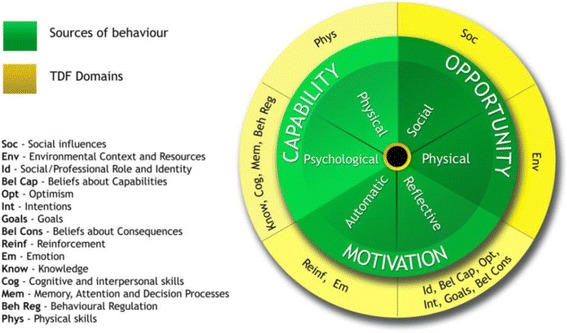
- The TDF is an integrated theoretical framework synthesised from 128 theoretical constructs from 33 theories; version 1 has 12 domains, and version 2 has 14 domains covering 84 theoretical constructs. It has been cited in over 800 peer-reviewed publications (Web of Knowledge accessed April 2017).
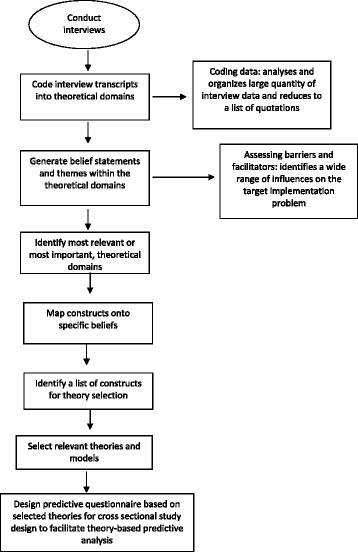
- The guide provides step-by-step methodological guidance for TDF-based implementation research, primarily qualitative interviews and focus groups: selecting and specifying target behaviours, selecting study design, deciding sampling strategy, developing interview schedules, collecting and analysing data, and reporting findings.
- Benefits of using the TDF include providing a theoretical basis for implementation studies, good coverage of potential reasons for slow diffusion of evidence into practice, and a method for progressing from theory-based investigation to intervention. Areas for development include methods for triangulating data (e.g., interviews, questionnaires, observation) and methods for designing interventions based on TDF-based problem analysis.
- Illustrative examples include a low back pain study with focus groups of 42 GPs and a cluster randomised trial randomising 47 practices (53 GPs) to control and 45 practices (59 GPs) to intervention; an SDD Delphi study that interviewed 141 participants; and a diabetes management qualitative systematic review that included 32 studies.
Methods
- Design: researchers from Canada, the UK and Australia attended a 3-day collaborative meeting in December 2012 to discuss the state of the science in using the TDF in implementation research and identify areas needing further development. Participants represented health psychology, sociology, implementation and health services research, statistics, and clinical disciplines including general practice, occupational therapy and chiropractic.
- Guide production: the group identified key steps in applying the TDF, pooled their experience and expertise to elaborate each step, and selected examples from the implementation research literature judged representative of specific TDF applications. The guide draws on the authors’ collective experience.
- Analysis: no datasets were generated or analysed for this article; the guide is a narrative, consensus-based resource focused mainly on qualitative approaches.
Limitations
- Stated in the paper: the scope is mostly limited to qualitative approaches, mainly interview and focus group data, with limited detail on using the TDF with other data collection methods such as survey or observation.
- Stated in the paper: illustrative applications were selected based on an informal rather than structured consensus process, leaving the possibility of selection bias in these examples; the aim was not to be representative but to provide examples across settings and implementation problems.
- Evident from the text: the guide is not a systematic review or an empirical validation of TDF application; its recommendations rest on the authors’ collective experience and selected illustrative examples.
Model-written summary. Check it against the paper before relying on it.
Integrity signals
Registry
Cites
Statistics
Figures
Verification
Claims the paper makes
25 Valid · 2 Not valid · 8 Not checked · 49 Own results and interpretations
Every source the paper cites for this claim was checked and supports it.
In the paper
“In an effort to make theories more accessible to those working in implementation, a team of behavioural scientists developed the TDF in collaboration with implementation researchers [15].”
§ A guide to using the Theoretical Domains Framework of behaviour change to investigate implementation problems > Development of the TDF
What the sources say
- Supportedcites [15] 15. Michie S, Johnston M, Abraham C, Lawton R, Parker D, Walker A, et al. Making psychological theory useful for implementing evidence based practice: a consensus approach. Qual Saf Health Care. 2005;14(1):26-33. source
The Discussion states that the project sought to simplify psychological theory and make it accessible to people involved in implementing evidence-based practice. The Health psychology theorists and Health services researchers sections describe the psychologists who developed the domains and the implementation researchers who evaluated them. Page numbers are not available in our copy. (LLM, conf=0.93)
plainstates a cause- Asserted: passes — The authors put it forward as true.
- Checkable: passes — It can be checked against evidence.
- Load-bearing: unclear — It is unclear whether the paper’s conclusions depend on it.
- Based: passes — The paper gives a reason why it holds.
- Supported
Every source the paper cites for this claim was checked and supports it.
In the paper
“The version of TDF, resulting from this validation, showed similar structure and content to the original with slight differences leading to 14 domains covering 84 theoretical constructs.”
§ A guide to using the Theoretical Domains Framework of behaviour change to investigate implementation problems > Development of the TDF
What the sources say
- Supportedcites [16] 16. Cane J, O'Connor D, Michie S. Validation of the theoretical domains framework for use in behaviour change and implementation research. Implement Sci. 2012;7:37. doi:10.1186/1748-5908-7-37. source
The Discussion reports good support for the TDF’s basic structure alongside refinements producing 14 domains. The Conclusions state that the refined framework contains 84 component constructs. (LLM, conf=0.93)
plainstates a cause- Asserted: passes — The authors put it forward as true.
- Checkable: passes — It can be checked against evidence.
- Load-bearing: unclear — It is unclear whether the paper’s conclusions depend on it.
- Based: passes — The paper gives a reason why it holds.
- Supported
The cited sources support only part of this claim — read each source’s verdict below.
In the paper
“The TDF is an integrated theoretical framework synthesised from 128 theoretical constructs from 33 theories judged most relevant to implementation questions.”
§ A guide to using the Theoretical Domains Framework of behaviour change to investigate implementation problems > Development of the TDF
What the sources say
- Partly supportedcites [15] 15. Michie S, Johnston M, Abraham C, Lawton R, Parker D, Walker A, et al. Making psychological theory useful for implementing evidence based practice: a consensus approach. Qual Saf Health Care. 2005;14(1):26-33. sourceExperimental — accuracy not yet measured
The Results report identifying 128 constructs drawn from 33 psychological theories, and the paper describes developing an integrative framework for implementation research. But the Simplifying into theoretical domains section says only a subset of those constructs was prioritised as particularly relevant; it does not say that all 128 were judged most relevant to implementation questions. Page numbers are unavailable in our copy. (LLM, conf=0.84)
plain- Asserted: passes — The authors put it forward as true.
- Checkable: passes — It can be checked against evidence.
- Load-bearing: unclear — It is unclear whether the paper’s conclusions depend on it.
- Based: passes — The paper gives a reason why it holds.
- Partly supported
Every source the paper cites for this claim was checked and supports it.
In the paper
“The Theoretical Domains Framework (TDF) was initially developed for implementation research to identify influences on health professional behaviour related to implementation of evidence-based recommendations and has been cited in over 800 peer-review publications (Web of Knowledge accessed April 2017).”
§ A guide to using the Theoretical Domains Framework of behaviour change to investigate implementation problems > Background
What the sources say
- Supportedcites [15] 15. Michie S, Johnston M, Abraham C, Lawton R, Parker D, Walker A, et al. Making psychological theory useful for implementing evidence based practice: a consensus approach. Qual Saf Health Care. 2005;14(1):26-33. source
The Abstract says the framework was developed for implementation research to study implementation of evidence-based practice and understand healthcare professionals’ behaviour. The Discussion says its theoretical domains were intended to explain failures to implement evidence-based practice. The separate publication-count statement is attributed to Web of Knowledge, not this source. (LLM, conf=0.93)
plain- Asserted: passes — The authors put it forward as true.
- Checkable: passes — It can be checked against evidence.
- Load-bearing: unclear — It is unclear whether the paper’s conclusions depend on it.
- Based: passes — The paper gives a reason why it holds.
- Supported
Every source the paper cites for this claim was checked and supports it.
In the paper
“The TDF underwent a validation exercise with an independent group of behavioural experts to investigate the optimal structure and content of the framework [16].”
§ A guide to using the Theoretical Domains Framework of behaviour change to investigate implementation problems > Development of the TDF
What the sources say
- Supportedcites [16] 16. Cane J, O'Connor D, Michie S. Validation of the theoretical domains framework for use in behaviour change and implementation research. Implement Sci. 2012;7:37. doi:10.1186/1748-5908-7-37. source
The Background states that the study aimed to validate the TDF’s optimal domain structure and content. The Materials > Procedure passage says participants had expertise in behaviour change theory and did not know the original framework, supporting the description of an independent group of experts. (LLM, conf=0.94)
plain- Asserted: passes — The authors put it forward as true.
- Checkable: passes — It can be checked against evidence.
- Load-bearing: unclear — It is unclear whether the paper’s conclusions depend on it.
- Based: passes — The paper gives a reason why it holds.
- Supported
16 more claims · 9 with their cited sources checked
Create a free account to see all 84 claims and every source verdict.
- Probably not a substantial claim. 59
- It may state two separate claims as one. 19
Claims other papers make about this one
Each is checked against this paper’s own text: does it say what the citing paper says it does?
The cited source says what the claim attributes to it.
In the citing paper
“The TDF organizes constructs across 14 domains, ranging from individual knowledge and skills to environmental context and social influences.”
The cited source says what the claim attributes to it.
In the citing paper
“The 14 domains of the TDF, described elsewhere [24], offer a concise coding framework that can be usefully conceptualized as possible targets for behavior change interventions.”
From Influences on the Uptake of and Engagement With Health and Well-Being Smartphone Apps: Systematic Review (2020) · cites this paper as [24]
Self-check
Percentages, sums and reported differences re-computed from the paper’s own numbers.
Each contradiction between two passages listed here was confirmed by an independent check.
Rated minor: it would not touch a result — a value no result rests on, a p-value that stays on the same side of the significance level, or a conflict that is clerical, resolved elsewhere in the paper, or outside its own findings.
In the paper
§ A guide to using the Theoretical Domains Framework of behaviour change to investigate implementation problems > 5. Collect the data
“In the example given above reported in Francis et al. [15], this step resulted in a list of belief statements supported by responses made in the interviews within each theoretical domain.”
§ A guide to using the Theoretical Domains Framework of behaviour change to investigate implementation problems > References
“15. Michie S, Johnston M, Abraham C, Lawton R, Parker D, Walker A, et al. Making psychological theory useful for implementing evidence based practice: a consensus approach.”
Rated minor: it would not touch a result — a value no result rests on, a p-value that stays on the same side of the significance level, or a conflict that is clerical, resolved elsewhere in the paper, or outside its own findings.
In the paper
§ A guide to using the Theoretical Domains Framework of behaviour change to investigate implementation problems > 3. Decide the sampling strategy
“## 3. Decide the sampling strategy”
§ A guide to using the Theoretical Domains Framework of behaviour change to investigate implementation problems > Conclusions
“| 3. Develop study materials | Although materials from previous studies may be | Requires in-depth understanding of the theoretical |”
Citations
Cites
Using thematic analysis in psychology
Braun, V., & Clarke, V. (2006) · Qualitative Research in Psychology · doi:10.1191/1478088706qp063oa · Cited by 194,414
The Measurement of Observer Agreement for Categorical Data
Landis, J. R., & Koch, G. G. (1977) · Biometrics · doi:10.2307/2529310 · Cited by 81,148 · cited 1×
“6 or percentage agreement > 60% is achieved [63].”
BackgroundThe Discovery of Grounded Theory: Strategies for Qualitative Research.
Wagner, H. R., Glaser, B. G., & Strauss, A. L. (1968) · Social Forces · doi:10.2307/2575405 · Cited by 46,361
Three Approaches to Qualitative Content Analysis
Hsieh, H.-F., & Shannon, S. E. (2005) · Qualitative Health Research · doi:10.1177/1049732305276687 · Cited by 44,601 · cited 1×
“theory and/or relevant research findings to interpret meaning from the content of qualitative data for initial codes [57].”
BackgroundThe Discovery of Grounded Theory; Strategies for Qualitative Research
Glaser, B. G., Strauss, A. L., & Strutzel, E. (1968) · Nursing Research · doi:10.1097/00006199-196807000-00014 · Cited by 39,449
(2006) · Cited by 18,730
Damschroder, L. J., Aron, D. C., Keith, R. E., Kirsh, S. R., Alexander, J. A., & Lowery, J. C. (2009) · Implementation Science · doi:10.1186/1748-5908-4-50 · Cited by 14,496 · cited 2×
“by Normalisation Process Theory [66], the Consolidated Framework For Implementation Research [67] and the Yorkshire Contributory Factors Framework [68].”
MethodHao (2015) · doi:10.1002/14651858 · Cited by 11,321
Developing and evaluating complex interventions: the new Medical Research Council guidance
Craig, P., Dieppe, P., Macintyre, S., Michie, S., Nazareth, I., & Petticrew, M. (2008) · BMJ · doi:10.1136/bmj.a1655 · Cited by 10,995
Self-citationQualitative research practice: a guide for social science students and researchers
(2003) · Choice Reviews Online · doi:10.5860/choice.41-1319 · Cited by 10,543
Cited by
Items 1,201–1,300 of 3,792
Bion, J., Brookes, O., Brown, C., Tarrant, C., Archer, J. C., Buckley, D., Buckley, L. M., Clement', I., Evison, F., Smith, F. G., et al. (2020) · Health Services and Delivery Research · doi:10.3310/hsdr08320 · Cited by 9
Davidson, Z. E., Bray, P., Röse, K., Rodrigues, M. J., Corben, L. A., North, K. N., Ryan, M. M., Burns, J., & the Clinical Practice Guideline Development Group (2021) · Disability and Rehabilitation · doi:10.1080/09638288.2021.1936221 · Cited by 8
A model of integrated remote monitoring and behaviour change for osteoarthritis
Tack, C. (2021) · BMC Musculoskeletal Disorders · doi:10.1186/s12891-021-04555-4 · Cited by 10
“The Theoretical Domains Framework (TDF) was developed to simplify behaviour change theory to assist evidence based implementation [10].”
BackgroundO’Connor, A., Tai, A., Kopsaftis, Z., & Carson‐Chahhoud, K. (2021) · International Journal of Qualitative Methods · doi:10.1177/16094069211042229 · Cited by 9
“It provides an understanding of behaviour change and forms a basis for exploring implementation problems allowing for our intervention design and application in the real world to be successful (Atkins et al., 2017).”
BackgroundHaskell, L., Tavender, E. J., O’Brien, S., Wilson, C. L., Babl, F. E., Borland, M. L., Schembri, R., Orsini, F., Cotterell, E., Sheridan, N., et al. (2021) · BMC Health Services Research · doi:10.1186/s12913-021-07279-2 · Cited by 10
“Interventions were developed using a stepped theory-informed approach: 1) five key evidence-based recommendations were identified from the Australasian Bronchiolitis Guideline [5], 2) a qualitative study of clinicians in Australia and New Zealand identified factors perceived to influence the treatment of infants with…”
BackgroundMethodInfluentialKwok, E. Y. L., Moodie, S., Cunningham, B. J., & Cardy, J. O. (2021) · Journal of Communication Disorders · doi:10.1016/j.jcomdis.2021.106166 · Cited by 10
Evaluation of a Genetics Education Program for Health Interpreters: A Pilot Study
Vidgen, M. E., Fowles, L., Istiko, S. N., Evans, E., Cutler, K., Sullivan, K., Bean, J., Healy, L., Hondow, G., McInerney-Leo, A. M., et al. (2022) · Frontiers in Genetics · doi:10.3389/fgene.2021.771892 · Cited by 8
“The questionnaire applied the Theoretical Domains Framework (Atkins et al., 2017) as the underlying concept to frame questions to investigate participant changes: knowledge, attitudes, self-efficacy, selfseeking behavior for education, and self-reported practice behaviour.”
MethodEnhancing pharmacy practice doctoral research with patient and public involvement
Youssef, E., Mellor, D., Walkerly, S., & Wright, D. J. (2022) · International Journal of Pharmacy Practice · doi:10.1093/ijpp/riac014 · Cited by 8
Barriers and Enablers to Delegating Malnutrition Care Activities to Dietitian Assistants
Rushton, A., Bauer, J. D., Young, A., Keller, H., & Bell, J. (2022) · Nutrients · doi:10.3390/nu14051037 · Cited by 8
Redley, B., Taylor, N. J., & Hutchinson, A. M. (2022) · Journal of Advanced Nursing · doi:10.1111/jan.15269 · Cited by 7
“For example, high scores for items related to behavioural regulation indicated the quality of care benefits were derived from nurses' behaviours related to self- monitoring, memory, attention and decision- making (Atkins et al., 2017).”
BackgroundMethodResultInfluentialIssac, H., Moloney, C., Taylor, M., et al. (2022) · Cited by 8
Leeman, J., Wangen, M., Kegler, M. C., Lee, M., O’Leary, M. C., Ko, L. K., Fernández, M. E., & Birken, S. A. (2022) · Frontiers in Health Services · doi:10.3389/frhs.2022.889786 · Cited by 16
Developing a primary care-initiated hepatitis C treatment pathway in Scotland: a qualitative study
Whiteley, D., Speakman, E. M., Elliott, L., Jarvis, H., Davidson, K., Quinn, M., & Flowers, P. (2022) · British Journal of General Practice · doi:10.3399/bjgp.2022.0044 · Cited by 9
Schmid‐Mohler, G., Hübsch, C., Steurer-Stey, C. A., Greco, N., Schuurmans, M. M., Beckmann, S., Chadwick, P., & Clarenbach, C. F. (2022) · International Journal of COPD · doi:10.2147/copd.s358426 · Cited by 8
“Influences on each target behavior were identified by analyzing evidence both from the literature – including patient perspective - and from health professionals, then deductively coding the resulting data using the COM-B model of behavior and the TDF.(24) Coding was done by one person (GSM) and reviewed by another (C…”
MethodCan behavior change techniques be delivered via short text messages?
Doğru, O. C., Webb, T. L., & Norman, P. E. (2022) · Translational Behavioral Medicine · doi:10.1093/tbm/ibac058 · Cited by 8
Patel, A., Sims, E. J., Blacklock, J., Birt, L., Bion, V., Clark, A., Griffiths, A. W., Guillard, C., Hammond, A., Holland, R., et al. (2022) · Trials · doi:10.1186/s13063-022-06925-2 · Cited by 8
“We therefore developed our intervention by first mapping the known individual-level barriers to the Theoretical Domains Framework (TDF), which is a synthesis of several behavioural science theories [21].”
MethodIankilevitch, M., Singh, G., & Russo, F. (2022) · Ear and Hearing · doi:10.1097/aud.0000000000001311 · Cited by 10
Bar, L., Marks, D., & Brandis, S. J. (2023) · Patient Preference and Adherence · doi:10.2147/ppa.s390123 · Cited by 8
“This is an iteration of the popular Theoretical Domains Framework (TDF).(39) The BCW claims to be more flexible than the TDF alone, however the TDF is often used alongside it.”
BackgroundMethodEmpowering Tennessee Pharmacists to Initiate PrEP Using Collaborative Pharmacy Practice Agreements
Cernasev, A., Barenie, R. E., Wofford, B. R., Golden, J., & Walker, C. M. (2023) · Clinics and Practice · doi:10.3390/clinpract13010025 · Cited by 8
“The research team adopted the theoretical domains framework (TDF) to collect necessary data to achieve the aim of this study [22].”
MethodCoteur, K., Nuland, M. V., Schoenmakers, B., Anthierens, S., & den Broeck, K. V. (2023) · JMIR Formative Research · doi:10.2196/43738 · Cited by 10
van der Zande, R. L., Koster, E. S., Teichert, M., & Bouvy, M. L. (2023) · International Journal of Clinical Pharmacy · doi:10.1007/s11096-023-01571-3 · Cited by 14
“Thus, this study adopts an explorative, qualitative approach based on the TDF [12, 14].”
BackgroundMethodInfluentialUnderstanding Intraoperative Transfusion Decision-Making Variability: A Qualitative Study
Lenet, T., Tropiano, J., Skanes, S., Ivankovic, V., Verret, M., McIsaac, D. I., Tinmouth, A. T., Nicholls, S. G., Patey, A. M., Fergusson, D. A., et al. (2023) · Transfusion Medicine Reviews · doi:10.1016/j.tmrv.2023.150726 · Cited by 12
Self-citationLauretta, M. L., Jarmolowicz, A. I., Amor, D. J., Best, S., & Morgan, A. T. (2023) · Journal of Speech Language and Hearing Research · doi:10.1044/2023_jslhr-22-00714 · Cited by 8
Coteur, K., Peters, S., Jansen, P., Schoenmakers, B., & Nuland, M. V. (2023) · Health Expectations · doi:10.1111/hex.13888 · Cited by 11
“Given the TDF ‘ provides a theoretical lens through which to view the cognitive, affective, social and environmental influences on behaviour 35,p.2 , this mapping activity enabled us to identify key messages concerning the factors that contribute to long ‐ term BZRA use for insomnia in primary care.”
BackgroundVinogradov, R., Smith, V., Hiu, S. K. W., McParlin, C., Farnworth, A., & Araújo‐Soares, V. (2023) · Midwifery · doi:10.1016/j.midw.2023.103860 · Cited by 13
Lynch, T., Ryan, C. A., Presseau, J., Foster, D. E., Huff, C., Bennett, K., & Cadogan, C. A. (2023) · Research in Social and Administrative Pharmacy · doi:10.1016/j.sapharm.2023.10.015 · Cited by 12
Bhuiya, A. R., Sutherland, J., Boateng, R., Bain, T., Skidmore, B., Perrier, L., Makarski, J., Munce, S., Lewis, I., Graham, I. D., et al. (2023) · Journal of Clinical Epidemiology · doi:10.1016/j.jclinepi.2023.10.021 · Cited by 13
Leece, P., Khorasheh, T., Corace, K. M., Strıke, C., Bayoumi, A. M., Taha, S. A., Marks, E., Pach, B., Ahamad, K., Grennell, E., et al. (2019) · BMJ Open · doi:10.1136/bmjopen-2019-032285 · Cited by 8
“37 The TDF is a synthesis of 33 theories relevant to behaviour change into twelve domains, and then revised to 14 domains, that influence behaviour change: knowledge; skills; social/professional role and identity; beliefs about capabilities; optimism; beliefs about consequences; reinforcement;…”
BackgroundMcKinney, A., Fitzsimons, D., Blackwood, B., White, M., & McGaughey, J. (2020) · Journal of Advanced Nursing · doi:10.1111/jan.14365 · Cited by 10
“The TDF is a comprehensive framework that is considered to be particularly suitable for implementation researchers as it addresses the behaviour change factors that are relevant for the successful implementation of an intervention (Atkins et al., 2017).”
BackgroundMethodMacLennan, S. J., & MacLennan, S. (2020) · Frontiers in Oncology · doi:10.3389/fonc.2020.00465 · Cited by 8
“, using the theoretical domains framework (19)].”
Barnhart, D. A., Semrau, K. E. A., Zigler, C. M., Molina, R. L., Delaney, M. M., Hirschhorn, L. R., & Spiegelman, D. L. (2020) · Implementation Science Communications · doi:10.1186/s43058-020-00014-8 · Cited by 13
Khandpur, N., Sato, P. D. M., Neto, J. R. G., Scagliusi, F. B., & Jaime, P. C. (2020) · Nutrition Journal · doi:10.1186/s12937-020-00585-1 · Cited by 8
on behalf of the Study Group ALS Home-monitoring and Coaching, Dontje, M. L., Reenen, E. T. K., Visser‐Meily, J. M. A., & Beelen, A. (2021) · Implementation Science Communications · doi:10.1186/s43058-021-00130-z · Cited by 11
Morton, K., Mhlakwaphalwa, T., Msimango, L., van Heerden, A. C., Ngubane, T., Joseph, P., Ngcobo, N., Feng, Z., Hosegood, V., van Rooyen, H., et al. (2021) · BMJ Open · doi:10.1136/bmjopen-2020-047408 · Cited by 8
Gebran, E., Antoniou, M., Samtani, S., Brookman, R., & Siette, J. (2025) · Dementia · doi:10.1177/14713012251412051 · Cited by 7
Fasugba, O., McInnes, E., Baye, J., Cheng, H., Gordon, R., & Middleton, S. (2021) · Journal of Hospital Infection · doi:10.1016/j.jhin.2021.03.028 · Cited by 10
Factors that influence oral hygiene care with hospitalised stroke patients: a mixed methods study
Klaic, M., Seng, E., & McGrath, R. (2021) · Disability and Rehabilitation · doi:10.1080/09638288.2021.2003450 · Cited by 8
Measuring the determinants of implementation behavior in multiprofessional rehabilitation
Paukkunen, M., Ala‐Mursula, L., Öberg, B. E., Karppinen, J. I., Sjögren, T., Riska, H., Nikander, R., & Abbott, A. D. (2023) · European Journal of Physical and Rehabilitation Medicine · doi:10.23736/s1973-9087.23.07857-7 · Cited by 12
Kukula, V. A., Odopey, S. A., Arthur, E., Odonkor, G., Awini, E., Adjei, A., Salami, O., Nkeramahame, J., Horgan, P., Olliaro, P., et al. (2023) · Clinical Infectious Diseases · doi:10.1093/cid/ciad327 · Cited by 7
“The study undertook a content analysis of primary, qualitative data collection using in-depth interviews and focus group discussions, informed by the Capability, Opportunity, Motivation (COM-B) theory of behavior, the Theoretical Domains Framework (TDF), and Behavior Change Wheel (BCW) approach, in health facilities (…”
BackgroundInfluentialVirtual Teaching Together: engaging parents and young children in STEM activities
Zucker, T. A., Mesa, M. P., Assel, M., McCallum, C., & DeMaster, D. (2024) · Frontiers in Psychology · doi:10.3389/fpsyg.2023.1334195 · Cited by 14
Grundy, A. C., Brooks, C. P., Johnston, I., et al. (2024) · Journal of Psychiatric and Mental Health Nursing · doi:10.1111/jpm.13074 · Cited by 7
von Auer, C., Probst, M., Schneider-Bachart, W., & Gaube, S. (2024) · PLoS ONE · doi:10.1371/journal.pone.0315456 · Cited by 12
Barriers and enablers to opioid deprescription: A qualitative study
Lawrence, R., Versteeg, E., Pike, A. I., Etchegary, H., & Hall, A. M. (2025) · PLoS ONE · doi:10.1371/journal.pone.0316730 · Cited by 7
“We used the Atkins et al [23] guide to direct our analysis, thereby allowing us to produce results that can be used to develop a theory-based intervention that includes evidence-and empirically-based strategies to tackle identified barriers to opioid deprescription.”
InfluentialIanni, L., Camden, C., Campbell, W. N., Colquhoun, H. L., & Anaby, D. (2025) · Canadian Journal of Occupational Therapy · doi:10.1177/00084174241310078 · Cited by 16
“…of behavioral change and the determinants of successful collaboration by San Martín-Rodríguez et al. (2005) and by the Theoretical Domains Framework (TDF) (Atkins et al., 2017), to identify factors in fl uencing collaboration and the factors that would need to change to improve collaboration.”
Self-citationElshazly, M., Jawad, S., Ahmed, A., ElGeed, H. A., & Yusuff, K. B. (2025) · PLoS ONE · doi:10.1371/journal.pone.0316363 · Cited by 7
Xu, R., Sun, Y., Liu, Y., Pan, J., Han, Y., Zhang, X., Zhao, H., Li, M., Wu, Y., Yu, C., et al. (2025) · Frontiers in Medicine · doi:10.3389/fmed.2025.1501918 · Cited by 7
Dunlop, K. L. A., Singh, N., Smit, A. K., Morrow, A., Steinberg, J., Cust, A. E., Makeham, M., Bonner, C., Terrill, B., Monrouxe, L. V., et al. (2025) · Frontiers in Medicine · doi:10.3389/fmed.2025.1577958 · Cited by 10
“…and enablers) and inductive analysis to determine implications as follows: A Behavioural Domains using the Theoretical Domains Framework (TDF): The TDF has been applied across a broad range of healthcare settings and behaviours to categorize barriers and enablers, including in genomics uptake (11).”
Arana‐Chicas, E., Zhang, Y., Chávez‐Iñiguez, A., Lin, P., Mattick, L. J., Kamen, C. S., Clark, V., Cartujano‐Barrera, F., & Mustian, K. M. (2025) · BMC Cancer · doi:10.1186/s12885-025-14182-0 · Cited by 16
“A structured, problem-focused approach, such as the Theoretical Domains Framework [80], can improve the design and documentation of theory application while providing evidence to support effective behavior change strategies.”
Kilfoy, A., Zaffino, I., McAtee, E., Panesar, P., Cleverley, K., Phạm, Q., Chu, C. H., & Jibb, L. (2025) · BMC Pediatrics · doi:10.1186/s12887-025-05656-y · Cited by 15
“Although this approach has been inconsistently applied, the importance of grounding intervention features and function in behavioral change frameworks or models to enhance impact has been previously demonstrated and is reflected in our findings [217].”
Atzmon, O., Crowther, M. E., Bei, B., & O’Connor, D. A. (2025) · Implementation Science · doi:10.1186/s13012-025-01435-6 · Cited by 14
“This trend may also be influenced by recent efforts to categorise TMFs [4] and provide pragmatic guides for researchers on how to utilise TMFs in implementation projects [100, 101].”
Self-citationA beginner's guide to implementation science
de Waard, D., Gainer, R. A., Sim, M., Cote, C. L., Tremblay, P., Bonnar, P., & Hirsch, G. M. (2025) · JTCVS Techniques · doi:10.1016/j.xjtc.2025.05.005 · Cited by 11
“Many frameworks/models are centered around behavior change, including the Theoretical Domains Framework 12 and the COM-B Model of Behavior and related Behavior Change Wheel.”
Khosropour, C. M., Healy, E., Murphy, E. M., et al. (2025) · Frontiers in Health Services · doi:10.3389/frhs.2025.1567688 · Cited by 7
“We used the Capability, Opportunity, Motivation-Behavior (COM-B) Model (16) and Theoretical Domains Framework (TDF) (17) in this study.”
InfluentialBarriers and Facilitators to Smoking Cessation Among University Students: A Scoping Review
Alanazi, F., Mohamed, W. J. M., Konstantinidis, S. T., & Blake, H. (2025) · International Journal of Environmental Research and Public Health · doi:10.3390/ijerph22060947 · Cited by 12
“The TDF was used to categorize the barriers and facilitators identified in the included studies [36].”
Berners-Lee, W., Cabecinha, M., Bell, J., Phillips, D., Witney, T., Pulford, C. V., Lorencatto, F., Fifer, H., Foster, K., Mohammed, H. P., et al. (2025) · Sexually Transmitted Infections · doi:10.1136/sextrans-2025-056556 · Cited by 7
Spaan, J., Westenberg, L. E. H., Ista, E., van der Geest, B. A. M., Reiss, I. K. M., Willemsen, S. P., Hulzebos, C. V., & Been, J. V. (2025) · Pediatric Research · doi:10.1038/s41390-025-04313-5 · Cited by 7
Systematic review of clinical practice guidelines on acupuncture for chronic musculoskeletal pain
Ho, L. T. F., Lai, C. N. T., Chen, H., Law, S. W., Yu, E., Lam, F. P. Y., Cheung, Y. C., Wu, I. X., Wong, S. Y. S., & Sit, R. W. S. (2025) · BMC Complementary Medicine and Therapies · doi:10.1186/s12906-025-05070-y · Cited by 9
“To enhance the adoption of acupuncture CPGs for managing chronic musculoskeletal pain, future research may benefit from incorporating stakeholder interviews guided by established implementation science frameworks, such as the Theoretical Domains Framework (TDF) [28].”
Mitri, E. A., Fletcher, L. R., Paynter, C., Vogrin, S., James, F., Ng, I., Holmes, N. E., Ierano, C., Roberts, J. A., Fernando, S. L., et al. (2025) · PLoS ONE · doi:10.1371/journal.pone.0330724 · Cited by 7
“Available from: https://cdn.who.int/media/docs/default-source/gcp/who-mia-list-2024-lv.pdf). utilising the Theoretical Framework [36], to ascertain feedback on the content, design and delivery of the Health Service Report, taking into account contextual influences (S1 Manual).”
Parslow, R. M., Gibbison, B., Pufulete, M., Rowan, K., Moore, A. J., & the OPTIC Study Group (2025) · Anaesthesia · doi:10.1111/anae.70017 · Cited by 10
“Pilot interviews were conducted with four clinicians to iteratively develop the topic guide [16].”
InfluentialPop-Vicas, A. E., Young, A., Knobloch, M.-J., Heise, C. P., Bowers, B. J., & Safdar, N. (2021) · Infection Control and Hospital Epidemiology · doi:10.1017/ice.2021.161 · Cited by 7
“Future research should evaluate (1) how prevention strategies tailored to surgeons’ mental models influence adherence, (2) whether increased adherence translates into significant SSI reductions, and (3) whether this success promotes a “SSI as preventable rather than inevitable” viewpoint.”
BackgroundInfluentialBale, T. L. A., Ramukumba, T. S., & Mudau, L. S. (2021) · Southern African Journal of Infectious Diseases · doi:10.4102/sajid.v36i1.255 · Cited by 7
To, D., Hall, A. M., Bussières, A., French, S. D., Lawrence, R., Pike, A. E., Patey, A. M., Brake-Patten, D., O’Keefe, L., Elliott, B., et al. (2022) · Chiropractic & Manual Therapies · doi:10.1186/s12998-022-00433-5 · Cited by 10
“Strengths and limitations A strength of our study is that we used the TDF to identify barriers and enablers to the adherence to radiographic guidelines for LBP, which may be used to inform the design of behaviour change interventions targeted at reducing non-indicated imaging for LBP [19].”
BackgroundMethodInfluentialSelf-citationDavison, S. N., Steinke, V., Wasylynuk, B. A., & Holroyd-Leduc, J. M. (2022) · BMJ Open · doi:10.1136/bmjopen-2021-054422 · Cited by 8
Sedekia, Y., Kapiga, S., Mcharo, O., Makata, K., Torondel, B., Dreibelbis, R., & Okello, E. S. (2022) · PLoS neglected tropical diseases · doi:10.1371/journal.pntd.0010438 · Cited by 9
“We employed thematic analysis that involved i) familiarization of data through re-listening to audio and/or rereading of transcripts and field notes; ii) initial coding guided by the COM-B Framework [29,31]; iii) searching for themes; iv) reviewing themes; v) defining and naming themes; vi) and writing up the report […”
MethodMiddleton, K., Williams, C., Bernard, D., Gautham, K. S., & Shivananda, S. P. (2022) · Canadian Journal of Respiratory Therapy · doi:10.29390/cjrt-2021-075 · Cited by 8
“We used TDF to specify the intended target behavior [18, 19] (Supplementary Tables 1 and 2(1)).”
BackgroundMethodInfluentialStillianesis, G., Cavaleri, R., Summers, S. J., & Tang, C. Y. (2022) · BMJ Open · doi:10.1136/bmjopen-2021-058928 · Cited by 9
ElChamaa, R., SEELY, A. J. E., Jeong, D., & Kitto, S. C. (2022) · Journal of Continuing Education in the Health Professions · doi:10.1097/ceh.0000000000000461 · Cited by 10
“It is a theoretical lens that can be used to view the cognitive, affective, social, and environmental influences on behavior.(35) The TDF has been used to identify barriers and facilitators to behavior change in health professionals, to inform the development of interventions, and for identifying implementation proble…”
BackgroundAntwi, W. K., & Aziato, L. (2022) · Radiography · doi:10.1016/j.radi.2022.11.012 · Cited by 7
Gray, C. S., Yao, X., Babl, F. E., Dalziel, S. R., Powell, C., Chong, S., Roland, D., Lyttle, M. D., Fernandes, R. M., Benito, J., et al. (2023) · BMJ Open Respiratory Research · doi:10.1136/bmjresp-2022-001502 · Cited by 9
Musselman, K. E., Provad, E., Djuric, A., Bercovitch, D., Yuen, I., & Kane, K. (2023) · Physical & Occupational Therapy In Pediatrics · doi:10.1080/01942638.2023.2197053 · Cited by 9
“TDF: Theoretical Domains Framework (Atkins et al., 2017); FES: functional electrical stimulation.”
BackgroundInfluentialDhaliwal, K. K., Watson, K. E., Lamont, N. C., Drall, K. M., Donald, M., James, M. T., Robertshaw, S., Verdin, N., Benterud, E., McBrien, K., et al. (2023) · Health Expectations · doi:10.1111/hex.13789 · Cited by 6
“F IGURE 1 Findings relevant to theoretical domains framework (TDF).(23) HCP, healthcare providers; SDG, sick day guidance.”
BackgroundInfluentialHiggins, E., & Booker, R. (2023) · International Journal of Wellbeing · doi:10.5502/ijw.v13i2.2833 · Cited by 18
“…for implementation research to identify influences on health professional behaviour related to implementation of evidence-based recommendations and has been cited in over 800 peer-review publications making it one of the most commonly used frameworks in implementation science (Atkins et al., 2017).”
Chen, Y., Prichard, R. A., Mason, M., Tower, M., Zimmerman, P.-A. P., Sparke, V., Layh, J., Mehdi, A. M., & Lin, F. F. (2023) · Journal of Public Health Policy · doi:10.1057/s41271-023-00422-9 · Cited by 8
“derived this framework from 33 psychological theories and 128 theoretical constructs organised into 14 domains [7] to assess cognitive, affective, social, and environmental factors that may influence behaviour [9].”
MethodFoye, U., Appleton, R., Nyikavaranda, P., Lyons, N., Dare, C. R. J., Lynch, C., Persaud, K., Ahmed, N., Stuart, R., Schlief, M., et al. (2023) · BMC Health Services Research · doi:10.1186/s12913-023-10058-w · Cited by 9
Sabanovic, H., Brooy, C. L., Méndez, S. J., et al. (2023) · Social Science & Medicine · doi:10.1016/j.socscimed.2023.116353 · Cited by 7
Best, S., Long, J. C., Fehlberg, Z., Taylor, N. J., Ellis, L. A., Boggs, K., & Braithwaite, J. (2023) · BMC Health Services Research · doi:10.1186/s12913-023-10053-1 · Cited by 8
“…of behaviours and displayed personal qualities of an individual in a social or work setting) and emotion (i.e., a complex reaction pattern, involving experiential, behavioural, and physiological elements, by which the individual attempts to deal with a personally significant matter or event) [17].”
BackgroundCo‐development and evaluation of the Musculoskeletal Telehealth Toolkit for physiotherapists
Ezzat, A. M., King, M., Silva, D. D. O., Pazzinatto, M. F., Cañeiro, J. P., Gourd, S., McGlasson, R. A., Malliaras, P., Dennett, A. M., Russell, T. G., et al. (2023) · Musculoskeletal Care · doi:10.1002/msc.1840 · Cited by 9
Barriers and facilitators to improving the cascade of HIV care in Ontario: a mixed method study
Mbuagbaw, L. C. E., Fernando, S., Lee, C., Owino, M., Youssef, C., & Snow, M. E. (2024) · BMC Health Services Research · doi:10.1186/s12913-023-10481-z · Cited by 8
“It has been used successfully in the exploration of barriers and facilitators to implementing evidence-based behaviours [29].”
MethodDamen, M. A. W., Detaille, S. I., Engels, J. A., & de Lange, A. (2024) · International Journal of Environmental Research and Public Health · doi:10.3390/ijerph21010116 · Cited by 12
Schuhmacher, S., Gaid, D., Bishop, L. D., Fleming, L., & Donnan, J. R. (2024) · PLoS ONE · doi:10.1371/journal.pone.0295858 · Cited by 11
Ramanathan, S., Yan, C. H., Suda, K. J., Evans, C. T., Khouja, T., Hershow, R. C., Rowan, S. A., Gross, A. E., Sharp, L. K., & National Dental PBRN Collaborative Group (2024) · Journal of Public Health Dentistry · doi:10.1111/jphd.12611 · Cited by 12
Knight, S., Rodda, J., Tavender, E. J., Anderson, V. A., Lannin, N. A., & Scheinberg, A. M. (2024) · Brain Impairment · doi:10.1071/ib23103 · Cited by 7
Exploring the content and delivery of feedback facilitation co-interventions: a systematic review
Sykes, M., Rosenberg-Yunger, Z. R. S., Quigley, M., Gupta, L., Thomas, O., Robinson, L., Caulfield, K., Ivers, N., & Alderson, S. (2024) · Implementation Science · doi:10.1186/s13012-024-01365-9 · Cited by 7
Self-citationWatson‐Mackie, K., Arundell, L., Lander, N., McKay, F. H., Jerebine, A., Venetsanou, F., & Barnett, L. M. (2024) · Journal of Medical Internet Research · doi:10.2196/52302 · Cited by 19
“The different characteristics of the studies, including study designs, PA outcomes, and measurement tools should be considered; for example, theory-based interventions are reported to result in better outcomes and have more generalizable findings than those that are not [84,85].”
Ho, L. T. F., Kwong, M. H., Li, A. S., Nilsén, P., Ho, F. F., Zhong, C. C., Wong, C. H. L., Lin, W. L., & Chung, V. C. (2024) · Frontiers in Public Health · doi:10.3389/fpubh.2024.1414297 · Cited by 9
“The target sample size of 25 (at least 15 with IO experience plus at least 10 without IO experience) fulfilled the number of participants expected to achieve saturation in implementation research ( n = 16–24) (30, 31).”
BackgroundA mixed methods study of suicide protective factors in college students
Cecchin, H. F. G., da Costa, H. E. R., Pacheco, G. R., de Valencia, G. B., & Murta, S. G. (2024) · Psicologia Reflexão e Crítica · doi:10.1186/s41155-024-00315-0 · Cited by 38
“Furthermore, psychotherapy is central to producing the desired change, presenting a “spillo-ver” effect (Atkins et al., 2017), that is, a positive effect on other related behaviors when the change occurs, such as a decrease in social anxiety and an increase in the person’s socialization, and…”
BackgroundBell, J., Mitchell, R. J., Harris, I. A., Seymour, H., Armstrong, E. G., Harris, R. G., Fleming, S., Hurring, S., & Close, J. (2024) · Healthcare · doi:10.3390/healthcare12212157 · Cited by 8
Powell, N., Upton, M., Kent, B., Sandoe, J. A. T., & Tonkin-Crine, S. K. (2025) · BMJ Open · doi:10.1136/bmjopen-2024-096452 · Cited by 7
“26 The BCW provides a systematic way of characterising interventions, their mechanisms of action and link intervention components to outcomes.”
Leigh, J. P., Petersen, J. A., de Grood, C., Whalen-Browne, L., Niven, D. J., & Stelfox, H. T. (2019) · BMJ Open · doi:10.1136/bmjopen-2019-033333 · Cited by 6
Crawshaw, J., Presseau, J., van Allen, Z., Carvalho, L. P., Jordison, K., English, S. W., Fergusson, D. A., Lauzier, F., Turgeon, A. F., Sarti, A. J., et al. (2019) · BMJ Open · doi:10.1136/bmjopen-2019-034594 · Cited by 7
“We will assess the relevance of constructs/ domains based on three factors, as per recommendations in the literature 17 : frequency of shared beliefs across respondents, incidence of conflicting beliefs and particular emphasis of the importance of a given belief in every respondent experience.”
MethodO'Mahony, B., Kerins, C., Murrin, C. M., & Kelly, C. N. M. (2020) · HRB Open Research · doi:10.12688/hrbopenres.13041.3 · Cited by 10
Colquhoun, H. L., Islam, R., Sullivan, K., Sandercock, J., Steinwender, S., & Grimshaw, J. (2020) · Occupational Therapy International · doi:10.1155/2020/3549835 · Cited by 10
“Of note is that this TDF study was conducted prior to the publication of a TDF guide [34].”
BackgroundSelf-citationCadogan, C. A., Rankin, A., Lewin, S. A., & Hughes, C. M. (2020) · HRB Open Research · doi:10.12688/hrbopenres.13044.1 · Cited by 6
Curtis, K. A., Ellwood, J., Walker, A. R., Qian, S., Delamont, P., Yu, P., Stojic, J., & Phang, S. M. (2020) · Australasian Emergency Care · doi:10.1016/j.auec.2020.08.007 · Cited by 8
Mackie, B. R., Mitchell, M. L., & Schults, J. A. (2020) · Australian Critical Care · doi:10.1016/j.aucc.2020.07.010 · Cited by 7
Kostick, K. M., Trejo, M. B., Bhimaraj, A., Civitello, A. B., Grinstein, J., Horstmanshof, D., Jorde, U. P., Loebe, M. M., Mehra, M. R., Sulemanjee, N., et al. (2021) · BMC Medical Informatics and Decision Making · doi:10.1186/s12911-021-01468-z · Cited by 8
Gray, K. L., Grebenshchikova, M., O'Reilly, S. L., McKellar, L. V., Clifton, P. M., & Keogh, J. B. (2021) · International Journal of Environmental Research and Public Health · doi:10.3390/ijerph18020480 · Cited by 8
Karppinen, J. I., Simula, A. S., Holopainen, R., Lausmaa, M., Remes, J., Paukkunen, M., Ussing, K., Booth, N., Ryynänen, K., Koski, T. P. K., et al. (2021) · Health Science Reports · doi:10.1002/hsr2.251 · Cited by 13
Backman, C., Wooller, K. R., Saraqini, D. H., Varin, M. D., Crick, M., Cho-Young, D., Freeman, L., Delaney, L., & Squires, J. E. (2021) · Nursing Open · doi:10.1002/nop2.920 · Cited by 10
“All 14 TDF domains were relevant to the use of the CAUTI protocol.”
BackgroundMethodInfluentialHutchesson, M., Rollo, M. E., Burrows, T. L., McCaffrey, T. A., Kirkpatrick, S. I., Kerr, D. A., Truby, H., Clarke, E. D., & Collins, C. E. (2021) · Nutrition & Dietetics · doi:10.1111/1747-0080.12692 · Cited by 7
Anderson, N., Kesten, J. M., Ayres, R. M., Hickman, M., Amlôt, R., Michie, S., & Lorencatto, F. (2021) · International Journal of Drug Policy · doi:10.1016/j.drugpo.2021.103437 · Cited by 8
Self-citation
Metadata
- Authors
- Atkins, L., Francis, J., Islam, R., O’Connor, D., Patey, A., Ivers, N., Foy, R., Duncan, E. M., Colquhoun, H., Grimshaw, J. M., Lawton, R., & Michie, S.
- Affiliations
- University College London (GB)
- University of London (GB)
- Ottawa Hospital Research Institute (CA)
- Monash University (AU)
- University of Toronto (CA)
- University of Leeds (GB)
- University of Aberdeen (GB)
- University of Ottawa (CA)
- Corresponding author
- Atkins, Lou
- ORCID
- Venue
- Implementation Science
- Published
- 2017-06-21
- Volume
- 12
- Issue
- 1
- Pages
- 77-77
- ISSN
- 1748-5908 (ISSN-L)
- PMC
- PMC5480145
- OpenAlex
- W2674995983
- Semantic Scholar
- 7ae5ea98c6f51755ffa2f67330dea33e0663f161
- Cited by
- 3,819
- References
- 87
- Citations by year
- 2026: 501 · 2025: 619 · 2024: 623 · 2023: 531 · 2022: 554 · 2021: 437 · 2020: 309 · 2019: 160 · 2018: 67 · 2017: 12
- FWCI
- 242.11
- Type
- journal article
- Language
- en
- Open access
- gold
- doi.org
- Licence
- cc-by
- Locations
- Implementation Science (publishedVersion, cc-by)
- Europe PMC (PubMed Central) (publishedVersion, other-oa)
- PubMed Central (publishedVersion, cc-by)
- PubMed (publishedVersion)
- UCL Discovery (University College London) (publishedVersion)
- White Rose Research Online (University of Leeds, The University of Sheffield, University of York) (acceptedVersion)
- TSpace (University of Toronto) (acceptedVersion, cc-by)
- City Research Online (City University London) (acceptedVersion)
- Monash University Research Portal (Monash University) (submittedVersion, other-oa)
- Aberdeen University Research Archive (Aberdeen University) (submittedVersion)
- DOAJ (DOAJ: Directory of Open Access Journals) (submittedVersion, cc-by-sa)
- Minerva Access (University of Melbourne) (submittedVersion, cc-by)
- Funders
- Canadian Institutes of Health Research
- Topics
- Health Sciences › Health Professions › General Health Professions › Health Policy Implementation Science
- Social Sciences › Psychology › Applied Psychology › Behavioral Health and Interventions
- Health Sciences › Health Professions › General Health Professions › Health Sciences Research and Education
- Keywords
- Theoretical Domains Framework, behavior change, implementation problems, implementation research, behavioral factors, intervention design, qualitative research
- MeSH terms
- Australia, Canada, Diffusion of Innovation, United Kingdom, Health Plan Implementation, Health Services Research, Humans, Health Behavior
About these checks
Registry, retraction, Cites and statistics results are computed, not judged, with one exception: a printed reference that no index lists is read once by a model before it counts as a citation error. Claims are extracted by a model and kept only when their quote appears verbatim in the text; each cited source is then checked, with a model’s help, for whether it says what the claim relies on. Those verdicts can be wrong — read the claim’s quote and the cited source before relying on one.
The claim verdicts this report counts are experimental: their accuracy is not yet measured.
A language model drew the claims from the paper on 2026-10-16, under version 3 of the claim definition (model deepseek-v4.1-flash, prompt extract-v3).
A second model labelled each claim on 2026-10-16 (model jev-1.13-20260917, definition revision gold-guideline-v0.2).
Cited sources are checked with a language model’s help (gpt-6-sol).
Statistics and arithmetic are recomputed, not judged.
Confidence bands are shown only for fields calibrated on our annotated test set. None is calibrated yet, so no band is shown.
What counts as a claim ›How we measure confidence ›How we check this ›
Are you an author, or do you see a problem with this page? Request a review
Data sources
Bibliographic data: Semantic Scholar, OpenAlex, Crossref.
Contains information from the Semantic Scholar Academic Graph Datasets, made available under the ODC Attribution License (ODC-BY 1.0).
Semantic Scholar’s data is described in: Kinney, R., et al. (2023). The Semantic Scholar Open Data Platform. arXiv:2301.10140.
