

A guide to using the Theoretical Domains Framework of behaviour change to investigate implementation problems
Open accessThe DOI matches its Crossref record; 90 of the 90 references it cites were found in a registry or an index; 40 of the 57 sources its claims cite were checked for support.
Abstract
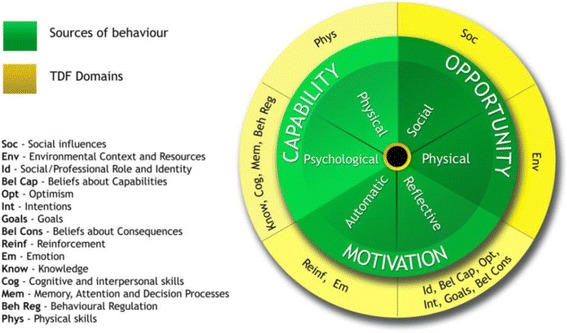
BACKGROUND: Implementing new practices requires changes in the behaviour of relevant actors, and this is facilitated by understanding of the determinants of current and desired behaviours. The Theoretical Domains Framework (TDF) was developed by a collaboration of behavioural scientists and implementation researchers who identified theories relevant to implementation and grouped constructs from these theories into domains. The collaboration aimed to provide a comprehensive, theory-informed approach to identify determinants of behaviour. The first version was published in 2005, and a subsequent version following a validation exercise was published in 2012. This guide offers practical guidance for those who wish to apply the TDF to assess implementation problems and support intervention design. It presents a brief rationale for using a theoretical approach to investigate and address implementation problems, summarises the TDF and its development, and describes how to apply the TDF to achieve implementation objectives. Examples from the implementation research literature are presented to illustrate relevant methods and practical considerations. METHODS: Researchers from Canada, the UK and Australia attended a 3-day meeting in December 2012 to build an international collaboration among researchers and decision-makers interested in the advancing use of the TDF. The participants were experienced in using the TDF to assess implementation problems, design interventions, and/or understand change processes. This guide is an output of the meeting and also draws on the authors' collective experience. Examples from the implementation research literature judged by authors to be representative of specific applications of the TDF are included in this guide. RESULTS: We explain and illustrate methods, with a focus on qualitative approaches, for selecting and specifying target behaviours key to implementation, selecting the study design, deciding the sampling strategy, developing study materials, collecting and analysing data, and reporting findings of TDF-based studies. Areas for development include methods for triangulating data, e.g. from interviews, questionnaires and observation and methods for designing interventions based on TDF-based problem analysis. CONCLUSIONS: We offer this guide to the implementation community to assist in the application of the TDF to achieve implementation objectives. Benefits of using the TDF include the provision of a theoretical basis for implementation studies, good coverage of potential reasons for slow diffusion of evidence into practice and a method for progressing from theory-based investigation to intervention.
Overview
CoChat Summary
TL;DR
This guide explains how to apply the Theoretical Domains Framework (TDF) to investigate implementation problems, focusing mainly on qualitative interview and focus group methods. It outlines steps from specifying target behaviours to analysing and reporting TDF-based data, with illustrative examples and stated limitations.
Key findings
- The TDF is an integrated theoretical framework synthesised from 128 theoretical constructs from 33 theories; version 1 has 12 domains, and version 2 has 14 domains covering 84 theoretical constructs. It has been cited in over 800 peer-reviewed publications (Web of Knowledge accessed April 2017).
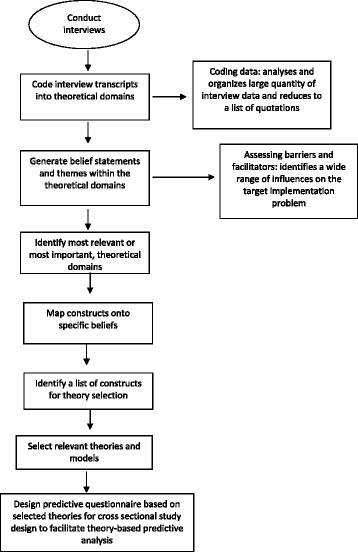
- The guide provides step-by-step methodological guidance for TDF-based implementation research, primarily qualitative interviews and focus groups: selecting and specifying target behaviours, selecting study design, deciding sampling strategy, developing interview schedules, collecting and analysing data, and reporting findings.
- Benefits of using the TDF include providing a theoretical basis for implementation studies, good coverage of potential reasons for slow diffusion of evidence into practice, and a method for progressing from theory-based investigation to intervention. Areas for development include methods for triangulating data (e.g., interviews, questionnaires, observation) and methods for designing interventions based on TDF-based problem analysis.
- Illustrative examples include a low back pain study with focus groups of 42 GPs and a cluster randomised trial randomising 47 practices (53 GPs) to control and 45 practices (59 GPs) to intervention; an SDD Delphi study that interviewed 141 participants; and a diabetes management qualitative systematic review that included 32 studies.
Methods
- Design: researchers from Canada, the UK and Australia attended a 3-day collaborative meeting in December 2012 to discuss the state of the science in using the TDF in implementation research and identify areas needing further development. Participants represented health psychology, sociology, implementation and health services research, statistics, and clinical disciplines including general practice, occupational therapy and chiropractic.
- Guide production: the group identified key steps in applying the TDF, pooled their experience and expertise to elaborate each step, and selected examples from the implementation research literature judged representative of specific TDF applications. The guide draws on the authors’ collective experience.
- Analysis: no datasets were generated or analysed for this article; the guide is a narrative, consensus-based resource focused mainly on qualitative approaches.
Limitations
- Stated in the paper: the scope is mostly limited to qualitative approaches, mainly interview and focus group data, with limited detail on using the TDF with other data collection methods such as survey or observation.
- Stated in the paper: illustrative applications were selected based on an informal rather than structured consensus process, leaving the possibility of selection bias in these examples; the aim was not to be representative but to provide examples across settings and implementation problems.
- Evident from the text: the guide is not a systematic review or an empirical validation of TDF application; its recommendations rest on the authors’ collective experience and selected illustrative examples.
Model-written summary. Check it against the paper before relying on it.
Integrity signals
Registry
Cites
Statistics
Figures
Verification
Claims the paper makes
25 Valid · 2 Not valid · 8 Not checked · 49 Own results and interpretations
Every source the paper cites for this claim was checked and supports it.
In the paper
“In an effort to make theories more accessible to those working in implementation, a team of behavioural scientists developed the TDF in collaboration with implementation researchers [15].”
§ A guide to using the Theoretical Domains Framework of behaviour change to investigate implementation problems > Development of the TDF
What the sources say
- Supportedcites [15] 15. Michie S, Johnston M, Abraham C, Lawton R, Parker D, Walker A, et al. Making psychological theory useful for implementing evidence based practice: a consensus approach. Qual Saf Health Care. 2005;14(1):26-33. source
The Discussion states that the project sought to simplify psychological theory and make it accessible to people involved in implementing evidence-based practice. The Health psychology theorists and Health services researchers sections describe the psychologists who developed the domains and the implementation researchers who evaluated them. Page numbers are not available in our copy. (LLM, conf=0.93)
plainstates a cause- Asserted: passes — The authors put it forward as true.
- Checkable: passes — It can be checked against evidence.
- Load-bearing: unclear — It is unclear whether the paper’s conclusions depend on it.
- Based: passes — The paper gives a reason why it holds.
- Supported
Every source the paper cites for this claim was checked and supports it.
In the paper
“The version of TDF, resulting from this validation, showed similar structure and content to the original with slight differences leading to 14 domains covering 84 theoretical constructs.”
§ A guide to using the Theoretical Domains Framework of behaviour change to investigate implementation problems > Development of the TDF
What the sources say
- Supportedcites [16] 16. Cane J, O'Connor D, Michie S. Validation of the theoretical domains framework for use in behaviour change and implementation research. Implement Sci. 2012;7:37. doi:10.1186/1748-5908-7-37. source
The Discussion reports good support for the TDF’s basic structure alongside refinements producing 14 domains. The Conclusions state that the refined framework contains 84 component constructs. (LLM, conf=0.93)
plainstates a cause- Asserted: passes — The authors put it forward as true.
- Checkable: passes — It can be checked against evidence.
- Load-bearing: unclear — It is unclear whether the paper’s conclusions depend on it.
- Based: passes — The paper gives a reason why it holds.
- Supported
The cited sources support only part of this claim — read each source’s verdict below.
In the paper
“The TDF is an integrated theoretical framework synthesised from 128 theoretical constructs from 33 theories judged most relevant to implementation questions.”
§ A guide to using the Theoretical Domains Framework of behaviour change to investigate implementation problems > Development of the TDF
What the sources say
- Partly supportedcites [15] 15. Michie S, Johnston M, Abraham C, Lawton R, Parker D, Walker A, et al. Making psychological theory useful for implementing evidence based practice: a consensus approach. Qual Saf Health Care. 2005;14(1):26-33. sourceExperimental — accuracy not yet measured
The Results report identifying 128 constructs drawn from 33 psychological theories, and the paper describes developing an integrative framework for implementation research. But the Simplifying into theoretical domains section says only a subset of those constructs was prioritised as particularly relevant; it does not say that all 128 were judged most relevant to implementation questions. Page numbers are unavailable in our copy. (LLM, conf=0.84)
plain- Asserted: passes — The authors put it forward as true.
- Checkable: passes — It can be checked against evidence.
- Load-bearing: unclear — It is unclear whether the paper’s conclusions depend on it.
- Based: passes — The paper gives a reason why it holds.
- Partly supported
Every source the paper cites for this claim was checked and supports it.
In the paper
“The Theoretical Domains Framework (TDF) was initially developed for implementation research to identify influences on health professional behaviour related to implementation of evidence-based recommendations and has been cited in over 800 peer-review publications (Web of Knowledge accessed April 2017).”
§ A guide to using the Theoretical Domains Framework of behaviour change to investigate implementation problems > Background
What the sources say
- Supportedcites [15] 15. Michie S, Johnston M, Abraham C, Lawton R, Parker D, Walker A, et al. Making psychological theory useful for implementing evidence based practice: a consensus approach. Qual Saf Health Care. 2005;14(1):26-33. source
The Abstract says the framework was developed for implementation research to study implementation of evidence-based practice and understand healthcare professionals’ behaviour. The Discussion says its theoretical domains were intended to explain failures to implement evidence-based practice. The separate publication-count statement is attributed to Web of Knowledge, not this source. (LLM, conf=0.93)
plain- Asserted: passes — The authors put it forward as true.
- Checkable: passes — It can be checked against evidence.
- Load-bearing: unclear — It is unclear whether the paper’s conclusions depend on it.
- Based: passes — The paper gives a reason why it holds.
- Supported
Every source the paper cites for this claim was checked and supports it.
In the paper
“The TDF underwent a validation exercise with an independent group of behavioural experts to investigate the optimal structure and content of the framework [16].”
§ A guide to using the Theoretical Domains Framework of behaviour change to investigate implementation problems > Development of the TDF
What the sources say
- Supportedcites [16] 16. Cane J, O'Connor D, Michie S. Validation of the theoretical domains framework for use in behaviour change and implementation research. Implement Sci. 2012;7:37. doi:10.1186/1748-5908-7-37. source
The Background states that the study aimed to validate the TDF’s optimal domain structure and content. The Materials > Procedure passage says participants had expertise in behaviour change theory and did not know the original framework, supporting the description of an independent group of experts. (LLM, conf=0.94)
plain- Asserted: passes — The authors put it forward as true.
- Checkable: passes — It can be checked against evidence.
- Load-bearing: unclear — It is unclear whether the paper’s conclusions depend on it.
- Based: passes — The paper gives a reason why it holds.
- Supported
16 more claims · 9 with their cited sources checked
Create a free account to see all 84 claims and every source verdict.
- Probably not a substantial claim. 59
- It may state two separate claims as one. 19
Claims other papers make about this one
Each is checked against this paper’s own text: does it say what the citing paper says it does?
The cited source says what the claim attributes to it.
In the citing paper
“The TDF organizes constructs across 14 domains, ranging from individual knowledge and skills to environmental context and social influences.”
The cited source says what the claim attributes to it.
In the citing paper
“The 14 domains of the TDF, described elsewhere [24], offer a concise coding framework that can be usefully conceptualized as possible targets for behavior change interventions.”
From Influences on the Uptake of and Engagement With Health and Well-Being Smartphone Apps: Systematic Review (2020) · cites this paper as [24]
Self-check
Percentages, sums and reported differences re-computed from the paper’s own numbers.
Each contradiction between two passages listed here was confirmed by an independent check.
Rated minor: it would not touch a result — a value no result rests on, a p-value that stays on the same side of the significance level, or a conflict that is clerical, resolved elsewhere in the paper, or outside its own findings.
In the paper
§ A guide to using the Theoretical Domains Framework of behaviour change to investigate implementation problems > 5. Collect the data
“In the example given above reported in Francis et al. [15], this step resulted in a list of belief statements supported by responses made in the interviews within each theoretical domain.”
§ A guide to using the Theoretical Domains Framework of behaviour change to investigate implementation problems > References
“15. Michie S, Johnston M, Abraham C, Lawton R, Parker D, Walker A, et al. Making psychological theory useful for implementing evidence based practice: a consensus approach.”
Rated minor: it would not touch a result — a value no result rests on, a p-value that stays on the same side of the significance level, or a conflict that is clerical, resolved elsewhere in the paper, or outside its own findings.
In the paper
§ A guide to using the Theoretical Domains Framework of behaviour change to investigate implementation problems > 3. Decide the sampling strategy
“## 3. Decide the sampling strategy”
§ A guide to using the Theoretical Domains Framework of behaviour change to investigate implementation problems > Conclusions
“| 3. Develop study materials | Although materials from previous studies may be | Requires in-depth understanding of the theoretical |”
Citations
Cites
Using thematic analysis in psychology
Braun, V., & Clarke, V. (2006) · Qualitative Research in Psychology · doi:10.1191/1478088706qp063oa · Cited by 194,414
The Measurement of Observer Agreement for Categorical Data
Landis, J. R., & Koch, G. G. (1977) · Biometrics · doi:10.2307/2529310 · Cited by 81,148 · cited 1×
“6 or percentage agreement > 60% is achieved [63].”
BackgroundThe Discovery of Grounded Theory: Strategies for Qualitative Research.
Wagner, H. R., Glaser, B. G., & Strauss, A. L. (1968) · Social Forces · doi:10.2307/2575405 · Cited by 46,361
Three Approaches to Qualitative Content Analysis
Hsieh, H.-F., & Shannon, S. E. (2005) · Qualitative Health Research · doi:10.1177/1049732305276687 · Cited by 44,601 · cited 1×
“theory and/or relevant research findings to interpret meaning from the content of qualitative data for initial codes [57].”
BackgroundThe Discovery of Grounded Theory; Strategies for Qualitative Research
Glaser, B. G., Strauss, A. L., & Strutzel, E. (1968) · Nursing Research · doi:10.1097/00006199-196807000-00014 · Cited by 39,449
(2006) · Cited by 18,730
Damschroder, L. J., Aron, D. C., Keith, R. E., Kirsh, S. R., Alexander, J. A., & Lowery, J. C. (2009) · Implementation Science · doi:10.1186/1748-5908-4-50 · Cited by 14,496 · cited 2×
“by Normalisation Process Theory [66], the Consolidated Framework For Implementation Research [67] and the Yorkshire Contributory Factors Framework [68].”
MethodHao (2015) · doi:10.1002/14651858 · Cited by 11,321
Developing and evaluating complex interventions: the new Medical Research Council guidance
Craig, P., Dieppe, P., Macintyre, S., Michie, S., Nazareth, I., & Petticrew, M. (2008) · BMJ · doi:10.1136/bmj.a1655 · Cited by 10,995
Self-citationQualitative research practice: a guide for social science students and researchers
(2003) · Choice Reviews Online · doi:10.5860/choice.41-1319 · Cited by 10,543
Cited by
Items 2,201–2,300 of 3,792
AlHarthi, M. S. (2025) · Healthcare · doi:10.3390/healthcare13111274 · Cited by 3
“TDF is a comprehensive model that consolidates multiple behaviour change theories to identify determinants of clinical behaviours [26].”
Davine, E. C., Busby, P. A., Peters, S., Francis, J., Harris, D., Timmer, B. H. B., & Sarant, J. Z. (2025) · Australian Journal of Primary Health · doi:10.1071/py24224 · Cited by 2
Self-citationPinto, J. W., Read, K. A., Tarabey, E., & Bishop, F. L. (2025) · European Journal of Integrative Medicine · doi:10.1016/j.eujim.2025.102517 · Cited by 4
Lin, Q. H., Chen, H., Shen, J., Yang, T., Tang, L., Zhang, T., Liu, X., Zeng, P., He, F., Liu, C., et al. (2025) · Cerebrovascular Diseases · doi:10.1159/000547148 · Cited by 2
“Cerebrovasc Dis 2026;55:400–413 DOI: 10.1159/000547148 conducted at the end of follow-up under the Theoretical Domains Framework to understand the facilitators of and barriers to dietary change [28].”
Influential‘Are we getting through to them? And in what way?’ Communicating physical activity with adolescents
Grady, C. L., Murtagh, E., Ng, K., Bengoechea, E. G., & Woods, C. B. (2025) · Health Promotion International · doi:10.1093/heapro/daaf062 · Cited by 2
“…is linked to the power gained through knowledge, it is not surprising that improving adolescents’ knowledge and helping them understand the beliefs about the consequences of their behaviour could lead to better health literacy (Bandura 1986, Ajzen 1991, Atkins et al. 2017, Paa-karri & George 2018).”
Sandham, V., Hill, A. E., Armstrong, R. M., & Hinchliffe, F. (2025) · American Journal of Speech-Language Pathology · doi:10.1044/2025_ajslp-25-00018 · Cited by 2
Chen, Y., Peet, J., Hausin, N., Hinds, D., Jayasinghe, R., Kennedy, W., Morris, S., Poulter, R. S., Starmer, G., Singbal, Y., et al. (2025) · Intensive and Critical Care Nursing · doi:10.1016/j.iccn.2025.104169 · Cited by 3
Elliott, M., Price, K.-M., Hewitt, R. M., Knowles, N., Ganesh, S., Baillie, J., & Jones, L. (2025) · BMC Nursing · doi:10.1186/s12912-025-03597-6 · Cited by 2
“The semi-structured focus group topic guide explored factors relevant to the target behaviours, informed by the TDF and COM-B model [36, 38, 40] (see Additional File 2), and was developed by the team with expertise in qualitative research, public health, health psychology and nursing.”
InfluentialPrison education in the resocialization of incarcerated individuals
Romero-Carazas, R., Delgado, F. D. C., Casco, R. J. E., Bernedo-Moreira, D. H., Morales-García, W. C., Rodríguez-Asto, R. A. A., & Quiñones-Ormeño, L. K. (2025) · Frontiers in Education · doi:10.3389/feduc.2025.1592692 · Cited by 13
Byrne, A., O’Malley, R., O'Connor, P. E., & Lydon, S. (2025) · International Journal for Quality in Health Care · doi:10.1093/intqhc/mzaf084 · Cited by 1
Buclin, C. P., Bürgisser, N., Berner, A., Juillerat, A., Blanc, C., Coen, M., Farhoumand, P. D., Porto, V., Porzi, J., Reny, J., et al. (2025) · Journal of General Internal Medicine · doi:10.1007/s11606-025-09843-6 · Cited by 2
Tropea, J., Gilbert, J., Bennett, N. J., et al. (2025) · American Journal of Infection Control · doi:10.1016/j.ajic.2025.09.014 · Cited by 2
Lecouturier, J., Bosomworth, H. J., Labus, M. B., Ellis, R., & Lovat, P. E. (2022) · PLoS ONE · doi:10.1371/journal.pone.0265048 · Cited by 5
Atkins, B., Bhattacharya, D., Smith, C., & Scott, S. (2022) · International Journal of Clinical Pharmacy · doi:10.1007/s11096-022-01446-z · Cited by 2
“The Theoretical Domains Framework (TDF) overcomes this challenge as it is a synthesis of 33 behaviour change theories for understanding and developing strategies to change behaviour organised into 14 theoretical domains [19].”
BackgroundMethodInfluentialFlemons, K., Bosch, M., Marcil, G., et al. (2022) · Canadian Journal of General Internal Medicine · doi:10.22374/cjgim.v17i1.525 · Cited by 2
van Leuven, J., Evans, S., Kichenadasse, G., Steeghs, N., Bonevski, B., Mikus, G., & van Dyk, M. (2023) · Cancers · doi:10.3390/cancers15133293 · Cited by 3
Bejarano, C. M., Snow, K., Lane, H., Calvert, H. G., Hoppe, K., Alfonsin, N., Turner, L. R., & Carlson, J. (2019) · Preventive Medicine Reports · doi:10.1016/j.pmedr.2019.100909 · Cited by 2
Sargent, L., Taylor, J., & Lowe, J. B. (2021) · JBI Evidence Synthesis · doi:10.11124/jbies-20-00187 · Cited by 4
Koukamari, P. H., Ghaffari, M., Tavafian, S. S., & Ramezankhani, A. (2021) · Health Scope · doi:10.5812/jhealthscope.108354 · Cited by 4
“As mentioned earlier, we undertook this study according to the TDF framework, which is used primarily in healthcare settings to investigate the factors influencing clinical behavior in order to design interventions to improve public and occupational health (45).”
MethodVérot, E., Denois, V. R., & Chauvin, F. (2021) · Social Science & Medicine · doi:10.1016/j.socscimed.2021.113896 · Cited by 2
Mifsud, J. L., Stephenson, J. R., Astin, F., & Galea, J. (2021) · Pilot and Feasibility Studies · doi:10.1186/s40814-021-00874-4 · Cited by 3
Pussig, B., Vandelanotte, S., Matheï, C., Pas, L., Aertgeerts, B., & Vermandere, M. (2021) · Family Practice · doi:10.1093/fampra/cmab078 · Cited by 3
Gordijn, R., Teichert, M., Nicolai, M. P. J., Elzevier, H. W., Guchelaar, H., & Hughes, C. M. (2021) · Sexual Medicine · doi:10.1016/j.esxm.2021.100440 · Cited by 2
“Prior to the start of the study, no specific recruitment target was stated as sampling would be guided by data saturation having been achieved in relation to barriers and facilitators.(29)”
BackgroundMethodInfluentialWalker, R. A. J., & Harada, K. (2022) · Journal of Aging and Physical Activity · doi:10.1123/japa.2021-0218 · Cited by 3
Rattu, V., & Hurst, D. (2022) · BDJ · doi:10.1038/s41415-022-4294-7 · Cited by 3
Lee, D. T., Bruno, C. J., Sharifi, M., Shabanova, V., & Johnston, L. (2023) · American Journal of Perinatology · doi:10.1055/s-0042-1760449 · Cited by 2
“…of this study was to systematically identify barriers to and facilitators of premedication utilization for nonemergent NI utilizing the TDF. 7 Findings identi fi ed in this study provide opportunities to develop targeted interventions to address barriers and enhance facilitators for NI…”
BackgroundBackman, C., Papp, S., Harley, A., Kolle, A. T., Visintini, S. M., Shah, S., Berdusco, R., Poitras, S., Beaulé, P. E., & French-Merkley, V. (2023) · JMIR Research Protocols · doi:10.2196/42056 · Cited by 3
“processes, environmental context and resources, social influences, emotion, and behavioral regulation [45-47].”
BackgroundA SPECTRUM OF STAKEHOLDER PERSPECTIVE TAKING IN EARLY-STAGE DESIGN
Rieken, E. F., Bond, K., Best, R. M., Burleson, G., & Brubaker, E. R. (2023) · Proceedings of the Design Society · doi:10.1017/pds.2023.40 · Cited by 4
“…change within the social sciences (Davis et al., 2014), we chose the Theoretical Domains Framework (TDF) from Michie, et al. because it provides a framework for explaining conditions that encourage new behaviors and skills within a particular situation (Michie et al., 2005; Atkins et al., 2017).”
MethodVieira, A. M., Szczepanik, G., de Waure, C., Tricco, A. C., Oliver, S. R., Stojanovic, J., Ribeiro, P. A. B., Pollock, D., Akl, E. A., Lavis, J. N., et al. (2023) · BMJ Open · doi:10.1136/bmjopen-2022-069856 · Cited by 4
“Using a triangulation approach, 33 34 we will then lead a structured discussion of each proposed item.”
Bourne, J. E., Leary, S. D., England, C. Y., & Searle, A. (2023) · Frontiers in Sports and Active Living · doi:10.3389/fspor.2023.1150724 · Cited by 5
“E-bike size and design features (51) (B) ‘I think the electronic bike was so heavy and not manageable’ (P10); ‘It was too high, because I didn't feel comfortable not being able to put my feet flat on the floor, so I had to wait for a seat, because the first seat, still my feet didn't touch the floor.”
BackgroundKawasaki disease: patients’ transition journey and recommendations for adult care
Chahal, N., Rush, J. P., Lardizabal, A., Nobile, R., Delayun, C., Collins, T. H., Thorne, S., & McCrindle, B. W. (2023) · Cardiology in the Young · doi:10.1017/s1047951123003578 · Cited by 3
A non-randomised feasibility study of a mHealth follow-up program in bariatric surgery
Wright, C., Kelly, J. T., Byrnes, J., Campbell, K. L., Healy, R., Musial, J., & Hamilton, K. (2023) · Pilot and Feasibility Studies · doi:10.1186/s40814-023-01401-3 · Cited by 3
“1) was used to inform the pathways of behaviour change [27].”
MethodReilly, M., Ali, A., Ali, A., Murphy, C., McGlynn, S., Alam, M., Doyle, F., McCutchan, G. M., Heavey, L., Brain, K., et al. (2023) · HRB Open Research · doi:10.12688/hrbopenres.13793.1 · Cited by 3
“This study is being conducted alongside an ongoing pilot clinical trial of lung cancer screening: the LHC trial 43 .”
Bresee, L. C., Lamont, N. C., Ocampo, W., Holroyd-Leduc, J. M., Sabuda, D. M., Leal, J. R., Dalton, B., Kaufman, J., Missaghi, B., Kim, J., et al. (2023) · BMC Health Services Research · doi:10.1186/s12913-023-10350-9 · Cited by 4
“The qualitative evaluation of the implementation of pro-biotics was conducted using two theoretical frameworks: the Theoretical Domains Framework (TDF) and the Consolidated Framework of Implementation Research (CFIR) [11, 12].”
MethodBarratt, R., & Gilbert, G. L. (2023) · American Journal of Infection Control · doi:10.1016/j.ajic.2023.12.003 · Cited by 2
Montilva-Monsalve, J., Dimantas, B., Perski, O., & Gutman, L. M. (2023) · JMIR Diabetes · doi:10.2196/49097 · Cited by 7
“The TDF provides a more granular understanding of the COM-B components (Figure 1 [24]) by further detailing the factors that influence behavior.”
BackgroundMethodInfluentialO’Donoghue, M., Kennedy, N., Forbes, J., & Murphy, C. (2024) · American Journal of Speech-Language Pathology · doi:10.1044/2024_ajslp-23-00303 · Cited by 6
Building Learning Healthcare Systems for Critical Care Medicine
Krishnamoorthy, V. K., Harris, R. M., Chowdhury, A., Bedoya, A., Bartz, R. R., & Raghunathan, K. (2024) · Anesthesiology · doi:10.1097/aln.0000000000004847 · Cited by 3
Vallyon, E., Aminian, S., & Heath, S. (2024) · International journal of osteopathic medicine · doi:10.1016/j.ijosm.2024.100719 · Cited by 2
Ahern, L., Timmons, S., Lamb, S. E., & McCullagh, R. (2024) · HRB Open Research · doi:10.12688/hrbopenres.13843.1 · Cited by 2
“Furthermore, by mapping the data to the Theoretical Domains Framework developed by Atkins et al .”
Rethinking the tiered trauma team response: A case‐series study in a regional trauma centre
Curtis, K. A., Clark, B., Lam, M. K., Huckle, R. J., Melville, G. W., Binks, S., Ryan, M. W., Gardner, T., Parsons, M. B., & Ashford, B. (2024) · Emergency Medicine Australasia · doi:10.1111/1742-6723.14399 · Cited by 2
Ayeno, H. D., Kassie, G. M., Atee, M., & Nguyen, T. A. (2024) · Campbell Systematic Reviews · doi:10.1002/cl2.1393 · Cited by 1
“It has 14 domains and has been developed to identify influences on health professional behaviour related to the implementation of evidence ‐ based recommendations (Atkins, 2017).”
BackgroundCarter, E. L., Hallen, S. A. M., Welch, G., et al. (2024) · Health Science Reports · doi:10.1002/hsr2.2000 · Cited by 2
“18 The TDF has also been proposed as a method to provide structure to early exploratory projects by anticipating and identifying potential barriers to target behaviors.”
BackgroundMethodJohnson, J., Pointon, L., Kaur, E., Vogt, K. S., Alzahrani, A., & Keyworth, C. (2024) · Journal of Workplace Behavioral Health · doi:10.1080/15555240.2024.2401347 · Cited by 2
“These categories were then collapsed into explanatory themes and mapped onto a matrix containing the Theoretical Domains Framework (TDF) (Atkins et al., 2017).”
InfluentialAttitudes toward Adolescent Mental Health Screening in a Dental Setting: A Mixed-Methods Study
Ticku, S., Nath, S., Ramesh, N., & Riedy, C. A. (2024) · JDR Clinical & Translational Research · doi:10.1177/23800844241273775 · Cited by 6
“Other theoretical models, such as the COM-B model of behavior change and the Theoretical Domains Framework (Michie et al. 2011; Atkins et al. 2017), might be more suitable for additional studies.”
Bussières, A., Passmore, S. R., Kopansky-Giles, D. R., Tavares, P., Ward, J., Ladwig, J. C., Glazebrook, C. M., Mior, S. A., Atkinson-Graham, M., Moss, J., et al. (2025) · Chiropractic & Manual Therapies · doi:10.1186/s12998-025-00576-1 · Cited by 5
“…be mapped onto behavior change intervention techniques to inform the development and refinement of culturally acceptable implementation support strategies designed to support or change the health system to increase adoption of the evidence-based practice of the GSCI MoC into usual care [91, 92].”
Clinical guidelines and patient related outcomes: summary of evidence and recommendations
de Vasconcelos, L. P., Rodrigues, L. D. O., & Nobre, M. R. C. (2019) · International Journal of Health Governance · doi:10.1108/ijhg-12-2018-0073 · Cited by 3
Evaluating the implementability of Antibiotic Surgical Prophylaxis guidelines
Ierano, C., Ayton, D., Peel, T. N., Marshall, C. L., & Thursky, K. (2019) · Infection Disease & Health · doi:10.1016/j.idh.2019.08.004 · Cited by 2
Saillour-Glénisson, F., Jouhet, V., Berdaï, D., Noïze, P., Floccia, M., Zamaron, S., Chêne, G., & Salmi, L. (2019) · Revue française des affaires sociales · doi:10.3917/rfas.193.0091 · Cited by 2
Pike, A. E., Mahoney, K., Patey, A. M., Inwood, S., Mortazhejri, S., Lawrence, R., & Hall, A. M. (2020) · BMJ Open · doi:10.1136/bmjopen-2019-036511 · Cited by 2
Self-citationVérot, E., Bouleftour, W., Macron, C., Rivoirard, R., & Chauvin, F. (2020) · JMIR Research Protocols · doi:10.2196/17485 · Cited by 2
“The special feature of TDF is that it specifically questions individual motivation and capacity factors, in addition to taking into account the physical and social environment of the context concerned by the implementation [68].”
InfluentialBehaviour change: The key to implementing evidence on COPD prevention, diagnosis and management
Yang, I. A., McDonald, C. F., & Francis, J. (2021) · Respirology · doi:10.1111/resp.14160 · Cited by 2
“These three identified barriers to performing spirometry in primary care correspond to three of the ‘domains’ in the Theoretical Domains Framework of clinical behaviour change, which proposes 14 kinds of barriers.(11) Using this framework to explore barriers to practice change has two important advantages over less st…”
BackgroundSelf-citation(2021) · Die Rehabilitation · doi:10.1055/a-1240-3615 · Cited by 2
“com], eine systematische, theoriegeleitete Vorgehensweise bei der Entwicklung von Fortbildungsmodulen eingesetzt [47, 48].”
BackgroundLiu, J. X. (2020) · Figshare · Cited by 3
Responding to Illegal Drug Use in Acute Care: Patient Needs and Perspectives
Kosteniuk, B. (2020) · ERA: Education and Research Archive (University of Alberta) · doi:10.7939/r3-tne7-1j27 · Cited by 2
Trevena, L. J., Mac, O. A., Muscat, D. M., Bakhit, M., Shepherd, H. L., Dimopoulos-Bick, T. L., Osten, R., Hoffmann, T., & Thompson, R. (2021) · Research Square · doi:10.21203/rs.3.rs-493777/v1 · Cited by 2
Flemons, K., Bosch, M., Coakeley, S., Muzammal, B., Kachra, R., & Ruzycki, S. M. (2020) · Research Square · doi:10.21203/rs.3.rs-86551/v1 · Cited by 2
Moonesinghe, R., McGuckin, D., Martin, P., Bedford, J., Wagstaff, D., Vindrola‐Padros, C., Sahni, A., Edwards, K., Singleton, G. F., Singh, P., et al. (2021) · Research Square · doi:10.21203/rs.3.rs-708161/v1 · Cited by 2
Flowers, P., Mapp, F., McQueen, J., Nandwani, R., The LUSTRUM programme, & Estcourt, C. S. (2021) · medRxiv · doi:10.1101/2021.08.07.21261736 · Cited by 3
“, 2011), the theoretical domains framework (Atkins et al., 2017) and concepts from systems science (e.”
BackgroundMethodAbrahams, Z., Schneider, M., Honikman, S., Olckers, P., Boisits, S., Seward, N., & Lund, C. (2021) · Research Square · doi:10.21203/rs.3.rs-956295/v1 · Cited by 2
Zucker, T. A., & Yeomans‐Maldonado, G. (2022) · EdArXiv (OSF Preprints) · doi:10.35542/osf.io/pf29n · Cited by 2
Behavioural Optimisation To Address Trial Conduct Challenges: Case Study In The UK-REBOA TrialPreprint
Lawrie, L., Duncan, E., Jansen, J. O., et al. (2022) · Research Square · doi:10.21203/rs.3.rs-1166980/v1 · Cited by 2
Self-citationLloyd, K. E., Foy, R., Hall, L., et al. (2022) · doi:10.31234/osf.io/swvf9 · Cited by 2
Self-citationAllison, A. L., Lorencatto, F., Michie, S., & Miodownik, M. A. (2021) · doi:10.14324/111.444/000059.v2 · Cited by 2
Self-citationOlder people digital engagement; a systematic scoping review (Preprint)Preprint
Kebede, A. S., Ozolins, L., Holst, H., & Galvin, K. (2022) · doi:10.2196/preprints.40192 · Cited by 2
Chung, O. S., Robinson, T., Johnson, A. M., Dowling, N. L., Ng, C. H., Yücel, M., & Segrave, R. A. (2022) · Frontiers in Psychiatry · doi:10.3389/fpsyt.2022.893637 · Cited by 2
Development of a qualitative data analysis codebook informed by the i-PARIHS frameworkPreprint
Ritchie, M. J., Drummond, K. L., Smith, B. N., Sullivan, J. L., & Landes, S. J. (2022) · Research Square · doi:10.21203/rs.3.rs-1999280/v1 · Cited by 2
Zeng, B., Pan, H., Li, L., Lan, T.-M., Ye, Z.-Y., Wang, P., & Liu, Y. (2022) · medRxiv · doi:10.1101/2022.10.05.22280725 · Cited by 2
Health behaviour theories: a conceptual lens to explore behaviour change
Cilliers, F. J., St‐Onge, C., & van der Vleuten, C. P. M. (2022) · Wiley eBooks · doi:10.1002/9781119839446.ch23 · Cited by 5
Duran, A. T., Keener-DeNoia, A., Stavrolakes, K., et al. (2023) · Research Square · doi:10.21203/rs.3.rs-2475875/v1 · Cited by 2
Embedding smoking cessation support in community service organisations
Wolfenden, L., & Wolfenden, L. (2021) · doi:10.57022/ihzq1178 · Cited by 4
Feasibility of DPYD Genotyping in Australian Cancer PatientsPreprint
White, C., Paul, C. L., Liet, E., et al. (2023) · Research Square · doi:10.21203/rs.3.rs-2838793/v1 · Cited by 2
Langmuir, T., Wilson, M. K., McCleary, N., Patey, A. M., Mekki, K., Ghazal, H., Noad, E. E., Buchan, J. L., Dubey, V., Galley, J., et al. (2023) · Research Square · doi:10.21203/rs.3.rs-3263714/v1 · Cited by 2
Self-citationFitzmaurice, Y., Beeke, S., Isaksen, J., Cunningham, Ú., Jagoe, C., Shé, É. N., & McMenamin, R. (2023) · HRB Open Research · doi:10.12688/hrbopenres.13783.1 · Cited by 7
“Notably, frameworks such as the Behaviour Change Wheel (BCW) (Michie et al., 2011) and the Theoretical Domains Framework (TDF) (Atkins et al., 2017; Cane et al., 2012; Michie et al., 2005), developed from synthesising theories and constructs, are being used more frequently in CPT research and other general research in…”
Souza, L. G., Archambault, P. M., Bouba, D. A., Dofara, S. G., Guay-Bélanger, S., Ghio, S. C., Gadio, S., Michaels, L. C., Paquette, J., Izumi, S., et al. (2024) · medRxiv · doi:10.1101/2024.02.05.24302368 · Cited by 2
Generalizability of Choice Architecture InterventionsPreprint
Szászi, B., Goldstein, D. G., Soman, D., & Michie, S. (2024) · PsyArXiv (OSF Preprints) · doi:10.31234/osf.io/8p4vq · Cited by 2
Self-citationNaydani, C. J., Jessiman, L. J., & Jarvis, S. (2025) · doi:10.1079/cabionehealth.2025.0011 · Cited by 4
Talbot, R., Harris, C., Cable, E., Whiten, B., Warren, J. D., Varley, R. A., & Volkmer, A. (2025) · medRxiv · doi:10.1101/2025.09.30.25336993 · Cited by 2
Watson, J., Jordan, R., Adab, P., Vlaev, I., Enocson, A., & Greenfield, S. (2022) · BMJ Open · doi:10.1136/bmjopen-2020-046875 · Cited by 27
Wang, M., Wu, J., & Shih, W.-Y. (2021) · European Journal Of Oral Sciences · doi:10.1111/eos.12841 · Cited by 1
Sperber, N. R., Cragun, D. L., Roberts, M. C., Bendz, L. M., Ince, P., Gonzales, S. E., Haga, S. B., Wu, R. R., Petry, N., Ramsey, L. B., et al. (2022) · Journal of Personalized Medicine · doi:10.3390/jpm12081313 · Cited by 1
Thompson, L. M. (2022) · Nature Energy · doi:10.1038/s41560-022-01101-x · Cited by 1
Willson, L., & Spence, K. (2022) · Comprehensive Child and Adolescent Nursing · doi:10.1080/24694193.2022.2053613 · Cited by 1
“Theoretical domains framework (version 2) was used to identify these to inform further development of the Feeding Steps protocol beyond the twelve-month fellowship (Atkins et al., 2017).”
MethodSchilling, S., Powell, B. J., Stewart, P. W., & Wood, J. N. (2023) · Trials · doi:10.1186/s13063-022-07024-y · Cited by 2
González-Casanova, I., Rodríguez, D. L. M., Brunel, J. O., Gómez, M. G. R., de Groot, M., & Fernández, A. (2023) · Frontiers in Public Health · doi:10.3389/fpubh.2023.1268253 · Cited by 1
“The use of COM-B and TDF has been recommended to collect information about barriers and opportunities that then can lead to the development and implementation of individual behavioral change interventions (17).”
MethodInfluentialNathan, N., Hall, A. E., Shoesmith, A., Bauman, A. E., Peden, B., Duggan, B., Gardner, C., Lane, C., Lecathelinais, C., Oldmeadow, C. J., et al. (2023) · BMC Public Health · doi:10.1186/s12889-023-16810-5 · Cited by 5
“Barriers were also mapped to the Behaviour Change Wheel (BCW) [40] and Theoretical Domains Framework (TDF) [41] to ensure: i) consideration of a comprehensive assessment of factors (i.e., capabilities, opportunities and motivation) impacting on an individual’s behaviour; and ii) identification of…”
MethodYe, F., & Cheng, W. (2023) · PROMET - Traffic&Transportation · doi:10.7307/ptt.v35i6.393 · Cited by 4
“…no causal elements are proposed to link constructs in the theoretical part of TDF, so TDF is a suitable framework for adaptation [11, 20], either by removing domains that are less relevant to the target behavior [12, 21] or by considering the addition of additional relevant domains [11, 22].”
BackgroundMethodInfluentialGeorge, S. E., Catchpole, C., Skinner, R., Barbaro, P., Adey, N., & Davies, S. (2024) · Australian and New Zealand Journal of Family Therapy · doi:10.1002/anzf.1573 · Cited by 1
Perceived barriers and facilitators of childcare providers’ physical activity: A mixed-methods study
Chaudhary, P., Rech, J. P., Kumar, G., & Dinkel, D. M. (2024) · Health Education Journal · doi:10.1177/00178969231222543 · Cited by 1
“…determinants (knowledge, skills, social/professional role and identity, beliefs about capabilities, beliefs about consequences, motivation and goals, memory attention and decision process, environmental context and resources, social influence, emotion and action planning (Atkins et al., 2017).”
BackgroundHealth Self-management Barriers and Facilitators in Long-term Care Facilities: A Qualitative Study
Huang, L.-L., Guan, X.-H., Hu, W.-W., Jiang, Y.-H., Fu, J., & Hong, W. (2024) · American Journal of Health Behavior · doi:10.5993/ajhb.48.1.12 · Cited by 1
Malazarte, J., Manila, L. D., Javier, D., Parba, R. M., Cruz, S. D., Sabado, A. A. S., & Carandang, R. R. (2024) · Pharmaceutical Sciences Asia · doi:10.29090/psa.2024.01.23.845 · Cited by 1
Wagi, C. R., Shalowitz, D. I., Randazzo, A., Peluso, A., & Birken, S. A. (2024) · Gynecologic Oncology Reports · doi:10.1016/j.gore.2024.101363 · Cited by 2
“To elaborate on the attitudes, beliefs, and perceptions of clinicians regarding CCC, we used the TDF, which includes 14 domains aiming to identify individual clinician determinants of behavior (Atkins et al., 2017).”
MethodEvaluation Approaches for Dissemination and Implementation Research
Gaglio, B., & Glasgow, R. E. (2023) · Oxford University Press eBooks · doi:10.1093/oso/9780197660690.003.0017 · Cited by 2
Chen, Y., Tower, M., Zimmerman, P.-A. P., Layh, J., Sparke, V., Prichard, R. A., Mason, M., & Lin, F. F. (2024) · Journal of Public Health Policy · doi:10.1057/s41271-024-00483-4 · Cited by 3
“This framework, the TDF, contains 14 domains and has been used commonly in implementation research to help identify perceived barriers and facilitators that subsequently guide behaviour change [14, 15].”
MethodSepsis screening protocol implementation: a clinician-validated rapid realist review
Melville, J., Carr, T., Goodridge, D. M., Muhajarine, N., & Groot, G. (2024) · BMJ Open Quality · doi:10.1136/bmjoq-2023-002593 · Cited by 3
“Fidelity indicates the effectiveness for behaviour change 28 because it is a measure of whether a change is implemented as intended.”
Enablers and Barriers to Home Management for Children with Gastroenteritis: Systematic Review
Weghorst, A. A., Lawrence, J. G., Jansen, D. E. M. C., Holtman, G. A., Sanci, L. A., Berger, M. Y., & Hiscock, H. (2024) · The Journal of Pediatrics Clinical Practice · doi:10.1016/j.jpedcp.2024.200115 · Cited by 3
Kithulegoda, N., Williams, C., Senthilmurugan, A., Aimola, S., Atkinson, J., Banerjee, A., Bazeghi, F., Bender, J. L., Flynn, S., Ghatage, L., et al. (2024) · BMJ Open · doi:10.1136/bmjopen-2024-085933 · Cited by 4
“27 28 This represents a theory-informed, comprehensive but applied approach to understanding barriers and facilitators to programme participation, health behaviour change and delivery of the intervention as planned.”
BackgroundSelf-citationSchulz, G. L., Painter, A. C., McQueen, A., et al. (2024) · Journal of Family Nursing · doi:10.1177/10748407241261123 · Cited by 1
“The aim was to recruit 10 youth and 10 parents based on previous theory-driven studies that reached data saturation with similar sample sizes (Atkins et al., 2017; Malterud et al., 2016; Sandelowski, 1995).”
Sabahi, S. M. A., Pinto, A. D., & Jayapal, S. K. (2024) · International journal of Nutrition Pharmacology Neurological Diseases · doi:10.4103/ijnpnd.ijnpnd_17_24 · Cited by 1
Jackson, H. M., Batterham, P. J., Calear, A. L., Ohan, J. L., & Farrer, L. M. (2024) · JMIR Mental Health · doi:10.2196/53794 · Cited by 5
“Qualitative methods involving consultation with end users and the application of structured frameworks of behavior change during data collection and XSL • FO RenderX interpretation (eg, theoretical domains framework [78]) may help address these aims.”
Method
Metadata
- Authors
- Atkins, L., Francis, J., Islam, R., O’Connor, D., Patey, A., Ivers, N., Foy, R., Duncan, E. M., Colquhoun, H., Grimshaw, J. M., Lawton, R., & Michie, S.
- Affiliations
- University College London (GB)
- University of London (GB)
- Ottawa Hospital Research Institute (CA)
- Monash University (AU)
- University of Toronto (CA)
- University of Leeds (GB)
- University of Aberdeen (GB)
- University of Ottawa (CA)
- Corresponding author
- Atkins, Lou
- ORCID
- Venue
- Implementation Science
- Published
- 2017-06-21
- Volume
- 12
- Issue
- 1
- Pages
- 77-77
- ISSN
- 1748-5908 (ISSN-L)
- PMC
- PMC5480145
- OpenAlex
- W2674995983
- Semantic Scholar
- 7ae5ea98c6f51755ffa2f67330dea33e0663f161
- Cited by
- 3,819
- References
- 87
- Citations by year
- 2026: 501 · 2025: 619 · 2024: 623 · 2023: 531 · 2022: 554 · 2021: 437 · 2020: 309 · 2019: 160 · 2018: 67 · 2017: 12
- FWCI
- 242.11
- Type
- journal article
- Language
- en
- Open access
- gold
- doi.org
- Licence
- cc-by
- Locations
- Implementation Science (publishedVersion, cc-by)
- Europe PMC (PubMed Central) (publishedVersion, other-oa)
- PubMed Central (publishedVersion, cc-by)
- PubMed (publishedVersion)
- UCL Discovery (University College London) (publishedVersion)
- White Rose Research Online (University of Leeds, The University of Sheffield, University of York) (acceptedVersion)
- TSpace (University of Toronto) (acceptedVersion, cc-by)
- City Research Online (City University London) (acceptedVersion)
- Monash University Research Portal (Monash University) (submittedVersion, other-oa)
- Aberdeen University Research Archive (Aberdeen University) (submittedVersion)
- DOAJ (DOAJ: Directory of Open Access Journals) (submittedVersion, cc-by-sa)
- Minerva Access (University of Melbourne) (submittedVersion, cc-by)
- Funders
- Canadian Institutes of Health Research
- Topics
- Health Sciences › Health Professions › General Health Professions › Health Policy Implementation Science
- Social Sciences › Psychology › Applied Psychology › Behavioral Health and Interventions
- Health Sciences › Health Professions › General Health Professions › Health Sciences Research and Education
- Keywords
- Theoretical Domains Framework, behavior change, implementation problems, implementation research, behavioral factors, intervention design, qualitative research
- MeSH terms
- Australia, Canada, Diffusion of Innovation, United Kingdom, Health Plan Implementation, Health Services Research, Humans, Health Behavior
About these checks
Registry, retraction, Cites and statistics results are computed, not judged, with one exception: a printed reference that no index lists is read once by a model before it counts as a citation error. Claims are extracted by a model and kept only when their quote appears verbatim in the text; each cited source is then checked, with a model’s help, for whether it says what the claim relies on. Those verdicts can be wrong — read the claim’s quote and the cited source before relying on one.
The claim verdicts this report counts are experimental: their accuracy is not yet measured.
A language model drew the claims from the paper on 2026-10-16, under version 3 of the claim definition (model deepseek-v4.1-flash, prompt extract-v3).
A second model labelled each claim on 2026-10-16 (model jev-1.13-20260917, definition revision gold-guideline-v0.2).
Cited sources are checked with a language model’s help (gpt-6-sol).
Statistics and arithmetic are recomputed, not judged.
Confidence bands are shown only for fields calibrated on our annotated test set. None is calibrated yet, so no band is shown.
What counts as a claim ›How we measure confidence ›How we check this ›
Are you an author, or do you see a problem with this page? Request a review
Data sources
Bibliographic data: Semantic Scholar, OpenAlex, Crossref.
Contains information from the Semantic Scholar Academic Graph Datasets, made available under the ODC Attribution License (ODC-BY 1.0).
Semantic Scholar’s data is described in: Kinney, R., et al. (2023). The Semantic Scholar Open Data Platform. arXiv:2301.10140.
