

The DOI matches its Crossref record; 84 of the 84 references it cites were found in a registry or an index.
Systematic review of the Exploration, Preparation, Implementation, Sustainment (EPIS) framework
Open accessAbstract
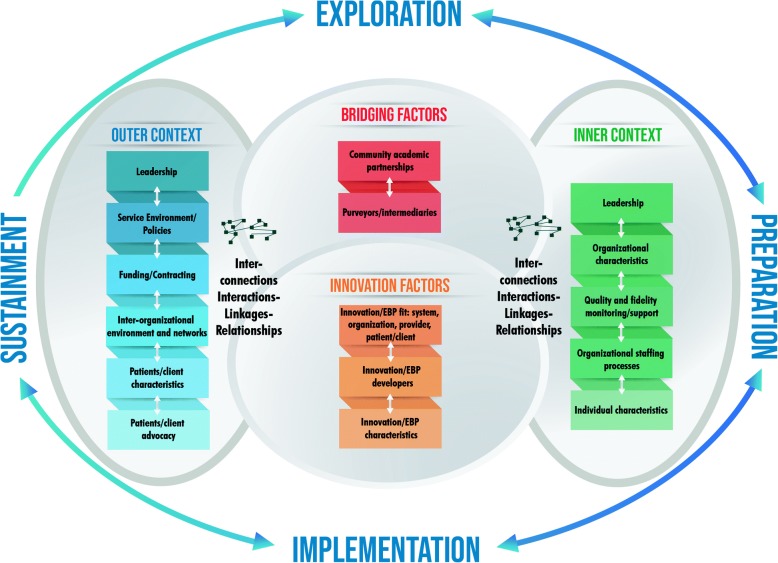
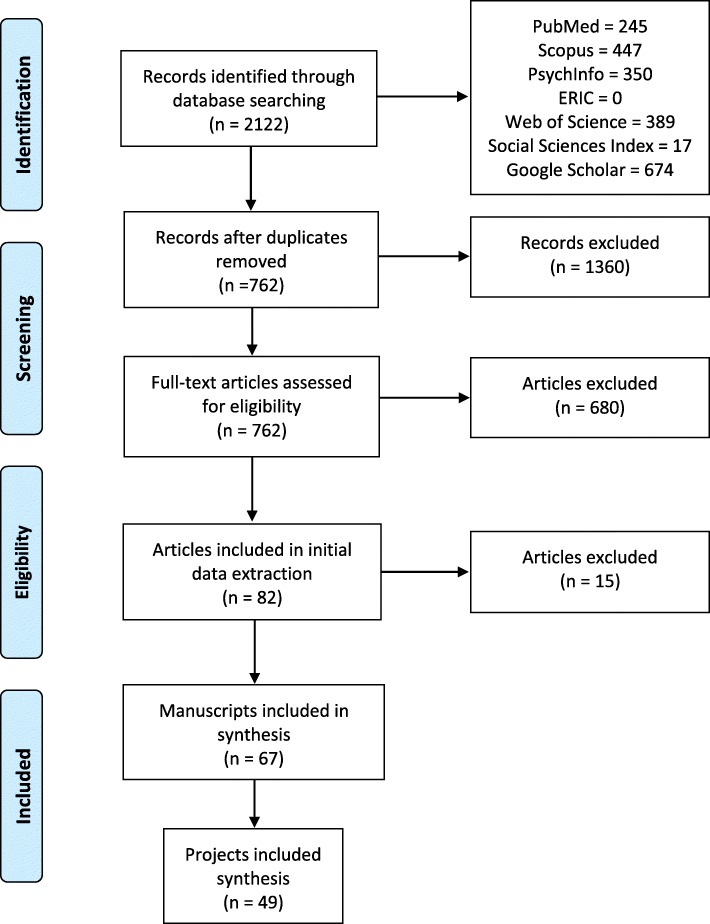
BACKGROUND: Effective implementation of evidence-based practices (EBPs) remains a significant challenge. Numerous existing models and frameworks identify key factors and processes to facilitate implementation. However, there is a need to better understand how individual models and frameworks are applied in research projects, how they can support the implementation process, and how they might advance implementation science. This systematic review examines and describes the research application of a widely used implementation framework, the Exploration, Preparation, Implementation, Sustainment (EPIS) framework. METHODS: A systematic literature review was performed to identify and evaluate the use of the EPIS framework in implementation efforts. Citation searches in PubMed, Scopus, PsycINFO, ERIC, Web of Science, Social Sciences Index, and Google Scholar databases were undertaken. Data extraction included the objective, language, country, setting, sector, EBP, study design, methodology, level(s) of data collection, unit(s) of analysis, use of EPIS (i.e., purpose), implementation factors and processes, EPIS stages, implementation strategy, implementation outcomes, and overall depth of EPIS use (rated on a 1-5 scale). RESULTS: In total, 762 full-text articles were screened by four reviewers, resulting in inclusion of 67 articles, representing 49 unique research projects. All included projects were conducted in public sector settings. The majority of projects (73%) investigated the implementation of a specific EBP. The majority of projects (90%) examined inner context factors, 57% examined outer context factors, 37% examined innovation factors, and 31% bridging factors (i.e., factors that cross or link the outer system and inner organizational context). On average, projects measured EPIS factors across two of the EPIS phases (M = 2.02), with the most frequent phase being Implementation (73%). On average, the overall depth of EPIS inclusion was moderate (2.8 out of 5). CONCLUSION: This systematic review enumerated multiple settings and ways the EPIS framework has been applied in implementation research projects, and summarized promising characteristics and strengths of the framework, illustrated with examples. Recommendations for future use include more precise operationalization of factors, increased depth and breadth of application, development of aligned measures, and broadening of user networks. Additional resources supporting the operationalization of EPIS are available.
Overview
The claims and statistics of this paper haven’t been checked yet.
Run the check — free, no account needed. It reads the open-access text and checks the sources it cites.
Integrity signals
Registry
Cites
Statistics
Figures
Verification
Claims the paper makes
The claims and statistics of this paper haven’t been checked yet.
Run the check — free, no account needed. It reads the open-access text and checks the sources it cites.
Claims other papers make about this one
Each is checked against this paper’s own text: does it say what the citing paper says it does?
The source backs part of the claim, not all of it — or backs it for a different population, condition or comparison.
In the citing paper
“Although the benefits of RPM are widely proven, its implementation and adoption in routine care has remained challenging.26”
From Implementation of a remote symptom monitoring pathway in oncology care: analysis of real-world experience across 33 cancer centres in France and Belgium (2024) · cites this paper as [26]
Experimental — accuracy not yet measuredThe source backs part of the claim, not all of it — or backs it for a different population, condition or comparison.
In the citing paper
“Although the benefits of RPM are widely proven, its implementation and adoption in routine care has remained challenging.26”
From Implementation of a remote symptom monitoring pathway in oncology care: analysis of real-world experience across 33 cancer centres in France and Belgium (2024) · cites this paper as [26]
Experimental — accuracy not yet measuredThe cited source says what the claim attributes to it.
In the citing paper
“The implementation of the RPM pathway followed the Exploration, Preparation, Implementation, Sustainment (EPIS) implementation science framework and other validated implementation techniques.17,26,27”
From Implementation of a remote symptom monitoring pathway in oncology care: analysis of real-world experience across 33 cancer centres in France and Belgium (2024) · cites this paper as [26]
The cited source says what the claim attributes to it.
In the citing paper
“When used in research, they can guide the design and conduct of studies, inform the theoretical and empirical thinking of research teams, and aid interpretation of findings.”
From Ten recommendations for using implementation frameworks in research and practice (2020) · cites this paper as [1]
The cited source says what the claim attributes to it.
In the citing paper
“The EPIS implementation framework (Aarons et al., 2011) is both a process and determinant framework (Nilsen, 2015) that includes four phases-Exploration, Preparation, Implementation, and Sustainment-each of which includes outer and inner contextual factors, bridging factors linking outer and inner contexts, and innovation factors that collectively are proposed to facilitate EBP implementation and”
From Implementation-as-Usual in Community-Based Organizations Providing Specialized Services to Individuals with Autism Spectrum Disorder: A Mixed Methods Study (2021) · cites this paper as Moullin et al., 2019
The cited source says what the claim attributes to it.
In the citing paper
“Additional inner contextual and intervention factors considered prior to adoption decision were derived from the qualitative data and are consistent with those identified in the recent EPIS systematic review (Moullin et al., 2019).”
From Implementation-as-Usual in Community-Based Organizations Providing Specialized Services to Individuals with Autism Spectrum Disorder: A Mixed Methods Study (2021) · cites this paper as Moullin et al., 2019
In the citing paper
“For intermediaries and practitioners, they can provide shared language to familiarize stakeholders with implementation and function as practical tools for planning, executing, and evaluating real-world implementation efforts.”
From Ten recommendations for using implementation frameworks in research and practice (2020) · cites this paper as [1]
In the citing paper
“Recent reviews of the use and application of implementation frameworks in implementation efforts highlight the limited use of frameworks, despite the value in doing so.”
From Ten recommendations for using implementation frameworks in research and practice (2020) · cites this paper as [1]
In the citing paper
“There is great value in effectively using implementation frameworks, models, and theories [1, 2].”
From Ten recommendations for using implementation frameworks in research and practice (2020) · cites this paper as [1]
In the citing paper
“These applied examples are based on the results of a recent systematic review [1], and the collective experience of the co-authors applying the EPIS framework in national and international implementation efforts.”
From Ten recommendations for using implementation frameworks in research and practice (2020) · cites this paper as [1]
In the citing paper
“Implementation frameworks often include several implementation determinants (i.e., barriers and enablers) that have been found to influence implementation outcomes [1, 2].”
From Ten recommendations for using implementation frameworks in research and practice (2020) · cites this paper as [1]
In the citing paper
“For the collection and analysis of qualitative data, frameworks such as EPIS or CFIR provide developed and freely available data analytic tools, including pre-populated coding templates and data aggregation matrices [1, 49].”
From Ten recommendations for using implementation frameworks in research and practice (2020) · cites this paper as [1]
Self-check
Percentages, sums and reported differences re-computed from the paper’s own numbers.
The self-check needs the paper’s full text.
Citations
Cites
Preferred Reporting Items for Systematic Reviews and Meta-Analyses: the PRISMA statement
Moher, D., Liberati, A., Tetzlaff, J., Altman, D. G., & for the PRISMA Group (2009) · BMJ · doi:10.1136/bmj.b2535 · Cited by 83,823
Preferred Reporting Items for Systematic Reviews and Meta-Analyses: The PRISMA Statement
Moher, D., Liberati, A., Tetzlaff, J., Altman, D. G., & The PRISMA Group (2009) · PLoS Medicine · doi:10.1371/journal.pmed.1000097 · Cited by 64,042
Preferred reporting items for systematic reviews and meta-analyses: the PRISMA Statement.
(2009) · PubMed Central · Cited by 44,859
Wang, G., Ma, R., Qiao, G., Wada, K., Aizawa, Y., & Satoh, T. (2015) · Integrative Medicine International · doi:10.1159/000368408 · Cited by 18,762
Evaluating the public health impact of health promotion interventions: the RE-AIM framework.
Glasgow, R. E., Vogt, T. M., & Boles, S. M. (1999) · American Journal of Public Health · doi:10.2105/ajph.89.9.1322 · Cited by 7,217
Making sense of implementation theories, models and frameworks
Nilsen, P. (2015) · Implementation Science · doi:10.1186/s13012-015-0242-0 · Cited by 4,447
Atkins, L., Francis, J., Islam, R., O’Connor, D., Patey, A., Ivers, N., Foy, R., Duncan, E. M., Colquhoun, H., Grimshaw, J. M., et al. (2017) · Implementation Science · doi:10.1186/s13012-017-0605-9 · Cited by 3,819
Advancing a Conceptual Model of Evidence-Based Practice Implementation in Public Service Sectors
Aarons, G. A., Hurlburt, M., & Horwitz, S. M. (2011) · Administration and Policy in Mental Health and Mental Health Services Research · doi:10.1007/s10488-010-0327-7 · Cited by 3,240
Self-citationThe Challenge of Innovation Implementation
Klein, K. J., & Sorra, J. S. (1996) · The Academy of Management Review · doi:10.2307/259164 · Cited by 2,113
Multifactor Leadership Questionnaire
Bass, B. M., & Avolio, B. J. (1995) · PsycTESTS Dataset · doi:10.1037/t03624-000 · Cited by 2,019
The PRECIS-2 tool: designing trials that are fit for purpose
Loudon, K., Treweek, S., Sullivan, F., Donnan, P., Thorpe, K. E., & Zwarenstein, M. (2015) · BMJ · doi:10.1136/bmj.h2147 · Cited by 1,846
The dynamic sustainability framework: addressing the paradox of sustainment amid ongoing change
Chambers, D. A., Glasgow, R. E., & Stange, K. C. (2013) · Implementation Science · doi:10.1186/1748-5908-8-117 · Cited by 1,724
A systematic review of the use of the Consolidated Framework for Implementation Research
Kirk, M. A., Kelley, C., Yankey, N., Birken, S. A., Abadie, B., & Damschroder, L. (2015) · Implementation Science · doi:10.1186/s13012-016-0437-z · Cited by 1,496
Bridging Research and Practice
Tabak, R. G., Khoong, E. C., Chambers, D. A., & Brownson, R. C. (2012) · American Journal of Preventive Medicine · doi:10.1016/j.amepre.2012.05.024 · Cited by 1,386
Dissemination and Implementation Research in HealthTranslating Science to Practice
Brownson, R. C., Colditz, G. A., & Proctor, E. K. (2012) · doi:10.1093/acprof:oso/9780199751877.001.0001 · Cited by 1,355
Wiltsey Stirman, S., Kimberly, J., Cook, N., Calloway, A., Castro, F., & Charns, M. (2012) · Implementation Science · doi:10.1186/1748-5908-7-17 · Cited by 1,355
Health Program Planning: An Educational and Ecological Approach
Green, L. W., & Kreuter, M. W. (1991) · Cited by 1,332
Patterson, M., West, M. A., Shackleton, V., Dawson, J., Lawthom, R., Maitlis, S., Robinson, D. L., & Wallace, A. M. (2005) · Journal of Organizational Behavior · doi:10.1002/job.312 · Cited by 1,318
Aarons, G. A. (2004) · Mental Health Services Research · doi:10.1023/b:mhsr.0000024351.12294.65 · Cited by 1,272
Self-citationReadiness for Organizational Change
Holt, D. T., Armenakis, A. A., Feild, H. S., & Harris, S. G. (2007) · The Journal of Applied Behavioral Science · doi:10.1177/0021886306295295 · Cited by 1,254
Mixed method designs in implementation research
Palinkas, L. A., Aarons, G. A., Horwitz, S., Chamberlain, P., Hurlburt, M., & Landsverk, J. (2011) · Administration and Policy in Mental Health and Mental Health Services Research · doi:10.1007/s10488-010-0314-z · Cited by 1,187
Self-citationStorylines of research in diffusion of innovation: a meta-narrative approach to systematic review
Greenhalgh, T., Robert, G., Macfarlane, F., Bate, P., Kyriakidou, O., & Peacock, R. (2005) · Social Science & Medicine · doi:10.1016/j.socscimed.2004.12.001 · Cited by 913
Maslach burnout inventory-general survey
김, 영. (2009) · Cited by 907
Assessing organizational readiness for change
Lehman, W. E. K., Greener, J. M., & Simpson, D. D. (2002) · Journal of Substance Abuse Treatment · doi:10.1016/s0740-5472(02)00233-7 · Cited by 863
The Sustainability of Evidence-Based Interventions and Practices in Public Health and Health Care
Shelton, R. C., Cooper, B. R., & Stirman, S. W. (2018) · Annual Review of Public Health · doi:10.1146/annurev-publhealth-040617-014731 · Cited by 806
Stirman, S. W., Miller, C. J., Toder, K., & Calloway, A. (2013) · Implementation Science · doi:10.1186/1748-5908-8-65 · Cited by 691
Glisson, C., Landsverk, J., Schoenwald, S., Kelleher, K., Hoagwood, K. E., Mayberg, S., Green, P., & The Research Network on Youth Mental Health (2008) · Administration and Policy in Mental Health and Mental Health Services Research · doi:10.1007/s10488-007-0148-5 · Cited by 608
Clustering competence in emotional intelligence: Insights from the Emotional Competence Inventory.
Boyatzis, R. E., Goleman, D., & Rhee, K. S. (2000) · Cited by 585
Barriers: The barriers to research utilization scale
Funk, S. G., Champagne, M. T., Wiese, R. A., & Tornquist, E. M. (1991) · Applied Nursing Research · doi:10.1016/s0897-1897(05)80052-7 · Cited by 583
Aarons, G. A., Ehrhart, M. G., & Farahnak, L. R. (2014) · Implementation Science · doi:10.1186/1748-5908-9-45 · Cited by 559
Self-citationEhrhart, M. G., Aarons, G. A., & Farahnak, L. R. (2014) · Implementation Science · doi:10.1186/s13012-014-0157-1 · Cited by 502
Self-citationAarons, G. A., Ehrhart, M. G., Farahnak, L. R., & Sklar, M. (2014) · Annual Review of Public Health · doi:10.1146/annurev-publhealth-032013-182447 · Cited by 474
Self-citationDynamic adaptation process to implement an evidence-based child maltreatment intervention
Aarons, G. A., Green, A. E., Palinkas, L. A., Self-Brown, S., Whitaker, D. J., Lutzker, J. R., Silovsky, J. F., Hecht, D. B., & Chaffin, M. J. (2012) · Implementation Science · doi:10.1186/1748-5908-7-32 · Cited by 449
Self-citationKlein, K. J., & Knight, A. P. (2005) · Current Directions in Psychological Science · doi:10.1111/j.0963-7214.2005.00373.x · Cited by 443
Measuring the perceived support for innovation in organizations.
Siegel, S. M., & Kaemmerer, W. F. (1978) · Journal of Applied Psychology · doi:10.1037/0021-9010.63.5.553 · Cited by 426
Qualitative approaches to use of the RE-AIM framework: rationale and methods
Holtrop, J. S., Rabin, B. A., & Glasgow, R. E. (2018) · BMC Health Services Research · doi:10.1186/s12913-018-2938-8 · Cited by 404
Self-citationA Guide for applying a revised version of the PARIHS framework for implementation
Stetler, C. B., Damschroder, L. J., Helfrich, C. D., & Hagedorn, H. J. (2011) · Implementation Science · doi:10.1186/1748-5908-6-99 · Cited by 402
Moullin, J. C., Sabater-Hernández, D., Fernandez-Llimos, F., & Benrimoj, S. I. (2015) · Health Research Policy and Systems · doi:10.1186/s12961-015-0005-z · Cited by 392
Self-citationBirken, S. A., Powell, B. J., Presseau, J., Kirk, M. A., Lorencatto, F., Gould, N. J., Shea, C. M., Weiner, B. J., Francis, J., Yu, Y., et al. (2017) · Implementation Science · doi:10.1186/s13012-016-0534-z · Cited by 387
Versteeg, M. H., Laurant, M. G., Franx, G. C., Jacobs, A. J., & Wensing, M. J. (2012) · Implementation Science · doi:10.1186/1748-5908-7-1 · Cited by 382
The Organizational Context of Children's Mental Health Services
Glisson, C. A. (2002) · Clinical Child and Family Psychology Review · doi:10.1023/a:1020972906177 · Cited by 378
Measuring the Diffusion of Innovative Health Promotion Programs
Steckler, A., Goodman, R. M., McLeroy, K. R., Thomas, S., & Koch, G. G. (1992) · American Journal of Health Promotion · doi:10.4278/0890-1171-6.3.214 · Cited by 238
Mixed Methods for Implementation Research
Aarons, G. A., Fettes, D. L., Sommerfeld, D. H., & Palinkas, L. A. (2011) · Child Maltreatment · doi:10.1177/1077559511426908 · Cited by 215
Self-citationDimeff, L., Koerner, K., Woodcock, E., Beadnell, B., Brown, M. Z., Skutch, J., Paves, A., Bazinet, A., & Harned, M. (2009) · Behaviour Research and Therapy · doi:10.1016/j.brat.2009.07.011 · Cited by 208
The Determinants of Team-Based Innovation in Organizations
Caldwell, D. F., & O’Reilly, C. A. (2003) · Small Group Research · doi:10.1177/1046496403254395 · Cited by 206
Sustaining Community‐Based Programs for Families: Conceptualization and Measurement*
Mancini, J. A., & Marek, L. I. (2004) · Family Relations · doi:10.1111/j.0197-6664.2004.00040.x · Cited by 199
T-CaST: an implementation theory comparison and selection tool
Birken, S. A., Rohweder, C. L., Powell, B. J., Shea, C. M., Scott, J. E., Leeman, J., Grewe, M. E., Kirk, M. A., Damschroder, L. J., Aldridge, W. A., et al. (2018) · Implementation Science · doi:10.1186/s13012-018-0836-4 · Cited by 199
Harden, S. M., Smith, M. L., Ory, M. G., Smith-Ray, R. L., Estabrooks, P. A., & Glasgow, R. E. (2018) · Frontiers in Public Health · doi:10.3389/fpubh.2018.00071 · Cited by 191
Weersing, V. R., Weisz, J. R., & Donenberg, G. R. (2002) · Journal of Clinical Child & Adolescent Psychology · doi:10.1207/s15374424jccp3102_03 · Cited by 189
Writing implementation research grant proposals: ten key ingredients
Proctor, E. K., Powell, B. J., Baumann, A. A., Hamilton, A. M., & Santens, R. L. (2012) · Implementation Science · doi:10.1186/1748-5908-7-96 · Cited by 169
Assessing citation networks for dissemination and implementation research frameworks
Skolarus, T. A., Lehmann, T., Tabak, R. G., Harris, J., Lecy, J., & Sales, A. E. (2017) · Implementation Science · doi:10.1186/s13012-017-0628-2 · Cited by 163
Aarons, G. A., Ehrhart, M. G., Moullin, J. C., Torres, E. M., & Green, A. E. (2017) · Implementation Science · doi:10.1186/s13012-017-0562-3 · Cited by 159
Self-citationLewis, C. C., Stanick, C. F., Martinez, R. G., Weiner, B. J., Kim, M., Barwick, M., & Comtois, K. A. (2016) · Implementation Science · doi:10.1186/s13012-014-0193-x · Cited by 155
Tricco, A. C., Ashoor, H. M., Cardoso, R., MacDonald, H. R., Cogo, E., Kastner, M., Perrier, L., McKibbon, A., Grimshaw, J., & Straus, S. E. (2015) · Implementation Science · doi:10.1186/s13012-016-0421-7 · Cited by 154
Interagency collaborative team model for capacity building to scale-up evidence-based practice
Hurlburt, M., Aarons, G. A., Fettes, D., Willging, C., Gunderson, L., & Chaffin, M. J. (2014) · Children and Youth Services Review · doi:10.1016/j.childyouth.2013.10.005 · Cited by 132
Self-citationAarons, G. A., Fettes, D. L., Hurlburt, M. S., Palinkas, L. A., Gunderson, L. M., Willging, C. E., & Chaffin, M. J. (2014) · Journal of Clinical Child & Adolescent Psychology · doi:10.1080/15374416.2013.876642 · Cited by 126
Self-citationBecan, J. E., Bartkowski, J. P., Knight, D. K., Wiley, T. R. A., DiClemente, R., Ducharme, L., Welsh, W. N., Bowser, D., McCollister, K., Hiller, M., et al. (2018) · Health & Justice · doi:10.1186/s40352-018-0068-3 · Cited by 119
Self-citationThe Therapy Process Observational Coding System for Child Psychotherapy Strategies Scale
McLeod, B. D., & Weisz, J. R. (2010) · Journal of Clinical Child & Adolescent Psychology · doi:10.1080/15374411003691750 · Cited by 118
Defining the external implementation context: an integrative systematic literature review
Watson, D. P., Adams, E. L., Shue, S. A., Coates, H., McGuire, A. B., Chesher, J., Jackson, J. R., & Omenka, O. I. (2018) · BMC Health Services Research · doi:10.1186/s12913-018-3046-5 · Cited by 111
Advancing the application, quality and harmonization of implementation science measures
Rabin, B. A., Purcell, P., Naveed, S., Moser, R. P., Henton, M. D., Proctor, E. K., Brownson, R. C., & Glasgow, R. E. (2012) · Implementation Science · doi:10.1186/1748-5908-7-119 · Cited by 106
Self-citationCooperative, T. J.-T., Knight, D. K., Belenko, S. R., Wiley, T., Robertson, A. A., Arrigona, N., Dennis, M. L., Bartkowski, J. P., McReynolds, L. S., Becan, J. E., et al. (2015) · Implementation Science · doi:10.1186/s13012-016-0423-5 · Cited by 103
Gleacher, A. A., Olin, S.-C. S., Nadeem, E., Pollock, M., Ringle, V. A. M., Bickman, L., Douglas, S. R., & Hoagwood, K. (2015) · Administration and Policy in Mental Health and Mental Health Services Research · doi:10.1007/s10488-015-0642-0 · Cited by 96
Measurement resources for dissemination and implementation research in health
Rabin, B. A., Lewis, C. C., Norton, W. E., Neta, G., Chambers, D., Tobin, J. N., Brownson, R. C., & Glasgow, R. E. (2015) · Implementation Science · doi:10.1186/s13012-016-0401-y · Cited by 92
Self-citationWhy new technologies fail: Overcoming the invisibility of implementation
Griffith, T. L., Zammuto, R. F., & Aiman‐Smith, L. (1999) · Industrial management · Cited by 89
Ehrhart, M. G., Aarons, G. A., & Farahnak, L. R. (2015) · Implementation Science · doi:10.1186/s13012-015-0255-8 · Cited by 73
Self-citationImplementation of Evidence-Based Services for Youth
Stumpf, R. E., Higa-McMillan, C. K., & Chorpita, B. F. (2008) · Behavior Modification · doi:10.1177/0145445508322625 · Cited by 69
Mazzucca, S., Tabak, R. G., Pilar, M. R., Ramsey, A. T., Baumann, A. A., Kryzer, E., Lewis, E. M., Padek, M. M., Powell, B. J., & Brownson, R. C. (2018) · Frontiers in Public Health · doi:10.3389/fpubh.2018.00032 · Cited by 65
Willging, C. E., Green, A. E., & Ramos, M. M. (2016) · Implementation Science · doi:10.1186/s13012-016-0507-2 · Cited by 58
Mixed Methods Evaluation in Dissemination and Implementation Science
Palinkas, L. A., & Cooper, B. R. (2017) · Oxford Scholarship Online · doi:10.1093/oso/9780190683214.003.0020 · Cited by 42
A multidisciplinary meta-analysis of human barriers to technology implementation.
Rizzuto, T. E., & Reeves, J. (2007) · Consulting psychology journal · doi:10.1037/1065-9293.59.3.226 · Cited by 39
Chambers, D. (2017) · Annual Review of Public Health · doi:10.1146/annurev-publhealth-110717-045850 · Cited by 33
Leavy, B., Kwak, L., Hagströmer, M., & Franzén, E. (2017) · BMC Neurology · doi:10.1186/s12883-017-0809-2 · Cited by 28
Beidas, R. S., Barmish, A. J., & Kendall, P. C. (2009) · ScholarlyCommons (University of Pennsylvania) · Cited by 25
Shoup, J. A., Gaglio, B., Varda, D., & Glasgow, R. E. (2014) · Translational Behavioral Medicine · doi:10.1007/s13142-014-0300-1 · Cited by 23
Patterson, T. L., Semple, S. J., Chavarin, C. V., Mendoza, D. V., dos Santos, L. E. R., Chaffin, M. J., Palinkas, L. A., Strathdee, S. A., & Aarons, G. A. (2012) · Implementation Science · doi:10.1186/1748-5908-7-105 · Cited by 23
Self-citationLewis, C. C., Stanick, C., Lyon, A., Darnell, D., Locke, J., Puspitasari, A., Marriott, B. R., Dorsey, C. N., Larson, M., Jackson, C., et al. (2018) · Implementation Science · doi:10.1186/s13012-018-0714-0 · Cited by 22
The “Critical” Elements of Illness Management and Recovery: Comparing Methodological Approaches
McGuire, A. B., Luther, L., White, D. A., White, L. M., McGrew, J. H., & Salyers, M. P. (2014) · Administration and Policy in Mental Health and Mental Health Services Research · doi:10.1007/s10488-014-0614-9 · Cited by 21
de Melo, M. N. T., de Sá, R. M. P. F., & Filho, D. A. D. M. (2016) · Ciência & Saúde Coletiva · doi:10.1590/1413-81232015216.08752016 · Cited by 15
Predictors of the Decision to Adopt Motivational Interviewing in Community Health Settings
Williams, J. R., Blais, M. P., Banks, D., Dusablon, T., Williams, W. O., & Hennessy, K. D. (2013) · The Journal of Behavioral Health Services & Research · doi:10.1007/s11414-013-9357-8 · Cited by 13
Moore, L. A., Aarons, G. A., Davis, J. H., & Novins, D. K. (2015) · Psychological Services · doi:10.1037/ser0000022 · Cited by 12
Self-citationWiley, T., Belenko, S. R., Knight, D. K., Bartkowski, J. P., Robertson, A. A., Aarons, G. A., Wasserman, G. A., Leukefeld, C. G., DiClemente, R. J., & Jones, D. J. (2015) · Implementation Science · doi:10.1186/1748-5908-10-s1-a43 · Cited by 12
Self-citationPeltzer, K., Prado, G. J., Horigian, V. E., Weiss, S. M., Cook, R., Sifunda, S., & Jones, D. L. (2016) · Journal of Psychology in Africa · doi:10.1080/14330237.2016.1219537 · Cited by 11
Gates, L. B., Hughes, A., & Kim, D. H. (2015) · Journal of Public Child Welfare · doi:10.1080/15548732.2015.1060917 · Cited by 5
Research works printed but not linked: 5
- de MNT M, de RMPF S, Filho DAM. Sustainability of an innovative school food program: a case study in the northeast of Brazil. SciELO Public Health. 2016;21:1899–908.
- Proceedings from the 10th Annual Conference on the Science of Dissemination and Implementation. In Science of Dissemination and Implementation; 2018; Arlington, VA. Implementation Science; 2017: 728.
- Aarons GA, Farahnak LR, Ehrhart MG, Sklar M. Aligning leadership across systems and organizations to develop strategic climate to for evidence-based practice implementation. Annu Rev Public Health. 2014;35:255–74. · DOI · Paper page
- QUALRIS workgroup: Qualitative research in implementation science. National Cancer Institute; 2017.
- Aarons G: Organizational climate for evidence-based practice implementation: development of a new scale. Proceedings of the Annual Association for Behavioral and Cognitive Therapies: November 2011: Toronto 2011.
Cited by
Sorted by citations
Damschroder, L. J., Reardon, C. M., Opra Widerquist, M. A., & Lowery, J. (2022) · Implementation Science · doi:10.1186/s13012-021-01181-5 · Cited by 784
Smith, J. D., Li, D. H., & Rafferty, M. R. (2020) · Implementation Science · doi:10.1186/s13012-020-01041-8 · Cited by 766
The FRAME-IS: a framework for documenting modifications to implementation strategies in healthcare
Miller, C. J., Barnett, M. L., Baumann, A. A., Gutner, C. A., & Wiltsey-Stirman, S. (2021) · Implementation Science · doi:10.1186/s13012-021-01105-3 · Cited by 490
Ten recommendations for using implementation frameworks in research and practice
Moullin, J. C., Dickson, K. S., Stadnick, N. A., Albers, B., Nilsen, P., Broder-Fingert, S., Mukasa, B., & Aarons, G. A. (2020) · Implementation Science Communications · doi:10.1186/s43058-020-00023-7 · Cited by 488
Self-citationMovsisyan, A., Arnold, L., Evans, R., Hallingberg, B., Moore, G., O’Cathain, A., Pfadenhauer, L. M., Segrott, J., & Rehfuess, E. (2019) · Implementation Science · doi:10.1186/s13012-019-0956-5 · Cited by 331
Metadata
- Authors
- Moullin, J. C., Dickson, K. S., Stadnick, N. A., Rabin, B., & Aarons, G. A.
- Affiliations
- Curtin University (AU)
- San Diego State University (US)
- University of California San Diego (US)
- Corresponding author
- Aarons, Gregory A.
- Venue
- Implementation Science
- Published
- 2019-01-05
- Volume
- 14
- Issue
- 1
- Pages
- 1-1
- ISSN
- 1748-5908 (ISSN-L)
- PMC
- PMC6321673
- OpenAlex
- W2907482335
- Cited by
- 1,223
- References
- 84
- Citations by year
- 2026: 184 · 2025: 218 · 2024: 200 · 2023: 208 · 2022: 153 · 2021: 152 · 2020: 74 · 2019: 32
- FWCI
- 18.83
- Type
- journal article
- Language
- en
- Open access
- gold
- doi.org
- Locations
- Implementation Science (publishedVersion, cc-by)
- Europe PMC (PubMed Central) (publishedVersion, other-oa)
- PubMed Central (publishedVersion, cc-by)
- PubMed (publishedVersion)
- DOAJ (DOAJ: Directory of Open Access Journals) (submittedVersion)
- eScholarship (California Digital Library) (submittedVersion)
- eScholarship (California Digital Library) (submittedVersion, cc-by)
- eSpace (Curtin University) (submittedVersion, cc-by)
- Funders
- National Institute on Drug Abuse (R01DA038466, U01DA036233)
- National Institute of Mental Health (R01MH072961, K23MH110602)
- Topics
- Health Sciences › Health Professions › General Health Professions › Health Policy Implementation Science
- Health Sciences › Health Professions › General Health Professions › Health Sciences Research and Education
- Health Sciences › Medicine › Public Health, Environmental and Occupational Health › Clinical practice guidelines implementation
- Keywords
- implementation research, evidence-based practice implementation, implementation framework, innovation drivers, implementation outcomes, implementation strategies
- MeSH terms
- Implementation Science, Diffusion of Innovation, Humans, Models, Theoretical, Public Health, Research Design, Evidence-Based Practice
About these checks
Registry, retraction, Cites and statistics results are computed, not judged, with one exception: a printed reference that no index lists is read once by a model before it counts as a citation error. Claims are extracted by a model and kept only when their quote appears verbatim in the text; each cited source is then checked, with a model’s help, for whether it says what the claim relies on. Those verdicts can be wrong — read the claim’s quote and the cited source before relying on one.
Statistics and arithmetic are recomputed, not judged.
Confidence bands are shown only for fields calibrated on our annotated test set. None is calibrated yet, so no band is shown.
What counts as a claim ›How we measure confidence ›How we check this ›
Are you an author, or do you see a problem with this page? Request a review
