

Action, actor, context, target, time (AACTT): a framework for specifying behaviour
Open accessThe DOI matches its Crossref record; 56 of the 56 references it cites were found in a registry or an index.
Abstract
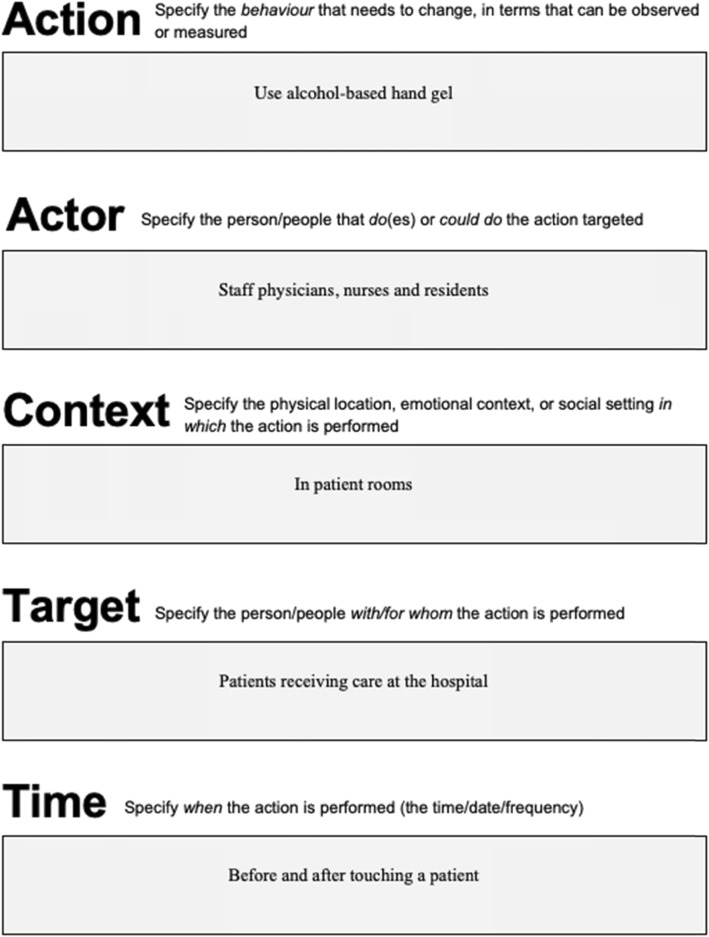
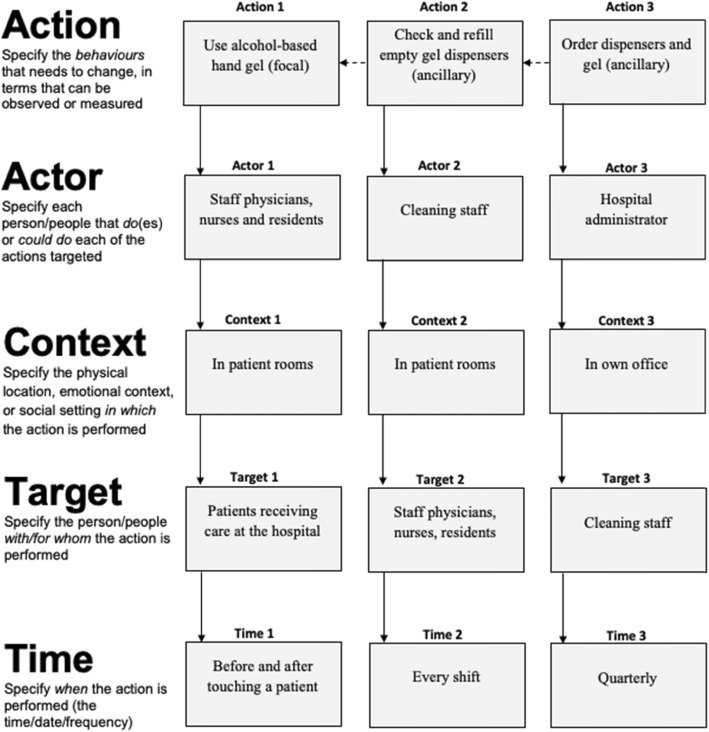
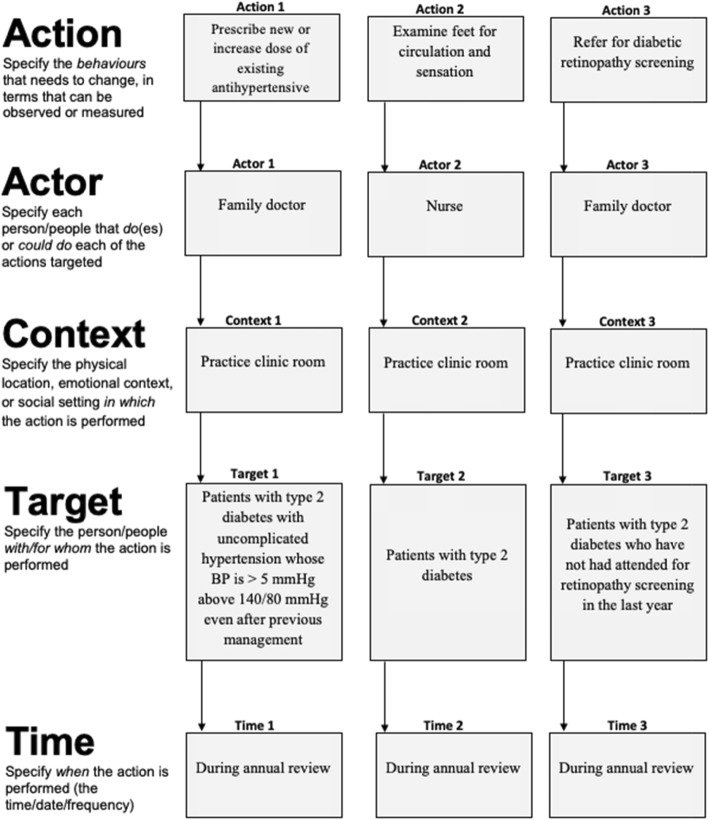
Background: Designing implementation interventions to change the behaviour of healthcare providers and other professionals in the health system requires detailed specification of the behaviour(s) targeted for change to ensure alignment between intervention components and measured outcomes. Detailed behaviour specification can help to clarify evidence-practice gaps, clarify who needs to do what differently, identify modifiable barriers and enablers, design interventions to address these and ultimately provides an indicator of what to measure to evaluate an intervention’s effect on behaviour change. An existing behaviour specification framework proposes four domains (Target, Action, Context, Time; TACT), but insufficiently clarifies who is performing the behaviour (i.e. the Actor). Specifying the Actor is especially important in healthcare settings characterised by multiple behaviours performed by multiple different people. We propose and describe an extension and re-ordering of TACT to enhance its utility to implementation intervention designers, practitioners and trialists: the Action, Actor, Context, Target, Time (AACTT) framework. We aim to demonstrate its application across key steps of implementation research and to provide tools for its use in practice to clarify the behaviours of stakeholders across multiple levels of the healthcare system. Methods and results: We used French et al.’s four-step implementation process model to describe the potential applications of the AACTT framework for (a) clarifying who needs to do what differently, (b) identifying barriers and enablers, (c) selecting fit-for-purpose intervention strategies and components and (d) evaluating implementation interventions. Conclusions: Describing and detailing behaviour using the AACTT framework may help to enhance measurement of theoretical constructs, inform development of topic guides and questionnaires, enhance the design of implementation interventions and clarify outcome measurement for evaluating implementation interventions.
Overview
The claims and statistics of this paper haven’t been checked yet.
Free: it reads the open-access text and checks the first 5 claims that cite a source we can check. Create a free account to check every claim.
Integrity signals
Registry
Cites
Statistics
Figures
Verification
Claims the paper makes
The claims and statistics of this paper haven’t been checked yet.
Free: it reads the open-access text and checks the first 5 claims that cite a source we can check. Create a free account to check every claim.
Claims other papers make about this one
Each is checked against this paper’s own text: does it say what the citing paper says it does?
The source backs part of the claim, not all of it — or backs it for a different population, condition or comparison.
In the citing paper
“This call for hypothesis testing in implementation outcomes research has been echoed by a number of recent papers [21–24].”
From Ten years of implementation outcomes research: a scoping review (2023) · cites this paper as [21]
Experimental — accuracy not yet measured
Self-check
Percentages, sums and reported differences re-computed from the paper’s own numbers.
The self-check needs the paper’s full text.
Citations
Cites
The theory of planned behavior
Ajzen, I. (1991) · Organizational Behavior and Human Decision Processes · doi:10.1016/0749-5978(91)90020-t · Cited by 134,657 · cited 6×
“Drawing upon Fishbein and Ajzen’s [9] early advice, a clearer, more actionable specification could be: ‘For people with diabetes (Target), record a blood pressure reading in the patient’s medical records (Action) in the primary care clinic (Context) when they attend for their annual diabetes review (Time)’ (Example 2).”
InfluentialDamschroder, L. J., Aron, D. C., Keith, R. E., Kirsh, S. R., Alexander, J. A., & Lowery, J. C. (2009) · Implementation Science · doi:10.1186/1748-5908-4-50 · Cited by 14,496 · cited 5×
“Birken SA, Powell BJ, Presseau J, Kirk MA, Lorencatto F, Gould NJ, et al. Combined use of the Consolidated Framework for Implementation Research (CFIR) and the Theoretical Domains Framework (TDF): a systematic review.”
BackgroundMethodInfluentialMichie, S., van Stralen, M. M., & West, R. (2011) · Implementation Science · doi:10.1186/1748-5908-6-42 · Cited by 13,697 · cited 3×
“Implementation intervention developers have a range of tools at their disposal for selecting and specifying interventions: high-level descriptors of implementation strategies such as those described in Cochrane’s Effective Practice and Organisation of Care (EPOC) [41] and Expert Recommendation for Implementing Change…”
MethodDeveloping and evaluating complex interventions: the new Medical Research Council guidance
Craig, P., Dieppe, P., Macintyre, S., Michie, S., Nazareth, I., & Petticrew, M. (2008) · BMJ · doi:10.1136/bmj.a1655 · Cited by 10,995 · cited 1×
“Knowledge-to-Action Framework [21], the UK MRC framework for developing and evaluating complex interventions [22] and process evaluations [23]).”
MethodCrossing the Quality Chasm: A New Health System for the 21st Century
Baker, A. (2001) · BMJ · doi:10.1136/bmj.323.7322.1192 · Cited by 10,736
Hoffmann, T. C., Glasziou, P. P., Boutron, I., Milne, R., Perera, R., Moher, D., Altman, D. G., Barbour, V., Macdonald, H., Johnston, M., et al. (2014) · BMJ · doi:10.1136/bmj.g1687 · Cited by 10,548 · cited 1×
“Best practice in implementation intervention development involves selecting evidence-based techniques and strategies that address the barriers and enablers identified [39], and clarifying who delivers and receives the intervention, how, when, where and how much [40].”
BackgroundCrossing the Quality Chasm: A New Health System for the 21st Century
Committee on Quality of Health Care in America (2002) · Journal For Healthcare Quality · doi:10.1111/j.1945-1474.2002.tb00463.x · Cited by 8,483
Michie, S., Richardson, M., Johnston, M., Abraham, C., Francis, J., Hardeman, W., Eccles, M. P., Cane, J., & Wood, C. E. (2013) · Annals of Behavioral Medicine · doi:10.1007/s12160-013-9486-6 · Cited by 7,629 · cited 3×
“Existing calls for better specification and reporting have focused on the description and labelling of implementation intervention strategies (e.g. with taxonomies of change strategies such as the ERIC [42] and BCT [43] taxonomies) and on the wider components of interventions (e.g. with checklists such as TIDIER [40]).”
MethodSelf-citationAttitude-behavior relations: A theoretical analysis and review of empirical research
Ajzen, I., & Fishbein, M. (1977) · Psychological Bulletin · doi:10.1037/0033-2909.84.5.888 · Cited by 7,611
Process evaluation of complex interventions: Medical Research Council guidance
Moore, G. F., Audrey, S., Barker, M., Bond, L., Bonell, C., Hardeman, W., Moore, L., O'Cathain, A., Tinati, T., Wight, D., et al. (2015) · BMJ · doi:10.1136/bmj.h1258 · Cited by 6,204
Research works printed but not linked: 2
- 7. Fishbein M, editor. Attitude and the prediction of behaviour (Chapter 51). In: Readings in attitude theory and measurement. New York: Wiley; 1967. p. 477-492.
- 11. Miller M. How well is the target behaviour specified in reports of behaviour change interventions for health care professionals? A systematic review of reporting practice [Master's thesis]: City University of London; 2015.
Cited by
Items 301–400 of 450
Online sexual, reproductive, and transgender healthcare for LGBTQI+ youth: A scoping reviewPreprint
McLeod, J., Estcourt, C. S., Flowers, P., Gibbs, J., & MacDonald, J. (2024) · medRxiv · doi:10.1101/2024.08.06.24311547
Pretorius, E. (2024) · Queensland University of Technology · doi:10.5204/thesis.eprints.251668
Best, S., Peters, S., Guccione, L., Francis, J., & Klaic, M. (2024) · Translational Behavioral Medicine · doi:10.1093/tbm/ibae044
Self-citationMambro, A., Fontaine, G., Ortiz-Paredes, D., Mortazhejri, S., Dussault, C., Cox, J., Presseau, J., & Kronfli, N. (2025) · International Journal of Drug Policy · doi:10.1016/j.drugpo.2025.104890
Self-citationRoberge‐Dao, J., Mayo, N. E., Rochette, A., Shikako‐Thomas, K., & Thomas, A. (2025) · Journal of Evaluation in Clinical Practice · doi:10.1111/jep.70196
“The addition of contextual cues in items has been said to increase the validity of responses, notably when the behavior has an element of automaticity [52].”
Nguyen‐Trung, K., Saeri, A. K., Zhao, K., Boulet, M., & Kaufman, S. (2025) · OSF Preprints (OSF Preprints) · doi:10.31219/osf.io/4x6wa_v2
McKinlay, A. R., Howlett, N., Antonopoulou, V., Lorencatto, F., McGowan, L. J., Osborn, D., O’Donnell, A., Oliver, E. J., Vlaev, I., Sniehotta, F. F., et al. (2025) · Systematic Reviews · doi:10.1186/s13643-025-02903-2
“Finally, the Action, Actor, Context, Target and Time framework (AACTT; [22]) can also assist with identifying key behaviours of people within a system to inform intervention evaluation.”
InfluentialSelf-citationO’Hare, F., Paynter, C., Foran, D., Kolic, M., Ondracek, C., Saunders, T., & Ayton, L. N. (2025) · Research Methods in Medicine & Health Sciences · doi:10.1177/26320843251379255
“31 Discrepancies were discussed with the involvement of a third author (MK) until an agreement was reached.”
InfluentialSrinivasan, D., Wang, R., Roberts, S. B., Lapointe‐Shaw, L., Tang, T., Birken, S. A., Harris, A., Ivers, N. M., Lorencatto, F., McCleary, N., et al. (2025) · BMC Health Services Research · doi:10.1186/s12913-025-13304-5 · Cited by 1
“To identify physician-level decisions and drivers of LoS, interview and observation data were organized by the Actor, Action, Context, Target, Time (AACTT) [70] framework to determine which discrete actions contributed to LoS in GIM, in what context(s), and who is involved.”
Self-citationBrown, A., Hudson, N., Jackson, J. K., Pinfold, J., Wolfenden, L., Nathan, N., Sewter, R., Kavalec, S., Davies, L. J., Young, S., et al. (2025) · JMIR Research Protocols · doi:10.2196/81390
“The preimplementation strategies, as illustrated in (Multimedia Appendix 2 [26,38-41]), were consistent across the intervention and control and included: • Involve executive boards: executive endorsement or management support.”
InfluentialCollins, K. A., Lacci‐Reilly, K. R., Aguilar, A. A., Fleg, J. L., George, S. M., Houmard, J. A., Huffman, K. M., Johannsen, N. M., Katz, D. H., Narendra, J. H., et al. (2025) · BMC Family Practice · doi:10.1186/s12875-025-03030-6
“1) [33, 34].”
Ajose-Adeogun, H., & Odo, I. (2023) · Global Academic Journal of Medical Sciences · doi:10.36348/gajms.2023.v05i06.007
Howlett, N., Antonopoulou, V., McKinlay, A. R., Lorencatto, F., McGowan, L. J., Osborn, D., O'Donnell, A. J., Oliver, E., Vlaev, I., Sniehotta, F. F., et al. (2025) · Systematic Reviews · doi:10.1186/s13643-025-02970-5
“The secondary outcome will be identification of the following AACTT [37] domains: key actions (e.g. sign-posting to psychological support), actors (e.g. obesity specialist nurse), contexts (e.g. tier 2/tier 3 weight management setting), targets (e.g. obesity service users), or time (e.g. at the end…”
InfluentialSelf-citationImad, N., Hall, A. E., Giles, L., Pearson, N., Shoesmith, A., Nathan, N., Grady, A., Renda, A., Belski, R., & Yoong, S. (2025) · Health Promotion International · doi:10.1093/heapro/daaf199
de Oliveira, C. A. (2025) · Digital Library of Theses and Dissertations (Universidade de São Paulo) · doi:10.11606/t.17.2025.tde-07112025-121808
Guyatt, S., Ferguson, M., Beckmann, M. M., & Wilkinson, S. A. (2025) · The Journal of Perinatal Education · doi:10.1891/jpe-2023-0049
The Continuing Challenge of Medication Adherence
(2025) · Frontiers research topics · doi:10.3389/978-2-8325-7235-1
Shuldiner, J., Lam, E., Shah, N., Grimshaw, J., Desveaux, L., Heisey, R., Taccone, M. S., Taljaard, M., Thavorn, K., Hodgson, D., et al. (2024) · Figshare · doi:10.6084/m9.figshare.26684919
Self-citationGleadhill, C., Alderman, K. B., Davidson, S. R. E., Kamper, S. J., Tutty, A., Robson, E., da Silva, P. V., Donald, B., Dooley, K., Manvell, J., et al. (2022) · Figshare · doi:10.6084/m9.figshare.21592574
Shuldiner, J., Lam, E., Shah, N., Grimshaw, J., Desveaux, L., Heisey, R., Taccone, M. S., Taljaard, M., Thavorn, K., Hodgson, D., et al. (2024) · Figshare · doi:10.6084/m9.figshare.26684904
Self-citationLawrie, L., Duncan, E. M., Lendrum, R., Lebrec, V., & Gillies, K. (2024) · Figshare · doi:10.6084/m9.figshare.26572546
Sarkies, M., Francis‐Auton, E., Long, J., Roberts, N., Westbrook, J., Lévesque, J., Watson, D. E., Hardwick, R., Sutherland, K., Disher, G. J., et al. (2024) · Figshare · doi:10.6084/m9.figshare.26652189
Gleadhill, C., Alderman, K. B., Davidson, S. R. E., Kamper, S. J., Tutty, A., Robson, E., da Silva, P. V., Donald, B., Dooley, K., Manvell, J., et al. (2022) · Figshare · doi:10.6084/m9.figshare.21592577
Smith, D., Cartwright, M., Dyson, J., Hartin, J., & Aitken, L. M. (2022) · Figshare · doi:10.6084/m9.figshare.20056239
Turner, R. R., Hart, J., Ashiru-Oredope, D. A. I., Atkins, L., Eades, C. P., Felton, T., Howlett, E., Rice, S., Shallcross, L. J., Lorencatto, F., et al. (2023) · Figshare · doi:10.6084/m9.figshare.23714169
Self-citationThe staff perspectives of implementing virtual reality in long term care homes
So, D. K. L. (2024) · cIRcle (University of British Columbia) · doi:10.14288/1.0445276
Nathan, N., Shoesmith, A., Hall, A., Peden, B., Riley-Gibson, E., Pascoe, W., Zucca, A. C., Lane, C., Gardner, C., Princehorn, E. M., et al. (2024) · NOVA (University of Newcastle Australia) · doi:10.25817/f8qp-z566
Czosnek, L., Zopf, E. M., Cormie, P., Rosenbaum, S., Richards, J., & Rankin, N. M. (2022) · Figshare · doi:10.6084/m9.figshare.20502028
Smith, D., Cartwright, M., Dyson, J., Hartin, J., & Aitken, L. M. (2022) · Figshare · doi:10.6084/m9.figshare.20056242
Newlands, R. S. N., Duncan, E., Treweek, S., Elliott, J., Presseau, J., Bower, P., MacLennan, G., Ogden, M., Wells, M., Witham, M. D., et al. (2022) · Figshare · doi:10.6084/m9.figshare.19561185
Self-citationCoffey, T., Duncan, E., Morgan, H., & Gillies, K. (2022) · Figshare · doi:10.6084/m9.figshare.20626397
Ray, D., Sniehotta, F., McColl, E., Ells, L. J., O'Neill, G., & McCabe, K. E. (2022) · Figshare · doi:10.6084/m9.figshare.21102200
Smith, D., Cartwright, M., Dyson, J., Hartin, J., & Aitken, L. M. (2022) · Figshare · doi:10.6084/m9.figshare.20056248
Cruden, G., Crable, E. L., Lengnick‐Hall, R., & Purtle, J. (2023) · Figshare · doi:10.6084/m9.figshare.24159255
Dunsmore, J., Duncan, E., MacLennan, S., N’Dow, J., & MacLennan, S. (2024) · Figshare · doi:10.6084/m9.figshare.26758556
Deinse, T. B. V., Zielinski, M. J., Holliday, S. B., Rudd, B. N., & Crable, E. L. (2024) · Figshare · doi:10.6084/m9.figshare.26644930
Dunsmore, J., Duncan, E., MacLennan, S., N’Dow, J., & MacLennan, S. (2024) · Figshare · doi:10.6084/m9.figshare.26517907
Basinska, K., Zúñiga, F., Simon, M., Geest, S. D., Guerbaai, R. A., Wellens, N. I. H., Nicca, D., & Brunkert, T. (2022) · Figshare · doi:10.6084/m9.figshare.19351134
Hanrahan, V., Lawrie, L., Duncan, E., Biesty, L., & Gillies, K. (2022) · Figshare · doi:10.6084/m9.figshare.21321548
Ray, D., Sniehotta, F., McColl, E., Ells, L. J., O'Neill, G., & McCabe, K. E. (2022) · Figshare · doi:10.6084/m9.figshare.21102209
Gleadhill, C., Alderman, K. B., Davidson, S. R. E., Kamper, S. J., Tutty, A., Robson, E., da Silva, P. V., Donald, B., Dooley, K., Manvell, J., et al. (2022) · Figshare · doi:10.6084/m9.figshare.21592571
Ray, D., Sniehotta, F., McColl, E., Ells, L. J., O'Neill, G., & McCabe, K. E. (2022) · Figshare · doi:10.6084/m9.figshare.21102191
Ray, D., Sniehotta, F., McColl, E., Ells, L. J., O'Neill, G., & McCabe, K. E. (2022) · Figshare · doi:10.6084/m9.figshare.21102203
Brehaut, J. C., Lavin Venegas, C., Hudek, N., Presseau, J., Carroll, K. A., & Rodger, M. (2021) · Figshare · doi:10.6084/m9.figshare.14462838
Self-citationSarkies, M., Francis‐Auton, E., Long, J., Roberts, N., Westbrook, J., Lévesque, J., Watson, D. E., Hardwick, R., Sutherland, K., Disher, G. J., et al. (2024) · Figshare · doi:10.6084/m9.figshare.26652198
Shuldiner, J., Lam, E., Shah, N., Grimshaw, J., Desveaux, L., Heisey, R., Taccone, M. S., Taljaard, M., Thavorn, K., Hodgson, D., et al. (2024) · Figshare · doi:10.6084/m9.figshare.26684907
Self-citationCruden, G., Crable, E. L., Lengnick‐Hall, R., & Purtle, J. (2023) · Figshare · doi:10.6084/m9.figshare.24159252
Ray, D., Sniehotta, F., McColl, E., Ells, L. J., O'Neill, G., & McCabe, K. E. (2022) · Figshare · doi:10.6084/m9.figshare.21102185
Shuldiner, J., Lam, E., Shah, N., Grimshaw, J., Desveaux, L., Heisey, R., Taccone, M. S., Taljaard, M., Thavorn, K., Hodgson, D., et al. (2024) · Figshare · doi:10.6084/m9.figshare.26684910
Self-citationVasiliou, V. S., Dockray, S., Dick, S., Davoren, M. P., Heavin, C., Linehan, C., & Byrne, M. (2021) · Figshare · doi:10.6084/m9.figshare.14623132
Turner, R. R., Hart, J., Ashiru-Oredope, D. A. I., Atkins, L., Eades, C. P., Felton, T., Howlett, E., Rice, S. J. C., Shallcross, L. J., Lorencatto, F., et al. (2023) · Figshare · doi:10.6084/m9.figshare.23714172
Self-citationBrehaut, J. C., Lavin Venegas, C., Hudek, N., Presseau, J., Carroll, K. A., & Rodger, M. (2021) · Figshare · doi:10.6084/m9.figshare.14462835
Self-citationCoffey, T., Duncan, E., Morgan, H., & Gillies, K. (2022) · Figshare · doi:10.6084/m9.figshare.20626403
King, L. K., Ivers, N. M., Waugh, E. J., MacKay, C., Stanaitis, I., Krystia, O., Stretton, J., Wong, S., Weisman, A., Bardai, Z., et al. (2023) · Figshare · doi:10.6084/m9.figshare.22616354
Ray, D., Sniehotta, F., McColl, E., Ells, L. J., O'Neill, G., & McCabe, K. E. (2022) · Figshare · doi:10.6084/m9.figshare.21102197
Skolarus, T. A., Hawley, S. T., Forman, J. H., Sales, A. E., Sparks, J. B., Metreger, T., Burns, J., Caram, M. V., Radhakrishnan, A., Dossett, L. A., et al. (2024) · Figshare · doi:10.6084/m9.figshare.26704380
Smith, D., Cartwright, M., Dyson, J., Hartin, J., & Aitken, L. M. (2022) · Figshare · doi:10.6084/m9.figshare.20056245
McHugh, S., Presseau, J., Luecking, C. T., & Powell, B. J. (2022) · Figshare · doi:10.6084/m9.figshare.20521686
Self-citationShuldiner, J., Lam, E., Shah, N., Grimshaw, J., Desveaux, L., Heisey, R., Taccone, M. S., Taljaard, M., Thavorn, K., Hodgson, D., et al. (2024) · Figshare · doi:10.6084/m9.figshare.26684922
Self-citationRay, D., Sniehotta, F., McColl, E., Ells, L. J., O'Neill, G., & McCabe, K. E. (2022) · Figshare · doi:10.6084/m9.figshare.21102212
Sarkies, M., Francis‐Auton, E., Long, J., Roberts, N., Westbrook, J., Lévesque, J., Watson, D. E., Hardwick, R., Sutherland, K., Disher, G. J., et al. (2024) · Figshare · doi:10.6084/m9.figshare.26652186
Dunsmore, J., Duncan, E., MacLennan, S., N’Dow, J., & MacLennan, S. (2024) · Figshare · doi:10.6084/m9.figshare.26517854
Cruden, G., Crable, E. L., Lengnick‐Hall, R., & Purtle, J. (2023) · Figshare · doi:10.6084/m9.figshare.24159249
Coffey, T., Duncan, E., Morgan, H., & Gillies, K. (2022) · Figshare · doi:10.6084/m9.figshare.20626400
Barriers and Enablers to Trial Optimization in the Neonatal Intensive Care Unit
Singh, K. (2022) · uO Research (University of Ottawa) · doi:10.20381/ruor-28180
Ray, D., Sniehotta, F., McColl, E., Ells, L. J., O'Neill, G., & McCabe, K. E. (2022) · Figshare · doi:10.6084/m9.figshare.21102206
Additional file 1 of Ten years of implementation outcomes research: a scoping review
Proctor, E. K., Bunger, A. C., Lengnick‐Hall, R., Gerke, D. R., Martin, J. K., Phillips, R. J., & Swanson, J. C. (2024) · Figshare · doi:10.6084/m9.figshare.26606383
Lawrie, L., Duncan, E. M., Lendrum, R., Lebrec, V., & Gillies, K. (2024) · Figshare · doi:10.6084/m9.figshare.26572540
Sarkies, M., Francis‐Auton, E., Long, J., Roberts, N., Westbrook, J., Lévesque, J., Watson, D. E., Hardwick, R., Sutherland, K., Disher, G. J., et al. (2024) · Figshare · doi:10.6084/m9.figshare.26652195
Ward, M. J., Matheny, M. E., Rubenstein, M. D., Bonnet, K. R., Dagostino, C., Schlundt, D. G., Anders, S. H., Reese, T., & Mixon, A. S. (2024) · Figshare · doi:10.6084/m9.figshare.25852982
Lawrie, L., Duncan, E. M., Lendrum, R., Lebrec, V., & Gillies, K. (2024) · Figshare · doi:10.6084/m9.figshare.26572543
Dunsmore, J., Duncan, E., MacLennan, S., N’Dow, J., & MacLennan, S. (2024) · Figshare · doi:10.6084/m9.figshare.26758562
Dunsmore, J., Duncan, E., MacLennan, S., N’Dow, J., & MacLennan, S. (2024) · Figshare · doi:10.6084/m9.figshare.26758559
Ray, D., Sniehotta, F., McColl, E., Ells, L. J., O'Neill, G., & McCabe, K. E. (2022) · Figshare · doi:10.6084/m9.figshare.21102194
Ray, D., Sniehotta, F., McColl, E., Ells, L. J., O'Neill, G., & McCabe, K. E. (2022) · Figshare · doi:10.6084/m9.figshare.21102188
Skolarus, T. A., Hawley, S. T., Forman, J. H., Sales, A. E., Sparks, J. B., Metreger, T., Burns, J., Caram, M. V., Radhakrishnan, A., Dossett, L. A., et al. (2024) · Figshare · doi:10.6084/m9.figshare.26704383
King, L. K., Ivers, N. M., Waugh, E. J., MacKay, C., Stanaitis, I., Krystia, O., Stretton, J., Wong, S., Weisman, A., Bardai, Z., et al. (2023) · Figshare · doi:10.6084/m9.figshare.22616357
Lawrie, L., Duncan, E. M., Lendrum, R., Lebrec, V., & Gillies, K. (2024) · Figshare · doi:10.6084/m9.figshare.26572549
Shuldiner, J., Lam, E., Shah, N., Grimshaw, J., Desveaux, L., Heisey, R., Taccone, M. S., Taljaard, M., Thavorn, K., Hodgson, D., et al. (2024) · Figshare · doi:10.6084/m9.figshare.26684916
Self-citationSarkies, M., Francis‐Auton, E., Long, J., Roberts, N., Westbrook, J., Lévesque, J., Watson, D. E., Hardwick, R., Sutherland, K., Disher, G. J., et al. (2024) · Figshare · doi:10.6084/m9.figshare.26652192
Shuldiner, J., Lam, E., Shah, N., Grimshaw, J., Desveaux, L., Heisey, R., Taccone, M. S., Taljaard, M., Thavorn, K., Hodgson, D., et al. (2024) · Figshare · doi:10.6084/m9.figshare.26684913
Self-citationShuldiner, J., Lam, E., Shah, N., Grimshaw, J., Desveaux, L., Heisey, R., Taccone, M. S., Taljaard, M., Thavorn, K., Hodgson, D., et al. (2024) · Figshare · doi:10.6084/m9.figshare.26684925
Self-citationEdwards, G. F. I. (2023) · VTechWorks (Virginia Tech)
Improving caring quality for people with dementia in nursing homes using IPOS-Dem
Spichiger, F. (2024) · IRIS
Smith, D. (2022) · City Research Online (City University London)
Karaoğlu, İ. E. (2024) · Repositori digital de la UPF (Universitat Pompeu Fabra)
Bain, T., Langmuir, T., Presseau, J., DeMaio, P., Bhuiya, A., Alam, S., Velez, C., Khan, Z., Lavis, J., & Wilson, M. (2023) · MacSphere (McMaster University) · doi:10.71548/2963
Self-citationRoberge‐Dao, J. (2023) · eScholarship@McGill (McGill) · doi:10.82308/1829
Role of Nurses in Identifying Early Care Escalation Needs
Alenzi, H. F. H., Alruwaili, S. D., Alruwaili, S. S. S., Alrowily, A. M. H., Alanazi, A. S., Alruwaili, N. G. F., Alhazmi, B. M. M., Alsolabi, A. S. A., Alhazmi, A. N. M., Alanazi, M. B. S., et al. (2024) · International Journal of Computational and Experimental Science and Engineering · doi:10.22399/ijcesen.4652
“For instance, a NEWS2 score of 3 might trigger a routine review, but if that score is driven by a new-onset confusion in an elderly post-operative patient, the nurse’s assessment would rightly elevate the urgency, prompting immediate action for potential delirium or other complications [13].”
Facing the challenges in implementing sexual health guidelines for cancer survivors
Gupta, N., Wittmann, D. A., Skolarus, T. A., Nelson, C. J., Loeb, S., & Mulhall, J. P. (2025) · The Journal of Sexual Medicine · doi:10.1093/jsxmed/qdaf322
“2 Then, assessing the impact of the strategy on whether or not the discussions occur would not only address gaps in implementation and potentially improve sexual health outcomes for PCa, but also provide a rigorous framework as a model for other cancer survivor populations to help ensure sexual…”
Santos, M. E. (2024) · LA Referencia (Red Federada de Repositorios Institucionales de Publicaciones Científicas)
dos Santos, L. E. S. (2023) · LA Referencia (Red Federada de Repositorios Institucionales de Publicaciones Científicas)
Harding, K. E., Lewis, A. K., Considine, J., Casey, P., Davis, I. S., Dennett, A. M., Tan, G. A., Boyle, J. A., & Taylor, N. F. (2026) · Frontiers in Health Services · doi:10.3389/frhs.2025.1691307
McAuliffe, S., Davies, S., Dunn, M., White, K., Bauer, J. D., Clark, J. R., & Findlay, M. (2026) · Supportive Care in Cancer · doi:10.1007/s00520-026-10312-x
“…Group and Development of Supportive Care-Led Pre-Operative Clinic: An in-person focus group informed the development of the EBCP using the Action, Actor, Context, Target, Time (AACTT) Framework [27] to define key roles and responsibilities related to nutrition care processes (Supplementary Data 2).”
Almquist, L. E. (2025) · ResearchWorks at the University of Washington (University of Washington) · doi:10.13140/rg.2.2.36554.63680
Santos, W. J., Graham, I. D., Vandyk, A. D., Harvey, G., & Squires, J. E. (2026) · JMIR Research Protocols · doi:10.2196/80204 · Cited by 1
“…use directed content analysis [51] to organize the data pertaining to nurse champions’ behaviors according to action, actor, context, target, time [52], to demonstrate the attitudes, judgment, knowledge, or skills (competencies) that are linked to the expected behaviors (action) that a nurse…”
Nkurikiye, J. B., Fockaert, L., Ruymbeke, K. V., Mutyebere, R., Uwizeyimana, V., Bizoza, A. R., Verbist, B., & Vranken, L. (2026) · Agroforestry Systems · doi:10.1007/s10457-026-01440-8
“Following Presseau et al. (2019), the ’Actor’ element in this study refers to individual farmer respondent.”
Zúñiga, F., Saringer-Hamiti, L., Siqeca, F., Holzer, S., Guerbaaï, R.-A., Brunkert, T., Islam, F., Bartáková, J., Orschulko, A., Staudacher, S., et al. (2026) · Implementation Science · doi:10.1186/s13012-026-01489-0
“…strategies were adapted based on these determinants and described using the action, actor, context, target, time (AACTT) framework of Presseau and colleagues [50], resulting in a set of clearly specified strategies to be examined in the planned cluster-RCT (see Supplementary Material 2).”
Metadata
- Authors
- Presseau, J., McCleary, N., Lorencatto, F., Patey, A. M., Grimshaw, J. M., & Francis, J. J.
- Affiliations
- University of Ottawa (CA)
- University College London (GB)
- Ottawa Hospital Research Institute (CA)
- City, University of London (GB)
- Corresponding author
- Presseau, Justin
- ORCID
- Venue
- Implementation Science
- Published
- 2019-12
- Volume
- 14
- Issue
- 1
- Pages
- 102-102
- ISSN
- 1748-5908 (ISSN-L)
- PMC
- PMC6896730
- OpenAlex
- W2992424904
- Semantic Scholar
- eb078a483997a0adf8600d44d0a9ed59fa27d2ef
- Cited by
- 411
- References
- 56
- Citations by year
- 2026: 54 · 2025: 75 · 2024: 73 · 2023: 67 · 2022: 88 · 2021: 35 · 2020: 16 · 2019: 1
- FWCI
- 47.69
- Type
- journal article
- Language
- en
- Open access
- gold
- doi.org
- Licence
- cc-by
- creativecommons.org/licenses/by/4.0/ (tdm)
- creativecommons.org/licenses/by/4.0/ (vor, 4 d)
- Locations
- Implementation Science (publishedVersion, cc-by)
- PubMed Central (publishedVersion, cc-by)
- PubMed (publishedVersion)
- City Research Online (City University London) (acceptedVersion)
- Minerva Access (University of Melbourne) (submittedVersion, other-oa)
- uO Research (University of Ottawa) (submittedVersion, public-domain)
- DOAJ (DOAJ: Directory of Open Access Journals) (submittedVersion, cc-by-sa)
- UCL Discovery (University College London) (submittedVersion)
- Funders
- Canadian Institutes of Health Research
- Topics
- Health Sciences › Health Professions › General Health Professions › Health Policy Implementation Science
- Social Sciences › Psychology › Applied Psychology › Behavioral Health and Interventions
- Health Sciences › Health Professions › General Health Professions › Health Sciences Research and Education
- Keywords
- implementation strategies, barriers and facilitators, implementation process model, outcome measurement, intervention design, topic guide, questionnaire
- MeSH terms
- Clinical Competence, Health Personnel, Health Plan Implementation, Health Services Research, Humans, Models, Theoretical, Time, Guideline Adherence, Quality Improvement
About these checks
Registry, retraction, Cites and statistics results are computed, not judged, with one exception: a printed reference that no index lists is read once by a model before it counts as a citation error. Claims are extracted by a model and kept only when their quote appears verbatim in the text; each cited source is then checked, with a model’s help, for whether it says what the claim relies on. Those verdicts can be wrong — read the claim’s quote and the cited source before relying on one.
Statistics and arithmetic are recomputed, not judged.
Confidence bands are shown only for fields calibrated on our annotated test set. None is calibrated yet, so no band is shown.
What counts as a claim ›How we measure confidence ›How we check this ›
Are you an author, or do you see a problem with this page? Request a review
Data sources
Bibliographic data: Semantic Scholar, OpenAlex, Crossref.
Contains information from the Semantic Scholar Academic Graph Datasets, made available under the ODC Attribution License (ODC-BY 1.0).
Semantic Scholar’s data is described in: Kinney, R., et al. (2023). The Semantic Scholar Open Data Platform. arXiv:2301.10140.
