

Prevalence, incidence and carrier frequency of 5q-linked spinal muscular atrophy - a literature review
Open accessThe DOI matches its Crossref record; 119 of the 119 references it cites were found in a registry or an index.
Abstract
Spinal muscular atrophy linked to chromosome 5q (SMA) is a recessive, progressive, neuromuscular disorder caused by bi-allelic mutations in the SMN1 gene, resulting in motor neuron degeneration and variable presentation in relation to onset and severity. A prevalence of approximately 1-2 per 100,000 persons and incidence around 1 in 10,000 live births have been estimated with SMA type I accounting for around 60% of all cases. Since SMA is a relatively rare condition, studies of its prevalence and incidence are challenging. Most published studies are outdated and therefore rely on clinical rather than genetic diagnosis. Furthermore they are performed in small cohorts in small geographical regions and only study European populations. In addition, the heterogeneity of the condition can lead to delays and difficulties in diagnosing the condition, especially outside of specialist clinics, and contributes to the challenges in understanding the epidemiology of the disease. The frequency of unaffected, heterozygous carriers of the SMN1 mutations appears to be higher among Caucasian and Asian populations compared to the Black (Sub-Saharan African ancestry) population. However, carrier frequencies cannot directly be translated into incidence and prevalence, as very severe (death in utero) and very mild (symptom free in adults) phenotypes carrying bi-allelic SMN1 mutations exist, and their frequency is unknown. More robust epidemiological data on SMA covering larger populations based on accurate genetic diagnosis or newborn screening would be helpful to support planning of clinical studies, provision of care and therapies and evaluation of outcomes.
Overview
The claims and statistics of this paper haven’t been checked yet.
Free: it reads the open-access text and checks the first 5 claims that cite a source we can check. Create a free account to check every claim.
Integrity signals
Registry
Cites
Statistics
Figures
Verification
Claims the paper makes
The claims and statistics of this paper haven’t been checked yet.
Free: it reads the open-access text and checks the first 5 claims that cite a source we can check. Create a free account to check every claim.
Claims other papers make about this one
Each is checked against this paper’s own text: does it say what the citing paper says it does?
In the citing paper
“This autosomal recessive disorder results from a mutation in the survival motor neuron SMN1 gene with an incidence of approximately 1:10,000 live births, 60% of whom have SMA type 1.2,3”
From Current clinical applications of in vivo gene therapy with AAVs (2021) · cites this paper as [2]
Self-check
Percentages, sums and reported differences re-computed from the paper’s own numbers.
The self-check needs the paper’s full text.
Citations
Cites
Identification and characterization of a spinal muscular atrophy-determining gene
Lefebvre, S., Bürglen, L., Reboullet, S., Clermont, O., Burlet, P., Viollet, L., Benichou, B., Cruaud, C., Millasseau, P., Zeviani, M., et al. (1995) · Cell · doi:10.1016/0092-8674(95)90460-3 · Cited by 3,990 · cited 2×
“This results in a frame-shift and production of a protein with a different C-terminal end, which is unstable and non-functional [3, 6].”
BackgroundMethodPrevalence of Muscular Dystrophies: A Systematic Literature Review
Theadom, A., Rodrigues, M., Roxburgh, R., Balalla, S., Higgins, C., Bhattacharjee, R., Jones, K., Krishnamurthi, R., & Feigin, V. (2014) · Neuroepidemiology · doi:10.1159/000369343 · Cited by 2,046
Population frequencies of inherited neuromuscular diseases—A world survey
Emery, A. E. H. (1991) · Neuromuscular Disorders · doi:10.1016/0960-8966(91)90039-u · Cited by 1,448 · cited 1×
“In 1991, Alan Emery published a review estimating the incidence for SMA type I to be around 4–6 in 100,000 (1 in 12,500–1 in 16,667) live births [49], which was based on only three studies [50–52].”
BackgroundFeldkötter, M., Schwarzer, V., Wirth, R., Wienker, T. F., & Wirth, B. (2002) · The American Journal of Human Genetics · doi:10.1086/338627 · Cited by 1,004
Lunn, M. R., & Wang, C. H. (2008) · The Lancet · doi:10.1016/s0140-6736(08)60921-6 · Cited by 995
Roy, N., Mahadevan, M. S., McLean, M., Shutter, G., Yaraghi, Z., Farahani, R., Baird, S., Besner-Johnston, A., Lefebvre, C., Kang, X., et al. (1995) · Cell · doi:10.1016/0092-8674(95)90461-1 · Cited by 981 · cited 1×
“NAIP, H4F5 and GTF2H2 are thought to be a modifiers due to their proximity to the SMN1 gene and NAIP also shows homology to apoptosis inhibitory proteins [12, 14, 16].”
BackgroundSugarman, E. A., Nagan, N., Zhu, H., Akmaev, V. R., Zhou, Z., Rohlfs, E. M., Flynn, K., Hendrickson, B. C., Scholl, T., Sirko-Osadsa, D. A., et al. (2012) · European Journal of Human Genetics · doi:10.1038/ejhg.2011.134 · Cited by 661 · cited 2×
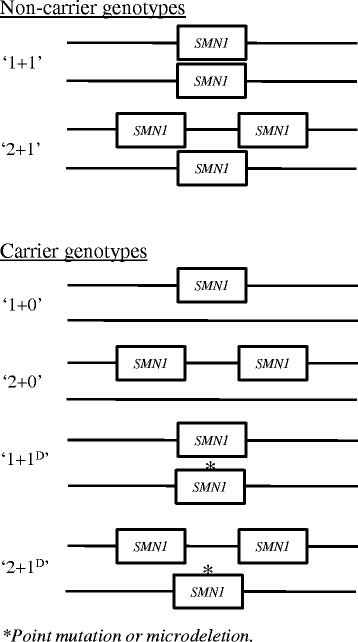
“This was seen in African Americans [46, 62, 77], as well as in Black Africans [66] and would indicate a higher proportion of 2-copy (duplication) alleles, thereby suggesting a higher number of ‘2 + 0’ carriers.”
BackgroundResultZerres, K. (1995) · Archives of Neurology · doi:10.1001/archneur.1995.00540290108025 · Cited by 563
McAndrew, P. E., Parsons, D. W., Simard, L. R., Rochette, C., Ray, P. N., Mendell, J. R., Prior, T. W., & Burghes, A. H. M. (1997) · The American Journal of Human Genetics · doi:10.1086/515465 · Cited by 543
Norwood, F. L. M., Harling, C., Chinnery, P. F., Eagle, M., Bushby, K., & Straub, V. (2009) · Brain · doi:10.1093/brain/awp236 · Cited by 541 · cited 1×
“Of three studies that investigated type II and type III separately, two found a higher prevalence of type III compared to type II [24, 32].”
Background
Research works printed but not linked: 2
- SPINRAZA® (Nusinersen) Approved in the European Union as First Treatment for Spinal Muscular Atrophy [ http://media.biogen.com/press-release/investor-relations/spinraza-nusinersen-approved-european-union-first-treatment-spinal-].
- Ignatius J Donner M H L Epidemiology of childhood disorders (in Finnish) Lihastautien Kehittyvä Tutkimus Ja Hoito 1989 Turku Kiasma
Cited by
Items 701–738 of 738
Aragon‐Gawinska, K., Garzón, N. C. Ñ., Muelas, N., Sivera, R., Sevilla, T., Hervás, D., Castellano, I. P., & Vazquez-Costa, J. F. (2026) · Journal of Neurology · doi:10.1007/s00415-026-13965-0
“Within our region, we estimated a prevalence of 1.94 cases per 100.000 inhabitants, which aligns closely with recent estimates from Italy [29] and remains within the established prevalence range for European countries—typi-cally 1–2 cases per 100.000 inhabitants [30].”
InfluentialYıkılmaz, S. K., Akcabelen, M., & Ata, G. (2026) · Physical & Occupational Therapy In Pediatrics · doi:10.1080/01942638.2026.2697784
Kulthanachairojana, N., Kamalaporn, H., Kuptanon, T., Preutthipan, A., Nugboon, M., Sriboonyong, T., Chaicoming, K., Pongsri, T., Leelaudomlipi, S., & Taychakhoonavudh, S. (2026) · Respiratory Medicine · doi:10.1016/j.rmed.2026.109015
Chung, H., Wang, C., Yu, C.-H., Huang, C.-Y., & Liang, F. (2026) · Orphanet Journal of Rare Diseases · doi:10.1186/s13023-026-04494-0
“The worldwide incidence of SMA is approximately 7.8 to 10 cases per 100,000 live births [5].”
InfluentialAbnormal auditory neural activity in individuals with spinal muscular atrophy
Rance, G., & Yiu, E. M. (2026) · Brain Communications · doi:10.1093/braincomms/fcag281
Hamadou, W. S., Amara, A., Chouk, H., Trabelsi, S., Bennour, A., Najar, S., Hammedi, M., Benzarti, A., Hmida, D., & Gribaa, M. (2026) · Neurogenetics · doi:10.1007/s10048-026-00923-1
“The high prevalence of SMA-I in our cohort is consistent with international epidemiological data regarding disease severity and frequency [32].”
Orachon, K., Jaranasaksakul, W., Onsod, P., Siriboonpiputtana, T., Rerkamnuaychoke, B., & Chareonsirisuthigul, T. (2026) · Clinica Chimica Acta · doi:10.1016/j.cca.2026.121257
Toro, W., Yang, M., Song, W., Wirtz, E. L., & Ye, D. (2026) · Advances in Therapy · doi:10.1007/s12325-026-03687-0
Pathologies neuromusculaires de l’enfant
Goff, L. L., & Goussé, G. (2025) · Elsevier eBooks · doi:10.1016/b978-2-294-77619-9.00009-1
Humanistic and Economic Burden of Spinal Muscular Atrophy in the Gulf Region
Elezbawy, B., Abaza, S., Alnajjar, A., Alabdulkarim, H. A., Al‐Omar, H. A., Fahmy, S., Aldallal, S., Ágh, T., & Fasseeh, A. N. (2026) · Cureus · doi:10.7759/cureus.114046
Santos, A. R. B. V., Ferreira, L. S., Santos, T. S., Mazzeu, J. F., & Sorte, N. C. A. B. (2026) · Jornal de Pediatria · doi:10.1016/j.jped.2026.101597
“It is one of the leading genetic causes of infant mortality associated with neuromuscular disease, with an estimated incidence ranging from 1:6000 to 1:11,000 live births [2,3].”
Meireles, M. R., DALPIAZ, G., Krohn, M. S., Maraschin, T. G., Hasenkamp, W., & da Silva, A. A. (2026) · Sensors · doi:10.3390/s26165171
Amare, T. Z., Tamirat, A., Zelalem, B., & Megen, E. F. (2026) · Research Square · doi:10.21203/rs.3.rs-10730430/v1
A Pilot Evaluation of Spinal Muscular Atrophy Carrier Frequency Among Newborns in Northern Cyprus
Kafshboran, H. R., Demey, J., Ismael, A. B., Şanlıdağ, B., Dalkan, C., Dırık, E., Çobanoğulları, H., & Ergören, M. Ç. (2026) · Current Genetic Medicine Reports · doi:10.1007/s40142-026-00264-3
Bai, J., Jiang, Q., Jiao, H., Jin, Y., Wang, H., Ge, X., Gao, Y., Peng, X., Song, F., Qu, Y.-J., et al. (2026) · Genes · doi:10.3390/genes17080971
Spinal muscular atrophy: history and current treatment landscape
Ünver, O., Wilmshurst, J. M., & Topaloğlu, H. (2026) · Journal of the International Child Neurology Association · doi:10.17724/jicna.2026.327
“It is one of the most common monogenic causes of infant mortality, with an incidence of approximately 1 in 6,000–30,000 live births and a carrier frequency of about 1 in 50 individuals [1–3].”
Sexton, M., Crow, E. W., & Peng, C. A. (2026) · Frontiers in Molecular Medicine · doi:10.3389/fmmed.2026.1901311
“It is the leading cause of hereditary infant mortality (Darras et al., 2015), with an incidence of 10 in 100,000 (Verhaart et al., 2017).”
A Single-Tube Nested PCR Method for SMN1 Deletion Detection in Spinal Muscular Atrophy
Kosaka, A., Sakima, M., Noguchi, Y., Shiroshita, T., Aoki, Y., Otsuka, Y., Bouike, Y., & Nishio, H. (2026) · Methods and Protocols · doi:10.3390/mps9050128
“The incidence of 5q-SMA is approximately 1 in 10,000 live births, and its prevalence is estimated at 1 to 2 per 100,000 persons [1,2].”
Abe, Y., Suzuki‐Muromoto, S., Kosuga, M., Isayama, T., Tajima, G., Aoki, Y., Ishige, N., & Ito, Y. (2026) · International Journal of Neonatal Screening · doi:10.3390/ijns12030071
“However, about 5% of patients with SMA harbor compound heterozygous SMN1 variants comprising a deletion on one allele and an intragenic pathogenic variant on the other allele [1,4,11].”
InfluentialGenetherapy in neurological disorders
Bushlyar, V., Roy, B., & Chatterjee, A. (2026) · Elsevier eBooks · doi:10.1016/b978-0-443-44631-3.00001-9
Zhang, X.-F., Wang, Y., Li, S., Liu, P., & Hu, W.-G. (2026) · Frontiers in Genetics · doi:10.3389/fgene.2026.1851666
“The incidence of SMA is approximately 1 in 11,000 live births, with a carrier frequency ranging from 1 in 40 to 1 in 70, making it the most common monogenic cause of infant mortality (Verhaart et al., 2017).”
Polat, M., Dinçer, S. A., & Terzi, Y. K. (2026) · IntechOpen eBooks · doi:10.5772/intechopen.1017730
Spinal muscular atrophy: Biology, pathogenesis, and therapeutic advances
René, C. A., & Parks, R. J. (2026) · Therapeutic Advances in Neurological Disorders · doi:10.1177/17562864261480901
“8 However, humans have a second paralogous gene also present on chromosome 5q13, termed SMN2 , that differs from SMN1 in one key aspect: a C-to-T base-transition at position 840 in SMN2 relative to SMN1 .”
Belančić, A., Gkrinia, E. M. M., Lam, Y. W., & Vitezić, D. (2026) · Frontiers in Pharmacology · doi:10.3389/fphar.2026.1793581
Consensus on gene therapy for spinal muscular atrophy in Taiwan
Jong, Y., Chien, Y., Liang, W., Weng, W., Hsu, T., Chou, I., Lee, I., Chen, S.-J., Chou, I., Ho, C., et al. (2026) · Journal of the Formosan Medical Association · doi:10.1016/j.jfma.2026.09.018
Gene therapy in spinal muscular atrophy (SMA)
Pinto, W. B. V. D. R., & Sgobbi, P. V. (2026) · Elsevier eBooks · doi:10.1016/b978-0-443-40467-2.00009-9
Cost-Effectiveness of Newborn Screening for Spinal Muscular Atrophy in Spain, Greece, and Portugal
Yahyaoui, R., Dinopoulos, A., Munell, F., Vieira, J. P., Santos, M. A., Gómez‐Andrés, D., McCarthy, G., Bischof, M., Kroes, M. A., & Zafeiriou, D. (2026) · Neurology and Therapy · doi:10.1007/s40120-026-01032-9
Toro, W., Yang, M., Song, W., Ye, D., Wirtz, E. L., Meehan, J., & Reyna, S. (2026) · Advances in Therapy · doi:10.1007/s12325-026-03710-4
Haberlová, J., Parmová, O., Svoboda, M., Lauerová, B., Gloser, M., Juříková, L., Havlín, O., Stanek, J., Kusnirikova, Z. K., Okáľová, K., et al. (2026) · Journal of Rare Diseases · doi:10.1007/s44162-026-00243-w
Mensdorff-Pouilly, A., Schmidt, I., Wiesenhofer, A., Rappold, M., Bittner, R. E., Bernert, G., & Schmidt, W. M. (2026) · European Journal of Paediatric Neurology · doi:10.1016/j.ejpn.2026.09.009
Nascimento, A., Acevedo, G. B., Beytía, M. D. L. Á., Bobadilla-Quesada, E. J., Castellar-Leones, S. M., Claudia Castiglioni, T., Casartelli, M. J., Contreras, G., Molina, M. F. C., Cedillo, R. E., et al. (2026) · Revista de Neurología · doi:10.31083/rn53782
Cankar, B., & TAŞ, E. (2026) · Özgür Yayınları eBooks · doi:10.58830/ozgur.pub1443.c5819
Aliyeva, G., Kılıç, S. M., Yapıcı, Z., & Topaloğlu, P. (2026) · Brain and Development · doi:10.1016/j.braindev.2026.104601
Kumhera, M., Vrščaj, E., Loboda, T., Osredkar, D., Holotova, P., Rohlenová, M., Lauerová, B., Jurasova, V., Hanzalová, J., Pavlı́ková, M., et al. (2026) · Journal of Neuromuscular Diseases · doi:10.1177/22143602261488135
Myostatin/Smad3 in Spinal Muscular Atrophy: Biomarkers of Disease Severity and Treatment Response
Riolo, G., Dosi, C., Parravicini, S., Zanin, R., Cheli, M., Grigoli, E. G., Canciello, A., Andreetta, F., Masson, R., Bonanno, S., et al. (2026) · Annals of Clinical and Translational Neurology · doi:10.1002/acn3.70564
Erdurak, Y., & Karan, T. N. (2026) · Toplum ve sosyal hizmet(Online)/Toplum ve sosyal hizmet · doi:10.33417/tsh.1862670
Isolated SMN2 gene deletion: Novel mutation presenting as late onset spinal muscular atrophy
Jayachandra, B., & Babu, T. A. (2024) · Pediatric Companion · doi:10.4103/pedc.pedc_12_25
Fucci, R., Iserani, A., Oliva, I., Badolato, L., Angelis, D. D., Cianchi, I., Rizzello, F., Evangelisti, P., Gensini, F., Falcone, P., et al. (2026) · Journal of Assisted Reproduction and Genetics · doi:10.1007/s10815-026-04066-y
Metadata
- Authors
- Verhaart, I. E. C., Robertson, A., Wilson, I. J., Aartsma-Rus, A., Cameron, S., Jones, C. C., Cook, S. F., & Lochmüller, H.
- Affiliations
- Newcastle University (GB)
- Biogen (United States) (US)
- Corresponding author
- Lochmüller, Hanns
- ORCID
- Venue
- Orphanet Journal of Rare Diseases
- Published
- 2017-07-04
- Volume
- 12
- Issue
- 1
- Pages
- 124-124
- ISSN
- 1750-1172 (ISSN-L)
- PMC
- PMC5496354
- OpenAlex
- W2733659072
- Cited by
- 739
- References
- 117
- Citations by year
- 2026: 82 · 2025: 108 · 2024: 125 · 2023: 91 · 2022: 90 · 2021: 91 · 2020: 63 · 2019: 45 · 2018: 33 · 2017: 2
- FWCI
- 5.52
- Type
- journal article
- Language
- en
- Open access
- gold
- doi.org
- Licence
- cc-by
- Locations
- Orphanet Journal of Rare Diseases (publishedVersion, cc-by)
- PubMed Central (publishedVersion, cc-by)
- PubMed (publishedVersion)
- Data Archiving and Networked Services (DANS) (submittedVersion)
- Leiden Repository (Leiden University) (submittedVersion)
- DOAJ (DOAJ: Directory of Open Access Journals) (submittedVersion, cc-by-sa)
- Newcastle University ePrints (Newcastle Univesity) (cc-by)
- Funders
- Biogen
- Topics
- Health Sciences › Medicine › Genetics (clinical) › Neurogenetic and Muscular Disorders Research
- Life Sciences › Neuroscience › Cellular and Molecular Neuroscience › Hereditary Neurological Disorders
- Life Sciences › Neuroscience › Cellular and Molecular Neuroscience › Genetic Neurodegenerative Diseases
- Keywords
- spinal muscular atrophy, chromosome 5q, SMN1, prevalence, incidence, carrier frequency, heterozygous carriers, SMA type I, phenotypic heterogeneity, genetic diagnosis, newborn screening
- MeSH terms
- Chromosomes, Human, Pair 5, Female, Humans, Male, Muscular Atrophy, Spinal, Incidence, Prevalence, Survival of Motor Neuron 1 Protein
About these checks
Registry, retraction, Cites and statistics results are computed, not judged, with one exception: a printed reference that no index lists is read once by a model before it counts as a citation error. Claims are extracted by a model and kept only when their quote appears verbatim in the text; each cited source is then checked, with a model’s help, for whether it says what the claim relies on. Those verdicts can be wrong — read the claim’s quote and the cited source before relying on one.
Statistics and arithmetic are recomputed, not judged.
Confidence bands are shown only for fields calibrated on our annotated test set. None is calibrated yet, so no band is shown.
What counts as a claim ›How we measure confidence ›How we check this ›
Are you an author, or do you see a problem with this page? Request a review
Data sources
Bibliographic data: Semantic Scholar, OpenAlex, Crossref.
Contains information from the Semantic Scholar Academic Graph Datasets, made available under the ODC Attribution License (ODC-BY 1.0).
Semantic Scholar’s data is described in: Kinney, R., et al. (2023). The Semantic Scholar Open Data Platform. arXiv:2301.10140.
