

Acceptance and commitment therapy universal prevention program for adolescents: a feasibility study.
Open accessThe DOI matches its Crossref record; 67 of the 67 references it cites were found in a registry or an index; 8 of the 31 sources its claims cite were checked for support.
Abstract
Background: There is a need to prevent anxiety and depression in young people and mindfulness contains important emotion regulation strategies. Acceptance and commitment therapy (ACT), a mindfulness-based therapy, has yet to be evaluated as a prevention program, but has demonstrated an ability to reduce symptoms of anxiety and depression in adult and adolescent populations. This study examines the feasibility of using an ACT-based prevention program in a sample of year 10 (aged 14-16 years) high school students from Sydney, Australia. Methods: Participants were allocated to either their usual classes or to the ACT-based intervention. Participants were followed for a period of 5 months post-intervention and completed the Flourishing Scale, Depression Anxiety Stress Scale, and a program evaluation questionnaire. Analyses were completed using intention-to-treat mixed models for repeated measures. Results: The results indicated that the intervention was acceptable to students and feasible to administer in a school setting. There were no statistically significant differences between the conditions, likely due to the small sample size (N = 48). However, between-group effect sizes demonstrated small to large differences for baseline to post-intervention mean scores and medium to large differences for baseline to follow-up mean scores, all favouring the ACT-based condition. Conclusion: The results suggest that an ACT-based school program has potential as a universal prevention program and merits further investigation in a larger trial.
Overview
CoChat Summary
TL;DR
This feasibility study tested a school-based ACT universal prevention program in 48 year 10 students aged 14–16 in Sydney, Australia. The program was acceptable and feasible, with no statistically significant between-group differences but effect sizes favoring ACT from baseline to follow-up.
Key findings
- The final sample was 48 participants aged 14–16 years (M = 15.64); 28 were male (58%).
- There were no significant baseline differences between ACT and control on DASS-depression (p = .55), anxiety (p = .88), stress (p = .48), total (p = .96), or Flourishing Scale (p = .37), and no sex difference (p = .72).
- The intervention was reported as acceptable to students and feasible to administer in a school setting; 24 participants completed the program evaluation, and overall there was agreement with the items except for exercising more.
- There were no statistically significant differences between conditions on the DASS-21 or FS, but the paper reports small to large between-group effect sizes at post-intervention and medium to large effect sizes at follow-up, all favoring ACT.
Methods
- Design: Quasi-randomized controlled feasibility study with cluster randomization by tutorial group; year 10 students were assigned to ACT or their usual classes (“Pastoral Care”), and outcomes were followed for 5 months post-intervention.
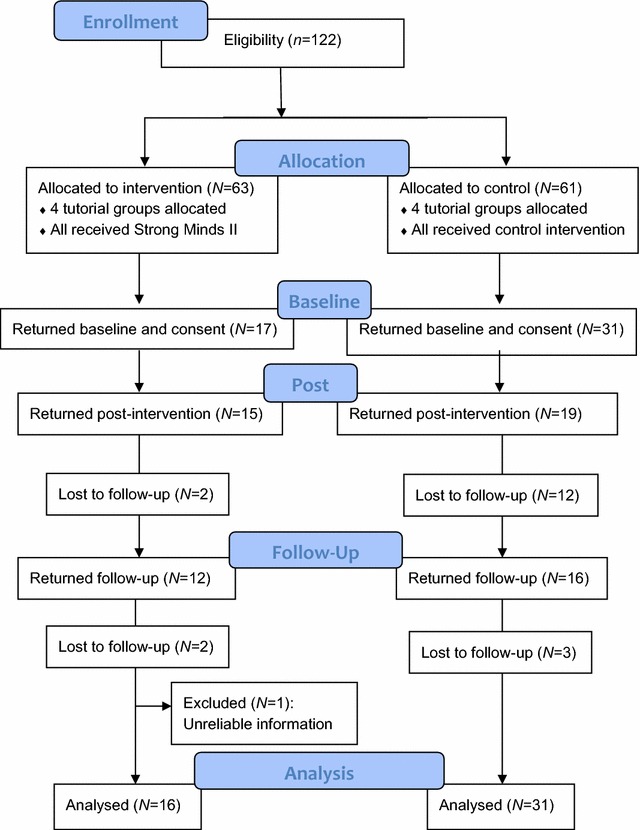
- Sample/data: Students came from one private high school in Sydney, Australia; 122 year 10 students were invited, 49 consented, 1 was discarded for unreliable data, leaving 48 participants.
- Analysis: Outcomes were measured with the DASS-21, Flourishing Scale, and a study-specific program evaluation questionnaire; analyses used intention-to-treat mixed models for repeated measures, with t-tests/chi-square for baseline and dropout comparisons and Cohen’s *d*/phi effect sizes.
Limitations
- The paper states several limitations: small sample size, quasi-randomisation, inability to distinguish the effects of teacher-led exercises vs psychologist-led workshops, a private school sample with high socio-economic status, and substantial dropout in the control condition.
- Evident from the text: the study was underpowered, and the authors note that the lack of statistically significant effects was likely due to the small sample size.
Model-written summary. Check it against the paper before relying on it.
Integrity signals
Registry
Cites
Statistics
Figures
Verification
Claims the paper makes
5 Valid · 0 Not valid · 12 Not checked · 31 Own results and interpretations
Every source the paper cites for this claim was checked and supports it.
In the paper
“A meta-analysis of prevention programs for depression [10] found that the average effect size from baseline to post-intervention was Pearson’s r = .15 (Cohen’s d = .30), which is equivalent to our results.”
§ Acceptance and commitment therapy universal prevention program for adolescents: a feasibility study > Discussion
What the sources say
- Supportedcites [10] Stice E, Shaw H, Bohon C, Marti CN, Rohde P. A meta-analytic review of depression prevention programs for children and adolescents: factors that predict magnitude of intervention effects. J Consult Clin Psychol. 2009;77:486–503. source
The Results section (“Average Effect Size and Effect Size Heterogeneity”; page not provided) reports an average posttest effect of r = .15 across the depression-prevention studies. The Methods section describes converting between Cohen’s d and r; d = .30 is the approximate equivalent of r = .15. The review concerns children and adolescents. (LLM, conf=0.91)
plain- Asserted: passes — The authors put it forward as true.
- Checkable: passes — It can be checked against evidence.
- Load-bearing: passes — The paper’s conclusions depend on it.
- Based: passes — The paper gives a reason why it holds.
- Supported
The cited sources support only part of this claim — read each source’s verdict below.
In the paper
“numerous clinical trials have demonstrated that mindfulness can assist with a wide range of mental health symptoms in adult populations [18–28].”
§ Acceptance and commitment therapy universal prevention program for adolescents: a feasibility study > Background
What the sources say
- Not checked — no full text of the sourcecites [18] Luken M, Sammons A. Systematic review of mindfulness practice for reducing job burnout. Am J Occup Ther. 2016;70:1–10. source
- Partly supportedcites [19] Burton A, Burgess C, Dean S, Koutsopoulou GZ, Hugh-Jones S. How effective are mindfulness-based interventions for reducing stress among healthcare professionals? A systematic review and meta-analysis. Stress Health. 2017;33:3–13. sourceExperimental — accuracy not yet measured
The Key findings (p. 9) report improvements in stress, depression, anxiety, burnout and other outcomes among healthcare professionals. But the Study characteristics (p. 7) identify only two randomized controlled trials among nine studies; most used pre-post designs. The review therefore supports benefits across several symptoms in this occupational group, but not the broader assertion that numerous clinical trials demonstrated them across adult populations. (LLM, conf=0.87)
- Partly supportedcites [20] Strauss C, Cavanagh K, Oliver A, Pettman D. Mindfulness-based interventions for people diagnosed with a current episode of an anxiety or depressive disorder: a meta-analysis of randomised controlled trials. PLoS ONE. 2014;9:e96110. sourceExperimental — accuracy not yet measured
The Results (Participant Characteristics; Meta-Analysis Findings) describe 12 trials involving mostly working-age adults with depressive or anxiety disorders and find lower primary-symptom severity overall with mindfulness-based interventions. But the anxiety-symptom result was not statistically significant, and the trials do not establish benefit across the broader range of mental health symptoms implied by the claim. Our copy provides no page numbers for these passages. (LLM, conf=0.86)
- Supportedcites [21] Vollestad J, Nielsen MB, Nielsen GH. Mindfulness- and acceptance-based interventions for anxiety disorders: a systematic review and meta-analysis. Br J Clin Psychol. 2012;51:239–60. source
The Results (p. 1) report that 19 eligible studies of mindfulness- and acceptance-based interventions found reductions in anxiety and comorbid depressive symptoms. The Discussion (p. 15) places these findings within a broader body of evidence for decreases across symptom measures and conditions, while cautioning that most trials were uncontrolled. This supports the citing sentence’s qualified claim that mindfulness can assist with mental health symptoms in adults. (LLM, conf=0.87)
- Partly supportedcites [22] Hofmann SG, Sawyer AT, Witt AA, Oh D. The effect of mindfulness-based therapy on anxiety and depression: a meta-analytic review. J Consult Clin Psychol. 2010;78:169–83. sourceExperimental — accuracy not yet measured
The Background and Methods describe 39 studies of mindfulness-based therapy in adult clinical samples. The Results report improvements in anxiety and depressive symptoms, but the review assessed those symptom categories rather than a wide range of mental health symptoms. (LLM, conf=0.85)
- Not checked — no full text of the sourcecites [23] Khoury B, Lecomte T, Fortin G, Masse M, Therien P, Bouchard V, Chapleau M-A, Paquin K, Hofmann SG. Mindfulness-based therapy: a comprehensive meta-analysis. Clin Psychol Rev. 2013;33:763–71. source
- Not checked — no full text of the sourcecites [24] Fjorback LO, Arendt M, Ombøl E, Fink P, Walach H. Mindfulness-based stress reduction and mindfulness-based cognitive therapy: a systematic review of randomized controlled trials. Acta Psychiatr Scand. 2011;124:102–19. source
- Not checked — no full text of the sourcecites [25] Klainin-Yobas P, Cho MA, Creedy D. Efficacy of mindfulness-based interventions on depressive symptoms among people with mental disorders: a meta-analysis. Int J Nurs Stud. 2012;49:109–21. source
- Not checked — no full text of the sourcecites [26] Zgierska A, Rabago D, Chawla N, Kushner K, Koehler R, Marlatt A. Mindfulness meditation for substance use disorders: a systematic review. Subst Abus. 2009;30:266–94. source
- Not checked — no full text of the sourcecites [27] Bohlmeijer E, Prenger R, Taal E, Cuijpers P. The effects of mindfulness-based stress reduction therapy on mental health of adults with a chronic medical disease: a meta-analysis. J Psychosom Res. 2010;68:539–44. source
boostedstates a cause- Asserted: passes — The authors put it forward as true.
- Checkable: passes — It can be checked against evidence.
- Load-bearing: unclear — It is unclear whether the paper’s conclusions depend on it.
- Based: passes — The paper gives a reason why it holds.
The cited sources support only part of this claim — read each source’s verdict below.
In the paper
“Effect sizes at follow-up were Pearson’s r = .11 (Cohen’s d = .20), which is lower than the effect size found in the present study.”
§ Acceptance and commitment therapy universal prevention program for adolescents: a feasibility study > Discussion
What the sources say
- Partly supportedcites [10] Stice E, Shaw H, Bohon C, Marti CN, Rohde P. A meta-analytic review of depression prevention programs for children and adolescents: factors that predict magnitude of intervention effects. J Consult Clin Psychol. 2009;77:486–503. sourceExperimental — accuracy not yet measured
The Results section (“Average Effect Size and Effect Size Heterogeneity”; page unavailable) reports an average follow-up effect size of r = .11 across studies. The paper does not report a corresponding Cohen’s d = .20; its Methods section describes converting d values to r, so the parenthetical value is not verified by the cited text. (LLM, conf=0.86)
plain- Asserted: passes — The authors put it forward as true.
- Checkable: passes — It can be checked against evidence.
- Load-bearing: passes — The paper’s conclusions depend on it.
- Based: passes — The paper gives a reason why it holds.
- Partly supported
The cited sources support only part of this claim — read each source’s verdict below.
In the paper
“The symptom measure selected has been used and validated in a non-clinical adolescent population [47–49].”
§ Acceptance and commitment therapy universal prevention program for adolescents: a feasibility study > Methods > Measures
What the sources say
- Partly supportedcites [47] Patrick J, Dyck M, Bramston P. Depression anxiety stress scale: is it valid for children and adolescents? J Clin Psychol. 2010;66:996–1007. sourceExperimental — accuracy not yet measured
The Participants and Procedure section describes a community sample that included adolescents, and the Results section assesses the DASS-21 in that sample. But the Abstract reports that the scale did not differentiate depression, anxiety, and stress in children and adolescents. The paper supports its use and evaluation in a non-clinical adolescent population, not an unqualified claim that it was validated for that population. (LLM, conf=0.88)
- Not checked — no full text of the sourcecites [48] Szabó M. The short version of the depression anxiety stress scales (DASS-21): factor structure in a young adolescent sample. J Adolesc. 2010;33:1–8. source
- Not checked — no full text of the sourcecites [49] Tully PJ, Zajac IT, Venning AJ. The structure of anxiety and depression in a normative sample of younger and older Australian adolescents. J Abnorm Child Psychol. 2009;37:717–26. source
plain- Asserted: passes — The authors put it forward as true.
- Checkable: passes — It can be checked against evidence.
- Load-bearing: passes — The paper’s conclusions depend on it.
- Based: passes — The paper gives a reason why it holds.
- Partly supported
The cited sources support only part of this claim — read each source’s verdict below.
In the paper
“Early intervention programs targeting depression and other mental health-related problems have reported a reduction in efficacy from post-intervention to follow-up [10, 59].”
§ Acceptance and commitment therapy universal prevention program for adolescents: a feasibility study > Discussion
What the sources say
- Partly supportedcites [10] Stice E, Shaw H, Bohon C, Marti CN, Rohde P. A meta-analytic review of depression prevention programs for children and adolescents: factors that predict magnitude of intervention effects. J Consult Clin Psychol. 2009;77:486–503. sourceExperimental — accuracy not yet measured
The Discussion’s “Summary of Effect Sizes” reports that average effects for depression prevention programs fell from r = .14 at posttest to r = .10 at follow-up. The cited paper does not establish the same pattern for programs targeting other mental health-related problems. Page numbers are not available in the supplied copy. (LLM, conf=0.84)
- Not checked — no full text of the sourcecites [59] Stice E, Shaw H. Eating disorder prevention programs: a meta-analytic review. Psychol Bull. 2004;130:206–27. source
plainstates a cause- Asserted: passes — The authors put it forward as true.
- Checkable: passes — It can be checked against evidence.
- Load-bearing: passes — The paper’s conclusions depend on it.
- Based: passes — The paper gives a reason why it holds.
- Partly supported
27 more claims
Create a free account to see all 48 claims and every source verdict.
- It may state two separate claims as one. 10
- Probably not a substantial claim. 8
- The quote only partly states this claim. 2
Claims other papers make about this one
Each is checked against this paper’s own text: does it say what the citing paper says it does?
The source backs part of the claim, not all of it — or backs it for a different population, condition or comparison.
In the citing paper
“Burckhardt et al. (2017) measured wellbeing, and findings were non-significant and the effect size small.”
From Acceptance and commitment therapy interventions in secondary schools and their impact on students' mental health and well-being: A systematic review (2022) · cites this paper as Burckhardt et al. (2017)
Experimental — accuracy not yet measuredThe cited source says what the claim attributes to it.
In the citing paper
“The included studies were located across six different countries, with three of the studies based in Australia (Burckhardt et al., 2017; Livheim et al., (a) 2015; Smith et al., 2020).”
From Acceptance and commitment therapy interventions in secondary schools and their impact on students' mental health and well-being: A systematic review (2022) · cites this paper as Burckhardt et al., 2017
The cited source says what the claim attributes to it.
In the citing paper
“The majority of the schools included in the studies were state schools, with the exception of one study based in a private school (Burckhardt et al., 2017) and one study based in a specialist school for students with Autistic Spectrum Disorder (Pahnke et al., 2014).”
From Acceptance and commitment therapy interventions in secondary schools and their impact on students' mental health and well-being: A systematic review (2022) · cites this paper as Burckhardt et al., 2017
The cited source says what the claim attributes to it.
In the citing paper
“Three studies found no significant findings across any of the outcomes measured (Burckhardt et al., 2017; Takahashi et al., 2020; Van der Gucht et al., 2017).”
From Acceptance and commitment therapy interventions in secondary schools and their impact on students' mental health and well-being: A systematic review (2022) · cites this paper as Burckhardt et al., 2017
The cited source says what the claim attributes to it.
In the citing paper
“In Burckhardt et al. (2017), there were medium to large effect sizes at follow up for both stress and anxiety despite a non-significant finding.”
From Acceptance and commitment therapy interventions in secondary schools and their impact on students' mental health and well-being: A systematic review (2022) · cites this paper as Burckhardt et al. (2017)
Citations
Cites
Statistical Power Analysis for the Behavioral Sciences
Muller, K. (1989) · Technometrics · doi:10.1080/00401706.1989.10488618 · Cited by 99,167
Statistical power analysis for the behavioral sciences
(1990) · Computers, Environment and Urban Systems · doi:10.1016/0198-9715(90)90050-4 · Cited by 65,269
Kessler, R. C., Berglund, P., Demler, O., Jin, R., Merikangas, K. R., & Walters, E. E. (2005) · Archives of General Psychiatry · doi:10.1001/archpsyc.62.6.593 · Cited by 20,391 · cited 1×
“Furthermore, evidence suggests that 50% of these disorders begin before the age of 14 and 75% by age 24 years [2].”
BackgroundLovibond, P. F., & Lovibond, S. H. (1995) · Behaviour Research and Therapy · doi:10.1016/0005-7967(94)00075-u · Cited by 14,523
The emerging field of emotion regulation: an integrative review
Gross, J. J. (1998) · Review of General Psychology · doi:10.1037/1089-2680.2.3.271 · Cited by 9,916 · cited 1×
“These two components correspond closely with two well-established emotion regulation strategies: attention deployment and acceptance [13, 14].”
Background(2008) · Medical Entomology and Zoology · Cited by 7,477
(1995) · Cited by 6,909
Emotion-regulation strategies across psychopathology: A meta-analytic review
Aldao, A., Nolen-Hoeksema, S., & Schweizer, S. (2010) · Clinical Psychology Review · doi:10.1016/j.cpr.2009.11.004 · Cited by 6,686
New well-being measures: Short scales to assess flourishing and positive and negative feelings
Diener, E., Wirtz, D., Tov, W., Kim-Prieto, C., Choi, D.-W., Oishi, S., & Biswas-Diener, R. (2010) · Social Indicators Research · doi:10.1007/s11205-009-9493-y · Cited by 4,980 · cited 1×
“Flourishing Scale (FS) The FS is a 7-item measure of wellbeing with responses given on a 7-point Likert scale [52].”
MethodSmall sample inference for fixed effects from restricted maximum likelihood
Kenward, M. G., & Roger, J. H. (1997) · Biometrics · doi:10.2307/2533558 · Cited by 4,552 · cited 1×
“The parameters of the model were estimated using restricted maximum likelihood as the evidence suggests it is preferable over maximum likelihood when the sample is small [55].”
Method
Research works printed but not linked: 1
- Mennin DS, Fresco DM. Emotion regulation as a framework for understanding and treating anxiety pathology. In: Krink AM, Sloan DM, editors. Emotion regulation in psychopathology. New York: Guildford Press; 2009.
Cited by
Phan, M. L., Renshaw, T. L., Caramanico, J., Greeson, J. M., Mackenzie, E., Atkinson‐Diaz, Z., Doppelt, N., Tai, H., Mandell, D. S., & Nuske, H. J. (2022) · Mindfulness · doi:10.1007/s12671-022-01885-9 · Cited by 245
A meta-analysis of the efficacy of acceptance and commitment therapy for children
Fang, S., & Ding, D. (2020) · Journal of Contextual Behavioral Science · doi:10.1016/j.jcbs.2020.01.007 · Cited by 119
Fang, S., & Ding, D. (2020) · Journal of Contextual Behavioral Science · doi:10.1016/j.jcbs.2020.04.005 · Cited by 81
Lappalainen, R., Lappalainen, P., Puolakanaho, A., Hirvonen, R., Eklund, K., Ahonen, T., Muotka, J., & Kiuru, N. (2021) · Journal of Contextual Behavioral Science · doi:10.1016/j.jcbs.2021.01.007 · Cited by 69
Salazar de Pablo, G., De Micheli, A., Solmi, M., Oliver, D., Catalan, A., Verdino, V., Di Maggio, L., Bonoldi, I., Radua, J., Baccaredda Boy, O., et al. (2021) · Harvard Review of Psychiatry · doi:10.1097/hrp.0000000000000294 · Cited by 51
Metadata
- Authors
- Burckhardt, R., Manicavasagar, V., Batterham, P. J., Hadzi-Pavlovic, D., & Shand, F.
- Affiliations
- Black Dog Institute (AU)
- Australian National University (AU)
- Corresponding author
- Burckhardt, Rowan
- Venue
- Child and Adolescent Psychiatry and Mental Health
- Published
- 2017-05-25
- Volume
- 11
- Issue
- 1
- Pages
- 27-27
- ISSN
- 1753-2000 (ISSN-L)
- PMC
- PMC5445489
- OpenAlex
- W2617419468
- Semantic Scholar
- d018ab4616d79ad542bc4498bcdfc006687b50c0
- Cited by
- 81
- References
- 67
- Citations by year
- 2026: 3 · 2025: 13 · 2024: 15 · 2023: 10 · 2022: 10 · 2021: 10 · 2020: 11 · 2019: 5 · 2018: 4
- FWCI
- 6.07
- Type
- journal article
- Language
- en
- Open access
- gold
- doi.org
- Licence
- cc-by
- creativecommons.org/licenses/by/4.0 (tdm)
- creativecommons.org/licenses/by/4.0 (vor)
- Locations
- Child and Adolescent Psychiatry and Mental Health (publishedVersion, cc-by)
- Europe PMC (PubMed Central) (publishedVersion, other-oa)
- PubMed Central (publishedVersion, cc-by)
- PubMed (publishedVersion)
- UNSWorks (University of New South Wales, Sydney, Australia) (submittedVersion, cc-by-nc-nd)
- UNSWorks (UNSW Sydney) (submittedVersion, cc-by-nc-nd)
- DOAJ (DOAJ: Directory of Open Access Journals) (submittedVersion, cc-by-sa)
- ANU Open Research (Australian National University) (submittedVersion)
- Funders
- Strong
- Topics
- Social Sciences › Psychology › Clinical Psychology › Mindfulness and Compassion Interventions
- Social Sciences › Psychology › Experimental and Cognitive Psychology › Anxiety, Depression, Psychometrics, Treatment, Cognitive Processes
- Social Sciences › Psychology › Applied Psychology › Digital Mental Health Interventions
- Keywords
- acceptance and commitment therapy, universal prevention, adolescents, school-based intervention, anxiety prevention, depression prevention, mindfulness, emotion regulation, intervention feasibility, treatment acceptability, high school students
About these checks
Registry, retraction, Cites and statistics results are computed, not judged, with one exception: a printed reference that no index lists is read once by a model before it counts as a citation error. Claims are extracted by a model and kept only when their quote appears verbatim in the text; each cited source is then checked, with a model’s help, for whether it says what the claim relies on. Those verdicts can be wrong — read the claim’s quote and the cited source before relying on one.
The claim verdicts this report counts are experimental: their accuracy is not yet measured.
A language model drew the claims from the paper on 2026-10-11, under version 3 of the claim definition (model deepseek-v4.1-flash, prompt extract-v3).
A second model labelled each claim on 2026-10-11 (model jev-1.13-20260917, definition revision gold-guideline-v0.2).
Cited sources are checked with a language model’s help (gpt-6-sol).
Statistics and arithmetic are recomputed, not judged.
Confidence bands are shown only for fields calibrated on our annotated test set. None is calibrated yet, so no band is shown.
What counts as a claim ›How we measure confidence ›How we check this ›
Are you an author, or do you see a problem with this page? Request a review
How to cite
Cite CoChat for the checks on this page, and the paper for its own findings.
- This page
- CoChat. (2026). Citation check: Acceptance and commitment therapy universal prevention program for adolescents: a feasibility study. https://app.cochat.ai/papers/10.1186/s13034-017-0164-5
- The paper
- Burckhardt, R., Manicavasagar, V., Batterham, P. J., Hadzi-Pavlovic, D., & Shand, F. (2017). Acceptance and commitment therapy universal prevention program for adolescents: a feasibility study. Child and Adolescent Psychiatry and Mental Health. https://doi.org/10.1186/s13034-017-0164-5
Data sources
Bibliographic data: Semantic Scholar, OpenAlex, Crossref.
Contains information from the Semantic Scholar Academic Graph Datasets, made available under the ODC Attribution License (ODC-BY 1.0).
Semantic Scholar’s data is described in: Kinney, R., et al. (2023). The Semantic Scholar Open Data Platform. arXiv:2301.10140.
