

Acceptance and commitment therapy universal prevention program for adolescents: a feasibility study.
Open accessThe DOI matches its Crossref record; 65 of the 67 references it cites were found in a registry or an index, and 1 are not checked yet; 9 of the 31 sources its claims cite were checked for support.
Abstract
Background: There is a need to prevent anxiety and depression in young people and mindfulness contains important emotion regulation strategies. Acceptance and commitment therapy (ACT), a mindfulness-based therapy, has yet to be evaluated as a prevention program, but has demonstrated an ability to reduce symptoms of anxiety and depression in adult and adolescent populations. This study examines the feasibility of using an ACT-based prevention program in a sample of year 10 (aged 14-16 years) high school students from Sydney, Australia. Methods: Participants were allocated to either their usual classes or to the ACT-based intervention. Participants were followed for a period of 5 months post-intervention and completed the Flourishing Scale, Depression Anxiety Stress Scale, and a program evaluation questionnaire. Analyses were completed using intention-to-treat mixed models for repeated measures. Results: The results indicated that the intervention was acceptable to students and feasible to administer in a school setting. There were no statistically significant differences between the conditions, likely due to the small sample size (N = 48). However, between-group effect sizes demonstrated small to large differences for baseline to post-intervention mean scores and medium to large differences for baseline to follow-up mean scores, all favouring the ACT-based condition. Conclusion: The results suggest that an ACT-based school program has potential as a universal prevention program and merits further investigation in a larger trial.
Verified 2026-11-25 · 1 reference not checked yet
Overview
CoChat Summary
TL;DR
This feasibility study tested a school-based ACT universal prevention program in 48 year 10 students aged 14–16 in Sydney, Australia. The program was acceptable and feasible, with no statistically significant between-group differences but effect sizes favoring ACT from baseline to follow-up.
Key findings
- The final sample was 48 participants aged 14–16 years (M = 15.64); 28 were male (58%).
- There were no significant baseline differences between ACT and control on DASS-depression (p = .55), anxiety (p = .88), stress (p = .48), total (p = .96), or Flourishing Scale (p = .37), and no sex difference (p = .72).
- The intervention was reported as acceptable to students and feasible to administer in a school setting; 24 participants completed the program evaluation, and overall there was agreement with the items except for exercising more.
- There were no statistically significant differences between conditions on the DASS-21 or FS, but the paper reports small to large between-group effect sizes at post-intervention and medium to large effect sizes at follow-up, all favoring ACT.
Methods
- Design: Quasi-randomized controlled feasibility study with cluster randomization by tutorial group; year 10 students were assigned to ACT or their usual classes (“Pastoral Care”), and outcomes were followed for 5 months post-intervention.
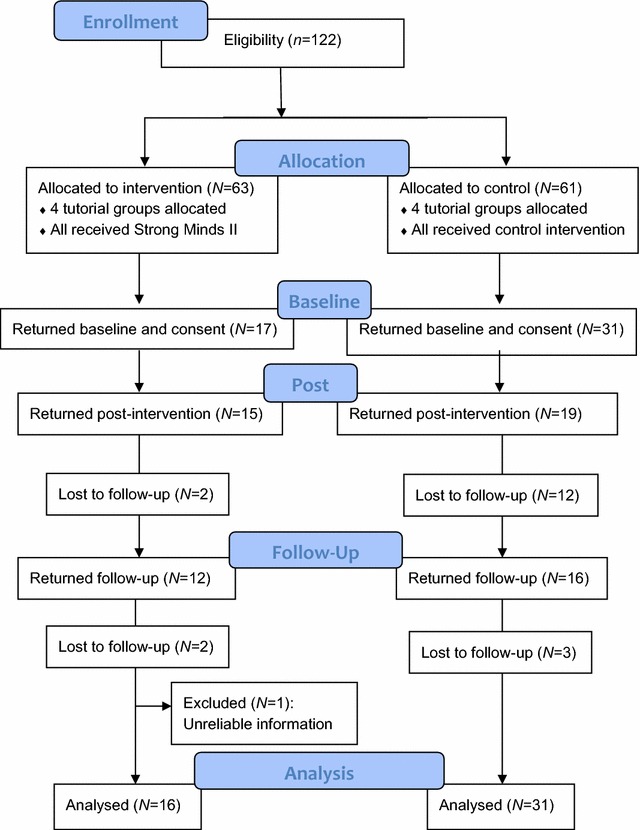
- Sample/data: Students came from one private high school in Sydney, Australia; 122 year 10 students were invited, 49 consented, 1 was discarded for unreliable data, leaving 48 participants.
- Analysis: Outcomes were measured with the DASS-21, Flourishing Scale, and a study-specific program evaluation questionnaire; analyses used intention-to-treat mixed models for repeated measures, with t-tests/chi-square for baseline and dropout comparisons and Cohen’s *d*/phi effect sizes.
Limitations
- The paper states several limitations: small sample size, quasi-randomisation, inability to distinguish the effects of teacher-led exercises vs psychologist-led workshops, a private school sample with high socio-economic status, and substantial dropout in the control condition.
- Evident from the text: the study was underpowered, and the authors note that the lack of statistically significant effects was likely due to the small sample size.
Model-written summary. Check it against the paper before relying on it.
Integrity signals
Registry
Cites
Statistics
Figures
Verification
Claims the paper makes
5 Valid · 0 Not valid · 12 Not checked · 31 Own results and interpretations
Every source the paper cites for this claim was checked and supports it.
In the paper
“A meta-analysis of prevention programs for depression [10] found that the average effect size from baseline to post-intervention was Pearson’s r = .15 (Cohen’s d = .30), which is equivalent to our results.”
§ Acceptance and commitment therapy universal prevention program for adolescents: a feasibility study > Discussion
What the sources say
- Supportedcites [10] Stice E Shaw H Bohon C Marti CN Rohde P A meta-analytic review of depression prevention programs for children and adolescents: factors that predict magnitude of intervention effects J Consult Clin Psychol 2009 77 486 503 10.1037/a0015168 19485590 PMC2758769 source
The Results section (“Average Effect Size and Effect Size Heterogeneity”; page not provided) reports an average posttest effect of r = .15 across the depression-prevention studies. The Methods section describes converting between Cohen’s d and r; d = .30 is the approximate equivalent of r = .15. The review concerns children and adolescents. (LLM, conf=0.91)
plain- Asserted: passes — The authors put it forward as true.
- Checkable: passes — It can be checked against evidence.
- Load-bearing: passes — The paper’s conclusions depend on it.
- Based: passes — The paper gives a reason why it holds.
- Supported
The cited sources support only part of this claim — read each source’s verdict below.
In the paper
“numerous clinical trials have demonstrated that mindfulness can assist with a wide range of mental health symptoms in adult populations [18–28].”
§ Acceptance and commitment therapy universal prevention program for adolescents: a feasibility study > Background
What the sources say
- Not checked — no full text of the sourcecites [18] Luken M Sammons A Systematic review of mindfulness practice for reducing job burnout Am J Occup Ther 2016 70 1 10 10.5014/ajot.2016.016956 PMC4776732 26943107 source
- Partly supportedcites [19] Burton A Burgess C Dean S Koutsopoulou GZ Hugh-Jones S How effective are mindfulness-based interventions for reducing stress among healthcare professionals? A systematic review and meta-analysis Stress Health. 2017 33 3 13 10.1002/smi.2673 26916333 sourceExperimental — accuracy not yet measured
The Key findings (p. 9) report improvements in stress, depression, anxiety, burnout and other outcomes among healthcare professionals. But the Study characteristics (p. 7) identify only two randomized controlled trials among nine studies; most used pre-post designs. The review therefore supports benefits across several symptoms in this occupational group, but not the broader assertion that numerous clinical trials demonstrated them across adult populations. (LLM, conf=0.87)
- Partly supportedcites [20] Strauss C Cavanagh K Oliver A Pettman D Mindfulness-based interventions for people diagnosed with a current episode of an anxiety or depressive disorder: a meta-analysis of randomised controlled trials PLoS ONE 2014 9 e96110 10.1371/journal.pone.0096110 24763812 PMC3999148 sourceExperimental — accuracy not yet measured
The Results (Participant Characteristics; Meta-Analysis Findings) describe 12 trials involving mostly working-age adults with depressive or anxiety disorders and find lower primary-symptom severity overall with mindfulness-based interventions. But the anxiety-symptom result was not statistically significant, and the trials do not establish benefit across the broader range of mental health symptoms implied by the claim. Our copy provides no page numbers for these passages. (LLM, conf=0.86)
- Supportedcites [21] Vollestad J Nielsen MB Nielsen GH Mindfulness- and acceptance-based interventions for anxiety disorders: a systematic review and meta-analysis Br J Clin Psychol 2012 51 239 260 10.1111/j.2044-8260.2011.02024.x 22803933 source
The Results (p. 1) report that 19 eligible studies of mindfulness- and acceptance-based interventions found reductions in anxiety and comorbid depressive symptoms. The Discussion (p. 15) places these findings within a broader body of evidence for decreases across symptom measures and conditions, while cautioning that most trials were uncontrolled. This supports the citing sentence’s qualified claim that mindfulness can assist with mental health symptoms in adults. (LLM, conf=0.87)
- Partly supportedcites [22] Hofmann SG Sawyer AT Witt AA Oh D The effect of mindfulness-based therapy on anxiety and depression: a meta-analytic review J Consult Clin Psychol 2010 78 169 183 10.1037/a0018555 20350028 PMC2848393 sourceExperimental — accuracy not yet measured
The Background and Methods describe 39 studies of mindfulness-based therapy in adult clinical samples. The Results report improvements in anxiety and depressive symptoms, but the review assessed those symptom categories rather than a wide range of mental health symptoms. (LLM, conf=0.85)
- Not checked — no full text of the sourcecites [23] Khoury B Lecomte T Fortin G Masse M Therien P Bouchard V Chapleau M-A Paquin K Hofmann SG Mindfulness-based therapy: a comprehensive meta-analysis Clin Psychol Rev. 2013 33 763 771 10.1016/j.cpr.2013.05.005 23796855 source
- Not checked — no full text of the sourcecites [24] Fjorback LO Arendt M Ombøl E Fink P Walach H Mindfulness-based stress reduction and mindfulness-based cognitive therapy: a systematic review of randomized controlled trials Acta Psychiatr Scand 2011 124 102 119 10.1111/j.1600-0447.2011.01704.x 21534932 source
- Not checked — no full text of the sourcecites [25] Klainin-Yobas P Cho MA Creedy D Efficacy of mindfulness-based interventions on depressive symptoms among people with mental disorders: a meta-analysis Int J Nurs Stud 2012 49 109 121 10.1016/j.ijnurstu.2011.08.014 21963234 source
- Partly supportedcites [26] Zgierska A Rabago D Chawla N Kushner K Koehler R Marlatt A Mindfulness meditation for substance use disorders: a systematic review Subst Abus. 2009 30 266 294 10.1080/08897070903250019 19904664 PMC2800788 sourceExperimental — accuracy not yet measured
The Randomised evidence section (nine RCTs) does report statistically significant improvement in 'both substance use and other outcomes', and the overview (p.1) lists 'other efficacy outcomes (such as psychological rating scores...)' among outcomes in adults with severe alcohol/drug dependence, marijuana or tobacco dependence (plus adolescents), so a hedged version of the claim is partly carried. However, the Authors' conclusions state 'There was no conclusive evidence to support mindfulness meditation for treatment of substance use disorders, although preliminary evidence was promising,' which the citing sentence overstates as trials having 'demonstrated' benefit; and the review's scope is substance-use-disorder populations and substance-use outcomes, not 'a wide range of mental health symptoms' in general adult populations. The CRD commentary likewise flags heterogeneity and difficulty determining clinical significance. (LLM, conf=0.78)
- Not checked — no full text of the sourcecites [27] Bohlmeijer E Prenger R Taal E Cuijpers P The effects of mindfulness-based stress reduction therapy on mental health of adults with a chronic medical disease: a meta-analysis J Psychosom Res 2010 68 539 544 10.1016/j.jpsychores.2009.10.005 20488270 source
boostedstates a cause- Asserted: passes — The authors put it forward as true.
- Checkable: passes — It can be checked against evidence.
- Load-bearing: unclear — It is unclear whether the paper’s conclusions depend on it.
- Based: passes — The paper gives a reason why it holds.
The cited sources support only part of this claim — read each source’s verdict below.
In the paper
“Effect sizes at follow-up were Pearson’s r = .11 (Cohen’s d = .20), which is lower than the effect size found in the present study.”
§ Acceptance and commitment therapy universal prevention program for adolescents: a feasibility study > Discussion
What the sources say
- Partly supportedcites [10] Stice E Shaw H Bohon C Marti CN Rohde P A meta-analytic review of depression prevention programs for children and adolescents: factors that predict magnitude of intervention effects J Consult Clin Psychol 2009 77 486 503 10.1037/a0015168 19485590 PMC2758769 sourceExperimental — accuracy not yet measured
The Results section (“Average Effect Size and Effect Size Heterogeneity”; page unavailable) reports an average follow-up effect size of r = .11 across studies. The paper does not report a corresponding Cohen’s d = .20; its Methods section describes converting d values to r, so the parenthetical value is not verified by the cited text. (LLM, conf=0.86)
plain- Asserted: passes — The authors put it forward as true.
- Checkable: passes — It can be checked against evidence.
- Load-bearing: passes — The paper’s conclusions depend on it.
- Based: passes — The paper gives a reason why it holds.
- Partly supported
The cited sources support only part of this claim — read each source’s verdict below.
In the paper
“The symptom measure selected has been used and validated in a non-clinical adolescent population [47–49].”
§ Acceptance and commitment therapy universal prevention program for adolescents: a feasibility study > Methods > Measures
What the sources say
- Partly supportedcites [47] Patrick J Dyck M Bramston P Depression anxiety stress scale: is it valid for children and adolescents? J Clin Psychol 2010 66 996 1007 20694962 sourceExperimental — accuracy not yet measured
The Participants and Procedure section describes a community sample that included adolescents, and the Results section assesses the DASS-21 in that sample. But the Abstract reports that the scale did not differentiate depression, anxiety, and stress in children and adolescents. The paper supports its use and evaluation in a non-clinical adolescent population, not an unqualified claim that it was validated for that population. (LLM, conf=0.88)
- Not checked — no full text of the sourcecites [48] Szabó M The short version of the depression anxiety stress scales (DASS-21): factor structure in a young adolescent sample J Adolesc. 2010 33 1 8 10.1016/j.adolescence.2009.05.014 19560196 source
- Not checked — no full text of the sourcecites [49] Tully PJ Zajac IT Venning AJ The structure of anxiety and depression in a normative sample of younger and older Australian adolescents J Abnorm Child Psychol 2009 37 717 726 10.1007/s10802-009-9306-4 19238534 source
plain- Asserted: passes — The authors put it forward as true.
- Checkable: passes — It can be checked against evidence.
- Load-bearing: passes — The paper’s conclusions depend on it.
- Based: passes — The paper gives a reason why it holds.
- Partly supported
The cited sources support only part of this claim — read each source’s verdict below.
In the paper
“Early intervention programs targeting depression and other mental health-related problems have reported a reduction in efficacy from post-intervention to follow-up [10, 59].”
§ Acceptance and commitment therapy universal prevention program for adolescents: a feasibility study > Discussion
What the sources say
- Partly supportedcites [10] Stice E Shaw H Bohon C Marti CN Rohde P A meta-analytic review of depression prevention programs for children and adolescents: factors that predict magnitude of intervention effects J Consult Clin Psychol 2009 77 486 503 10.1037/a0015168 19485590 PMC2758769 sourceExperimental — accuracy not yet measured
The Discussion’s “Summary of Effect Sizes” reports that average effects for depression prevention programs fell from r = .14 at posttest to r = .10 at follow-up. The cited paper does not establish the same pattern for programs targeting other mental health-related problems. Page numbers are not available in the supplied copy. (LLM, conf=0.84)
- Not checked — no full text of the sourcecites [59] Stice E Shaw H Eating disorder prevention programs: a meta-analytic review Psychol Bull 2004 130 206 227 10.1037/0033-2909.130.2.206 14979770 source
plainstates a cause- Asserted: passes — The authors put it forward as true.
- Checkable: passes — It can be checked against evidence.
- Load-bearing: passes — The paper’s conclusions depend on it.
- Based: passes — The paper gives a reason why it holds.
- Partly supported
27 more claims
Create a free account to see all 48 claims and every source verdict.
- It may state two separate claims as one. 10
- Probably not a substantial claim. 8
- The quote only partly states this claim. 2
Claims other papers make about this one
Each is checked against this paper’s own text: does it say what the citing paper says it does?
The source backs part of the claim, not all of it — or backs it for a different population, condition or comparison.
In the citing paper
“Burckhardt et al. (2017) measured wellbeing, and findings were non-significant and the effect size small.”
From Acceptance and commitment therapy interventions in secondary schools and their impact on students' mental health and well-being: A systematic review (2022) · cites this paper as Burckhardt et al. (2017)
Experimental — accuracy not yet measuredThe cited source says what the claim attributes to it.
In the citing paper
“The included studies were located across six different countries, with three of the studies based in Australia (Burckhardt et al., 2017; Livheim et al., (a) 2015; Smith et al., 2020).”
From Acceptance and commitment therapy interventions in secondary schools and their impact on students' mental health and well-being: A systematic review (2022) · cites this paper as Burckhardt et al., 2017
The cited source says what the claim attributes to it.
In the citing paper
“The majority of the schools included in the studies were state schools, with the exception of one study based in a private school (Burckhardt et al., 2017) and one study based in a specialist school for students with Autistic Spectrum Disorder (Pahnke et al., 2014).”
From Acceptance and commitment therapy interventions in secondary schools and their impact on students' mental health and well-being: A systematic review (2022) · cites this paper as Burckhardt et al., 2017
The cited source says what the claim attributes to it.
In the citing paper
“Three studies found no significant findings across any of the outcomes measured (Burckhardt et al., 2017; Takahashi et al., 2020; Van der Gucht et al., 2017).”
From Acceptance and commitment therapy interventions in secondary schools and their impact on students' mental health and well-being: A systematic review (2022) · cites this paper as Burckhardt et al., 2017
The cited source says what the claim attributes to it.
In the citing paper
“In Burckhardt et al. (2017), there were medium to large effect sizes at follow up for both stress and anxiety despite a non-significant finding.”
From Acceptance and commitment therapy interventions in secondary schools and their impact on students' mental health and well-being: A systematic review (2022) · cites this paper as Burckhardt et al. (2017)
Citations
Cites
Statistical Power Analysis for the Behavioral Sciences
Muller, K. (1989) · Technometrics · doi:10.1080/00401706.1989.10488618 · Cited by 99,167
Statistical power analysis for the behavioral sciences
(1990) · Computers, Environment and Urban Systems · doi:10.1016/0198-9715(90)90050-4 · Cited by 65,269
Kessler, R. C., Berglund, P., Demler, O., Jin, R., Merikangas, K. R., & Walters, E. E. (2005) · Archives of General Psychiatry · doi:10.1001/archpsyc.62.6.593 · Cited by 20,391 · cited 1×
“Furthermore, evidence suggests that 50% of these disorders begin before the age of 14 and 75% by age 24 years [2].”
BackgroundLovibond, P. F., & Lovibond, S. H. (1995) · Behaviour Research and Therapy · doi:10.1016/0005-7967(94)00075-u · Cited by 14,523
The emerging field of emotion regulation: an integrative review
Gross, J. J. (1998) · Review of General Psychology · doi:10.1037/1089-2680.2.3.271 · Cited by 9,916 · cited 1×
“These two components correspond closely with two well-established emotion regulation strategies: attention deployment and acceptance [13, 14].”
Background(2008) · Medical Entomology and Zoology · Cited by 7,477
(1995) · Cited by 6,909
Emotion-regulation strategies across psychopathology: A meta-analytic review
Aldao, A., Nolen-Hoeksema, S., & Schweizer, S. (2010) · Clinical Psychology Review · doi:10.1016/j.cpr.2009.11.004 · Cited by 6,686
New well-being measures: Short scales to assess flourishing and positive and negative feelings
Diener, E., Wirtz, D., Tov, W., Kim-Prieto, C., Choi, D.-W., Oishi, S., & Biswas-Diener, R. (2010) · Social Indicators Research · doi:10.1007/s11205-009-9493-y · Cited by 4,980 · cited 1×
“Flourishing Scale (FS) The FS is a 7-item measure of wellbeing with responses given on a 7-point Likert scale [52].”
MethodSmall sample inference for fixed effects from restricted maximum likelihood
Kenward, M. G., & Roger, J. H. (1997) · Biometrics · doi:10.2307/2533558 · Cited by 4,552 · cited 1×
“The parameters of the model were estimated using restricted maximum likelihood as the evidence suggests it is preferable over maximum likelihood when the sample is small [55].”
Method
Research works printed but not linked: 1
- Mennin DS Fresco DM Krink AM Sloan DM Emotion regulation as a framework for understanding and treating anxiety pathology Emotion regulation in psychopathology 2009 New York Guildford Press
Cited by
Phan, M. L., Renshaw, T. L., Caramanico, J., Greeson, J. M., Mackenzie, E., Atkinson‐Diaz, Z., Doppelt, N., Tai, H., Mandell, D. S., & Nuske, H. J. (2022) · Mindfulness · doi:10.1007/s12671-022-01885-9 · Cited by 251
A meta-analysis of the efficacy of acceptance and commitment therapy for children
Fang, S., & Ding, D. (2020) · Journal of Contextual Behavioral Science · doi:10.1016/j.jcbs.2020.01.007 · Cited by 119
Fang, S., & Ding, D. (2020) · Journal of Contextual Behavioral Science · doi:10.1016/j.jcbs.2020.04.005 · Cited by 81
Lappalainen, R., Lappalainen, P., Puolakanaho, A., Hirvonen, R., Eklund, K., Ahonen, T., Muotka, J., & Kiuru, N. (2021) · Journal of Contextual Behavioral Science · doi:10.1016/j.jcbs.2021.01.007 · Cited by 69
Salazar de Pablo, G., De Micheli, A., Solmi, M., Oliver, D., Catalan, A., Verdino, V., Di Maggio, L., Bonoldi, I., Radua, J., Baccaredda Boy, O., et al. (2021) · Harvard Review of Psychiatry · doi:10.1097/hrp.0000000000000294 · Cited by 51
Harvey, L. J., White, F. A., Hunt, C. J., & Abbott, M. J. (2023) · Behaviour Research and Therapy · doi:10.1016/j.brat.2023.104408 · Cited by 60
Wang, P., Wang, Z., & Qiu, S. (2024) · Child and Adolescent Psychiatry and Mental Health · doi:10.1186/s13034-024-00735-x · Cited by 78
“Only a few studies aimed to explore the contextual factors by providing information about the schools and socioeconomic backgrounds in which the interventions were conducted [63, 72].”
BackgroundMethodInfluentialCritchfield, T. S., Barnes‐Holmes, D., & Dougher, M. J. (2018) · Perspectives on Behavior Science · doi:10.1007/s40614-018-0154-9 · Cited by 57
Emotion Regulation Intensive Outpatient Programming: Development, Feasibility, and Acceptability
Shaffer, R., Wink, L. K., Ruberg, J. R., Pittenger, A., Adams, R. E., Sorter, M., Manning, P., & Erickson, C. (2018) · Journal of Autism and Developmental Disorders · doi:10.1007/s10803-018-3727-2 · Cited by 35
Phillips, S. T., & Mychailyszyn, M. P. (2022) · School Mental Health · doi:10.1007/s12310-021-09492-0 · Cited by 47
Knight, L., & Samuel, V. (2022) · Journal of Contextual Behavioral Science · doi:10.1016/j.jcbs.2022.06.006 · Cited by 37
“Fang and Ding, (2020b) 17 Average Burckhardt et al. (2017) 17 Average”
BackgroundMethodResultInfluentialMertens, E. C. A., Deković, M., Leijten, P. H. O., van Londen, M., & Reitz, E. (2020) · Clinical Child and Family Psychology Review · doi:10.1007/s10567-020-00328-y · Cited by 56
A Scoping Review of Arts-Based Mindfulness Interventions for Children and Youth
Coholic, D. A., Schwabe, N., & Lander, K. (2020) · Child and Adolescent Social Work Journal · doi:10.1007/s10560-020-00657-5 · Cited by 55
Takahashi, F., Ishizu, K., Matsubara, K., Ohtsuki, T., & Shimoda, Y. (2020) · Journal of Contextual Behavioral Science · doi:10.1016/j.jcbs.2020.03.001 · Cited by 35
Harris, E., & Samuel, V. (2020) · Journal of Cognitive Psychotherapy · doi:10.1891/jcpsy-d-20-00001 · Cited by 32
Gunawardena, H., Voukelatos, A., Nair, S. V., Cross, S. P. M., & Hickie, I. B. (2023) · International Journal of Environmental Research and Public Health · doi:10.3390/ijerph20156508 · Cited by 42
“Four interventions measured subjective wellbeing and involved ACT [65], resistance training [80], and two involved positive psychology [64,67].”
BackgroundInfluentialVolkaert, B., Wante, L., Loeys, T., Boelens, E., & Braet, C. (2021) · School Mental Health · doi:10.1007/s12310-021-09478-y · Cited by 29
Disturbed families or families disturbed: a reconsideration
Giles, E. M., Cross, A. S., Matthews, R. V., & Lacey, J. H. (2021) · Eating and Weight Disorders - Studies on Anorexia Bulimia and Obesity · doi:10.1007/s40519-021-01160-1 · Cited by 26
Scholz, D., Taylor, A. M., & Strelan, P. (2022) · Adolescent Research Review · doi:10.1007/s40894-022-00193-6 · Cited by 31
“Additionally, programs based on ACT and mindfulness produced positive but non-significant effects (Burckhardt et al., 2017; Volanen et al., 2020).”
MethodJuhász, Á., Sebestyén, N., Árva, D., Barta, V., Pártos, K., Vokó, Z., & Rákosy, Z. (2024) · Journal of School Psychology · doi:10.1016/j.jsp.2024.101352 · Cited by 38
Musanje, K., Camlin, C. S., Kamya, M. R., Vanderplasschen, W., Sinclair, D. L., Getahun, M., Kirabo, H., Nangendo, J., Kiweewa, J. M., White, R. G., et al. (2023) · PLOS Global Public Health · doi:10.1371/journal.pgph.0001605 · Cited by 24
“Furthermore, interventions grounded in mindfulness and acceptance incorporate elements of mindfulness to help people be more present in a non- judgmental way to their current experiences which can promote emotion regulation, and counteract the imbalance of developmental changes amidst under-developed executive functio…”
BackgroundEffectiveness of Acceptance and Commitment Therapy on Mental Health Issues: A Systematic Review
Aravind, A., Agarwal, M., Malhotra, S., & Ayyub, S. (2024) · Annals of Neurosciences · doi:10.1177/09727531241300741 · Cited by 16
“24,25 The examined literature highlights the potential of ACT to improve the regulation of emotions, cultivate psychological resilience, and mitigate the intensity of symptoms in various contexts.”
ACT for adolescents: Impact of a pilot group intervention on psychological wellbeing
Smith, K. J., Oxman, L. N., & Hayes, L. (2020) · Journal of Psychologists and Counsellors in Schools · doi:10.1017/jgc.2019.33 · Cited by 15
Keinonen, K., Lappalainen, P., Kotamäki-Viinikka, S., & Lappalainen, R. I. (2022) · Journal of Contextual Behavioral Science · doi:10.1016/j.jcbs.2022.11.010 · Cited by 22
Lostelius, P. V., Ståhle-Öberg, L., & Fjellman‐Wiklund, A. (2018) · European Journal of Physiotherapy · doi:10.1080/21679169.2018.1505946 · Cited by 12
Mindfulness-Based Programs in School Settings: Current State of the Research
Rawana, J. S., Diplock, B. D., & Chan, S. (2018) · Plenum series on human exceptionality · doi:10.1007/978-3-319-89842-1_18 · Cited by 13
Musanje, K., Kasujja, R., Camlin, C. S., Hooper, N., Hope-Bell, J., Sinclair, D. L., Kibanja, G. M., Mpirirwe, R., Kalyango, J. N., & Kamya, M. R. (2024) · PLoS ONE · doi:10.1371/journal.pone.0301988 · Cited by 10
“…standard of care, involving peer leaders to lessen the burden on providers, fitting sessions into pre-existing scheduled activities such as drama clubs and running DNA-V sessions on clinic days to reduce on the frequency of clinic visits as earlier identified in our previous studies [31,38].”
Burley, J., & McAloon, J. (2024) · Journal of Contextual Behavioral Science · doi:10.1016/j.jcbs.2023.11.003 · Cited by 13
Binder, F., Koenig, J., Resch, F., & Kaess, M. (2024) · Psychotherapy and Psychosomatics · doi:10.1159/000537934 · Cited by 14
“Besides the disadvantages of a high expense – with a comparably large proportion of participants not affected by stress at all – these studies often lack proper randomization, frequently within quasi-randomized settings, for example, in school classes [51, 52, 57].”
BackgroundLevin, M. E., Mukasa, M. N., Bowers, E. M., Klimczak, K. S., & Aller, T. B. (2025) · Behavioral Sciences · doi:10.3390/bs15010075 · Cited by 16
Yavuz, M., Çalkan, B., Sönmez, E., Tetik, G., & Kadak, M. T. (2019) · Çocuk ve Gençlik Ruh Sağlığı Dergisi / Turkish Journal of Child and Adolescent Mental Health · doi:10.4274/tjcamh.galenos.2019.2018.07.022 · Cited by 11
Effect of acceptance and commitment therapy for adolescent depression: a meta-analysis
Yu, X., Zhao, B. T., Yin, T., Qu, H., Zhang, J., Cheng, X., & Xu, C. (2025) · Frontiers in Psychiatry · doi:10.3389/fpsyt.2025.1506822 · Cited by 11
Samuel, V. M., Constable, C., Harris, E., & Channon, S. (2021) · Pastoral Care in Education · doi:10.1080/02643944.2021.1977991 · Cited by 11
Shao, S., Zhang, Y., Yang, M., Li, C., Zhao, R., Liu, Z., Wu, M., Liu, Y., Zhu, Z., & Cui, L. (2024) · Journal of School Psychology · doi:10.1016/j.jsp.2024.101357 · Cited by 6
Mendes, A. L., Canavarro, M. C., & Ferreira, C. (2022) · Appetite · doi:10.1016/j.appet.2021.105715 · Cited by 5
The Depression Anxiety Stress Scale: Features and applications
Gillies, J. C. P., & Dozois, D. J. A. (2021) · Elsevier eBooks · doi:10.1016/b978-0-12-817933-8.00025-6 · Cited by 10
Mertens, E. C. A., Deković, M., van Londen, M., Spitzer, J. E., & Reitz, E. (2022) · Clinical Child and Family Psychology Review · doi:10.1007/s10567-022-00406-3 · Cited by 10
Musanje, K., Kamya, M. R., Kasujja, R., Hooper, N., Katahoire, A., White, R. G., Kimera, E., Getahun, M., Sinclair, D. L., Ojiambo, D., et al. (2023) · Journal of Contextual Behavioral Science · doi:10.1016/j.jcbs.2023.07.002 · Cited by 5
“MABIs help develop emotion regulation and present-moment awareness skills (Hayes, 2003), which are likely to counteract the imbalance created by adolescents ’ underdeveloped executive functions of self-control, self-monitoring and judgment (Burckhardt et al., 2017).”
BackgroundHabibollahi, S., Abedi, A., Naderi, F., & Mazaheri, M. M. (2019) · Journal of Research in Behavioural Sciences · doi:10.52547/rbs.16.3.344 · Cited by 4
Nejad-Ebrahim Soumee, Z., tajigharajeh, S., Mousavi, S. E., Nazarali, Z., Bakhshani, N.-M., Nasrabadi, S., Mohebi, M. D., Ahmadi, R., & Sarani Yaztappeh, J. (2024) · Current Psychology · doi:10.1007/s12144-024-06801-z · Cited by 3
“Findings from clinical samples indicate that ACT is an effective emotion regulation strategy, thereby warranting its evaluation as a preventive program (Burckhardt et al., 2017).”
Sease, T. B., John, D. A., Perkins, D. R., & Sandoz, E. K. (2023) · Journal of Family Trauma Child Custody & Child Development · doi:10.1080/26904586.2023.2189203 · Cited by 5
石津, 憲., Ohtsuki, T., Shimoda, Y., & Kunisato, Y. (2024) · Journal of Contextual Behavioral Science · doi:10.1016/j.jcbs.2024.100851 · Cited by 5
Nisar, A., Watkins, R. C., Gillard, D., Grindle, C. F., Thompson, P. A., Pegram, J., & Hastings, R. P. (2025) · Journal of Contextual Behavioral Science · doi:10.1016/j.jcbs.2025.100886 · Cited by 4
Taylor, L. M. W., Waite, P., Halldorsson, B., Percy, R., Violato, M., & Creswell, C. (2019) · Trials · doi:10.1186/s13063-019-3295-6 · Cited by 5
Javadi, T. H. S., Masjedi, M. A., Hamzehloo, E., Chehraghi, M. J., Razavi, L., Rahmani, S., & Nejati, S. (2020) · International Clinical Neuroscience Journal · doi:10.34172/icnj.2021.08 · Cited by 5
Lappalainen, A.-L., Keinonen, K., Lappalainen, P., Lappalainen, R., Kaipainen, K., Puolakanaho, A., & Kiuru, N. (2025) · Child & Family Behavior Therapy · doi:10.1080/07317107.2024.2437637 · Cited by 3
“There is also some evidence showing that brief online ACT interventions can be effective for adolescents with promoting mental well-being in non-clinical samples (Burckhardt et al., 2017; Lappalainen et al., 2023; Puolakanaho et al., 2019).”
Woo, J. M., Tam, C. L., & Verghis, S. (2025) · Journal of Contextual Behavioral Science · doi:10.1016/j.jcbs.2024.100865 · Cited by 3
Vangölü, M. S., & Tanhan, F. (2025) · Buca eğitim fakültesi dergisi (Online)/Buca Eğitim Fakültesi dergisi · doi:10.53444/deubefd.1485339 · Cited by 4
Kang, S., Stepanek, M., Reisinger, D. L., Schmitt, L., Kennedy, M., Loar, J., & Shaffer, R. C. (2025) · International Journal of Developmental Disabilities · doi:10.1080/20473869.2025.2537133 · Cited by 2
ACT in Schools: A Public Health Approach
Renshaw, T. L., Weeks, S. N., Roberson, A. J., & Vinal, S. A. (2022) · Oxford University Press eBooks · doi:10.1093/oxfordhb/9780197550076.013.26 · Cited by 9
Cai, R. A., & Chaplin, H. (2019) · In clinical practice · doi:10.1007/978-3-319-95519-3_2 · Cited by 2
Stapleton, A., Lavelle, J., & McHugh, L. (2022) · PsyArXiv (OSF Preprints) · doi:10.31234/osf.io/j2kpt · Cited by 4
Murphy, S., & Samuel, V. M. (2025) · Pastoral Care in Education · doi:10.1080/02643944.2025.2464531 · Cited by 6
“Universal interventions avoid some of the difficulties associated with targeted interventions, such as large-scale screening, missing vulnerable students and potential stigmatisation (Burckhardt et al., 2017).”
Cheng, D., Shirley, H. S.-L., Powell, C., Daniel, L. W. L., & Sugarman, H. (2025) · Evidence-Based Practice in Child and Adolescent Mental Health · doi:10.1080/23794925.2025.2491069 · Cited by 1
Qvick, J., Hintsanen, M., Vahlberg, T. J., & Volanen, S. (2026) · Journal of Happiness Studies · doi:10.1007/s10902-025-01003-1 · Cited by 3
“The lack of control conditions (Bernay et al., 2016 ), relatively small sample sizes (n < 150) (Bernay et al., 2016 ; Britton et al., 2014 ; Burckhardt et al., 2017 ; Devcich et al., 2017 ; Johnson & Wade, 2019 ; Kang et al., 2018 ) and limited follow-up evaluations (Britton et al., 2014 ; Devcich…”
Binder, F., Werner, A., Fülöp, R., Parzer, P., Koenig, J., Resch, F., & Kaess, M. (2020) · Praxis der Kinderpsychologie und Kinderpsychiatrie · doi:10.13109/prkk.2020.69.3.183 · Cited by 1
The Cambodian Khmer Rouge Child Survivor and Effective Mental Health Treatments
Zolnikov, T. R., & Yamada-Mitsuuchi, S. H. (2022) · American Journal of Qualitative Research · doi:10.29333/ajqr/11596 · Cited by 1
“ACT was studied on a small population of Cambodians and hold aspects that are congruent with their cultural beliefs, such as mindfulness and focusing on body sensations, or somatic symptoms (Burckhardt et al., 2017).”
BackgroundHusić, I., & Dautbegović, A. (2024) · Obrazovanje odraslih/Adult Education · doi:10.53617/issn2744-2047.2023.23.1.81 · Cited by 1
Scheiner, C., Daunke, A., Seidel, A., Mittermeier, S., Romanos, M., Kölch, M. G., & Buerger, A. (2023) · Trials · doi:10.1186/s13063-022-06970-x · Cited by 5
ACT in Schools: A Public Health ApproachPreprint
Renshaw, T. L., Weeks, S. N., Roberson, A. J., & Vinal, S. A. (2021) · doi:10.31234/osf.io/ar3m8 · Cited by 3
Youth in Foster Care: Creating Avenues for Success
Holmes, C. L., Merideth, K., Looby, E. J., Jackson, A. M., Donald, L. L., Nozik, S., & Chapman, C. L. (2020) · Advances in psychology, mental health, and behavioral studies (APMHBS) book series · doi:10.4018/978-1-7998-7319-8.ch008
Mertens, E. C. A. (2020) · Utrecht University Repository (Utrecht University) · doi:10.33540/63
Youth in Foster Care: Creating Avenues for Success
Holmes, C. L., Merideth, K., Looby, E. J., Jackson, A. M., Donald, L. L., Nozik, S., & Chapman, C. L. (2022) · IGI Global eBooks · doi:10.4018/978-1-6684-5598-2.ch028
Obrazovanje odraslih/Adult Education
(2024) · Obrazovanje odraslih/Adult Education · doi:10.53617/issn2744-2047.2023.23.1
Cai, R. A., & Chaplin, H. (2025) · In clinical practice · doi:10.1007/978-3-031-82102-8_2
Ünal, T., Yeşilel, D. B. A., & Kuru, Y. (2026) · Pastoral Care in Education · doi:10.1080/02643944.2026.2743879
Metadata
- Authors
- Burckhardt, R., Manicavasagar, V., Batterham, P. J., Hadzi-Pavlovic, D., & Shand, F.
- Affiliations
- Black Dog Institute (AU)
- Australian National University (AU)
- Corresponding author
- Burckhardt, Rowan
- Venue
- Child and Adolescent Psychiatry and Mental Health
- Published
- 2017-05-25
- Volume
- 11
- Issue
- 1
- Pages
- 27-27
- ISSN
- 1753-2000 (ISSN-L)
- PMC
- PMC5445489
- OpenAlex
- W2617419468
- Semantic Scholar
- d018ab4616d79ad542bc4498bcdfc006687b50c0
- Cited by
- 81
- References
- 67
- Citations by year
- 2026: 3 · 2025: 13 · 2024: 15 · 2023: 10 · 2022: 10 · 2021: 10 · 2020: 11 · 2019: 5 · 2018: 4
- FWCI
- 6.07
- Type
- journal article
- Language
- en
- Open access
- gold
- doi.org
- Licence
- cc-by
- creativecommons.org/licenses/by/4.0 (tdm)
- creativecommons.org/licenses/by/4.0 (vor)
- Locations
- Child and Adolescent Psychiatry and Mental Health (publishedVersion, cc-by)
- Europe PMC (PubMed Central) (publishedVersion, other-oa)
- PubMed Central (publishedVersion, cc-by)
- PubMed (publishedVersion)
- UNSWorks (University of New South Wales, Sydney, Australia) (submittedVersion, cc-by-nc-nd)
- UNSWorks (UNSW Sydney) (submittedVersion, cc-by-nc-nd)
- DOAJ (DOAJ: Directory of Open Access Journals) (submittedVersion, cc-by-sa)
- ANU Open Research (Australian National University) (submittedVersion)
- Funders
- Strong
- Topics
- Social Sciences › Psychology › Clinical Psychology › Mindfulness and Compassion Interventions
- Social Sciences › Psychology › Experimental and Cognitive Psychology › Anxiety, Depression, Psychometrics, Treatment, Cognitive Processes
- Social Sciences › Psychology › Applied Psychology › Digital Mental Health Interventions
- Keywords
- acceptance and commitment therapy, universal prevention, adolescents, school-based intervention, anxiety prevention, depression prevention, mindfulness, emotion regulation, intervention feasibility, treatment acceptability, high school students
About these checks
Registry, retraction, Cites and statistics results are computed, not judged, with one exception: a printed reference that no index lists is read once by a model before it counts as a citation error. Claims are extracted by a model and kept only when their quote appears verbatim in the text; each cited source is then checked, with a model’s help, for whether it says what the claim relies on. Those verdicts can be wrong — read the claim’s quote and the cited source before relying on one.
The claim verdicts this report counts are experimental: their accuracy is not yet measured.
A language model drew the claims from the paper on 2026-10-11, under version 3 of the claim definition (model deepseek-v4.1-flash, prompt extract-v3).
A second model labelled each claim on 2026-10-11 (model jev-1.13-20260917, definition revision gold-guideline-v0.2).
Cited sources are checked with a language model’s help (gpt-6-sol and qwen3.8-omni-flash).
Statistics and arithmetic are recomputed, not judged.
Confidence bands are shown only for fields calibrated on our annotated test set. None is calibrated yet, so no band is shown.
What counts as a claim ›How we measure confidence ›How we check this ›
Are you an author, or do you see a problem with this page? Request a review
Data sources
Bibliographic data: Semantic Scholar, OpenAlex, Crossref.
Contains information from the Semantic Scholar Academic Graph Datasets, made available under the ODC Attribution License (ODC-BY 1.0).
Semantic Scholar’s data is described in: Kinney, R., et al. (2023). The Semantic Scholar Open Data Platform. arXiv:2301.10140.
