

Calcium activated adenylyl cyclase AC8 but not AC1 is required for prolonged behavioral anxiety
Open accessThe DOI matches its Crossref record; 51 of the 51 references it cites were found in a registry or an index.
Abstract
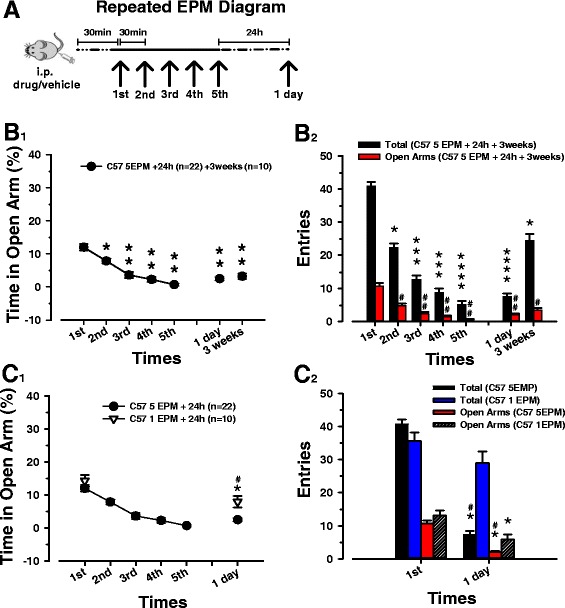
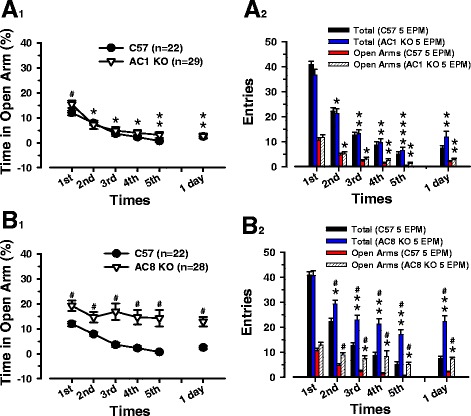
BACKGROUND: Anxiety disorder is a state of mental discomfort while acute anxiety induces an enhancement of vigilance/arousal or increased anxious responses. Most of the previous studies investigated basic mechanisms for acute anxiety, while less information is available for prolonged or repetitive anxiety. RESULTS: In the present study, we wanted to examine possible molecular mechanisms for behavioral anxiety after repeated exposures. Performing a paradigm of five sessions of the elevated plus-maze (EPM), we show that the repeated exposure to the EPM induces a long-lasting anxiety causing a gradual increase of anxiolytic activity, which is maintained for at least 21 days. Genetic deletion of AC8 (adenylyl cyclase 8) but not AC1 abolished long-lasting anxiety. CONCLUSIONS: Our results suggest that calcium-stimulated AC8 is required to sustain the long-lasting anxiety caused by repeated EPM testing, and we can identify in AC8 a novel target for treating anxiety-related mood disorders.
Overview
The claims and statistics of this paper haven’t been checked yet.
Free: it reads the open-access text and checks the first 5 claims that cite a source we can check. Create a free account to check every claim.
Integrity signals
Registry
Cites
Statistics
Figures
Verification
Claims the paper makes
The claims and statistics of this paper haven’t been checked yet.
Free: it reads the open-access text and checks the first 5 claims that cite a source we can check. Create a free account to check every claim.
Claims other papers make about this one
Each is checked against this paper’s own text: does it say what the citing paper says it does?
The source backs part of the claim, not all of it — or backs it for a different population, condition or comparison.
In the citing paper
“Early studies with these AC8−/− mice suggested that they display normal baseline anxiety behavior and were resistant to repeated stress-induced anxiety (256, 258, 259).”
From Physiological roles of mammalian transmembrane adenylyl cyclase isoforms (2022) · cites this paper as [258]
Experimental — accuracy not yet measuredThe cited source says what the claim attributes to it.
In the citing paper
“Early studies with these AC8−/− mice suggested that they display normal baseline anxiety behavior and were resistant to repeated stress-induced anxiety (256, 258, 259).”
From Physiological roles of mammalian transmembrane adenylyl cyclase isoforms (2022) · cites this paper as [258]
In the citing paper
“A long-term anxiety-like paradigm also demonstrated a role for AC8 in anxiety but not for AC1 (258).”
From Physiological roles of mammalian transmembrane adenylyl cyclase isoforms (2022) · cites this paper as [258]
Self-check
Percentages, sums and reported differences re-computed from the paper’s own numbers.
The self-check needs the paper’s full text.
Citations
Cites
A synaptic model of memory: long-term potentiation in the hippocampus
Bliss, T. V. P., & Collingridge, G. L. (1993) · Nature · doi:10.1038/361031a0 · Cited by 11,566 · cited 1×
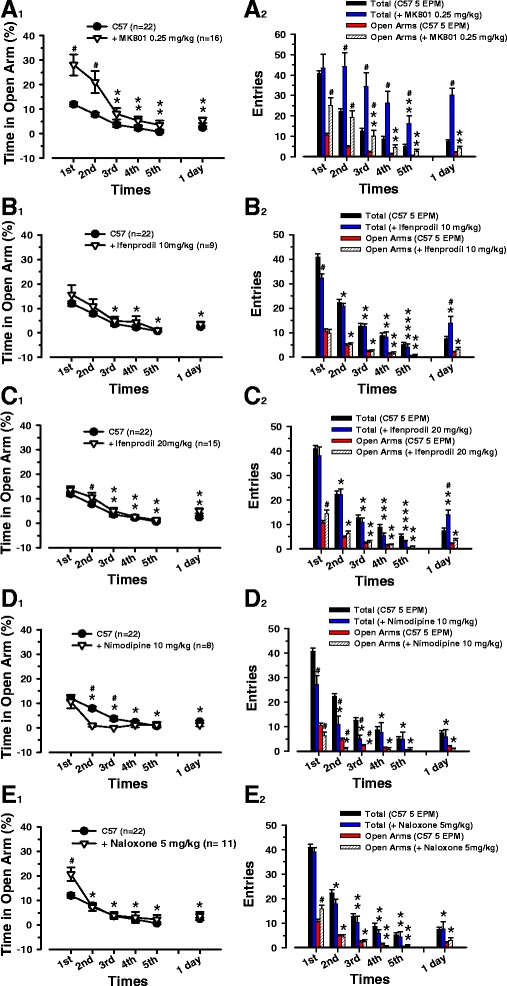
“In order to exclude an involvement of learning and memory, a process NMDA receptor-mediated [19] and to confirm the anxiolytic effect of the antagonist MK801 [20], we have administered, to a group of 16 mice, a dose of 0.”
MethodThe open field as a paradigm to measure the effects of drugs on anxiety-like behaviors: a review
Prut, L., & Belzung, C. (2003) · European Journal of Pharmacology · doi:10.1016/s0014-2999(03)01272-x · Cited by 3,175
Molecular and Cellular Basis of Addiction
Nestler, E. J., & Aghajanian, G. K. (1997) · Science · doi:10.1126/science.278.5335.58 · Cited by 1,313
Postsynaptic Calcium Is Sufficient for Potentiation of Hippocampal Synaptic Transmission
Malenka, R. C., Kauer, J. A., Zucker, R. S., & Nicoll, R. A. (1988) · Science · doi:10.1126/science.2845577 · Cited by 829
Anticonvulsant Action of Excitatory Amino Acid Antagonists
Croucher, M. J., Collins, J. F., & Meldrum, B. S. (1982) · Science · doi:10.1126/science.7079744 · Cited by 695
Mice deficient for δ- and μ-opioid receptors exhibit opposing alterations of emotional responses
Filliol, D., Ghozland, S., Chluba, J., Martin, M., Matthes, H. W. D., Simonin, F., Befort, K., Gavériaux-Ruff, C., Dierich, A., LeMeur, M., et al. (2000) · Nature Genetics · doi:10.1038/76061 · Cited by 672
Anxiogenic stimuli in the elevated plus-maze
Treit, D., Menard, J., & Royan, C. (1993) · Pharmacology Biochemistry and Behavior · doi:10.1016/0091-3057(93)90492-c · Cited by 628
Morphine receptors as regulators of adenylate cyclase activity.
Sharma, S. K., Nirenberg, M., & Klee, W. A. (1975) · Proceedings of the National Academy of Sciences · doi:10.1073/pnas.72.2.590 · Cited by 531
Roles of NMDA NR2B Subtype Receptor in Prefrontal Long-Term Potentiation and Contextual Fear Memory
Zhao, M.-G., Toyoda, H., Lee, Y.-S., Wu, L.-J., Ko, S. W., Zhang, X.-H., Jia, Y., Shum, F., Xu, H., Li, B.-M., et al. (2005) · Neuron · doi:10.1016/j.neuron.2005.08.014 · Cited by 495
Self-citationWong, S. T., Athos, J., Figueroa, X. A., Pineda, V. V., Schaefer, M. L., Chavkin, C. C., Muglia, L. J., & Storm, D. R. (1999) · Neuron · doi:10.1016/s0896-6273(01)80036-2 · Cited by 486
Bauer, E. P., Schafe, G. E., & LeDoux, J. E. (2002) · The Journal of Neuroscience · doi:10.1523/jneurosci.22-12-05239.2002 · Cited by 438
NMDA application potentiates synaptic transmission in the hippocampus
Kauer, J. A., Malenka, R. C., & Nicoll, R. A. (1988) · Nature · doi:10.1038/334250a0 · Cited by 423
Moosmang, S., Haider, N., Klugbauer, N., Adelsberger, H., Langwieser, N., Müller, J., Stiess, M., Marais, E., Schulla, V., Lacinova, L., et al. (2005) · The Journal of Neuroscience · doi:10.1523/jneurosci.1531-05.2005 · Cited by 417
Long-term potentiation of NMDA receptor-mediated synaptic transmission in the hippocampus
Bashir, Z. I., Alford, S., Davies, S. N., Randall, A. D., & Collingridge, G. L. (1991) · Nature · doi:10.1038/349156a0 · Cited by 372
Koga, K., Descalzi, G., Chen, T., Ko, H.-G., Lu, J., Li, S., Son, J., Kim, T., Kwak, C., Huganir, R. L., et al. (2015) · Neuron · doi:10.1016/j.neuron.2014.12.021 · Cited by 364
Self-citationExpression of NMDA receptor-dependent LTP in the hippocampus: bridging the divide
Bliss, T. V., & Collingridge, G. L. (2013) · Molecular Brain · doi:10.1186/1756-6606-6-5 · Cited by 305 · cited 1×
“We have considered as one of the possible main targets in our study, the NMDA receptors, which mediate the induction of LTP and memory [39].”
BackgroundCastillo, P. E., Weisskopf, M. G., & Nicoll, R. A. (1994) · Neuron · doi:10.1016/0896-6273(94)90269-0 · Cited by 298
Xia, Z., Refsdal, C. D., Merchant, K. M., Dorsa, D. M., & Storm, D. R. (1991) · Neuron · doi:10.1016/0896-6273(91)90251-t · Cited by 270
Wei, F., Qiu, C.-S., Kim, S. J., Muglia, L., Maas, J. W., Pineda, V. V., Xu, H.-M., Chen, Z.-F., Storm, D. R., Muglia, L. J., et al. (2002) · Neuron · doi:10.1016/s0896-6273(02)01019-x · Cited by 254
Self-citationDunn, R. W., Corbett, R., & Fielding, S. (1989) · European Journal of Pharmacology · doi:10.1016/0014-2999(89)90811-x · Cited by 225
Zhao, M.-G., Ko, S. W., Wu, L.-J., Toyoda, H., Xu, H., Quan, J., Li, J., Jia, Y., Ren, M., Xu, Z. C., et al. (2006) · The Journal of Neuroscience · doi:10.1523/jneurosci.2103-06.2006 · Cited by 197 · cited 1×
“The EPM test was performed as previously described [17].”
MethodSelf-citationFile, S. E., Mabbutt, P. S., & Hitchcott, P. K. (1990) · Psychopharmacology · doi:10.1007/bf02245751 · Cited by 196
Rodgers, R. J., Lee, C., & Shepherd, J. K. (1992) · Psychopharmacology · doi:10.1007/bf02253596 · Cited by 170
One-trial tolerance to the anxiolytic effects of chlordiazepoxide in the plus-maze
File, S. E. (1990) · Psychopharmacology · doi:10.1007/bf02244419 · Cited by 165
Identification of an Adenylyl Cyclase Inhibitor for Treating Neuropathic and Inflammatory Pain
Wang, H., Xu, H., Wu, L.-J., Kim, S. S., Chen, T., Koga, K., Descalzi, G., Gong, B., Vadakkan, K. I., Zhang, X., et al. (2011) · Science Translational Medicine · doi:10.1126/scitranslmed.3001269 · Cited by 165
Self-citationHuang, Y., & Malenka, R. (1993) · The Journal of Neuroscience · doi:10.1523/jneurosci.13-02-00568.1993 · Cited by 163
Altered Stress-Induced Anxiety in Adenylyl Cyclase Type VIII-Deficient Mice
Schaefer, M. L., Wong, S. T., Wozniak, D. F., Muglia, L. M., Liauw, J. A., Zhuo, M., Nardi, A., Hartman, R. E., Vogt, S. K., Luedke, C. E., et al. (2000) · The Journal of Neuroscience · doi:10.1523/jneurosci.20-13-04809.2000 · Cited by 152
Self-citationLiauw, J., Wu, L.-J., & Zhuo, M. (2005) · Journal of Neurophysiology · doi:10.1152/jn.01205.2004 · Cited by 124
Self-citationHuber, K. M., Mauk, M. D., & Kelly, P. T. (1995) · Journal of Neurophysiology · doi:10.1152/jn.1995.73.1.270 · Cited by 102
Borroni, A. M., Fichtenholtz, H., Woodside, B. L., & Teyler, T. J. (2000) · The Journal of Neuroscience · doi:10.1523/jneurosci.20-24-09272.2000 · Cited by 100
Zhang, M.-M., Liu, S.-B., Chen, T., Koga, K., Zhang, T., Li, Y.-Q., & Zhuo, M. (2014) · Molecular Brain · doi:10.1186/1756-6606-7-47 · Cited by 89
Self-citationDifferential involvement of the Mu and Kappa opioid receptors in spatial learning
Jamot, L., Matthes, H. W. D., Simonin, F., Kieffer, B. L., & Roder, J. C. (2003) · Genes, Brain and Behavior · doi:10.1034/j.1601-183x.2003.00013.x · Cited by 78
Cruz-Morales, S. E., Santos, N. R., & Brandão, M. L. (2002) · Pharmacology Biochemistry and Behavior · doi:10.1016/s0091-3057(02)00813-4 · Cited by 78
Vadakkan, K. I., Wang, H., Ko, S. W., Zastepa, E., Petrovic, M. J., Sluka, K. A., & Zhuo, M. (2006) · Molecular Pain · doi:10.1186/1744-8069-2-7 · Cited by 76
Self-citationSHINNICK‐GALLAGHER, P., McKERNAN, M. G., XIE, J., & ZINEBI, F. (2003) · Annals of the New York Academy of Sciences · doi:10.1111/j.1749-6632.2003.tb07078.x · Cited by 75
Wolf, E. J., Rasmusson, A. M., Mitchell, K. S., Logue, M. W., Baldwin, C. T., & Miller, M. W. (2014) · Depression and Anxiety · doi:10.1002/da.22260 · Cited by 75 · cited 2×
“In addition, recent human studies suggest that single-nucleotide polymorphism (SNPs) and mutation on ADCY8 gene may link to anxiety or depression [16, 34].”
BackgroundImpaired Presynaptic Long-Term Potentiation in the Anterior Cingulate Cortex of Fmr1 Knock-out Mice
Koga, K., Liu, M.-G., Qiu, S., Song, Q., O'Den, G., Chen, T., & Zhuo, M. (2015) · The Journal of Neuroscience · doi:10.1523/jneurosci.2644-14.2015 · Cited by 65
Self-citationThe costs of social anxiety disorder: the role of symptom severity and comorbidities
Stuhldreher, N., Leibing, E., Leichsenring, F., Beutel, M. E., Herpertz, S., Hoyer, J., Konnopka, A., Salzer, S., Strauss, B., Wiltink, J., et al. (2014) · Journal of Affective Disorders · doi:10.1016/j.jad.2014.04.039 · Cited by 63 · cited 1×
“Both pathological and non-pathological forms represent one of the most prevalent forms of mental discomfort with detrimental economic impact [1].”
BackgroundVillacres, E. C., Wu, Z., Hua, W., Nielsen, M. D., Watters, J. J., Yan, C., Beavo, J., & Storm, D. R. (1995) · Journal of Biological Chemistry · doi:10.1074/jbc.270.24.14352 · Cited by 61
Guscott, M. R., Clarke, H. F., Murray, F., Grimwood, S., Bristow, L. J., & Hutson, P. H. (2003) · European Journal of Pharmacology · doi:10.1016/s0014-2999(03)02182-4 · Cited by 53
Frussa‐Filho, R., & Ribeiro, R. D. A. (2002) · Life Sciences · doi:10.1016/s0024-3205(02)01709-5 · Cited by 44
Maurice, T., Bayle, J., & Privat, A. (1995) · Behavioural Pharmacology · doi:10.1097/00008877-199503000-00009 · Cited by 43
Genetic Alteration of Anxiety and Stress-Like Behavior in Mice Lacking CaMKIV
Shum, F. W. F., Ko, S. W., Lee, Y., Kaang, B., & Zhuo, M. (2005) · Molecular Pain · doi:10.1186/1744-8069-1-22 · Cited by 39
Self-citationNMDAR2B tyrosine phosphorylation regulates anxiety-like behavior and CRF expression in the amygdala
Delawary, M., Tezuka, T., Kiyama, Y., Yokoyama, K., Inoue, T., Hattori, S., Hashimoto, R., Umemori, H., Manabe, T., Yamamoto, T. S., et al. (2010) · Molecular Brain · doi:10.1186/1756-6606-3-37 · Cited by 36
Opioid peptides and immunodysfunction in patients with major depression and anxiety disorders
Castilla‐Cortázar, I., Castilla, A., & Gurpegui, M. (1998) · Journal of Physiology and Biochemistry · doi:10.1007/bf03655595 · Cited by 34
Keuylian, Z., de Baaij, J. H. F., Gueguen, M., Glorian, M., Rouxel, C., Merlet, E., Lipskaia, L., Blaise, R., Mateo, V., & Limon, I. (2012) · Journal of Biological Chemistry · doi:10.1074/jbc.m111.292516 · Cited by 34
Risk Factors for Anxiety in Major Depressive Disorder Patients
Xin, L.-M., Chen, L., Ji, Z.-P., Zhang, S.-Y., Wang, J., Liu, Y.-H., Chen, D.-F., Yang, F.-D., Wang, G., Fang, Y.-R., et al. (2015) · Clinical Psychopharmacology and Neuroscience · doi:10.9758/cpn.2015.13.3.263 · Cited by 34
Law, P., & Loh, H. H. (1993) · Molecular Pharmacology · doi:10.1016/s0026-895x(25)13643-2 · Cited by 33
The role of the endogenous opioid system in the pathogenesis of anxiety disorders
Sher, L. (1998) · Medical Hypotheses · doi:10.1016/s0306-9877(98)90264-x · Cited by 27
Quartermain, D., & deSoria, V. G. (2001) · Neurobiology of Learning and Memory · doi:10.1006/nlme.2000.3981 · Cited by 26
New treatment models for compulsive disorders
Grant, J. E., Fineberg, N. A., Ameringen, M. V., Cath, D. C., Visser, H. A. D., Carmi, L., Pallanti, S., Hollander, E., & van Balkom, A. J. L. M. (2015) · European Neuropsychopharmacology · doi:10.1016/j.euroneuro.2015.11.008 · Cited by 26
Cited by
Physiological roles of mammalian transmembrane adenylyl cyclase isoforms
Ostrom, K. F., LaVigne, J. E., Brust, T. F., Seifert, R., Dessauer, C. W., Watts, V. J., & Ostrom, R. S. (2022) · Physiological Reviews · doi:10.1152/physrev.00013.2021 · Cited by 131
Expression and functions of adenylyl cyclases in the CNS
Devasani, K., & Yao, Y. (2022) · Fluids and Barriers of the CNS · doi:10.1186/s12987-022-00322-2 · Cited by 110
Blaze, J., Choi, I., Wang, Z., Umali, M., Mendelev, N., Tschiffely, A. E., Ahlers, S. T., Elder, G. A., Ge, Y., & Haghighi, F. G. (2020) · Frontiers in Behavioral Neuroscience · doi:10.3389/fnbeh.2020.00160 · Cited by 38
Hayes, M. P., Soto‐Velasquez, M., Fowler, C. A., Watts, V. J., & Roman, D. L. (2017) · ACS Chemical Neuroscience · doi:10.1021/acschemneuro.7b00349 · Cited by 27
Zhang, W., Cao, H., Li, Y., Fu, X., & Zhang, Y. (2022) · JCI Insight · doi:10.1172/jci.insight.153191 · Cited by 15
Metadata
- Authors
- Bernabucci, M., & Zhuo, M.
- Affiliations
- University of Toronto (CA)
- Corresponding author
- Zhuo, Min
- Venue
- Molecular Brain
- Published
- 2016-05-27
- Volume
- 9
- Issue
- 1
- Pages
- 60-60
- ISSN
- 1756-6606 (ISSN-L)
- PMC
- PMC4884383
- OpenAlex
- W2403572125
- Cited by
- 11
- References
- 51
- Citations by year
- 2024: 1 · 2023: 1 · 2022: 2 · 2021: 4 · 2020: 2 · 2017: 1
- FWCI
- 0.19
- Type
- journal article
- Language
- en
- Open access
- gold
- doi.org
- Licence
- cc-by
- Locations
- Molecular Brain (publishedVersion, cc-by)
- Europe PMC (PubMed Central) (publishedVersion, cc-by)
- PubMed Central (publishedVersion, cc-by)
- PubMed (publishedVersion)
- TSpace (University of Toronto) (submittedVersion)
- Funders
- CIHR (258523)
- NSERC (402555)
- Topics
- Life Sciences › Neuroscience › Cellular and Molecular Neuroscience › Neuroscience and Neuropharmacology Research
- Life Sciences › Neuroscience › Cellular and Molecular Neuroscience › Neurotransmitter Receptor Influence on Behavior
- Life Sciences › Neuroscience › Cognitive Neuroscience › Memory and Neural Mechanisms
- Keywords
- adenylyl cyclase 8, adenylyl cyclase 1, anxiety-like behavior, gene deletion, anxiolytic effects
- MeSH terms
- Adenylyl Cyclases, Animals, Anxiety, Behavior, Animal, Calcium, Male, Mice, Inbred C57BL, Naloxone, Receptors, N-Methyl-D-Aspartate, Mice, Knockout, Maze Learning, Calcium Channels, L-Type
About these checks
Registry, retraction, Cites and statistics results are computed, not judged, with one exception: a printed reference that no index lists is read once by a model before it counts as a citation error. Claims are extracted by a model and kept only when their quote appears verbatim in the text; each cited source is then checked, with a model’s help, for whether it says what the claim relies on. Those verdicts can be wrong — read the claim’s quote and the cited source before relying on one.
Statistics and arithmetic are recomputed, not judged.
Confidence bands are shown only for fields calibrated on our annotated test set. None is calibrated yet, so no band is shown.
What counts as a claim ›How we measure confidence ›How we check this ›
Are you an author, or do you see a problem with this page? Request a review
Data sources
Bibliographic data: Semantic Scholar, OpenAlex, Crossref.
Contains information from the Semantic Scholar Academic Graph Datasets, made available under the ODC Attribution License (ODC-BY 1.0).
Semantic Scholar’s data is described in: Kinney, R., et al. (2023). The Semantic Scholar Open Data Platform. arXiv:2301.10140.
