

Digital image analysis and machine learning-assisted prediction of neoadjuvant chemotherapy response in triple-negative breast cancer
Open accessPublished version of a preprint
The DOI matches its Crossref record; 78 of the 79 references it cites were found in a registry or an index; 13 of the 18 sources its claims cite were checked for support.
Abstract
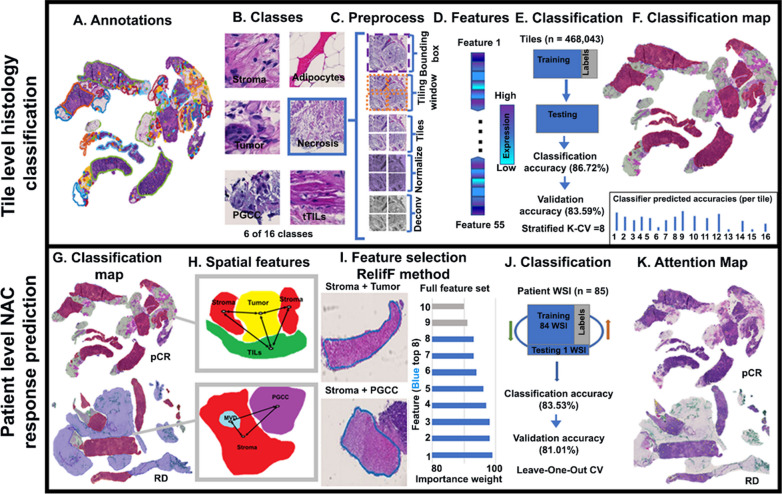
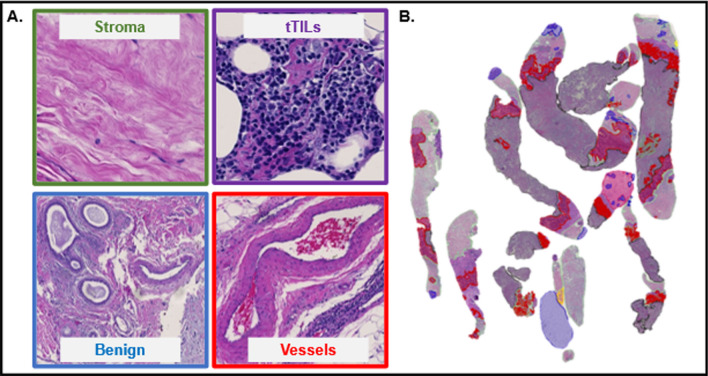
BACKGROUND: Pathological complete response (pCR) is associated with favorable prognosis in patients with triple-negative breast cancer (TNBC). However, only 30-40% of TNBC patients treated with neoadjuvant chemotherapy (NAC) show pCR, while the remaining 60-70% show residual disease (RD). The role of the tumor microenvironment in NAC response in patients with TNBC remains unclear. In this study, we developed a machine learning-based two-step pipeline to distinguish between various histological components in hematoxylin and eosin (H&E)-stained whole slide images (WSIs) of TNBC tissue biopsies and to identify histological features that can predict NAC response. METHODS: H&E-stained WSIs of treatment-naïve biopsies from 85 patients (51 with pCR and 34 with RD) of the model development cohort and 79 patients (41 with pCR and 38 with RD) of the validation cohort were separated through a stratified eightfold cross-validation strategy for the first step and leave-one-out cross-validation strategy for the second step. A tile-level histology label prediction pipeline and four machine-learning classifiers were used to analyze 468,043 tiles of WSIs. The best-trained classifier used 55 texture features from each tile to produce a probability profile during testing. The predicted histology classes were used to generate a histology classification map of the spatial distributions of different tissue regions. A patient-level NAC response prediction pipeline was trained with features derived from paired histology classification maps. The top graph-based features capturing the relevant spatial information across the different histological classes were provided to the radial basis function kernel support vector machine (rbfSVM) classifier for NAC treatment response prediction. RESULTS: The tile-level prediction pipeline achieved 86.72% accuracy for histology class classification, while the patient-level pipeline achieved 83.53% NAC response (pCR vs. RD) prediction accuracy of the model development cohort. The model was validated with an independent cohort with tile histology validation accuracy of 83.59% and NAC prediction accuracy of 81.01%. The histological class pairs with the strongest NAC response predictive ability were tumor and tumor tumor-infiltrating lymphocytes for pCR and microvessel density and polyploid giant cancer cells for RD. CONCLUSION: Our machine learning pipeline can robustly identify clinically relevant histological classes that predict NAC response in TNBC patients and may help guide patient selection for NAC treatment.
Overview
CoChat Summary
## TL;DR
This study developed a two-step machine learning pipeline on H&E whole-slide images from triple-negative breast cancer biopsies to predict neoadjuvant chemotherapy response (pCR vs residual disease). In independent validation, the model achieved 83.53% patient-level training/cohort performance in development and 81.01% accuracy in the validation cohort, with the strongest predictive histology pairs linked to pCR and RD.
## Key findings
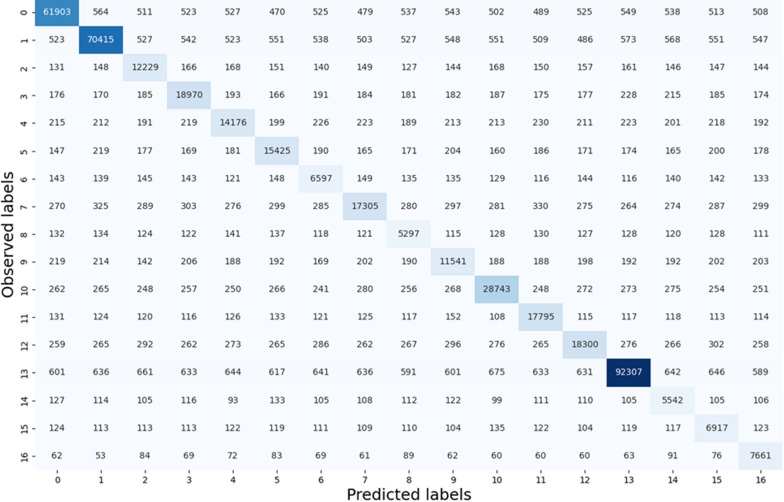
- The tile-level histology classifier achieved 86.72% accuracy in cross-validation, and 83.59% validation accuracy in the independent cohort.
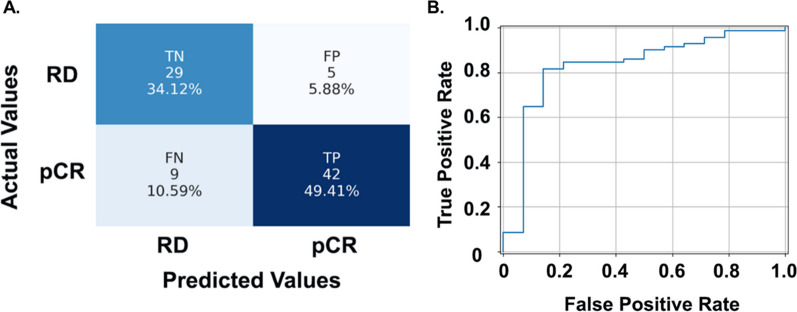
- The patient-level NAC response model achieved 83.53% accuracy in the development cohort and 81.01% accuracy in the validation cohort.
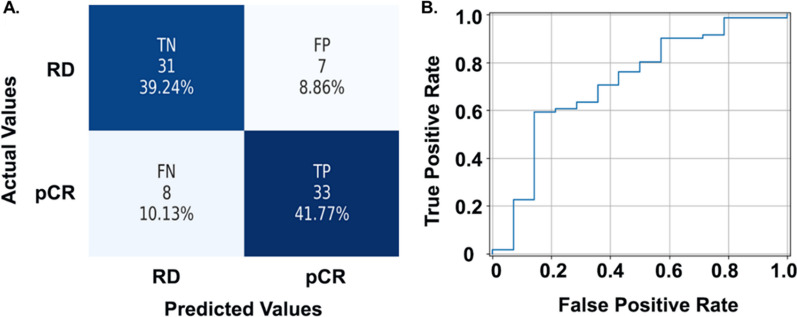
- In validation, the NAC response pipeline correctly predicted 33/41 pCR cases and 31/38 RD cases, with specificity 81.58%, sensitivity 80.49%, and AUC 0.83.
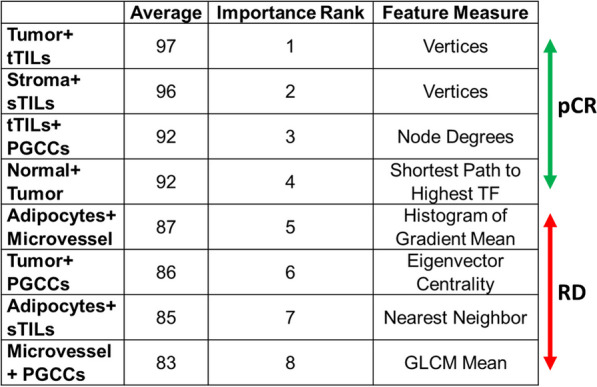
- The most predictive histology pairs were tumor + tumor-infiltrating lymphocytes (tTILs) for pCR and microvessel density (MVD) + polyploid giant cancer cells (PGCCs) for RD; among 120 histology feature pairs, the authors selected the top eight as most predictive.
## Methods
- Retrospective analysis of H&E-stained pre-NAC core needle biopsy WSIs from treatment-naïve TNBC patients: 85 patients in the model development cohort (51 pCR, 34 RD) and 79 patients in the validation cohort (41 pCR, 38 RD).
- Two-step pipeline: first, tile-level histology classification of 468,043 tiles using texture features (reduced from 80 to 55) and four classifiers; second, patient-level NAC response prediction using graph-based spatial TME features from paired histology classification maps.
- Main analysis used stratified 8-fold cross-validation for tile classification and leave-one-out cross-validation (LOO-CV) for patient-level prediction, with rbfSVM performing best at both stages.
## Limitations
- The paper states limitations of small sample sizes, slide quality issues, and expensive computational processes.
- It also notes class imbalance across histology classes and that more histology classes and more expert annotators would likely improve performance.
- Evident from the text: the study is retrospective and drawn from only two institutions, which may limit generalizability.
Model-written summary. Check it against the paper before relying on it.
Integrity signals
Registry
Cites
Statistics
Figures
Verification
Claims the paper makes
5 Valid · 2 Not valid · 0 Not checked · 52 Own results and interpretations
Every source the paper cites for this claim was checked and supports it.
In the paper
“Pathological complete response (pCR) is associated with favorable prognosis in patients with triple-negative breast cancer (TNBC).”
- Also stated in: § Introduction · plain
“pCR is an important predictor of disease-free survival and overall survival in patients with TNBC [7].”
§ Digital image analysis and machine learning-assisted prediction of neoadjuvant chemotherapy response in triple-negative breast cancer > Abstract > Background
What the sources say
- Supportedcites [7] Gass P Lux MP Rauh C Hein A Bani MR Fiessler C Prediction of pathological complete response and prognosis in patients with neoadjuvant treatment for triple-negative breast cancer BMC Cancer 2018 18 1 1051 10.1186/s12885-018-4925-1 30373556 PMC6206705 source
The Background states that achieving pCR is important for favorable long-term prognosis in TNBC. The Results report that pCR was significantly related to increased disease-free and overall survival in both treatment groups, and the Discussion describes pCR as a predictor of both outcomes. (LLM, conf=0.94)
plainstates an association- Asserted: passes — The authors put it forward as true.
- Checkable: passes — It can be checked against evidence.
- Load-bearing: passes — The paper’s conclusions depend on it.
- Based: passes — The paper gives a reason why it holds.
- Also stated in: § Introduction · plain
The cited sources support only part of this claim — read each source’s verdict below.
In the paper
“TME components and their interactions can influence NAC response in patients with TNBC [70–72].”
§ Digital image analysis and machine learning-assisted prediction of neoadjuvant chemotherapy response in triple-negative breast cancer > Discussion
What the sources say
- Partly supportedcites [70] Thagaard J Stovgaard ES Vognsen LG Hauberg S Dahl A Ebstrup T Automated quantification of sTIL density with H&E-based digital image analysis has prognostic potential in triple-negative breast cancers Cancers (Basel). 2021 13 12 3050 10.3390/cancers13123050 34207414 PMC8235502 sourceExperimental — accuracy not yet measured
The Introduction states that immune-system and tumor-microenvironment interactions play a role in clinical outcomes for patients with TNBC. It does not specifically link those interactions to neoadjuvant chemotherapy (NAC) response; the Methods (§2.1) say patients who received neoadjuvant chemotherapy were excluded. (LLM, conf=0.87)
- Partly supportedcites [71] Hong J Rui W Fei X Chen X Shen K Association of tumor-infiltrating lymphocytes before and after neoadjuvant chemotherapy with pathological complete response and prognosis in patients with breast cancer Cancer Med 2021 10 22 7921 7933 10.1002/cam4.4302 34562054 PMC8607245 sourceExperimental — accuracy not yet measured
The Discussion identifies tumor-infiltrating lymphocytes (TILs) as part of the tumor microenvironment, and the Conclusions report that higher pre-NAC TIL levels were associated with higher pathological complete response rates regardless of breast cancer subtype, including TNBC. The paper does not establish that interactions among TME components influence NAC response; its finding is an association involving TIL levels, not a demonstration of causation. (LLM, conf=0.85)
- Not checked — no full text of the sourcecites [72] Lee HJ Cho SY Cho EY Lim Y Cho SI Jung W Artificial intelligence (AI)–powered spatial analysis of tumor-infiltrating lymphocytes (TIL) for prediction of response to neoadjuvant chemotherapy (NAC) in triple-negative breast cancer (TNBC) J Clin Oncol 2022 40 16_suppl 595 10.1200/JCO.2022.40.16_suppl.595 source
plainstates a possible cause- Asserted: passes — The authors put it forward as true.
- Checkable: passes — It can be checked against evidence.
- Load-bearing: passes — The paper’s conclusions depend on it.
- Based: passes — The paper gives a reason why it holds.
- Partly supported
A result the paper reports from its own data — it cites no other source for it, so there is none to check. The quote shows it is in the paper.
In the paper
“The model was validated with an independent cohort with tile histology validation accuracy of 83.59% and NAC prediction accuracy of 81.01%”
- Also stated in: § Validating the NAC response prediction performance in an independent cohort · plain
“with a prediction accuracy of 81.01%”
§ Digital image analysis and machine learning-assisted prediction of neoadjuvant chemotherapy response in triple-negative breast cancer > Abstract > Results
plain- Asserted: passes — The authors put it forward as true.
- Checkable: passes — It can be checked against evidence.
- Load-bearing: passes — The paper’s conclusions depend on it.
- Based: passes — The paper gives a reason why it holds.
- Also stated in: § Validating the NAC response prediction performance in an independent cohort · plain
A result the paper reports from its own data — it cites no other source for it, so there is none to check. The quote shows it is in the paper.
In the paper
“the classifier reached an average recall from 75.11 to 92.97%”
§ Digital image analysis and machine learning-assisted prediction of neoadjuvant chemotherapy response in triple-negative breast cancer > Results > ML classifier provides accurate tile-level histology classification in H&E-stained WSIs
plain- Asserted: passes — The authors put it forward as true.
- Checkable: passes — It can be checked against evidence.
- Load-bearing: passes — The paper’s conclusions depend on it.
- Based: passes — The paper gives a reason why it holds.
A result the paper reports from its own data — it cites no other source for it, so there is none to check. The quote shows it is in the paper.
In the paper
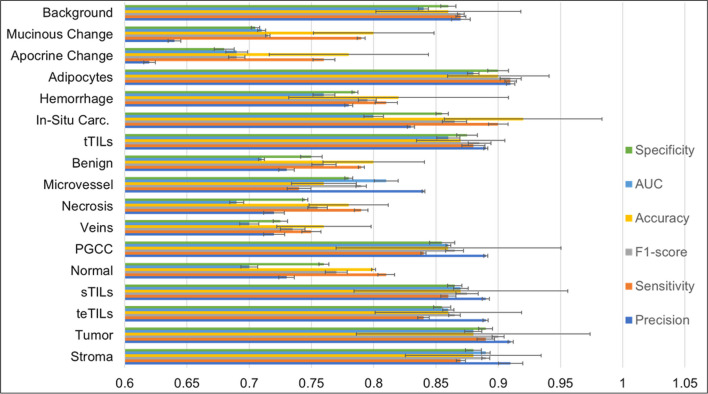
“The validation accuracy for individual histology classes in the validation cohort ranged from 69.74 to 87.88%.”
§ Digital image analysis and machine learning-assisted prediction of neoadjuvant chemotherapy response in triple-negative breast cancer > Results > ML classifier provides accurate tile-level histology classification in H&E-stained WSIs
plain- Asserted: passes — The authors put it forward as true.
- Checkable: passes — It can be checked against evidence.
- Load-bearing: passes — The paper’s conclusions depend on it.
- Based: passes — The paper gives a reason why it holds.
32 more claims
Create a free account to see all 59 claims and to verify the 4 references still open.
- Probably not a substantial claim. 14
- It may state two separate claims as one. 11
Citations
Cites
Textural Features for Image Classification
Haralick, R. M., Shanmugam, K., & Dinstein, I. (1973) · IEEE Transactions on Systems, Man, and Cybernetics · doi:10.1109/tsmc.1973.4309314 · Cited by 22,886 · cited 1×
“…features from each tile by six image texture extraction methods: gray-level co-occurrence matrix (GLCM; Method S1A), Gabor filter (Method S1B), local binary patterns (LBP; Method S1C), Tamura (Method S1D), lower-order histogram (Method S1E), and higher-order histogram (Method S1E) [26–34].”
MethodMultiresolution gray-scale and rotation invariant texture classification with local binary patterns
Ojala, T., Pietikainen, M., & Maenpaa, T. (2002) · IEEE Transactions on Pattern Analysis and Machine Intelligence · doi:10.1109/tpami.2002.1017623 · Cited by 15,398
Microenvironmental regulation of tumor progression and metastasis
Quail, D. F., & Joyce, J. A. (2013) · Nature Medicine · doi:10.1038/nm.3394 · Cited by 7,994 · cited 1×
“Communication between TME components and their spatial relationships affect cancer progression, treatment response, and disease outcomes [12, 13].”
BackgroundTriple-negative breast cancer: clinical features and patterns of recurrence
Dent, R., Trudeau, M., Pritchard, K. I., Hanna, W. M., Kahn, H. K., Sawka, C. A., Lickley, L. A., Rawlinson, E., Sun, P., & Narod, S. A. (2007) · Clinical Cancer Research · doi:10.1158/1078-0432.ccr-06-3045 · Cited by 5,091 · cited 1×
“At the time of diagnosis, TNBCs tend to have a more advanced histologic grade and larger size compared to hormone-positive breast cancers [4].”
BackgroundTheoretical and Empirical Analysis of ReliefF and RReliefF
Robnik-Šikonja, M., & Kononenko, I. (2003) · Machine Learning · doi:10.1023/a:1025667309714 · Cited by 3,025 · cited 1×
“The ReliefF importance weights were used to assess the significance of the selected TME graph features [54–56, 67, 68].”
MethodReinhard, E., Adhikhmin, M., Gooch, B., & Shirley, P. (2001) · IEEE Computer Graphics and Applications · doi:10.1109/38.946629 · Cited by 2,937 · cited 1×
“All image tiles were normalized by the stain color prior to model development [21].”
MethodLiedtke, C., Mazouni, C., Hess, K. R., André, F., Tordai, A., Mejia, J. A., Symmans, W. F., Gonzalez-Angulo, A. M., Hennessy, B., Green, M., et al. (2008) · Journal of Clinical Oncology · doi:10.1200/jco.2007.14.4147 · Cited by 2,892 · cited 1×
“TNBCs also have higher recurrence and metastasis rates and typically metastasize to the brain, lung, and liver [5, 6].”
BackgroundQuantification of histochemical staining by color deconvolution.
Ruifrok, A. C. C., & Johnston, D. A. (2001) · PubMed · Cited by 2,568
Unsupervised texture segmentation using Gabor filters
Jain, A. K., & Farrokhnia, F. (1991) · Pattern Recognition · doi:10.1016/0031-3203(91)90143-s · Cited by 2,182
Textural Features Corresponding to Visual Perception
Tamura, H., Mori, S., & Yamawaki, T. (1978) · IEEE Transactions on Systems, Man, and Cybernetics · doi:10.1109/tsmc.1978.4309999 · Cited by 2,155
Histopathological Image Analysis: A Review
Gurcan, M. N., Boucheron, L. E., Can, A., Madabhushi, A., Rajpoot, N. M., & Yener, B. (2009) · IEEE Reviews in Biomedical Engineering · doi:10.1109/rbme.2009.2034865 · Cited by 2,052 · cited 3×
“To better model the spatial relationships of these histology components in biological systems [46–53], we created TME graphs to characterize tissue TME states and the spatial interactions of tissue regions of paired histology classes.”
BackgroundMethodRUSBoost: A Hybrid Approach to Alleviating Class Imbalance
Seiffert, C., Khoshgoftaar, T. M., Van Hulse, J., & Napolitano, A. (2010) · IEEE Transactions on Systems, Man, and Cybernetics - Part A: Systems and Humans · doi:10.1109/tsmca.2009.2029559 · Cited by 1,867
Tumor microenvironment complexity and therapeutic implications at a glance
Baghban, R., Roshangar, L., Jahanban-Esfahlan, R., Seidi, K., Ebrahimi-Kalan, A., Jaymand, M., Kolahian, S., Javaheri, T., & Zare, P. (2020) · Cell Communication and Signaling · doi:10.1186/s12964-020-0530-4 · Cited by 1,784 · cited 1×
“Communication between TME components and their spatial relationships affect cancer progression, treatment response, and disease outcomes [12, 13].”
BackgroundTextons, the elements of texture perception, and their interactions
Julesz, B. (1981) · Nature · doi:10.1038/290091a0 · Cited by 1,703
Relief-based feature selection: Introduction and review
Urbanowicz, R. J., Meeker, M., La Cava, W., Olson, R. S., & Moore, J. H. (2018) · Journal of Biomedical Informatics · doi:10.1016/j.jbi.2018.07.014 · Cited by 1,311 · cited 1×
“The importance weight of graph features was determined using the ReliefF algorithm, a filter-method approach designed to solve classification problems with discrete or numerical features [54–57].”
MethodImage analysis and machine learning in digital pathology: challenges and opportunities
Madabhushi, A., & Lee, G. (2016) · Medical Image Analysis · doi:10.1016/j.media.2016.06.037 · Cited by 1,093 · cited 2×
“Machine learning (ML) can more accurately and efficiently characterize the TME [16–18].”
BackgroundDeep learning in histopathology: the path to the clinic
van der Laak, J., Litjens, G., & Ciompi, F. (2021) · Nature Medicine · doi:10.1038/s41591-021-01343-4 · Cited by 902 · cited 2×
“Machine learning (ML) can more accurately and efficiently characterize the TME [16–18].”
BackgroundOvercoming the Myopia of Inductive Learning Algorithms with RELIEFF
Kononenko, I., Šimec, E., & Robnik-Šikonja, M. (1997) · Applied Intelligence · doi:10.1023/a:1008280620621 · Cited by 796 · cited 1×
“The ReliefF importance weights were used to assess the significance of the selected TME graph features [54–56, 67, 68].”
MethodA stroma-related gene signature predicts resistance to neoadjuvant chemotherapy in breast cancer
Farmer, P., Bonnefoi, H., Anderle, P., Cameron, D., Wirapati, P., Becette, V., André, S., Piccart, M., Campone, M., Brain, E., et al. (2009) · Nature Medicine · doi:10.1038/nm.1908 · Cited by 623
Multi-class texture analysis in colorectal cancer histology
Kather, J. N., Weis, C.-A., Bianconi, F., Melchers, S. M., Schad, L. R., Gaiser, T., Marx, A., & Zöllner, F. G. (2016) · Scientific Reports · doi:10.1038/srep27988 · Cited by 578 · cited 1×
“…features from each tile by six image texture extraction methods: gray-level co-occurrence matrix (GLCM; Method S1A), Gabor filter (Method S1B), local binary patterns (LBP; Method S1C), Tamura (Method S1D), lower-order histogram (Method S1E), and higher-order histogram (Method S1E) [26–34].”
MethodRashidi, H. H., Tran, N. K., Betts, E. V., Howell, L. P., & Green, R. (2019) · Academic Pathology · doi:10.1177/2374289519873088 · Cited by 371
RUSBoost: Improving classification performance when training data is skewed
Seiffert, C., Khoshgoftaar, T. M., Van Hulse, J., & Napolitano, A. (2008) · 2008 19th International Conference on Pattern Recognition · doi:10.1109/icpr.2008.4761297 · Cited by 297 · cited 1×
“Four ML classifiers were used to classify image tiles by the resulting feature set, including 1-nearest neighbor (1NN), linear support vector machine (linSVM), radial basis function SVM (rbfSVM), and ensemble tree (ensembleTree) with the RUSBoost method [35–37].”
MethodSKCV: Stratified K-fold cross-validation on ML classifiers for predicting cervical cancer
Prusty, S., Patnaik, S., & Dash, S. K. (2022) · Frontiers in Nanotechnology · doi:10.3389/fnano.2022.972421 · Cited by 248
Evaluating Machine Learning Models and Their Diagnostic Value
Varoquaux, G., & Colliot, O. (2023) · Neuromethods · doi:10.1007/978-1-0716-3195-9_20 · Cited by 242
Distribution-balanced stratified cross-validation for accuracy estimation
Zeng, X., & Martinez, T. R. (2000) · Journal of Experimental & Theoretical Artificial Intelligence · doi:10.1080/095281300146272 · Cited by 235 · cited 1×
“The tile histology classification performance was evaluated by a stratified eightfold cross-validation strategy [23–25].”
MethodKeam, B., Im, S.-A., Lee, K.-H., Han, S.-W., Oh, D.-Y., Kim, J. H., Lee, S.-H., Han, W., Kim, D.-W., Kim, T.-Y., et al. (2011) · Breast Cancer Research · doi:10.1186/bcr2834 · Cited by 235
Efficient strategies for leave-one-out cross validation for genomic best linear unbiased prediction
Cheng, H., Garrick, D. J., & Fernando, R. L. (2017) · Journal of Animal Science and Biotechnology · doi:10.1186/s40104-017-0164-6 · Cited by 234 · cited 1×
“The leave-one-out cross-validation (LOO-CV) method was used to evaluate the patient-level NAC response prediction performance [38, 39].”
MethodCraig, D. W., O'Shaughnessy, J. A., Kiefer, J. A., Aldrich, J., Sinari, S., Moses, T. M., Wong, S., Dinh, J., Christoforides, A., Blum, J. L., et al. (2013) · Molecular Cancer Therapeutics · doi:10.1158/1535-7163.mct-12-0781 · Cited by 220 · cited 2×
“Triple-negative breast cancer (TNBC) is an aggressive breast cancer subtype that lacks expression of estrogen, progesterone, and human epidermal growth factor 2 receptors [1].”
BackgroundOgier du Terrail, J., Leopold, A., Joly, C., Béguier, C., Andreux, M., Maussion, C., Schmauch, B., Tramel, E. W., Bendjebbar, E., Zaslavskiy, M., et al. (2023) · Nature Medicine · doi:10.1038/s41591-022-02155-w · Cited by 217 · cited 2×
“Other recently published studies that have relied on WSI models [77, 78] include one that used a federated learning model to predict NAC response in TNBC, and found hemorrhage, TILs, and necrosis as predictive of pCR and apocrine change, fibrosis, and noncohesive tumor cells being predictive of RD…”
ResultFeature Extraction Based on Co-occurrence of Adjacent Local Binary Patterns
Nosaka, R., Ohkawa, Y., & Fukui, K. (2011) · Lecture Notes in Computer Science · doi:10.1007/978-3-642-25346-1_8 · Cited by 192
Niikura, N., Hayashi, N., Masuda, N., Takashima, S., Nakamura, R., Watanabe, K.-I., Kanbayashi, C., Ishida, M., Hozumi, Y., Tsuneizumi, M., et al. (2014) · Breast Cancer Research and Treatment · doi:10.1007/s10549-014-3090-8 · Cited by 186 · cited 1×
“TNBCs also have higher recurrence and metastasis rates and typically metastasize to the brain, lung, and liver [5, 6].”
BackgroundUnderstanding the biology of triple-negative breast cancer
Criscitiello, C., Azim, H. A., Schouten, P. C., Linn, S. C., & Sotiriou, C. (2012) · Annals of Oncology · doi:10.1093/annonc/mds188 · Cited by 162 · cited 1×
“TNBC accounts for 15–20% of all breast cancers, affecting nearly half a million women in the USA each year [2, 3].”
BackgroundPrognostic value of tumor-infiltrating lymphocytes in Epstein–Barr virus-associated gastric cancer
Kang, B. W., Seo, A. N., Yoon, S. S., Bae, H., Jeon, S. W., Kwon, O. K., Chung, H. Y., Yu, W., Kang, H., & Kim, J. G. (2015) · Annals of Oncology · doi:10.1093/annonc/mdv610 · Cited by 162 · cited 1×
“…annotated, including tumor, stroma, adipocytes, PGCC, normal tissue, stromaTIL (sTIL), blood vessels, benign tumor, MVD, tertiaryTIL (teTIL), tumorTIL (tTIL), in situ carcinoma, hemorrhage, necrosis, apocrine change, and mucinous change. teTILs are TILs close to tertiary lymphoid structures [20].”
BackgroundSzeghalmy, S., & Fazekas, A. (2023) · Sensors · doi:10.3390/s23042333 · Cited by 162 · cited 1×
“The tile histology classification performance was evaluated by a stratified eightfold cross-validation strategy [23–25].”
MethodChang, S.-W., Abdul-Kareem, S., Merican, A. F., & Zain, R. B. (2013) · BMC Bioinformatics · doi:10.1186/1471-2105-14-170 · Cited by 159 · cited 1×
“The top three TME features captured the spatial interactions between (1) tumor cells and tTILs, (2) stroma and sTILs, and (3) tTILs and PGCCs. Studies have shown the predictive importance of tumor area, immune activation markers, and TILs in TNBC biopsies [73–76].”
BackgroundPolyploidy Formation in Doxorubicin-Treated Cancer Cells Can Favor Escape from Senescence
Mosieniak, G., Sliwinska, M. A., Alster, O., Strzeszewska, A., Sunderland, P., Piechota, M., Was, H., & Sikora, E. (2015) · Neoplasia · doi:10.1016/j.neo.2015.11.008 · Cited by 155
Mohammed, R. A. A., Ellis, I. O., Mahmmod, A. M., Hawkes, E. C., Green, A. R., Rakha, E. A., & Martin, S. G. (2011) · Modern Pathology · doi:10.1038/modpathol.2011.4 · Cited by 145
Song, I. H., Heo, S.-H., Bang, W. S., Park, H. S., Park, I. A., Kim, Y.-A., Park, S. Y., Roh, J., Gong, G., & Lee, H. J. (2017) · Cancer Research and Treatment · doi:10.4143/crt.2016.215 · Cited by 143
Gabor filters-based feature extraction for character recognition
Wang, X., Ding, X., & Liu, C. (2005) · Pattern Recognition · doi:10.1016/j.patcog.2004.08.004 · Cited by 142
Multinucleated polyploidy drives resistance to Docetaxel chemotherapy in prostate cancer
Mittal, K., Donthamsetty, S., Kaur, R., Yang, C., Gupta, M. V., Reid, M. D., Choi, D. H., Rida, P. C. G., & Aneja, R. (2017) · British Journal of Cancer · doi:10.1038/bjc.2017.78 · Cited by 119 · cited 1×
“As tumor cells interact closely with immune cells, stroma, PGCCs, and adipocytes in the TME [40–45], histology classification maps were generated for each patient.”
BackgroundSelf-citationKim, J.-Y., Jeong, H. S., Chung, T., Kim, M., Lee, J. H., Jung, W. H., & Koo, J. S. (2017) · Oncotarget · doi:10.18632/oncotarget.17775 · Cited by 115
Biswas, T., Efird, J. T., Prasad, S., Jindal, C., & Walker, P. R. (2017) · Oncotarget · doi:10.18632/oncotarget.22521 · Cited by 113 · cited 1×
“Non-responders and partial responders can be spared treatment side effects and offered alternative treatment regimens (e.g., a combination of NAC and immunotherapy) to improve outcomes and decrease morbidity [8–10].”
BackgroundSirois, I., Aguilar-Mahecha, A., Lafleur, J., Fowler, E., Vu, V., Scriver, M., Buchanan, M., Chabot, C., Ramanathan, A., Balachandran, B., et al. (2019) · Molecular Cancer Research · doi:10.1158/1541-7786.mcr-19-0264 · Cited by 110 · cited 2×
“These results are in line with previously published studies [58–66].”
MethodResultAl-Ejeh, F., Simpson, P. T., Sanus, J. M., Klein, K., Kalimutho, M., Shi, W., Miranda, M., Kutasovic, J., Raghavendra, A., Madore, J., et al. (2014) · Oncogenesis · doi:10.1038/oncsis.2014.14 · Cited by 107 · cited 1×
“Women with TNBC exhibit significantly worse 5-year survival rates than those with non-TNBC, regardless of the tumor stage at diagnosis [69].”
BackgroundEffective graph classification based on topological and label attributes
Li, G., Semerci, M., Yener, B., & Zaki, M. J. (2012) · Statistical Analysis and Data Mining: The ASA Data Science Journal · doi:10.1002/sam.11153 · Cited by 99
Cell-Graph Mining for Breast Tissue Modeling and Classification
Bilgin, C., Demir, C., Nagi, C., & Yener, B. (2007) · 2007 29th Annual International Conference of the IEEE Engineering in Medicine and Biology Society · doi:10.1109/iembs.2007.4353540 · Cited by 99
Breast core needle biopsy: issues and controversies
Bilous, M. (2010) · Modern Pathology · doi:10.1038/modpathol.2010.34 · Cited by 86 · cited 1×
“Studies have shown that the histomorphological components of the TME, such as a tumor, microvessels (MVD), polyploid giant cancer cells (PGCCs), immune cells, and necrotic areas, can help predict NAC response in TNBC [14].”
BackgroundGass, P., Lux, M. P., Rauh, C., Hein, A., Bani, M. R., Fiessler, C., Hartmann, A., Häberle, L., Pretscher, J., Erber, R., et al. (2018) · BMC Cancer · doi:10.1186/s12885-018-4925-1 · Cited by 83 · cited 1×
“The primary endpoint of NAC is a pathological complete response (pCR), defined as the absence of residual invasive disease (RD) in the breast and axilla. pCR is an important predictor of disease-free survival and overall survival in patients with TNBC [7].”
BackgroundSaini, G., Joshi, S., Garlapati, C., Li, H., Kong, J., Krishnamurthy, J., Reid, M. D., & Aneja, R. (2021) · Seminars in Cancer Biology · doi:10.1016/j.semcancer.2021.03.017 · Cited by 83 · cited 1×
“As tumor cells interact closely with immune cells, stroma, PGCCs, and adipocytes in the TME [40–45], histology classification maps were generated for each patient.”
BackgroundSelf-citationGiants and monsters: Unexpected characters in the story of cancer recurrence
(2020) · Advances in Cancer Research · doi:10.1016/bs.acr.2020.03.001 · Cited by 78
Computer-aided prognosis on breast cancer with hematoxylin and eosin histopathology images: A review
Chen, J., Li, Y., Xu, J., Gong, L., Wang, L., Liu, W.-L., & Liu, J. (2017) · Tumor Biology · doi:10.1177/1010428317694550 · Cited by 77
Cooper, L., Sertel, O., Kong, J., Lozanski, G., Huang, K., & Gürcan, M. N. (2009) · Computer Methods and Programs in Biomedicine · doi:10.1016/j.cmpb.2009.04.012 · Cited by 70
Self-citationMounce, S. R., Ellis, K., Edwards, J. M., Speight, V. L., Jakomis, N., & Boxall, J. B. (2017) · Water Resources Management · doi:10.1007/s11269-017-1595-8 · Cited by 67 · cited 1×
“Four ML classifiers were used to classify image tiles by the resulting feature set, including 1-nearest neighbor (1NN), linear support vector machine (linSVM), radial basis function SVM (rbfSVM), and ensemble tree (ensembleTree) with the RUSBoost method [35–37].”
MethodCooper, L. A., Kong, J., Gutman, D. A., Dunn, W. D., Nalisnik, M., & Brat, D. J. (2015) · Laboratory Investigation · doi:10.1038/labinvest.2014.153 · Cited by 61 · cited 1×
“Advances in computing, imaging, and pathology have created new opportunities to explore the relationships between histology, molecular events, and clinical outcomes to help predict NAC response in patients with TNBC [15].”
BackgroundSelf-citationWang, Z., Zhang, Y., Chen, Z., Yang, H., Sun, Y., Kang, J., Yang, Y., & Liang, X. (2016) · 2016 IEEE International Geoscience and Remote Sensing Symposium (IGARSS) · doi:10.1109/igarss.2016.7729190 · Cited by 59 · cited 2×
“The importance weight of graph features was determined using the ReliefF algorithm, a filter-method approach designed to solve classification problems with discrete or numerical features [54–57].”
MethodOshi, M., Tokumaru, Y., Angarita, F. A., Lee, L., Yan, L., Matsuyama, R., Endo, I., & Takabe, K. (2021) · Scientific Reports · doi:10.1038/s41598-021-91897-7 · Cited by 58
ECM-aware cell-graph mining for bone tissue modeling and classification
Bilgin, C. C., Bullough, P., Plopper, G. E., & Yener, B. (2010) · Data Mining and Knowledge Discovery · doi:10.1007/s10618-009-0153-2 · Cited by 54 · cited 1×
“To better model the spatial relationships of these histology components in biological systems [46–53], we created TME graphs to characterize tissue TME states and the spatial interactions of tissue regions of paired histology classes.”
MethodGamucci, T., Pizzuti, L., Sperduti, I., Mentuccia, L., Vaccaro, A., Moscetti, L. I., Marchetti, P., Carbognin, L., Michelotti, A., Iezzi, L., et al. (2017) · Journal of Cellular Physiology · doi:10.1002/jcp.26103 · Cited by 51 · cited 1×
“Non-responders and partial responders can be spared treatment side effects and offered alternative treatment regimens (e.g., a combination of NAC and immunotherapy) to improve outcomes and decrease morbidity [8–10].”
BackgroundThagaard, J., Stovgaard, E. S., Vognsen, L. G., Hauberg, S., Dahl, A., Ebstrup, T., Doré, J., Vincentz, R. E., Jepsen, R. K., Roslind, A., et al. (2021) · Cancers · doi:10.3390/cancers13123050 · Cited by 50 · cited 1×
“TME components and their interactions can influence NAC response in patients with TNBC [70–72].”
BackgroundImmunotherapy in triple-negative breast cancer: A literature review and new advances
Valencia, G., Rioja, P., Morante, Z., Ruiz, R., Fuentes, H. A., Castañeda, C. A., Vidaurre, T., Neciosup, S. P., & Gómez, H. (2022) · World Journal of Clinical Oncology · doi:10.5306/wjco.v13.i3.219 · Cited by 50 · cited 1×
“More recently, immuno - therapy has shown success in TNBC management, and the FDA has approved pembrolizumab for use in combination with NAC in high-risk patients with early-stage TNBC [11].”
BackgroundChen, V. E., Gillespie, E. F., Zakeri, K., Murphy, J. D., Yashar, C. M., Lu, S. M., & Einck, J. P. (2017) · Advances in Radiation Oncology · doi:10.1016/j.adro.2017.01.012 · Cited by 48
(2018) · Europe PMC (PubMed Central) · doi:10.22034/apjcp.2018.19.9.2423 · Cited by 45
Holánek, M., Selingerová, I., Bílek, O., Kazda, T., Fabián, P., Foretová, L., Zvaríková, M., Obermannova, R. L., Koloušková, I., Coufal, O., et al. (2021) · Cancers · doi:10.3390/cancers13071586 · Cited by 41 · cited 1×
“The top three TME features captured the spatial interactions between (1) tumor cells and tTILs, (2) stroma and sTILs, and (3) tTILs and PGCCs. Studies have shown the predictive importance of tumor area, immune activation markers, and TILs in TNBC biopsies [73–76].”
BackgroundAcar, E., Plopper, G. E., & Yener, B. (2012) · PLoS ONE · doi:10.1371/journal.pone.0032227 · Cited by 35 · cited 1×
“A simple graph G = ( V , E ) is undirected and unweighted, with V as the graph node set and E as the graph edge set [46, 49].”
MethodZamboglou, C., Kramer, M., Kiefer, S., Bronsert, P., Ceci, L., Sigle, A., Schultze‐Seemann, W., Jilg, C. A., Sprave, T., Fassbender, T. F., et al. (2021) · Scientific Reports · doi:10.1038/s41598-021-85028-5 · Cited by 34
Cell-graphs: image-driven modeling of structure-function relationship
Yener, B. (2016) · Communications of the ACM · doi:10.1145/2960404 · Cited by 33
Rapoport, B. L., Nayler, S., Mlecnik, B., Smit, T., Heyman, L., Bouquet, I., Martel, M., Galon, J., Benn, C.-A., & Anderson, R. (2022) · Cancers · doi:10.3390/cancers14102525 · Cited by 33 · cited 2×
“These results are in line with previously published studies [58–66].”
MethodResultKrüger, K., Silwal-Pandit, L., Wik, E., Straume, O., Stefansson, I. M., Borgen, E., Garred, Ø., Naume, B., Engebraaten, O., & Akslen, L. A. (2021) · Scientific Reports · doi:10.1038/s41598-021-81914-0 · Cited by 32
Deep learning based registration of serial whole-slide histopathology images in different stains
Roy, M., Wang, F., Teodoro, G., Bhattarai, S., Bhargava, M., Rekha, T. S., Aneja, R., & Kong, J. (2023) · Journal of Pathology Informatics · doi:10.1016/j.jpi.2023.100311 · Cited by 32
Self-citationKolberg-Liedtke, C., Feuerhake, F., Garke, M., Christgen, M., Kates, R. E., Grischke, E. M., Forstbauer, H., Braun, M., Warm, M., Hackmann, J., et al. (2022) · Breast Cancer Research · doi:10.1186/s13058-022-01552-w · Cited by 29
Hong, J., Rui, W., Fei, X., Chen, X., & Shen, K. (2021) · Cancer Medicine · doi:10.1002/cam4.4302 · Cited by 24
Multiscale Feature Analysis of Salivary Gland Branching Morphogenesis
Bilgin, C. C., Ray, S., Baydil, B., Daley, W. P., Larsen, M., & Yener, B. (2012) · PLoS ONE · doi:10.1371/journal.pone.0032906 · Cited by 23
Hacking, S. M., Karam, J., Singh, K., Uzun, E. D. G., Brickman, A., Yakirevich, E., Taliano, R., & Wang, Y. (2023) · Pathology - Research and Practice · doi:10.1016/j.prp.2023.154476 · Cited by 16 · cited 2×
“Another study quantified the stromal and tumor features in a WSI-based multi-omic (WSI, clinical, pathological) ML model and found that high collagenous stroma was best associated with lower pCR rates [78].”
BackgroundResultYamaguchi, J., Moriuchi, H., Ueda, T., Kawashita, Y., Hazeyama, T., Tateishi, M., Aoki, S., Uchihashi, K., & Nakamura, M. (2021) · BMC Cancer · doi:10.1186/s12885-021-08147-2 · Cited by 14
Lee, H. J., Cho, S. Y., Cho, E. Y., Lim, Y., Cho, S. I., Jung, W., Song, S., Kang, M., Ryu, J., Ma, M., et al. (2022) · Journal of Clinical Oncology · doi:10.1200/jco.2022.40.16_suppl.595 · Cited by 10 · cited 1×
“TME components and their interactions can influence NAC response in patients with TNBC [70–72].”
BackgroundEguchi, Y., Nakai, T., Kojima, M., Wakabayashi, M., Sakamoto, N., Sakashita, S., Miyazaki, S., Taki, T., Watanabe, R., Watanuki, R., et al. (2022) · Cancer Science · doi:10.1111/cas.15273 · Cited by 9
Qian, X.-L., Xia, X.-Q., Li, Y.-Q., Jia, Y.-M., Sun, Y.-Y., Song, Y.-M., Xue, H.-Q., Hao, Y.-F., Wang, J., Wang, X.-Z., et al. (2023) · Scientific Reports · doi:10.1038/s41598-023-36517-2 · Cited by 8
(2018) · doi:10.26574/maedica.2018.13.4.317
Research works printed but not linked: 2
- Howlader NNA, Krapcho M, Miller D, Brest A, Yu M, Ruhl J, Tatalovich Z, Mariotto A, Lewis DR, Chen HS, Feuer EJ, Cronin KA (eds. SEER Cancer Statistics Review. 1975–2017).
- Robnik-Sikonja M, Kononenko I. An adaptation of Relief for attribute estimation in regression. In: Proceedings of the fourteenth international conference on machine learning: Morgan Kaufmann Publishers Inc.; 1997. pp. 296–304.
Cited by
Drug resistance in breast cancer: Mechanisms and strategies for management
Wu, G., Xiao, M., Hao, W.-C., Yang, Z., Liu, X., Xu, D., Peng, Z.-X., & Zhang, L. (2025) · Drug Resistance Updates · doi:10.1016/j.drup.2025.101288 · Cited by 91
Tailored therapies for triple-negative breast cancer: current landscape and future perceptions
Khan, Y., Rizvi, S., Raza, A., Khan, A., Hussain, M. S., Khan, N. U., Alshammari, S. O., Alshammari, Q. A., Alshammari, A., & Ellakwa, D. E. (2025) · Naunyn-Schmiedeberg s Archives of Pharmacology · doi:10.1007/s00210-025-03896-4 · Cited by 26
“ML systems have also been successful in predicting patient response to neoadjuvant chemotherapy by correctly differentiating residual disease from pathological complete response through comprehensive biopsy image analysis (Fisher et al. 2024).”
Baharun, N. B., Adam, A., Zailani, M. A. H., Rajpoot, N., Xu, Q., & Zin, R. R. M. (2024) · BMC Cancer · doi:10.1186/s12885-024-12962-8 · Cited by 25
Challenges and opportunities for the next generation of computational tumor models
Munn, L. L., & Jain, R. K. (2025) · PLoS Biology · doi:10.1371/journal.pbio.3003269 · Cited by 14
“Machine learning techniques can enable inference from time-series or observational data and facilitate the integration of heterogeneous datasets, including genomic, proteomic and imaging data, for robust model initialization [9–11].”
Chen, Y., Qi, Y., Li, T., Lin, A., Ni, Y., Pu, R., & Sun, B. (2024) · Frontiers in Aging Neuroscience · doi:10.3389/fnagi.2024.1393841 · Cited by 17
Metadata
- Authors
- Fisher, T. B., Saini, G., Rekha, T. S., Krishnamurthy, J., Bhattarai, S., Callagy, G., Webber, M., Janssen, E. A. M., Kong, J., & Aneja, R.
- Affiliations
- Georgia State University (US)
- University of Alabama at Birmingham (US)
- JSS Academy of Higher Education and Research (IN)
- Ollscoil na Gaillimhe – University of Galway (IE)
- Stavanger University Hospital (NO)
- Corresponding author
- Kong, Jun
- Aneja, Ritu
- ORCID
- Venue
- Breast Cancer Research
- Published
- 2024-01-18
- Volume
- 26
- Issue
- 1
- Pages
- 12-12
- ISSN
- 1465-5411 (ISSN-L)
- 1465-542X
- PMC
- PMC10797728
- OpenAlex
- W4390971849
- Semantic Scholar
- 125a23908fc5df5eefd793607e59d256eb478be5
- Cited by
- 42
- References
- 79
- Citations by year
- 2026: 17 · 2025: 18 · 2024: 7
- FWCI
- 6.19
- Type
- journal article
- Language
- en
- Open access
- gold
- doi.org
- Licence
- cc-by
- creativecommons.org/licenses/by/4.0 (tdm)
- creativecommons.org/licenses/by/4.0 (vor)
- Locations
- Breast Cancer Research (publishedVersion, cc-by)
- Research Square (acceptedVersion, cc-by)
- PubMed Central (publishedVersion, cc-by)
- PubMed (publishedVersion)
- PubMed Central (submittedVersion, cc-by)
- DOAJ (DOAJ: Directory of Open Access Journals) (submittedVersion, cc-by-sa)
- Funders
- National Institutes of Health (1U01CA242936)
- National Institutes of Health,United States (R01CA239120)
- Topics
- Physical Sciences › Computer Science › Artificial Intelligence › AI in cancer detection
- Health Sciences › Medicine › Radiology, Nuclear Medicine and Imaging › Radiomics and Machine Learning in Medical Imaging
- Life Sciences › Biochemistry, Genetics and Molecular Biology › Cancer Research › Breast Cancer Treatment Studies
- Keywords
- triple-negative breast cancer, neoadjuvant chemotherapy response, pathological complete response, whole slide images, histological classification, tumor-infiltrating lymphocytes, microvessel density, polyploid giant cancer cells, residual disease, tumor microenvironment, texture features, treatment response prediction, patient selection, digital pathology, support vector machine, graph features
About these checks
Registry, retraction, Cites and statistics results are computed, not judged, with one exception: a printed reference that no index lists is read once by a model before it counts as a citation error. Claims are extracted by a model and kept only when their quote appears verbatim in the text; each cited source is then checked, with a model’s help, for whether it says what the claim relies on. Those verdicts can be wrong — read the claim’s quote and the cited source before relying on one.
The claim verdicts this report counts are experimental: their accuracy is not yet measured.
A language model drew the claims from the paper on 2026-10-10, under version 3 of the claim definition (model deepseek-v4.1-flash, prompt extract-v3).
A second model labelled each claim on 2026-10-10 (model jev-1.13-20260917, definition revision gold-guideline-v0.2).
Cited sources are checked with a language model’s help (gpt-6-sol).
Statistics and arithmetic are recomputed, not judged.
Confidence bands are shown only for fields calibrated on our annotated test set. None is calibrated yet, so no band is shown.
What counts as a claim ›How we measure confidence ›How we check this ›
Are you an author, or do you see a problem with this page? Request a review
Data sources
Bibliographic data: Semantic Scholar, OpenAlex, Crossref.
Contains information from the Semantic Scholar Academic Graph Datasets, made available under the ODC Attribution License (ODC-BY 1.0).
Semantic Scholar’s data is described in: Kinney, R., et al. (2023). The Semantic Scholar Open Data Platform. arXiv:2301.10140.
