

MAST: a flexible statistical framework for assessing transcriptional changes and characterizing heterogeneity in single-cell RNA sequencing data
Open accessPublished version of a preprint
The DOI matches its Crossref record; 38 of the 39 references it cites were found in a registry or an index.
Abstract
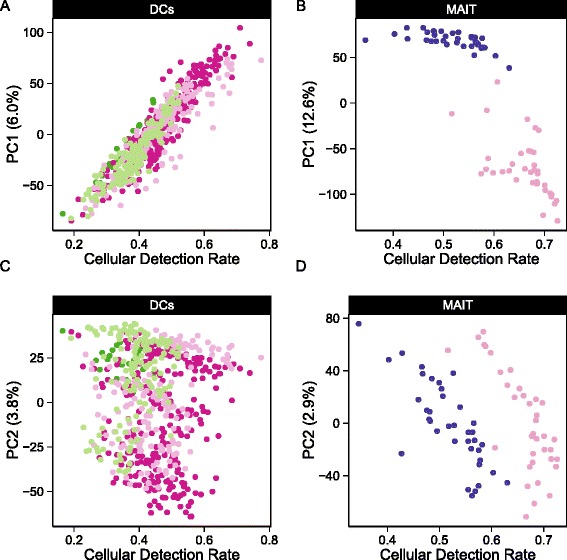
Single-cell transcriptomics reveals gene expression heterogeneity but suffers from stochastic dropout and characteristic bimodal expression distributions in which expression is either strongly non-zero or non-detectable. We propose a two-part, generalized linear model for such bimodal data that parameterizes both of these features. We argue that the cellular detection rate, the fraction of genes expressed in a cell, should be adjusted for as a source of nuisance variation. Our model provides gene set enrichment analysis tailored to single-cell data. It provides insights into how networks of co-expressed genes evolve across an experimental treatment. MAST is available at https://github.com/RGLab/MAST .
Overview
The claims and statistics of this paper haven’t been checked yet.
Free: it reads the open-access text and checks the first 5 claims that cite a source we can check. Create a free account to check every claim.
Integrity signals
Registry
Cites
Statistics
Figures
Verification
Claims the paper makes
The claims and statistics of this paper haven’t been checked yet.
Free: it reads the open-access text and checks the first 5 claims that cite a source we can check. Create a free account to check every claim.
Claims other papers make about this one
Each is checked against this paper’s own text: does it say what the citing paper says it does?
The source backs part of the claim, not all of it — or backs it for a different population, condition or comparison.
In the citing paper
“MAST with RE is testing a two-part hypothesis that the other tools are not directly testing.”
From A practical solution to pseudoreplication bias in single-cell studies (2021) · cites this paper as [10]
Experimental — accuracy not yet measuredThe source backs part of the claim, not all of it — or backs it for a different population, condition or comparison.
In the citing paper
“We demonstrate that this implementation performs exceptionally well when adjusting for individual as a random effect10.”
From A practical solution to pseudoreplication bias in single-cell studies (2021) · cites this paper as [10]
Experimental — accuracy not yet measuredThe cited source says what the claim attributes to it.
In the citing paper
“Scatter plots demonstrating the strong correlation between the calculated effect sizes of two differential gene expression analysis methods (MAST55 (used here) and pseudobulk74,75) across cell types in the human medial frontal cortex (a) and choroid plexus (b).”
From Dysregulation of brain and choroid plexus cell types in severe COVID-19 (2021) · cites this paper as [55]
The cited source says what the claim attributes to it.
In the citing paper
“The MAST framework uses a two-part generalized linear model to test for DE while controlling for specified covariates.”
From Dissection of artifactual and confounding glial signatures by single-cell sequencing of mouse and human brain (2022) · cites this paper as [90]
The cited source says what the claim attributes to it.
In the citing paper
“The sparsity and heterogeneity of single-cell data initially encouraged the development of specialized statistical methods to identify differentially expressed mRNAs7,8.”
From Confronting false discoveries in single-cell differential expression (2021) · cites this paper as [8]
11 more claims about this paper
Create a free account to see every claim other papers make about this one.
Self-check
Percentages, sums and reported differences re-computed from the paper’s own numbers.
The self-check needs the paper’s full text.
Citations
Cites
Controlling the False Discovery Rate: A Practical and Powerful Approach to Multiple Testing
Benjamini, Y., & Hochberg, Y. (1995) · Journal of the Royal Statistical Society Series B: Statistical Methodology · doi:10.1111/j.2517-6161.1995.tb02031.x · Cited by 109,482 · cited 1×
“The test results across genes can be combined and adjusted for multiplicity using the FDR adjustment [31].”
MethodRobinson, M. D., McCarthy, D. J., & Smyth, G. K. (2010) · Bioinformatics · doi:10.1093/bioinformatics/btp616 · Cited by 41,364 · cited 1×
“…methods have been proposed for modeling bulk RNA-seq data that permit sophisticated modeling through linear [12] or generalized linear models [13, 14], but these models have not yet been adapted to single-cell data because they do not properly account for the observed bimodal-ity in…”
MethodRSEM: accurate transcript quantification from RNA-Seq data with or without a reference genome
Li, B., & Dewey, C. N. (2011) · BMC Bioinformatics · doi:10.1186/1471-2105-12-323 · Cited by 22,179 · cited 1×
“Sequences were aligned to the UCSC Human Genome Assembly version 19, gene expression levels quantified using RSEM [28], and TPM values loaded into R [29] for analyses.”
MethodDifferential expression analysis for sequence count data
Anders, S., & Huber, W. (2010) · Genome Biology · doi:10.1186/gb-2010-11-10-r106 · Cited by 15,581
Bioconductor: open software development for computational biology and bioinformatics
Gentleman, R. C., Carey, V. J., Bates, D. M., Bolstad, B., Dettling, M., Dudoit, S., Ellis, B., Gautier, L., Ge, Y., Gentry, J., et al. (2004) · Genome Biology · doi:10.1186/gb-2004-5-10-r80 · Cited by 12,172 · cited 1×
“Sequences were aligned to the UCSC Human Genome Assembly version 19, gene expression levels quantified using RSEM [28], and TPM values loaded into R [29] for analyses.”
MethodSmyth, G. K. (2004) · Statistical Applications in Genetics and Molecular Biology · doi:10.2202/1544-6115.1027 · Cited by 11,829
Trapnell, C., Cacchiarelli, D., Grimsby, J., Pokharel, P., Li, S., Morse, M., Lennon, N. J., Livak, K. J., Mikkelsen, T. S., & Rinn, J. L. (2014) · Nature Biotechnology · doi:10.1038/nbt.2859 · Cited by 7,314
Molecular signatures database (MSigDB) 3.0
Liberzon, A., Subramanian, A., Pinchback, R., Thorvaldsdóttir, H., Tamayo, P., & Mesirov, J. P. (2011) · Bioinformatics · doi:10.1093/bioinformatics/btr260 · Cited by 7,111
voom: precision weights unlock linear model analysis tools for RNA-seq read counts
Law, C. W., Chen, Y., Shi, W., & Smyth, G. K. (2014) · Genome Biology · doi:10.1186/gb-2014-15-2-r29 · Cited by 6,155 · cited 1×
“Several methods have been proposed for modeling bulk RNA-seq data that permit sophisticated modeling through linear [12] or generalized linear models [13, 14], but these models have not yet been adapted to single-cell data because they do not properly account for the observed bimodal-ity in…”
MethodStochastic Gene Expression in a Single Cell
Elowitz, M. B., Levine, A. J., Siggia, E. D., & Swain, P. S. (2002) · Science · doi:10.1126/science.1070919 · Cited by 5,441
GOrilla: a tool for discovery and visualization of enriched GO terms in ranked gene lists
Eden, E., Navon, R., Steinfeld, I., Lipson, D., & Yakhini, Z. (2009) · BMC Bioinformatics · doi:10.1186/1471-2105-10-48 · Cited by 3,356
Normalization of RNA-seq data using factor analysis of control genes or samples
Risso, D., Ngai, J., Speed, T. P., & Dudoit, S. (2014) · Nature Biotechnology · doi:10.1038/nbt.2931 · Cited by 2,052 · cited 1×
“Finally, we investigated the relationship between our approach and the weight correction of Shalek et al. [5] and other technical bias correction approaches like Re-move Unwanted Variation (RUV) and Surrogate Variable Analysis (SVA; Additional file 1: Figure S5A, B) [17, 18].”
MethodImaging individual mRNA molecules using multiple singly labeled probes
Raj, A., van den Bogaard, P., Rifkin, S. A., van Oudenaarden, A., & Tyagi, S. (2008) · Nature Methods · doi:10.1038/nmeth.1253 · Cited by 2,028 · cited 1×
“Re-sults from synthetic biology also support the notion that bimodality can arise from the stochastic nature of gene expression [2, 3, 8, 9].”
BackgroundA weakly informative default prior distribution for logistic and other regression models
Gelman, A., Jakulin, A., Pittau, M. G., & Su, Y.-S. (2008) · The Annals of Applied Statistics · doi:10.1214/08-aoas191 · Cited by 1,790 · cited 1×
“…follows: The regression coefficients of the discrete component are regularized using a Bayesian approach as implemented in the bayesglm function of the arm R package, which uses weakly informative priors [30] to provide sensible estimates under linear separation (See Additional file 1 for details).”
MethodA WEAKLY INFORMATIVE DEFAULT PRIOR DISTRIBUTION FOR LOGISTIC AND OTHER REGRESSION MODELS
Gelman, A., Jakulin, A., & Grazia, M. (2009) · Cited by 1,352
Bayesian approach to single-cell differential expression analysis
Kharchenko, P. V., Silberstein, L., & Scadden, D. T. (2014) · Nature Methods · doi:10.1038/nmeth.2967 · Cited by 1,348 · cited 1×
“Previously, Kharchenko et al. [6] developed a so-called three-component mixture model to test for differential gene expression while accounting for bimodal expression.”
BackgroundBuettner, F., Natarajan, K. N., Casale, F. P., Proserpio, V., Scialdone, A., Theis, F. J., Teichmann, S. A., Marioni, J. C., & Stegle, O. (2015) · Nature Biotechnology · doi:10.1038/nbt.3102 · Cited by 1,136 · cited 2×
“An alternative approach would be to estimate the CDR coefficient using a set of control genes assumed to be treatment invariant, such as housekeeping or ERCC spike-ins [25, 26] and including it as an offset to the linear predictors in the regression.”
MethodSingle-cell RNA-seq reveals dynamic paracrine control of cellular variation
Shalek, A. K., Satija, R., Shuga, J., Trombetta, J. J., Gennert, D., Lu, D., Chen, P., Gertner, R. S., Gaublomme, J. T., Yosef, N., et al. (2014) · Nature · doi:10.1038/nature13437 · Cited by 1,000 · cited 10×
“Shalek et al. [5] analyzed murine bone marrow-derived dendritic cells simulated using three pathogenic components over the course of 6 h and estimated the proportion of cells that expressed a gene and the expression level of expressing cells.”
BackgroundMethodResultInfluentialSelf-citationAccounting for technical noise in single-cell RNA-seq experiments
Brennecke, P., Anders, S., Kim, J. K., Kołodziejczyk, A. A., Zhang, X., Proserpio, V., Baying, B., Benes, V., Teichmann, S. A., Marioni, J. C., et al. (2013) · Nature Methods · doi:10.1038/nmeth.2645 · Cited by 979
Camera: a competitive gene set test accounting for inter-gene correlation
Wu, D., & Smyth, G. K. (2012) · Nucleic Acids Research · doi:10.1093/nar/gks461 · Cited by 891 · cited 3×
“The approach is similar to that used by CAMERA [16] for bulk experiments in its accounting for inter-gene correlation that is known to inflate the false significance (type-I error) in permutation-based GSEA protocols [16], although it differs in that it uses the sampling variance of each model…”
BackgroundMethodInfluentialLi, S., Rouphael, N., Duraisingham, S., Romero-Steiner, S., Presnell, S., Davis, C., Schmidt, D. S., Johnson, S. E., Milton, A., Rajam, G., et al. (2014) · Nature Immunology · doi:10.1038/ni.2789 · Cited by 770
Missing data and technical variability in single-cell RNA-sequencing experiments
Hicks, S. C., Townes, F. W., Teng, M., & Irizarry, R. A. (2018) · Biostatistics · doi:10.1093/biostatistics/kxx053 · Cited by 635
Marguerat, S., Schmidt, A., Codlin, S., Chen, W., Aebersold, R., & Bähler, J. (2012) · Cell · doi:10.1016/j.cell.2012.09.019 · Cited by 571 · cited 1×
“…might seem to obviate the need to normalize for starting RNA quantities, but recent work shows that cells scale transcript copy number with cell volume (a factor that affects gene expression globally) to maintain a constant mRNA concentration and thus constant biochemical reaction rates [10, 11].”
Backgroundsvaseq: removing batch effects and other unwanted noise from sequencing data
Leek, J. T. (2014) · Nucleic Acids Research · doi:10.1093/nar/gku864 · Cited by 546
Emergence of reproducible spatiotemporal activity during motor learning
Peters, A. J., Chen, S. X., & Komiyama, T. (2014) · Nature · doi:10.1038/nature13235 · Cited by 491
Genetic Determinants and Cellular Constraints in Noisy Gene Expression
Sanchez, A., & Golding, I. (2013) · Science · doi:10.1126/science.1242975 · Cited by 483 · cited 2×
“Re-sults from synthetic biology also support the notion that bimodality can arise from the stochastic nature of gene expression [2, 3, 8, 9].”
BackgroundFrom single-cell to cell-pool transcriptomes: Stochasticity in gene expression and RNA splicing
Marinov, G. K., Williams, B. A., McCue, K., Schroth, G. P., Gertz, J., Myers, R. M., & Wold, B. J. (2014) · Genome Research · doi:10.1101/gr.161034.113 · Cited by 468 · cited 1×
“Re-sults from synthetic biology also support the notion that bimodality can arise from the stochastic nature of gene expression [2, 3, 8, 9].”
BackgroundPadovan-Merhar, O., Nair, G. P., Biaesch, A. G., Mayer, A., Scarfone, S., Foley, S. W., Wu, A. R., Churchman, L. S., Singh, A., & Raj, A. (2015) · Molecular Cell · doi:10.1016/j.molcel.2015.03.005 · Cited by 451 · cited 3×
“As discussed by Padovan-Merhar et al. [11], care must be taken when interpreting experiments where the sys-tem shows global changes in CDR across treatment groups.”
BackgroundMethodData exploration, quality control and testing in single-cell qPCR-based gene expression experiments
McDavid, A., Finak, G., Chattopadyay, P. K., Dominguez, M., Lamoreaux, L., Ma, S. S., Roederer, M., & Gottardo, R. (2013) · Bioinformatics · doi:10.1093/bioinformatics/bts714 · Cited by 395 · cited 1×
“We and other groups [4 – 7] have shown that the proportion of cells with detectable expression reflects both technical factors and biological differences between samples.”
Self-citationThe Mouse Genome Database (MGD): premier model organism resource for mammalian genomics and genetics
Blake, J. A., Bult, C. J., Kadin, J. A., Richardson, J. E., Eppig, J. T., & the Mouse Genome Database Group (2011) · Nucleic Acids Research · doi:10.1093/nar/gkq1008 · Cited by 263 · cited 1×
“In our analyses, we used the Emory blood transcriptional modules [22] as well as mouse GO annotations available from the Mouse Genome Informatics website [34].”
MethodChu, T., Tyznik, A. J., Roepke, S., Berkley, A. M., Woodward-Davis, A., Pattacini, L., Bevan, M. J., Zehn, D., & Prlic, M. (2013) · Cell Reports · doi:10.1016/j.celrep.2013.02.020 · Cited by 191 · cited 1×
“Its down-regulation at the mRNA level after 24 h likely precedes subsequent protein-level down-regulation [19 – 21].”
BackgroundSelf-citationStochastic gene expression: from single molecules to the proteome
Kaufmann, B. B., & van Oudenaarden, A. (2007) · Current Opinion in Genetics & Development · doi:10.1016/j.gde.2007.02.007 · Cited by 163 · cited 1×
“Re-sults from synthetic biology also support the notion that bimodality can arise from the stochastic nature of gene expression [2, 3, 8, 9].”
Distinct Requirements for Activation of NKT and NK Cells during Viral Infection
Tyznik, A. J., Verma, S., Wang, Q., Kronenberg, M., & Benedict, C. A. (2014) · The Journal of Immunology · doi:10.4049/jimmunol.1300837 · Cited by 79 · cited 1×
“level down-regulation [19–21].”
Combining independent p values: Extensions of the Stouffer and binomial methods.
Darlington, R. B., & Hayes, A. F. (2000) · Psychological Methods · doi:10.1037/1082-989x.5.4.496 · Cited by 66 · cited 1×
“GSEA tests are done separately on the two components of the hurdle model and the results from the two components are combined using Stouffer ’ s method [32], which favors consensus in the two components [33] (see Additional file 1 for details).”
MethodAnnotated Bibliography of Some Papers on Combining Significances or p-valuesPreprint
Cousins, R. D. (2007) · arXiv (Cornell University) · doi:10.48550/arxiv.0705.2209 · Cited by 59 · cited 1×
“GSEA tests are done separately on the two components of the hurdle model and the results from the two components are combined using Stouffer ’ s method [32], which favors consensus in the two components [33] (see Additional file 1 for details).”
MethodSmeltz, R. B. (2007) · The Journal of Immunology · doi:10.4049/jimmunol.178.8.4786 · Cited by 49 · cited 1×
“Its down-regulation at the mRNA level after 24 h likely precedes subsequent protein-level down-regulation [19 – 21].”
BackgroundE gr2 induced during DC development acts as an intrinsic negative regulator of DC immunogenicity
Miah, M. A., Byeon, S. E., Ahmed, M. S., Yoon, C., Ha, S., & Bae, Y. (2013) · European Journal of Immunology · doi:10.1002/eji.201243046 · Cited by 25 · cited 1×
“The most significantly elevated genes at 6 h included CCL5 , CD40 , IL12B , and interferon-inducible ( IFIT ) gene family members, while down-regulation was observed for EGR1 and EGR2 , transcription factors that are known to negatively regulate dendritic cell immunogenicity [24].”
Backgroundde Wit, H., Hoogstraten, D., Halie, R. M., & Vellenga, E. (1996) · PubMed · Cited by 24
Research works printed but not linked: 1
- Hicks SC, Teng M, Irizarry RA. On the widespread and critical impact of systematic bias and batch effects in single-cell RNA-seq data. bioRxiv. 2015:025528.
Cited by
Integrating single-cell transcriptomic data across different conditions, technologies, and species
Butler, A., Hoffman, P., Smibert, P., Papalexi, E., & Satija, R. (2018) · Nature Biotechnology · doi:10.1038/nbt.4096 · Cited by 13,174
“For example, zero-inflated differential expression tests have been tailored to scRNA-seq data to identify changes within a single-cell type 16,17 , and clustering approaches 18–23 can detect proportional shifts across conditions if cell types are conserved.”
MethodSCANPY: large-scale single-cell gene expression data analysis
Wolf, F. A., Angerer, P., & Theis, F. J. (2018) · Genome Biology · doi:10.1186/s13059-017-1382-0 · Cited by 8,881
“Background Simple integrated analysis work flows for single-cell transcriptomic data [1] have been enabled by frameworks such as SEURAT [2], MONOCLE [3], SCDE/PAGODA [4], MAST [5], CELL RANGER [6], SCATER [7], and SCRAN [8].”
MethodScenic: single-cell regulatory network inference and clustering.
Aibar, S., González-Blas, C. B., Moerman, T., Huynh-Thu, V. A., Imrichova, H., Hulselmans, G., Rambow, F., Marine, J.-C., Geurts, P., Aerts, J., et al. (2017) · Nature Methods · doi:10.1038/nmeth.4463 · Cited by 6,520
“Biopsies are taken from primary lesions (9) in radial growth phase (RGP) or vertical growth phase (VGP), sentinel lymph nodes (8), and metastatic lesions (8).”
Hafemeister, C., & Satija, R. (2019) · Genome Biology · doi:10.1186/s13059-019-1874-1 · Cited by 4,479
“Motivated by previous work that has demonstrated the utility of GLMs for differential expression [Finak et al., 2015], we reasoned that including sequencing depth as a GLM covariate could effectively model this technical source of variance, with the GLM residuals corresponding to normalized expression values.”
MethodSingle-cell landscape of bronchoalveolar immune cells in patients with COVID-19
Liao, M., Liu, Y., Yuan, J., Wen, Y., Xu, G., Zhao, J., Cheng, L., Li, J., Wang, X., Wang, F., et al. (2020) · Nature Medicine · doi:10.1038/s41591-020-0901-9 · Cited by 2,614
Metadata
- Authors
- Finak, G., McDavid, A., Yajima, M., Deng, J., Gersuk, V., Shalek, A. K., Slichter, C. K., Miller, H. W., McElrath, M. J., Prlic, M., Linsley, P. S., & Gottardo, R.
- Affiliations
- Fred Hutch Cancer Center (US)
- Broad Institute (US)
- ORCID
- Venue
- Genome Biology
- Published
- 2015-12
- Volume
- 16
- Issue
- 1
- Pages
- 278-278
- ISSN
- 1465-6906 (ISSN-L)
- 1474-760X
- PMC
- PMC4676162
- OpenAlex
- W2190545194
- Cited by
- 3,159
- References
- 39
- Citations by year
- 2026: 389 · 2025: 464 · 2024: 477 · 2023: 445 · 2022: 419 · 2021: 371 · 2020: 255 · 2019: 153 · 2018: 100 · 2017: 58 · 2016: 24 · 2015: 1
- FWCI
- 26.47
- Type
- journal article
- Language
- en
- Open access
- gold
- doi.org
- Licence
- cc-by
- creativecommons.org/licenses/by/4.0/ (tdm)
- creativecommons.org/licenses/by/4.0/ (vor, 9 d)
- Locations
- Genome biology (publishedVersion, cc-by)
- bioRxiv (Cold Spring Harbor Laboratory) (acceptedVersion, cc-by-nc-nd)
- Europe PMC (PubMed Central) (publishedVersion, cc-by)
- PubMed Central (publishedVersion, cc-by)
- PubMed (publishedVersion)
- DSpace@MIT (Massachusetts Institute of Technology) (submittedVersion, cc-by-nc-sa)
- OpenBU (Boston University) (submittedVersion, cc-by)
- Funders
- National Institutes of Health (DP2 DE023321, R01 EB008400)
- Bill and Melinda Gates Foundation (OPP1032317)
- Topics
- Life Sciences › Biochemistry, Genetics and Molecular Biology › Molecular Biology › Single-cell and spatial transcriptomics
- Life Sciences › Biochemistry, Genetics and Molecular Biology › Molecular Biology › Gene expression and cancer classification
- Life Sciences › Biochemistry, Genetics and Molecular Biology › Molecular Biology › Genomics and Phylogenetic Studies
- Keywords
- single-cell RNA sequencing, gene expression heterogeneity, dropout, detection rate, gene set enrichment analysis, statistical framework
- MeSH terms
- Animals, Data Interpretation, Statistical, Dendritic Cells, Humans, Genetic Variation, Linear Models, Sequence Analysis, RNA, Gene Expression Profiling, Mice, Single-Cell Analysis, Transcriptome
About these checks
Registry, retraction, Cites and statistics results are computed, not judged, with one exception: a printed reference that no index lists is read once by a model before it counts as a citation error. Claims are extracted by a model and kept only when their quote appears verbatim in the text; each cited source is then checked, with a model’s help, for whether it says what the claim relies on. Those verdicts can be wrong — read the claim’s quote and the cited source before relying on one.
Statistics and arithmetic are recomputed, not judged.
Confidence bands are shown only for fields calibrated on our annotated test set. None is calibrated yet, so no band is shown.
What counts as a claim ›How we measure confidence ›How we check this ›
Are you an author, or do you see a problem with this page? Request a review
Data sources
Bibliographic data: Semantic Scholar, OpenAlex, Crossref.
Contains information from the Semantic Scholar Academic Graph Datasets, made available under the ODC Attribution License (ODC-BY 1.0).
Semantic Scholar’s data is described in: Kinney, R., et al. (2023). The Semantic Scholar Open Data Platform. arXiv:2301.10140.
