

Deep genome sequencing and variation analysis of 13 inbred mouse strains defines candidate phenotypic alleles, private variation and homozygous truncating mutations
Open accessPublished version of a preprint
The DOI matches its Crossref record; 102 of the 102 references it cites were found in a registry or an index.
Abstract
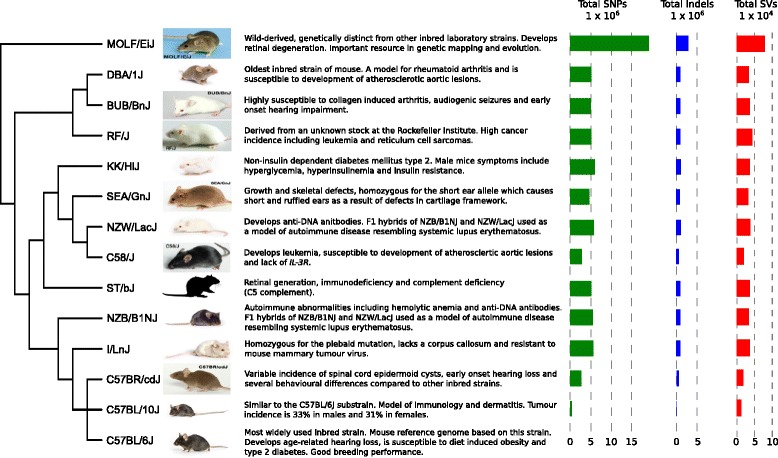
BACKGROUND: The Mouse Genomes Project is an ongoing collaborative effort to sequence the genomes of the common laboratory mouse strains. In 2011, the initial analysis of sequence variation across 17 strains found 56.7 M unique single nucleotide polymorphisms (SNPs) and 8.8 M indels. We carry out deep sequencing of 13 additional inbred strains (BUB/BnJ, C57BL/10J, C57BR/cdJ, C58/J, DBA/1J, I/LnJ, KK/HiJ, MOLF/EiJ, NZB/B1NJ, NZW/LacJ, RF/J, SEA/GnJ and ST/bJ), cataloguing molecular variation within and across the strains. These strains include important models for immune response, leukaemia, age-related hearing loss and rheumatoid arthritis. We now have several examples of fully sequenced closely related strains that are divergent for several disease phenotypes. RESULTS: Approximately 27.4 M unique SNPs and 5 M indels are identified across these strains compared to the C57BL/6 J reference genome (GRCm38). The amount of variation found in the inbred laboratory mouse genome has increased to 71 M SNPs and 12 M indels. We investigate the genetic basis of highly penetrant cancer susceptibility in RF/J finding private novel missense mutations in DNA damage repair and highly cancer associated genes. We use two highly related strains (DBA/1J and DBA/2J) to investigate the genetic basis of collagen-induced arthritis susceptibility. CONCLUSIONS: This paper significantly expands the catalogue of fully sequenced laboratory mouse strains and now contains several examples of highly genetically similar strains with divergent phenotypes. We show how studying private missense mutations can lead to insights into the genetic mechanism for a highly penetrant phenotype.
Overview
The claims and statistics of this paper haven’t been checked yet.
Free: it reads the open-access text and checks the first 5 claims that cite a source we can check. Create a free account to check every claim.
Integrity signals
Registry
Cites
Statistics
Figures
Verification
Claims the paper makes
The claims and statistics of this paper haven’t been checked yet.
Free: it reads the open-access text and checks the first 5 claims that cite a source we can check. Create a free account to check every claim.
Claims other papers make about this one
Each is checked against this paper’s own text: does it say what the citing paper says it does?
The cited source doesn’t support the claim as written.
In the citing paper
“We also attempted SNP-based demultiplexing of in silico–pooled data from DBA/1J mice (Shinozaki et al, 2022) which have ∼5 × 10⁶ total SNPs and indels (Doran et al, 2016).”
From Evaluation of genetic demultiplexing of single-cell sequencing data from model species (2023) · cites this paper as Doran et al, 2016
Checked by a reasoning model — may be wrong.
Experimental — accuracy not yet measuredThe source backs part of the claim, not all of it — or backs it for a different population, condition or comparison.
In the citing paper
“Until now, most gene expression studies of different mouse strains have used the BL6 reference genome despite millions of known genetic variations between strains.14,15”
From High-quality mouse reference genomes reveal the structural complexity of the murine protein-coding landscape (2026) · cites this paper as [14]
Experimental — accuracy not yet measuredThe source backs part of the claim, not all of it — or backs it for a different population, condition or comparison.
In the citing paper
“C57BL/6 mice are nearly genetically identical with only ∼15,000 SNPs and insertion–deletion mutations (indels) (Doran et al, 2016), providing evidence that SNP-based demuxers are unable to separate biological replicates from highly inbred mice.”
From Evaluation of genetic demultiplexing of single-cell sequencing data from model species (2023) · cites this paper as Doran et al, 2016
Experimental — accuracy not yet measuredThe cited source says what the claim attributes to it.
In the citing paper
“Compared to previous de novo mouse strain genomes and variation catalogs,14,15,18 these long-read genome assemblies show significant improvement in the most complex regions, such as MHC, defensin, T cell receptor (TCR), and Ly49 loci.”
From High-quality mouse reference genomes reveal the structural complexity of the murine protein-coding landscape (2026) · cites this paper as [14]
Self-check
Percentages, sums and reported differences re-computed from the paper’s own numbers.
The self-check needs the paper’s full text.
Citations
Cites
The Sequence Alignment/Map format and SAMtools
Li, H., Handsaker, B., Wysoker, A., Fennell, T., Ruan, J., Homer, N., Marth, G., Abecasis, G., Durbin, R., & 1000 Genome Project Data Processing Subgroup (2009) · Bioinformatics · doi:10.1093/bioinformatics/btp352 · Cited by 62,041
KEGG: Kyoto Encyclopedia of Genes and Genomes
Kanehisa, M. (2000) · Nucleic Acids Research · doi:10.1093/nar/28.1.27 · Cited by 37,077 · cited 7×
“In fact, the most significantly over-represented REACTOME and KEGG pathways were “Degradation of the extracellular matrix” (p=0.0049) and “ECM-receptor interaction” (p=0.013) respectively.”
MethodInfluentialKEGG: Kyoto Encyclopedia of Genes and Genomes
Ogata, H., Goto, S., Sato, K., Fujibuchi, W., Bono, H., & Kanehisa, M. (1999) · Nucleic Acids Research · doi:10.1093/nar/27.1.29 · Cited by 31,232
The Genome Analysis Toolkit: A MapReduce framework for analyzing next-generation DNA sequencing data
McKenna, A., Hanna, M., Banks, E., Sivachenko, A., Cibulskis, K., Kernytsky, A., Garimella, K., Altshuler, D., Gabriel, S., Daly, M., et al. (2010) · Genome Research · doi:10.1101/gr.107524.110 · Cited by 27,895
A global reference for human genetic variation
The 1000 Genomes Project Consortium, authors, C., Auton, A., Abecasis, G. R., Steering committee, Altshuler, D. M., Durbin, R. M., Abecasis, G. R., Bentley, D. R., Chakravarti, A., et al. (2015) · Nature · doi:10.1038/nature15393 · Cited by 18,247
The variant call format and VCFtools
Danecek, P., Auton, A., Abecasis, G., Albers, C. A., Banks, E., DePristo, M. A., Handsaker, R. E., Lunter, G., Marth, G. T., Sherry, S. T., et al. (2011) · Bioinformatics · doi:10.1093/bioinformatics/btr330 · Cited by 16,200
Robinson, J. T., Thorvaldsdóttir, H., Winckler, W., Guttman, M., Lander, E. S., Getz, G., & Mesirov, J. P. (2011) · Nature Biotechnology · doi:10.1038/nbt.1754 · Cited by 15,390 · cited 1×
“Upon visual inspection of these deletions using the alignment data and the integrative genomics viewer [42], eight were identified as real differences between the strains.”
MethodInitial sequencing and comparative analysis of the mouse genome
Mouse Genome Sequencing Consortium (2002) · Nature · doi:10.1038/nature01262 · Cited by 7,187 · cited 1×
“The first draft version of the mouse reference genome was produced based on a whole genome shotgun sequencing strategy of a female C57BL/6J strain mouse [4] followed several years later by the finished genome sequence [5].”
MethodSIFT: predicting amino acid changes that affect protein function
Ng, P. C. (2003) · Nucleic Acids Research · doi:10.1093/nar/gkg509 · Cited by 6,577
Kumar, P., Henikoff, S., & Ng, P. C. (2009) · Nature Protocols · doi:10.1038/nprot.2009.86 · Cited by 6,521
Cited by
Items 101–107 of 107
González‐Fernández, Á. (2025) · European Journal of Immunology · doi:10.1002/eji.202451678
Fairhurst, A., Celhar, T., & Mohan, C. (2026) · Elsevier eBooks · doi:10.1016/b978-0-443-33957-8.00037-8
Henfrey, C., Print, E. H. T., Zhang, G., Hinch, R., Maudlin, I., Moralli, D., Davies, B. L., Donnelly, P., & Hinch, A. G. (2026) · bioRxiv (Cold Spring Harbor Laboratory) · doi:10.64898/2026.03.26.714455
Additional file 1 of Variation under domestication in animal models: the case of the Mexican axolotl
Torres‐Sánchez, M. (2020) · Figshare · doi:10.6084/m9.figshare.13278722
Aging Rhesus Macaque show tissue and sex-specific balance of drifting and coordinated miRNA programsPreprint
Rishik, S., Nutma, E., Ludwig, N., Fischer, U., Tänzer, T., Rheinheimer, S., Hart, M., Gröger, L., Meerjanssen, J., Flotho, M., et al. (2026) · bioRxiv (Cold Spring Harbor Laboratory) · doi:10.64898/2026.04.27.720577
Host heterogeneity shapes clonal selection and organotropism in an extranodal lymphoma mouse model
Li, X., Deng, M., Jiang, Y., Luo, L., Zhang, C., Tang, H., Wei, Z., 冷加燕, & Liu, C. (2026) · Cell Death and Disease · doi:10.1038/s41419-026-09014-3
Metadata
- Authors
- Doran, A. G., Wong, K., Flint, J., Adams, D. J., Hunter, K. W., & Keane, T. M.
- Affiliations
- Wellcome Sanger Institute (GB)
- National Cancer Institute (US)
- Corresponding author
- Hunter, Kent W.
- Venue
- Genome Biology
- Published
- 2016-08-01
- Volume
- 17
- Issue
- 1
- Pages
- 167-167
- ISSN
- 1465-6906 (ISSN-L)
- 1474-760X
- PMC
- PMC4968449
- OpenAlex
- W2953218747
- Semantic Scholar
- d9f571c389f18658c08d793e0af8fc7524224174
- Cited by
- 101
- References
- 101
- Citations by year
- 2026: 6 · 2025: 11 · 2024: 12 · 2023: 9 · 2022: 5 · 2021: 12 · 2020: 12 · 2019: 17 · 2018: 7 · 2017: 8 · 2016: 2
- FWCI
- 5.89
- Type
- journal article
- Language
- en
- Open access
- gold
- doi.org
- Licence
- cc-by
- creativecommons.org/licenses/by/4.0/ (tdm)
- creativecommons.org/licenses/by/4.0/ (vor)
- Locations
- Genome biology (publishedVersion, cc-by)
- bioRxiv (Cold Spring Harbor Laboratory) (acceptedVersion, cc-by)
- PubMed Central (publishedVersion, cc-by)
- PubMed (publishedVersion)
- Funders
- Wellcome Trust
- Biotechnology and Biological Sciences Research Council (BB/M000281/1)
- Medical Research Council (MR/L007428/1)
- National Cancer Institute
- Topics
- Life Sciences › Biochemistry, Genetics and Molecular Biology › Molecular Biology › Genomics and Phylogenetic Studies
- Life Sciences › Biochemistry, Genetics and Molecular Biology › Genetics › Genetic and phenotypic traits in livestock
- Life Sciences › Biochemistry, Genetics and Molecular Biology › Genetics › Genetic Mapping and Diversity in Plants and Animals
- Keywords
- inbred mouse strains, single nucleotide polymorphisms, indels, private mutations, homozygous truncating mutation, DBA/2J, collagen-induced arthritis, cancer susceptibility, DNA repair genes
- MeSH terms
- Alleles, Animals, Base Sequence, Chromosome Mapping, DNA Damage, DNA Repair, Homozygote, Mice, Inbred Strains, Genome, Mutation, Missense, Polymorphism, Single Nucleotide, Mice, INDEL Mutation, High-Throughput Nucleotide Sequencing
About these checks
Registry, retraction, Cites and statistics results are computed, not judged, with one exception: a printed reference that no index lists is read once by a model before it counts as a citation error. Claims are extracted by a model and kept only when their quote appears verbatim in the text; each cited source is then checked, with a model’s help, for whether it says what the claim relies on. Those verdicts can be wrong — read the claim’s quote and the cited source before relying on one.
Statistics and arithmetic are recomputed, not judged.
Confidence bands are shown only for fields calibrated on our annotated test set. None is calibrated yet, so no band is shown.
What counts as a claim ›How we measure confidence ›How we check this ›
Are you an author, or do you see a problem with this page? Request a review
Data sources
Bibliographic data: Semantic Scholar, OpenAlex, Crossref.
Contains information from the Semantic Scholar Academic Graph Datasets, made available under the ODC Attribution License (ODC-BY 1.0).
Semantic Scholar’s data is described in: Kinney, R., et al. (2023). The Semantic Scholar Open Data Platform. arXiv:2301.10140.
