

Deep genome sequencing and variation analysis of 13 inbred mouse strains defines candidate phenotypic alleles, private variation and homozygous truncating mutations
Open accessPublished version of a preprint
The DOI matches its Crossref record; 102 of the 102 references it cites were found in a registry or an index.
Abstract
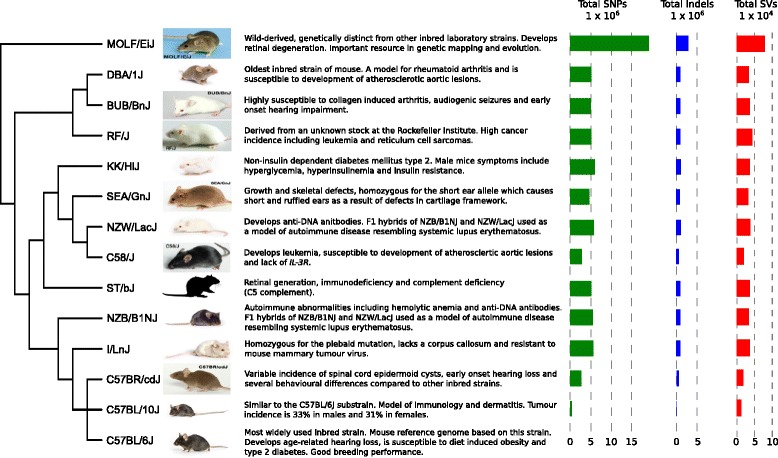
BACKGROUND: The Mouse Genomes Project is an ongoing collaborative effort to sequence the genomes of the common laboratory mouse strains. In 2011, the initial analysis of sequence variation across 17 strains found 56.7 M unique single nucleotide polymorphisms (SNPs) and 8.8 M indels. We carry out deep sequencing of 13 additional inbred strains (BUB/BnJ, C57BL/10J, C57BR/cdJ, C58/J, DBA/1J, I/LnJ, KK/HiJ, MOLF/EiJ, NZB/B1NJ, NZW/LacJ, RF/J, SEA/GnJ and ST/bJ), cataloguing molecular variation within and across the strains. These strains include important models for immune response, leukaemia, age-related hearing loss and rheumatoid arthritis. We now have several examples of fully sequenced closely related strains that are divergent for several disease phenotypes. RESULTS: Approximately 27.4 M unique SNPs and 5 M indels are identified across these strains compared to the C57BL/6 J reference genome (GRCm38). The amount of variation found in the inbred laboratory mouse genome has increased to 71 M SNPs and 12 M indels. We investigate the genetic basis of highly penetrant cancer susceptibility in RF/J finding private novel missense mutations in DNA damage repair and highly cancer associated genes. We use two highly related strains (DBA/1J and DBA/2J) to investigate the genetic basis of collagen-induced arthritis susceptibility. CONCLUSIONS: This paper significantly expands the catalogue of fully sequenced laboratory mouse strains and now contains several examples of highly genetically similar strains with divergent phenotypes. We show how studying private missense mutations can lead to insights into the genetic mechanism for a highly penetrant phenotype.
Overview
The claims and statistics of this paper haven’t been checked yet.
Free: it reads the open-access text and checks the first 5 claims that cite a source we can check. Create a free account to check every claim.
Integrity signals
Registry
Cites
Statistics
Figures
Verification
Claims the paper makes
The claims and statistics of this paper haven’t been checked yet.
Free: it reads the open-access text and checks the first 5 claims that cite a source we can check. Create a free account to check every claim.
Claims other papers make about this one
Each is checked against this paper’s own text: does it say what the citing paper says it does?
The cited source doesn’t support the claim as written.
In the citing paper
“We also attempted SNP-based demultiplexing of in silico–pooled data from DBA/1J mice (Shinozaki et al, 2022) which have ∼5 × 10⁶ total SNPs and indels (Doran et al, 2016).”
From Evaluation of genetic demultiplexing of single-cell sequencing data from model species (2023) · cites this paper as Doran et al, 2016
Checked by a reasoning model — may be wrong.
Experimental — accuracy not yet measuredThe source backs part of the claim, not all of it — or backs it for a different population, condition or comparison.
In the citing paper
“Until now, most gene expression studies of different mouse strains have used the BL6 reference genome despite millions of known genetic variations between strains.14,15”
From High-quality mouse reference genomes reveal the structural complexity of the murine protein-coding landscape (2026) · cites this paper as [14]
Experimental — accuracy not yet measuredThe source backs part of the claim, not all of it — or backs it for a different population, condition or comparison.
In the citing paper
“C57BL/6 mice are nearly genetically identical with only ∼15,000 SNPs and insertion–deletion mutations (indels) (Doran et al, 2016), providing evidence that SNP-based demuxers are unable to separate biological replicates from highly inbred mice.”
From Evaluation of genetic demultiplexing of single-cell sequencing data from model species (2023) · cites this paper as Doran et al, 2016
Experimental — accuracy not yet measuredThe cited source says what the claim attributes to it.
In the citing paper
“Compared to previous de novo mouse strain genomes and variation catalogs,14,15,18 these long-read genome assemblies show significant improvement in the most complex regions, such as MHC, defensin, T cell receptor (TCR), and Ly49 loci.”
From High-quality mouse reference genomes reveal the structural complexity of the murine protein-coding landscape (2026) · cites this paper as [14]
Self-check
Percentages, sums and reported differences re-computed from the paper’s own numbers.
The self-check needs the paper’s full text.
Citations
Cites
The Sequence Alignment/Map format and SAMtools
Li, H., Handsaker, B., Wysoker, A., Fennell, T., Ruan, J., Homer, N., Marth, G., Abecasis, G., Durbin, R., & 1000 Genome Project Data Processing Subgroup (2009) · Bioinformatics · doi:10.1093/bioinformatics/btp352 · Cited by 62,041
KEGG: Kyoto Encyclopedia of Genes and Genomes
Kanehisa, M. (2000) · Nucleic Acids Research · doi:10.1093/nar/28.1.27 · Cited by 37,077 · cited 7×
“In fact, the most significantly over-represented REACTOME and KEGG pathways were “Degradation of the extracellular matrix” (p=0.0049) and “ECM-receptor interaction” (p=0.013) respectively.”
MethodInfluentialKEGG: Kyoto Encyclopedia of Genes and Genomes
Ogata, H., Goto, S., Sato, K., Fujibuchi, W., Bono, H., & Kanehisa, M. (1999) · Nucleic Acids Research · doi:10.1093/nar/27.1.29 · Cited by 31,232
The Genome Analysis Toolkit: A MapReduce framework for analyzing next-generation DNA sequencing data
McKenna, A., Hanna, M., Banks, E., Sivachenko, A., Cibulskis, K., Kernytsky, A., Garimella, K., Altshuler, D., Gabriel, S., Daly, M., et al. (2010) · Genome Research · doi:10.1101/gr.107524.110 · Cited by 27,895
A global reference for human genetic variation
The 1000 Genomes Project Consortium, authors, C., Auton, A., Abecasis, G. R., Steering committee, Altshuler, D. M., Durbin, R. M., Abecasis, G. R., Bentley, D. R., Chakravarti, A., et al. (2015) · Nature · doi:10.1038/nature15393 · Cited by 18,247
The variant call format and VCFtools
Danecek, P., Auton, A., Abecasis, G., Albers, C. A., Banks, E., DePristo, M. A., Handsaker, R. E., Lunter, G., Marth, G. T., Sherry, S. T., et al. (2011) · Bioinformatics · doi:10.1093/bioinformatics/btr330 · Cited by 16,200
Robinson, J. T., Thorvaldsdóttir, H., Winckler, W., Guttman, M., Lander, E. S., Getz, G., & Mesirov, J. P. (2011) · Nature Biotechnology · doi:10.1038/nbt.1754 · Cited by 15,390 · cited 1×
“Upon visual inspection of these deletions using the alignment data and the integrative genomics viewer [42], eight were identified as real differences between the strains.”
MethodInitial sequencing and comparative analysis of the mouse genome
Mouse Genome Sequencing Consortium (2002) · Nature · doi:10.1038/nature01262 · Cited by 7,187 · cited 1×
“The first draft version of the mouse reference genome was produced based on a whole genome shotgun sequencing strategy of a female C57BL/6J strain mouse [4] followed several years later by the finished genome sequence [5].”
MethodSIFT: predicting amino acid changes that affect protein function
Ng, P. C. (2003) · Nucleic Acids Research · doi:10.1093/nar/gkg509 · Cited by 6,577
Kumar, P., Henikoff, S., & Ng, P. C. (2009) · Nature Protocols · doi:10.1038/nprot.2009.86 · Cited by 6,521
Cited by
Comparative transcriptomics in human and mouse
Breschi, A., Gingeras, T. R., & Guigó, R. (2017) · Nature Reviews Genetics · doi:10.1038/nrg.2017.19 · Cited by 360
Park, H., Oh, J., Shim, G., Cho, B., Chang, Y., Kim, S., Baek, S., Kim, H., Shin, J., Choi, H., et al. (2019) · Nature Neuroscience · doi:10.1038/s41593-019-0352-0 · Cited by 272
Lilue, J., Doran, A. G., Fiddes, I. T., Abrudan, M., Armstrong, J., Bennett, R., Chow, W., Collins, J., Collins, S., Czechanski, A., et al. (2018) · Nature Genetics · doi:10.1038/s41588-018-0223-8 · Cited by 267
Self-citationGenomes of the Mouse Collaborative Cross
Srivastava, A., Morgan, A. P., Najarian, M. L., Sarsani, V. K., Sigmon, J. S., Shorter, J. R., Kashfeen, A., McMullan, R. C., Williams, L. H., Giusti-Rodríguez, P., et al. (2017) · Genetics · doi:10.1534/genetics.116.198838 · Cited by 201
“2012; Doran et al.”
BackgroundInfluentialVan Cauwenbergh, O., Di Serafino, A., Tytgat, J., & Soubry, A. (2020) · Clinical Epigenetics · doi:10.1186/s13148-020-00845-1 · Cited by 163
“For instance, some SNPs—as well as deletions and insertions—are unique to one specific strain, called “private SNPs” or “private deletions/insertions,” respectively [103].”
BackgroundSigmon, J. S., Blanchard, M. W., Baric, R. S., Bell, T. A., Brennan, J., Brockmann, G. A., Burks, A. W., Calabrese, J. M., Caron, K. M., Cheney, R. E., et al. (2020) · Genetics · doi:10.1534/genetics.120.303596 · Cited by 108
Eppig, J. T. (2017) · ILAR Journal · doi:10.1093/ilar/ilx013 · Cited by 103
Genetic Models Reveal cis and trans Immune-Regulatory Activities for lincRNA-Cox2
Elling, R., Robinson, E. K., Shapleigh, B., Liapis, S. C., Covarrubias, S., Katzman, S., Groff, A. F., Jiang, Z., Agarwal, S., Motwani, M., et al. (2018) · Cell Reports · doi:10.1016/j.celrep.2018.10.027 · Cited by 103
Ferraj, A., Audano, P. A., Balachandran, P., Czechanski, A., Flores, J. I., Radecki, A. A., Mosur, V. V., Gordon, D., Walawalkar, I. A., Eichler, E. E., et al. (2023) · Cell Genomics · doi:10.1016/j.xgen.2023.100291 · Cited by 90
Löscher, W., Ferland, R. J., & Ferraro, T. N. (2017) · Epilepsy & Behavior · doi:10.1016/j.yebeh.2017.05.040 · Cited by 85
The virtuous cycle of human genetics and mouse models in drug discovery
Nadeau, J. H., & Auwerx, J. H. (2019) · Nature Reviews Drug Discovery · doi:10.1038/s41573-018-0009-9 · Cited by 84
Translating Mouse Models: Immune Variation and Efficacy Testing
Sellers, R. S. (2017) · Toxicologic Pathology · doi:10.1177/0192623316675767 · Cited by 77
Sequence and Structural Diversity of Mouse Y Chromosomes
Morgan, A. P., & de Villena, F. P. (2017) · Molecular Biology and Evolution · doi:10.1093/molbev/msx250 · Cited by 67
Ma, Y., Guo, Y., Ye, H., Huang, K., Lv, Z., & Ke, Y. (2019) · Ecotoxicology and Environmental Safety · doi:10.1016/j.ecoenv.2019.03.055 · Cited by 66
Arroyo, J., Escobar-Zarate, D., Wells, H. H., Constans, M., Thao, K., Smith, J. M., Sieben, C. J., Martell, M. R., Kline, T. L., Irazabal, M. V., et al. (2021) · Kidney International · doi:10.1016/j.kint.2021.01.028 · Cited by 65
Annunziato, S., Lutz, C., Henneman, L., Bhin, J., Wong, K., Siteur, B., van Gerwen, B., de Korte‐Grimmerink, R., Zafra, M. P., Schatoff, E. M., et al. (2020) · The EMBO Journal · doi:10.15252/embj.2019102169 · Cited by 64
Self-citationMaternal-biased H3K27me3 correlates with paternal-specific gene expression in the human morula
Zhang, W., Chen, Z., Yin, Q., Zhang, D., Racowsky, C., & Zhang, Y. (2019) · Genes & Development · doi:10.1101/gad.323105.118 · Cited by 56
He, Q., Cuirong, S., & Pan, Y.-J. (2024) · Scientific Reports · doi:10.1038/s41598-023-50703-2 · Cited by 45
Dornbos, P., & LaPres, J. J. (2017) · Toxicology · doi:10.1016/j.tox.2017.12.007 · Cited by 42
Vorobyev, A., Gupta, Y., Sezin, T., Koga, H., Bartsch, Y. C., Belheouane, M., Künzel, S., Sina, C., Schilf, P., Körber-Ahrens, H., et al. (2019) · Nature Communications · doi:10.1038/s41467-019-11952-w · Cited by 39
Shorter, J. R., Najarian, M. L., Bell, T. A., Blanchard, M. W., Ferris, M. T., Hock, P., Kashfeen, A., Kirchoff, K. E., Linnertz, C. L., Sigmon, J. S., et al. (2019) · G3 Genes Genomes Genetics · doi:10.1534/g3.119.400039 · Cited by 38
Top-Down Proteomics Enables Comparative Analysis of Brain Proteoforms Between Mouse Strains
Davis, R. G., Park, H.-M., Kim, K., Greer, J. B., Fellers, R. T., LeDuc, R. D., Romanova, E. V., Rubakhin, S. S., Zombeck, J. A., Wu, C., et al. (2018) · Analytical Chemistry · doi:10.1021/acs.analchem.7b04108 · Cited by 36
A severe atherosclerosis mouse model on the resistant NOD background
Wang, X., Huang, R., Zhang, L., Li, S., Luo, J. C., Gu, Y., Chen, Z., Zheng, Q., Chao, T., Zheng, W., et al. (2018) · Disease Models & Mechanisms · doi:10.1242/dmm.033852 · Cited by 34
Ehret, T., Torelli, F., Klotz, C., Pedersen, A. B., & Seeber, F. (2017) · Frontiers in Cellular and Infection Microbiology · doi:10.3389/fcimb.2017.00238 · Cited by 33
Mortazavi, M., Ren, Y., Saini, S., Antaki, D., St. Pierre, C. L., Williams, A., Sohni, A., Wilkinson, M. F., Gymrek, M., Sebat, J., et al. (2022) · Cell Genomics · doi:10.1016/j.xgen.2022.100102 · Cited by 24
Functional maps of a genomic locus reveal confinement of an enhancer by its target gene
Eder, M., Moene, C. J. I., Dauban, L., Magnitov, M. D., Drayton, J. A., de Haas, M., Leemans, C., Verkuilen, M., de Wit, E., Hansen, A. S., et al. (2025) · Science · doi:10.1126/science.ads6552 · Cited by 29
Functional maps of a genomic locus reveal confinement of an enhancer by its target gene
Eder, M., Moene, C. J. I., Dauban, L., Leemans, C., & van Steensel, B. (2024) · doi:10.1101/2024.08.26.609360 · Cited by 28
Carey, K., Ryu, J., Uh, K., Lengi, A. J., Clark‐Deener, S., Corl, B. A., & Lee, K. (2019) · BMC Biotechnology · doi:10.1186/s12896-019-0517-7 · Cited by 28
Immune Relevant and Immune Deficient Mice: Options and Opportunities in Translational Research
Radaelli, E., Santagostino, S. F., Sellers, R. S., & Brayton, C. F. (2018) · ILAR Journal · doi:10.1093/ilar/ily026 · Cited by 28
Analysis of structural variation among inbred mouse strains
Arslan, A., Fang, Z., Wang, M., Tan, Y., Cheng, Z., Chen, X., Guan, Y., Pisani, L. J., Yoo, B., Bejerano, G., et al. (2023) · BMC Genomics · doi:10.1186/s12864-023-09197-5 · Cited by 23
TAD border deletion at the Kit locus causes tissue-specific ectopic activation of a neighboring gene
Kabirova, E., Ryzhkova, A., Lukyanchikova, V., Khabarova, A. A., Korablev, A. N., Шнайдер, Т. А., Nuriddinov, M., Belokopytova, P. S., Smirnov, A. V., Хоцкин, Н. В., et al. (2024) · Nature Communications · doi:10.1038/s41467-024-48523-7 · Cited by 22
Sex-specific DNA-replication in the early mammalian embryo
Halliwell, J. A., Gonzalez, J. M., Hashim, A., Dahl, J. A., Hoffmann, E. R., & Lerdrup, M. (2024) · Nature Communications · doi:10.1038/s41467-024-50727-w · Cited by 22
Evaluation of genetic demultiplexing of single-cell sequencing data from model species
Cardiello, J. F., Joven Araus, A., Giatrellis, S., Helsens, C., Simon, A., & Leigh, N. D. (2023) · Life Science Alliance · doi:10.26508/lsa.202301979 · Cited by 21
“C57BL/6mice are nearly genetically identical with only ~15,000 SNPs and insertion–deletion mutations (indels) (Doran et al, 2016), providing evidence that SNP-based demuxers are unable to separate biological replicates from highly inbred mice.”
BackgroundMethodInteractions between the genome and the nuclear lamina are multivalent and cooperative
Dauban, L., Eder, M., de Haas, M., Franceschini-Santos, V. H., Yáñez-Cuna, J. O., Martinovic, M., van Schaik, T., Leemans, C., Teunissen, H., Rademaker, K., et al. (2025) · Nature Structural & Molecular Biology · doi:10.1038/s41594-025-01655-w · Cited by 21
Chd8 regulates X chromosome inactivation in mouse through fine-tuning control of Xist expression
Cerase, A., Young, A. N., Ruiz, N. B., Buneß, A., Sant, G. M., Arnold, M., Giacomo, M. D., Ascolani, M., Kumar, M., Hierholzer, A., et al. (2021) · Communications Biology · doi:10.1038/s42003-021-01945-1 · Cited by 21
Barnard, S. G. R., Moquet, J., Lloyd, S., Ellender, M., Ainsbury, E. A., & Quinlan, R. A. (2018) · International Journal of Radiation Biology · doi:10.1080/09553002.2018.1532609 · Cited by 21
Decay of driver mutations shapes the landscape of intestinal transformation
Lourenço, F. C., Sadien, I. D., Wong, K., Adler, S., Sawle, A., Santana, L. S., Hazelwood, L. D., Giavara, G., Nicholson, A. M., Eldridge, M., et al. (2025) · Nature · doi:10.1038/s41586-025-09762-w · Cited by 20
Self-citationMouse protein coding diversity: What’s left to discover?
Lilue, J., Shivalikanjli, A., Adams, D. J., & Keane, T. M. (2019) · PLOS Genetics · doi:10.1371/journal.pgen.1008446 · Cited by 19
“Paired-end reads are aligned to the C57BL/6J reference genome to identify SNPs, indels, and structure variations (SVs) [16,17].”
MethodSelf-citationIsometric skeletal muscle contractile properties in common strains of male laboratory mice
Minchew, E. C., Williamson, N. C., Readyoff, A. T., McClung, J. M., & Spangenburg, E. E. (2022) · Frontiers in Physiology · doi:10.3389/fphys.2022.937132 · Cited by 19
Genetics of metabolic syndrome: potential clues from wild-derived inbred mouse strains
Karunakaran, S., & Clee, S. M. (2017) · Physiological Genomics · doi:10.1152/physiolgenomics.00059.2017 · Cited by 18
Morgan, A. P., Didion, J. P., Doran, A., Holt, J., McMillan, L., Keane, T., & de Villena, F. P. (2016) · G3 Genes Genomes Genetics · doi:10.1534/g3.116.034751 · Cited by 18
Self-citationA spatial code governs olfactory receptor choice and aligns sensory maps in the nose and brain
Brann, D. H., Tsukahara, T., Tau, C., Kalloor, D., Lubash, R. W., Kannan, L. T., Klimpert, N., Köllő, M., Escamilla-Del-Arenal, M., Bintu, B., et al. (2026) · Cell · doi:10.1016/j.cell.2026.03.051 · Cited by 17
High Throughput Computational Mouse Genetic AnalysisPreprint
Arslan, A., Guan, Y., Fang, Z., Chen, X., Donaldson, R., Zhu, W., Ford, M., Wu, M., Zheng, M., Dill, D. L., et al. (2020) · bioRxiv (Cold Spring Harbor Laboratory) · doi:10.1101/2020.09.01.278465 · Cited by 17
How can ethology inform the neuroscience of fear, aggression and dominance?
Battivelli, D., Fan, Z., Hu, H., & Gross, C. T. (2024) · Nature reviews. Neuroscience · doi:10.1038/s41583-024-00858-2 · Cited by 15
Villani, F., Sasani, T. A., Maksimov, M., Gunturkun, M. H., Ma, N., Ren, Y.-Y., Rothschild, D., Chen, H., Lu, L., Dumont, B. L., et al. (2022) · bioRxiv (Cold Spring Harbor Laboratory) · doi:10.1101/2022.04.21.489063 · Cited by 15
Functional signatures of evolutionarily young CTCF binding sites
Azazi, D., Mudge, J. M., Odom, D. T., & Flicek, P. (2020) · BMC Biology · doi:10.1186/s12915-020-00863-8 · Cited by 14
Zea mays RNA-seq estimated transcript abundances are strongly affected by read mapping bias
Zhan, S., Griswold, C. K., & LUKENS, L. N. (2021) · BMC Genomics · doi:10.1186/s12864-021-07577-3 · Cited by 14
Hume, D. A. (2023) · European Journal of Immunology · doi:10.1002/eji.202250242 · Cited by 14
Meier, M. J., Beal, M. A., Schoenrock, A., Yauk, C. L., & Marchetti, F. (2019) · Scientific Reports · doi:10.1038/s41598-019-50302-0 · Cited by 12
Jurrjens, A. W., Seldin, M. M., Giles, C., Meikle, P. J., Drew, B. G., & Calkin, A. C. (2023) · eLife · doi:10.7554/elife.86139 · Cited by 11
Computational identification of disease models through cross-species phenotype comparison
Cacheiro, P., Pava, D., Parkinson, H., Vanzanten, M., Wilson, R. J., Güneş, O., & Smedley, D. P. (2024) · Disease Models & Mechanisms · doi:10.1242/dmm.050604 · Cited by 11
Knockout mice are an important tool for human monogenic heart disease studies
Cacheiro, P., Spielmann, N., Mashhadi, H. H., Fuchs, H., Gailus‐Durner, V., Smedley, D. P., & de Angelis, M. H. (2023) · Disease Models & Mechanisms · doi:10.1242/dmm.049770 · Cited by 11
Drug-induced chromatin accessibility changes associate with sensitivity to liver tumor promotion
Vitobello, A., Perner, J., Beil, J., Zhu, J., Río-Espínola, A. D., Morawiec, L., Westphal, M., Dubost, V., Altorfer, M., Naumann, U., et al. (2019) · Life Science Alliance · doi:10.26508/lsa.201900461 · Cited by 10
Single-mitosis dissection of acute and chronic DNA mutagenesis and repair
Ginno, P. A., Borgers, H., Ernst, C., Schneider, A., Behm, M., Aitken, S. J., Taylor, M. S., & Odom, D. T. (2024) · Nature Genetics · doi:10.1038/s41588-024-01712-y · Cited by 9
X-chromosome upregulation operates on a gene-by-gene basis at RNA and protein levels
Allsop, R., Boeren, J., Tan, B. F., Merzouk, S., Poovanthingal, S., van IJcken, W. F. J., Demmers, J., Mira-Bontenbal, H., Gontan, C., Gribnau, J. H., et al. (2025) · Nature Communications · doi:10.1038/s41467-025-64195-3 · Cited by 9
Helmy, M., Li, J. U., Yan, X. F., Meade, R. K., Anderson, E., Chen, P. B., Czechanski, A. M., Di Domenico, T., Flint, J., Garrison, E., et al. (2026) · Cell Genomics · doi:10.1016/j.xgen.2025.101074 · Cited by 8
“Compared to previous de novo mouse strain genomes and variation catalogs, 14,15,18 these long-read genome assemblies show significant improvement in the most complex regions, such as MHC, defensin, T cell receptor (TCR), and Ly49 loci.”
Self-citationGenomic variation in captive deer mouse (Peromyscus maniculatus) populations
Lucius, M. D., Ji, H., Altomare, D., Doran, R., Torkian, B., Havighorst, A., Kaza, V., Zhang, Y., Gasparian, A. V., Magagnoli, J., et al. (2021) · BMC Genomics · doi:10.1186/s12864-021-07956-w · Cited by 8
Population Genomics of the House Mouse and the Brown Rat
Ullrich, K. K., & Tautz, D. (2020) · Methods in molecular biology · doi:10.1007/978-1-0716-0199-0_18 · Cited by 8
Variation under domestication in animal models: the case of the Mexican axolotl
Torres‐Sánchez, M. (2020) · BMC Genomics · doi:10.1186/s12864-020-07248-9 · Cited by 8
Farkas, C., Fuentes‐Villalobos, F., Rebolledo‐Jaramillo, B., Benavides, F. J., Castro, A. F., & Pincheira, R. (2019) · BMC Genomics · doi:10.1186/s12864-019-5504-9 · Cited by 7
Allchin, R. L., Kelly, M. E., Mamand, S., Doran, A., Keane, T., Ahearne, M. J., & Wagner, S. D. (2019) · PLoS ONE · doi:10.1371/journal.pone.0215765 · Cited by 6
Self-citationE96V Mutation in the Kdelr3 Gene Is Associated with Type 2 Diabetes Susceptibility in Obese NZO Mice
Altenhofen, D., Khuong, J. M.-A., Kuhn, T., Lebek, S., Görigk, S., Kaiser, K., Binsch, C., Grieß, K., Knebel, B., Belgardt, B., et al. (2023) · International Journal of Molecular Sciences · doi:10.3390/ijms24010845 · Cited by 5
Hampton, B. K., Plante, K. S., Whitmore, A. C., Linnertz, C. L., Madden, E. A., Noll, K. E., Boyson, S. P., Parotti, B., Xenakis, J. G., Bell, T. A., et al. (2022) · PLoS Genetics · doi:10.1371/journal.pgen.1010548 · Cited by 5
Neurog2 regulates Isl1 to modulate horizontal cell number
Keeley, P. W., Patel, P. S., Ryu, M. S., & Reese, B. E. (2023) · Development · doi:10.1242/dev.201315 · Cited by 5
Leptin system loss of function in the absence of obesity in zebrafish
Lakshminarasimha, A. B., Page-McCaw, P., Möckel, D., Gremse, F., & Michel, M. (2021) · Journal of Endocrinology · doi:10.1530/joe-21-0037 · Cited by 4
Insertion of short L1 sequences generates inter-strain histone acetylation differences in the mouse
Boyboy, B. A. G., & Ichiyanagi, K. (2024) · Mobile DNA · doi:10.1186/s13100-024-00321-0 · Cited by 4
Metabolite-induced DNA damage drives stochastic stem cell loss and clonal hematopoiesis
Kamimae-Lanning, A. N., Brown, J. M., Günther, M., Esau, F., Russell, H., Larcher, L., Langevin, F., Isobe, T., Wilson, N. K., Dingler, F. A., et al. (2026) · Cell stem cell · doi:10.1016/j.stem.2026.02.011 · Cited by 3
Effects of CTCF on the regulatory landscape of the mouse Sox2 locusPreprint
Eder, M., Moene, C. J. I., Kaagman, M., Braccioli, L., de Wit, E., & van Steensel, B. (2026) · bioRxiv (Cold Spring Harbor Laboratory) · doi:10.64898/2026.03.16.711995 · Cited by 2
An introduction to laboratory animal genetics
Stewart, M., & Wells, S. E. (2024) · Wiley eBooks · doi:10.1002/9781119555278.ch4 · Cited by 2
Ren, W., Fang, Z., Dolzhenko, E., Saunders, C. T., Cheng, Z., Popic, V., & Peltz, G. (2026) · Advanced Science · doi:10.1002/advs.202522890 · Cited by 2
Murine Models of Familial Cytokine Storm Syndromes
Volkmer, B., Aichele, P., & Schmid, J. P. (2019) · Springer eBooks · doi:10.1007/978-3-030-22094-5_28 · Cited by 2
Yoshida, K., Takada, T., Muratani, M., & Amano, T. (2025) · Scientific Reports · doi:10.1038/s41598-025-21643-w · Cited by 2
Brain-wide Genome Editing via STEP-RNPs for Treatment of Angelman SyndromePreprint
Lu, X., Xie, Y., Bao, Y., Yu, J., Wang, Z., Fan, J., Sheu, W. C., Long, G., Tu, Z., Tong, J., et al. (2025) · bioRxiv (Cold Spring Harbor Laboratory) · doi:10.1101/2025.11.13.684643 · Cited by 1
An Automated Method To Predict Mouse Gene and Protein Sequences Using Variant Data
Dornbos, P., Arkatkar, A., & LaPres, J. J. (2020) · G3 Genes Genomes Genetics · doi:10.1534/g3.119.400983 · Cited by 1
In silico candidate variant and gene identification using inbred mouse strains
Munz, M., Khodaygani, M., Aherrahrou, Z., Busch, H. S., & Wohlers, I. (2021) · PeerJ · doi:10.7717/peerj.11017 · Cited by 1
Murine Models of Familial Cytokine Storm Syndromes
Volkmer, B., Marchetti, T., Aichele, P., & Schmid, J. P. (2024) · Advances in experimental medicine and biology · doi:10.1007/978-3-031-59815-9_33 · Cited by 1
Human Impacts on the Evolution of Rats and Mice in East Asia
Osada, N., & Suzuki, H. (2024) · Evolutionary studies · doi:10.1007/978-981-97-6887-5_2 · Cited by 1
Taste perception of sweetness in mice with hereditary hyperglycemia
Lukina, E. A., & Murovets, V. O. (2025) · Integrative Physiology · doi:10.33910/2687-1270-2025-6-3-295-306 · Cited by 1
Kulesh, B., Bozadjian, R. V., Parisi, R. J., Leong, S. A., Kautzman, A. G., Reese, B. E., & Keeley, P. W. (2023) · Frontiers in Neuroscience · doi:10.3389/fnins.2023.1078168 · Cited by 1
Radulović, J., Zhang, H., Petrovic, Z., Wood, E. M., Cicvaric, A., Krispil-Alon, M., Jovasevic, V., Parker, K., Bassett, T. E., Carboncino, A., et al. (2025) · Research Square · doi:10.21203/rs.3.rs-6864379/v1
Additional file 1 of Analysis of structural variation among inbred mouse strains
Arslan, A., Fang, Z., Wang, M., Tan, Y., Cheng, Z., Chen, X., Guan, Y., Pisani, L. J., Yoo, B., Bejerano, G., et al. (2023) · Figshare · doi:10.6084/m9.figshare.22610008
Análise das alterações genéticas em exomas de camundongos
de Souza, T. A. (2019) · Digital Library of Theses and Dissertations (Universidade de São Paulo) · doi:10.11606/t.87.2019.tde-05042019-144443
Additional file 1 of Genomic variation in captive deer mouse (Peromyscus maniculatus) populations
Lucius, M. D., Ji, H., Altomare, D., Doran, R., Torkian, B., Havighorst, A., Kaza, V., Zhang, Y., Gasparian, A. V., Magagnoli, J., et al. (2021) · Figshare · doi:10.6084/m9.figshare.16620679
Cauwenbergh, O. V., Serafino, A. D., Tytgat, J., & Soubry, A. (2020) · Figshare · doi:10.6084/m9.figshare.12291461
Tfh Lymphoma: Analysis of a RHOA Mutation & Establishment of a Pre-Clinical Model
Allchin, R. L. (2019) · Figshare
Moskowitz, J. E. (2019) · MOspace Institutional Repository (University of Missouri) · doi:10.32469/10355/76253
Boyboy, B. A. G., & Ichiyanagi, K. (2024) · Figshare · doi:10.6084/m9.figshare.25801092
Boyboy, B. A. G., & Ichiyanagi, K. (2024) · Figshare · doi:10.6084/m9.figshare.25800965
Diverse wild-derived inbred strains provide a new community resource
Nachman, M. W., & Dumont, B. L. (2024) · Mammalian Genome · doi:10.1007/s00335-024-10061-4
Benavides, F. J., & Guénet, J. (2021) · Laboratory animal science and medicine · doi:10.1007/978-3-030-66147-2_2
Sharrocks, A. D., & Carrera, S. (2019) · Faculty Opinions – Post-Publication Peer Review of the Biomedical Literature · doi:10.3410/f.734367670.793555992
A Framework to Analyse and Interpret Mouse Functional Genome by Prioritizing High Impact SNPsPreprint
Arslan, A. (2020) · bioRxiv (Cold Spring Harbor Laboratory) · doi:10.1101/2020.12.18.423378
Comparative genomic analysis of inbred rat strains reveals the existence of ancestral polymorphisms
Kim, H.-J., Yoshihara, M., & Suyama, M. (2020) · Mammalian Genome · doi:10.1007/s00335-020-09831-7
Gnatowski, E., Zeliff, D., Dozmorov, M. G., & Miles, M. F. (2025) · bioRxiv (Cold Spring Harbor Laboratory) · doi:10.1101/2025.05.25.656014
Precision modeling of breast cancer in the CRISPR era
Annunziato, S. (2020) · Leiden Repository (Leiden University)
Barnard, S. G. R. (2020) · Durham e-Theses (Durham University)
Metadata
- Authors
- Doran, A. G., Wong, K., Flint, J., Adams, D. J., Hunter, K. W., & Keane, T. M.
- Affiliations
- Wellcome Sanger Institute (GB)
- National Cancer Institute (US)
- Corresponding author
- Hunter, Kent W.
- Venue
- Genome Biology
- Published
- 2016-08-01
- Volume
- 17
- Issue
- 1
- Pages
- 167-167
- ISSN
- 1465-6906 (ISSN-L)
- 1474-760X
- PMC
- PMC4968449
- OpenAlex
- W2953218747
- Semantic Scholar
- d9f571c389f18658c08d793e0af8fc7524224174
- Cited by
- 101
- References
- 101
- Citations by year
- 2026: 6 · 2025: 11 · 2024: 12 · 2023: 9 · 2022: 5 · 2021: 12 · 2020: 12 · 2019: 17 · 2018: 7 · 2017: 8 · 2016: 2
- FWCI
- 5.89
- Type
- journal article
- Language
- en
- Open access
- gold
- doi.org
- Licence
- cc-by
- creativecommons.org/licenses/by/4.0/ (tdm)
- creativecommons.org/licenses/by/4.0/ (vor)
- Locations
- Genome biology (publishedVersion, cc-by)
- bioRxiv (Cold Spring Harbor Laboratory) (acceptedVersion, cc-by)
- PubMed Central (publishedVersion, cc-by)
- PubMed (publishedVersion)
- Funders
- Wellcome Trust
- Biotechnology and Biological Sciences Research Council (BB/M000281/1)
- Medical Research Council (MR/L007428/1)
- National Cancer Institute
- Topics
- Life Sciences › Biochemistry, Genetics and Molecular Biology › Molecular Biology › Genomics and Phylogenetic Studies
- Life Sciences › Biochemistry, Genetics and Molecular Biology › Genetics › Genetic and phenotypic traits in livestock
- Life Sciences › Biochemistry, Genetics and Molecular Biology › Genetics › Genetic Mapping and Diversity in Plants and Animals
- Keywords
- inbred mouse strains, single nucleotide polymorphisms, indels, private mutations, homozygous truncating mutation, DBA/2J, collagen-induced arthritis, cancer susceptibility, DNA repair genes
- MeSH terms
- Alleles, Animals, Base Sequence, Chromosome Mapping, DNA Damage, DNA Repair, Homozygote, Mice, Inbred Strains, Genome, Mutation, Missense, Polymorphism, Single Nucleotide, Mice, INDEL Mutation, High-Throughput Nucleotide Sequencing
About these checks
Registry, retraction, Cites and statistics results are computed, not judged, with one exception: a printed reference that no index lists is read once by a model before it counts as a citation error. Claims are extracted by a model and kept only when their quote appears verbatim in the text; each cited source is then checked, with a model’s help, for whether it says what the claim relies on. Those verdicts can be wrong — read the claim’s quote and the cited source before relying on one.
Statistics and arithmetic are recomputed, not judged.
Confidence bands are shown only for fields calibrated on our annotated test set. None is calibrated yet, so no band is shown.
What counts as a claim ›How we measure confidence ›How we check this ›
Are you an author, or do you see a problem with this page? Request a review
Data sources
Bibliographic data: Semantic Scholar, OpenAlex, Crossref.
Contains information from the Semantic Scholar Academic Graph Datasets, made available under the ODC Attribution License (ODC-BY 1.0).
Semantic Scholar’s data is described in: Kinney, R., et al. (2023). The Semantic Scholar Open Data Platform. arXiv:2301.10140.
