

Deep genome sequencing and variation analysis of 13 inbred mouse strains defines candidate phenotypic alleles, private variation and homozygous truncating mutations
Open accessPublished version of a preprint
The DOI matches its Crossref record; 102 of the 102 references it cites were found in a registry or an index.
Abstract
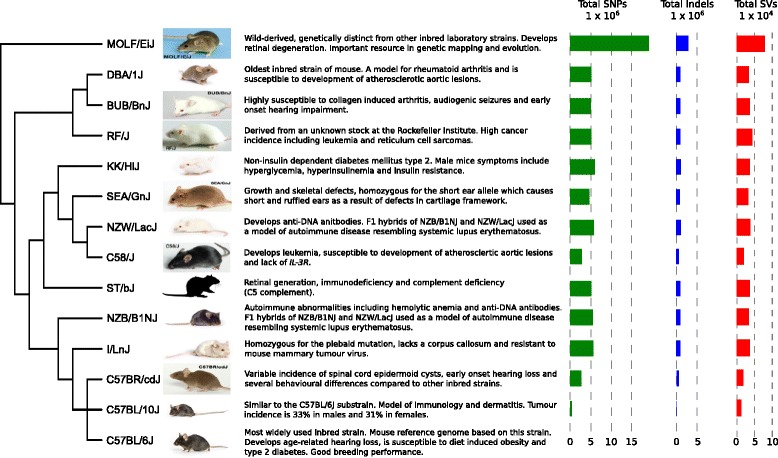
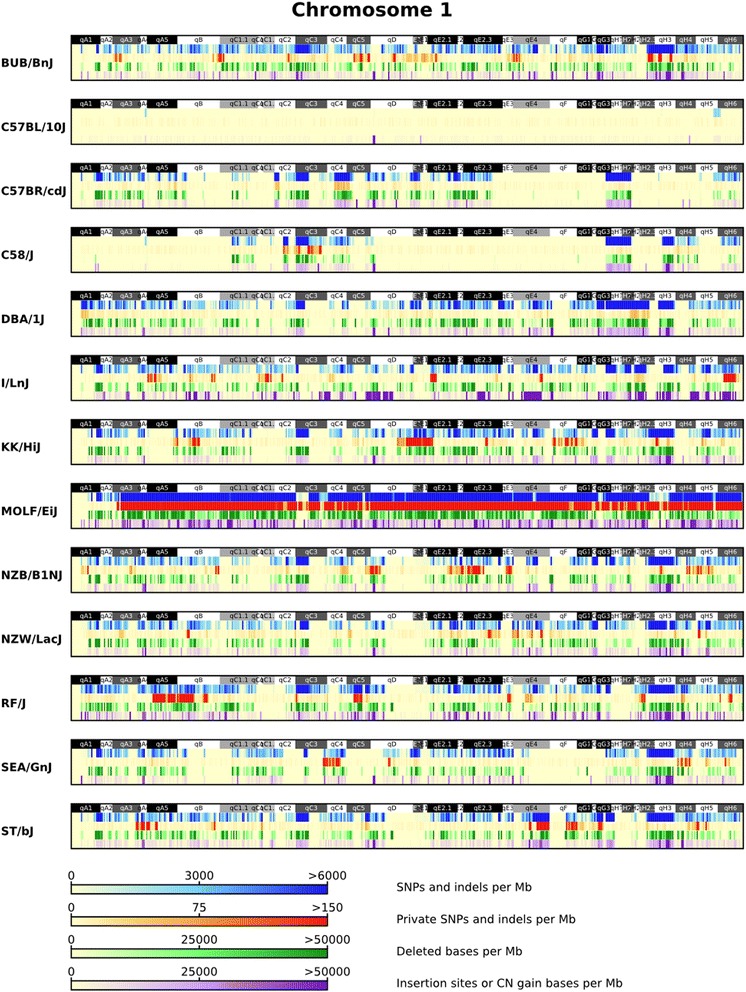
BACKGROUND: The Mouse Genomes Project is an ongoing collaborative effort to sequence the genomes of the common laboratory mouse strains. In 2011, the initial analysis of sequence variation across 17 strains found 56.7 M unique single nucleotide polymorphisms (SNPs) and 8.8 M indels. We carry out deep sequencing of 13 additional inbred strains (BUB/BnJ, C57BL/10J, C57BR/cdJ, C58/J, DBA/1J, I/LnJ, KK/HiJ, MOLF/EiJ, NZB/B1NJ, NZW/LacJ, RF/J, SEA/GnJ and ST/bJ), cataloguing molecular variation within and across the strains. These strains include important models for immune response, leukaemia, age-related hearing loss and rheumatoid arthritis. We now have several examples of fully sequenced closely related strains that are divergent for several disease phenotypes. RESULTS: Approximately 27.4 M unique SNPs and 5 M indels are identified across these strains compared to the C57BL/6 J reference genome (GRCm38). The amount of variation found in the inbred laboratory mouse genome has increased to 71 M SNPs and 12 M indels. We investigate the genetic basis of highly penetrant cancer susceptibility in RF/J finding private novel missense mutations in DNA damage repair and highly cancer associated genes. We use two highly related strains (DBA/1J and DBA/2J) to investigate the genetic basis of collagen-induced arthritis susceptibility. CONCLUSIONS: This paper significantly expands the catalogue of fully sequenced laboratory mouse strains and now contains several examples of highly genetically similar strains with divergent phenotypes. We show how studying private missense mutations can lead to insights into the genetic mechanism for a highly penetrant phenotype.
Overview
The claims and statistics of this paper haven’t been checked yet.
Free: it reads the open-access text and checks the first 5 claims that cite a source we can check. Create a free account to check every claim.
Integrity signals
Registry
Cites
Statistics
Figures
Verification
Claims the paper makes
The claims and statistics of this paper haven’t been checked yet.
Free: it reads the open-access text and checks the first 5 claims that cite a source we can check. Create a free account to check every claim.
Claims other papers make about this one
Each is checked against this paper’s own text: does it say what the citing paper says it does?
The cited source doesn’t support the claim as written.
In the citing paper
“We also attempted SNP-based demultiplexing of in silico–pooled data from DBA/1J mice (Shinozaki et al, 2022) which have ∼5 × 10⁶ total SNPs and indels (Doran et al, 2016).”
From Evaluation of genetic demultiplexing of single-cell sequencing data from model species (2023) · cites this paper as Doran et al, 2016
Checked by a reasoning model — may be wrong.
Experimental — accuracy not yet measuredThe source backs part of the claim, not all of it — or backs it for a different population, condition or comparison.
In the citing paper
“Until now, most gene expression studies of different mouse strains have used the BL6 reference genome despite millions of known genetic variations between strains.14,15”
From High-quality mouse reference genomes reveal the structural complexity of the murine protein-coding landscape (2026) · cites this paper as [14]
Experimental — accuracy not yet measuredThe source backs part of the claim, not all of it — or backs it for a different population, condition or comparison.
In the citing paper
“C57BL/6 mice are nearly genetically identical with only ∼15,000 SNPs and insertion–deletion mutations (indels) (Doran et al, 2016), providing evidence that SNP-based demuxers are unable to separate biological replicates from highly inbred mice.”
From Evaluation of genetic demultiplexing of single-cell sequencing data from model species (2023) · cites this paper as Doran et al, 2016
Experimental — accuracy not yet measuredThe cited source says what the claim attributes to it.
In the citing paper
“Compared to previous de novo mouse strain genomes and variation catalogs,14,15,18 these long-read genome assemblies show significant improvement in the most complex regions, such as MHC, defensin, T cell receptor (TCR), and Ly49 loci.”
From High-quality mouse reference genomes reveal the structural complexity of the murine protein-coding landscape (2026) · cites this paper as [14]
Self-check
Percentages, sums and reported differences re-computed from the paper’s own numbers.
The self-check needs the paper’s full text.
Citations
Cites
The Sequence Alignment/Map format and SAMtools
Li, H., Handsaker, B., Wysoker, A., Fennell, T., Ruan, J., Homer, N., Marth, G., Abecasis, G., Durbin, R., & 1000 Genome Project Data Processing Subgroup (2009) · Bioinformatics · doi:10.1093/bioinformatics/btp352 · Cited by 62,041
KEGG: Kyoto Encyclopedia of Genes and Genomes
Kanehisa, M. (2000) · Nucleic Acids Research · doi:10.1093/nar/28.1.27 · Cited by 37,077 · cited 7×
“In fact, the most significantly over-represented REACTOME and KEGG pathways were “Degradation of the extracellular matrix” (p=0.0049) and “ECM-receptor interaction” (p=0.013) respectively.”
MethodInfluentialKEGG: Kyoto Encyclopedia of Genes and Genomes
Ogata, H., Goto, S., Sato, K., Fujibuchi, W., Bono, H., & Kanehisa, M. (1999) · Nucleic Acids Research · doi:10.1093/nar/27.1.29 · Cited by 31,232
The Genome Analysis Toolkit: A MapReduce framework for analyzing next-generation DNA sequencing data
McKenna, A., Hanna, M., Banks, E., Sivachenko, A., Cibulskis, K., Kernytsky, A., Garimella, K., Altshuler, D., Gabriel, S., Daly, M., et al. (2010) · Genome Research · doi:10.1101/gr.107524.110 · Cited by 27,895
A global reference for human genetic variation
The 1000 Genomes Project Consortium, authors, C., Auton, A., Abecasis, G. R., Steering committee, Altshuler, D. M., Durbin, R. M., Abecasis, G. R., Bentley, D. R., Chakravarti, A., et al. (2015) · Nature · doi:10.1038/nature15393 · Cited by 18,247
The variant call format and VCFtools
Danecek, P., Auton, A., Abecasis, G., Albers, C. A., Banks, E., DePristo, M. A., Handsaker, R. E., Lunter, G., Marth, G. T., Sherry, S. T., et al. (2011) · Bioinformatics · doi:10.1093/bioinformatics/btr330 · Cited by 16,200
Robinson, J. T., Thorvaldsdóttir, H., Winckler, W., Guttman, M., Lander, E. S., Getz, G., & Mesirov, J. P. (2011) · Nature Biotechnology · doi:10.1038/nbt.1754 · Cited by 15,390 · cited 1×
“Upon visual inspection of these deletions using the alignment data and the integrative genomics viewer [42], eight were identified as real differences between the strains.”
MethodInitial sequencing and comparative analysis of the mouse genome
Mouse Genome Sequencing Consortium (2002) · Nature · doi:10.1038/nature01262 · Cited by 7,187 · cited 1×
“The first draft version of the mouse reference genome was produced based on a whole genome shotgun sequencing strategy of a female C57BL/6J strain mouse [4] followed several years later by the finished genome sequence [5].”
MethodSIFT: predicting amino acid changes that affect protein function
Ng, P. C. (2003) · Nucleic Acids Research · doi:10.1093/nar/gkg509 · Cited by 6,577
Kumar, P., Henikoff, S., & Ng, P. C. (2009) · Nature Protocols · doi:10.1038/nprot.2009.86 · Cited by 6,521
Aligning sequence reads, clone sequences and assembly contigs with BWA-MEM
Li, H. (2013) · DROPS (Schloss Dagstuhl – Leibniz Center for Informatics) · doi:10.48550/arxiv.1303.3997 · Cited by 5,159
Aligning sequence reads, clone sequences and assembly con*gs with BWA-MEM
Li, H. (2014) · arXiv (Cornell University) · doi:10.6084/m9.figshare.963153.v1 · Cited by 4,932
The Extracellular Matrix: Not Just Pretty Fibrils
Hynes, R. O. (2009) · Science · doi:10.1126/science.1176009 · Cited by 3,527 · cited 1×
“The ECM is a fundamental component of the cellular microenvironment, composed of a complex mix of structural and functional molecules [67].”
BackgroundAmino Acid Difference Formula to Help Explain Protein Evolution
Grantham, R. (1974) · Science · doi:10.1126/science.185.4154.862 · Cited by 2,363
Extracellular Matrix Degradation and Remodeling in Development and Disease
Lu, P., Takai, K., Weaver, V. M., & Werb, Z. (2011) · Cold Spring Harbor Perspectives in Biology · doi:10.1101/cshperspect.a005058 · Cited by 2,265 · cited 1×
“In addition, components of the ECM are in continual contact with epithelial cells and mediate signalling of processes involved in regulation of cell proliferation, apoptosis and differentiation [69].”
Background(2015) · doi:10.1093/bioinformatics/btv710 · Cited by 2,234
A conditional knockout resource for the genome-wide study of mouse gene function
Skarnes, W. C., Rosen, B., West, A. P., Koutsourakis, M., Bushell, W., Iyer, V., Mujica, A. O., Thomas, M., Harrow, J., Cox, T., et al. (2011) · Nature · doi:10.1038/nature10163 · Cited by 1,708 · cited 1×
“many new genetic screens [6], the creation of null alleles for the majority of genes [7], and accelerated the discov-”
BackgroundDeriving the consequences of genomic variants with the Ensembl API and SNP Effect Predictor
McLaren, W., Pritchard, B., Rios, D., Chen, Y., Flicek, P., & Cunningham, F. (2010) · Bioinformatics · doi:10.1093/bioinformatics/btq330 · Cited by 1,586
Mouse genomic variation and its effect on phenotypes and gene regulation.
Keane, T. M., Goodstadt, L., Danecek, P., White, M. A., Wong, K., Yalcin, B., Heger, A., Agam, A., Slater, G., Goodson, M., et al. (2011) · Nature · doi:10.1038/nature10413 · Cited by 1,580 · cited 2×
“variation and produce full chromosome sequences of each strain [9].”
BackgroundSelf-citationCox, T. R., & Erler, J. T. (2011) · Disease Models & Mechanisms · doi:10.1242/dmm.004077 · Cited by 1,569
LUMPY: a probabilistic framework for structural variant discovery
Layer, R. M., Chiang, C., Quinlan, A. R., & Hall, I. M. (2014) · Genome Biology · doi:10.1186/gb-2014-15-6-r84 · Cited by 1,554
Extracellular Matrix Assembly: A Multiscale Deconstruction
Mouw, J. K., Ou, G., & Weaver, V. M. (2014) · Nature Reviews Molecular Cell Biology · doi:10.1038/nrm3902 · Cited by 1,534 · cited 1×
“The ECM has important roles in a diverse set of functions including cellular development, tissue differentiation, growth and tissue homeostasis [68].”
BackgroundBreakDancer: an algorithm for high-resolution mapping of genomic structural variation
Chen, K., Wallis, J. W., McLellan, M. D., Larson, D. E., Kalicki, J. M., Pohl, C. S., McGrath, S. D., Wendl, M. C., Zhang, Q., Locke, D. P., et al. (2009) · Nature Methods · doi:10.1038/nmeth.1363 · Cited by 1,479
Brand, D. D., Latham, K. A., & Rosloniec, E. F. (2007) · Nature Protocols · doi:10.1038/nprot.2007.173 · Cited by 1,418
Reactome: a knowledgebase of biological pathways
Joshi-Tope, G. (2004) · Nucleic Acids Research · doi:10.1093/nar/gki072 · Cited by 1,290
InnateDB: systems biology of innate immunity and beyond—recent updates and continuing curation
Breuer, K., Foroushani, A. K., Laird, M. R., Chen, C., Sribnaia, A., Lo, R., Winsor, G. L., Hancock, R. E. W., Brinkman, F. S. L., & Lynn, D. J. (2013) · Nucleic Acids Research · doi:10.1093/nar/gks1147 · Cited by 1,259
Breast-Cancer Risk in Families with Mutations in PALB2
Antoniou, A. C., Casadei, S., Heikkinen, T., Barrowdale, D., Pylkäs, K., Roberts, J., Lee, A., Subramanian, D., De Leeneer, K., Fostira, F., et al. (2014) · New England Journal of Medicine · doi:10.1056/nejmoa1400382 · Cited by 851
Retinal degeneration mutants in the mouse
Chang, B., Hawes, N. L., Hurd, R. E., Davisson, M. T., Nusinowitz, S., & Heckenlively, J. R. (2002) · Vision Research · doi:10.1016/s0042-6989(01)00146-8 · Cited by 840 · cited 3×
“Each of the remaining strains also exhibit several notable phenotypes; BUB/BnJ are homozygous for the Mass1 allele, which is responsible for early onset (3–4 weeks of age) hearing impairment [17]; a high proportion of I/LnJ mice display agenesis of the corpus callosum which is associated with developmental delays and…”
BackgroundGenealogies of mouse inbred strains
Beck, J. A., Lloyd, S., Hafezparast, M., Lennon-Pierce, M., Eppig, J. T., Festing, M. F. W., & Fisher, E. M. C. (2000) · Nature Genetics · doi:10.1038/71641 · Cited by 823
Hereditary Diffuse Gastric Cancer Syndrome: CDH1 Mutations and Beyond
Hansford, S., Kaurah, P., Li-Chang, H., Woo, M., Senz, J., Pinheiro, H., Schrader, K. A., Schaeffer, D. F., Shumansky, K., Zogopoulos, G., et al. (2015) · JAMA Oncology · doi:10.1001/jamaoncol.2014.168 · Cited by 694
Pittler, S. J., & Baehr, W. (1991) · Proceedings of the National Academy of Sciences · doi:10.1073/pnas.88.19.8322 · Cited by 564
Deficient DNA mismatch repair: a common etiologic factor for colon cancer
Peltomaki, P. (2001) · Human Molecular Genetics · doi:10.1093/hmg/10.7.735 · Cited by 505
Lineage-Specific Biology Revealed by a Finished Genome Assembly of the Mouse
Church, D. M., Goodstadt, L., Hillier, L. W., Zody, M. C., Goldstein, S., She, X., Bult, C. J., Agarwala, R., Cherry, J. L., DiCuccio, M., et al. (2009) · PLoS Biology · doi:10.1371/journal.pbio.1000112 · Cited by 503
Kingsley, D. M., Bland, A. E., Grubber, J. M., Marker, P. C., Russell, L. B., Copeland, N. G., & Jenkins, N. A. (1992) · Cell · doi:10.1016/0092-8674(92)90510-j · Cited by 482
Apoptosis pathways in cancer and cancer therapy
Debatin, K.-M. (2004) · Cancer Immunology, Immunotherapy · doi:10.1007/s00262-003-0474-8 · Cited by 476
A sequence-based variation map of 8.27 million SNPs in inbred mouse strains
Frazer, K. A., Eskin, E., Kang, H. M., Bogue, M. A., Hinds, D. A., Beilharz, E. J., Gupta, R. V., Montgomery, J., Morenzoni, M. M., Nilsen, G. B., et al. (2007) · Nature · doi:10.1038/nature06067 · Cited by 429
Interleukin-10 Receptor Signaling through the JAK-STAT Pathway
Riley, J. K., Takeda, K., Akira, S., & Schreiber, R. D. (1999) · Journal of Biological Chemistry · doi:10.1074/jbc.274.23.16513 · Cited by 398
Long-read sequence assembly of the gorilla genome
Gordon, D., Huddleston, J., Chaisson, M. J. P., Hill, C. M., Kronenberg, Z. N., Munson, K. M., Malig, M., Raja, A., Fiddes, I., Hillier, L. W., et al. (2016) · Science · doi:10.1126/science.aae0344 · Cited by 333 · cited 1×
“A recent study found that more accurate structural variation calls can be derived from long read technologies compared to those produced by short read detection methods [87], therefore we expect that future releases of variants on these strains will be even more accurate.”
BackgroundRichards, F. M., McKee, S. A., Rajpar, M. H., Cole, T. R. P., Evans, D. G. R., Jankowski, J. A., McKeown, C., Sanders, D. S. A., & Maher, E. R. (1999) · Human Molecular Genetics · doi:10.1093/hmg/8.4.607 · Cited by 328
Care, R. S., Valk, P. J. M., Goodeve, A. C., Abu‐Duhier, F. M., Geertsma‐Kleinekoort, W. M. C., Wilson, G. A., Gari, M. A., Peake, I. R., Löwenberg, B., & Reilly, J. T. (2003) · British Journal of Haematology · doi:10.1046/j.1365-2141.2003.04362.x · Cited by 323
Sequence-based characterization of structural variation in the mouse genome
Yalcin, B., Wong, K., Agam, A., Goodson, M., Keane, T. M., Gan, X., Nellåker, C., Goodstadt, L., Nicod, J., Bhomra, A., et al. (2011) · Nature · doi:10.1038/nature10432 · Cited by 301 · cited 2×
“25% for insertions, which are comparable to estimates previously published for MGP strains [40,41].”
ResultSelf-citationDEFICIENCY OF THE FIFTH COMPONENT OF COMPLEMENT IN MICE WITH AN INHERITED COMPLEMENT DEFECT
Nilsson, U. R., & Müller-Eberhard, H. J. (1967) · The Journal of Experimental Medicine · doi:10.1084/jem.125.1.1 · Cited by 277
Paul, L. K. (2011) · Journal of Neurodevelopmental Disorders · doi:10.1007/s11689-010-9059-y · Cited by 260
Leukemia and preleukemia in Fanconi anemia patients
Auerbach, A. D., & Allen, R. G. (1991) · Cancer Genetics and Cytogenetics · doi:10.1016/0165-4608(91)90002-c · Cited by 257
IL-10R Polymorphisms Are Associated with Very-early-onset Ulcerative Colitis
Moran, C. J., Walters, T. D., Guo, C.-H., Kugathasan, S., Klein, C., Turner, D., Wolters, V. M., Bandsma, R. H., Mouzaki, M., Zachos, M., et al. (2013) · Inflammatory Bowel Diseases · doi:10.1002/ibd.22974 · Cited by 244
Accurate de novo and transmitted indel detection in exome-capture data using microassembly
Narzisi, G., O'Rawe, J. A., Iossifov, I., Fang, H., Lee, Y.-H., Wang, Z., Wu, Y., Lyon, G. J., Wigler, M., & Schatz, M. C. (2014) · Nature Methods · doi:10.1038/nmeth.3069 · Cited by 216
Pathway-specific differences between tumor cell lines and normal and tumor tissue cells
Ertel, A., Verghese, A., Byers, S. W., Ochs, M., & Tozeren, A. (2006) · Molecular Cancer · doi:10.1186/1476-4598-5-55 · Cited by 212
Functional FAS promoter polymorphisms are associated with increased risk of acute myeloid leukemia.
Sibley, K., Rollinson, S. J., Allan, J. M., Smith, A. G., Law, G. R., Roddam, P. L., Skibola, C. F., Smith, M. T., & Morgan, G. J. (2003) · PubMed · Cited by 202
Identification of germline genetic mutations in patients with pancreatic cancer
Salo‐Mullen, E. E., O'Reilly, E. M., Kelsen, D. P., Ashraf, A. M., Lowery, M. A., Yu, K. H., Reidy, D. L., Epstein, A. S., Lincoln, A., Saldia, A., et al. (2015) · Cancer · doi:10.1002/cncr.29664 · Cited by 198
PALB2/FANCN: Recombining Cancer and Fanconi Anemia
Tischkowitz, M., & Xia, B. (2010) · Cancer Research · doi:10.1158/0008-5472.can-10-1012 · Cited by 198
Deficiency of the murine fifth complement component (C5). A 2-base pair gene deletion in a 5'-exon.
Wetsel, R. A., Fleischer, D. T., & Haviland, D. L. (1990) · Journal of Biological Chemistry · doi:10.1016/s0021-9258(19)39817-5 · Cited by 197
RetroSeq: transposable element discovery from next-generation sequencing data
Keane, T. M., Wong, K., & Adams, D. J. (2013) · Bioinformatics · doi:10.1093/bioinformatics/bts697 · Cited by 193
Self-citationGenetic background effects on age-related hearing loss associated with Cdh23 variants in mice
Kane, K. L., Longo-Guess, C. M., Gagnon, L. H., Ding, D., Salvi, R. J., & Johnson, K. R. (2012) · Hearing Research · doi:10.1016/j.heares.2011.11.007 · Cited by 181
Tsumaki, N., Nakase, T., Miyaji, T., Kakiuchi, M., Kimura, T., Ochi, T., & Yoshikawa, H. (2002) · Journal of Bone and Mineral Research · doi:10.1359/jbmr.2002.17.5.898 · Cited by 177
Svenson, K. L., Von Smith, R., Magnani, P. A., Suetin, H. R., Paigen, B., Naggert, J. K., Li, R., Churchill, G. A., & Peters, L. L. (2007) · Journal of Applied Physiology · doi:10.1152/japplphysiol.01077.2006 · Cited by 173
Tools for targeted manipulation of the mouse genome
van der Weyden, L., Adams, D. J., & Bradley, A. (2002) · Physiological Genomics · doi:10.1152/physiolgenomics.00074.2002 · Cited by 168
Self-citationExperimental Studies on Lymphomatosis of Mice
Fürth, J., Seibold, H. R., & Rathbone, R. R. (1933) · American Journal of Cancer · doi:10.1158/ajc.1933.521 · Cited by 144
An imprinted rheumatoid arthritis methylome signature reflects pathogenic phenotype
Whitaker, J. W., Shoemaker, R., Boyle, D. L., Hillman, J., Anderson, D. W., Wang, W., & Firestein, G. S. (2013) · Genome Medicine · doi:10.1186/gm444 · Cited by 129
Lilue, J., Müller, U. B., Steinfeldt, T., & Howard, J. C. (2013) · eLife · doi:10.7554/elife.01298 · Cited by 109 · cited 1×
“However, in wild-derived strains many loci are composed of novel alleles and divergent haplotypes from the current reference genome [88].”
BackgroundCollagen-induced arthritis is exacerbated in IL-10-deficient mice
Finnegan, A., Kaplan, C. D., Cao, Y., Eibel, H., Glant, T. T., & Zhang, J. (2002) · Arthritis Research & Therapy · doi:10.1186/ar601 · Cited by 105
ADAM15 Supports Prostate Cancer Metastasis by Modulating Tumor Cell–Endothelial Cell Interaction
Najy, A. J., Day, K. C., & Day, M. L. (2008) · Cancer Research · doi:10.1158/0008-5472.can-07-2432 · Cited by 105
PERSSON, S., MIKULOWSKA, A., NARULA, S., O'GARRA, A., & HOLMDAHL, R. (1996) · Scandinavian Journal of Immunology · doi:10.1046/j.1365-3083.1996.d01-355.x · Cited by 103
Fine mapping in 94 inbred mouse strains using a high-density haplotype resource
Kirby, A., Kang, H. M., Wade, C. M., Cotsapas, C., Kostem, E., Han, B., Furlotte, N., Kang, E. Y., Rivas, M., Bogue, M. A., et al. (2010) · Genetics · doi:10.1534/genetics.110.115014 · Cited by 102
Paigen, K. (2003) · Genetics · doi:10.1093/genetics/163.4.1227 · Cited by 98
Deficiency of complement component 5 ameliorates glaucoma in DBA/2J mice
Howell, G. R., Soto, I., Ryan, M., Graham, L. C., Smith, R. S., & John, S. W. (2013) · Journal of Neuroinflammation · doi:10.1186/1742-2094-10-76 · Cited by 96
Hegan, D. C., Narayanan, L., Jirik, F. R., Edelmann, W., Liskay, R. M., & Glazer, P. M. (2006) · Carcinogenesis · doi:10.1093/carcin/bgl079 · Cited by 94
Effects of nicotine on avoidance conditioning of inbred strains of mice
Bovet, D., Bovet-Nitti, F., & Oliverio, A. (1966) · Psychopharmacology · doi:10.1007/bf00401895 · Cited by 88
The Mouse Genomes Project: a repository of inbred laboratory mouse strain genomes
Adams, D. J., Doran, A., Lilue, J., & Keane, T. (2015) · Mammalian Genome · doi:10.1007/s00335-015-9579-6 · Cited by 86
Self-citationSequencing and characterization of the FVB/NJ mouse genome
Wong, K., Bumpstead, S., Van Der Weyden, L., Reinholdt, L. G., Wilming, L. G., Adams, D. J., & Keane, T. M. (2012) · Genome Biology · doi:10.1186/gb-2012-13-8-r72 · Cited by 76
Self-citationRheumatoid arthritis, a complex multifactorial disease: On the way toward individualized medicine
Glocker, M. O., Guthke, R., Kekow, J., & Thiesen, H.-J. (2006) · Medicinal Research Reviews · doi:10.1002/med.20045 · Cited by 75
Mechanism of the pleiotropic effects of the short‐ear mutant gene in the mouse
Green, M. C. (1968) · Journal of Experimental Zoology · doi:10.1002/jez.1401670202 · Cited by 73
Somatic mutations in the death domain of theFas (Apo-1/CD95) gene in gastric cancer
Park, W. S., Oh, R. R., Kim, Y. S., Park, J. Y., Lee, S. H., Shin, M. S., Kim, S. Y., Kim, P. J., Lee, H. K., Yoo, N. J., et al. (2001) · The Journal of Pathology · Cited by 73
Induction of Autoantibody Production Is Limited in Nonautoimmune Mice
Singh, R. R., Ebling, F. M., Albuquerque, D., Saxena, V., Kumar, V., Giannini, E. H., Marion, T. N., Finkelman, F. D., & Hahn, B. H. (2002) · The Journal of Immunology · doi:10.4049/jimmunol.169.1.587 · Cited by 71
Experimental Studies on the Genetics of Spontaneous Leukemia in Mice
Cole, R. K., & Fürth, J. (1941) · Cancer Research · Cited by 67
Integrative Omics Analysis of Rheumatoid Arthritis Identifies Non-Obvious Therapeutic Targets
Whitaker, J. W., Boyle, D. L., Bartók, B., Ball, S. T., Gay, S., Wang, W., & Firestein, G. S. (2015) · PLoS ONE · doi:10.1371/journal.pone.0124254 · Cited by 64
Johnson, K. R., Zheng, Q. Y., Weston, M. D., Ptáček, L. J., & Noben‐Trauth, K. (2005) · Genomics · doi:10.1016/j.ygeno.2005.02.006 · Cited by 62
Benachenhou, N., Guiral, S., Gorska‐Flipot, I., Labuda, D., & Sinnett, D. (1998) · International Journal of Cancer · doi:10.1002/(sici)1097-0215(19980717)77:2<173::aid-ijc1>3.0.co;2-n · Cited by 59
Inbred FVB/N Mice Are Mutant at the cp49/Bfsp2 Locus and Lack Beaded Filament Proteins in the Lens
Simirskii, V. N., Lee, R. S., Wawrousek, E. F., & Duncan, M. K. (2006) · Investigative Ophthalmology & Visual Science · doi:10.1167/iovs.06-0423 · Cited by 58
The fine-scale architecture of structural variants in 17 mouse genomes
Yalcin, B., Wong, K., Bhomra, A., Goodson, M., Keane, T. M., Adams, D. J., & Flint, J. (2012) · Genome Biology · doi:10.1186/gb-2012-13-3-r18 · Cited by 53
Self-citationIchihara, M., Hara, T., Takagi, M., Cho, L., Gorman, D. M., & Miyajima, A. (1995) · The EMBO Journal · doi:10.1002/j.1460-2075.1995.tb07075.x · Cited by 52
RNA-seq analysis of synovial fibroblasts brings new insights into rheumatoid arthritis
Heruth, D. P., Gibson, M., Grigoryev, D. N., Zhang, L. Q., & Ye, S. Q. (2012) · Cell & Bioscience · doi:10.1186/2045-3701-2-43 · Cited by 52
Copy number variant detection in inbred strains from short read sequence data
Simpson, J. T., McIntyre, R. E., Adams, D. J., & Durbin, R. (2010) · Bioinformatics · doi:10.1093/bioinformatics/btp693 · Cited by 51
Self-citationMyopathy and phosphorylase kinase deficiency caused by a mutation in thePHKA1 gene
Wuyts, W. A., Reyniers, E., Ceuterick, C., Storm, K., de Barsy, T., & Martin, J. (2005) · American Journal of Medical Genetics Part A · doi:10.1002/ajmg.a.30517 · Cited by 49
van Oers, J. M. M., Edwards, Y., Chahwan, R., Zhang, W., Smith, C., Pechuan, X., Schaetzlein, S., Jin, B., Wang, Y., Bergman, A., et al. (2014) · Oncogene · doi:10.1038/onc.2013.365 · Cited by 47
Benachenhou, N., Guiral, S., Gorska‐Flipot, I., Labuda, D., & Sinnett, D. (1999) · British Journal of Cancer · doi:10.1038/sj.bjc.6690162 · Cited by 46
Efficient gene-driven germ-line point mutagenesis of C57BL/6J mice
Michaud, E. J., Culiat, C. T., Klebig, M. L., Barker, P. E., Cain, K., Carpenter, D. J., Easter, L. L., Foster, C. M., Gardner, A. W., Guo, Z., et al. (2005) · BMC Genomics · doi:10.1186/1471-2164-6-164 · Cited by 39
The functional cancer map: A systems-level synopsis of genetic deregulation in cancer
Krupp, M., Maass, T., Marquardt, J. U., Staib, F., Bauer, T., König, R., Biesterfeld, S., Galle, P. R., Tresch, A., & Teufel, A. (2011) · BMC Medical Genomics · doi:10.1186/1755-8794-4-53 · Cited by 39
Mismatch Repair Gene MSH3 Polymorphism is Associated With the Risk of Sporadic Prostate Cancer
Hirata, H., Hinoda, Y., Kawamoto, K., Kikuno, N., Suehiro, Y., Okayama, N., Tanaka, Y., & Dahiya, R. (2008) · The Journal of Urology · doi:10.1016/j.juro.2008.01.009 · Cited by 34
Schneider, A., Davidson, J., Wüllrich, A., & Kilimann, M. W. (1993) · Nature Genetics · doi:10.1038/ng1293-381 · Cited by 29
Spontaneous Glomerulosclerosis in Aging Rf Mice
Gude, W. D., & Lupton, A. C. (1960) · Journal of Gerontology · doi:10.1093/geronj/15.4.373 · Cited by 29
Wu, M. K., Hyogo, H., Yadav, S. K., Novikoff, P. M., & Cohen, D. E. (2004) · Journal of Lipid Research · doi:10.1194/jlr.m400387-jlr200 · Cited by 27
Orimo, H., Nakajima, E., Yamamoto, M., Ikejima, M., Emi, M., & Shimada, T. (2000) · Journal of Human Genetics · doi:10.1007/s100380070031 · Cited by 26
Differences in DBA/1J and DBA/2J reveal lipid QTL genes
Stylianou, I. M., Langley, S. R., Walsh, K., Chen, Y., Revenu, C., & Paigen, B. J. (2008) · Journal of Lipid Research · doi:10.1194/jlr.m800244-jlr200 · Cited by 26
Villa‐Morales, M., Santos, J., & Fernández‐Piqueras, J. (2005) · Oncogene · doi:10.1038/sj.onc.1209234 · Cited by 25
Pan, H., Agate, D. S., King, B. L., Wu, M. K., Roderick, S. L., Leiter, E. H., & Cohen, D. E. (2006) · FEBS Letters · doi:10.1016/j.febslet.2006.09.066 · Cited by 23
Qi, Z., Wang, J., Sun, Z., Ma, F.-M., Zhang, Q.-R., Hirose, S., & Jiang, Y. (2005) · Immunogenetics · doi:10.1007/s00251-005-0036-7 · Cited by 21
IL10R1 loss-of-function alleles in rheumatoid arthritis and systemic lupus erythematosus.
Hermann, J., Gruber, S. G., Neufeld, J. B., Grundtner, P., Graninger, W. B., Graninger, W. B., Berghold, A., & Gasché, C. (2009) · Clinical and Experimental Rheumatology · Cited by 20
Kitahama, K., Valatx, J. L., & Jouvet, M. (1981) · Physiology & Behavior · doi:10.1016/0031-9384(81)90297-3 · Cited by 20
Animal model of human disease: myelogenous leukemia in the RF mouse.
Wolman, S. R., McMorrow, L. E., & Cohen, M. W. (1982) · PubMed Central · Cited by 19
Donate, P. B., Fornari, T. A., Junta, C. M., Magalhães, D. A., Macedo, C., Cunha, T. M., Nguyen, C., Cunha, F. Q., & Passos, G. A. S. (2010) · Immunobiology · doi:10.1016/j.imbio.2010.09.007 · Cited by 16
Wu, M. K., & Cohen, D. E. (2005) · American Journal of Physiology-Gastrointestinal and Liver Physiology · doi:10.1152/ajpgi.00107.2005 · Cited by 10
The DBA/1 Strain Is a Novel Mouse Model for Experimental Borrelia burgdorferi Infection
Campfield, B. T., Nolder, C. L., Davis, A. W., Hirsch, R., & Nowalk, A. J. (2012) · Clinical and Vaccine Immunology · doi:10.1128/cvi.00251-12 · Cited by 5
Cited by
Comparative transcriptomics in human and mouse
Breschi, A., Gingeras, T. R., & Guigó, R. (2017) · Nature Reviews Genetics · doi:10.1038/nrg.2017.19 · Cited by 360
Park, H., Oh, J., Shim, G., Cho, B., Chang, Y., Kim, S., Baek, S., Kim, H., Shin, J., Choi, H., et al. (2019) · Nature Neuroscience · doi:10.1038/s41593-019-0352-0 · Cited by 272
Lilue, J., Doran, A. G., Fiddes, I. T., Abrudan, M., Armstrong, J., Bennett, R., Chow, W., Collins, J., Collins, S., Czechanski, A., et al. (2018) · Nature Genetics · doi:10.1038/s41588-018-0223-8 · Cited by 267
Self-citationGenomes of the Mouse Collaborative Cross
Srivastava, A., Morgan, A. P., Najarian, M. L., Sarsani, V. K., Sigmon, J. S., Shorter, J. R., Kashfeen, A., McMullan, R. C., Williams, L. H., Giusti-Rodríguez, P., et al. (2017) · Genetics · doi:10.1534/genetics.116.198838 · Cited by 201
“2012; Doran et al.”
BackgroundInfluentialVan Cauwenbergh, O., Di Serafino, A., Tytgat, J., & Soubry, A. (2020) · Clinical Epigenetics · doi:10.1186/s13148-020-00845-1 · Cited by 163
“For instance, some SNPs—as well as deletions and insertions—are unique to one specific strain, called “private SNPs” or “private deletions/insertions,” respectively [103].”
Background
Metadata
- Authors
- Doran, A. G., Wong, K., Flint, J., Adams, D. J., Hunter, K. W., & Keane, T. M.
- Affiliations
- Wellcome Sanger Institute (GB)
- National Cancer Institute (US)
- Corresponding author
- Hunter, Kent W.
- Venue
- Genome Biology
- Published
- 2016-08-01
- Volume
- 17
- Issue
- 1
- Pages
- 167-167
- ISSN
- 1465-6906 (ISSN-L)
- 1474-760X
- PMC
- PMC4968449
- OpenAlex
- W2953218747
- Semantic Scholar
- d9f571c389f18658c08d793e0af8fc7524224174
- Cited by
- 101
- References
- 101
- Citations by year
- 2026: 6 · 2025: 11 · 2024: 12 · 2023: 9 · 2022: 5 · 2021: 12 · 2020: 12 · 2019: 17 · 2018: 7 · 2017: 8 · 2016: 2
- FWCI
- 5.89
- Type
- journal article
- Language
- en
- Open access
- gold
- doi.org
- Licence
- cc-by
- creativecommons.org/licenses/by/4.0/ (tdm)
- creativecommons.org/licenses/by/4.0/ (vor)
- Locations
- Genome biology (publishedVersion, cc-by)
- bioRxiv (Cold Spring Harbor Laboratory) (acceptedVersion, cc-by)
- PubMed Central (publishedVersion, cc-by)
- PubMed (publishedVersion)
- Funders
- Wellcome Trust
- Biotechnology and Biological Sciences Research Council (BB/M000281/1)
- Medical Research Council (MR/L007428/1)
- National Cancer Institute
- Topics
- Life Sciences › Biochemistry, Genetics and Molecular Biology › Molecular Biology › Genomics and Phylogenetic Studies
- Life Sciences › Biochemistry, Genetics and Molecular Biology › Genetics › Genetic and phenotypic traits in livestock
- Life Sciences › Biochemistry, Genetics and Molecular Biology › Genetics › Genetic Mapping and Diversity in Plants and Animals
- Keywords
- inbred mouse strains, single nucleotide polymorphisms, indels, private mutations, homozygous truncating mutation, DBA/2J, collagen-induced arthritis, cancer susceptibility, DNA repair genes
- MeSH terms
- Alleles, Animals, Base Sequence, Chromosome Mapping, DNA Damage, DNA Repair, Homozygote, Mice, Inbred Strains, Genome, Mutation, Missense, Polymorphism, Single Nucleotide, Mice, INDEL Mutation, High-Throughput Nucleotide Sequencing
About these checks
Registry, retraction, Cites and statistics results are computed, not judged, with one exception: a printed reference that no index lists is read once by a model before it counts as a citation error. Claims are extracted by a model and kept only when their quote appears verbatim in the text; each cited source is then checked, with a model’s help, for whether it says what the claim relies on. Those verdicts can be wrong — read the claim’s quote and the cited source before relying on one.
Statistics and arithmetic are recomputed, not judged.
Confidence bands are shown only for fields calibrated on our annotated test set. None is calibrated yet, so no band is shown.
What counts as a claim ›How we measure confidence ›How we check this ›
Are you an author, or do you see a problem with this page? Request a review
Data sources
Bibliographic data: Semantic Scholar, OpenAlex, Crossref.
Contains information from the Semantic Scholar Academic Graph Datasets, made available under the ODC Attribution License (ODC-BY 1.0).
Semantic Scholar’s data is described in: Kinney, R., et al. (2023). The Semantic Scholar Open Data Platform. arXiv:2301.10140.
