

SCANPY: large-scale single-cell gene expression data analysis
Open accessPublished version of a preprint
The DOI matches its Crossref record; 54 of the 56 references it cites were found in a registry or an index.
Abstract
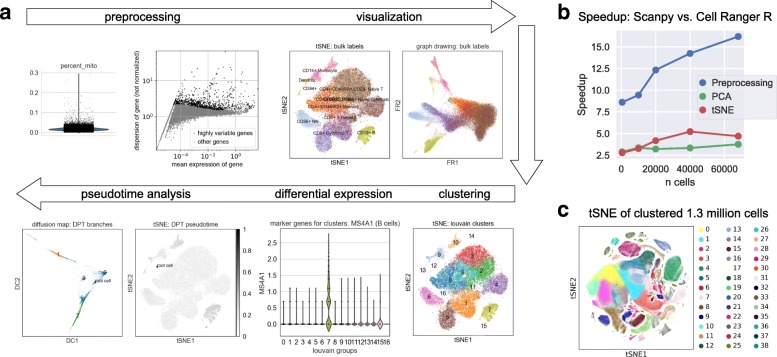
SCANPY is a scalable toolkit for analyzing single-cell gene expression data. It includes methods for preprocessing, visualization, clustering, pseudotime and trajectory inference, differential expression testing, and simulation of gene regulatory networks. Its Python-based implementation efficiently deals with data sets of more than one million cells ( https://github.com/theislab/Scanpy ). Along with SCANPY, we present ANNDATA, a generic class for handling annotated data matrices ( https://github.com/theislab/anndata ).
Overview
The claims and statistics of this paper haven’t been checked yet.
Free: it reads the open-access text and checks the first 5 claims that cite a source we can check. Create a free account to check every claim.
Integrity signals
Registry
Cites
Statistics
Figures
Verification
Claims the paper makes
The claims and statistics of this paper haven’t been checked yet.
Free: it reads the open-access text and checks the first 5 claims that cite a source we can check. Create a free account to check every claim.
Claims other papers make about this one
Each is checked against this paper’s own text: does it say what the citing paper says it does?
The source backs part of the claim, not all of it — or backs it for a different population, condition or comparison.
In the citing paper
“the most widely used analysis packages in the field currently employ DE methods prone to false discoveries by default 35 , 36 .”
From Confronting false discoveries in single-cell differential expression (2021) · cites this paper as [36]
Experimental — accuracy not yet measuredThe cited source says what the claim attributes to it.
In the citing paper
“Currently available platforms exist on the command line in R (McCarthy et al, 2017; Butler et al, 2018) or Python (Wolf et al, 2018), and as local applications (Patel, 2018; preprint: Scholz et al, 2018) or Web servers (Gardeux et al, 2017; Zhu et al, 2017) with graphical user interfaces (GUIs).”
From Current best practices in single-cell RNA-seq analysis: a tutorial (2019) · cites this paper as Wolf et al, 2018
The cited source says what the claim attributes to it.
In the citing paper
“To ensure that our benchmark is not affected by DE calculation, we also selected the top 20 DE genes using Wilcoxon test (tl.rank_genes_groups(method = ’wilcoxon’)).”
From Benchmarking foundation cell models for post-perturbation RNA-seq prediction (2025) · cites this paper as [30]
The cited source says what the claim attributes to it.
In the citing paper
“To filter extremely low-quality or damaged cells, we kept cells with over 200 genes expressed (i.e., expression vector with non-zero value count > 200) for pre-training by using the Seurat 61 and Scanpy 62 packages.”
From Large-scale foundation model on single-cell transcriptomics (2024) · cites this paper as [61]
In the citing paper
“We also identified other known iron regulators for which knockdown increased iron levels, including FBXL5, a negative regulator of iron levels57, the Fe/S cluster biogenesis genes NFU1 and NUBPL, and MCOLN1, which encodes an endolysosomal iron release channel58 (Fig. 2f).”
From Genome-wide CRISPRi/a screens in human neurons link lysosomal failure to ferroptosis (2021) · cites this paper as [58]
2 more claims about this paper
Create a free account to see every claim other papers make about this one.
Self-check
Percentages, sums and reported differences re-computed from the paper’s own numbers.
The self-check needs the paper’s full text.
Citations
Cites
LeCun, Y., Bengio, Y., & Hinton, G. (2015) · Nature · doi:10.1038/nature14539 · Cited by 84,126
Scikit-learn: Machine Learning in Python
Pedregosa, F., Varoquaux, G., Gramfort, A., Michel, V., Thirion, B., Grisel, O., Blondel, M., Müller, A., Nothman, J., Louppe, G., et al. (2012) · arXiv · doi:10.48550/arxiv.1201.0490 · Cited by 71,016 · cited 2×
“Parts of the toolkit rely on SCIKIT - LEARN [27], STATSMODELS [38], S EABORN [39], N ETWORK X [28], IGRAPH [14], the T SNE package of [40], and the Louvain clustering package of [41].”
BackgroundMethodMatplotlib: a 2D graphics environment
Hunter, J. D. (2007) · Computing in Science & Engineering · doi:10.1109/mcse.2007.55 · Cited by 39,249 · cited 1×
“S CANPY ’s core relies on N UMPY [33], S CIPY [34], M AT - PLOTLIB [35], P ANDAS [36], and H 5 PY [37].”
BackgroundFast unfolding of communities in large networks
Blondel, V. D., Guillaume, J.-L., Lambiotte, R., & Lefebvre, E. (2008) · Journal of Statistical Mechanics: Theory and Experiment · doi:10.1088/1742-5468/2008/10/p10008 · Cited by 21,424
Trapnell, C., Roberts, A., Goff, L., Pertea, G., Kim, D., Kelley, D. R., Pimentel, H., Salzberg, S. L., Rinn, J. L., & Pachter, L. (2012) · Nature Protocols · doi:10.1038/nprot.2012.016 · Cited by 12,116
Gephi: An Open Source Software for Exploring and Manipulating Networks
Bastian, M., Heymann, S., & Jacomy, M. (2009) · Proceedings of the International AAAI Conference on Web and Social Media · doi:10.1609/icwsm.v3i1.13937 · Cited by 11,675 · cited 1×
“Moreover, the class provides several functions to compute random-walk-based metrics that are not available in other graph software [14, 28, 29].”
BackgroundData Structures for Statistical Computing in Python
McKinney, W. (2010) · Proceedings of the Python in Science Conference · doi:10.25080/majora-92bf1922-00a · Cited by 11,032 · cited 1×
“SCANPY’s technological foundations SCANPY’s core relies on NUMPY [33], SCIPY [34], MATPLOTLIB [35], PANDAS [36], and H5PY [37].”
MethodThe NumPy Array: A Structure for Efficient Numerical Computation
van der Walt, S., Colbert, S. C., & Varoquaux, G. (2011) · Computing in Science & Engineering · doi:10.1109/mcse.2011.37 · Cited by 9,381 · cited 1×
“S CANPY ’s core relies on N UMPY [33], S CIPY [34], M AT - PLOTLIB [35], P ANDAS [36], and H 5 PY [37].”
BackgroundExploring Network Structure, Dynamics, and Function Using NetworkX
Hagberg, A. A., Schult, D. A., & Swart, P. J. (2008) · Proceedings of the Python in Science Conference · doi:10.25080/tcwv9851 · Cited by 7,477 · cited 2×
“Moreover, the class provides several functions to compute randomwalk-based metrics that are not available in other graph software [14, 28, 29].”
BackgroundMethodMassively parallel digital transcriptional profiling of single cells
Zheng, G. X. Y., Terry, J. M., Belgrader, P., Ryvkin, P., Bent, Z. W., Wilson, R., Ziraldo, S. B., Wheeler, T. D., McDermott, G. P., Zhu, J., et al. (2017) · Nature Communications · doi:10.1038/ncomms14049 · Cited by 7,353 · cited 6×
“Benchmarking against the more run-time optimized C ELL R ANGER R kit [6], we demonstrate a speedup of 5 to 16 times for a data set of 68,579 PBMCs (Fig.”
Influential
Research works printed but not linked: 2
- Collette A Python and HDF5 2013 Sebasto pol O’Reilly
- Matthews de, G, Alexander G, et al.GPflow: a Gaussian process library using TensorFlow. J Mach Learn Res. 2017; 18:1–6. https://github.com/SheffieldML/GPy.
Cited by
Items 901–1,000 of 1,178
Improving stem cell-derived pancreatic islets using single-cell multiome-inferred regulomes
Zhu, H., Wang, G., Nguyen-Ngoc, K.-V., Kim, D., Miller, M., Goss, G., Kovsky, J., Harrington, A. R., Saunders, D., Melton, R., et al. (2022) · doi:10.1101/2022.09.25.509355 · Cited by 85
Welch, G. M., Boix, C. A., Schmauch, E., Davila-Velderrain, J., Victor, M. B., Dileep, V., Bozzelli, P. L., Su, Q., Cheng, J. D., Lee, A., et al. (2022) · Science Advances · doi:10.1126/sciadv.abo4662 · Cited by 84
Mosaic integration and knowledge transfer of single-cell multimodal data with MIDAS
He, Z., Hu, S., Chen, Y., An, S., Zhou, J., Liu, R., Shi, J., Wang, J., Dong, G., Shi, J., et al. (2024) · Nature Biotechnology · doi:10.1038/s41587-023-02040-y · Cited by 84
Retinoic acid signaling is critical during the totipotency window in early mammalian development
Iturbide, A., Segura, M. L. R. T., Noll, C., Schorpp, K., Rothenaigner, I., Ruiz-Morales, E. R., Lubatti, G., Agami, A., Hadian, K., Scialdone, A., et al. (2021) · Nature Structural & Molecular Biology · doi:10.1038/s41594-021-00590-w · Cited by 89
MITI minimum information guidelines for highly multiplexed tissue images
Schapiro, D., Yapp, C., Sokolov, A., Reynolds, S. M., Chen, Y.-A., Sudar, D., Xie, Y., Muhlich, J. L., Arias-Camison, R., Arena, S., et al. (2022) · Nature Methods · doi:10.1038/s41592-022-01415-4 · Cited by 88
High-throughput and high-dimensional single-cell analysis of antigen-specific CD8+ T cells
Ma, K.-Y., Schonnesen, A. A., He, C., Xia, A. Y., Sun, E., Chen, E., Sebastian, K., Guo, Y., BALDERAS, R. S., Kulkarni-Date, M. N., et al. (2021) · Nature Immunology · doi:10.1038/s41590-021-01073-2 · Cited by 95
Khabirova, E., Jardine, L., Coorens, T. H. H., Webb, S., Treger, T. D., Engelbert, J., Porter, T., Prigmore, E., Collord, G., Piapi, A., et al. (2022) · Nature Medicine · doi:10.1038/s41591-022-01720-7 · Cited by 98
Li, L., Krasnykov, K., Homolka, D., Gos, P., Mendel, M., Fish, R. J., Pandey, R. R., & Pillai, R. S. (2022) · Molecular Cell · doi:10.1016/j.molcel.2022.02.034 · Cited by 93
Petitpré, C., Faure, L., Uhl, P., Fontanet, P., Filová, I., Pavlínková, G., Adameyko, I. I., Hadjab, S., & Lallemend, F. (2022) · Nature Communications · doi:10.1038/s41467-022-31580-1 · Cited by 93
Cockburn, K., Annusver, K., Gonzalez, D. G., Ganesan, S., May, D. P., Mesa, K. R., Kawaguchi, K., Kasper, M., & Greco, V. (2022) · Nature Cell Biology · doi:10.1038/s41556-022-01021-8 · Cited by 84
Suo, C., Polański, K., Dann, E., Lindeboom, R. G. H., Vilarrasa‐Blasi, R., Vento‐Tormo, R., Haniffa, M. A., Meyer, K. B., Dratva, L. M., Tuong, Z. K., et al. (2023) · Nature Biotechnology · doi:10.1038/s41587-023-01734-7 · Cited by 96
“Single-cell AIR software are often designed to interact with a companion single-cell gene expression software, for example, scirpy 13 with scanpy 14 and scRepertoire 15 with Seurat 16 , providing valuable analysis and visualization options.”
Disentanglement of single-cell data with biolord
Piran, Z., Cohen, N., Hoshen, Y., & Nitzan, M. (2024) · Nature Biotechnology · doi:10.1038/s41587-023-02079-x · Cited by 75
Spatially clustered type I interferon responses at injury borderzones
Ninh, V. K., Calcagno, D. M., Yu, J. D., Zhang, B., Taghdiri, N., Sehgal, R., Mesfin, J. M., Chen, C. J., Kalhor, K., Toomu, A., et al. (2024) · Nature · doi:10.1038/s41586-024-07806-1 · Cited by 97
“Data analysis of RNA MERFISH data was performed with single-cell sequencing analysis tools such as Scanpy and Squidpy 53,54 .”
Demaree, B., Delley, C. L., Vasudevan, H. N., Peretz, C. A. C., Ruff, D., Smith, C. C., & Abate, A. R. (2021) · Nature Communications · doi:10.1038/s41467-021-21810-3 · Cited by 83
Single‐cell molecular profiling provides a high‐resolution map of basophil and mast cell development
Hamey, F., Lau, W. W. Y., Kuciński, I., Wang, X., Diamanti, E., Wilson, N. K., Göttgens, B., & Dahlin, J. S. (2020) · Allergy · doi:10.1111/all.14633 · Cited by 94
Parkinson's disease motor symptoms rescue by CRISPRa‐reprogramming astrocytes into GABAergic neurons
Giehrl‐Schwab, J., Giesert, F., Rauser, B., Lao, C. L., Hembach, S., Lefort, S., Ibarra, I. L., Koupourtidou, C., Luecken, M. D., Truong, D. J., et al. (2022) · EMBO Molecular Medicine · doi:10.15252/emmm.202114797 · Cited by 91
“Nor-malization and log transformation was performed using the counts per million (CPM) strategy with a target count depth of 10,000 using SCANPY’s (Wolf et al , 2018) normalize_total and log1p functions.”
MethodSelf-citationFurtwängler, B., Üresin, N., Motamedchaboki, K., Huguet, R., López‐Ferrer, D., Zabrouskov, V., Porse, B. T., & Schoof, E. M. (2022) · Molecular & Cellular Proteomics · doi:10.1016/j.mcpro.2022.100219 · Cited by 90
Wu, W., Chia, T., Lu, J., Li, X., Guan, J., Li, Y., Fu, F., Zhou, S., Feng, Y., Deng, J., et al. (2023) · Nature Cancer · doi:10.1038/s43018-023-00612-0 · Cited by 94
Liu, Z., Yang, J., Long, Y., Zhang, C., Wang, D., Zhang, X., Dong, W., Zhao, L., Liu, C., Zhai, J., et al. (2023) · Nature Plants · doi:10.1038/s41477-023-01524-8 · Cited by 93
McLean, B. A., Wong, C. K., Kabir, M. G., & Drucker, D. J. (2022) · Molecular Metabolism · doi:10.1016/j.molmet.2022.101641 · Cited by 82
A prebiotic diet modulates microglial states and motor deficits in α-synuclein overexpressing mice
Abdel-Haq, R., Schlachetzki, J. C., Boktor, J. C., Cantu-Jungles, T. M., Thron, T., Zhang, M., Bostick, J. W., Khazaei, T., Chilakala, S., Morais, L. H., et al. (2022) · eLife · doi:10.7554/elife.81453 · Cited by 82
“Data analysis steps including Leiden clustering, differential gene expression analysis, and plotting of marker genes were performed using the Scanpy package (Wolf, Angerer, and Theis 2018).”
MethodSanborn, M. A., Wang, X., Gao, S., Dai, Y., & Rehman, J. (2025) · Nature Communications · doi:10.1038/s41467-025-57047-7 · Cited by 82
“We developed SenePy , a lightweight and fast scoring algorithm speci fi c for our gene sets that borrows from Seurat ’ s AddModuleScore() and Scanpy ’ s tl.score_genes().”
Hong, R., Koga, Y., Bandyadka, S., Leshchyk, A., Wang, Y., Akavoor, V., Cao, X., Sarfraz, I., Wang, Z., Alabdullatif, S., et al. (2022) · Nature Communications · doi:10.1038/s41467-022-29212-9 · Cited by 82
“The exportSCE-toAnnData() function exports the data into a Python annotated data matrix ( AnnData ) 28 object.”
MethodCerebro: interactive visualization of scRNA-seq data
Hillje, R., Pelicci, P. G., & Luzi, L. (2019) · Bioinformatics · doi:10.1093/bioinformatics/btz877 · Cited by 90
“While cerebroPrepare currently only supports to prepare Seurat objects for visualization in Cerebro, export methods for object types of other popular scRNA-seq analysis frameworks, such as SingleCellExperiment or AnnData (used by scanpy [12]) can be added in the future.”
MethodZeng, Y., Zhou, X., Rao, J., Lu, Y., & Yang, Y. (2020) · IEEE International Conference on Bioinformatics and Biomedicine (BIBM) · doi:10.1109/bibm49941.2020.9313569 · Cited by 93
“To be more specific, scRNA-seq data often contains substantial noise and dropout events, which may be caused by biological and experimentally technical factors, such as cell cycle effects [8], amplification bias, and the low RNA capture rate [9].”
BackgroundCrosse, E. I., Gordon-Keylock, S., Rybtsov, S., Binagui-Casas, A., Felchle, H., Nnadi, N. C., Kirschner, K., Chandra, T., Tamagno, S., Webb, D. J., et al. (2020) · Cell Stem Cell · doi:10.1016/j.stem.2020.08.004 · Cited by 82
“SCANPY (Wolf et al., 2018) was used for the follow steps 1 – 15.”
MethodSomatic mutations and single-cell transcriptomes reveal the root of malignant rhabdoid tumours
Custers, L., Khabirova, E., Coorens, T. H. H., Oliver, T. R. W., Calandrini, C., Young, M. D., Braga, F. A. V., Ellis, P., Mamanova, L., Segers, H., et al. (2021) · Nature Communications · doi:10.1038/s41467-021-21675-6 · Cited by 88
Bao, X., Li, Q., Chen, J., Chen, D., Ye, C., Dai, X., Wang, Y., Li, X., Rong, X., Cheng, F., et al. (2022) · Cancer Immunology Research · doi:10.1158/2326-6066.cir-21-1101 · Cited by 80
A dietary change to a high-fat diet initiates a rapid adaptation of the intestine
Enriquez, J. R., McCauley, H. A., Zhang, K. X., Sanchez, J. G., Kalin, G. T., Lang, R. A., & Wells, J. M. (2022) · Cell Reports · doi:10.1016/j.celrep.2022.111641 · Cited by 87
Engineered cell entry links receptor biology with single-cell genomics
Yu, B., Shi, Q., Belk, J. A., Yost, K. E., Parker, K. R., Li, R., Liu, B. B., Huang, H., Lingwood, D., Greenleaf, W. J., et al. (2022) · Cell · doi:10.1016/j.cell.2022.11.016 · Cited by 75
Barmada, A., Klein, J., Ramaswamy, A., Brodsky, N. N., Jaycox, J. R., Sheikha, H., Jones, K. M., Habet, V., Campbell, M., Sumida, T. S., et al. (2023) · Science Immunology · doi:10.1126/sciimmunol.adh3455 · Cited by 84
“Data processing was performed using the Scanpy toolkit (149) following published recommended standard practices.”
MethodKapellos, T. S., Bassler, K. E., Fujii, W., Nalkurthi, C., Schaar, A. C., Bonaguro, L., Pecht, T., Galvão, I., Agrawal, S., Saglam, A., et al. (2023) · Cell Reports · doi:10.1016/j.celrep.2023.112525 · Cited by 88
Self-citationSIMBA: single-cell embedding along with features
Chen, H., Ryu, J., Vinyard, M. E., Lerer, A., & Pinello, L. (2024) · Nature Methods · doi:10.1038/s41592-023-01899-8 · Cited by 84
Delineating mouse β-cell identity during lifetime and in diabetes with a single cell atlas
Hrovatin, K., Bastidas-Ponce, A., Bakhti, M., Zappia, L., Büttner, M., Salinno, C., Sterr, M., Böttcher, A., Migliorini, A., Lickert, H., et al. (2023) · Nature Metabolism · doi:10.1038/s42255-023-00876-x · Cited by 86
Self-citationSiGra: single-cell spatial elucidation through an image-augmented graph transformer
Tang, Z., Li, Z., Hou, T., Zhang, T., Yang, B., Su, J., & Song, Q. (2023) · Nature Communications · doi:10.1038/s41467-023-41437-w · Cited by 75
Precise identification of cell states altered in disease using healthy single-cell references
Dann, E., Cujba, A.-M., Oliver, A. J., Meyer, K. B., Teichmann, S. A., & Marioni, J. C. (2023) · Nature Genetics · doi:10.1038/s41588-023-01523-7 · Cited by 96
“( BST2 , CMPK2 , EIF2AK2 , EPSTI1 , HERC5 , IFI35 , IFI44L , IFI6 , IFIT3 , ISG15 , LY6E , MX1 , MX2 , OAS1 , OAS2 , PARP9 , PLSCR1 , SAMD9 , SAMD9L , SP110 , STAT1 , TRIM22 , UBE2L6 , XAF1 and IRF7 ), using the SCANPY function scanpy.tl.score_genes() to quantify signature expression for each cell.”
MethodInfluentialSplicing neoantigen discovery with SNAF reveals shared targets for cancer immunotherapy
Li, G., Mahajan, S., Ma, S., Jeffery, E. D., Zhang, X., Bhattacharjee, A., Venkatasubramanian, M., Weirauch, M. T., Miraldi, E. R., Grimes, H. L., et al. (2024) · Science Translational Medicine · doi:10.1126/scitranslmed.ade2886 · Cited by 85
(2023) · doi:10.1101/2023.08.30.555644 · Cited by 82
Multimodal single cell data integration challenge: results and lessons learned
Lance, C., Luecken, M. D., Burkhardt, D. B., Cannoodt, R., Rautenstrauch, P., Laddach, A., Ubingazhibov, A., Cao, Z.-J., Deng, K., Khan, S., et al. (2022) · doi:10.1101/2022.04.11.487796 · Cited by 81
Self-citationMeeting the Challenges of High-Dimensional Single-Cell Data Analysis in Immunology
Palit, S., Heuser-Loy, C., de Almeida, G. P., Theis, F. J., & Zielinski, C. E. (2019) · Frontiers in Immunology · doi:10.3389/fimmu.2019.01515 · Cited by 92
Self-citationIsoform cell-type specificity in the mouse primary motor cortex
Booeshaghi, A. S., Yao, Z., van Velthoven, C., Smith, K., Tasic, B., Zeng, H., & Pachter, L. (2021) · Nature · doi:10.1038/s41586-021-03969-3 · Cited by 84
Feature selection revisited in the single-cell era
Yang, P., Huang, H., & Liu, C. (2021) · Genome Biology · doi:10.1186/s13059-021-02544-3 · Cited by 83
“In contrast, Kawaguchi et al. [86] summarised scATAC-seq data to the gene level using SCANPY [87] and performed embedded feature selection using either logistic LASSO or random forests to identify DAGs [86].”
MethodHou, S., Li, Z., Dong, J., Gao, Y., Chang, Z., Ding, X., Li, S., Li, Y., Zeng, Y., Qian, X., et al. (2022) · Cell Research · doi:10.1038/s41422-022-00615-z · Cited by 84
“3).(76) The data were normalized using standard totalcount normalization and then taken log1p transformation as expression level.”
MethodSingle-cell transcriptomics of adult macaque hippocampus reveals neural precursor cell populations
Hao, Z.-Z., Wei, J.-R., Xiao, D., Liu, R., Xu, N., Tang, L., Huang, M., Shen, Y., Xing, C., Huang, W., et al. (2022) · Nature Neuroscience · doi:10.1038/s41593-022-01073-x · Cited by 89
Ke, M. S., Elshenawy, B., Sheldon, H., Arora, A., & Buffa, F. M. (2022) · BioEssays · doi:10.1002/bies.202200084 · Cited by 90
Anand, G. M., Megale, H. C., Murphy, S. H., Weis, T. A., Lin, Z., He, Y., Wang, X., Liu, J., & Ramanathan, S. (2023) · Cell · doi:10.1016/j.cell.2022.12.043 · Cited by 84
Batch alignment of single-cell transcriptomics data using deep metric learning
Yu, X., Xu, X., Zhang, J., & Li, X. (2023) · Nature Communications · doi:10.1038/s41467-023-36635-5 · Cited by 96
CD8+ lymphocytes are critical for early control of tuberculosis in macaques
Winchell, C. G., Nyquist, S. K., Chao, M. C., Maiello, P. A., Myers, A. J., Hopkins, F. F., Chase, M. R., Gideon, H. P., Patel, K. V., Bromley, J. D., et al. (2023) · The Journal of Experimental Medicine · doi:10.1084/jem.20230707 · Cited by 91
“Count matrices were combined and analyzed using Scanpy (version 1.7.2; Wolf et al., 2018).”
MethodInfluentialSeyfferth, C., Eekhout, T., Shi, D., Neumann, M., Berg, L. S., Ke, Y., Shahan, R., Cox, K. L., Gómez-Cano, F., Nelissen, H., et al. (2024) · The Plant Cell · doi:10.1093/plcell/koae003 · Cited by 92
“Processed data not only include the cell/ gene counts matrix at minimum but can also include more complex data objects such as those generated by the Seurat (R) (Hao et al. 2021) or AnnData (Python) (Wolf et al. 2018) packages.”
MethodSingle-cell omics: experimental workflow, data analyses and applications
Sun, F., Li, H., Sun, D., Fu, S., Gu, L., Shao, X., Wang, Q., Dong, X., Duan, B., Xing, F., et al. (2024) · Science China Life Sciences · doi:10.1007/s11427-023-2561-0 · Cited by 102
Spatial single-cell isotope tracing reveals heterogeneity of de novo fatty acid synthesis in cancer
Buglakova, E., Ekelöf, M., Schwaiger-Haber, M., Schlicker, L., Molenaar, M. R., Shahraz, M., Stuart, L., Eisenbarth, A., Hilsenstein, V., Patti, G. J., et al. (2024) · Nature Metabolism · doi:10.1038/s42255-024-01118-4 · Cited by 94
Semba, T., & Ishimoto, T. (2024) · British Journal of Cancer · doi:10.1038/s41416-024-02882-6 · Cited by 97
“These algorithms are widely implemented in software, such as Phenograph [76], Seurat [77], Scanpy [78], and Giotto [79].”
Adult skull bone marrow is an expanding and resilient haematopoietic reservoir
Koh, B. I., Mohanakrishnan, V., Jeong, H., Park, H., Kruse, K., Choi, Y. J., Nieminen-Kelhä, M., Kumar, R., Pereira, R. S., Adams, S., et al. (2024) · Nature · doi:10.1038/s41586-024-08163-9 · Cited by 98
Tzec-Interián, J. A., González‐Padilla, D., & Góngora‐Castillo, E. (2025) · Quantitative Biology · doi:10.1002/qub2.78 · Cited by 100
“The Louvain algorithm is the most widely used for scRNA ‐ seq data, but an improvement called Leiden [197] has recently been implemented in tools such as SCANPY [141] and Seurat [140], and it has been recommended to obtain ideal clustering for annotating cells [180, 184] (Table 2).”
Left–right-alternating theta sweeps in entorhinal–hippocampal maps of space
Vollan, A. Z., Gardner, R. J., Moser, M., & Moser, E. I. (2025) · Nature · doi:10.1038/s41586-024-08527-1 · Cited by 114
“Clustering analyses of grid-cell modules and bursting sub-types of grid cells were conducted using the python package Scanpy 87 and its dependencies (including numpy, pandas, scipy, scikit-learn and matplotlib).”
A suite of enhancer AAVs and transgenic mouse lines for genetic access to cortical cell types
Ben‐Simon, Y., Hooper, M. J., Narayan, S., Daigle, T. L., Dwivedi, D., Way, S. W., Oster, A., Stafford, D. A., Mich, J. K., Taormina, M. J., et al. (2025) · Cell · doi:10.1016/j.cell.2025.05.002 · Cited by 98
A cellular atlas of Pitx2-dependent cardiac development
Hill, M. C., Kadow, Z. A., Li, L., Tran, T. T., Wythe, J. D., & Martin, J. F. (2019) · Development · doi:10.1242/dev.180398 · Cited by 79
Self-assembling manifolds in single-cell RNA sequencing data
Tarashansky, A. J., Xue, Y., Li, P., Quake, S. R., & Wang, B. (2019) · eLife · doi:10.7554/elife.48994 · Cited by 87
Moudgil, A., Wilkinson, M., Chen, X., He, J., Cammack, A. J., Vasek, M. J., Lagunas, T., Qi, Z., Lalli, M. A., Guo, C., et al. (2020) · Cell · doi:10.1016/j.cell.2020.06.037 · Cited by 94
Profiling of immune dysfunction in COVID-19 patients allows early prediction of disease progression
Rendeiro, A. F., Casano, J., Vorkas, C. K., Singh, H. K., Morales, A. E., Desimone, R. A., Ellsworth, G. B., Soave, R., Kapadia, S. N., Saito, K., et al. (2020) · Life Science Alliance · doi:10.26508/lsa.202000955 · Cited by 88
“…representation for all cells, dimensionality reduction was performed with principal component analysis, a neighbor graph was computed using 15 neighbors per cell, UMAP (Becht et al, 2018) with default parameters, and Leiden clustering, all using the Scanpy package (Wolf et al, 2018) version 1.5.1.”
MethodInfluentialLópez, J. P., Brivio, E., Santambrogio, A., Donno, C. D., Kos, A., Peters, M., Rost, N., Czamara, D., Brückl, T. M., Roeh, S., et al. (2021) · Science Advances · doi:10.1126/sciadv.abe4497 · Cited by 97
Self-citationLima, A., Lubatti, G., Burgstaller, J. P., Hu, D., Green, A. P., Gregorio, A. D., Zawadzki, T., Pernaute, B., Mahammadov, E., Pérez-Montero, S., et al. (2021) · Nature Metabolism · doi:10.1038/s42255-021-00422-7 · Cited by 91
Lung emphysema and impaired macrophage elastase clearance in mucolipin 3 deficient mice
Spix, B., Butz, E. S., Chen, C., Rosato, A. S., Tang, R., Jeridi, A., Kudrina, V., Plesch, E., Wartenberg, P., Arlt, E., et al. (2022) · Nature Communications · doi:10.1038/s41467-021-27860-x · Cited by 88
A guidebook of spatial transcriptomic technologies, data resources and analysis approaches
Yue, L., Liu, F., Hu, J., Yang, P., Wang, Y., Dong, J., Shu, W., Huang, X., & Wang, S. (2023) · Computational and Structural Biotechnology Journal · doi:10.1016/j.csbj.2023.01.016 · Cited by 96
“Recently, some advanced methods of dimensionality reduction have also been proposed, such as Scanpy [153], STUtility [98], SpatialPCA [73], Spaniel [155], SpatialCPie [156], lisaClust [157] and Squidpy [183].”
MethodYaman, Y. I., Huang, R., & Ramanathan, S. (2022) · Cell · doi:10.1016/j.cell.2022.12.042 · Cited by 82
Wang, G., Zhao, J., Yan, Y., Wang, Y., Wu, A. R., & Yang, C. (2023) · Nature Machine Intelligence · doi:10.1038/s42256-023-00734-1 · Cited by 101
“48 and 49).”
MethodA time- and single-cell-resolved model of murine bone marrow hematopoiesis
Kuciński, I., Campos, J., Barile, M., Severi, F., Bohin, N., Moreira, P. N., Allen, L., Lawson, H., Haltalli, M. L. R., Kinston, S., et al. (2024) · Cell stem cell · doi:10.1016/j.stem.2023.12.001 · Cited by 93
Differentiation route determines the functional outputs of adult megakaryopoiesis
Li, J., Liu, J., Li, Y., Chen, L. V., Cheng, H., Li, Y., Cheng, T., Wang, Q., & Zhou, B. O. (2024) · Immunity · doi:10.1016/j.immuni.2024.02.006 · Cited by 91
Nederlof, I., Isaeva, O. I., de Graaf, M., Gielen, R., Bakker, N. A. M., Rolfes, A. L., Garner, H., Boeckx, B., Traets, J. J. H., Mandjes, I. A. M., et al. (2024) · Nature Medicine · doi:10.1038/s41591-024-03249-3 · Cited by 96
Chen, T., Oh, S., Gregory, S., Shen, X., & Diehl, A. M. (2020) · JCI Insight · doi:10.1172/jci.insight.141024 · Cited by 79
“Unsupervised clustering was performed using Scanpy (5) with an appropriate resolution and visualized in UMAP.”
MethodSpatiotemporally resolved transcriptomics reveals the subcellular RNA kinetic landscape
Ren, J., Zhou, H., Zeng, H., Wang, C. K., Huang, J., Qiu, X., Sui, X., Li, Q., Wu, X., Lin, Z., et al. (2023) · Nature Methods · doi:10.1038/s41592-023-01829-8 · Cited by 79
Ketamine exerts its sustained antidepressant effects via cell-type-specific regulation of Kcnq2
Lopez, J. P., Lücken, M. D., Brivio, E., Karamihalev, S., Kos, A., De Donno, C., Benjamin, A., Yang, H., Dick, A. L. W., Stoffel, R., et al. (2022) · Neuron · doi:10.1016/j.neuron.2022.05.001 · Cited by 79
“Data processing and analysis was done in scanpy (Wolf et al., 2018) (version 1.”
MethodSelf-citationChiara, L. D., Conte, C., Semeraro, R., Díaz-Bulnes, P., Angelotti, M. L., Mazzinghi, B., Molli, A., Antonelli, G., Landini, S., Melica, M. E., et al. (2022) · Nature Communications · doi:10.1038/s41467-022-33110-5 · Cited by 86
Biology-inspired data-driven quality control for scientific discovery in single-cell transcriptomics
Subramanian, A., Alperovich, M., Yang, Y., & Li, B. (2022) · Genome Biology · doi:10.1186/s13059-022-02820-w · Cited by 76
“Widely used pipelines [11, 12] by default set a flat filter on the QC criteria for each sample or sets of samples analyzed, agnostic of the dataset and biology under study.”
MethodYang, W., Wang, P., Xu, S., Wang, T., Luo, M., Cai, Y., Xu, C., Xue, G., Que, J., Ding, Q., et al. (2024) · Nature Communications · doi:10.1038/s41467-024-51329-2 · Cited by 104
“Initially, the standard Scanpy functions were used to preprocess the Visium data 48,73 (as shown in Methods), identifying 324 spots and 16,562 genes (Fig.”
TGF-β and RAS jointly unmask primed enhancers to drive metastasis
Lee, J. H., Rivera, F. J. S., He, L. Y., Basnet, H., Chen, F., Spina, E., Li, L., Torner, C., Chan, J. E., Yarlagadda, D. V. K., et al. (2024) · Cell · doi:10.1016/j.cell.2024.08.014 · Cited by 89
Roux, A. E., Zhang, C., Paw, J., Zavala-Solorio, J., Malahias, E., Vijay, T., Kolumam, G., Kenyon, C., & Kimmel, J. C. (2022) · Cell Systems · doi:10.1016/j.cels.2022.05.002 · Cited by 78
Cellular taxonomy and spatial organization of the murine ventral posterior hypothalamus
Mickelsen, L. E., Flynn, W. F., Springer, K., Wilson, L., Beltrami, E. J., Bolisetty, M., Robson, P., & Jackson, A. C. (2020) · eLife · doi:10.7554/elife.58901 · Cited by 80
“Downstream analysis was performed using Scanpy (v1.”
MethodInfluentialUpdates on Immunotherapy and Immune Landscape in Renal Clear Cell Carcinoma
Kim, M., Jin, Z., Kolb, R. H., Borcherding, N. C., Chatzkel, J. A., Falzarano, S. M., & Zhang, W. (2021) · Cancers · doi:10.3390/cancers13225856 · Cited by 88
Yasumizu, Y., Ohkura, N., Murata, H., Kinoshita, M., Funaki, S., Nojima, S., Kido, K., Kohara, M., Motooka, D., Okuzaki, D., et al. (2022) · Nature Communications · doi:10.1038/s41467-022-31951-8 · Cited by 92
Recent advances in the field of single-cell proteomics
Petrosius, V., & Schoof, E. M. (2022) · Translational Oncology · doi:10.1016/j.tranon.2022.101556 · Cited by 87
“Fortunately, the fields of scp-MS and scRNAseq are plagued by similar challenges and have complementary downstream analysis goals, with a plethora of successful implementations in the scRNAseq field [52, 79,93].”
BackgroundSingle cell sequencing reveals that CD39 inhibition mediates changes to the tumor microenvironment
Liu, L., Hou, Y., Deng, C., Tao, Z., Chen, Z., Hu, J., & Chen, K. (2022) · Nature Communications · doi:10.1038/s41467-022-34495-z · Cited by 84
Early human lung immune cell development and its role in epithelial cell fate
Barnes, J. L., Yoshida, M., He, P., Worlock, K. B., Lindeboom, R. G. H., Suo, C., Pett, J. P., Wilbrey-Clark, A., Dann, E., Mamanova, L., et al. (2023) · Science Immunology · doi:10.1126/sciimmunol.adf9988 · Cited by 81
Lee, C. Y. C., Kennedy, B. C., Richoz, N., Dean, I., Tuong, Z. K., Gaspal, F., Li, Z., Willis, C., Hasegawa, T., Whiteside, S. K., et al. (2024) · Nature Communications · doi:10.1038/s41467-024-44787-1 · Cited by 99
Claudio Quiros, A., Coudray, N., Yeaton, A., Yang, X., Liu, B., Le, H., Chiriboga, L., Karimkhan, A., Narula, N., Moore, D. A., et al. (2024) · Nature Communications · doi:10.1038/s41467-024-48666-7 · Cited by 71
Walter, L. D., Orton, J. L., Ntekas, I., Fong, E. H. H., Maymí, V. I., Rudd, B. D., Vlaminck, I. D., Elisseeff, J. H., & Cosgrove, B. D. (2024) · Nature Aging · doi:10.1038/s43587-024-00756-3 · Cited by 96
“9.3) 73 was used to load the spatial coordinates of each bead as provided by Curio Bioscience.”
InfluentialZhu, X., Hu, M., Huang, X., Li, L., Lin, X., Shao, X., Li, J., Du, X., Zhang, X., Sun, R., et al. (2025) · Cell Metabolism · doi:10.1016/j.cmet.2024.12.013 · Cited by 95
Ren, L., Liu, C., Çifcibaşı, K., Ballmann, M., Rammes, G., Reyes, C. M., Tokalov, S. V., Klingl, A., Grünert, J., Goyal, K., et al. (2025) · Cancer Cell · doi:10.1016/j.ccell.2025.09.003 · Cited by 95
Pertpy: an end-to-end framework for perturbation analysis
Heumos, L., Ji, Y., May, L. T., Green, T. D., Peidli, S., Zhang, X., Wu, X., Ostner, J., Schumacher, A., Hrovatin, K., et al. (2025) · Nature Methods · doi:10.1038/s41592-025-02909-7 · Cited by 112
“Although scanpy 34 is widely used for single-cell analysis, it lacks support for complex experimental designs that account successfully or not successfully perturbed.”
Self-citationLange, C. M., Rost, F., Machate, A., Reinhardt, S., Lesche, M., Weber, A., Kuscha, V., Dahl, A., Rulands, S., & Brand, M. (2020) · Development · doi:10.1242/dev.185595 · Cited by 90
Human Alzheimer’s disease reactive astrocytes exhibit a loss of homeostastic gene expression
Dai, D. L., Li, M., & Lee, E. B. (2023) · Acta Neuropathologica Communications · doi:10.1186/s40478-023-01624-8 · Cited by 77
“Feature plots of astrocyte nuclei colored by gene expression were generated using Scanpy’s [76] pl.umap function.”
MethodInfluentialImmunology in the Era of Single-Cell Technologies
Efremova, M., Vento-Tormo, R., Park, J.-E., Teichmann, S. A., & James, K. R. (2020) · Annual Review of Immunology · doi:10.1146/annurev-immunol-090419-020340 · Cited by 79
“Downstream analysis such as normalization and dimensionality reduction algorithms to determine the variability within the cells are now part of standard packages for scRNA-seq analysis (29, 30).”
MethodBurrows, N., Bashford-Rogers, R. J. M., Bhute, V. J., Peñalver, A., Ferdinand, J. R., Stewart, B. J., Smith, J. E. G., Deobagkar‐Lele, M., Giudice, G., Connor, T. M. F., et al. (2020) · Nature Immunology · doi:10.1038/s41590-020-0772-8 · Cited by 93
Single cell transcriptome research in human placenta
Li, H., Huang, Q., Liu, Y., & Garmire, L. X. (2020) · Reproduction · doi:10.1530/rep-20-0231 · Cited by 81
“2019), Python (Wolf et al. 2018) or as Web servers (Gardeux et al.”
Developmental and evolutionary dynamics of cis-regulatory elements in mouse cerebellar cells
Sarropoulos, I., Sepp, M., Frömel, R., Leiss, K., Trost, N., Leushkin, E. V., Okonechnikov, K., Joshi, P. K., Giere, P., Kutscher, L. M., et al. (2021) · Science · doi:10.1126/science.abg4696 · Cited by 89
Guo, J., Chen, D., Deng, S.-H., Huang, J.-R., Song, J., Li, X.-Y., Cui, B., & Liu, Y. (2021) · Cancer Immunology Immunotherapy · doi:10.1007/s00262-021-03076-2 · Cited by 85
A transcriptional rheostat couples past activity to future sensory responses
Tsukahara, T., Brann, D. H., Pashkovski, S. L., Guitchounts, G., Bozza, T. C., & Datta, S. R. (2021) · Cell · doi:10.1016/j.cell.2021.11.022 · Cited by 86
“8) using the Scanpy package (Wolf et al., 2018) as well as custom-written scripts using the open-source python scientific stack (pysam, SciPy, NumPy, scikit-learn, umap-learn, pandas, statsmodels, matplotlib, seaborn, Numba, Dask).”
MethodInfluentialMultiMAP: dimensionality reduction and integration of multimodal data
Jain, M. S., Polanski, K., Conde, C. D., Chen, X., Park, J., Mamanova, L., Knights, A., Botting, R. A., Stephenson, E., Haniffa, M., et al. (2021) · Genome Biology · doi:10.1186/s13059-021-02565-y · Cited by 77
Zhang, Z., Yang, C., & Zhang, X. (2022) · Genome biology · doi:10.1186/s13059-022-02706-x · Cited by 87
“For real datasets, we select first 500 or 1000 highly variable genes using SCANPY [46] and select the regions in scATAC-seq datasets that lie within the gene body or 2000 base-pairs upstream of the selected genes on the genome.”
MethodHijacking of transcriptional condensates by endogenous retroviruses
Asimi, V., Kumar, A. S., Niskanen, H., Riemenschneider, C., Hetzel, S., Naderi, J., Fasching, N., Popitsch, N. P., Du, M., Kretzmer, H., et al. (2022) · Nature Genetics · doi:10.1038/s41588-022-01132-w · Cited by 82
Metadata
- Authors
- Wolf, F. A., Angerer, P., & Theis, F. J.
- Affiliations
- Helmholtz Munich (DE)
- Corresponding author
- Wolf, F. Alexander
- Theis, Fabian J.
- Venue
- Genome Biology
- Published
- 2018-02-06
- Volume
- 19
- Issue
- 1
- Pages
- 15-15
- ISSN
- 1465-6906 (ISSN-L)
- 1474-760X
- PMC
- PMC5802054
- OpenAlex
- W2800392236
- Semantic Scholar
- 7e49aa718a7e5fea9784e5c04c1c853edec9e46a
- Cited by
- 8,881
- References
- 56
- Citations by year
- 2026: 1867 · 2025: 2017 · 2024: 1679 · 2023: 1112 · 2022: 862 · 2021: 706 · 2020: 448 · 2019: 152 · 2018: 36
- FWCI
- 122.03
- Type
- journal article
- Language
- en
- Open access
- gold
- doi.org
- Licence
- cc-by
- Locations
- Genome biology (publishedVersion, cc-by)
- bioRxiv (Cold Spring Harbor Laboratory) (acceptedVersion, cc-by-nd)
- PubMed Central (publishedVersion, cc-by)
- PubMed (publishedVersion)
- DOAJ (DOAJ: Directory of Open Access Journals) (submittedVersion, cc-by-sa)
- Site cant be reached (submittedVersion, cc-by)
- Funders
- Helmholtz-Gemeinschaft (Helmholtz Postdoc Grant)
- Topics
- Life Sciences › Biochemistry, Genetics and Molecular Biology › Molecular Biology › Single-cell and spatial transcriptomics
- Life Sciences › Biochemistry, Genetics and Molecular Biology › Molecular Biology › Gene Regulatory Network Analysis
- Life Sciences › Biochemistry, Genetics and Molecular Biology › Molecular Biology › Gene expression and cancer classification
- Keywords
- single-cell RNA sequencing, data preprocessing, clustering, pseudotime, single-cell trajectory analysis, differential gene expression, AnnData, Python
- MeSH terms
- Software, Gene Expression Profiling, Gene Regulatory Networks, Single-Cell Analysis
About these checks
Registry, retraction, Cites and statistics results are computed, not judged, with one exception: a printed reference that no index lists is read once by a model before it counts as a citation error. Claims are extracted by a model and kept only when their quote appears verbatim in the text; each cited source is then checked, with a model’s help, for whether it says what the claim relies on. Those verdicts can be wrong — read the claim’s quote and the cited source before relying on one.
Statistics and arithmetic are recomputed, not judged.
Confidence bands are shown only for fields calibrated on our annotated test set. None is calibrated yet, so no band is shown.
What counts as a claim ›How we measure confidence ›How we check this ›
Are you an author, or do you see a problem with this page? Request a review
Data sources
Bibliographic data: Semantic Scholar, OpenAlex, Crossref.
Contains information from the Semantic Scholar Academic Graph Datasets, made available under the ODC Attribution License (ODC-BY 1.0).
Semantic Scholar’s data is described in: Kinney, R., et al. (2023). The Semantic Scholar Open Data Platform. arXiv:2301.10140.
