

SCANPY: large-scale single-cell gene expression data analysis
Open accessPublished version of a preprint
The DOI matches its Crossref record; 54 of the 56 references it cites were found in a registry or an index.
Abstract
SCANPY is a scalable toolkit for analyzing single-cell gene expression data. It includes methods for preprocessing, visualization, clustering, pseudotime and trajectory inference, differential expression testing, and simulation of gene regulatory networks. Its Python-based implementation efficiently deals with data sets of more than one million cells ( https://github.com/theislab/Scanpy ). Along with SCANPY, we present ANNDATA, a generic class for handling annotated data matrices ( https://github.com/theislab/anndata ).
Overview
The claims and statistics of this paper haven’t been checked yet.
Free: it reads the open-access text and checks the first 5 claims that cite a source we can check. Create a free account to check every claim.
Integrity signals
Registry
Cites
Statistics
Figures
Verification
Claims the paper makes
The claims and statistics of this paper haven’t been checked yet.
Free: it reads the open-access text and checks the first 5 claims that cite a source we can check. Create a free account to check every claim.
Claims other papers make about this one
Each is checked against this paper’s own text: does it say what the citing paper says it does?
The source backs part of the claim, not all of it — or backs it for a different population, condition or comparison.
In the citing paper
“the most widely used analysis packages in the field currently employ DE methods prone to false discoveries by default 35 , 36 .”
From Confronting false discoveries in single-cell differential expression (2021) · cites this paper as [36]
Experimental — accuracy not yet measuredThe cited source says what the claim attributes to it.
In the citing paper
“Currently available platforms exist on the command line in R (McCarthy et al, 2017; Butler et al, 2018) or Python (Wolf et al, 2018), and as local applications (Patel, 2018; preprint: Scholz et al, 2018) or Web servers (Gardeux et al, 2017; Zhu et al, 2017) with graphical user interfaces (GUIs).”
From Current best practices in single-cell RNA-seq analysis: a tutorial (2019) · cites this paper as Wolf et al, 2018
The cited source says what the claim attributes to it.
In the citing paper
“To ensure that our benchmark is not affected by DE calculation, we also selected the top 20 DE genes using Wilcoxon test (tl.rank_genes_groups(method = ’wilcoxon’)).”
From Benchmarking foundation cell models for post-perturbation RNA-seq prediction (2025) · cites this paper as [30]
The cited source says what the claim attributes to it.
In the citing paper
“To filter extremely low-quality or damaged cells, we kept cells with over 200 genes expressed (i.e., expression vector with non-zero value count > 200) for pre-training by using the Seurat 61 and Scanpy 62 packages.”
From Large-scale foundation model on single-cell transcriptomics (2024) · cites this paper as [61]
In the citing paper
“We also identified other known iron regulators for which knockdown increased iron levels, including FBXL5, a negative regulator of iron levels57, the Fe/S cluster biogenesis genes NFU1 and NUBPL, and MCOLN1, which encodes an endolysosomal iron release channel58 (Fig. 2f).”
From Genome-wide CRISPRi/a screens in human neurons link lysosomal failure to ferroptosis (2021) · cites this paper as [58]
2 more claims about this paper
Create a free account to see every claim other papers make about this one.
Self-check
Percentages, sums and reported differences re-computed from the paper’s own numbers.
The self-check needs the paper’s full text.
Citations
Cites
LeCun, Y., Bengio, Y., & Hinton, G. (2015) · Nature · doi:10.1038/nature14539 · Cited by 84,126
Scikit-learn: Machine Learning in Python
Pedregosa, F., Varoquaux, G., Gramfort, A., Michel, V., Thirion, B., Grisel, O., Blondel, M., Müller, A., Nothman, J., Louppe, G., et al. (2012) · arXiv · doi:10.48550/arxiv.1201.0490 · Cited by 71,016 · cited 2×
“Parts of the toolkit rely on SCIKIT - LEARN [27], STATSMODELS [38], S EABORN [39], N ETWORK X [28], IGRAPH [14], the T SNE package of [40], and the Louvain clustering package of [41].”
BackgroundMethodMatplotlib: a 2D graphics environment
Hunter, J. D. (2007) · Computing in Science & Engineering · doi:10.1109/mcse.2007.55 · Cited by 39,249 · cited 1×
“S CANPY ’s core relies on N UMPY [33], S CIPY [34], M AT - PLOTLIB [35], P ANDAS [36], and H 5 PY [37].”
BackgroundFast unfolding of communities in large networks
Blondel, V. D., Guillaume, J.-L., Lambiotte, R., & Lefebvre, E. (2008) · Journal of Statistical Mechanics: Theory and Experiment · doi:10.1088/1742-5468/2008/10/p10008 · Cited by 21,424
Trapnell, C., Roberts, A., Goff, L., Pertea, G., Kim, D., Kelley, D. R., Pimentel, H., Salzberg, S. L., Rinn, J. L., & Pachter, L. (2012) · Nature Protocols · doi:10.1038/nprot.2012.016 · Cited by 12,116
Gephi: An Open Source Software for Exploring and Manipulating Networks
Bastian, M., Heymann, S., & Jacomy, M. (2009) · Proceedings of the International AAAI Conference on Web and Social Media · doi:10.1609/icwsm.v3i1.13937 · Cited by 11,675 · cited 1×
“Moreover, the class provides several functions to compute random-walk-based metrics that are not available in other graph software [14, 28, 29].”
BackgroundData Structures for Statistical Computing in Python
McKinney, W. (2010) · Proceedings of the Python in Science Conference · doi:10.25080/majora-92bf1922-00a · Cited by 11,032 · cited 1×
“SCANPY’s technological foundations SCANPY’s core relies on NUMPY [33], SCIPY [34], MATPLOTLIB [35], PANDAS [36], and H5PY [37].”
MethodThe NumPy Array: A Structure for Efficient Numerical Computation
van der Walt, S., Colbert, S. C., & Varoquaux, G. (2011) · Computing in Science & Engineering · doi:10.1109/mcse.2011.37 · Cited by 9,381 · cited 1×
“S CANPY ’s core relies on N UMPY [33], S CIPY [34], M AT - PLOTLIB [35], P ANDAS [36], and H 5 PY [37].”
BackgroundExploring Network Structure, Dynamics, and Function Using NetworkX
Hagberg, A. A., Schult, D. A., & Swart, P. J. (2008) · Proceedings of the Python in Science Conference · doi:10.25080/tcwv9851 · Cited by 7,477 · cited 2×
“Moreover, the class provides several functions to compute randomwalk-based metrics that are not available in other graph software [14, 28, 29].”
BackgroundMethodMassively parallel digital transcriptional profiling of single cells
Zheng, G. X. Y., Terry, J. M., Belgrader, P., Ryvkin, P., Bent, Z. W., Wilson, R., Ziraldo, S. B., Wheeler, T. D., McDermott, G. P., Zhu, J., et al. (2017) · Nature Communications · doi:10.1038/ncomms14049 · Cited by 7,353 · cited 6×
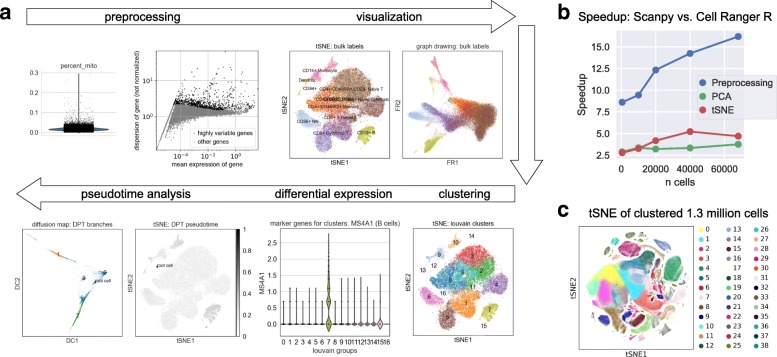
“Benchmarking against the more run-time optimized C ELL R ANGER R kit [6], we demonstrate a speedup of 5 to 16 times for a data set of 68,579 PBMCs (Fig.”
Influential
Research works printed but not linked: 2
- Collette A Python and HDF5 2013 Sebasto pol O’Reilly
- Matthews de, G, Alexander G, et al.GPflow: a Gaussian process library using TensorFlow. J Mach Learn Res. 2017; 18:1–6. https://github.com/SheffieldML/GPy.
Cited by
Items 1,101–1,178 of 1,178
XenoCell: classification of cellular barcodes in single cell experiments from xenograft samples
Cheloni, S., Hillje, R., Luzi, L., Pelicci, P. G., & Gatti, E. (2021) · BMC Medical Genomics · doi:10.1186/s12920-021-00872-8 · Cited by 28
“The final output of XenoCell consists of filtered, paired FASTQ files which are ready to be analysed by any standard bioinformatic pipeline for single-cell analysis, such as Cell Ranger (Zheng, 2017) as well as custom workflows, e.g. based on STAR (Dobin, 2013), Seurat (Satija, 2013) and Scanpy (Wolf, 2018).”
MethodA Complete Workflow for High Throughput Human Single Skeletal Muscle Fiber Proteomics
(2023) · doi:10.1021/jasms.3c00072 · Cited by 28
Complete Workflow for High Throughput Human Single Skeletal Muscle Fiber Proteomics
Momenzadeh, A., Jiang, Y., Kreimer, S., Teigen, L. E., Zepeda, C. S., Haghani, A., Mastali, M., Song, Y., Hutton, A., Parker, S. J., et al. (2023) · doi:10.1101/2023.02.23.529600 · Cited by 28
Plattner, C., Lamberti, G., Blattmann, P., Kirchmair, A., Rieder, D., Loncova, Z., Sturm, G., Scheidl, S., Ijsselsteijn, M., Fotakis, G., et al. (2023) · iScience · doi:10.1016/j.isci.2023.108399 · Cited by 27
Ma, C., Chitra, U., Zhang, S., & Raphael, B. J. (2022) · Cell Systems · doi:10.1016/j.cels.2022.09.002 · Cited by 27
Shared enhancer gene regulatory networks between wound and oncogenic programs
Floc'hlay, S., Balaji, R., Stanković, D., Christiaens, V. M., Bravo González-Blas, C., De Winter, S., Hulselmans, G. J., De Waegeneer, M., Quan, X., Koldere, D., et al. (2023) · eLife · doi:10.7554/elife.81173 · Cited by 27
Xu, Y., Zhang, J., Hu, Y., Li, X., Sun, L., Peng, Y., Sun, Y., Liu, B., Bian, Z., & Rong, Z. (2021) · Cell Reports · doi:10.1016/j.celrep.2021.109524 · Cited by 27
Single-cell multi-omics map of human fetal blood in Down syndrome
Marderstein, A. R., De Zuani, M., Moeller, R., Bezney, J., Padhi, E. M., Wong, S., Coorens, T. H. H., Xie, Y., Xue, H., Montgomery, S. B., et al. (2024) · Nature · doi:10.1038/s41586-024-07946-4 · Cited by 26
“We then merged all CellRanger outputs into a single Scanpy object 54 .”
MethodSTING Deletion Protects Against Amyloid β‐induced Alzheimer's Disease Pathogenesis
Thanos, J. M., Campbell, O. C., Cowan, M. N., Bruch, K. R., Moore, K. A., Ennerfelt, H. E., Natale, N. R., Mangalmurti, A., Kerur, N., & Lukens, J. R. (2025) · Alzheimer's & Dementia · doi:10.1002/alz.70305 · Cited by 26
Neely, J., Hartoularos, G., Bunis, D., Sun, Y., Lee, D., Kim, S., Ye, C. J., & Sirota, M. (2022) · Frontiers in Immunology · doi:10.3389/fimmu.2022.902232 · Cited by 26
Dumeaux, V., Massahi, S., Bettauer, V., Mottola, A., Dukovny, A., Khurdia, S. S., Costa, A. C. B. P., Omran, R. P., Simpson, S., Xie, J. L., et al. (2023) · eLife · doi:10.7554/elife.81406 · Cited by 25
Lutz, R., Poos, A. M., Solé-Boldo, L., John, L., Wagner, J., Prokoph, N., Baertsch, M. A., Vonficht, D., Palit, S., Brobeil, A., et al. (2025) · Science Immunology · doi:10.1126/sciimmunol.adp6667 · Cited by 25
“Marker expression levels were z-normalized and an initial round of Leiden-based clustering (n_neighbors = 10, resolution = 1.5) was performed with all markers except for PAX5, Ki67, PD1, CD39, TIM3 and LAG3 using the scanpy Python package (76, 77).”
InfluentialAlpha cell dysfunction in type 1 diabetes is independent of a senescence program
Brawerman, G., Ntranos, V., & Thompson, P. J. (2022) · Frontiers in Endocrinology · doi:10.3389/fendo.2022.932516 · Cited by 24
Glucose-dependent insulinotropic polypeptide receptor signaling alleviates gut inflammation in mice
Hammoud, R., Kaur, K. D., Koehler, J. A., Baggio, L. L., Wong, C. K., Advani, K. E., Yusta, B., Efimova, I., Gribble, F. M., Reimann, F., et al. (2025) · JCI Insight · doi:10.1172/jci.insight.174825 · Cited by 24
The origin of hepatocellular carcinoma depends on metabolic zonation
Guo, J., Liang, R., Chung, A., Li, Z., Li, B., Chen, E., Li, L., Wang, J., Hsieh, M.-H., Fang, I. X., et al. (2026) · Science · doi:10.1126/science.adv7129 · Cited by 41
Benchmarking AI Models for In Silico Gene Perturbation of Cells
Li, C., Gao, H., She, Y., Bian, H., Chen, Q., Liu, K., Wei, L., & Zhang, X. (2024) · doi:10.1101/2024.12.20.629581 · Cited by 24
PmVAE: learning interpretable single-cell representations with pathway modules
Gut, G., Stark, S. G., Rätsch, G., & Davidson, N. R. (2021) · doi:10.1101/2021.01.28.428664 · Cited by 24
Inhibition of NETosis via PAD4 alleviated inflammation in giant cell myocarditis
Hu, Z., Hua, X., Mo, X., Chang, Y., Chen, X., Xu, Z., Tao, M., Hu, G., & Song, J. (2023) · iScience · doi:10.1016/j.isci.2023.107162 · Cited by 24
Matatall, K. A., Wathan, T. K., Nguyen, M., Chen, H., McDonald, A., Qi, G., Belk, J. A., Florez, M. A., Le, D. T., Olarinde, T., et al. (2025) · Cell Stem Cell · doi:10.1016/j.stem.2025.06.006 · Cited by 31
Molecular profiling of sponge deflation reveals an ancient relaxant-inflammatory response
Ruperti, F., Becher, I., Stokkermans, A., Wang, L., Marschlich, N., Potel, C., Maus, E., Stein, F., Drotleff, B., Schippers, K. J., et al. (2024) · Current Biology · doi:10.1016/j.cub.2023.12.021 · Cited by 23
Single-cell proteomic landscape of the developing human brain
Wu, T., Jiang, L., Mukhtar, T., Wang, L., Jian, R., Wang, C., Trinh, T., Kriegstein, A. R., Snyder, M., & Li, J. (2026) · Nature Biotechnology · doi:10.1038/s41587-025-02980-7 · Cited by 23
Gamez-Garcia, A., Espinosa-Alcantud, M., Bueno-Costa, A., Alari-Pahissa, E., Marazuela-Duque, A., Thackray, J. K., Ray, C., Berenguer, C., Kumari, P., Bech, J. J., et al. (2024) · Nature Immunology · doi:10.1038/s41590-024-01995-7 · Cited by 22
“For human scRNA-seq analysis, the associated Loom file was downloaded and reanalyzed using Scanpy 44 .”
Lotfollahi, M., Wolf, F. A., & Theis, F. J. (2018) · doi:10.1101/478503 · Cited by 21
“scGen is based on Tensorflow [21] and on the single-cell analysis toolbox Scanpy [22].”
MethodSelf-citationA microglia clonal inflammatory disorder in Alzheimer’s disease
Vicario, R., Fragkogianni, S., Weber, L., Lazarov, T., Hu, Y., Hayashi, S. Y., Craddock, B., Socci, N. D., Alberdi, A., Baako, A., et al. (2025) · eLife · doi:10.7554/elife.96519.3 · Cited by 21
“For pathway enrichment analysis, genes were pre-ranked using differential expression analysis in SCANPY Wolf et al., 2018 with Wilcoxon rank-sum method.”
Morrell, E. D., Holton, S. E., Lawrance, M., Orlov, M., Franklin, Z., Mitchem, M. A., DeBerg, H., Gersuk, V. H., Garay, A., Barnes, E., et al. (2023) · Nature Communications · doi:10.1038/s41467-023-43223-0 · Cited by 20
APOE4/4 is linked to damaging lipid droplets in Alzheimer’s microglia
Haney, M. S., Pálovics, R., Munson, C. N., Long, C., Johansson, P., Yip, O., Dong, W., Rawat, E., West, E., Schlachetzki, J. C., et al. (2023) · doi:10.1101/2023.07.21.549930 · Cited by 20
Fu, M., Chen, H., Cai, Z., Yang, Y., Feng, Z., Zeng, M., Chen, L., Qin, Y., Cai, B., Zhu, P., et al. (2021) · Cell Regeneration · doi:10.1186/s13619-021-00078-4 · Cited by 20
“4.5 (Wolf et al., 2018).”
InfluentialscAMAC: Self-supervised clustering of scRNA-seq data based on adaptive multi-scale autoencoder
Tan, D., Yang, C., Wang, J., Su, Y., & Zheng, C. (2024) · Briefings in Bioinformatics · doi:10.1093/bib/bbae068 · Cited by 19
Deep learning perturbation models can outperform baselines on calibrated metrics
Miller, H. E., Mejia, G. M., Leblanc, F. J. A., Swain, B., Wang, B., & de Lima Camillo, L. P. (2026) · Nature Biotechnology · doi:10.1038/s41587-026-03307-w · Cited by 18
Resolving cellular systems by ultra-sensitive and economical single-cell transcriptome filtering
Vallejo, A. F., Davies, J., Grover, A., Tsai, C.-H., Jepras, R., Polak, M. E., & West, J. (2019) · doi:10.1101/800631 · Cited by 17
DNA methylation protects cancer cells against senescence
Chen, X., Yamaguchi, K., Rodgers, B., Goehrig, D., Vindrieux, D., Lahaye, X., Nolot, M., Ferry, L., Lanciano, S., Martin, N., et al. (2025) · Nature Communications · doi:10.1038/s41467-025-61157-7 · Cited by 17
Interpreting Single-Cell and Spatial Omics Data Using Deep Neural Network Training Dynamics
Karin, J., Mintz, R., Raveh, B., & Nitzan, M. (2024) · Nature Computational Science · doi:10.1038/s43588-024-00721-5 · Cited by 16
PIP4K2C inhibition reverses autophagic flux impairment induced by SARS-CoV-2
Karim, M., Mishra, M., Lo, C.-W., Saul, S., Cagirici, H. B., Gourdelier, M., Ghita, L., Ojha, A., Tran, D. H. N., Agrawal, A., et al. (2025) · Nature Communications · doi:10.1038/s41467-025-61759-1 · Cited by 16
A systematic comparison of computational methods for expression forecasting
Kernfeld, E., Yang, Y., Weinstock, J. S., Battle, A., & Cahan, P. (2023) · doi:10.1101/2023.07.28.551039 · Cited by 15
Marzano, P., Balin, S., Terzoli, S., Della Bella, S., Cazzetta, V., Piazza, R., Sandrock, I., Ravens, S., Tan, L., Prinz, I., et al. (2023) · Frontiers in Immunology · doi:10.3389/fimmu.2023.1208662 · Cited by 13
Genetic Mapping of Monocyte Fate Decisions Following Myocardial Infarction
Koenig, A. L., Kadyrov, F. F., Amrute, J. M., Yang, S., Weinheimer, C. J., Nigro, J. M., Kovacs, A., Smith, G., & Lavine, K. J. (2023) · doi:10.1101/2023.12.24.573263 · Cited by 12
Molecular and cellular processes disrupted in the early postnatal Down syndrome prefrontal cortex
Risgaard, R. D., Hanthanan Arachchilage, K., Knaack, S. A., Hosseini, M., Chen, R. J., Kumarage, P., Schmidt, D. K., Huang, X., Sheng, J., Wang, C. J., et al. (2026) · Science · doi:10.1126/science.aea1549 · Cited by 12
A murine aging cell atlas reveals cell identity and tissue-specific trajectories of aging
(2019) · doi:10.1101/657726 · Cited by 12
“We leveraged 447 the scanpy toolkit [99] in subsequent analyses.”
MethodExpression quantitative trait locus studies in the era of single-cell omics
Luo, J., Wu, X., Cheng, Y., Chen, G., Wang, J., & Song, X. (2023) · Frontiers in Genetics · doi:10.3389/fgene.2023.1182579 · Cited by 11
“For example, clusteringmodules in Scanpy (Wolf et al., 2018), Seurat (Hao et al.”
BackgroundSingleBrain: A Meta-Analysis of Single-Nucleus eQTLs Linking Genetic Risk to Brain Disorders
Jang, B., Kailash, B., Tokolyi, A., Cuddleston, W. H., Ravi, A., Jung, S.-H., Naito, T., Kim, B., Kim, M. S., Cho, M., et al. (2025) · doi:10.1101/2025.03.06.25323424 · Cited by 11
Identifying novel drug targets for calcific aortic valve disease through Mendelian randomization
Xu, D., Lu, J., Yang, Y., Hu, W., Chen, J., Xue, J., Yang, S., Cao, N., Hu, H., Qian, N., et al. (2025) · Atherosclerosis · doi:10.1016/j.atherosclerosis.2025.119110 · Cited by 10
Human haematopoietic stem cells remember inflammatory stress
Zeng, A. G. X., Nagree, M. S., Jakobsen, N. A., Shah, S., Varesi, A., Kang, J. R. W., Murison, A., Cheong, J.-G., Turkalj, S., Zhang, X., et al. (2026) · Nature · doi:10.1038/s41586-026-10522-7 · Cited by 10
Variability of the innate immune response is globally constrained by transcriptional bursting
(2023) · doi:10.3389/fmolb.2023.1176107 · Cited by 8
Kousi, M., Boix, C., Park, Y. P., Mathys, H., Sledzieski, S., Peng, Z., Bennett, D. A., Tsai, L.-H., & Kellis, M. (2022) · doi:10.1101/2022.04.21.489103 · Cited by 7
Network Dynamics‐based Subtyping of Alzheimer's Disease With Microglial Genetic Risk Factors
Choi, J. H., Lee, J., Kang, U., Chang, H., & Cho, K.-H. (2024) · Alzheimer's Research & Therapy · doi:10.1186/s13195-024-01583-9 · Cited by 7
“The output consisted of a cell-by-gene matrix, with each element (i, j) representing the unique molecular indices detected in cell i for gene j. Subsequent analyses were conducted using Scanpy version 1.6.0 within the Python environment [43].”
MethodInfluentialChen, Z., Chen, S., Ning, Y., Zhang, Q., Wang, B., Yu, B., Li, Y., Liao, Z., Wei, C., Lu, Z., et al. (2024) · arXiv · doi:10.48550/arxiv.2410.05080 · Cited by 7
Chiu, H.-H., Varghese, A., Shao, K., Lu, Y.-C., Nahar, R., Chen, H., Deng, Q., Bao, X., & Li, C. (2024) · doi:10.1101/2024.10.01.616063 · Cited by 6
Masson, H., Tat, J., Di Giusto, P., Antonakoudis, A., Shamie, I., Baghdassarian, H., Samoudi, M., Robinson, C. M., Kuo, C.-C., Koga, N., et al. (2025) · Cell Systems · doi:10.1016/j.cels.2025.101453 · Cited by 6
Zheng, Y., Schupp, J., Adams, T., Clair, G., Justet, A., Ahangari, F., Yan, X., Hansen, P., Carlon, M., Cortesi, E., et al. (2023) · doi:10.21203/rs.3.rs-3676579/v1 · Cited by 34
Enhancer grammar of liver cell types and hepatocyte zonation states
González-Blas, C. B., Matetovici, I., Hillen, H., Taskiran, I. I., Vandepoel, R., Christiaens, V., Sansores-García, L., Verboven, E., Hulselmans, G., Poovathingal, S., et al. (2022) · doi:10.1101/2022.12.08.519575 · Cited by 6
Computational challenges of cell cycle analysis using single cell transcriptomics
Chervov, A., & Zinovyev, A. (2022) · arXiv · doi:10.48550/arxiv.2208.05229 · Cited by 4
“, Seurat [5], Scanpy [6]) to analyse the cell cycle dynamics and are there better alternatives? The brief analysis of the Seurat/Scanpy features related to cell cycle can be found in section 4.”
BackgroundTaurine lowers inflammaging by regulating the NLRP3 inflammasome in macrophages
Guan, C., Ryu, S., Dong, M., Zhu, Y., Maeda, R., Youm, Y.-H., Mohanty, S., Kim, H.-H., Orliaguet, L., Dlugos, T., et al. (2026) · Cell · doi:10.1016/j.cell.2026.09.061 · Cited by 4
Agboraw, E., Haese-Hill, W., Hentzschel, F., Briggs, E., Aghabi, D., Heawood, A., Harding, C. R., Shiels, B., Crouch, K., Somma, D., et al. (2025) · Nucleic Acids Research · doi:10.1093/nar/gkaf091 · Cited by 4
“Analysis of single-cell transcriptomic data is typically handled by general-purpose packages such as Seu-rat [ 14 ] or Scanpy [ 15 ], often in combination with more specific tools and / or software packages designed to customize specific steps in the analysis pipeline, such as cluster annotation,…”
Distinct Cellular Phenotypes of Language and Executive Decline in Amyotrophic Lateral Sclerosis
Petrescu, J., Gouveia Roque, C., Jackson, C. A., Daly, A. C., Butti, Z., Kang, K., Casel, O., Leung, M., Reilly, L., Eschbach, J., et al. (2026) · Cell · doi:10.1016/j.cell.2026.07.008 · Cited by 4
Mosaic chromosomal alterations in blood are associated with an increased risk of Alzheimer’s disease
Naito, T., Hirata, K., Jang, B., Lakhani, C. M., Buonfiglioli, A., Lee, W.-P., Valladares, O., Wang, L.-S., Okada, Y., Won, H.-H., et al. (2025) · doi:10.1101/2025.05.29.25328544 · Cited by 4
Kadyrov, F. F., Koenig, A. L., Amrute, J. M., Dun, H., Li, W., Weinheimer, C. J., Nigro, J. M., Kovacs, A., Bredemeyer, A. L., Lai, L., et al. (2022) · doi:10.1101/2022.08.04.502542 · Cited by 3
Genetic variants shape single-cell chromatin accessibility and disease risk
Xue, A., Fan, J., Dong, O. A., Huang, H. L., Chen, L., Allen, P. C., Spenceley, E., Sagi-Zsigmond, E., Bowen, B., Henry, A., et al. (2026) · Nature · doi:10.1038/s41586-026-11173-4 · Cited by 3
Higher-order interactions in neuronal function: from genes to ionic currents in biophysical models
Reva, M., Arnaudon, A., Zbili, M., Makkeh, A., Markram, H., Goaillard, J.-M., & Van Geit, W. (2025) · Proceedings of the National Academy of Sciences · doi:10.1073/pnas.2500048122 · Cited by 3
Yu, Y., Fedele, G., Celardo, I., Zhou, L., Zhi Tan, B. W., Loh, S. H. Y., & Martins, L. M. (2025) · doi:10.1101/2025.02.26.640405 · Cited by 3
Wang, W. X., & Lefebvre, J. L. (2020) · doi:10.1101/2020.02.29.971366
Mapping adipocyte interactome networks by HaloTag-enrichment-mass spectrometry
Yazaki, J., Yamanashi, T., Nemoto, S., Kobayashi, A., Han, Y.-W., Hasegawa, T., Iwase, A., Ishikawa, M., Konno, R., Imami, K., et al. (2024) · Biology Methods and Protocols · doi:10.1093/biomethods/bpae039 · Cited by 2
Meinel, M., Langreder, N., Schmitt, A., Technau-Hafsi, K., Hillig, C., Roenneberg, S., Bernklauová, A., Říčař, J., Kacerovská, D., Wobser, M., et al. (2025) · doi:10.1101/2025.10.18.25338021 · Cited by 2
RNA exosome-mediated RNA surveillance governs developmental timing in the human cerebellum
Barr, N. A., Baltov, B., Kang, R. E., Gada, J. J., Wade, M. J., Tjoa, E. N., Lee, V., Seth, A., Dzirasa, K., Schaffer, A. E., et al. (2026) · doi:10.64898/2026.04.19.719460 · Cited by 2
Mapping adipocyte interactome networks by Halotag-enrichment-mass spectrometry
(2023) · doi:10.1101/2023.12.24.573280 · Cited by 2
Yoo, Y.-E., Mandal, P., Tang, Z., Zhang, Z., Zhang, J., Chen, X., Robinson, M., Eaton, M., Deming, B., Halurkar, M., et al. (2025) · doi:10.1101/2025.09.16.676420 · Cited by 1
“10.5) package in R and then mapped to a reference 10x Whole Mouse Brain (CCN20230722).”
InfluentialCoulon, A., Rabiller, F., Takalo, M., Roy, A., Pelletier, A., Martiskainen, H., Siedlecki-Wullich, D., Lannette-Weimann, N., Majerníková, N., Grenon, A., et al. (2026) · Nature Genetics · doi:10.1038/s41588-026-02709-5 · Cited by 7
TBX3 advances the developmental chromatin landscape toward the hepatic fate
Stephan, T. L., Cullum, R., Drissler, S., Thomas, A., Fuglerud, B. M., Clement-Ranney, M., Lotto, J., Krentz, N. A. J., Duncan, S. A., & Hoodless, P. A. (2025) · Developmental Cell · doi:10.1016/j.devcel.2025.05.014 · Cited by 1
Li, L., Wu, Q., Lin, Z., Liang, S., Fu, Q., Wei, Y., Wang, B., & Su, T. (2026) · Radiotherapy and Oncology · doi:10.1016/j.radonc.2025.111225 · Cited by 1
Sukumar, S. K., Antonydhason, V., Molander, L., Sandakly, J., Umapathy, G., Mendoza-Garcia, P., Masudi, T., Schlossser, A., Nässel, D. R., Wegener, C., et al. (2023) · doi:10.7554/elife.88985.1 · Cited by 1
Cell-TIMP: Cellular Trajectory Inference Based on Morphological Parameters
Raj, P., Gupta, H., Anantha, P., & Barman, I. (2025) · Nano Letters · doi:10.1021/acs.nanolett.5c01009 · Cited by 1
Stefanska, M., Kot, M., Koterba, D., & Zeyland, J. (2026) · Cells · doi:10.3390/cells15121110
Wei, B., Troendle, E. P., Simpson, D. A., & Stitt, A. W. (2026) · PLoS ONE · doi:10.1371/journal.pone.0345045
“The extracted matrices were imported into Scanpy (version 1.9.6; [21]) to create initial objects for downstream analysis.”
InfluentialOrder Matters: Ambient RNA correction confounds doublet detection in single-cell RNA sequencing
Meier, M., Howitt, G., Grima, C. V., Dixit, G., King, H., Gubbels, L., Levi, E., Davies, K., Shanthikumar, S., Neeland, M. R., et al. (2026) · doi:10.64898/2026.10.13.758369
“Based on the distribution of the doublet scores for artificial doublets, a doublet threshold is determined to assign singlet and doublet labels to each droplet. scrublet is implemented in python and available through bioconda [60] or the scanpy [61] ecosystem.”
CauTrigger: deciphering biological system state transitions by hierarchical causal decomposition
Zhang, C., Cai, D., Aihara, K., & Chen, L. (2026) · Nature Methods · doi:10.1038/s41592-026-03274-9
OpenDVP: an experimental and computational framework for community-empowered deep visual proteomics
Nimo, J., Fritzsche, S., Valdes, D. S., Trinh, M., Pentimalli, T., Klingeberg, M., Schallenberg, S., Klauschen, F., Herse, F., Florian, S., et al. (2026) · Nature Methods · doi:10.1038/s41592-026-03262-z
A scalable in vitro cell competition model identifies preleukemic super competitor clones
Cabrera-Cosme, L., Rubio-Lara, J. A., Bennett, E., Miłek, J., Baldreki, C., Dowle, A., Vijayabaskar, M. S., Davies, S. J., Taylor-Smith, E., Bain, F. M., et al. (2026) · doi:10.64898/2026.10.21.760611
Lin, D., Atkinson, J. R., Wu, W., Chen, M., Jayasekara, S., Segal, B. M., Ma, A., & Gao, J. (2026) · doi:10.64898/2026.09.16.752098
scELMo: Embeddings from Language Models are Good Learners for Single-cell Data Analysis
Liu, T., Chen, T., Zheng, W., Luo, X., Chen, Y., & Zhao, H. (2023) · doi:10.1101/2023.12.07.569910 · Cited by 30
“We follow the data pre-processing steps from Scanpy [66] for scRNA-seq datasets.”
Method
Metadata
- Authors
- Wolf, F. A., Angerer, P., & Theis, F. J.
- Affiliations
- Helmholtz Munich (DE)
- Corresponding author
- Wolf, F. Alexander
- Theis, Fabian J.
- Venue
- Genome Biology
- Published
- 2018-02-06
- Volume
- 19
- Issue
- 1
- Pages
- 15-15
- ISSN
- 1465-6906 (ISSN-L)
- 1474-760X
- PMC
- PMC5802054
- OpenAlex
- W2800392236
- Semantic Scholar
- 7e49aa718a7e5fea9784e5c04c1c853edec9e46a
- Cited by
- 8,881
- References
- 56
- Citations by year
- 2026: 1867 · 2025: 2017 · 2024: 1679 · 2023: 1112 · 2022: 862 · 2021: 706 · 2020: 448 · 2019: 152 · 2018: 36
- FWCI
- 122.03
- Type
- journal article
- Language
- en
- Open access
- gold
- doi.org
- Licence
- cc-by
- Locations
- Genome biology (publishedVersion, cc-by)
- bioRxiv (Cold Spring Harbor Laboratory) (acceptedVersion, cc-by-nd)
- PubMed Central (publishedVersion, cc-by)
- PubMed (publishedVersion)
- DOAJ (DOAJ: Directory of Open Access Journals) (submittedVersion, cc-by-sa)
- Site cant be reached (submittedVersion, cc-by)
- Funders
- Helmholtz-Gemeinschaft (Helmholtz Postdoc Grant)
- Topics
- Life Sciences › Biochemistry, Genetics and Molecular Biology › Molecular Biology › Single-cell and spatial transcriptomics
- Life Sciences › Biochemistry, Genetics and Molecular Biology › Molecular Biology › Gene Regulatory Network Analysis
- Life Sciences › Biochemistry, Genetics and Molecular Biology › Molecular Biology › Gene expression and cancer classification
- Keywords
- single-cell RNA sequencing, data preprocessing, clustering, pseudotime, single-cell trajectory analysis, differential gene expression, AnnData, Python
- MeSH terms
- Software, Gene Expression Profiling, Gene Regulatory Networks, Single-Cell Analysis
About these checks
Registry, retraction, Cites and statistics results are computed, not judged, with one exception: a printed reference that no index lists is read once by a model before it counts as a citation error. Claims are extracted by a model and kept only when their quote appears verbatim in the text; each cited source is then checked, with a model’s help, for whether it says what the claim relies on. Those verdicts can be wrong — read the claim’s quote and the cited source before relying on one.
Statistics and arithmetic are recomputed, not judged.
Confidence bands are shown only for fields calibrated on our annotated test set. None is calibrated yet, so no band is shown.
What counts as a claim ›How we measure confidence ›How we check this ›
Are you an author, or do you see a problem with this page? Request a review
Data sources
Bibliographic data: Semantic Scholar, OpenAlex, Crossref.
Contains information from the Semantic Scholar Academic Graph Datasets, made available under the ODC Attribution License (ODC-BY 1.0).
Semantic Scholar’s data is described in: Kinney, R., et al. (2023). The Semantic Scholar Open Data Platform. arXiv:2301.10140.
