

Normalization and variance stabilization of single-cell RNA-seq data using regularized negative binomial regression
Open accessPublished version of a preprint
The DOI matches its Crossref record; 41 of the 42 references it cites were found in a registry or an index; 23 of the 27 sources its claims cite were checked for support.
Abstract
Single-cell RNA-seq (scRNA-seq) data exhibits significant cell-to-cell variation due to technical factors, including the number of molecules detected in each cell, which can confound biological heterogeneity with technical effects. To address this, we present a modeling framework for the normalization and variance stabilization of molecular count data from scRNA-seq experiments. We propose that the Pearson residuals from “regularized negative binomial regression,” where cellular sequencing depth is utilized as a covariate in a generalized linear model, successfully remove the influence of technical characteristics from downstream analyses while preserving biological heterogeneity. Importantly, we show that an unconstrained negative binomial model may overfit scRNA-seq data, and overcome this by pooling information across genes with similar abundances to obtain stable parameter estimates. Our procedure omits the need for heuristic steps including pseudocount addition or log-transformation and improves common downstream analytical tasks such as variable gene selection, dimensional reduction, and differential expression. Our approach can be applied to any UMI-based scRNA-seq dataset and is freely available as part of the R package , with a direct interface to our single-cell toolkit .
Overview
CoChat Summary
TL;DR
The paper introduces regularized negative binomial regression for normalizing UMI-based single-cell RNA-seq data, using Pearson residuals as variance-stabilized expression values. It argues that this removes sequencing-depth effects while preserving biological heterogeneity better than log-normalization or unconstrained negative binomial models.
Key findings
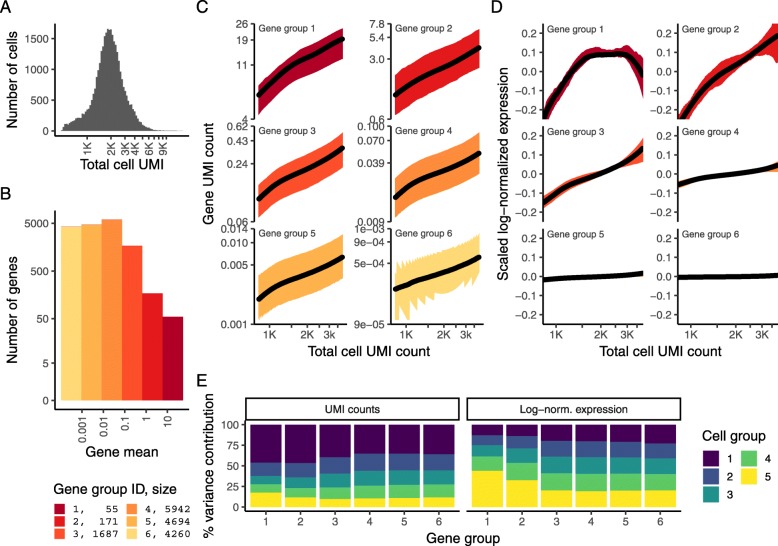
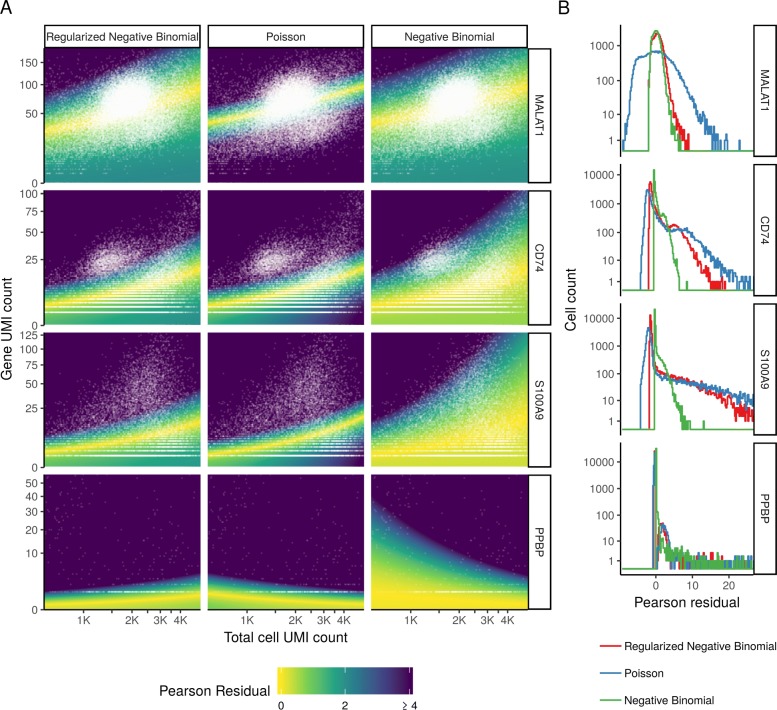
- A single scaling factor does not normalize all genes equally: in a 33,148-cell PBMC dataset with median 1891 UMI/cell and 16,809 genes detected in ≥5 cells, log-normalization effectively normalized only low/medium-abundance genes, while high-abundance genes remained depth-confounded and low-depth cells showed disproportionately high variance for high-abundance genes.
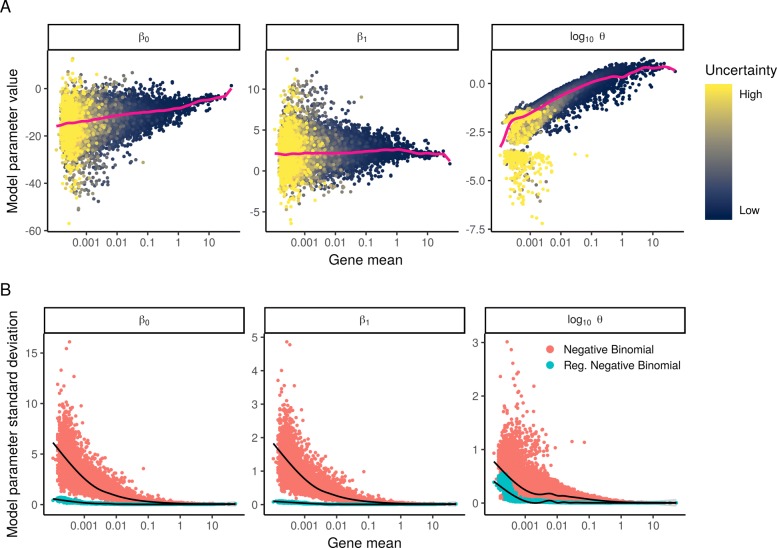
- Unconstrained negative binomial regression overfit scRNA-seq data, especially for low/medium-abundance genes, producing irreproducible parameter estimates across bootstraps; kernel-regularized parameters were consistent across subsamples.
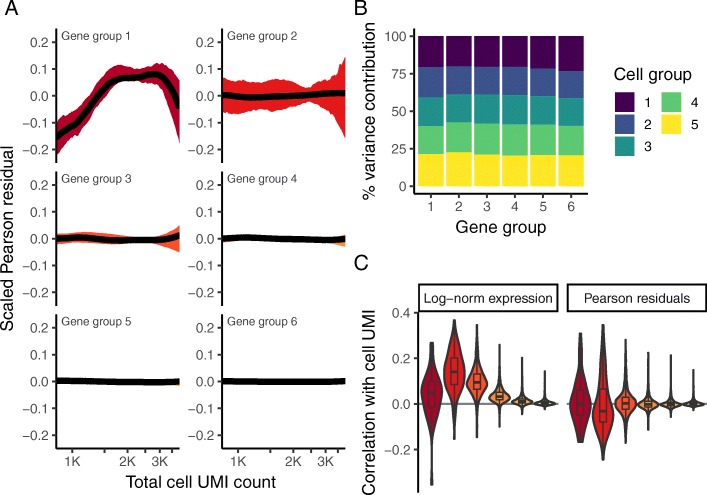
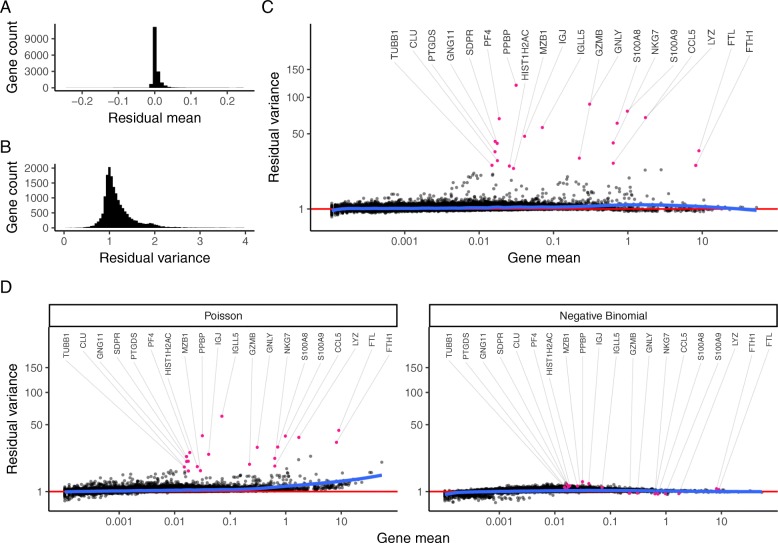
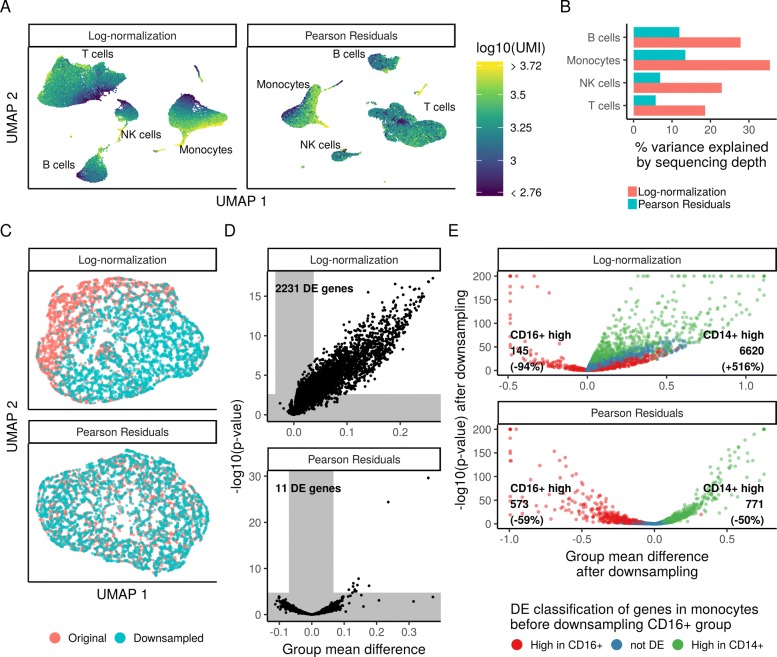
- Pearson residuals from regularized NB regression had minimal correlation with sequencing depth, residual mean centered at 0, residual variance peaked at 1, and high-variance outlier genes were known immune cell markers such as PPBP, GNLY, and IGJ.
- In differential expression tests, splitting CD14+ monocytes and downsampling one group to 50% depth yielded >2000 DE genes with log-normalized data at FDR 0.01 but only 11 genes with Pearson residuals; downsampling CD16+ monocytes to 20% depth gave highly concordant Pearson-residual DE results, unlike log-normalized data.
Methods
- For each gene, UMI counts were modeled with a generalized linear model using total cell UMI count as a covariate, a negative binomial error distribution, and a log link, estimating intercept, slope, and dispersion θ.
- The workflow has three steps: independent per-gene NB regression; kernel regression (ksmooth, normal kernel, bandwidth from bw.SJ multiplied by a default bandwidth adjustment factor of 3) to regularize parameters across genes with similar mean expression; then a constrained NB regression/affine transformation to Pearson residuals, clipped to a maximum of √N.
- Analyses used five UMI datasets from plate- and droplet-based protocols, focusing on a 33,148-cell 10x PBMC dataset, plus a Chromium control dataset, a 26,439 murine bipolar cell batch-extension example, simulation, PCA/UMAP, and t-test differential expression with Benjamini-Hochberg FDR.
Limitations
- The paper states that the method assumes most genes do not exhibit significant biological variation, which may be overly simplistic for highly heterogeneous samples; it suggests a possible pre-clustering extension to reduce this concern.
- The batch-covariate extension requires all cell types to share a similar batch effect; the paper notes that cell-type-specific batch effects or shifts in cell-type proportions require non-linear batch correction strategies.
- The paper states that kernel bandwidth selection matters, with extreme values causing over- or under-smoothing; it also reports 11 false-positive DE genes attributed to highly expressed genes that are difficult to fit because few genes share similar mean values. Evident from the text, the method is presented for UMI-based scRNA-seq and is not validated here for non-UMI or other single-cell modalities.
Model-written summary. Check it against the paper before relying on it.
Integrity signals
Registry
Cites
Statistics
Figures
Verification
Claims the paper makes
16 Valid · 1 Not valid · 2 Not checked · 80 Own results and interpretations
Every source the paper cites for this claim was checked and supports it.
In the paper
“Our regularization procedure explicitly learns and accounts for the well-established relationship [27] between a gene’s mean abundance and variance in single-cell data”
§ Normalization and variance stabilization of single-cell RNA-seq data using regularized negative binomial regression > Results > Applying regularized negative binomial regression for single-cell normalization
What the sources say
- Supportedcites [27] Eling N Richard AC Richardson S Marioni JC Vallejos CA Correcting the mean-variance dependency for differential variability testing using single-cell RNA sequencing data Cell Syst 2018 7 3 284 94 30172840 PMC6167088 source
The citation supports the mean–variance relationship, not the citing authors’ description of their own regularization procedure. The source’s Methods section calls the confounding between mean and variability in scRNA-seq well known, and its Results section describes inferring a trend between gene-specific mean expression and over-dispersion. (LLM, conf=0.92)
boostedstates an association- Asserted: passes — The authors put it forward as true.
- Checkable: passes — It can be checked against evidence.
- Load-bearing: passes — The paper’s conclusions depend on it.
- Based: passes — The paper gives a reason why it holds.
- Supported
The cited sources support only part of this claim — read each source’s verdict below.
In the paper
“These same challenges apply to bulk RNA-seq workflows, but are exacerbated due to the extreme comparative sparsity of scRNA-seq data [5].”
§ Normalization and variance stabilization of single-cell RNA-seq data using regularized negative binomial regression > Introduction
What the sources say
- Partly supportedcites [5] Svensson Valentine Natarajan Kedar Nath Ly Lam-Ha Miragaia Ricardo J Labalette Charlotte Macaulay Iain C Cvejic Ana Teichmann Sarah A Power analysis of single-cell RNA-sequencing experiments Nature Methods 2017 14 4 381 387 28263961 PMC5376499 sourceExperimental — accuracy not yet measured
The Introduction says scRNA-seq starts with tiny amounts of material and requires amplification, making detection sensitivity an important challenge. The cited passages do not establish that scRNA-seq data are comparatively sparser than bulk RNA-seq data or that shared workflow challenges are exacerbated by sparsity; the Results instead report greater molecular detection sensitivity for the scRNA-seq protocols studied. (LLM, conf=0.78)
plainstates a cause- Asserted: passes — The authors put it forward as true.
- Checkable: passes — It can be checked against evidence.
- Load-bearing: passes — The paper’s conclusions depend on it.
- Based: passes — The paper gives a reason why it holds.
- Partly supported
Every source the paper cites for this claim was checked and supports it.
In the paper
“Indeed, the authors of SCnorm [6] reached similar conclusions in the normalization of non-UMI-based single-cell RNA-seq data.”
§ Normalization and variance stabilization of single-cell RNA-seq data using regularized negative binomial regression > Results > A single scaling factor does not effectively normalize both lowly and highly expressed genes
What the sources say
- Supportedcites [6] Bacher R Chu LF Leng N Gasch AP Thomson JA Stewart RM SCnorm: robust normalization of single-cell RNA-seq data Nat Methods 2017 14 6 584 6 28418000 PMC5473255 source
The paper’s Abstract reports that commonly used normalization methods can introduce artifacts in single-cell RNA-seq data and that SCnorm avoids the overcorrection seen with global scale factors. Its H1/H9 case studies describe sequencing cDNA libraries and analyzing read counts, consistent with the cited characterization of the work as concerning non-UMI-based data. The citing sentence does not specify what the conclusions are ‘similar’ to, so that comparison cannot be assessed further. (LLM, conf=0.83)
plain- Asserted: passes — The authors put it forward as true.
- Checkable: passes — It can be checked against evidence.
- Load-bearing: unclear — It is unclear whether the paper’s conclusions depend on it.
- Based: passes — The paper gives a reason why it holds.
- Supported
Every source the paper cites for this claim was checked and supports it.
In the paper
“Finally, while we focus here on modeling technical variation due to differences in cellular sequencing depth, we note that our approach can be easily extended to model alternative “nuisance” parameters, including cell cycle [31], mitochondrial percentage, or experimental batch, simply by adding additional covariates to the model.”
§ Normalization and variance stabilization of single-cell RNA-seq data using regularized negative binomial regression > Discussion
What the sources say
- Supportedcites [31] Buettner F Natarajan KN Casale FP Proserpio V Scialdone A Theis FJ Computational analysis of cell-to-cell heterogeneity in single-cell RNA-sequencing data reveals hidden subpopulations of cells Nat Biotechnol 2015 33 2 155 60 25599176 source
The citation [31] is attached specifically to “cell cycle,” not to mitochondrial percentage or experimental batch. The Discussion says scLVM accounts for cell-cycle effects as a confounding factor, and the section on creating residual expression data sets describes removing those effects. The supplied passages do not give page numbers. (LLM, conf=0.94)
plainstates a cause- Asserted: passes — The authors put it forward as true.
- Checkable: passes — It can be checked against evidence.
- Load-bearing: unclear — It is unclear whether the paper’s conclusions depend on it.
- Based: passes — The paper gives a reason why it holds.
- Supported
The cited sources support only part of this claim — read each source’s verdict below.
In the paper
“This is consistent with previous observations in both bulk and single-cell RNA-seq that count data is overdispersed [9, 12, 14, 28].”
§ Normalization and variance stabilization of single-cell RNA-seq data using regularized negative binomial regression > Results > Pearson residuals effectively normalize technical differences, while retaining biological variation
What the sources say
- Supportedcites [9] Risso D Perraudeau F Gribkova S Dudoit S Vert JP A general and flexible method for signal extraction from single-cell RNA-seq data Nat Commun 2018 9 1 1 17 29348443 PMC5773593 source
The Introduction says the paper models single-cell counts with a zero-inflated negative binomial distribution to account for over-dispersion. The Results (‘Goodness-of-fit of ZINB-WaVE model’) say negative binomial models are quite successful for bulk RNA-seq, supporting the same point for bulk counts. (LLM, conf=0.86)
- Partly supportedcites [12] Love MI Huber W Anders S Moderated estimation of fold change and dispersion for RNA-Seq data with DESeq2 Genome Biol 2014 15 12 550 25516281 PMC4302049 sourceExperimental — accuracy not yet measured
In Materials and methods > Estimation of dispersions (page unavailable), the paper identifies an overdispersion component in RNA-seq count variance and discusses observed dispersion in the Pickrell dataset. It does not address single-cell RNA-seq, so it supports the bulk RNA-seq part but not the single-cell part attributed to this source. (LLM, conf=0.88)
- Not checked — no full text of the sourcecites [14] Grün D Kester L van Oudenaarden A Validation of noise models for single-cell transcriptomics Nat Methods 2014 11 6 637 40 24747814 source
- Partly supportedcites [28] Robinson MD McCarthy DJ Smyth GK edgeR: a Bioconductor package for differential expression analysis of digital gene expression data Bioinformatics 2010 26 1 139 40 19910308 PMC2796818 sourceExperimental — accuracy not yet measured
The Model section describes RNA-seq counts using an overdispersed Poisson or negative-binomial model, supporting the claim for conventional replicated RNA-seq. Our copy does not address single-cell RNA-seq. The Features section also notes that technical replicates may fit a Poisson distribution without overdispersion. (LLM, conf=0.88)
plain- Asserted: passes — The authors put it forward as true.
- Checkable: passes — It can be checked against evidence.
- Load-bearing: passes — The paper’s conclusions depend on it.
- Based: passes — The paper gives a reason why it holds.
- Supported
47 more claims · 1 with their cited sources checked
Create a free account to see all 99 claims and every source verdict.
- It may state two separate claims as one. 39
- Probably not a substantial claim. 15
Claims other papers make about this one
Each is checked against this paper’s own text: does it say what the citing paper says it does?
The cited source says what the claim attributes to it.
In the citing paper
“We normalized and scaled the count matrices via SCTransform v0.3.571 with default parameters.”
From CHIT1 at diagnosis predicts faster disability progression and reflects early microglial activation in multiple sclerosis (2024) · cites this paper as [71]
The cited source says what the claim attributes to it.
In the citing paper
“Data from different sequencing runs, batches and ages were integrated and scaled using SCTransform (Hafemeister and Satija, 2019), while regressing out the following covariates; percentage of mitochondrial genes, the number of cells collected per parent organoid, the number of genes per cell and the number of reads per cell.”
From ELAVL4, splicing, and glutamatergic dysfunction precede neuron loss in MAPT mutation cerebral organoids (2021) · cites this paper as Hafemeister and Satija, 2019
The cited source says what the claim attributes to it.
In the citing paper
“Using SCTransform, transcript expression data were normalised to adjust for differences in sequencing depth between cells and scaled to correct for cell-to-cell variation in total UMI count [22]. Data were also normalised to remove confounding sources of variation such as mitochondrial mapping percentage, post-mortem delay, age of death, and batch number.”
From Apolipoprotein E abundance is elevated in the brains of individuals with Down syndrome–Alzheimer’s disease (2025) · cites this paper as [22]
The check wasn’t confident either way, so it gives no verdict — never disputed.
In the citing paper
“Enriched biological pathways (Metascape54) amongst upregulated gene markers of COVID-19 astrocytes.”
From Dysregulation of brain and choroid plexus cell types in severe COVID-19 (2021) · cites this paper as [54]
Experimental — accuracy not yet measuredIn the citing paper
“To generate a low-dimensional representation of the protein data only, we opted to use SCTransform64, which produced an improved cell-state resolution.”
From Clonal tracing with somatic epimutations reveals dynamics of blood ageing (2025) · cites this paper as [64]
Self-check
Percentages, sums and reported differences re-computed from the paper’s own numbers.
Each contradiction between two passages listed here was confirmed by an independent check.
Rated minor: it would not touch a result — a value no result rests on, a p-value that stays on the same side of the significance level, or a conflict that is clerical, resolved elsewhere in the paper, or outside its own findings.
In the paper
§ Normalization and variance stabilization of single-cell RNA-seq data using regularized negative binomial regression > Results > Modeling single-cell data with a negative binomial distribution leads to overfitting
“we reasoned that including sequencing depth as a GLM covariate could effectively model this technical source of variance, with the GLM residuals corresponding to normalized expression values.”
§ Normalization and variance stabilization of single-cell RNA-seq data using regularized negative binomial regression > Methods > Model extensions—additional nuisance parameters
“we have used the log-transformed total number of UMI assigned to each cell as the dependent variable to model gene-level UMI counts.”
Rated minor: it would not touch a result — a value no result rests on, a p-value that stays on the same side of the significance level, or a conflict that is clerical, resolved elsewhere in the paper, or outside its own findings.
In the paper
§ Normalization and variance stabilization of single-cell RNA-seq data using regularized negative binomial regression > Results > A single scaling factor does not effectively normalize both lowly and highly expressed genes
“For each gene group, we examined the average relationship between observed counts and cell sequencing depth. We fit a smooth line for each gene individually”
§ Normalization and variance stabilization of single-cell RNA-seq data using regularized negative binomial regression > Methods > Trends in the data before and after normalization
“for every gene, we fit the expression (UMI counts, scaled log-normalized expression, scaled Pearson residuals) as a function of log10-transformed mean UMI count using kernel regression”
Citations
Cites
Moderated estimation of fold change and dispersion for RNA-seq data with DESeq2
Love, M. I., Huber, W., & Anders, S. (2014) · Genome Biology · doi:10.1186/s13059-014-0550-8 · Cited by 95,106 · cited 1×
“The first set aims to identify ’size factors’ for individual cells, as is commonly performed for bulk RNA-seq [Love et al., 2014].”
Robinson, M. D., McCarthy, D. J., & Smyth, G. K. (2010) · Bioinformatics · doi:10.1093/bioinformatics/btp616 · Cited by 41,364
Differential expression analysis for sequence count data
Anders, S., & Huber, W. (2010) · Genome Biology · doi:10.1186/gb-2010-11-10-r106 · Cited by 15,581 · cited 1×
“For example, DESeq [23] uses the negative binomial distribution for read count data and links variance and mean by local regression.”
MethodComprehensive Integration of Single-Cell Data
Stuart, T., Butler, A., Hoffman, P., Hafemeister, C., Papalexi, E., Mauck, W. M., Hao, Y., Stoeckius, M., Smibert, P., & Satija, R. (2019) · Cell · doi:10.1016/j.cell.2019.05.031 · Cited by 15,453
Self-citationIntegrating single-cell transcriptomic data across different conditions, technologies, and species
Butler, A., Hoffman, P., Smibert, P., Papalexi, E., & Satija, R. (2018) · Nature Biotechnology · doi:10.1038/nbt.4096 · Cited by 13,174
Self-citationSmyth, G. K. (2004) · Statistical Applications in Genetics and Molecular Biology · doi:10.2202/1544-6115.1027 · Cited by 11,829 · cited 1×
“Similarly, an extension of sctransform could perform differential expression directly on the resulting parameter estimates instead of the residual values, potentially coupling this with an empirical Bayes framework [12, 30].”
MethodUMAP: Uniform Manifold Approximation and Projection
McInnes, L., Healy, J., Saul, N., & Großberger, L. (2018) · Journal of Open Source Software · doi:10.21105/joss.00861 · Cited by 9,826 · cited 1×
“For 2D visualization, the PC embeddings were passed into UMAP [36, 37] with default parameters.”
MethodSCANPY: large-scale single-cell gene expression data analysis
Wolf, F. A., Angerer, P., & Theis, F. J. (2018) · Genome Biology · doi:10.1186/s13059-017-1382-0 · Cited by 8,881 · cited 1×
“, 2018] and SCANPY [Wolf et al., 2018], compensates for this effect.”
BackgroundUMAP: Uniform Manifold Approximation and Projection for Dimension Reduction
McInnes, L., Healy, J., & Melville, J. (2018) · arXiv · doi:10.48550/arxiv.1802.03426 · Cited by 7,101
Spatial reconstruction of single-cell gene expression data
Satija, R., Farrell, J. A., Gennert, D., Schier, A. F., & Regev, A. (2015) · Nature Biotechnology · doi:10.1038/nbt.3192 · Cited by 7,055 · cited 2×
“To facilitate users applying these methods to their own datasets, our approach is freely available as an open-source R package sctransform (github.com/ChristophH/sctransform), with an accompanying interface to our single-cell R toolkit Seurat [16–18].”
MethodSelf-citation
Research works printed but not linked: 1
- McInnes L Healy J Saul N Grossberger L UMAP: uniform manifold approximation and projection J Open Source Softw 2018 3 29 861 · DOI · Paper page
Cited by
Items 301–400 of 4,585
Wyler, E., Franke, V., Menegatti, J., Kocks, C., Boltengagen, A., Praktiknjo, S. D., Walch‐Rückheim, B., Bosse, J. B., Rajewsky, N., Grässer, F. A., et al. (2019) · Nature Communications · doi:10.1038/s41467-019-12894-z · Cited by 146
Genetic ancestry effects on the response to viral infection are pervasive but cell type specific
Randolph, H. E., Mu, Z., Fiege, J. K., Thielen, B. K., Grenier, J., Cobb, M., Hussin, J., Li, Y., Langlois, R. A., & Barreiro, L. B. (2021) · Science · doi:10.1126/science.abg0928 · Cited by 150
Spatial omics: Navigating to the golden era of cancer research
Wu, Y. C., Cheng, Y., Wang, X., Fan, J., & Gao, Q. (2022) · Clinical and Translational Medicine · doi:10.1002/ctm2.696 · Cited by 146
“69 This algorithm integrates regularised negative binomial regression and Pearson residuals which proved to be fit for ST data.”
MethodPrenatal immune stress blunts microglia reactivity, impairing neurocircuitry
Hayes, L. N., An, K., Carloni, E., Li, F., Vincent, E., Trippaers, C., Paranjpe, M. D., Dölen, G., Goff, L. A., Ramos, A., et al. (2022) · Nature · doi:10.1038/s41586-022-05274-z · Cited by 145
Reconstituting human somitogenesis in vitro
Yamanaka, Y., Hamidi, S., Yoshioka-Kobayashi, K., Munira, S., Sunadome, K., Zhang, Y., Kurokawa, Y., Ericsson, R., Mieda, A., Thompson, J. L., et al. (2022) · Nature · doi:10.1038/s41586-022-05649-2 · Cited by 154
Neuronal APOE4 removal protects against tau-mediated gliosis, neurodegeneration and myelin deficits
Koutsodendris, N., Blumenfeld, J., Agrawal, A., Traglia, M., Grone, B., Zilberter, M., Yip, O., Rao, A., Nelson, M. R., Hao, Y., et al. (2023) · Nature Aging · doi:10.1038/s43587-023-00368-3 · Cited by 132
Airspace Macrophages and Monocytes Exist in Transcriptionally Distinct Subsets in Healthy Adults
Mould, K. J., Moore, C. M., McManus, S. A., McCubbrey, A. L., McClendon, J. D., Griesmer, C. L., Henson, P. M., & Janssen, W. J. (2021) · American Journal of Respiratory and Critical Care Medicine · doi:10.1164/rccm.202005-1989oc · Cited by 133
“Briefly, single-cell data were normalized, integrated, and clustered using the Seurat (15, 16) pipeline.”
MethodA single-cell atlas of human teeth
Pagella, P., Roditi, L. D. V., Stadlinger, B., Moor, A. E., & Mitsiadis, T. A. (2021) · iScience · doi:10.1016/j.isci.2021.102405 · Cited by 136
Vision-dependent specification of cell types and function in the developing cortex
Cheng, S., Butrus, S., Tan, L., Xu, R., Sagireddy, S., Trachtenberg, J. T., Shekhar, K., & Zipursky, S. L. (2022) · Cell · doi:10.1016/j.cell.2021.12.022 · Cited by 131
Pont, F., Tosolini, M., & Fournié, J. J. (2019) · Nucleic Acids Research · doi:10.1093/nar/gkz601 · Cited by 130
“This pre-processing tool, named sctransform (15), normalizes and stabilizes the technical noise variance of UMI counts prior to downstream analyses by principal component analysis (PCA), dimensionality reduction and further exploration of results.”
BackgroundMethodInfluentialDemystifying “drop-outs” in single-cell UMI data
Kim, T. H., Zhou, X., & Chen, M. (2020) · Genome Biology · doi:10.1186/s13059-020-02096-y · Cited by 130
Joseph, D. B., Henry, G. H., Malewska, A., Reese, J. C., Mauck, R. J., Gahan, J. C., Hutchinson, R. C., Malladi, V. S., Roehrborn, C. G., Vezina, C. M., et al. (2021) · The Journal of Pathology · doi:10.1002/path.5751 · Cited by 148
Identification of early neurodegenerative pathways in progressive multiple sclerosis
Kaufmann, M., Schaupp, A.-L., Sun, R., Coscia, F., Dendrou, C. A., Cortés, A., Kaur, G., Evans, H. G., Mollbrink, A., Navarro, J. F., et al. (2022) · Nature Neuroscience · doi:10.1038/s41593-022-01097-3 · Cited by 136
Zhang, X., Chao, P., Zhang, L. J., Xu, L., Cui, X., Wang, S., Wusiman, M., Jiang, H., & Lu, C. (2023) · Frontiers in Immunology · doi:10.3389/fimmu.2023.1030198 · Cited by 141
“ScRNA-seq offers advantages over RNA-seq, including dissecting heterogeneity within cell populations and identifying rare cells related to the disease by using the single-cell profiles in mixed-cell populations (18).”
BackgroundOrexin neurons inhibit sleep to promote arousal
De Luca, R., Nardone, S., Grace, K. P., Venner, A., Cristofolini, M., Bandaru, S. S., Sohn, L. T., Kong, D., Mochizuki, T., Viberti, B., et al. (2022) · Nature Communications · doi:10.1038/s41467-022-31591-y · Cited by 130
Valdeolivas, A., Amberg, B., Giroud, N., Richardson, M., Gálvez, E. J. C., Badillo, S., Julien-Laferrière, A., Túrós, D., Voith von Voithenberg, L., Wells, I., et al. (2024) · npj Precision Oncology · doi:10.1038/s41698-023-00488-4 · Cited by 130
“We normalized the UMI counts from the remaining spots using SCTransform 55 .”
Shu, D. H., Ho, W. J., Kagohara, L. T., Girgis, A. A., Shin, S. M., Danilova, L., Lee, J. W., Sidiropoulos, D. N., Mitchell, S., Munjal, K., et al. (2024) · Nature Immunology · doi:10.1038/s41590-024-01992-w · Cited by 182
“The Seurat function SCTransform was used to normalize raw count data to a Gamma-Poisson generalized linear model, perform variance stabilization, identify highly variable features and scale features 63,64 .”
The spatial transcriptomic landscape of the healing mouse intestine following damage
Parigi, S. M., Larsson, L., Das, S., Flores, R. O. R., Frede, A., Tripathi, K. P., Diaz, O. E., Selin, K., Morales, R. A., Luo, X., et al. (2022) · Nature Communications · doi:10.1038/s41467-022-28497-0 · Cited by 150
“Input expression matrices of each slide were normalized with sctransform implemented in Seurat 3.1.4.9 51 .”
InfluentialNolan, E., Bridgeman, V. L., Ombrato, L., Karoutas, A., Rabas, N., Sewnath, C. A. N., Vásquez, M., Rodrigues, F. S., Horswell, S. D., Faull, P. A., et al. (2022) · Nature Cancer · doi:10.1038/s43018-022-00336-7 · Cited by 145
Moorlag, S. J. C. F. M., Folkman, L., ter Horst, R., Krausgruber, T., Barreca, D., Schuster, L. C., Fife, V. E. R., Matzaraki, V., Li, W., Reichl, S., et al. (2024) · Immunity · doi:10.1016/j.immuni.2023.12.005 · Cited by 158
Guirguis, A. A., Ofir-Rosenfeld, Y., Knezevic, K., Blackaby, W., HARDICK, D. J., Chan, Y.-C., Motazedian, A., Gillespie, A., Vassiliadis, D., Lam, E. Y. N., et al. (2023) · Cancer Discovery · doi:10.1158/2159-8290.cd-23-0007 · Cited by 151
Clonal relations in the mouse brain revealed by single-cell and spatial transcriptomics
Ratz, M., von Berlin, L., Larsson, L., Martin, M., Westholm, J. O., La Manno, G., Lundeberg, J., & Frisén, J. (2022) · Nature Neuroscience · doi:10.1038/s41593-022-01011-x · Cited by 127
Shim, J., Oh, S. J., Yeo, E., Park, J., Bae, J. H., Kim, S., Lee, D., & Lee, J. H. (2022) · Journal of Investigative Dermatology · doi:10.1016/j.jid.2022.01.017 · Cited by 136
Kang, B., Camps, J., Fan, B., Jiang, H., Ibrahim, M. M., Hu, X., Qin, S., Kirchhoff, D., Chiang, D. Y., Wang, S., et al. (2022) · Genome biology · doi:10.1186/s13059-022-02828-2 · Cited by 155
“The SCTransform-normalized gene expression values were used in the calculation of cell–cell affinities.”
MethodSpatially resolved mapping of cells associated with human complex traits
Song, L., Chen, W., Hou, J., Guo, M., & Yang, J. (2025) · Nature · doi:10.1038/s41586-025-08757-x · Cited by 179
Human germline heterozygous gain-of-function STAT6 variants cause severe allergic disease
Sharma, M., Leung, D., Momenilandi, M., Jones, L. C. W., Pacillo, L., James, A. E., Murrell, J. R., Delafontaine, S., Maimaris, J., Vaseghi-Shanjani, M., et al. (2023) · Journal of Experimental Medicine · doi:10.1084/jem.20221755 · Cited by 125
May-Zhang, A. A., Tycksen, E., Southard-Smith, A. N., Deal, K. K., Benthal, J. T., Buehler, D. P., Adam, M., Simmons, A. J., Monaghan, J. R., Matlock, B. K., et al. (2020) · Gastroenterology · doi:10.1053/j.gastro.2020.09.032 · Cited by 134
Krausgruber, T., Redl, A., Barreca, D., Doberer, K., Romanovskaia, D., Dobnikar, L., Guarini, M., Unterluggauer, L., Kleißl, L., Atzmüller, D., et al. (2023) · Immunity · doi:10.1016/j.immuni.2023.01.014 · Cited by 144
Mosquera, J. V., Auguste, G., Wong, D., Turner, A. W., Hodonsky, C. J., Alvarez-Yela, A. C., Song, Y., Cheng, Q., Lino Cardenas, C. L., Theofilatos, K., et al. (2023) · Cell Reports · doi:10.1016/j.celrep.2023.113380 · Cited by 123
Lercher, A., Bhattacharya, A., Popa, A. M., Caldera, M., Schlapansky, M. F., Baazim, H., Agerer, B., Gürtl, B., Kosack, L., Májek, P., et al. (2019) · Immunity · doi:10.1016/j.immuni.2019.10.014 · Cited by 123
Tools for the analysis of high-dimensional single-cell RNA sequencing data
Wu, Y., & Zhang, K. (2020) · Nature Reviews Nephrology · doi:10.1038/s41581-020-0262-0 · Cited by 141
“…size factors within each pool 35 . sctransform (implemented in the Seurat package) uses a probabilistic model to compute the effect of total UMI or read count on each gene, which also enables it to stabilize gene variances (discussed later in more detail) and identify over-dispersed genes 36 .”
BackgroundMethodMartins-Ferreira, R., Calafell-Segura, J., Leal, B., Rodríguez-Ubreva, J., Martínez-Saez, E., Mereu, E., Pinho E Costa, P., Laguna, A., & Ballestar, E. (2025) · Nature Communications · doi:10.1038/s41467-025-56124-1 · Cited by 123
“The doubletFinder_v3 function 59 was used to estimate doublets from each individual subject, which were removed from each dataset ’ s Seurat object, followed by SCTransform normalization 60 with default 3000 variable genes.”
Amnion signals are essential for mesoderm formation in primates
Yang, R., Goedel, A., Kang, Y., Si, C., Chu, C., Zheng, Y., Chen, Z., Gruber, P. J., Xiao, Y., Zhou, C., et al. (2021) · Nature Communications · doi:10.1038/s41467-021-25186-2 · Cited by 126
Taavitsainen, S., Engedal, N., Cao, S., Handle, F., Erickson, A. M., Preković, S., Wetterskog, D., Tolonen, T. T., Vuorinen, E. M., Kiviaho, A., et al. (2021) · Nature Communications · doi:10.1038/s41467-021-25624-1 · Cited by 139
SARS-CoV-2 promotes microglial synapse elimination in human brain organoids
Samudyata, Oliveira, A. O., Malwade, S., Rufino de Sousa, N., Goparaju, S. K., Gracias, J., Orhan, F., Steponaviciute, L., Schalling, M., Sheridan, S. D., et al. (2022) · Molecular Psychiatry · doi:10.1038/s41380-022-01786-2 · Cited by 122
Cheu, J. W., Lee, D. P. H., Li, Q., Goh, C. C., Bao, M. H., Yuen, V. W., Zhang, M. S., Yang, C., Chan, C. Y., Tse, A. P., et al. (2023) · Cellular and Molecular Gastroenterology and Hepatology · doi:10.1016/j.jcmgh.2023.03.001 · Cited by 141
Lee, R. D., Munro, S. A., Knutson, T. P., LaRue, R. S., Heltemes-Harris, L. M., & Farrar, M. A. (2021) · Nature Communications · doi:10.1038/s41467-021-27232-5 · Cited by 146
Stroke induces disease-specific myeloid cells in the brain parenchyma and pia
Beuker, C., Schafflick, D., Strecker, J.-K., Heming, M., Li, X., Wolbert, J., Schmidt-Pogoda, A., Thomas, C., Kuhlmann, T., Aranda-Pardos, I., et al. (2022) · Nature Communications · doi:10.1038/s41467-022-28593-1 · Cited by 121
Pyramidal neuron subtype diversity governs microglia states in the neocortex
Stogsdill, J. A., Kim, K., Binan, L., Farhi, S. L., Levin, J. Z., & Arlotta, P. (2022) · Nature · doi:10.1038/s41586-022-05056-7 · Cited by 121
Computational solutions for spatial transcriptomics
Kleino, I., Frolovaitė, P., Suomi, T., & Elo, L. L. (2022) · Computational and Structural Biotechnology Journal · doi:10.1016/j.csbj.2022.08.043 · Cited by 130
“The scRNA-seq specific methods like SCtransformation [112], SCnorm [113], or SCRAN [114] can also be used to remove unwanted variations.”
MethodTherapeutic targeting of EP300/CBP by bromodomain inhibition in hematologic malignancies
Nicosia, L., Spencer, G. J., Brooks, N. A. N., Amaral, F. M. R., Basma, N. J., Chadwick, J. A., Revell, B., Wingelhofer, B., Maiqués-Díaz, A., Sinclair, O. J., et al. (2023) · Cancer Cell · doi:10.1016/j.ccell.2023.11.001 · Cited by 146
Shamsi, F., Piper, M., Ho, L.-L., Huang, T. L., Gupta, A., Streets, A., Lynes, M. D., & Tseng, Y.-H. (2021) · Nature Metabolism · doi:10.1038/s42255-021-00373-z · Cited by 120
“The clustering analysis was done using the sctransform method 43 after regressing out the variation due to cell cycle and integration across samples.”
From bench to bedside: Single-cell analysis for cancer immunotherapy
Davis-Marcisak, E. F., Deshpande, A. M., Stein-O’Brien, G., Ho, W. J., Laheru, D. A., Jaffee, E. M., Fertig, E. J., & Kagohara, L. T. (2021) · Cancer Cell · doi:10.1016/j.ccell.2021.07.004 · Cited by 136
Droplet-based forward genetic screening of astrocyte–microglia cross-talk
Wheeler, M. A., Clark, I. C., Lee, H.-G., Li, Z., Linnerbauer, M., Rone, J. M., Blain, M., Akl, C. F., Piester, G., Giovannoni, F., et al. (2023) · Science · doi:10.1126/science.abq4822 · Cited by 120
Single-cell CAR T atlas reveals type 2 function in 8-year leukaemia remission
Bai, Z., Feng, B., McClory, S., de Oliveira, B. C., Diorio, C. J., Grégoire, C., Tao, B., Yang, L., Zhao, Z., Peng, L., et al. (2024) · Nature · doi:10.1038/s41586-024-07762-w · Cited by 139
“For subclustering analyses of basal unstimulated or CD19-3T3-stimulated CAR T cells from both the discovery and validation cohorts, the sctransform normalization method in Seurat was used 40 .”
Bosc, C., Saland, E., Bousard, A., Gadaud, N., Sabatier, M., Cognet, G., Farge, T., Boët, E., Gotanègre, M., Aroua, N., et al. (2021) · Nature Cancer · doi:10.1038/s43018-021-00264-y · Cited by 137
Nelson, M. R., Liu, P., Agrawal, A., Yip, O., Blumenfeld, J., Traglia, M., Kim, M. J., Koutsodendris, N., Rao, A., Grone, B., et al. (2023) · Nature Neuroscience · doi:10.1038/s41593-023-01480-8 · Cited by 120
“Normalization and variance stabilization was performed using sctrans-form 88 with the ‘glmGamPoi’ (Bioconductor package version 1.6.0) method 89 for initial parameter estimation.”
MethodInfluentialHuang, L., Desai, R., Conrad, D. N., Leite, N. C., Akshinthala, D., Lim, C. M., González, R. S., Muthuswamy, L. B., Gartner, Z. J., & Muthuswamy, S. K. (2021) · Cell stem cell · doi:10.1016/j.stem.2021.03.022 · Cited by 133
Cell segmentation-free inference of cell types from in situ transcriptomics data
Park, J., Choi, W., Tiesmeyer, S., Long, B., Borm, L. E., Garren, E., Nguyen, T. N., Tasic, B., Codeluppi, S., Graf, T., et al. (2021) · Nature Communications · doi:10.1038/s41467-021-23807-4 · Cited by 118
Single-cell nuclear architecture across cell types in the mouse brain
Takei, Y., Zheng, S., Yun, J., Shah, S., Pierson, N., White, J., Schindler, S., Tischbirek, C. H., Yuan, G.-C., & Cai, L. (2021) · Science · doi:10.1126/science.abj1966 · Cited by 118
PD-1 blockade therapy promotes infiltration of tumor-attacking exhausted T cell clonotypes
Nagasaki, J., Inozume, T., Sax, N., Ariyasu, R., Ishikawa, M., Yamashita, K., Kawazu, M., Ueno, T., Irie, T., Tanji, E., et al. (2022) · Cell Reports · doi:10.1016/j.celrep.2022.110331 · Cited by 134
Microglia maintain structural integrity during fetal brain morphogenesis
Lawrence, A. R., Canzi, A., Bridlance, C., Olivié, N., Lansonneur, C., Catale, C., Pizzamiglio, L., Kloeckner, B., Silvin, A., Munro, D. A. D., et al. (2024) · Cell · doi:10.1016/j.cell.2024.01.012 · Cited by 118
Niche-Selective Inhibition of Pathogenic Th17 Cells by Targeting Metabolic Redundancy
Wu, L., Hollinshead, K. E. R., Hao, Y., Au, C., Kroehling, L., Ng, C., Lin, W.-Y., Li, D., Silva, H. M., Shin, J., et al. (2020) · Cell · doi:10.1016/j.cell.2020.06.014 · Cited by 121
Self-citationNon-coding deletions identify Maenli lncRNA as a limb-specific En1 regulator
Allou, L., Balzano, S., Magg, A., Quinodoz, M., Royer‐Bertrand, B., Schöpflin, R., Chan, W.-L., Speck‐Martins, C. E., Carvalho, D. R., Farage, L., et al. (2021) · Nature · doi:10.1038/s41586-021-03208-9 · Cited by 134
Single-cell analyses identify circulating anti-tumor CD8 T cells and markers for their enrichment
Pauken, K. E., Shahid, O., Lagattuta, K. A., Mahuron, K. M., Luber, J. M., Lowe, M. M., Huang, L., Delaney, C., Long, J. M., Fung, M. E., et al. (2021) · The Journal of Experimental Medicine · doi:10.1084/jem.20200920 · Cited by 124
“, 2020), and work has concluded that the zero measurements in count data reflect true biology (Choi et al., 2020; Hafemeister and Satija, 2019; Svensson, 2020; Townes et al., 2019).”
BackgroundGeller, A. E., Shrestha, R., Woeste, M. R., Guo, H., Hu, X., Ding, C., Andreeva, K., Chariker, J. H., Zhou, M., Tieri, D. A., et al. (2022) · Nature Communications · doi:10.1038/s41467-022-28407-4 · Cited by 130
Multi-omic profiling of the developing human cerebral cortex at the single-cell level
Zhu, K., Bendl, J. M., Rahman, S., Vicari, J. M., Coleman, C., Clarence, T., Latouche, O., Tsankova, N. M., Li, A., Brennand, K., et al. (2023) · Science Advances · doi:10.1126/sciadv.adg3754 · Cited by 128
Landmarks of human embryonic development inscribed in somatic mutations
Bizzotto, S., Dou, Y., Ganz, J., Doan, R. N., Kwon, M., Bohrson, C. L., Kim, S. N., Bae, T., Abyzov, A., NIMH Brain Somatic Mosaicism Network, et al. (2021) · Science · doi:10.1126/science.abe1544 · Cited by 117
Identification of ALK in thinness
Orthofer, M., Valsesia, A., Mägi, R., Wang, Q.-P., Kaczanowska, J., Kozieradzki, I., Leopoldi, A., Cikes, D., Zopf, L. M., Tretiakov, E. O., et al. (2020) · Cell · doi:10.1016/j.cell.2020.04.034 · Cited by 117
“1 package (Hafemeister and Satija, 2019; Stuart et al., 2019) and visualized by uniform manifold approximation and projection (UMAP) algorithm (McInnes et al.”
MethodFamilial Alzheimer’s disease mutations in PSEN1 lead to premature human stem cell neurogenesis
Arber, C., Lovejoy, C., Harris, L., Willumsen, N., Alatza, A., Casey, J. M., Lines, G., Kerins, C., Mueller, A. K., Zetterberg, H., et al. (2021) · Cell Reports · doi:10.1016/j.celrep.2020.108615 · Cited by 116
Modeling Human TBX5 Haploinsufficiency Predicts Regulatory Networks for Congenital Heart Disease
Kathiriya, I. S., Rao, K. S., Iacono, G., Devine, W. P., Blair, A. P., Hota, S. K., Lai, M. H., Garay, B. I., Thomas, R., Gong, H. Z., et al. (2021) · Developmental Cell · doi:10.1016/j.devcel.2020.11.020 · Cited by 116
“4’s ‘Integration and Label Transfer-SCTransform’ workflow to resolve effects from experimental instances that are driven by cell-cell technical variations, including sequencing depth (Hafemeister and Satija, 2019; Stuart et al., 2019).”
BackgroundPeng, C., Huggins, M. A., Wanhainen, K. M., Knutson, T. P., Lu, H., Georgiev, H., Mittelsteadt, K. L., Jarjour, N. N., Wang, H., Hogquist, K. A., et al. (2021) · Immunity · doi:10.1016/j.immuni.2021.11.017 · Cited by 119
Review of single-cell RNA-seq data clustering for cell-type identification and characterization
Zhang, S., Li, X., Lin, J., Lin, Q., & Wong, K. (2023) · RNA · doi:10.1261/rna.078965.121 · Cited by 131
“Sctransform proposed to utilize the Pearson residuals from regularized negative binomial regression as a covariate in a generalized linear model to remove the influence of technical characteristics while preserving biological heterogeneity (Hafemeister and Satija 2019).”
MethodSingle-cell analysis of human MAIT cell transcriptional, functional and clonal diversity
Garner, L. C., Amini, A., FitzPatrick, M. E. B., Lett, M. J., Hess, G. F., Sinnreich, M. F., Provine, N. M., & Klenerman, P. (2023) · Nature Immunology · doi:10.1038/s41590-023-01575-1 · Cited by 126
Lim, R. J., Salehi‐Rad, R., Tran, L. M., Oh, M. S., Dumitras, C., Crosson, W. P., Li, R., Patel, T. S., Man, S., Yean, C. E., et al. (2024) · Cell Reports Medicine · doi:10.1016/j.xcrm.2024.101479 · Cited by 173
Adaptation to chronic ER stress enforces pancreatic β-cell plasticity
Chen, C.-W., Guan, B.-J., Alzahrani, M. R., Gao, Z., Gao, L., Bracey, S., Wu, J., Mbow, C. A., Jobava, R., Haataja, L., et al. (2022) · Nature Communications · doi:10.1038/s41467-022-32425-7 · Cited by 116
Dhodapkar, K. M., Cohen, A. D., Kaushal, A., Garfall, A. L., Manalo, R. J., Carr, A. R., McCachren, S. S., Stadtmauer, E. A., Lacey, S. F., Melenhorst, J. J., et al. (2022) · Blood Cancer Discovery · doi:10.1158/2643-3230.bcd-22-0018 · Cited by 115
Lander, V. E., Belle, J. I., Kingston, N. L., Herndon, J. M., Hogg, G. D., Liu, X., Kang, L.-I., Knolhoff, B. L., Bogner, S. J., Baer, J. M., et al. (2022) · Cancer Discovery · doi:10.1158/2159-8290.cd-22-0192 · Cited by 114
A multicenter study benchmarking single-cell RNA sequencing technologies using reference samples
Chen, W., Zhao, Y., Chen, X., Yang, Z., Xu, X., Bi, Y., Chen, V., Li, J., Choi, H., Ernest, B., et al. (2021) · Nature Biotechnology · doi:10.1038/s41587-020-00748-9 · Cited by 114
Xu, P., Wang, M., Song, W.-M., Wang, Q., Yuan, G.-C., Sudmant, P. H., Zare, H., Tu, Z., Orr, M. E., & Zhang, B. (2022) · Molecular Neurodegeneration · doi:10.1186/s13024-021-00507-7 · Cited by 114
“Gene expressions from each voxel were normalized by the sctransform [43] in Seurat, which uses regularized negative binomial models to account for technical artifacts while preserving biological variance.”
MethodLee, Y., Bogdanoff, D., Wang, Y., Hartoularos, G. C., Woo, J. M., Mowery, C. T., Nisonoff, H. M., Lee, D. S., Sun, Y., Lee, J., et al. (2021) · Science Advances · doi:10.1126/sciadv.abg4755 · Cited by 114
Conventional NK cells and tissue-resident ILC1s join forces to control liver metastasis
Ducimetière, L., Lucchiari, G., Litscher, G., Nater, M., Heeb, L., Núñez, N. G., Wyss, L., Bürri, D., Vermeer, M., Gschwend, J., et al. (2021) · Proceedings of the National Academy of Sciences · doi:10.1073/pnas.2026271118 · Cited by 127
Generation of mesenchyme free intestinal organoids from human induced pluripotent stem cells
Mithal, A., Capilla, A., Heinze, D., Berical, A., Villacorta-Martin, C., Vedaie, M., Jacob, A., Abo, K., Szymaniak, A., Peasley, M., et al. (2020) · Nature Communications · doi:10.1038/s41467-019-13916-6 · Cited by 113
Pompura, S. L., Wagner, A., Kitz, A., Laperche, J. M., Yosef, N., Dominguez‐Villar, M., & Hafler, D. A. (2021) · Journal of Clinical Investigation · doi:10.1172/jci138519 · Cited by 127
A cell-type-specific atlas of the inner ear transcriptional response to acoustic trauma
Milon, B. C., Shulman, E. D., So, K. S., Cederroth, C. R., Lipford, E. L., Sperber, M., Sellon, J. B., Sarlus, H., Pregernig, G., Shuster, B., et al. (2021) · Cell Reports · doi:10.1016/j.celrep.2021.109758 · Cited by 123
Spatially exploring RNA biology in archival formalin-fixed paraffin-embedded tissues
Bai, Z., Zhang, D., Gao, Y. P., Tao, B., Zhang, D., Bao, S., Enninful, A., Wang, Y., Li, H., Su, G., et al. (2024) · Cell · doi:10.1016/j.cell.2024.09.001 · Cited by 135
Yonekura, S., Terrisse, S., Alves Costa Silva, C., Lafarge, A., Iebba, V., Ferrere, G., Goubet, A.-G., Fahrner, J.-E., Lahmar, I., Ueda, K., et al. (2022) · Cancer Discovery · doi:10.1158/2159-8290.cd-21-0999 · Cited by 112
Llonch, S., Barragán, M., Nieto, P., Mallol, A., Elosua-Bayés, M., Lorden, P., Ruiz, S., Zambelli, F., Heyn, H., Vassena, R., et al. (2021) · Aging Cell · doi:10.1111/acel.13360 · Cited by 127
“…et al., 2019) SCTransform pipeline, a modelling framework for the normalization and variance stabilization of molecular count data from scRNA- seq (Hafemeister & Satija, 2019), which finds sharper biological differences and avoids most technical/confounding factors compared with Seurat's standard…”
MethodStrating, E., Verhagen, M. P., Wensink, G. E., Dünnebach, E., Wijler, L. A., Aranguren, I., la Cruz, A. S. D., Peters, N. A., Hageman, J. H., van der Net, M. C., et al. (2023) · Frontiers in Immunology · doi:10.3389/fimmu.2023.1053920 · Cited by 136
“Data was processed with the Seurat single cell transform workflow (45).”
MethodA genetic link between risk for Alzheimer's disease and severe COVID-19 outcomes via the OAS1 gene
Magusali, N., Graham, A. C., Piers, T. M., Panichnantakul, P., Yaman, U., Shoai, M., Reynolds, R. H., Botia, J. A., Brookes, K. J., Guetta-Baranes, T., et al. (2021) · Brain · doi:10.1093/brain/awab337 · Cited by 111
Brügger, M. D., Valenta, T., Fazilaty, H., Hausmann, G., & Basler, K. (2020) · PLoS Biology · doi:10.1371/journal.pbio.3001032 · Cited by 118
“For all three datasets, normalization, scaling, and variable gene selection was performed using the “SCTransform” function in Seurat [45] with standard settings.”
Jasso, G. J., Jaiswal, A., Varma, M., Laszewski, T., Grauel, A. L., Omar, A. S., Silva, N., Dranoff, G., Porter, J. A., Mansfield, K. G., et al. (2022) · PLoS Biology · doi:10.1371/journal.pbio.3001532 · Cited by 122
Elevating microglia TREM2 reduces amyloid seeding and suppresses disease-associated microglia
Zhao, N., Qiao, W., Li, F., Ren, Y., Zheng, J., Martens, Y. A., Wang, X., Li, L., Liu, C.-C., Chen, K., et al. (2022) · Journal of Experimental Medicine · doi:10.1084/jem.20212479 · Cited by 111
“…of selected marker genes in each cluster was visualized with the VlnPlot function from the Seurat package using the normalized and scaled data from SCT transformation, which removes the confounding effect of the gene detection rate and mitochondria mapping percentage (Hafemeister and Satija, 2019).”
MethodYang, J., Vamvini, M. T., Nigro, P., Ho, L., Galani, K., Alvarez, M., Tanigawa, Y., Renfro, A., Carbone, N. P., Laakso, M., et al. (2022) · Cell Metabolism · doi:10.1016/j.cmet.2022.09.004 · Cited by 130
“Integration was done without any batch correction using Seurat v3 (Hafemeister and Satija, 2019).”
MethodDesta, G. M., & Birhanu, A. G. (2025) · Acta Biochimica Polonica · doi:10.3389/abp.2025.13922 · Cited by 150
Elyanow, R., Dumitrascu, B., Engelhardt, B. E., & Raphael, B. J. (2020) · Genome Research · doi:10.1101/gr.251603.119 · Cited by 109
Congenital heart disease risk loci identified by genome-wide association study in European patients
Lahm, H., Jia, M., Dreßen, M., Wirth, F., Puluca, N., Gilsbach, R., Keavney, B. D., Cleuziou, J., Beck, N., Bondareva, O., et al. (2021) · Journal of Clinical Investigation · doi:10.1172/jci141837 · Cited by 109
Individual cell types in C. elegans age differently and activate distinct cell-protective responses
Roux, A. E., Yuan, H., Podshivalova, K., Hendrickson, D., Kerr, R., Kenyon, C., & Kelley, D. (2023) · Cell Reports · doi:10.1016/j.celrep.2023.112902 · Cited by 109
Omatsu, M., Nakanishi, Y., Iwane, K., Aoyama, N., Duran, A., Muta, Y., Martinez-Ordoñez, A., Han, Q., Agatsuma, N., Mizukoshi, K., et al. (2023) · Nature Communications · doi:10.1038/s41467-023-41095-y · Cited by 109
“Each sample was normalized using SCTransform 52 .”
Sun, C., Wang, L., Wang, H., Huang, T., Yao, W., Li, J., & Zhang, X. (2020) · Stem Cell Research & Therapy · doi:10.1186/s13287-020-01660-4 · Cited by 127
“Here, we used regularized negative binomial regression method to perform normalization and variance stabilization of our scRNA-seq data, which is an appropriate distribution to model UMI count data from a “homogeneous” single-cell population suggested by [56].”
MethodBassiouni, R., Idowu, M. O., Gibbs, L. D., Robila, V., Grizzard, P. J., Webb, M. G., Song, J., Noriega, A., Craig, D. W., & Carpten, J. D. (2022) · Cancer Research · doi:10.1158/0008-5472.can-22-2682 · Cited by 143
Transferred mitochondria accumulate reactive oxygen species, promoting proliferation
Kidwell, C. U., Casalini, J. R., Pradeep, S., Scherer, S. D., Greiner, D., Bayık, D., Watson, D. C., Olson, G. S., Lathia, J. D., Johnson, J. S., et al. (2023) · eLife · doi:10.7554/elife.85494 · Cited by 122
“The reads were then scaled and normalized using SEURAT ‘sctransform’ function ( Hafemeister and Satija, 2019 ).”
Explainable multi-task learning for multi-modality biological data analysis
Tang, X., Zhang, J., He, Y., Zhang, X., Lin, Z., Partarrieu, S., Hanna, E. B., Ren, Z., Shen, H., Yang, Y., et al. (2023) · Nature Communications · doi:10.1038/s41467-023-37477-x · Cited by 108
“We fi rst applied UnitedNet to a single-batch DBiT-seq embryo dataset, which simultaneously mapped the whole transcriptome and 22 proteins on an embryonic tissue 31 .”
Cytotoxic CD8+ T cells target citrullinated antigens in rheumatoid arthritis
Moon, J., Younis, S., Ramadoss, N. S., Iyer, R., Sheth, K., Sharpe, O., Rao, N. L., Bécart, S., Carman, J., James, E. A., et al. (2023) · Nature Communications · doi:10.1038/s41467-022-35264-8 · Cited by 127
OPG Production Matters Where It Happened
Tsukasaki, M., Asano, T., Muro, R., Huynh, N. C., Komatsu, N., Okamoto, K., Nakano, K., Okamura, T., Nitta, T., & Takayanagi, H. (2020) · Cell Reports · doi:10.1016/j.celrep.2020.108124 · Cited by 111
Ding, J., & Regev, A. (2021) · Nature Communications · doi:10.1038/s41467-021-22851-4 · Cited by 106
“However, a recent study suggests that zero inflation is an artifact of normalizing UMI counts (Townes et al., 2019), and negative binomial distributions generally fit the UMI counts well (Hafemeister and Satija, 2019; Svensson, 2019; Vieth et al., 2017).”
BackgroundRetinoblastoma from human stem cell-derived retinal organoids
Norrie, J. L., Nityanandam, A., Lai, K., Chen, X. '., Wilson, M. W., Stewart, E. A., Griffiths, L. M., Jin, H., Wu, G., Orr, B. A., et al. (2021) · Nature Communications · doi:10.1038/s41467-021-24781-7 · Cited by 124
Human Coronary Plaque T Cells Are Clonal and Cross-React to Virus and Self
Chowdhury, R. R., D’Addabbo, J., Huang, X., Veizades, S., Sasagawa, K., Louis, D. M., Cheng, P., Sokol, J., Jensen, A., Tso, A., et al. (2022) · Circulation Research · doi:10.1161/circresaha.121.320090 · Cited by 105
“different stages of plaque progression; (5) define cytokines that interact with the plaque environment; and (6) map a possible ligand-receptor relationship between T cells and smooth muscle cells (SMCs) and macrophages within the plaque.”
BackgroundMethodAlvisi, G., Termanini, A., Soldani, C., Portale, F., Carriero, R., Pilipow, K., Costa, G., Polidoro, M. A., Franceschini, B., Malenica, I., et al. (2022) · Journal of Hepatology · doi:10.1016/j.jhep.2022.05.043 · Cited by 122
Shih, A., Adelson, R. P., Vashistha, H., Khalili, H., Nayyar, A., Puran, R., Herrera, R., Chatterjee, P. K., Lee, A. T., Truskinovsky, A. M., et al. (2022) · BMC Medicine · doi:10.1186/s12916-022-02500-3 · Cited by 128
“Gene expression normalization and cell clustering was done using the SCTransform pipeline [21] with percent mitochondrial reads regressed out and person specific batch effects corrected using Harmony [22].”
Method
Metadata
- Authors
- Hafemeister, C., & Satija, R.
- Affiliations
- New York Genome Center (US)
- Venue
- Genome Biology
- Published
- 2019-12
- Volume
- 20
- Issue
- 1
- Pages
- 296-296
- ISSN
- 1465-6906 (ISSN-L)
- 1474-760X
- PMC
- PMC6927181
- OpenAlex
- W2997280954
- Semantic Scholar
- 6ecf1dfa2688d949a309e2cc336ddd929a69b12b
- Cited by
- 4,479
- References
- 42
- Citations by year
- 2026: 622 · 2025: 795 · 2024: 897 · 2023: 773 · 2022: 675 · 2021: 460 · 2020: 231 · 2019: 24
- FWCI
- 116.50
- Type
- journal article
- Language
- en
- Open access
- gold
- doi.org
- Licence
- cc-by
- creativecommons.org/licenses/by/4.0 (tdm)
- creativecommons.org/licenses/by/4.0 (vor, 22 d)
- Locations
- Genome biology (publishedVersion, cc-by)
- bioRxiv (Cold Spring Harbor Laboratory) (acceptedVersion, cc-by-nc-nd)
- PubMed Central (publishedVersion, cc-by)
- PubMed (publishedVersion)
- DOAJ (DOAJ: Directory of Open Access Journals) (submittedVersion, cc-by-sa)
- Funders
- New York State Department of Health
- California Institute of Technology
- New York Genome Center
- Deutsche Forschungsgemeinschaft (328558384)
- National Institutes of Health (1dp2hg009623-01, OT2OD026673)
- National Institute of Mental Health (R01MH071679)
- National Human Genome Research Institute (DP2-HG-009623)
- National Institute of Neurological Disorders and Stroke (R35NS097404)
- Eunice Kennedy Shriver National Institute of Child Health and Human Development (R01HD096770)
- Topics
- Life Sciences › Biochemistry, Genetics and Molecular Biology › Molecular Biology › Single-cell and spatial transcriptomics
- Life Sciences › Biochemistry, Genetics and Molecular Biology › Molecular Biology › Gene expression and cancer classification
- Life Sciences › Biochemistry, Genetics and Molecular Biology › Molecular Biology › Genomics and Phylogenetic Studies
- Keywords
- single-cell RNA sequencing, data normalization, variance stabilization, Pearson residuals, sequencing depth, technical variability, overfitting, differential gene expression, Seurat
- MeSH terms
- Humans, Regression Analysis, Software, Sequence Analysis, RNA, Single-Cell Analysis
About these checks
Registry, retraction, Cites and statistics results are computed, not judged, with one exception: a printed reference that no index lists is read once by a model before it counts as a citation error. Claims are extracted by a model and kept only when their quote appears verbatim in the text; each cited source is then checked, with a model’s help, for whether it says what the claim relies on. Those verdicts can be wrong — read the claim’s quote and the cited source before relying on one.
The claim verdicts this report counts are experimental: their accuracy is not yet measured.
A language model drew the claims from the paper on 2026-10-14, under version 3 of the claim definition (model deepseek-v4.1-flash, prompt extract-v3).
A second model labelled each claim on 2026-10-14 (model jev-1.13-20260917, definition revision gold-guideline-v0.2).
Cited sources are checked with a language model’s help (gpt-6-sol).
Statistics and arithmetic are recomputed, not judged.
Confidence bands are shown only for fields calibrated on our annotated test set. None is calibrated yet, so no band is shown.
What counts as a claim ›How we measure confidence ›How we check this ›
Are you an author, or do you see a problem with this page? Request a review
Data sources
Bibliographic data: Semantic Scholar, OpenAlex, Crossref.
Contains information from the Semantic Scholar Academic Graph Datasets, made available under the ODC Attribution License (ODC-BY 1.0).
Semantic Scholar’s data is described in: Kinney, R., et al. (2023). The Semantic Scholar Open Data Platform. arXiv:2301.10140.
