

The design and construction of reference pangenome graphs with minigraph
Open accessThe DOI matches its Crossref record; 69 of the 69 references it cites were found in a registry or an index.
Abstract
The recent advances in sequencing technologies enable the assembly of individual genomes to the quality of the reference genome. How to integrate multiple genomes from the same species and make the integrated representation accessible to biologists remains an open challenge. Here, we propose a graph-based data model and associated formats to represent multiple genomes while preserving the coordinate of the linear reference genome. We implement our ideas in the minigraph toolkit and demonstrate that we can efficiently construct a pangenome graph and compactly encode tens of thousands of structural variants missing from the current reference genome.
Overview
The claims and statistics of this paper haven’t been checked yet.
Free: it reads the open-access text and checks the first 5 claims that cite a source we can check. Create a free account to check every claim.
Integrity signals
Registry
Cites
Statistics
Figures
Verification
Claims the paper makes
The claims and statistics of this paper haven’t been checked yet.
Free: it reads the open-access text and checks the first 5 claims that cite a source we can check. Create a free account to check every claim.
Claims other papers make about this one
Each is checked against this paper’s own text: does it say what the citing paper says it does?
The source backs part of the claim, not all of it — or backs it for a different population, condition or comparison.
In the citing paper
“Although minigraph can perform base-level alignment since version 0.17, it only includes SVs (≥50 base pairs (bp) by default) during graph construction.”
From Pangenome graph construction from genome alignments with Minigraph-Cactus (2024) · cites this paper as [16]
Experimental — accuracy not yet measuredThe source backs part of the claim, not all of it — or backs it for a different population, condition or comparison.
In the citing paper
“Either the graphs needed to be constructed from variant calls against a reference 3,6,32 and, therefore, unable to properly represent nested variation while still suffering from some reference bias, or they were limited to only SVs 16 and unable to effectively be used for short-read mapping with current tools 6 .”
From Pangenome graph construction from genome alignments with Minigraph-Cactus (2024) · cites this paper as [16]
Experimental — accuracy not yet measured
Self-check
Percentages, sums and reported differences re-computed from the paper’s own numbers.
The self-check needs the paper’s full text.
Citations
Cites
The variant call format and VCFtools
Danecek, P., Auton, A., Abecasis, G., Albers, C. A., Banks, E., DePristo, M. A., Handsaker, R. E., Lunter, G., Marth, G. T., Sherry, S. T., et al. (2011) · Bioinformatics · doi:10.1093/bioinformatics/btr330 · Cited by 16,200
Robinson, J. T., Thorvaldsdóttir, H., Winckler, W., Guttman, M., Lander, E. S., Getz, G., & Mesirov, J. P. (2011) · Nature Biotechnology · doi:10.1038/nbt.1754 · Cited by 15,390 · cited 1×
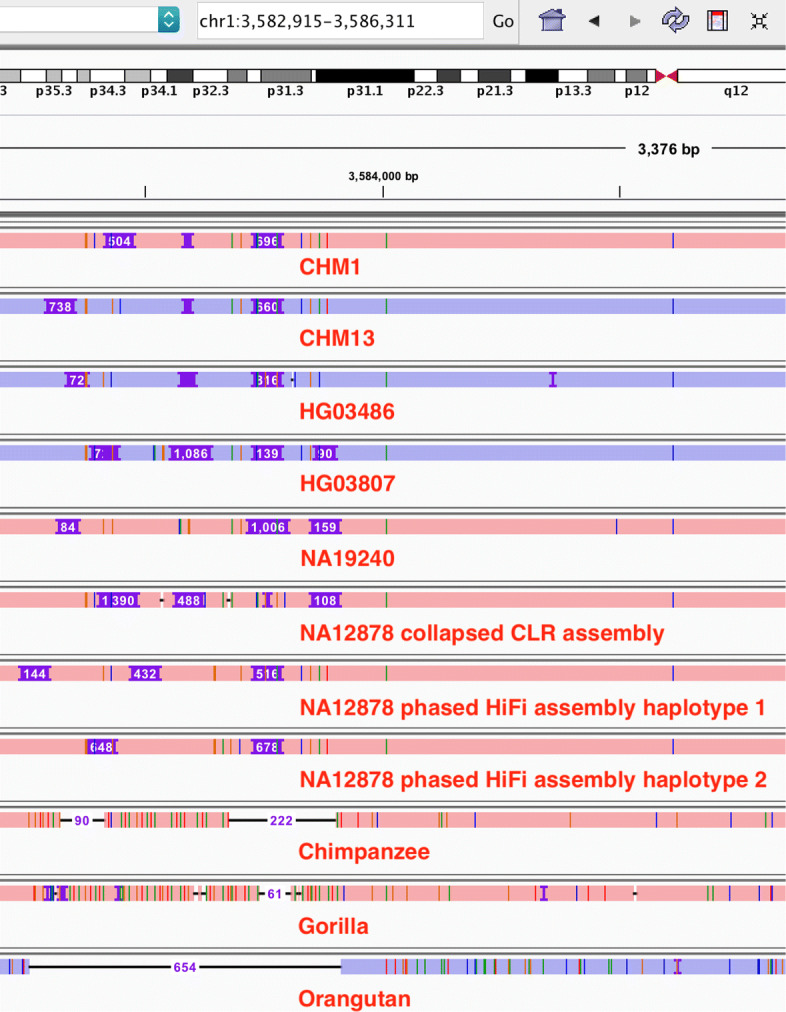
“We manually inspected tens of differences in IGV [42] and identified two causes.”
MethodMinimap2: Pairwise alignment for nucleotide sequences
Li, H. (2018) · Bioinformatics · doi:10.1093/bioinformatics/bty191 · Cited by 14,807 · cited 3×
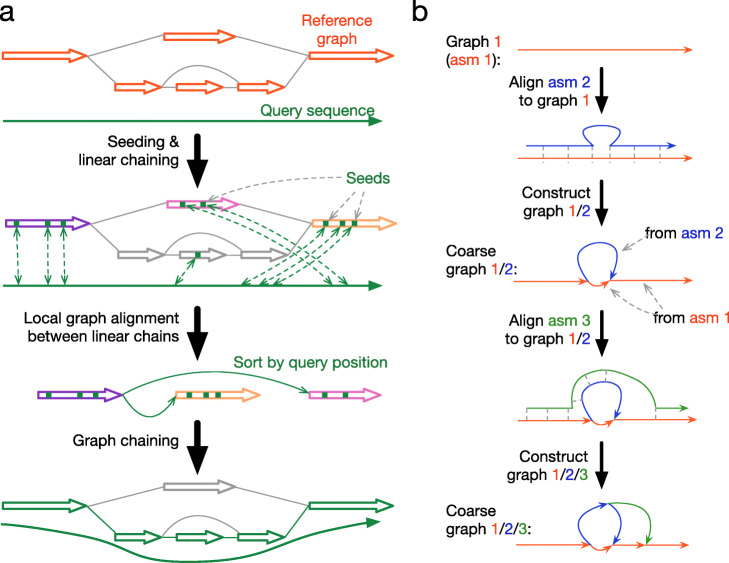
“As existing sequence-to-graph aligners [38, 39] do not work with chromosomelong query sequences, we adapted minimap2 [40] for our purpose and implemented minigraph (Fig.”
BackgroundMethodInfluentialSelf-citationA framework for variation discovery and genotyping using next-generation DNA sequencing data
DePristo, M. A., Banks, E., Poplin, R., Garimella, K. V., Maguire, J. R., Hartl, C., Philippakis, A. A., del Angel, G., Rivas, M. A., Hanna, M., et al. (2011) · Nature Genetics · doi:10.1038/ng.806 · Cited by 11,456 · cited 1×
“1.2 [46].”
InfluentialUsing RepeatMasker to Identify Repetitive Elements in Genomic Sequences
Tarailo‐Graovac, M., & Chen, N. (2009) · Current Protocols in Bioinformatics · doi:10.1002/0471250953.bi0410s25 · Cited by 3,398
Wenger, A. M., Peluso, P., Rowell, W. J., Chang, P.-C., Hall, R. J., Concepcion, G. T., Ebler, J., Fungtammasan, A., Kolesnikov, A., Olson, N. D., et al. (2019) · Nature Biotechnology · doi:10.1038/s41587-019-0217-9 · Cited by 1,841 · cited 1×
“iting factor in our understanding of genetic variations. Meanwhile, the advances in long-read sequencing technologies make it possible to assemble a human individual to a quality comparable to GRCh38 [1,5]. There are already a dozen of high-quality human assemblies available in GenBank [6]. Properly integrating these…”
BackgroundSelf-citationThe ENCODE Blacklist: Identification of Problematic Regions of the Genome
Amemiya, H. M., Kundaje, A., & Boyle, A. P. (2019) · Scientific Reports · doi:10.1038/s41598-019-45839-z · Cited by 1,831 · cited 1×
“We constructed a human pangenome graph excluding CHM1 and CHM13, the two samples used in the SynDip benchmark [4], and generated regions around variations (see Methods), which we call as blacklist regions, following the rationale in [45].”
MethodMissing heritability and strategies for finding the underlying causes of complex disease
Eichler, E. E., Flint, J., Gibson, G., Kong, A., Leal, S. M., Moore, J. H., & Nadeau, J. H. (2010) · Nature Reviews Genetics · doi:10.1038/nrg2809 · Cited by 1,687 · cited 1×
“Some of these variants are likely associated with phenotype [3] but are often missed or misinterpreted when we map sequence data to GRCh38, in particular with short reads [4].”
BackgroundHigh-quality draft assemblies of mammalian genomes from massively parallel sequence data
Gnerre, S., MacCallum, I., Przybylski, D., Ribeiro, F. J., Burton, J. N., Walker, B. J., Sharpe, T., Hall, G., Shea, T. P., Sykes, S., et al. (2011) · Proceedings of the National Academy of Sciences · doi:10.1073/pnas.1017351108 · Cited by 1,533 · cited 1×
“In a de Bruijn graph, we often attach sequences to edges instead of vertices [36, 37].”
BackgroundMinimap and miniasm: fast mapping and de novo assembly for noisy long sequences
Li, H. (2016) · Bioinformatics · doi:10.1093/bioinformatics/btw152 · Cited by 1,508 · cited 6×
“As there are no text formats for sequence-to-graph alignment, we propose a new Graphical mApping Format (GAF) by extending the Pairwise mApping Format (PAF) [35].”
BackgroundMethodInfluentialSelf-citation
Cited by
Haplotype-resolved de novo assembly using phased assembly graphs with hifiasm
Cheng, H., Concepcion, G. T., Feng, X., Zhang, H., & Li, H. (2021) · Nature Methods · doi:10.1038/s41592-020-01056-5 · Cited by 5,859
Self-citationThe complete sequence of a human genome
Nurk, S., Koren, S., Rhie, A., Rautiainen, M., Bzikadze, A. V., Mikheenko, A., Vollger, M. R., Altemose, N., Uralsky, L., Gershman, A., et al. (2022) · Science · doi:10.1126/science.abj6987 · Cited by 3,136
Self-citationNew strategies to improve minimap2 alignment accuracy
Li, H. (2021) · Bioinformatics · doi:10.1093/bioinformatics/btab705 · Cited by 1,236
“This has inspired new chaining algorithms (Li et al., 2020; Ren and Chaisson, 2021) which are not integrated into minimap2.”
MethodSelf-citationA draft human pangenome reference.
Liao, W.-W., Asri, M., Ebler, J., Doerr, D., Haukness, M., Hickey, G., Lu, S., Lucas, J. K., Monlong, J., Abel, H. J., et al. (2023) · Nature · doi:10.1038/s41586-023-05896-x · Cited by 1,129
“The SV sites were then annotated as described in the Methods section of minigraph paper (Li et al., 2020).”
BackgroundMethodInfluentialSelf-citationPlant pan-genomes are the new reference
Bayer, P. E., Golicz, A. A., Scheben, A., Batley, J., & Edwards, D. (2020) · Nature Plants · doi:10.1038/s41477-020-0733-0 · Cited by 550
Metadata
- Authors
- Li, H., Feng, X., & Chu, C.
- Affiliations
- Harvard University (US)
- Corresponding author
- Li, Heng
- Venue
- Genome Biology
- Published
- 2020-10-16
- Volume
- 21
- Issue
- 1
- Pages
- 265-265
- ISSN
- 1465-6906 (ISSN-L)
- 1474-760X
- PMC
- PMC7568353
- OpenAlex
- W3092652421
- Semantic Scholar
- 4aa51fbe41e6588e59c8f9f7aaaaac3c83a56019
- Cited by
- 455
- References
- 68
- Citations by year
- 2026: 70 · 2025: 101 · 2024: 93 · 2023: 68 · 2022: 67 · 2021: 50 · 2020: 5
- FWCI
- 15.48
- Type
- journal article
- Language
- en
- Open access
- gold
- doi.org
- Licence
- cc-by
- creativecommons.org/licenses/by/4.0 (tdm)
- creativecommons.org/licenses/by/4.0 (vor)
- Locations
- Genome biology (publishedVersion, cc-by)
- PubMed Central (publishedVersion, cc-by)
- PubMed (publishedVersion)
- DOAJ (DOAJ: Directory of Open Access Journals) (submittedVersion, cc-by-sa)
- Funders
- National Institutes of Health
- National Human Genome Research Institute (U01HG010961, R01HG010040)
- Topics
- Life Sciences › Biochemistry, Genetics and Molecular Biology › Molecular Biology › Genomics and Phylogenetic Studies
- Life Sciences › Biochemistry, Genetics and Molecular Biology › Genetics › Genome Rearrangement Algorithms
- Physical Sciences › Mathematics › Theoretical Computer Science › Algorithms and Data Compression
- Keywords
- pangenome graphs, Minigraph, reference genome, structural variants, graph-based data model, genome assembly, coordinate alignment, chromosomal integration
- MeSH terms
- Animals, Humans, Reference Standards, Genome, Human, Genomics, Genomic Structural Variation
About these checks
Registry, retraction, Cites and statistics results are computed, not judged, with one exception: a printed reference that no index lists is read once by a model before it counts as a citation error. Claims are extracted by a model and kept only when their quote appears verbatim in the text; each cited source is then checked, with a model’s help, for whether it says what the claim relies on. Those verdicts can be wrong — read the claim’s quote and the cited source before relying on one.
Statistics and arithmetic are recomputed, not judged.
Confidence bands are shown only for fields calibrated on our annotated test set. None is calibrated yet, so no band is shown.
What counts as a claim ›How we measure confidence ›How we check this ›
Are you an author, or do you see a problem with this page? Request a review
Data sources
Bibliographic data: Semantic Scholar, OpenAlex, Crossref.
Contains information from the Semantic Scholar Academic Graph Datasets, made available under the ODC Attribution License (ODC-BY 1.0).
Semantic Scholar’s data is described in: Kinney, R., et al. (2023). The Semantic Scholar Open Data Platform. arXiv:2301.10140.
