

A phase II study in advanced cancer patients to evaluate the early transition to palliative care (the PREPArE trial): protocol study for a randomized controlled trial.
Open accessThe DOI matches its Crossref record; 34 of the 38 references it cites were found in a registry or an index; 8 of the 20 sources its claims cite were checked for support.
Abstract
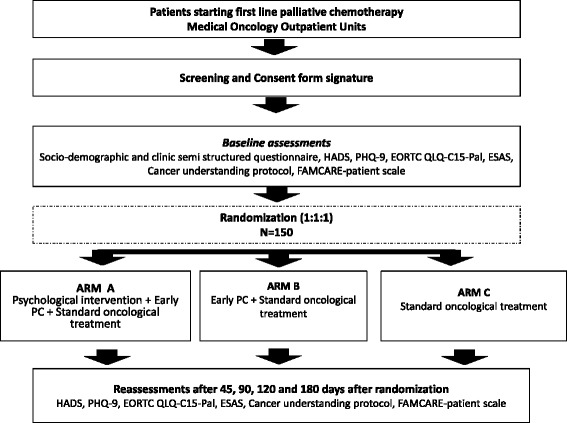
Background: Previous studies have demonstrated the benefit of early integration of palliative care (PC) in oncology. However, patients continue to receive late referrals to PC even in comprehensive cancer centers. Patients and health professionals may perceive PC as 'a place to die,' and this stigma is a barrier to timely referrals and to patient acceptance of treatment.Methods/design: The primary objective is to evaluate the feasibility of psychosocial intervention and PC in patients with advanced cancer. The patients will be submitted to a series of brief psychosocial interventions that are based on cognitive behavioral therapy, and patient acceptance and satisfaction will be assessed. In addition, the impact of these interventions on depressive symptoms will be evaluated. A randomized, open-label, phase II trial with two intervention arms and a control group will be conducted. Patients who are started on palliative chemotherapy and who meet the inclusion criteria will be enrolled. The study participants will be recruited from the outpatient oncology clinics at Barretos Cancer Hospital and will be randomized into one of the following three treatment arms: Arm A, which will include five weekly psychosocial interventions based on CBT in combination with early PC; Arm B, which will include early PC only; and Arm C, which will include standard oncologic care. The Hospital Anxiety and Depression Scale (HADS), the Patient Health Questionnaire (PHQ-9), the Edmonton Symptom Assessment System (ESAS-br), the Family Satisfaction with End-of-Life Care (FAMCARE)-Patient scale, and the Disease Understanding Protocol will be used for data collection. The patients will answer these questionnaires at baseline and 45, 90, 120 and 180 days after randomization.Discussion: Despite evidence of the positive impact of early PC, it is often provided to patients only at later stages. The inadequate awareness and stigmatization of PC as a place to die are barriers that complicate the early referral. Patients with advanced cancer may benefit from a psychosocial and educational strategy that adequately prepares them for initial PC appointments after an early referral to PC. We anticipate that benefits of psychological intervention shall be synergistic to secondary emotional benefits from the early integration of PC.Trial Registration: This trial was registered on 6 May 2014 with ClinicalTrials.gov (identifier: NCT02133274).
Overview
CoChat Summary
TL;DR
This is a randomized, open-label phase II trial protocol testing whether early palliative care, with or without a brief CBT-based psychosocial intervention, can improve feasibility, satisfaction, and depressive symptoms in advanced cancer patients starting palliative chemotherapy. The study is designed as a three-arm trial at Barretos Cancer Hospital and emphasizes feasibility and acceptability rather than definitive efficacy.
Key findings
- The trial’s primary objectives are to assess feasibility of a brief CBT-based psychosocial intervention plus early palliative care and to measure patient acceptance/satisfaction, as well as depressive symptoms at 90 days.
- Participants will be randomized 1:1:1 into three arms: Arm A, five weekly CBT-based psychosocial sessions plus early palliative care; Arm B, early palliative care only; Arm C, standard oncologic care.
- Sample size planning targeted 39 patients per arm for the main comparison, and 50 patients per arm allowing for a 25%–30% loss rate; the interim analysis is planned after 20 participants with complete data in each arm.
- The protocol specifies repeated assessments at baseline and 45, 90, 120, and 180 days using HADS, PHQ-9, ESAS-br, FAMCARE-Patient, EORTC QLQ-C15-Pal, and a disease awareness measure.
Methods
- Randomized, open-label, phase II clinical trial with two intervention arms and one control arm, conducted among patients starting first-line palliative chemotherapy.
- Eligible patients are adults aged 18 to <75 years with advanced cancer diagnoses, ECOG performance status ≤2, and estimated life expectancy >6 and <24 months; patients with current psychological treatment, antidepressant use for depressive disorders/anxiety, or existing regular palliative care follow-up are excluded.
- Main analysis includes ANOVA/chi-squared tests for baseline comparisons, mixed-model ANOVA for repeated measures of depression, anxiety, and quality of life, and chi-squared or Fisher’s exact tests for disease awareness and invasive end-of-life procedures.
Limitations
- The paper explicitly states that the main limitation is the small sample size; it describes the study as preliminary and notes that a larger confirmatory study may be needed.
- The text also states that patients with underlying psychological problems are excluded, which may limit generalizability to the broader advanced cancer population.
- Evident from the protocol design: no results are reported here because this is a study protocol, so no intervention effects or feasibility outcomes are available yet.
Model-written summary. Check it against the paper before relying on it.
Integrity signals
Registry
Cites
Statistics
Figures
Verification
Claims the paper makes
6 Valid · 1 Not valid · 9 Not checked · 10 Own results and interpretations
Every source the paper cites for this claim was checked and supports it.
In the paper
“However, patients continue to receive late referrals to PC even in comprehensive cancer centers.”
- Also stated in: § Background · plain
“Despite evidence of the positive impact of early PC on the progress of cancer patients, PC is often provided to patients at later stages even at oncology and PC reference centers [9].”
- Also stated in: § Discussion · hedged
“Patients are most likely referred to PC too late even at oncology reference centers [9].”
§ A phase II study in advanced cancer patients to evaluate the early transition to palliative care (the PREPArE trial): protocol study for a randomized controlled trial > Abstract > Background
What the sources say
- Supportedcites [9] Hui D Kim S-H Kwon JH Tanco KC Zhang T Kang JH Access to palliative care among patients treated at a comprehensive cancer center Oncologist 2012 17 1574 80 10.1634/theoncologist.2012-0192 23220843 PMC3528390 source
The Abstract concludes that palliative care referrals at the comprehensive cancer center occurred late in the disease process, with many missed opportunities for earlier referral. The Introduction also says palliative care is routinely delivered very late to patients with advanced cancer. (LLM, conf=0.94)
plain- Asserted: passes — The authors put it forward as true.
- Checkable: passes — It can be checked against evidence.
- Load-bearing: passes — The paper’s conclusions depend on it.
- Based: passes — The paper gives a reason why it holds.
- Also stated in: § Background · plain
In the paper
“A post-hoc analysis inclusively demonstrated a 2.7-month increase in the overall survival rate of patients who received PC.”
§ A phase II study in advanced cancer patients to evaluate the early transition to palliative care (the PREPArE trial): protocol study for a randomized controlled trial > Background
What the sources say
- Not checked — no full text of the sourcecites [6] Temel JS Greer JA Muzikansky A Gallagher ER Admane S Jackson VA Early palliative care for patients with metastatic non-small-cell lung cancer N Engl J Med 2010 363 733 42 10.1056/NEJMoa1000678 20818875 source
boostedstates a cause- Asserted: passes — The authors put it forward as true.
- Checkable: passes — It can be checked against evidence.
- Load-bearing: passes — The paper’s conclusions depend on it.
- Based: passes — The paper gives a reason why it holds.
What the paper did — it cites no source for this, so there is none to check. The quote shows it is in the paper.
In the paper
“The main limitation is the small sample size.”
§ A phase II study in advanced cancer patients to evaluate the early transition to palliative care (the PREPArE trial): protocol study for a randomized controlled trial > Discussion
plain- Asserted: passes — The authors put it forward as true.
- Checkable: passes — It can be checked against evidence.
- Load-bearing: passes — The paper’s conclusions depend on it.
- Based: passes — The paper gives a reason why it holds.
In the paper
“The ESAS-br was associated with adequate psychometric properties when used in a Brazilian population (Paiva et al., unpublished data).”
§ A phase II study in advanced cancer patients to evaluate the early transition to palliative care (the PREPArE trial): protocol study for a randomized controlled trial > Methods/design > Measures
What the sources say
- Not matchedcites Paiva et al., unpublished data
This doesn’t read as a citation we can look up.
plainstates an association- Asserted: passes — The authors put it forward as true.
- Checkable: passes — It can be checked against evidence.
- Load-bearing: unclear — It is unclear whether the paper’s conclusions depend on it.
- Based: passes — The paper gives a reason why it holds.
- Not matched
What the paper did — it cites no source for this, so there is none to check. The quote shows it is in the paper.
In the paper
“A study of this size will have 80% power to detect differences between Arms A plus B versus Arm C on the depression symptom scores associated with an effect size of 0.5 and alpha of 5%.”
§ A phase II study in advanced cancer patients to evaluate the early transition to palliative care (the PREPArE trial): protocol study for a randomized controlled trial > Methods/design > Sample size calculation
plainstates an association- Asserted: passes — The authors put it forward as true.
- Checkable: passes — It can be checked against evidence.
- Load-bearing: passes — The paper’s conclusions depend on it.
- Based: passes — The paper gives a reason why it holds.
1 more claim
Create a free account to see all 26 claims and every source verdict.
- It may state two separate claims as one. 14
- Probably not a substantial claim. 11
Citations
Cites
Statistical Power Analysis for the Behavioral Sciences
Muller, K. (1989) · Technometrics · doi:10.1080/00401706.1989.10488618 · Cited by 99,167
Faul, F., Erdfelder, E., Lang, A.-G., & Buchner, A. (2007) · Behavior Research Methods · doi:10.3758/bf03193146 · Cited by 65,971 · cited 2×
“0 (Heinrich-Heine-Universität, Düsseldorf, Germany) [28] was used to calculate the minimum sample size required for this study.”
MethodInfluentialStatistical power analysis for the behavioral sciences
(1990) · Computers, Environment and Urban Systems · doi:10.1016/0198-9715(90)90050-4 · Cited by 65,269
The Hospital Anxiety and Depression Scale
Zigmond, A. S., & Snaith, R. P. (1983) · Acta Psychiatrica Scandinavica · doi:10.1111/j.1600-0447.1983.tb09716.x · Cited by 47,139
The PHQ-9: Validity of a brief depression severity measure
Kroenke, K., Spitzer, R. L., & Williams, J. B. W. (2001) · Journal of General Internal Medicine · doi:10.1046/j.1525-1497.2001.016009606.x · Cited by 44,910
An analysis of variance test for normality (complete samples)
SHAPIRO, S. S., & WILK, M. B. (1965) · Biometrika · doi:10.1093/biomet/52.3-4.591 · Cited by 23,480
Depression and quality of life in older persons: A review
Sivertsen, H., Bjørkløf, G. H., Engedal, K., Selbæk, G., & Helvik, A.-S. (2015) · Dementia and Geriatric Cognitive Disorders · doi:10.1159/000437299 · Cited by 14,152
Early Palliative Care for Patients with Metastatic Non–Small-Cell Lung Cancer
Temel, J. S., Greer, J. A., Muzikansky, A., Gallagher, E. R., Admane, S., Jackson, V. A., Dahlin, C. M., Blinderman, C. D., Jacobsen, J., Pirl, W. F., et al. (2010) · New England Journal of Medicine · doi:10.1056/nejmoa1000678 · Cited by 7,482 · cited 3×
“Identifying the reasons patients are referred to PC services is essential because of the benefits of early PC in patients with advanced cancer [6-8,29].”
BackgroundGuillemin, F., Bombardier, C., & Beaton, D. (1993) · Journal of Clinical Epidemiology · doi:10.1016/0895-4356(93)90142-n · Cited by 6,060
Bruera, E., Kuehn, N., Miller, M. J., Selmser, P., & Macmillan, K. (1991) · Journal of Palliative Care · doi:10.1177/082585979100700202 · Cited by 2,683 · cited 1×
“The Brazilian version of the Edmonton Symptom Assessment Scale (ESAS-br) consists of a visual numeric scale with scores of 0 to 10 to assess ten symptoms, including pain, fatigue, drowsiness, nausea, depression, anxiety, loss of appetite, feeling of wellness, breathlessness, and insomnia [19].”
MethodEarly palliative care for patients with advanced cancer: a cluster-randomised controlled trial
Zimmermann, C., Swami, N., Krzyzanowska, M., Hannon, B., Leighl, N., Oza, A., Moore, M., Rydall, A., Rodin, G., Tannock, I., et al. (2014) · The Lancet · doi:10.1016/s0140-6736(13)62416-2 · Cited by 1,781 · cited 2×
“Identifying the reasons patients are referred to PC services is essential because of the benefits of early PC in patients with advanced cancer [6-8,29].”
BackgroundBakitas, M., Lyons, K. D., Hegel, M. T., Balan, S., Brokaw, F. C., Seville, J., Hull, J. G., Li, Z., Tosteson, T. D., Byock, I. R., et al. (2009) · JAMA · doi:10.1001/jama.2009.1198 · Cited by 1,726 · cited 3×
“Identifying the reasons patients are referred to PC services is essential because of the benefits of early PC in patients with advanced cancer [6-8,29].”
BackgroundBotega, N. J., Bio, M. R., Zomignani, M. A., Garcia Jr, C., & Pereira, W. A. B. (1995) · Revista de Saúde Pública · doi:10.1590/s0034-89101995000500004 · Cited by 826
Global Atlas of Palliative Care at the End of Life
Worldwide Palliative Care Alliance (2014) · Cited by 772
The changing model of palliative care
Graham, F., & Clark, D. (2008) · Medicine · doi:10.1016/j.mpmed.2007.11.009 · Cited by 743
Groenvold, M., Petersen, M. A., Aaronson, N. K., Arraras, J. I., Blazeby, J. M., Bottomley, A., Fayers, P. M., de Graeff, A., Hammerlid, E., Kaasa, S., et al. (2006) · European Journal of Cancer · doi:10.1016/j.ejca.2005.06.022 · Cited by 678 · cited 1×
“The QLQ-C15-Pal assesses two functional scales (physical and emotional), two symptom scales (fatigue and pain), and five single-item scales (nausea/vomiting, dyspnea, insomnia, loss of appetite, and constipation) [17].”
BackgroundSantos, I. S., Tavares, B. F., Munhoz, T. N., de Almeida, L. S. P., da Silva, N. T. B., Tams, B. D., Patella, A. M., & Matijasevich, A. (2013) · Cadernos de Saúde Pública · doi:10.1590/0102-311x00144612 · Cited by 669
Santos, I. S., Tavares, B. F., Munhoz, T. N., Almeida, L. S. P. D., Silva, N. T. B. D., Tams, B. D., Patella, A. M., & Matijasevich, A. (2013) · Cadernos de Saúde Pública · doi:10.1590/s0102-311x2013001200006 · Cited by 415
Santos, I. S., Tavares, B. F., Munhoz, T. N., de Almeida, L. S. P., da Silva, N. T. B., Tams, B. D., Patella, A. M., & Matijasevich, A. (2013) · LA Referencia (Red Federada de Repositorios Institucionales de Publicaciones Científicas) · Cited by 367
The Science of Cognitive Therapy
Hofmann, S. G., Asmundson, G. J. G., & Beck, A. T. (2013) · Behavior Therapy · doi:10.1016/j.beth.2009.01.007 · Cited by 366 · cited 1×
“CBT is based on the premise that cognition affects behavior; however, cognition may be monitored and changed and the desired behavioral change may be achieved through cognitive change [31].”
BackgroundGreer, J. A., Jackson, V. A., Meier, D. E., & Temel, J. S. (2013) · CA: A Cancer Journal for Clinicians · doi:10.3322/caac.21192 · Cited by 345 · cited 1×
“Identifying the reasons patients are referred to PC services is essential because of the benefits of early PC in patients with advanced cancer [6-8,29].”
BackgroundBruera, E., & Hui, D. (2010) · Journal of Clinical Oncology · doi:10.1200/jco.2010.29.5618 · Cited by 305 · cited 1×
“by a PC team for advanced cancer patients who are submitted to e ‘Goals of Care’ [35]”
BackgroundKristjanson, L. J. (1993) · Social Science & Medicine · doi:10.1016/0277-9536(93)90066-d · Cited by 261 · cited 1×
“The Family Satisfaction with End-of-Life Care (FAMCARE)-Patient scale, originally titled FAMCARE, was developed to assess the satisfaction of family caregivers of advanced cancer patients with healthcare [20].”
Access to Palliative Care Among Patients Treated at a Comprehensive Cancer Center
Hui, D., Kim, S.-H., Kwon, J. H., Tanco, K. C., Zhang, T., Kang, J. H., Rhondali, W., Chisholm, G., & Bruera, E. (2012) · The Oncologist · doi:10.1634/theoncologist.2012-0192 · Cited by 218 · cited 2×
“Patients are most likely referred to PC too late even at oncology reference centers [9].”
BackgroundTransitions to palliative care in acute hospitals in England: qualitative study: Table 1
Gott, M., Ingleton, C., Bennett, M. I., & Gardiner, C. (2011) · BMJ Supportive & Palliative Care · doi:10.1136/bmj.d1773 · Cited by 157 · cited 1×
“The inadequate awareness and stigmatization of PC, which is perceived as a place to die, are barriers that complicate the early referral of patients to PC [10,11].”
BackgroundTeam working: palliative care as a model of interdisciplinary practice
Crawford, G. B., & Price, S. D. (2003) · Medical Journal of Australia · doi:10.5694/j.1326-5377.2003.tb05575.x · Cited by 131 · cited 1×
“Therefore, PC should be provided by a multidisciplinary team that acts integrally in outpatient, hospital, and/or home environments [4,5].”
BackgroundGreer, J. A., Traeger, L., Bemis, H., Solis, J., Hendriksen, E. S., Park, E. R., Pirl, W. F., Temel, J. S., Prigerson, H. G., & Safren, S. A. (2012) · The Oncologist · doi:10.1634/theoncologist.2012-0041 · Cited by 111 · cited 1×
“Evidence suggests that CBT may benefit advanced-stage cancer patients by reducing anxiety symptoms, improving QL [33], and decreasing psychiatric disorders, which have been observed in cancer patients who were classified as high-risk for the development of such disorders [25].”
BackgroundThe FAMCARE-Patient scale: Measuring satisfaction with care of outpatients with advanced cancer
Lo, C., Burman, D., Hales, S., Swami, N., Rodin, G., & Zimmermann, C. (2009) · European Journal of Cancer · doi:10.1016/j.ejca.2009.09.003 · Cited by 105 · cited 1×
“The most current version of the scale includes 13 items with 5-point Likert-type scale responses that range from ‘very dissatisfied’ (a score of 1) to ‘very satisfied’ (a score of 5) [22].”
BackgroundLo, C., Burman, D., Rodin, G., & Zimmermann, C. (2009) · Quality of Life Research · doi:10.1007/s11136-009-9494-y · Cited by 86 · cited 1×
“[21] modified the original items to transform this instrument into a 16-item scale for assessing the satisfaction of patients with advanced cancer who undergo outpatient treatment.”
MethodPitceathly, C., Maguire, P., Fletcher, I., Parle, M., Tomenson, B., & Creed, F. (2009) · Annals of Oncology · doi:10.1093/annonc/mdn708 · Cited by 84 · cited 2×
“The care protocol that was developed for the present study was based on the method of structuring sessions as proposed by Beck [24] and was adapted from a previous study [25].”
BackgroundMethodMiyashita, M., Hirai, K., Morita, T., Sanjo, M., & Uchitomi, Y. (2008) · Supportive Care in Cancer · doi:10.1007/s00520-007-0215-1 · Cited by 72 · cited 1×
“The inadequate awareness and stigmatization of PC, which is perceived as a place to die, are barriers that complicate the early referral of patients to PC [10,11].”
BackgroundNunes, N. A. H. (2014) · Supportive Care in Cancer · doi:10.1007/s00520-014-2119-1 · Cited by 45 · cited 1×
“The EORTC-QLQ-C15-Pal was validated for use in Brazil in 2013 with adequate psychometric properties [18].”
MethodDastan, N. B., & Buzlu, S. (2012) · Asian Pacific Journal of Cancer Prevention · doi:10.7314/apjcp.2012.13.10.5313 · Cited by 38 · cited 1×
“A broad sharing of experiences and lessons by other patients with advanced cancer was observed [34].”
BackgroundPAIVA, C. E., FARIA, C. B., NASCIMENTO, M. S. D. A., DOS SANTOS, R., SCAPULATEMPO, H. H. L. R. C., COSTA, E., & PAIVA, B. S. R. (2012) · European Journal of Cancer Care · doi:10.1111/j.1365-2354.2011.01298.x · Cited by 32 · cited 1×
“Patients who are referred to PC are often anxious at the first appointment [12], which leads to a high absenteeism rate.”
BackgroundSelf-citationPsicoterapias cognitivo-comportamentais: um diálogo com a psiquiatria
Rangé, B. (2001) · Cited by 29
Working With a Palliative Care Team
Wiebe, L. A., & Von Roenn, J. H. (2010) · The Cancer Journal · doi:10.1097/ppo.0b013e3181f28ae6 · Cited by 24 · cited 1×
“Therefore, PC should be provided by a multidisciplinary team that acts integrally in outpatient, hospital, and/or home environments [4,5].”
Background
Research works printed but not linked: 2
- Beck J Terapia Cognitiva: Teoria E Prática 1997 Porto Alegre Artmed
- Beck AT Alford BA O Poder Integrador Da Terapia Cognitiva 2000 Porto Alegre Artes Médicas Sul
Cited by
Early palliative care for adults with advanced cancer
Haun, M. W., Estel, S., Rücker, G., Friederich, H.-C., Villalobos, M., Thomas, M., & Hartmann, M. (2017) · Cochrane Database of Systematic Reviews · doi:10.1002/14651858.cd011129.pub2 · Cited by 757
Care transition strategies in Latin American countries: an integrative review
Lima, M. A. D. D. S., de Magalhães, A. M. M., Oelke, N. D., Marques, G. Q., Lorenzini, E., Weber, L. A. F., & Fan, I. (2018) · Revista gaúcha de enfermagem · doi:10.1590/1983-1447.2018.20180119 · Cited by 116
Is Early Palliative Care Feasible in Patients With Multiple Myeloma?
Porta-Sales, J., Guerrero-Torrelles, M., Moreno‐Alonso, D., Escarre, J. S., Clapés, V., Trelis-Navarro, J., Sureda, A. M., & Sevilla-Ribosa, A. F. D. (2017) · Journal of Pain and Symptom Management · doi:10.1016/j.jpainsymman.2017.04.012 · Cited by 80
Schapira, M. C., Outumuro, M. B., Giber, F., Pino, C., Mattiussi, M., Montero‐Odasso, M., Boietti, B. R., Saimovici, J. M., Gallo, C., Hornstein, L., et al. (2021) · Aging Clinical and Experimental Research · doi:10.1007/s40520-021-01893-0 · Cited by 45
do Carmo, T. M., Paiva, B. S. R., de Oliveira, C. Z., Nascimento, M. S. D. A., & Paiva, C. E. (2017) · BMC Cancer · doi:10.1186/s12885-017-3560-6 · Cited by 40
“The interventions performed in the present study are described in full detail in a previous publication [12].”
MethodInfluentialSelf-citation
Metadata
- Authors
- do Carmo, T. M., Paiva, B. S. R., de Siqueira, M. R., da Rosa, L. D. T. B., de Oliveira, C. Z., Nascimento, M. S. D. A., & Paiva, C. E.
- Affiliations
- Hospital de Câncer de Barretos (BR)
- Corresponding author
- Paiva, Carlos Eduardo
- Venue
- Trials
- Published
- 2015-04-12
- Volume
- 16
- Issue
- 1
- Pages
- 160-160
- ISSN
- 1745-6215 (ISSN-L)
- PMC
- PMC4413544
- OpenAlex
- W2056429043
- Semantic Scholar
- f2e2e37e3e4fd6de684a7c391644ad446e33a5d7
- Cited by
- 12
- References
- 38
- Citations by year
- 2026: 2 · 2024: 1 · 2021: 1 · 2020: 2 · 2018: 1 · 2017: 4 · 2016: 1
- Type
- conference abstract
- Language
- en
- Open access
- gold
- doi.org
- Locations
- Trials (publishedVersion, cc-by)
- PubMed Central (publishedVersion, cc-by)
- PubMed (publishedVersion)
- Funders
- Fundação de Amparo à Pesquisa do Estado de São Paulo (2014/, 14/22052-5)
- Topics
- Health Sciences › Medicine › Public Health, Environmental and Occupational Health › Palliative Care and End-of-Life Issues
- Health Sciences › Medicine › Public Health, Environmental and Occupational Health › Palliative and Oncologic Care
- Health Sciences › Medicine › Oncology › Cancer survivorship and care
- Keywords
- early palliative care, advanced cancer, palliative care referral, psychosocial interventions, cognitive behavioral therapy, palliative chemotherapy, depressive symptoms, anxiety, symptom burden, end-of-life care, patient satisfaction, family satisfaction, disease understanding
- MeSH terms
- Transitional Care, Adaptation, Psychological, Adolescent, Adult, Aged, Brazil, Clinical Protocols, Feasibility Studies, Female, Humans, Health Knowledge, Attitudes, Practice, Male, Middle Aged, Neoplasms, Palliative Care, Patient Education as Topic, Quality of Life, Surveys and Questionnaires, Referral and Consultation, Research Design, Time Factors, Cognitive Behavioral Therapy, Treatment Outcome, Patient Satisfaction, Disease Progression, Young Adult
About these checks
Registry, retraction, Cites and statistics results are computed, not judged, with one exception: a printed reference that no index lists is read once by a model before it counts as a citation error. Claims are extracted by a model and kept only when their quote appears verbatim in the text; each cited source is then checked, with a model’s help, for whether it says what the claim relies on. Those verdicts can be wrong — read the claim’s quote and the cited source before relying on one.
The claim verdicts this report counts are experimental: their accuracy is not yet measured.
A language model drew the claims from the paper on 2026-10-11, under version 3 of the claim definition (model deepseek-v4.1-flash, prompt extract-v3).
A second model labelled each claim on 2026-10-11 (model jev-1.13-20260917, definition revision gold-guideline-v0.2).
Cited sources are checked with a language model’s help (gpt-6-sol).
Statistics and arithmetic are recomputed, not judged.
Confidence bands are shown only for fields calibrated on our annotated test set. None is calibrated yet, so no band is shown.
What counts as a claim ›How we measure confidence ›How we check this ›
Are you an author, or do you see a problem with this page? Request a review
Data sources
Bibliographic data: Semantic Scholar, OpenAlex, Crossref.
Contains information from the Semantic Scholar Academic Graph Datasets, made available under the ODC Attribution License (ODC-BY 1.0).
Semantic Scholar’s data is described in: Kinney, R., et al. (2023). The Semantic Scholar Open Data Platform. arXiv:2301.10140.
