

Online parent-targeted cognitive-behavioural therapy intervention to improve quality of life in families of young cancer survivors: study protocol for a randomised controlled trial.
Open accessThe DOI matches its Crossref record; 75 of the 77 references it cites were found in a registry or an index; 17 of the 53 sources its claims cite were checked for support.
Abstract
Background: Due to advances in multimodal therapies, most children survive cancer. In addition to the stresses of diagnosis and treatment, many families are now navigating the challenges of survivorship. Without sufficient support, the ongoing distress that parents experience after their child's cancer treatment can negatively impact the quality of life and psychological wellbeing of all family members.Methods/design: The 'Cascade' (Cope, Adapt, Survive: Life after C AncEr) study is a three-arm randomised controlled trial to evaluate the feasibility and efficacy of a new intervention to improve the quality of life of parents of young cancer survivors. Cascade will be compared to a peer-support group control and a 6-month waitlist control. Parents (n = 120) whose child (under 16 years of age) has completed cancer treatment in the past 1 to 12 months will be recruited from hospitals across Australia. Those randomised to receive Cascade will participate in four, weekly, 90-minute online group sessions led live by a psychologist. Cascade involves peer discussion on cognitive-behavioural coping skills, including behavioural activation, thought challenging, mindfulness and acceptance, communication and assertiveness skills training, problem-solving and goal-setting. Participants randomised to peer support will receive four, weekly, 90-minute, live, sessions of non-directive peer support. Participants will complete measures at baseline, directly post-intervention, one month post-intervention, and 6 months post-intervention. The primary outcome will be parents' quality of life. Secondary outcomes include parent depression, anxiety, parenting self-agency, and the quality of life of children in the family. The child cancer survivor and all siblings aged 7 to 15 years will be invited to complete self-report quality of life measures covering physical, emotional, social and school-related domains.Discussion: This article reviews the empirical rationale for group-based, online cognitive-behavioural therapy in parents of children who have recently finished cancer treatment. The potential challenges of delivering skills-based programs online are highlighted. Cascade's videoconferencing technology has the potential to address the geographic and psychological isolation of families after cancer treatment. Teaching parents coping skills as they resume their normal lives after their child's cancer may see long-term benefits for the quality of life of the family as a whole.Trial Registration: ACTRN12613000270718 (registered 6 March 2013).
Overview
CoChat Summary
## TL;DR
This is a study protocol for a three-arm randomized controlled trial testing Cascade, an online CBT-based group intervention for parents of children who recently completed cancer treatment, against peer support and waitlist control. The trial is designed to assess feasibility and whether Cascade improves parents’ quality of life and related psychosocial outcomes.
## Key findings
- The planned trial will recruit 120 parents of children under 16 years who completed cancer treatment with curative intent in the past 12 months, with about 40 per arm.
- The study’s primary outcome is parents’ quality of life, measured with the PedsQL Family Impact Module; secondary outcomes include parent depression, anxiety, parenting self-agency, and children’s quality of life.
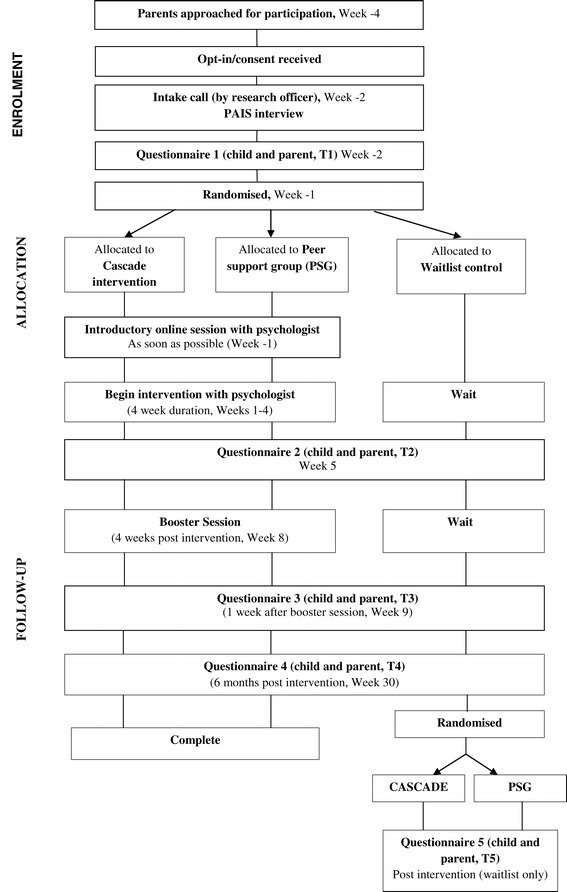
- The intervention consists of four weekly online 90-minute group sessions, plus an introductory session and a booster session one month later.
- Feasibility targets include a 40% response rate and 20% attrition; the authors estimate about 375 parents would need to be approached to recruit 120 participants.
## Methods
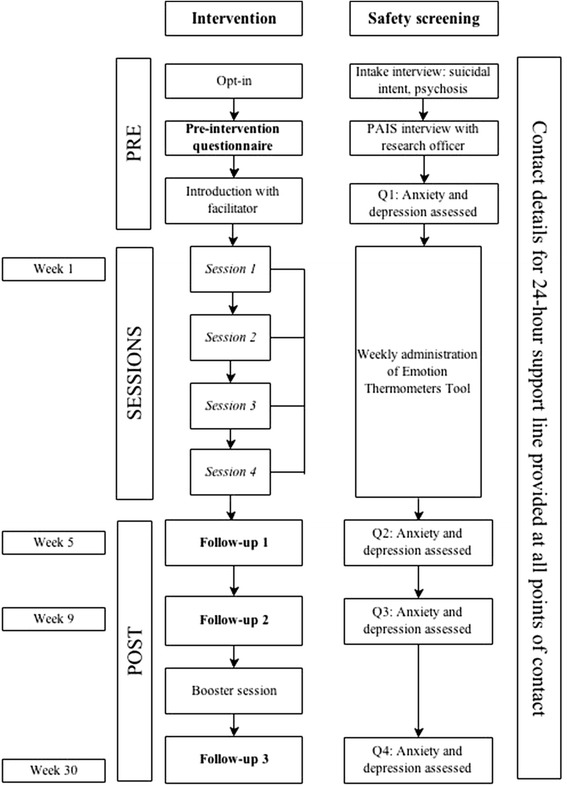
- Design: Multi-site, three-arm randomized controlled trial with Cascade, peer-support group, and 6-month waitlist control; assessments at baseline (T1), post-intervention (T2), 5 weeks post-intervention / 1 week post-booster (T3), and 6 months post-intervention (T4).
- Sample/data: Parents or legal guardians of children <16 years who finished cancer treatment with curative intent within the last 1–12 months; children aged 7–15 years are invited to complete self-report measures.
- Analysis: Intention-to-treat and as-treated analyses using mixed random-intercept models; multiple regression to identify predictors of treatment outcome; multiple comparisons with Holm-Bonferroni adjustment.
## Limitations
- The paper itself notes that the three-armed design will increase recruitment time and that the 6-month follow-up may complicate analyses because participants may receive other support during follow-up.
- It also makes evident that this is a protocol, so no trial results are reported here (evident from the text).
- The study may have generalizability constraints because eligibility requires English literacy and private internet/computer access; this is evident from the inclusion and access criteria.
Model-written summary. Check it against the paper before relying on it.
Integrity signals
Registry
Cites
Statistics
Figures
Verification
Claims the paper makes
12 Valid · 1 Not valid · 22 Not checked · 7 Own results and interpretations
The cited sources support only part of this claim — read each source’s verdict below.
In the paper
“Any variation or systematic biases between groups will be detected and corrected by the independent assessors during treatment fidelity checks of a random 15% of all video-recorded sessions (the validated ‘Method of Assessing Treatment Delivery’ advises a minimum of 11%) [51].”
§ Online parent-targeted cognitive-behavioural therapy intervention to improve quality of life in families of young cancer survivors: study protocol for a randomised controlled trial > Methods/Design > Procedures
What the sources say
- Partly supportedcites [51] Leeuw M Goossens M de Vet H Vlaeyena J The fidelity of treatment delivery can be assessed in treatment outcome studies: a successful illustration from behavioral medicine J Clin Epidemiol. 2009 62 81 90 10.1016/j.jclinepi.2008.03.008 18722086 sourceExperimental — accuracy not yet measured
Sections 4.1.1 and 4.2.1 support randomly selecting recorded sessions for assessment by independent raters, and the discussion says repeated assessment during a trial can help improve treatment delivery. But Section 4.1.2 describes 11% as the proportion selected in this particular study to calculate interrater reliability, not a minimum advised by MATD. The paper also does not guarantee that assessors will detect and correct any variation or systematic bias between groups. Page numbers were not available in our copy. (LLM, conf=0.88)
plainstates a cause- Asserted: passes — The authors put it forward as true.
- Checkable: passes — It can be checked against evidence.
- Load-bearing: unclear — It is unclear whether the paper’s conclusions depend on it.
- Based: passes — The paper gives a reason why it holds.
- Partly supported
Every source the paper cites for this claim was checked and supports it.
In the paper
“Each Cascade module applies CBT techniques to the key domains of concern identified in our previous research [4,49] (see Table 2).”
§ Online parent-targeted cognitive-behavioural therapy intervention to improve quality of life in families of young cancer survivors: study protocol for a randomised controlled trial > Methods/Design > Interventions
What the sources say
- Supportedcites [4] Wakefield CE McLoone JK Butow P Lenthen K Cohn RJ Parental adjustment to the completion of their child’s cancer treatment: A systematic review Pediatr Blood Cancer. 2011 56 524 31 10.1002/pbc.22725 21298736 source
In the Results and Discussion (page unavailable), the paper identifies parents’ concerns after their child’s cancer treatment, including fear of recurrence, uncertainty and helplessness. Its concluding discussion (page unavailable) also identifies fatigue, loneliness, social isolation and parenting issues as targets for interventions. The citation supports the identification of these domains; the sentence describes the Cascade modules as the citing authors’ own application of CBT. (LLM, conf=0.90)
- Supportedcites [49] Wakefield CE McLoone JK Butow P Lenthen K Cohn RJ Support after the completion of cancer treatment: Perspectives of Australian adolescents and their families Eur J Cancer Care (Engl). 2013 22 530 9 10.1111/ecc.12059 23730980 source
The cited study identifies unmet post-treatment support needs among adolescent cancer survivors and their families. Its Discussion (page unavailable) highlights gaps in emotional and psychological support and recommends psycho-oncology-specific modules. The citation supports the identification of concerns; the statement about how Cascade applies CBT describes the citing authors’ own modules. (LLM, conf=0.88)
plain- Asserted: passes — The authors put it forward as true.
- Checkable: passes — It can be checked against evidence.
- Load-bearing: unclear — It is unclear whether the paper’s conclusions depend on it.
- Based: passes — The paper gives a reason why it holds.
- Supported
The cited sources that could be checked couldn’t confirm or dispute this claim.
In the paper
“Improving parents’ communication skills can also promote adaptive functioning in children with cancer [27].”
§ Online parent-targeted cognitive-behavioural therapy intervention to improve quality of life in families of young cancer survivors: study protocol for a randomised controlled trial > Background
What the sources say
- Could not verifycites [27] Drotar D Relating parent and family functioning to the psychological adjustment of children with chronic health conditions: What have we learned? What do we need to know? J Pediatr Psychol. 1997 22 149 65 10.1093/jpepsy/22.1.1 9114640 sourceExperimental — accuracy not yet measured
The Discussion and clinical-implications passages concern family support and psychological distress among mothers of children with hemophilia and HIV infection. Searches for parental communication skills and children’s adaptive functioning found no passage addressing whether improving those skills benefits children with cancer. (LLM, conf=0.76)
plainstates a possible cause- Asserted: passes — The authors put it forward as true.
- Checkable: passes — It can be checked against evidence.
- Load-bearing: passes — The paper’s conclusions depend on it.
- Based: passes — The paper gives a reason why it holds.
- Could not verify
Every source the paper cites for this claim was checked and supports it.
In the paper
“The Pediatric Quality of Life inventory (PedsQL) Family Impact Module [57] was selected as the primary psychosocial outcome variable as it assesses parent/caregiver functional concerns specifically related to their child’s illness.”
§ Online parent-targeted cognitive-behavioural therapy intervention to improve quality of life in families of young cancer survivors: study protocol for a randomised controlled trial > Methods/Design > Assessments
What the sources say
- Supportedcites [57] Varni JW Sherman SA Burwinkle TM Dickinson PE Dixon P The PedsQL™ family impact module: preliminary reliability and validity Health Qual Life Outcomes. 2004 2 55 10.1186/1477-7525-2-55 15450120 PMC521692 source
The Abstract describes the PedsQL™ Family Impact Module as measuring the impact of pediatric chronic health conditions on parents and families. The PedsQL™ Family Impact Module section specifies parent-reported functioning, including communication and worry; Table 1 includes concerns about the child’s health condition and treatment. The decision to use it as the primary outcome belongs to the citing authors. (LLM, conf=0.93)
plain- Asserted: passes — The authors put it forward as true.
- Checkable: passes — It can be checked against evidence.
- Load-bearing: passes — The paper’s conclusions depend on it.
- Based: passes — The paper gives a reason why it holds.
- Supported
The cited sources support only part of this claim — read each source’s verdict below.
In the paper
“PROMIS has excellent psychometric properties superior to many other measures available to assess emotional functioning [61].”
§ Online parent-targeted cognitive-behavioural therapy intervention to improve quality of life in families of young cancer survivors: study protocol for a randomised controlled trial > Methods/Design > Assessments
What the sources say
- Partly supportedcites [61] Cella D Riley W Stone A Rothrock N Reeve B Yount S The patient-reported outcomes measurement information system (PROMIS) developed and tested its first wave of adult self-reported health outcome item banks: 2005–2008 J Clin Epidemiol. 2010 63 1179 94 10.1016/j.jclinepi.2010.04.011 20685078 PMC2965562 sourceExperimental — accuracy not yet measured
The Results report high reliability and strong correlations with legacy measures for the emotional-distress item banks and their short forms. But the Abstract Conclusion describes PROMIS short forms as comparable to legacy instruments, not superior to other measures of emotional functioning. (LLM, conf=0.90)
plain- Asserted: passes — The authors put it forward as true.
- Checkable: passes — It can be checked against evidence.
- Load-bearing: unclear — It is unclear whether the paper’s conclusions depend on it.
- Based: passes — The paper gives a reason why it holds.
- Partly supported
11 more claims
Create a free account to see all 42 claims and to verify the 1 reference still open.
- It may state two separate claims as one. 18
- Probably not a substantial claim. 11
Claims other papers make about this one
Each is checked against this paper’s own text: does it say what the citing paper says it does?
The cited source says what the claim attributes to it.
In the citing paper
“With ethical approval, some aspects of the study design were modified after publication of the study protocol [35] as challenges were identified in the roll-out of the trial.”
From Providing psychological support to parents of childhood cancer survivors: ‘cascade’ intervention trial results and lessons for the future (2021) · cites this paper as [35]
The cited source says what the claim attributes to it.
In the citing paper
“Our target sample size was 120, which would have provided 80% power to detect medium-large differences in HRQL (an effect size of 0.65) [35]; however, recruitment was closed when the funding period ended.”
From Providing psychological support to parents of childhood cancer survivors: ‘cascade’ intervention trial results and lessons for the future (2021) · cites this paper as [35]
The cited source says what the claim attributes to it.
In the citing paper
“Even with multiple amendments to our original trial protocol [35], our trial did not meet our recruitment targets, with slower than anticipated launch of the trial at each site, and lower than anticipated participant accrual.”
From Providing psychological support to parents of childhood cancer survivors: ‘cascade’ intervention trial results and lessons for the future (2021) · cites this paper as [35]
Citations
Cites
CONSORT 2010 Statement: updated guidelines for reporting parallel group randomised trials
the CONSORT Group, Schulz, K. F., Altman, D. G., & Moher, D. (2010) · BMC Medicine · doi:10.1186/1741-7015-8-18 · Cited by 13,371
Development and preliminary testing of the new five-level version of EQ-5D (EQ-5D-5L)
Herdman, M., Gudex, C., Lloyd, A., Janssen, M., Kind, P., Parkin, D., Bonsel, G., & Badia, X. (2011) · Quality of Life Research · doi:10.1007/s11136-011-9903-x · Cited by 9,795
Moher, D., Hopewell, S., Schulz, K. F., Montori, V., Gotzsche, P. C., Devereaux, P. J., Elbourne, D., Egger, M., & Altman, D. G. (2010) · BMJ · doi:10.1136/bmj.c869 · Cited by 8,883
Cella, D., Riley, W., Stone, A., Rothrock, N., Reeve, B., Yount, S., Amtmann, D., Bode, R., Buysse, D., Choi, S., et al. (2010) · Journal of Clinical Epidemiology · doi:10.1016/j.jclinepi.2010.04.011 · Cited by 5,128
Norman, G. R., Sloan, J. A., & Wyrwich, K. W. (2003) · Medical Care · doi:10.1097/01.mlr.0000062554.74615.4c · Cited by 4,700
CONSORT 2010 statement: updated guidelines for reporting parallel group randomized trials
Schulz, K. F., Altman, D. G., Moher, D., & for the CONSORT Group* (2010) · Annals of Internal Medicine · doi:10.7326/0003-4819-152-11-201006010-00232 · Cited by 3,824
Principles and Practice of Pediatric Oncology
(1990) · Annals of Internal Medicine · doi:10.7326/0003-4819-112-8-636_3 · Cited by 2,027
Moher, D., Hopewell, S., Schulz, K. F., Montori, V., Gøtzsche, P. C., Devereaux, P. J., Elbourne, D., Egger, M., & Altman, D. G. (2010) · Journal of Clinical Epidemiology · doi:10.1016/j.jclinepi.2010.03.004 · Cited by 1,858
Tutorial on maximum likelihood estimation
Myung, I. J. (2003) · Journal of Mathematical Psychology · doi:10.1016/s0022-2496(02)00028-7 · Cited by 1,802 · cited 1×
“Random intercept models, which utilise maximumlikelihood estimation, provide more efficient estimates of effects with unbalanced data than the traditional repeated measures approach [67].”
MethodPotential roles of parental self-efficacy in parent and child adjustment: A review
Jones, T. L., & Prinz, R. J. (2005) · Clinical Psychology Review · doi:10.1016/j.cpr.2004.12.004 · Cited by 1,743 · cited 1×
“Importantly, parents’ confidence in their ability to parent and associated positive parenting practices may be a protective factor for families under stress [60].”
Background
Research works printed but not linked: 3
- Field TM Bornstein M Psychologically depressed parents Handbook of parenting, vol 1995 Mahwah, NJ Lawrence Erlbaum & Associates 85 99
- Patterson P Millar B Visser A The needs of young people who have a sibling with cancer: Report on the CanTeen national member survey for sibling members 2008 CanTeen Australia
- Australia C Cancer support groups: a guide to setting up peer facilitated supports 2009 Cancer Australia Canberra
Cited by
Michel, G., Brinkman, T. M., Wakefield, C. E., & Grootenhuis, M. (2020) · Pediatric Clinics of North America · doi:10.1016/j.pcl.2020.07.005 · Cited by 133
Self-citationFinancial toxicity of childhood cancer and changes to parents’ employment after treatment completion
Kelada, L., Wakefield, C. E., Vetsch, J., SCHOFIELD, D. J., Sansom‐Daly, U. M., Hetherington, K., O'Brien, T. A., Cohn, R. J., Anazodo, A. C., Viney, R. C., et al. (2020) · Pediatric Blood & Cancer · doi:10.1002/pbc.28345 · Cited by 90
Self-citationWakefield, C. E., Sansom-Daly, U. M., McGill, B. C., Ellis, S. J., Doolan, E. L., Robertson, E. G., Mathur, S., & Cohn, R. J. (2016) · Supportive Care in Cancer · doi:10.1007/s00520-016-3077-6 · Cited by 61
“CASCAdE (Cope, Adapt, Survive: Life after CAncEr) was developed by a multidisciplinary team with many years of experience in pediatric psycho-oncology, including psychologists, pediatric oncologists, social workers, and parent consumers [23].”
MethodHarrison, R., Raman, M., Walpola, R. L., Chauhan, A., & Sansom‐Daly, U. M. (2021) · BMC Health Services Research · doi:10.1186/s12913-021-06611-0 · Cited by 55
Self-citationYoga into Cancer Care: A Review of the Evidence-based Research
Agarwal, R. P., & Maroko-Afek, A. (2018) · International Journal of Yoga · doi:10.4103/ijoy.ijoy_42_17 · Cited by 76
Siblings of young people with chronic illness: Caring responsibilities and psychosocial functioning.
Kelada, L., Wakefield, C. E., Drew, D., Ooi, C. Y., Palmer, E. E., Bye, A., De Marchi, S., Jaffe, A., & Kennedy, S. (2022) · Journal of Child Health Care · doi:10.1177/13674935211033466 · Cited by 59
Self-citationInterventions to help support caregivers of people with a brain or spinal cord tumour
Boele, F. W., Rooney, A. G., Bulbeck, H., & Sherwood, P. R. (2019) · Cochrane Database of Systematic Reviews · doi:10.1002/14651858.cd012582.pub2 · Cited by 74
Cernvall, M., Carlbring, P., Wikman, A., Ljungman, L., Ljungman, G., & von Essen, L. (2017) · Journal of Medical Internet Research · doi:10.2196/jmir.6852 · Cited by 45
“Recent developments and ongoing work in the wider field of interventions for parents of children with cancer also include Web-based CBT to improve quality of life in families of young cancer survivors [16].”
Ogez, D., Péloquin, K., Bertout, L., Bourque, C.-J., Curnier, D., Drouin, S., Laverdière, C., Marcil, V., Ribeiro, R., Callaci, M., et al. (2019) · Journal of Clinical Psychology in Medical Settings · doi:10.1007/s10880-019-09612-8 · Cited by 35
Kölemen, A. B., Akyüz, E., Toprak, A., Deveci, E., & Yeşil, G. (2021) · Orphanet Journal of Rare Diseases · doi:10.1186/s13023-021-02046-2 · Cited by 54
Wakefield, C. E., Sansom-Daly, U. M., McGill, B. C., Hetherington, K., Ellis, S. J., Robertson, E. G., Donoghoe, M. W., McCarthy, M., Kelada, L., Girgis, A., et al. (2021) · Cancers · doi:10.3390/cancers13225597 · Cited by 28
“65) [35]; however, recruitment was closed when the funding period ended.”
BackgroundMethodInfluentialSelf-citationWest, C., Dusome, D. L., Winsor, J., & Rallison, L. B. (2020) · Qualitative Health Research · doi:10.1177/1049732320912410 · Cited by 31
How Parents of Childhood Cancer Survivors Perceive Support From Their Extended Families
Kelada, L., Wakefield, C. E., Carlson, L., Hetherington, K., McGill, B. C., McCarthy, M., Miles, G. C. P., Cohn, R. J., & Sansom‐Daly, U. M. (2019) · Journal of Child and Family Studies · doi:10.1007/s10826-019-01394-9 · Cited by 29
Self-citationKaushal, T., Satapathy, S. S., Chadda, R. K., Bakhshi, S., Sagar, R., & Sapra, S. (2018) · The Indian Journal of Pediatrics · doi:10.1007/s12098-018-2679-z · Cited by 12
Kaushal, T., Satapathy, S. S., Bakhshi, S., Sagar, R., & Chadda, R. K. (2021) · Archives de Pédiatrie · doi:10.1016/j.arcped.2021.11.004 · Cited by 10
Tutus, D., Plener, P. L., & Niemitz, M. (2018) · Zeitschrift für Kinder- und Jugendpsychiatrie und Psychotherapie · doi:10.1024/1422-4917/a000640 · Cited by 8
Friis-Healy, E. A., Farber, E. W., Cook, S. C., Cullum, K. A., Gillespie, C. F., Marshall-Lee, E. D., Upshaw, N. C., White, D. T., Zhang, S., & Kaslow, N. J. (2022) · Psychological Services · doi:10.1037/ser0000594 · Cited by 7
Chow, W. K., Hetherington, K., McGill, B. C., Sansom‐Daly, U. M., Daly, R., Miles, G. C. P., Cohn, R. J., & Wakefield, C. E. (2022) · Pediatric Blood & Cancer · doi:10.1002/pbc.30015 · Cited by 7
Self-citationLopez, C., Sultan, S., Lamore, K., et al. (2021) · Supportive Care in Cancer · doi:10.1007/s00520-021-06250-5 · Cited by 3
Vetsch, J., McGill, B. C., Sansom‐Daly, U. M., Hetherington, K., Ellis, S. J., Marshall, K. H., & Wakefield, C. E. (2018) · Acta Oncologica · doi:10.1080/0284186x.2018.1512157 · Cited by 3
Self-citationVagnini, D., Lamperti, N., Molgora, S., Barile, F., Facchin, F., Mazza, U., & Saita, E. (2023) · International Journal of Environmental Research and Public Health · doi:10.3390/ijerph20126105 · Cited by 3
Fear of cancer recurrence in informal caregivers of childhood cancer survivors
Espinoza-Salgado, F. S., Landa-Ramírez, É., & Robles, R. (2022) · Salud Mental · doi:10.17711/sm.0185-3325.2022.040 · Cited by 3
Espinoza-Salgado, F. S., García, R. R., Wakefield, C. E., Kelada, L., Sansom‐Daly, U. M., McGill, B. C., Tusie, A. Z., García, L. J., Cardos, R. D. S. C., & Zapata‐Tarrés, M. (2022) · Psicooncología · doi:10.5209/psic.80798 · Cited by 2
Self-citationSociodemographic Factors and Quality of Life in Children and Adolescents under Cancer Treatment
González-Ramírez, L. P., Gómez-Martínez, R., Luna-Flores, C. L., Colunga-Rodríguez, C., Solís, M. G. O., & Ortega-Cortés, R. (2017) · Psychology · doi:10.4236/psych.2017.84036 · Cited by 2
Hsu, J. O., Sansom‐Daly, U. M., Hetherington, K., Ellis, S. J., Donoghoe, M. W., Cohn, R. J., Tusie, A. Z., & Wakefield, C. E. (2021) · Acta Oncologica · doi:10.1080/0284186x.2021.1955968 · Cited by 1
Self-citationHarrison, R., Raman, M., Walpola, R. L., et al. (2021) · Research Square · doi:10.21203/rs.3.rs-374973/v1 · Cited by 1
Self-citationSansom‐Daly, U. M., Hetherington, K., Hetherington, K., McGill, B. C., McGill, B. C., Kelada, L., Kelada, L., McLoone, J. K., McLoone, J. K., Signorelli, C., et al. (2021) · QUADERNI DI PSICOTERAPIA COGNITIVA · doi:10.3280/qpc47-2020oa11207 · Cited by 1
Self-citationIrestorm, E., Wakefield, C. E., Houweling, R., Hetherington, K., McGill, B. C., McDonald, F. E. J., Cohn, R. J., & Sansom‐Daly, U. M. (2026) · Supportive Care in Cancer · doi:10.1007/s00520-026-10867-9 · Cited by 1
Self-citationSmith, N. D. W., Legra, C., & Faith, M. A. (2025) · Child & Family Behavior Therapy · doi:10.1080/07317107.2025.2540794
Online therapeutic groups: integrative literature review (2012-2022)
Costa, S. S. D., & Santeiro, T. V. (2025) · Psico-USF · doi:10.1590/1413-8271202530e281807
Habenicht, A., Ahern, E., Cody, D., McDarby, V., & Houghton, S. (2023) · Journal of Health Psychology · doi:10.1177/13591053231216700 · Cited by 3
Gómez‐Díaz, J. A. (2023) · Revista de Psicología Universidad de Antioquia · doi:10.17533/udea.rp.e352334 · Cited by 2
Hill, L., & Gubi, P. M. (2020) · Illness Crisis & Loss · doi:10.1177/1054137320919916
Barello, S., Menichetti, J., & Graffigna, G. (2017) · IGI Global eBooks · doi:10.4018/978-1-5225-3926-1.ch004
Barello, S., Menichetti, J., & Graffigna, G. (2016) · Advances in psychology, mental health, and behavioral studies (APMHBS) book series · doi:10.4018/978-1-4666-9986-1.ch003 · Cited by 1
Metadata
- Authors
- Wakefield, C. E., Sansom-Daly, U. M., McGill, B. C., McCarthy, M., Girgis, A., Grootenhuis, M., Barton, B., Patterson, P., Osborn, M., Lowe, C., Anazodo, A., Miles, G., & Cohn, R. J.
- Affiliations
- UNSW Sydney (AU)
- Royal Children's Hospital (AU)
- Amsterdam UMC Location University of Amsterdam (NL)
- The University of Sydney (AU)
- Royal Adelaide Hospital (AU)
- Children's Health Queensland Hospital and Health Service (AU)
- Prince of Wales Hospital (AU)
- Princess Margaret Hospital for Children (AU)
- Corresponding author
- Wakefield, Claire E
- ORCID
- Venue
- Trials
- Published
- 2015-04-11
- Volume
- 16
- Issue
- 1
- Pages
- 153-153
- ISSN
- 1745-6215 (ISSN-L)
- PMC
- PMC4395969
- OpenAlex
- W2140037727
- Cited by
- 35
- References
- 77
- Citations by year
- 2026: 1 · 2025: 2 · 2023: 3 · 2022: 3 · 2021: 10 · 2020: 4 · 2019: 3 · 2018: 4 · 2017: 3 · 2016: 2
- FWCI
- 2.98
- Type
- journal article
- Language
- en
- Open access
- gold
- doi.org
- Locations
- Trials (publishedVersion, cc-by)
- PubMed Central (publishedVersion, cc-by)
- PubMed (publishedVersion)
- UNSWorks (University of New South Wales, Sydney, Australia) (submittedVersion, cc-by-nc-nd)
- Pure Amsterdam UMC (submittedVersion, other-oa)
- UNSWorks (UNSW Sydney) (submittedVersion, cc-by-nc-nd)
- Data Archiving and Networked Services (DANS) (submittedVersion)
- Minerva Access (University of Melbourne) (submittedVersion, cc-by)
- Funders
- Cancer Australia (APP1065428)
- University of Technology Sydney
- Medical Research Council
- National Health and Medical Research Council (1067501)
- Topics
- Health Sciences › Medicine › Pediatrics, Perinatology and Child Health › Childhood Cancer Survivors' Quality of Life
- Health Sciences › Medicine › Oncology › Cancer survivorship and care
- Social Sciences › Psychology › Clinical Psychology › Family Support in Illness
- Keywords
- childhood cancer survivors, parental mental health, quality of life, cognitive behavioral therapy, online group therapy, videoconferencing, peer support, coping strategies, behavioral activation, mindfulness, acceptance and commitment therapy, assertiveness training, children's quality of life, family well-being
- MeSH terms
- Adaptation, Psychological, Adolescent, Australia, Child, Clinical Protocols, Feasibility Studies, Humans, Neoplasms, Parent-Child Relations, Parents, Peer Group, Quality of Life, Surveys and Questionnaires, Research Design, Therapy, Computer-Assisted, Time Factors, Cognitive Behavioral Therapy, Parenting, Treatment Outcome, Telemedicine, Survivors, Internet, Videoconferencing
About these checks
Registry, retraction, Cites and statistics results are computed, not judged, with one exception: a printed reference that no index lists is read once by a model before it counts as a citation error. Claims are extracted by a model and kept only when their quote appears verbatim in the text; each cited source is then checked, with a model’s help, for whether it says what the claim relies on. Those verdicts can be wrong — read the claim’s quote and the cited source before relying on one.
The claim verdicts this report counts are experimental: their accuracy is not yet measured.
A language model drew the claims from the paper on 2026-10-11, under version 3 of the claim definition (model deepseek-v4.1-flash, prompt extract-v3).
A second model labelled each claim on 2026-10-11 (model jev-1.13-20260917, definition revision gold-guideline-v0.2).
Cited sources are checked with a language model’s help (gpt-6-sol).
Statistics and arithmetic are recomputed, not judged.
Confidence bands are shown only for fields calibrated on our annotated test set. None is calibrated yet, so no band is shown.
What counts as a claim ›How we measure confidence ›How we check this ›
Are you an author, or do you see a problem with this page? Request a review
Data sources
Bibliographic data: Semantic Scholar, OpenAlex, Crossref.
Contains information from the Semantic Scholar Academic Graph Datasets, made available under the ODC Attribution License (ODC-BY 1.0).
Semantic Scholar’s data is described in: Kinney, R., et al. (2023). The Semantic Scholar Open Data Platform. arXiv:2301.10140.
