

The effects of yoga versus stretching and resistance training exercises on psychological distress for people with mild-to-moderate Parkinson’s disease: study protocol for a randomized controlled trial
Open accessThe DOI matches its Crossref record; 53 of the 53 references it cites were found in a registry or an index; 2 of the 54 sources its claims cite were checked for support.
Abstract
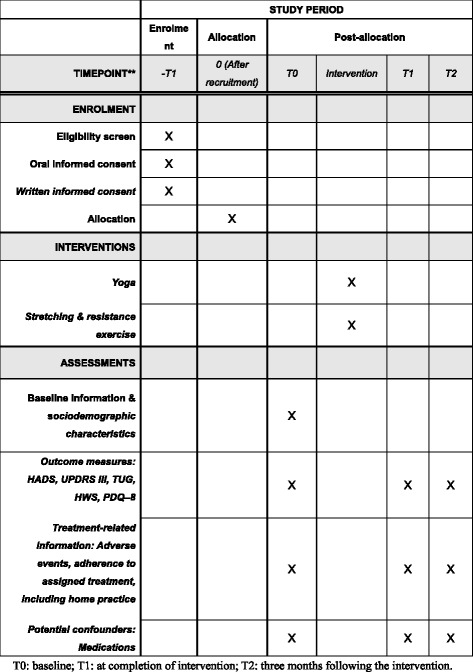
BACKGROUND: Psychological distress is prevalent among people with Parkinson's disease (PD) and aggravates their motor symptoms, thereby leading to increased disability, high healthcare costs, and poor health-related quality of life (HRQoL). The under-recognition and adverse effects of the pharmacological management of anxiety and depression among the PD population are considerable. Thus, adopting a Complementary and Alternative Management (CAM) approach to address this problem is important. Yoga, one of the most common "mind-body" CAM therapies, can improve the psychological wellbeing of people with chronic illnesses. However, limited research on the effects of yoga in people with PD has been conducted. This study will determine the effects of yoga on the psychological wellbeing of people with mild-to-moderate PD and will compare these effects with those of stretching and resistance training exercises. METHODS: A community-based, single-blind, randomized trial will be conducted. A total of 126 subjects will be recruited and randomly divided into yoga (n = 63) or stretching and resistance exercise (n = 63) groups. For 8 weeks, the yoga group will receive a weekly 90-min session of yoga, and the control group will receive a weekly 60-min session of stretching and resistance exercises. The primary outcome will be the level of psychological distress measured using the Hospital Anxiety and Depression Scale. The secondary outcomes will include the severity of motor symptoms measured by the Movement Disorders Society - Unified Parkinson's Disease Scale - Part III Motor Examination; mobility, balance, and fall risk measured by the Timed Up and Go test; spiritual wellbeing measured by the Holistic Wellbeing Scale; and HRQoL measured by the Parkinson's Disease Questionnaire-8. Assessment will be conducted at baseline, 8th, and 20th weeks of follow-ups. DISCUSSION: This study will be the first randomized trial to compare the effect of yoga versus stretching and resistance training exercises in a PD population. Results will contribute to the value of yoga as a therapeutic option for managing psychological distress in PD patients. Multiple outcomes including psychological, physiological, and spiritual and HRQoL will also be measured to elucidate the potential mechanisms of yoga. The effect of yoga on people with chronic illnesses will further be elucidated. This information should contribute to future research, practice, and policy related to PD management. TRIAL REGISTRATION: WHO Primary Registry - Chinese Clinical Trials Registry (ChiCTR): CUHK_CCRB00522 Registered on 8 October 2016; date of approval 19 August 2016.
Overview
CoChat Summary
## TL;DR
This paper is a study protocol for a community-based, single-blind randomized controlled trial testing whether an 8-week yoga program improves psychological distress in people with mild-to-moderate Parkinson’s disease better than stretching and resistance training. It plans to enroll 126 participants and measure anxiety/depression, motor symptoms, mobility/balance, spiritual wellbeing, and HRQoL at baseline, 8 weeks, and 20 weeks.
## Key findings
- Not stated in the paper.
- The protocol planned to recruit 126 subjects, randomized 63/63 to yoga vs stretching and resistance exercise.
- The intervention period was 8 weeks; yoga was weekly 90-min sessions in the abstract, but the methods section later describes weekly 60-min sessions plus 20-min home practice twice weekly, and the control group as weekly 60-min sessions plus 20-min home practice twice weekly.
- A pilot study of 10 people with mild-to-moderate idiopathic PD found the yoga intervention feasible and acceptable; enrollment rate was 58.8%, class adherence was 97.5%, there were no adverse events, and preliminary analysis showed significant improvements in HADS (mean = –4.7 ± 4.16, p = 0.006) and holistic wellbeing-affliction (mean = –0.87 ± 0.80, p = 0.007).
## Methods
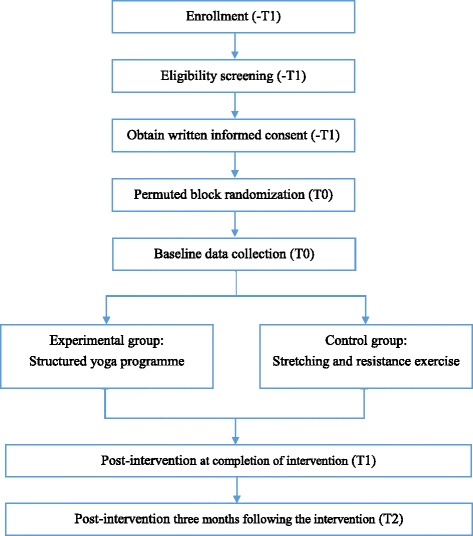
- Community-based, single-blind randomized controlled trial with 1:1 permuted block randomization (block size 8).
- Planned sample: 126 people with mild-to-moderate idiopathic PD recruited from two PD support groups and two specialized outpatient clinics; inclusion required Hoehn and Yahr stage I to III, age >18, ability to stand/walk, and written consent.
- Main analysis: intention-to-treat with generalized estimating equation (GEE) models to compare differential change over time between groups for primary and secondary outcomes.
## Limitations
- The paper states that participation is voluntary and restricted to mild-to-moderate PD, and that people with depressive/anxiety symptoms may be less likely to participate; it also excludes those receiving psychiatric treatment, which may limit generalizability to people with significant psychological distress.
- The paper states that the single-blind design may introduce performance, attrition, and evaluation bias and could overestimate treatment effects.
- Evident from the text: this is a protocol, so no trial outcome results are reported for the planned randomized comparison.
Model-written summary. Check it against the paper before relying on it.
Integrity signals
Registry
Cites
Statistics
Figures
Verification
Claims the paper makes
2 Valid · 0 Not valid · 30 Not checked · 37 Own results and interpretations
The sources with a verdict support this claim; the rest weren’t checked yet, have no full text we could read, or their verdicts aren’t rated yet.
In the paper
“This scale has been suggested for use in the PD population as somatic symptoms that may potentially overlap parkinsonian manifestations are not assessed in this scale [43, 44].”
§ The effects of yoga versus stretching and resistance training exercises on psychological distress for people with mild-to-moderate Parkinson’s disease: study prxotocol for a randomized controlled trial > Methods > Outcomes
What the sources say
- Supportedcites [43] Mondolo F Jahanshahi M Grana A Biasutti E Cacciatori E Di Benedetto P The validity of the Hospital Anxiety and Depression Scale and the Geriatric Depression Scale in Parkinson’s disease Behav Neurol 2006 17 2 109 15 10.1155/2006/136945 16873922 PMC5471536 source
The Discussion states that somatic symptoms of depression overlap with Parkinson’s disease symptoms and that the HADS is suitable for use in PD because it has no somatic items. This directly supports the reason given in the citing sentence. (LLM, conf=0.94)
- Not checked yetcites [44] Rodriguez-Blazquez C Frades-Payo B Forjaz MJ de Pedro-Cuesta J Martinez-Martin P Psychometric attributes of the Hospital Anxiety and Depression Scale in Parkinson’s disease Mov Disord 2009 24 4 519 25 10.1002/mds.22321 19177496 source
hedged- Asserted: passes — The authors put it forward as true.
- Checkable: passes — It can be checked against evidence.
- Load-bearing: passes — The paper’s conclusions depend on it.
- Based: passes — The paper gives a reason why it holds.
- Supported
A result the paper reports from its own data — it cites no other source for it, so there is none to check. The quote shows it is in the paper.
In the paper
“The enrollment rate was 58.8% and class adherence rate was 97.5%.”
§ The effects of yoga versus stretching and resistance training exercises on psychological distress for people with mild-to-moderate Parkinson’s disease: study prxotocol for a randomized controlled trial > Methods > Pilot study
plainn = 10- Asserted: passes — The authors put it forward as true.
- Checkable: passes — It can be checked against evidence.
- Load-bearing: unclear — It is unclear whether the paper’s conclusions depend on it.
- Based: passes — The paper gives a reason why it holds.
A result the paper reports from its own data — it cites no other source for it, so there is none to check. The quote shows it is in the paper.
In the paper
“From the preliminary data analysis, significant improvements were found for (1) psychological distress in terms of the HADS (paired t test (T 1 –T 0 ): mean = – 4.7 ± 4.16, p = 0.006)”
§ The effects of yoga versus stretching and resistance training exercises on psychological distress for people with mild-to-moderate Parkinson’s disease: study prxotocol for a randomized controlled trial > Methods > Pilot study
plainstates a causen = 10 ·- Asserted: passes — The authors put it forward as true.
- Checkable: passes — It can be checked against evidence.
- Load-bearing: passes — The paper’s conclusions depend on it.
- Based: passes — The paper gives a reason why it holds.
A result the paper reports from its own data — it cites no other source for it, so there is none to check. The quote shows it is in the paper.
In the paper
“All participants were satisfied with this program.”
§ The effects of yoga versus stretching and resistance training exercises on psychological distress for people with mild-to-moderate Parkinson’s disease: study prxotocol for a randomized controlled trial > Methods > Pilot study
plainn = 10- Asserted: passes — The authors put it forward as true.
- Checkable: passes — It can be checked against evidence.
- Load-bearing: unclear — It is unclear whether the paper’s conclusions depend on it.
- Based: passes — The paper gives a reason why it holds.
A result the paper reports from its own data — it cites no other source for it, so there is none to check. The quote shows it is in the paper.
In the paper
“and (2) holistic wellbeing in terms of affliction (paired t test (T 1 –T 0 ): mean = – 0.87 ± 0.80, p = 0.007).”
§ The effects of yoga versus stretching and resistance training exercises on psychological distress for people with mild-to-moderate Parkinson’s disease: study prxotocol for a randomized controlled trial > Methods > Pilot study
plainstates a causen = 10 ·- Asserted: passes — The authors put it forward as true.
- Checkable: passes — It can be checked against evidence.
- Load-bearing: passes — The paper’s conclusions depend on it.
- Based: passes — The paper gives a reason why it holds.
18 more claims
Create a free account to see all 69 claims and to verify the 52 references still open.
- It may state two separate claims as one. 16
- Probably not a substantial claim. 37
Claims other papers make about this one
Each is checked against this paper’s own text: does it say what the citing paper says it does?
The check wasn’t confident either way, so it gives no verdict — never disputed.
In the citing paper
“Compared to our previous clinical trial of mindfulness yoga, there was inconsistency in the evidence of its effects on anxiety, motor symptoms, and HRQOL12,20,21.”
From A randomized clinical trial of mindfulness meditation versus exercise in Parkinson’s disease during social unrest (2023) · cites this paper as [20]
Experimental — accuracy not yet measured
Citations
Cites
The Hospital Anxiety and Depression Scale
Zigmond, A. S., & Snaith, R. P. (1983) · Acta Psychiatrica Scandinavica · doi:10.1111/j.1600-0447.1983.tb09716.x · Cited by 47,139
Depression and quality of life in older persons: A review
Sivertsen, H., Bjørkløf, G. H., Engedal, K., Selbæk, G., & Helvik, A.-S. (2015) · Dementia and Geriatric Cognitive Disorders · doi:10.1159/000437299 · Cited by 14,152
Goetz, C. G., Tilley, B. C., Shaftman, S. R., Stebbins, G. T., Fahn, S., Martinez‐Martin, P., Poewe, W., Sampaio, C., Stern, M. B., Dodel, R., et al. (2008) · Movement Disorders · doi:10.1002/mds.22340 · Cited by 7,536
(2008) · Medical Entomology and Zoology · Cited by 7,477
Is the CVI an acceptable indicator of content validity? Appraisal and recommendations
Polit, D. F., Beck, C. T., & Owen, S. V. (2007) · Research in Nursing & Health · doi:10.1002/nur.20199 · Cited by 5,273 · cited 1×
“78 or higher was considered good content validity [37].”
BackgroundAdams, J. L., Dinesh, K., Xiong, M., Tarolli, C. G., Sharma, S., Sheth, N., Aranyosi, A. J., Zhu, W., Goldenthal, S., Biglan, K. M., et al. (2017) · Digital Biomarkers · doi:10.1159/000479018 · Cited by 3,171
Alterations in brain and immune function produced by mindfulness meditation
Davidson, R. J., Kabat-Zinn, J., Schumacher, J., Rosenkranz, M., Muller, D., Santorelli, S. F., Urbanowski, F., Harrington, A., Bonus, K., & Sheridan, J. F. (2003) · Psychosomatic Medicine · doi:10.1097/01.psy.0000077505.67574.e3 · Cited by 2,925 · cited 2×
“based Behavioral Medicine Committee [39].”
Equipoise and the Ethics of Clinical Research
Freedman, B. (1987) · New England Journal of Medicine · doi:10.1056/nejm198707163170304 · Cited by 2,339 · cited 1×
“To minimize bias stemming from expectation, study participants will be blinded to the study hypotheses and details of study manuals, the information provided in the Informed Consent Form will follow the principle of equipoise by declaring uncertainty about the superiority of treatment effect of both arms [38].”
MethodThe prevention and treatment of missing data in clinical trials
Little, R. J., D'Agostino, R., Cohen, M. L., Dickersin, K., Emerson, S. S., Farrar, J. T., Frangakis, C., Hogan, J. W., Molenberghs, G., Murphy, S. A., et al. (2012) · New England Journal of Medicine · doi:10.1056/nejmsr1203730 · Cited by 1,884 · cited 1×
“will be kept up to date and reasons of dropout will be documented [40].”
BackgroundChiesa, A., & Serretti, A. (2009) · The Journal of Alternative and Complementary Medicine · doi:10.1089/acm.2008.0495 · Cited by 1,681
Barone, P., Antonini, A., Colosimo, C., Marconi, R., Morgante, L., Avarello, T. P., Bottacchi, E., Cannas, A., Ceravolo, G., Ceravolo, R., et al. (2009) · Movement Disorders · doi:10.1002/mds.22643 · Cited by 1,445
JENKINSON, C., FITZPATRICK, R., PETO, V., GREENHALL, R., & HYMAN, N. (1997) · Age and Ageing · doi:10.1093/ageing/26.5.353 · Cited by 1,321 · cited 1×
“HRQoL The Parkinson’s Disease Questionnaire-8 (PDQ-8) is a short-form, 8-item questionnaire used to quantify the impact of PD on the HRQoL of patients [50].”
Miller, J. J., Fletcher, K., & Kabat-Zinn, J. (1995) · General Hospital Psychiatry · doi:10.1016/0163-8343(95)00025-m · Cited by 1,131
Tai chi and postural stability in patients with Parkinson's disease
Li, F., Harmer, P., Fitzgerald, K., Eckstrom, E., Stock, R., Galver, J., Maddalozzo, G., & Batya, S. S. (2012) · New England Journal of Medicine · doi:10.1056/nejmoa1107911 · Cited by 890
Steffen, T., & Seney, M. (2008) · Physical Therapy · doi:10.2522/ptj.20070214 · Cited by 860
Fjorback, L. O., Arendt, M., Ørnbøl, E., Fink, P., & Walach, H. (2011) · Acta Psychiatrica Scandinavica · doi:10.1111/j.1600-0447.2011.01704.x · Cited by 803
Cramer, H., Lauche, R., Langhorst, J., & Dobos, G. (2013) · Depression and Anxiety · doi:10.1002/da.22166 · Cited by 708 · cited 1×
“79 on anxiety was found when comparing yoga with relaxation [26].”
BackgroundNon-recognition of depression and other non-motor symptoms in Parkinson's disease
Shulman, L. M., Taback, R. L., Rabinstein, A. A., & Weiner, W. J. (2002) · Parkinsonism & Related Disorders · doi:10.1016/s1353-8020(01)00015-3 · Cited by 695
The current and projected economic burden of Parkinson's disease in the United States
Kowal, S. L., Dall, T. M., Chakrabarti, R., Storm, M. V., & Jain, A. (2013) · Movement Disorders · doi:10.1002/mds.25292 · Cited by 667 · cited 1×
“Based on demographic changes and prolonged life expectancy, the estimated prevalence of PD is expected to double by 2040 [1].”
BackgroundNon-motor symptoms in Parkinson's disease
Pfeiffer, R. F. (2016) · Parkinsonism & Related Disorders · doi:10.1016/j.parkreldis.2015.09.004 · Cited by 644
Blocked randomization with randomly selected block sizes
Efird, J. (2010) · International Journal of Environmental Research and Public Health · doi:10.3390/ijerph8010015 · Cited by 564 · cited 1×
“Eligible participants will be randomized into experimental or control groups at 1:1 ratio through a permuted block randomization with a block size of 8 [25].”
MethodDiagnostic criteria for psychosis in Parkinson's disease: Report of an NINDS, NIMH work group
Ravina, B., Marder, K., Fernandez, H. H., Friedman, J. H., McDonald, W., Murphy, D., Aarsland, D., Babcock, D., Cummings, J., Endicott, J., et al. (2007) · Movement Disorders · doi:10.1002/mds.21382 · Cited by 528
Wegner, M., Helmich, I., Machado, S., Nardi, A., Arias-Carrion, O., & Budde, H. (2014) · CNS & Neurological Disorders - Drug Targets · doi:10.2174/1871527313666140612102841 · Cited by 446 · cited 1×
“The beneficial effects of CAM on reducing anxiety and depressive symptoms have been demonstrated in individuals with chronic illnesses [17, 18].”
BackgroundAnxiety disorders in Parkinson's disease: Prevalence and risk factors
Dissanayaka, N. N. W., Sellbach, A., Matheson, S., O'Sullivan, J. D., Silburn, P. A., Byrne, G. J., Marsh, R., & Mellick, G. D. (2010) · Movement Disorders · doi:10.1002/mds.22833 · Cited by 408 · cited 1×
“Despite the high prevalence and substantial negative consequences of psychological distress in the PD population, this problem is poorly recognized and rarely addressed [6, 14].”
BackgroundHuang, S.-L., Hsieh, C.-L., Wu, R.-M., Tai, C.-H., Lin, C.-H., & Lu, W.-S. (2011) · Physical Therapy · doi:10.2522/ptj.20090126 · Cited by 401
(1993) · PubMed · Cited by 349
Ravindran, A. V., Balneaves, L. G., Faulkner, G., Ortiz, A., McIntosh, D., Morehouse, R. L., Ravindran, L., Yatham, L. N., Kennedy, S. H., Lam, R. W., et al. (2016) · The Canadian Journal of Psychiatry · doi:10.1177/0706743716660290 · Cited by 337
Marsh, L., McDonald, W. M., Cummings, J., Ravina, B., & NINDS/NIMH Work Group on Depression and Parkinson's Disease (2006) · Movement Disorders · doi:10.1002/mds.20723 · Cited by 318
The impact of depressive symptoms in early Parkinson disease
Ravina, B., Camicioli, R., Como, P. G., Marsh, L., Jankovic, J., Weintraub, D., & Elm, J. (2007) · Neurology · doi:10.1212/01.wnl.0000268695.63392.10 · Cited by 301 · cited 1×
“Despite the high prevalence and substantial negative consequences of psychological distress in the PD population, this problem is poorly recognized and rarely addressed [6, 14].”
BackgroundToward a nursing theory of selftranscendence: Deductive reformulation using developmental theories
Reed, P. G. (1991) · Advances in Nursing Science · doi:10.1097/00012272-199106000-00008 · Cited by 270
Yoga and Mindfulness: Clinical Aspects of an Ancient Mind/Body Practice
Salmon, P., Lush, E., Jablonski, M., & Sephton, S. E. (2009) · Cognitive and Behavioral Practice · doi:10.1016/j.cbpra.2008.07.002 · Cited by 257 · cited 1×
“The guiding principle of yoga is to foster resilience for accepting adversities in life [24].”
BackgroundTesting Functional Performance in People With Parkinson Disease
Brusse, K. J., Zimdars, S., Zalewski, K. R., & Steffen, T. M. (2005) · Physical Therapy · doi:10.1093/ptj/85.2.134 · Cited by 252
Middle Range Theory for Nursing
(2013) · Springer Publishing Company eBooks · doi:10.1891/9780826195524 · Cited by 245
Foster, E. R., Golden, L., Duncan, R. P., & Earhart, G. M. (2013) · Archives of Physical Medicine and Rehabilitation · doi:10.1016/j.apmr.2012.07.028 · Cited by 216
Using the Timed Up & Go Test in a Clinical Setting to Predict Falling in Parkinson's Disease
Nocera, J. R., Stegemöller, E. L., Malaty, I. A., Okun, M. S., Marsiske, M., & Hass, C. J. (2013) · Archives of Physical Medicine and Rehabilitation · doi:10.1016/j.apmr.2013.02.020 · Cited by 195 · cited 1×
“Current evidence shows that both stretching and resistance exercises and yoga improve motor symptoms and functions in the PD population [19, 35].”
BackgroundDemystifying Self-Transcendence for Mental Health Nursing Practice and Research
Reed, P. G. (2009) · Archives of Psychiatric Nursing · doi:10.1016/j.apnu.2009.06.006 · Cited by 118
Kwok, J. Y. Y., Choi, K. C., & Chan, H. Y. L. (2016) · Complementary Therapies in Medicine · doi:10.1016/j.ctim.2016.09.016 · Cited by 115 · cited 2×
“Considering previous RCTs of mind-body interventions among people with PD [20], an attrition rate of 25% is taken into consideration.”
BackgroundSelf-citationMenza, M., Dobkin, R. D., Marin, H., Mark, M. H., Gara, M., Buyske, S., Bienfait, K., & Dicke, A. (2009) · Movement Disorders · doi:10.1002/mds.22586 · Cited by 106
Anxiety, depression, and quality of life in Parkinson's disease
Quelhas, R., & Costa, M. (2009) · The Journal of Neuropsychiatry and Clinical Neurosciences · doi:10.1176/jnp.2009.21.4.413 · Cited by 100
Psychometric attributes of the Hospital Anxiety and Depression Scale in Parkinson's disease
Rodriguez‐Blazquez, C., Frades‐Payo, B., Forjaz, M. J., de Pedro‐Cuesta, J., Martinez‐Martin, P., & on behalf of the Longitudinal Parkinson's Disease Patient Study (Estudio longitudinal de pacientes con enfermedad de Parkinson ‐ELEP) Group (2009) · Movement Disorders · doi:10.1002/mds.22321 · Cited by 97 · cited 1×
“This scale has been suggested for use in the PD population as somatic symptoms that may potentially overlap parkinsonian manifestations are not assessed in this scale [43, 44].”
MethodMondolo, F., Jahanshahi, M., Granà, A., Biasutti, E., Cacciatori, E., & Di Benedetto, P. (2006) · Behavioural Neurology · doi:10.1155/2006/136945 · Cited by 88 · cited 1×
“This scale has been suggested for use in the PD population as somatic symptoms that may potentially overlap parkinsonian manifestations are not assessed in this scale [43, 44].”
MethodMiller, J., Fletcher, K., & Kabat-Zinn, J. (1998) · International Journal of Yoga Therapy · doi:10.17761/ijyt.8.1.f5654n6515513127 · Cited by 80
Psychosocial Interventions for Depression and Anxiety in Parkinson's Disease
Yang, S., Sajatovic, M., & Walter, B. L. (2012) · Journal of Geriatric Psychiatry and Neurology · doi:10.1177/0891988712445096 · Cited by 75 · cited 1×
“Regarding the negative side effects of pharmacological treatments of anxiety and depression in PD patients, adopting a Complementary and Alternative Management (CAM) approach that addresses psychological distress in PD patients is important [16].”
BackgroundTherapeutic Effects of Tai Chi in Patients with Parkinson’s Disease
Choi, H., Garber, C. E., Jun, T.-W., Jin, Y., Chung, S.-J., & Kang, H.-J. (2013) · ISRN Neurology · doi:10.1155/2013/548240 · Cited by 75
Reed, P. G. (2018) · Springer Publishing Company eBooks · doi:10.1891/9780826159922.0007 · Cited by 70
Chan, C. H. Y., Chan, T. H. Y., Leung, P. P. Y., Brenner, M. J., Wong, V. P. Y., Leung, E. K. T., Wang, X., Lee, M. Y., Chan, J. S. M., & Chan, C. L. W. (2014) · Journal of Ethnic And Cultural Diversity in Social Work · doi:10.1080/15313204.2014.932550 · Cited by 61 · cited 1×
“Satisfactory psychometric properties has been demonstrated in the Chinese version [49] 4.”
Simpson, J., McMillan, H., & Reeve, D. (2013) · Parkinson's Disease · doi:10.1155/2013/608562 · Cited by 56
Validation of PDQ-8 as an independent instrument in English and Chinese
Tan, L. C. S., Lau, P., Au, W., & Luo, N. (2007) · Journal of the Neurological Sciences · doi:10.1016/j.jns.2007.01.072 · Cited by 51 · cited 1×
“87, and construct validity has been demonstrated against the Hoehn and Yahr scale and UPDRS motor scores [51] Data collection”
BackgroundThe Seven Spiritual Laws of Yoga: A Practical Guide to Healing Body, Mind, and Spirit
Chopra, D., & Simon, D. (2004) · Medical Entomology and Zoology · Cited by 21
Anxiety Disorders in Chinese Patients with Parkinson'S Disease
Chen, Y.-K., Lu, J.-Y., Chan, D. M. L., Mok, V. C. T., Wong, K. S., Ungvari, G. S., Tang, W. K., & Yeung, M. A. (2010) · The International Journal of Psychiatry in Medicine · doi:10.2190/pm.40.1.h · Cited by 19
Self-citationMental Health Care Use in Parkinson’s Disease: A Record Linkage Study
Leentjens, A. F. G., Driessen, G., Weber, W., Drukker, M., & van Os, J. (2008) · Neuroepidemiology · doi:10.1159/000116243 · Cited by 9
A pilot study of mindfulness yoga on psychological distress in people with Parkinson’s Disease (PD)
Kwok, J., Kwan, J., & Chan, H. Y. L. (2017) · Cited by 1
Self-citationKwok, J., Yeung, M. A., & Chan, H. Y. L. (2017) · Cited by 1
Self-citation
Research works printed but not linked: 2
- Hales DJ Rapaport MH Moeller K Major depressive disorder: maintenance of certification workbook 2012 Arlington American Psychiatric Association
- Lee FK Developing and piloting an exercise programme for older Chinese people with knee osteoarthritis in Hong Kong (unpublished Master’s thesis) 2011 Hong Kong The Chinese University of Hong Kong
Cited by
Kwok, J. Y. Y., Kwan, J. C. Y., Auyeung, M., Mok, V. C. T., Lau, C. K. Y., Choi, K. C., & Chan, H. Y. L. (2019) · JAMA Neurology · doi:10.1001/jamaneurol.2019.0534 · Cited by 379
Self-citationPhysical exercise for people with Parkinson’s disease: a systematic review and network meta-analysis
Ernst, M., Folkerts, A.-K., Gollan, R., Lieker, E., Caro-Valenzuela, J., Adams, A., Cryns, N., Monsef, I., Dresen, A., Roheger, M., et al. (2023) · Cochrane Database of Systematic Reviews · doi:10.1002/14651858.cd013856.pub2 · Cited by 206
The benefits and mechanisms of exercise training for Parkinson's disease
Feng, Y.-S., Yang, S.-D., Tan, Z.-X., Wang, M.-M., Xing, Y., Dong, F., & Zhang, F. (2020) · Life Sciences · doi:10.1016/j.lfs.2020.117345 · Cited by 218
Jin, X., Wang, L., Liu, S., Zhu, L., Loprinzi, P. D., & Fan, X. (2019) · International Journal of Environmental Research and Public Health · doi:10.3390/ijerph17010031 · Cited by 136
Physical exercise for people with Parkinson’s disease: a systematic review and network meta-analysis
Ernst, M., Folkerts, A., Gollan, R., Lieker, E., Caro-Valenzuela, J., Adams, A., Cryns, N., Monsef, I., Dresen, A., Roheger, M., et al. (2024) · Cochrane Database of Systematic Reviews · doi:10.1002/14651858.cd013856.pub3 · Cited by 154
Metadata
- Authors
- Kwok, J. Y. Y., Kwan, J. C. Y., Auyeung, M., Mok, V. C. T., & Chan, H. Y. L.
- Affiliations
- Chinese University of Hong Kong (HK)
- Pamela Youde Nethersole Eastern Hospital (CN)
- Corresponding author
- Kwok, JoJo Yan Yan
- Venue
- Trials
- Published
- 2017-11-02
- Volume
- 18
- Issue
- 1
- Pages
- 509-509
- ISSN
- 1745-6215 (ISSN-L)
- PMC
- PMC5667474
- OpenAlex
- W2766558057
- Cited by
- 56
- References
- 53
- Citations by year
- 2026: 3 · 2025: 6 · 2024: 7 · 2023: 7 · 2022: 5 · 2021: 8 · 2020: 10 · 2019: 7 · 2018: 2 · 2017: 1
- FWCI
- 3.81
- Type
- journal article
- Language
- en
- Open access
- gold
- doi.org
- Licence
- cc-by
- Locations
- Trials (publishedVersion, cc-by)
- PubMed Central (publishedVersion, cc-by)
- PubMed (publishedVersion)
- DOAJ (DOAJ: Directory of Open Access Journals) (submittedVersion, cc-by-sa)
- Topics
- Health Sciences › Medicine › Clinical Neurology › Parkinson's Disease Mechanisms and Treatments
- Social Sciences › Psychology › Clinical Psychology › Mindfulness and Compassion Interventions
- Health Sciences › Medicine › Oncology › Cancer survivorship and care
- Keywords
- Parkinson's disease, yoga, psychological distress, anxiety, depression, stretching, resistance training, complementary and alternative medicine, mind-body interventions, motor symptoms, fall risk, spiritual well-being, health-related quality of life, exercise therapy, non-pharmacological treatment, community-based intervention, older adults, Hospital Anxiety and Depression Scale, Unified Parkinson's Disease Rating Scale
- MeSH terms
- Affect, Clinical Protocols, Health Status, Hong Kong, Humans, Mental Health, Motor Activity, Parkinson Disease, Quality of Life, Research Design, Severity of Illness Index, Stress, Psychological, Time Factors, Yoga, Single-Blind Method, Treatment Outcome, Muscle Stretching Exercises, Resistance Training
About these checks
Registry, retraction, Cites and statistics results are computed, not judged, with one exception: a printed reference that no index lists is read once by a model before it counts as a citation error. Claims are extracted by a model and kept only when their quote appears verbatim in the text; each cited source is then checked, with a model’s help, for whether it says what the claim relies on. Those verdicts can be wrong — read the claim’s quote and the cited source before relying on one.
The claim verdicts this report counts are experimental: their accuracy is not yet measured.
A language model drew the claims from the paper on 2026-10-11, under version 3 of the claim definition (model deepseek-v4.1-flash, prompt extract-v3).
A second model labelled each claim on 2026-10-11 (model jev-1.13-20260917, definition revision gold-guideline-v0.2).
Cited sources are checked with a language model’s help (gpt-6-sol).
Statistics and arithmetic are recomputed, not judged.
Confidence bands are shown only for fields calibrated on our annotated test set. None is calibrated yet, so no band is shown.
What counts as a claim ›How we measure confidence ›How we check this ›
Are you an author, or do you see a problem with this page? Request a review
Data sources
Bibliographic data: Semantic Scholar, OpenAlex, Crossref.
Contains information from the Semantic Scholar Academic Graph Datasets, made available under the ODC Attribution License (ODC-BY 1.0).
Semantic Scholar’s data is described in: Kinney, R., et al. (2023). The Semantic Scholar Open Data Platform. arXiv:2301.10140.
