

Transdiagnostic and tailored internet intervention to improve mental health among university students: Research protocol for a randomized controlled trial
Open accessPublished version of a preprint
The DOI matches its Crossref record; 67 of the 70 references it cites were found in a registry or an index; 39 of the 45 sources its claims cite were checked for support.
Abstract
Background: Emerging adulthood is often associated with mental health problems. About one in three university students report symptoms of depression and anxiety that can negatively affect their developmental trajectory concerning work, intimate relationships, and health. This can interfere with academic performance, as mood and anxiety disorders are key predictors of dropout from higher education. A treatment gap exists, where a considerable proportion of students do not seek help for mood and anxiety symptoms. Offering internet interventions to students with mental health problems could reduce the treatment gap, increase mental health, and improve academic performance. A meta-analysis on internet interventions for university students showed small effects for depression and none for anxiety. Larger trials are recommended to further explore effects of guidance, transdiagnostic approaches, and individual treatment components. Methods: This study will offer 1200 university students in Sweden participation in a three-armed randomized controlled trial (RCT) evaluating a guided or unguided transdiagnostic internet intervention for mild to moderate depression and anxiety, where the waitlist control group accesses the intervention at 6-month follow-up. Students reporting suicidal ideation/behaviors will be excluded and referred to treatment within the existing healthcare system. An embedded study within the trial (SWAT) will assess at week 3 of 8 whether participants in the guided and unguided groups are at higher risk of failing to benefit from treatment. Those at risk will be randomized to an adaptive treatment strategy, or to continue the treatment as originally randomized. Primary outcomes are symptoms of depression and anxiety. Follow-ups will occur at post-treatment and at 6-, 12-, and 24-month post-randomization. Between-group outcome analyses will be reported, and qualitative interviews about treatment experiences are planned. Discussion: This study investigates the effects of a transdiagnostic internet intervention among university students in Sweden, with an adaptive treatment strategy employed during the course of treatment to minimize the risk of treatment failure. The study will contribute knowledge about longitudinal trajectories of mental health and well-being following treatment, taking into account possible gender differences in responsiveness to treatment. With time, effective internet interventions could make treatment for mental health issues more widely accessible to the student group. © The Author(s) 2024.
Overview
CoChat Summary
## TL;DR
This is a 2024 trial protocol for a three-armed randomized controlled trial of an 8-week transdiagnostic, tailored internet CBT program (“PUMA”) for Swedish university students with mild to moderate depression and/or anxiety. It also includes an embedded study-within-a-trial (SWAT) that rerandomizes participants who show no short-term benefit to either an adaptive treatment strategy or continued standard treatment.
## Key findings
- Not stated in the paper.
- The planned main trial will recruit up to 1200 university students in Sweden, with a power calculation indicating 176 per group (528 total) would be needed to detect d = 0.3 at alpha = 0.05 and power = 0.8; allowing for 40% attrition at 6 months led to a minimum target of 880 participants.
- The intervention is 8 weeks long, with primary outcomes assessed at 10 weeks post-randomization (T3) and follow-ups at 6, 12, and 24 months.
- The protocol cites prior evidence that self-selected tailoring showed a somewhat more positive outcome than clinician-selected tailoring, and elsewhere notes a small, significant advantage (d = 0.26) for user-tailoring compared with clinician tailoring; these are background findings, not results of this trial.
## Methods
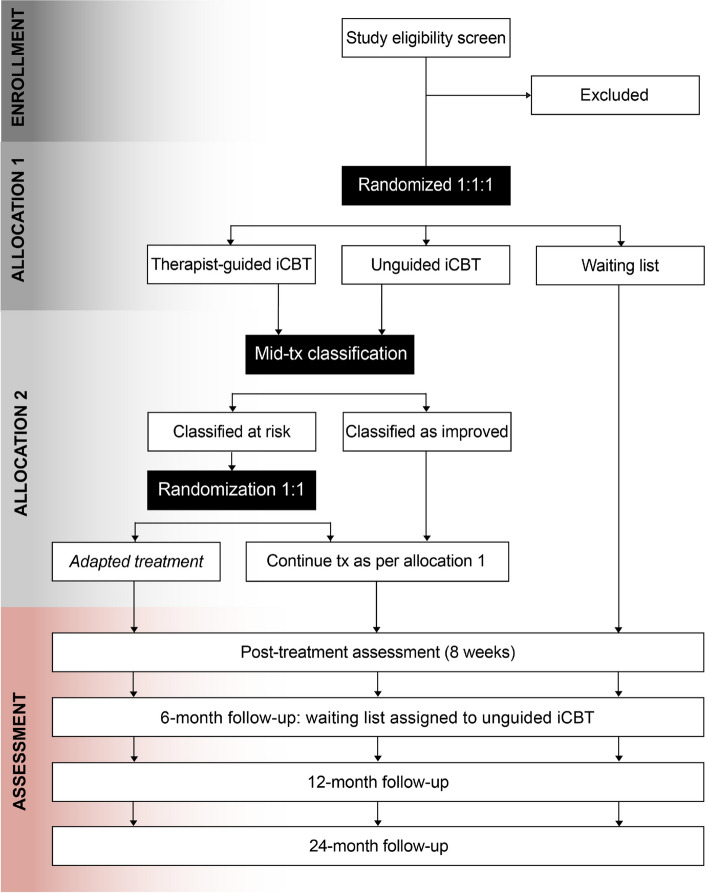
- Three-armed, parallel-group RCT comparing guided versus unguided transdiagnostic internet treatment against a waitlist control; a nested SWAT rerandomizes participants in guided/unguided arms who show lack of short-term benefit in week 3.
- Participants are Swedish university students recruited from the WHO-WMH-ICS survey population across participating universities; eligibility requires PHQ-9 scores 5–19 and/or GAD-7 scores ≥5, with exclusions for current psychological treatment, recent medication initiation, severe symptoms, suicidal ideation, psychosis, or problematic alcohol/drug scores.
- Main analyses use intention-to-treat, with multilevel linear regression for the co-primary outcomes (PHQ-9 and GAD-7), adjusted for baseline measures, age, gender, and HBTQ status; missing data will be handled with multiple imputation and available-case analyses, and models will be estimated using both Bayesian inference and maximum likelihood.
## Limitations
- The paper states that attrition from follow-up is expected to be higher than expected, and that this is a concern in the study.
- The authors note that GCP monitoring was not used because they opted out of it due to its requirement that only one endpoint measure be used as a primary outcome.
- Evident from the text: this is a protocol, so no trial outcomes are reported yet, and several analyses and qualitative components are only planned rather than completed.
Model-written summary. Check it against the paper before relying on it.
Integrity signals
Registry
Cites
Statistics
Figures
Verification
Claims the paper makes
23 Valid · 2 Not valid · 5 Not checked · 22 Own results and interpretations
Some cited sources support this claim and some don’t — read each source’s verdict below.
In the paper
“and results have so far shown minor effects.”
§ Transdiagnostic and tailored internet intervention to improve mental health among university students: Research protocol for a randomized controlled trial > Introduction > Background and rationale (6a) The human developmental trajectory is marked by crucial transitions from one phase to another, for example childhood to adolescence, or late adolescence to emerging adulthood [1]. For many individuals, the latter phase coincides with university studies and is characterized by exploration of identity on a personal and career level [2]. The period is also characterized by a higher rate of engagement in risky behaviors, compared to later adulthood [1]. The variability of life changes and events in emerging adulthood is associated with a high prevalence and incidence of mental health problems. About one in three university students show symptoms of depression and anxiety that can have serious negative effects on the developmental trajectory at work, in intimate relationships and for health [3, 4], and may interfere with academic performance [5]. The most prevalent disorders at this stage include mood, anxiety, and substance use, all key predictors of dropout from higher education [6]. Additional mental problems frequently co-occur with these disorders. Despite the prevalence of mental health problems, students are generally not very likely to seek help, because they either do not believe they need help, experience stigma or lack confidence that they will be helped, or find that they lack quick access to treatment [7]. Cognitive behavioral therapy (CBT) is an internationally widespread treatment method shown to be effective for common mental health disorders, particularly depression [8]. One way to lower the threshold for access to such treatment is to offer internet interventions, which have shown treatment effects for CBT that are equivalent to face-to-face treatment for diagnosis-specific depression, anxiety, and a variety of other conditions [9]. A significant overall research question is whether these internet interventions should be guided by human support. Early studies found that human guidance significantly contributed to reducing attrition as well as increasing treatment effects, and a recent review of 31 meta-analyses confirmed that just under half of reported studies showed that guidance was significantly better than treatment with no human support or minimal such support. At the same time, 9% showed that unguided interventions had better outcomes than supported ones. It is still not clear what factors indicate an obvious need for supported interventions, although the severity of mental health problems might be one indicator [10]. For the target group of university students in particular, a systematic review and meta-analysis of internet interventions to increase students’ mental health showed small between-group effects on measures of depression and no between-group differences on anxiety measures when publication bias was taken into account, where human guidance of interventions did not yield any advantage for the students [11]. In contrast, a later synthesis of data from 18 systematic reviews and meta-analyses for a wider group of adolescents and young people concluded that CBT-based interventions for depression and anxiety could be termed effective, and that involvement of human support could improve effectiveness and intervention adherence [12]. The most recent synthesis of evidence for ICBT interventions for university students, an umbrella review including seven systematic reviews or meta-analyses, found research support for expanding access to digital mental health interventions for university students, and recommended increasing rigor in future studies, including increased analysis of user data on engagement and intervention retention [13]. It thus seems that offering evidence-based guided or unguided internet interventions to students with mental health problems could potentially yield at least some improvements in mental health [3], in the best of cases, participating in such interventions could also contribute to better academic performance and quality of life during the university years, and support improved mental health even past graduation. To summarize, over the past two decades, diagnosis-specific internet interventions have been thoroughly investigated, with moderate to large effects [9]. The evidence base for internet interventions targeting university students is cautiously positive, but currently not robust [11–13]. The overall research field on digital mental health interventions (DMHIs) has recently been moving towards experimentation with internet interventions that can address more than one condition within the same program; i.e., transdiagnostic interventions based on internet-delivered CBT (iCBT) [e.g., 14]. The advantage of such transdiagnostic interventions is that they can be offered as a “one-size fits all” treatment for individuals with the most common mental health disorders, primarily depression and anxiety. Transdiagnostic interventions for mild to moderate depression and anxiety among university students have been developed and tested in Australia, Canada, Indonesia, the Netherlands, and the UK, [14–20], and results have so far shown minor effects. Existing research on internet interventions also yields recommendations for larger randomized controlled trials, in order to explore different effects of individual treatment components and the specific role of guidance and/or tailoring of interventions [19]. Further, studies are needed to explore the possibility that internet-delivered CBT (ICBT) for students with symptoms of mild to moderate depression or anxiety might benefit from small improvements that could be clinically relevant [21]. We do not know to what extent internet-delivered transdiagnostic interventions, guided or unguided, could reduce depression and anxiety among university students, nor how long effects might persist, but the existing evidence base suggests that ICBT interventions could have positive effects in the university student group. Additional research is needed to explore if and how transdiagnostic iCBT might yield sustainable post-treatment effects. One factor affecting the lack of positive results in earlier studies could be that treatment protocols need to be designed to deliver greater tailoring in relation to individual needs, as in precision medicine [22]. Students in higher education are clearly in need of effective mental health interventions, and it is a matter of considerable urgency to meet their needs, particularly given that students in Sweden who report mental health problems are twice as likely to drop out without completing a degree [23]. The current study builds on ongoing studies mapping mental health issues among university students in Sweden [24] within the international WHO-WMH-ICS consortium [3]. This study will recruit participants from epidemiological survey respondents at multiple universities, offering participation in a three-armed randomized controlled trial (RCT) that will evaluate guided and unguided internet-based transdiagnostic treatment for depression and anxiety, in comparison to waitlist controls. The transdiagnostic internet-delivered treatment program will also offer user-tailoring of some of the treatment content, an aspect that has shown a small, significant advantage (d = 0.26). in comparison to content that is tailored by clinicians [25]. An additional novel feature in this project is that it will encompass a secondary, embedded randomized “study within a trial” (SWAT) [26] that addresses the risk that some of the students in the target group will be less likely to improve in ordinary guided or unguided treatment, and may benefit from an adaptive treatment strategy, which has been shown effective in an earlier trial for insomnia among adults [27]. This embedded trial aligns with a precision medicine approach that adapts treatment content to unique individual needs for increased potential treatment benefits [22].
What the sources say
- Partly supportedcites [14] Musiat P, Potterton R, Gordon G, Spencer L, Zeiler M, Waldherr K, Kuso S, Nitsch M, Adamcik T, Wagner G, et al. Web-based indicated prevention of common mental disorders in university students in four European countries - Study protocol for a randomised controlled trial. Internet Interv. 2019;16:35–42. PMC6364328 30775263 sourceExperimental — accuracy not yet measured
The Introduction (page not provided) reports mixed results for web-based mental-health interventions in university students: about half of the reviewed studies had a significant positive outcome, while about a third found no effect. It does not establish that effects were minor specifically for transdiagnostic interventions; it also reports reduced symptoms after a pilot transdiagnostic intervention. (LLM, conf=0.78)
- Partly supportedcites [15] Klein AA-O, Wolters NE, Bol EJM, Koelen J, de Koning L, Roetink SSM, van Blom JJ, Pronk T, van der Heijde C, Salemink E, et al. Online computer or therapist-guided cognitive behavioral therapy in university students with anxiety and/or depression: study protocol of a randomised controlled trial. BMJ Open. 2021:2044–6055. (Electronic). PMC8628330 34836897 sourceExperimental — accuracy not yet measured
The Background reports small effects on depression and anxiety in university students from a meta-analysis of online psychological interventions. It does not say those interventions were specifically transdiagnostic; the paper’s own transdiagnostic trial is a protocol and reports no results. (LLM, conf=0.85)
- Partly supportedcites [16] Bolinski FA-O, Kleiboer A, Karyotaki E, Bosmans JE, Zarski AC, Weisel KK, Ebert DD, Jacobi C, Cuijpers P, Riper H. Effectiveness of a transdiagnostic individually tailored Internet-based and mobile-supported intervention for the indicated prevention of depression and anxiety (ICare Prevent) in Dutch college students: study protocol for a randomised controlled trial. Trials. 2018;19(1):118. PMC5819200 29458407 sourceExperimental — accuracy not yet measured
The Background (page unavailable) reports small to moderate effects for face-to-face universal prevention programs among college students. It does not identify those programs as transdiagnostic; the Discussion (page unavailable) instead says evidence for transdiagnostic indicated prevention among college students is scarce. Thus the reported effect size cannot be attributed specifically to transdiagnostic interventions. (LLM, conf=0.82)
- Could not verifycites [17] Rahmadiana M, Karyotaki E, Passchier J, Cuijpers P, van Ballegooijen W, Wimbarti S, Riper H. Guided internet-based transdiagnostic intervention for Indonesian university students with symptoms of anxiety and depression: A pilot study protocol. Internet Interv. 2019;15:28–34. PMC6290259 30568878 sourceExperimental — accuracy not yet measured
The Introduction says internet-based interventions have shown effectiveness among students, but gives no effect sizes or assessment of transdiagnostic interventions specifically. The Discussion describes an effectiveness trial as a future step. Searches for minor or small effects found no passage supporting the claimed magnitude. (LLM, conf=0.76)
- Disputedcites [18] Karyotaki E, Klein AM, Riper H, Wit L, Krijnen L, Bol E, Bolinski F, Burger S, Ebert DD, Auerbach RP, et al. Examining the effectiveness of a web-based intervention for symptoms of depression and anxiety in college students: study protocol of a randomised controlled trial. BMJ Open. 2019:2044–6055. (Electronic). PMC6530301 31092668 sourceExperimental — accuracy not yet measured
The Introduction reports moderate to large effects for two transdiagnostic web-based interventions in college students (depression d=0.55 and 1.59; anxiety d=0.66 and 1.33) and calls the findings encouraging. The Discussion characterizes the limited trial evidence as mixed and inconclusive, not as showing minor effects. (LLM, conf=0.87)
Checked by a reasoning model — may be wrong.
- Partly supportedcites [19] Farrer LM, Gulliver A, Katruss N, Fassnacht DB, Kyrios M, Batterham PJ. A novel multi-component online intervention to improve the mental health of university students: Randomised controlled trial of the Uni Virtual Clinic. Internet Interv. 2019;18:100276. PMC6926241 31890625 sourceExperimental — accuracy not yet measured
The Results (Secondary outcomes; page unavailable) report mostly small between-group effects for the Uni Virtual Clinic, supporting the claim for this intervention. But academic self-efficacy had a moderate effect at three months (d = 0.60), and the Discussion reports small-to-moderate effects in other student studies. The paper therefore does not establish that transdiagnostic interventions for university students have generally shown only minor effects. (LLM, conf=0.84)
- Not checked — no full text of the sourcecites [20] Day V McGrath PJ Wojtowicz M Internet-based guided self-help for university students with anxiety, depression and stress: A randomized controlled clinical trial Behav Res Ther 2013 51 7 344 351 10.1016/j.brat.2013.03.003 23639300 source
plain- Asserted: passes — The authors put it forward as true.
- Checkable: passes — It can be checked against evidence.
- Load-bearing: passes — The paper’s conclusions depend on it.
- Based: passes — The paper gives a reason why it holds.
- Partly supported
Every source the paper cites for this claim was checked and supports it.
In the paper
“One way to lower the threshold for access to such treatment is to offer internet interventions, which have shown treatment effects for CBT that are equivalent to face-to-face treatment for diagnosis-specific depression, anxiety, and a variety of other conditions [9].”
§ Transdiagnostic and tailored internet intervention to improve mental health among university students: Research protocol for a randomized controlled trial > Introduction > Background and rationale (6a) The human developmental trajectory is marked by crucial transitions from one phase to another, for example childhood to adolescence, or late adolescence to emerging adulthood [1]. For many individuals, the latter phase coincides with university studies and is characterized by exploration of identity on a personal and career level [2]. The period is also characterized by a higher rate of engagement in risky behaviors, compared to later adulthood [1]. The variability of life changes and events in emerging adulthood is associated with a high prevalence and incidence of mental health problems. About one in three university students show symptoms of depression and anxiety that can have serious negative effects on the developmental trajectory at work, in intimate relationships and for health [3, 4], and may interfere with academic performance [5]. The most prevalent disorders at this stage include mood, anxiety, and substance use, all key predictors of dropout from higher education [6]. Additional mental problems frequently co-occur with these disorders. Despite the prevalence of mental health problems, students are generally not very likely to seek help, because they either do not believe they need help, experience stigma or lack confidence that they will be helped, or find that they lack quick access to treatment [7]. Cognitive behavioral therapy (CBT) is an internationally widespread treatment method shown to be effective for common mental health disorders, particularly depression [8]. One way to lower the threshold for access to such treatment is to offer internet interventions, which have shown treatment effects for CBT that are equivalent to face-to-face treatment for diagnosis-specific depression, anxiety, and a variety of other conditions [9]. A significant overall research question is whether these internet interventions should be guided by human support. Early studies found that human guidance significantly contributed to reducing attrition as well as increasing treatment effects, and a recent review of 31 meta-analyses confirmed that just under half of reported studies showed that guidance was significantly better than treatment with no human support or minimal such support. At the same time, 9% showed that unguided interventions had better outcomes than supported ones. It is still not clear what factors indicate an obvious need for supported interventions, although the severity of mental health problems might be one indicator [10]. For the target group of university students in particular, a systematic review and meta-analysis of internet interventions to increase students’ mental health showed small between-group effects on measures of depression and no between-group differences on anxiety measures when publication bias was taken into account, where human guidance of interventions did not yield any advantage for the students [11]. In contrast, a later synthesis of data from 18 systematic reviews and meta-analyses for a wider group of adolescents and young people concluded that CBT-based interventions for depression and anxiety could be termed effective, and that involvement of human support could improve effectiveness and intervention adherence [12]. The most recent synthesis of evidence for ICBT interventions for university students, an umbrella review including seven systematic reviews or meta-analyses, found research support for expanding access to digital mental health interventions for university students, and recommended increasing rigor in future studies, including increased analysis of user data on engagement and intervention retention [13]. It thus seems that offering evidence-based guided or unguided internet interventions to students with mental health problems could potentially yield at least some improvements in mental health [3], in the best of cases, participating in such interventions could also contribute to better academic performance and quality of life during the university years, and support improved mental health even past graduation. To summarize, over the past two decades, diagnosis-specific internet interventions have been thoroughly investigated, with moderate to large effects [9]. The evidence base for internet interventions targeting university students is cautiously positive, but currently not robust [11–13]. The overall research field on digital mental health interventions (DMHIs) has recently been moving towards experimentation with internet interventions that can address more than one condition within the same program; i.e., transdiagnostic interventions based on internet-delivered CBT (iCBT) [e.g., 14]. The advantage of such transdiagnostic interventions is that they can be offered as a “one-size fits all” treatment for individuals with the most common mental health disorders, primarily depression and anxiety. Transdiagnostic interventions for mild to moderate depression and anxiety among university students have been developed and tested in Australia, Canada, Indonesia, the Netherlands, and the UK, [14–20], and results have so far shown minor effects. Existing research on internet interventions also yields recommendations for larger randomized controlled trials, in order to explore different effects of individual treatment components and the specific role of guidance and/or tailoring of interventions [19]. Further, studies are needed to explore the possibility that internet-delivered CBT (ICBT) for students with symptoms of mild to moderate depression or anxiety might benefit from small improvements that could be clinically relevant [21]. We do not know to what extent internet-delivered transdiagnostic interventions, guided or unguided, could reduce depression and anxiety among university students, nor how long effects might persist, but the existing evidence base suggests that ICBT interventions could have positive effects in the university student group. Additional research is needed to explore if and how transdiagnostic iCBT might yield sustainable post-treatment effects. One factor affecting the lack of positive results in earlier studies could be that treatment protocols need to be designed to deliver greater tailoring in relation to individual needs, as in precision medicine [22]. Students in higher education are clearly in need of effective mental health interventions, and it is a matter of considerable urgency to meet their needs, particularly given that students in Sweden who report mental health problems are twice as likely to drop out without completing a degree [23]. The current study builds on ongoing studies mapping mental health issues among university students in Sweden [24] within the international WHO-WMH-ICS consortium [3]. This study will recruit participants from epidemiological survey respondents at multiple universities, offering participation in a three-armed randomized controlled trial (RCT) that will evaluate guided and unguided internet-based transdiagnostic treatment for depression and anxiety, in comparison to waitlist controls. The transdiagnostic internet-delivered treatment program will also offer user-tailoring of some of the treatment content, an aspect that has shown a small, significant advantage (d = 0.26). in comparison to content that is tailored by clinicians [25]. An additional novel feature in this project is that it will encompass a secondary, embedded randomized “study within a trial” (SWAT) [26] that addresses the risk that some of the students in the target group will be less likely to improve in ordinary guided or unguided treatment, and may benefit from an adaptive treatment strategy, which has been shown effective in an earlier trial for insomnia among adults [27]. This embedded trial aligns with a precision medicine approach that adapts treatment content to unique individual needs for increased potential treatment benefits [22].
What the sources say
- Supportedcites [9] Hedman-Lagerlöf E Carlbring P Svärdman F Riper H Cuijpers P Andersson G Therapist-supported Internet-based cognitive behaviour therapy yields similar effects as face-to-face therapy for psychiatric and somatic disorders: an updated systematic review and meta-analysis World Psychiatry 2023 22 2 305 314 10.1002/wps.21088 37159350 PMC10168168 source
The Abstract reports similar effects for therapist-supported internet-based CBT and face-to-face CBT across disorders; half the trials concerned depression or anxiety. The Discussion likewise reports similar symptomatic improvement across the study populations, which included a variety of other conditions. The evidence concerns therapist-supported internet interventions specifically. (LLM, conf=0.91)
plainstates a cause- Asserted: passes — The authors put it forward as true.
- Checkable: passes — It can be checked against evidence.
- Load-bearing: passes — The paper’s conclusions depend on it.
- Based: passes — The paper gives a reason why it holds.
- Supported
The cited sources support only part of this claim — read each source’s verdict below.
In the paper
“a recent review of 31 meta-analyses confirmed that just under half of reported studies showed that guidance was significantly better than treatment with no human support or minimal such support.”
§ Transdiagnostic and tailored internet intervention to improve mental health among university students: Research protocol for a randomized controlled trial > Introduction > Background and rationale (6a) The human developmental trajectory is marked by crucial transitions from one phase to another, for example childhood to adolescence, or late adolescence to emerging adulthood [1]. For many individuals, the latter phase coincides with university studies and is characterized by exploration of identity on a personal and career level [2]. The period is also characterized by a higher rate of engagement in risky behaviors, compared to later adulthood [1]. The variability of life changes and events in emerging adulthood is associated with a high prevalence and incidence of mental health problems. About one in three university students show symptoms of depression and anxiety that can have serious negative effects on the developmental trajectory at work, in intimate relationships and for health [3, 4], and may interfere with academic performance [5]. The most prevalent disorders at this stage include mood, anxiety, and substance use, all key predictors of dropout from higher education [6]. Additional mental problems frequently co-occur with these disorders. Despite the prevalence of mental health problems, students are generally not very likely to seek help, because they either do not believe they need help, experience stigma or lack confidence that they will be helped, or find that they lack quick access to treatment [7]. Cognitive behavioral therapy (CBT) is an internationally widespread treatment method shown to be effective for common mental health disorders, particularly depression [8]. One way to lower the threshold for access to such treatment is to offer internet interventions, which have shown treatment effects for CBT that are equivalent to face-to-face treatment for diagnosis-specific depression, anxiety, and a variety of other conditions [9]. A significant overall research question is whether these internet interventions should be guided by human support. Early studies found that human guidance significantly contributed to reducing attrition as well as increasing treatment effects, and a recent review of 31 meta-analyses confirmed that just under half of reported studies showed that guidance was significantly better than treatment with no human support or minimal such support. At the same time, 9% showed that unguided interventions had better outcomes than supported ones. It is still not clear what factors indicate an obvious need for supported interventions, although the severity of mental health problems might be one indicator [10]. For the target group of university students in particular, a systematic review and meta-analysis of internet interventions to increase students’ mental health showed small between-group effects on measures of depression and no between-group differences on anxiety measures when publication bias was taken into account, where human guidance of interventions did not yield any advantage for the students [11]. In contrast, a later synthesis of data from 18 systematic reviews and meta-analyses for a wider group of adolescents and young people concluded that CBT-based interventions for depression and anxiety could be termed effective, and that involvement of human support could improve effectiveness and intervention adherence [12]. The most recent synthesis of evidence for ICBT interventions for university students, an umbrella review including seven systematic reviews or meta-analyses, found research support for expanding access to digital mental health interventions for university students, and recommended increasing rigor in future studies, including increased analysis of user data on engagement and intervention retention [13]. It thus seems that offering evidence-based guided or unguided internet interventions to students with mental health problems could potentially yield at least some improvements in mental health [3], in the best of cases, participating in such interventions could also contribute to better academic performance and quality of life during the university years, and support improved mental health even past graduation. To summarize, over the past two decades, diagnosis-specific internet interventions have been thoroughly investigated, with moderate to large effects [9]. The evidence base for internet interventions targeting university students is cautiously positive, but currently not robust [11–13]. The overall research field on digital mental health interventions (DMHIs) has recently been moving towards experimentation with internet interventions that can address more than one condition within the same program; i.e., transdiagnostic interventions based on internet-delivered CBT (iCBT) [e.g., 14]. The advantage of such transdiagnostic interventions is that they can be offered as a “one-size fits all” treatment for individuals with the most common mental health disorders, primarily depression and anxiety. Transdiagnostic interventions for mild to moderate depression and anxiety among university students have been developed and tested in Australia, Canada, Indonesia, the Netherlands, and the UK, [14–20], and results have so far shown minor effects. Existing research on internet interventions also yields recommendations for larger randomized controlled trials, in order to explore different effects of individual treatment components and the specific role of guidance and/or tailoring of interventions [19]. Further, studies are needed to explore the possibility that internet-delivered CBT (ICBT) for students with symptoms of mild to moderate depression or anxiety might benefit from small improvements that could be clinically relevant [21]. We do not know to what extent internet-delivered transdiagnostic interventions, guided or unguided, could reduce depression and anxiety among university students, nor how long effects might persist, but the existing evidence base suggests that ICBT interventions could have positive effects in the university student group. Additional research is needed to explore if and how transdiagnostic iCBT might yield sustainable post-treatment effects. One factor affecting the lack of positive results in earlier studies could be that treatment protocols need to be designed to deliver greater tailoring in relation to individual needs, as in precision medicine [22]. Students in higher education are clearly in need of effective mental health interventions, and it is a matter of considerable urgency to meet their needs, particularly given that students in Sweden who report mental health problems are twice as likely to drop out without completing a degree [23]. The current study builds on ongoing studies mapping mental health issues among university students in Sweden [24] within the international WHO-WMH-ICS consortium [3]. This study will recruit participants from epidemiological survey respondents at multiple universities, offering participation in a three-armed randomized controlled trial (RCT) that will evaluate guided and unguided internet-based transdiagnostic treatment for depression and anxiety, in comparison to waitlist controls. The transdiagnostic internet-delivered treatment program will also offer user-tailoring of some of the treatment content, an aspect that has shown a small, significant advantage (d = 0.26). in comparison to content that is tailored by clinicians [25]. An additional novel feature in this project is that it will encompass a secondary, embedded randomized “study within a trial” (SWAT) [26] that addresses the risk that some of the students in the target group will be less likely to improve in ordinary guided or unguided treatment, and may benefit from an adaptive treatment strategy, which has been shown effective in an earlier trial for insomnia among adults [27]. This embedded trial aligns with a precision medicine approach that adapts treatment content to unique individual needs for increased potential treatment benefits [22].
What the sources say
- Partly supportedcites [10] Werntz A Amado S Jasman M Ervin A Rhodes JE Providing human support for the use of digital mental health interventions: systematic meta-review J Med Internet Res 2023 25 e42864 10.2196/42864 36745497 PMC9941905 sourceExperimental — accuracy not yet measured
The Discussion (Principal Findings) reports 31 meta-analyses and says that 22 of 45 effect sizes (48%) favored human-supported over unsupported digital mental health interventions. The claim incorrectly describes that fraction as a fraction of reported studies; the paper counts effect sizes, not studies. (LLM, conf=0.90)
boostedstates a cause- Asserted: passes — The authors put it forward as true.
- Checkable: passes — It can be checked against evidence.
- Load-bearing: unclear — It is unclear whether the paper’s conclusions depend on it.
- Based: passes — The paper gives a reason why it holds.
- Partly supported
The cited sources support only part of this claim — read each source’s verdict below.
In the paper
“About one in three university students report symptoms of depression and anxiety that can negatively affect their developmental trajectory concerning work, intimate relationships, and health.”
- Also stated in: § Background and rationale (6a) The human developmental trajectory is marked by crucial transitions from one phase to another, for example childhood to adolescence, or late adolescence to emerging adulthood [1]. For many individuals, the latter phase coincides with university studies and is characterized by exploration of identity on a personal and career level [2]. The period is also characterized by a higher rate of engagement in risky behaviors, compared to later adulthood [1]. The variability of life changes and events in emerging adulthood is associated with a high prevalence and incidence of mental health problems. About one in three university students show symptoms of depression and anxiety that can have serious negative effects on the developmental trajectory at work, in intimate relationships and for health [3, 4], and may interfere with academic performance [5]. The most prevalent disorders at this stage include mood, anxiety, and substance use, all key predictors of dropout from higher education [6]. Additional mental problems frequently co-occur with these disorders. Despite the prevalence of mental health problems, students are generally not very likely to seek help, because they either do not believe they need help, experience stigma or lack confidence that they will be helped, or find that they lack quick access to treatment [7]. Cognitive behavioral therapy (CBT) is an internationally widespread treatment method shown to be effective for common mental health disorders, particularly depression [8]. One way to lower the threshold for access to such treatment is to offer internet interventions, which have shown treatment effects for CBT that are equivalent to face-to-face treatment for diagnosis-specific depression, anxiety, and a variety of other conditions [9]. A significant overall research question is whether these internet interventions should be guided by human support. Early studies found that human guidance significantly contributed to reducing attrition as well as increasing treatment effects, and a recent review of 31 meta-analyses confirmed that just under half of reported studies showed that guidance was significantly better than treatment with no human support or minimal such support. At the same time, 9% showed that unguided interventions had better outcomes than supported ones. It is still not clear what factors indicate an obvious need for supported interventions, although the severity of mental health problems might be one indicator [10]. For the target group of university students in particular, a systematic review and meta-analysis of internet interventions to increase students’ mental health showed small between-group effects on measures of depression and no between-group differences on anxiety measures when publication bias was taken into account, where human guidance of interventions did not yield any advantage for the students [11]. In contrast, a later synthesis of data from 18 systematic reviews and meta-analyses for a wider group of adolescents and young people concluded that CBT-based interventions for depression and anxiety could be termed effective, and that involvement of human support could improve effectiveness and intervention adherence [12]. The most recent synthesis of evidence for ICBT interventions for university students, an umbrella review including seven systematic reviews or meta-analyses, found research support for expanding access to digital mental health interventions for university students, and recommended increasing rigor in future studies, including increased analysis of user data on engagement and intervention retention [13]. It thus seems that offering evidence-based guided or unguided internet interventions to students with mental health problems could potentially yield at least some improvements in mental health [3], in the best of cases, participating in such interventions could also contribute to better academic performance and quality of life during the university years, and support improved mental health even past graduation. To summarize, over the past two decades, diagnosis-specific internet interventions have been thoroughly investigated, with moderate to large effects [9]. The evidence base for internet interventions targeting university students is cautiously positive, but currently not robust [11–13]. The overall research field on digital mental health interventions (DMHIs) has recently been moving towards experimentation with internet interventions that can address more than one condition within the same program; i.e., transdiagnostic interventions based on internet-delivered CBT (iCBT) [e.g., 14]. The advantage of such transdiagnostic interventions is that they can be offered as a “one-size fits all” treatment for individuals with the most common mental health disorders, primarily depression and anxiety. Transdiagnostic interventions for mild to moderate depression and anxiety among university students have been developed and tested in Australia, Canada, Indonesia, the Netherlands, and the UK, [14–20], and results have so far shown minor effects. Existing research on internet interventions also yields recommendations for larger randomized controlled trials, in order to explore different effects of individual treatment components and the specific role of guidance and/or tailoring of interventions [19]. Further, studies are needed to explore the possibility that internet-delivered CBT (ICBT) for students with symptoms of mild to moderate depression or anxiety might benefit from small improvements that could be clinically relevant [21]. We do not know to what extent internet-delivered transdiagnostic interventions, guided or unguided, could reduce depression and anxiety among university students, nor how long effects might persist, but the existing evidence base suggests that ICBT interventions could have positive effects in the university student group. Additional research is needed to explore if and how transdiagnostic iCBT might yield sustainable post-treatment effects. One factor affecting the lack of positive results in earlier studies could be that treatment protocols need to be designed to deliver greater tailoring in relation to individual needs, as in precision medicine [22]. Students in higher education are clearly in need of effective mental health interventions, and it is a matter of considerable urgency to meet their needs, particularly given that students in Sweden who report mental health problems are twice as likely to drop out without completing a degree [23]. The current study builds on ongoing studies mapping mental health issues among university students in Sweden [24] within the international WHO-WMH-ICS consortium [3]. This study will recruit participants from epidemiological survey respondents at multiple universities, offering participation in a three-armed randomized controlled trial (RCT) that will evaluate guided and unguided internet-based transdiagnostic treatment for depression and anxiety, in comparison to waitlist controls. The transdiagnostic internet-delivered treatment program will also offer user-tailoring of some of the treatment content, an aspect that has shown a small, significant advantage (d = 0.26). in comparison to content that is tailored by clinicians [25]. An additional novel feature in this project is that it will encompass a secondary, embedded randomized “study within a trial” (SWAT) [26] that addresses the risk that some of the students in the target group will be less likely to improve in ordinary guided or unguided treatment, and may benefit from an adaptive treatment strategy, which has been shown effective in an earlier trial for insomnia among adults [27]. This embedded trial aligns with a precision medicine approach that adapts treatment content to unique individual needs for increased potential treatment benefits [22]. · plain
“About one in three university students show symptoms of depression and anxiety that can have serious negative effects on the developmental trajectory at work, in intimate relationships and for health [3, 4]”
§ Transdiagnostic and tailored internet intervention to improve mental health among university students: Research protocol for a randomized controlled trial > Abstract > Background
What the sources say
- Partly supportedcites [3] Cuijpers P Auerbach RP Benjet C Bruffaerts R Ebert D Karyotaki E Kessler RC The World Health Organization World Mental Health International College Student initiative: An overview Int J Methods Psychiatr Res 2019 28 e1761 10.1002/mpr.1761 30614123 PMC6590455 sourceExperimental — accuracy not yet measured
The College Student Surveys section reports that more than one-third of students screened positive for at least one lifetime mental disorder, not that one in three reported symptoms of depression and anxiety specifically. The Introduction supports the sentence’s broader point about adverse effects on later work, relationships, and health. Our copy provides no page numbers for these passages. (LLM, conf=0.88)
- Partly supportedcites [4] Bruffaerts R Mortier P Kiekens G Auerbach RP Cuijpers P Demyttenaere K Green JG Nock MK Kessler RC Mental health problems in college freshmen: Prevalence and academic functioning J Affect Disord 2018 225 97 103 10.1016/j.jad.2017.07.044 28802728 PMC5846318 sourceExperimental — accuracy not yet measured
The Results (§3.2; page not available in our copy) report that 34.9% of college freshmen had a mental health problem in the past year. That figure includes problems beyond depression and anxiety; internalizing problems, a broader category that includes both, were reported by 23.7%. The claim also generalizes from freshmen to university students overall. (LLM, conf=0.91)
plain- Asserted: passes — The authors put it forward as true.
- Checkable: passes — It can be checked against evidence.
- Load-bearing: unclear — It is unclear whether the paper’s conclusions depend on it.
- Based: passes — The paper gives a reason why it holds.
- Also stated in: § Background and rationale (6a) The human developmental trajectory is marked by crucial transitions from one phase to another, for example childhood to adolescence, or late adolescence to emerging adulthood [1]. For many individuals, the latter phase coincides with university studies and is characterized by exploration of identity on a personal and career level [2]. The period is also characterized by a higher rate of engagement in risky behaviors, compared to later adulthood [1]. The variability of life changes and events in emerging adulthood is associated with a high prevalence and incidence of mental health problems. About one in three university students show symptoms of depression and anxiety that can have serious negative effects on the developmental trajectory at work, in intimate relationships and for health [3, 4], and may interfere with academic performance [5]. The most prevalent disorders at this stage include mood, anxiety, and substance use, all key predictors of dropout from higher education [6]. Additional mental problems frequently co-occur with these disorders. Despite the prevalence of mental health problems, students are generally not very likely to seek help, because they either do not believe they need help, experience stigma or lack confidence that they will be helped, or find that they lack quick access to treatment [7]. Cognitive behavioral therapy (CBT) is an internationally widespread treatment method shown to be effective for common mental health disorders, particularly depression [8]. One way to lower the threshold for access to such treatment is to offer internet interventions, which have shown treatment effects for CBT that are equivalent to face-to-face treatment for diagnosis-specific depression, anxiety, and a variety of other conditions [9]. A significant overall research question is whether these internet interventions should be guided by human support. Early studies found that human guidance significantly contributed to reducing attrition as well as increasing treatment effects, and a recent review of 31 meta-analyses confirmed that just under half of reported studies showed that guidance was significantly better than treatment with no human support or minimal such support. At the same time, 9% showed that unguided interventions had better outcomes than supported ones. It is still not clear what factors indicate an obvious need for supported interventions, although the severity of mental health problems might be one indicator [10]. For the target group of university students in particular, a systematic review and meta-analysis of internet interventions to increase students’ mental health showed small between-group effects on measures of depression and no between-group differences on anxiety measures when publication bias was taken into account, where human guidance of interventions did not yield any advantage for the students [11]. In contrast, a later synthesis of data from 18 systematic reviews and meta-analyses for a wider group of adolescents and young people concluded that CBT-based interventions for depression and anxiety could be termed effective, and that involvement of human support could improve effectiveness and intervention adherence [12]. The most recent synthesis of evidence for ICBT interventions for university students, an umbrella review including seven systematic reviews or meta-analyses, found research support for expanding access to digital mental health interventions for university students, and recommended increasing rigor in future studies, including increased analysis of user data on engagement and intervention retention [13]. It thus seems that offering evidence-based guided or unguided internet interventions to students with mental health problems could potentially yield at least some improvements in mental health [3], in the best of cases, participating in such interventions could also contribute to better academic performance and quality of life during the university years, and support improved mental health even past graduation. To summarize, over the past two decades, diagnosis-specific internet interventions have been thoroughly investigated, with moderate to large effects [9]. The evidence base for internet interventions targeting university students is cautiously positive, but currently not robust [11–13]. The overall research field on digital mental health interventions (DMHIs) has recently been moving towards experimentation with internet interventions that can address more than one condition within the same program; i.e., transdiagnostic interventions based on internet-delivered CBT (iCBT) [e.g., 14]. The advantage of such transdiagnostic interventions is that they can be offered as a “one-size fits all” treatment for individuals with the most common mental health disorders, primarily depression and anxiety. Transdiagnostic interventions for mild to moderate depression and anxiety among university students have been developed and tested in Australia, Canada, Indonesia, the Netherlands, and the UK, [14–20], and results have so far shown minor effects. Existing research on internet interventions also yields recommendations for larger randomized controlled trials, in order to explore different effects of individual treatment components and the specific role of guidance and/or tailoring of interventions [19]. Further, studies are needed to explore the possibility that internet-delivered CBT (ICBT) for students with symptoms of mild to moderate depression or anxiety might benefit from small improvements that could be clinically relevant [21]. We do not know to what extent internet-delivered transdiagnostic interventions, guided or unguided, could reduce depression and anxiety among university students, nor how long effects might persist, but the existing evidence base suggests that ICBT interventions could have positive effects in the university student group. Additional research is needed to explore if and how transdiagnostic iCBT might yield sustainable post-treatment effects. One factor affecting the lack of positive results in earlier studies could be that treatment protocols need to be designed to deliver greater tailoring in relation to individual needs, as in precision medicine [22]. Students in higher education are clearly in need of effective mental health interventions, and it is a matter of considerable urgency to meet their needs, particularly given that students in Sweden who report mental health problems are twice as likely to drop out without completing a degree [23]. The current study builds on ongoing studies mapping mental health issues among university students in Sweden [24] within the international WHO-WMH-ICS consortium [3]. This study will recruit participants from epidemiological survey respondents at multiple universities, offering participation in a three-armed randomized controlled trial (RCT) that will evaluate guided and unguided internet-based transdiagnostic treatment for depression and anxiety, in comparison to waitlist controls. The transdiagnostic internet-delivered treatment program will also offer user-tailoring of some of the treatment content, an aspect that has shown a small, significant advantage (d = 0.26). in comparison to content that is tailored by clinicians [25]. An additional novel feature in this project is that it will encompass a secondary, embedded randomized “study within a trial” (SWAT) [26] that addresses the risk that some of the students in the target group will be less likely to improve in ordinary guided or unguided treatment, and may benefit from an adaptive treatment strategy, which has been shown effective in an earlier trial for insomnia among adults [27]. This embedded trial aligns with a precision medicine approach that adapts treatment content to unique individual needs for increased potential treatment benefits [22]. · plain
Every source the paper cites for this claim was checked and supports it.
In the paper
“A treatment gap exists, where a considerable proportion of students do not seek help for mood and anxiety symptoms.”
- Also stated in: § Background and rationale (6a) The human developmental trajectory is marked by crucial transitions from one phase to another, for example childhood to adolescence, or late adolescence to emerging adulthood [1]. For many individuals, the latter phase coincides with university studies and is characterized by exploration of identity on a personal and career level [2]. The period is also characterized by a higher rate of engagement in risky behaviors, compared to later adulthood [1]. The variability of life changes and events in emerging adulthood is associated with a high prevalence and incidence of mental health problems. About one in three university students show symptoms of depression and anxiety that can have serious negative effects on the developmental trajectory at work, in intimate relationships and for health [3, 4], and may interfere with academic performance [5]. The most prevalent disorders at this stage include mood, anxiety, and substance use, all key predictors of dropout from higher education [6]. Additional mental problems frequently co-occur with these disorders. Despite the prevalence of mental health problems, students are generally not very likely to seek help, because they either do not believe they need help, experience stigma or lack confidence that they will be helped, or find that they lack quick access to treatment [7]. Cognitive behavioral therapy (CBT) is an internationally widespread treatment method shown to be effective for common mental health disorders, particularly depression [8]. One way to lower the threshold for access to such treatment is to offer internet interventions, which have shown treatment effects for CBT that are equivalent to face-to-face treatment for diagnosis-specific depression, anxiety, and a variety of other conditions [9]. A significant overall research question is whether these internet interventions should be guided by human support. Early studies found that human guidance significantly contributed to reducing attrition as well as increasing treatment effects, and a recent review of 31 meta-analyses confirmed that just under half of reported studies showed that guidance was significantly better than treatment with no human support or minimal such support. At the same time, 9% showed that unguided interventions had better outcomes than supported ones. It is still not clear what factors indicate an obvious need for supported interventions, although the severity of mental health problems might be one indicator [10]. For the target group of university students in particular, a systematic review and meta-analysis of internet interventions to increase students’ mental health showed small between-group effects on measures of depression and no between-group differences on anxiety measures when publication bias was taken into account, where human guidance of interventions did not yield any advantage for the students [11]. In contrast, a later synthesis of data from 18 systematic reviews and meta-analyses for a wider group of adolescents and young people concluded that CBT-based interventions for depression and anxiety could be termed effective, and that involvement of human support could improve effectiveness and intervention adherence [12]. The most recent synthesis of evidence for ICBT interventions for university students, an umbrella review including seven systematic reviews or meta-analyses, found research support for expanding access to digital mental health interventions for university students, and recommended increasing rigor in future studies, including increased analysis of user data on engagement and intervention retention [13]. It thus seems that offering evidence-based guided or unguided internet interventions to students with mental health problems could potentially yield at least some improvements in mental health [3], in the best of cases, participating in such interventions could also contribute to better academic performance and quality of life during the university years, and support improved mental health even past graduation. To summarize, over the past two decades, diagnosis-specific internet interventions have been thoroughly investigated, with moderate to large effects [9]. The evidence base for internet interventions targeting university students is cautiously positive, but currently not robust [11–13]. The overall research field on digital mental health interventions (DMHIs) has recently been moving towards experimentation with internet interventions that can address more than one condition within the same program; i.e., transdiagnostic interventions based on internet-delivered CBT (iCBT) [e.g., 14]. The advantage of such transdiagnostic interventions is that they can be offered as a “one-size fits all” treatment for individuals with the most common mental health disorders, primarily depression and anxiety. Transdiagnostic interventions for mild to moderate depression and anxiety among university students have been developed and tested in Australia, Canada, Indonesia, the Netherlands, and the UK, [14–20], and results have so far shown minor effects. Existing research on internet interventions also yields recommendations for larger randomized controlled trials, in order to explore different effects of individual treatment components and the specific role of guidance and/or tailoring of interventions [19]. Further, studies are needed to explore the possibility that internet-delivered CBT (ICBT) for students with symptoms of mild to moderate depression or anxiety might benefit from small improvements that could be clinically relevant [21]. We do not know to what extent internet-delivered transdiagnostic interventions, guided or unguided, could reduce depression and anxiety among university students, nor how long effects might persist, but the existing evidence base suggests that ICBT interventions could have positive effects in the university student group. Additional research is needed to explore if and how transdiagnostic iCBT might yield sustainable post-treatment effects. One factor affecting the lack of positive results in earlier studies could be that treatment protocols need to be designed to deliver greater tailoring in relation to individual needs, as in precision medicine [22]. Students in higher education are clearly in need of effective mental health interventions, and it is a matter of considerable urgency to meet their needs, particularly given that students in Sweden who report mental health problems are twice as likely to drop out without completing a degree [23]. The current study builds on ongoing studies mapping mental health issues among university students in Sweden [24] within the international WHO-WMH-ICS consortium [3]. This study will recruit participants from epidemiological survey respondents at multiple universities, offering participation in a three-armed randomized controlled trial (RCT) that will evaluate guided and unguided internet-based transdiagnostic treatment for depression and anxiety, in comparison to waitlist controls. The transdiagnostic internet-delivered treatment program will also offer user-tailoring of some of the treatment content, an aspect that has shown a small, significant advantage (d = 0.26). in comparison to content that is tailored by clinicians [25]. An additional novel feature in this project is that it will encompass a secondary, embedded randomized “study within a trial” (SWAT) [26] that addresses the risk that some of the students in the target group will be less likely to improve in ordinary guided or unguided treatment, and may benefit from an adaptive treatment strategy, which has been shown effective in an earlier trial for insomnia among adults [27]. This embedded trial aligns with a precision medicine approach that adapts treatment content to unique individual needs for increased potential treatment benefits [22]. · hedged
“Despite the prevalence of mental health problems, students are generally not very likely to seek help, because they either do not believe they need help, experience stigma or lack confidence that they will be helped, or find that they lack quick access to treatment [7].”
§ Transdiagnostic and tailored internet intervention to improve mental health among university students: Research protocol for a randomized controlled trial > Abstract > Background
What the sources say
- Supportedcites [7] Ebert D, Mortier P, Kählke F, Bruffaerts R, Baumeister H, Auerbach RP, et al. Barriers of mental health treatment utilization among first year college students: First cross-national results from the WHO World Mental Health International College Student Initiative. Int J Methods Psychiatr Res. 2019. In press. PMC6522323 31069905 source
The Introduction reports that most college students with clinically significant mental disorders remain untreated and that fewer than one in four students with any 12-month mental disorder or suicidal thoughts and behaviors receive treatment. The Results identify major depressive episodes and generalized anxiety disorder among the disorders studied; together, these passages support the broad claim of a treatment gap for mood and anxiety symptoms. (LLM, conf=0.88)
plain- Asserted: passes — The authors put it forward as true.
- Checkable: passes — It can be checked against evidence.
- Load-bearing: passes — The paper’s conclusions depend on it.
- Based: passes — The paper gives a reason why it holds.
- Also stated in: § Background and rationale (6a) The human developmental trajectory is marked by crucial transitions from one phase to another, for example childhood to adolescence, or late adolescence to emerging adulthood [1]. For many individuals, the latter phase coincides with university studies and is characterized by exploration of identity on a personal and career level [2]. The period is also characterized by a higher rate of engagement in risky behaviors, compared to later adulthood [1]. The variability of life changes and events in emerging adulthood is associated with a high prevalence and incidence of mental health problems. About one in three university students show symptoms of depression and anxiety that can have serious negative effects on the developmental trajectory at work, in intimate relationships and for health [3, 4], and may interfere with academic performance [5]. The most prevalent disorders at this stage include mood, anxiety, and substance use, all key predictors of dropout from higher education [6]. Additional mental problems frequently co-occur with these disorders. Despite the prevalence of mental health problems, students are generally not very likely to seek help, because they either do not believe they need help, experience stigma or lack confidence that they will be helped, or find that they lack quick access to treatment [7]. Cognitive behavioral therapy (CBT) is an internationally widespread treatment method shown to be effective for common mental health disorders, particularly depression [8]. One way to lower the threshold for access to such treatment is to offer internet interventions, which have shown treatment effects for CBT that are equivalent to face-to-face treatment for diagnosis-specific depression, anxiety, and a variety of other conditions [9]. A significant overall research question is whether these internet interventions should be guided by human support. Early studies found that human guidance significantly contributed to reducing attrition as well as increasing treatment effects, and a recent review of 31 meta-analyses confirmed that just under half of reported studies showed that guidance was significantly better than treatment with no human support or minimal such support. At the same time, 9% showed that unguided interventions had better outcomes than supported ones. It is still not clear what factors indicate an obvious need for supported interventions, although the severity of mental health problems might be one indicator [10]. For the target group of university students in particular, a systematic review and meta-analysis of internet interventions to increase students’ mental health showed small between-group effects on measures of depression and no between-group differences on anxiety measures when publication bias was taken into account, where human guidance of interventions did not yield any advantage for the students [11]. In contrast, a later synthesis of data from 18 systematic reviews and meta-analyses for a wider group of adolescents and young people concluded that CBT-based interventions for depression and anxiety could be termed effective, and that involvement of human support could improve effectiveness and intervention adherence [12]. The most recent synthesis of evidence for ICBT interventions for university students, an umbrella review including seven systematic reviews or meta-analyses, found research support for expanding access to digital mental health interventions for university students, and recommended increasing rigor in future studies, including increased analysis of user data on engagement and intervention retention [13]. It thus seems that offering evidence-based guided or unguided internet interventions to students with mental health problems could potentially yield at least some improvements in mental health [3], in the best of cases, participating in such interventions could also contribute to better academic performance and quality of life during the university years, and support improved mental health even past graduation. To summarize, over the past two decades, diagnosis-specific internet interventions have been thoroughly investigated, with moderate to large effects [9]. The evidence base for internet interventions targeting university students is cautiously positive, but currently not robust [11–13]. The overall research field on digital mental health interventions (DMHIs) has recently been moving towards experimentation with internet interventions that can address more than one condition within the same program; i.e., transdiagnostic interventions based on internet-delivered CBT (iCBT) [e.g., 14]. The advantage of such transdiagnostic interventions is that they can be offered as a “one-size fits all” treatment for individuals with the most common mental health disorders, primarily depression and anxiety. Transdiagnostic interventions for mild to moderate depression and anxiety among university students have been developed and tested in Australia, Canada, Indonesia, the Netherlands, and the UK, [14–20], and results have so far shown minor effects. Existing research on internet interventions also yields recommendations for larger randomized controlled trials, in order to explore different effects of individual treatment components and the specific role of guidance and/or tailoring of interventions [19]. Further, studies are needed to explore the possibility that internet-delivered CBT (ICBT) for students with symptoms of mild to moderate depression or anxiety might benefit from small improvements that could be clinically relevant [21]. We do not know to what extent internet-delivered transdiagnostic interventions, guided or unguided, could reduce depression and anxiety among university students, nor how long effects might persist, but the existing evidence base suggests that ICBT interventions could have positive effects in the university student group. Additional research is needed to explore if and how transdiagnostic iCBT might yield sustainable post-treatment effects. One factor affecting the lack of positive results in earlier studies could be that treatment protocols need to be designed to deliver greater tailoring in relation to individual needs, as in precision medicine [22]. Students in higher education are clearly in need of effective mental health interventions, and it is a matter of considerable urgency to meet their needs, particularly given that students in Sweden who report mental health problems are twice as likely to drop out without completing a degree [23]. The current study builds on ongoing studies mapping mental health issues among university students in Sweden [24] within the international WHO-WMH-ICS consortium [3]. This study will recruit participants from epidemiological survey respondents at multiple universities, offering participation in a three-armed randomized controlled trial (RCT) that will evaluate guided and unguided internet-based transdiagnostic treatment for depression and anxiety, in comparison to waitlist controls. The transdiagnostic internet-delivered treatment program will also offer user-tailoring of some of the treatment content, an aspect that has shown a small, significant advantage (d = 0.26). in comparison to content that is tailored by clinicians [25]. An additional novel feature in this project is that it will encompass a secondary, embedded randomized “study within a trial” (SWAT) [26] that addresses the risk that some of the students in the target group will be less likely to improve in ordinary guided or unguided treatment, and may benefit from an adaptive treatment strategy, which has been shown effective in an earlier trial for insomnia among adults [27]. This embedded trial aligns with a precision medicine approach that adapts treatment content to unique individual needs for increased potential treatment benefits [22]. · hedged
15 more claims · 9 with their cited sources checked
Create a free account to see all 52 claims and to verify the 1 reference still open.
- It may state two separate claims as one. 16
- Probably not a substantial claim. 25
Citations
Cites
The PHQ-9: Validity of a brief depression severity measure
Kroenke, K., Spitzer, R. L., & Williams, J. B. W. (2001) · Journal of General Internal Medicine · doi:10.1046/j.1525-1497.2001.016009606.x · Cited by 44,910
A Brief Measure for Assessing Generalized Anxiety Disorder: The GAD-7
Spitzer, R. L., Kroenke, K., Williams, J. B. W., & Löwe, B. (2006) · Archives of Internal Medicine · doi:10.1001/archinte.166.10.1092 · Cited by 31,765 · cited 1×
“…self-report of mild to moderate depression and/or anxiety, operationalized as a score of at least 5 and up to and including 19 points on the 9-item Patient Health Questionnaire (PHQ-9) [29]; and/or a score of at 5 or more points on the 7-item General Anxiety Disorder questionnaire (GAD-7) [30].”
MethodEmerging adulthood: A theory of development from the late teens through the twenties.
Arnett, J. J. (2000) · American Psychologist · doi:10.1037/0003-066x.55.5.469 · Cited by 16,843
Development of a new resilience scale: The Connor-Davidson Resilience Scale (CD-RISC)
Connor, K. M., & Davidson, J. R. T. (2003) · Depression and Anxiety · doi:10.1002/da.10113 · Cited by 11,793
Bush, K. (1998) · Archives of Internal Medicine · doi:10.1001/archinte.158.16.1789 · Cited by 6,196
A New Initiative on Precision Medicine
Collins, F. S., & Varmus, H. (2015) · New England Journal of Medicine · doi:10.1056/nejmp1500523 · Cited by 5,202
The WHO-5 well-being index: A systematic review of the literature
Topp, C. W., Østergaard, S. D., Søndergaard, S., & Bech, P. (2015) · Psychotherapy and Psychosomatics · doi:10.1159/000376585 · Cited by 4,708
Skevington, S. M., Lotfy, M., & O'Connell, K. A. (2004) · Quality of Life Research · doi:10.1023/b:qure.0000018486.91360.00 · Cited by 4,686
Morin, C. M., Belleville, G., Bélanger, L., & Ivers, H. (2011) · Sleep · doi:10.1093/sleep/34.5.601 · Cited by 4,620
Rammstedt, B., & John, O. P. (2007) · Journal of Research in Personality · doi:10.1016/j.jrp.2006.02.001 · Cited by 4,244
Garnefski, N., Kraaij, V., Schroevers, M. J., & Somsen, G. A. (2008) · Journal of Clinical Psychology in Medical Settings · doi:10.1007/s10880-008-9136-5 · Cited by 2,479
Psychometric properties of the credibility/expectancy questionnaire
Devilly, G. J., & Borkovec, T. D. (2000) · Journal of Behavior Therapy and Experimental Psychiatry · doi:10.1016/s0005-7916(00)00012-4 · Cited by 2,295
The New Life Stage of Emerging Adulthood at Ages 18–29 Years: Implications for Mental Health
Arnett, J. J., Žukauskienė, R., & Sugimura, K. (2014) · The Lancet Psychiatry · doi:10.1016/s2215-0366(14)00080-7 · Cited by 1,896 · cited 2×
“The human developmental trajectory is marked by crucial transitions from one phase to another, for example childhood to adolescence, or late adolescence to emerging adulthood [1].”
BackgroundResultThe client satisfaction questionnaire
Attkisson, C. C., & Zwick, R. (1982) · Evaluation and Program Planning · doi:10.1016/0149-7189(82)90074-x · Cited by 1,743
Schmitt, D. P., & Allik, J. (2005) · Journal of Personality and Social Psychology · doi:10.1037/0022-3514.89.4.623 · Cited by 1,665
Mental disorders among college students in the World Health Organization World Mental Health Surveys
Auerbach, R. P., Alonso, J., Axinn, W. G., Cuijpers, P., Ebert, D. D., Green, J. G., Hwang, I., Kessler, R. C., Liu, H., Mortier, P., et al. (2016) · Psychological Medicine · doi:10.1017/s0033291716001665 · Cited by 1,587
Factor structure of the working alliance inventory
Tracey, T. J., & Kokotovic, A. M. (1989) · Psychological Assessment: A Journal of Consulting and Clinical Psychology · doi:10.1037/1040-3590.1.3.207 · Cited by 1,501
Bjureberg, J., Ljótsson, B., Tull, M. T., Hedman, E., Sahlin, H., Lundh, L.-G., Bjärehed, J., DiLillo, D., Messman-Moore, T., Gumpert, C. H., et al. (2016) · Journal of Psychopathology and Behavioral Assessment · doi:10.1007/s10862-015-9514-x · Cited by 1,081
Andersson, G., Cuijpers, P., Carlbring, P., Riper, H., & Hedman, E. (2014) · World Psychiatry · doi:10.1002/wps.20151 · Cited by 1,077
Self-citationMental health problems in college freshmen: Prevalence and academic functioning
Bruffaerts, R., Mortier, P., Kiekens, G., Auerbach, R. P., Cuijpers, P., Demyttenaere, K., Green, J. G., Nock, M. K., & Kessler, R. C. (2018) · Journal of Affective Disorders · doi:10.1016/j.jad.2017.07.044 · Cited by 1,047 · cited 1×
“About one in three university students show symptoms of depression and anxiety that can have serious negative effects on the developmental trajectory at work, in intimate relationships and for health [3, 4], and may interfere with academic performance [5].”
BackgroundInternet-delivered psychological treatments: from innovation to implementation
Andersson, G., Titov, N., Dear, B. F., Rozental, A., & Carlbring, P. (2019) · World Psychiatry · doi:10.1002/wps.20610 · Cited by 750
Self-citationInterpretation and identification of causal mediation
Pearl, J. (2014) · Psychological Methods · doi:10.1037/a0036434 · Cited by 554 · cited 1×
“We will use a causal inference framework, using Bayesian inference to estimate the natural direct effect and natural indirect effect (as per the definitions of Pearl [60]).”
MethodWhat is behavioral activation?
Kanter, J. W., Manos, R. C., Bowe, W. M., Baruch, D. E., Busch, A. M., & Rusch, L. C. (2010) · Clinical Psychology Review · doi:10.1016/j.cpr.2010.04.001 · Cited by 515
Kanter, J. W., Mulick, P. S., Busch, A. M., Berlin, K. S., & Martell, C. R. (2007) · Journal of Psychopathology and Behavioral Assessment · doi:10.1007/s10862-006-9038-5 · Cited by 493
Lehtimaki, S., Martic, J., Wahl, B., Foster, K. T., & Schwalbe, N. (2021) · JMIR Mental Health · doi:10.2196/25847 · Cited by 488 · cited 1×
“…of data from 18 systematic reviews and meta-analyses for a wider group of adolescents and young people concluded that CBT-based interventions for depression and anxiety could be termed effective, and that involvement of human support could improve effectiveness and intervention adherence [12].”
BackgroundNarrow, W. E., Clarke, D. E., Kuramoto, S. J., Kraemer, H. C., Kupfer, D. J., Greiner, L., & Regier, D. A. (2013) · American Journal of Psychiatry · doi:10.1176/appi.ajp.2012.12071000 · Cited by 446 · cited 1×
“Scores on the DSM-5 CCSM short-form questionnaire [31, 32] Participants who fulfil exclusion criteria 1 or 2 do not complete the PHQ-9 and GAD-7.”
MethodHarrer, M., Adam, S. H., Baumeister, H., Cuijpers, P., Karyotaki, E., Auerbach, R. P., Kessler, R. C., Bruffaerts, R., Berking, M., & Ebert, D. D. (2019) · International Journal of Methods in Psychiatric Research · doi:10.1002/mpr.1759 · Cited by 445 · cited 2×
“…interventions to increase students’ mental health showed small between-group effects on measures of depression and no between-group differences on anxiety measures when publication bias was taken into account, where human guidance of interventions did not yield any advantage for the students [11].”
BackgroundEbert, D. D., Mortier, P., Kaehlke, F., Bruffaerts, R., Baumeister, H., Auerbach, R. P., Alonso, J., Vilagut, G., Martínez, K. U., Lochner, C., et al. (2019) · International Journal of Methods in Psychiatric Research · doi:10.1002/mpr.1782 · Cited by 407 · cited 1×
“Despite the prevalence of mental health problems, students are generally not very likely to seek help, because they either do not believe they need help, experience stigma or lack confidence that they will be helped, or find that they lack quick access to treatment [7].”
BackgroundBouwmans, C., De Jong, K., Timman, R., Zijlstra-Vlasveld, M., Van der Feltz-Cornelis, C., Tan, S. S., & Hakkaart-van Roijen, L. (2013) · BMC Health Services Research · doi:10.1186/1472-6963-13-217 · Cited by 401
Cuijpers, P., Miguel, C., Harrer, M., Plessen, C. Y., Ciharova, M., Ebert, D., & Karyotaki, E. (2023) · World Psychiatry · doi:10.1002/wps.21069 · Cited by 354 · cited 1×
“Cognitive behavioral therapy (CBT) is an internationally widespread treatment method shown to be effective for common mental health disorders, particularly depression [8].”
Andersson, G., Carlbring, P., Titov, N., & Lindefors, N. (2019) · The Canadian Journal of Psychiatry · doi:10.1177/0706743719839381 · Cited by 324
Self-citationTrial Forge Guidance 1: what is a Study Within A Trial (SWAT)?
Treweek, S., Bevan, S., Bower, P., Campbell, M., Christie, J., Clarke, M., Collett, C., Cotton, S., Devane, D., El Feky, A., et al. (2018) · Trials · doi:10.1186/s13063-018-2535-5 · Cited by 298 · cited 1×
“An additional novel feature in this project is that it will encompass a secondary, embedded randomized “study within a trial” (SWAT) [26] that addresses the risk that some of the students in the target group will be less likely to improve in ordinary guided or unguided treatment, and may benefit…”
BackgroundJohansson, R., Sjöberg, E., Sjögren, M., Johnsson, E., Carlbring, P., Andersson, T., Rousseau, A., & Andersson, G. (2012) · PLoS ONE · doi:10.1371/journal.pone.0036905 · Cited by 268 · cited 1×
“Versions of the modules used in this trial were evaluated in two earlier studies [34, 35] as well as in a more recent study evaluating self-selected tailoring as compared to clinician-selected tailoring, with a somewhat more positive outcome for the self-selected procedure [25].”
MethodSelf-citationHedman‐Lagerlöf, E., Carlbring, P., Svärdman, F., Riper, H., Cuijpers, P., & Andersson, G. (2023) · World Psychiatry · doi:10.1002/wps.21088 · Cited by 259 · cited 2×
“To summarize, over the past two decades, diagnosis-specific internet interventions have been thoroughly investigated, with moderate to large effects [9].”
BackgroundSelf-citationRozental, A., Kottorp, A., Forsström, D., Månsson, K., Boettcher, J., Andersson, G., Furmark, T., & Carlbring, P. (2019) · Behavioural and Cognitive Psychotherapy · doi:10.1017/s1352465819000018 · Cited by 230
Self-citationFeatures and functionality of the Iterapi platform for internet-based psychological treatment
Vlaescu, G., Alasjö, A., Miloff, A., Carlbring, P., & Andersson, G. (2016) · Internet Interventions · doi:10.1016/j.invent.2016.09.006 · Cited by 229 · cited 3×
“The intervention, titled “PUMA,” is offered to participants in all three of the trial arms and consists of eight treatment modules based on CBT, all delivered over 8 weeks via the iTerapi internet treatment platform at Linköping University [33].”
MethodInfluentialSelf-citationBruffaerts, R., Mortier, P., Auerbach, R. P., Alonso, J., Hermosillo De la Torre, A. E., Cuijpers, P., Demyttenaere, K., Ebert, D. D., Green, J. G., Hasking, P., et al. (2019) · International Journal of Methods in Psychiatric Research · doi:10.1002/mpr.1764 · Cited by 228 · cited 1×
“…trial is to estimate the effects of an internet intervention for common mental health problems among university students in Sweden, who demonstrate mild to moderate symptoms of depression and/or anxiety, who are experiencing lower everyday functionality and whose treatment needs are unmet [6, 28].”
BackgroundIndividually-tailored, internet-based treatment for anxiety disorders: a randomized controlled trial
Carlbring, P., Maurin, L., Törngren, C., Linna, E., Eriksson, T., Sparthan, E., Strååt, M., Marquez von Hage, C., Bergman-Nordgren, L., & Andersson, G. (2011) · Behaviour Research and Therapy · doi:10.1016/j.brat.2010.10.002 · Cited by 227
Self-citationRozental, A., Kottorp, A., Boettcher, J., Andersson, G., & Carlbring, P. (2016) · PLOS ONE · doi:10.1371/journal.pone.0157503 · Cited by 223 · cited 1×
“Adverse events and harms during the RCT are measured with the Negative Experiences Questionnaire (NEQ), [61], and trial safety procedures include monitoring of symptom levels.”
MethodSelf-citationAlonso, J., Mortier, P., Auerbach, R. P., Bruffaerts, R., Vilagut, G., Cuijpers, P., Demyttenaere, K., Ebert, D. D., Ennis, E., Gutiérrez-García, R. A., et al. (2018) · Depression and Anxiety · doi:10.1002/da.22778 · Cited by 205
Cuijpers, P., Auerbach, R. P., Benjet, C., Bruffaerts, R., Ebert, D., Karyotaki, E., & Kessler, R. C. (2019) · International Journal of Methods in Psychiatric Research · doi:10.1002/mpr.1761 · Cited by 190
Providing Human Support for the Use of Digital Mental Health Interventions: Systematic Meta-review
Werntz, A., Amado, S., Jasman, M., Ervin, A., & Rhodes, J. E. (2023) · Journal of Medical Internet Research · doi:10.2196/42864 · Cited by 158 · cited 1×
“It is still not clear what factors indicate an obvious need for supported interventions, although the severity of mental health problems might be one indicator [10].”
BackgroundDay, V., McGrath, P. J., & Wojtowicz, M. (2013) · Behaviour Research and Therapy · doi:10.1016/j.brat.2013.03.003 · Cited by 145 · cited 1×
“Transdiagnostic interventions for mild to moderate depression and anxiety among university students have been developed and tested in Australia, Canada, Indonesia, the Netherlands, and the UK, [14–20], and results have so far shown minor effects.”
BackgroundVeličković, K., Hallberg, I. R., Axelsson, U., Borrebaeck, C. A. K., Rydén, L., Johnsson, P., & Månsson, J. (2020) · Health and Quality of Life Outcomes · doi:10.1186/s12955-020-01383-3 · Cited by 127
Preliminary validation of an ultra‐brief version of the Penn State Worry Questionnaire
Berle, D., Starcevic, V., Moses, K., Hannan, A., Milicevic, D., & Sammut, P. (2011) · Clinical Psychology & Psychotherapy · doi:10.1002/cpp.724 · Cited by 112
Wahlund, T., Mataix-Cols, D., Olofsdotter Lauri, K., de Schipper, E., Ljótsson, B., Aspvall, K., & Andersson, E. (2021) · Psychotherapy and Psychosomatics · doi:10.1159/000512843 · Cited by 105
Bendtsen, M. (2018) · Journal of Medical Internet Research · doi:10.2196/10873 · Cited by 105 · cited 1×
“All models of primary and secondary outcomes will be estimated using both Bayesian inference and maximum likelihood estimation [59].”
MethodSelf-citationEffectiveness of digital mental health interventions for university students: An umbrella review
Harith, S., Backhaus, I., Mohbin, N., Ngo, H. T., & Khoo, S. (2022) · PeerJ · doi:10.7717/peerj.13111 · Cited by 105 · cited 2×
“The evidence base for internet interventions targeting university students is cautiously positive, but currently not robust [11–13].”
BackgroundKessler, R. C. (2018) · Current Opinion in Psychiatry · doi:10.1097/yco.0000000000000377 · Cited by 103 · cited 1×
“…will consist of a rich set of self-report variables found in prior studies to be predictors of response to CBT; e.g., socio-demographic factors; history, triggers, and symptom of mental disorders; comorbid disorders/ symptoms; stress and adversity; and personality traits/ temperament [64].”
BackgroundForsell, E., Jernelöv, S., Blom, K., Kraepelien, M., Svanborg, C., Andersson, G., Lindefors, N., & Kaldo, V. (2019) · American Journal of Psychiatry · doi:10.1176/appi.ajp.2018.18060699 · Cited by 100
Self-citationLenhard, F., Sauer, S., Andersson, E., Månsson, K. N., Mataix‐Cols, D., Rück, C., & Serlachius, E. (2018) · International Journal of Methods in Psychiatric Research · doi:10.1002/mpr.1576 · Cited by 84
Skills of Cognitive Therapy (SoCT): a new measure of patients' comprehension and use
Jarrett, R. B., Vittengl, J. R., Clark, L. A., & Thase, M. E. (2011) · Psychological Assessment · doi:10.1037/a0022485 · Cited by 79
Alonso, J., Vilagut, G., Mortier, P., Auerbach, R. P., Bruffaerts, R., Cuijpers, P., Demyttenaere, K., Ebert, D. D., Ennis, E., Gutiérrez‐García, R. A., et al. (2019) · International Journal of Methods in Psychiatric Research · doi:10.1002/mpr.1750 · Cited by 79
The DSM-5 Self-Rated Level 1 Cross-Cutting Symptom Measure as a Screening Tool
Bastiaens, L., & Galus, J. (2017) · Psychiatric Quarterly · doi:10.1007/s11126-017-9518-7 · Cited by 65 · cited 1×
“Scores on the DSM-5 CCSM short-form questionnaire [31, 32] Participants who fulfil exclusion criteria 1 or 2 do not complete the PHQ-9 and GAD-7.”
MethodKaryotaki, E., Klein, A. M., Ciharova, M., Bolinski, F., Krijnen, L., de Koning, L., de Wit, L., van der Heijde, C. M., Ebert, D. D., Riper, H., et al. (2022) · Behaviour Research and Therapy · doi:10.1016/j.brat.2021.104028 · Cited by 60 · cited 1×
“Further, studies are needed to explore the possibility that internet-deliv-ered CBT (ICBT) for students with symptoms of mild to moderate depression or anxiety might benefit from small improvements that could be clinically relevant [21].”
BackgroundWeisel, K. K., Zarski, A.-C., Berger, T., Krieger, T., Schaub, M. P., Moser, C. T., Berking, M., Dey, M., Botella, C., Baños, R., et al. (2019) · Internet Interventions · doi:10.1016/j.invent.2018.04.002 · Cited by 57
Andersson, G., Käll, A., Juhlin, S., Wahlström, C., de Fine Licht, E., Färdeman, S., Franck, A., Tholcke, A., Nachtweij, K., Fransson, E., et al. (2023) · Behaviour Research and Therapy · doi:10.1016/j.brat.2023.104265 · Cited by 51 · cited 2×
“The transdiagnostic internet-delivered treat-ment program will also offer user-tailoring of some of the treatment content, an aspect that has shown a small, significant advantage ( d = 0.26). in comparison to content that is tailored by clinicians [25].”
BackgroundMethodInfluentialSelf-citationFarrer, L. M., Gulliver, A., Katruss, N., Fassnacht, D. B., Kyrios, M., & Batterham, P. J. (2019) · Internet Interventions · doi:10.1016/j.invent.2019.100276 · Cited by 46 · cited 1×
“Existing research on internet interventions also yields recommendations for larger randomized controlled trials, in order to explore different effects of individual treatment components and the specific role of guidance and/or tailoring of interventions [19].”
BackgroundStress and hazardous alcohol use: Associations with early dropout from university
Andersson, C., Johnsson, K. O., Berglund, M., & Öjehagen, A. (2009) · Scandinavian Journal of Public Health · doi:10.1177/1403494809344359 · Cited by 43 · cited 1×
“Students in higher education are clearly in need of effective mental health interventions, and it is a matter of considerable urgency to meet their needs, particularly given that students in Sweden who report mental health problems are twice as likely to drop out without completing a degree [23].”
BackgroundSelf-citationBolinski, F., Kleiboer, A., Karyotaki, E., Bosmans, J. E., Zarski, A.-C., Weisel, K. K., Ebert, D. D., Jacobi, C., Cuijpers, P., & Riper, H. (2018) · Trials · doi:10.1186/s13063-018-2477-y · Cited by 31
Internet-Based Extinction Therapy for Worry: A Randomized Controlled Trial
Andersson, E., Hedman, E., Wadström, O., Boberg, J., Andersson, E. Y., Axelsson, E., Bjureberg, J., Hursti, T., & Ljótsson, B. (2017) · Behavior Therapy · doi:10.1016/j.beth.2016.07.003 · Cited by 30
Karyotaki, E., Klein, A. M., Riper, H., Wit, L. D., Krijnen, L., Bol, E., Bolinski, F., Burger, S., Ebert, D. D., Auerbach, R. P., et al. (2019) · BMJ Open · doi:10.1136/bmjopen-2018-028739 · Cited by 28
Musiat, P., Potterton, R., Gordon, G., Spencer, L., Zeiler, M., Waldherr, K., Kuso, S., Nitsch, M., Adamcik, T., Wagner, G., et al. (2019) · Internet Interventions · doi:10.1016/j.invent.2018.02.004 · Cited by 27 · cited 2×
“…research field on digital mental health interventions (DMHIs) has recently been moving towards experimentation with internet interventions that can address more than one condition within the same program; i.e., transdiagnostic interventions based on internet-delivered CBT (iCBT) [e.g. , 14].”
BackgroundRahmadiana, M., Karyotaki, E., Passchier, J., Cuijpers, P., van Ballegooijen, W., Wimbarti, S., & Riper, H. (2019) · Internet Interventions · doi:10.1016/j.invent.2018.11.002 · Cited by 25
Kraepelien, M., Forsell, E., Karin, E., Johansson, R., Lindefors, N., & Kaldo, V. (2018) · BJPsych Open · doi:10.1192/bjo.2018.41 · Cited by 12
Self-citationAndersson, C. R., Bendtsen, M., Lindfors, P., Molander, O., Lindner, P., Topooco, N., Engström, K., & Berman, A. H. (2021) · International Journal of Methods in Psychiatric Research · doi:10.1002/mpr.1891 · Cited by 10
Self-citationKlein, A., Wolters, N. E., Bol, E. J. M., Koelen, J., de Koning, L., Roetink, S. S. M., van Blom, J. J., Pronk, T., van der Heijde, C., Salemink, E., et al. (2021) · BMJ Open · doi:10.1136/bmjopen-2021-049554 · Cited by 10
Research works printed but not linked: 2
- Surgenor IJ Attitudes towards seeking professional psychological help Aust J Psychol 1985 14 27 33
- Rosenberg M Conceiving the self 1979 New York Basic Books
Cited by
Overcoming mental health challenges in higher education: a narrative review
Duraku, Z. H., Davis, H., Arënliu, A., Uka, F., & Behluli, V. (2024) · Frontiers in Psychology · doi:10.3389/fpsyg.2024.1466060 · Cited by 100
Brennenstuhl, S., Agard, C., Ho, R., & Cleverley, K. (2025) · PLoS ONE · doi:10.1371/journal.pone.0319473 · Cited by 18
Maltoni, J., Neufeld, C. B., Aminoff, V., & Andersson, G. (2025) · Internet Interventions · doi:10.1016/j.invent.2025.100854 · Cited by 10
“The study involved adapting previous studies for the Brazilian context of previous studies in collaboration with a Swedish institution specializing in online interventions, led by the last author of this project (Aminoff et al., 2023; Berman et al., 2024; Topooco et al., 2018).”
Self-citationEffect of Digital Health Interventions on College Students’ Lifestyle Behaviors: Systematic Review
Zhou, Q., Jiang, J., Yin, Z., & Fan, R. (2026) · Journal of Medical Internet Research · doi:10.2196/82192 · Cited by 22
“…continuing large-scale studies targeting general undergraduate populations to assess the generalizability of interventions; and second, strengthening targeted interventions for high-risk groups while prioritizing the reduction of participation barriers among students from diverse backgrounds [74].”
Socias-Soler, J., Francisco, C., Martínez‐García, L., Péris-Baquero, Ó., & Osma, J. (2025) · International Journal of Methods in Psychiatric Research · doi:10.1002/mpr.70025
“Implementing the UP in the university context can significantly contribute to improving students' mental health and reducing dropout rates and poor academic performance (Bani et al. 2024; Berman et al. 2024).”
Metadata
- Authors
- Berman, A. H., Topooco, N., Lindfors, P., Bendtsen, M., Lindner, P., Molander, O., Kraepelien, M., Sundström, C., Talebizadeh, N., Engström, K., Vlaescu, G., Andersson, G., & Andersson, C.
- Affiliations
- Uppsala University (SE)
- Linköping University (SE)
- Stockholm University (SE)
- Region Stockholm (SE)
- Karolinska Institutet (SE)
- Corresponding author
- Berman, Anne H.
- ORCID
- Venue
- Trials
- Published
- 2024-03-01
- Volume
- 25
- Issue
- 1
- Pages
- 158-158
- ISSN
- 1745-6215 (ISSN-L)
- PMC
- PMC10908025
- OpenAlex
- W4392359040
- Semantic Scholar
- 69d03b39ff9e4190732e15b9fe11a0c1e5f6a850
- Cited by
- 9
- References
- 70
- Citations by year
- 2026: 4 · 2025: 4 · 2024: 1
- FWCI
- 3.56
- Type
- journal article
- Language
- en
- Open access
- gold
- doi.org
- Licence
- cc-by
- creativecommons.org/licenses/by/4.0 (tdm)
- creativecommons.org/licenses/by/4.0 (vor)
- Locations
- Trials (publishedVersion, cc-by)
- Research Square (acceptedVersion, cc-by)
- PubMed Central (publishedVersion, cc-by)
- PubMed (publishedVersion)
- Diva portal (Dalarna University Library) (submittedVersion, other-oa)
- KTH Publication Database DiVA (KTH Royal Institute of Technology) (submittedVersion, other-oa)
- DOAJ (DOAJ: Directory of Open Access Journals) (submittedVersion)
- Funders
- Vetenskapsrådet (2019-01127)
- Uppsala University
- Topics
- Social Sciences › Psychology › Applied Psychology › Digital Mental Health Interventions
- Social Sciences › Psychology › Experimental and Cognitive Psychology › Anxiety, Depression, Psychometrics, Treatment, Cognitive Processes
- Health Sciences › Medicine › Psychiatry and Mental health › Mental Health Treatment and Access
- Keywords
- university students, depression, anxiety, emerging adulthood, adaptive treatment strategies, treatment gap, treatment failure, treatment response, gender differences in treatment response, mental health, academic performance
- MeSH terms
- Internet-Based Intervention, Adult, Anxiety, Humans, Mental Health, Students, Universities, Meta-Analysis as Topic, Randomized Controlled Trials as Topic, Internet
About these checks
Registry, retraction, Cites and statistics results are computed, not judged, with one exception: a printed reference that no index lists is read once by a model before it counts as a citation error. Claims are extracted by a model and kept only when their quote appears verbatim in the text; each cited source is then checked, with a model’s help, for whether it says what the claim relies on. Those verdicts can be wrong — read the claim’s quote and the cited source before relying on one.
The claim verdicts this report counts are experimental: their accuracy is not yet measured.
A language model drew the claims from the paper on 2026-10-11, under version 3 of the claim definition (model deepseek-v4.1-flash, prompt extract-v3).
A second model labelled each claim on 2026-10-11 (model jev-1.13-20260917, definition revision gold-guideline-v0.2).
Cited sources are checked with a language model’s help (gpt-6-sol).
Statistics and arithmetic are recomputed, not judged.
Confidence bands are shown only for fields calibrated on our annotated test set. None is calibrated yet, so no band is shown.
What counts as a claim ›How we measure confidence ›How we check this ›
Are you an author, or do you see a problem with this page? Request a review
Data sources
Bibliographic data: Semantic Scholar, OpenAlex, Crossref.
Contains information from the Semantic Scholar Academic Graph Datasets, made available under the ODC Attribution License (ODC-BY 1.0).
Semantic Scholar’s data is described in: Kinney, R., et al. (2023). The Semantic Scholar Open Data Platform. arXiv:2301.10140.
