

Attitudes and perceptions of UK medical students towards artificial intelligence and radiology: a multicentre survey
Open accessThe DOI matches its Crossref record; 13 of the 13 references it cites were found in a registry or an index.
Abstract
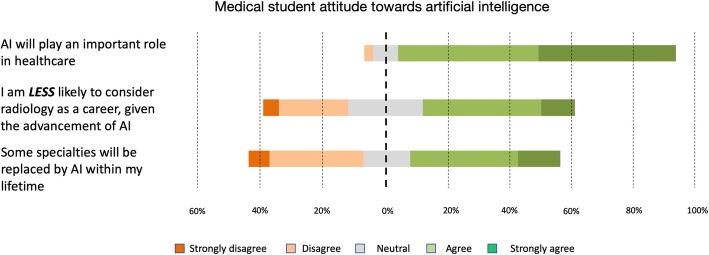
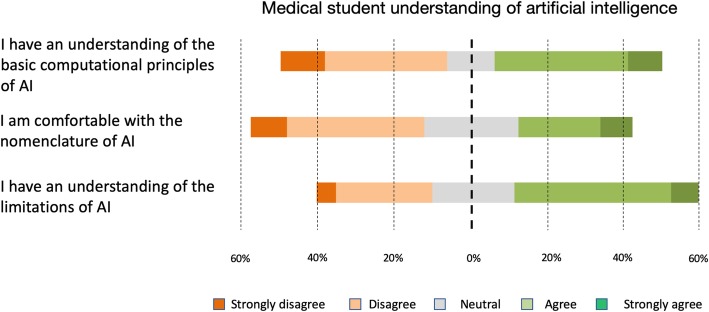
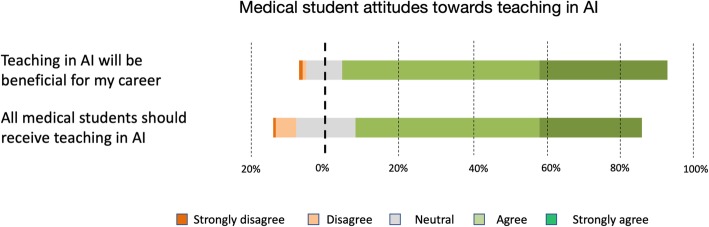
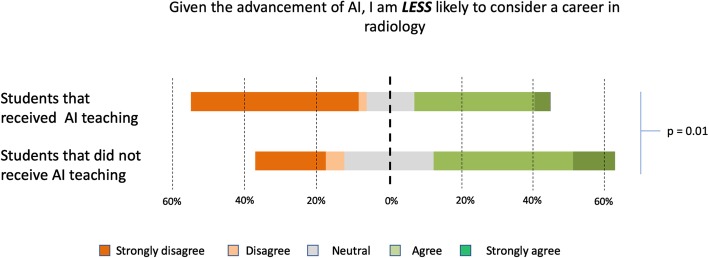
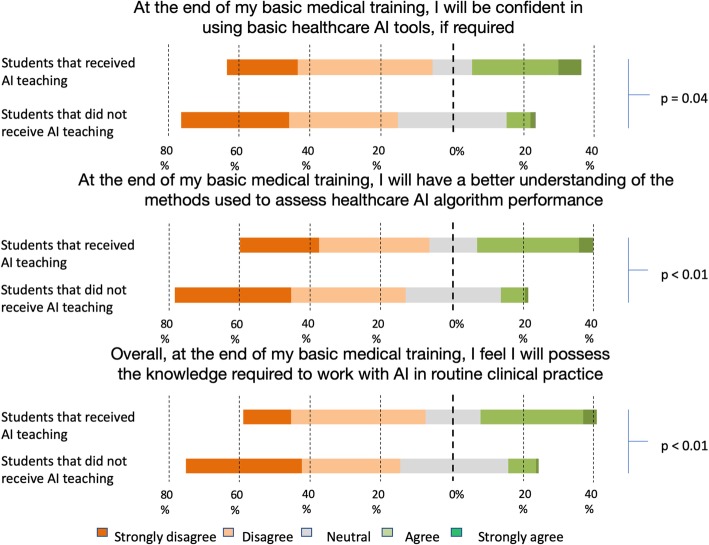
Objectives: To explore the attitudes of United Kingdom (UK) medical students regarding artificial intelligence (AI), their understanding, and career intention towards radiology. We also examine the state of education relating to AI amongst this cohort. Methods: UK medical students were invited to complete an anonymous electronic survey consisting of Likert and dichotomous questions. Results: Four hundred eighty-four responses were received from 19 UK medical schools. Eighty-eight percent of students believed that AI will play an important role in healthcare, and 49% reported they were less likely to consider a career in radiology due to AI. Eighty-nine percent of students believed that teaching in AI would be beneficial for their careers, and 78% agreed that students should receive training in AI as part of their medical degree. Only 45 students received any teaching on AI; none of the students received such teaching as part of their compulsory curriculum. Statistically, students that did receive teaching in AI were more likely to consider radiology (p = 0.01) and rated more positively to the questions relating to the perceived competence in the post-graduation use of AI (p = 0.01–0.04); despite this, a large proportion of students in the taught group reported a lack of confidence and understanding required for the critical use of healthcare AI tools. Conclusions: UK medical students understand the importance of AI and are keen to engage. Medical school training on AI should be expanded and improved. Realistic use cases and limitations of AI must be presented to students so they will not feel discouraged from pursuing radiology.
Overview
The claims and statistics of this paper haven’t been checked yet.
Free: it reads the open-access text and checks the first 5 claims that cite a source we can check. Create a free account to check every claim.
Integrity signals
Registry
Cites
Statistics
Figures
Verification
Claims the paper makes
The claims and statistics of this paper haven’t been checked yet.
Free: it reads the open-access text and checks the first 5 claims that cite a source we can check. Create a free account to check every claim.
Claims other papers make about this one
Each is checked against this paper’s own text: does it say what the citing paper says it does?
The source backs part of the claim, not all of it — or backs it for a different population, condition or comparison.
In the citing paper
“Moreover, many studies emphasized the relevance of AI literacy in higher and adult education (Lee, 2021a;Rodríguez-García et al., 2020;Sit et al., 2020;Xu & Babaian, 2021).”
From Artificial intelligence literacy in higher and adult education: A scoping literature review (2022) · cites this paper as Sit et al., 2020
Experimental — accuracy not yet measuredThe source backs part of the claim, not all of it — or backs it for a different population, condition or comparison.
In the citing paper
“Overall, in addition to positive attitudes toward AI, students generally expressed enthusiasm for integrating it into their future medical practice [70, 71]. Many believed AI had the potential to enhance and transform medicine by optimizing physicians’ workloads and reducing healthcare costs [42, 72, 73]. Additionally, students viewed AI as a supportive tool that can assist physicians, help”
From Artificial intelligence in undergraduate medical education: an updated scoping review (2025) · cites this paper as [70]
Experimental — accuracy not yet measuredThe source backs part of the claim, not all of it — or backs it for a different population, condition or comparison.
In the citing paper
“However, they are generally enthusiastic about learning and using AI in their practice [16, 17].”
From AI in medical education: medical student perception, curriculum recommendations and design suggestions (2023) · cites this paper as [16]
Experimental — accuracy not yet measuredThe source backs part of the claim, not all of it — or backs it for a different population, condition or comparison.
In the citing paper
“the current medical school curricula very rarely cover aspects of medical informatics, let alone AI, as part of their mandatory study programs [ 16 – 18 ].”
From Effect of a flipped classroom course to foster medical students’ AI literacy with a focus on medical imaging: a single group pre-and post-test study (2022) · cites this paper as [16]
Experimental — accuracy not yet measuredThe cited source says what the claim attributes to it.
In the citing paper
“Moreover, medical students who have received training in AI may be better equipped and more comfortable using AI tools and technologies in their later clinical work as they learn to understand and use AI concepts and their potential applications from the beginning of their careers [12, 13].”
From Biomedical Ethical Aspects Towards the Implementation of Artificial Intelligence in Medical Education (2023) · cites this paper as [12]
2 more claims about this paper
Create a free account to see every claim other papers make about this one.
Self-check
Percentages, sums and reported differences re-computed from the paper’s own numbers.
The self-check needs the paper’s full text.
Citations
Cites
R: A Language and Environment for Statistical Computing
R Core Team (2025) · doi:10.32614/r.manuals · Cited by 352,181
High-performance medicine: the convergence of human and artificial intelligence
Topol, E. J. (2019) · Nature Medicine · doi:10.1038/s41591-018-0300-7 · Cited by 10,450
Artificial intelligence and deep learning in ophthalmology
Ting, D. S. W., Pasquale, L. R., Peng, L., Campbell, J. P., Lee, A. Y., Raman, R., Tan, G. S. W., Schmetterer, L., Keane, P. A., & Wong, T. Y. (2019) · British Journal of Ophthalmology · doi:10.1136/bjophthalmol-2018-313173 · Cited by 1,554
Artificial Intelligence and Deep Learning in Ophthalmology
Wang, Z., Keane, P. A., Chiang, M., Cheung, C. Y., Wong, T. Y., & Ting, D. S. W. (2022) · Artificial Intelligence in Medicine · doi:10.1007/978-3-030-64573-1_200 · Cited by 1,524
Rajpurkar, P., Irvin, J., Ball, R. L., Zhu, K., Yang, B., Mehta, H., Duan, T., Ding, D., Bagul, A., Langlotz, C. P., et al. (2018) · PLOS Medicine · doi:10.1371/journal.pmed.1002686 · Cited by 1,449
Digital pathology and artificial intelligence
Niazi, M. K. K., Parwani, A. V., & Gurcan, M. N. (2019) · The Lancet Oncology · doi:10.1016/s1470-2045(19)30154-8 · Cited by 1,232
Deep learning algorithms for detection of critical findings in head CT scans: a retrospective study
Chilamkurthy, S., Ghosh, R., Tanamala, S., Biviji, M., Campeau, N. G., Venugopal, V. K., Mahajan, V., Rao, P., & Warier, P. (2018) · The Lancet · doi:10.1016/s0140-6736(18)31645-3 · Cited by 1,020
Medical students' attitude towards artificial intelligence: a multicentre survey
Pinto dos Santos, D., Giese, D., Brodehl, S., Chon, S. H., Staab, W., Kleinert, R., Maintz, D., & Baeßler, B. (2019) · European Radiology · doi:10.1007/s00330-018-5601-1 · Cited by 754
Deep Learning—A Technology With the Potential to Transform Health Care
Hinton, G. (2018) · JAMA · doi:10.1001/jama.2018.11100 · Cited by 667 · cited 1×
“It is only more recently that an increasingly circumspect view of AI adaptation in medical imaging has gained acceptance [13], including by some of the same thought leaders that originally predicted the rapid demise of radiologists [15].”
BackgroundGong, B., Nugent, J. P., Guest, W., Parker, W., Chang, P. J., Khosa, F., & Nicolaou, S. (2019) · Academic Radiology · doi:10.1016/j.acra.2018.10.007 · Cited by 325 · cited 2×
“in a Canadian cohort (N = 322) [9], where one sixth of medical students interested in radiology”
Background
Cited by
Items 401–500 of 607
AI Influencing Factors among StudentsPreprint
Mishra, A. K., & Mishra, S. (2024) · SSRN Electronic Journal · doi:10.2139/ssrn.5037669 · Cited by 2
“The findings resonate with Sit et al. (2020), who explored similar themes among medical students in the UK.”
Environmental Triggers in Migraine patients in Riyadh: A Cross-Sectional Study
Harbi, A. A., Alzahrani, N. H., Alsuhibany, H. A., Aldosari, M. A. A., Alsalman, R. S., & Alkhalifah, A. (2021) · World Family Medicine Journal/Middle East Journal of Family Medicine · doi:10.5742/mewfm.2021.94172 · Cited by 1
Exploring Artificial Intelligence Role in Enhancing Medical Education for Future Physicians
Din, M. U., Ali, M. S., Saira, S., Naeem, I., Mahmood, A., & Raza, A. (2025) · Pakistan Journal of Health Sciences · doi:10.54393/pjhs.v6i2.2766 · Cited by 1
Taher, E., Hegazy, M. H., Hegazy, M. M., Abomousa, M. M., Osman, N. A., Mohamed, M. E., & Elfar, E. (2025) · Egyptian Journal of Nutrition and Health · doi:10.21608/ejnh.2025.418668 · Cited by 2
Pablo, K. D., Cadorna, K. G., Cabanag, R., Berganio, A. L., Roberto, R. P., Guieb, J. M., Barbieto, E., Dapiawen, K. J., & Peña, L. V. C. D. (2025) · Psychology and Education A Multidisciplinary Journal · doi:10.70838/pemj.350304 · Cited by 1
Artificial intelligence in dentistry: awareness among dentists and computer scientists
Costa, E. D., Vieira, M. A., Ambrosano, G. M. B., Gaêta‐Araujo, H., Carneiro, J. A., Zancan, B. A. G., Scaranti, A., Macedo, A. A., & Tirapelli, C. (2025) · Oral Radiology · doi:10.1007/s11282-025-00828-z · Cited by 2
ANATOMY MEETS AI: INSIGHT OF MEDICAL STUDENTS OF PESHAWAR TO EXPLORE CHATGPT’S IMPACT
Ain, Q. U., Javed, M., Azam, M., Haider, S., & Ashfaq, M. (2025) · Northwest journal of medical sciences. · doi:10.69723/njms.05.01.0469 · Cited by 1
Emerging Trends and Big Ideas for the Future of Artificial Intelligence (AI) in Education
Venkateswaran, P. S., Kamatchi, S. D., & Ravikumar, V. (2025) · Advances in computational intelligence and robotics book series · doi:10.4018/979-8-3373-1827-1.ch012 · Cited by 1
Kichloo, A., & Choudhary, S. (2025) · International Journal of Basic & Clinical Pharmacology · doi:10.18203/2319-2003.ijbcp20251759 · Cited by 1
Pattanayak, S., Gupta, K., Ray, K., Saha, S., & Basu, M. (2025) · International Journal of Community Medicine and Public Health · doi:10.18203/2394-6040.ijcmph20252469 · Cited by 1
Albaik, M., Al-Qahtani, S. A., Mantargi, M. J. S., Alghamdi, A., Sindi, I. A., Sheikh, R. A., Kamel, M. S., & Kurdi, L. A. F. (2025) · PeerJ Computer Science · doi:10.7717/peerj-cs.3255 · Cited by 2
Thuy, L. T., Sen, H. T. N., Giang, N. H., Huynh, B. H., & Ha, V. T. N. (2025) · Health Policy and Technology · doi:10.1016/j.hlpt.2025.101145 · Cited by 2
AI and Marketing: Bridging the Gap Through a Game-based Tool Among Higher Education Students
Oliveira, H. Z., & Lima, H. (2025) · Comunicar · doi:10.5281/zenodo.16123255 · Cited by 2
Bibi, M., Qasim, S., Raza, N., Khan, S., Zahra, R., & Fayaz, A. (2025) · The Healer Journal of Physiotherapy and Rehabilitation Sciences · doi:10.55735/k5rwtb76 · Cited by 1
Awareness of generative artificial intelligence in chemistry education among trainee teachers
Chandran, T. S., & Bakri, Y. M. (2026) · Journal of Education and Learning (EduLearn) · doi:10.11591/edulearn.v20i1.23005 · Cited by 2
Artificial intelligence in education: a bibliometric analysis of emerging trends
Pek, L. S., Ahmad, N. A., Zulkifli, F., Yob, F. S. C., Ependi, U., & Cruz, G. R. C. (2026) · International Journal of Evaluation and Research in Education (IJERE) · doi:10.11591/ijere.v15i1.34428 · Cited by 1
“Sit et al. [34] and Santos et al. [35] explore attitudes toward AI among medical students, indicating both enthusiasm and concerns regarding AI ’ s role in clinical practice.”
Sami, A., Asad, M., Moin, H., Syed, H., & Javed, M. A. (2026) · BMC Medical Education · doi:10.1186/s12909-026-08740-8 · Cited by 1
“Later in the study the participants that received training in using basic clinical AI tools felt more confident using AI tools (p-value: 0.001) [28].”
InfluentialPerspectivas da inteligência artificial na educação médica: Uma revisão narrativa
Meirelles, L. D. M. R., do Amaral, A. J. P., Gevisiez, E. C., Jardim, J. V. S., Fernandes, L. R. S., & da Fonseca, W. L. M. S. (2025) · Congresso Médico Acadêmico UniFOA. · doi:10.47385/cmedunifoa.2065.2025 · Cited by 1
Kotzki, S., Turner, C. M., & Vuillerme, N. (2026) · JMIR Medical Education · doi:10.2196/76572 · Cited by 1
“When the back-translated English versions (version B) were compared with the original questionnaires, no loss or change in meaning was identified for 3 instruments (Karaca et al [25], Sit et al [26], and Park et al [29]).”
InfluentialAli, S., Basheer, A., Ali, H., Ullah, Z., Lubaba, U., Ahmed, M. W., & Ahmed, A. W. (2026) · The Healer Journal of Physiotherapy and Rehabilitation Sciences · doi:10.55735/57kjc743 · Cited by 1
Si, J. (2026) · Medical Education Online · doi:10.1080/10872981.2026.2696610 · Cited by 1
Wang, J., & Schweizer, L. (2026) · SAM Advanced Management Journal · doi:10.1108/samamj-10-2025-0058 · Cited by 1
Liu, W., Cao, L., Chen, X. W., & Pan, H. (2026) · BMC Medical Education · doi:10.1186/s12909-026-09918-w · Cited by 2
“Existing research shows significant regional variations in students’ knowledge, attitudes, and usage of AI [16–18].”
Dilinika, J. M. S. (2026) · Education for Information · doi:10.1177/01678329261468180 · Cited by 1
Alsharif, A. A., Alsaleh, N. A., Alshehri, G. H., AlRasheed, H. A., Daghastani, D. R., Alotaibi, S. S., Alasmari, L. A., AlGhamdi, R. H., & Naser, A. Y. (2026) · Digital Health · doi:10.1177/20552076261476556 · Cited by 2
Use of artificial intelligence in education and training of radiology
Cevallos, M. B. M., Lam, C. B. M., López-Pino, M. J., Moreno, A. M. M., & López, D. F. V. (2026) · Frontiers in Radiology · doi:10.3389/fradi.2026.1899739 · Cited by 1
“One of the most common limitations involved the widespread reliance on cross-sectional study designs and self-reported measures (41, 52, 53, 55, 59, 64, 66).”
InfluentialCross-country patterns in radiography student readiness for artificial intelligence
El-Sayed, M. Z., Rawashdeh, M. A., Moossa, A., Atfah, M., Prajna, B., Hassan, H. G. E. M. A., Khattap, M. G., Bekheet, M. A. A., Islam, I., Haggag, M. G., et al. (2025) · Radiography · doi:10.1016/j.radi.2025.103281 · Cited by 1
Medical Students’ Career Perceptions of Radiology
Vatcher, N., & Hapgood, C. (2025) · The Journal of Macrodynamic Analysis (Memorial University of Newfoundland) · Cited by 1
Hille, E. M., Bleher, H., Coppers, B., Engelhardt, S., Eskofier, B. M., Garbe, L., Heckel, M., Liphardt, A., Manlig, A., Rohleder, N., et al. (2026) · Journal of Medical Internet Research · doi:10.2196/75783 · Cited by 1
“In particular, quantitative interview studies with physicians and medical students revealed an eagerness to incorporate AI into health [10,14,18].”
Perceptions and Use of Generative Artificial Intelligence (AI) Among Criminal Justice Students
Nodeland, B., Saber, M., & Wall, R. (2026) · Journal of Criminal Justice Education · doi:10.1080/10511253.2026.2640902 · Cited by 1
Zaman, S. (2026) · Gomal University Journal of Research · doi:10.51380/gujr-42-01-10 · Cited by 1
Denizli, F., Kınış, Z., & Hızaler, E. (2026) · Journal of Health Organization and Management · doi:10.1108/jhom-01-2026-0027 · Cited by 2
Alan, S. Ç., & Aydın, A. K. (2026) · BMC Medical Education · doi:10.1186/s12909-026-09258-9 · Cited by 1
“Prepared by the researchers based on the literature data [2, 3, 5, 6], this form assesses students’ sociodemographic characteristics, experiences with AI education and use, career perceptions, and interest in technology.”
InfluentialMugara, R., Ali, E. Y., & Sari, W. (2025) · Jurnal Imiah Pendidikan dan Pembelajaran · doi:10.23887/jipp.v9i3.100960 · Cited by 1
El-Helaly, M., Hussein, A. M., Taman, A., Farrag, N. S., Elfeky, A. A., Elhelaly, A. M., & Essam, N. (2026) · Scientific Reports · doi:10.1038/s41598-026-72964-3 · Cited by 1
Shreshthi, K. K., Nimavat, J., Makwana, M. H., Jasani, P., Sochaliya, K., & Chudasama, M. I. (2026) · Cureus · doi:10.7759/cureus.113804 · Cited by 1
“Findings from the United Kingdom, Malaysia, Indonesia, the UAE, and India converge on a common theme: students express recognition of AI's educational potential yet simultaneously report deficiencies in practical competence and ethical understanding [10,13-18].”
Increased Psychological Disorders among Pediatric Population during Covid
AlQaatri, H. A. J. H. (2021) · World Family Medicine Journal/Middle East Journal of Family Medicine · doi:10.5742/mewfm.2021.94174 · Cited by 1
Effectiveness of Community Mental Health Service in Oman: A Pilot Study
Al-Jadidi, S., Aboalatta, A. S., Al-Rahbi, I., Al-Harrasi, M., AlRauzaiqi, H., Sabeih, M. A., AlGammari, T., & Al-Shammakhi, A. (2021) · World Family Medicine Journal/Middle East Journal of Family Medicine · doi:10.5742/mewfm.2021.94180 · Cited by 3
Kalinina, M. L., Svitachev, A. P., Biswas, D., & Vishnu, P. (2023) · Digital Diagnostics · doi:10.17816/dd430346 · Cited by 1
Zorman, L., & Farkaš, J. (2024) · Anali PAZU · doi:10.18690/analipazu.14.1.49-70.2024 · Cited by 2
Empowering Healthcare Professionals Through AI-Powered Lifelong Learning for Improving Patient Care
Rajendran, R., Subramanian, Y. R., Poddar, S., & Geetha, V. (2024) · Advances in educational technologies and instructional design book series · doi:10.4018/979-8-3693-2440-0.ch006 · Cited by 3
Attitude towards artificial intelligence among medical students in Kerala
Gangadharan, K. J., & Singh, P. (2024) · E-Learning and Digital Media · doi:10.1177/20427530241276138 · Cited by 1
Alhithlool, A. W., Almutlaq, A. S., Almulla, S. A., al-Hamdan, A., Alotaibi, Z. B., AlHithlool, A. W., Kamal, A. H., Daoud, M. Y. I., & Zakaria, O. M. (2024) · Medical Teacher · doi:10.1080/0142159x.2024.2407129 · Cited by 2
“This fully supports previously published data that stated AI would have a pivotal role in diagnosis and treatment, yet it would not replace the role of human medical staff as care providers [29,30].”
Kotter, E. (2024) · Imaging informatics for healthcare professionals · doi:10.1007/978-3-031-68942-0_3 · Cited by 2
Pal, N., Syed, J. M., Madhan, R., Patil, V., Shambu, S. K., & Chalasani, S. H. (2026) · Clinical eHealth · doi:10.1016/j.ceh.2026.04.002 · Cited by 1
Mantello, P. A., Ho, T. M., Nguyen, M., & Vuong, Q. (2021) · OSF Preprints (OSF Preprints) · doi:10.31219/osf.io/4exjs · Cited by 1
Zainal, H., Xin, X. H., Thumboo, J., & Fong, K. Y. (2023) · Research Square · doi:10.21203/rs.3.rs-3098448/v1 · Cited by 2
Vecellio, M. (2025) · medRxiv · doi:10.1101/2025.03.22.25324458 · Cited by 1
Güncan, B., & Eser, U. (2025) · doi:10.2196/preprints.79053 · Cited by 1
Artificial Intelligence Education for Health Professions Students: A Scoping ReviewPreprint
Buckmaster, F., van Staden, D. B., & Coetzee, L. (2025) · Research Square · doi:10.21203/rs.3.rs-6972197/v1 · Cited by 1
Shinners, L. (2023) · Cross Connect (Southern Cross University) · doi:10.25918/thesis.312 · Cited by 1
Lippert, K. A. N. (2020) · NORA - Norwegian Open Research Archives · Cited by 5
Molnets: An Artificial Chemistry Based on Neural Networks
Colombano, S. P., Luk, J., Segovia-Juarez, J. L., Lohn, J. D., & Clancy, D. J. (2002) · NASA Technical Reports Server (NASA)
Ahmed, S. F., Alghamdi, G. A., Albalawi, A. A., AlQahtani, M., Ghonim, I. M., Elhady, H. M., Abdelhamid, S. A., & Eldesouky, A. A. (2021) · World Family Medicine Journal/Middle East Journal of Family Medicine · doi:10.5742/mewfm.2021.94189
Ballaji, W. K., & Hadadi, H. M. (2021) · World Family Medicine Journal/Middle East Journal of Family Medicine · doi:10.5742/mewfm.2021.94186
Barriers to Compliance of Hypertensive Patients in Abha City, Saudi Arabia
Almonawar, A. A., Alasmary, A. S., Mogbel, M. M., & Almojamad, H. M. (2021) · World Family Medicine Journal/Middle East Journal of Family Medicine · doi:10.5742/mewfm.2021.94177 · Cited by 1
Role of SGLT2 Inhibitors and GLP-1 Analogs in Cardiovascular Risk Reduction in Type 2 Diabetes
Rashed, M. H., Dauyoumor, T. D., Corney, S. M., Konono, K., Joubert, N., Mohamed, M., Sukhoo-Pertab, M., Makhomisane, M., Njeri, I., Mwita, J. C., et al. (2021) · World Family Medicine Journal/Middle East Journal of Family Medicine · doi:10.5742/mewfm.2021.94188
Diagnostic approach to eosinophilia in children
Shasho, R. (2021) · World Family Medicine Journal/Middle East Journal of Family Medicine · doi:10.5742/mewfm.2021.94190
Knowledge, Attitude and Practice of Non-Psychiatric Physicians about Addiction
Al-Ahmari, S. M., Almusa, A. A., Alshomrani, A. A., Ahmary, W. S. H. A., Assiry, Z. S. A., Alqahtany, S. M. S., Asiri, A. Y., Alqahtani, T. S., Alassiri, N. S., & Mostafa, O. A. (2021) · World Family Medicine Journal/Middle East Journal of Family Medicine · doi:10.5742/mewfm.2021.94185
Digital Health Adoption: Looking Beyond the Role of Technology
Kyratsis, Y., Scarbrough, H., Begley, A., & Denis, J. (2023) · Frontiers research topics · doi:10.3389/978-2-83252-030-7 · Cited by 1
Zuma, N. P., Mewalall, T., & Khoza, T. E. (2022) · Radiation Science and Technology · doi:10.11648/j.rst.20220804.12
Investigating Factors Shaping Future Doctors' Willingness to Adopt AI Diagnosis Support Systems
Mishra, M. K., & Upadhyaya, A. (2024) · SN Computer Science · doi:10.1007/s42979-024-02896-0 · Cited by 2
“17% of German medical students feared AI may replace health professionals [30], while 49% of English medical students did not consider radiology due to AI [18].”
Alfuhaid, R. (2024) · Authorea · doi:10.22541/au.171769113.31311492/v1
LTP Prod Release Test. (Preprint)
Strand, C., Biswal, S., Marri, B., & Tadele, A. (2024) · JMIR Serious Games · doi:10.2196/64227
LTP POST-Release submission (Preprint)
Mykhaylyuk, I., Abraham, T., & Biswal, S. (2024) · Journal of Medical Internet Research · doi:10.2196/64229
LTP-Post_HS processing statuses 22 and 23 test (Preprint)
Biswal, S., Abraham, T., & Marri, B. (2024) · Journal of Medical Internet Research · doi:10.2196/64404
Current Situation and Prospects of Education in Medical Imaging Artificial Intelligence
Zhang, X., Jiang, L. H., Liang, M., Guo, L., Xiao, Y., & Wang, Y. (2024) · Springer eBooks · doi:10.1007/978-981-99-8441-1_28 · Cited by 1
Ansary, M. S., Mahato, I., Mahanti, J., Gorai, N., & Behera, S. K. (2024) · Advances in educational technologies and instructional design book series · doi:10.4018/979-8-3693-7220-3.ch005
Artificial intelligence in Medical Education-A Crosssectional study in Private Setup
Javed, A. (2024) · Journal of Rashid Latif Medical College · doi:10.69545/y05fkm17
Gregory, J. S. (2024) · Biomedical visualization · doi:10.1007/978-3-031-73270-6_5
Amin, M. A., Nadeem, M., Ali, M., Bilal, M., Khalida, M., Khan, I., & Akhtar, M. (2025) · Journal of Society of Prevention Advocacy and Research KEMU · doi:10.21649/jspark.v3i4.717
Utilization of Artificial Intelligence on Educational Climate and Students’ Academic Achievement
Chanpokin, R., & Lomarda, E. Y. (2025) · Psychology and Education A Multidisciplinary Journal · doi:10.70838/pemj.350509
Bhat, A., Fatima, A., & Bhat, B. A. (2025) · SKUAST JOURNAL OF RESEARCH · doi:10.5958/2349-297x.2025.00005.3
سمات الشخصية لدى طلبة جامعة الكويت وعلاقتها بالاتجاه نحو الذكاء الاصطناعي
شعبان, م. ق. ت. (2025) · مجلة کلیة التربیة فى العلوم النفسیة · doi:10.21608/jfeps.2025.428186
Mukherjee, S., Roy, S., Chakraborty, A., & Mukhopadhyay, D. (2025) · Student s Journal of Health Research Africa · doi:10.51168/sjhrafrica.v6i6.1712
Masihuddin, A., Shaikh, Z. A., & Nazish, A. (2025) · Advances in healthcare information systems and administration book series · doi:10.4018/979-8-3693-9092-4.ch017
Elgebaly, A. S., Bahbah, E. I., Althaher, A., Richardson, R., ElAbd, R., Shahid, Z., Abdalla, H., Hammad, R., & Imam, M. A. (2025) · doi:10.2196/preprints.78535
Gallegos, M. S., Trujillo, S. E. A., & Merlos, J. C. P. (2025) · Isagoge - Journal of Humanities and Social Sciences · doi:10.59079/isagoge.v5i1.254
Moallem, E., Ghavami, V., Moghri, J., Marvi, A., Najafi, M., & Tabatabaee, S. S. (2025) · Journal of Health Administration · doi:10.61882/jha.28.1.40 · Cited by 2
“Accordingly, studies have been conducted in countries such as the United States [12-14], the United Kingdom [15], Australia [16], Turkey [6], Iraq [17], Lebanon [18,19], Taiwan [20], Saudi Arabia [21], Egypt [22], Palestine [23], and others.”
Barış, M., Kağıt, K., & Yazıcı, Z. B. (2025) · Anadolu Kliniği Tıp Bilimleri Dergisi · doi:10.21673/anadoluklin.1599210
Impact of Artificial Intelligence on Higher Education in Peru: A Pre-experimental Study
Vidaurre, S. M. E., Valdivia, A. N. M., Quelopana, R. L. G., Nolasco-Mamani, M. A., Iturry, I. E. A., & Rodríguez, N. C. V. (2025) · Lecture notes in networks and systems · doi:10.1007/978-3-031-93109-3_39
Yin, H., Shi, D., & Meng, C. (2025) · Discover Artificial Intelligence · doi:10.1007/s44163-025-00552-x
“However, concerns regarding potential replacement continue to cause hesitation among some students in choosing radiology as their specialty [14, 15].”
Al-Rubaye, A. A., Abdul-Qadir, R. A., Issa, M. S., Saleem, I., Alsilaykhee, M. A., Ali, H. I., Khudhair, A. Y., & Hadi, H. A. (2025) · Research Square · doi:10.21203/rs.3.rs-8169603/v1
Amiri, H., Peiravi, S., Shojaee, S. S. R., Rouhparvarzamin, M., Nateghi, M. N., Etemadi, M. H., ShojaeiBaghini, M., Musaie, F., Anvari, M. H., & Anar, M. A. (2024) · Figshare · doi:10.6084/m9.figshare.26706867
Fitzek, S., & Choi, K.-E. A. (2024) · Figshare · doi:10.6084/m9.figshare.26758306
Jebreen, K., RADWAN, E. S., Rebai, W. K., Alattar, E., Radwan, A., Safi, W., Radwan, W., & Alajez, M. (2024) · Figshare · doi:10.6084/m9.figshare.26717358
Daniyal, M., Qureshi, M., Marzo, R. R., Aljuaid, M. M., & Shahid, D. (2024) · Figshare · doi:10.6084/m9.figshare.25792775
Laupichler, M. C., Hadizadeh, D. R., Wintergerst, M. W. M., von der Emde, L., Paech, D., Dick, E., & Raupach, T. (2022) · Figshare · doi:10.6084/m9.figshare.21582652
Laupichler, M. C., Hadizadeh, D. R., Wintergerst, M. W. M., von der Emde, L., Paech, D., Dick, E., & Raupach, T. (2022) · Figshare · doi:10.6084/m9.figshare.21582658
Karaca, O., Çalışkan, S. A., & Demir, K. (2021) · Figshare · doi:10.6084/m9.figshare.14059884
Jebreen, K., RADWAN, E. S., Rebai, W. K., Alattar, E., Radwan, A., Safi, W., Radwan, W., & Alajez, M. (2024) · Figshare · doi:10.6084/m9.figshare.26717355
Jebreen, K., RADWAN, E. S., Rebai, W. K., Alattar, E., Radwan, A., Safi, W., Radwan, W., & Alajez, M. (2024) · Figshare · doi:10.6084/m9.figshare.25770556
Busch, F., Hoffmann, L., Truhn, D., Ortiz-Prado, E., Makowski, M. R., Bressem, K. K., & Adams, L. C. (2024) · Figshare · doi:10.6084/m9.figshare.27129365
Jebreen, K., RADWAN, E. S., Rebai, W. K., Alattar, E., Radwan, A., Safi, W., Radwan, W., & Alajez, M. (2024) · Figshare · doi:10.6084/m9.figshare.25770366
Karaca, O., Çalışkan, S. A., & Demir, K. (2021) · Figshare · doi:10.6084/m9.figshare.14059878
КОМПЬЮТЕР В БЕЛОМ ХАЛАТЕ: КАК ТЕХНОЛОГИИ ТРАНСФОРМИРУЮТ МЕДИЦИНСКОЕ ОБРАЗОВАНИЕ В УЗБЕКИСТАНЕ
Базарбаев, М., & Izzatillayevna, S. D. (2025) · Innovations in Science and Technologies · doi:10.5281/zenodo.15289462 · Cited by 11
Laupichler, M. C., Hadizadeh, D. R., Wintergerst, M. W. M., von der Emde, L., Paech, D., Dick, E., & Raupach, T. (2022) · Figshare · doi:10.6084/m9.figshare.21582661
Karaca, O., Çalışkan, S. A., & Demir, K. (2021) · Figshare · doi:10.6084/m9.figshare.14059881
Busch, F., Hoffmann, L., Truhn, D., Ortiz-Prado, E., Makowski, M. R., Bressem, K. K., & Adams, L. C. (2024) · Figshare · doi:10.6084/m9.figshare.27129362
Metadata
- Authors
- Sit, C., Srinivasan, R., Amlani, A., Muthuswamy, K., Azam, A., Monzon, L., & Poon, D. S.
- Affiliations
- St Thomas' Hospital (GB)
- King's College London (GB)
- Corresponding author
- Poon, Daniel Stephen
- Venue
- Insights into Imaging
- Published
- 2020-02-05
- Volume
- 11
- Issue
- 1
- Pages
- 14-14
- ISSN
- 1869-4101 (ISSN-L)
- PMC
- PMC7002761
- OpenAlex
- W3012668909
- Cited by
- 507
- References
- 12
- Citations by year
- 2026: 81 · 2025: 118 · 2024: 113 · 2023: 72 · 2022: 52 · 2021: 57 · 2020: 13
- FWCI
- 14.28
- Type
- journal article
- Language
- en
- Open access
- gold
- doi.org
- Licence
- cc-by
- creativecommons.org/licenses/by/4.0 (tdm)
- creativecommons.org/licenses/by/4.0 (vor)
- Locations
- Insights into Imaging (publishedVersion, cc-by)
- Europe PMC (PubMed Central) (publishedVersion, cc-by)
- PubMed Central (publishedVersion, cc-by)
- PubMed (publishedVersion)
- DOAJ (DOAJ: Directory of Open Access Journals) (submittedVersion)
- Topics
- Health Sciences › Medicine › Health Informatics › Artificial Intelligence in Healthcare and Education
- Health Sciences › Medicine › Radiology, Nuclear Medicine and Imaging › Radiology practices and education
- Social Sciences › Education › Innovations in Medical Education
- Keywords
- artificial intelligence in healthcare, medical students, attitudes toward AI, medical school training, UK medical education
About these checks
Registry, retraction, Cites and statistics results are computed, not judged, with one exception: a printed reference that no index lists is read once by a model before it counts as a citation error. Claims are extracted by a model and kept only when their quote appears verbatim in the text; each cited source is then checked, with a model’s help, for whether it says what the claim relies on. Those verdicts can be wrong — read the claim’s quote and the cited source before relying on one.
Statistics and arithmetic are recomputed, not judged.
Confidence bands are shown only for fields calibrated on our annotated test set. None is calibrated yet, so no band is shown.
What counts as a claim ›How we measure confidence ›How we check this ›
Are you an author, or do you see a problem with this page? Request a review
Data sources
Bibliographic data: Semantic Scholar, OpenAlex, Crossref.
Contains information from the Semantic Scholar Academic Graph Datasets, made available under the ODC Attribution License (ODC-BY 1.0).
Semantic Scholar’s data is described in: Kinney, R., et al. (2023). The Semantic Scholar Open Data Platform. arXiv:2301.10140.
