

Attitudes and perceptions of UK medical students towards artificial intelligence and radiology: a multicentre survey
Open accessThe DOI matches its Crossref record; 13 of the 13 references it cites were found in a registry or an index.
Abstract
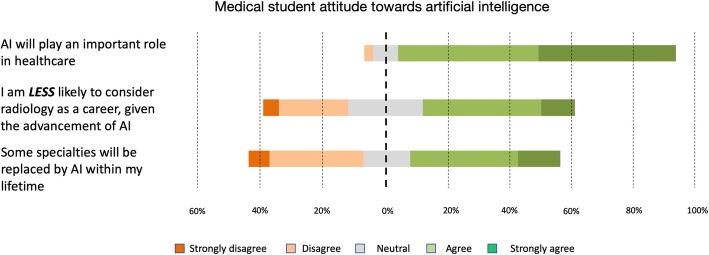
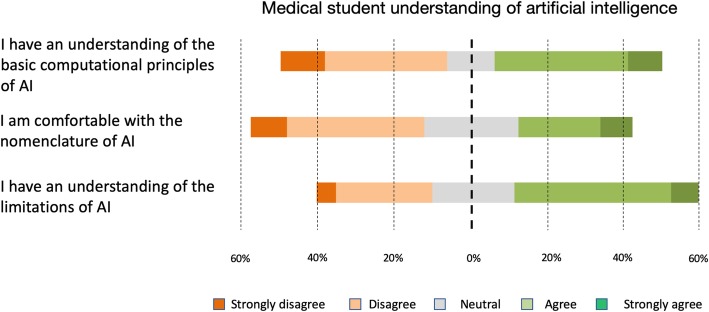
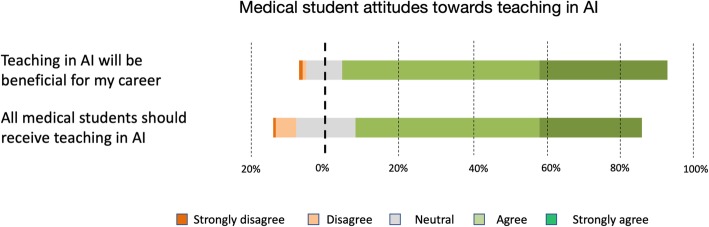
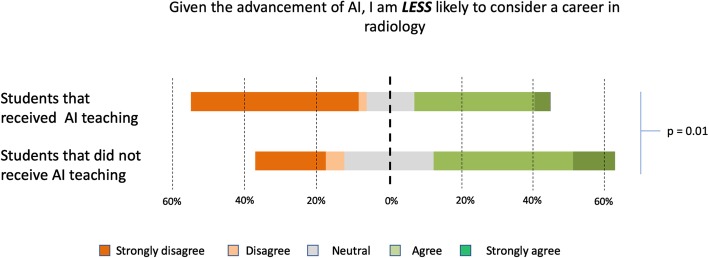
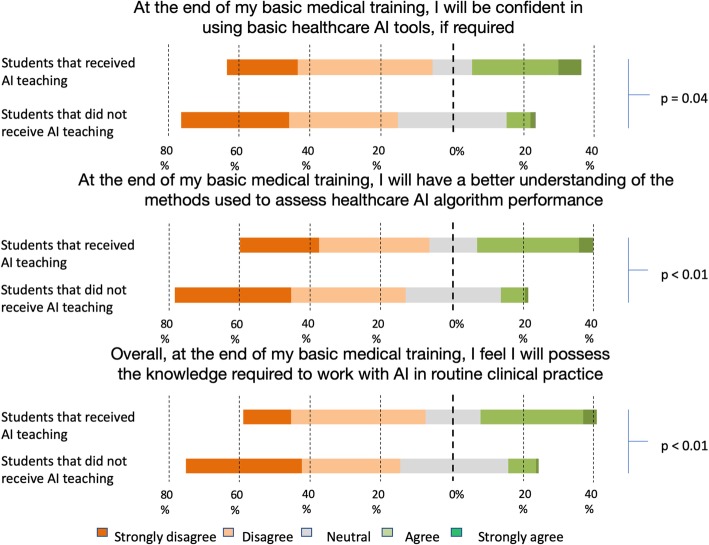
Objectives: To explore the attitudes of United Kingdom (UK) medical students regarding artificial intelligence (AI), their understanding, and career intention towards radiology. We also examine the state of education relating to AI amongst this cohort. Methods: UK medical students were invited to complete an anonymous electronic survey consisting of Likert and dichotomous questions. Results: Four hundred eighty-four responses were received from 19 UK medical schools. Eighty-eight percent of students believed that AI will play an important role in healthcare, and 49% reported they were less likely to consider a career in radiology due to AI. Eighty-nine percent of students believed that teaching in AI would be beneficial for their careers, and 78% agreed that students should receive training in AI as part of their medical degree. Only 45 students received any teaching on AI; none of the students received such teaching as part of their compulsory curriculum. Statistically, students that did receive teaching in AI were more likely to consider radiology (p = 0.01) and rated more positively to the questions relating to the perceived competence in the post-graduation use of AI (p = 0.01–0.04); despite this, a large proportion of students in the taught group reported a lack of confidence and understanding required for the critical use of healthcare AI tools. Conclusions: UK medical students understand the importance of AI and are keen to engage. Medical school training on AI should be expanded and improved. Realistic use cases and limitations of AI must be presented to students so they will not feel discouraged from pursuing radiology.
Overview
The claims and statistics of this paper haven’t been checked yet.
Free: it reads the open-access text and checks the first 5 claims that cite a source we can check. Create a free account to check every claim.
Integrity signals
Registry
Cites
Statistics
Figures
Verification
Claims the paper makes
The claims and statistics of this paper haven’t been checked yet.
Free: it reads the open-access text and checks the first 5 claims that cite a source we can check. Create a free account to check every claim.
Claims other papers make about this one
Each is checked against this paper’s own text: does it say what the citing paper says it does?
The source backs part of the claim, not all of it — or backs it for a different population, condition or comparison.
In the citing paper
“Moreover, many studies emphasized the relevance of AI literacy in higher and adult education (Lee, 2021a;Rodríguez-García et al., 2020;Sit et al., 2020;Xu & Babaian, 2021).”
From Artificial intelligence literacy in higher and adult education: A scoping literature review (2022) · cites this paper as Sit et al., 2020
Experimental — accuracy not yet measuredThe source backs part of the claim, not all of it — or backs it for a different population, condition or comparison.
In the citing paper
“Overall, in addition to positive attitudes toward AI, students generally expressed enthusiasm for integrating it into their future medical practice [70, 71]. Many believed AI had the potential to enhance and transform medicine by optimizing physicians’ workloads and reducing healthcare costs [42, 72, 73]. Additionally, students viewed AI as a supportive tool that can assist physicians, help”
From Artificial intelligence in undergraduate medical education: an updated scoping review (2025) · cites this paper as [70]
Experimental — accuracy not yet measuredThe source backs part of the claim, not all of it — or backs it for a different population, condition or comparison.
In the citing paper
“However, they are generally enthusiastic about learning and using AI in their practice [16, 17].”
From AI in medical education: medical student perception, curriculum recommendations and design suggestions (2023) · cites this paper as [16]
Experimental — accuracy not yet measuredThe source backs part of the claim, not all of it — or backs it for a different population, condition or comparison.
In the citing paper
“the current medical school curricula very rarely cover aspects of medical informatics, let alone AI, as part of their mandatory study programs [ 16 – 18 ].”
From Effect of a flipped classroom course to foster medical students’ AI literacy with a focus on medical imaging: a single group pre-and post-test study (2022) · cites this paper as [16]
Experimental — accuracy not yet measuredThe cited source says what the claim attributes to it.
In the citing paper
“Moreover, medical students who have received training in AI may be better equipped and more comfortable using AI tools and technologies in their later clinical work as they learn to understand and use AI concepts and their potential applications from the beginning of their careers [12, 13].”
From Biomedical Ethical Aspects Towards the Implementation of Artificial Intelligence in Medical Education (2023) · cites this paper as [12]
2 more claims about this paper
Create a free account to see every claim other papers make about this one.
Self-check
Percentages, sums and reported differences re-computed from the paper’s own numbers.
The self-check needs the paper’s full text.
Citations
Cites
R: A Language and Environment for Statistical Computing
R Core Team (2025) · doi:10.32614/r.manuals · Cited by 352,181
High-performance medicine: the convergence of human and artificial intelligence
Topol, E. J. (2019) · Nature Medicine · doi:10.1038/s41591-018-0300-7 · Cited by 10,450
Artificial intelligence and deep learning in ophthalmology
Ting, D. S. W., Pasquale, L. R., Peng, L., Campbell, J. P., Lee, A. Y., Raman, R., Tan, G. S. W., Schmetterer, L., Keane, P. A., & Wong, T. Y. (2019) · British Journal of Ophthalmology · doi:10.1136/bjophthalmol-2018-313173 · Cited by 1,554
Artificial Intelligence and Deep Learning in Ophthalmology
Wang, Z., Keane, P. A., Chiang, M., Cheung, C. Y., Wong, T. Y., & Ting, D. S. W. (2022) · Artificial Intelligence in Medicine · doi:10.1007/978-3-030-64573-1_200 · Cited by 1,524
Rajpurkar, P., Irvin, J., Ball, R. L., Zhu, K., Yang, B., Mehta, H., Duan, T., Ding, D., Bagul, A., Langlotz, C. P., et al. (2018) · PLOS Medicine · doi:10.1371/journal.pmed.1002686 · Cited by 1,449
Digital pathology and artificial intelligence
Niazi, M. K. K., Parwani, A. V., & Gurcan, M. N. (2019) · The Lancet Oncology · doi:10.1016/s1470-2045(19)30154-8 · Cited by 1,232
Deep learning algorithms for detection of critical findings in head CT scans: a retrospective study
Chilamkurthy, S., Ghosh, R., Tanamala, S., Biviji, M., Campeau, N. G., Venugopal, V. K., Mahajan, V., Rao, P., & Warier, P. (2018) · The Lancet · doi:10.1016/s0140-6736(18)31645-3 · Cited by 1,020
Medical students' attitude towards artificial intelligence: a multicentre survey
Pinto dos Santos, D., Giese, D., Brodehl, S., Chon, S. H., Staab, W., Kleinert, R., Maintz, D., & Baeßler, B. (2019) · European Radiology · doi:10.1007/s00330-018-5601-1 · Cited by 754
Deep Learning—A Technology With the Potential to Transform Health Care
Hinton, G. (2018) · JAMA · doi:10.1001/jama.2018.11100 · Cited by 667 · cited 1×
“It is only more recently that an increasingly circumspect view of AI adaptation in medical imaging has gained acceptance [13], including by some of the same thought leaders that originally predicted the rapid demise of radiologists [15].”
BackgroundGong, B., Nugent, J. P., Guest, W., Parker, W., Chang, P. J., Khosa, F., & Nicolaou, S. (2019) · Academic Radiology · doi:10.1016/j.acra.2018.10.007 · Cited by 325 · cited 2×
“in a Canadian cohort (N = 322) [9], where one sixth of medical students interested in radiology”
Background
Cited by
Items 501–600 of 607
Οι στάσεις και αντιλήψεις των φοιτητών δημόσιας και ενιαίας υγείας για την τεχνητή νοημοσύνη
Σουφλιά, Α.-Γ. Η., & Σουφλιά, Α.-Γ. Η. (2023) · University of Thessaly Institutional Repository (University of Thessaly)
Lindberg, R., & Åkerman, M. (2024) · DiVA at Umeå University (Umeå University)
Tremblay, J. (2023) · Papyrus : Institutional Repository (Université de Montréal) · doi:10.71781/23406
The development of a postgraduate family medicine artificial intelligence curriculum framework
Tolentino, R. (2024) · eScholarship@McGill (McGill) · doi:10.82308/16308
Investigating Undergraduate Students’ Intention to Engage in Artificial Intelligence Learning
Jacob, U. S., & Pillay, J. (2024) · Engagement Jurnal Pengabdian Kepada Masyarakat · doi:10.29062/engagement.v8i1.1728
Abid Ullah, U. U. (2025) · The Research of Medical Science Review · doi:10.5281/zenodo.17853225
Dawood, B. M. A. E., Abouelfettoh, A., Zewiel, M. A. A., Perumal, L., Alibrahim, L., Boayesha, A., Alaklabi, H., Alrashed, A., Alsuwaylih, A., Alashoor, E., et al. (2025) · Nursing Forum · doi:10.1155/nuf/2848944 · Cited by 2
Assessing Medical Students’ Anxiety and Preparedness Regarding Artificial Intelligence
van Dijk, H., de Vries, P., & Bakker, J. (2023) · Interdisciplinary Research in Medical Sciences Specialty · doi:10.51847/vmzmolm73z
Khomych, O. V., Umryk, M. A., Strutynska, O., Zlobynets, A. S., Shevchenko, T., & Marushko, Y. V. (2025) · Studies in systems, decision and control · doi:10.1007/978-3-032-03612-4_11
Junhao, F. (2025) · International Journal of Healthcare and Information Technology · doi:10.25047/ijhitech.v3i2.6428
Pediatric Nursing Students and Artificial Intelligence: A Cross-Sectional Study
Al-Waly, L. A. M., Shawq, A. H., & Kareem, S. H. (2026) · The Malaysian Journal of Nursing · doi:10.31674/mjn.2026.v17i03.012
Rahim, N. R. B. A., & Ismail, F. N. (2022) · Annals of Pharmacy Education Safety and Public Health Advocacy · doi:10.51847/wsxojzvirp
Sharma, K., Dixit, M. P., Nim, D. K., & Chaurasia, R. C. (2026) · International Journal of Basic & Clinical Pharmacology · doi:10.18203/2319-2003.ijbcp20260429
Tyagi, S., Verma, S., Gupta, A., & Gupta, V. (2025) · International Conference on Internet of Things: Smart Innovation and Usages (IoT-SIU) · doi:10.1109/iot-siu65919.2025.11402707
“On the other hand students felt more at ease utilising AI technologies [18].”
Generative AI and Education: Student Voices, Ethical Challenges, and Classroom Innovations
Moura, A. (2026) · Advances in computational intelligence and robotics book series · doi:10.4018/979-8-2600-0101-1.ch003
Almulhem, M., Almusailem, A., Alayesh, M., Najimah, A. B., Karam, H. B., Alsaleem, H., Almajhad, H., Alessa, Z. K., & Alfridan, M. M. (2026) · Cureus · doi:10.7759/cureus.104430
“…electronic questionnaire adapted from previously published studies assessing students’ knowledge, perceptions, and attitudes toward AI in healthcare and medical education, including the framework originally described by Sit et al. [15] and subsequently adapted in regional studies [16,17].”
Computational problems and use of AI in the medical evaluation of imaging exams
Μάτζαρι, Ρ. Φ. (2023) · University of Thessaly Institutional Repository (University of Thessaly)
Learning from practice: How professionals use AI and what it means for higher education
Christian, E. N., Jia, X., Dellen, S. A. V., Zubovic, Y., & Dehr, K. (2026) · Industry and Higher Education · doi:10.1177/09504222261438628
Akpınar, G., & Kantarcı, S. (2026) · International Journal of Technology in Education and Science · doi:10.46328/ijtes.7805
“Multicenter studies conducted with medical students and resident doctors show that while there is a widespread belief that AI can contribute to diagnostic and treatment processes, concerns about potential threats to professional roles cannot be ignored (Rjoop et al., 2025; Sit et al., 2020).”
Raghavan, B., Goyal, S., Kashif, M. S., & Tellis, V. M. (2026) · Indian journal of radiology and imaging - new series/Indian journal of radiology and imaging/Indian Journal of Radiology & Imaging · doi:10.1055/s-0046-1819653
Tian, X., Chen, H., Herrera, M., Shdefa, A. A., Deng, J., Yi, L., & Tang, L. (2026) · doi:10.2196/preprints.98293
Vallejos, K. S. L. (2024) · LA Referencia (Red Federada de Repositorios Institucionales de Publicaciones Científicas) · Cited by 4
Hancco, E. G. A. (2025) · LA Referencia (Red Federada de Repositorios Institucionales de Publicaciones Científicas)
Inteligencia Artificial en Medicina: Percepciones de estudiantes y trabajadores del área de la salud
Espinoza, I. R. G., Hernández, A. D. L., Romero, E. M., Castro-Ponce, A., Juárez-Salazar, G., Gutiérrez, F. A. C., Carmona, D. Y. D., & Cuenca, L. T. C. (2026) · Revista Mexicana de Investigación Médica · doi:10.62954/g1qa3868
AI Literacy as a Mediator Between Education Climate and Learning Agency in Nursing Students
Zeng, F., Liu, Q., Zhang, Y., Jiang, N., Ning, M., & Yu, Q. (2026) · Nursing Education Perspectives · doi:10.1097/01.nep.0000000000001547
From Bias to Belonging: Ethical Pathways for Inclusive and Privacy-Respectful AI in Education
Adiyono, A., Nurhayati, S., Rienovita, E., Setiawati, E., & Kumalasari, C. (2026) · Advances in computational intelligence and robotics book series · doi:10.4018/979-8-3373-7467-3.ch009
Yesupatham, S. T., Kumari, A., & Suryanarayana, R. (2026) · Cureus · doi:10.7759/cureus.109794
“These findings suggest that students view AI primarily as a supportive tool rather than a replacement for healthcare professionals, consistent with previous literature [6,12].”
Arık, Ş. B., & Güven, G. Ö. (2026) · Mersin Üniversitesi Tıp Fakültesi Lokman Hekim Tıp Tarihi ve Folklorik Tıp Dergisi · doi:10.31020/mutftd.1853893
Elifneh, Y. W. (2026) · Global Knowledge, Memory and Communication · doi:10.1108/gkmc-08-2025-0587
Yavaş, H. G., Korkmaz, M., & Emekli, E. (2026) · Eskisehir Medical Journal Eskisehir City Hospital · doi:10.48176/esmj.2026.258
Nain, P., Kalra, A., Agarwal, N., Goyal, R. K., Nirbhavane, P., & Sardana, S. (2026) · International Journal of Drug Delivery Technology · doi:10.25258/ijddt.16.47s.15
Health Care Students’/Professionals’ Perspectives on Artificial Intelligence: Survey in Erbil, IraqPreprint
Balisani, A., Zand, D., Virji‐Babul, N., & Shallal, T. M. A. (2026) · medRxiv · doi:10.64898/2026.05.27.26354009
Al-Qaimari, D., Ewida, A., Eid, O. A., Sinan, H., Osman, O. Y. A., Mohamad, R. I. A., Nosair, E. A., & Hussein, A. (2026) · Cureus · doi:10.7759/cureus.110639
“This aligns with findings from Sit et al., in which 98.5% agreed that AI will play an important role in healthcare, and nearly half of the students were less likely to consider a career in radiology because of the perceived success of AI [10].”
InfluentialMohr, G., Zhu, Y., Ye, X., Lennon, M., MacLellan, C., Maclay, J. D., Lowe, D. J., Sainsbury, C. A. R., Dong, F., & Lagnado, D. A. (2026) · BMC Medical Education · doi:10.1186/s12909-026-09597-7
“A substantial portion of students expressed concerns about AI’s impact on their careers, such as job displacement and decreased interest in specialties like radiology [75, 76].”
Kumar, K. (2026) · Innovative Journal of Medical Imaging · doi:10.62502/ijmi/v3i2art4
Assessing medical interns’ readiness for artificial intelligence in healthcare
Bardolia, D. D., Rathod, J., Rathi, S., & Nemlekar, S. (2026) · Telangana Journal of Psychiatry · doi:10.4103/tjp.tjp_80_25
Shallal, T. M. A. (2026) · doi:10.2196/preprints.104548
Perceptions of Artificial Intelligence in Radiology Education: A Survey-based Study
Aswathi, P., Pavithra, M. K., Prasanth, G., William Leo, A., & S, J. U. (2026) · International Research Journal on Advanced Engineering Hub (IRJAEH) · doi:10.47392/irjaeh.2026.0559
Toprak, K., ERÇAKIR, M., & Göbel, P. (2026) · BMC Health Services Research · doi:10.1186/s12913-026-14995-0
“There are similar studies documenting that while the fear of job loss comes to the forefront for some professionals, others regard technology as an opportunity for professional development [13, 28, 29].”
Koca, M., & Ulaş, S. (2026) · BMC Medical Education · doi:10.1186/s12909-026-09828-x
“In a United Kingdom study across 19 medical schools, while 88% of students recognized the importance of AI, only 9.2% had received training [18].”
InfluentialHorasan, B., Ergin, A., & Şenarabacı, E. (2026) · BMC Medical Education · doi:10.1186/s12909-026-09859-4
“In a study from the United Kingdom, the majority of medical students believed that AI would play a significant role in future healthcare and considered receiving AI education beneficial for their careers [34].”
Gao, Y.-P., Shu, J., Wang, D., Lv, W., Ding, Y., & Zeng, L. (2026) · Research Square · doi:10.21203/rs.3.rs-9843034/v1
Cheza, C. V. E., Navarrete, H. J. M., Cruz, S. S. P., & Palacios, C. E. M. (2026) · Ciencia Latina Revista Científica Multidisciplinar · doi:10.37811/cl_rcm.v10i3.24536
Garrouste, V., & Paris, F. (2026) · Research Square · doi:10.21203/rs.3.rs-9957077/v1
Tanvir, I., Halwani, M. A., Halwani, M. A., Hassan, A., Waseem, H., Elbasateeny, S. S., Bibi, F., Zaidi, S. K., & Naseer, M. I. (2026) · Khyber Medical University Journal · doi:10.35845/kmuj.2026.24286
Azizam, N. A., Latiff, D. S. A., Aziz, N. I. S. A., Dzulkipli, M. R., & Maon, S. N. (2026) · International Journal of Research and Innovation in Social Science · doi:10.47772/ijriss.2026.100601177
Fitzek, S., & Drăgan, C. (2026) · Artificial intelligence · doi:10.5772/intechopen.1015696
Karaferis, D. C. (2026) · Journal of Virology and Vaccination · doi:10.58489/2836-6387/009
Artificial intelligence for medical imaging education: bibliometric and visual analysis
Wu, Y., & Wu, W. (2026) · Frontiers in Medicine · doi:10.3389/fmed.2026.1821176 · Cited by 1
“Third, a capability-governance mismatch may emerge as LLMs demonstrate performance approaching passing thresholds on medical licensing examinations while exhibiting reported hallucination risks (43, 46).”
Artificial Intelligence in Healthcare: A Study of Student Knowledge, Attitude and Ethical Concerns
Tariq, Z., Shahdin, R., Fatima, A., Waheed, Y., Qaiser, D., Mazhar, A., Khan, I., Maryam, S., Hashmi, I., Tehreem, S., et al. (2026) · RADS Journal of Pharmacy and Allied Health Sciences · doi:10.37962/jphs.v3i4.213
Isleyen, M., & Katnik, Y. R. (2026) · Journal of Health Sciences and Medicine · doi:10.32322/jhsm.1909192
Al-Madhagi, O. A., Al-Shadadi, H. H., Al-Hubaishi, A. K., Dobian, S. A., Alkhalifi, A. K., & Hashem, L. M. (2026) · BMC Medical Education · doi:10.1186/s12909-026-10106-z
Ghimire, P., Sharma, S., & Ghimire, P. G. (2026) · Journal of Nepalgunj Medical College · doi:10.3126/jngmc.v24i1.98234
“7 This underscores the persistent educational gap in South Asian medical training institutions.”
Artificial Intelligence-Assisted Medical Education: Usability, Benefits and Ethical Evaluation
Çaloğlu, A. S., Durna, H., Ergen, Z. N., & Başer, A. (2026) · Journal of Medical Education and Family Medicine · doi:10.62425/jmefm.1888807
Vaz, F. S., Tar, Y. G., Cardozo, R. M., & Gandhi, S. (2026) · doi:10.5005/ijaim-11066-0001
Dauda, H., Muaz, A. T., Usman, H., & Labbo, A. M. (2026) · Aminu Kano Academic Scholars Association Multidisciplinary Journal · doi:10.64726/09jahy88
Baigi, S. F. M., Sarbaz, M., & Kimiafar, K. (2026) · Research Square · doi:10.21203/rs.3.rs-10606670/v1
Wardani, W. K., Zakiyyah, A. H., & Adhitya, L. (2026) · At Turots Jurnal Pendidikan Islam · doi:10.51468/jpi.v8i1.1288
Adoption of AI in Romanian PR and communication education: A TAM-informed survey study
Fitzek, S., Bârgăoanu, A., & Sultănescu, D. (2026) · Heliyon · doi:10.1016/j.heliyon.2026.e45352
Bernuy, J. B. V., Nolasco-Mamani, M. A., Rodríguez, N. C. V., Quelopana, R. L. G., Valdivia, A. N. M., & Vidaurre, S. M. E. (2026) · Lecture notes in networks and systems · doi:10.1007/978-3-032-27541-7_34
Alamro, A. (2026) · Saudi Journal for Health Sciences · doi:10.4103/sjhs.sjhs_63_26
Acar, E., Sevim, M., & Bıçaklar, D. (2026) · Türkiye Sağlık Bilimleri ve Araştırmaları Dergisi · doi:10.51536/tusbad.1937070
Ramamoorthi, L. S., & Omachonu, V. K. (2026) · Research Square · doi:10.21203/rs.3.rs-10484875/v1
Thuy, L. T., Nguyen, G. H., Nguyen, H. T. Y., Huynh, L. T., & Doan, C. T. K. (2026) · The Asia Pacific Scholar · doi:10.29060/taps.2026-11-4/oa3725
al-madah, R. (2026) · Annals of dental specialty · doi:10.51847/11oq5ahwfy · Cited by 1
Radbea, O. R., Șutoi, D., Chiu, B., Popa, D. I., Dudau, I., Marin, G., Ciontos, A. N., Mulcutan-Chis, V., Sutoi, M., Chioibaş, R., et al. (2026) · Advances in Medical Education and Practice · doi:10.2147/amep.s633577
Plett, C., Galuppo, I., Koutsouleris, N., Schulze, T. G., Falkai, P., Horrer, A., & Wiegand, A. (2025) · JMIR Medical Education · doi:10.2196/88317
Lin, F., Bischops, A., Kerth, J.-L., Meissner, T., Bruni, T., Eickhoff, S. B., Heinrichs, B., Lahnakoskia, J. M., & Dukart, J. (2026) · medRxiv · doi:10.64898/2026.09.10.26362703
Kotzki, S., Knepfler, S., Marco, L. D., & Vuillerme, N. (2026) · JMIR Medical Education · doi:10.2196/94310
“By contrast, the questionnaires by Sit et al and Park et al [22, 24] were previously published survey instruments with more limited psychometric evidence.”
Chelly, S., Layouni, S., Loubiri, I., Mansia, M., & Ghali, H. (2026) · International Medical Education · doi:10.3390/ime5030096
Teddy, K., & Ayebanengimote, V. (2026) · American Journal of Health Research · doi:10.11648/j.ajhr.20261405.11
A survey study of Cambodian university lecturers’ experiences and perceptions of AI use
Heng, K., Sok, S., Sol, K., & Sor, R. (2026) · Discover Artificial Intelligence · doi:10.1007/s44163-026-02313-w
“…drawing from the perspectives and attitudes of lecturers and students toward its adoption in higher education across various contexts [13, 26, 39, 69, 79, 91], relatively little is known about how university lecturers in developing countries like Cambodia experience and perceive the adoption of…”
Alhassan, I. Z., Issahaku, A.-S., Alidu, F., & Abdul-Bach, M. R. S. (2026) · Frontiers in Medicine · doi:10.3389/fmed.2026.1903859
“Similar perceptions have been reported among medical students in the United Kingdom, where Sit et al. found that perceptions of AI influenced students’ views about radiology and future career choice (4, 9, 10).”
KASAP, S. (2026) · Journal of International Students · doi:10.32674/t6wvv124
Okudan, S., Oflaz, A. B., Duyan, Ş. A., & Kayıtmazbatır, E. T. (2026) · Genel Tıp Dergisi · doi:10.54005/geneltip.1846508
Andadola, A. M. S. U., Walallawita, W. K. M. M. M., Perera, V., & Mendis, S. N. J. K. (2026) · BMC Medical Education · doi:10.1186/s12909-026-10496-0
Rasool, A., Riaz, A., & Ehsan, K. (2026) · The Healer Journal of Physiotherapy and Rehabilitation Sciences · doi:10.55735/fcpqpw88
Nam, Y., Rárosi, F., Fodor, G. H., Peták, F., Nagy, A. C., & Tolnai, J. (2026) · Future Internet · doi:10.3390/fi18100525
Thuy, L. T., Giang, N. H., Hoai, N. T. Y., My, T. T., Trinh, L. H., & Oanh, T. T. H. (2026) · Education in Medicine Journal · doi:10.21315/eimj2026.18.3.16
“Comparable findings have been reported in studies from the United Kingdom and Saudi Arabia (23,24), whereas higher positivity rates were observed among students in South Korea and Pakistan (25,26), where more comprehensive curricular integration and public discourse on AI in healthcare may have contributed to greater…”
Moldt, J.-A., Wietek, T. F., Nieselt, K., Zabel, S., Claassen, M., Wagner, S., Keim, U., & Herrmann‐Werner, A. (2026) · JMIR Medical Education · doi:10.2196/104151
“While some view AI as a supportive tool that may enhance efficiency and clinical reasoning, others express concerns regarding deskilling, loss of professional autonomy, and shifting responsibilities [24,25].”
GÖDE, A. (2026) · Advances in computational intelligence and robotics book series · doi:10.4018/979-8-2600-4599-2.ch008
Yulianto, Y., Junaidi, J., & Saryono, U. (2025) · Enrichment Journal of Management · doi:10.35335/enrichment.v15i4.2372
A Survey on Awarness and Usage of Ai Tools in Education Among Collegiate Students
Shrimant, S. S. V. M. (2026) · Journal of chemical health risks
Rohym, H., & Saleh, A. (2025) · International Journal of Medical Toxicology and Forensic Medicine · doi:10.22037/ijmtfm.v15i4.48702
Zorman, L., & Farkaš, J. (2024) · University of Maribor digital library (University of Maribor)
Mengintegrasikan teknologi AI dalam mengoptimalkan pembelajaran bagi Guru SD Muhammadiyah Kebumen
Sutrisno, D., Susanti, A., & Hermanto, H. (2024) · Prosiding Seminar Nasional Hasil Pengabdian Kepada Masyarakat Universitas Ahmad Dahlan
Birlik, A. B., Küçük, S., & Aydın, A. S. (2026) · DergiPark
Yahaya, A., Okafor, S. C., Pantami, A. M., Kaosisochukwu, U., Ohaji, J. C., Nwankwo, C. M.-J., Deborah, O. O., Olaoba, J. O., Gabriels, D. P., Usiosefe, H. I., et al. (2026) · Research Square · doi:10.21203/rs.3.rs-10880027/v1
Алексеевна, Л. О., & Вячеславович, Б. П. (2026) · Вестник Московского городского педагогического университета. · doi:10.24412/2312-6647-2026-248-92-108
Hesari, M. J., Soleimanpouromran, M., & Abbasi, Z. (2026) · North Khorasan University of Medical Sciences · doi:10.66224/nkums.18.3.1
Negoiță, D.-C., Gîndac, C., Akula, A., Marin, K. C., & Ilie, A. C. (2026) · Current Oncology · doi:10.3390/curroncol33100626
“Sit and colleagues found that prior AI teaching was associated with greater confidence in working with AI, but their cross-sectional survey did not test sustained clinical use or an economic-literacy intervention [24].”
Jauro, S. S., Aminu, A. A., Muhammad, A.-A., Ajuji, M., Dawaki, M., & Mohammed, A. (2026) · FUDMA Journal of Sciences · doi:10.33003/fjs-2026-1022-6293
Jahan, S., Hossain, M. A., Islam, A., Afreen, A., Dey, S., & Kitaba, H. A. (2026) · Journal of Dhaka National Medical College & Hospital · doi:10.3329/jdnmch.v32i2.94228
“16,17 The frequency-of-use and perceived-helpfulness items were collected as free text and were independently coded into categories for descriptive analysis.”
Walli, N. Z., Ngowi, E., Gidion, D., Salum, H., Mbithe, H., Zehri, A., & Noorani, M. (2026) · Research Square · doi:10.21203/rs.3.rs-11007797/v1
Walli, N. Z., Gidion, D., Ngowi, E., Salum, H., Mbithe, H., Zehri, A., & Noorani, M. (2026) · Research Square · doi:10.21203/rs.3.rs-10984431/v1
Hà, P. N., Nguyễn, T. N. Q., & Hồ, Đ. T. V. (2026) · Tạp chí Y Dược học Cần Thơ · doi:10.58490/ctjump.2026i103.5079
Li, H., Wang, Y., 娄, 玉., Chen, L., Cao, A., & Du, P. (2026) · Frontiers in Medicine · doi:10.3389/fmed.2026.2017131
Aveiro-Róbalo, T. R., Prats, J. M. I., Oviedo, A. M. R. D., Contini, A. S. S. P., Sanchez, L. S. S., Benítez, M. A., González, A. O., Fernández, R. T., Pérez, M. V. B., Giménez, A. T., et al. (2026) · Frontiers in Education · doi:10.3389/feduc.2026.1908486
Metadata
- Authors
- Sit, C., Srinivasan, R., Amlani, A., Muthuswamy, K., Azam, A., Monzon, L., & Poon, D. S.
- Affiliations
- St Thomas' Hospital (GB)
- King's College London (GB)
- Corresponding author
- Poon, Daniel Stephen
- Venue
- Insights into Imaging
- Published
- 2020-02-05
- Volume
- 11
- Issue
- 1
- Pages
- 14-14
- ISSN
- 1869-4101 (ISSN-L)
- PMC
- PMC7002761
- OpenAlex
- W3012668909
- Cited by
- 507
- References
- 12
- Citations by year
- 2026: 81 · 2025: 118 · 2024: 113 · 2023: 72 · 2022: 52 · 2021: 57 · 2020: 13
- FWCI
- 14.28
- Type
- journal article
- Language
- en
- Open access
- gold
- doi.org
- Licence
- cc-by
- creativecommons.org/licenses/by/4.0 (tdm)
- creativecommons.org/licenses/by/4.0 (vor)
- Locations
- Insights into Imaging (publishedVersion, cc-by)
- Europe PMC (PubMed Central) (publishedVersion, cc-by)
- PubMed Central (publishedVersion, cc-by)
- PubMed (publishedVersion)
- DOAJ (DOAJ: Directory of Open Access Journals) (submittedVersion)
- Topics
- Health Sciences › Medicine › Health Informatics › Artificial Intelligence in Healthcare and Education
- Health Sciences › Medicine › Radiology, Nuclear Medicine and Imaging › Radiology practices and education
- Social Sciences › Education › Innovations in Medical Education
- Keywords
- artificial intelligence in healthcare, medical students, attitudes toward AI, medical school training, UK medical education
About these checks
Registry, retraction, Cites and statistics results are computed, not judged, with one exception: a printed reference that no index lists is read once by a model before it counts as a citation error. Claims are extracted by a model and kept only when their quote appears verbatim in the text; each cited source is then checked, with a model’s help, for whether it says what the claim relies on. Those verdicts can be wrong — read the claim’s quote and the cited source before relying on one.
Statistics and arithmetic are recomputed, not judged.
Confidence bands are shown only for fields calibrated on our annotated test set. None is calibrated yet, so no band is shown.
What counts as a claim ›How we measure confidence ›How we check this ›
Are you an author, or do you see a problem with this page? Request a review
Data sources
Bibliographic data: Semantic Scholar, OpenAlex, Crossref.
Contains information from the Semantic Scholar Academic Graph Datasets, made available under the ODC Attribution License (ODC-BY 1.0).
Semantic Scholar’s data is described in: Kinney, R., et al. (2023). The Semantic Scholar Open Data Platform. arXiv:2301.10140.
